Customer Service Troubleshooting Guide
Begin
14 pages · ~28 min
Customer Service Troubleshooting Guide
This training helps customer service professionals diagnose and resolve common service issues, improving problem-solving skills and customer satisfaction.
What you’ll learn
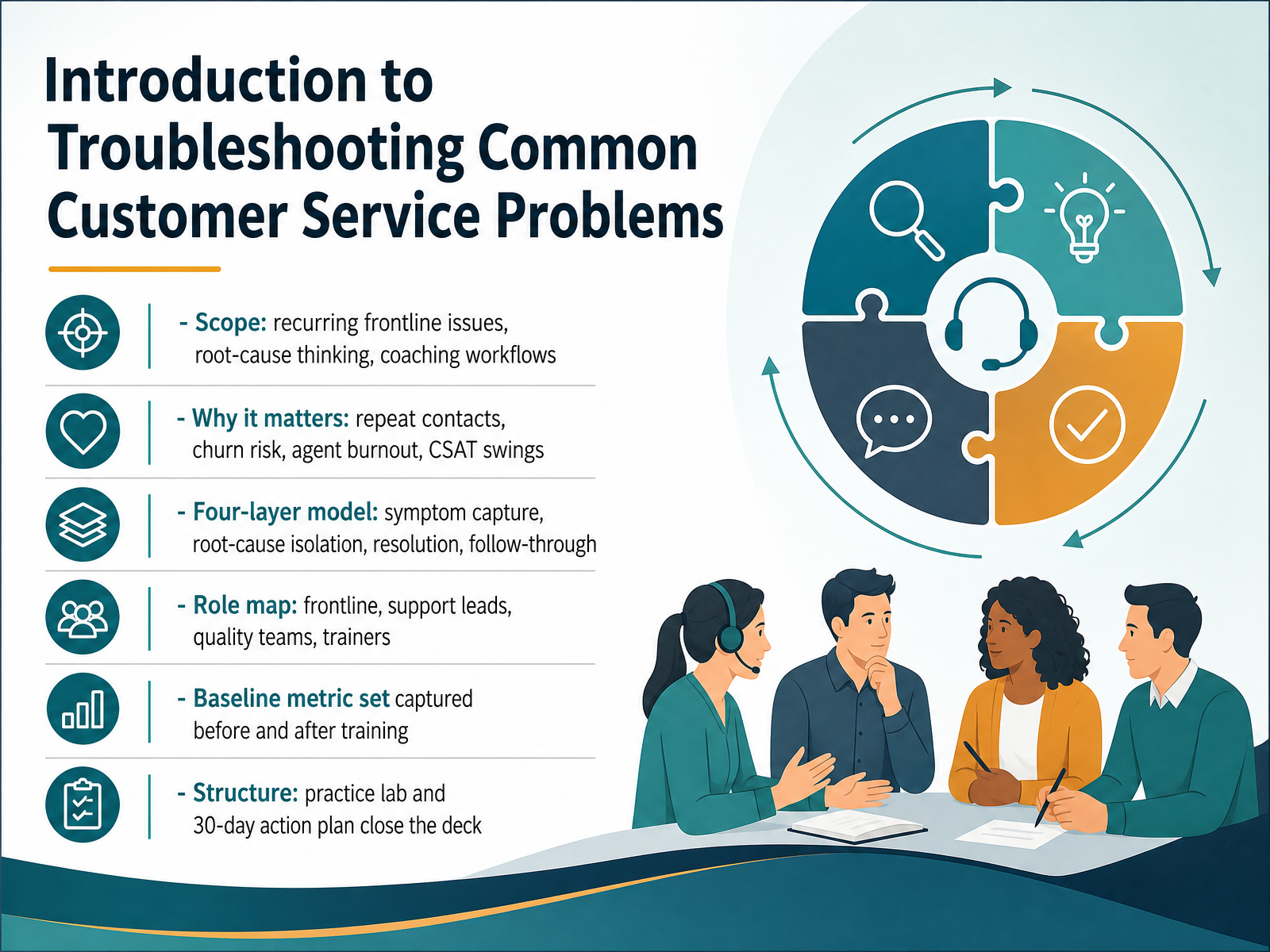
- 01Introduction to Troubleshooting Common Customer Service ProblemsWelcome. This course is about troubleshooting common customer service problems. The goal is simple. We want you to treat service problems as solvable systems issues, not personal failures. Our scope covers recurring frontline issues, root cause thinking, and coaching workflows. Here is why it matters. Repeat contacts, churn risk, agent burnout, and swings in customer satisfaction all trace back to problems that were never fully diagnosed. In this course, we will work through a four layer model. First, symptom capture. Then root cause isolation. Then resolution. And finally, follow through. We will also map roles across the frontline, support leads, quality teams, and trainers. Before we start, we capture a baseline set of metrics so you can measure change after training. We close with a practice lab and a thirty day action plan. Take a breath. This is practical, and it is built for experienced practitioners. Next, we look at the business case, and what poor troubleshooting actually costs.helpcrunch.comsprinklr.combluetweak.com+22 min
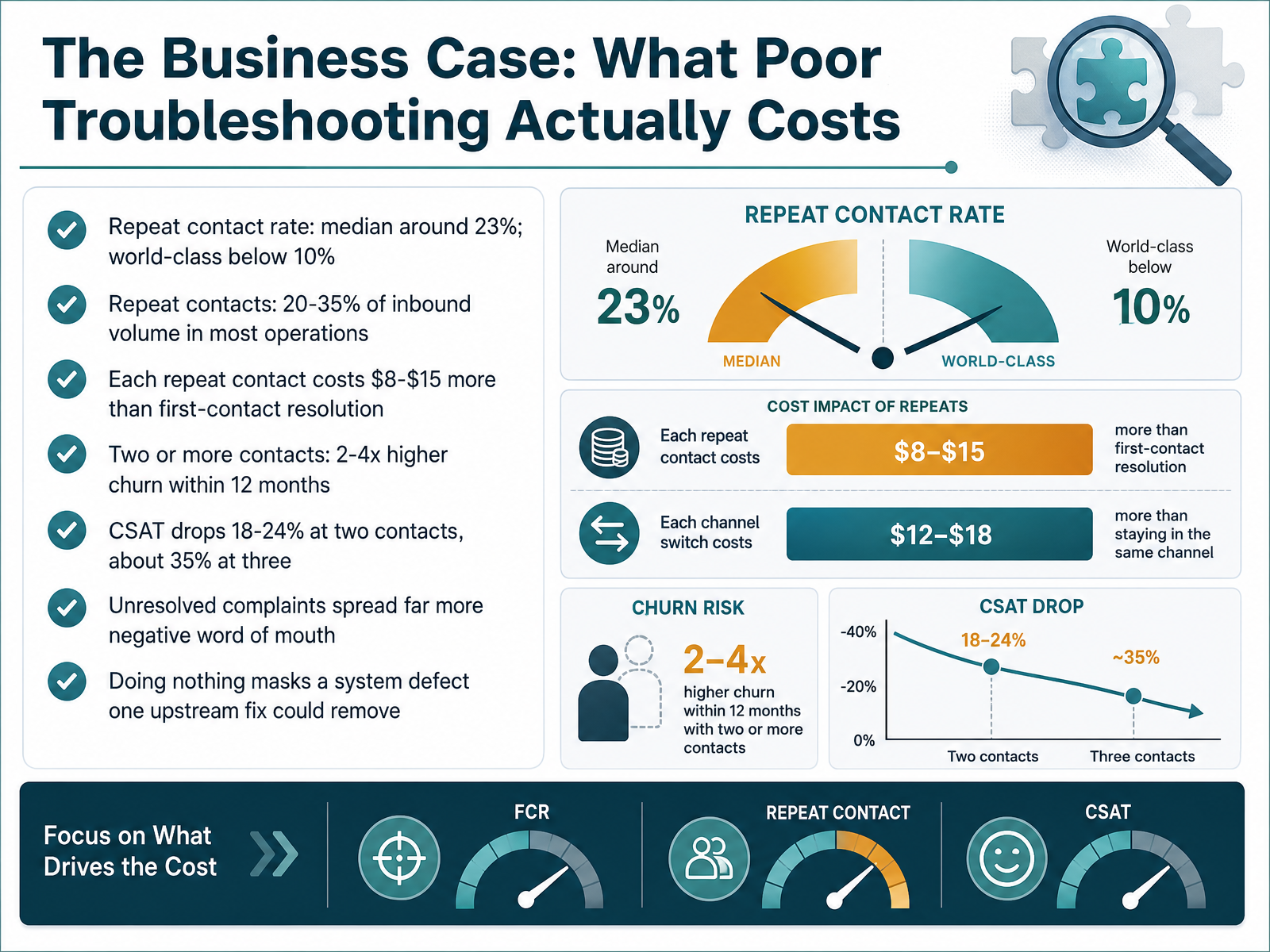
- 02The Business Case: What Poor Troubleshooting Actually CostsLet us look at what poor troubleshooting actually costs. This is not about blame. It is about measurable waste. In most operations, repeat contacts make up twenty to thirty-five percent of inbound volume. The median repeat contact rate sits around twenty-three percent. World-class teams stay below ten percent. So there is a wide gap between typical and best-in-class. Each repeat contact costs roughly eight to fifteen dollars more than resolving the issue on the first contact. That adds up quickly at scale. The customer impact is steeper. When someone has to reach out two or more times, churn risk rises two to four times within twelve months. Satisfaction drops eighteen to twenty-four percent at two contacts, and around thirty-five percent at three. Unresolved complaints also spread far more negative word of mouth than resolved ones. The real cost of doing nothing is hidden. A repeat contact often signals a system defect that one upstream fix could remove. So the business case is simple. Reducing repeat contacts lowers cost, protects revenue, and improves satisfaction. Next, let us build a working taxonomy of these problems. Know the Problems Before You Fix Them: A Working Taxonomy.
 2 min
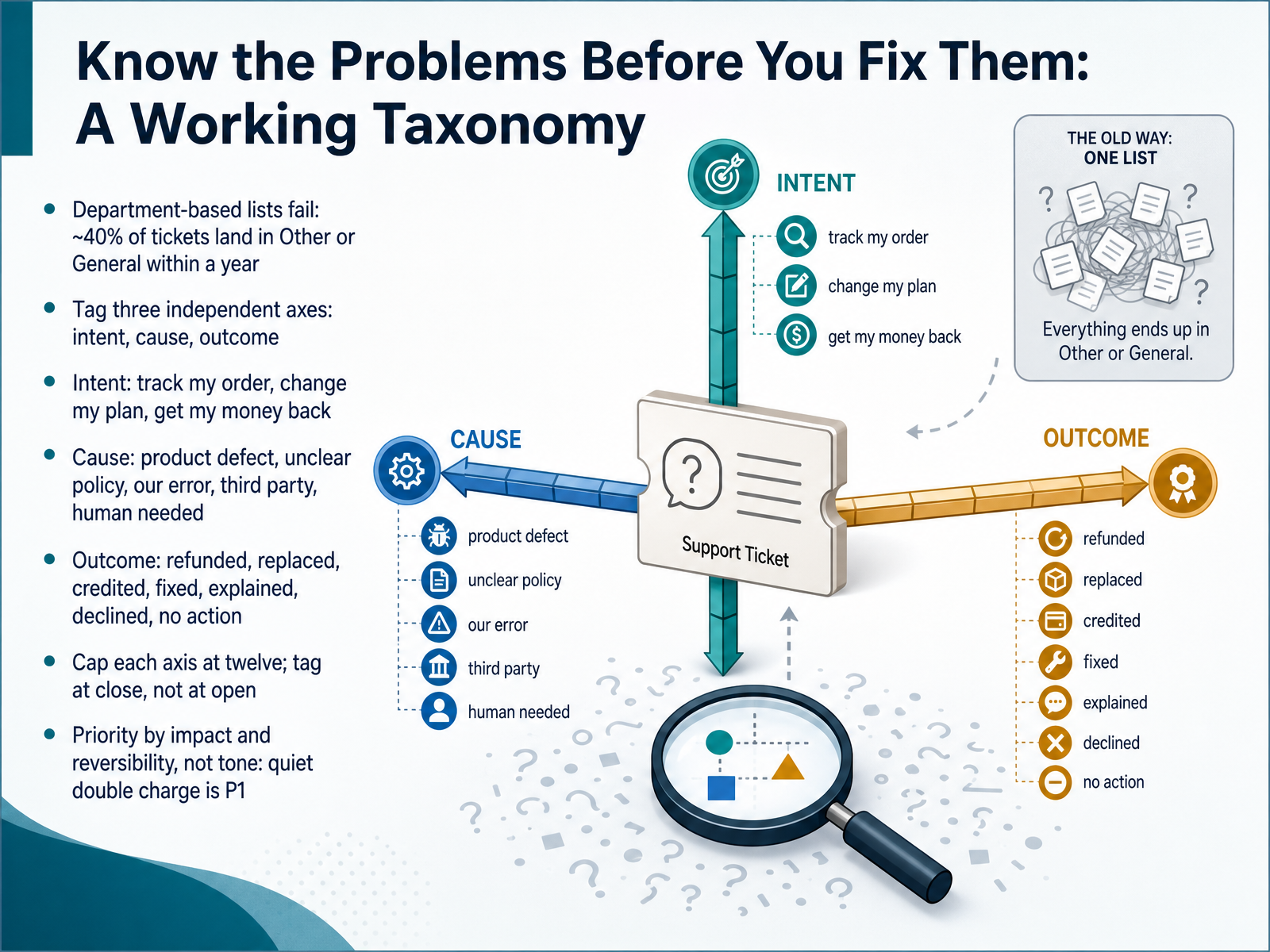
2 min - 03Know the Problems Before You Fix Them: A Working TaxonomyLet's look at how to know the problems before you fix them. Most teams start with a list built around departments. Billing, Shipping, Technical, Account. Those are your org chart, and customers don't have your departments. Within a year, roughly forty percent of tickets land in Other or General. That's a design problem, not a discipline problem. So instead, tag three independent axes. Intent is what the customer was trying to do. Track my order. Change my plan. Get my money back. Cause is why they had to ask. Product defect. Unclear policy. Our error. Third party. A human needed. Outcome is what you did. Refunded, replaced, credited, fixed, explained, declined, no action. Each axis has a short, obvious list. Cap each one at twelve entries, or agents just pick from the top of the dropdown. And tag at close, not at open. At open, you don't yet know the cause, and cause is the axis that tells you what to fix. Finally, set priority by impact and reversibility, not tone. A politely worded double charge is still P1. That gives you a working taxonomy you can actually query. Next, we'll walk through five failure categories you will actually meet.
 customerscience.com.auinfohub.delltechnologies.comsupportbench.com+22 min
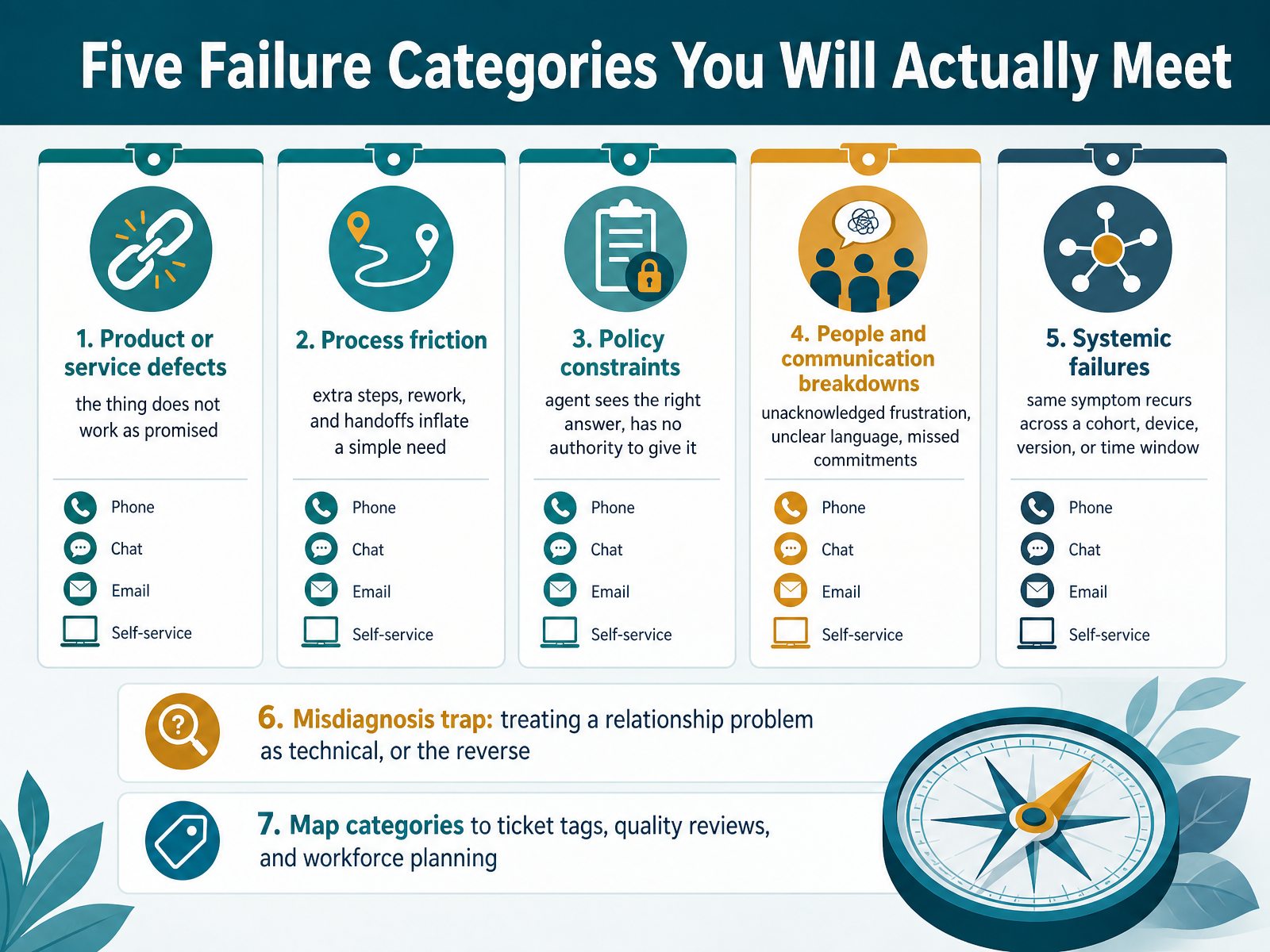
 - 04Five Failure Categories You Will Actually MeetLet's walk through the five failure categories you will actually meet. First, product or service defects. The thing does not work as promised. Second, process friction. Extra steps, rework, and handoffs inflate a simple need. Third, policy constraints. The agent sees the right answer but has no authority to give it. Fourth, people and communication breakdowns. Unacknowledged frustration, unclear language, or missed commitments. Fifth, systemic failures. The same symptom recurs across a cohort, a device, a version, or a time window. Watch for the misdiagnosis trap. Treating a relationship problem as technical, or the reverse, sends the fix in the wrong direction. So map each category to your ticket tags, quality reviews, and workforce planning. That turns individual complaints into patterns you can act on. Next, we will look at diagnostic methods for finding the real root cause under pressure.
 1 min
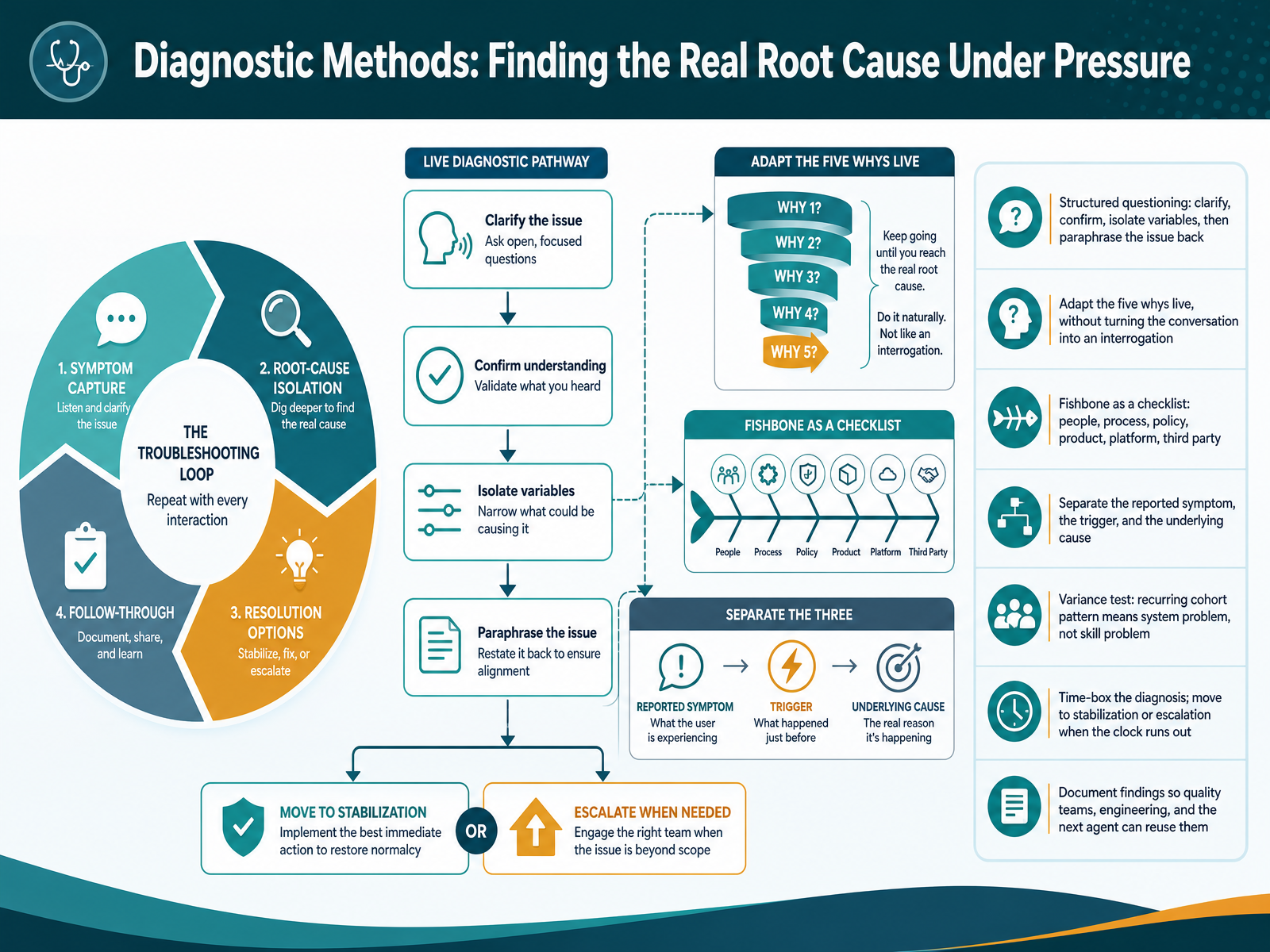
1 min - 05Diagnostic Methods: Finding the Real Root Cause Under PressureNow let's look at how to find the real root cause when the clock is running. Start with structured questioning. Clarify what the customer expected. Confirm what actually happened. Isolate one variable at a time, then paraphrase the issue back so everyone agrees on the problem. You can adapt the five whys live, but keep it conversational, not an interrogation. Use a fishbone as a quick checklist: people, process, policy, product, platform, and third party. Separate the reported symptom, the trigger, and the underlying cause. Here is a simple example. If one customer reports a billing error, treat it as an isolated case. If a cohort reports the same billing error on the same day, that is variance. A recurring cohort pattern means a system problem, not a skill problem. Time-box the diagnosis. When the clock runs out, move to stabilization or escalation. Then document your findings. Clear notes let quality teams, engineering, and the next agent reuse the work instead of starting over. Next, let's consider some diagnostic traps to avoid, in Avoid These Diagnostic Traps.
 2 min
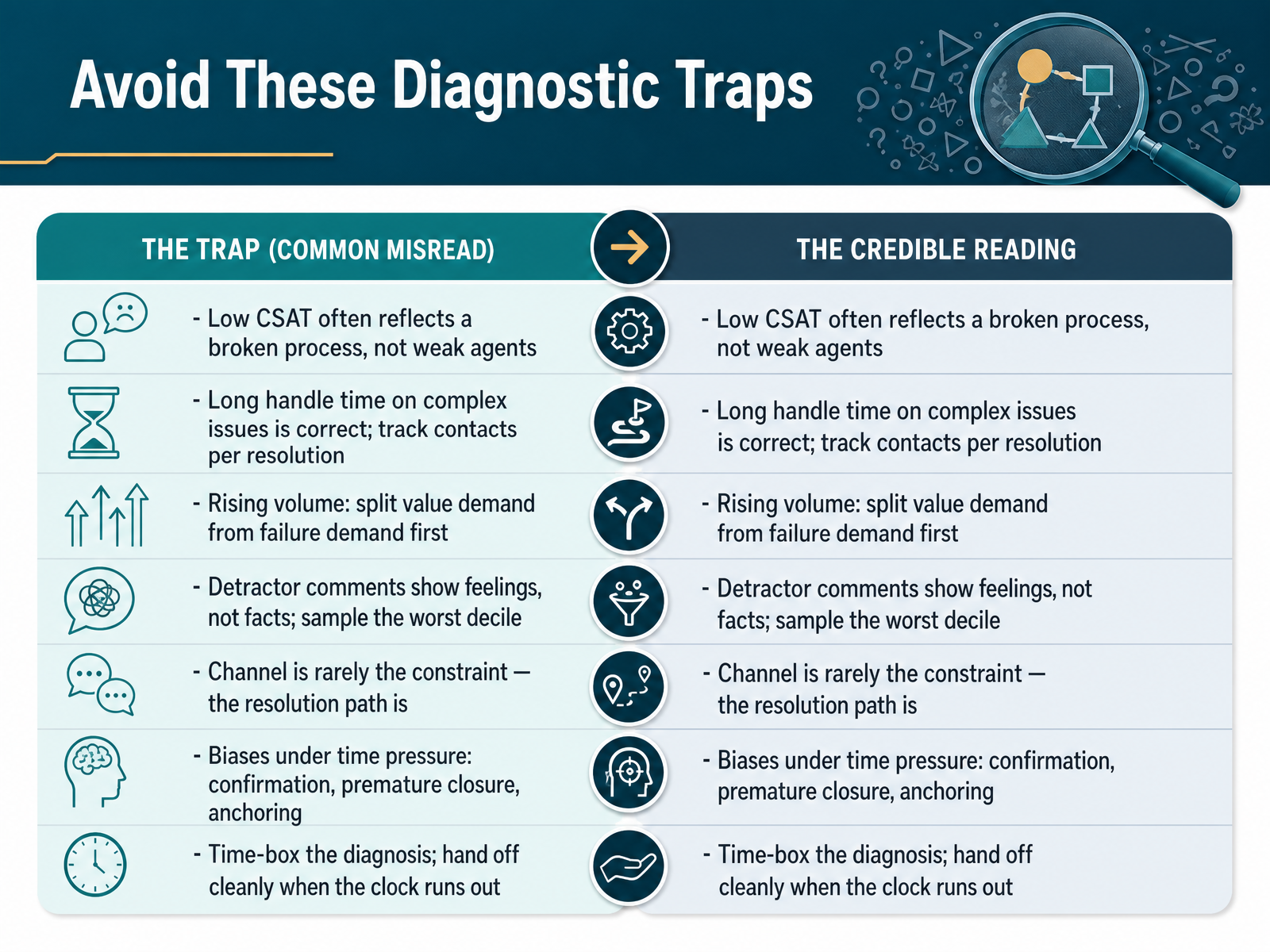
2 min - 06Avoid These Diagnostic TrapsLet's look at the traps that trip up even experienced diagnosticians.
First, low customer satisfaction scores usually point to a broken process, not weak agents. Before you coach anyone, check the workflow.
Second, long handle time on complex issues is correct. What you want to track is contacts per resolution, not raw speed.
Third, when volume rises, split value demand from failure demand. Value demand is what customers genuinely need. Failure demand is repeat contacts caused by your own process.
Fourth, detractor comments show feelings, not facts. Treat them as signals, then sample the worst tenth to see the pattern.
Fifth, channel is rarely the constraint. The resolution path is.
Finally, watch for biases under time pressure: confirmation, premature closure, and anchoring. Time-box the diagnosis, and hand off cleanly when the clock runs out. That keeps momentum without forcing a rushed answer.
Next, we'll move into handling difficult customers and high emotion moments.
 2 min
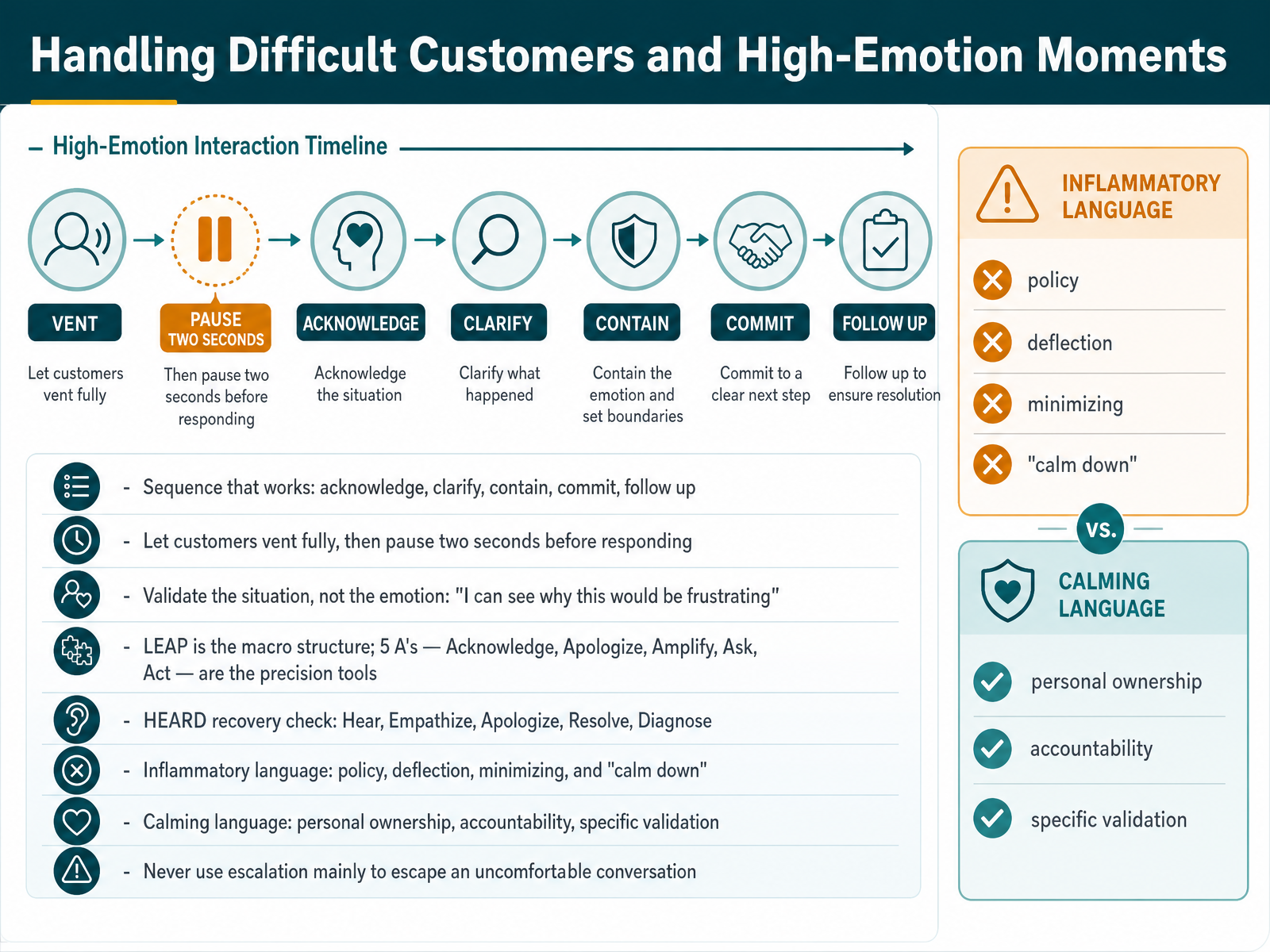
2 min - 07Handling Difficult Customers and High-Emotion MomentsNow let's look at handling difficult customers and high-emotion moments. Use a sequence that works: acknowledge, clarify, contain, commit, and follow up. Start by letting the customer vent fully. Do not interrupt. Then pause for two seconds before you respond. That small gap shows you are thinking, and it gives the emotion room to settle. Next, validate the situation, not the emotion. Say something like, I can see why this would be frustrating. That acknowledges their experience without sounding patronizing. For structure, LEAP is your macro map: Listen, Empathize, Apologize, and Problem-solve. The five A's are your precision tools inside it: Acknowledge, Apologize, Amplify, Ask, and Act. Amplify means inviting more detail before you jump to a fix. For recovery checks, remember HEARD: Hear, Empathize, Apologize, Resolve, and Diagnose. Watch your language. Policy talk, deflection, minimizing, and the phrase calm down all inflame the moment. Calming language sounds like personal ownership, accountability, and specific validation. And one firm rule: never escalate just to escape an uncomfortable conversation. Escalate for complexity or genuine authority gaps, not to hand off the pressure. Coming up next, we will cover protecting agents, boundaries, abuse, and duty of care.
 feedbackrobot.comshopify.comfront.com+22 min
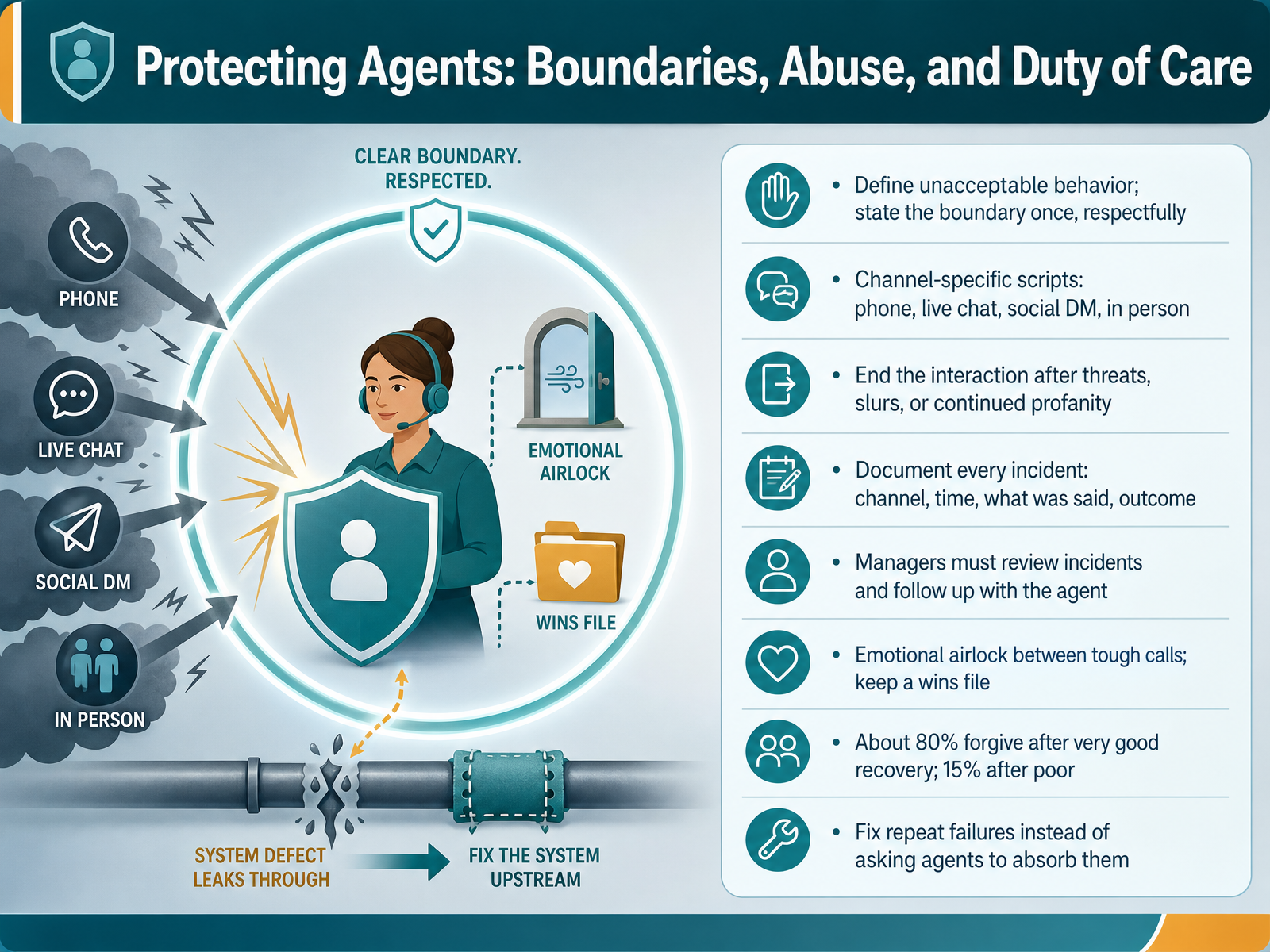
 - 08Protecting Agents: Boundaries, Abuse, and Duty of CareLet's talk about protecting agents. This is a duty of care issue, not a soft one. Start by defining unacceptable behavior clearly. When it happens, state the boundary once, respectfully, and do not debate it. Have channel-specific scripts ready for phone, live chat, social direct messages, and in person. On a call, you might say, I want to help, but I need you to stop shouting. If the behavior continues, end the interaction. End it after threats, slurs, or continued profanity. That is a system rule, not a personal reaction. Then document every incident: channel, time, what was said, and the outcome. Managers must review each incident and follow up with the agent. Build in an emotional airlock between tough calls, and keep a wins file for perspective. Remember, about eighty percent of customers forgive after a very good recovery. Only about fifteen percent forgive after a poor one. So fix repeat failures instead of asking agents to absorb them. Next, we look at resolution design: options, trade-offs, and follow-through.
 2 min
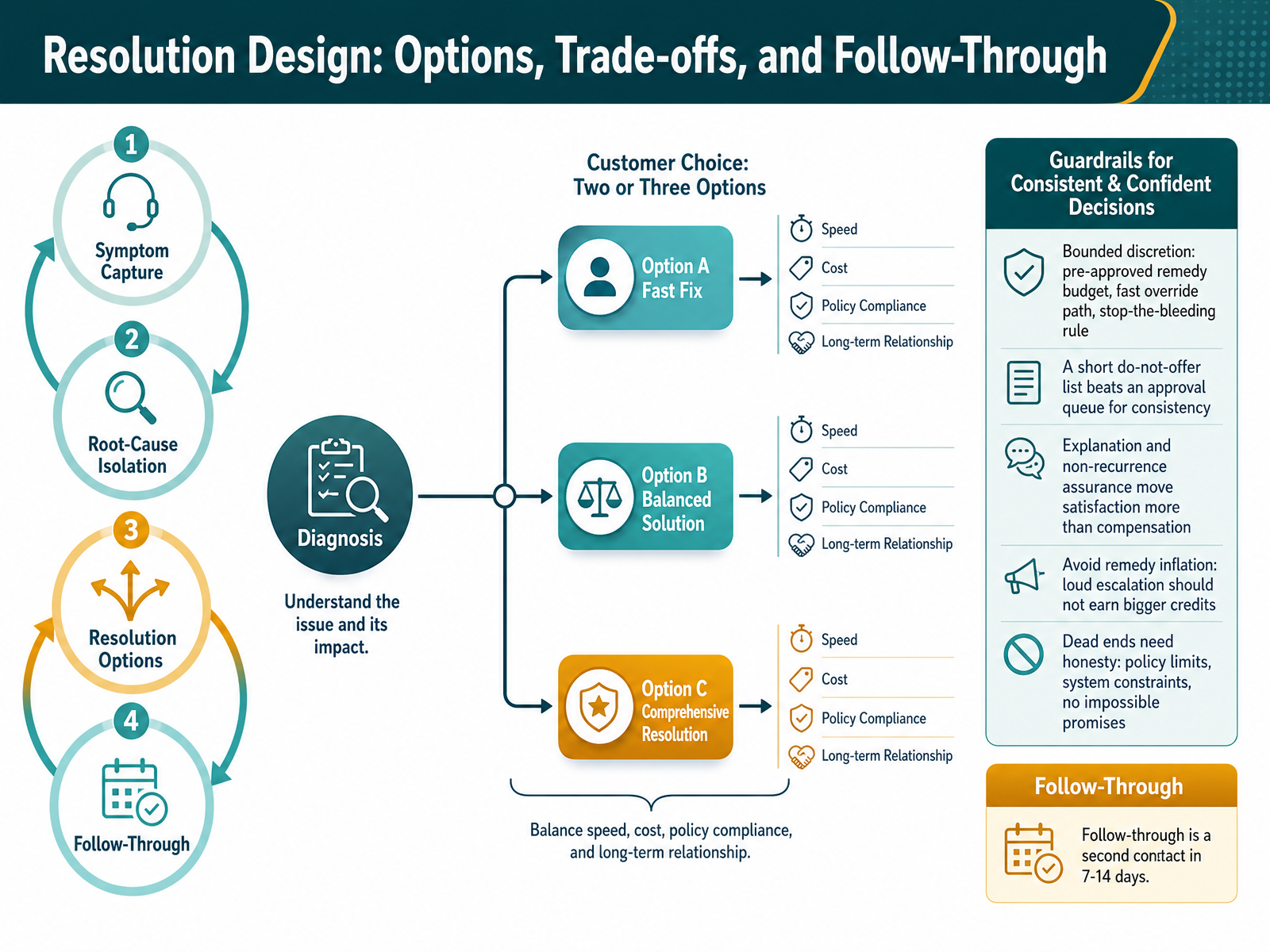
2 min - 09Resolution Design: Options, Trade-offs, and Follow-ThroughNow let's talk about resolution design. Start by offering two or three clear options, then let the customer choose. That gives them control and often shortens the conversation.
Weigh four things: speed, cost, policy compliance, and the long-term relationship. Keep decisions bounded. Give agents a pre-approved remedy budget, a fast override path, and a stop-the-bleeding rule for urgent cases.
A short do-not-offer list works better than an approval queue. Everyone knows what is off the table, so responses stay consistent.
Remember that explanation and assurance of non-recurrence move satisfaction more than money does. And avoid remedy inflation. Loud escalation should not earn bigger credits.
When you hit a dead end, be honest about policy limits and system constraints. Never promise what you cannot deliver. Follow-through is a second contact within seven to fourteen days.
When to Escalate and How to Hand Off Without Losing the Customer. That is next.
 1 min
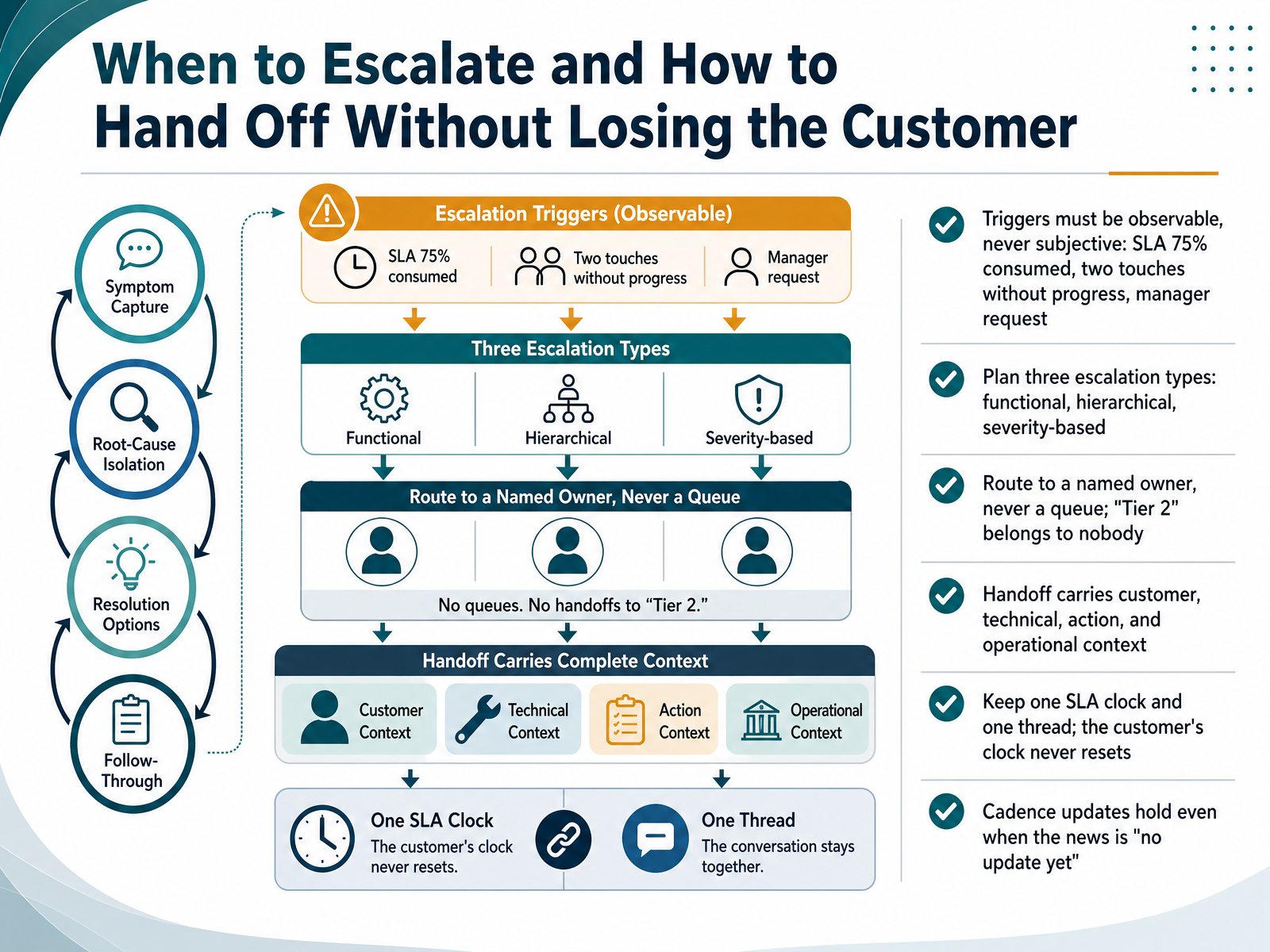
1 min - 10When to Escalate and How to Hand Off Without Losing the CustomerLet's talk about escalation. The goal is simple. Move the problem without moving the customer. So first, triggers. Triggers must be observable, never subjective. For example: seventy-five percent of the service level agreement consumed, two touches without progress, or a manager request. Second, plan three escalation types: functional, hierarchical, and severity-based. Functional is a capability gap. Hierarchical needs more authority. Severity-based means the impact crossed a threshold. Most failures come from only planning the first type. Third, route to a named owner, never a queue. Tier two belongs to nobody. A named person is accountable for the next action. Fourth, the handoff carries four kinds of context: customer, technical, action, and operational. That covers who they are, what was tried, what happens next, and the service level agreement status. Fifth, keep one service level agreement clock and one thread. The customer's clock never resets because you handed off internally. And hold your update cadence even when the news is no update yet. Silence is what erodes trust, not slow fixes. So the practical takeaway: make escalation a defined system, not a judgment call. Next, we look at channel and tooling problems: phone, chat, email, and self-service.
 blog.getdarwin.aisupportbench.comeesel.ai+22 min
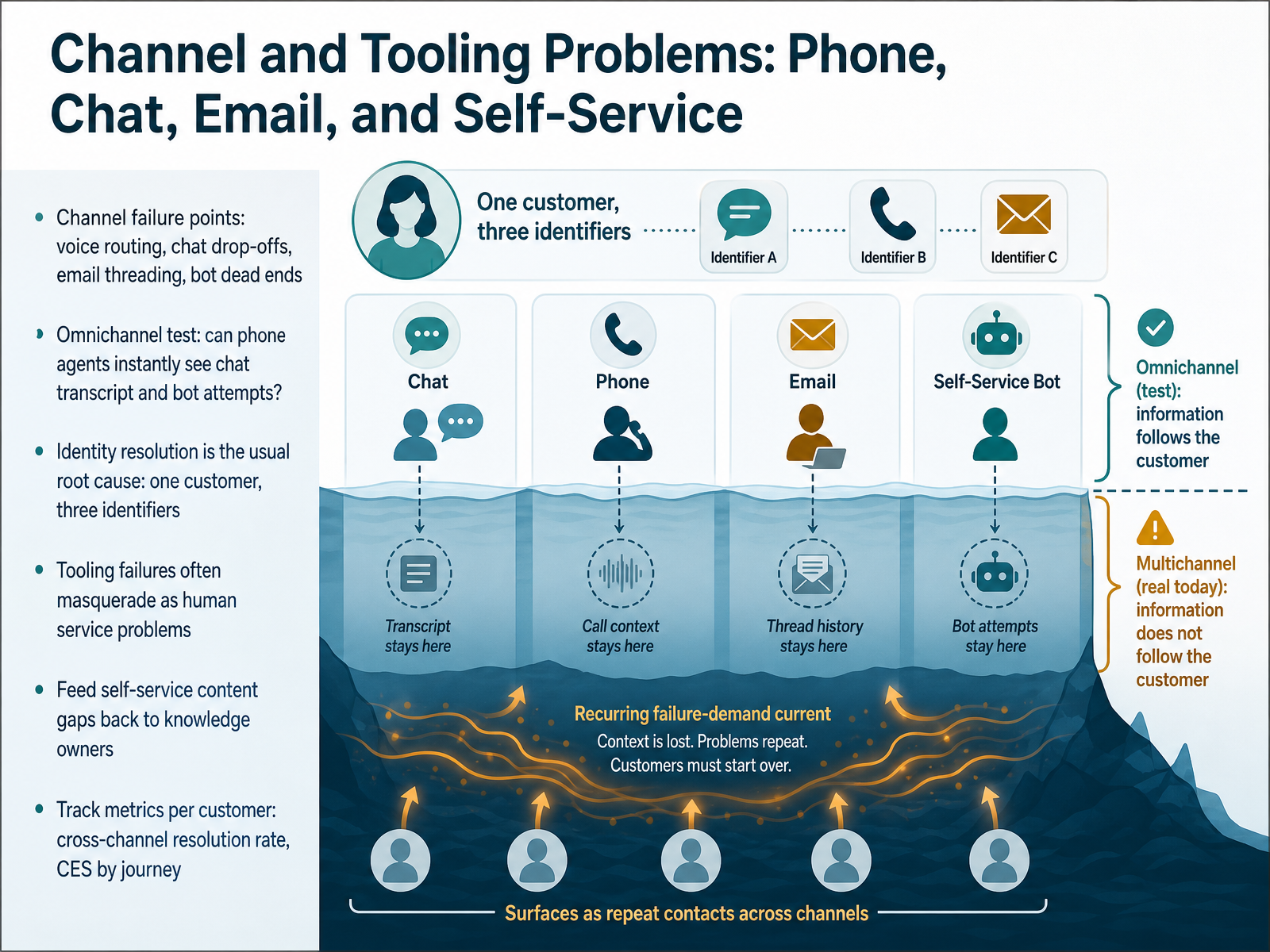
 - 11Channel and Tooling Problems: Phone, Chat, Email, and Self-ServiceNow let's look at channel and tooling problems. These show up in predictable places. Voice routing sends the call to the wrong queue. Chat sessions drop off mid-conversation. Email threads fragment, and bots hit dead ends they cannot recover from. Here is a simple test for real omnichannel. When a customer moves from chat to phone, can your phone agent instantly see the chat transcript and the steps the bot already took? If not, you are multichannel with a shared inbox, not omnichannel. The usual root cause is identity resolution. One customer reaches out with three identifiers. An email address, a phone number, and a social handle. The systems treat them as three different people. So the context never follows the person. Remember this. Tooling failures often masquerade as human service problems. Before you coach the agent, check the routing. When self-service content has gaps, feed those gaps back to the knowledge owners. And measure per customer, not per channel. Track cross-channel resolution rate and customer effort score by journey. Next, we turn to coaching and quality, and how to turn troubleshooting data into skill growth.
 2 min
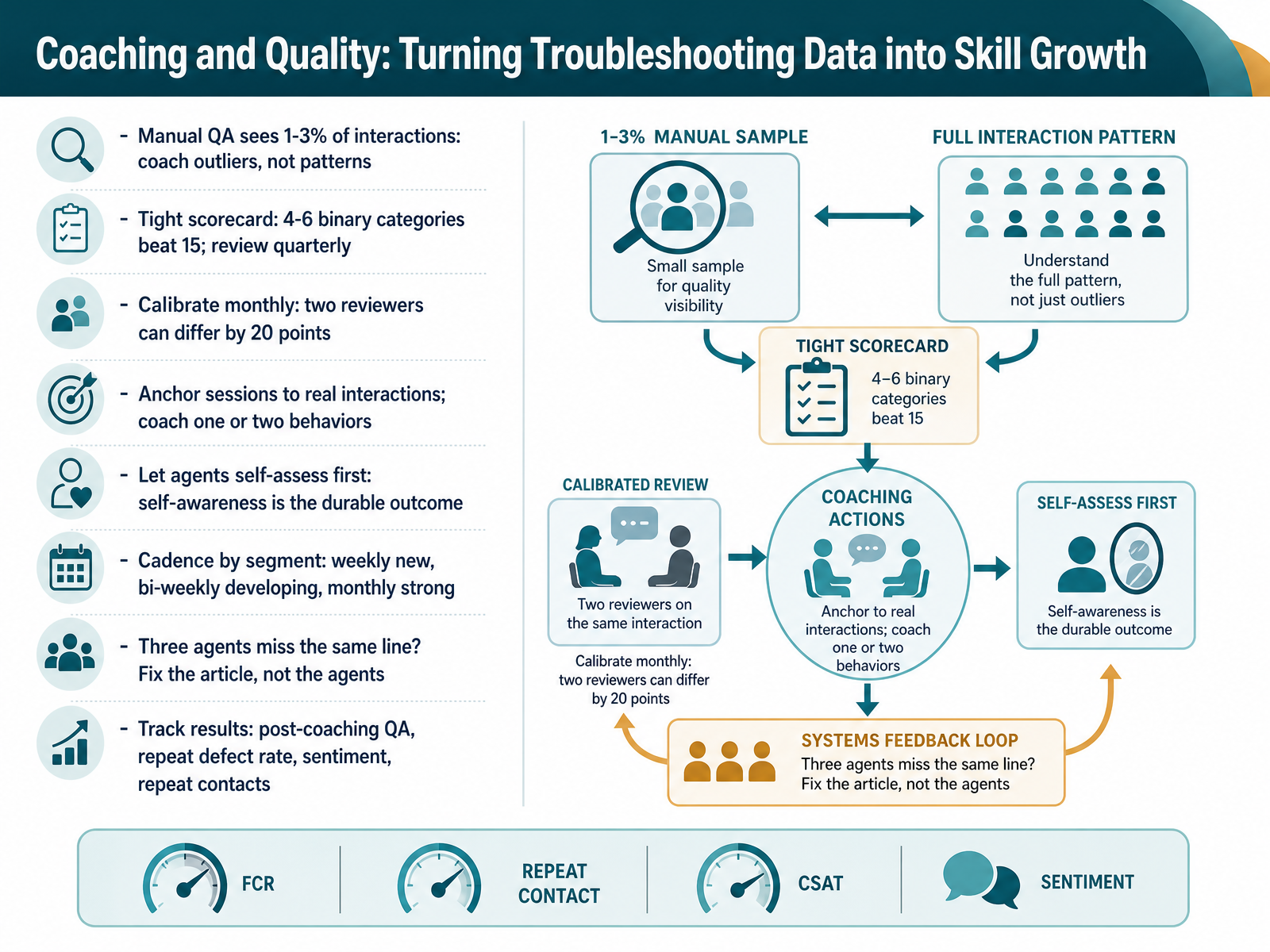
2 min - 12Coaching and Quality: Turning Troubleshooting Data into Skill GrowthLet us look at how troubleshooting data becomes skill growth through coaching and quality. Manual quality review typically sees only one to three percent of interactions. That means you are coaching outliers, not patterns. Keep your scorecard tight. Four to six binary categories work better than fifteen, and review the criteria quarterly. Calibrate monthly, because two reviewers can easily differ by twenty points on the same interaction. Anchor every coaching session to a real interaction, and coach just one or two behaviors. Let agents self-assess first. Self-awareness is the durable outcome. Set cadence by segment. Weekly for new agents, every other week for developing agents, monthly for strong performers. And if three agents miss the same line, fix the article, not the agents. Track results after coaching. Post-coaching quality scores, repeat defect rate, sentiment, and repeat contacts. That is how you know the coaching worked. Next, we turn to measuring impact and preventing recurrence.
 2 min
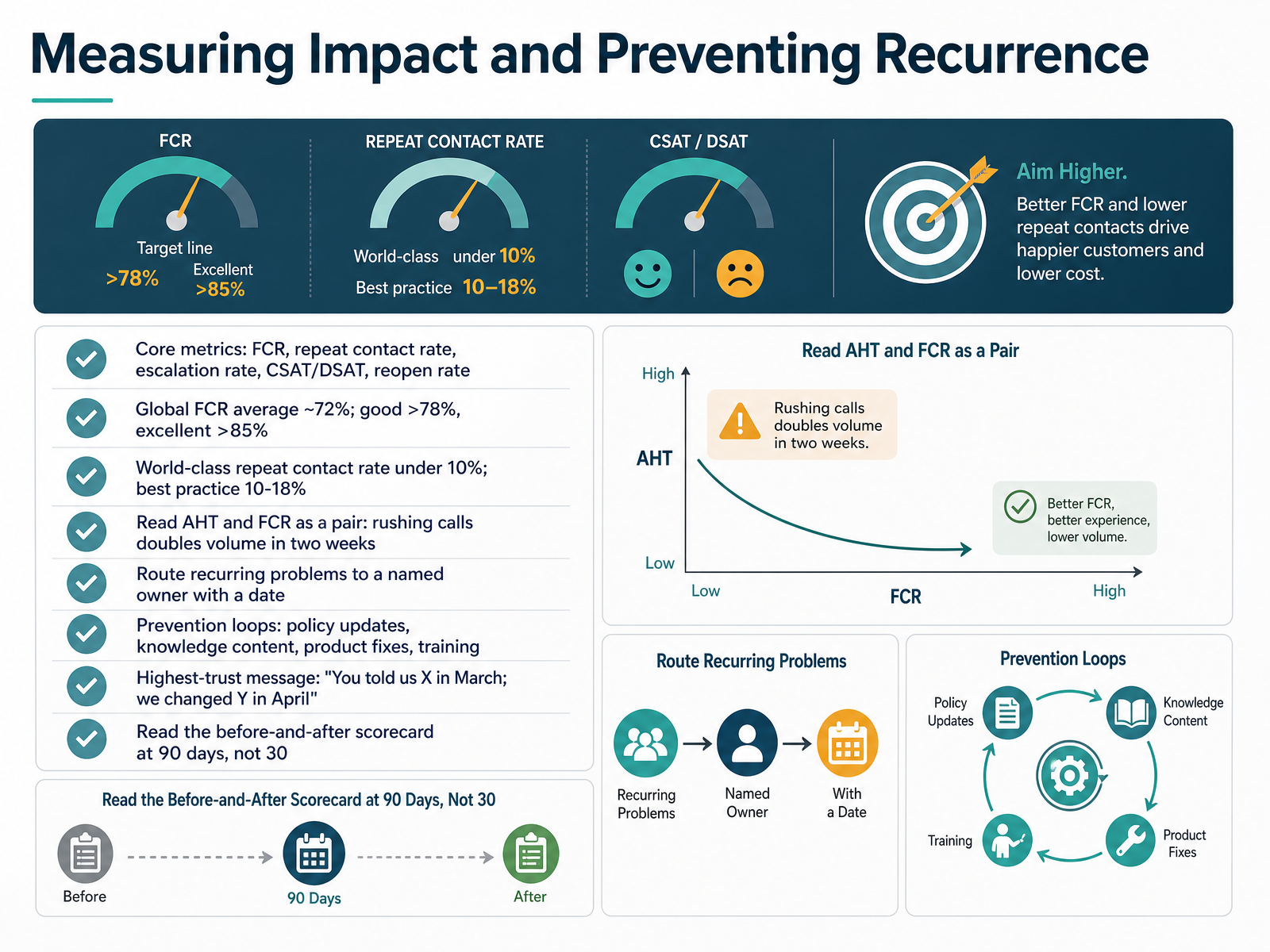
2 min - 13Measuring Impact and Preventing RecurrenceLet's turn to measuring impact and preventing recurrence. Start with a focused metric set. First contact resolution, repeat contact rate, escalation rate, satisfaction and dissatisfaction scores, and reopen rate. For context, global first contact resolution averages around seventy-two percent. Above seventy-eight is good, and above eighty-five is excellent. World-class repeat contact rate is under ten percent, with ten to eighteen percent considered best practice. One critical caution. Read average handle time and first contact resolution as a pair. Rushing calls to lower handle time usually pushes resolution down, and unresolved contacts return, roughly doubling volume within about two weeks. So protect resolution quality first. Next, prevention. Route recurring problems to a named owner with a date. Build prevention loops that feed policy updates, knowledge content, product fixes, and training. The highest-trust message you can send a customer sounds like this. You told us about this in March, and we changed that in April. And read your before-and-after scorecard at ninety days, not thirty, because thirty days is often too early to see whether the fix held. Let's move into the practice lab.
 2 min
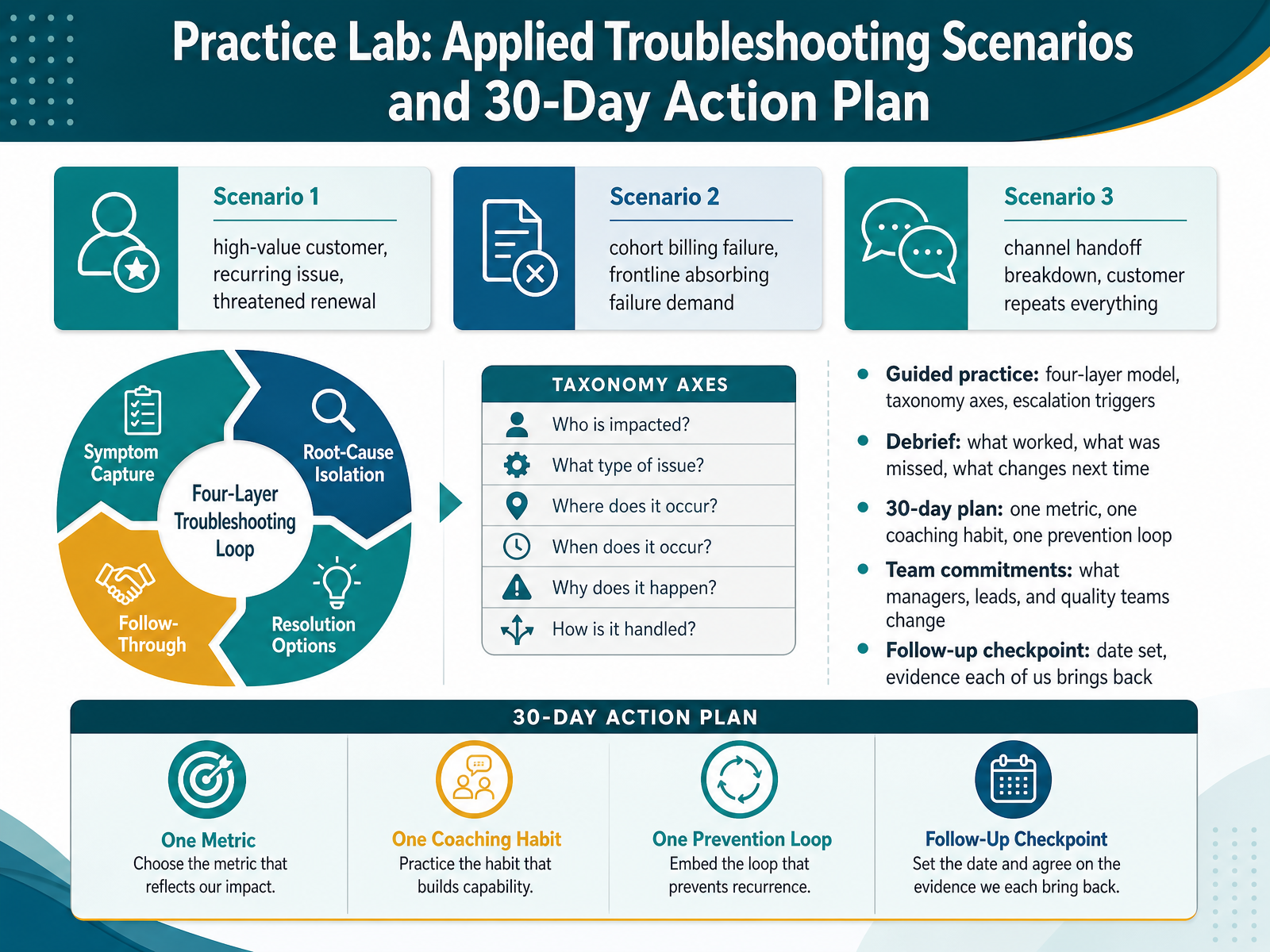
2 min - 14Practice Lab: Applied Troubleshooting Scenarios and 30-Day Action PlanLet's close with practice, not theory. Take the three scenarios in front of you. A high-value customer with a recurring issue and a threatened renewal. A cohort billing failure, where the frontline is absorbing failure demand. And a channel handoff breakdown, where the customer repeats everything.
Run each one through the four-layer model, the taxonomy axes, and your escalation triggers. Then debrief honestly. What worked, what was missed, what changes next time.
Your thirty-day plan is simple. Pick one metric, one coaching habit, and one prevention loop. Managers, leads, and quality teams each name what they will change. Set a follow-up date, and bring evidence.
That is the whole discipline. Name the symptom, find the cause, take one action. You have the tools now. Thank you for the work you do, and good luck.
 2 min
2 min
Take the deck with you
Download this course as a file — free, no sign-up needed.
- PDF handoutEvery slide page, ready to print or share.15 pages · 4.3 MBDownload
- Narrated PowerPointThe deck that presents itself — every slide carries the digital human's narration video.15 pages · 16.1 MBDownload
- PowerPoint slidesThe full deck as a .pptx — open it in PowerPoint, Keynote, or Google Slides.15 pages · 4.2 MBDownload
Free to use in your own training — please keep the PersonWise credit page at the end.
Have your own deck? Turn it into a course
Sources consulted
Web sources consulted while building this course.
- Problem-Solving in Customer Service: 6 Proven Techniques — helpcrunch.com
- Customer Service Problem Solving: How Top Brands Do It | Sprinklr — sprinklr.com
- 15 Customer Support Challenges in 2026 and How to Solve Them — bluetweak.com
- Customer Service Best Practices for 2026 — contactcenterusa.com
- How to Improve Your Customer Service: 14 Tips for 2026 | Salesforce — salesforce.com
- Implementing Issue Taxonomy Step by Step (with Codeable Tags) - Customer Science — customerscience.com.au
- Standardized issue taxonomy | Intelligent Case Classification | Dell Technologies Info Hub — infohub.delltechnologies.com
- Incident Taxonomy: Improve Root Cause Reporting — supportbench.com
- Support Ticket Categories: A Taxonomy That Survives Contact — aicustomerservice.cc
- Business challenge | Rethinking Hierarchical Text Classification: Insights from Multi-Agent Experiments with Small Language Models | Dell Technologies Info Hub — infohub.delltechnologies.com
- Customer Service Recovery: Scripts, Steps & Examples (2026) — feedbackrobot.com
- How to Deal With Angry Customers and Keep Them Loyal (2026) - Shopify — shopify.com
- Customer service recovery: A definition and proven strategies — front.com
- Service Recovery: Turning a Failed Service Experience Into Retention | Blog | Perspective AI — getperspective.ai
- 13 De-escalation Techniques for Customer Service Professionals — indeed.com
- Customer Service Escalation in 2026: 9 AI-to-Human Handoff Best Practices — blog.getdarwin.ai
- Handoff templates for global support teams (what to include every time) — supportbench.com
- How to handle support escalations with AI (2026 guide) | eesel AI — eesel.ai
- Customer Escalation Management: The B2B Playbook (2026) — supportbench.com
- Ticket escalation done right: how to move issues up the chain without losing context - Crisp — crisp.chat