Begin
13 pages · ~26 min
Remote Employee Onboarding Practices
Equips managers and HR teams to onboard remote employees effectively, covering best practices for engagement, communication, and productivity in distributed teams.
A digital instructor presents all 13 pages. Hold “Ask” at any point and ask out loud — the answer comes from this course. No sign-up needed.
What you’ll learn
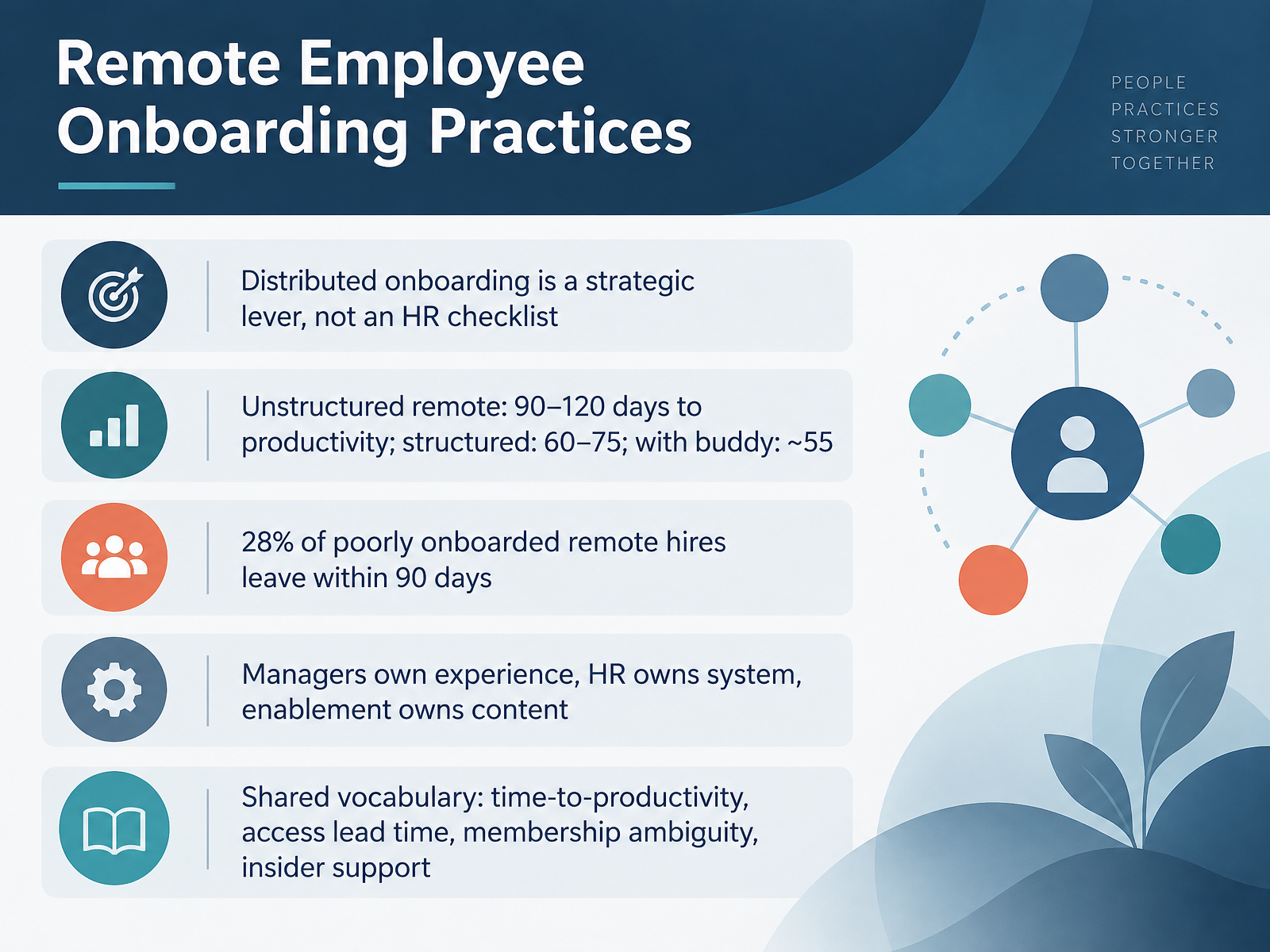
- 01Remote Employee Onboarding PracticesWelcome. This course is about onboarding remote employees well, and our goal is simple. You will leave with practices you can apply to your very next hire. Let's reframe something first. Distributed onboarding is a strategic lever, not an HR checklist. The numbers make the case. Unstructured remote onboarding takes ninety to one hundred twenty days to reach productivity. A structured program brings that to sixty to seventy five days. Add a buddy, and it drops to about fifty five. And twenty eight percent of poorly onboarded remote hires leave within ninety days. Ownership matters here. Managers own the experience. HR owns the system. Enablement owns the content. Agree on shared language too: time-to-productivity, access lead time, membership ambiguity, and insider support. Here is your first action. In your next team meeting, ask which of these four terms your team already tracks. Then note the gaps. Next, we look at the business case and what poor remote onboarding really costs you.businesswire.comstealthagents.commissinvestigate.com+22 min
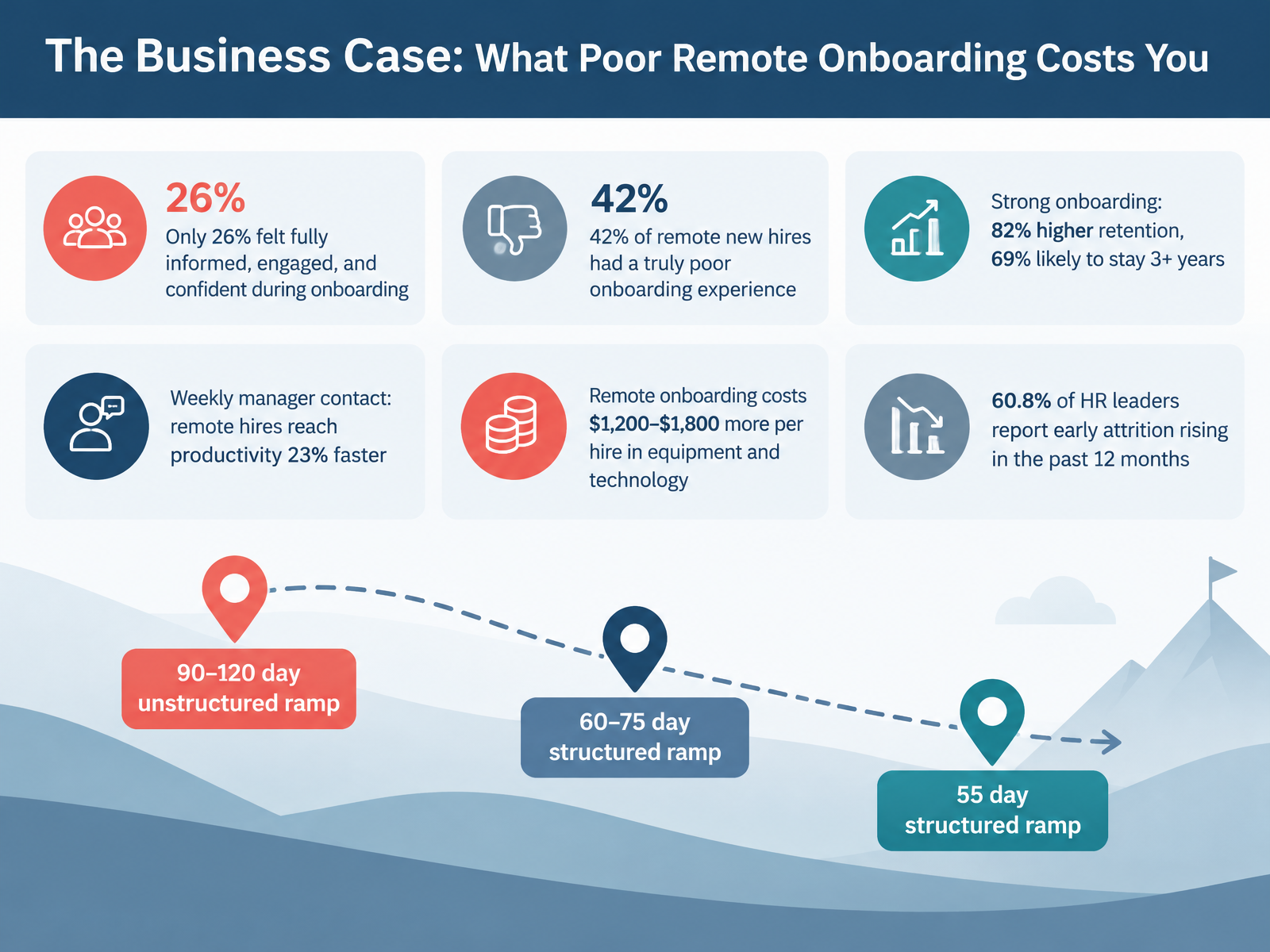
- 02The Business Case: What Poor Remote Onboarding Costs YouLet's put a number on what weak remote onboarding actually costs you. In one global survey, only twenty-six percent of employees felt fully informed, engaged, and confident during onboarding. For remote hires, forty-two percent called their experience truly poor. The upside is real. Strong onboarding programs see eighty-two percent higher retention, and sixty-nine percent of well-onboarded hires stay three years or more. Manager contact matters too. Remote hires who meet their manager weekly reach productivity twenty-three percent faster. Now the cost side. Remote onboarding runs roughly twelve hundred to eighteen hundred dollars more per hire in equipment and technology. And sixty point eight percent of HR leaders say early attrition rose in the past twelve months. So before your next hire starts, write down your ramp cost per hire, including equipment, manager time, and training. That one figure makes the business case for you. Next, let's look at what actually changes when onboarding goes remote.
 businesswire.comstealthagents.commissinvestigate.com+22 min
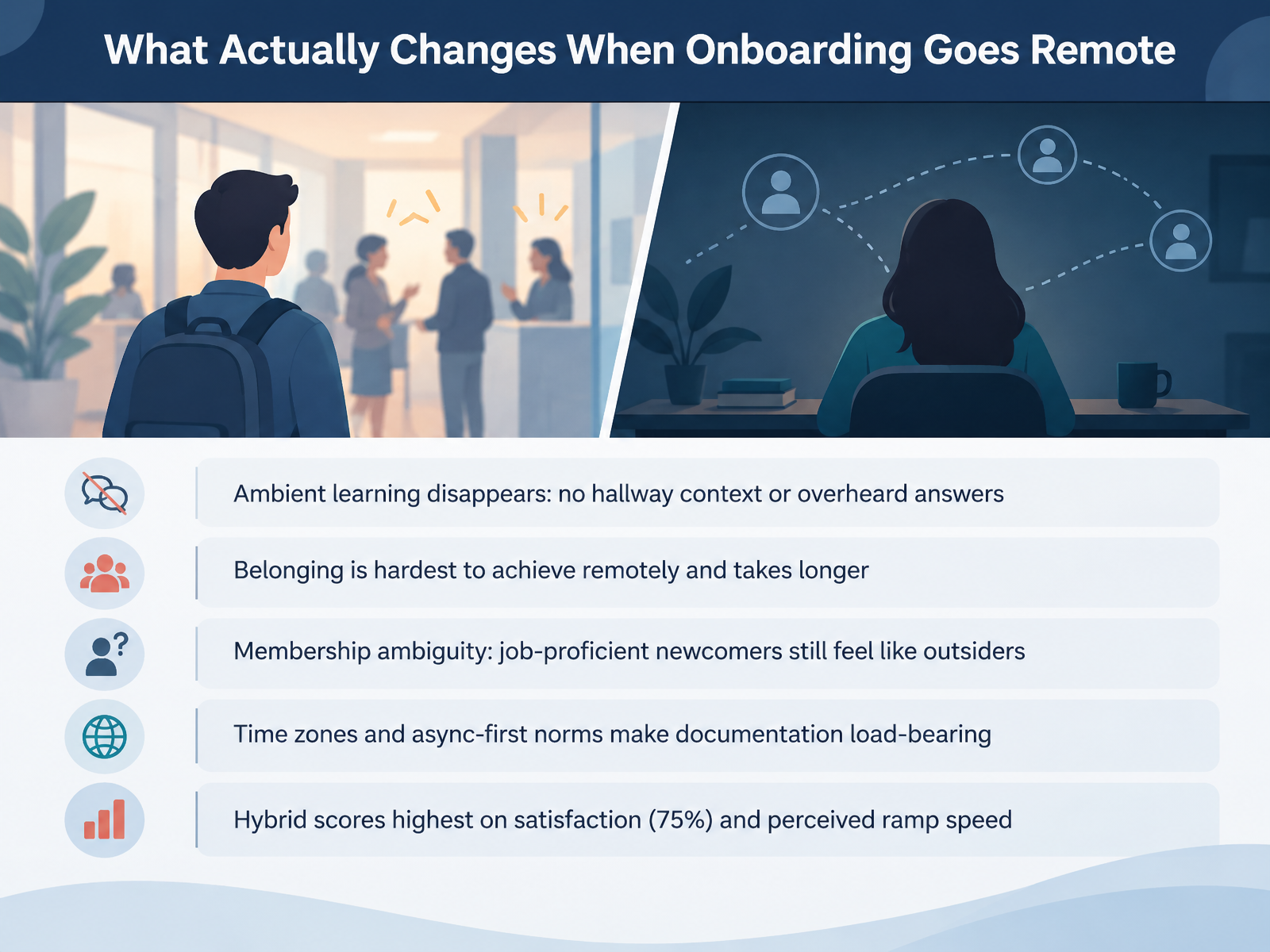
- 03What Actually Changes When Onboarding Goes RemoteLet's look at what actually changes when onboarding goes remote. First, ambient learning disappears. In an office, a new hire overhears answers and picks up context in the hallway. Remotely, that goes silent unless you replace it. Second, belonging is the hardest thing to build remotely, and it takes longer. Third, membership ambiguity: newcomers may be fully proficient at the job and still feel like outsiders. Watch for that in your next one-on-ones. Fourth, time zones and async norms make documentation load-bearing, so knowledge has to be findable without asking anyone. One useful benchmark: hybrid onboarding scores highest, with seventy-five percent satisfaction and the fastest perceived ramp. So treat in-person touchpoints as a deliberate design choice, not a perk. Your action after this: ask your newest hire which hallway answers they missed in week one, and write down two fixes. Next, we'll cover design principles for a distributed onboarding journey.
 doi.orgdoi.orgsciencedirect.com+22 min
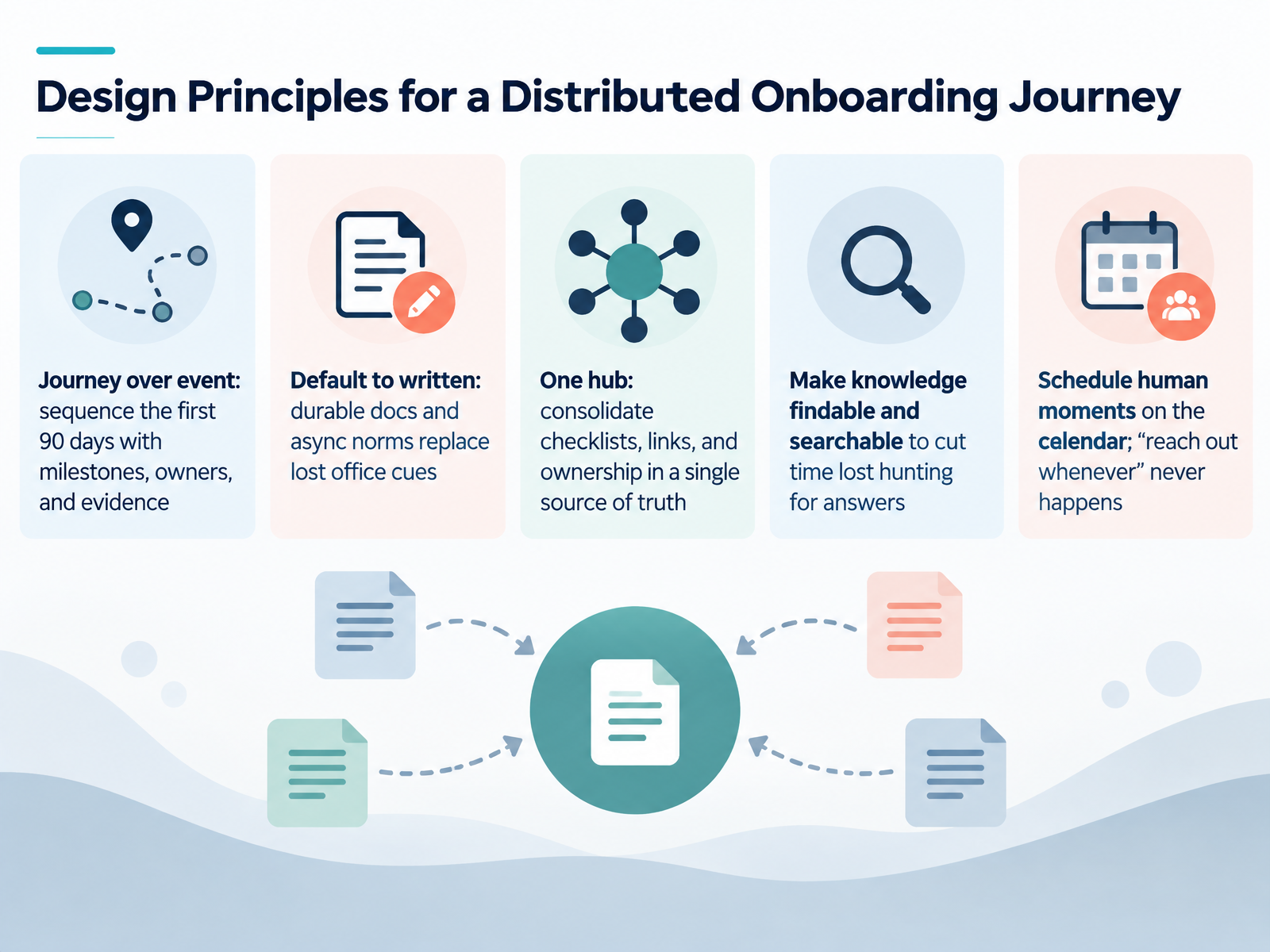
- 04Design Principles for a Distributed Onboarding JourneyLet's look at five design principles for a distributed onboarding journey. First, treat onboarding as a journey, not an event. Sequence the first ninety days with milestones, named owners, and evidence of completion. Second, default to written. Durable docs and async norms replace the cues people used to absorb in the office. Third, use one hub. Consolidate checklists, links, and ownership in a single source of truth. Fourth, make knowledge findable and searchable, so new hires stop losing hours hunting for answers. Fifth, put human moments on the calendar. "Reach out whenever" never happens, so schedule the intro chats, buddy time, and manager check-ins explicitly. Your action before your next hire: open your onboarding plan and confirm each of these five is in writing, with a named owner. That sets up what comes next, preboarding from offer to day one.
 doi.orgdoi.orgsciencedirect.com+21 min
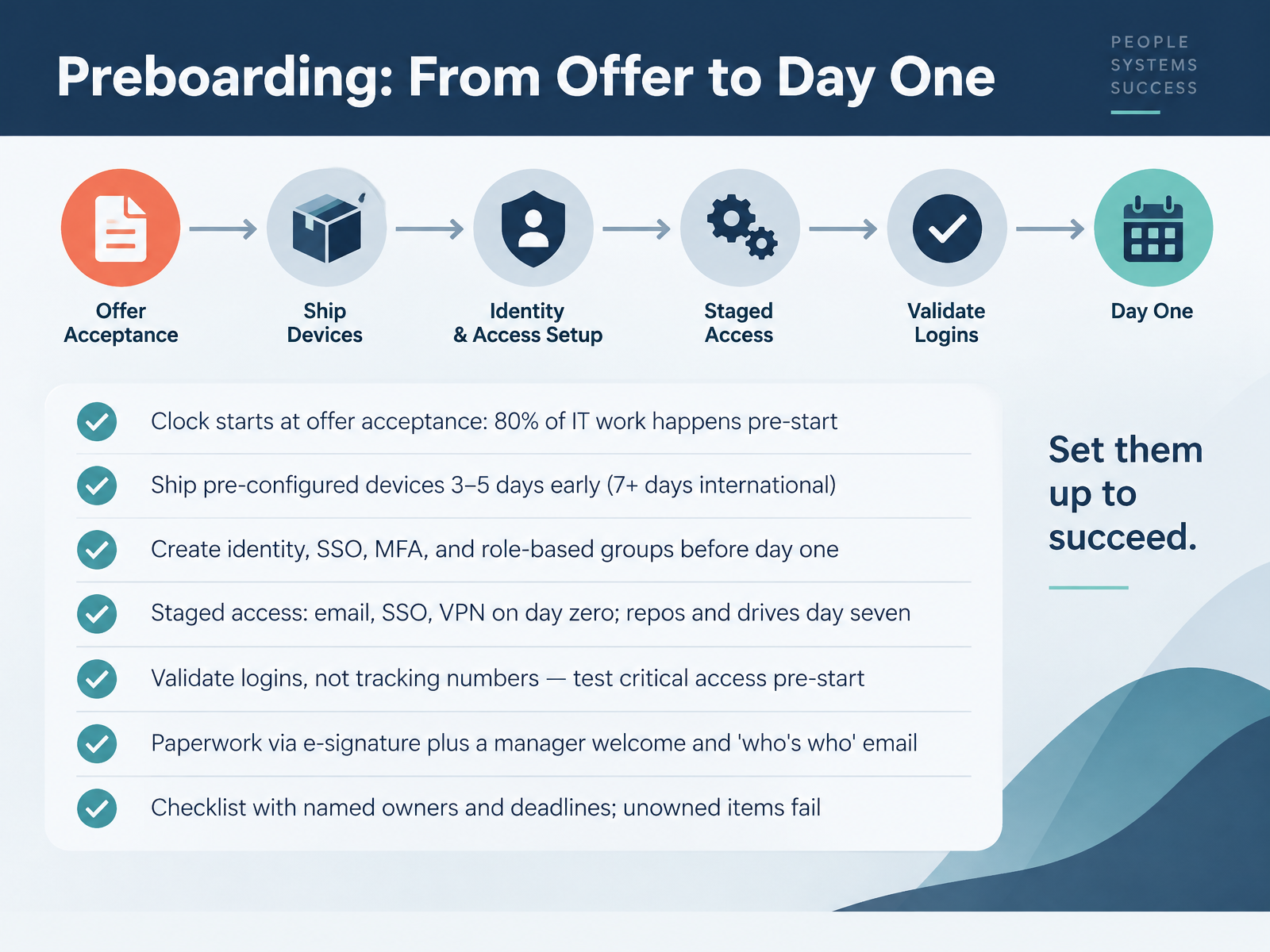
- 05Preboarding: From Offer to Day OneNow let's look at preboarding, the window from offer acceptance to day one. Treat the clock as starting the moment the offer is signed. About eighty percent of the IT work happens before the start date, so build your timeline around that. Ship a pre-configured device three to five days early, and at least seven days early for international hires. Before day one, create the identity, single sign on, multi factor authentication, and role-based groups. Stage access deliberately. Email, single sign on, and VPN on day zero. Repositories and shared drives on day seven. Then validate logins instead of tracking numbers. Have the new hire actually test critical access before they start. Send paperwork through e-signature, plus a manager welcome and a who's who email naming key contacts. Finally, put every preboarding task on one checklist with a named owner and a deadline. Unowned items fail. So this week, assign an owner and a due date to each preboarding item on your list. Next, we move into Week One and Week Two: Structure Without Overload.
 hrcloud.compeopleopshq.comremoasset.com+22 min
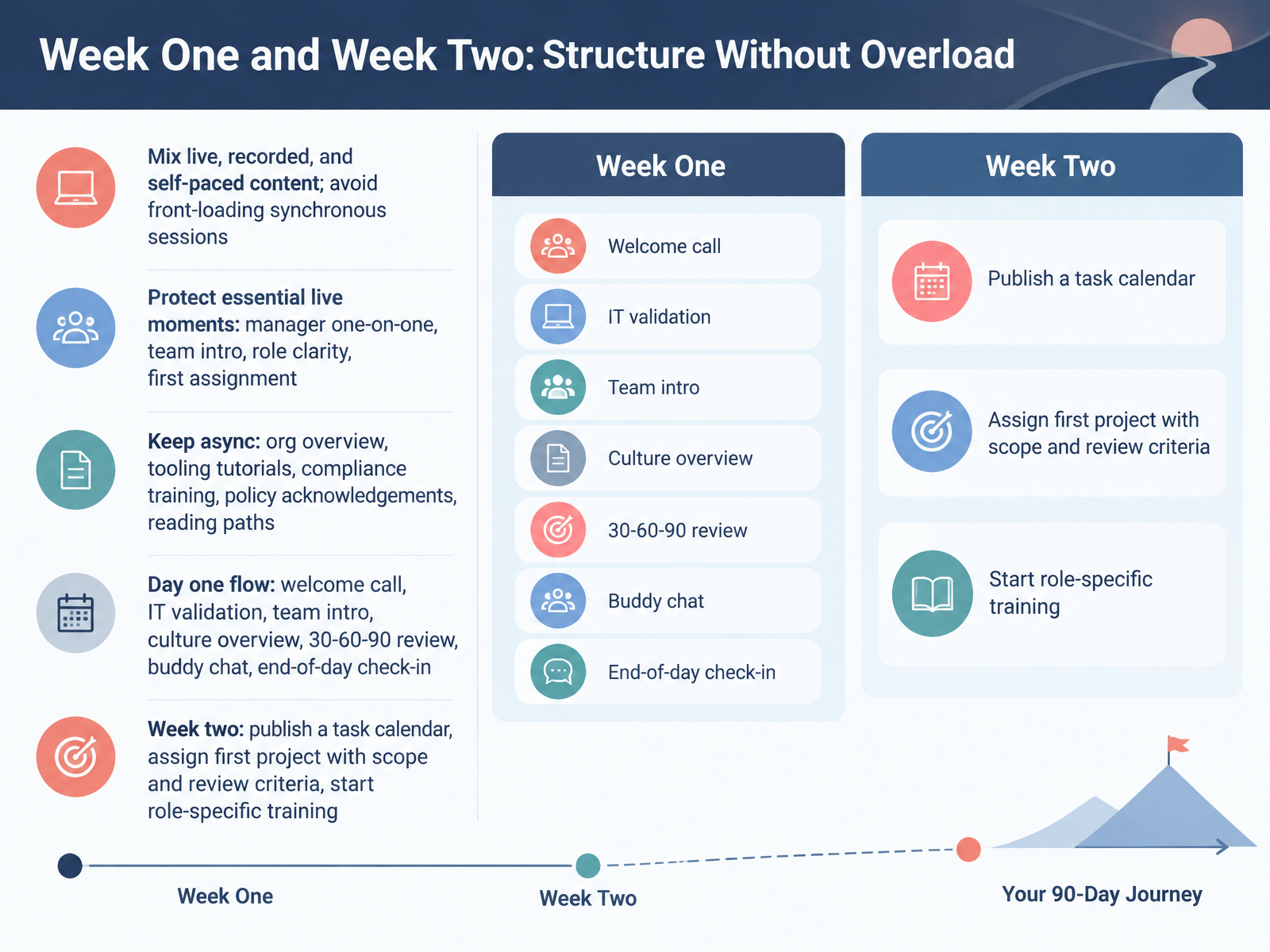
- 06Week One and Week Two: Structure Without OverloadNow let's look at weeks one and two. The goal is structure without overload. Mix live, recorded, and self-paced content, and avoid stacking synchronous sessions early. Your new hire has no context yet. Protect a few live moments: the manager one-on-one, the team intro, role clarity, and the first assignment. Keep the rest asynchronous. Org overview, tooling tutorials, compliance training, and policy acknowledgements can all be self-paced. For day one, follow a simple flow: a welcome call, IT validation, team intro, culture overview, a 30-60-90 review, a buddy chat, and an end-of-day check-in. In week two, publish a task calendar. Assign a first project with clear scope and review criteria. Then start role-specific training. For this week's hire, build that day one agenda and confirm every live session is intentional. Next, we'll cover roles and responsibilities: manager, buddy, HR, and enablement.
 hrcloud.compeopleopshq.comremoasset.com+22 min
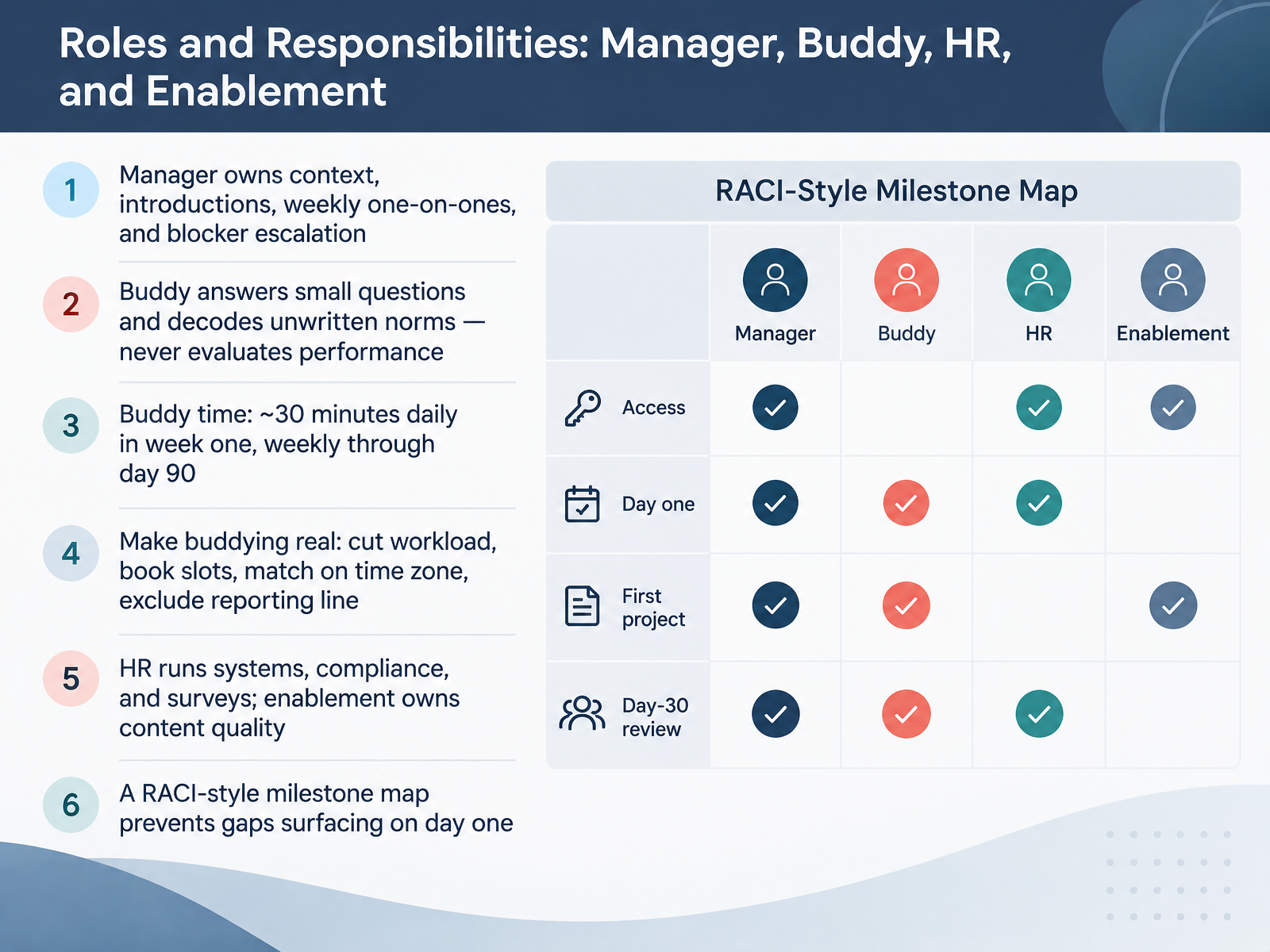
- 07Roles and Responsibilities: Manager, Buddy, HR, and EnablementLet's look at who owns what. Your manager owns context, introductions, weekly one-on-ones, and blocker escalation. Your buddy handles the small questions and unwritten norms, and never evaluates performance. Set buddy time explicitly: around thirty minutes daily in week one, then weekly through day ninety. Make buddying real by cutting the buddy's workload, booking calendar slots, matching on time zone, and keeping the buddy outside the reporting line. HR runs systems, compliance, and surveys, while enablement owns content quality. A RACI-style milestone map keeps gaps from surfacing on day one. Before your next hire starts, write a one-page role map naming the manager, buddy, HR, and enablement owner, then book the first week of buddy slots. Next, we move to Building Connection and Belonging at a Distance.
 sakha.onehandbook.gitlab.comlead.app+21 min
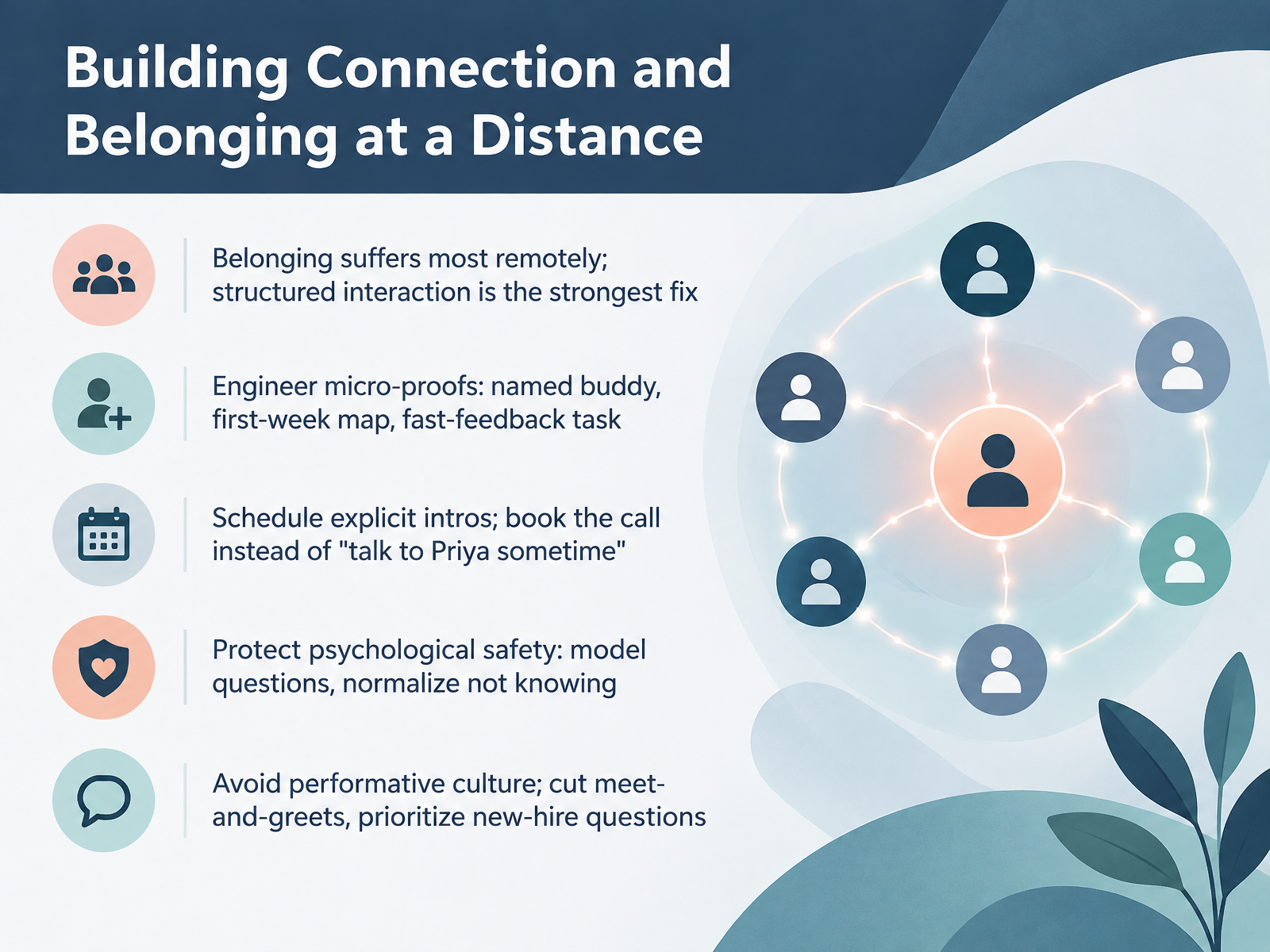
- 08Building Connection and Belonging at a DistanceLet's talk about connection and belonging at a distance. Belonging takes the biggest hit when people work remotely, and structured interaction is the strongest fix you have. Engineer micro-proofs in the first thirty days: a named buddy, a first-week map, and one real task with fast feedback. When you say you'll introduce the new hire to Priya, don't leave it as talk to her sometime. Book the call, and put explicit intros on the calendar. Protect psychological safety by modeling questions. Say out loud that you ask them all the time, and normalize not knowing. And avoid performative culture. Cut the crowded meet-and-greets and put new-hire questions first. So this week, book one intro call and swap one social event for a question-first session. Next, we'll look at the 30-60-90 plan and manager feedback loops.
 doi.orgdoi.orgsciencedirect.com+22 min
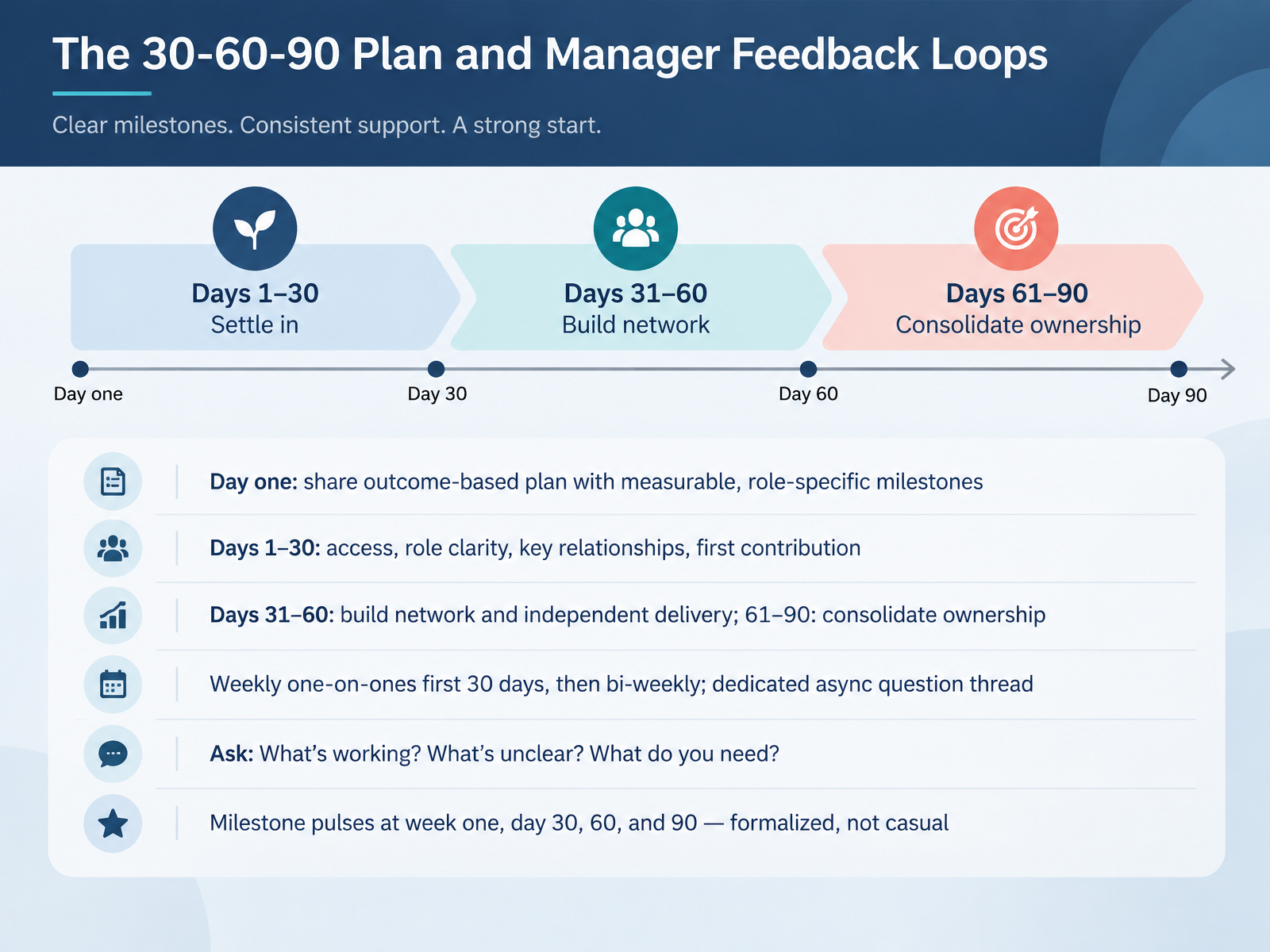
- 09The 30-60-90 Plan and Manager Feedback LoopsNext, let's turn the ninety-day arc into something concrete. On day one, share an outcome-based plan with measurable, role-specific milestones. During days one to thirty, focus on access, role clarity, key relationships, and a first contribution. Days thirty-one to sixty build network and independent delivery. Days sixty-one to ninety consolidate ownership. Run weekly one-on-ones for the first thirty days, then move to bi-weekly, and keep a dedicated async question thread open. Ask three questions: What's working? What's unclear? What do you need? And schedule milestone pulses at week one, day thirty, sixty, and ninety. Make them formal, not casual hallway check-ins. Before your next hire starts, write those milestones into the plan and calendar each pulse. That brings us to measuring onboarding effectiveness.
 sakha.onehandbook.gitlab.comlead.app+21 min
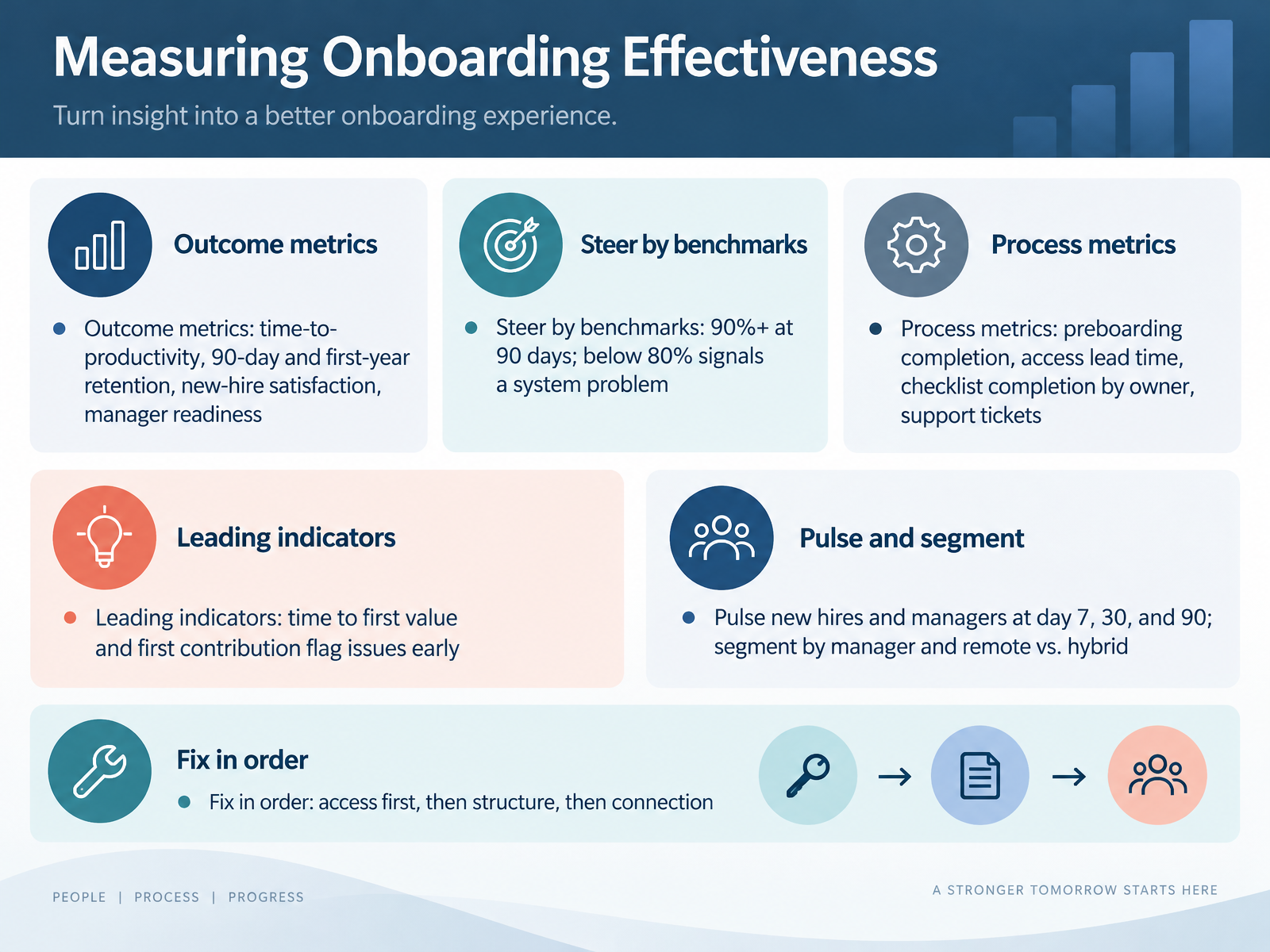
- 10Measuring Onboarding EffectivenessLet's look at how you actually measure whether onboarding works. Start with outcome metrics: time-to-productivity, retention at ninety days and at one year, new-hire satisfaction, and manager readiness. For a benchmark, aim for ninety percent or higher at ninety days. Anything below eighty percent signals a system problem, not a bad hire. Track process metrics too: preboarding completion, how fast access is granted, checklist completion by owner, and support ticket volume. Then watch leading indicators. Time to first value and time to first contribution flag issues weeks before retention does. Pulse new hires and their managers at day seven, thirty, and ninety, and segment the results by manager and by remote versus hybrid. When something breaks, fix in order: access first, then structure, then connection. This week, pull your last two hire cohorts and check their ninety-day retention against that eighty percent line. Next, we'll cover common pitfalls and how to avoid them.
 businesswire.comstealthagents.commissinvestigate.com+22 min
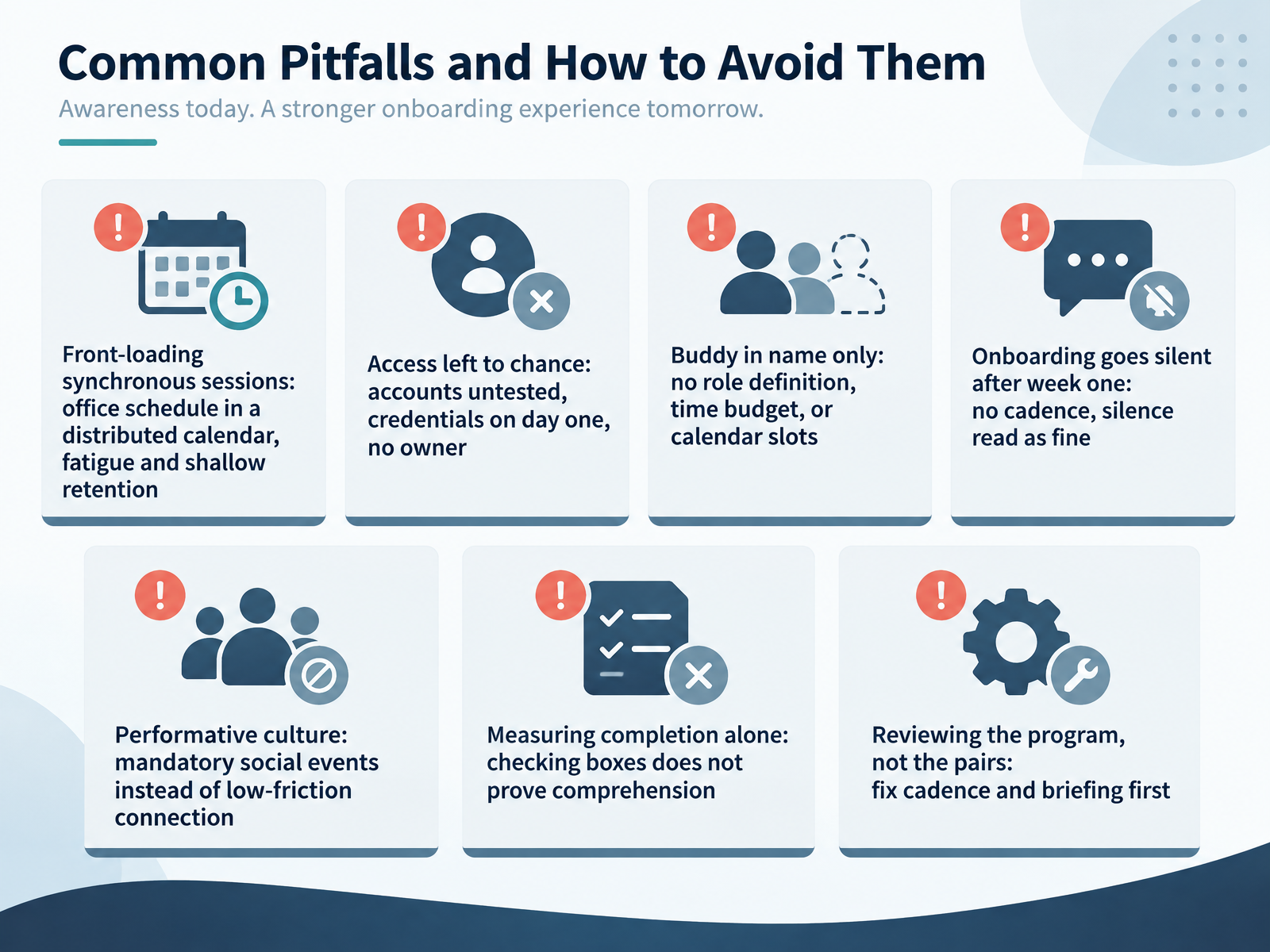
- 11Common Pitfalls and How to Avoid ThemLet's talk about the pitfalls that quietly break remote onboarding. First, don't front-load synchronous sessions. Spread live sessions across a distributed calendar, or you'll create fatigue and shallow retention. Second, don't leave access to chance. Test accounts and credentials before day one, and name an owner. Third, a buddy in name only fails. Define the role, give a time budget, and book calendar slots. Fourth, onboarding often goes silent after week one. Set a cadence, because new hires read silence as fine. Fifth, skip performative culture. Offer low-friction connection instead of mandatory social events. Sixth, don't measure completion alone. Checking boxes does not prove comprehension. And seventh, when something breaks, review the pairs, not just the program. Fix cadence and briefing first. Your action: audit your next hire's first two weeks and correct one pitfall before day one. That leads us into the action plan for launching or refreshing your remote onboarding.
 doi.orgsakha.onehandbook.gitlab.com+22 min
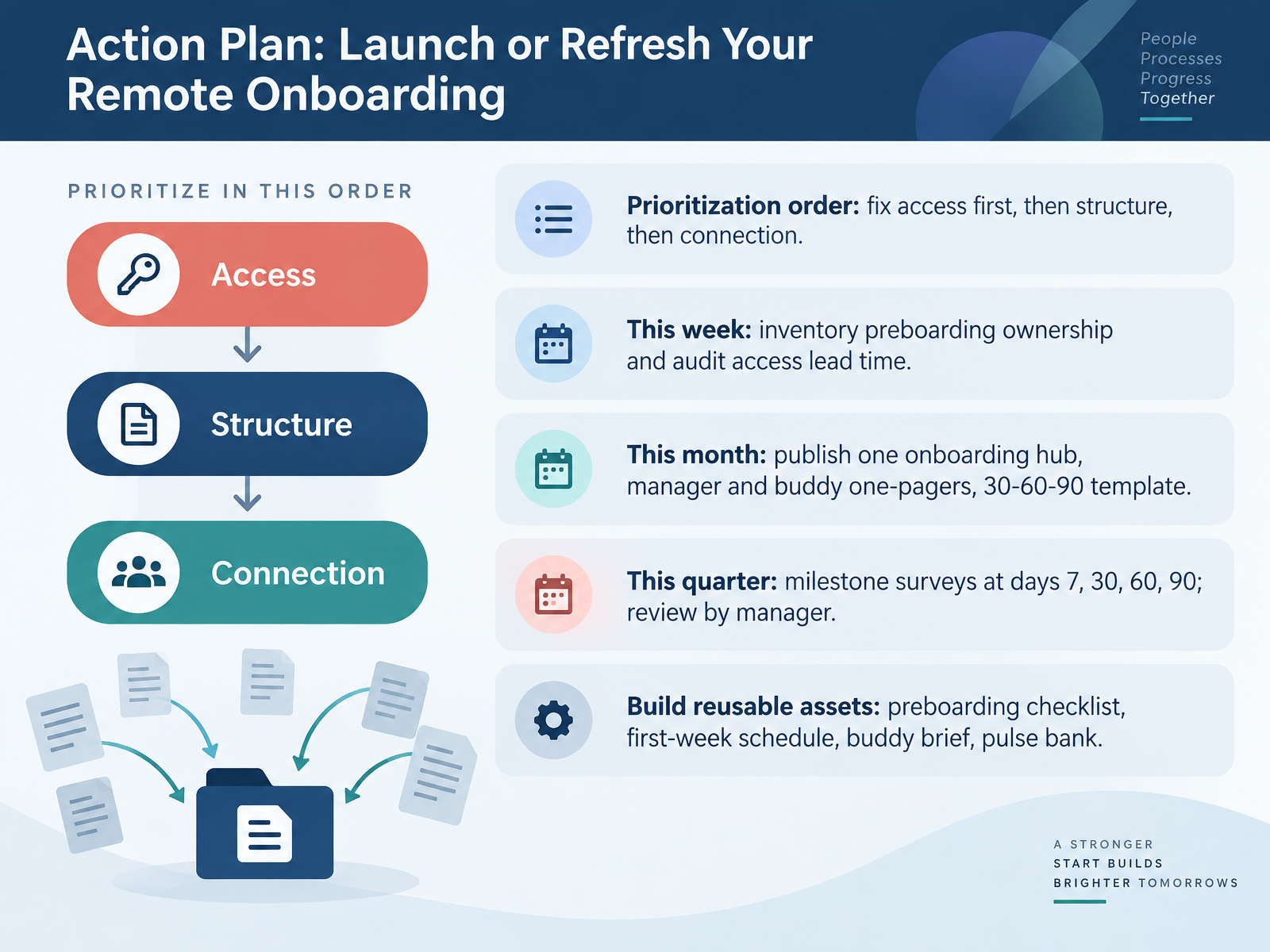
- 12Action Plan: Launch or Refresh Your Remote OnboardingLet's close the loop with a practical action plan you can actually run. Prioritize in this order: fix access first, then structure, then connection. Access failures block everything else, so start there. This week, inventory who owns preboarding, and audit your access lead time. Pick one hire and trace how early the laptop ships and when logins are tested. This month, publish one onboarding hub. Add manager and buddy one-pagers, plus a 30-60-90 template. This quarter, run milestone surveys at days 7, 30, 60, and 90, with manager review. Build reusable assets as you go: a preboarding checklist, a first-week schedule, a buddy brief, and a pulse question bank. Choose your first asset and assign an owner by name. Next, let's pull this together in Key Takeaways and Next Steps.
 hrcloud.compeopleopshq.comremoasset.com+22 min
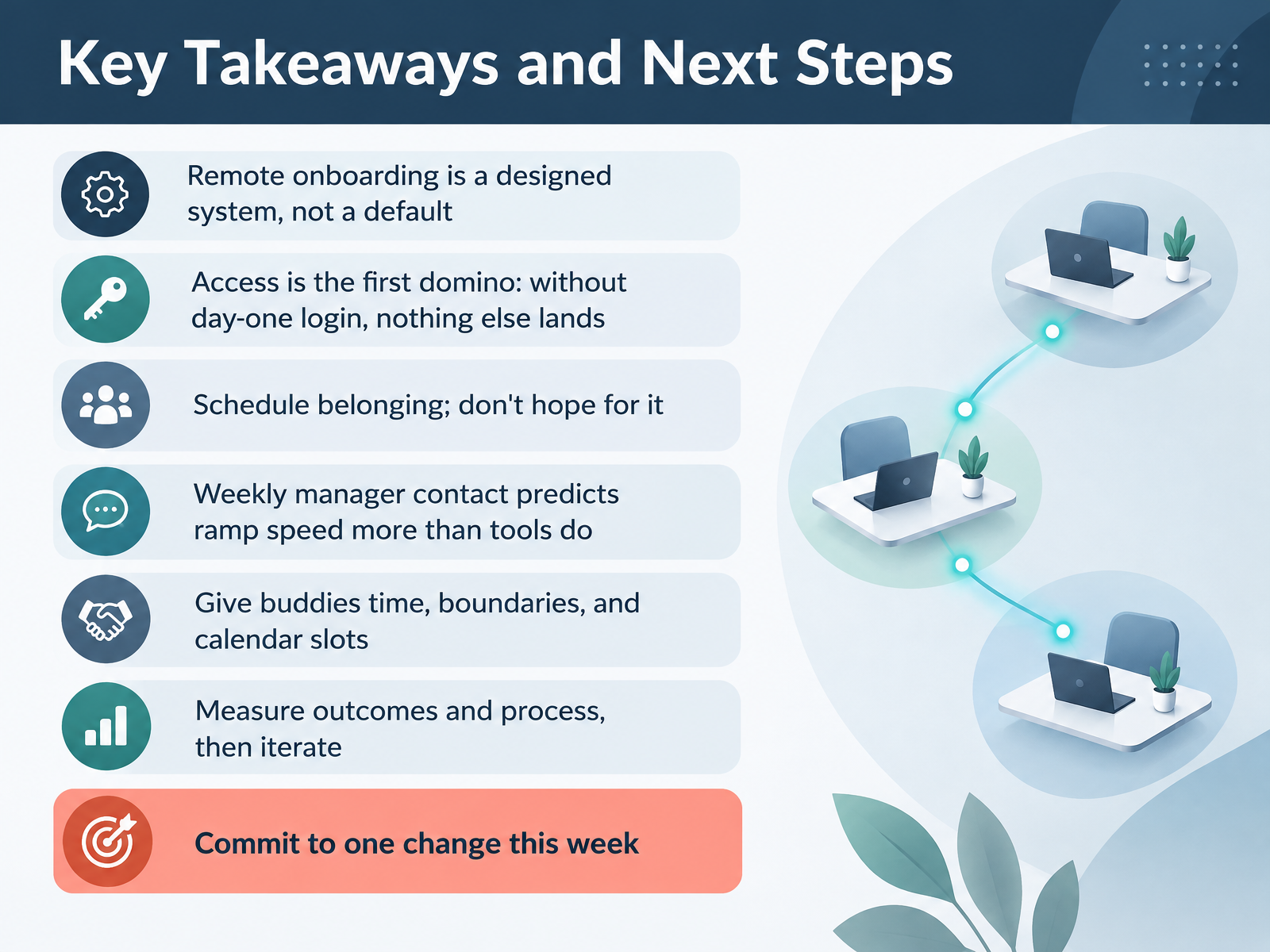
- 13Key Takeaways and Next StepsLet's pull this together. Remote onboarding is a designed system, not a default. Access is the first domino. If the day-one login fails, nothing else lands, so confirm it before the start date. Schedule belonging instead of hoping for it. Put the coffee chats and introductions on the calendar. Weekly manager contact predicts ramp speed more than any tool does. One short check-in every week in the first ninety days. Give buddies time, clear boundaries, and calendar slots. Then measure outcomes and process together. Track time to first contribution and ninety-day retention. Review them at your next team meeting. Finally, commit to one change this week. Big picture: one in four remote hires leaves within ninety days after poor onboarding. You can shift that. Pick one fix, write it down, and name the owner. Thank you for working through this with me. You now have a practical system, so go make your next remote hire's first ninety days count.
 businesswire.comstealthagents.commissinvestigate.com+22 min
Take the deck with you
Download this course as a file — free, no sign-up needed.
- PDF handoutEvery slide page, ready to print or share.14 pages · 2.8 MBDownload
- Narrated PowerPointThe deck that presents itself — every slide carries the digital human's narration video.14 pages · 11.3 MBDownload
- PowerPoint slidesThe full deck as a .pptx — open it in PowerPoint, Keynote, or Google Slides.14 pages · 2.7 MBDownload
Free to use in your own training — please keep the PersonWise credit page at the end.
Have your own deck? Turn it into a course
Sources consulted
Web sources consulted while building this course.
- Global Enboarder Survey: 1 in 3 Employees Report Poor Onboarding Experiences, With Remote and Hybrid Teams Hit the Hardest — businesswire.com
- Remote Onboarding Statistics 2026: Key Data | Stealth Agents — stealthagents.com
- The State of Remote Work & Outsourcing 2026 - Miss Investigate — missinvestigate.com
- 18 Jaw-Dropping Onboarding Statistics | Click Boarding — clickboarding.com
- 27+ Employee Onboarding Statistics You Must Know in 2026 - AIHR — aihr.com
- The Evolving Future of Work: Implications for Newcomer Adaptability and Connectivity During Organizational Socialization — doi.org
- Onboarding as knowledge management in remote software teams: A literature review — doi.org
- Sense of belonging in hybrid work settings — sciencedirect.com
- Membership Ambiguity and Insider Support in Remote Socialization: A Qualitative Exploration of Newcomers' Experiences of Remote Onboarding — doi.org
- Onboarding Software Professionals in a Hybrid World — doi.org
- Preboarding Checklist — hrcloud.com
- The IT Onboarding Checklist for Remote Employees: Hardware, Software, Security, and Day-One Readiness (2026) — peopleopshq.com
- IT Onboarding Checklist for Remote Hires: Before, On & After Day One — remoasset.com
- IT Onboarding for Remote & Hybrid Teams - AMPthilly — ampthilly.com
- New Hire IT Readiness Checklist for IT Teams — deel.com
- How to Build an Onboarding Buddy Program That Works (2026) | Sakha | Sakha — sakha.one
- Solutions Architects Onboarding | The GitLab Handbook — handbook.gitlab.com
- How to Manage Onboarding Buddy Programs Without Admin Burnout - LEAD — lead.app
- How to Create Remote Buddy System Program for Onboarding | Remote Work Tools — welikeremotestack.com
- Buddy Program: How to Run an Onboarding Buddy System — mentornity.com