Begin
17 pages · ~34 min
How Electricity Works: Circuits & Energy
An introduction to electrical circuits and energy flow, designed for learners seeking a foundational understanding of how electricity works.
A digital instructor presents all 17 pages. Hold “Ask” at any point and ask out loud — the answer comes from this course. No sign-up needed.
What you’ll learn
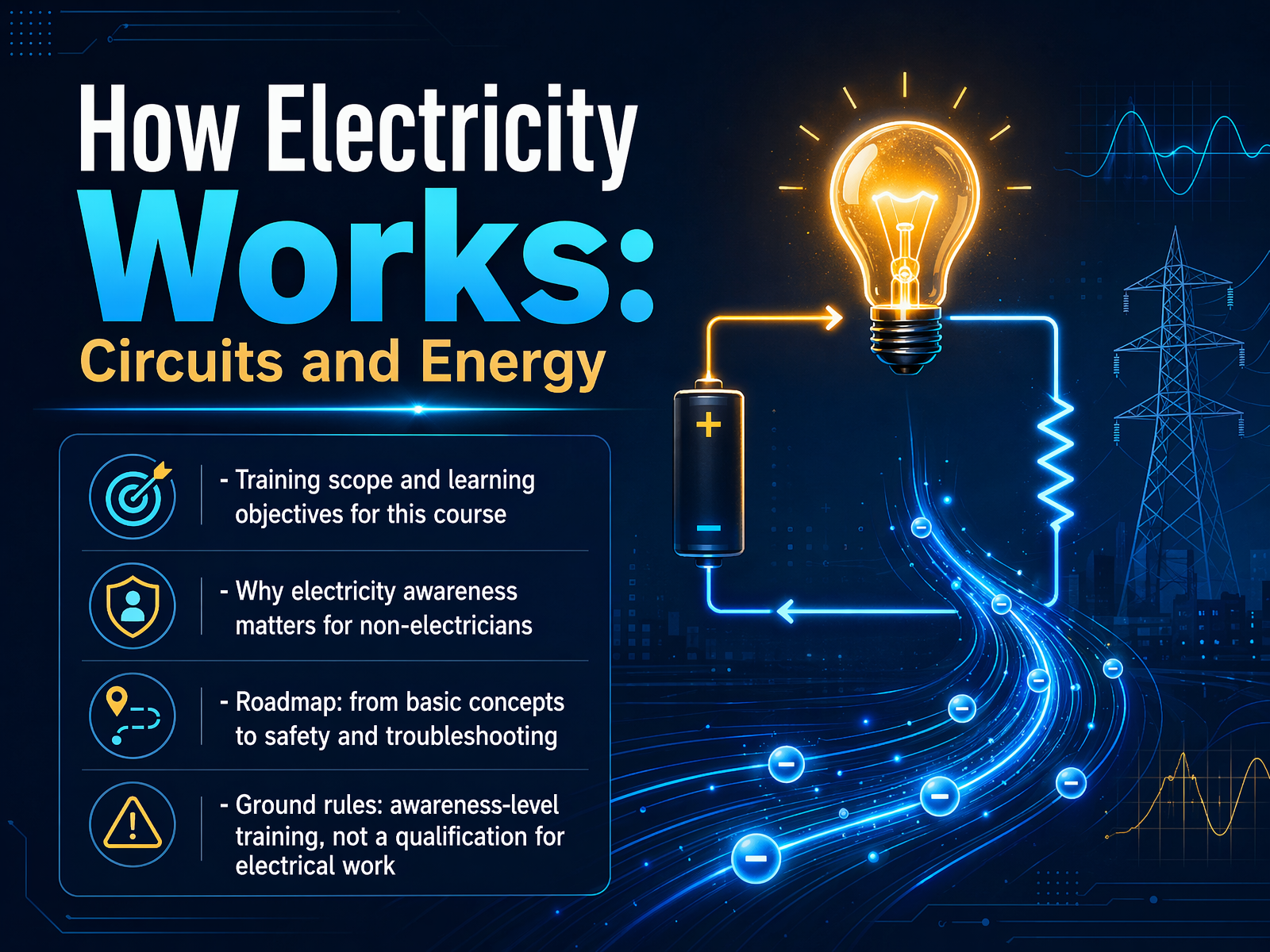
- 01How Electricity Works: Circuits and EnergyWelcome. I'm digital human instructor. This course is called How Electricity Works: Circuits and Energy. It's designed for anyone who isn't an electrician, but who works with or around electricity every day, which is most of us. Our goal is simple: to help you understand what electricity is, how it behaves, and most importantly, why it deserves your full respect. We'll start with basic concepts, build up to how circuits work, and then move into real-world safety and troubleshooting. A quick but important ground rule: this is awareness-level training. It will not qualify you to perform electrical work. It will give you the knowledge to recognize hazards and stay safe. Let's begin by looking at the hidden danger and why electricity deserves respect.osha.govccohs.calabtrain.noaa.gov+22 min
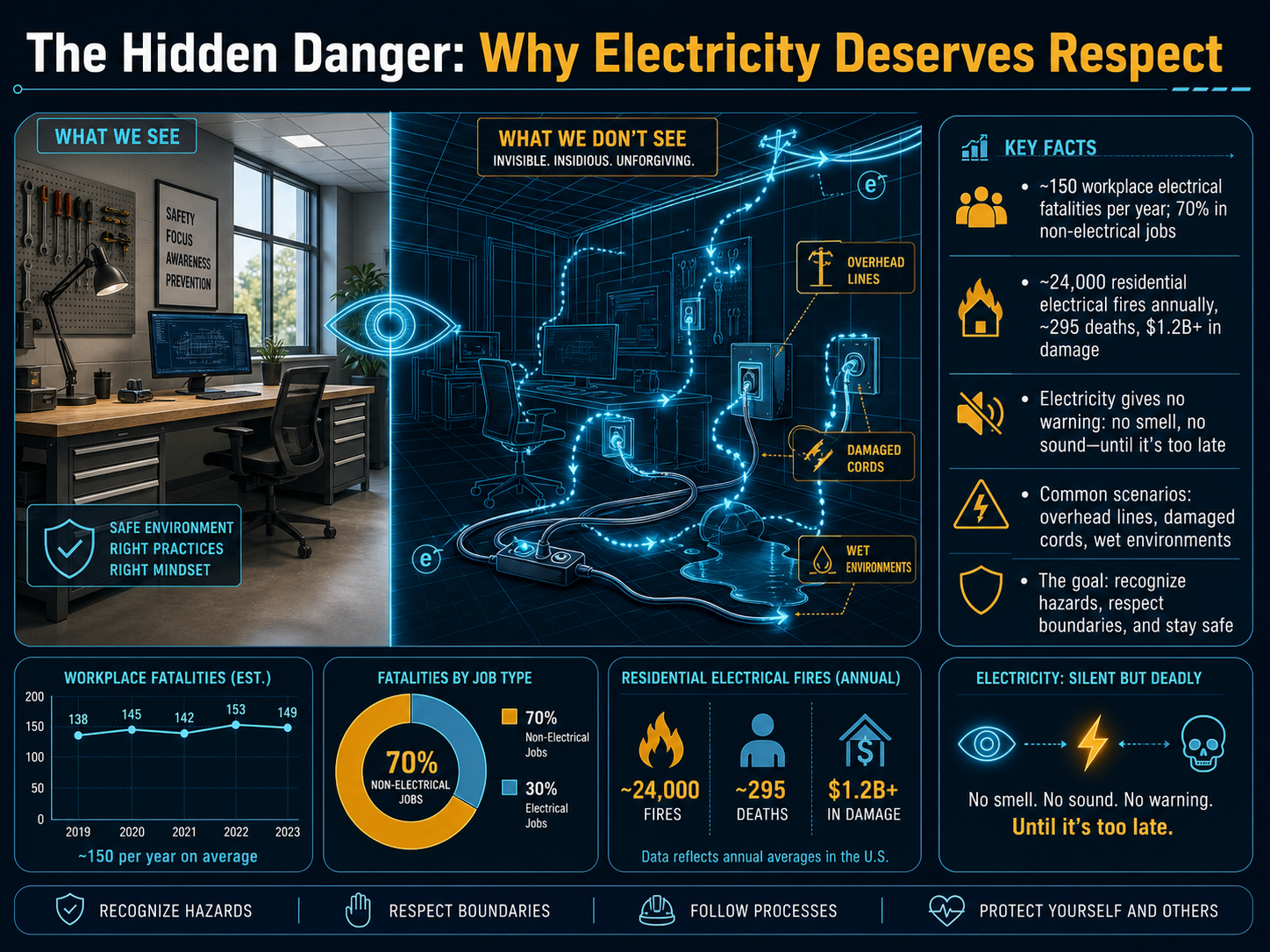
- 02The Hidden Danger: Why Electricity Deserves RespectNow, let's talk about a hidden danger that we often overlook. Electricity deserves our respect, and the statistics show us why. Every year, about 150 workplace electrical fatalities occur in the United States. And here is the surprising part: roughly 70 percent of those deaths happen to people in non-electrical jobs. These are not electricians; they are operators, custodians, and office workers. Beyond the workplace, our homes are at risk too. There are roughly 24,000 residential electrical fires annually, leading to nearly 295 deaths and over 1.2 billion dollars in property damage. That is a massive impact. What makes electricity so dangerous is that it gives no warning. There is no smell to alert you, no sound to hear, until it is far too late. Think about common situations you might encounter: overhead power lines, a damaged extension cord, or working in a wet environment. Each of these can turn a normal day into a disaster. Our goal in this course is simple: we want you to recognize these hazards, respect the boundaries around them, and build the habits to stay safe. Next, we will build that foundation by looking at what electricity really is: atoms, electrons, and charge.
 osha.govccohs.calabtrain.noaa.gov+22 min
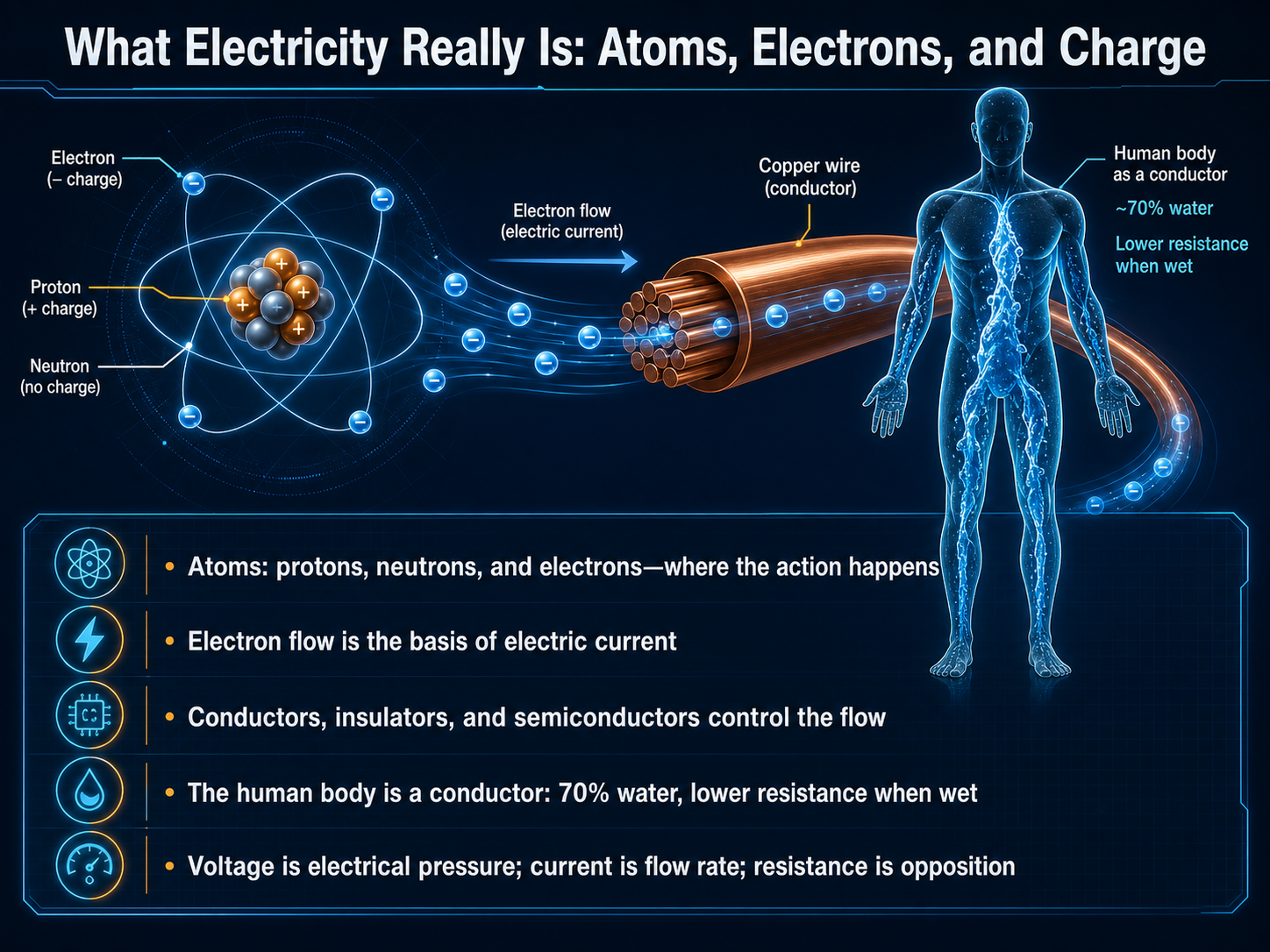
 - 03What Electricity Really Is: Atoms, Electrons, and ChargeAll right, let's get down to the smallest level to see what electricity really is. It all starts with atoms. Inside every atom, you have protons, neutrons, and electrons. The electrons are where the action is. Electricity is basically the flow of these electrons from atom to atom. Think of it like a tiny, invisible river of energy moving through a material. Now, we control this flow with different materials. Conductors, like copper, let electrons flow easily. Insulators, like rubber, block that flow. And semiconductors are somewhere in between. Here's a critical point about safety: your body is a conductor. It's about 70 percent water, which makes it a very good path for electricity, especially if your skin is wet. That's why we use a water analogy. Think of voltage as electrical pressure, current as the flow rate, and resistance as anything that opposes that flow. Understanding these three things is the first step to recognizing danger. Let's use this foundation to understand the path electricity takes. Next, we'll explore the closed loop, and see exactly how circuits work.
 osha.govccohs.calabtrain.noaa.gov+22 min
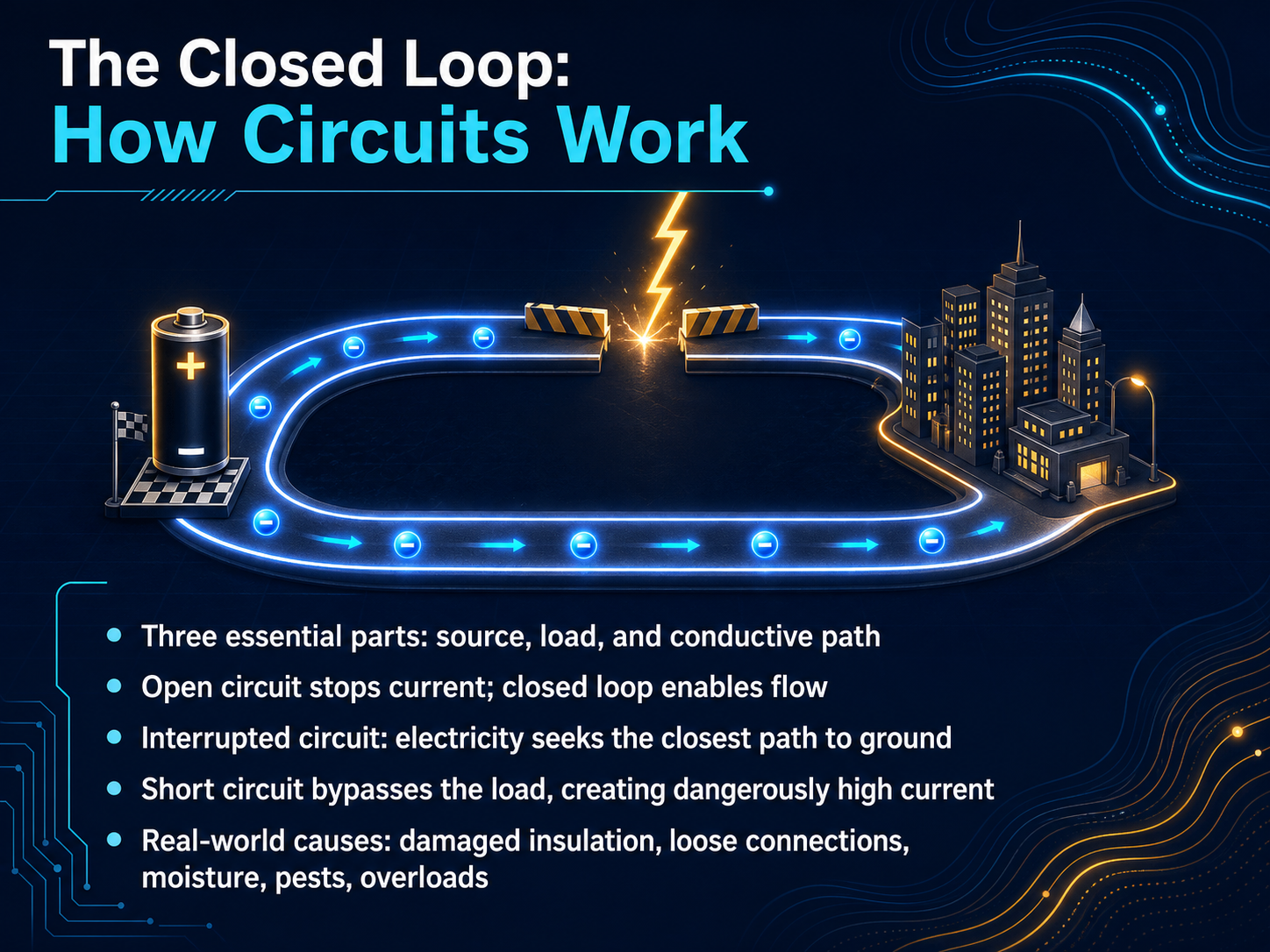
 - 04The Closed Loop: How Circuits WorkLet's look at what a circuit really is. Think of it as a closed loop, a complete circle that electricity can travel through. For this loop to work, you need three essential parts. First, a source of energy, like a battery or a wall outlet. Second, a load, which is the device doing the work, such as a light bulb or a motor. And third, a conductive path, usually wires, that connects everything together. When the loop is closed, current flows and the light turns on. But if you break the loop, say by flipping a switch, you create an open circuit. The path is interrupted, and the current stops instantly. Now, what happens if the circuit is broken unexpectedly? Electricity doesn't just vanish. It will seek the closest path to the ground. If you touch a damaged wire, you could become that path. This is why a short circuit is so dangerous. A short circuit bypasses the load entirely, creating a direct path back to the source. With almost no resistance, the current skyrockets, generating intense heat that can melt insulation and start fires. Short circuits happen in the real world more often than you might think. Damaged insulation on a frayed cord, loose wire connections inside an outlet, moisture in a junction box, or even pests chewing through wiring can all create an unintended path. Overloading a circuit is another common cause, as the heat can eventually break down the insulation. Understanding the closed loop is the key to staying safe. Now, to really grasp what's happening inside that loop, we need to talk about the forces that control the flow. Let's move on to our next topic: Voltage, Current, and Resistance, explained with the water analogy.
 osha.govccohs.calabtrain.noaa.gov+22 min
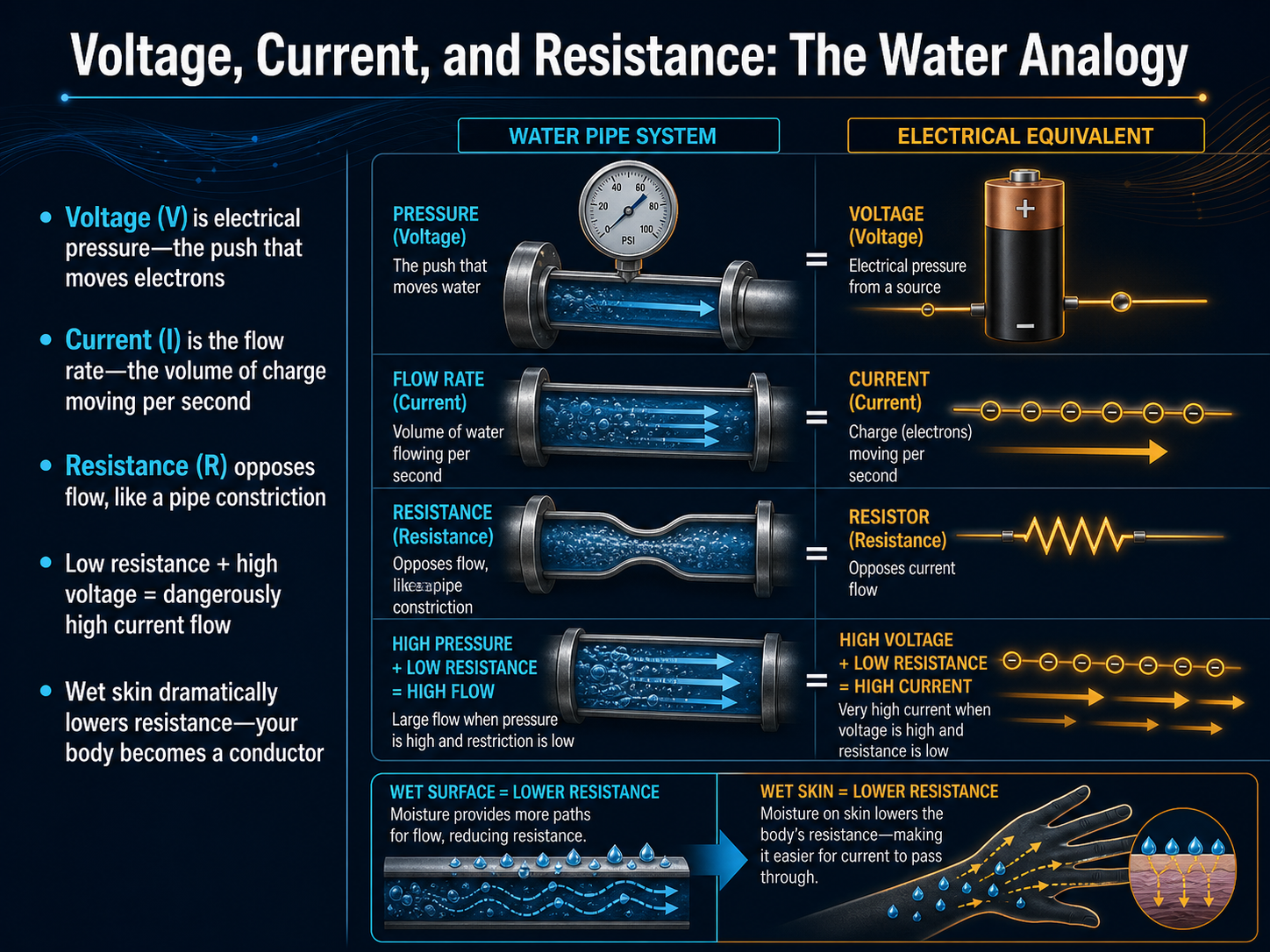
 - 05Voltage, Current, and Resistance: The Water AnalogyAlright, let's make these three key ideas—voltage, current, and resistance—really easy to picture. Think of a garden hose. Voltage is the water pressure inside the hose. It's the push that moves electrons. We measure that push in volts. Current is the flow rate, the volume of water actually moving through the hose. That's measured in amps. Resistance is anything that restricts the flow, like a kink in the hose or a narrower pipe. We measure resistance in ohms. Now, here's what matters for safety. If we have low resistance combined with high voltage, we get dangerously high current flow. And here's the critical connection to your body: your skin is a pretty good insulator when it's dry, but what happens when it's wet? That dramatically lowers your resistance. Even a standard outlet voltage can then push enough current through you to cause serious injury. Your body, which is mostly water, becomes a conductor, completing the circuit. That's a sobering thought, so let's keep that water analogy in mind as we move to the single most important rule in electricity. Next up, we'll break down Ohm's Law.
 osha.govccohs.calabtrain.noaa.gov+22 min
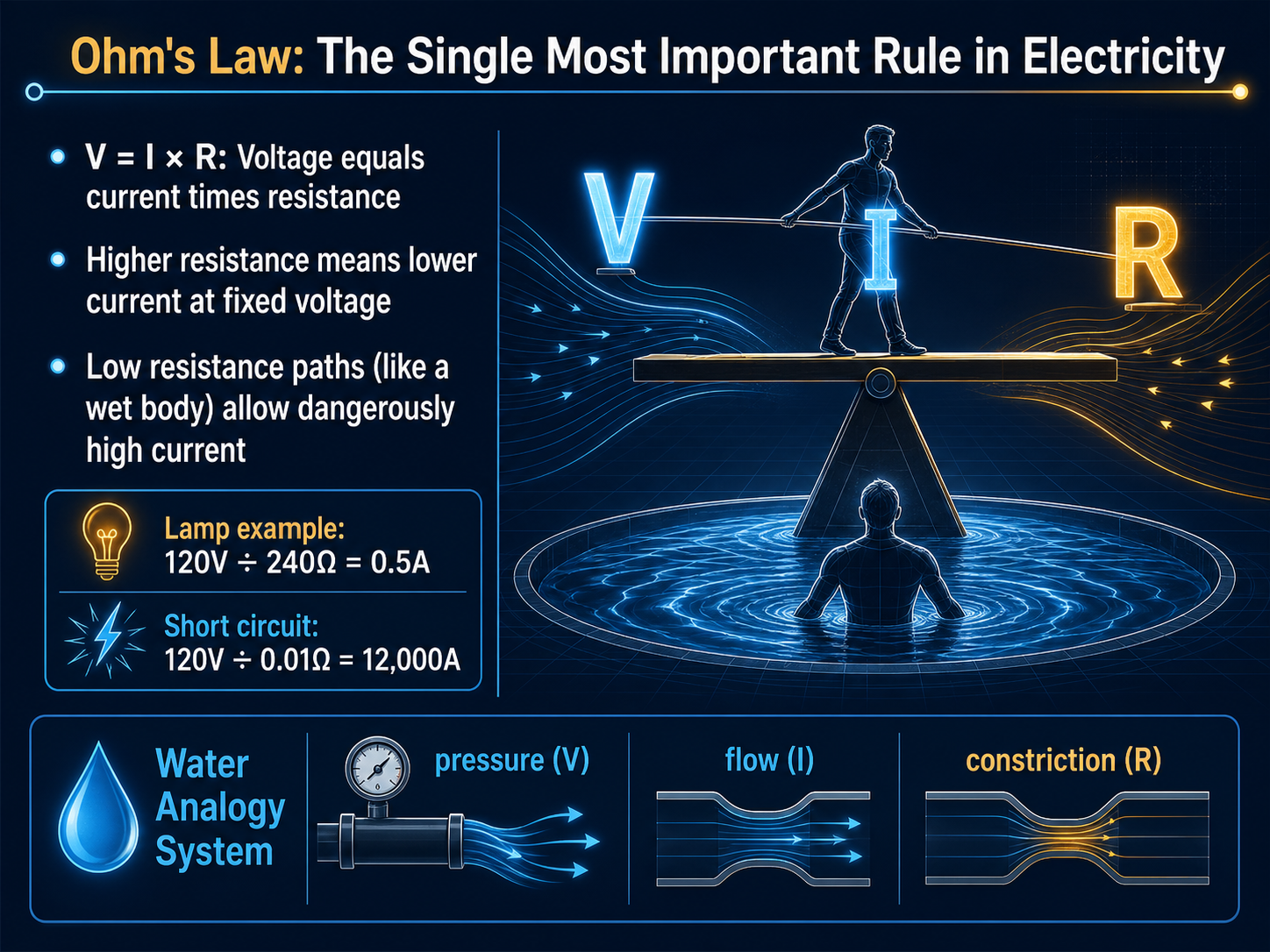
 - 06Ohm's Law: The Single Most Important Rule in ElectricityNow we come to the single most important rule in electricity: Ohm's Law. If you remember only one formula from this course, this is the one. It's beautifully simple: voltage equals current times resistance, or V equals I times R. Think of it like water flowing through a pipe. Voltage is the electrical pressure pushing the water, current is the actual flow of water, and resistance is any constriction in the pipe. So, at a fixed voltage, squeezing the pipe—increasing the resistance—means less water flows. That's a lower current. But here's why this matters for your safety. Your body is a conductor, and a wet body has very low resistance. That kind of low-resistance path allows dangerously high current to flow. Let's see it in numbers. A lamp at 120 volts with 240 ohms of resistance draws a safe half an amp. But if you create a short circuit with a resistance of just 0.01 ohms, the current skyrockets to 12,000 amps. That's an incredible, deadly force. Understanding this relationship between voltage, current, and resistance is your key to understanding why electricity is both useful and, without respect, extremely hazardous. Let's build on this and see how these three elements combine to create power and energy, and what you're actually paying for.
 osha.govccohs.calabtrain.noaa.gov+22 min
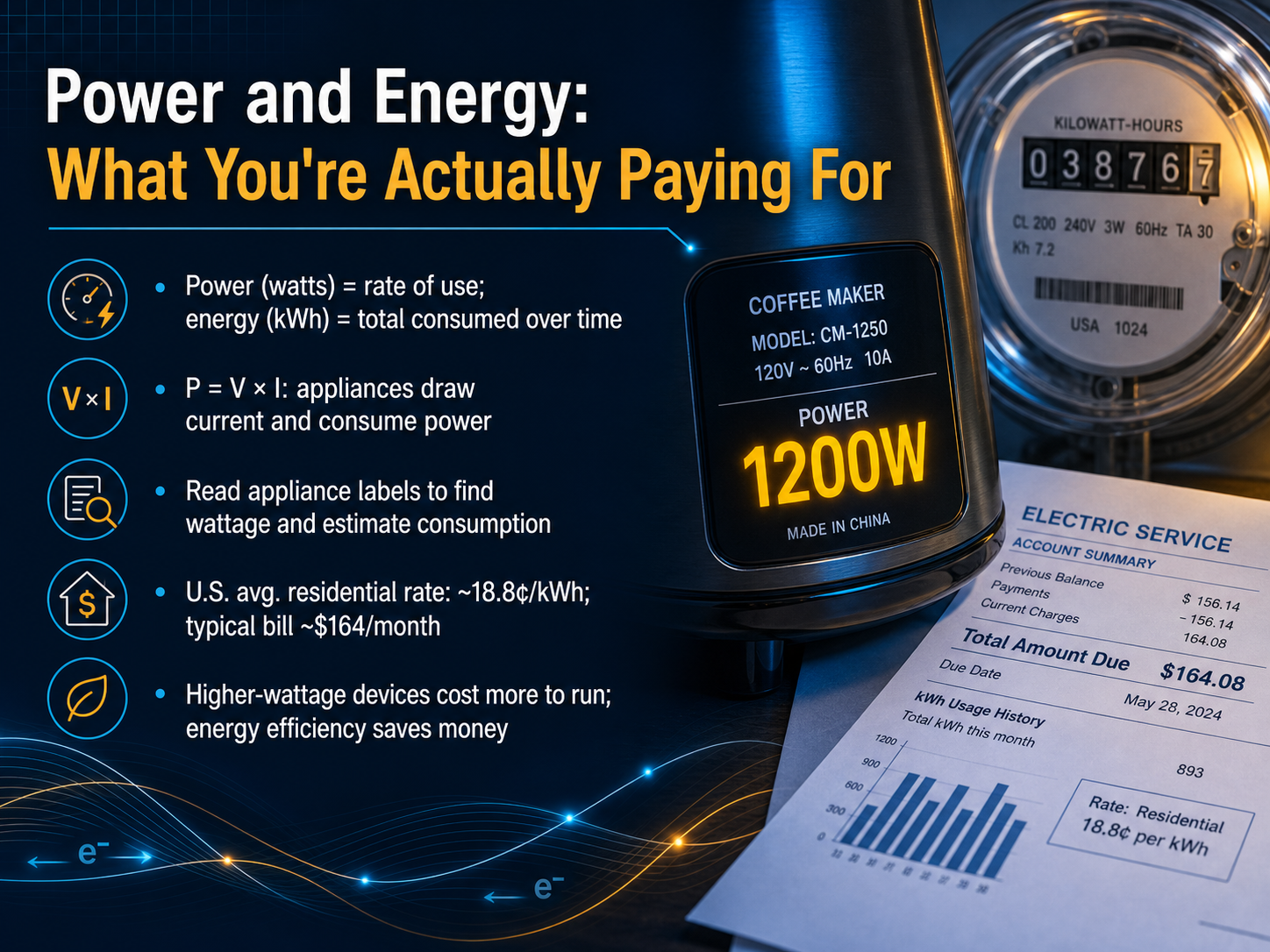
 - 07Power and Energy: What You're Actually Paying ForLet's get to the heart of your electric bill—power and energy. Think of power, measured in watts, as the speed of energy use—like miles per hour in a car. Energy, in kilowatt-hours, is the total distance traveled. So a 100-watt light bulb running for ten hours uses one kilowatt-hour of energy. That's the unit you actually pay for. We find power with a simple formula: P equals V times I, or volts times amps. Every appliance has a label stating its wattage. Check it to estimate how much energy it eats up. In the US, the average residential rate right now is about eighteen point eight cents per kilowatt-hour, with a typical monthly bill around one hundred sixty-four dollars. A higher wattage means higher cost. So, choosing energy-efficient appliances directly saves you money. Now, the way you connect those devices makes a big difference in how their voltage and current behave. Let's look at that next—series and parallel circuits.
 eia.goveia.govelectricchoice.com+21 min
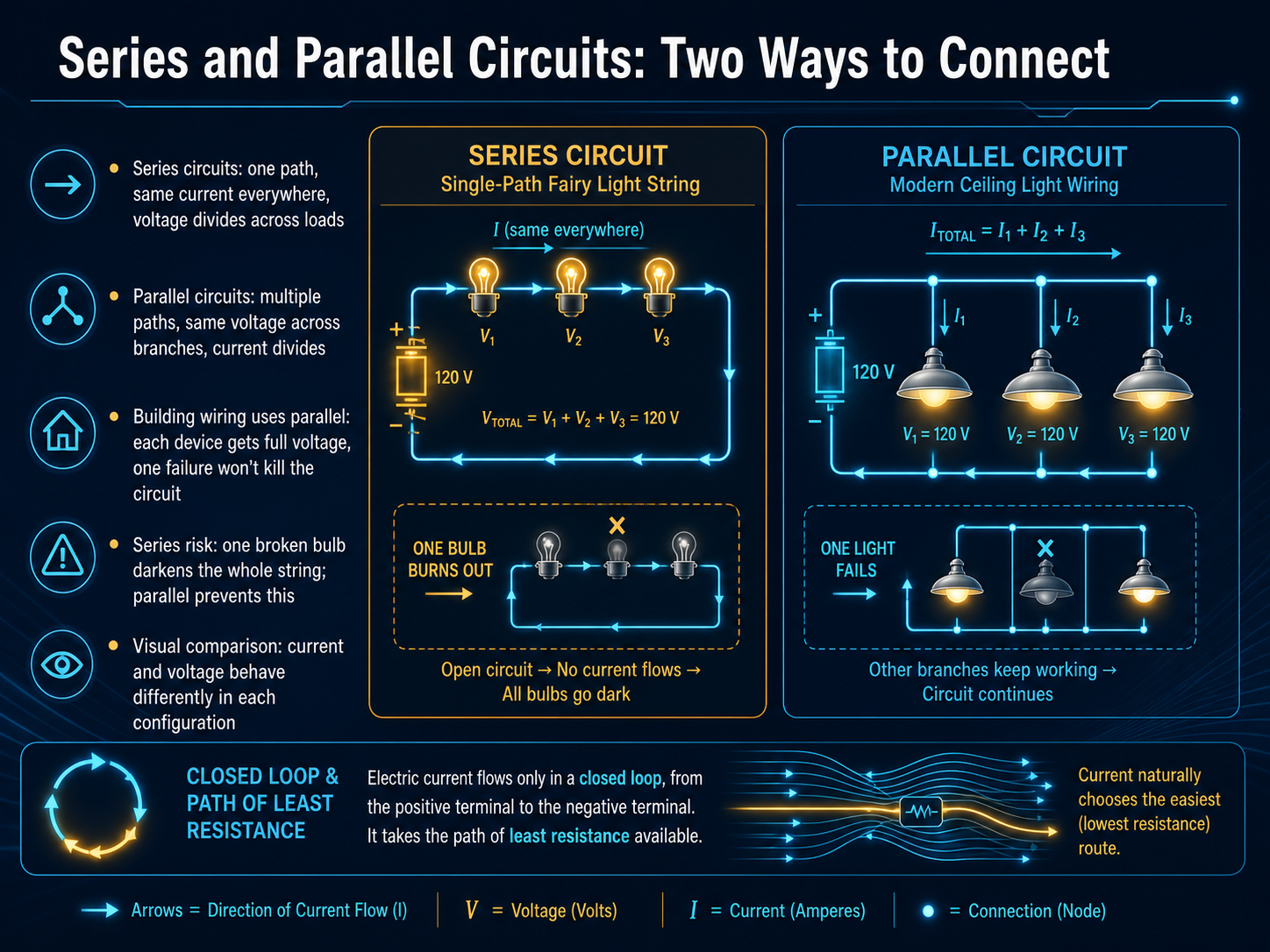
 - 08Series and Parallel Circuits: Two Ways to ConnectNow let's look at the two ways we can connect components: series and parallel. Think of a series circuit as a single lane road. The current has only one path to follow, so it's the same everywhere. But the voltage, or electrical pressure, gets divided up among the loads. The big risk here is that if one part fails, like a burned-out bulb, the whole path breaks and everything goes dark. String lights used to work this way. A parallel circuit is more like a multi-lane highway. Each lane is its own independent path. The voltage across each branch is the same, full voltage, while the current divides up. This is why your home is wired in parallel. You can turn off a lamp in the living room, and the fridge in the kitchen keeps running perfectly. The failure of one device doesn't kill the whole circuit. So, the key takeaway is that current and voltage behave very differently depending on how you connect the components. Up next, we'll explore another fundamental difference: AC and DC, two ways to move charge.
 classcentral.comallaboutcircuits.comstartingelectronics.org+22 min
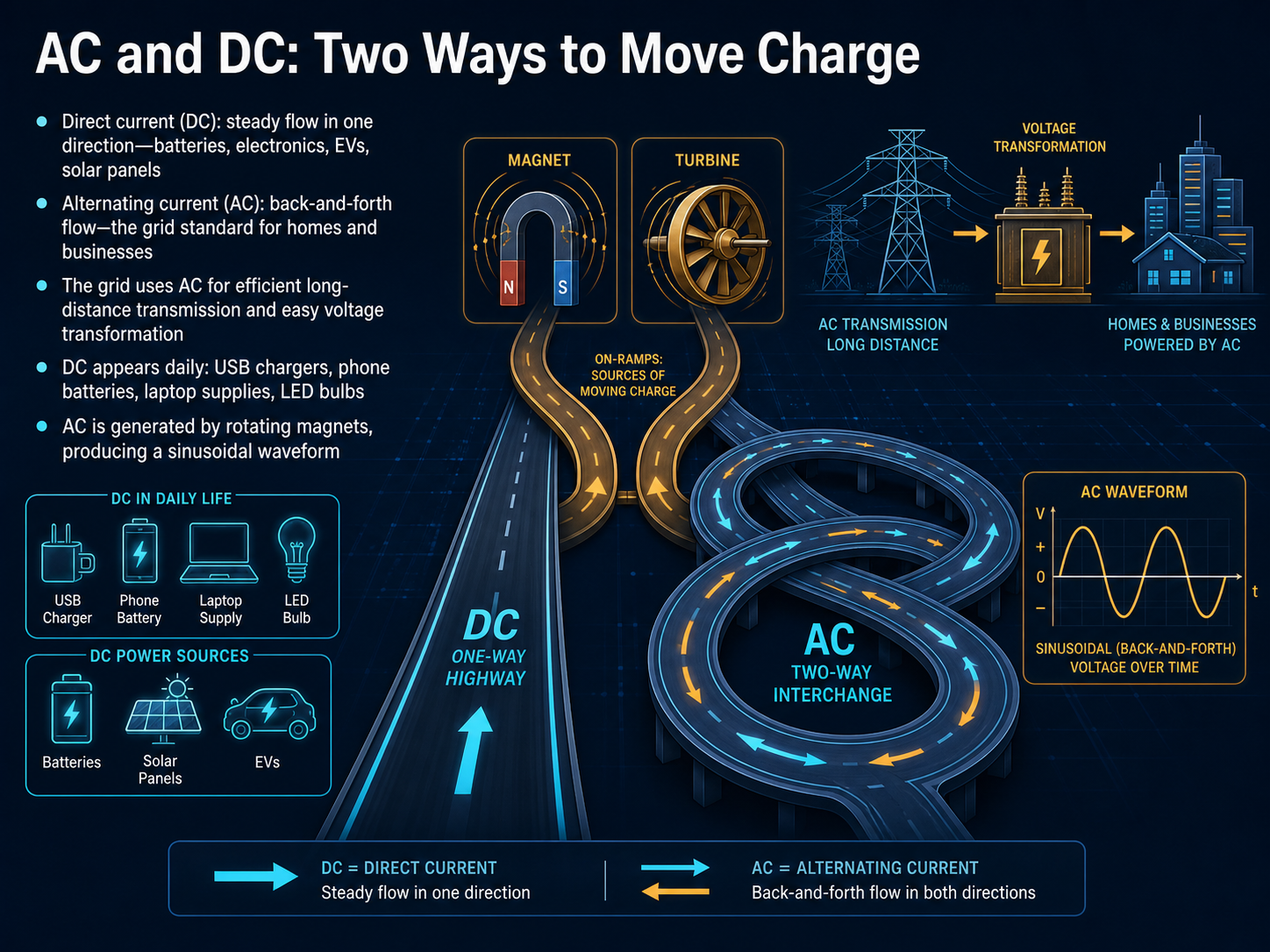
 - 09AC and DC: Two Ways to Move ChargeThen let's look at the two ways we actually move electrical charge. We call them direct current, or DC, and alternating current, AC. Think of DC like a river flowing smoothly in one direction. That's what you get from a battery, your phone, a laptop charger, or even a solar panel. The flow is steady and predictable. AC, on the other hand, is a back-and-forth movement. Imagine a saw pushing and pulling. In the United States, this direction changes sixty times a second. The power grid uses AC because it's incredibly efficient at sending electricity over long distances, and we can easily change its voltage to make it safe for our homes. A rotating magnet inside a generator is what creates that smooth, rising-and-falling sinusoidal wave. So, simply put, DC is a one-way street, and AC is a two-way street that rapidly reverses. Understanding this difference is key, but equally important is how we interact with electricity safely. Next, we'll explore how the human body becomes part of a circuit and why that can be dangerous. Let's talk about protecting people from shock, burns, and the body's vulnerability.
 classcentral.comallaboutcircuits.comstartingelectronics.org+22 min
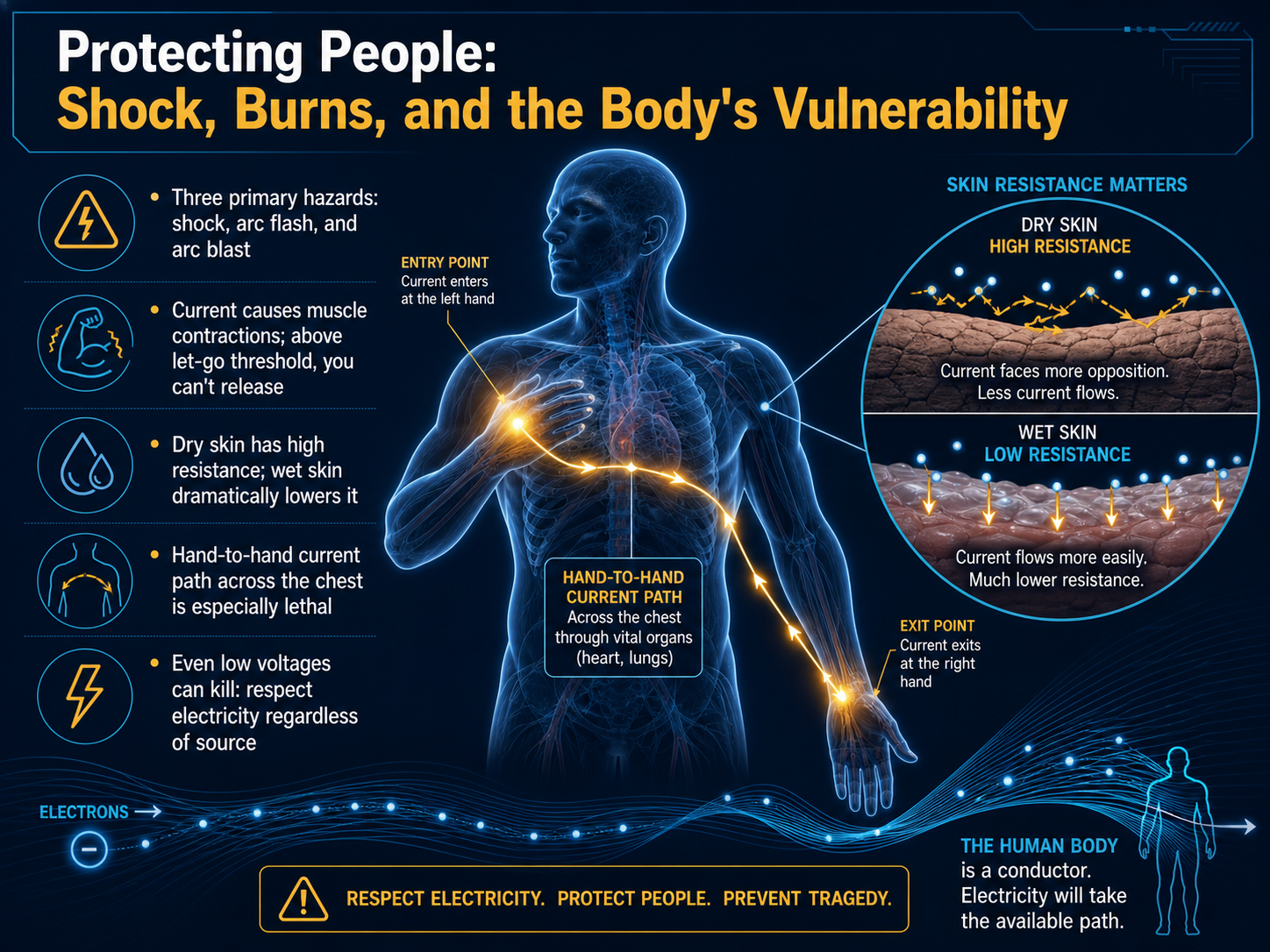
 - 10Protecting People: Shock, Burns, and the Body's VulnerabilityNow let's talk about what happens to us when electricity takes an unintended path through the body. The three primary hazards you need to remember are shock, arc flash, and arc blast. A shock happens when current passes through you. Arc flash and arc blast are explosive releases of heat and pressure that can cause severe burns even without direct contact. Think for a moment: why is a shock so dangerous? Electric current can override your nervous system. It causes uncontrollable muscle contractions. Above a tiny threshold called the let-go threshold, you literally cannot release the conductor. Your grip tightens, and the current keeps flowing. Your skin's resistance is your only natural defense. Dry skin has fairly high resistance. But wet or damp skin? That resistance drops dramatically. A voltage that might only tingle on dry hands can become lethal when your skin is wet. The path the current takes through your body matters just as much. A hand-to-hand path sends current straight across your chest, through your heart and lungs. That path is especially dangerous and can be fatal. Here's the most important takeaway: even low voltages can kill. Never assume a circuit is safe just because it isn't high voltage. Respect electricity regardless of the source. Next, we'll look at how protective devices like fuses, breakers, GFCIs, and grounding work to prevent these very injuries.
 osha.govccohs.calabtrain.noaa.gov+22 min
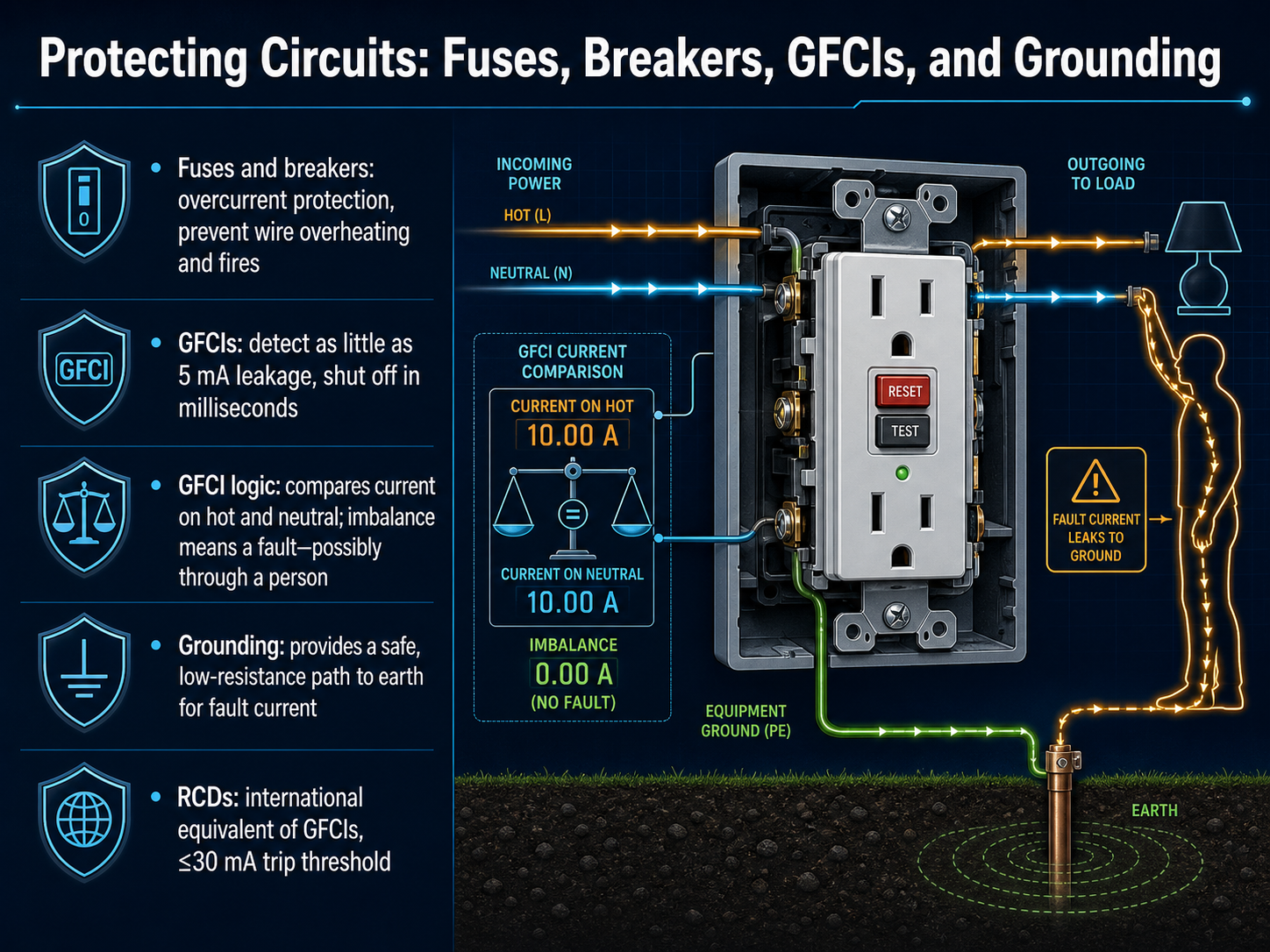
 - 11Protecting Circuits: Fuses, Breakers, GFCIs, and GroundingNow let's talk about the devices designed to keep us safe. Think of these as the guardians of the circuit. First, we have fuses and breakers. Their job is overcurrent protection. If too much current flows, a wire can overheat and start a fire. A fuse blows, or a breaker trips, to stop that current immediately. Next, and this is crucial for personal safety, we have the GFCI, or Ground Fault Circuit Interrupter. You'll see these in bathrooms and kitchens. A GFCI constantly compares the current flowing out on the hot wire and back on the neutral wire. If there's a tiny difference, as little as five milliamps, it detects a leak. That leak could be electricity flowing through a person to ground. The GFCI shuts off power in milliseconds, fast enough to save a life. Internationally, you may hear the term RCD, or Residual Current Device. It works on the same principle, tripping at thirty milliamps or less. Finally, grounding provides a safe, low-resistance path for fault current to flow directly into the earth. That's like a safety valve that helps protective devices work correctly. Understanding these few devices is a huge step in recognizing a safe environment. Next, we'll use that knowledge to recognize hazards and understand what to look for every day.
 osha.govccohs.calabtrain.noaa.gov+22 min
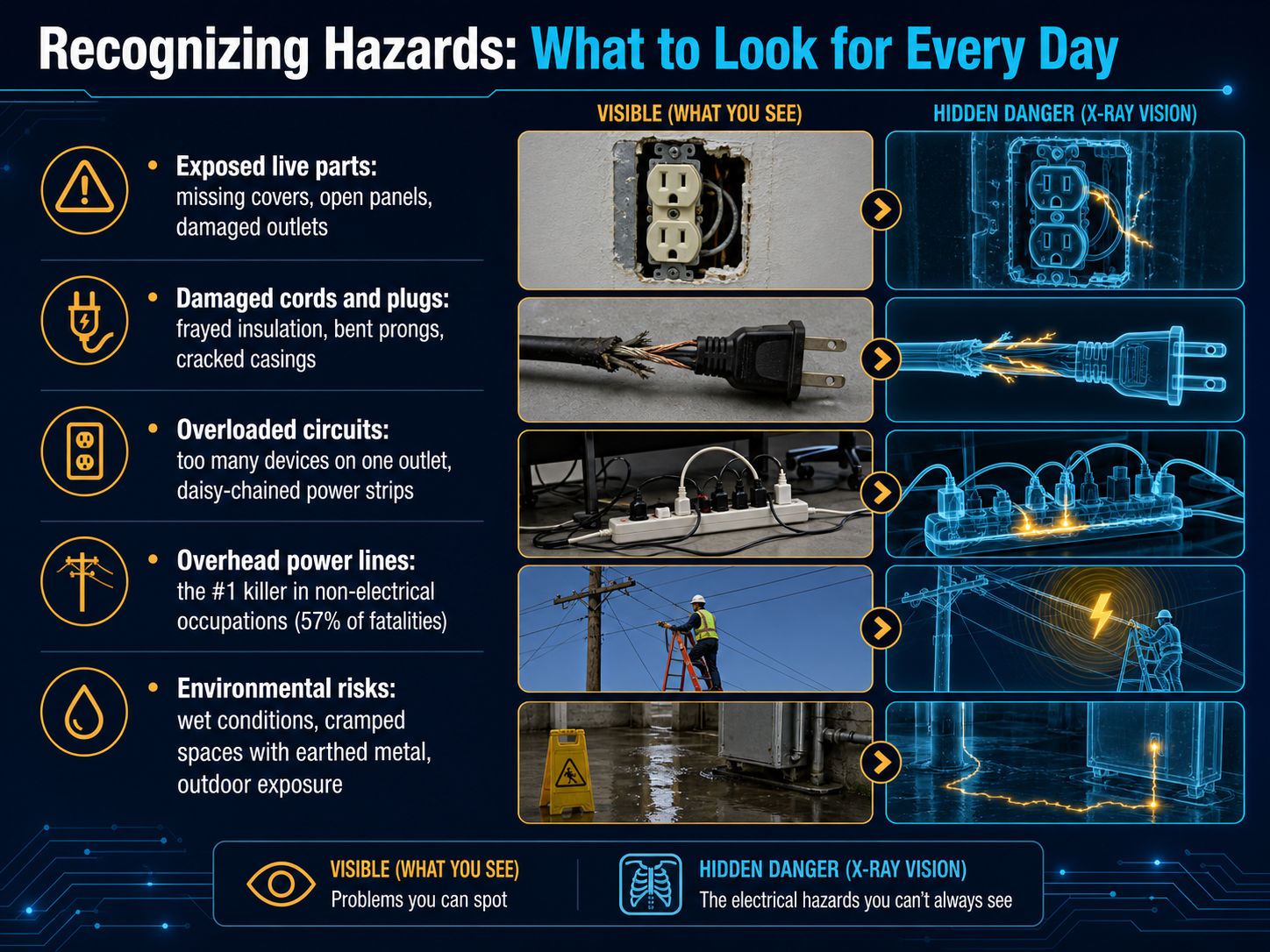
 - 12Recognizing Hazards: What to Look for Every DayNow let's talk about what to actually look for every day. Recognizing hazards is your first line of defense. First, exposed live parts. This means missing covers on breaker panels, open junction boxes, or outlets with broken faceplates. If you can see the wiring inside, stay away and report it. Next, check your cords and plugs. Look for frayed insulation, bent prongs, or cracked casings. A damaged cord is a shock waiting to happen. Also, watch for overloaded circuits. Are there too many things plugged into one outlet, or are power strips daisy-chained together? That's a major fire risk. Now, a very serious one: overhead power lines. You might think they don't affect you, but statistically, contact with overhead lines is the number one killer in non-electrical jobs, accounting for fifty-seven percent of fatalities. Always look up and stay at least ten feet away. Finally, consider your environment. Wet conditions, cramped spaces with lots of grounded metal, and outdoor exposure all dramatically increase the risk of shock. If you see any of these hazards, don't try to fix them yourself. Stop, and report it to a supervisor. Next, we'll move into safe work practices for non-electricians.
 osha.govccohs.calabtrain.noaa.gov+22 min
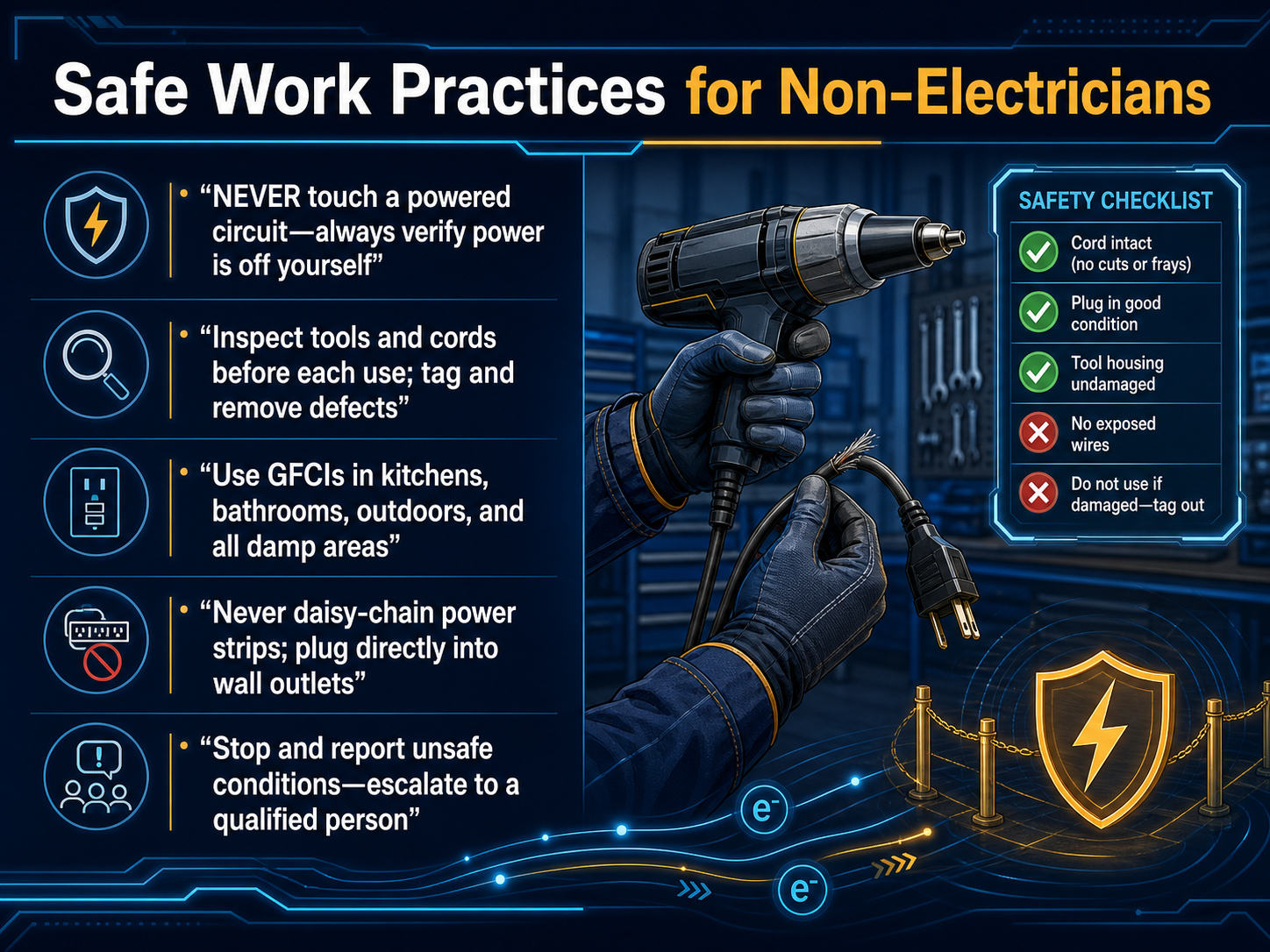
 - 13Safe Work Practices for Non-ElectriciansNow let's talk about some safe work practices that keep you, as a non-electrician, protected every day. The most important rule is never touch a powered circuit. If you need to plug something in or reset a breaker, always verify the power is off yourself. Don't take someone else's word for it. Before you use any tool or cord, give it a quick inspection. Look for cuts, cracks, or exposed wires. If you find a defect, tag it and take it out of service immediately. Remember that water and electricity are a deadly combination. In kitchens, bathrooms, outdoors, or any damp area, make sure your tools are plugged into a GFCI outlet. That's the outlet with the test and reset buttons. It's designed to shut off power in a fraction of a second if it senses a problem. Also, never daisy-chain power strips. Plugging one strip into another can overload the circuit and cause a fire. Always plug your equipment directly into a wall outlet. Finally, if you see an unsafe condition, like a missing breaker panel cover or a sparking outlet, stop and report it. Don't try to fix it yourself. Escalate it to a qualified electrician or your supervisor. You are the eyes and ears of your workplace. Speaking up can prevent a serious accident. Next, we'll cover what to do if something does go wrong, in our session on emergency response.
 osha.govccohs.calabtrain.noaa.gov+22 min
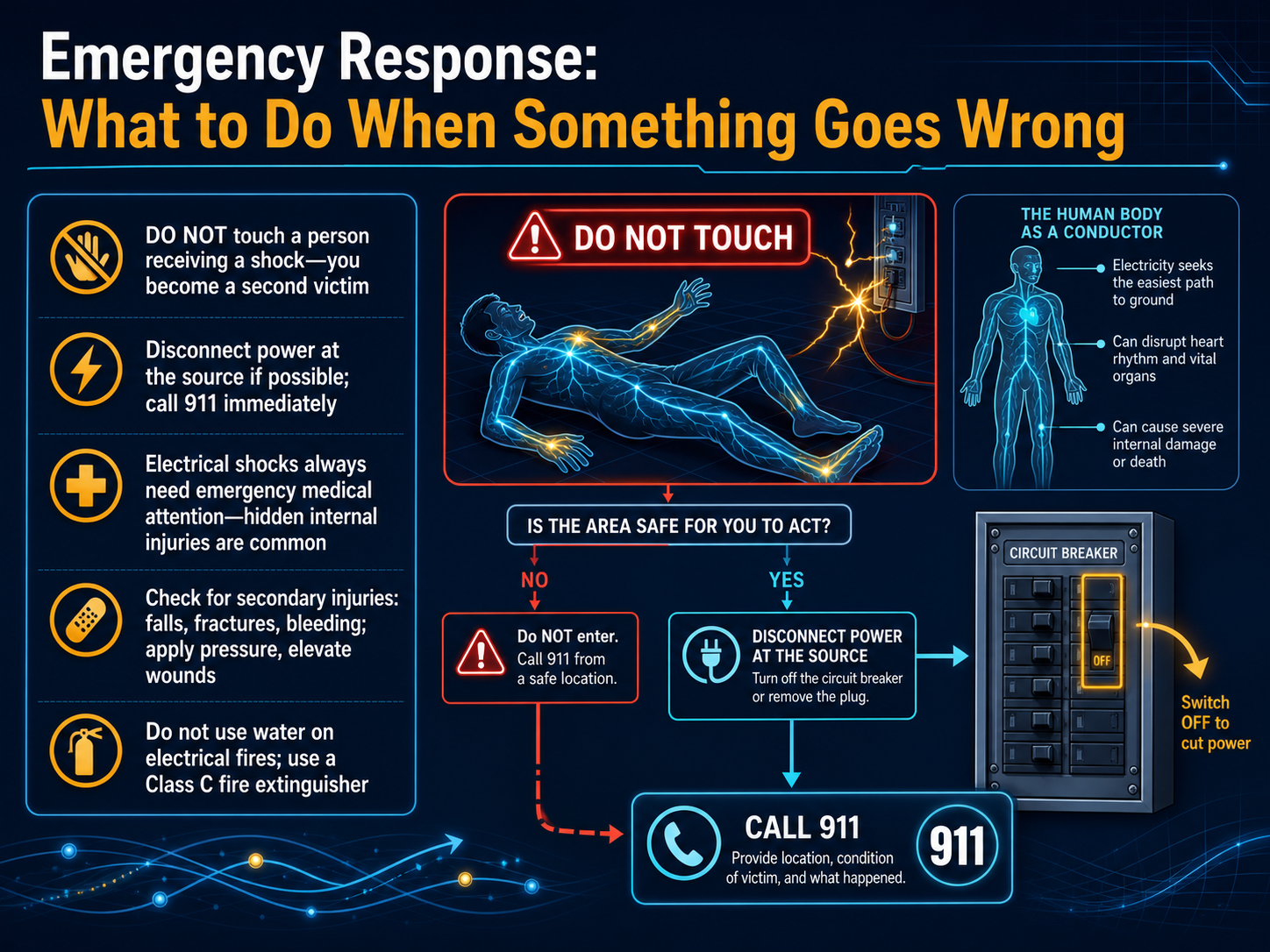
 - 14Emergency Response: What to Do When Something Goes WrongNow let's talk about what to do if something goes wrong. This is one of the most important parts of our safety mindset. Rule number one, and I cannot stress this enough, is do not touch a person who is receiving an electric shock. If you touch them, the electricity can pass from their body into yours, and you become a second victim. Your first step is to disconnect the power at the source if you can safely do so, and call 911 immediately. Remember, electrical shocks always need emergency medical attention, even if the person seems fine. Hidden internal injuries like tissue and nerve damage are very common. Next, check for secondary injuries. The shock may have caused violent muscle cramps, making the person fall. Look for fractures, bleeding, or other wounds. If they are bleeding, apply pressure and elevate the wound. Finally, a quick but critical note on electrical fires. Never, ever use water on an electrical fire. Water conducts electricity and can make the situation far worse. You must use a Class C fire extinguisher. Up next, we'll shift gears and put these concepts into practice with a hands-on demonstration of building a simple circuit.
 osha.govccohs.calabtrain.noaa.gov+22 min
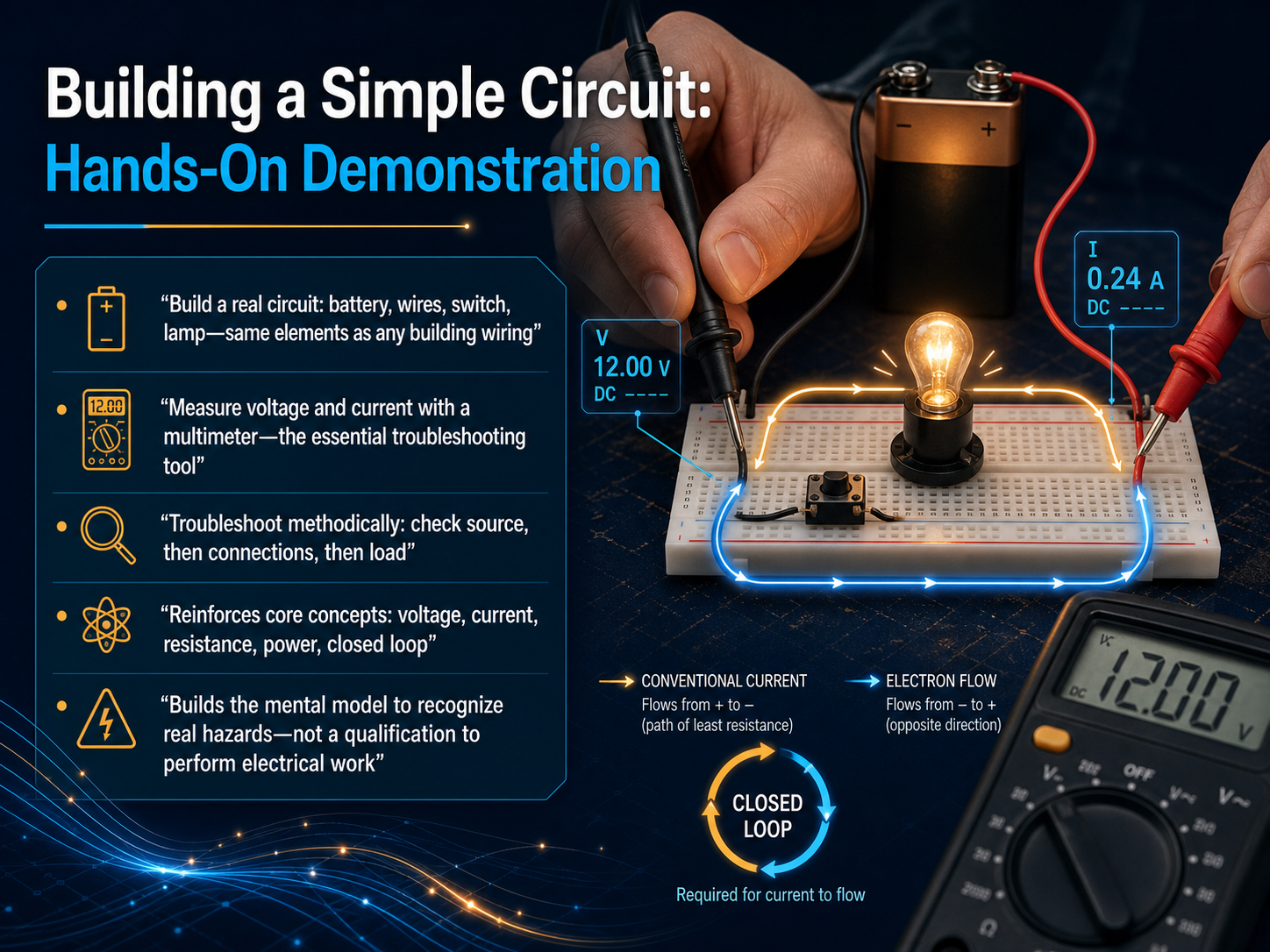
 - 15Building a Simple Circuit: Hands-On DemonstrationNow let's bring this all together with a real, hands-on demonstration. We’re going to build a simple circuit using the same basic building blocks you’d find in your home wiring: a battery, some wires, a switch, and a lamp. Seeing it on a workbench makes the theory feel real. Once the circuit is built, we’ll introduce the essential troubleshooting tool—the multimeter. We’ll put it to work, measuring voltage and current to show you exactly what’s flowing through the circuit. If something goes wrong, like a loose connection, we’ll troubleshoot methodically. We always start by checking the source, then the connections, and finally the load itself. This process isn’t just about fixing a small demo; it directly reinforces the core concepts of voltage, current, resistance, and power, and the non-negotiable need for a closed loop. Most importantly, this exercise builds the mental model you need to recognize real electrical hazards. Remember, this builds awareness, but it is not a qualification to perform electrical work. Next, we’ll review the core concepts that keep you safe.
 classcentral.comallaboutcircuits.comstartingelectronics.org+22 min
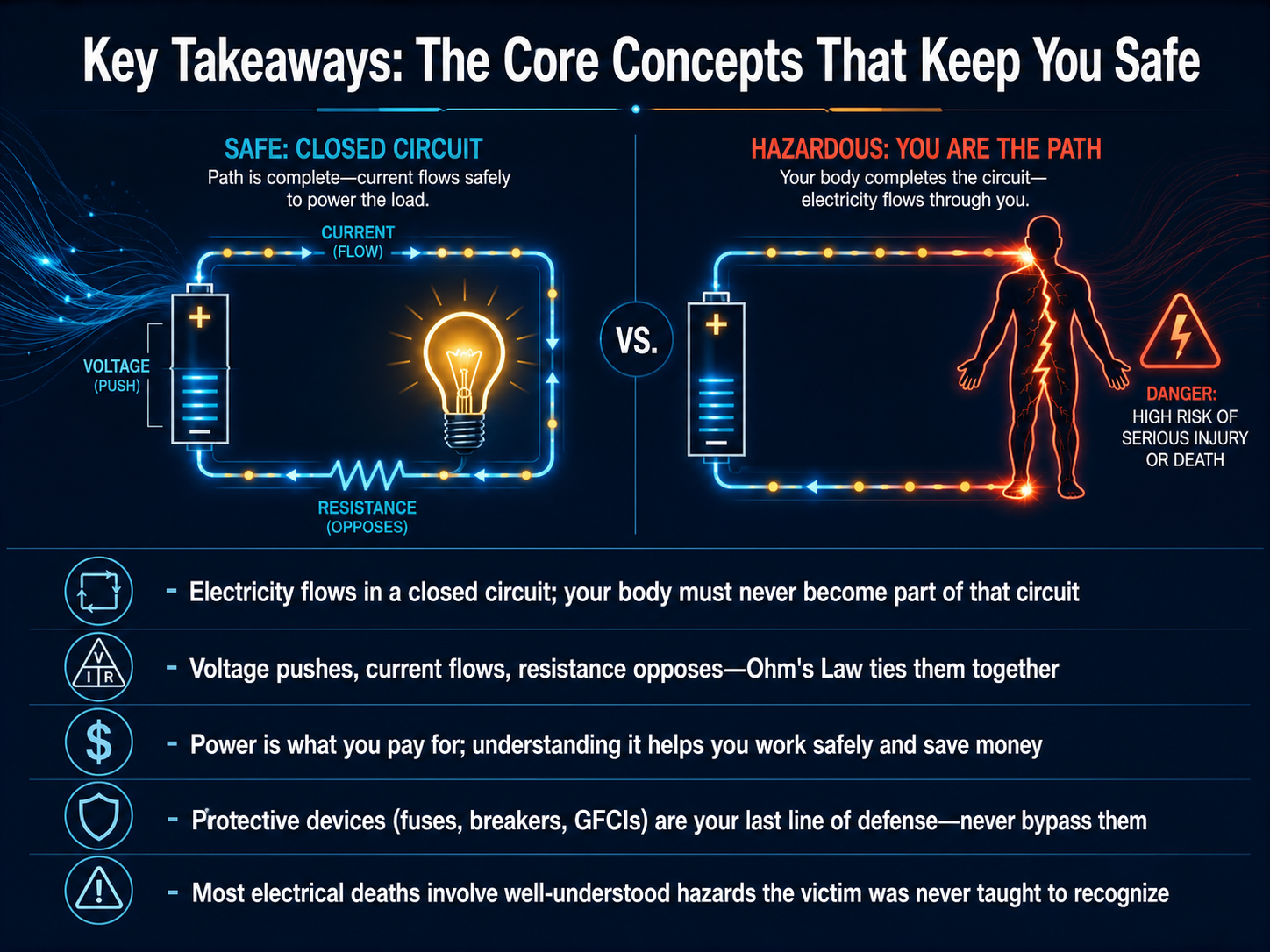
 - 16Key Takeaways: The Core Concepts That Keep You SafeLet's quickly pull together the core ideas that keep you safe. First, electricity flows in a closed loop, a circuit. Your body must never become part of that path. Second, remember the relationship: voltage pushes, current flows, and resistance opposes it. Ohm's Law ties all three together. Third, power is what you pay for. Understanding it helps you work safely and save money. Fourth, protective devices like fuses, breakers, and GFCIs are your last line of defense. Never bypass them. Finally, and this is crucial, most electrical deaths involve well-understood hazards that the victim was simply never taught to recognize. Your awareness is your best protection. Coming up next, let's look at resources for continued learning.
 osha.govccohs.calabtrain.noaa.gov+21 min
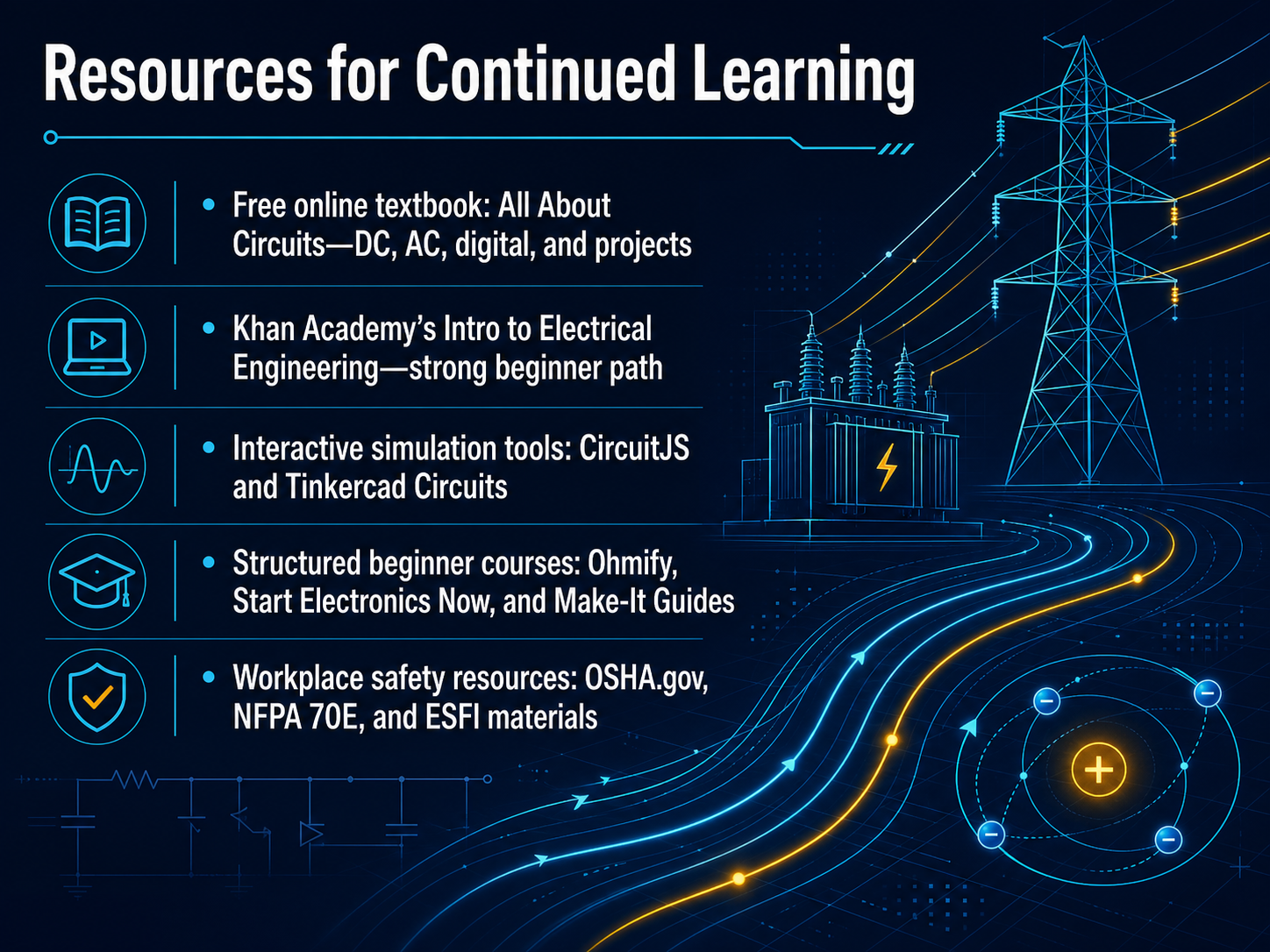
 - 17Resources for Continued LearningAnd that brings us to the end of our journey through circuits and energy. But your learning shouldn't stop here. I've put together a short list of resources to help you keep building your skills. You can start with the free, multi-volume textbook from All About Circuits, which covers DC, AC, and digital topics. For a guided, beginner-friendly path, check out Khan Academy's Intro to Electrical Engineering. When you're ready to experiment, try interactive simulators like CircuitJS or Tinkercad Circuits. They let you build and test circuits safely on your screen. If you prefer a structured course, explore platforms like Ohmify, Start Electronics Now, or the Make-It Guides. And please remember, safety is a lifelong habit. Bookmark the resources from OSHA, NFPA, and the Electrical Safety Foundation. Thank you for joining me today. You now have a solid foundation, so keep exploring, stay curious, and always respect the power of electricity.
 classcentral.comallaboutcircuits.comstartingelectronics.org+22 min
Take the deck with you
Download this course as a file — free, no sign-up needed.
- PDF handoutEvery slide page, ready to print or share.18 pages · 5.8 MBDownload
- Narrated PowerPointThe deck that presents itself — every slide carries the digital human's narration video.18 pages · 24.8 MBDownload
- PowerPoint slidesThe full deck as a .pptx — open it in PowerPoint, Keynote, or Google Slides.18 pages · 5.7 MBDownload
Free to use in your own training — please keep the PersonWise credit page at the end.
Have your own deck? Turn it into a course
Sources consulted
Web sources consulted while building this course.
- This material was produced under a Susan Harwood Training Grant #SH-24896-SH — osha.gov
- CCOHS: Electrical Safety - Basic Information — ccohs.ca
- Basic Electrical Safety — labtrain.noaa.gov
- Electrical safety and you: A brief guide (INDG231(rev1)) — hse.gov.uk
- Electrical - Overview | Occupational Safety and Health Administration — osha.gov
- Electricity Monthly Update - U.S. Energy Information Administration (EIA) — eia.gov
- Electric Power Monthly - U.S. Energy Information Administration (EIA) — eia.gov
- Electricity Rates by State (July 2026) | Electric Choice — electricchoice.com
- Electricity Rate per kWh 2026: 18.83c US Average, Rates by State and Utility — electricityratepertkwh.com
- Electricity Rates by State | July 2026 | Choose Energy — chooseenergy.com
- 7 Best Electronics Courses for 2026: Circuits and PCBs — Class Central — classcentral.com
- Textbook for Electrical Engineering & Electronics — allaboutcircuits.com
- Electronics Course for Beginners - Start Electronics Now! — startingelectronics.org
- Books/eBooks - Electrical Engineering Technology - LibGuides at SUNY Erie Community College — libguides.ecc.edu
- Beginner’s Electronics Guide: A Step‑by‑Step Path for New Makers — davevanderwekke.com