Begin
15 pages · ~30 min
Public Speaking Patterns and Pitfalls
Analyze real public speaking examples to identify effective patterns, strengths, and common pitfalls. Ideal for speakers seeking to refine their delivery.
A digital instructor presents all 15 pages. Hold “Ask” at any point and ask out loud — the answer comes from this course. No sign-up needed.
What you’ll learn
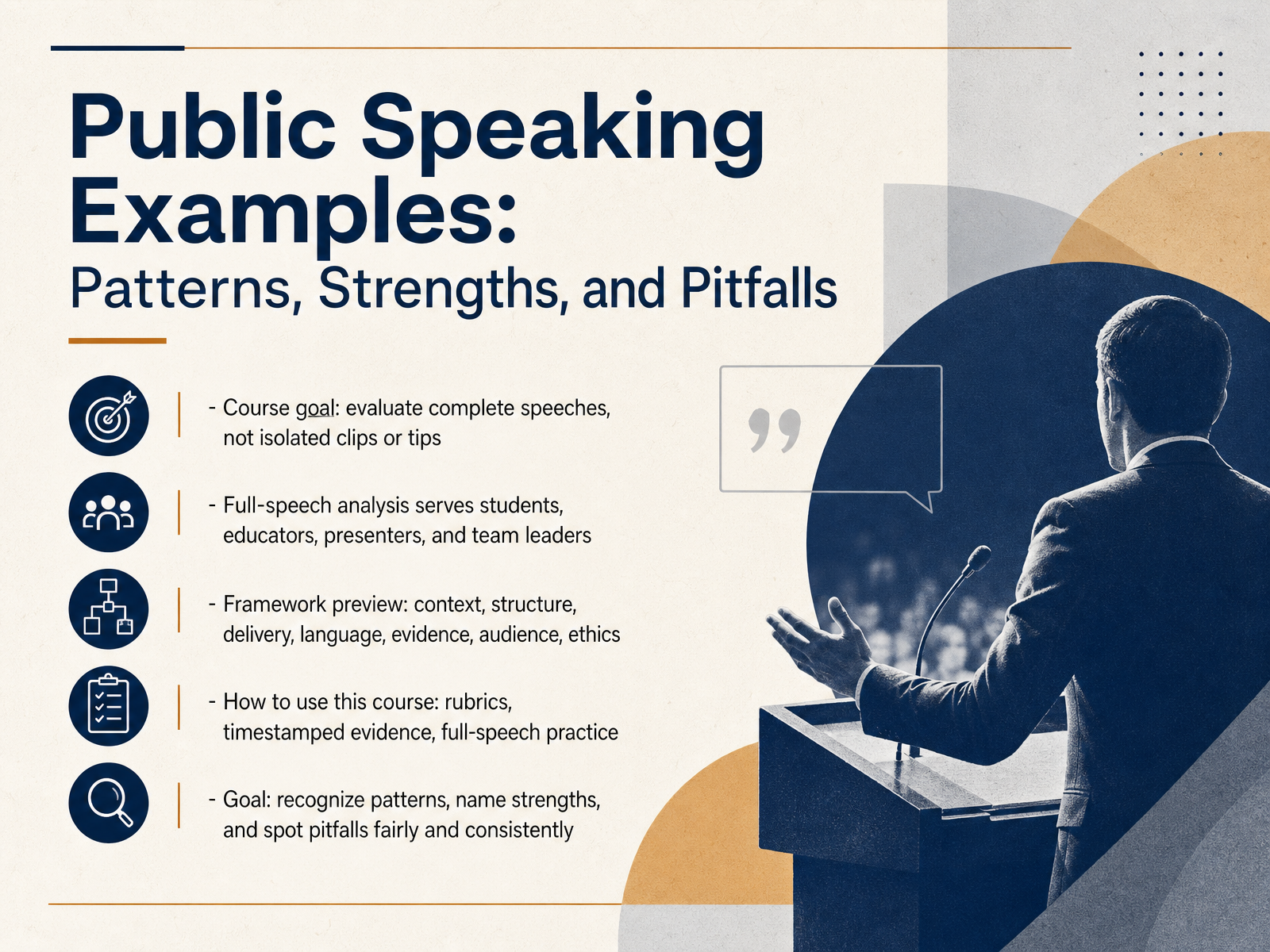
- 01Public Speaking Examples: Patterns, Strengths, and PitfallsWelcome. I'm glad you're here, because evaluating a speech well is a skill you can build. This course is about analyzing complete speeches, not isolated clips or quick tips. That matters, because a transcript of one sentence, or a thirty second highlight, can predict a lot. But it can't tell you whether the whole argument held together or whether the speaker earned the ending.
Full speech analysis serves students, educators, presenters, and team leaders. Whoever you are, your job is the same. Identify a pattern, name its strength or pitfall, and explain the likely effect on an audience. To help you do that, we'll work through a framework with seven lenses. Context, structure, delivery, language, evidence, audience, and ethics. You'll use rubrics to anchor your scores, timestamped evidence to support your judgments, and full speeches to practice on. Filler words, pacing, transitions, and slide design may all come up, but always in the context of the complete performance.
The goal is simple. Recognize patterns, name strengths, and spot pitfalls fairly and consistently. Let's begin with why complete speeches reveal more than clips.doi.orgdoi.orgdoi.org+21 min
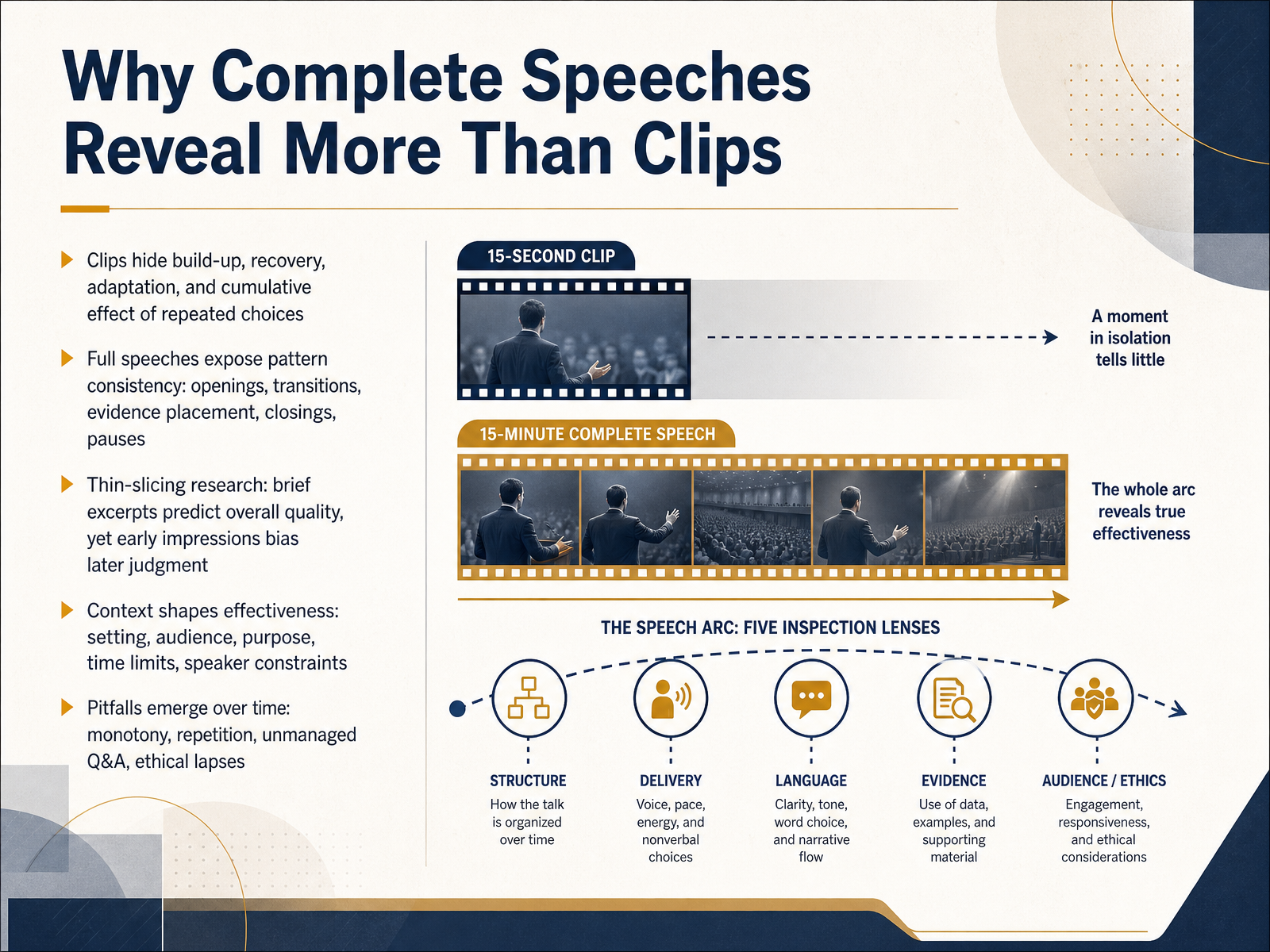
- 02Why Complete Speeches Reveal More Than ClipsNow, why do complete speeches reveal more than clips? When you only watch a short excerpt, you miss the build-up, the recovery after a stumble, the speaker's adaptation to the room, and the cumulative effect of repeated choices. A full speech exposes pattern consistency: how openings are framed, how transitions land, where evidence is placed, how closings are delivered, and how pauses are used. Research on thin slicing shows that brief excerpts can predict overall quality fairly well. Yet those early impressions bias later judgment, so a strong opening can mask a weak ending. Context matters too. The setting, audience, purpose, time limits, and speaker constraints all shape what effectiveness means. And pitfalls only emerge over time, like monotony, repetition, unmanaged Q and A, or ethical lapses. So evaluate the whole speech, not just the highlight. Next, we will use the Five-Lens Evaluation Framework to guide that analysis.
 doi.orgdoi.orgdoi.org+22 min
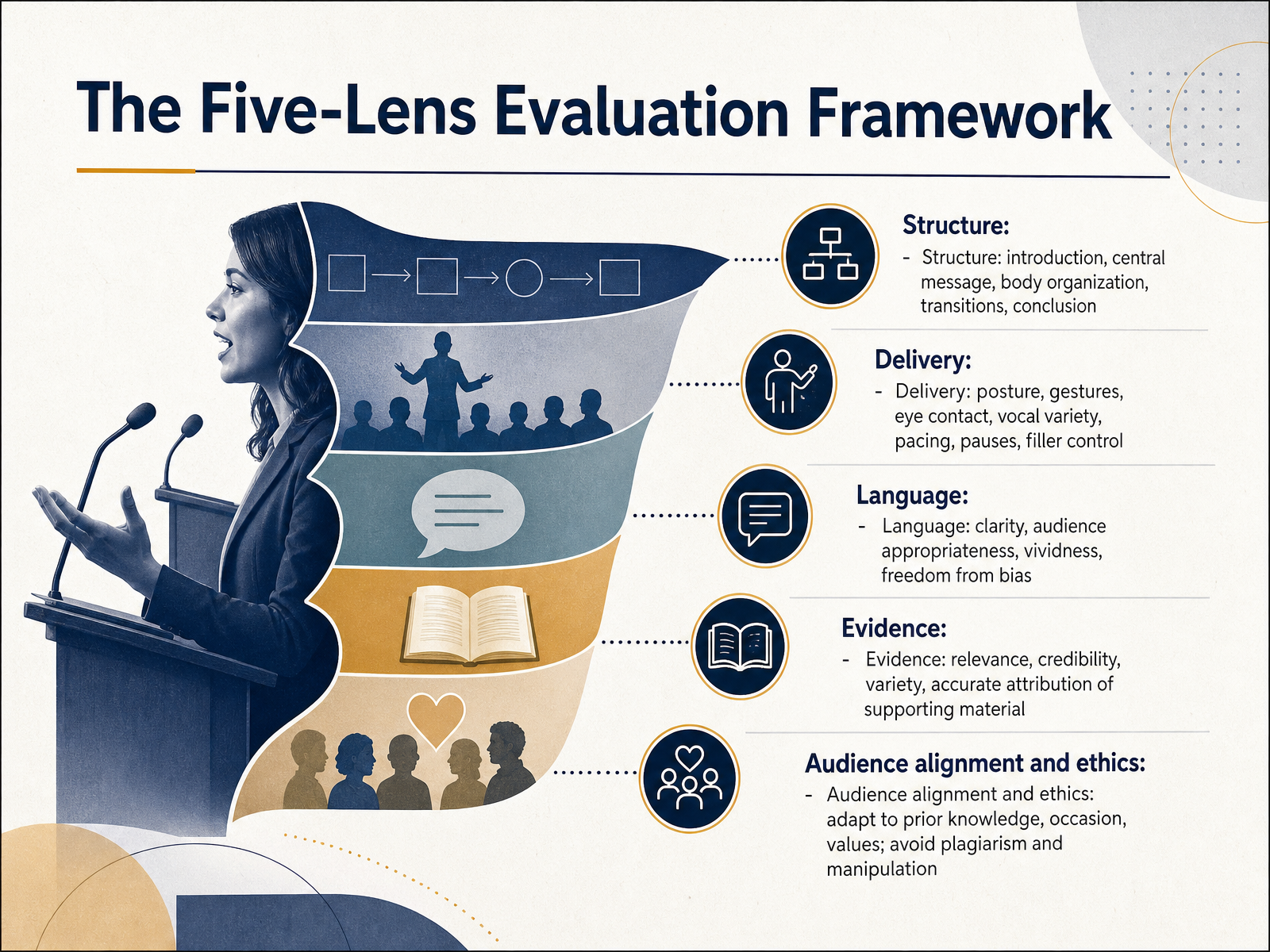
- 03The Five-Lens Evaluation FrameworkNow let's give you a practical structure for evaluating any complete speech. Think of it as five lenses, and you can apply them in any order. First, structure. Listen for a clear introduction, a central message, organized body sections, transitions, and a conclusion that actually closes the loop. If the central message is hard to find, that's your first pattern to name. Second, delivery. Watch posture, gestures, and eye contact, and listen for vocal variety, pacing, pauses, and filler control. A speaker who looks at the audience rather than their notes usually lands better. Third, language. Ask whether the words are clear, appropriate for this audience, vivid, and free from bias. Fourth, evidence. Check relevance, credibility, variety, and whether sources are attributed accurately. A mix of examples, statistics, and expert quotes is stronger than one repeated type. Fifth, audience alignment and ethics. Does the speaker adapt to what listeners already know, to the occasion, and to their values, while avoiding plagiarism and manipulation? That last lens is where evaluation becomes a judgment about responsibility, not just skill. So here's your takeaway. When you analyze a speech, name the lens, name the strength or pitfall, then explain the likely effect on the audience. That habit turns vague reactions into useful, specific feedback. Next, we'll look at the structural patterns that tend to work best.
 assessment.unc.edupittstate.edulibrary.ascd.org+22 min
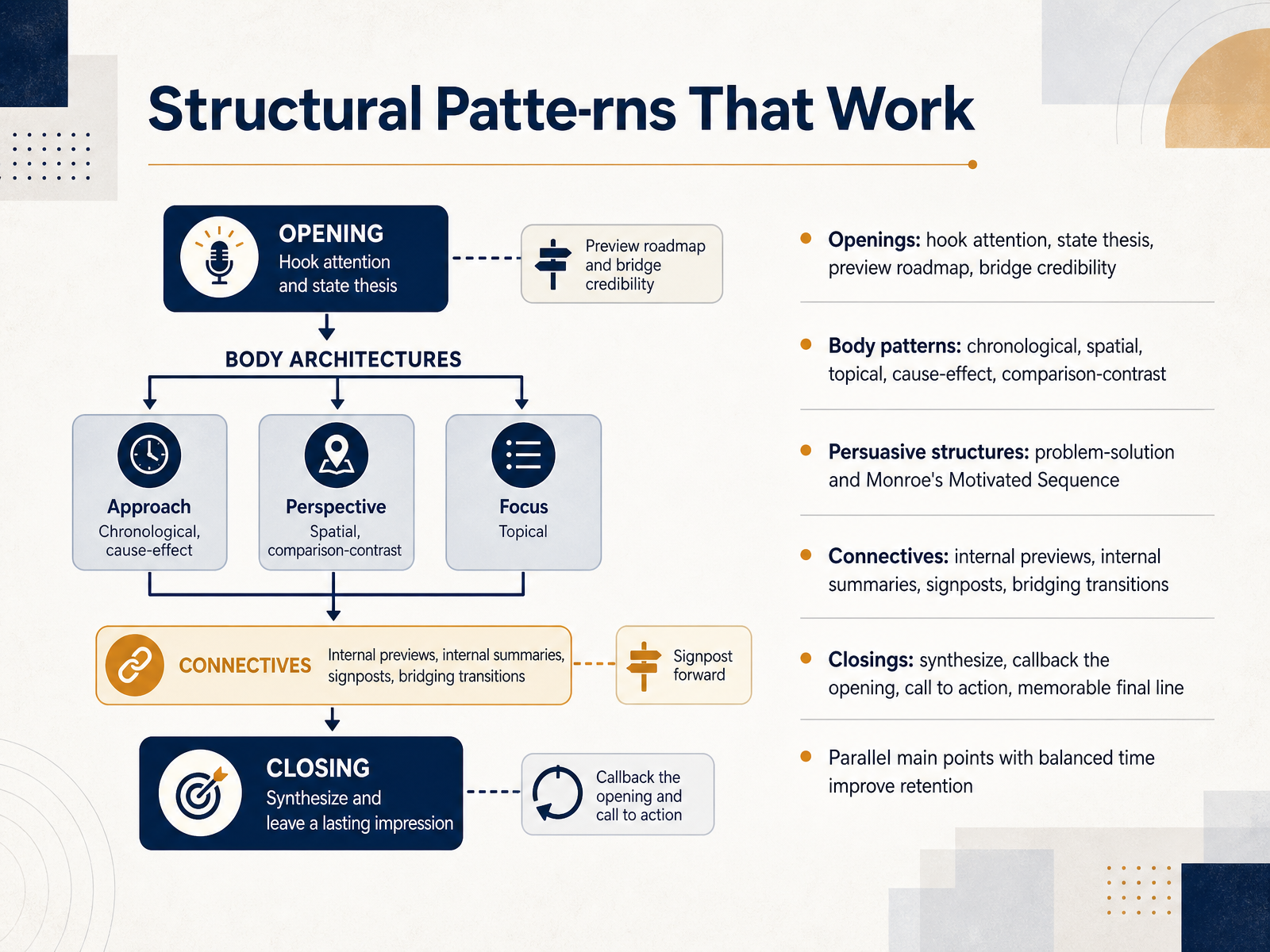
- 04Structural Patterns That WorkNow let's look at structural patterns that work. Think of structure as your speech's architecture. Strong speeches usually open by hooking attention, stating the thesis, previewing the roadmap, and bridging credibility. For the body, you can organize points chronologically, spatially, topically, by cause and effect, or by comparison and contrast. When you need to persuade, problem-solution and Monroe's Motivated Sequence both move an audience from need toward action. Connectives hold everything together. Internal previews tell listeners what's coming, internal summaries remind them what they just heard, signposts mark their location, and bridging transitions carry them forward. Close by synthesizing your message, calling back to your opening, issuing a call to action, or landing a memorable final line. One dependable choice is keeping your main points parallel and giving each roughly equal time. That balance makes your speech easier to follow and remember. Next, we'll explore delivery and rhetorical patterns that work.
 opentext.ku.educomm.pitt.edusocialsci.libretexts.org+22 min
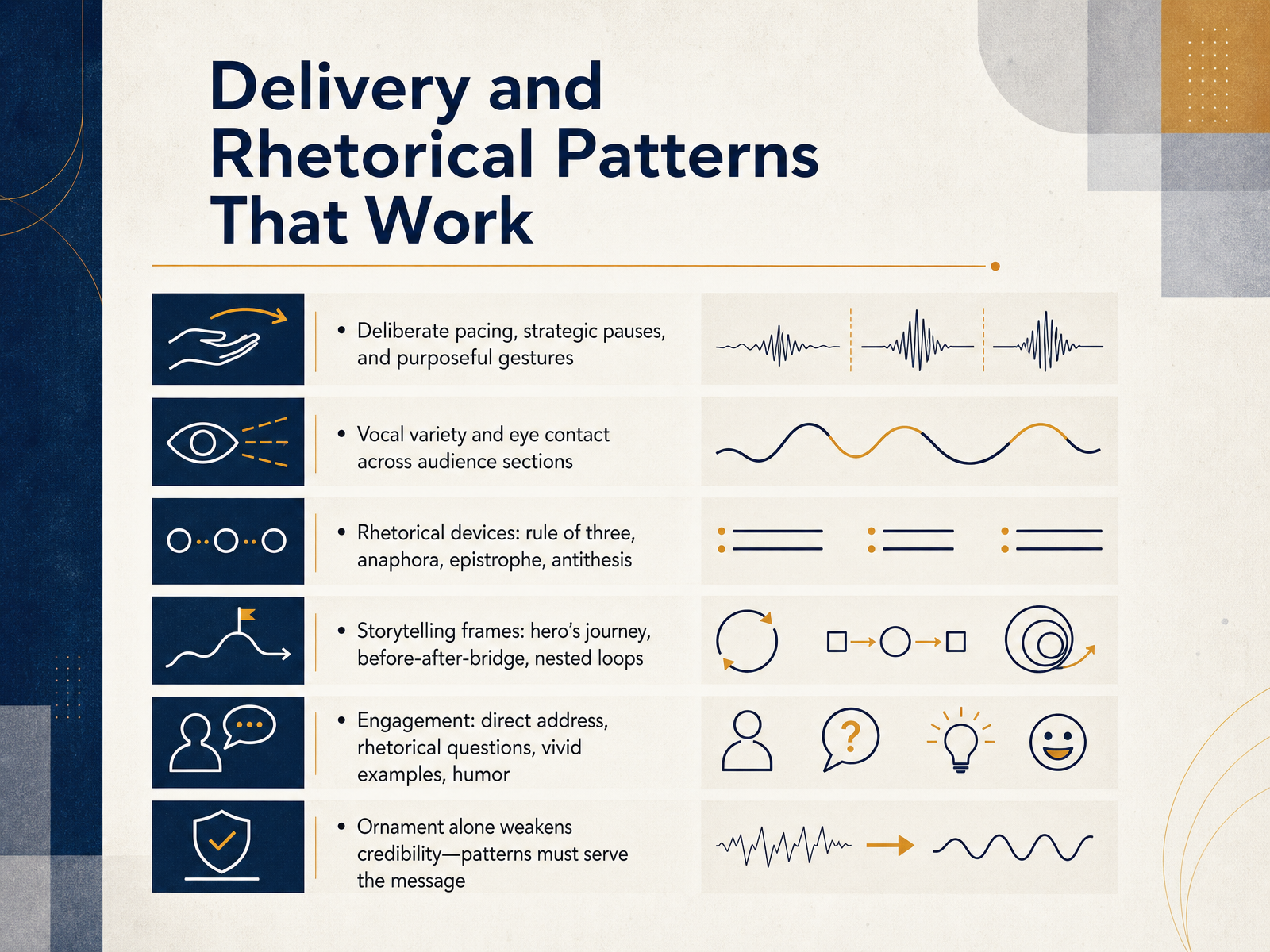
- 05Delivery and Rhetorical Patterns That WorkNow let's examine the delivery and rhetorical patterns that consistently work. When you evaluate a speech, start with delivery. Deliberate pacing, strategic pauses, and purposeful gestures all signal control. So does vocal variety, along with eye contact that moves across sections of the audience rather than fixing on one spot. Then look at the language itself. Rhetorical devices like the rule of three, anaphora, epistrophe, and antithesis create rhythm and emphasis. Storytelling frames, such as the hero's journey, the before-after-bridge, and nested loops, give content a shape an audience can follow and remember. Engagement strategies, including direct address, rhetorical questions, vivid examples, and humor, keep listeners involved. Here is the key evaluation principle. Ornament alone weakens credibility. When you name a pattern, ask whether it serves the message, and explain the likely effect on the audience. A pause that lands a point is a strength. A pause that simply fills space is a pitfall. Next, we turn to structural pitfalls in complete speeches.
 opentext.ku.educomm.pitt.edusocialsci.libretexts.org+22 min
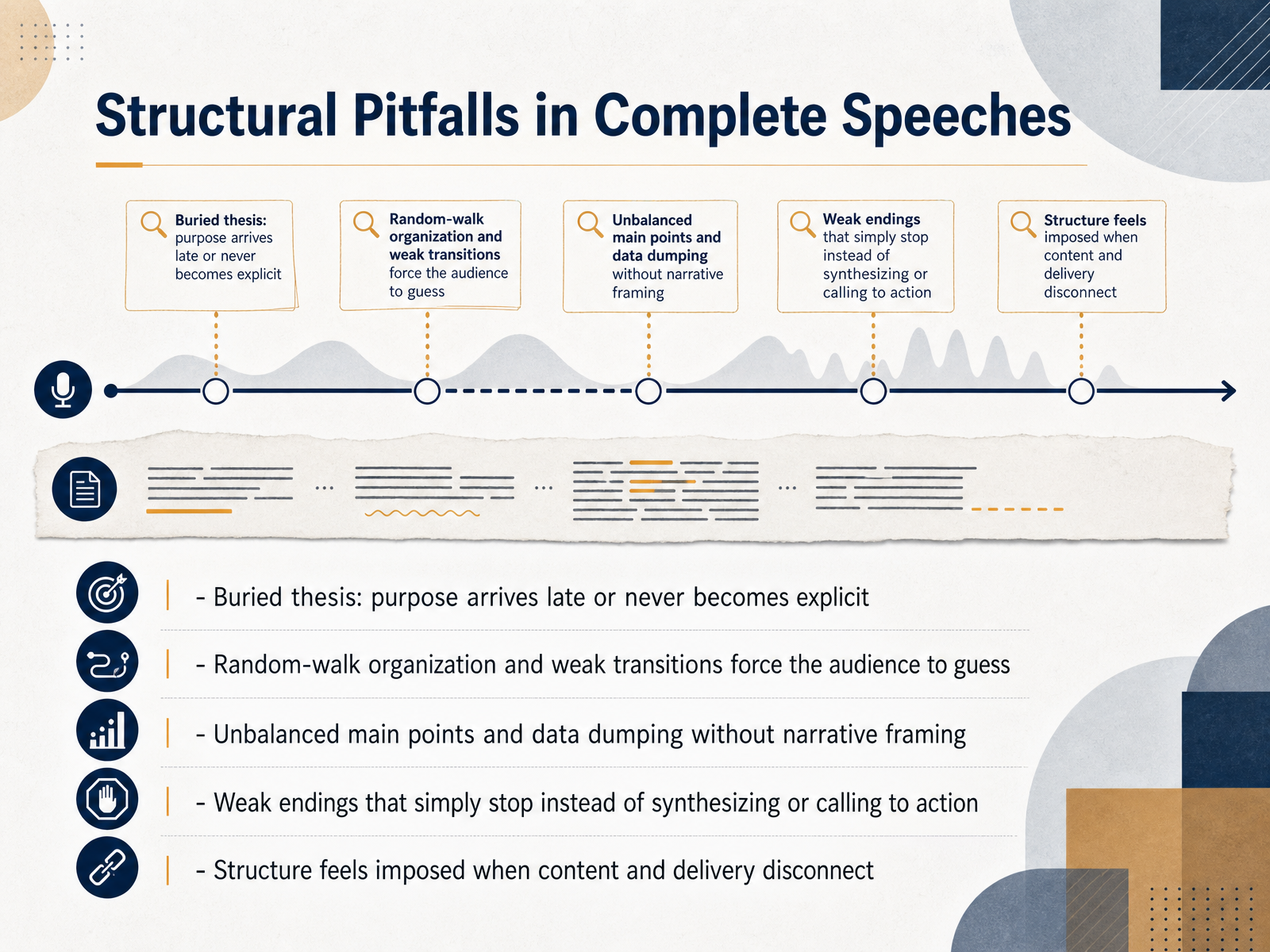
- 06Structural Pitfalls in Complete SpeechesNow let's look at structural pitfalls you'll commonly see in full speeches. Your job is to spot the pattern, name the flaw, and explain the effect on the audience. Start with a buried thesis. If the purpose arrives late, or never becomes explicit, listeners spend the opening guessing. Next, random walk organization. When points jump around and transitions are weak, the audience has to build the structure themselves. Then there's imbalance. One main point gets most of the time while others are rushed. Data dumping is a cousin of this. Numbers without a narrative frame feel like noise rather than evidence. Watch for weak endings too. A speech that simply stops leaves the audience without synthesis or direction. Finally, structure can feel imposed. When content and delivery disconnect, the organization looks like a template rather than a path. As you evaluate, name the pitfall and its likely audience effect. That keeps your analysis specific. Let's turn now to delivery, evidence, audience, and ethical pitfalls.
 opentext.ku.educomm.pitt.edusocialsci.libretexts.org+21 min
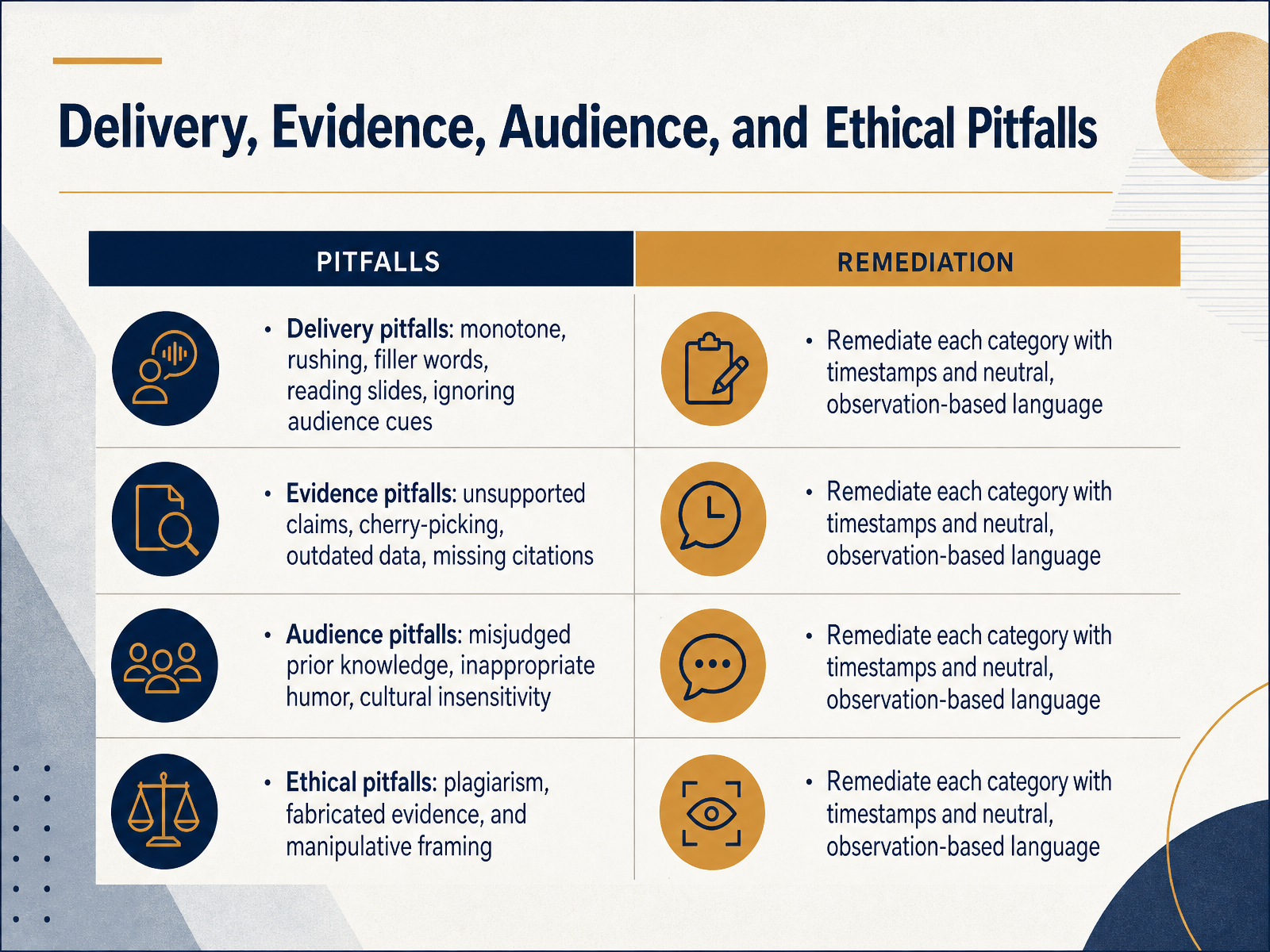
- 07Delivery, Evidence, Audience, and Ethical PitfallsLet's look at four categories of pitfalls you will encounter when evaluating a complete speech: delivery, evidence, audience fit, and ethics. For delivery, listen for a monotone voice, rushing, filler words, reading from slides, and ignoring audience cues. Imagine a speaker racing through twenty minutes of dense data; the audience simply cannot absorb it, so the pattern is overload, and the effect is disengagement. For evidence, watch for unsupported claims, cherry-picking, outdated data, and missing citations. If a speaker cites one favorable study and hides three contradictory ones, name the pitfall as selective evidence and explain that trust erodes once the audience senses a stacked deck. Audience pitfalls include misjudged prior knowledge, inappropriate humor, and cultural insensitivity. Ethical pitfalls are the most serious: plagiarism, fabricated evidence, and manipulative framing. Your practical move is remediation. Anchor every observation to a timestamp and use neutral, observation-based language. Instead of saying the speaker was boring, say that from two minutes to three minutes the pace stayed fast and the tone changed little, which made key points harder to follow. That gives the presenter something concrete to fix. Keep your eyes on one more complete speech, because we will now apply these patterns directly. That brings us to our case study on Majora Carter's TED Talk.
 mannerofspeaking.orgmannerofspeaking.orgsixminutes.dlugan.com+22 min
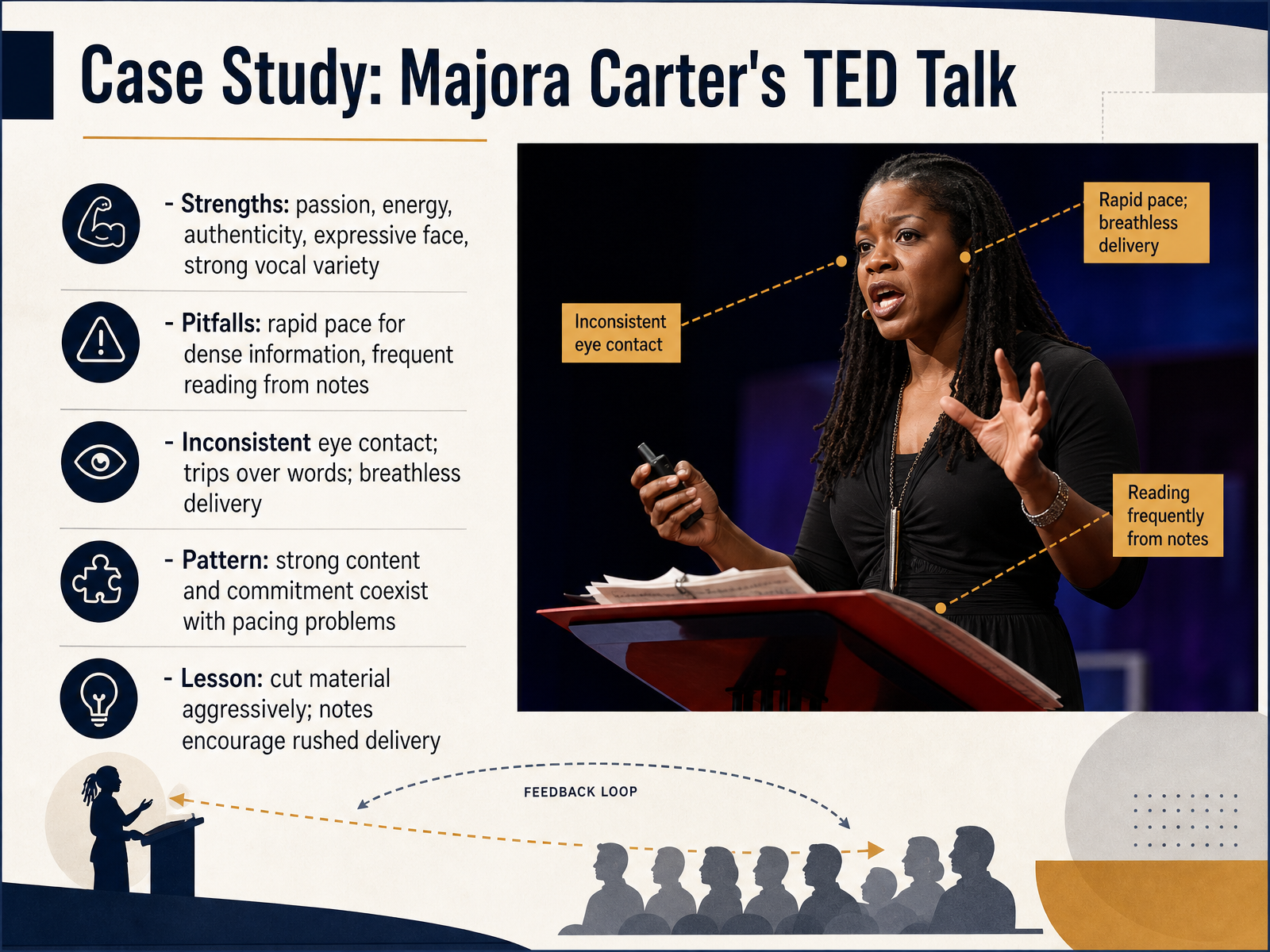
- 08Case Study: Majora Carter's TED TalkLet's put these evaluation skills to work on a full speech, a case study you can learn a lot from. Majora Carter's TED Talk is a powerful example of strengths and pitfalls living side by side. Her strengths are obvious: real passion, energy, authenticity, an expressive face, and strong vocal variety. She clearly cares about her message. But the pitfalls matter too. She speaks at a rapid pace, even though her material is dense. She reads from notes often, and that habit encourages rushed delivery. Her eye contact is inconsistent. She trips over words and sounds breathless, which tells you the information load is simply too high for the time. So notice the pattern: strong content and deep commitment coexist with pacing problems. The lesson is practical. Cut your material aggressively, because fewer ideas delivered well will land harder than many ideas delivered fast. Next, we'll look at a very different case: Mohammed Qahtani's championship speech.
 mannerofspeaking.orgmannerofspeaking.orgsixminutes.dlugan.com+22 min
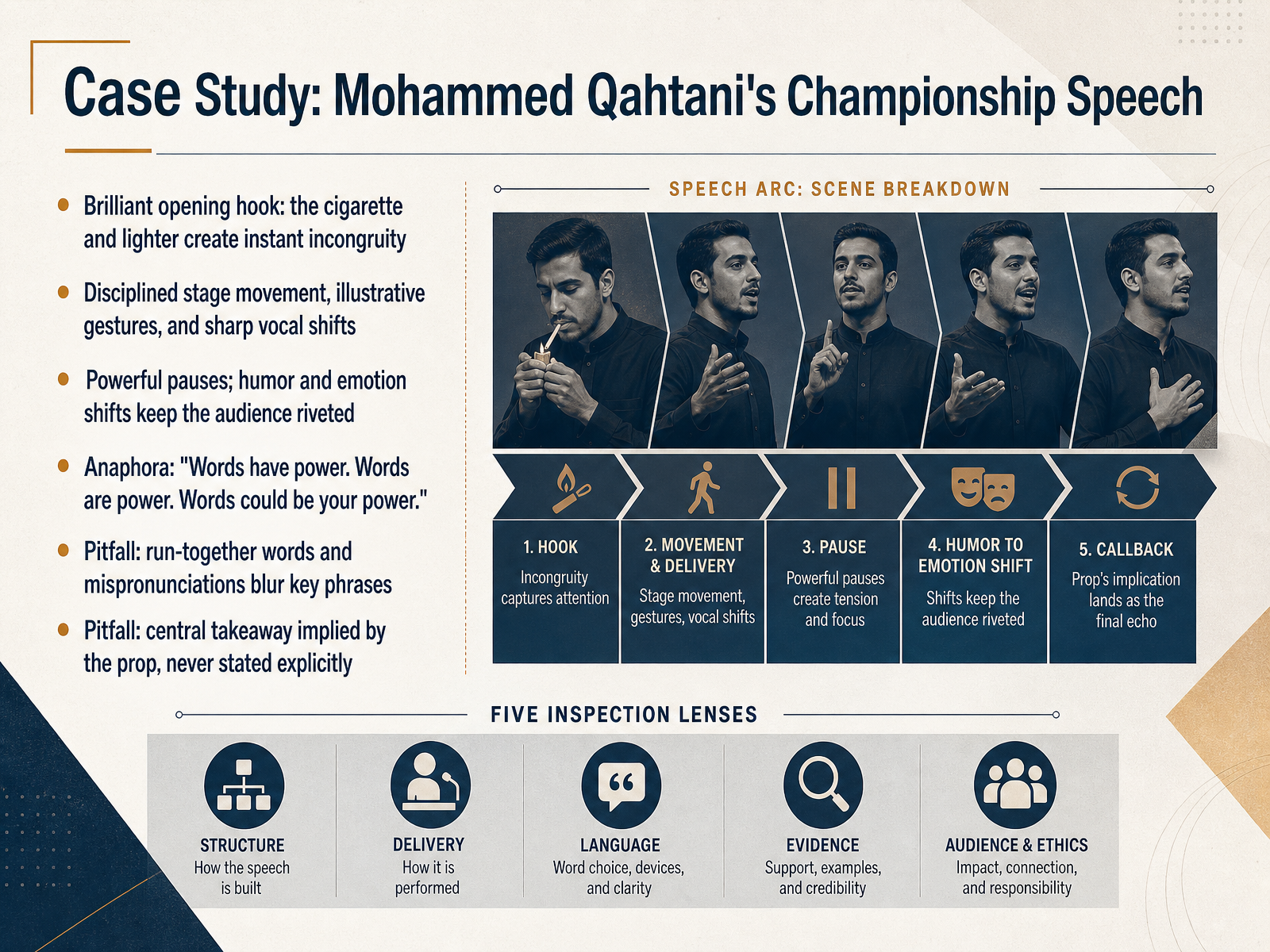
- 09Case Study: Mohammed Qahtani's Championship SpeechNow let's put these evaluation skills into practice with a well-known example: Mohammed Qahtani's championship speech. Watch how he opens. He pulls out a cigarette and a lighter, and the audience instantly wonders if he will really light up on stage. That incongruity is a deliberate pattern, and its strength is immediate attention. He also owns the stage with disciplined movement, illustrative gestures, and sharp vocal shifts. His pauses are powerful, and his quick turns between humor and emotion keep the audience riveted. Listen for anaphora too: words have power, words are power, words could be your power. That repetition builds momentum. But name the pitfalls as well. He sometimes runs words together or mispronounces them, which blurs key phrases. And his central takeaway stays implied by the prop rather than stated outright. So ask yourself: what is the pattern, is it a strength or a pitfall, and how does it affect the audience? Next, we will see how another speaker applies these lessons in a different setting: Mark Carney's Davos speech.
 mannerofspeaking.orgmannerofspeaking.orgsixminutes.dlugan.com+21 min
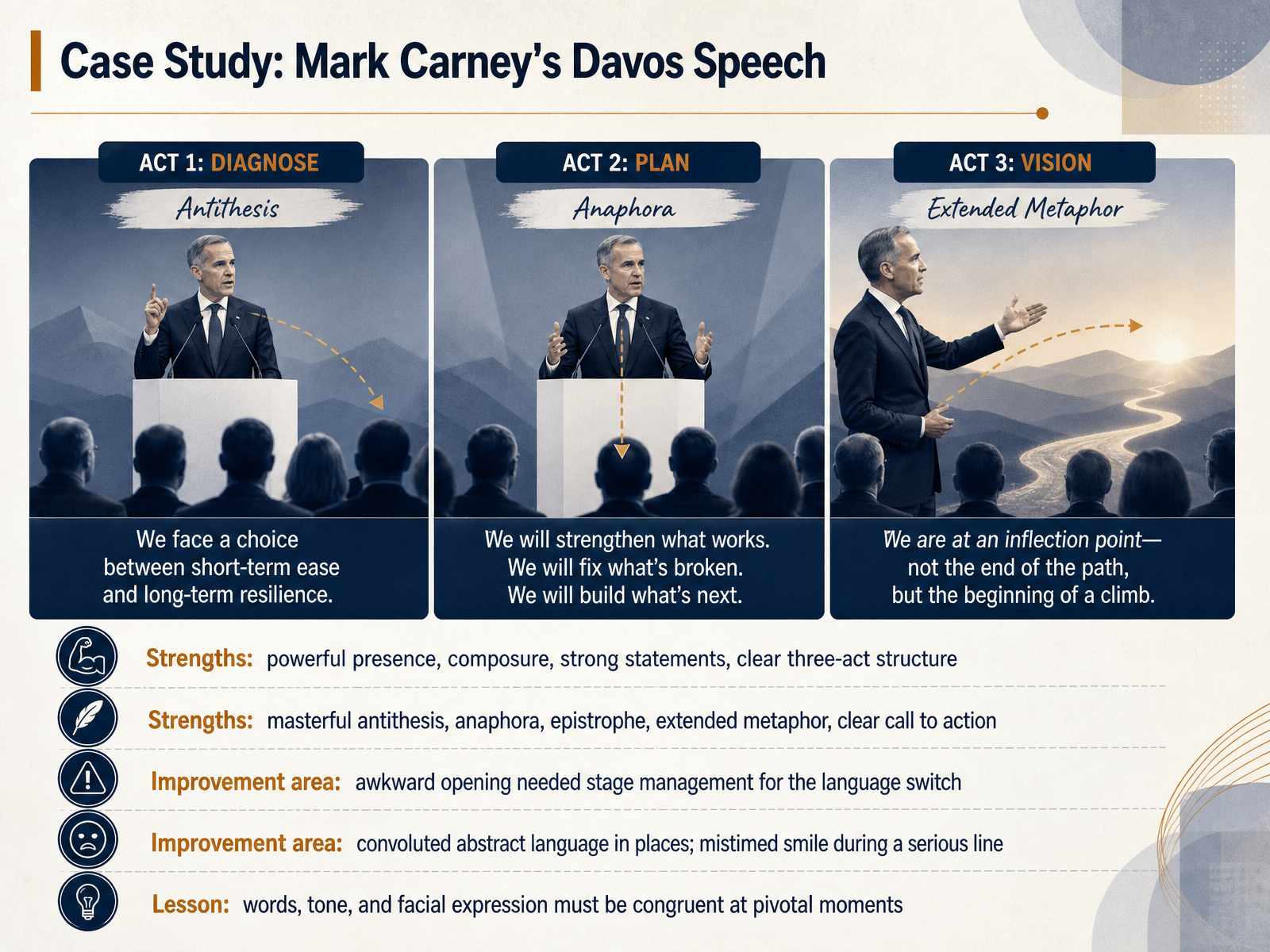
- 10Case Study: Mark Carney's Davos SpeechNow let's apply these ideas to a real, complete speech. Our case study is Mark Carney's Davos speech. Start with the strengths. Carney projects powerful presence and composure. He knows exactly where he is going. His structure is a clear three-act shape: diagnose the problem, present the plan, then paint the vision. Listen for his strong statements, like nostalgia is not a strategy. That line lands because it is short and sure. He is also a master of rhetorical devices. He uses antithesis, anaphora, epistrophe, and an extended metaphor about a shopkeeper's sign. And he finishes with a clear call to action. Now the improvement areas. His opening was awkward, and it needed stage management for the language switch from French to English. In places, his language became convoluted and abstract, burying the point. And during a serious line, he smiled at the wrong moment. Here is the lesson. Words, tone, and facial expression must be congruent at pivotal moments. So when you evaluate a speech, name the pattern, name the strength or pitfall, and explain the effect on the audience. Next, we look at how to read a complete speech through annotation and evidence capture.
 mannerofspeaking.orgmannerofspeaking.orgsixminutes.dlugan.com+22 min
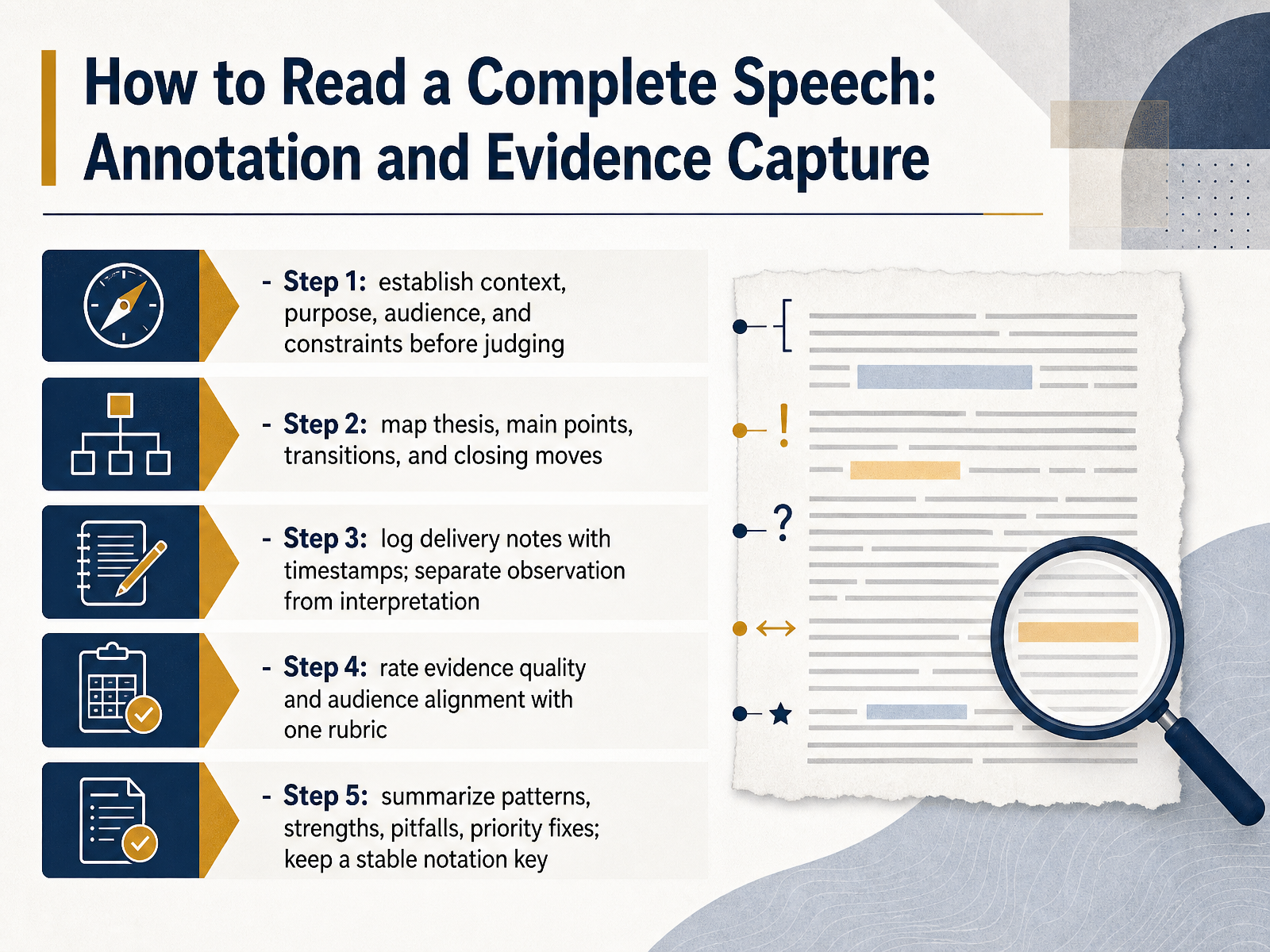
- 11How to Read a Complete Speech: Annotation and Evidence CaptureNow let's make that evaluation process repeatable. Reading a complete speech takes a steady method, not a single impression. So here is a five-step workflow you can apply right away.
First, establish context, purpose, audience, and constraints before you judge anything. A speech to a hostile board is not failing just because it is cautious.
Second, map the structure. Where is the thesis? What are the main points? How do the transitions connect them, and what closing moves does the speaker use?
Third, log delivery notes with timestamps. Keep observation separate from interpretation. Write that the speaker paused for two seconds, not that they seemed nervous.
Fourth, rate evidence quality and audience alignment using one rubric, so your judgments stay consistent across speeches.
Fifth, summarize patterns, strengths, pitfalls, and priority fixes. Keep a stable notation key. If a pause marker means the same thing every time, your notes stay comparable and defensible.
That stability is what turns scattered impressions into evidence you can explain and act on.
Next, we put this method to work in the Practice Workshop: Evaluating Real Speeches.
 2 min
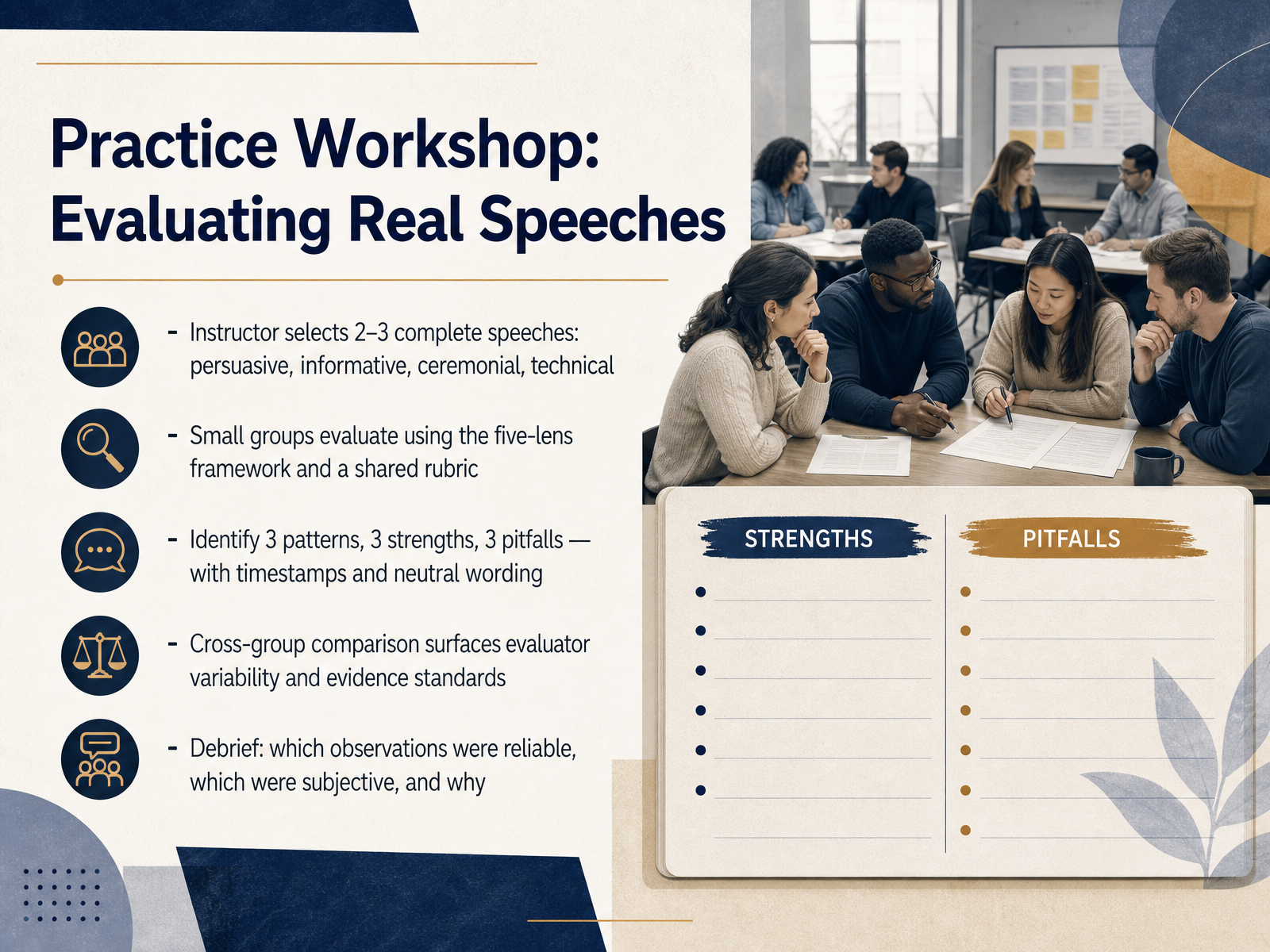
- 12Practice Workshop: Evaluating Real SpeechesNow let's put all of this into practice. For this workshop, your instructor selects two or three complete speeches, drawing from persuasive, informative, ceremonial, or technical contexts. In small groups, you evaluate each one using the five-lens framework and a shared rubric. Your task is to identify three patterns, three strengths, and three pitfalls, each supported with timestamps and neutral wording. For example, instead of saying the speaker seemed nervous, you might write, at two minutes fifteen seconds, the speaker paused and looked down for four seconds during the key claim. Once groups finish, you compare findings across teams. This step is where the real learning happens, because it surfaces evaluator variability and clarifies what counts as solid evidence. Then, in the debrief, ask yourselves which observations were reliable across groups, which were more subjective, and why. That reflection sharpens your judgment for every speech you assess from now on. Next, we'll look at tailoring feedback to roles and audiences.
 doi.orgdoi.orgdoi.org+22 min
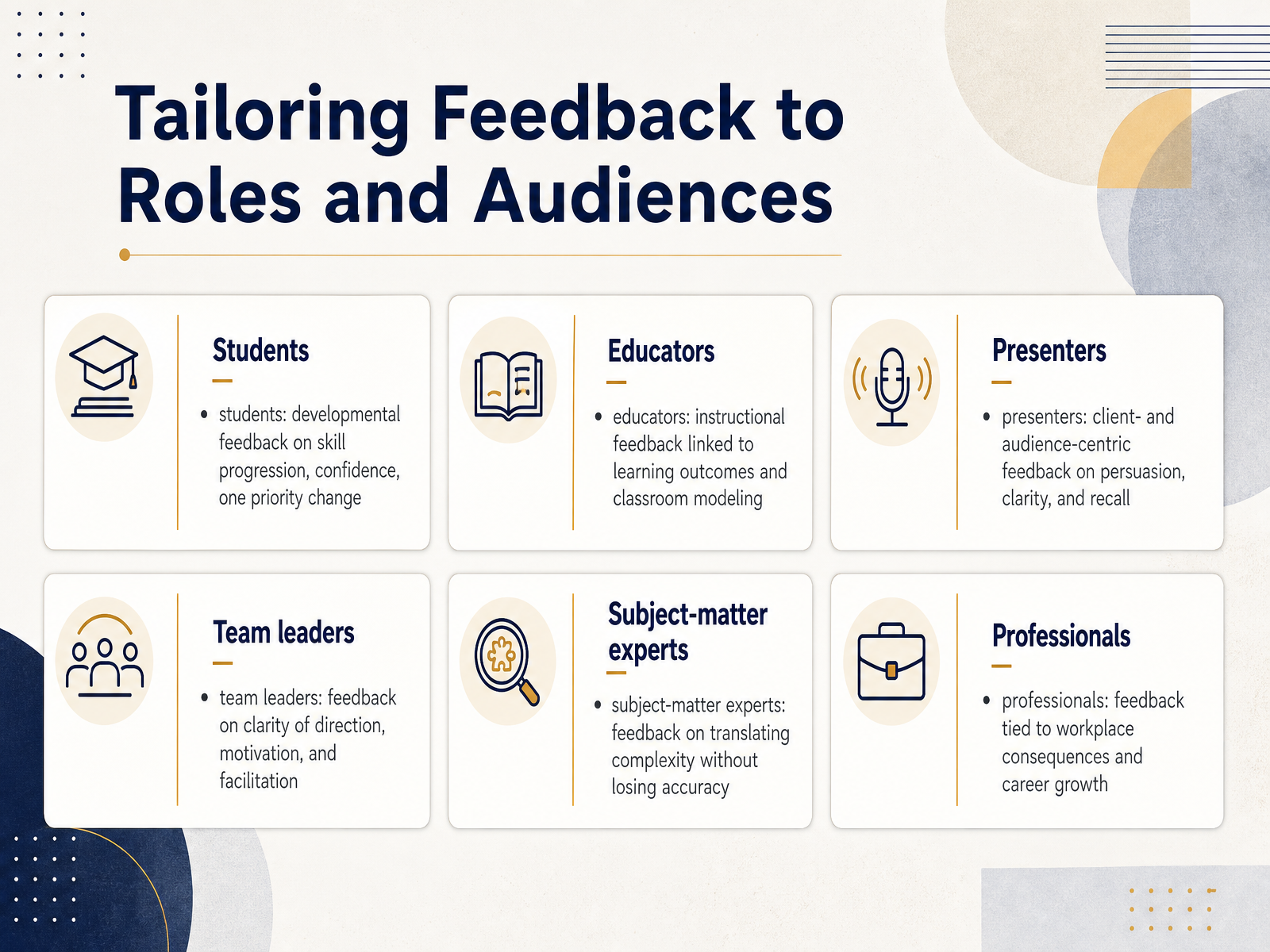
- 13Tailoring Feedback to Roles and AudiencesNow let's look at how to tailor feedback to roles and audiences. The core idea is simple. The same speech can deserve different feedback depending on who is listening and what they need to grow. For students, developmental feedback works best. Focus on skill progression, confidence, and one priority change. For example, praise clearer transitions, then suggest one behavior to practice next. For educators, link feedback to learning outcomes and classroom modeling. Ask whether the speech demonstrated the very skills students are expected to learn. For presenters, keep feedback client and audience centered. Address persuasion, clarity, and recall. Did the message land, and will people remember it? Team leaders need feedback on clarity of direction, motivation, and facilitation. Did people leave knowing what to do and why it matters? Subject matter experts need feedback on translating complexity without losing accuracy. Professionals need feedback tied to workplace consequences and career growth. So match the lens to the role, name the strength or pitfall, and explain the likely effect. From Evaluation to Improvement: Practice That Works.
 2 min
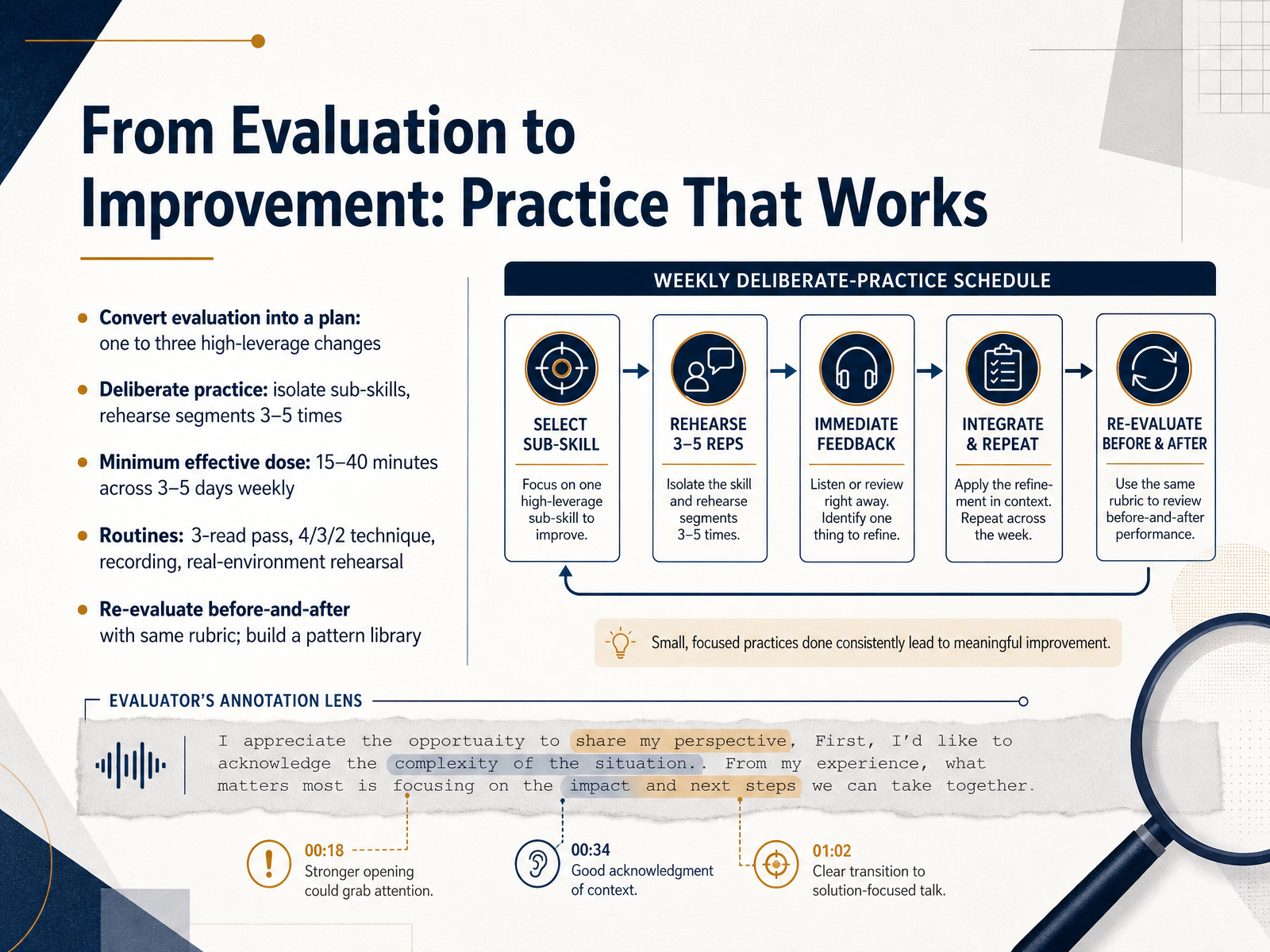
- 14From Evaluation to Improvement: Practice That WorksNow let's turn evaluation into improvement. You have your notes and your rubric. The real question is: what changes will actually make you better? Start by converting your evaluation into a short plan, just one to three high-leverage changes. Pick the moves that will shift your audience's experience the most, not ten small tweaks. Then practice deliberately. Isolate a sub-skill, like your opening or your pacing, and rehearse that segment three to five times. Research shows extra repetitions past five add little. Keep the dosage realistic: fifteen to forty minutes across three to five days each week, not one long cram. Useful routines include a three-read pass, the four, three, two technique, recording yourself, and rehearsing in the real environment. Finally, re-evaluate before and after with the same rubric, and build a pattern library of what works for you. Next, let's pull it all together with Key Takeaways and Self-Assessment.
 2 min
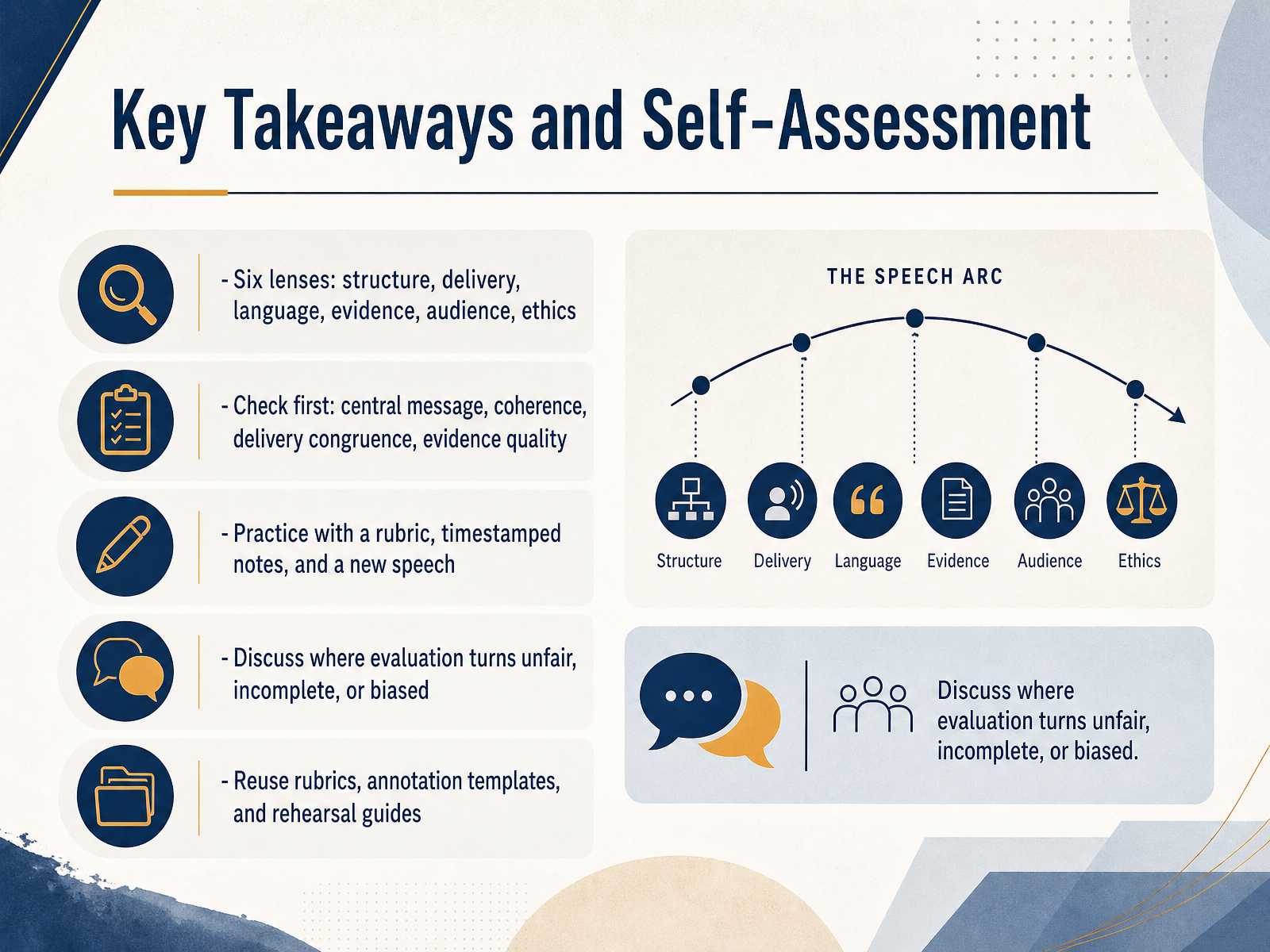
- 15Key Takeaways and Self-AssessmentAs we close, let's consolidate what you've built. You now have six lenses for evaluating any speech: structure, delivery, language, evidence, audience, and ethics. Think of them as a checklist you can run in your head. Start with four quick checks. Is the central message clear? Does the speech hold together coherently? Does the delivery match the message? And is the supporting evidence credible and varied? When you practice, use a rubric, take timestamped notes, and apply your skills to a new speech rather than the same familiar one. That is how evaluation becomes a habit, not a one-time exercise. Also make room to discuss the harder question: when does evaluation turn unfair, incomplete, or biased? Naming those moments openly keeps your feedback honest and useful. Finally, keep your tools close. Reuse your rubrics, annotation templates, and rehearsal guides across every speech you assess. Thank you for your attention and your willingness to evaluate thoughtfully. You are ready to give feedback that helps speakers grow. Keep practicing, stay curious, and trust your trained eye.
 assessment.unc.edupittstate.edulibrary.ascd.org+22 min
Take the deck with you
Download this course as a file — free, no sign-up needed.
- PDF handoutEvery slide page, ready to print or share.16 pages · 4.8 MBDownload
- Narrated PowerPointThe deck that presents itself — every slide carries the digital human's narration video.16 pages · 19.1 MBDownload
- PowerPoint slidesThe full deck as a .pptx — open it in PowerPoint, Keynote, or Google Slides.16 pages · 4.7 MBDownload
Free to use in your own training — please keep the PersonWise credit page at the end.
Have your own deck? Turn it into a course
Sources consulted
Web sources consulted while building this course.
- A Proof‐of‐Concept Study on Scoring Oral Presentation Videos in Higher Education — doi.org
- The art of audience engagement: LLM-based thin-slicing of scientific talks — doi.org
- A Preliminary Investigation of the Factors Related to the Design and Scoring of Video‐Based Oral Communication Performance Tasks in Higher Education — doi.org
- Classroom public speaking assessment: Reliability and validity of selected evaluation instruments — doi.org
- An Active Data Representation of Videos for Automatic Scoring of Oral Presentation Delivery Skills and Feedback Generation — frontiersin.org
- AAC&U Oral Communication VALUE Rubric — assessment.unc.edu
- PSU ORAL COMMUNICATION VALUE RUBRIC — pittstate.edu
- FIGURE 4. Analytic Rubric for Public Speaking — library.ascd.org
- Speech and Presentation Grading Rubric — fitnyc.edu
- A1. Public Speaking Higher Order Learning Goals (HOLGS) — myusf.usfca.edu
- Structure and Organization – Public Speaking as Performance — opentext.ku.edu
- Structuring the Speech | Department of Communication — comm.pitt.edu
- 2.3: Five Canons of Rhetoric - Social Sci LibreTexts — socialsci.libretexts.org
- Chapter 10: Creating the Body of a Speech – Stand Up, Speak Out 3rd Edition — milnepublishing.geneseo.edu
- How to Structure a Speech: 7 Key Elements for a Compelling Story — moxieinstitute.com
- Analysis of the 2025 Toastmasters World Championship Winning Speech — mannerofspeaking.org
- Analysis of a speech by Mark Carney - Manner of speaking — mannerofspeaking.org
- Video Critique: Majora Carter – Greening the Ghetto (TED 2006) — sixminutes.dlugan.com
- World Champion Toastmaster Speech: What Worked & What Didn’t — linkedin.com
- Speech Critique: Dan Pink (TED 2009) — sixminutes.dlugan.com