Begin
13 pages · ~26 min
Habitable Worlds Search
Explore the search for habitable exoplanets and the conditions that make a world capable of supporting life.
A digital instructor presents all 13 pages. Hold “Ask” at any point and ask out loud — the answer comes from this course. No sign-up needed.
What you’ll learn
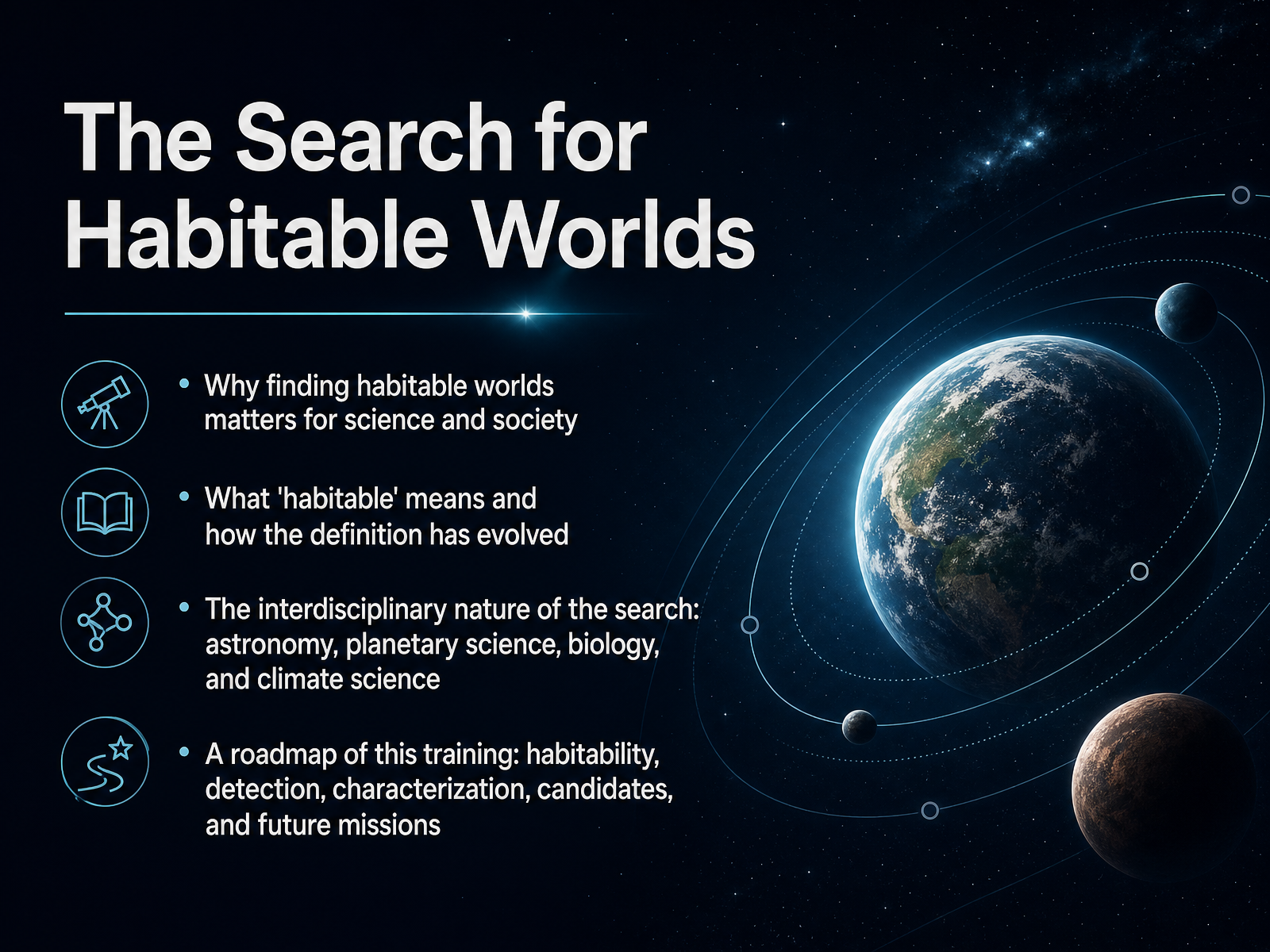
- 01The Search for Habitable WorldsWelcome to The Search for Habitable Worlds. Over the next few minutes, I want to share why this search matters so deeply, not just for astronomy, but for how we understand our own place in the universe. At its simplest, a habitable world is one where liquid water can exist. But as you will see, that definition is evolving fast. Our discoveries of subsurface oceans on icy moons, and new thinking about tidally locked planets around small stars, are stretching what we mean by habitable. This is not a single discipline. Astronomers find the planets, planetary scientists model their interiors, biologists frame what life needs, and climate scientists unpack atmospheres. You are joining an investigation that spans all of these. In this training, we will start with habitability, then move through detection, characterization, leading candidates, and the future missions that may give us an answer. Let us begin with the most basic question. What does habitable actually mean?science.nasa.goviopscience.iop.orgmdpi.com+22 min
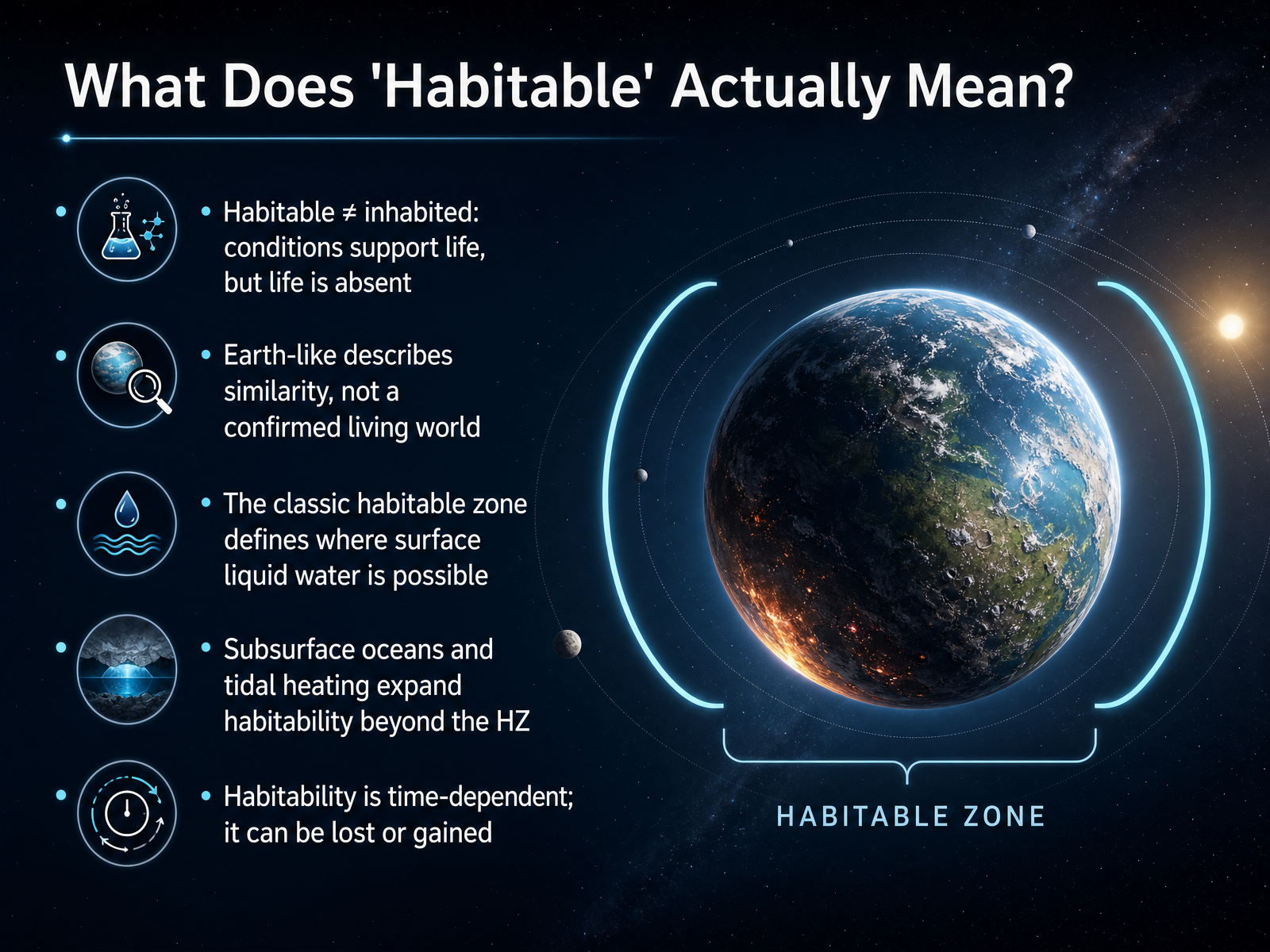
- 02What Does 'Habitable' Actually Mean?Now we arrive at a surprisingly tricky word: habitable. It sounds simple, but it carries a lot of assumptions. First, a crucial distinction: habitable does not mean inhabited. It means the conditions could theoretically support life, yet life might be completely absent. So an Earth-like world describes similarity in size or temperature, not a confirmed living planet. The classic definition revolves around the habitable zone, often called the Goldilocks zone. It is the distance from a star where surface liquid water could exist, not too hot, not too cold. But here is where the search gets fascinating. We have discovered subsurface oceans on icy moons like Europa and Enceladus, kept liquid by tidal heating and radioactive decay, far outside that traditional zone. This shows us habitability is not a fixed boundary. It is time-dependent. A world can lose its habitability, like a desiccated Mars, or potentially gain it as its star evolves. So, we cannot just follow the water on the surface anymore. We have to think much deeper. Let's move on to what that means for our search strategy, as we go beyond 'Follow the Water'.
 science.nasa.goviopscience.iop.orgmdpi.com+22 min
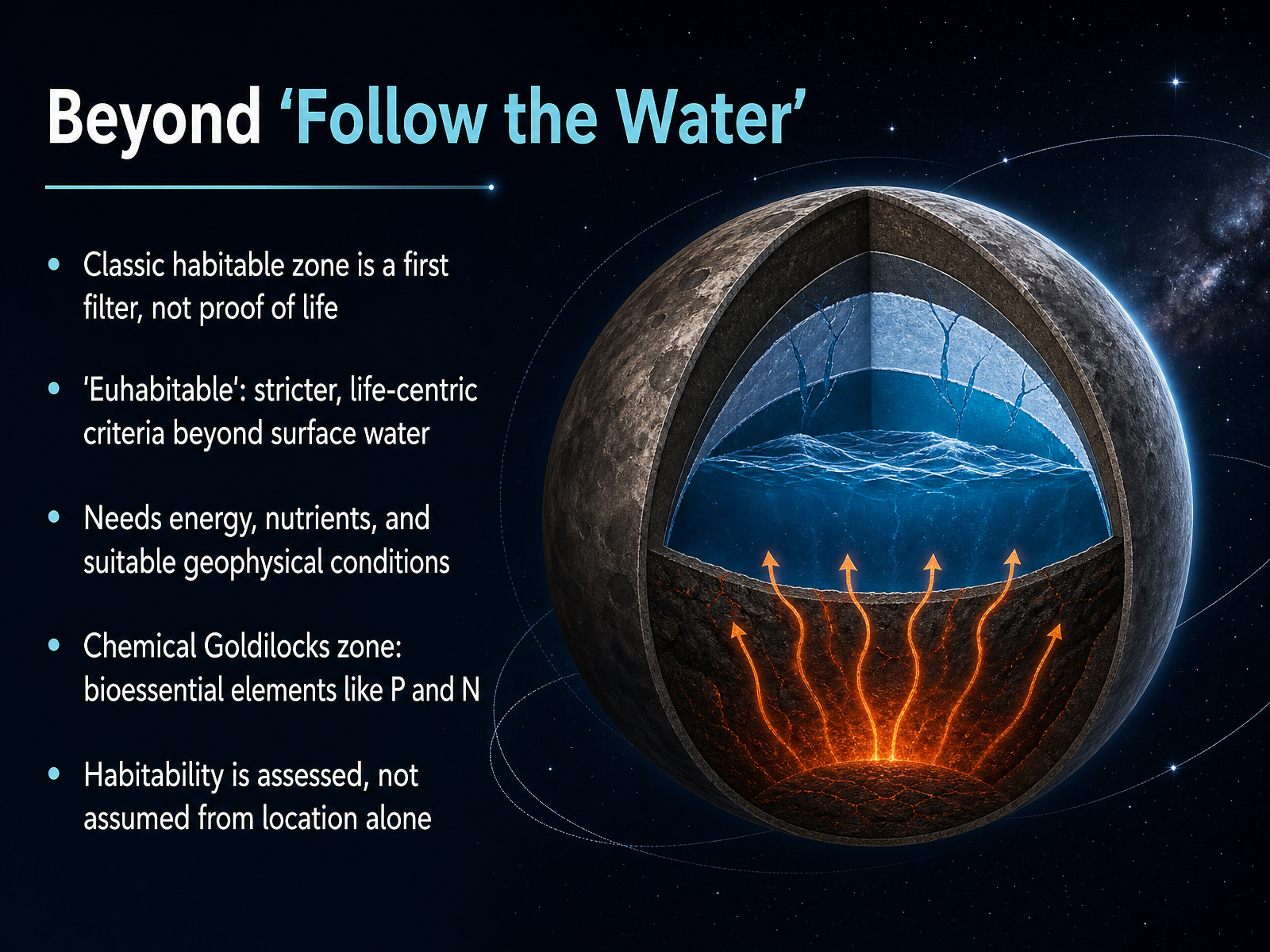
 - 03Beyond 'Follow the Water'So, we’re moving beyond the simple checklist of following the water. The classic habitable zone is a useful starting point for a search, but it is only a first filter. It asks one question: could liquid water survive on the surface? That does not tell us if a planet is truly suitable for life. Think of it like looking for a house. Finding one with a roof doesn’t mean the plumbing and electricity are working. To capture this idea, scientists have proposed a new term: euhabitable. This stricter, life-centric standard requires not just water, but a usable source of energy, a supply of essential nutrients, and stable geophysical conditions. A planet also needs the right chemical ingredients. This means falling within a chemical Goldilocks zone. We need bioessential elements like phosphorus and nitrogen to be available in the crust and mantle. If a planet formed under the wrong conditions, these vital elements might be locked away forever in the core, making the surface barren. So, the key takeaway here is this: habitability is an assessment, not an assumption based on location alone.
 iopscience.iop.orgiopscience.iop.orglink.springer.com+22 min
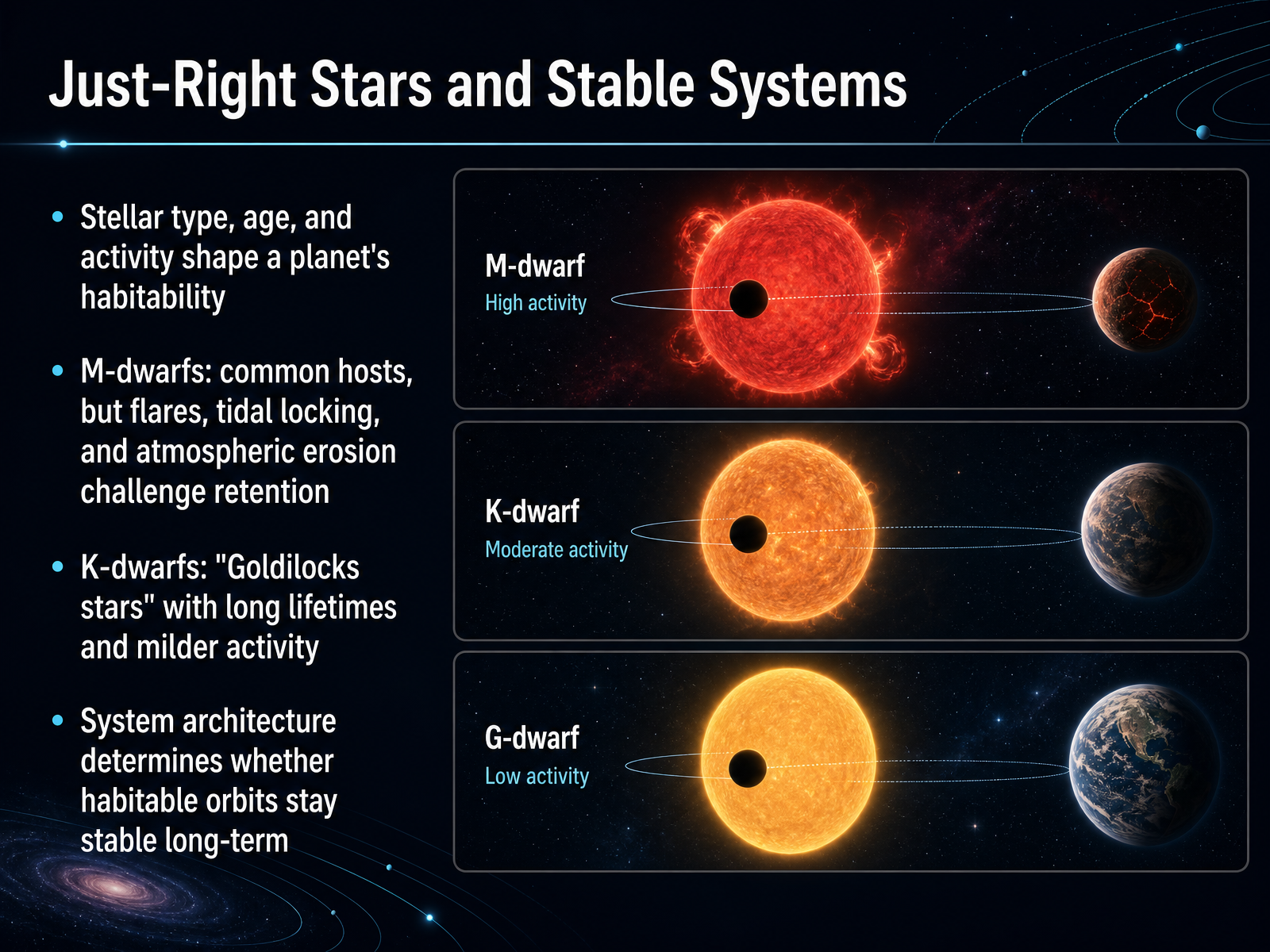
 - 04Just-Right Stars and Stable SystemsNow let's consider the star itself. Because habitability isn't only about distance. The type, age, and activity of a host star can make or break a planet's prospects. Take M dwarfs, the small red stars. They're incredibly common, and they host lots of rocky planets. But they come with serious challenges. Powerful flares can strip away atmospheres. And because their habitable zones are so close in, planets there tend to become tidally locked, with one side always facing the star. That can create extreme conditions and drive rapid water loss. So many researchers now point to K dwarfs as the real sweet spot. Slightly smaller and cooler than our Sun, they live much longer and are far less violent in their youth. They're often called the Goldilocks stars. And there's one more piece. Even if a planet sits in the right zone, it needs a stable long-term orbit. The gravitational architecture of the whole system matters. If a giant planet is tugging things around, a habitable world could be thrown out of its comfortable orbit. So, finding a truly habitable world means asking, is this a just right star in a stable system? Next, we'll explore how we actually find these planets around other stars.
 iopscience.iop.orgiopscience.iop.orgaanda.org+22 min
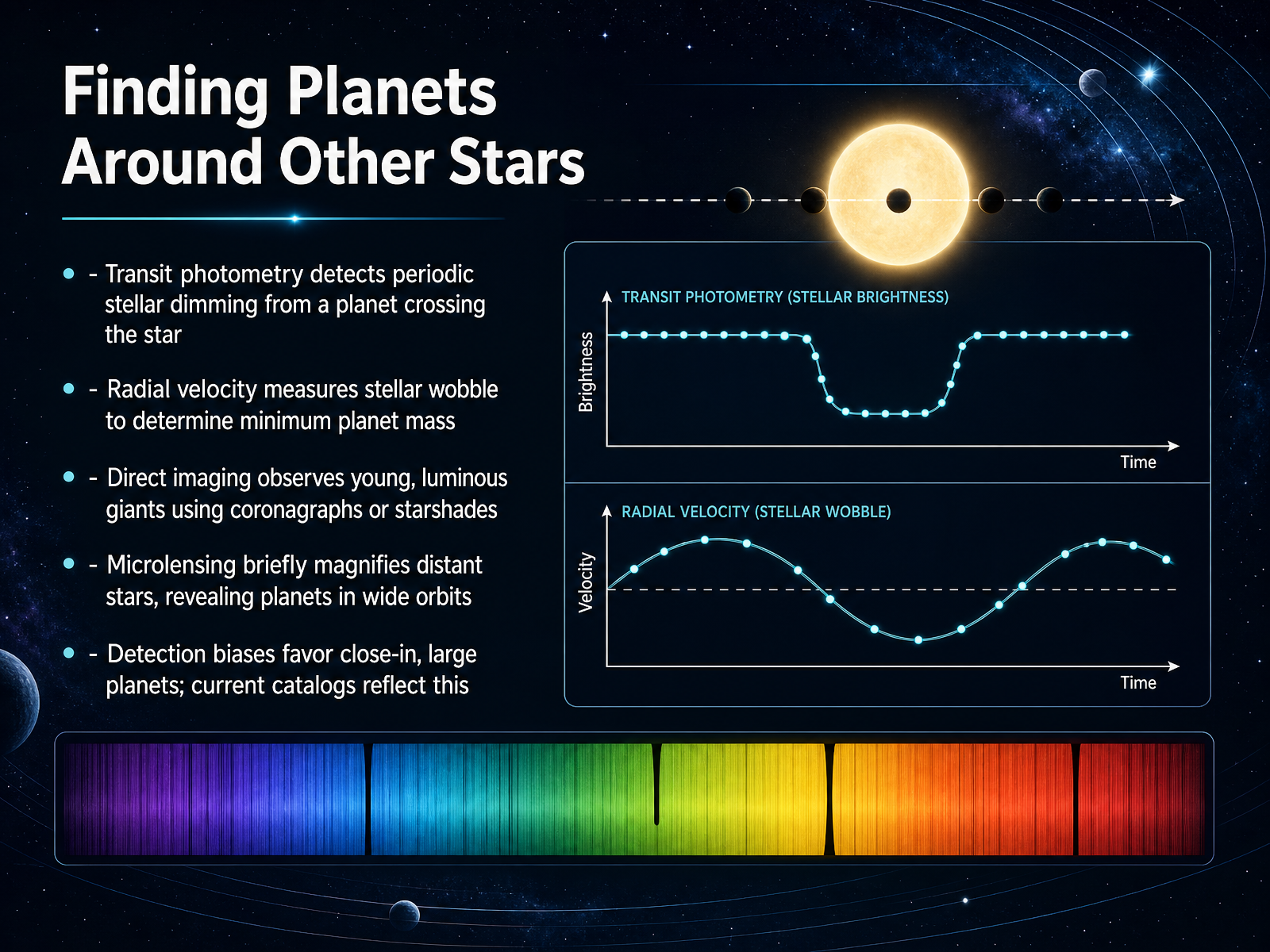
 - 05Finding Planets Around Other StarsSo how do we actually find these worlds? We can't just point a telescope and hope. Let's look at the main techniques, starting with the two that dominate the catalogs. Transit photometry watches for a tiny, periodic dip in a star's brightness, the shadow of a planet crossing its face. It is how we find most exoplanets today. Radial velocity measures the star's subtle wobble as a planet's gravity tugs on it, which gives us the planet's minimum mass. Then there is direct imaging, which blocks out starlight using coronagraphs or starshades, but it mostly works for young, bright giants far from their stars. Microlensing catches the brief brightening of a distant star when another system passes in front of it, a rare event that reveals planets in wide orbits. Here is the important part. Every method has a bias. We are much better at finding big planets orbiting close in. So when we look at the catalogs, we are not seeing a fair census. We are seeing what our tools can see. That is a crucial lesson to carry forward.
 journal26.magtechjournal.comdoi.orgdoi.org+22 min
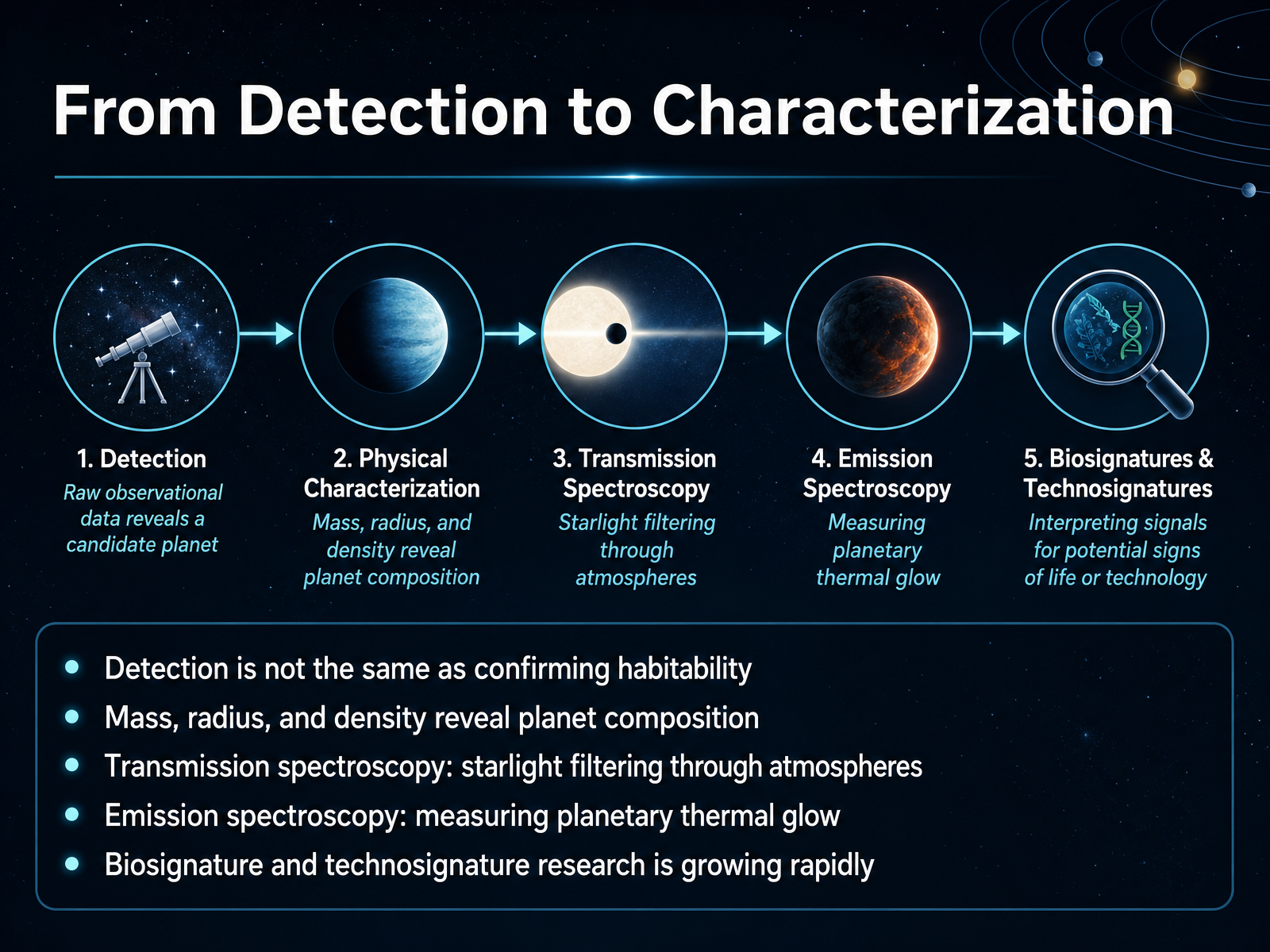
 - 06From Detection to CharacterizationNow we arrive at a crucial shift in the search. Finding a planet is not the same as confirming it can support life. So, let's walk through how we move from detection to characterization. We begin with basic measurements. Mass, radius, and density work together to tell us whether a world is truly rocky, or perhaps a small gas-rich planet. If a planet has a rocky density and sits in the right orbit, then we look closer at any atmosphere it might hold. We do this mainly with two powerful techniques. The first is transmission spectroscopy. We watch starlight filter through the edge of a planet's atmosphere as it passes in front of its star. Those filtered fingerprints reveal what gases are present. The second is emission spectroscopy. Here, we measure the planet's own thermal glow, especially as it slips behind its star. This tells us about its dayside temperature and even hints at surface conditions. Step by step, these signals sharpen our picture. And the search for biosignatures and technosignatures is expanding rapidly. We will return to that lively field soon. But first, let's look at the telescope that is transforming this work, and see what it is teaching us about rocky worlds.
 pnas.orgjournal26.magtechjournal.comdoi.org+22 min
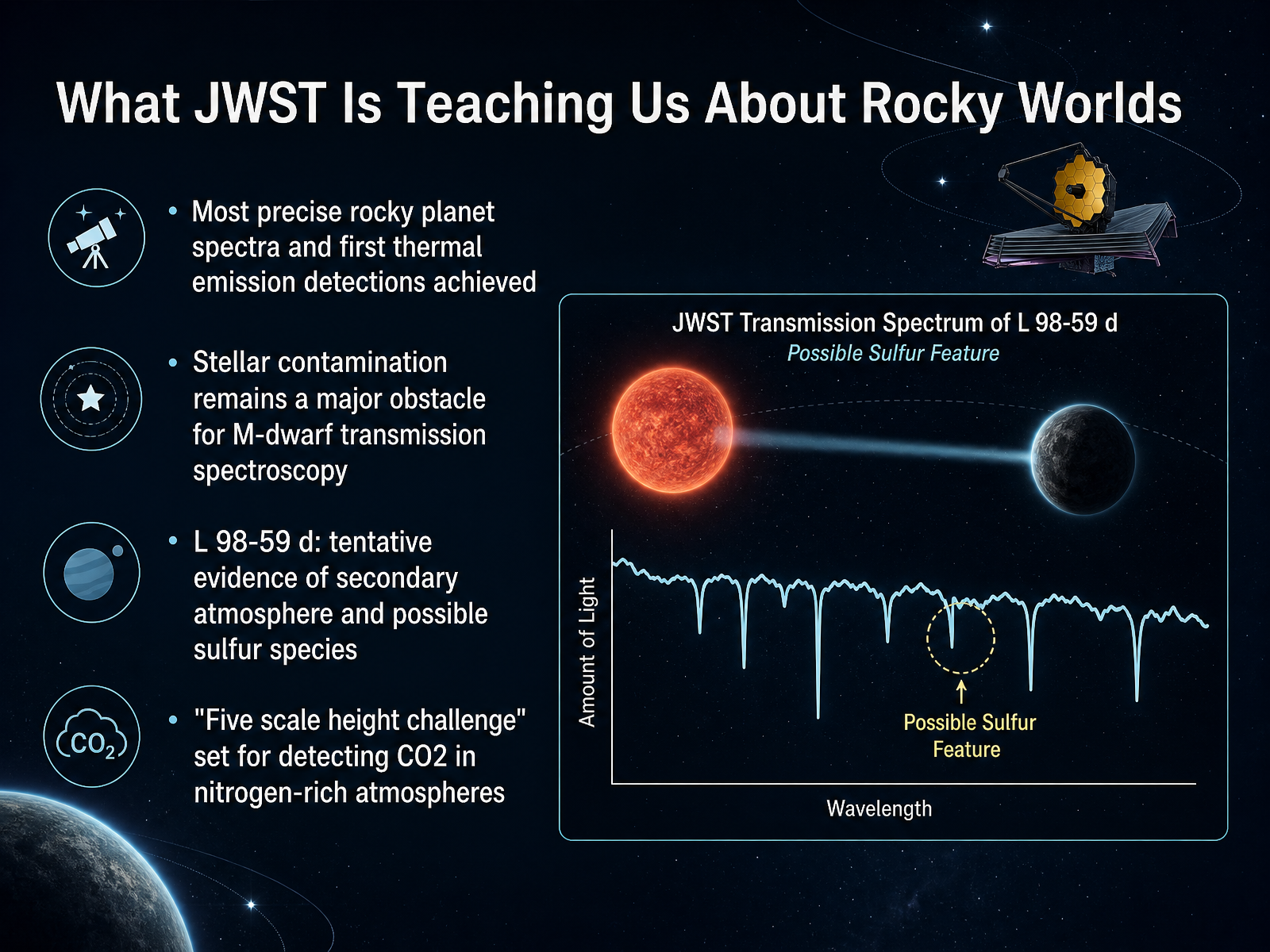
 - 07What JWST Is Teaching Us About Rocky WorldsSo, what has JWST actually shown us so far about rocky worlds? The results are a mix of remarkable precision and humbling challenges. We now have the most precise rocky planet spectra ever recorded, and we have even detected the thermal emission from rocky planets cooler than 800 Kelvin for the first time. But here is the surprising part. Despite all this data, that first definitive detection of an atmosphere remains elusive. One major obstacle is stellar contamination. Signals from starspots and faculae can mimic or hide atmospheric features, making the data hard to trust. In fact, on the planet L 98-59 d, we see tentative evidence of a secondary atmosphere, with hints of sulfur species like hydrogen sulfide and sulfur dioxide. It is intriguing, perhaps even a clue to volcanic activity, but still, it is tentative. To move forward, the community has set a new goal, the five scale height challenge. This means achieving the precision needed to detect the carbon dioxide feature in a nitrogen-rich atmosphere, just like our own. Meeting this challenge will unlock the next level of atmospheric discovery. As scientists push for that precision, it is important to remember which worlds are the most promising targets.
 pnas.org1 min
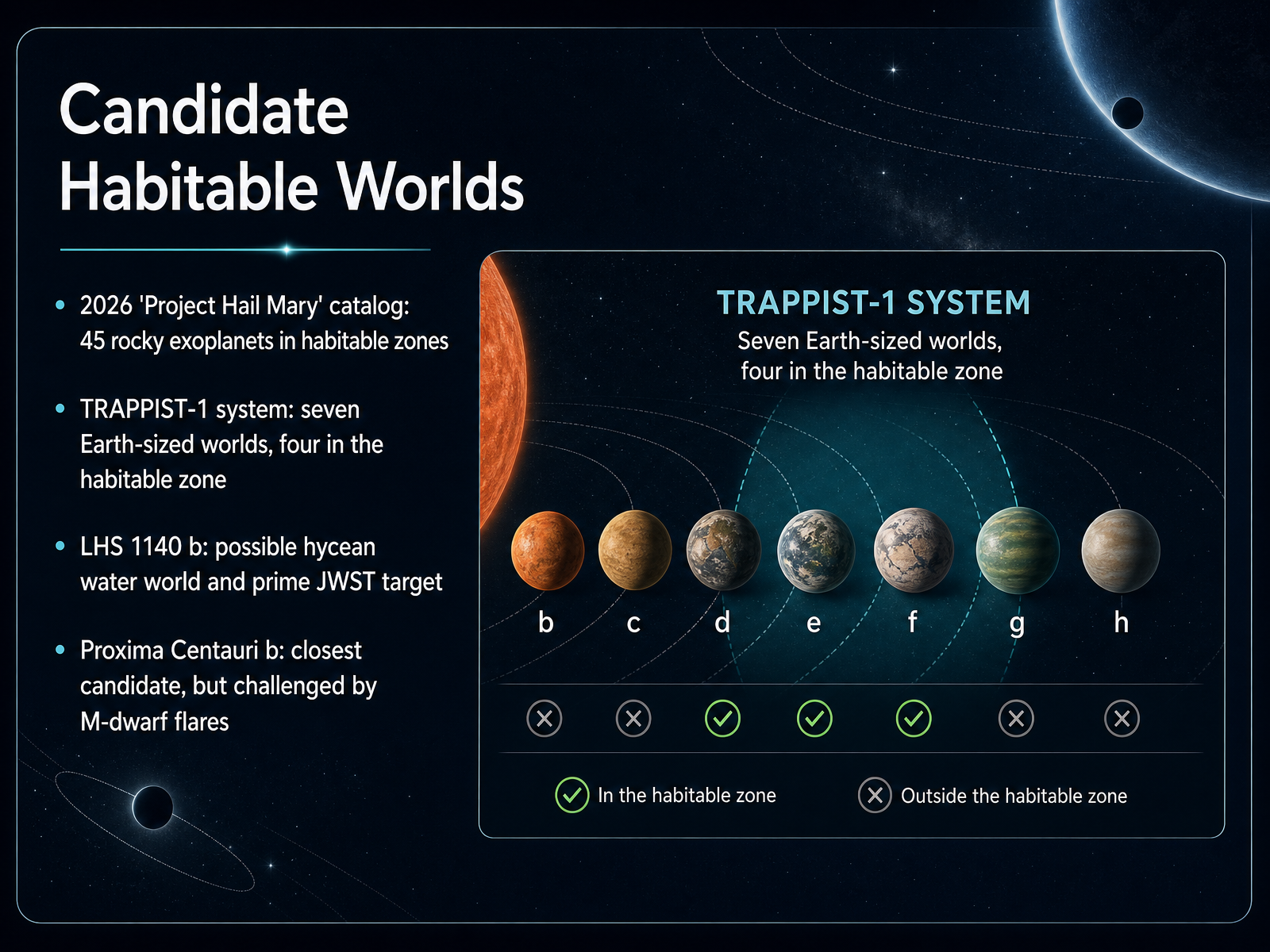
 - 08Candidate Habitable WorldsSo, where are we actually pointing our telescopes next? That is the question this next generation of planet catalogs is trying to answer. In 2026, a team at the Carl Sagan Institute released what they call the Project Hail Mary catalog. It narrows down over six thousand known exoplanets to just forty-five rocky worlds sitting comfortably within their star's habitable zone. Now, these aren't just numbers in a table. These are the specific places where liquid water could exist. Take TRAPPIST-1, a tiny red star about forty light-years away. It boasts seven Earth-sized planets, and incredibly, four of them are in the habitable zone. Then there is LHS 1140 b, a dense world that might be a roiling water ocean under a thick atmosphere, making it a prime target for the James Webb Space Telescope. And let's not forget Proxima Centauri b, the closest candidate to us at just over four light-years. It is tempting, but its star is prone to violent flares that might have stripped away any chance for an atmosphere. But even with these challenges, identifying where to look is the first critical step. And to truly understand these worlds, we have to start pushing at the very edges of where life might be possible.
 pnas.orgiopscience.iop.orgiopscience.iop.org+22 min
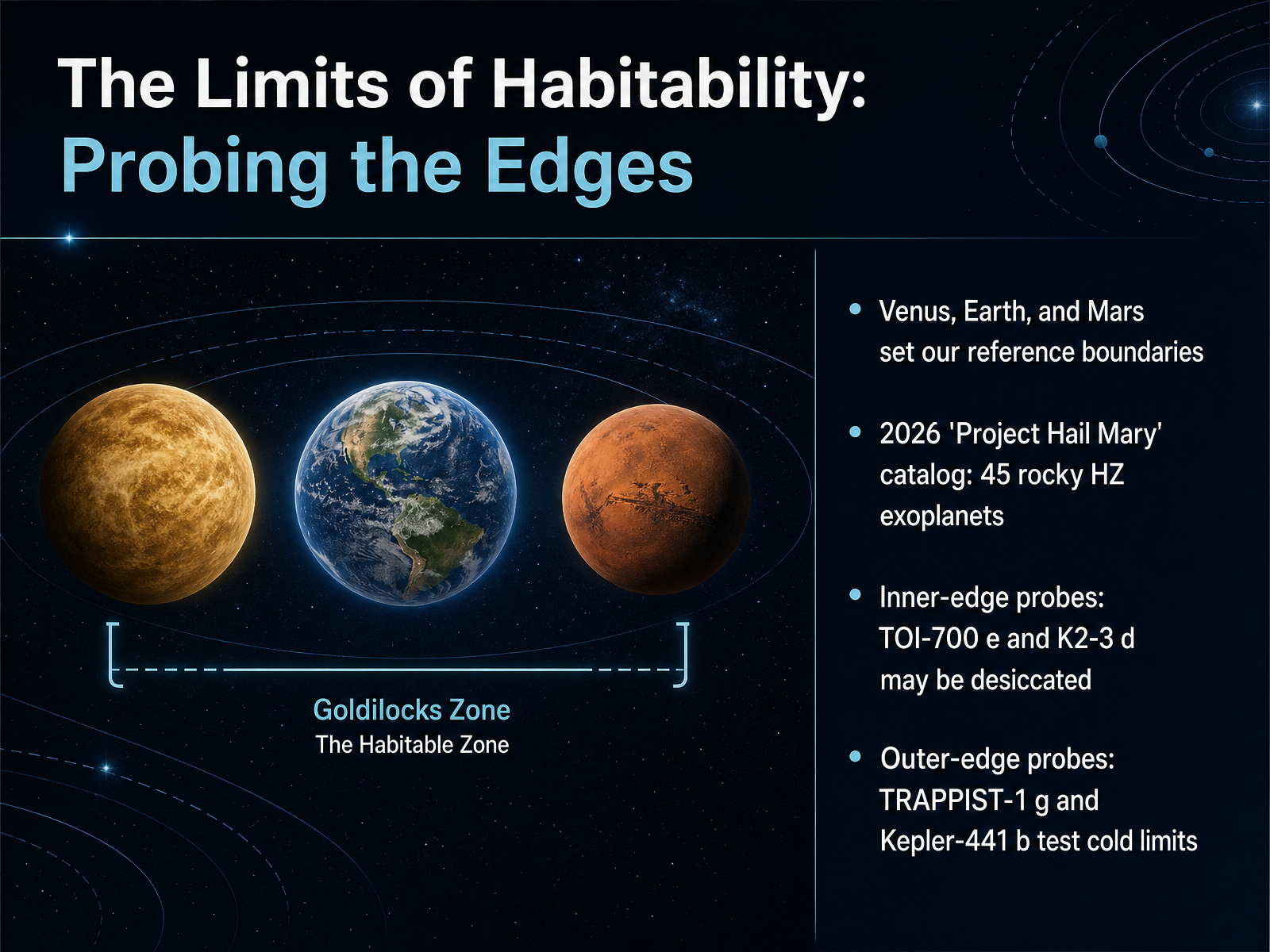
 - 09The Limits of Habitability: Probing the EdgesNow we come to the limits of habitability, probing the very edges of where life might exist. Our own solar system gives us the reference points. Venus shows us what happens when a planet gets too much stellar energy. Mars shows us what happens when a planet gets too little, or loses its atmosphere. Earth sits in the comfortable middle. This year, in twenty twenty-six, a study nicknamed Project Hail Mary, after the novel, published a catalog of forty-five rocky exoplanets that sit within the habitable zones of their stars. The team didn't just list the most Earth-like worlds. They deliberately selected planets that push the boundaries. Consider the inner edge. Worlds like TOI-700 e and K2-3 d receive intense radiation from their stars. They may be desiccated, stripped of their water, like a cautionary tale of a runaway greenhouse effect. Now consider the outer edge. Planets like TRAPPIST-1 g and Kepler-441 b orbit far from their star, testing how cold a world can get before it freezes solid. These are natural laboratories. By studying planets that might be too hot or too cold, we sharpen our definition of what makes a world truly habitable. Next, we'll explore how we communicate this search for habitable worlds.
 iopscience.iop.orgiopscience.iop.orglink.springer.com+22 min
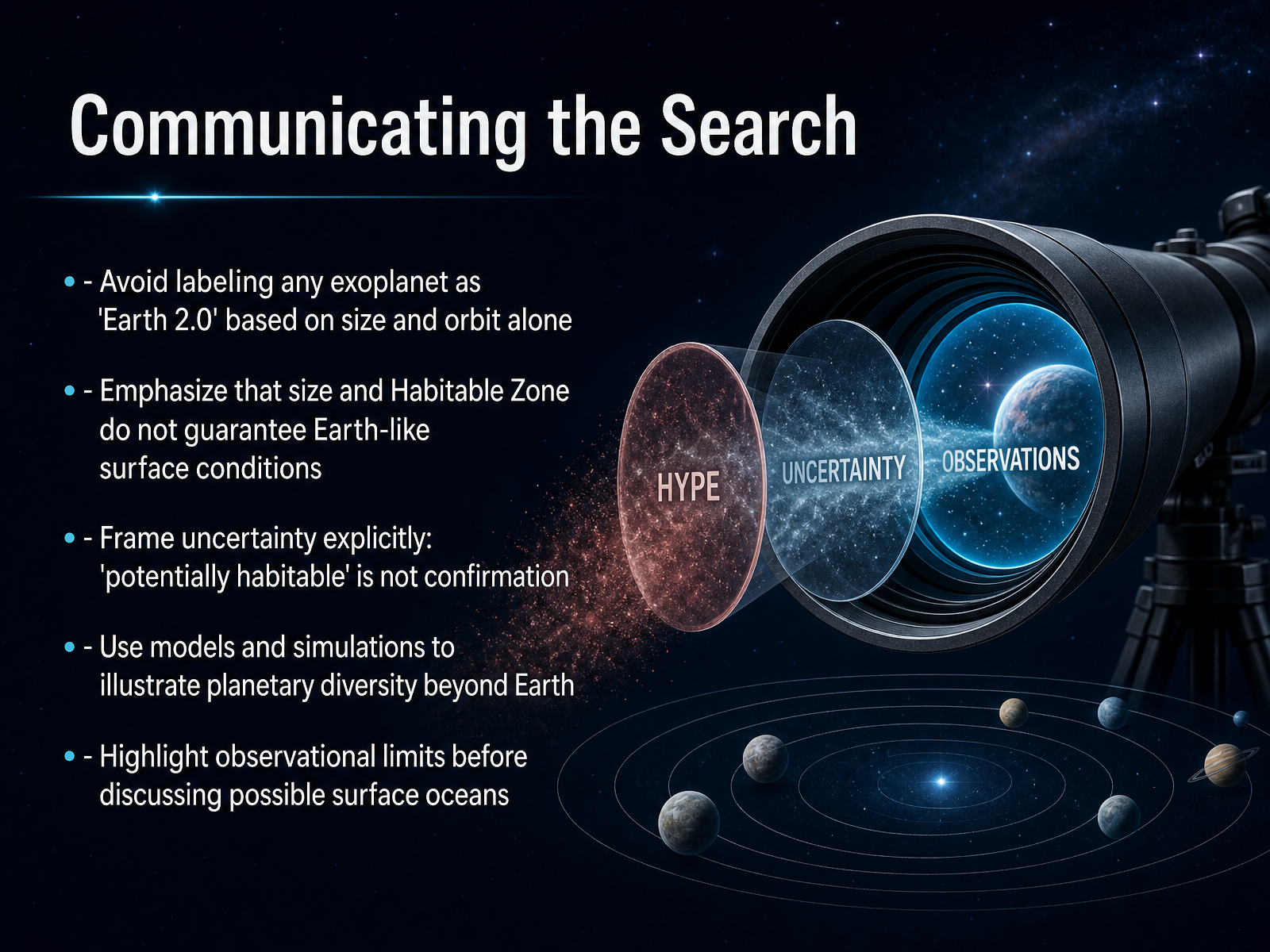
 - 10Communicating the SearchNow we come to a crucial part of our investigation: how we talk about these worlds. A planet that is roughly Earth-sized and sits in the habitable zone is a fascinating target. But calling it an 'Earth 2.0'? That is a leap we should avoid. Size and orbit only tell us the address, not the atmosphere, or whether there is any water on the surface. Think of Venus. It is near the habitable zone, yet its surface is hot enough to melt lead. So we must be explicit about our uncertainty. 'Potentially habitable' means possible, not confirmed. To explore this idea, we can use climate models. These simulations let us change a planet's land, oceans, or volcanic gases to see how surface conditions might shift. It is a powerful way to visualize diversity beyond our own Earth. And before we discuss possible oceans, we should be clear about our observational limits. Right now, for most small planets, we know their size and orbit, but nothing about their surface. That honesty builds trust and frames our next frontier.
 science.nasa.goviopscience.iop.orgmdpi.com+21 min
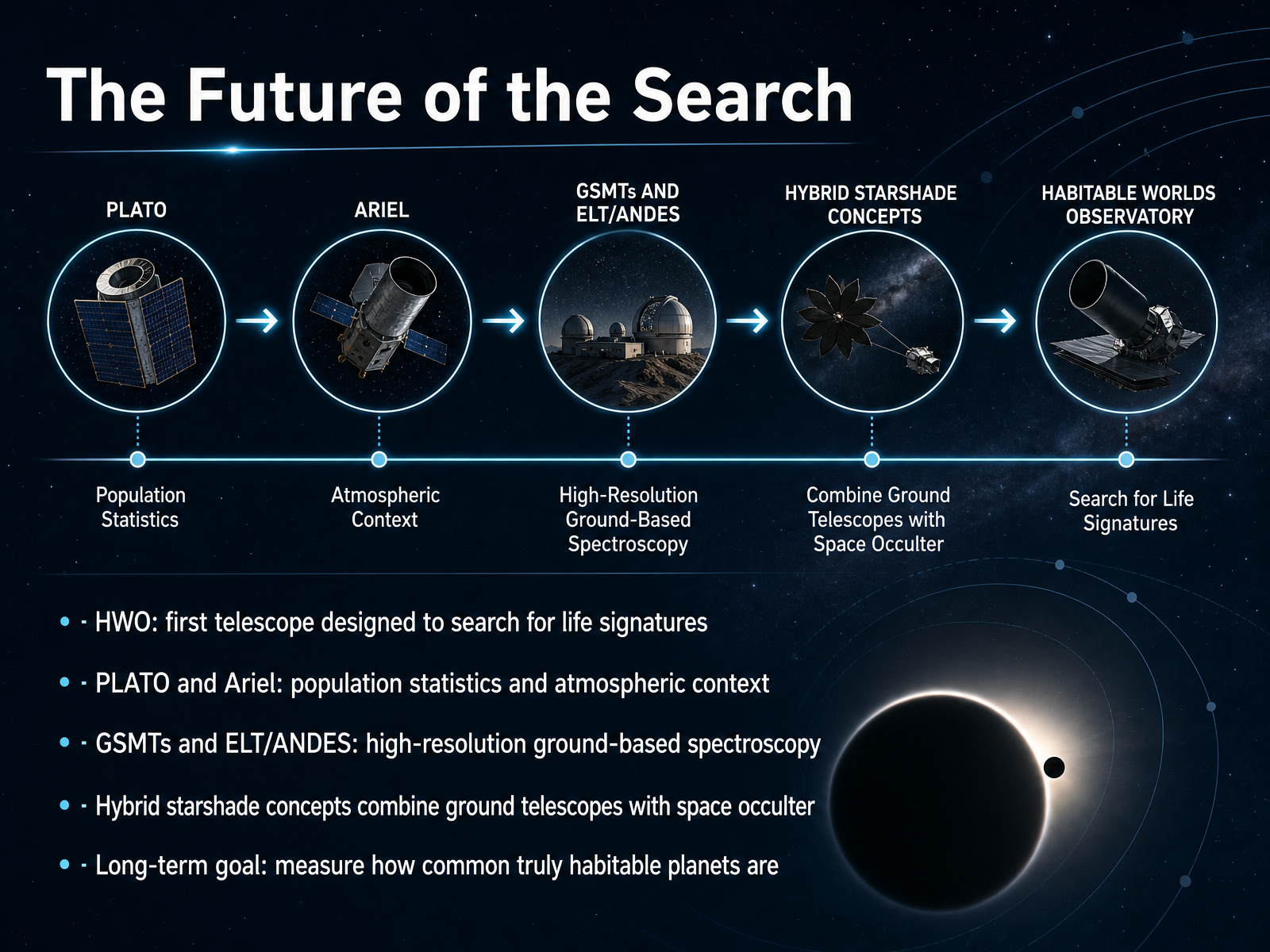
 - 11The Future of the SearchSo where is this search heading? It is becoming a coordinated, multi-front effort. The centerpiece is a future space telescope called the Habitable Worlds Observatory, or H W O. It will be the first telescope designed specifically to search for life signatures on planets around other stars. Missions like Plato and Ariel will provide essential context, giving us population statistics and atmospheric background for thousands of worlds. On the ground, giant telescopes will use instruments like Andes to capture high-resolution spectra, looking for gases like oxygen and water vapor. There is also a fascinating new idea, a hybrid approach, that pairs a ground telescope with a starshade flying in space to block starlight and reveal faint planets. All these paths share one long-term goal. We want to measure how common truly habitable worlds really are. Next, we will talk about staying current and getting involved in this exciting field.
 link.springer.comiopscience.iop.orgcambridge.org1 min
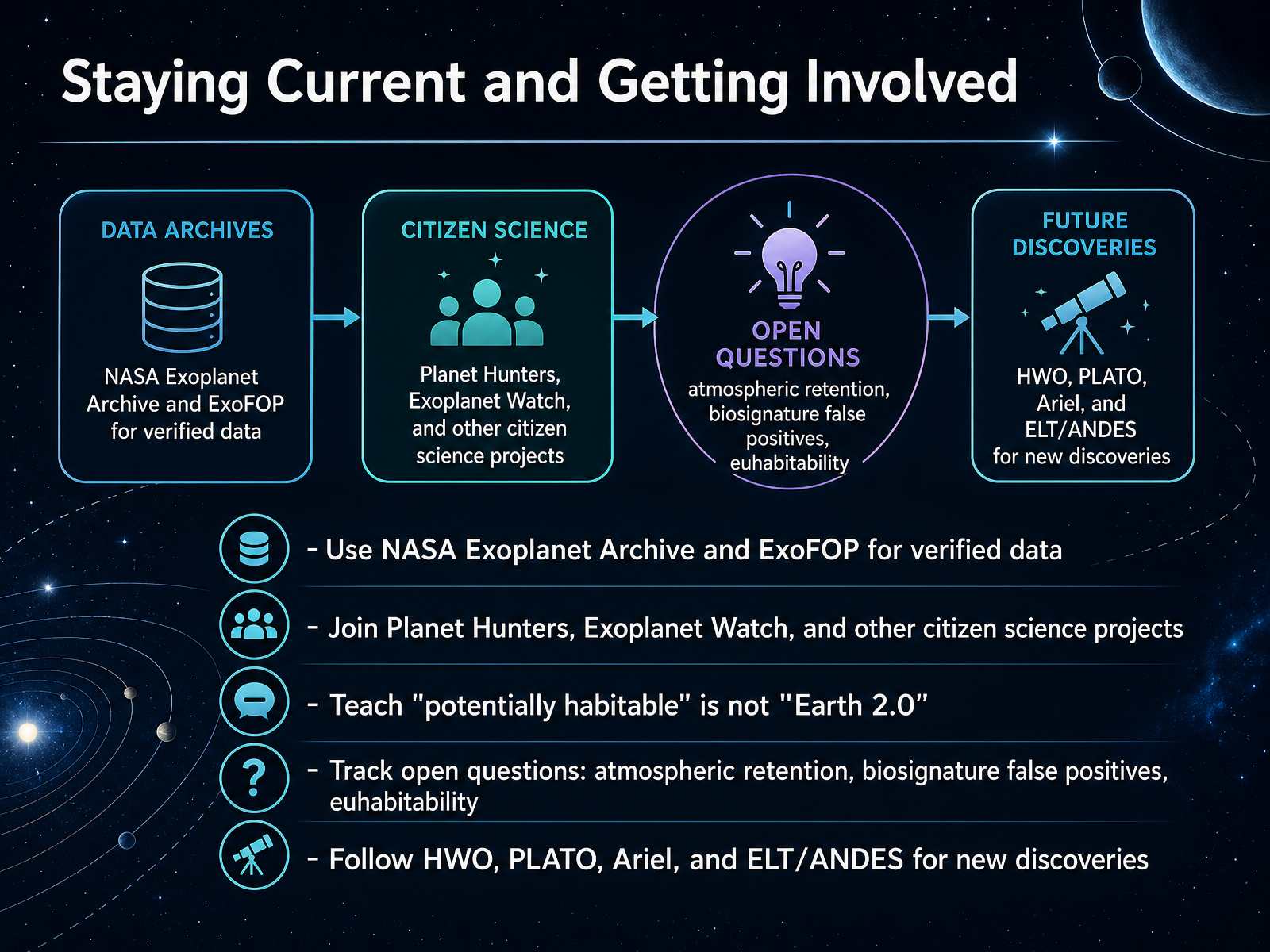
 - 12Staying Current and Getting InvolvedSo how do we stay part of this unfolding story? There are concrete ways to get involved right now. For reliable, up-to-date data, bookmark the NASA Exoplanet Archive and ExoFOP. These are the verified databases where researchers share findings. And you don't need a PhD to contribute. Citizen science platforms like Planet Hunters and Exoplanet Watch let you help classify real light curves and refine transit data. Your time can genuinely advance the search. At the same time, the science itself keeps evolving. One term gaining traction is euhabitability. It frames habitability not just by location, but by all the conditions life actually needs. This helps avoid the trap of calling every potentially habitable world an Earth 2.0. Open questions remain, like how atmospheres are retained, how we rule out biosignature false positives, and what euhabitability truly requires. Big new instruments are coming, such as HWO, PLATO, Ariel, and the ground-based ELT with ANDES. Each will sharpen our ability to read the atmospheres of rocky worlds. These tools will turn today's open questions into tomorrow's data. Up next, let's pull it all together with the core concepts review.
 link.springer.comiopscience.iop.orgcambridge.org2 min
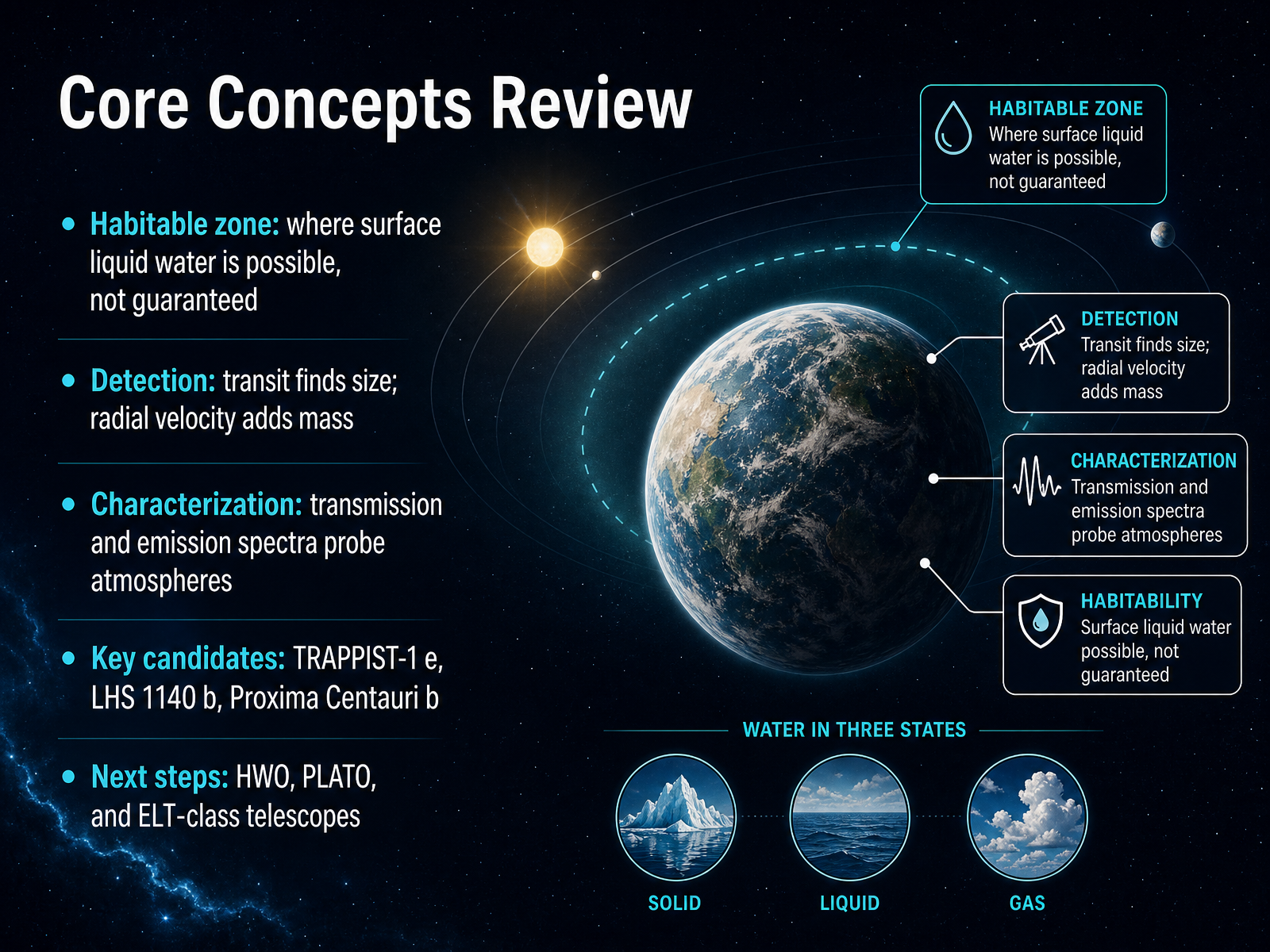
 - 13Core Concepts ReviewLet's bring all the threads together. The habitable zone is where surface liquid water is possible, not guaranteed. It's a starting point, not a final answer. And our detection toolkit works in layers. The transit method gives us a planet's size. Adding radial velocity gives us its mass. Together, size plus mass gives us density, and density tells us if a world is rocky. Then comes characterization. Transmission and emission spectra let us probe atmospheres, searching for molecules like water vapor, carbon dioxide, and methane. Among the most intriguing candidates are TRAPPIST-1 e, LHS 1140 b, and Proxima Centauri b. Each one presents a unique opportunity and a unique challenge. The next chapter belongs to a new generation of instruments. The Habitable Worlds Observatory, ESA's PLATO mission, and extremely large ground-based telescopes will sharpen our view dramatically. We have moved beyond counting planets. We are now reading their stories. Thank you for joining me on this journey, and keep looking up.
 science.nasa.goviopscience.iop.orgmdpi.com+22 min
Take the deck with you
Download this course as a file — free, no sign-up needed.
- PDF handoutEvery slide page, ready to print or share.14 pages · 3.8 MBDownload
- Narrated PowerPointThe deck that presents itself — every slide carries the digital human's narration video.14 pages · 15.0 MBDownload
- PowerPoint slidesThe full deck as a .pptx — open it in PowerPoint, Keynote, or Google Slides.14 pages · 3.8 MBDownload
Free to use in your own training — please keep the PersonWise credit page at the end.
Have your own deck? Turn it into a course
Sources consulted
Web sources consulted while building this course.
- The Habitable Zone — science.nasa.gov
- A Terminology and Quantitative Framework for Assessing the Habitability of Solar System and Extraterrestrial Worlds - IOPscience — iopscience.iop.org
- The Changing Concept of Habitability on Earth, the Solar System, and Beyond — mdpi.com
- Euhabitability: A New Term to Aid in the Search for Life in ... — link.springer.com
- Revisiting Seager’s 2013 Habitability Diagram with 2025 Data - IOPscience — beta.iopscience.iop.org
- Exoplanets beyond the Conservative Habitable Zone. I. Habitability — iopscience.iop.org
- Exoplanets beyond the Conservative Habitable Zone. II. Occurrence - IOPscience — iopscience.iop.org
- Euhabitability: A New Term To Aid In The Search For Life In Addition To The Habitable Zone Framework - Astrobiology — astrobiology.com
- Observing Exoplanet Biosignatures outside the Conservative Habitable Zone | Proceedings of the International Astronomical Union | Cambridge Core — cambridge.org
- The Contribution of M-dwarf Flares to the Thermal Escape of Potentially Habitable Planet Atmospheres - IOPscience — iopscience.iop.org
- The Receding Cosmic Shoreline of Mid-to-late M Dwarfs: Measurements of Active Lifetimes Worsen Challenges for Atmosphere Retention by Rocky Exoplanets - IOPscience — iopscience.iop.org
- Why M-dwarf flares have a limited impact on the atmospheric evaporation of sub-Neptunes and Earth-sized planets | Astronomy & Astrophysics (A&A) — aanda.org
- The Impact of Stellar Flares on the Atmospheric Escape of Exoplanets Orbiting M Stars. I. Insights from the AU Mic System - IOPscience — iopscience.iop.org
- Life on Exoplanets in the Habitable Zone of M Dwarfs? - IOPscience — iopscience.iop.org
- Current status and future trends of exoplanet detection technologies — journal26.magtechjournal.com
- Biases in the Transit, Radial velocity, Gravitational Microlensing, and direct Imaging exoplanet discovery methods — doi.org
- EXOPLANET DETECTION METHODS: AN OVERVIEW OF TECHNIQUES AND LIMITATIONS — doi.org
- How We Find and Classify Exoplanets - NASA Science — science.nasa.gov
- ESA - How to find an exoplanet - European Space Agency — esa.int
- A first look at rocky exoplanets with JWST — pnas.org