Begin
14 pages · ~28 min
Dimensional Analysis: Unit Conversion Mastery
This training helps learners master dimensional analysis to convert units accurately and confidently across measurement systems. Ideal for students and professionals needing reliable unit conversion skills.
A digital instructor presents all 14 pages. Hold “Ask” at any point and ask out loud — the answer comes from this course. No sign-up needed.
What you’ll learn
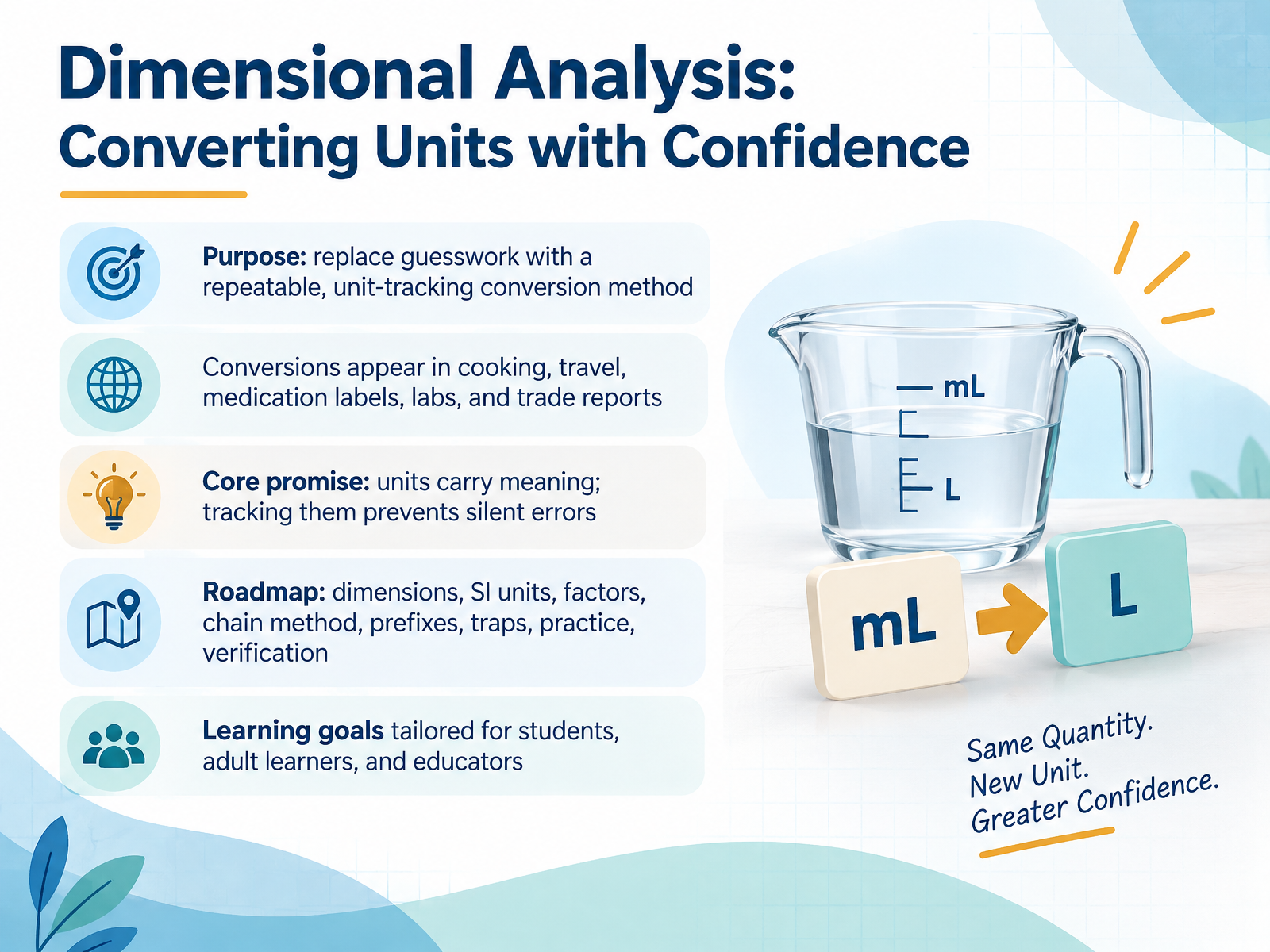
- 01Dimensional Analysis: Converting Units with ConfidenceWelcome. Today we're going to build a skill that makes unit conversions calm and reliable. The topic is dimensional analysis, which is simply a repeatable, unit-tracking method for converting units. It replaces guesswork with a clear path.
Think about where conversions show up. Cooking measurements. Travel distances and temperatures. Medication labels. Lab work. Even trade reports. In each place, a quiet unit mistake can cause real trouble.
Here is the core promise. Units carry meaning. When you track them carefully, they help you catch silent errors before they cause harm.
Our roadmap has several stops. First, dimensions versus units. Next, the SI system. Then conversion factors, the chain method, prefixes, common traps, practice, and finally, verification. Does that make sense so far?
Your goal may differ. Students will build a solid foundation. Adult learners will gain confidence for everyday and workplace tasks. Educators will pick up clear ways to explain each step.
So take one idea with you today. Every step in a conversion should carry its units along. Let's begin by asking why units matter at all, and how dimensions differ from units. That's next, in Why Units Matter: Dimensions Versus Units.2 min
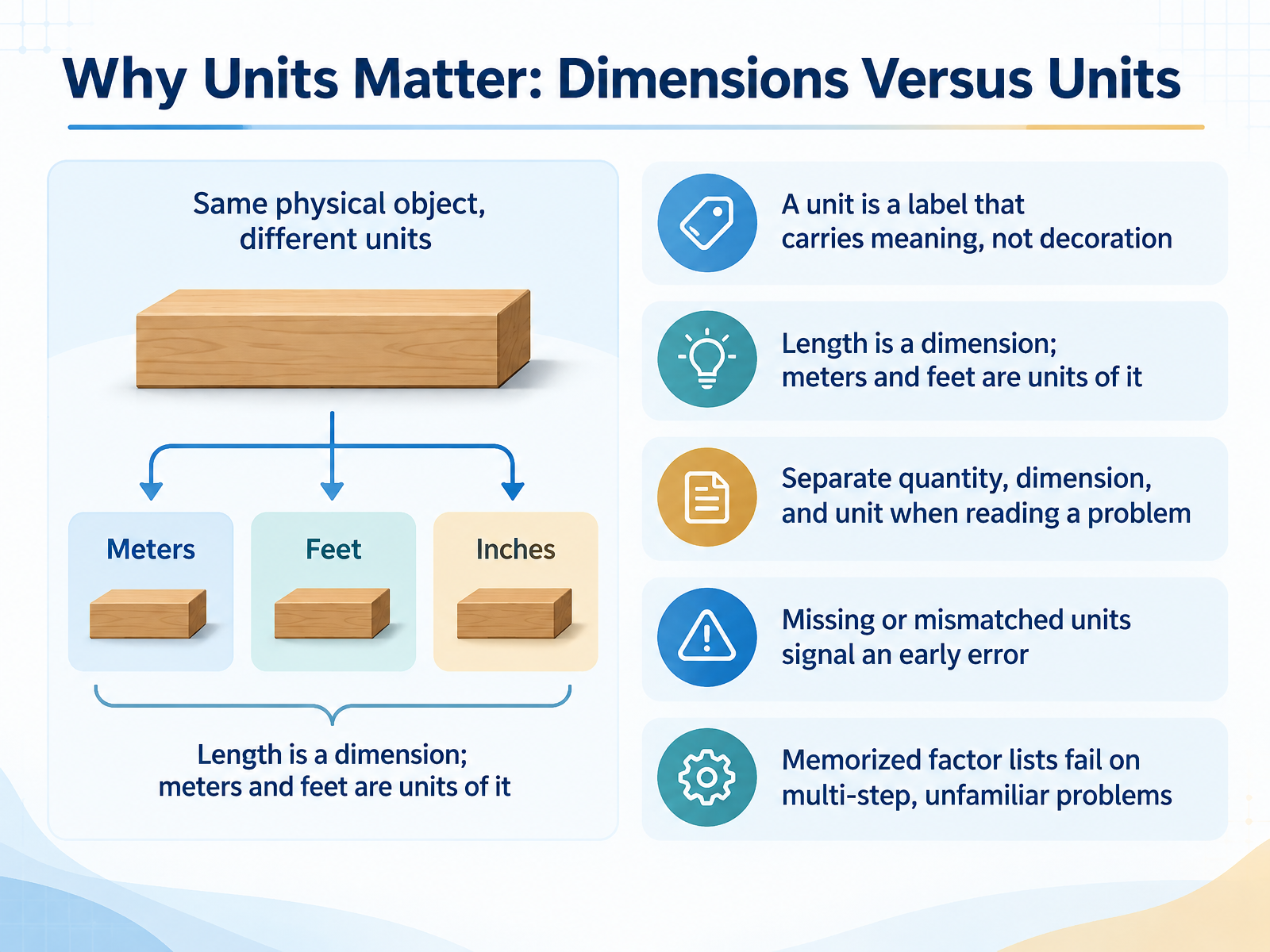
- 02Why Units Matter: Dimensions Versus UnitsLet's look at why units matter, and the difference between dimensions and units. First, think of a unit as a label that carries meaning, not decoration. Length is a dimension. Meters and feet are units of that dimension. When you read a problem, separate three things: the quantity, its dimension, and its unit. For example, a distance of five meters: five is the quantity, the dimension is length, and the unit is meters. Next, watch for missing or mismatched units. They usually signal an early error, so check them right away. Mistakes here are normal, so treat them as clues. And remember, memorized factor lists often fail on multi-step, unfamiliar problems. So build the habit of tracking dimensions as you go. Does that make sense so far? In short, keep dimension, quantity, and unit distinct. Your takeaway: before calculating, label every number with its unit. Next, we'll look at the seven SI base quantities and derived units.
 1 min
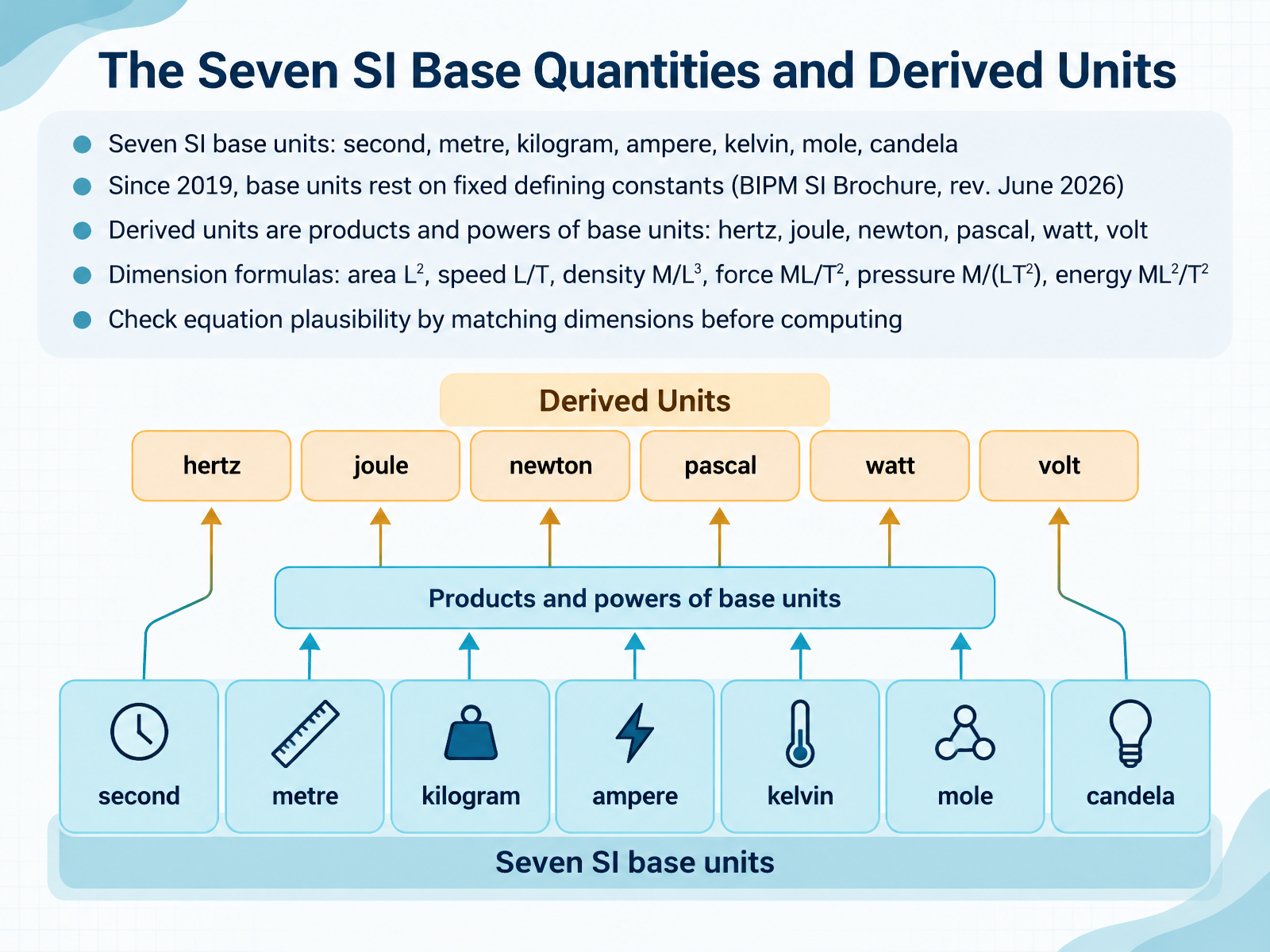
- 03The Seven SI Base Quantities and Derived UnitsLet's look at the building blocks of units. First, there are seven SI base units: the second, metre, kilogram, ampere, kelvin, mole, and candela. These cover time, length, mass, electric current, temperature, amount of substance, and light intensity. Since 2019, they rest on fixed defining constants, as described in the BIPM SI Brochure. Next, derived units are just products and powers of base units. For example, the hertz, joule, newton, pascal, watt, and volt. Now check dimension formulas. Area is L squared. Speed is L divided by T. Density is M divided by L cubed. Force is M times L divided by T squared. Pressure is M divided by L times T squared. Energy is M times L squared divided by T squared. Does that make sense so far? Before you compute, match dimensions to see if an equation is plausible. That one habit catches many errors. Next, we'll practice with conversion factors, ratios equal to one.
 2 min
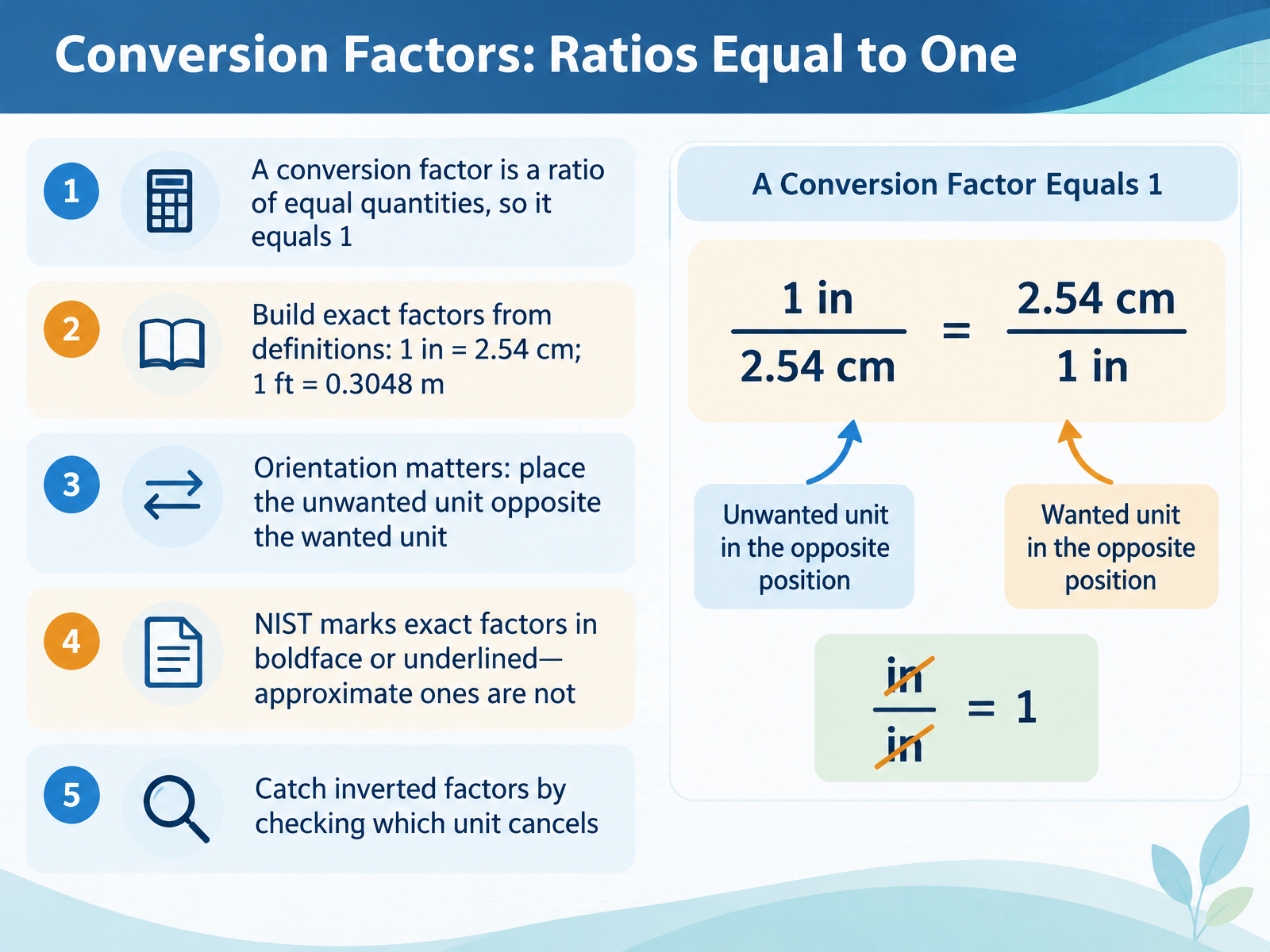
- 04Conversion Factors: Ratios Equal to OneNow let's build your conversion toolkit. A conversion factor is a ratio of two equal quantities, so its value is exactly one. Multiplying by one never changes the real amount, only the units.
First, build exact factors from definitions. Since one inch equals two point five four centimeters, you can write one inch over two point five four centimeters, or flip it.
Next, orientation matters. Place the unit you want to cancel on the opposite side. If you are converting inches to centimeters, put inches in the denominator so they cancel, and centimeters on top.
One more clue: the National Institute of Standards and Technology marks exact factors in bold or underlined type. Factors that are not marked are approximate, so treat them with care. And if a factor feels inverted, just check which unit cancels. If the unwanted unit remains, flip the factor.
Does that make sense so far? Quick summary: a conversion factor equals one, and the right orientation cancels the unwanted unit. Your takeaway: before you multiply, say out loud which unit should cancel, then place it on the opposite side.
Next, let's look at prefixes and unit notation read correctly.
 2 min
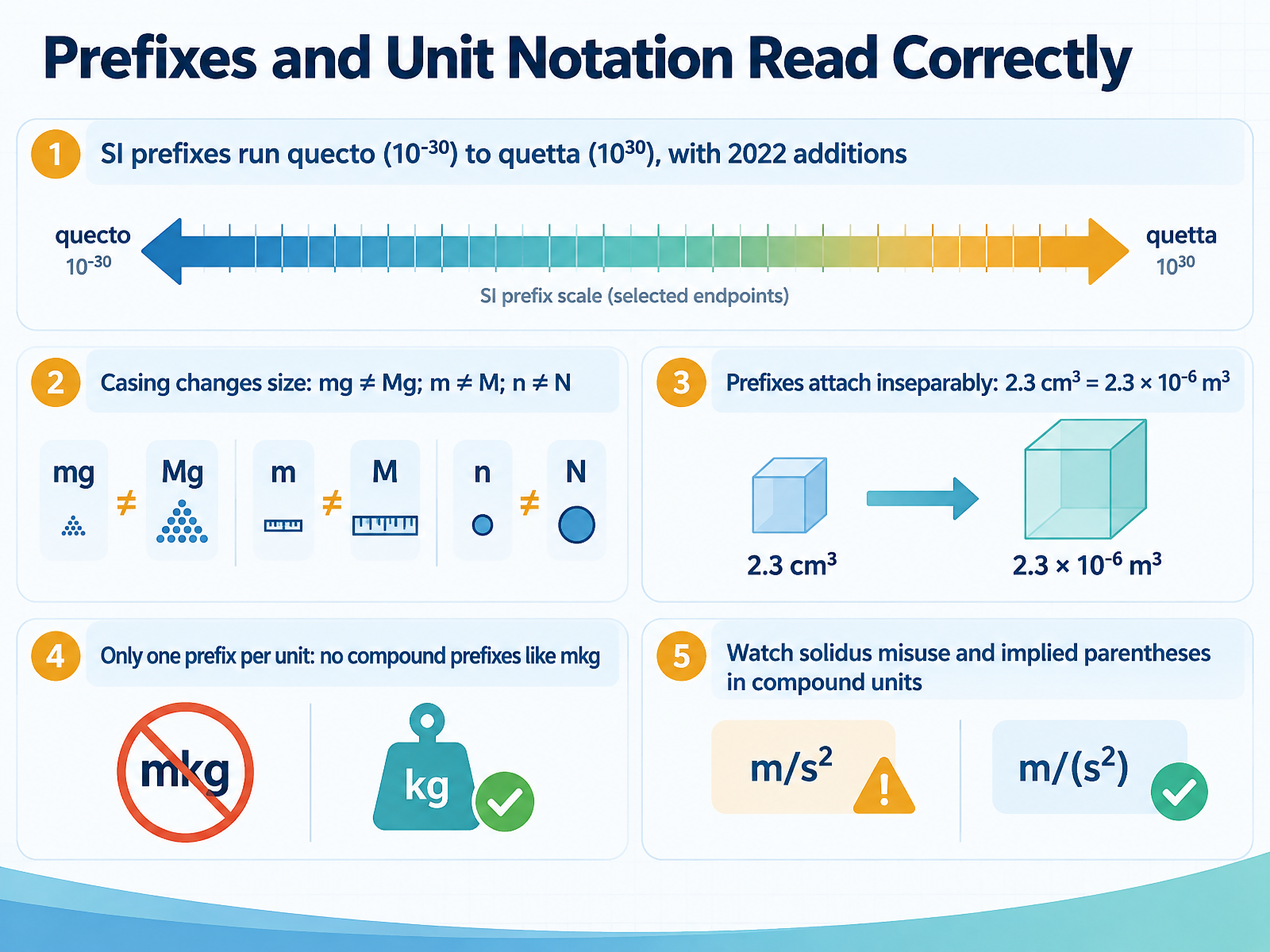
- 05Prefixes and Unit Notation Read CorrectlyNow let's read prefixes and unit notation correctly. First, SI prefixes span from quecto at ten to the negative thirtieth, up to quetta at ten to the thirtieth, with new additions in twenty twenty-two. Next, casing changes the size. Milligrams is not megagrams. Lowercase m means milli, uppercase M means mega. Likewise, lowercase n is nano, and uppercase N is newton. Does that make sense so far? Remember, prefixes attach inseparably. Two point three cubic centimeters equals two point three times ten to the negative sixth cubic meters. Also, use only one prefix per unit. No compound prefixes like millikilograms. Finally, watch solidus misuse and implied parentheses in compound units. So to summarize: check the prefix, mind the case, and keep units clean. Your takeaway: before calculating, say the unit aloud and confirm each prefix. Coming up next, The Chain Method: One Expression, Many Steps.
 2 min
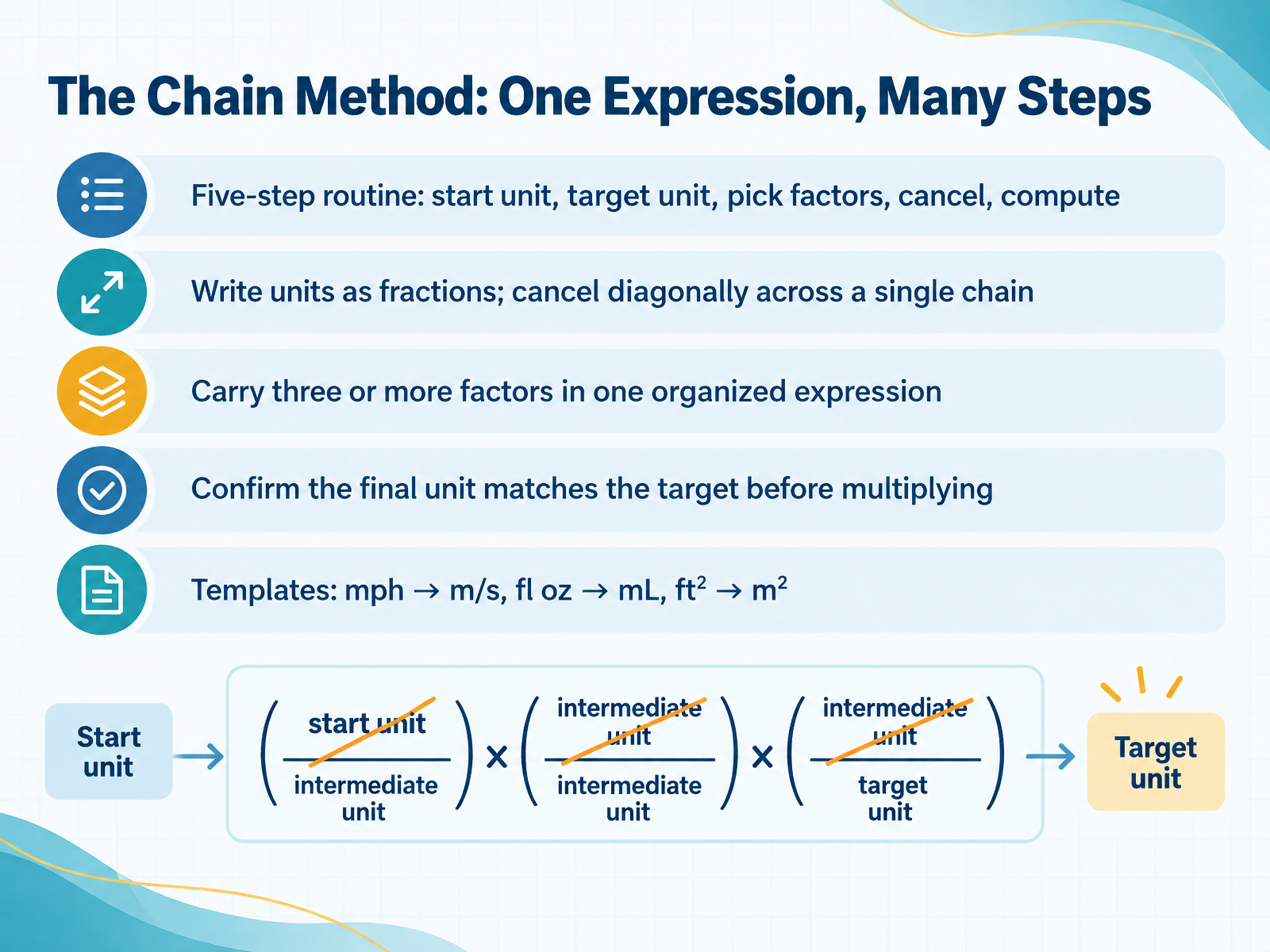
- 06The Chain Method: One Expression, Many StepsNow we come to a method that makes complex conversions feel simple. It's called the chain method: one expression, many steps. Here's the five-step routine. First, write your starting unit. Next, write your target unit. Then, pick the conversion factors that connect them. After that, cancel any units that appear on opposite sides of the line. Finally, compute the numbers. Always write units as fractions, and cancel diagonally across a single chain. That way, everything stays organized. You can carry three or more factors in one expression without losing track. Before you multiply, confirm that the final unit matches your target. For example, miles per hour to meters per second, fluid ounces to milliliters, or square feet to square meters. Mistakes are normal. Just check each step. So here's your takeaway: build the chain first, then do the math. Next, we'll look at temperature and other non-ratio conversions.
 2 min
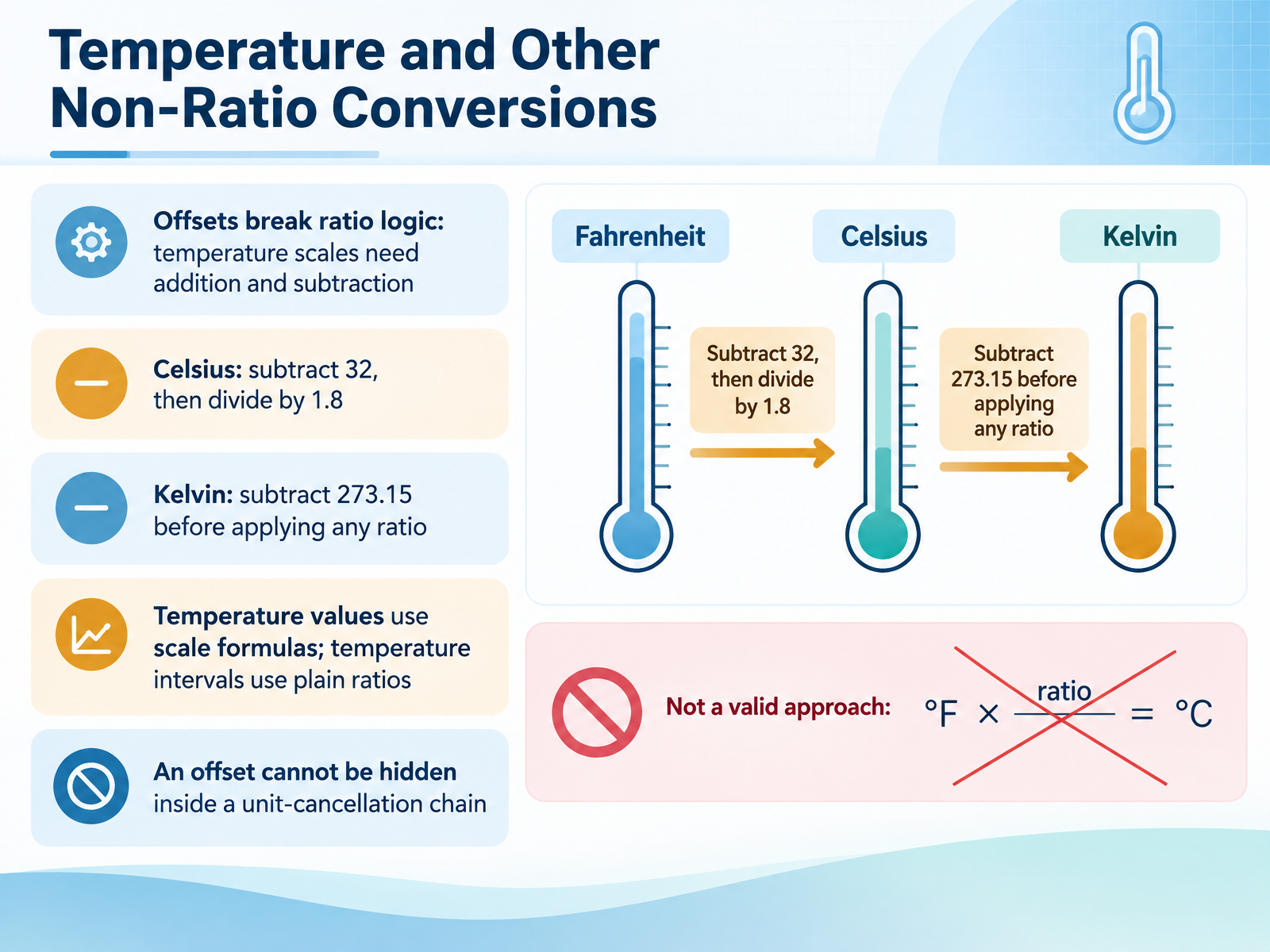
- 07Temperature and Other Non-Ratio ConversionsNow let's look at temperature and other non-ratio conversions. Most units multiply or divide cleanly. Temperature is different, because its scales have offsets. An offset is a fixed starting point, and it breaks the ratio logic we have used so far. For Celsius, first subtract thirty two, then divide by one point eight. For Kelvin, subtract two hundred seventy three point one five before applying any ratio. Here is the key distinction. A temperature value uses a scale formula. But a temperature interval, like a change of five degrees, uses a plain ratio. Also, an offset cannot be hidden inside a unit-cancellation chain. It must be applied on its own. Does that make sense so far? So the takeaway is this. Ask whether you have a position on a scale or a difference between two temperatures, then choose the right method. Next, we will move between metric and US customary units.
 2 min
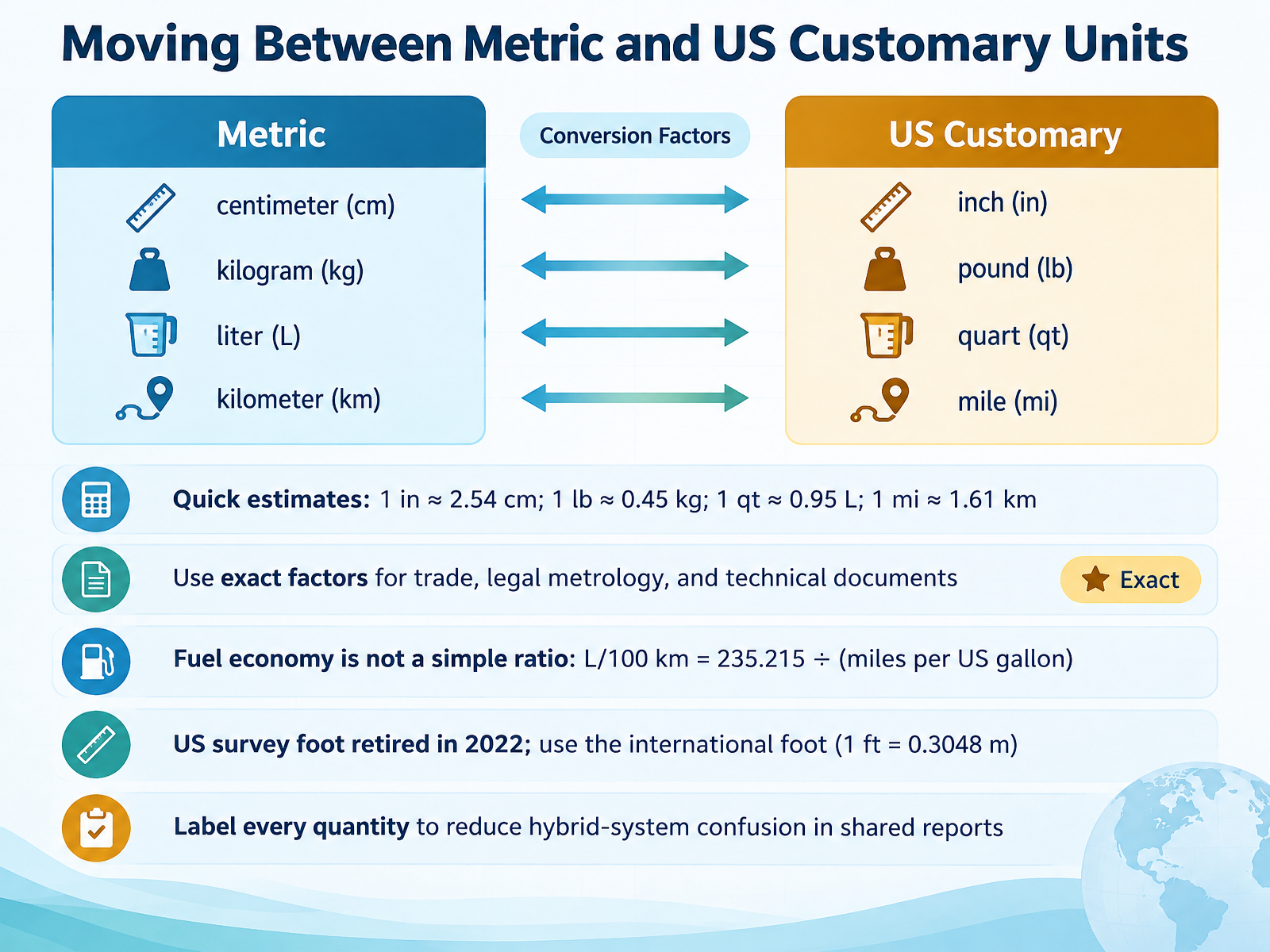
- 08Moving Between Metric and US Customary UnitsNow let's move between metric and US customary units. First, quick estimates you can do in your head. One inch is approximately two point five four centimeters. One pound is approximately zero point four five kilograms. One quart is approximately zero point nine five liters. And one mile is approximately one point six one kilometers. These are great for a rough feel, not for a contract. For trade, legal metrology, and technical documents, always use exact conversion factors. Next, fuel economy. It is not a simple ratio. To convert miles per US gallon to liters per one hundred kilometers, use two hundred thirty five point two one five divided by miles per gallon. Now check your feet. The US survey foot was retired in twenty twenty two. Use the international foot, where one foot equals zero point three zero four eight meters. And label every quantity, with its unit and system, to reduce hybrid-system confusion in shared reports. So, estimate freely, convert exactly for official work, and always label your units. Here is your takeaway: write the unit next to every number before you calculate. Next, we will look at common traps and how to avoid them.
 2 min
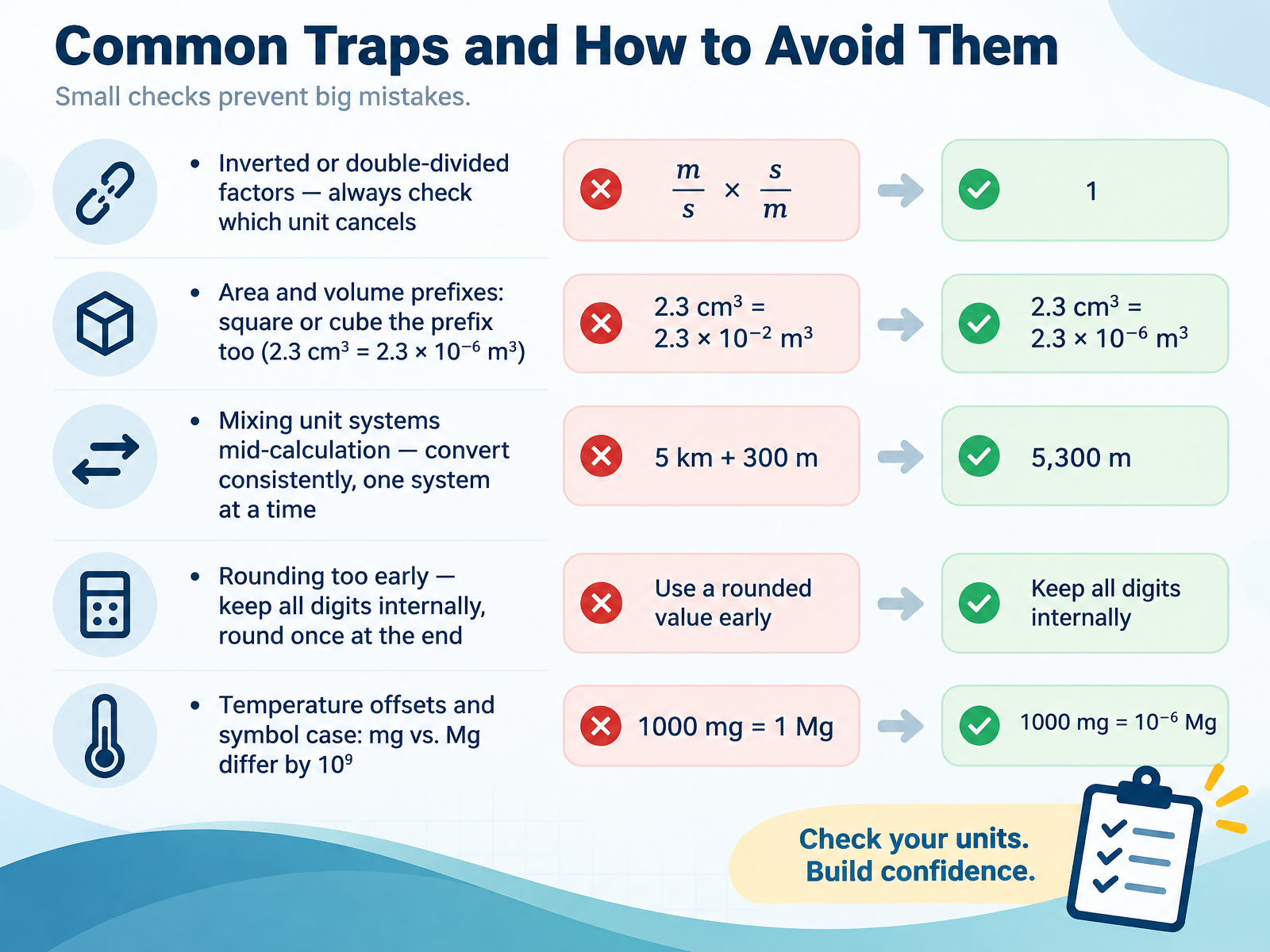
- 09Common Traps and How to Avoid ThemNow let's look at common traps, and how to avoid them. First, inverted or double-divided factors. Before you calculate, pause and ask: which unit actually cancels? If you're unsure, write the units out and cross them off one by one. Next, area and volume prefixes. For cubic units, cube the prefix too. For example, two point three cubic centimeters equals two point three times ten to the negative six cubic meters. Does that make sense so far? Also, avoid mixing unit systems mid-calculation. Stay in one system at a time and convert consistently. Then, don't round too early. Keep all digits internally, and round once at the end. Finally, watch temperature offsets, and symbol case. Milligrams and megagrams differ by a factor of ten to the ninth. So, to summarize, check your cancellations, cube volume prefixes, and round late. Your takeaway: before every conversion, circle the unit that should cancel. That one habit catches most traps. Next, we'll look at checking your work, focusing on magnitude and precision.
 1 min
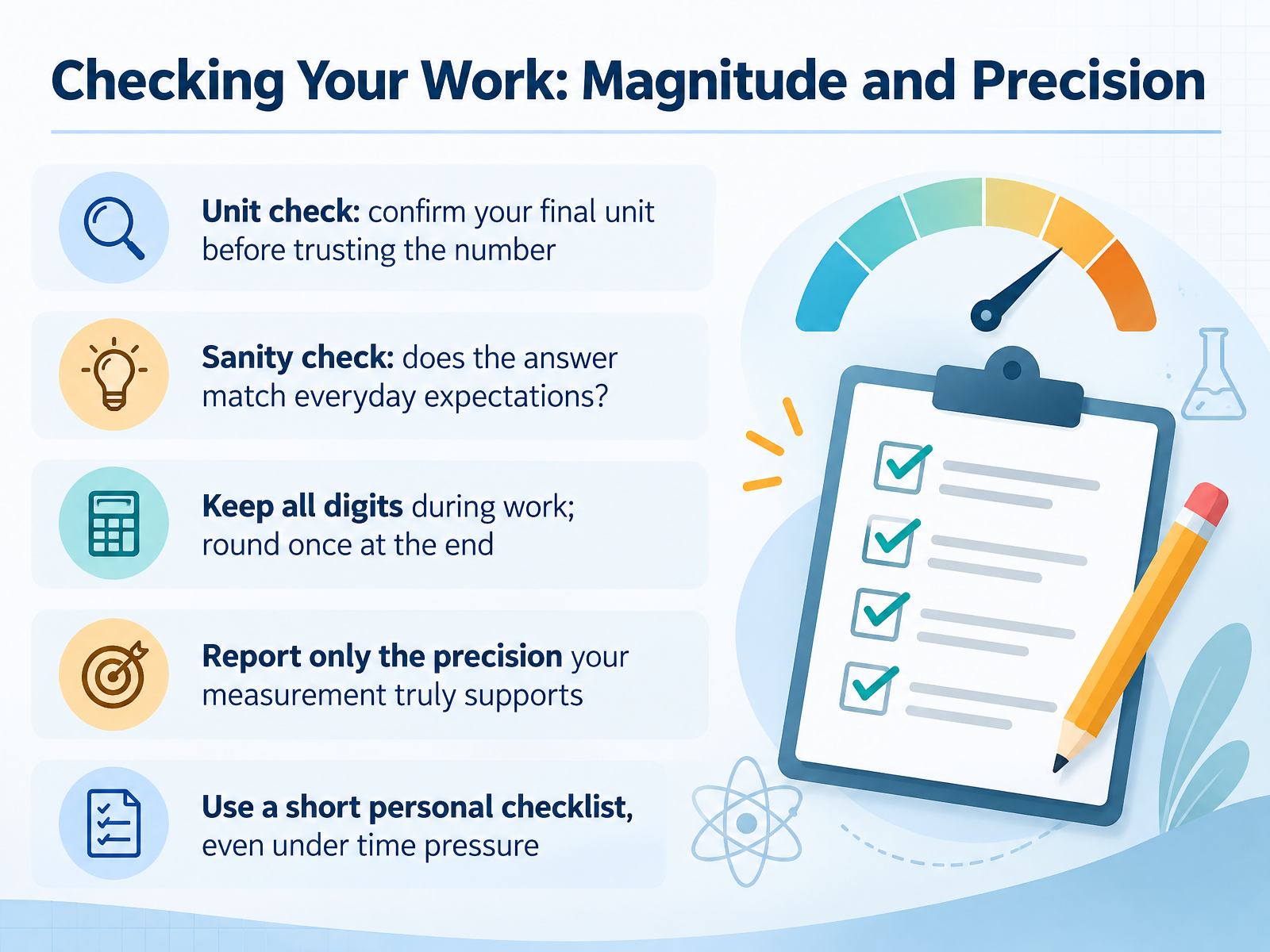
- 10Checking Your Work: Magnitude and PrecisionNow let's talk about checking your work, because a confident answer and a correct answer are not always the same thing. Start with the unit check. Before you trust your number, confirm the final unit matches what the question asked for. If you expected milligrams and you got grams, stop there. Something went wrong. Next, run a sanity check. Does the answer match everyday expectations? If a recipe calls for a few cups of flour, an answer in gallons should make you pause. Does that make sense so far? Then there's precision. Keep all your digits during the work, and round only once, at the end. And report only the precision your measurement truly supports. Writing five decimal places from a rough ruler doesn't make the answer better. It just looks better. My advice is a short personal checklist: unit, magnitude, round at the end. Use it every time, even under time pressure. Mistakes are normal, and this checklist catches them fast. Next, we'll put all of this into practice with student and lab scenarios.
 2 min
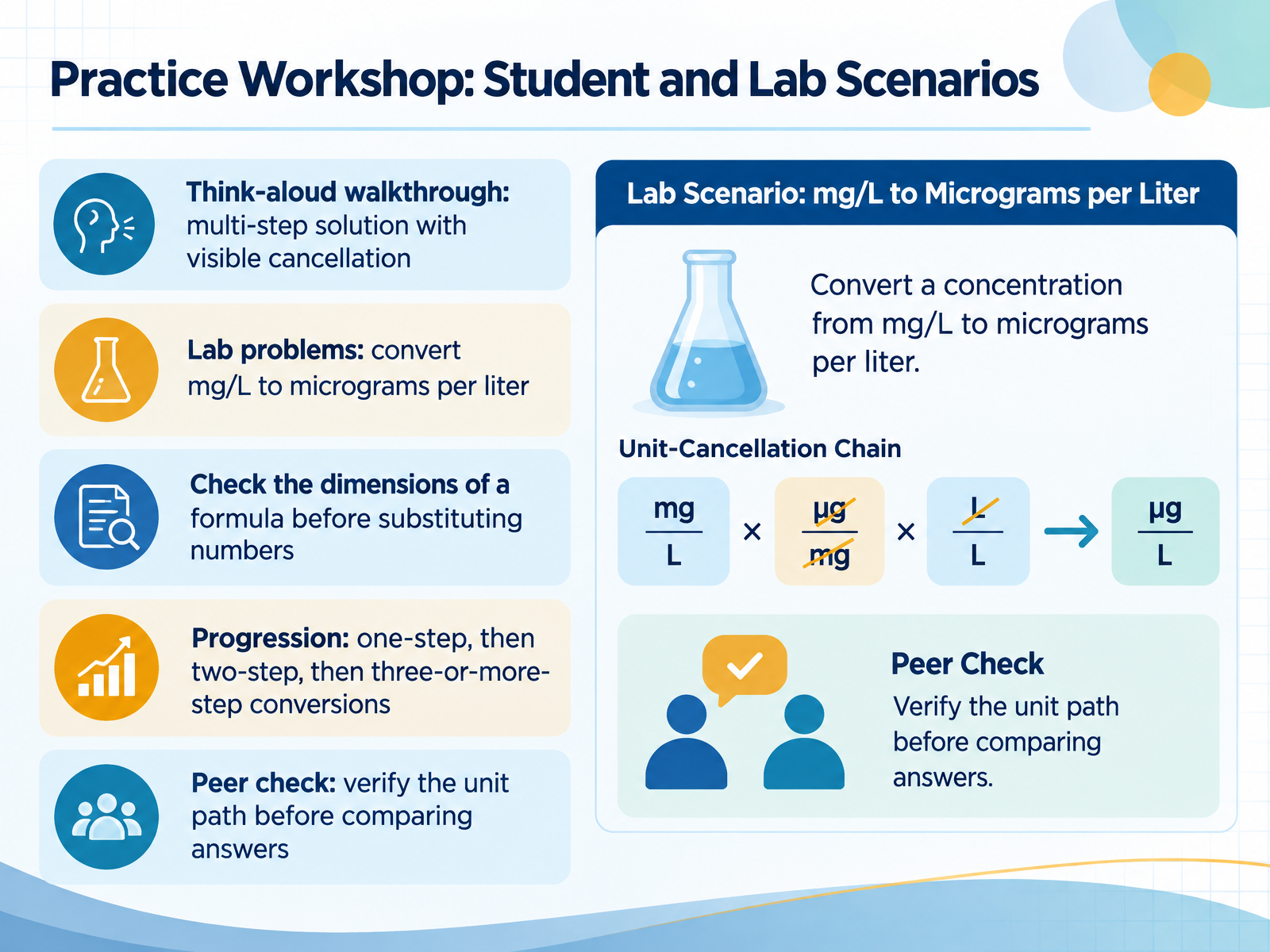
- 11Practice Workshop: Student and Lab ScenariosNow let's put your skills into practice with a workshop. We'll start with a think-aloud walkthrough. I'll solve a multi-step problem out loud, and you'll see each unit cancel as I go. Watch the units, not just the numbers. Next, a lab example. To convert milligrams per liter to micrograms per liter, you multiply by one thousand, because one milligram equals one thousand micrograms. Liters stay the same and cancel nothing here. Does that make sense so far? Another habit: check the dimensions of a formula before you substitute any numbers. It catches errors early. We'll build up gradually. One-step conversions first. Then two-step. Then three or more steps. Finally, do a peer check. Before comparing final answers, verify the unit path together. Remember, mistakes are normal steps in learning. Your takeaway for this segment: always confirm the unit path first, then the numbers. Up next, we'll move into practice workshop with everyday and educator scenarios.
 2 min
- 12Practice Workshop: Everyday and Educator ScenariosNow let's put your unit reasoning to work in a practice workshop. First, everyday scenarios. Picture travel distances, scaling a recipe, comparing grocery unit prices, or checking a medication label. Each one asks you to track units carefully. Next, workplace cases. Say you convert packaged goods or fuel figures, and your organization requires documented conversion factors. Write the factor down, and show the chain. Then, for educators, think about grading exercises. Don't just mark a number wrong. Trace exactly where unit tracking broke down. When you grade rationales, reward unit reasoning, not only correct numbers. Does that make sense so far? Pause and try one yourself. Your exit task is this. Take one unfamiliar conversion, solve it with the chain method, and choose a precision you can defend. That habit will serve you well. Next, we'll look at reference sources and tools.
 1 min
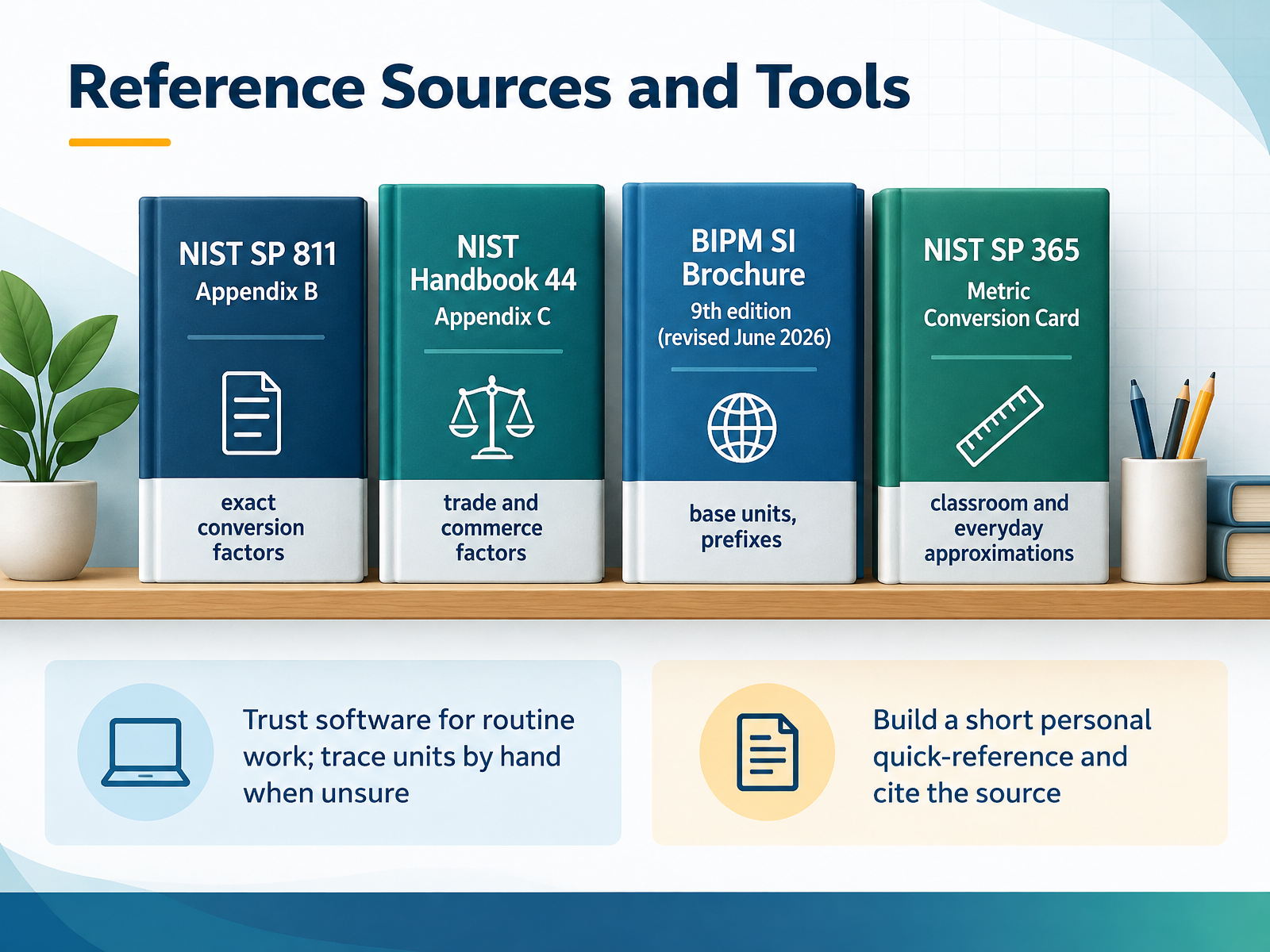
- 13Reference Sources and ToolsNow let's talk about where to find trustworthy conversion factors. Your sources matter as much as your math. First, for exact values, NIST Special Publication 811, Appendix B, is your gold standard. Next, for trade and commerce, look at NIST Handbook 44, Appendix C. For base units and prefixes, the BIPM SI Brochure, ninth edition, revised in June 2026, is the definitive reference. For quick classroom approximations, the NIST SP 365 Metric Conversion Card is handy. Does that make sense so far? In daily work, it's fine to trust your software for routine conversions. But when you're unsure, trace the units by hand. For example, if a recipe calls for two hundred fifty milliliters and your tool shows a strange result, check the factor against a reliable source. Finally, build a short personal quick-reference of the conversions you use most, and always cite the source. That habit keeps your work accurate and reproducible. Next, we'll bring everything together in Managing Conversions Confidently at Work: Review and Next Steps.
 1 min
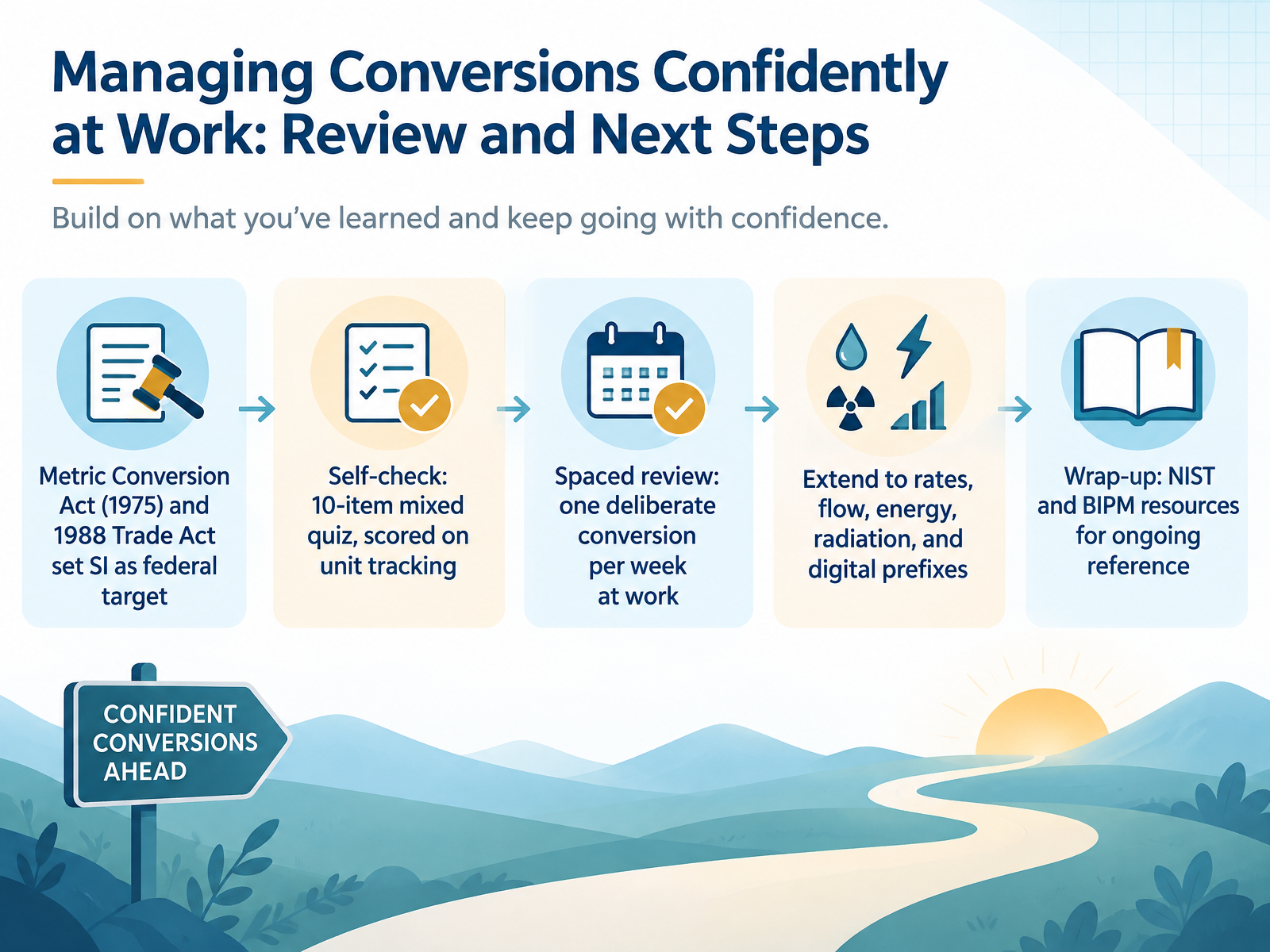
- 14Managing Conversions Confidently at Work: Review and Next StepsLet's bring this all together. First, the big picture: the Metric Conversion Act of nineteen seventy-five, and the nineteen eighty-eight Trade Act, set SI units as the federal target. So when your workplace uses metric, you are working with the standard, not an exception. Next, check yourself. Take a ten-item mixed quiz, scored on your unit tracking. That means credit goes to showing units clearly and cancelling them correctly, not just getting the number right. Does that make sense so far? Then, keep it fresh with spaced review. Do one deliberate conversion per week at work, just one, and notice how quickly it becomes natural. From there, extend the same steps to rates, flow, energy, radiation, and digital prefixes like kilo and mega. The method stays the same. Track your units, cancel carefully, and sanity-check the result. For ongoing reference, bookmark the NIST and BIPM resources, and return to them whenever a unit feels unfamiliar. So here is your takeaway. Pick one weekly conversion, score yourself on unit tracking, and remember that mistakes are simply part of learning. Thank you for joining me, and keep converting with confidence.
 2 min
Take the deck with you
Download this course as a file — free, no sign-up needed.
- PDF handoutEvery slide page, ready to print or share.15 pages · 3.3 MBDownload
- Narrated PowerPointThe deck that presents itself — every slide carries the digital human's narration video.15 pages · 16.0 MBDownload
- PowerPoint slidesThe full deck as a .pptx — open it in PowerPoint, Keynote, or Google Slides.15 pages · 3.3 MBDownload
Free to use in your own training — please keep the PersonWise credit page at the end.
Have your own deck? Turn it into a course