Begin
14 pages · ~28 min
L&D Process: Stages, Roles & Deliverables
This training explains the stages, roles, and deliverables of the learning and development process for L&D professionals and stakeholders involved in designing and delivering training.
A digital instructor presents all 14 pages. Hold “Ask” at any point and ask out loud — the answer comes from this course. No sign-up needed.
What you’ll learn
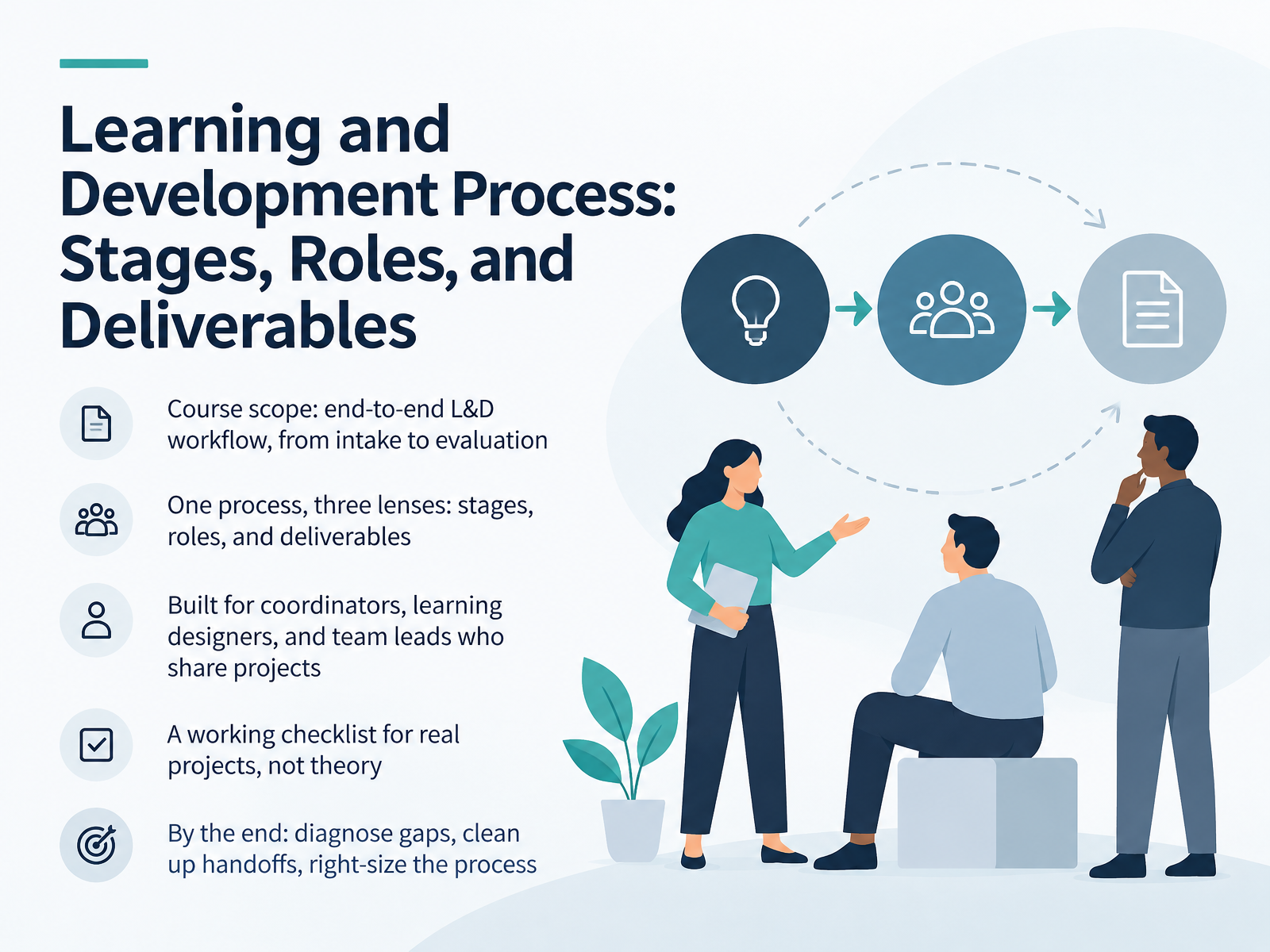
- 01Learning and Development Process: Stages, Roles, and DeliverablesWelcome. This course walks you through the learning and development process from end to end, from the first intake conversation to evaluation after launch. We will look at one process through three lenses: stages, roles, and deliverables. The stages are the phases work moves through, the roles are who owns each piece, and the deliverables are the tangible outputs, like a design plan, a storyboard, or a pilot feedback report. This is built for coordinators, learning designers, and team leads who share projects, so expect a working checklist for real projects, not theory. By the end, you will be able to diagnose gaps in your current workflow, clean up handoffs between roles, and right-size the process to fit the project. Next, we look at why a defined L and D process matters.documents.nbcc.cainstructionaldesign.orgd2l.com+21 min
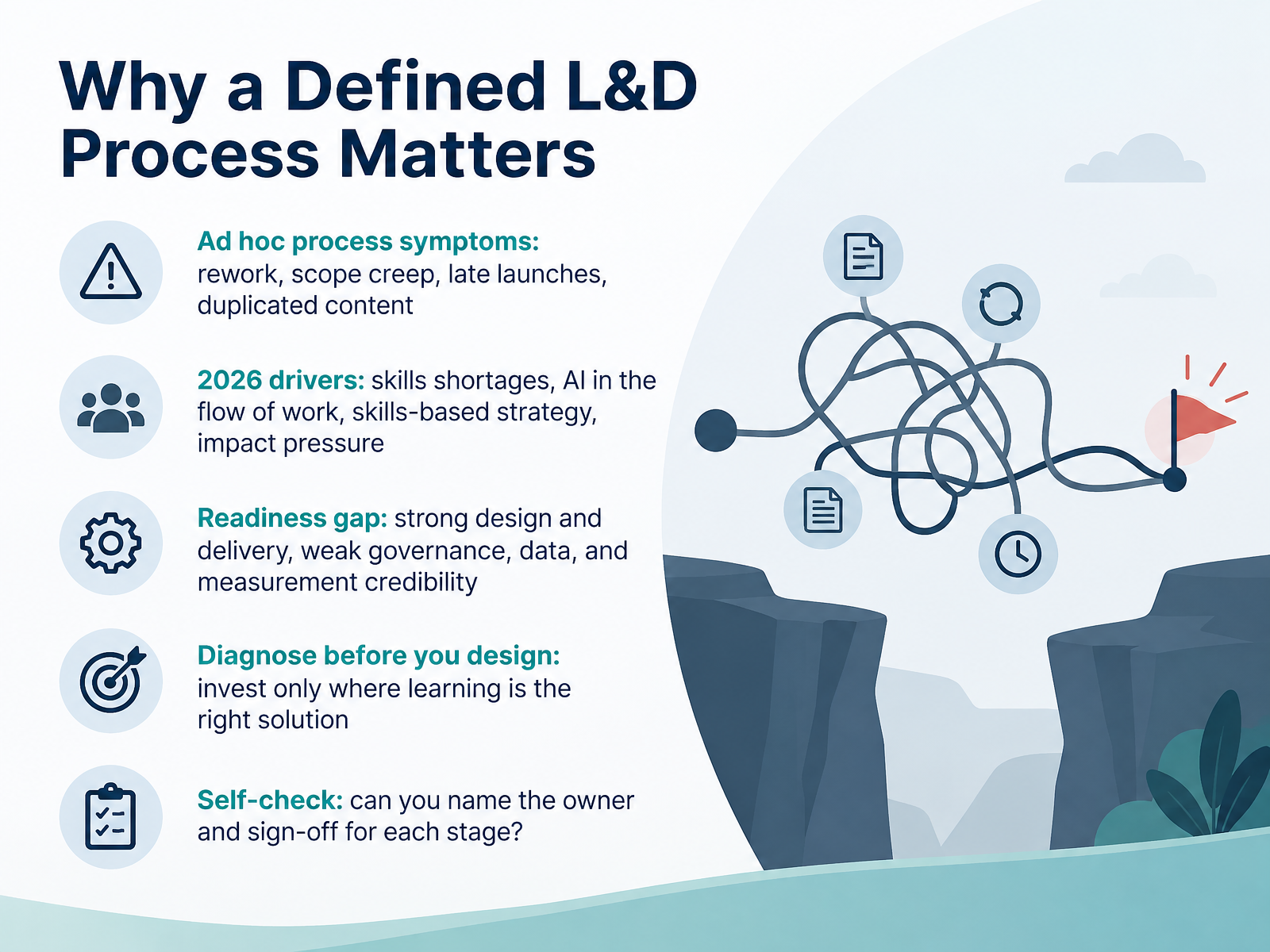
- 02Why a Defined L&D Process MattersLet's look at why a defined L&D process matters. If your process is ad hoc, the symptoms show up quickly. You get rework, scope creep, late launches, and duplicated content that different teams build twice. Next, consider the 2026 drivers. Skills shortages continue, AI is moving into the flow of work, more organizations are pursuing a skills-based strategy, and leaders are demanding credible proof of impact. In contrast, many teams are strong at design and delivery but weak at governance, data, and measurement credibility. So diagnose before you design. Invest only where learning is the right solution, rather than defaulting to a course. Here is a quick self-check. Can you name the owner and the sign-off, for each stage of your process? If not, that is where to start. Next, we will cover core concepts and shared vocabulary.
 1 min
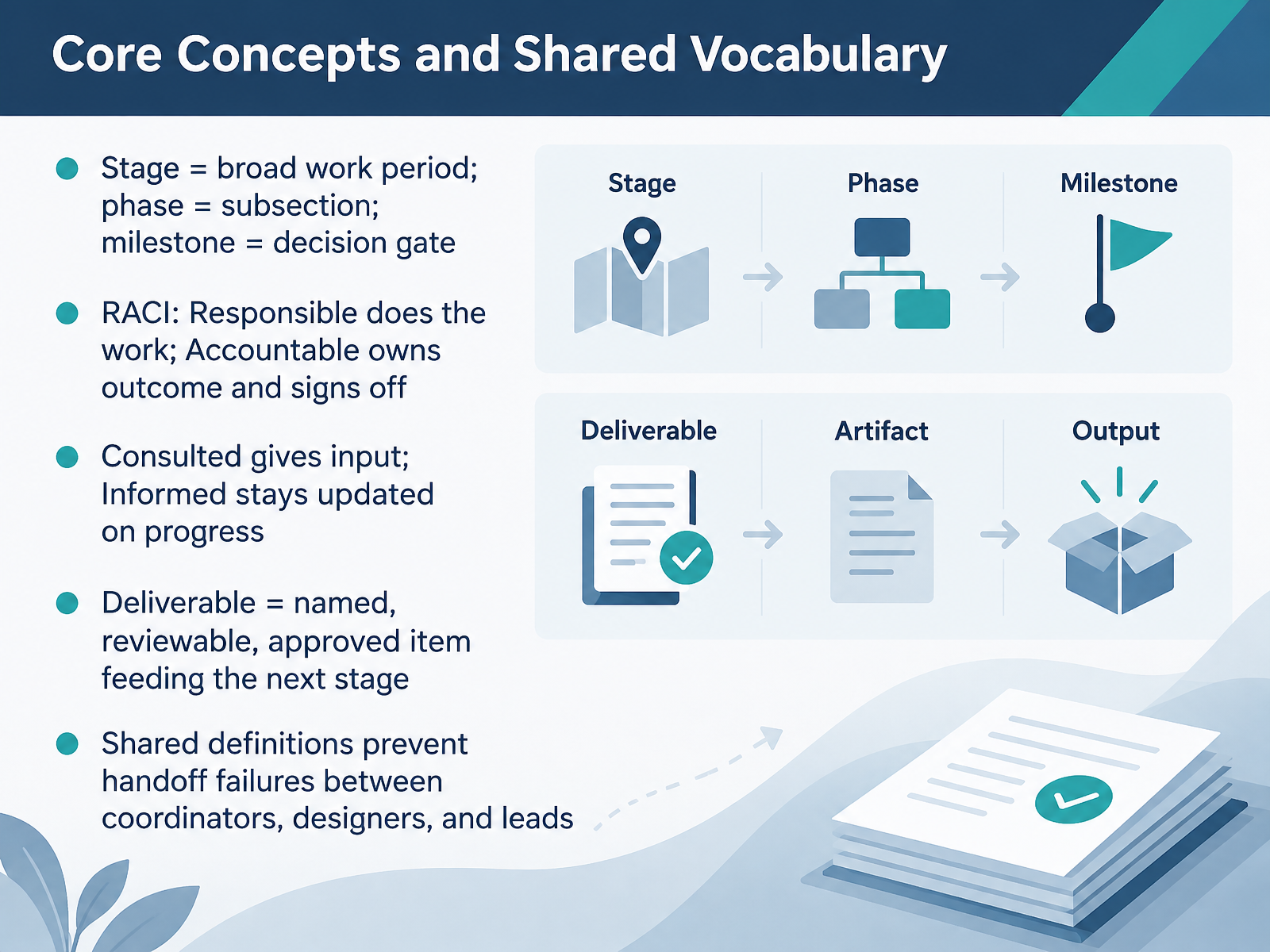
- 03Core Concepts and Shared VocabularyBefore we walk through the workflow itself, let's lock down the core concepts and the shared vocabulary we'll use all the way through. This is the language that keeps coordinators, designers, and team leads aligned, so listen for the distinctions. A stage is a broad work period, like analysis or design. A phase is a subsection within that stage. A milestone is a decision gate, where work is reviewed and either approved or sent back. Next, the R A C I roles. Responsible does the work. Accountable owns the outcome and signs off. Consulted gives input before decisions are made. Informed stays updated on progress but is not asked for approval. In contrast to a task or an activity, a deliverable is a named, reviewable, approved item that feeds the next stage, such as an approved needs analysis or a signed-off design document. Shared definitions prevent handoff failures, so when you name a stage or a milestone, use the same terms your designers and leads use. To put this vocabulary in motion, let's look at a stage-gate view of the L and D workflow.
 2 min
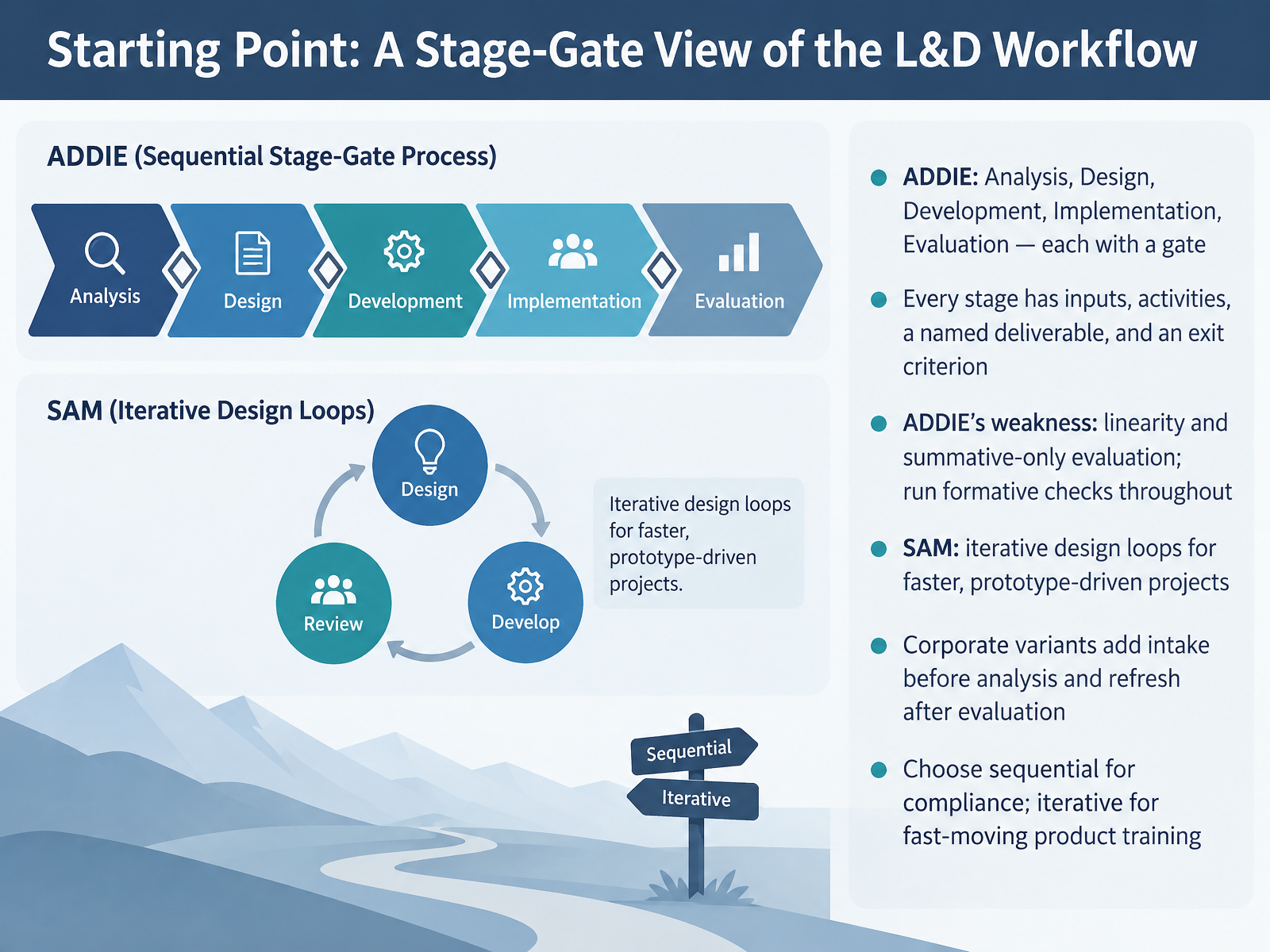
- 04Starting Point: A Stage-Gate View of the L&D WorkflowLet's build a shared mental model of the workflow, starting with a stage-gate view. ADDIE stands for Analysis, Design, Development, Implementation, and Evaluation. In a stage-gate model, each of those stages ends at a gate. Every stage has inputs, activities, one named deliverable, and an exit criterion. The exit criterion is the evidence you review before you move on. Think of a design sign-off with an approved storyboard, for example. The weakness of ADDIE is linearity and evaluation that arrives only at the end. So run formative checks throughout. In contrast, SAM, the Successive Approximation Model, uses iterative design loops. It suits faster, prototype-driven projects. Many corporate variants add an intake step before analysis and a refresh step after evaluation. Choose a sequential path for compliance training, and an iterative path for fast-moving product training. Next, we look at Stage 1: Intake and Needs Analysis.
 2 min
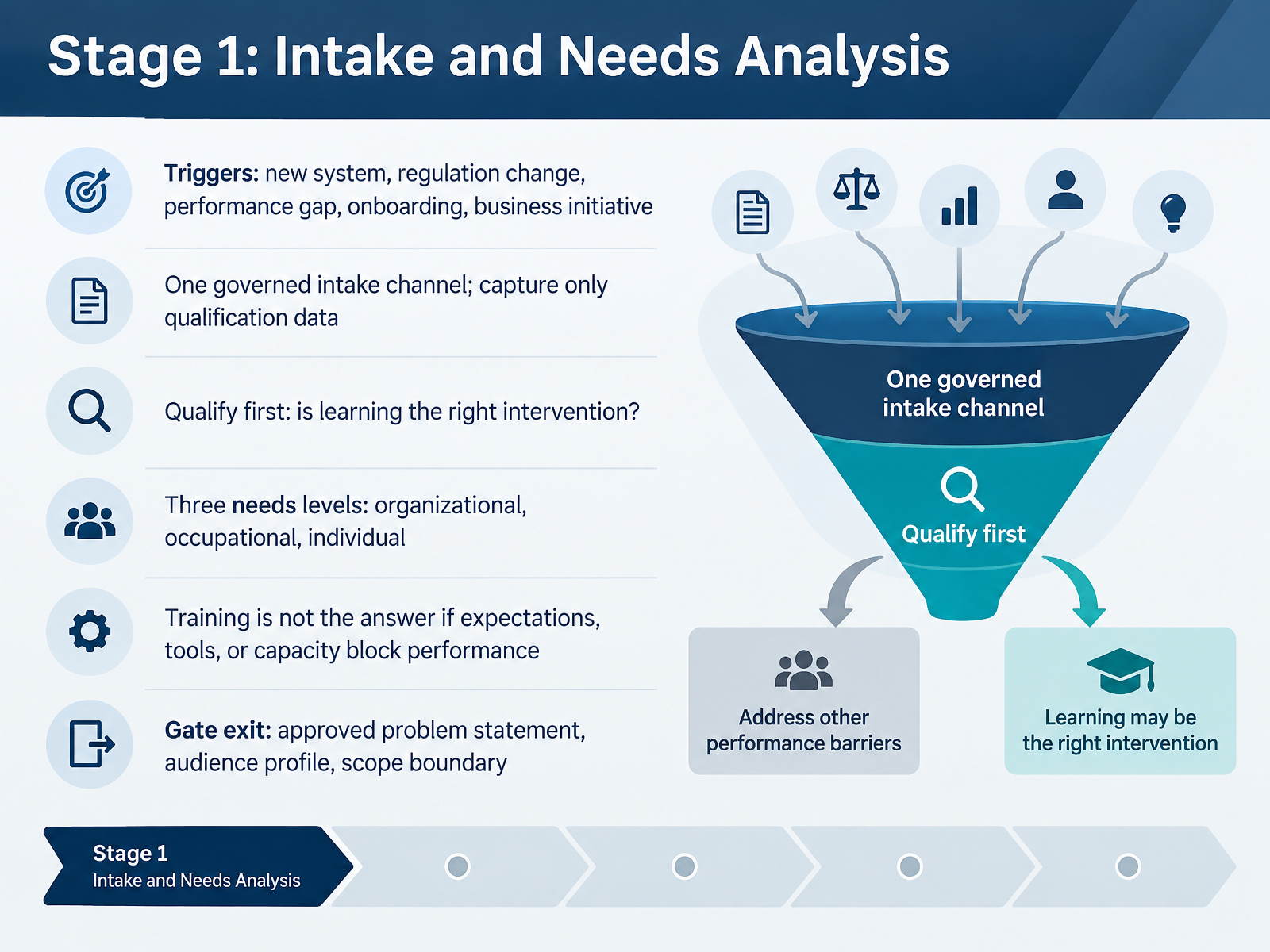
- 05Stage 1: Intake and Needs AnalysisLet's walk through the first stage: intake and needs analysis. This stage is triggered by things like a new system rollout, a regulation change, an observed performance gap, onboarding demand, or a larger business initiative. All of these requests should flow through one governed intake channel, and that form should capture only qualification data, not every detail of a proposed course. Next, qualify first by asking a simple question: is learning the right intervention here? We look at three needs levels: organizational needs, which connect to business goals; occupational needs, which describe what a role requires; and individual needs, which show where a specific person is struggling. And here is the distinction that matters. Training is not the answer when expectations, tools, or capacity are blocking performance. If people know what to do but lack access or time, a course will not fix it. No one leaves this stage without a gate exit of three approved deliverables: a clear problem statement, an audience profile, and a scope boundary. With that foundation in place, let's move on to designing the solution: objectives, assessment, and design brief.
 2 min
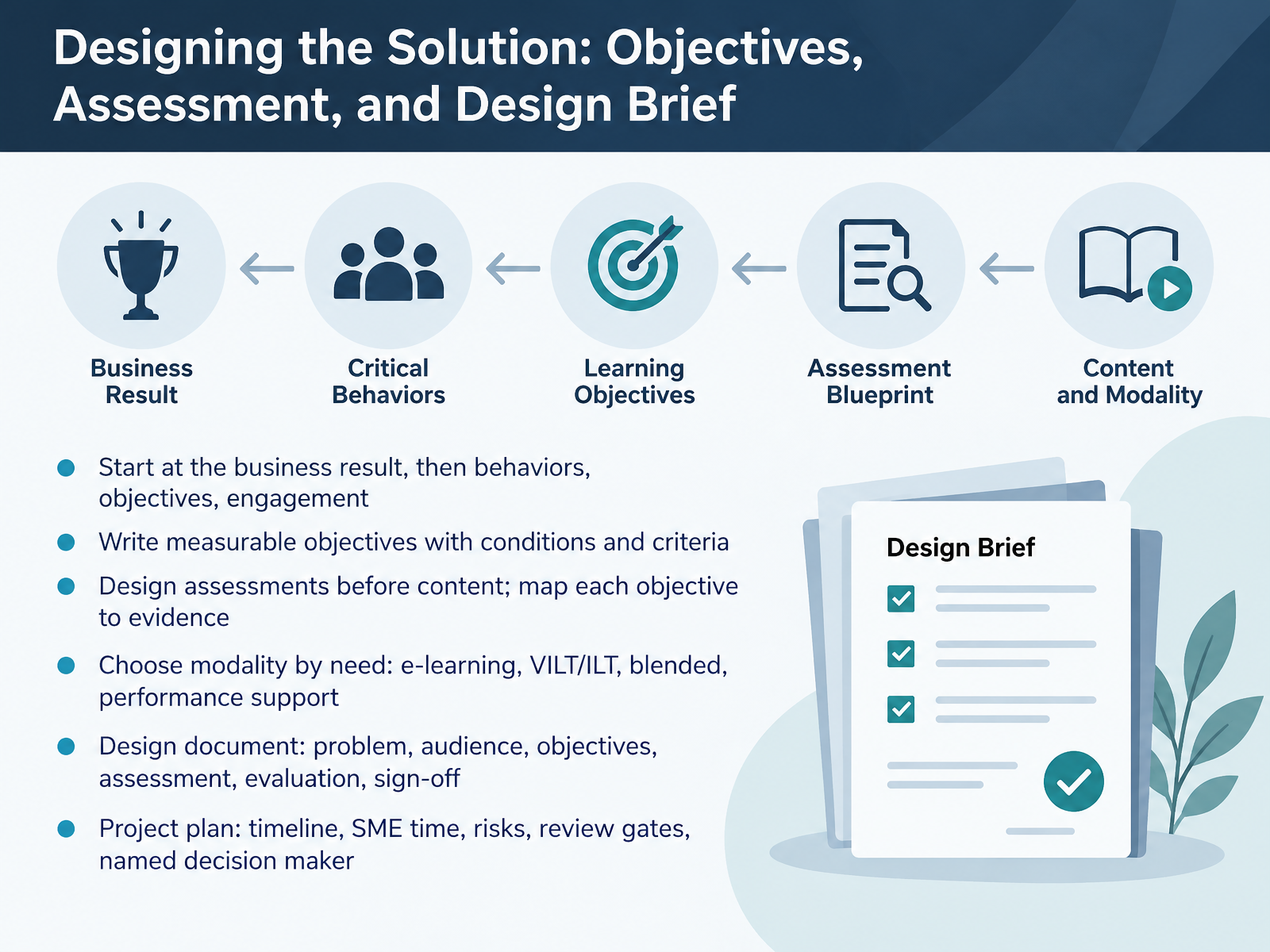
- 06Designing the Solution: Objectives, Assessment, and Design BriefNow let's look at designing the solution, where objectives, assessment, and the design brief come together. Start at the business result, then work down to the behaviors, the learning objectives, and finally the engagement. Write measurable objectives that state the conditions and the criteria for success. Next, design your assessments before you write any content, and map each objective to the evidence it requires. In contrast to jumping straight to content, this keeps the design honest. Choose your modality by need: e-learning, virtual or in-person instruction, blended, or performance support. Then document the design: the problem, audience, objectives, assessment, evaluation plan, and sign-off. And build a project plan covering the timeline, subject matter expert time, risks, review gates, and one named decision maker. That brief keeps everyone aligned. Next, Stage 3: Development and Production.
 1 min
- 07Stage 3: Development and ProductionNow let's move into Stage 3: Development and Production. This is where your design becomes a real build, and your first deliverable is a storyboard for every screen. That means capturing the text, the narration, each interaction, the feedback learners see, and the accessibility notes, all in one place, like a screen-by-screen shot list for a video. Storyboard sign-off works as a production contract. So get it agreed in writing, because changes cost far less now than after the build starts. Next, build a prototype of one section in the final visual style. That prototype validates the design and confirms your tracking fires correctly before you commit to full production. Then follow the release gates. Alpha is for content review, beta is for final assets, and gold is for release, so each gate has its own purpose. Plan two scoped review rounds with clear deadlines. Open-ended review cycles are the fastest route to overruns. And quality assurance accessibility, and test the published package inside the real learning management system, not just your authoring tool. Finally, choose build versus buy and your tools by the objective, not by habit. Next, Stage 4: Implementation and Delivery.
 2 min
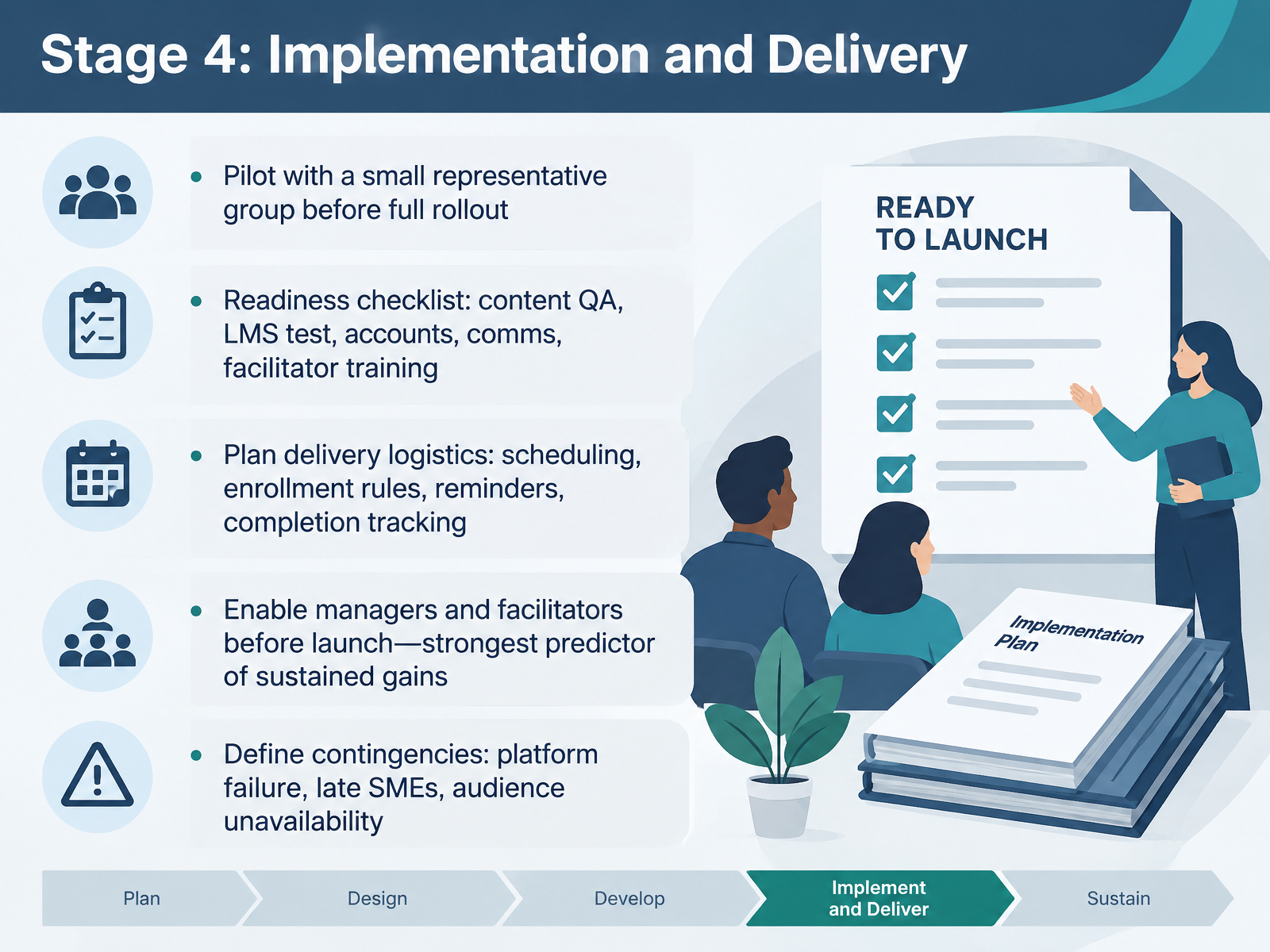
- 08Stage 4: Implementation and DeliveryNow we move into Stage Four: Implementation and Delivery. This is where your design meets real learners, so start small. Pilot with a representative group before full rollout, and use a readiness checklist to confirm five things: content quality assurance, an LMS test of the course, learner accounts, communications, and facilitator training. Then plan the delivery logistics: scheduling, enrollment rules, reminders, and completion tracking. Before launch, enable managers and facilitators. That step is the strongest predictor of sustained gains, because a prepared manager reinforces the learning on the job. In contrast, a facilitator who sees the materials for the first time on launch day will struggle. Finally, define contingencies for platform failure, late subject matter experts, and audience unavailability. Next, we look at Stage Five: Evaluation and Continuous Improvement.
 2 min
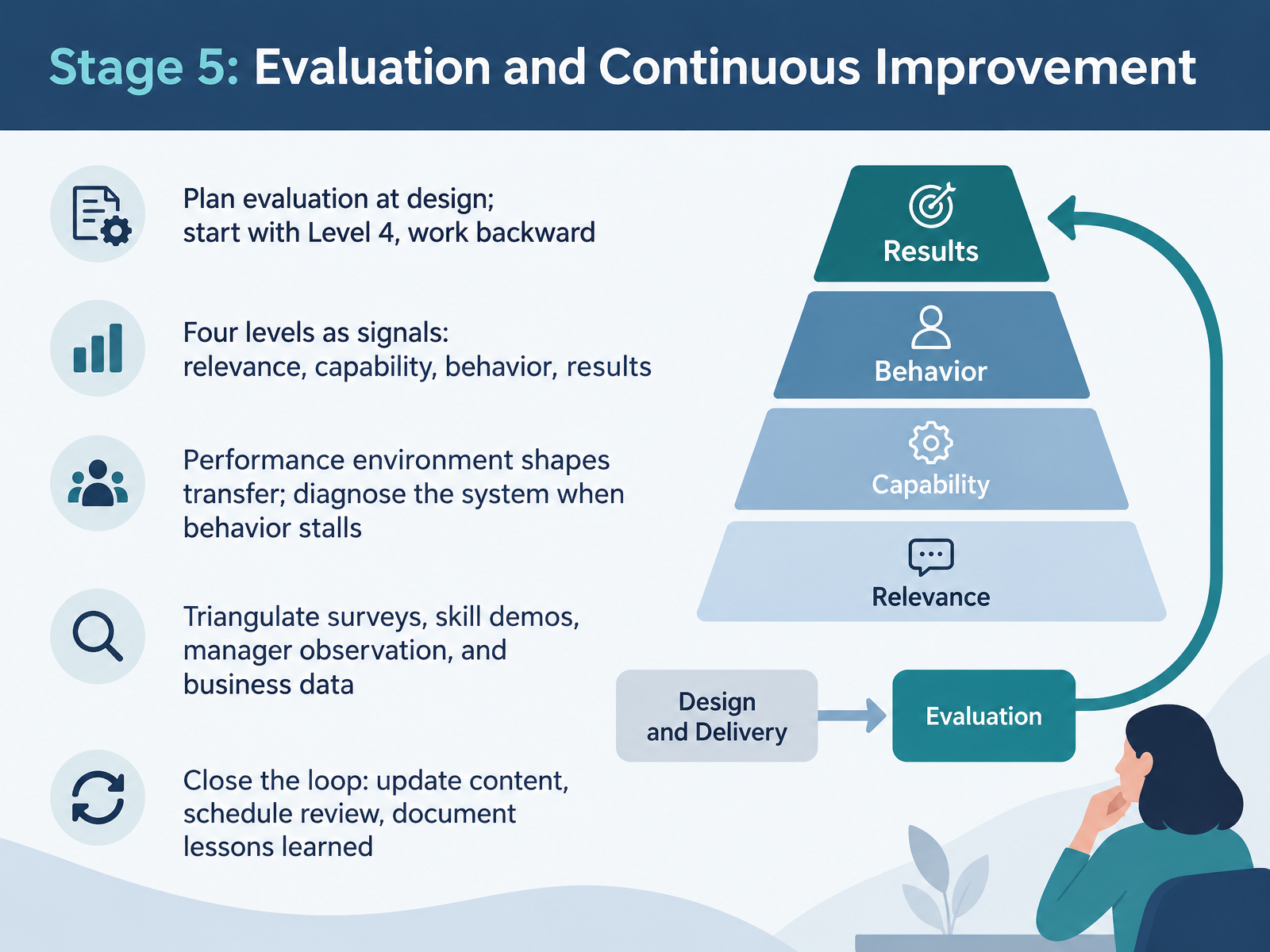
- 09Stage 5: Evaluation and Continuous ImprovementNow we move into evaluation and continuous improvement. Plan evaluation at the design stage, not at the end. Start with Level Four, the results you need, and work backward through behavior, capability, and relevance. These four levels are signals. Relevance tells you whether the learning matched the need. Capability shows whether people can perform. Behavior shows whether they actually apply it on the job. Results connect the learning to business outcomes. Remember, the performance environment shapes transfer. If behavior stalls, diagnose the system first. Check tools, incentives, manager support, and workload before blaming the training. Triangulate your evidence. Combine surveys, skill demonstrations, manager observation, and business data. Each source covers a gap the others miss. Then close the loop. Update the content, schedule the next review, and document lessons learned so the next cycle starts stronger. Next, let's look at who owns each of these steps, in Roles, Responsibilities, and the RACI View.
 2 min
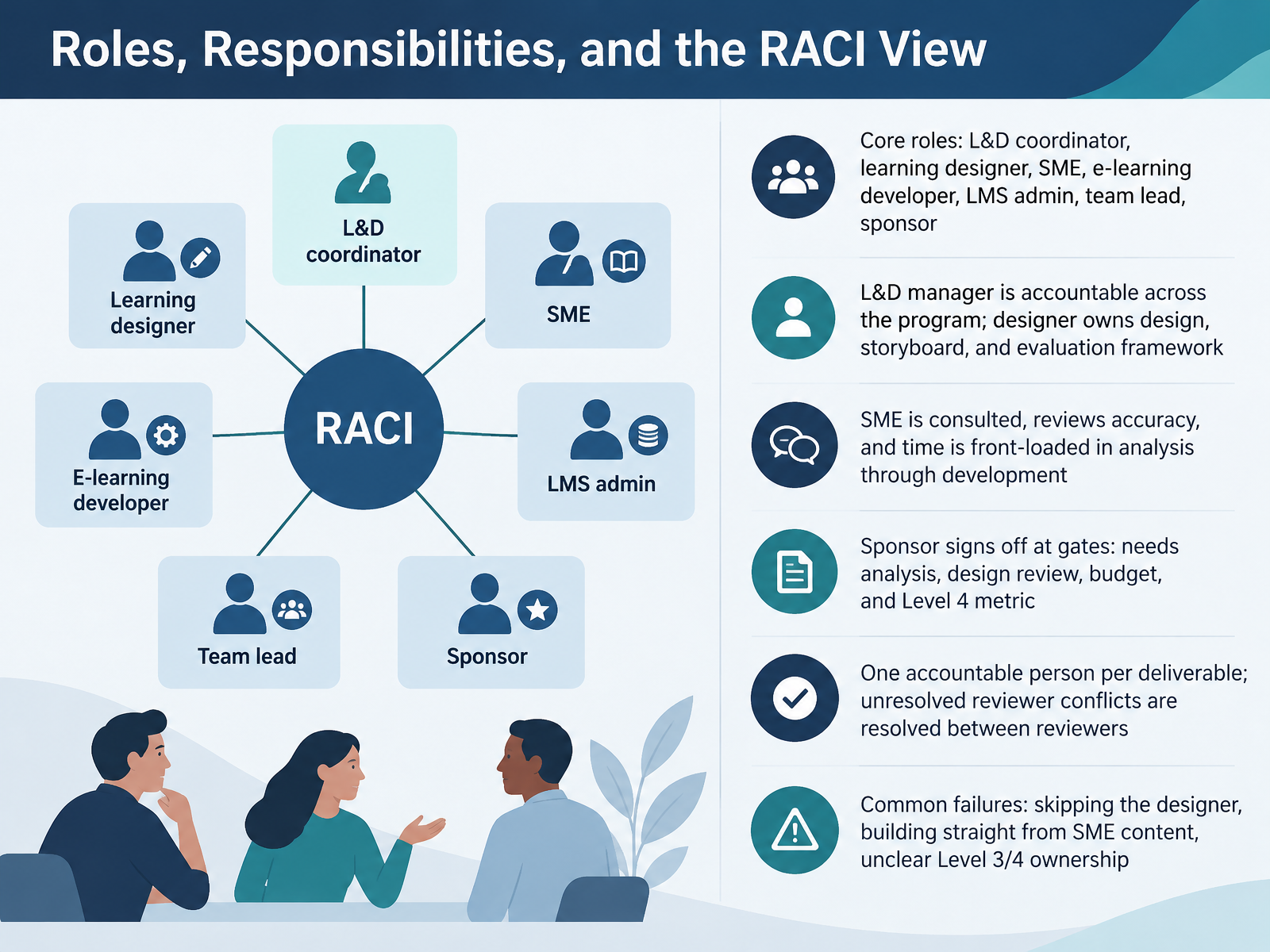
- 10Roles, Responsibilities, and the RACI ViewNow let's look at roles, responsibilities, and the R A C I view. R A C I stands for Responsible, Accountable, Consulted, and Informed, and it helps you clarify who does what on each deliverable. Your core roles include the L and D coordinator, the learning designer, the subject matter expert, or S M E, the e-learning developer, the L M S admin, the team lead, and the sponsor. The L and D manager is accountable across the program, while the designer owns the design, the storyboard, and the evaluation framework. The S M E is consulted, reviews accuracy, and their time is front-loaded from analysis through development. The sponsor signs off at gates: needs analysis, design review, budget, and the Level Four metric. Keep one accountable person per deliverable, and resolve reviewer conflicts between the reviewers themselves. In contrast, common failures include skipping the designer, building straight from S M E content, and unclear ownership of Level Three and Level Four metrics. Next, we'll map the deliverables that must exist at each stage.
 2 min
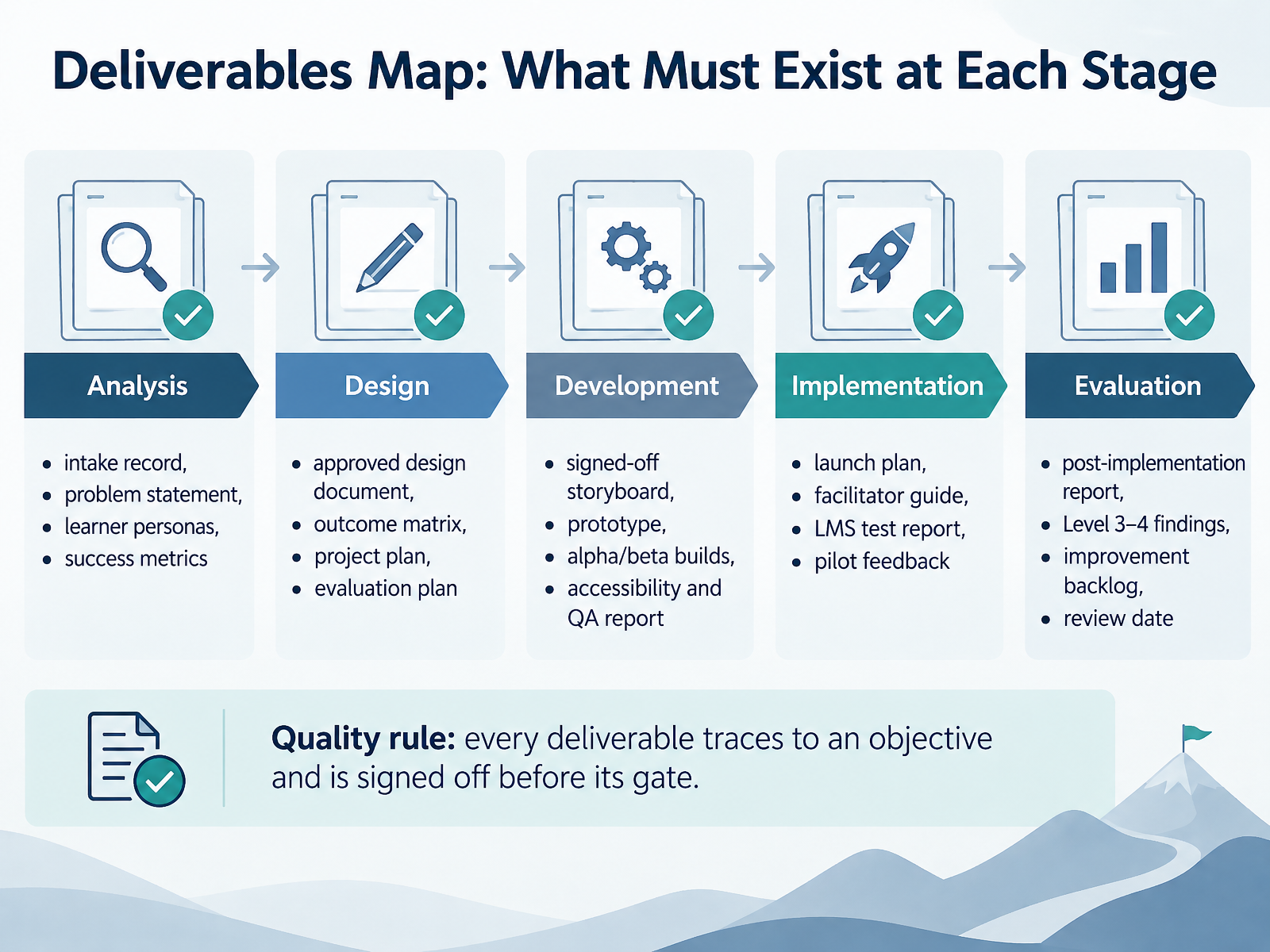
- 11Deliverables Map: What Must Exist at Each StageNow let's map the deliverables. For each stage, this is what must actually exist before you move on. In Analysis, you need an intake record, a problem statement, learner personas, and success metrics. Next stage, Design, produces the approved design document, an outcome matrix, the project plan, and the evaluation plan. During Development, expect a signed-off storyboard, a prototype, alpha and beta builds, and an accessibility and QA report. Implementation delivers the launch plan, facilitator guide, LMS test report, and pilot feedback. Finally, Evaluation yields a post-implementation report, Level three and Level four findings, an improvement backlog, and a review date. Here is the quality rule that ties it together. Every deliverable traces to an objective, and it is signed off before its gate. One distinction to keep clear. A deliverable is the artifact itself; a gate is the checkpoint where that artifact gets approved. Next, we will look at handoffs and failure modes, and where L and D processes break.
 2 min
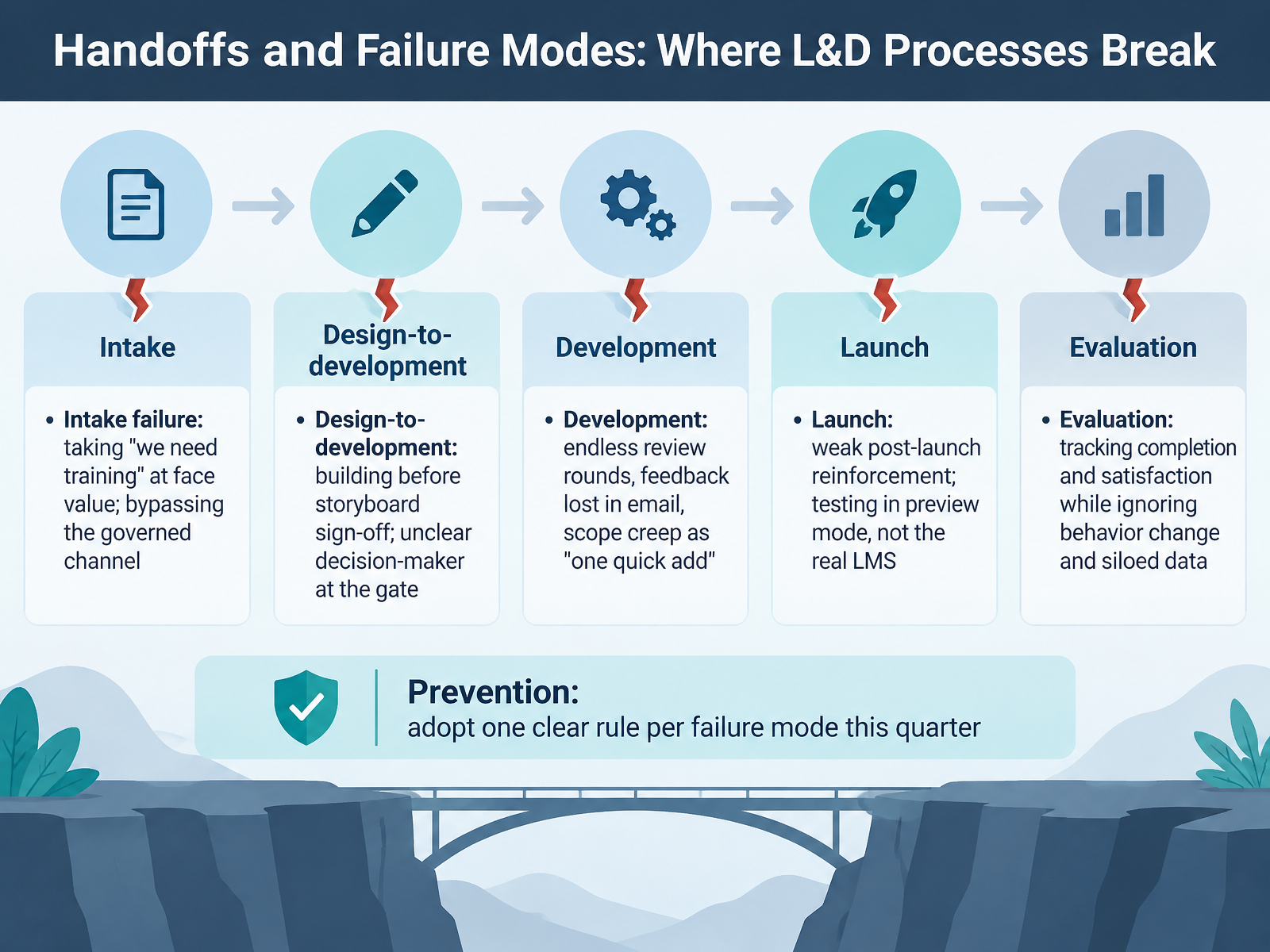
- 12Handoffs and Failure Modes: Where L&D Processes BreakLet's look at where L&D processes actually break down, stage by stage. The first failure mode is intake. That happens when you take we need training at face value and skip the governed request channel. You end up designing for a request nobody has validated.
Next stage, design to development. Here the break comes from building before storyboard sign-off, or from an unclear decision-maker at the gate. Name the approver before work starts.
In development, watch for endless review rounds, feedback lost in email, and scope creep disguised as one quick add. Log feedback in one place and treat adds as change requests.
At launch, two things weaken impact: testing in preview mode instead of the real LMS, and thin post-launch reinforcement. In evaluation, completion and satisfaction get tracked while behavior change and siloed data get ignored.
Your prevention step is simple. Adopt one clear rule per failure mode this quarter. Next, we look at scaling the process, small projects versus large programs.
 1 min
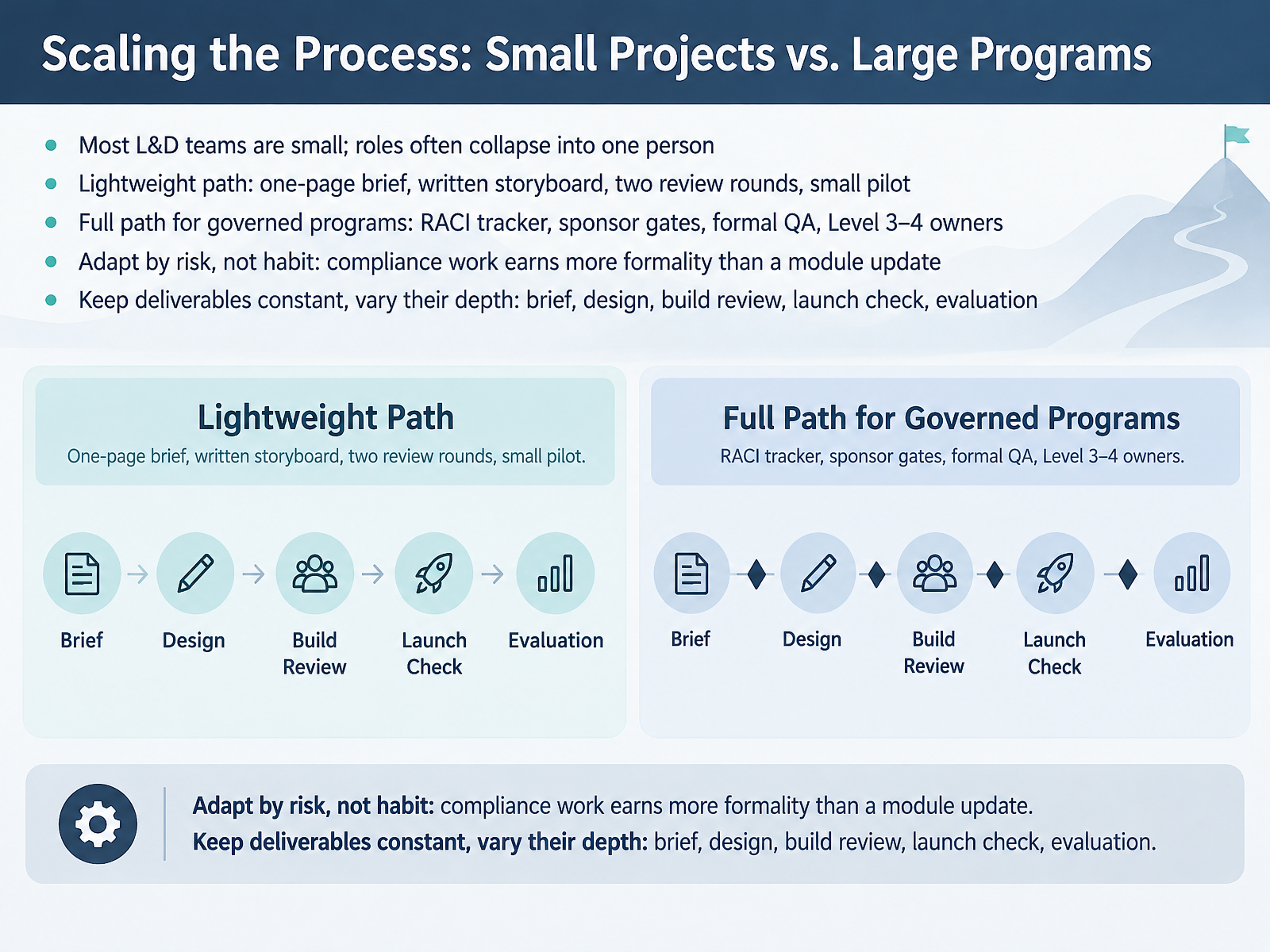
- 13Scaling the Process: Small Projects vs. Large ProgramsNext, let's talk about scaling the process. Most learning and development teams are small, so roles often collapse into one person who writes the brief, designs the course, and runs the review. That is normal, and you should plan for it. For routine work, use the lightweight path: a one-page brief, a written storyboard, two review rounds, and a small pilot. In contrast, governed programs need the full path: a RACI tracker that names who is responsible, accountable, consulted, and informed, plus sponsor gates, formal quality assurance, and named owners for Level three and Level four evaluation. Adapt by risk, not habit. Compliance work earns more formality than a simple module update. Keep the same deliverables every time, but vary their depth: the brief, the design, the build review, the launch check, and the evaluation. Your one-page process checklist and next steps are coming up.
 2 min
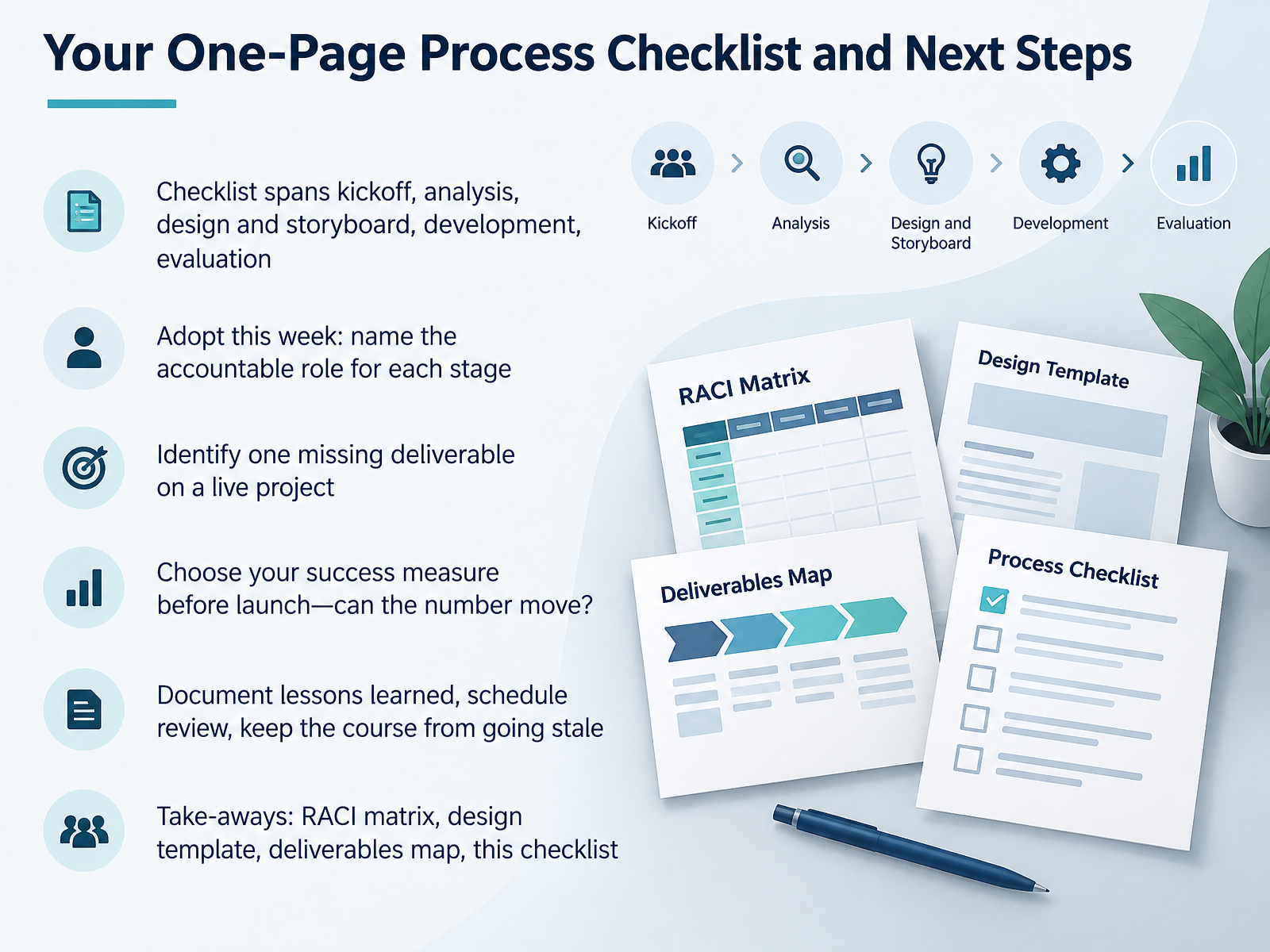
- 14Your One-Page Process Checklist and Next StepsLet's close by making this practical. Your one-page checklist spans five stages: kickoff, analysis, design and storyboard, development, and evaluation. This week, name the accountable role for each stage. That single step removes most of the confusion we've discussed. Next, look at a live project and identify one missing deliverable. Is the storyboard signed off? Is the success measure written down? Then choose your success measure before launch, and ask a simple question: can the number actually move? If it can't, pick a different measure. After delivery, document lessons learned and schedule a review, so the course doesn't go stale. Your take-aways are the RACI matrix, the design template, the deliverables map, and this checklist. Keep them close. Thank you for your attention, and go make your next project a little smoother.
 1 min
Take the deck with you
Download this course as a file — free, no sign-up needed.
- PDF handoutEvery slide page, ready to print or share.15 pages · 3.3 MBDownload
- Narrated PowerPointThe deck that presents itself — every slide carries the digital human's narration video.15 pages · 15.2 MBDownload
- PowerPoint slidesThe full deck as a .pptx — open it in PowerPoint, Keynote, or Google Slides.15 pages · 3.3 MBDownload
Free to use in your own training — please keep the PersonWise credit page at the end.
Have your own deck? Turn it into a course
Sources consulted
Web sources consulted while building this course.
- ADDIE Model — documents.nbcc.ca
- ADDIE Model - InstructionalDesign.org — instructionaldesign.org
- What Is the ADDIE Model of Instructional Design (2026 Update) — d2l.com
- ADDIE Model: Complete Guide to Instructional Design [2026] | Konstantly Blog — konstantly.com
- Guide to Corporate Course Development: A 7-Phase Strategic Framework — liberateglobal.com