Introduction to Quantum Computing
Begin
15 pages · ~30 min
Introduction to Quantum Computing
This training introduces the fundamentals of quantum computing for beginners, covering key concepts like qubits, superposition, and quantum gates.
My workspace30 minFree to watch
What you’ll learn
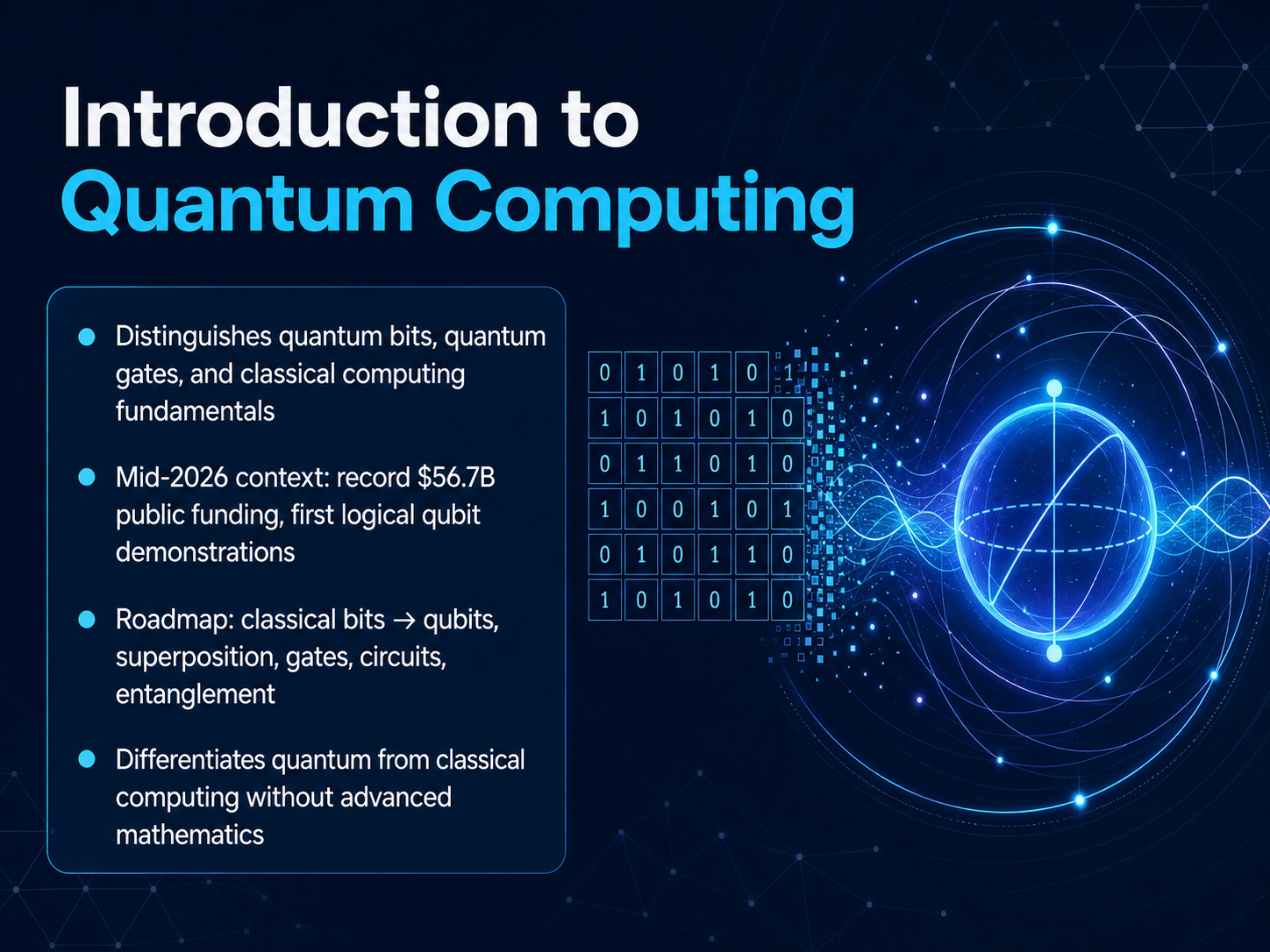
- 01Introduction to Quantum ComputingWelcome to this introduction to quantum computing. Over the next few minutes, we are going to build a clear picture of what makes quantum different from classical computing, starting with the most fundamental concepts and working our way up. Our goal today is straightforward. We want you to walk away being able to distinguish between classical bits and quantum bits, or qubits, and to understand the role of quantum gates and circuits. We will avoid advanced mathematics and instead focus on the big ideas and practical contrasts. To set the stage, let us look at where we are right now. By the middle of twenty twenty-six, public funding for quantum technology passed a record fifty-six point seven billion dollars. Researchers have also demonstrated the first logical qubits, a major engineering milestone. That tells us this field is moving fast. Our roadmap starts by revisiting the classical bit you already know. Then we will introduce the qubit and the strange idea of superposition. After that, we will see how quantum gates build circuits, and finally, we will touch on entanglement, the deep connection between qubits that classical systems cannot replicate. Keep one thing in mind as we go. We are not describing magic. We are exploring a different set of rules that nature gives us at the smallest scales. Let us begin that journey right now by looking at our familiar starting point, the classical bit.nist.govqasm.techboxqubit.co.uk+22 min
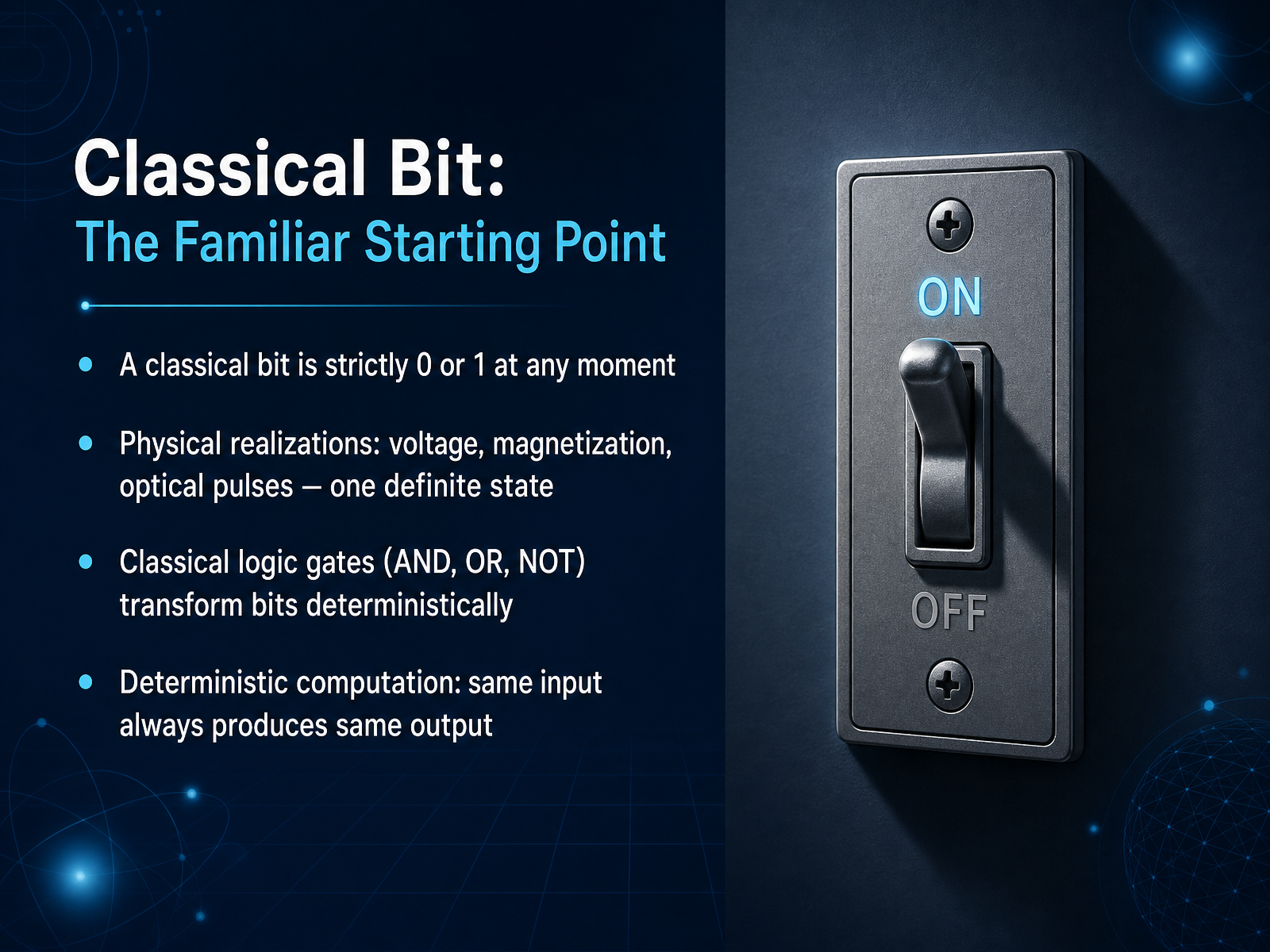
- 02Classical Bit: The Familiar Starting PointNow, let’s build from the most familiar starting point in computing: the classical bit. Everything your laptop or phone does rests on this simple idea. A classical bit is like a tiny, reliable switch. At any single moment, it is either zero or one. It’s not almost a one, or mostly a zero. It is strictly one definite state. Physically, that definite state might be a high voltage versus a low voltage on a wire, or a specific magnetization on a hard drive. The point is, the bit commits to a single, clear identity. When classical bits work together, they pass through logic gates, like AND, OR, and NOT. These gates transform bits in a predictable, deterministic way. If you feed the exact same pattern of bits into a classical circuit, you will get the exact same output every time. This predictability is the foundation of all traditional software. Understanding this rigid either-or world gives us the solid ground we need to now step into the much stranger, more fluid behavior of the quantum bit. Let’s explore that next, as we introduce the qubit and the concept of superposition.
 nist.govqasm.techboxqubit.co.uk+22 min
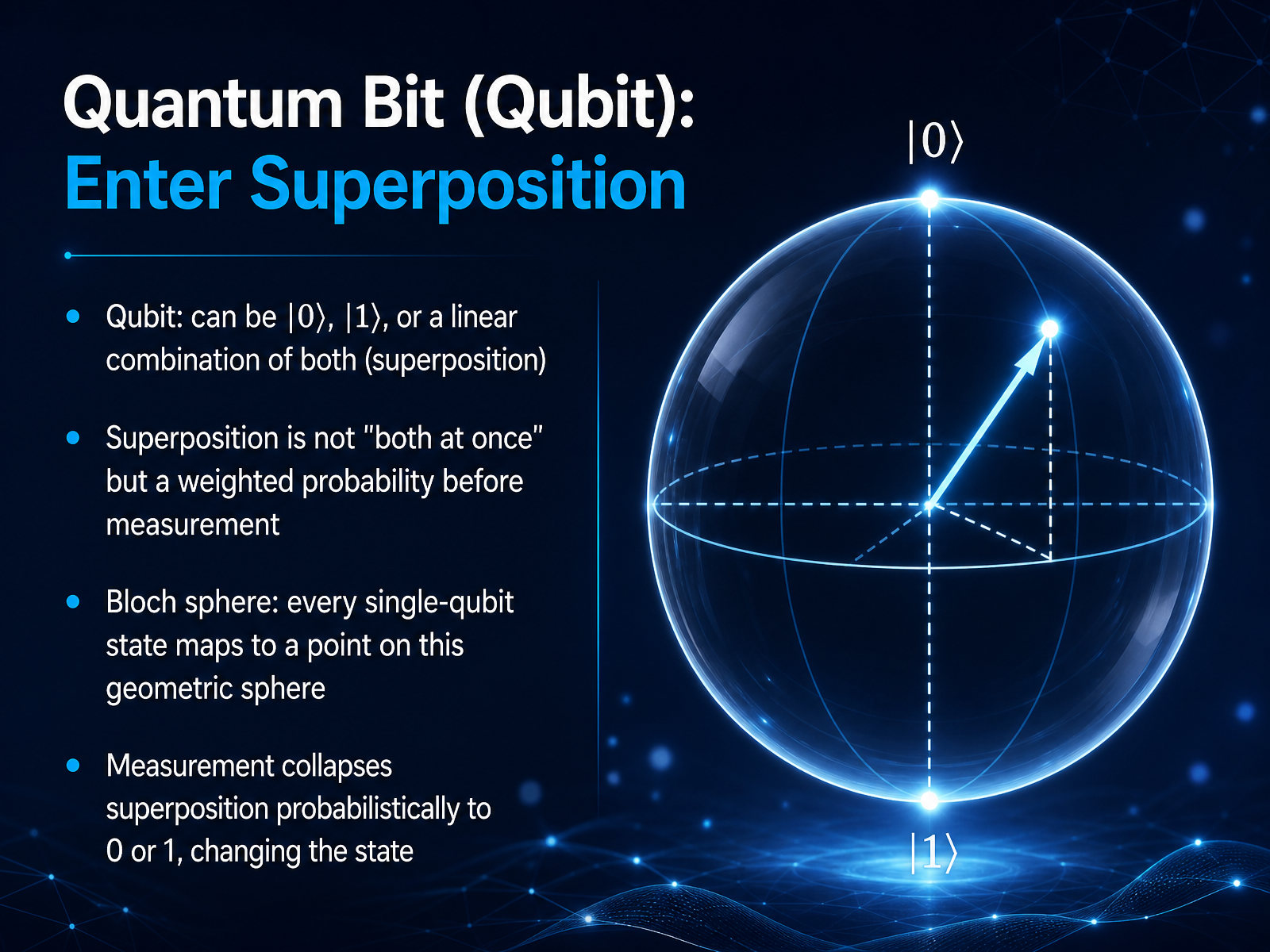
 - 03Quantum Bit (Qubit): Enter SuperpositionNow, let's move from the simple world of classical bits to the quantum bit, or qubit. A classical bit is like a coin lying on a table: it's definitely heads, or definitely tails. A qubit is like that coin spinning on its edge. While it spins, its state isn't simply one or the other. We call this special in-between state a superposition. But here's a crucial distinction: a qubit in superposition doesn't mean it's magically both zero and one at the same time. It's better to think of it as a state that holds specific probabilities of becoming zero or one when we look. Imagine a dimmable lamp that isn't just on or off but can be described by how bright it might be. The power comes from how we can manipulate these probabilities. To help visualize all this, scientists use a tool called the Bloch sphere, a geometric map where every possible single-qubit state is a single point on its surface. The important thing to remember is that the act of measurement itself changes everything. Just like catching the spinning coin forces it to a single side, measuring a qubit forces its superposition to probabilistically collapse into a definite zero or a definite one. Coming up, we'll dig deeper into what superposition really is, and what it isn't.
 nist.govqasm.techboxqubit.co.uk+22 min
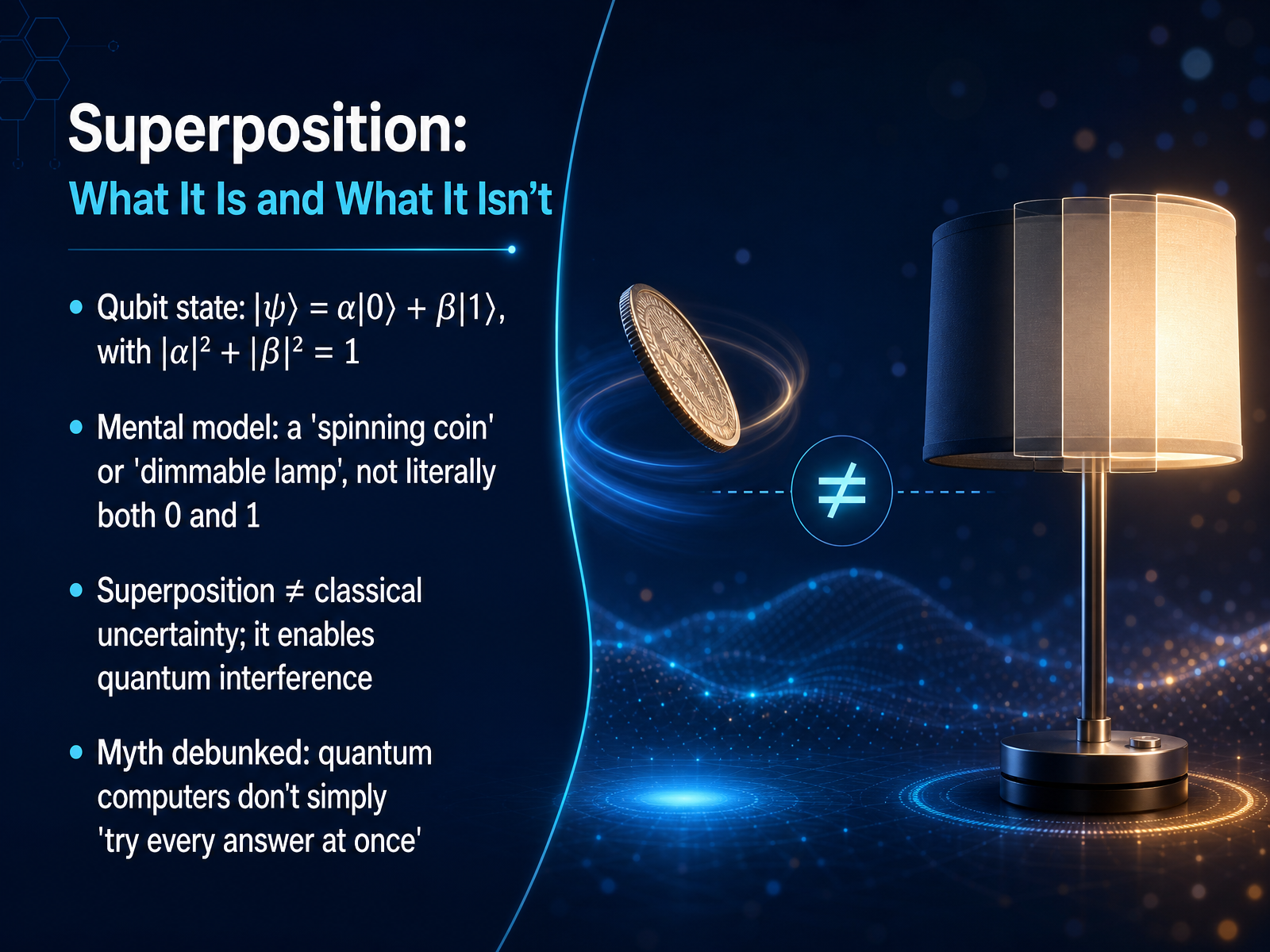
 - 04Superposition: What It Is and What It Isn'tNow let's unpack superposition. What it really is and what it is not. You often hear that a qubit is both zero and one at the same time. That picture is not quite right, and it can lead to confusion later. A better mental model is a spinning coin. While it spins, it is not heads and it is not tails. It is in a fluid in-between state that only becomes heads or tails when you stop it with your hand. A qubit works the same way. Before you measure it, the qubit stores a blend of possibilities. That blend is captured by a simple rule. We write the qubit state as alpha zero plus beta one. The numbers alpha and beta tell us how much of each possibility is present. Their squared values must add up to one, because when we measure, the qubit must give us either a zero or a one. A common myth is that a quantum computer simply tries every answer at once. That is not how the physics works. The real power comes from a uniquely quantum trick called interference. By carefully mixing and canceling those alpha and beta values, we can make wrong answers fade out and correct answers emerge. Superposition is not the same as classical uncertainty either. When you flip a coin and cover it with your palm, you just do not know the answer yet. In a qubit, the blend of possibilities is a real physical state before you look, not just a lack of information. Keep this image of a spinning coin in mind. It helps you see superposition as a rich, probabilistic resource, not a magic both-at-once paradox. Coming up next, we will see what happens when that spinning coin finally lands. Let's move to quantum measurement and the idea of collapse and probability.
 nist.govqasm.techboxqubit.co.uk+22 min
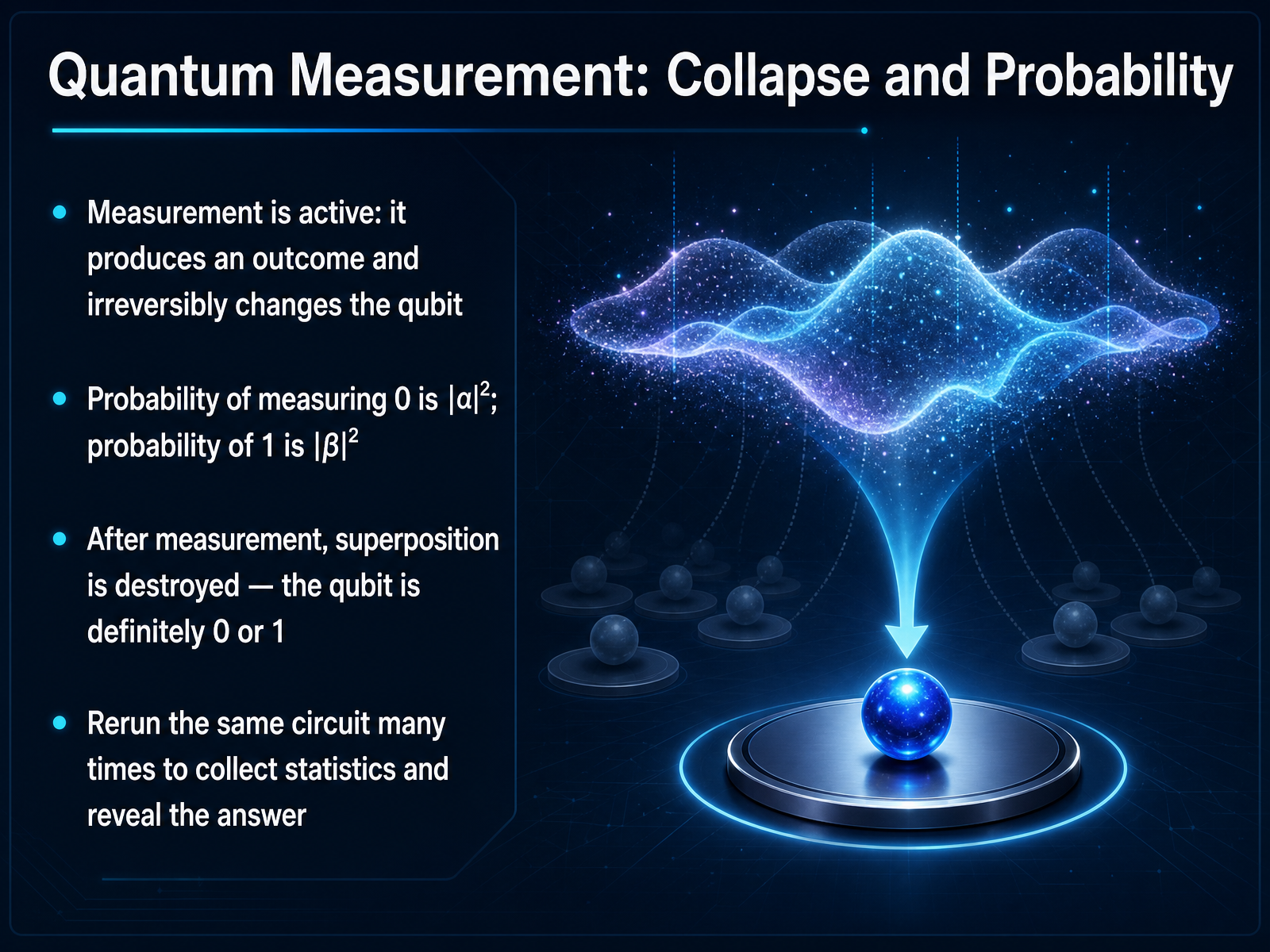
 - 05Quantum Measurement: Collapse and ProbabilityNow we come to one of the most important, and often misunderstood, ideas in quantum computing: measurement. In our everyday experience, measurement is a passive act. You look at a thermometer, and the temperature is unchanged. You check a coin on a table, and it stays heads or tails. In the quantum world, measurement is an active and irreversible event. It's not just reading a value; it forces a qubit to make a choice. When we measure a qubit, its superposition collapses. It leaves its fluid, in-between state and becomes a definite 0 or a definite 1, just like a classical bit. The critical point is that we cannot predict the outcome with certainty. We only know the probability. That probability is determined by the amplitudes we discussed earlier. The chance of measuring zero is the magnitude squared of alpha. The chance of measuring one is the magnitude squared of beta. Because the answer is probabilistic, we cannot just run a quantum circuit once. We have to rerun the same sequence thousands of times. Looking at the statistics of all those runs reveals the answer the algorithm was designed to produce, allowing us to see which outcome was most probable. Next, we will explore the tools we use to manipulate these probabilities before measurement: quantum gates.
 nist.govqasm.techboxqubit.co.uk+22 min
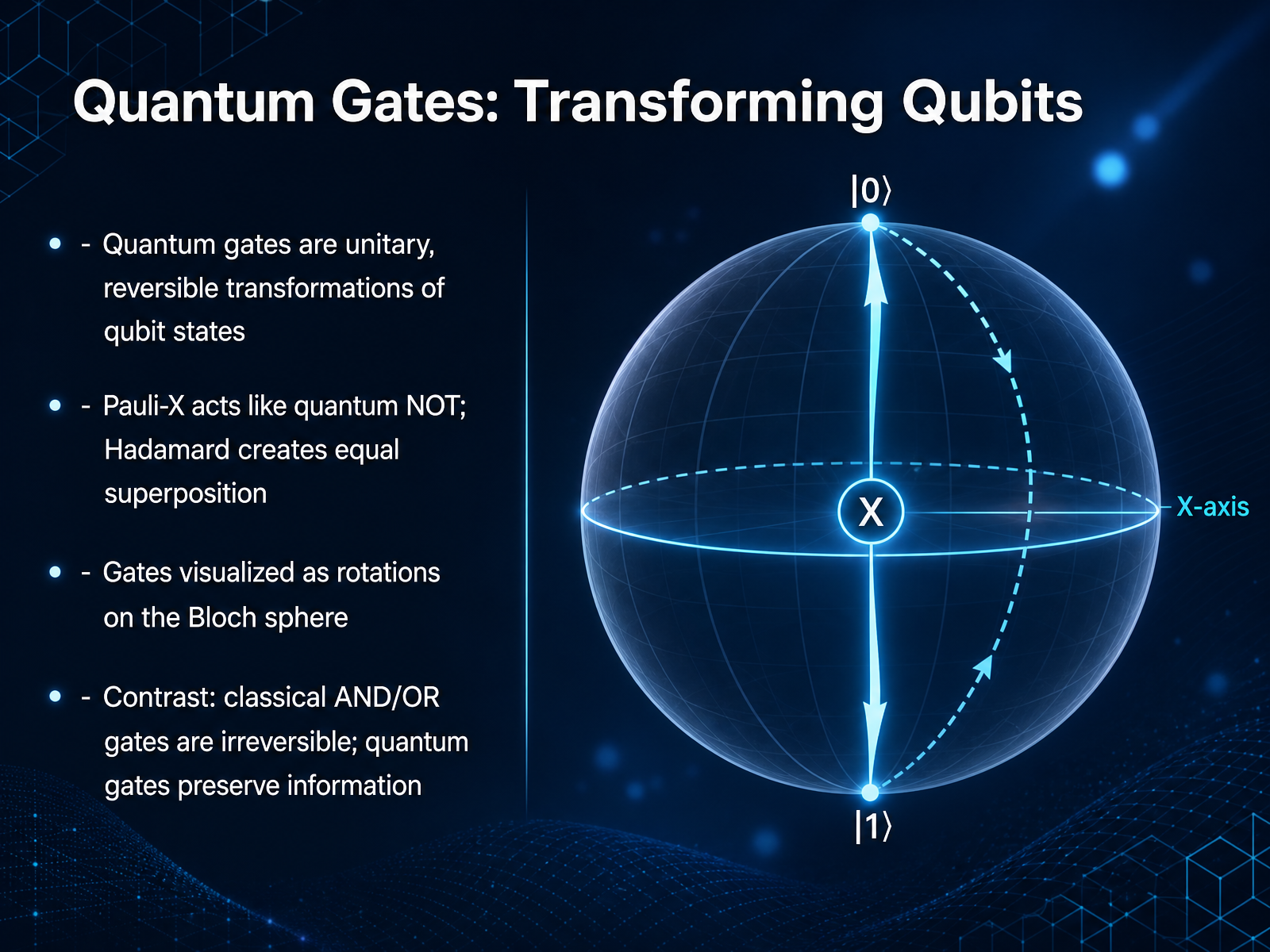
 - 06Quantum Gates: Transforming QubitsNow let's look at how we actually change a qubit's state. In the classical world, we use logic gates like AND, OR, and NOT. These gates are irreversible—if you put two bits through an AND gate and get a zero, you can't work backwards to know exactly what the inputs were. Information is lost. Quantum gates have to play by different rules. They must be reversible, meaning no information is thrown away. We call these unitary transformations. Think of them as rotations on that Bloch sphere we pictured earlier, always moving the qubit from one valid state to another without destroying the quantum information. Two essential gates to remember: the Pauli-X gate, which acts like a quantum NOT by flipping zero to one and one to zero, and the Hadamard gate, which takes a qubit in a definite state and creates an equal superposition—that perfect blend of zero and one we've been talking about. To visualize this, every quantum gate is simply a rotation on the Bloch sphere. The Hadamard, for instance, takes the qubit from the North Pole and rotates it right onto the equator. While classical gates erase the past, quantum gates keep the whole history, twisting and turning a qubit's probability through space. Let's put this all together and see a direct side-by-side comparison of classical and quantum computing on the next slide.
 nist.govqasm.techboxqubit.co.uk+22 min
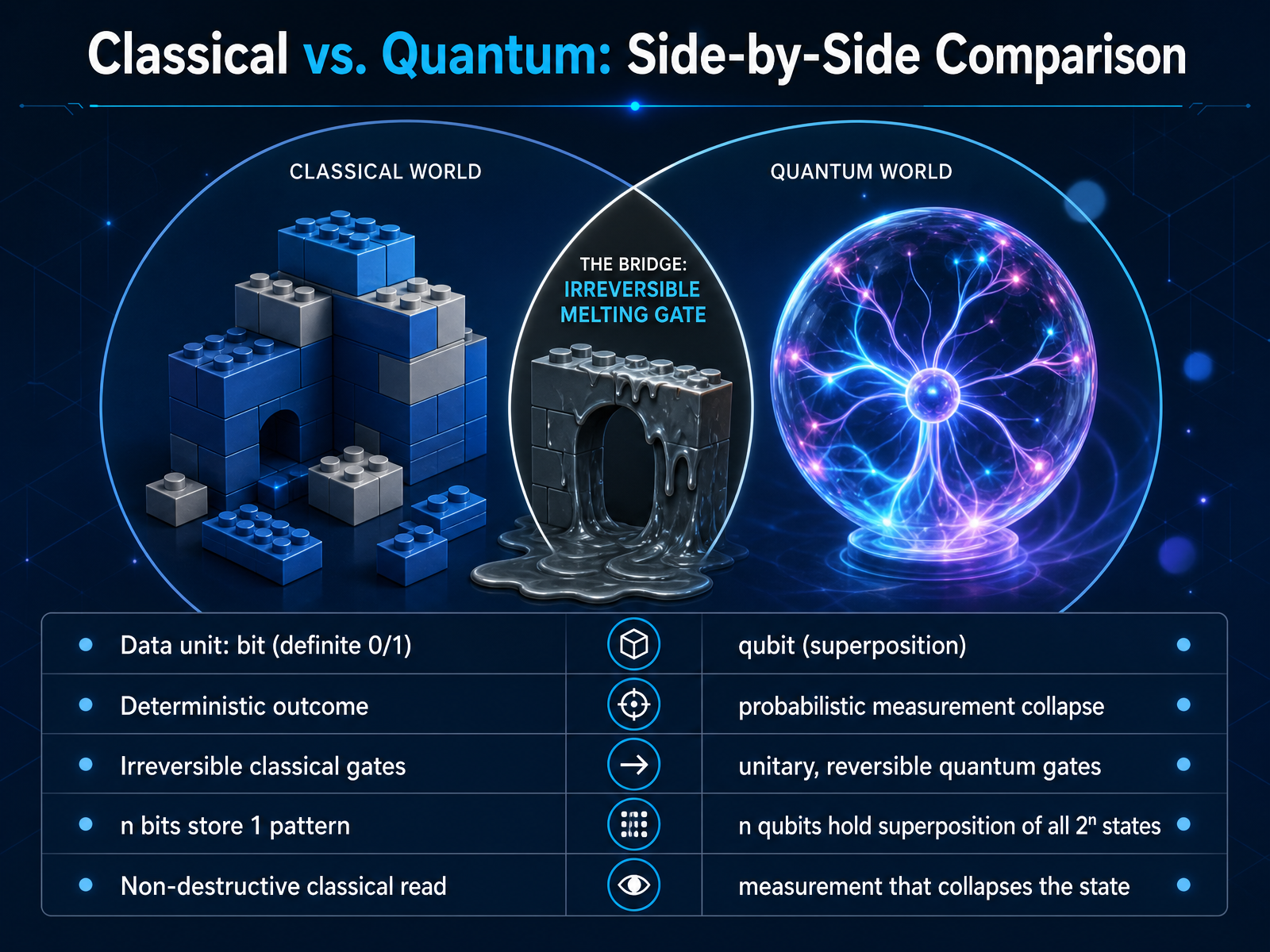
 - 07Classical vs. Quantum: Side-by-Side ComparisonNow let's put these ideas side by side, so the contrast between classical computing and quantum computing becomes crystal clear. Think of a classical bit as a coin lying flat on a table. It is either heads or tails, zero or one, no ambiguity. You can look at it as many times as you want without changing it. A qubit is more like a coin spinning on its edge. While it spins, it isn't decided. It holds a blend of possibilities, what we call superposition. Only when you stop it to check does it collapse into one definite outcome. That measurement is part of the process and it changes the state. Next, consider how these units work together. Three classical bits can hold one pattern, like zero one one, at a time. Three qubits in superposition can hold a blend of all eight possible patterns simultaneously. That's exponential scaling, and that's the core engine of quantum computing power. Finally, let's look at the logic gates. Classical gates, like AND or OR, are often irreversible; you can't always tell what the inputs were just from the output. Quantum gates are different. They must be reversible unitary operations, like smooth, lossless rotations of that spinning coin. This side-by-side view shows that quantum computing isn't just faster; it runs on entirely different rules. Up next, we'll expand this picture and see what happens when we link multiple qubits together using the CNOT gate.
 nist.govqasm.techboxqubit.co.uk+22 min
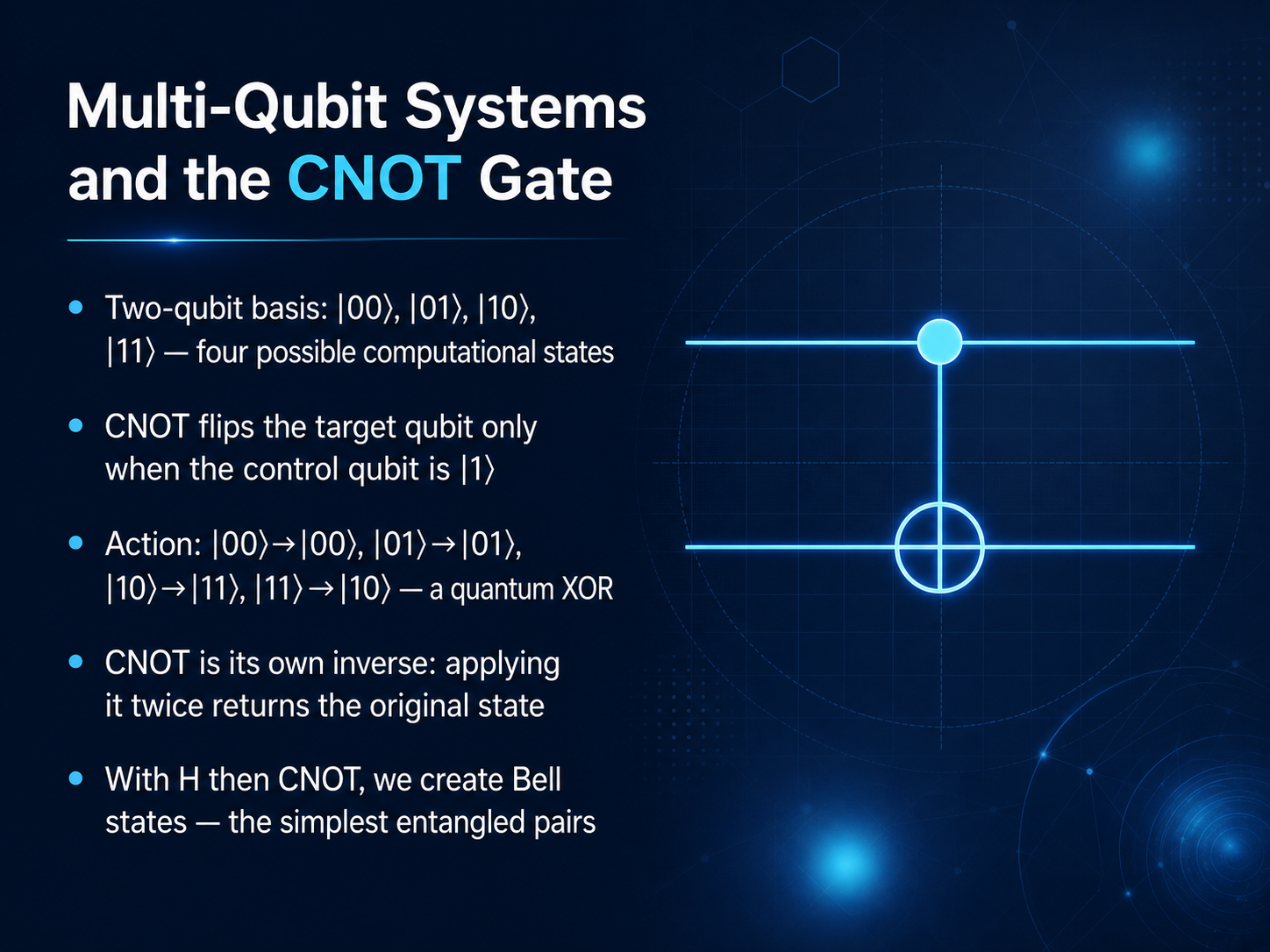
 - 08Multi-Qubit Systems and the CNOT GateLet's now look at what happens when we have more than one qubit. A single qubit has two basis states, zero and one. With two qubits, we get four possible combinations: zero-zero, zero-one, one-zero, and one-one. To control interactions between these qubits, we introduce the CNOT gate, short for controlled-NOT. It's a two-qubit gate, like a quantum if-statement. One qubit acts as the control, the other as the target. If the control qubit is one, the target flips. If the control is zero, nothing changes. So zero-zero stays zero-zero, zero-one stays zero-one, but one-zero becomes one-one, and one-one becomes one-zero. Think of it as a quantum exclusive-or: the target output is the XOR of the two inputs, while the control always passes through unchanged. Another useful property: CNOT is its own inverse. Apply it twice, and you return to the original state. This gate becomes really powerful when combined with a Hadamard gate. First, put the control qubit in superposition, then apply CNOT. You create a Bell state, the simplest form of entanglement, where measuring one qubit instantly tells you the state of the other. Next, we’ll explore exactly what entanglement means and why it has no classical counterpart.
 intoquantum.pubqolour.iomortalapps.com+22 min
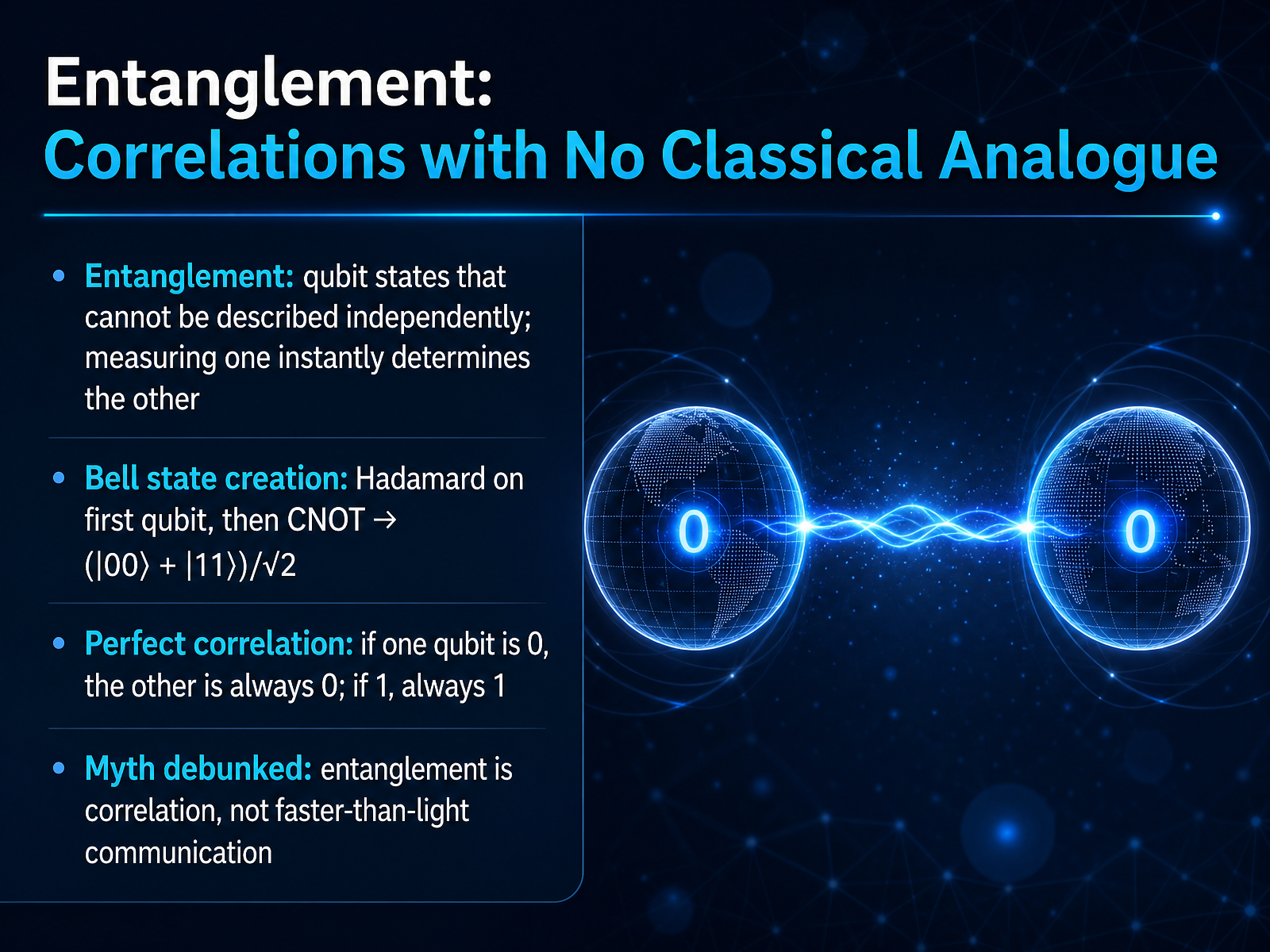
 - 09Entanglement: Correlations with No Classical AnalogueNow let's explore one of the most fascinating ideas in quantum computing: entanglement. It’s a type of correlation between qubits that has no parallel in our everyday classical world. When two qubits are entangled, you can no longer describe each one independently. Their fates are linked. This means measuring one qubit instantly determines the state of the other. To see how this is created, we build what's called a Bell state. We start with two qubits, both in the state zero. First, we put the first qubit into a 50-50 superposition using a Hadamard gate. Then, we apply a C-NOT gate. The C-NOT acts like a quantum 'if statement': it flips the second, or target, qubit only if the first, or control, qubit is one. Because the control qubit is in a superposition of zero and one, the C-NOT entangles the two. The result is a perfect correlation. If we measure the first qubit and find it's zero, the second one is guaranteed to be zero. If the first is one, the second is also one. It's a powerful link, but let's debunk a common myth. Entanglement is a correlation of measurement outcomes. It does not allow you to send information faster than light. It's a new tool for computation, not a new form of communication. Next, we'll move from individual gates to 'From Gates to Circuits: Building Quantum Logic'.
 intoquantum.pubqolour.iomortalapps.com+22 min
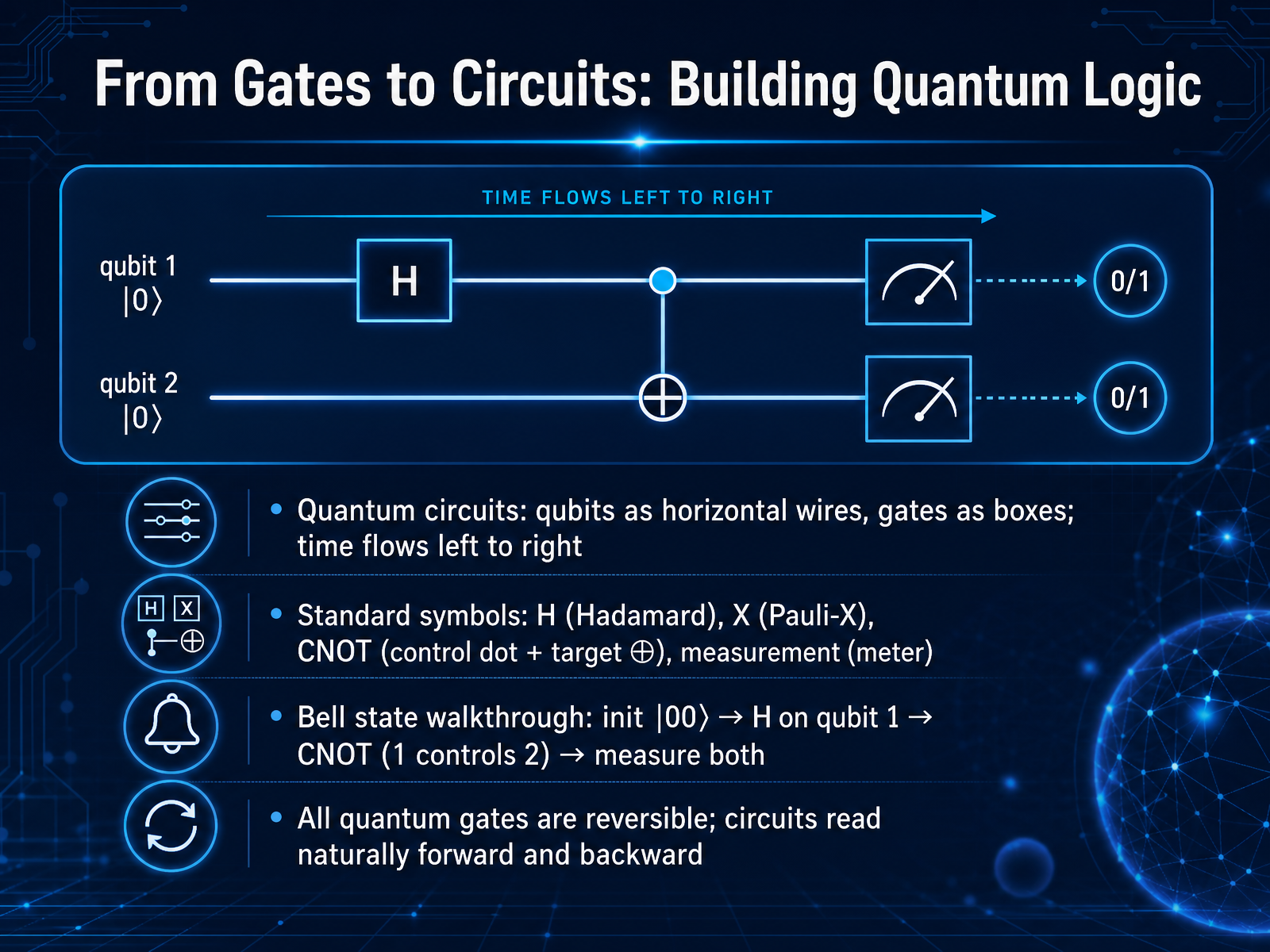
 - 10From Gates to Circuits: Building Quantum LogicNow that we have met some individual gates, let's see how we combine them into circuits. You can picture a quantum circuit as a timeline that flows from left to right. Qubits are shown as horizontal lines, and gates appear as labeled boxes placed on those lines. The Hadamard gate uses the letter H. The Pauli-X gate is shown as an X, and the controlled-NOT gate has a solid control dot connected by a line to a plus-in-a-circle target symbol. Measurement appears as a small meter icon. A good way to understand this is by building a Bell state. We start with both qubits in the zero state. We apply a Hadamard to the first qubit to create superposition. Then we apply a controlled-NOT, with the first qubit as control and the second as target. This flips the second qubit only when the first is one, instantly entangling the two. Finally, we measure both qubits. The results will always match, either both zero or both one. One last principle to keep in mind: all quantum gates are reversible, meaning you can read the circuit forward or backward and always recover the original state. This reversible nature will lead us into our next topic, which covers the key limitations we face today, including the no-cloning rule, noise, and the NISQ era.
 intoquantum.pubqolour.iomortalapps.com+22 min
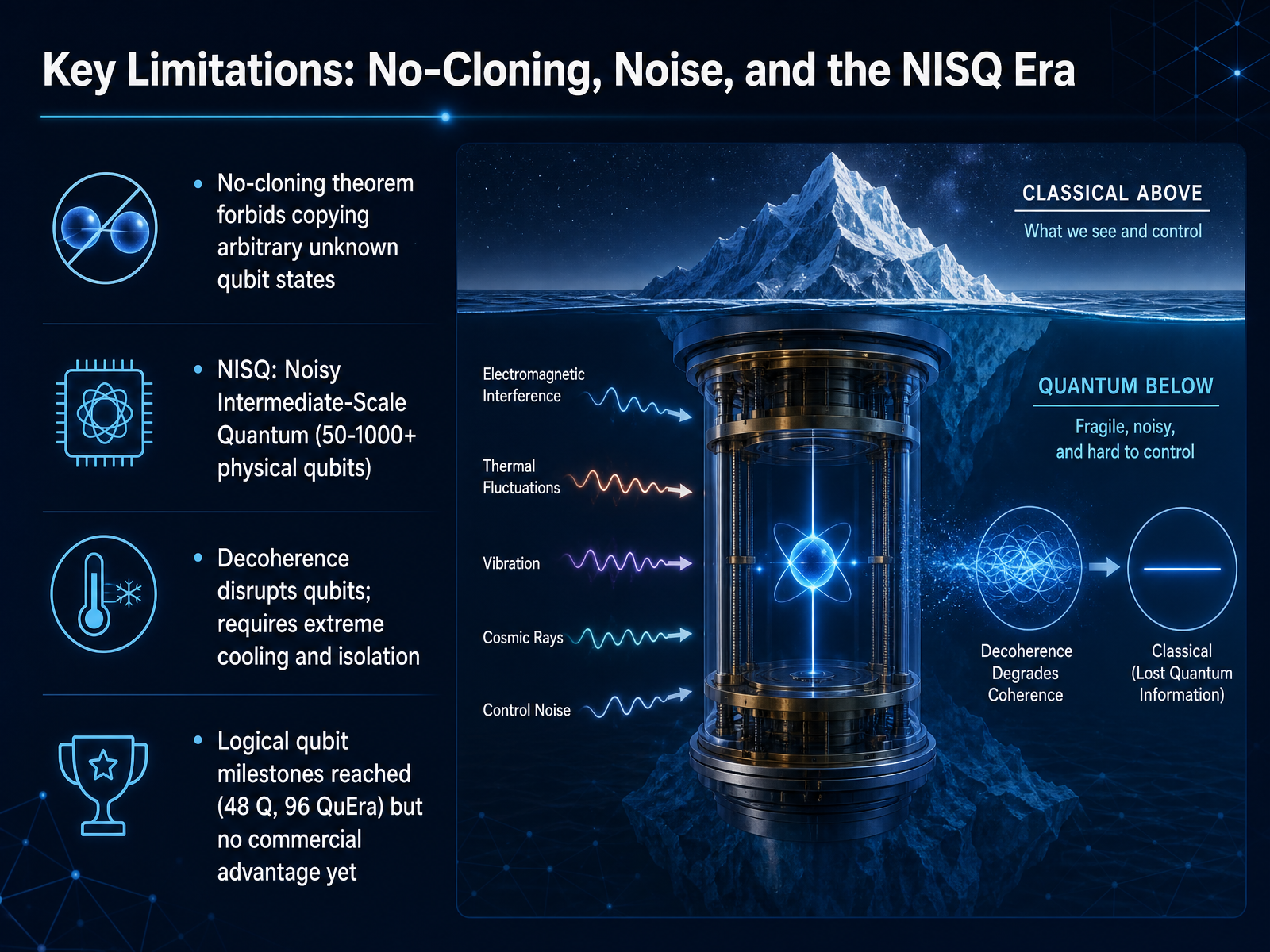
 - 11Key Limitations: No-Cloning, Noise, and the NISQ EraWith all the progress we have discussed, it is important to step back and look at where the real challenges lie today. This slide focuses on three key limitations: the no-cloning theorem, the noisy reality of our machines, and the era we call NISQ. Let us start with the no-cloning theorem. In classical computing, you can copy a file as many times as you want. In quantum computing, the laws of physics forbid you from making an exact copy of an arbitrary, unknown qubit state. This might sound like a minor technicality, but it is a fundamental rule that prevents simple error correction by redundancy. Because you cannot just duplicate qubits to protect against errors, we have to use much more sophisticated and qubit-intensive methods. This leads directly to our second challenge: noise. We are currently in the Noisy Intermediate-Scale Quantum era, or NISQ. Think of it as the frontier where our processors, ranging from about fifty to over a thousand physical qubits, are powerful enough to be interesting but still too noisy to run the long, perfect algorithms we dream of. For example, a qubit might lose its information, a process called decoherence, after just a fraction of a millisecond. To fight this, we must cool the chips to temperatures colder than deep space and isolate them from every imaginable vibration and stray signal. The good news is we are starting to tame the noise. We have crossed a major threshold by creating logical qubits, groups of physical qubits working together to suppress errors. Teams have reached milestones like forty-eight and even ninety-six logical qubits. To be clear, no machine has yet delivered a commercially valuable result that a classical computer could not do faster or cheaper. We are building the robust engines of the future, but for now, they are still being tested in the lab. Let us now clear up some of the inevitable confusion this creates by looking at some misconceptions worth retiring.
 8441224.fs1.hubspotusercontent-na1.netiqm.techcnbc.com+22 min
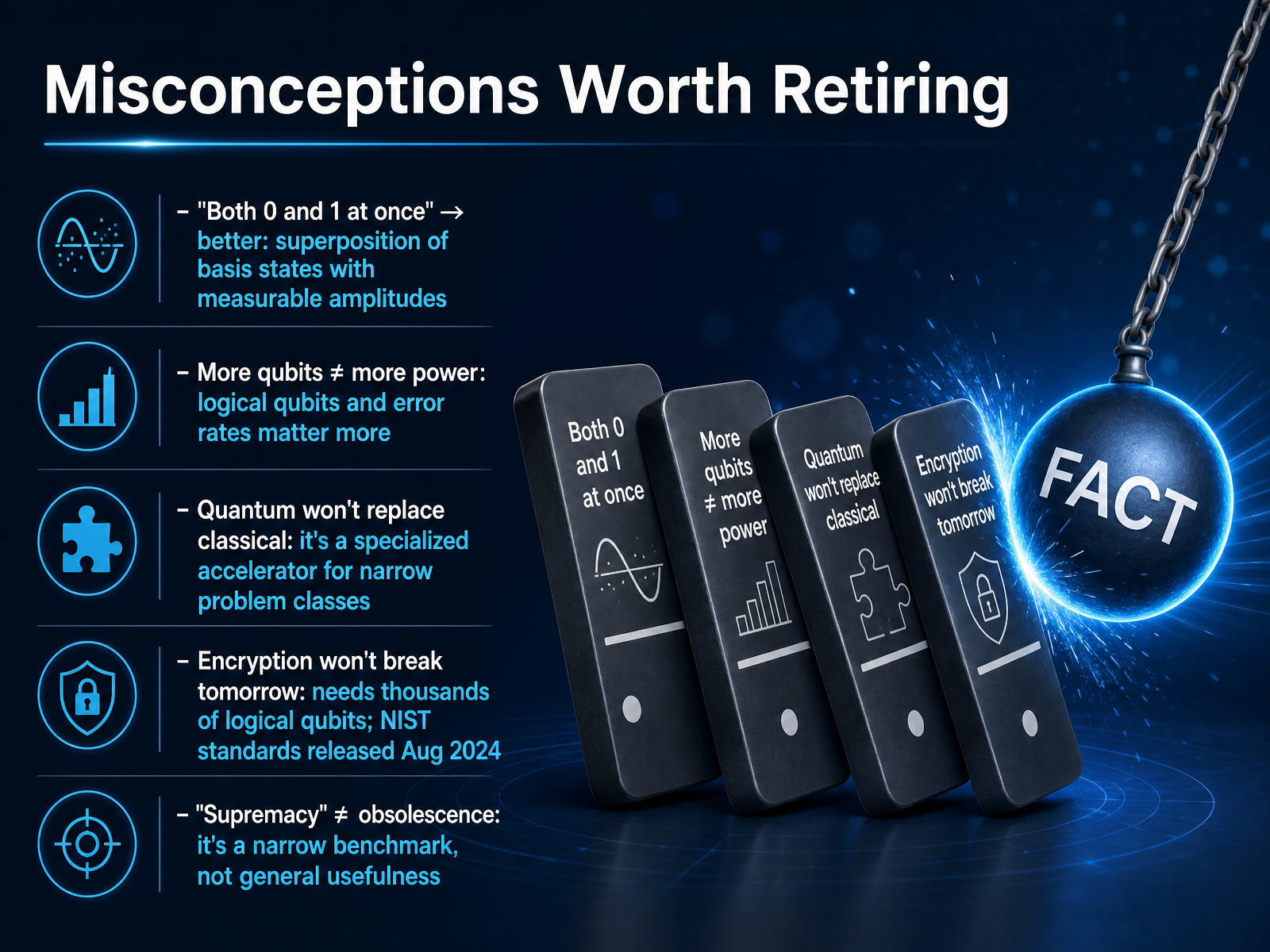
 - 12Misconceptions Worth RetiringLet's clear up a few common myths that can muddle our understanding. First, the idea that a qubit is both zero and one at once. This shorthand is everywhere, but a qubit is more accurately a combination of basis states with amplitudes that describe probabilities. Think of it as a spinning coin rather than a fixed switch. Next, more qubits do not automatically mean more power. What really matters are logical qubits and low error rates. A thousand noisy qubits can do less useful work than a carefully protected handful. You will also hear that quantum computers will replace classical ones. They will not. Quantum systems are specialized accelerators for narrow problem classes like simulation and factoring. For everyday computing, your classical machine remains the best tool. On encryption, the threat is real but distant. Breaking modern cryptography requires thousands of logical qubits, far beyond today's hardware. That said, NIST released new post-quantum standards in August twenty twenty-four, so the migration planning has already begun. Finally, quantum supremacy is not obsolescence. It is a benchmark, often on an artificial task, that proves the physics works. It does not yet mean practical advantage on useful problems. Now let's turn to when to think quantum and when to stay classical.
 zeroindaily.commedium.comthequantuminsider.com+22 min
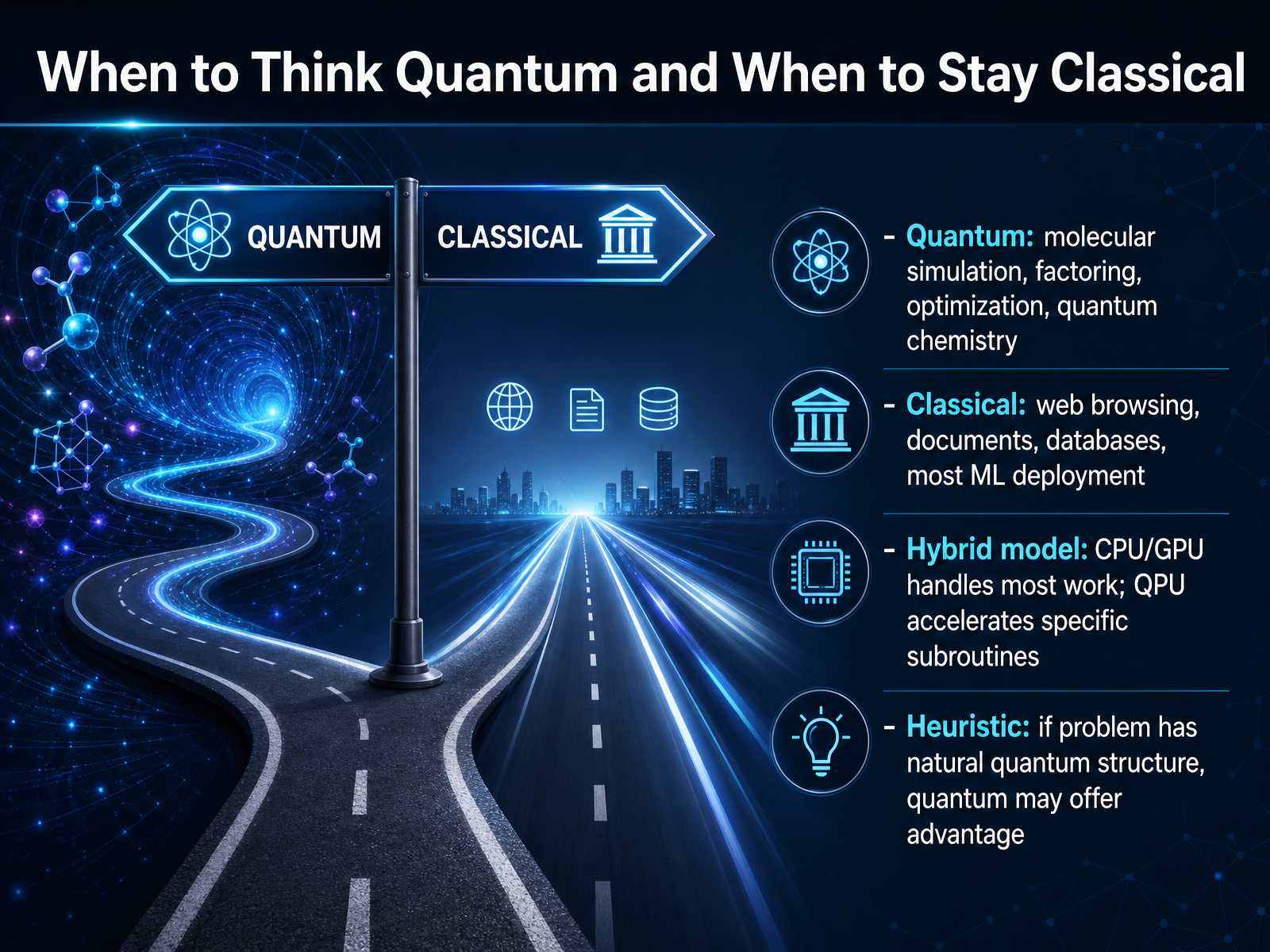
 - 13When to Think Quantum and When to Stay ClassicalNow let's answer a very practical question: when should you think quantum, and when should you stick with classical? It really comes down to the structure of the problem. For molecular simulation, factoring large numbers, or quantum chemistry, a quantum computer explores the possibilities in a fundamentally more natural way. For everyday tasks like web browsing, writing documents, managing databases, or deploying most machine learning models, classical computers are faster, cheaper, and far more reliable. The sensible path forward is a hybrid model. Think of your main CPU or GPU handling nearly all the work, while a quantum processing unit, a QPU, accelerates only the specific subroutines where it shines. A good heuristic to remember is this: if a problem has a natural quantum structure, like simulating a molecule, quantum may offer an advantage. If it doesn't, classical methods are the clear winner. Coming up next, we'll turn this understanding into action with a look at 'Hands-On Quantum: SDKs and Cloud Access'.
 qasm.tech8441224.fs1.hubspotusercontent-na1.netiqm.tech+22 min
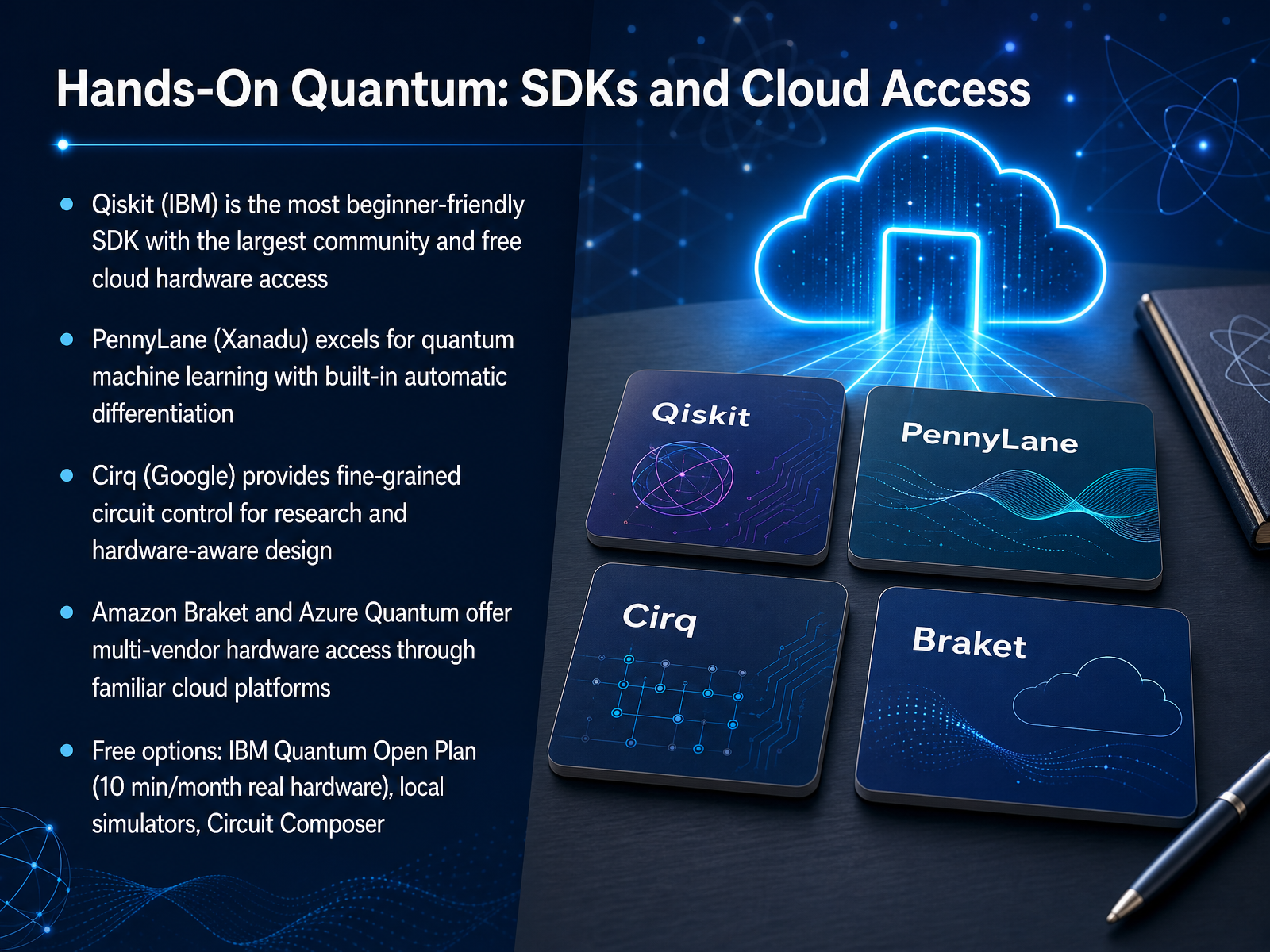
 - 14Hands-On Quantum: SDKs and Cloud AccessNow that you understand qubits and gates in theory, let’s talk about how you actually build and run circuits in practice. The good news is you don’t need a quantum computer in your room. You can access real hardware and powerful simulators entirely through the cloud, using software development kits called SDKs. The most popular starting point is Qiskit from IBM. It has the largest community, clear documentation, and an Open Plan that gives you ten free minutes per month on real quantum processors. That is enough for hundreds of simple experiments. If you are interested in quantum machine learning, look at PennyLane. It was built from the start to handle gradients and hybrid models, so it feels natural for AI workflows. For researchers who want fine-grained control over every gate, Google’s Cirq gives you a lightweight, explicit way to design circuits. On the cloud side, Amazon Braket and Azure Quantum let you run circuits across hardware from multiple vendors, which is valuable if your team needs enterprise governance or wants to compare different qubit technologies. No matter which you choose, you can install any of these tools on your laptop, simulate circuits locally, and then send the same code to a real quantum computer when you are ready. This practical step brings together everything we have discussed so far, from qubits to measurements. Next, we will explore the classical-to-quantum mindset shift and your next steps.
 2 min
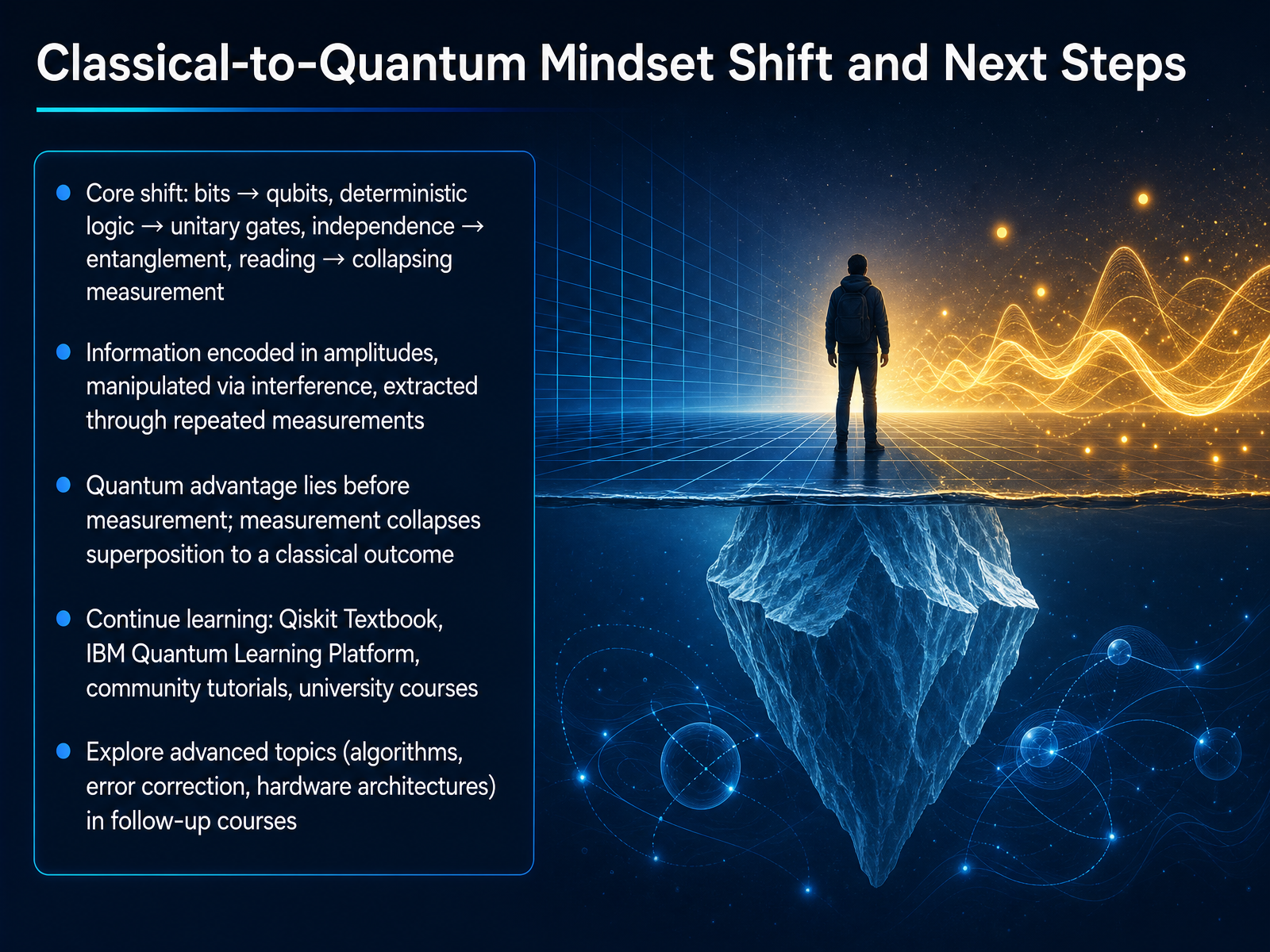
2 min - 15Classical-to-Quantum Mindset Shift and Next StepsLet’s bring everything together around one simple idea. Moving from classical to quantum computing is a mindset shift. Instead of bits that are definitely zero or one, we have qubits in superposition. Instead of fixed logic operations, we use unitary quantum gates. And instead of reading a value without disturbing it, quantum measurement collapses the superposition and gives us a probabilistic outcome. Before that measurement is where the real power lives. Information is encoded in complex amplitudes and processed through interference. The act of measurement extracts a classical answer, so we often run circuits many times and look at the statistics. As you continue your journey, Qiskit and the IBM Quantum Learning Platform offer free hands-on practice and direct access to real hardware. From here you can explore algorithms, error correction, and hardware architectures in deeper follow-up courses. Thank you for learning with me, and I look forward to seeing you in the next course.
 qasm.technist.govboxqubit.co.uk+22 min
Sources consulted
Web sources consulted while building this course.
- Quantum Computing Explained | NIST — nist.gov
- Bits vs. Qubits: Understanding the Core Difference | 2026 Guide — qasm.tech
- How to Explain a Qubit Without the Jargon: A Teacher’s Guide to Superposition, Measurement, and Entanglement — boxqubit.co.uk
- Lesson 1 — What Is a Qubit? Understanding Quantum States from Scratch - nerd-ish — nerdish.org
- A Qubit in 60 Seconds – HyperDrift — hyperdrift.io
- An Easy-To-Follow Introduction To The CNOT Gate — intoquantum.pub
- CNOT Gate — The Two-Qubit Gate That Creates Entanglement | Qolour — qolour.io
- CNOT Gate | Quantum Circuits | Quantum Computing | MortalApps — mortalapps.com
- Controlled NOT gate — en.wikipedia.org
- The Controlled-NOT (CNOT) Gate in Quantum Computing — postquantum.com
- STATE OF THE GLOBAL QUANTUM INDUSTRY — 8441224.fs1.hubspotusercontent-na1.net
- State of Quantum - Fourth Edition - 2026 - IQM Quantum Computers — iqm.tech
- Quantum firms race to market as the industry sees 'inflection point' — cnbc.com
- State of Quantum Computing 2026: Hardware, Funding and Milestones — entangledfuture.com
- Quantum Computing Market Readiness 2026 — analysis-atlas.com
- Quantum Computing Misconceptions Debunked Zero In Daily — zeroindaily.com
- Quantum Sundays |69⟩ Schrödinger’s Hype: 10 Quantum Computing Myths Worth Retiring | by Adnan Masood, PhD. | Jun, 2026 | Medium — medium.com
- Quantum Myths vs Reality - Understanding Where the ... — thequantuminsider.com
- Andrea Rocchetto — quantumfactsheet.github.io
- Quantum Computing Myths vs Reality Guide — qubit365.app