Begin
14 pages · ~28 min
Brand Positioning Strategy
This training teaches marketing professionals how to define brand positioning through clear goals, strategic choices, and tradeoffs to build a differentiated market presence.
A digital instructor presents all 14 pages. Hold “Ask” at any point and ask out loud — the answer comes from this course. No sign-up needed.
What you’ll learn
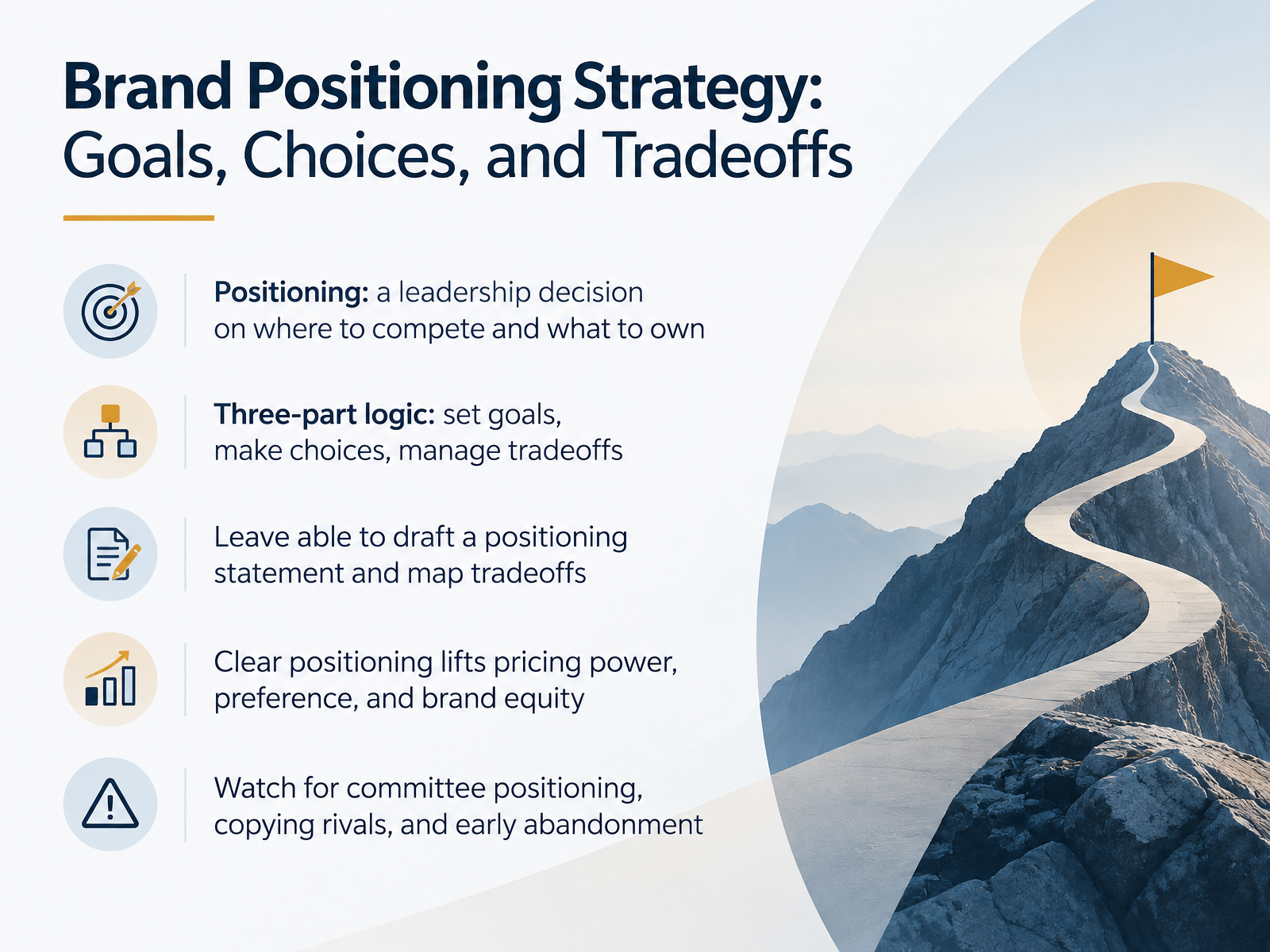
- 01Brand Positioning Strategy: Goals, Choices, and TradeoffsWelcome. Over the next fourteen slides, we're going to treat brand positioning as a leadership decision, not a marketing exercise. By the end, you'll be able to draft a positioning statement and map the tradeoffs behind it. Here's the logic we'll follow. First, set goals. Second, make choices. Third, manage tradeoffs. Goals tell you where you want to compete. Choices tell you what you will own, and what you will deliberately leave alone. Tradeoffs are where most teams stall, because a real position costs you something. When positioning is clear, it lifts pricing power, customer preference, and brand equity. When it's vague, you pay for it in discounts and slow growth. Watch for three common failures. Committee positioning, where everyone softens the claim until it means nothing. Copying rivals, which makes you interchangeable. And abandoning the position too early, before the market has had time to register it. So keep one question in mind throughout. If this position doesn't change a decision, a behavior, or an economic outcome, it isn't positioning yet. Let's start with what positioning actually is.brandingstrategyinsider.combrandingstrategyinsider.comvivaldigroup.com+22 min
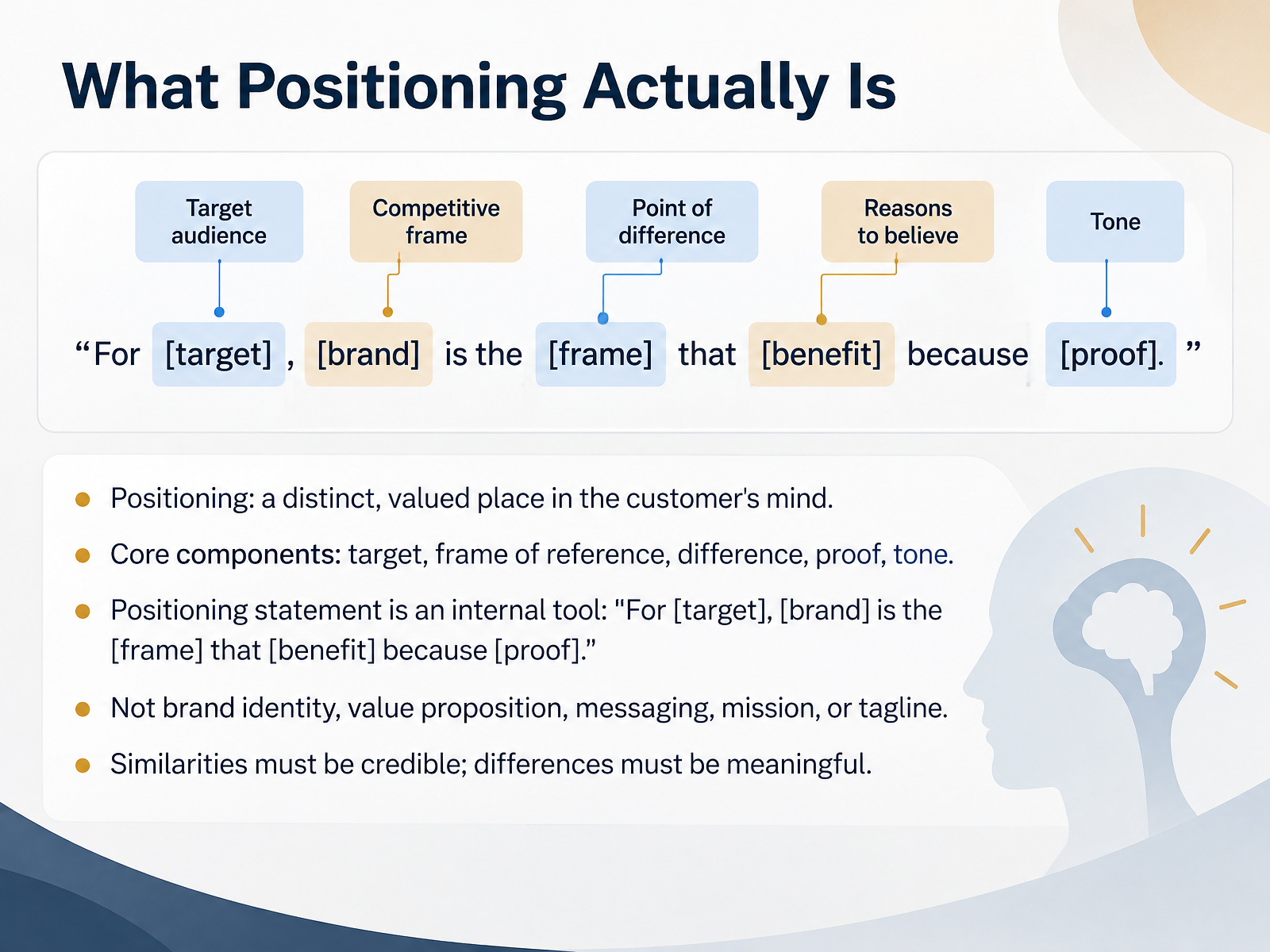
- 02What Positioning Actually IsLet's get precise about what positioning actually is. Positioning is the distinct, valued place you hold in the customer's mind. Not your logo, not your mission statement, not your tagline. It comes down to five components: your target, your frame of reference, your difference, your proof, and your tone. Most teams skip the frame of reference and jump straight to the difference. That's a mistake, because your frame tells customers what category you belong to and what they're comparing you against. A positioning statement is an internal tool, not customer copy. It reads like this: For a specific target, our brand is the frame of reference that delivers this benefit, because of this proof. Similarities must be credible. Differences must be meaningful. If you can't prove it, customers won't believe it. If it doesn't matter to them, it won't move the decision. So ask yourself: where does your positioning actually live in the customer's mind, and is your proof strong enough to hold it there? Next, we'll look at setting positioning goals that link to business outcomes.
 marksherrington.compubmed.ncbi.nlm.nih.govassets.csom.umn.edu+22 min
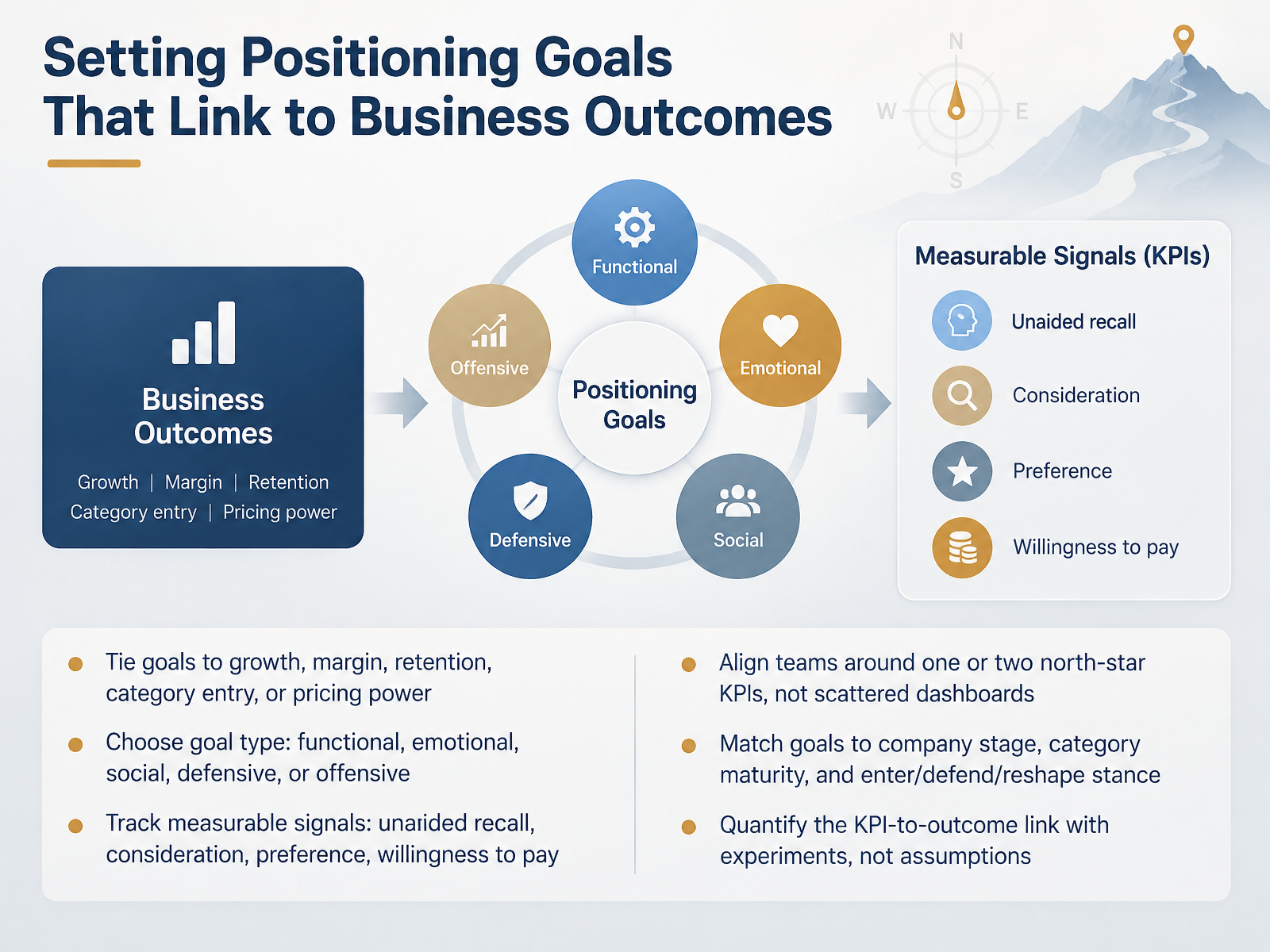
- 03Setting Positioning Goals That Link to Business OutcomesLet's talk about goals. Your positioning goals only matter if they connect to a business outcome you already care about. That could be growth, margin, retention, category entry, or pricing power. Next, decide what kind of goal you're setting. Functional, emotional, social, defensive, or offensive. These are not labels for a workshop. They determine the fight you're picking. Then, pick measurable signals. Unaided recall, consideration, preference, and willingness to pay. If you can't track it, you can't manage it. Here's the part most teams get wrong. Align everyone around one or two north-star KPIs. Not a wall of scattered dashboards. Match those goals to your company stage, category maturity, and whether you're entering, defending, or reshaping the market. Finally, quantify the link between your KPI and the outcome. Use experiments, not assumptions. Run tests, read the slope, and check the time lag. Build your own ratios, not just industry benchmarks. So, tie your goals to outcomes, choose one fight, and prove the link. Next, let's look at Market and Customer Evidence.
 thinkwithgoogle.comoctopusmarketing.agencybigeyeagency.com+22 min
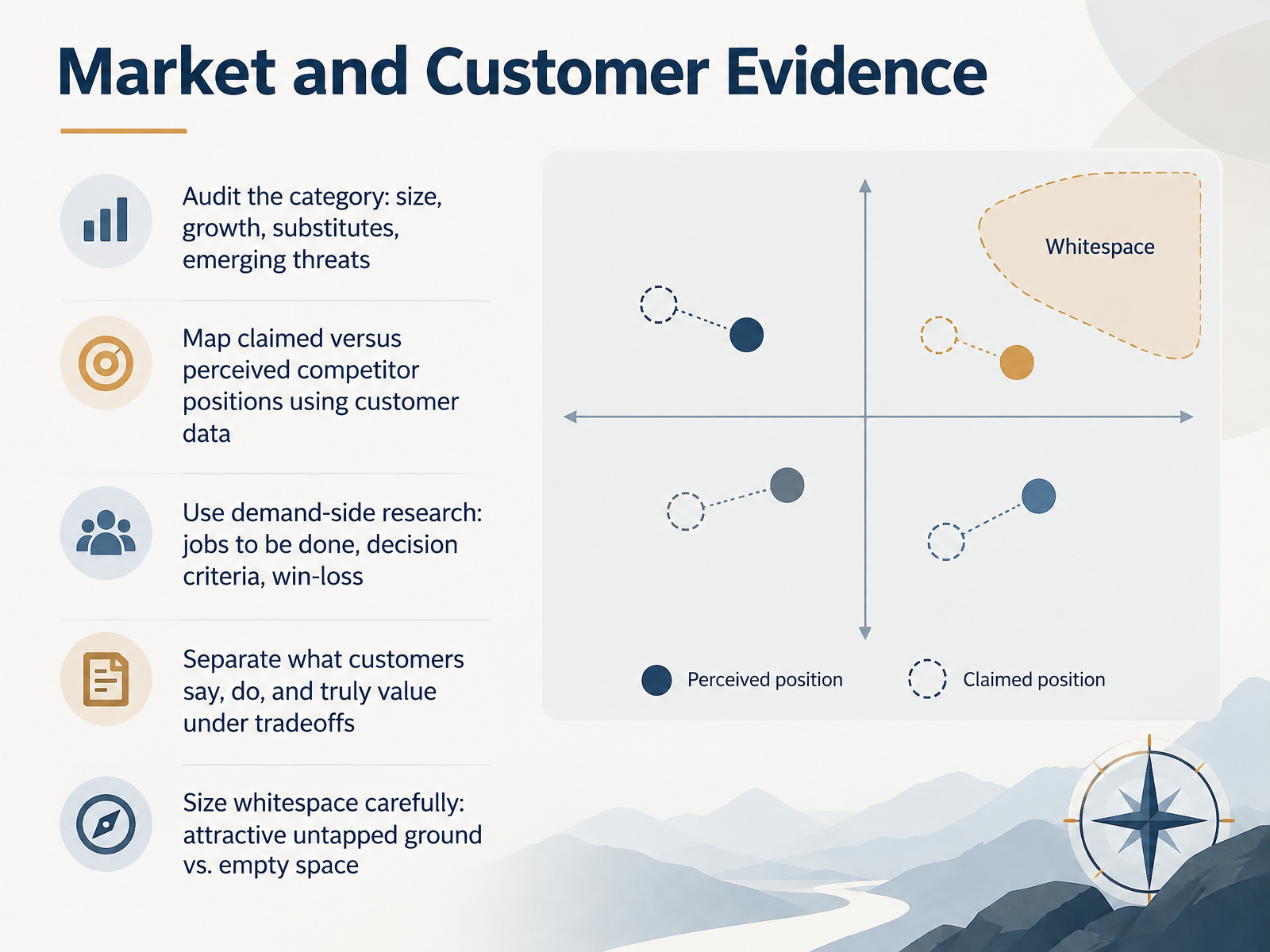
- 04Market and Customer EvidenceNow let's ground your positioning in market and customer evidence. Start with the category itself. Audit its size, growth rate, substitutes, and emerging threats. Categories shift fast, and a threat rarely looks like a direct competitor at first. Next, map claimed versus perceived positions. What competitors say about themselves is marketing. Where customers actually place them is reality. Use perceptual maps built from customer ratings, not your sales team's assumptions. Then go demand-side. Understand the jobs customers are hiring you to do, their decision criteria, and your win-loss patterns. And separate what customers say, what they do, and what they truly value when tradeoffs hit. They may claim they want premium quality, then buy on price. Finally, size whitespace carefully. Attractive untapped ground has demand behind it. Empty space may just be empty for a reason. So before you claim a gap, confirm customers care. Choosing a position: category, difference, and proof.
 internationaljournalssrg.orgonline.hbs.edutoolshero.com+21 min
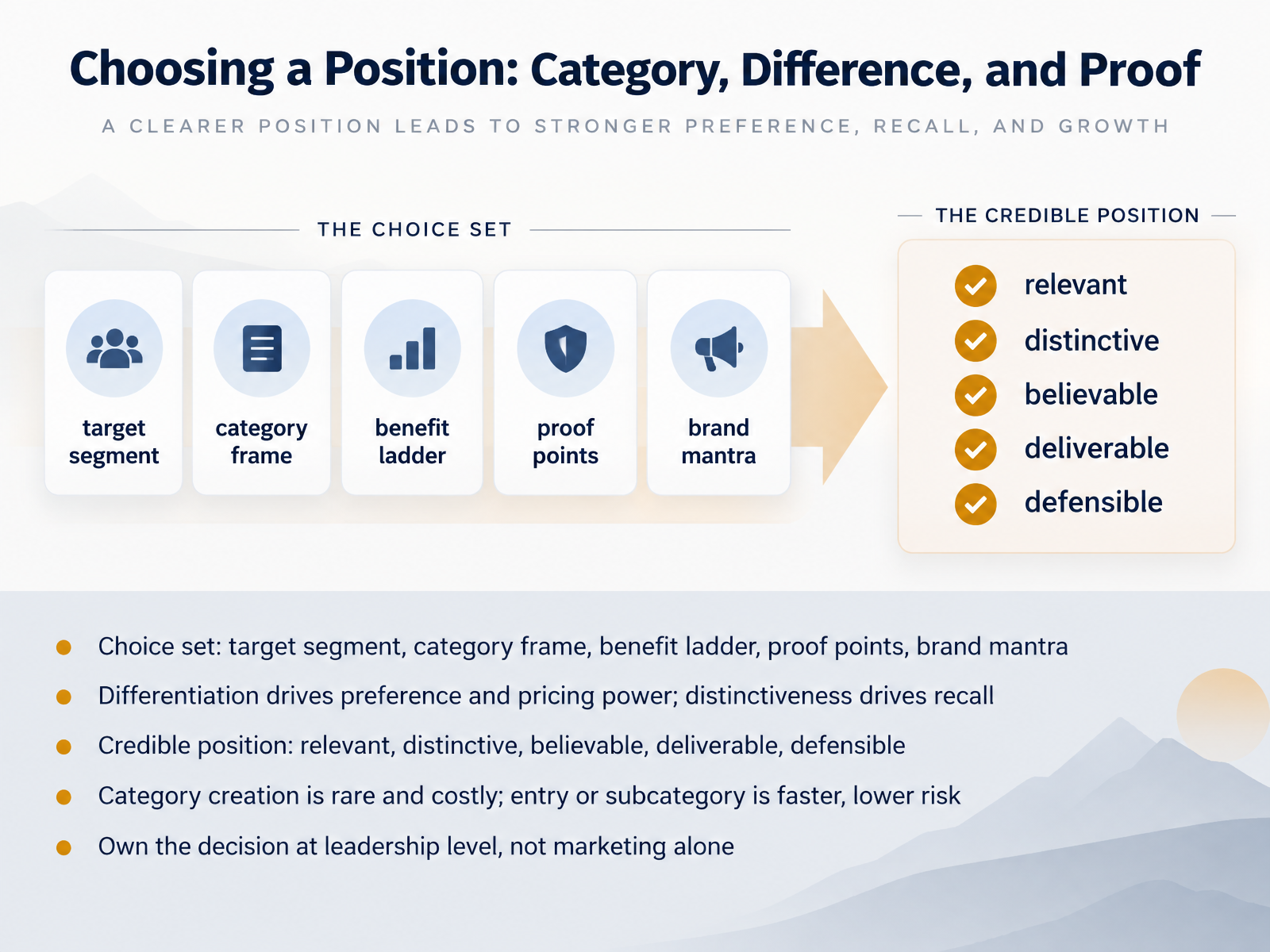
- 05Choosing a Position: Category, Difference, and ProofLet us break down what you are actually choosing. Your choice set has five parts: target segment, category frame, benefit ladder, proof points, and a brand mantra. Get these wrong and everything downstream drifts.
Remember the split between differentiation and distinctiveness. Differentiation drives preference and pricing power. Distinctiveness drives recall. You need both, and they are not the same job.
A credible position has to be relevant, distinctive, believable, deliverable, and defensible. Miss any one of those and you have an aspiration, not a position.
So how do you frame the category? Category creation is rare and costly. Entry or subcategory positioning is faster and lower risk. For most of you, that is the smarter play.
And own this decision at leadership level, not marketing alone. Positioning is a business choice, so the room should include the people who control resources and direction.
Tradeoffs That Make Positioning Real.
 brandingstrategyinsider.combrandingstrategyinsider.comvivaldigroup.com+21 min
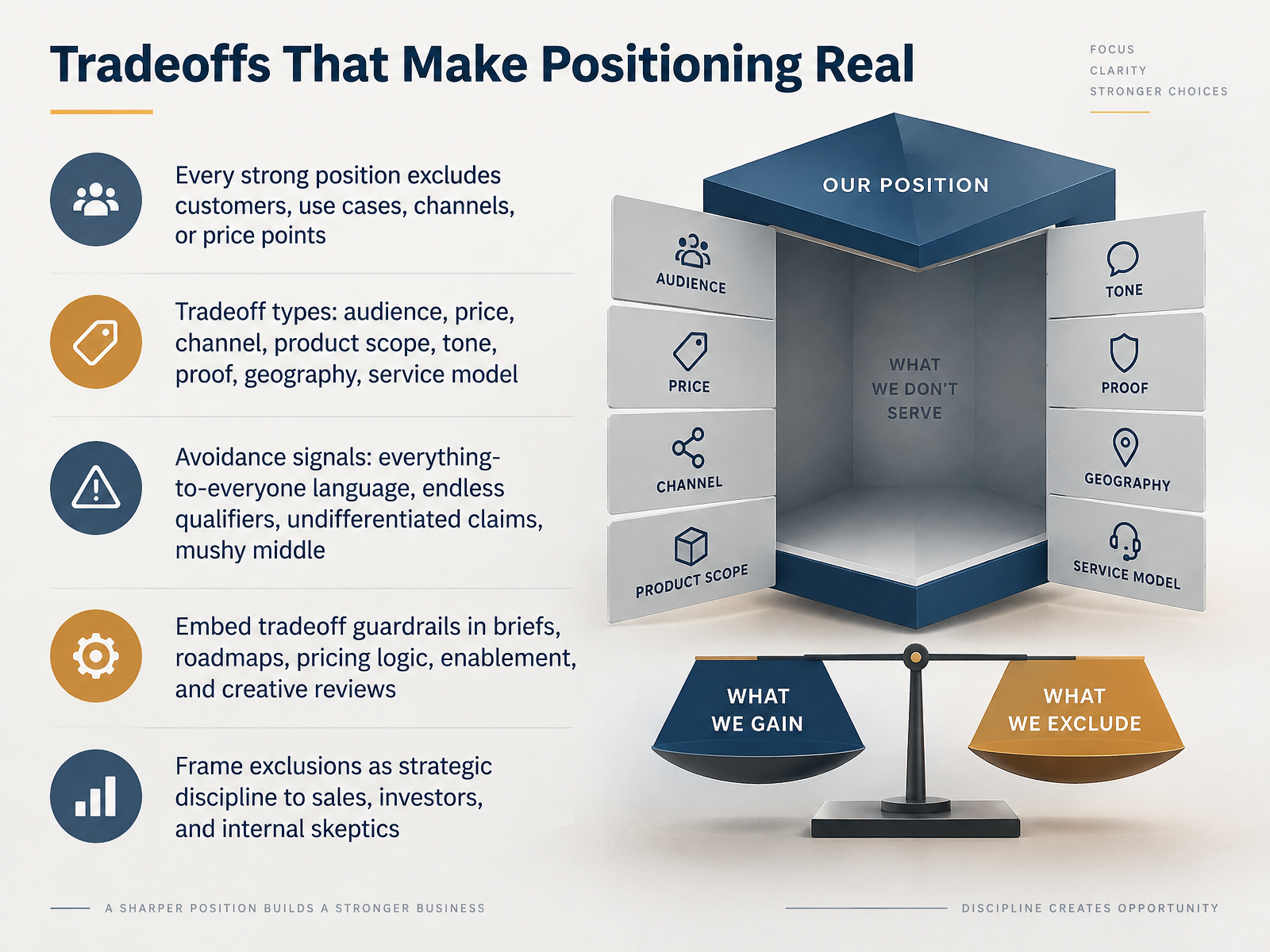
- 06Tradeoffs That Make Positioning RealLet's talk about the tradeoffs that make positioning real. Every strong position excludes something. It excludes customers, use cases, channels, or price points. That's not a flaw. That's the point. Think about Basecamp, which deliberately turned away enterprise revenue to stay the simple project management tool for small teams. When you try to serve everyone, you land in the mushy middle, where no one owns you. Target's recent struggles show how hard it is to hold an accessible premium position when Walmart attacks on price and Amazon attacks on convenience. So name your tradeoff types. Audience, price, channel, product scope, tone, proof, geography, service model. Then watch for avoidance signals, like everything-to-everyone language, endless qualifiers, and undifferentiated claims. Embed guardrails in your briefs, roadmaps, pricing logic, sales enablement, and creative reviews. Finally, frame exclusions as strategic discipline when you talk to sales, investors, and internal skeptics. That is how positioning becomes a decision, not a slogan. Putting Positioning to Work Across the Organization.
 2 min
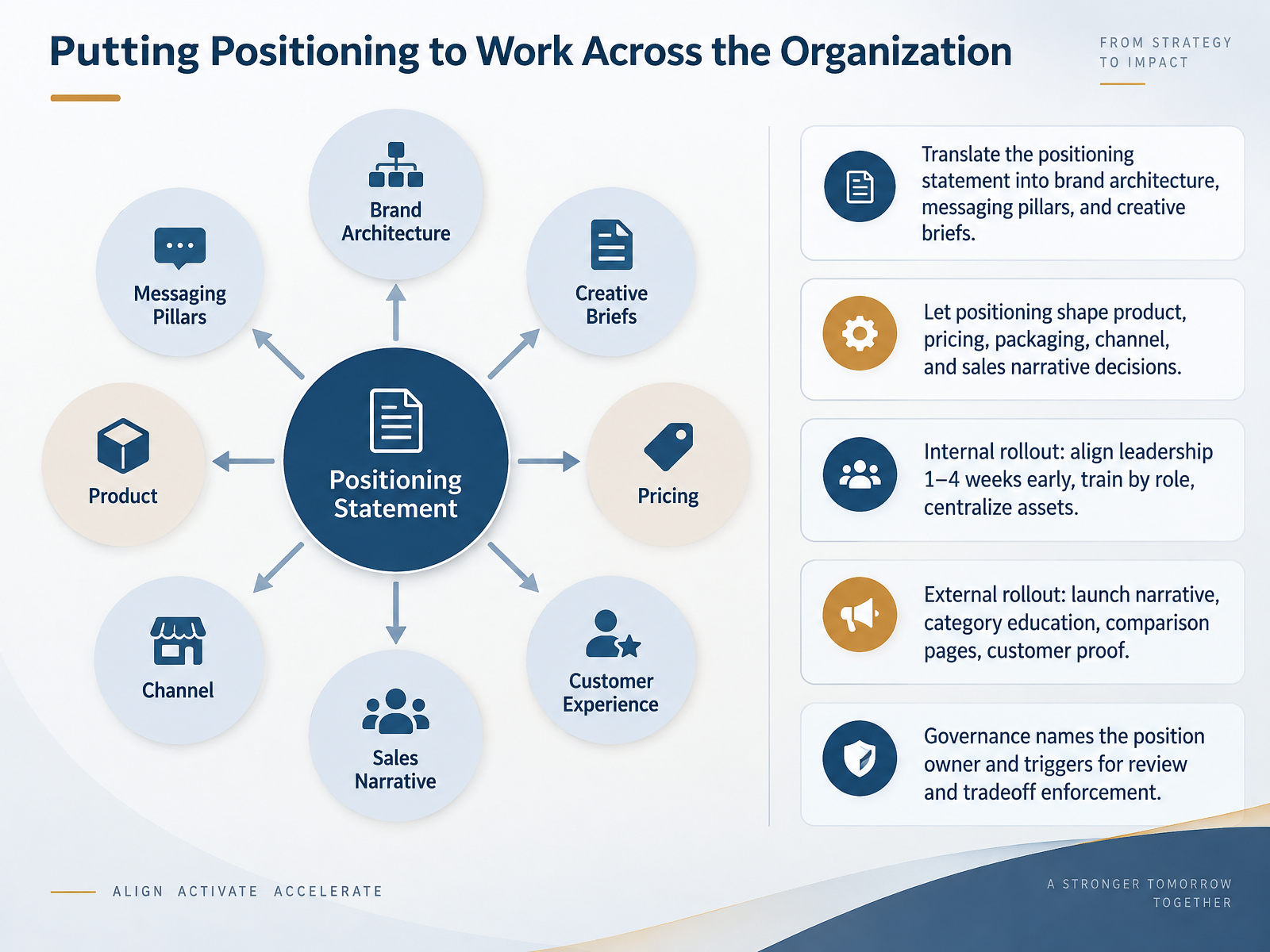
- 07Putting Positioning to Work Across the OrganizationNow let's make positioning operational. Start by translating the positioning statement into three things: brand architecture, messaging pillars, and creative briefs. That is what turns a strategy document into daily work. From there, let positioning shape real decisions. Product, pricing, packaging, channel, and your sales narrative should all trace back to the position you chose. If they conflict, you have a tradeoff to resolve, not a message to soften. For internal rollout, align leadership one to four weeks early, train by role, and put every asset in one central hub. Sales needs objection handling. Support needs an updated FAQ. Marketing needs messaging and voice guidelines. External rollout comes after that: launch the narrative, educate the category, build comparison pages, and publish customer proof. Finally, governance. Name one position owner, set triggers for review, and enforce the tradeoffs you committed to. Otherwise, positioning quietly drifts. Next, we look at measuring, testing, and iterating.
 2 min
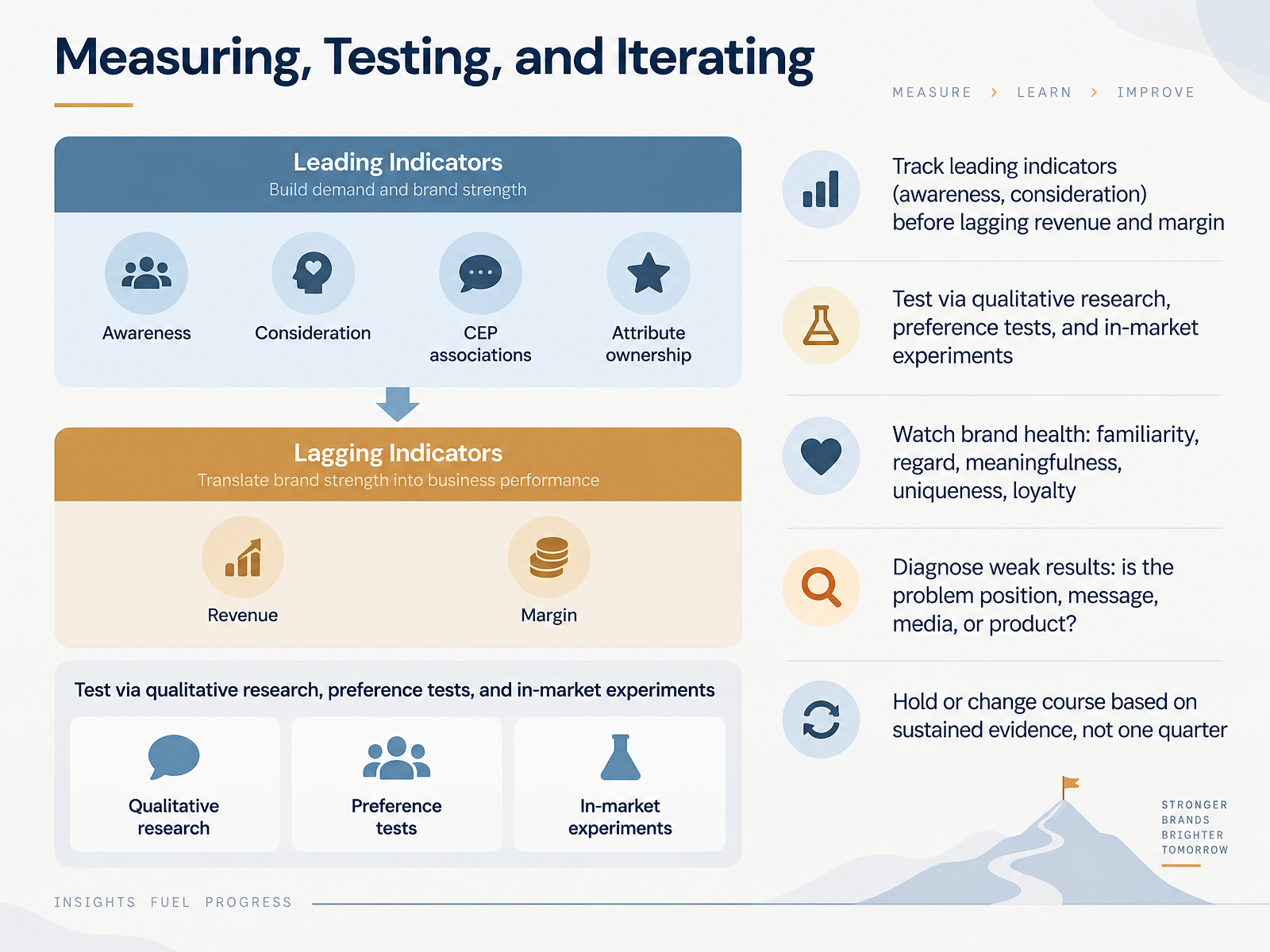
- 08Measuring, Testing, and IteratingNow let's talk about measuring what you've built, because positioning without measurement is just a guess. Start with leading indicators. Track awareness and consideration before you look at revenue and margin, because perception moves first and the numbers follow. Test in three ways. Qualitative research tells you why. Preference tests tell you which message wins. In-market experiments tell you what actually shifts behavior. Then watch your brand health closely. Familiarity, regard, meaningfulness, uniqueness, and loyalty. These five metrics reveal whether your position is holding or eroding. When results come in weak, don't panic. Diagnose instead. Is the problem your position, your message, your media, or your product? Each one demands a different fix. And here's the discipline that matters most. Hold or change course based on sustained evidence, not one quarter. A single wave of data is noise. Two or three consistent waves is a signal. So set thresholds upfront, decide what would trigger a change, and give your positioning enough time to prove itself. Next, let's see how this plays out in real brand cases.
 thinkwithgoogle.comoctopusmarketing.agencybigeyeagency.com+22 min
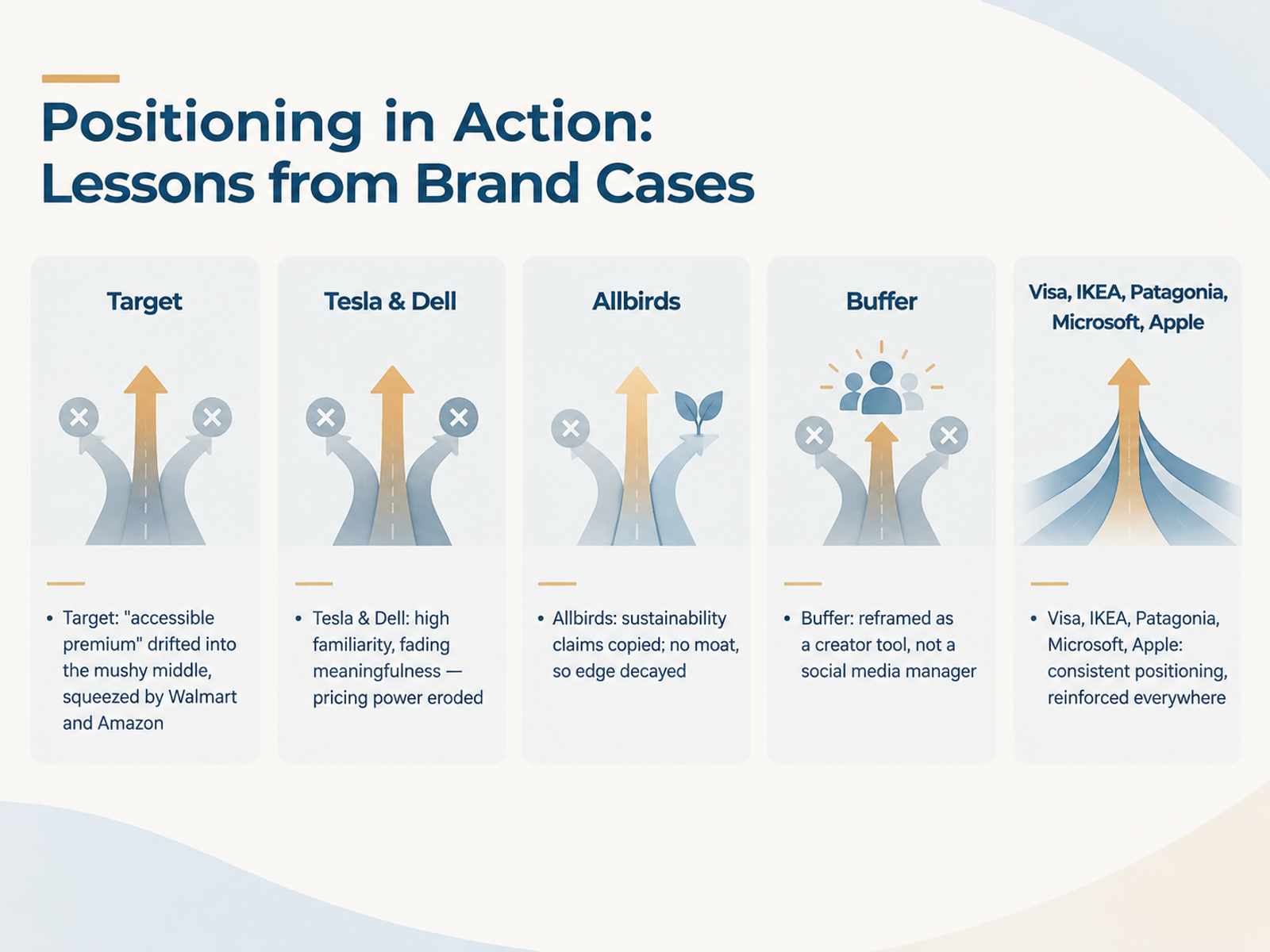
- 09Positioning in Action: Lessons from Brand CasesLet's look at positioning in action, because the tradeoffs get real fast. Target built its name on accessible premium. But it drifted into the mushy middle, squeezed from below by Walmart's scale and from above by Amazon's convenience. When you sit in the middle, every decision becomes a compromise. Tesla and Dell show a different failure. High familiarity, but fading meaningfulness. People know you, they just stop caring. That erodes pricing power, and Tesla's price cuts proved it. Allbirds had a real edge in sustainability, until competitors copied the claim. No moat, so the edge decayed into operational parity. Buffer shows the way out. They reframed from social media manager to creator tool, which put them closer to Canva than Hootsuite. Now the contrast. Visa, IKEA, Patagonia, Microsoft, Apple. Different categories, same discipline. They pick a position, then reinforce it everywhere, year after year. So here's your takeaway. Familiarity is not meaningfulness. If competitors can copy your claim, it is not a position yet. Next, we will cover common pitfalls and tradeoff discipline.
 thinkwithgoogle.comoctopusmarketing.agencybigeyeagency.com+21 min
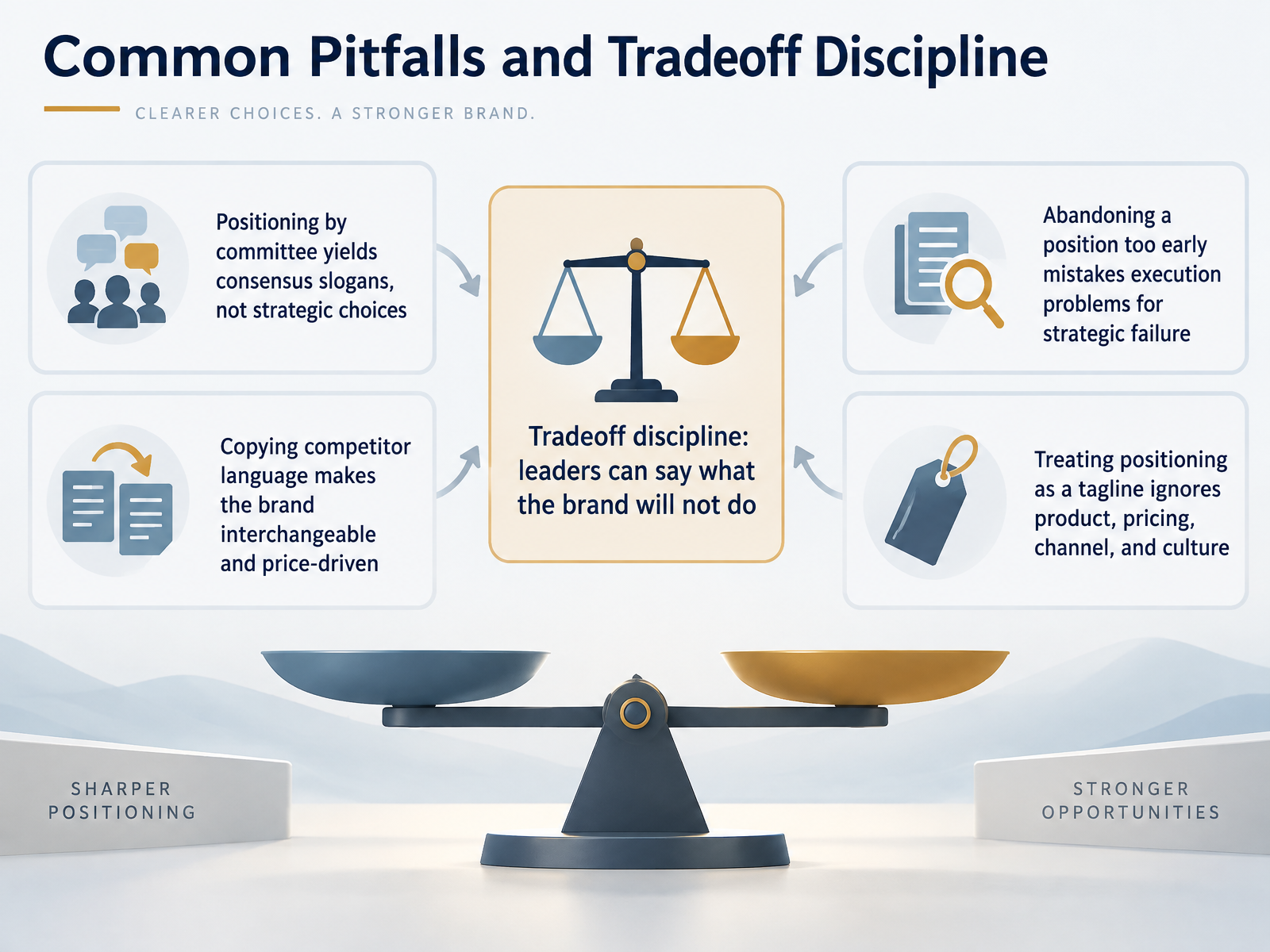
- 10Common Pitfalls and Tradeoff DisciplineLet's talk about the pitfalls that quietly undo good positioning work. First, positioning by committee. When everyone gets a vote, you end up with a consensus slogan, not a strategic choice. Second, copying competitor language. If you describe yourself the way rivals describe themselves, you become interchangeable, and interchangeable brands compete on price. Third, quitting a position too early. Often the problem is execution, not strategy, so before you abandon a position, check whether you actually delivered it. Fourth, treating positioning as a tagline. A tagline is the output. The work lives in product, pricing, channel, and culture. Real tradeoff discipline means leaders can name what the brand will not do. Next, let's draft yours, in Workshop Part 1: Draft Your Positioning Statement.
 brandingstrategyinsider.combrandingstrategyinsider.comvivaldigroup.com+21 min
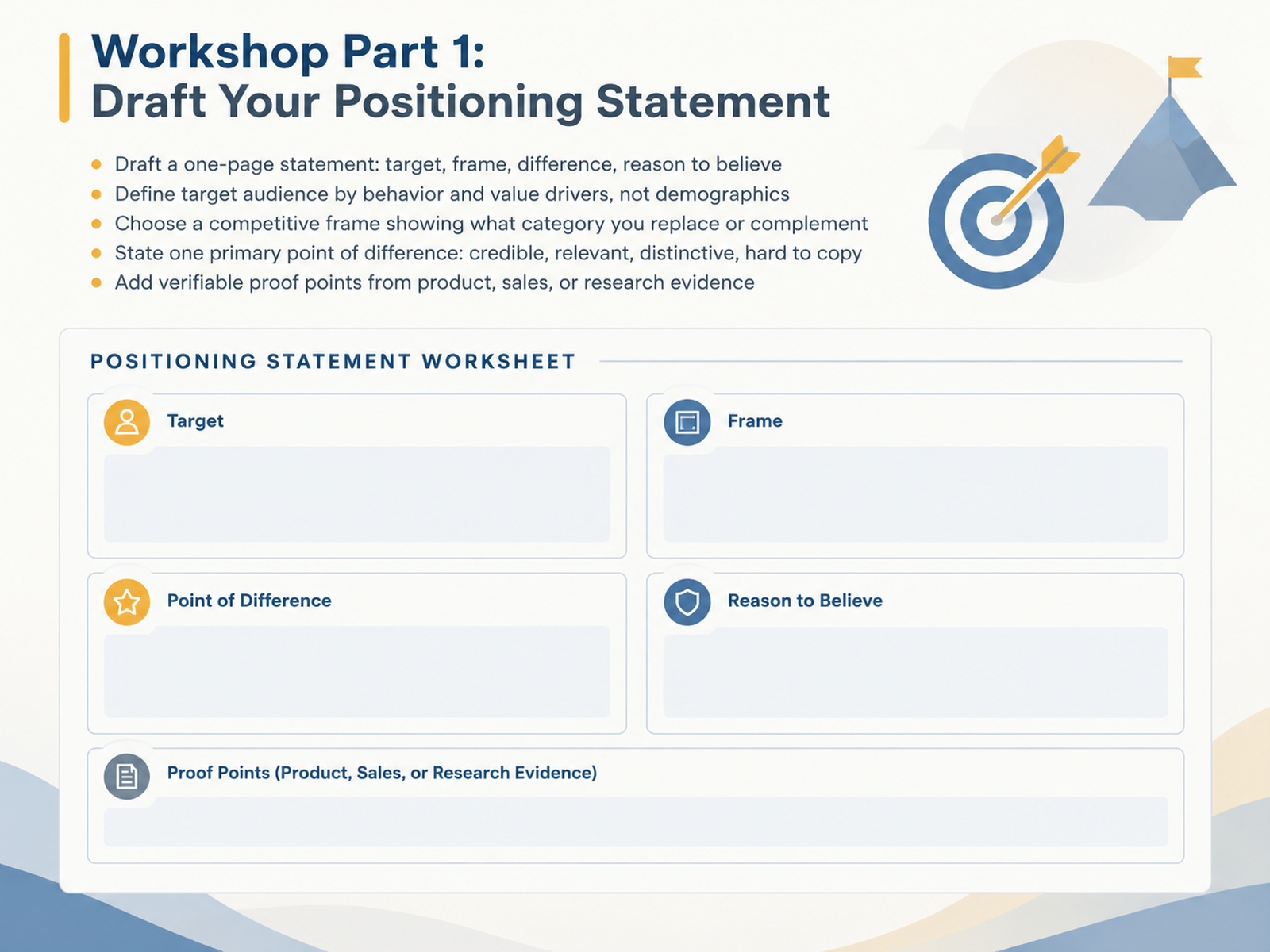
- 11Workshop Part 1: Draft Your Positioning StatementNow, let's get practical. Your job in Workshop Part One is to draft a one-page positioning statement built on four elements: target, frame, difference, and reason to believe.
Start with the target. Define your audience by behavior and value drivers, not demographics. Who they are matters less than how they buy and what they value.
Next, choose a competitive frame. Name the category you replace or complement. Be explicit about what you are measured against in the buyer's mind.
Then state one primary point of difference. It has to be credible, relevant, distinctive, and hard to copy. One strong point beats a list of vague claims.
Finally, add verifiable proof points. Pull evidence from product performance, sales data, or research. Keep the statement to one page. If you cannot defend it with evidence, cut it.
Next, in Workshop Part Two, we will map the tradeoffs and pressure-test that position.
 internationaljournalssrg.orgonline.hbs.edutoolshero.com+21 min
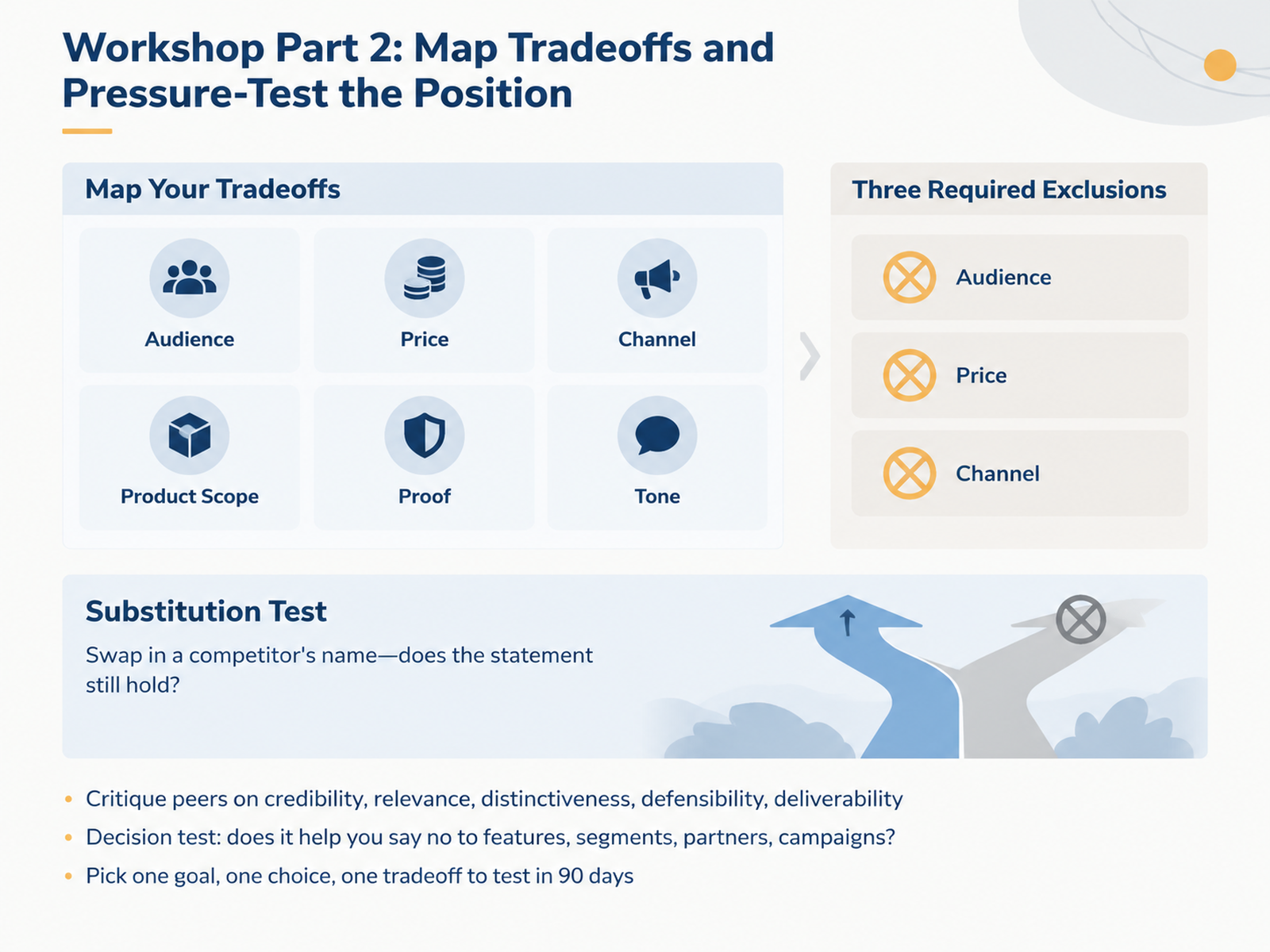
- 12Workshop Part 2: Map Tradeoffs and Pressure-Test the PositionNow let's pressure-test the position you built. First, name at least three tradeoffs, and write them down. Audience. Price. Channel. Product scope. Proof. Tone. Pick the three where a real decision is waiting, because tradeoffs you won't name will get made for you by sales, or by a competitor. Next, critique each other on five tests. Is it credible? Relevant? Distinctive? Defensible? Deliverable? Then run the substitution test. Swap in a competitor's name. If the statement still holds, it isn't positioning, it's category description. Then the decision test. Does this position help you say no to a feature, a segment, a partner, a campaign? If not, it's decoration. Finally, commit. One goal, one choice, one tradeoff, tested in ninety days. That gives you real evidence instead of another debate. Next, we turn that commitment into the 90-Day Activation Plan.
 internationaljournalssrg.orgonline.hbs.edutoolshero.com+22 min
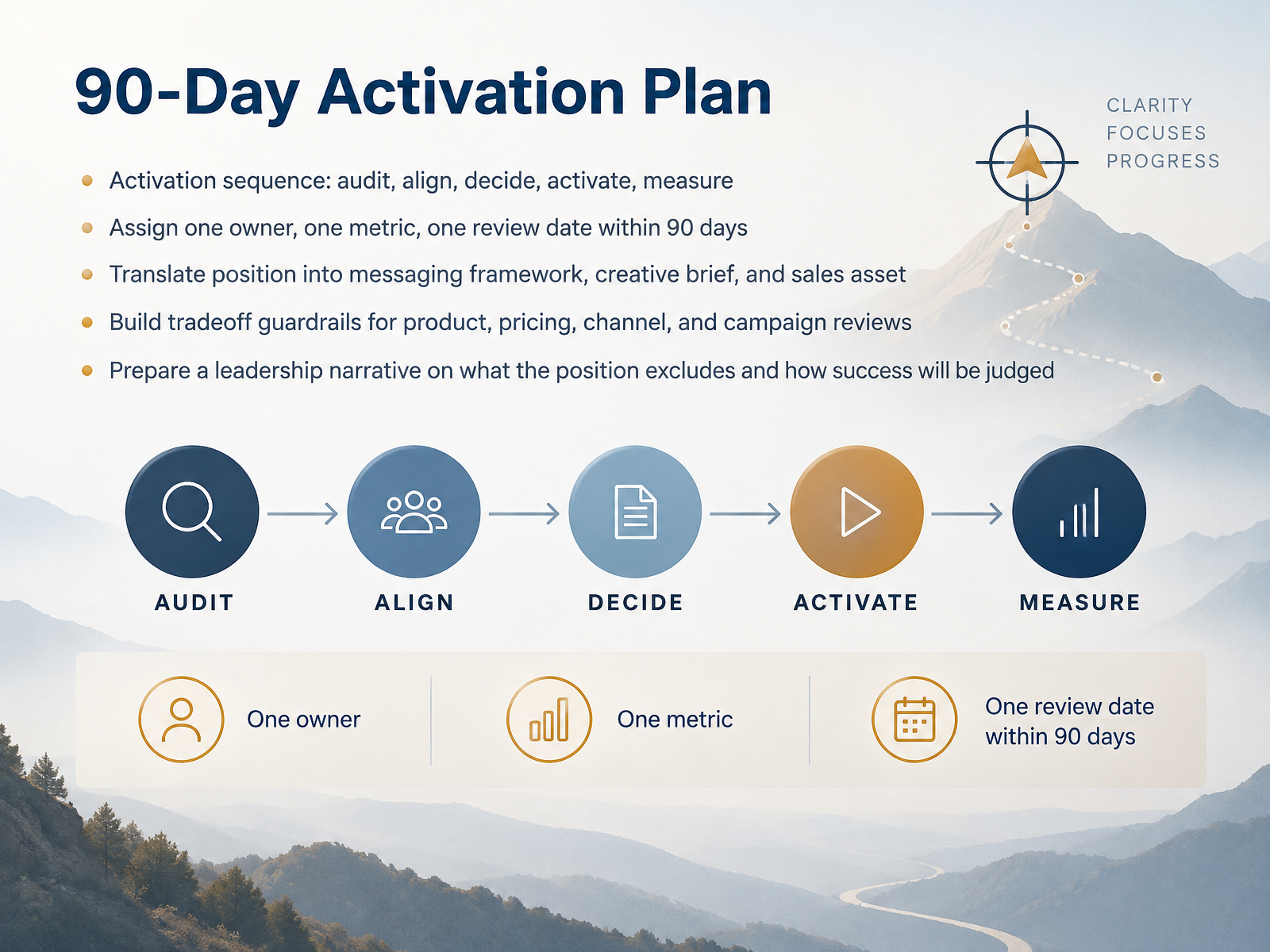
- 1390-Day Activation PlanNow, let's turn positioning into a ninety-day plan you can actually run. The sequence is audit, align, decide, activate, measure. Give each stage a deadline, and keep the whole thing inside one quarter. Assign one owner, one metric, and one review date. Not a committee. One name on the hook. Then translate the position into a messaging framework, a creative brief, and a sales asset. Those three artifacts force you to say what the position means in practice. Next, build tradeoff guardrails for product, pricing, channel, and campaign reviews. When someone proposes a feature or a discount that contradicts the position, the guardrail tells you to stop before the debate restarts. Finally, prepare a leadership narrative on what the position excludes and how success will be judged. State the exclusions plainly, and name the metric you will read at the review date. That way, alignment holds when the pressure comes. Next, let's pull this together in Key Takeaways and Next Steps.
 2 min
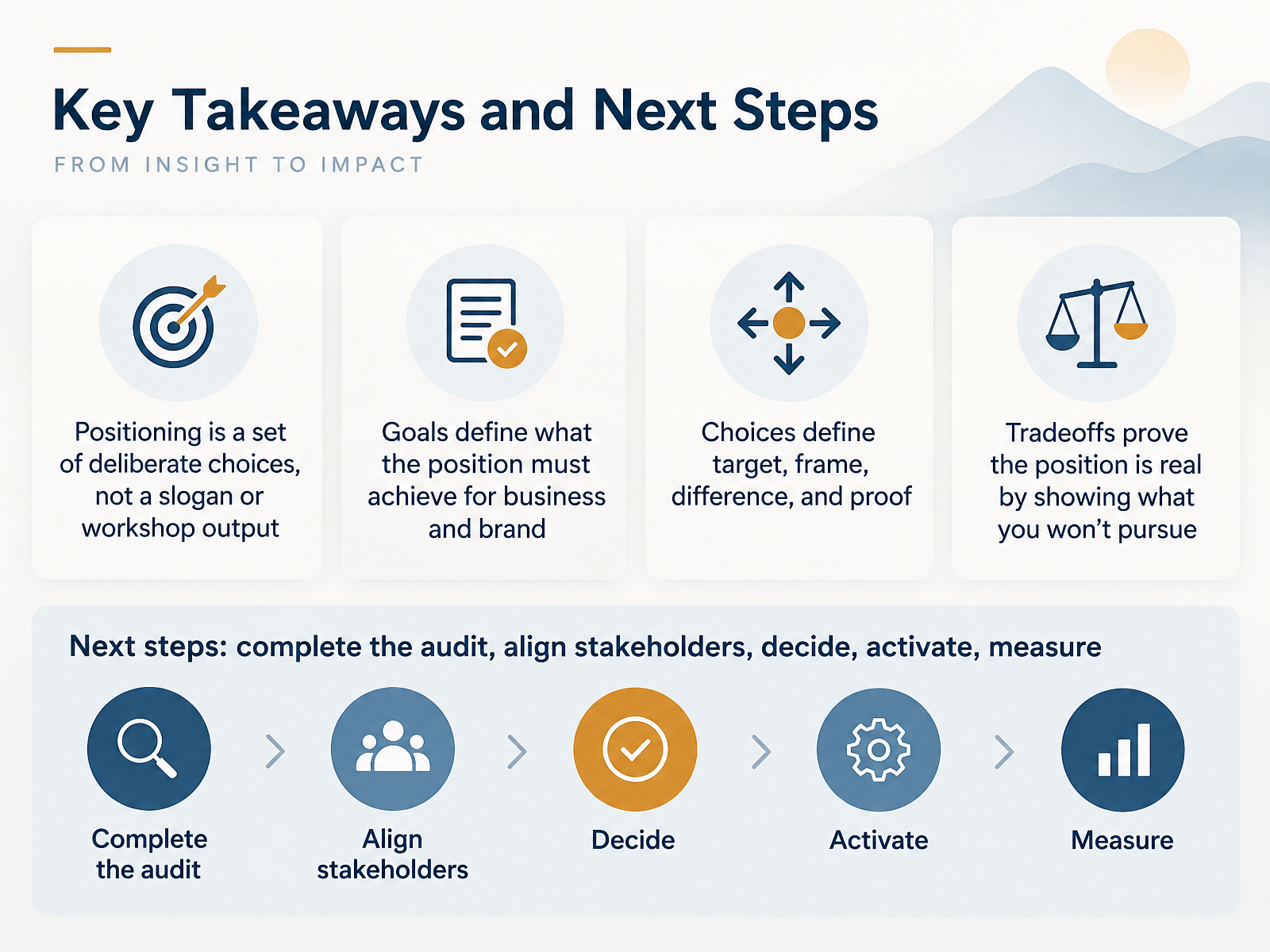
- 14Key Takeaways and Next StepsLet's pull this together. Positioning is a set of deliberate choices, not a slogan, and not a workshop output. Goals define what the position must achieve for the business and the brand. Choices define your target, your frame, your difference, and your proof. And tradeoffs prove the position is real, because they show what you will not pursue. So here is your next sequence. Complete the audit. Align stakeholders, even when they disagree. Decide. Activate. Then measure, with a clear link to business outcomes. You will not get perfect certainty, and that is fine. Clarity beats consensus. Thank you for working through this with me. Go make the hard choices, and make them count.
 thinkwithgoogle.comoctopusmarketing.agencybigeyeagency.com+21 min
Take the deck with you
Download this course as a file — free, no sign-up needed.
- PDF handoutEvery slide page, ready to print or share.15 pages · 3.0 MBDownload
- Narrated PowerPointThe deck that presents itself — every slide carries the digital human's narration video.15 pages · 15.1 MBDownload
- PowerPoint slidesThe full deck as a .pptx — open it in PowerPoint, Keynote, or Google Slides.15 pages · 2.9 MBDownload
Free to use in your own training — please keep the PersonWise credit page at the end.
Have your own deck? Turn it into a course
Sources consulted
Web sources consulted while building this course.
- Brand Positioning Is A Leadership Decision, Not A Marketing Exercise - Branding Strategy Insider — brandingstrategyinsider.com
- Brand Positioning That Improves The Economics Of Growth - Branding Strategy Insider — brandingstrategyinsider.com
- What Is Brand Strategy? A Definitive Guide for Modern Leaders - Vivaldi Group — vivaldigroup.com
- Brand Positioning Strategy Framework for Market Leadership — kurums.com
- Brand Strategy Must Change The Economics Of Choice - Branding Strategy Insider — brandingstrategyinsider.com
- by Kevin Lane KellerBRAND PLANNING — marksherrington.com
- Three questions you need to ask about your brand. — pubmed.ncbi.nlm.nih.gov
- Building Strong Brands: Three Models for Developing and Implementing Brand Plans — assets.csom.umn.edu
- Keller_SBM3_03.pptx — slideshare.net
- Keller sbm3 03 | PPT — slideshare.net
- Modern Brand Measurement Playbook — thinkwithgoogle.com
- Brand Measurement Framework: KPIs, Metrics & Models — octopusmarketing.agency
- Brand Positioning: A Bigeye Guide for Agency Growth in 2025 — bigeyeagency.com
- Brand Positioning Strategies for 2025: Winning the Market with Strategic Marketing % - WebGrit — webgrit.com
- Six Steps to More Effective Marketing Measurement — bcg.com
- Perceptual Mapping as a Marketing Research Tool for Brand Positioning — internationaljournalssrg.org
- How to Use Perceptual Mapping to Assess Your Competition — online.hbs.edu
- Perceptual Map and Mapping (PERMAP) - Toolshero — toolshero.com
- How to Make a Perceptual Map in Excel Using AI — thebricks.com
- Brand Equity Perceptual Mapping - Georgia Southern Commons — digitalcommons.georgiasouthern.edu