Begin
14 pages · ~28 min
Milky Way Structure and Motion
This training explains the structure and motion of the Milky Way, helping learners understand its components, spiral arms, and galactic rotation.
A digital instructor presents all 14 pages. Hold “Ask” at any point and ask out loud — the answer comes from this course. No sign-up needed.
What you’ll learn
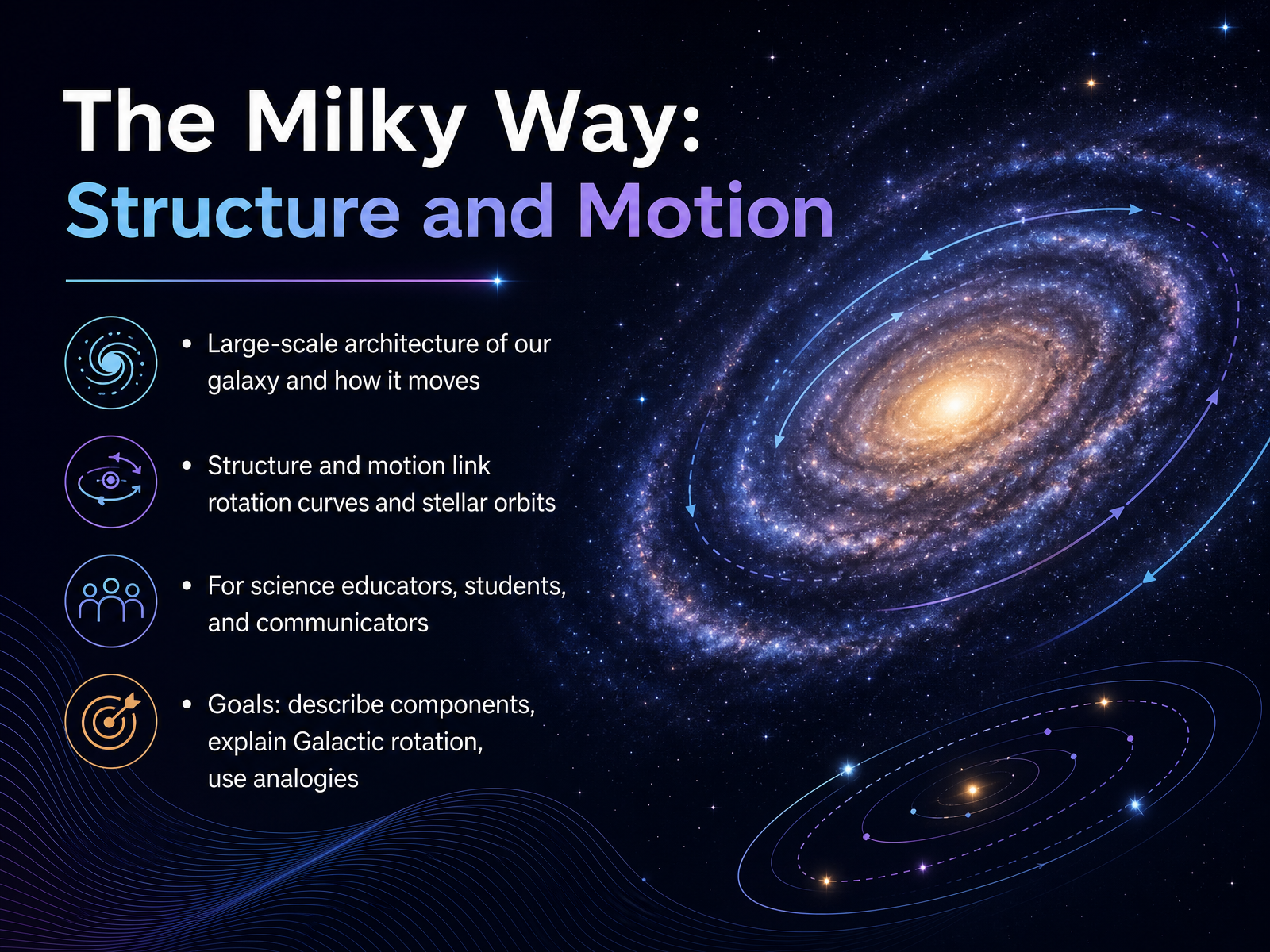
- 01The Milky Way: Structure and MotionWelcome. In this course, we will explore the Milky Way as a living system, not just a catalog of stars. Think of our galaxy as a vast city of gas, dust, and hundreds of billions of suns, all bound together by gravity. Today we will look at its large-scale architecture. We will ask what the galactic disk really is, why the central bulge glows with older stars, and what holds the outer halo together. We will also link that structure to motion. How do stars orbit the center? Why do rotation curves surprise astronomers? And why does the Sun need over two hundred million years to complete one galactic year, about as long as the age of dinosaurs to today. By the end, you will be able to describe the main components, explain Galactic rotation in plain terms, and use simple analogies that make these scales feel real. We are inside this system, so we will learn to picture it from within and from above. Next, we begin with how we see our galaxy from the inside.astroedu.iau.orgamnh.orgesa.int+21 min
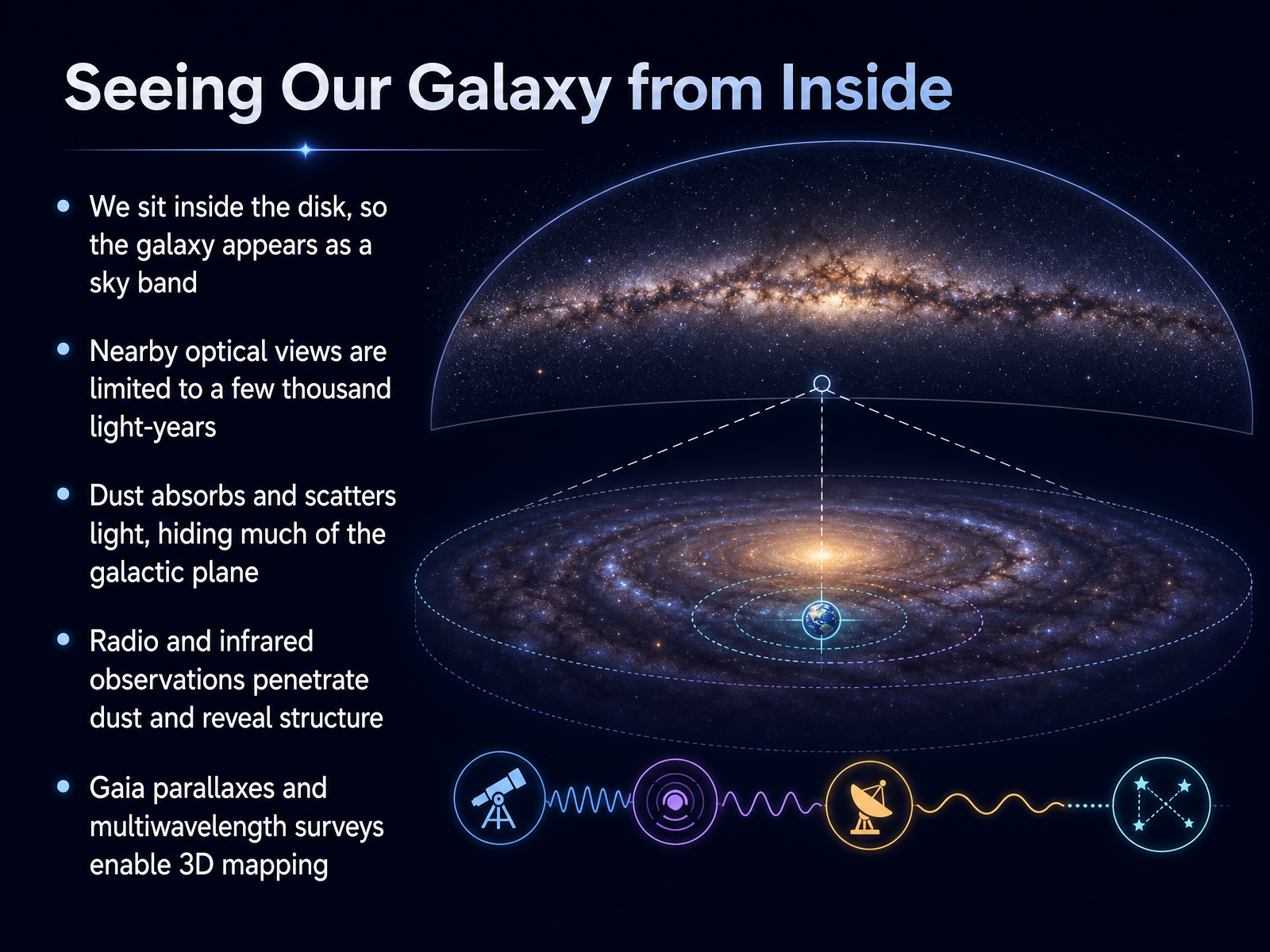
- 02Seeing Our Galaxy from InsideNow, let’s think about the very first challenge in understanding our galaxy: the view from our own doorstep. Because we are embedded inside the disk, we do not get a top-down picture. Instead, on a dark night, the Milky Way appears as a glowing band stretching across the entire sky. That band is simply the crowded light of distant stars in the galactic plane. But in visible light, our view is extremely limited. Interstellar dust, tiny solid particles scattered through space, acts like a thick fog. It absorbs and scatters starlight so effectively that in optical wavelengths, we can only see clearly for a few thousand light-years before the plane fades into darkness. This dust hides much of the galactic plane from us, blocking the light from the far side of our own galaxy. To see through the fog, astronomers switch to longer wavelengths. Radio and infrared observations can pierce the dust much more easily, revealing structures that optical telescopes simply cannot reach. And with precise measurements from the Gaia mission and large multiwavelength surveys, we can now measure stellar positions and dust distributions in three dimensions. This gives us the remarkable ability to map the true structure of the galaxy, even from our seat inside it. Next, we will zoom out from this observing perspective and look at the main structural components of the Milky Way.
 iopscience.iop.orgaanda.orgiopscience.iop.org+21 min
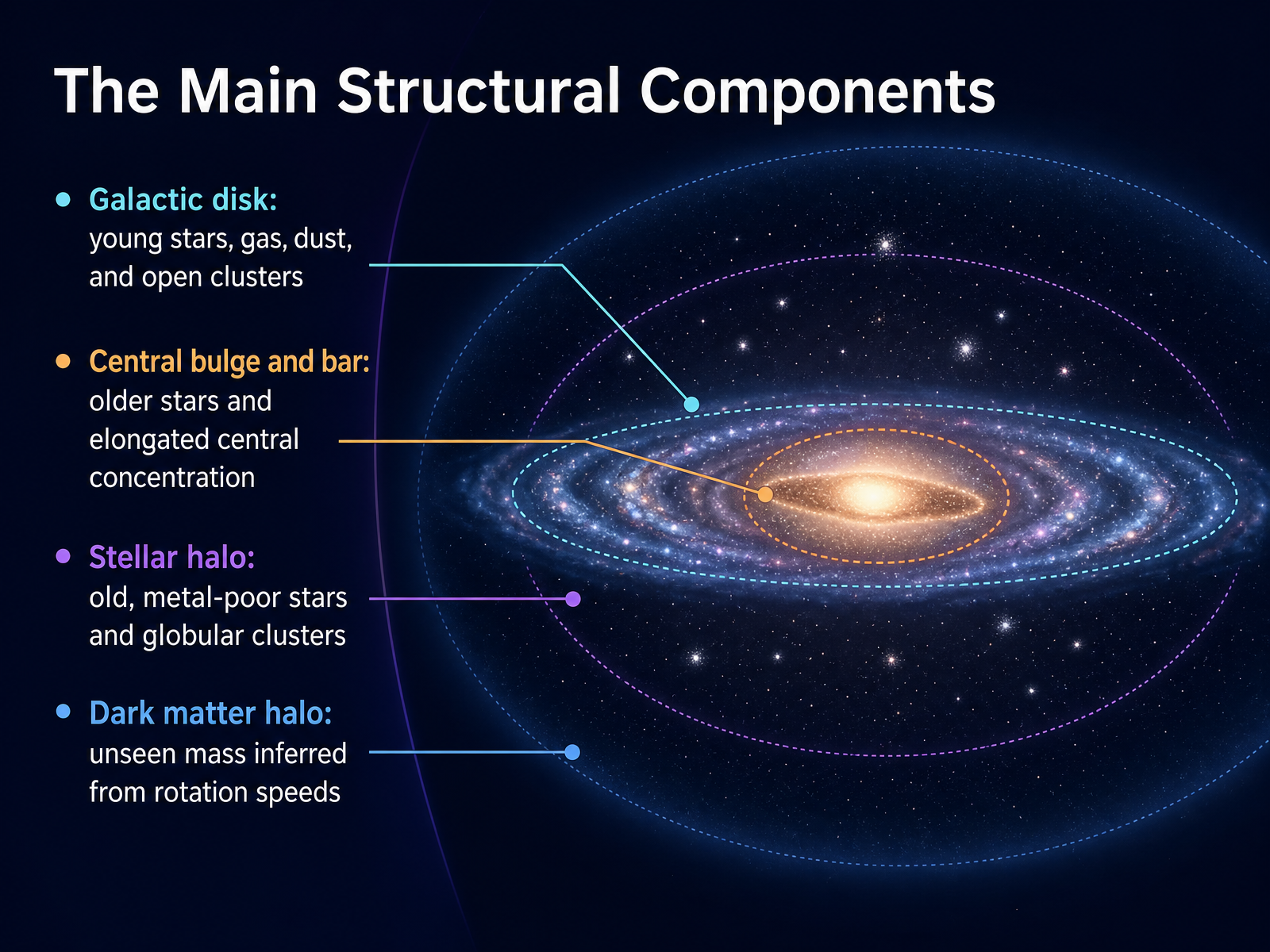
 - 03The Main Structural ComponentsNow let's break the Milky Way into its main structural components. First, there's the galactic disk, a thin, rotating plane packed with young stars, gas, dust, and open star clusters. This is where new stars are actively being born. At the center sits the bulge, a dense concentration of mostly older stars, and running through it is an elongated bar, a feature we now know shapes the inner galaxy. Surrounding all of this is the stellar halo, a sparse, roughly spherical region containing very old, metal-poor stars and ancient globular clusters that swarm high above and below the disk. And finally, there's the dark matter halo, an invisible but massive component we infer because stars and gas at the galaxy's edge orbit far too fast for the visible matter alone to hold them. Think of it as the gravitational scaffolding around everything else. These components are not just boxes on a diagram. Each one moves differently and tells a different story about how the Milky Way formed. Next, let's zoom into the disk to explore its most dramatic feature, spiral arms and star formation.
 iopscience.iop.organnualreviews.orgaanda.org+21 min
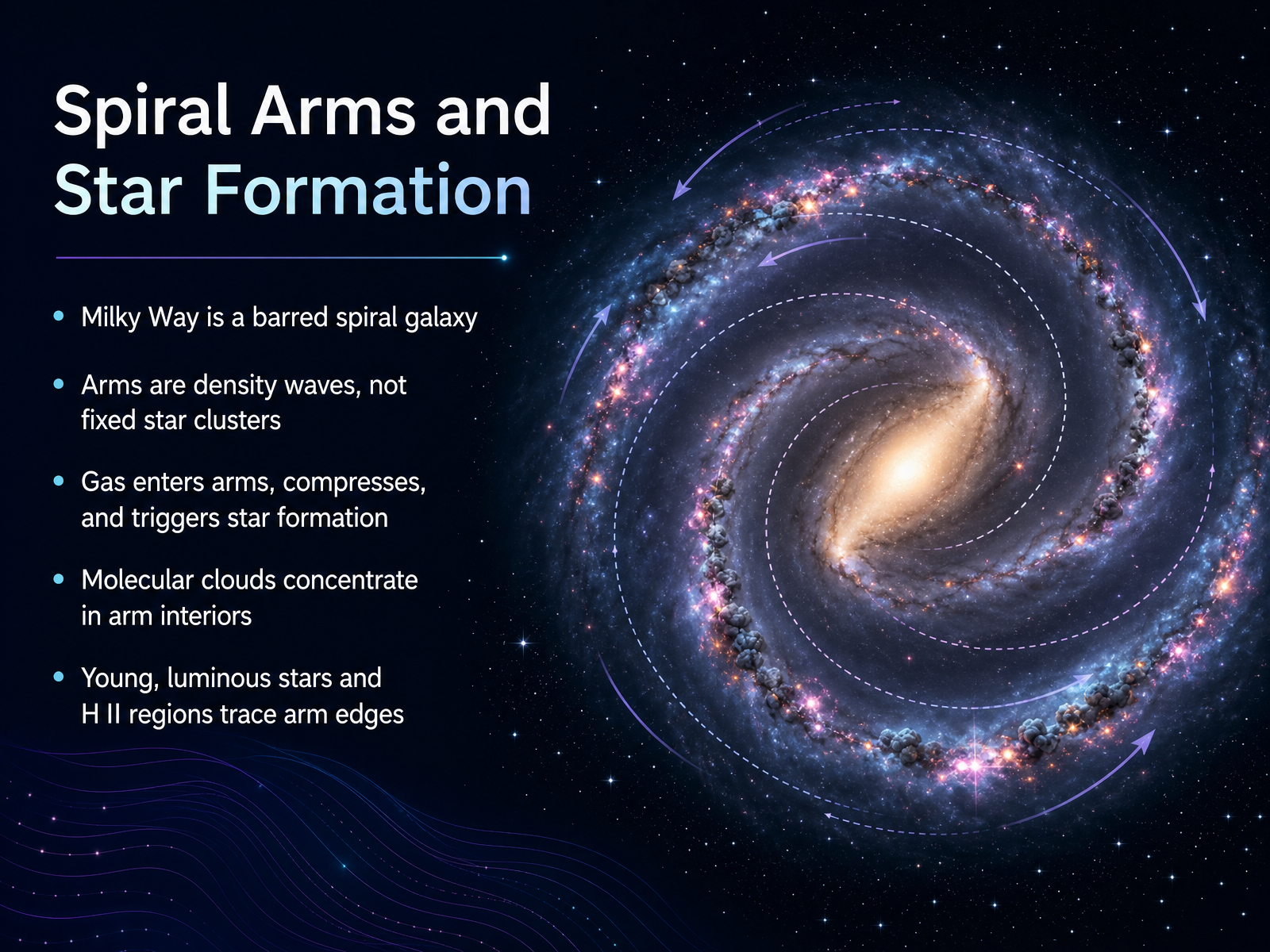
 - 04Spiral Arms and Star FormationNow let’s look at what makes the Milky Way a barred spiral galaxy. A barred spiral has a central bar of stars from which the large spiral arms wind outward. But those arms are not solid objects or fixed chains of stars traveling together. They are density waves, patterns of higher gravitational pull that move through the galactic disk. Think of them like slow-moving traffic jams on a cosmic highway. Individual stars and gas clouds pass through the wave pattern, but the pattern itself persists. As orbiting gas enters an arm, it gets compressed, triggering the formation of new stars. Molecular clouds gather in the interiors of the arms, where the gas is densest and coldest. Then, along the inner edges, we find the youngest, most luminous stars and glowing H II regions, the bright nurseries that trace the arm like a string of lights. So the spiral pattern builds stars at its leading edge and leaves a trail of young stars behind it. Up next, we’ll explore how the entire Milky Way rotates.
 link.springer.comiopscience.iop.orgiopscience.iop.org+21 min
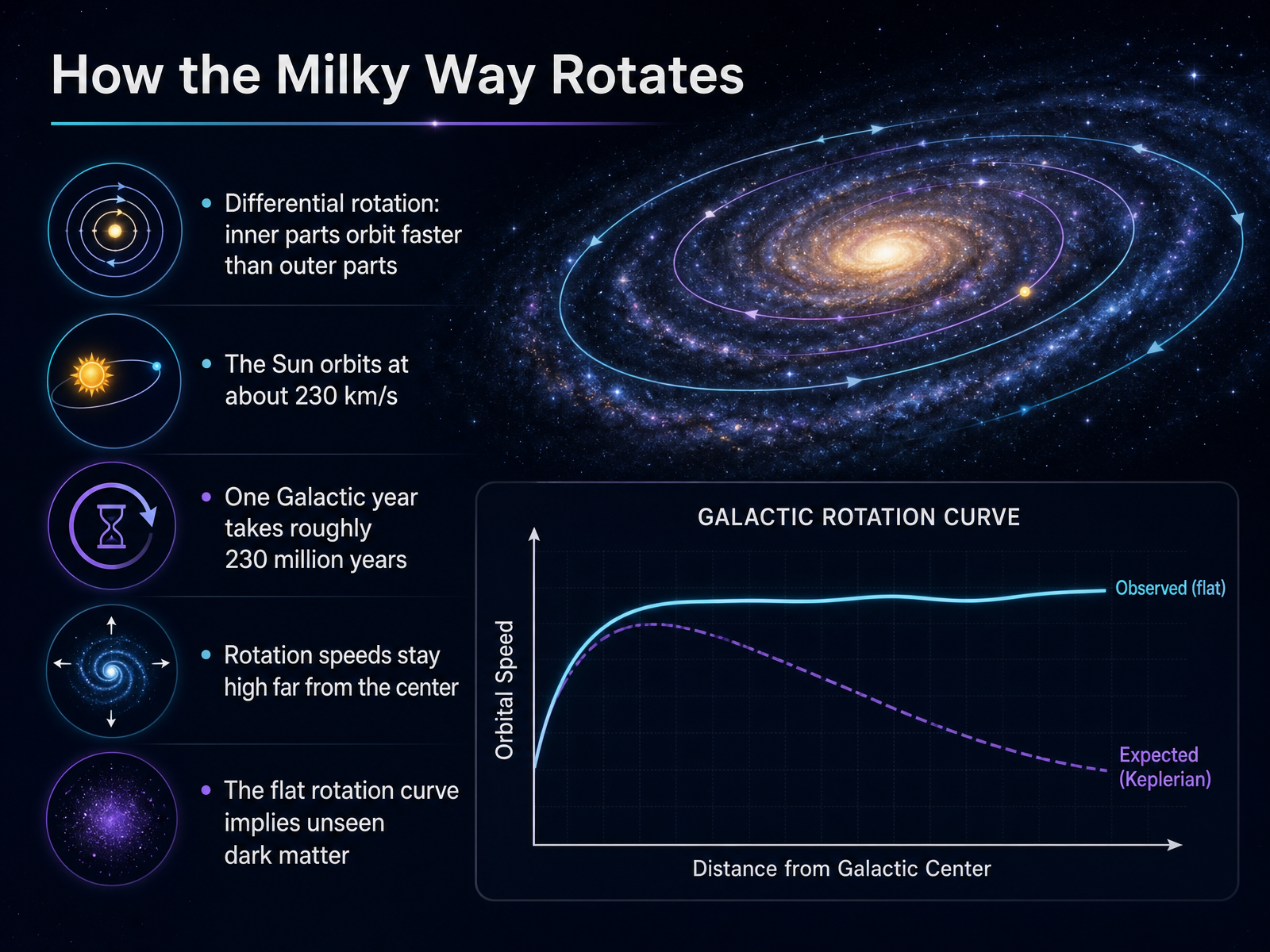
 - 05How the Milky Way RotatesNow let's look at how this vast system actually moves. The Milky Way doesn't spin like a solid wheel. Instead, it rotates differentially, meaning the inner regions orbit the center faster than the outer regions. Our Sun, for example, races around the galactic center at about two hundred thirty kilometers per second. Even at that incredible speed, one full orbit, what we call a Galactic year, takes roughly two hundred thirty million years. That's about as long as the entire reign of the dinosaurs. Far from the center, something surprising happens. The rotation speeds stay high. Based on the visible stars and gas alone, we would expect the outer parts to slow down dramatically. But they don't. This flat rotation curve points to an invisible source of gravity holding things together, dark matter. We can't see it directly, but its gravitational pull shapes how our galaxy moves. Next, let's explore motion within the galaxy itself.
 1 min
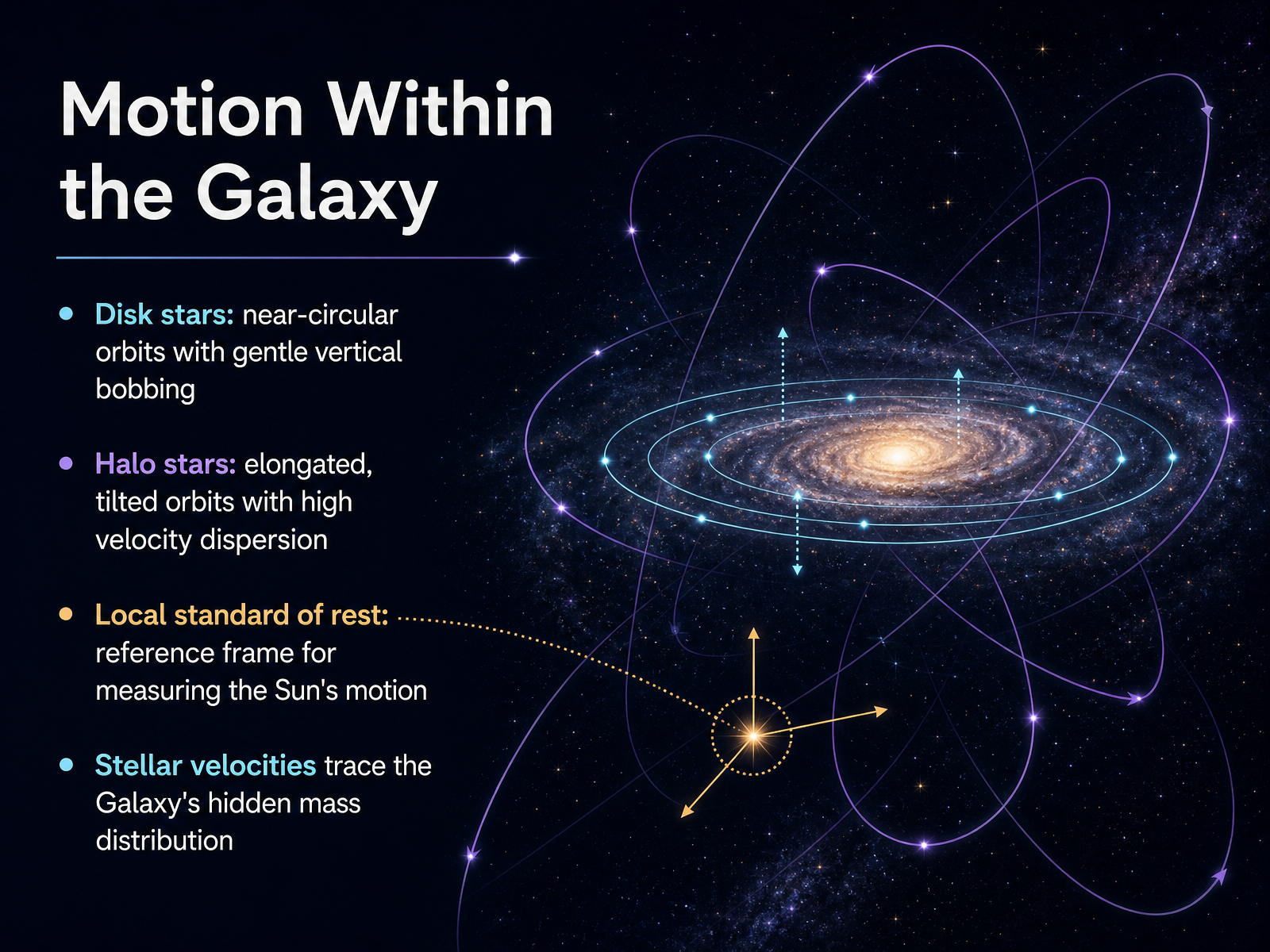
1 min - 06Motion Within the GalaxyNow let's set the galaxy in motion. The way a star moves tells us a lot about where it lives. Stars in the galactic disk follow near-circular orbits, gently bobbing up and down as they circle the center. This creates a thin, orderly structure. Halo stars, on the other hand, are the free spirits of the Milky Way. They travel on elongated, tilted paths, plunging through the disk at high speeds and moving with what astronomers call high velocity dispersion, meaning their speeds and directions vary widely. To measure our own motion, we use a reference frame called the local standard of rest. It is the velocity of a hypothetical star on a perfectly circular orbit at the Sun's position, giving us a baseline for comparison. By watching how fast different populations move, astronomers can trace the galaxy's hidden mass distribution, including dark matter. The orbits act as a gravitational map. Next, let's journey inward to the most extreme environment of all: the galactic center.
 1 min
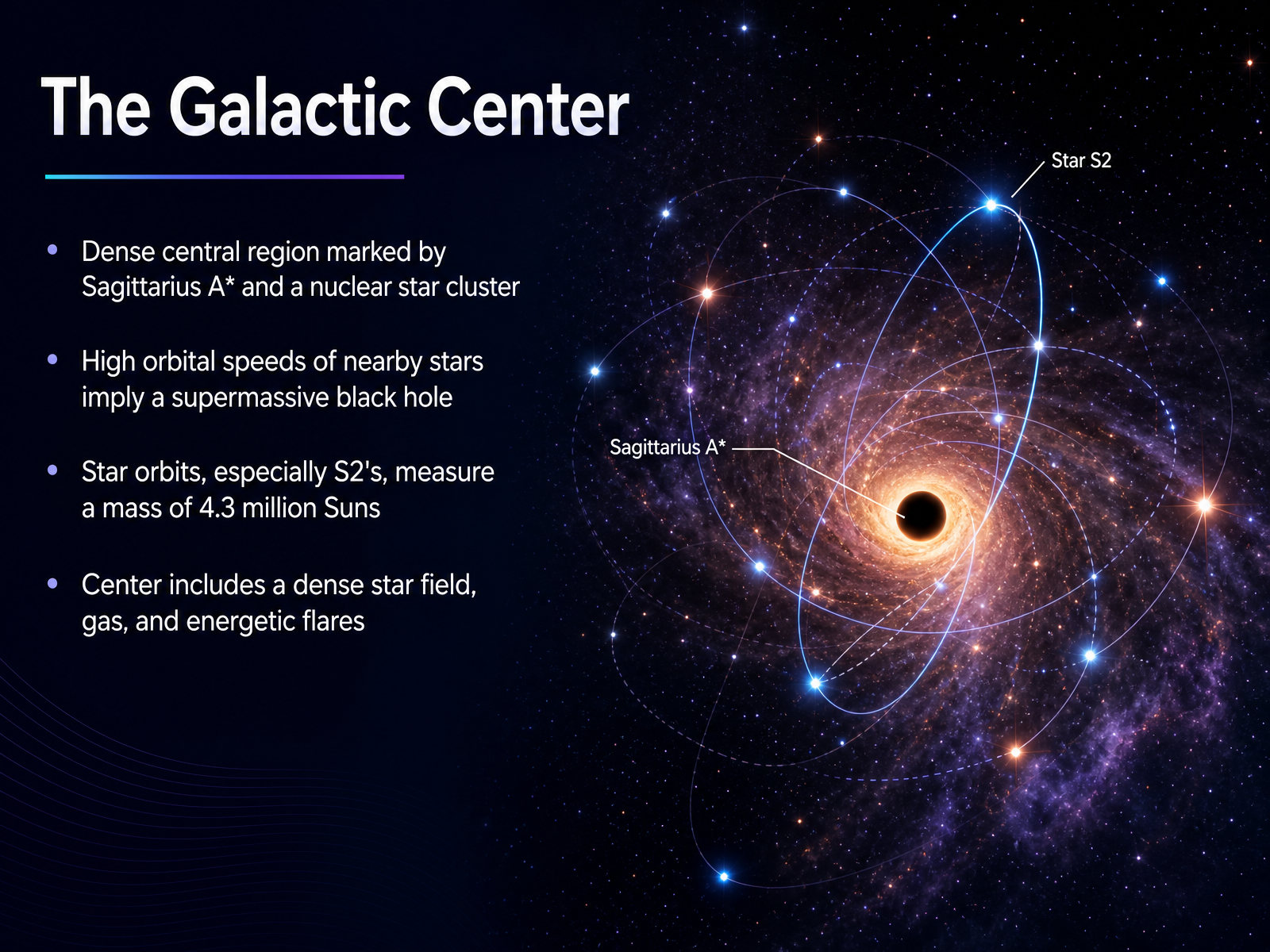
1 min - 07The Galactic CenterLet's turn now to the very center of our galaxy. Imagine flying toward the brightest part of the Milky Way, into a region called the galactic center. Here, stars are packed so tightly that the night sky would be dazzlingly bright. At the heart of this crowded neighborhood lies a dense cluster of stars and a mysterious object known as Sagittarius A star, or Sgr A*. Astronomers tracked the orbits of stars racing around this point. One star in particular, S2, completes a full orbit in just sixteen years, moving at incredible speeds. By applying the laws of gravity to its orbit, scientists calculated that it is circling something with a mass of four point three million Suns, packed into a space smaller than our solar system. That is a supermassive black hole. The center is not just dark and quiet. It is a dynamic, energetic place, full of dense gas and frequent flares of radiation. This discovery turns an abstract idea into a real, measurable object. Next, we will zoom out and explore the Milky Way in motion through space.
 2 min
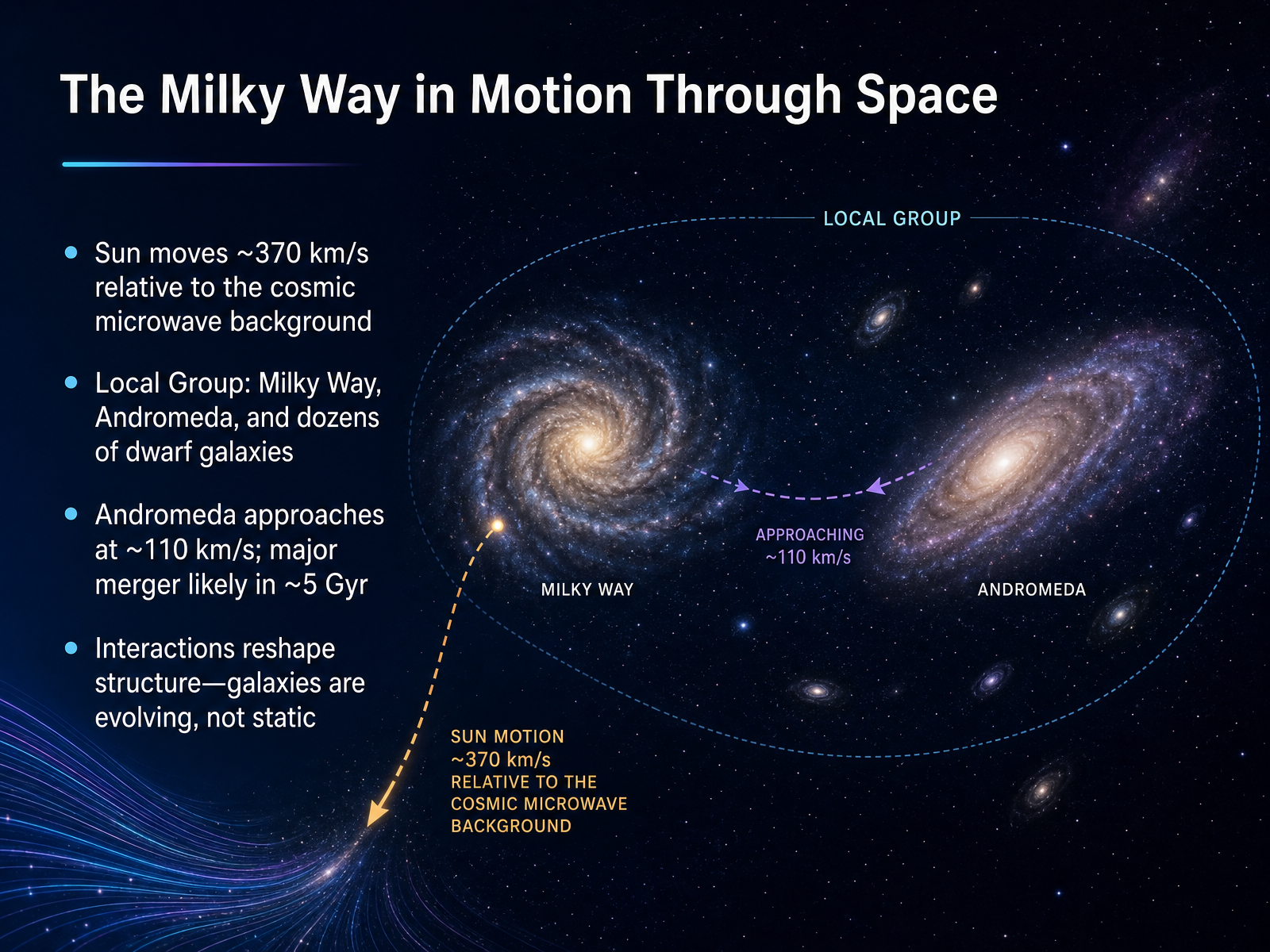
2 min - 08The Milky Way in Motion Through SpaceNow let's zoom out and think about our galaxy not as a static object, but as a traveler. The Milky Way is moving through space, and the clearest way to see that is against the cosmic microwave background, the faint afterglow of the Big Bang. Relative to that universal reference frame, our Sun is racing along at about three hundred seventy kilometers per second. That's fast enough to cross the entire continental United States in about twelve seconds. On a larger scale, we travel with our galactic neighborhood, the Local Group. This is a collection of the Milky Way, the Andromeda galaxy, and dozens of smaller dwarf galaxies, all bound together by gravity. Andromeda is approaching us at roughly one hundred ten kilometers per second. In about five billion years, give or take, it's likely the two great spirals will collide and merge. That timeline is as far in the future as the age of the Earth is in the past. These interactions are not rare events, they constantly reshape galaxies. So the Milky Way we see tonight is not a finished product, but a system still in motion, still evolving. Next, let's clear up some common misconceptions about our galaxy.
 2 min
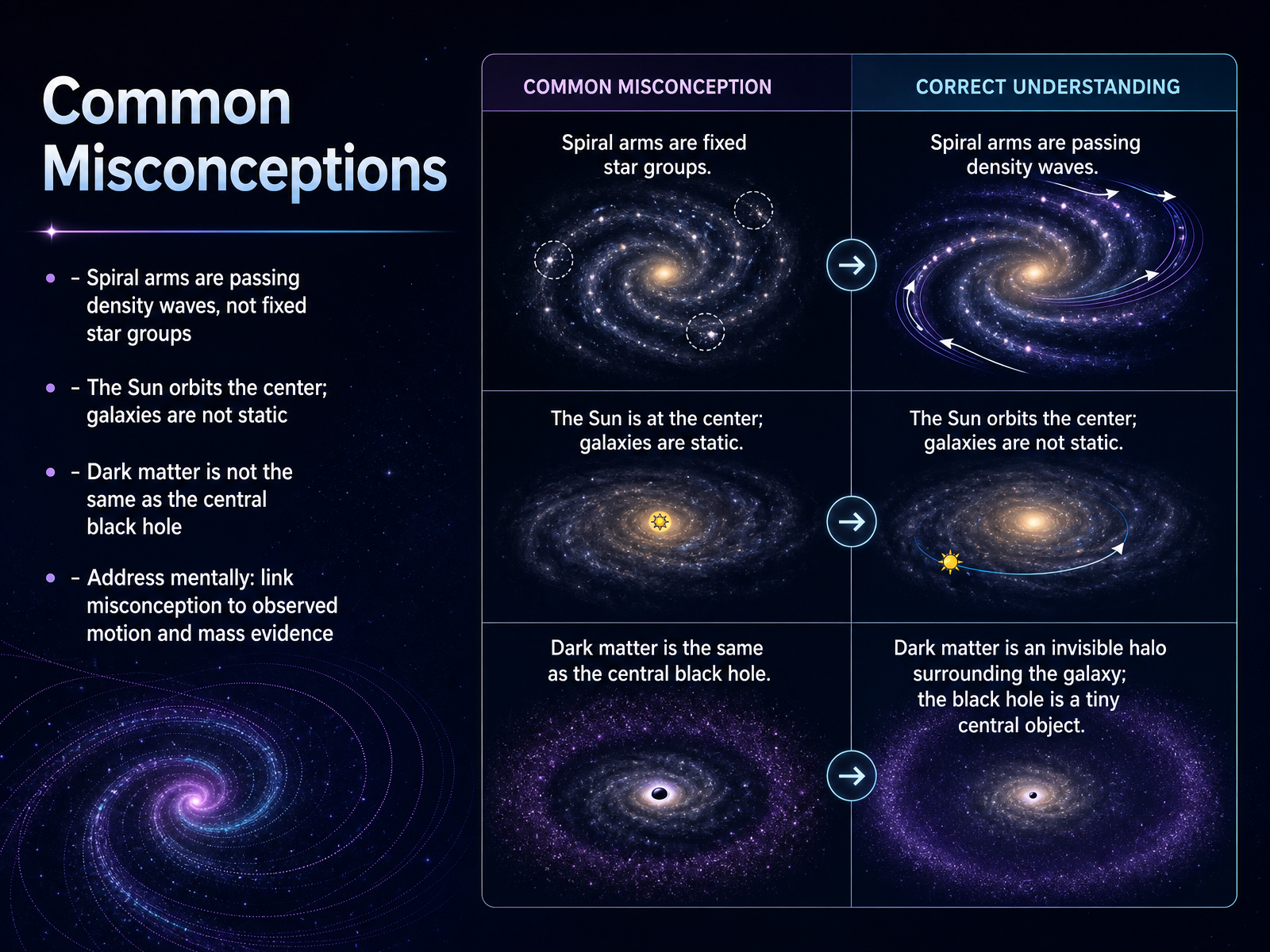
2 min - 09Common MisconceptionsNow, let us clear up a few ideas about the Milky Way that often trip people up. First, those beautiful spiral arms are not fixed groups of stars traveling together. They are passing density waves, regions where stars and gas bunch up briefly, like a slow traffic jam on a cosmic highway. Second, our galaxy is not a static pinwheel. The Sun, along with everything else, orbits the galactic center at roughly 220 kilometers per second. Even at that speed, one trip around takes about 230 million years. Third, dark matter and the central black hole are not the same thing. The black hole is a massive single object, but dark matter is an unseen, widely spread halo. We know it is there because stars far from the center move faster than visible mass alone can explain. If you link each misconception to the motion and mass we can observe, the real structure of the galaxy makes much more sense. Up next, let’s ground these ideas with everyday analogies that work.
 1 min
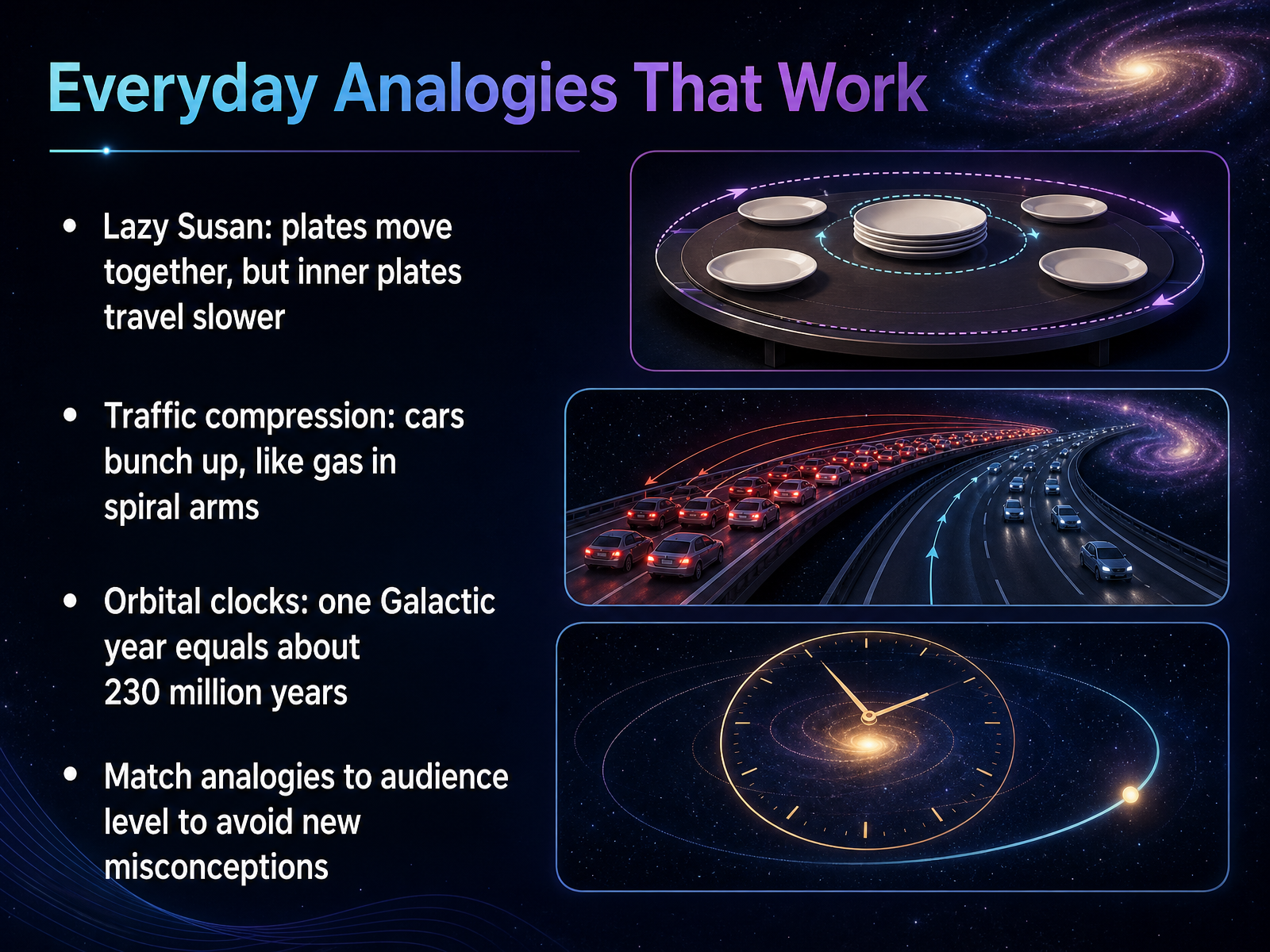
1 min - 10Everyday Analogies That WorkLet’s bring these ideas a little closer to Earth. Think of a lazy Susan on a dinner table. The plates near the center complete a full turn faster than the plates near the edge, even though they all travel together. That mirrors how stars orbit the galactic center. The Sun, for instance, is a passenger in this slow, graceful carousel, taking about two hundred and thirty million years to complete just one lap. We call that a galactic year, and it is older than the reign of the dinosaurs. Another useful image is traffic compression. You know how cars bunch up as they approach a slow zone? In a similar way, gas and dust pile up in the spiral arms of the Milky Way, triggering new waves of star formation. The arms are not rigid structures. They are bright traffic jams of matter. When choosing an analogy, we must match it to the learner’s level. A lazy Susan can explain rotation, but it can also suggest a solid disk, which is not quite right. Use the comparison to spark curiosity, not to replace the physics. Next, we will explore classroom activities and demos that make this motion truly visible.
 astroedu.iau.orgamnh.orgesa.int+22 min
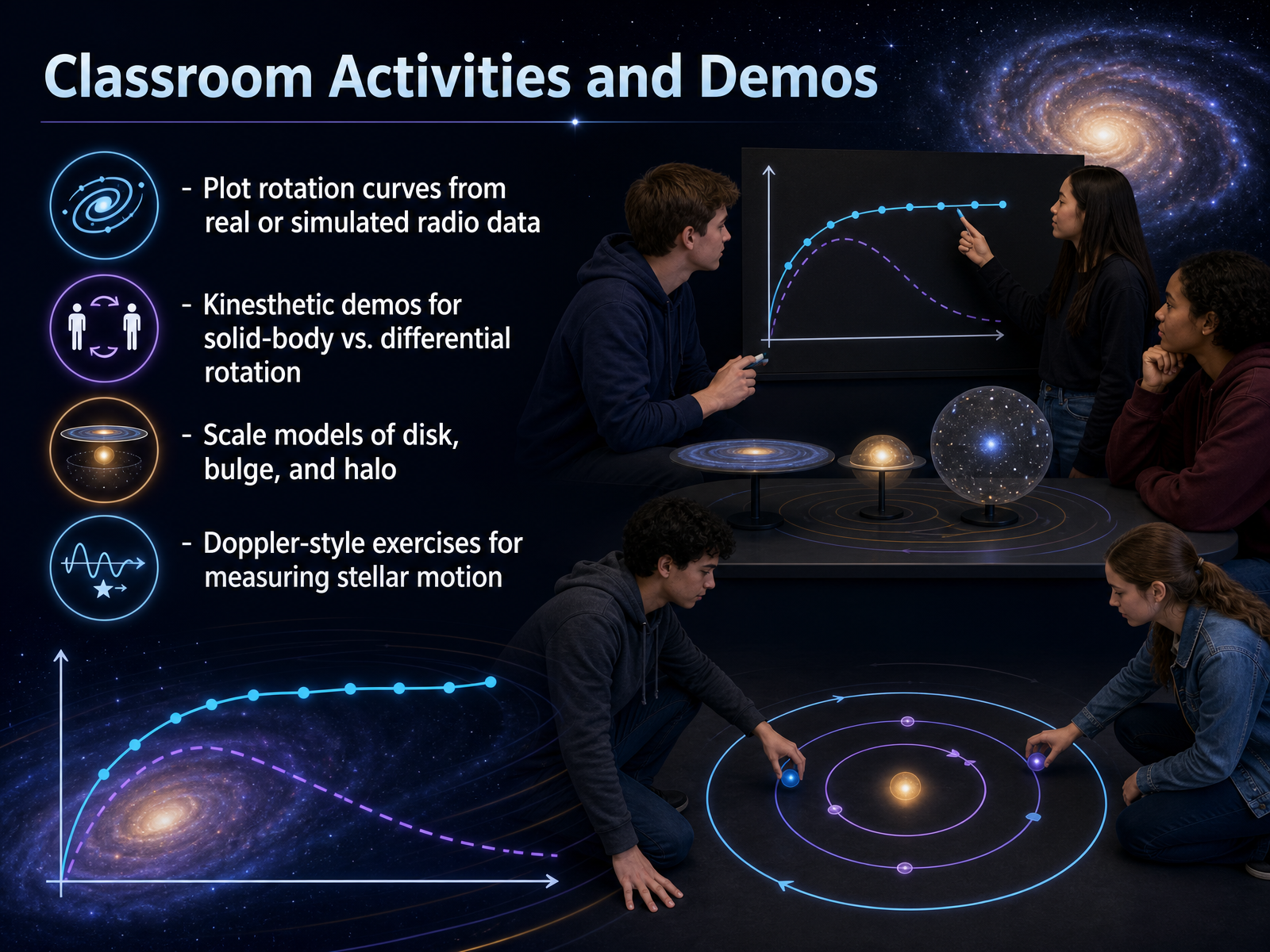
 - 11Classroom Activities and DemosLet’s make this visible in the classroom. Start by plotting rotation curves from radio data, either real observations or simulated numbers. Students almost gasp when the curve stays flat instead of falling off. Then get everyone standing for a kinesthetic demo, linking arms to mimic solid body rotation, where everyone turns together, versus holding hands to show differential rotation, where the outer students lag behind. It makes the difference immediate and physical. Next, build scale models of the disk, the bulge, and the halo. Even a rough model works, because it forces students to confront where most of the mass actually sits. Finally, try Doppler style exercises to measure stellar motion. Use the idea of a stretching or slack bungee cord to feel redshift and blueshift. These activities do more than teach structure. They let students discover why the flat rotation curve is strange. Up next, we will look at resources for current data and visualizations.
 2 min
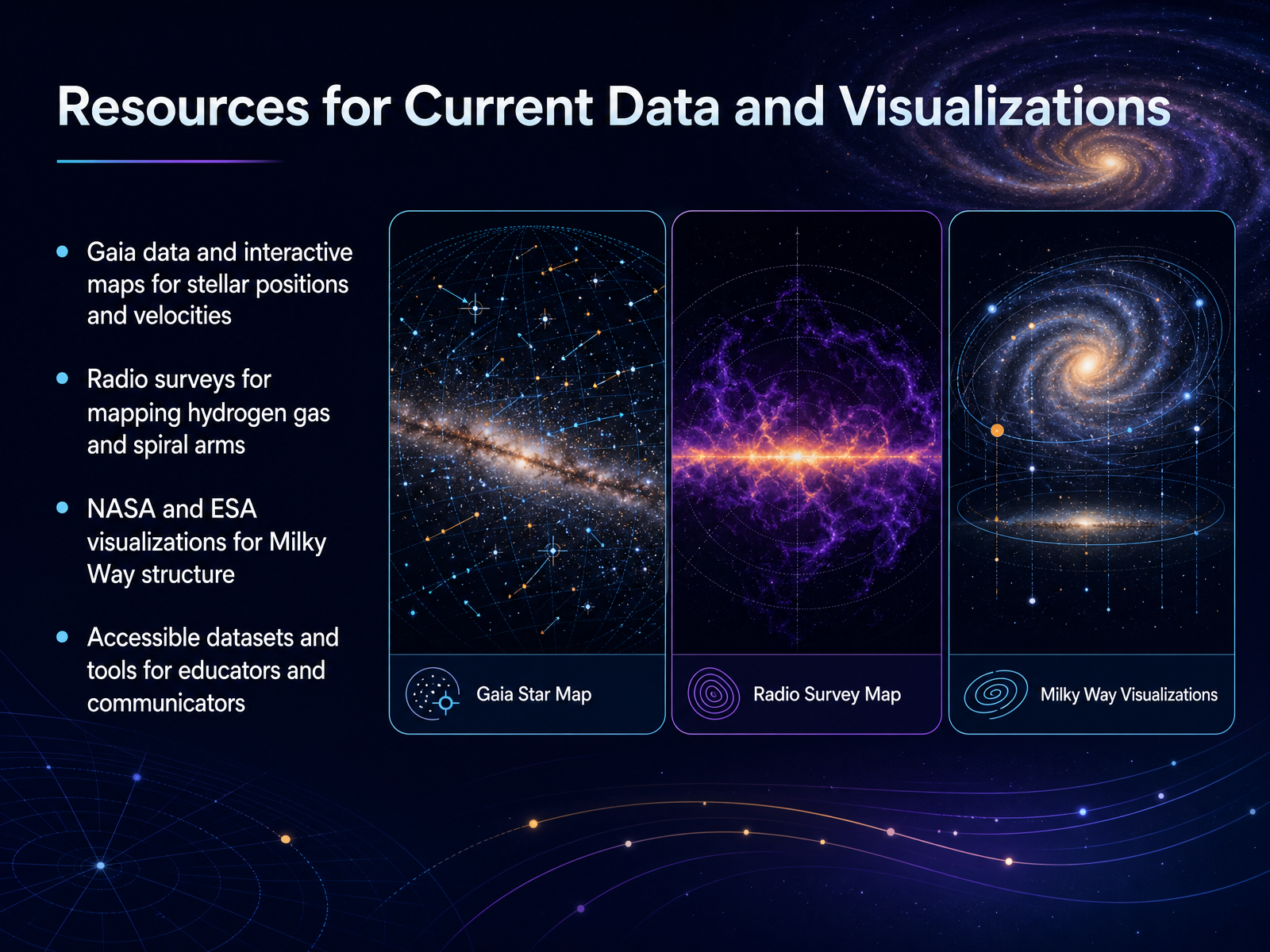
2 min - 12Resources for Current Data and VisualizationsBy now you may be wondering where to find current, reliable data about the Milky Way. The good news is that many of the most powerful datasets are public and made for exploration. The Gaia mission, for example, gives precise positions and velocities for nearly two billion stars, and scientists have built interactive maps from it so you can fly through the disk and watch stellar motion unfold. Radio surveys add another layer by mapping hydrogen gas and revealing the spiral arms that optical light cannot reach through dust. NASA and ESA also produce clear, research-based visualizations of the galaxy's disk, bulge, and halo. For educators and communicators, many of these tools come with lesson-friendly interfaces, simplified datasets, and ready to use visuals. They turn the Milky Way from an abstract topic into something students can see, query, and question. Up next, we will look at teaching strategies for different audiences.
 iopscience.iop.orgaanda.orgiopscience.iop.org+22 min
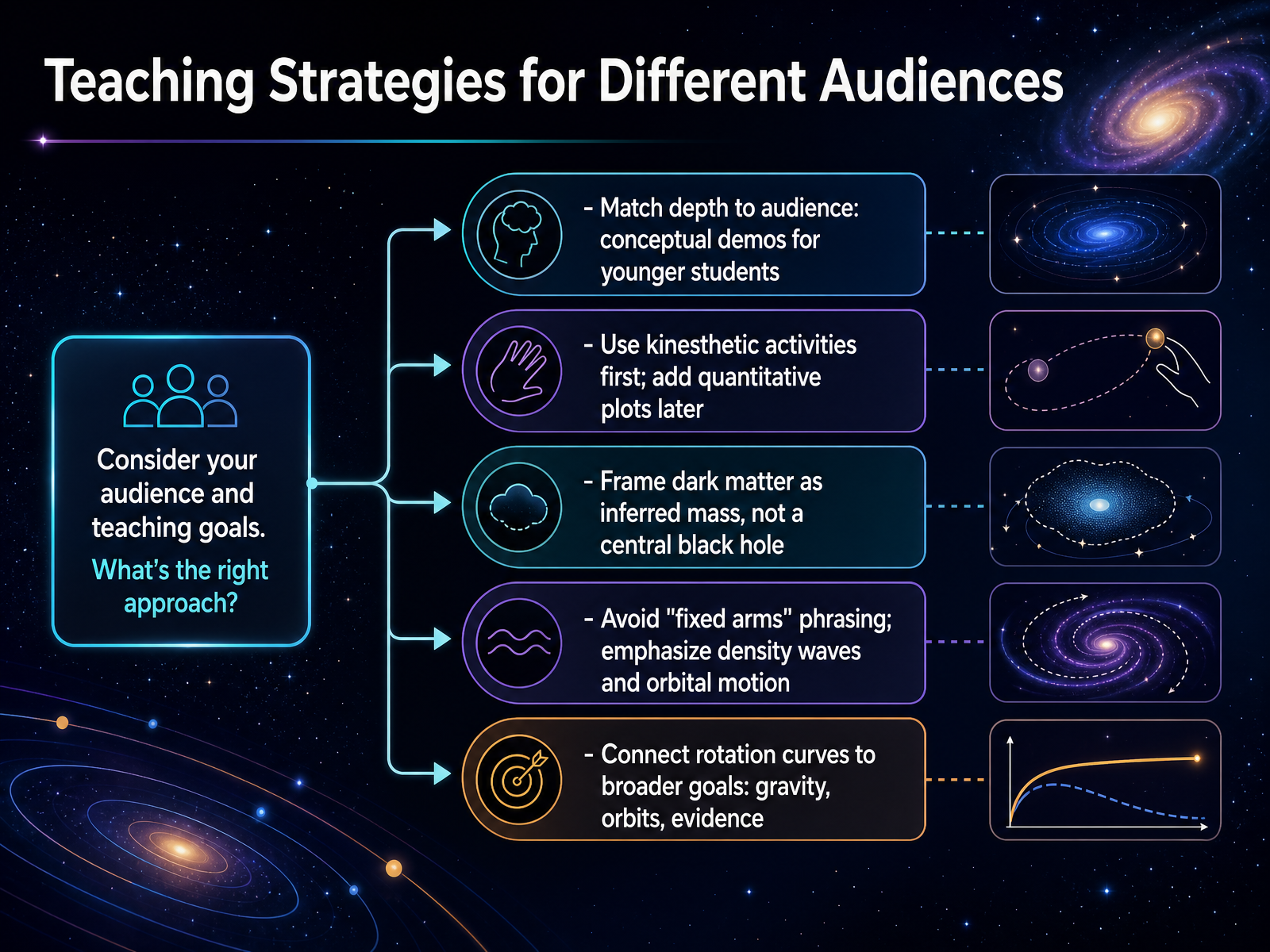
 - 13Teaching Strategies for Different AudiencesLet’s turn to something more practical: how to teach all of this to different learners. Start by matching depth to your audience. Younger students respond well to conceptual demos, like physically acting out the rotation of the galaxy. Save quantitative plots for later. In fact, kinesthetic activities should come first, because they build intuition before students see numbers. When you talk about dark matter, frame it as inferred mass. It is not a central black hole. The evidence comes from gravity, from the way stars and gas move. Also, avoid saying the galaxy has fixed arms. Spiral arms are better described as density waves, regions where stars and gas bunch up as they orbit. That phrasing keeps the motion honest. Finally, connect rotation curves to broader physics goals: gravity, orbits, and the nature of evidence. One carefully chosen rotation curve can teach all three. So choose activities that let students feel the pattern first, measure it second, and interpret it last.
 2 min
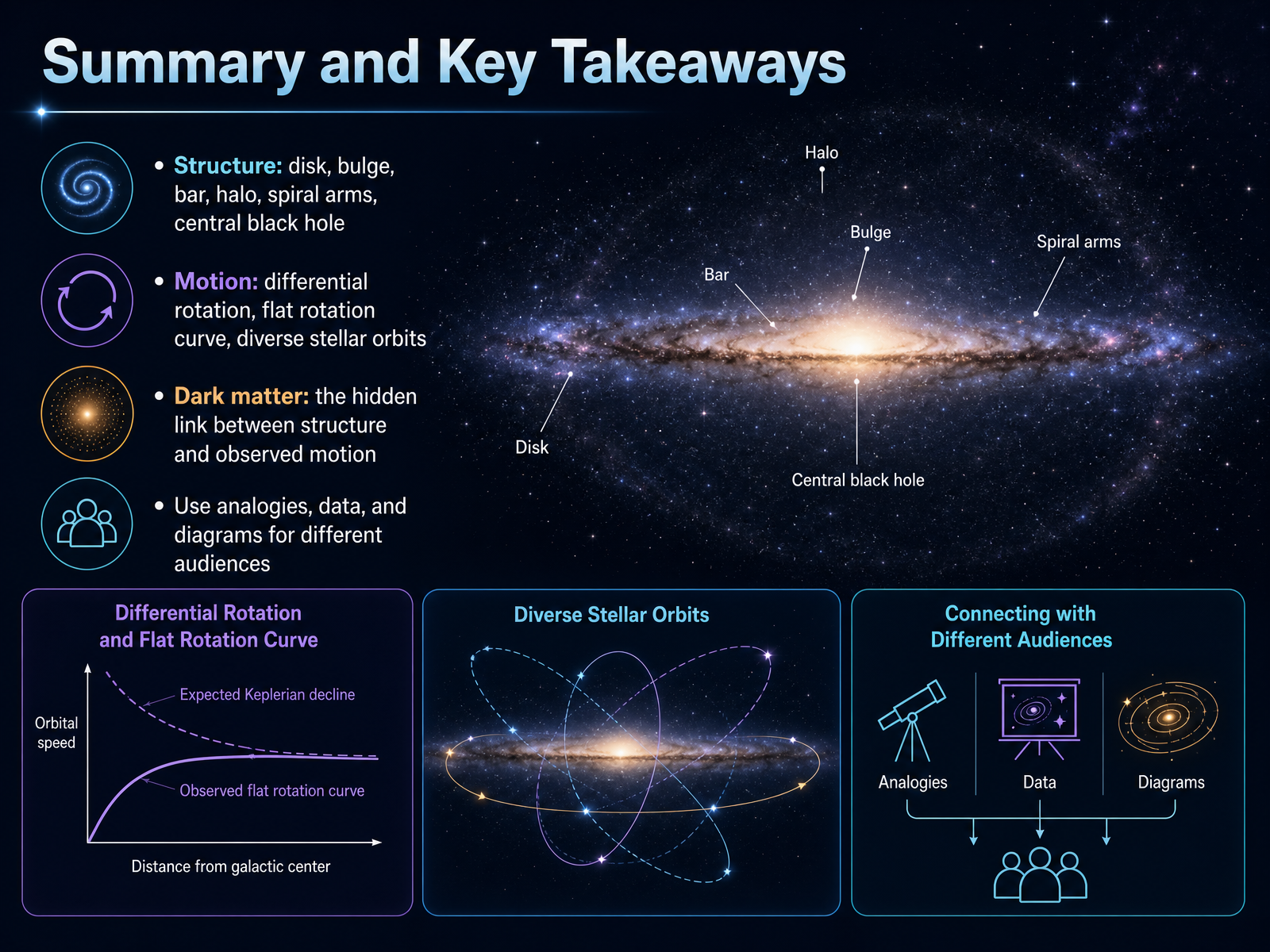
2 min - 14Summary and Key TakeawaysSo let’s bring the whole picture together. The Milky Way is a barred spiral galaxy built from a flat, star-forming disk, a central bulge and bar, a sparse stellar halo, sweeping spiral arms, and a four-million-solar-mass black hole at the center. Motion ties all of these pieces together. The disk rotates differentially, inner stars lap outer stars, and the rotation curve stays remarkably high far beyond the visible disk. That flat rotation curve is one of our clearest signs of dark matter, an invisible but gravitationally powerful halo that dominates our galaxy’s mass and shapes its dynamics. We also see that structure in motion, from orderly disk orbits to the eccentric paths of halo stars. When you teach this, meet your audience where they are. Use a spinning pinwheel for differential rotation, a city-sized scale model for distances, and real data from Gaia or stellar orbits around Sagittarius A star when learners are ready for evidence. Thank you for exploring our home galaxy, and remember, every star you see is part of one connected, evolving system.
 astroedu.iau.orgamnh.orgesa.int+21 min
Take the deck with you
Download this course as a file — free, no sign-up needed.
- PDF handoutEvery slide page, ready to print or share.15 pages · 4.4 MBDownload
- Narrated PowerPointThe deck that presents itself — every slide carries the digital human's narration video.15 pages · 17.0 MBDownload
- PowerPoint slidesThe full deck as a .pptx — open it in PowerPoint, Keynote, or Google Slides.15 pages · 4.3 MBDownload
Free to use in your own training — please keep the PersonWise credit page at the end.
Have your own deck? Turn it into a course
Sources consulted
Web sources consulted while building this course.
- Living in the Milky Way | astroEDU — astroedu.iau.org
- ENCOUNTERS — amnh.org
- ESA - How does Gaia study the Milky Way? — esa.int
- ESA Science & Technology - Galaxies and the Expanding Universe — sci.esa.int
- National Aeronautics and Space Administration — science.nasa.gov
- An All-sky 3D Dust Map Based on Gaia and LAMOST - IOPscience — iopscience.iop.org
- A new dust map of the Milky Way - I. Principal features — aanda.org
- A 3D Dust Map Based on Gaia, Pan-STARRS 1, and 2MASS - IOPscience — iopscience.iop.org
- A cross-match-free method for large-scale 3D extinction mapping with Gaia and 2MASS | Astronomy & Astrophysics (A&A) — aanda.org
- A THREE-DIMENSIONAL MAP OF MILKY WAY DUST - IOPscience — iopscience.iop.org
- Milky Way Subsystems from Globular Cluster Kinematics Using Gaia DR2 and HST Data - IOPscience — iopscience.iop.org
- The Galaxy in Context: Structural, Kinematic, and Integrated Properties | Annual Reviews — annualreviews.org
- Globular clusters in ORBIT: Complete dynamical characterisation of the Milky Way globular cluster population through updated orbital reconstruction | Astronomy & Astrophysics (A&A) — aanda.org
- Equilibrium Disk-Bulge-Halo Models for the Milky Way and Andromeda Galaxies - IOPscience — iopscience.iop.org
- Milky Way Anatomy — svs.gsfc.nasa.gov
- The observed age gradient in the Milky Way—as a test for theories of spiral arm structure | Astrophysics and Space Science | Springer Nature Link — link.springer.com
- A New Multitracer Approach to Defining the Spiral Arm Width in the Milky Way - IOPscience — iopscience.iop.org
- The Strength of the Dynamical Spiral Perturbation in the Galactic Disk - IOPscience — iopscience.iop.org
- A SUBSTRUCTURE INSIDE SPIRAL ARMS, AND A MIRROR IMAGE ACROSS THE GALACTIC MERIDIAN - IOPscience — iopscience.iop.org
- Six Decades of Spiral Density Wave Theory | Annual Reviews — annualreviews.org