Begin
14 pages · ~28 min
Cybersecurity Decision Documentation
This training teaches cybersecurity professionals how to document decisions clearly and consistently, strengthening accountability and audit readiness.
A digital instructor presents all 14 pages. Hold “Ask” at any point and ask out loud — the answer comes from this course. No sign-up needed.
What you’ll learn
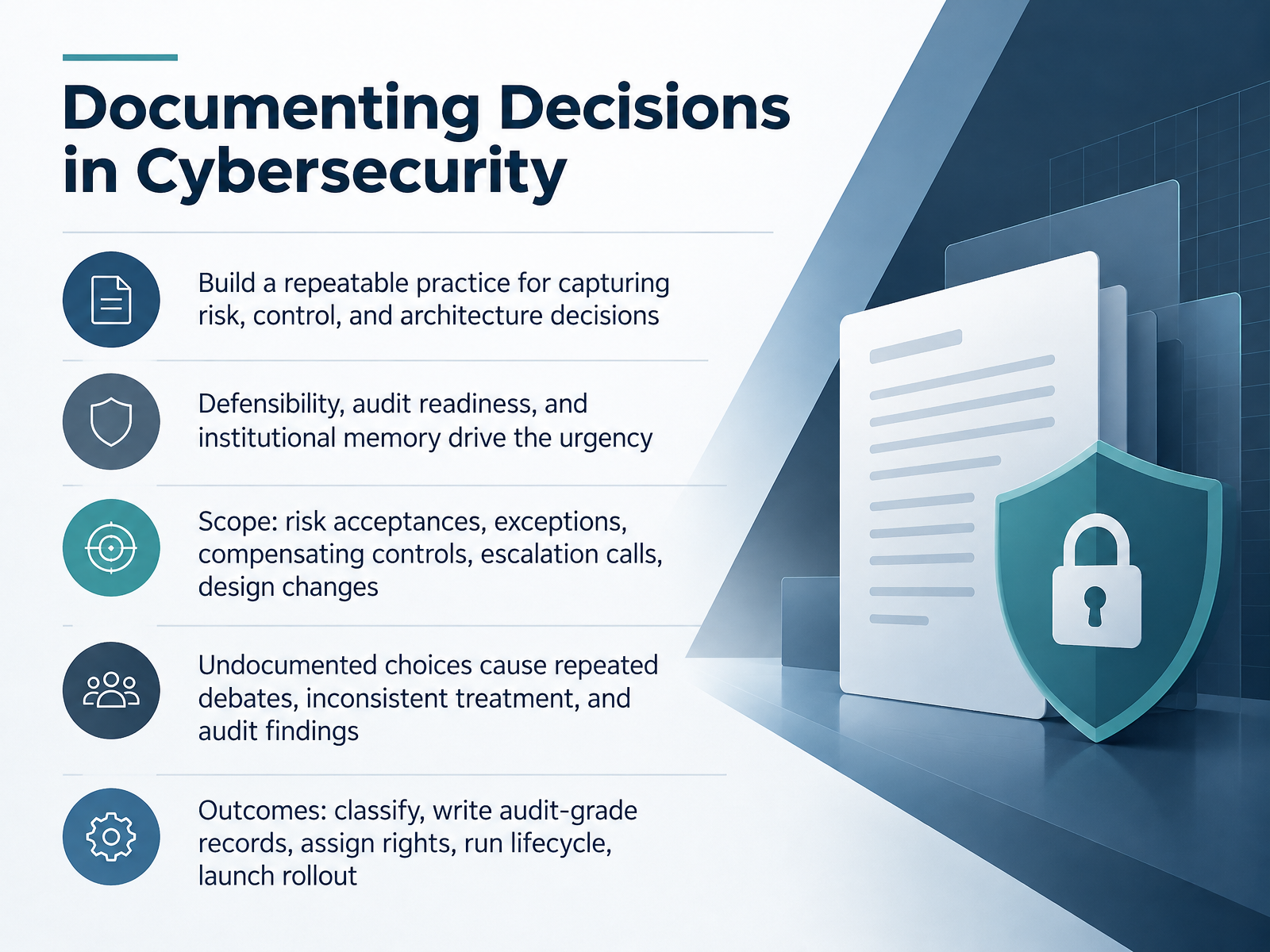
- 01Documenting Decisions in CybersecurityWelcome. This course is about documenting decisions in cybersecurity, and our goal is practical: building a repeatable practice for capturing risk, control, and architecture decisions, so your reasoning survives contact with an auditor, an incident, or a colleague from another team.
The urgency is straightforward. Strong decision records give you defensibility, audit readiness, and institutional memory. The scope covers risk acceptances, exceptions, compensating controls, escalation calls, and design changes.
Undocumented choices cost you. Teams relitigate the same debates, treat similar risks inconsistently, and collect avoidable audit findings.
By the end, you will be able to classify decisions, write audit-grade records, assign the right owners, run a lifecycle that keeps records current, and launch a rollout that sticks.
Let us start with why these records function as a control, not paperwork.owasp.orgsafeguard.shcybersecurityaudit.services+22 min
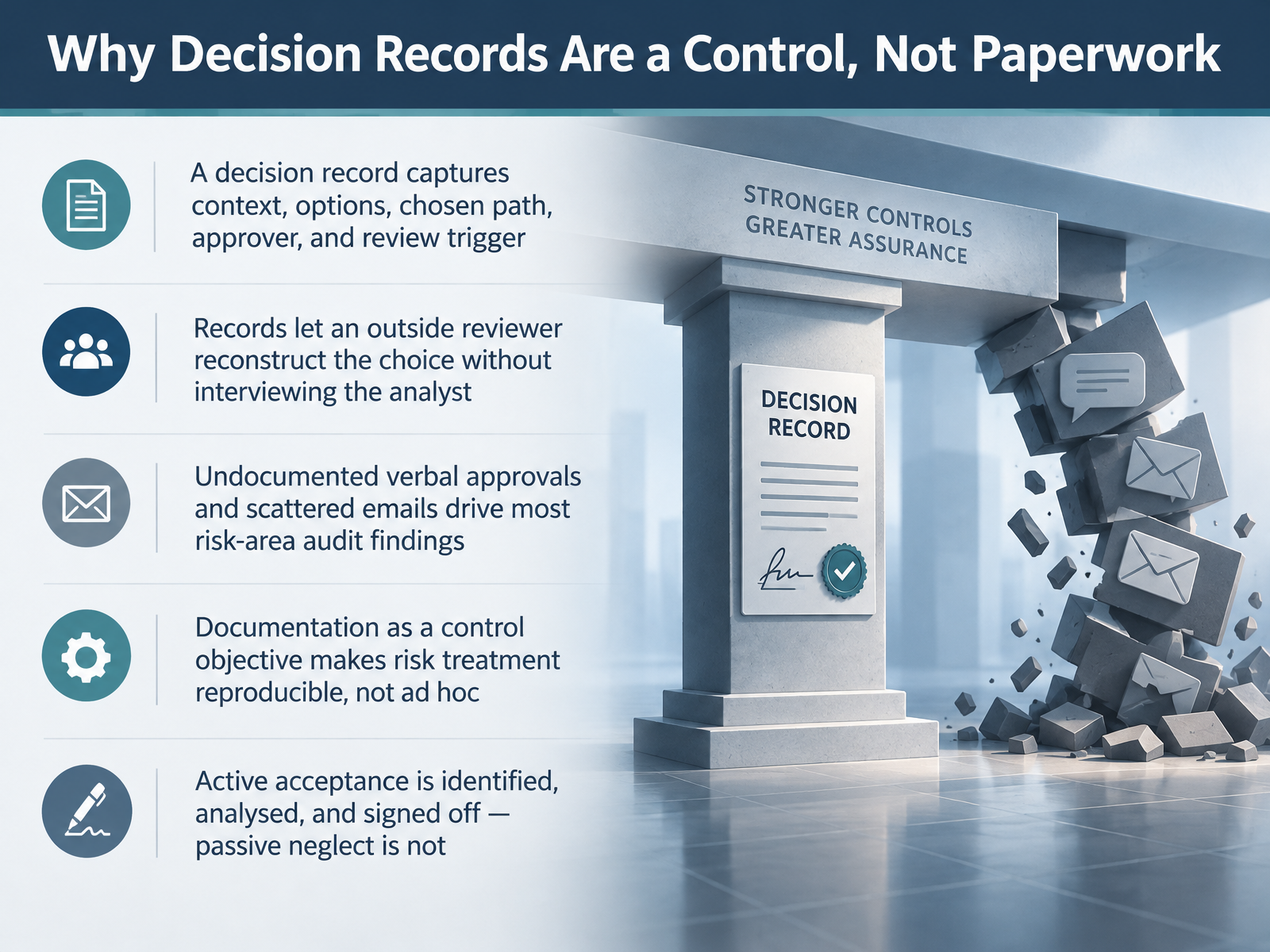
- 02Why Decision Records Are a Control, Not PaperworkLet's look at why a decision record is a control, and not paperwork. At its core, a decision record captures five things: the context, the options considered, the chosen path, the approver, and the review trigger. That structure lets an outside reviewer reconstruct the choice without interviewing your analyst. And that matters, because undocumented verbal approvals and scattered emails drive most audit findings in risk areas. So treat documentation as a control objective itself. It makes risk treatment reproducible rather than ad hoc. And keep this distinction sharp. Active acceptance is identified, analysed, and signed off. Passive neglect is not. An open email thread is not an approval. Now, what makes a decision worth recording in the first place?
 owasp.orgsafeguard.shcybersecurityaudit.services+21 min
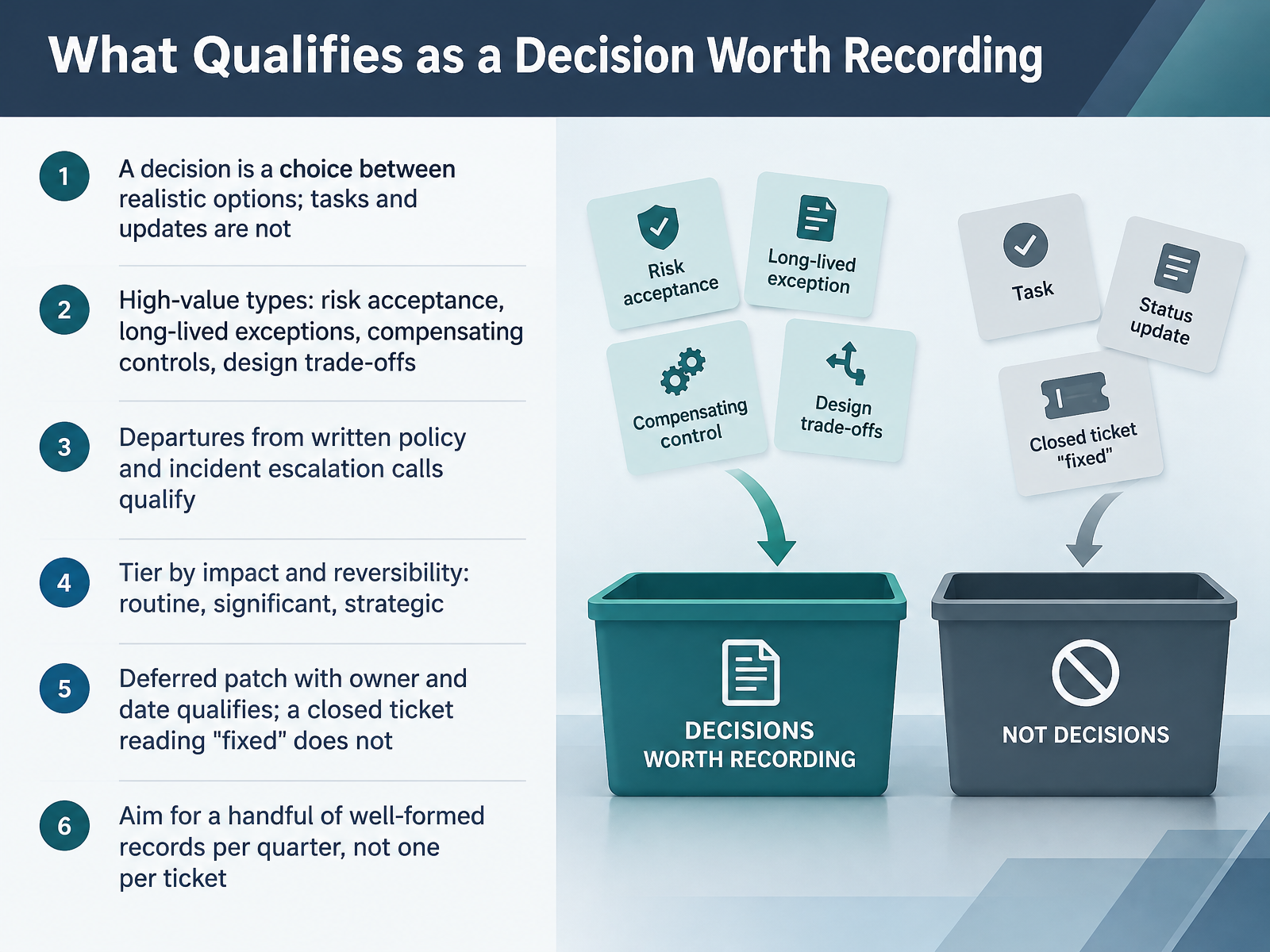
- 03What Qualifies as a Decision Worth RecordingLet's get precise about what actually belongs in the log. A decision is a choice between realistic options you genuinely weighed. A task, a status update, or a review that closes with a resolution is not a decision. The high-value entries are familiar: risk acceptance, long-lived exceptions, compensating controls, and design trade-offs. Departures from written policy qualify. So do incident escalation calls, because someone will ask later why you chose that path. Tier each record by impact and reversibility: routine, significant, or strategic. A deferred patch with a named owner and a review date qualifies. A closed ticket reading fixed does not. And resist logging every ticket. Aim for a handful of well-formed records per quarter. That keeps the log readable, defensible, and useful during an audit or an incident handoff. Next, we'll look at the one-page format that makes this quick to write. That brings us to Minimum Viable Record: The One-Page Template.
 orsmframework.orgsafeguard.shdocs.aws.amazon.com+22 min
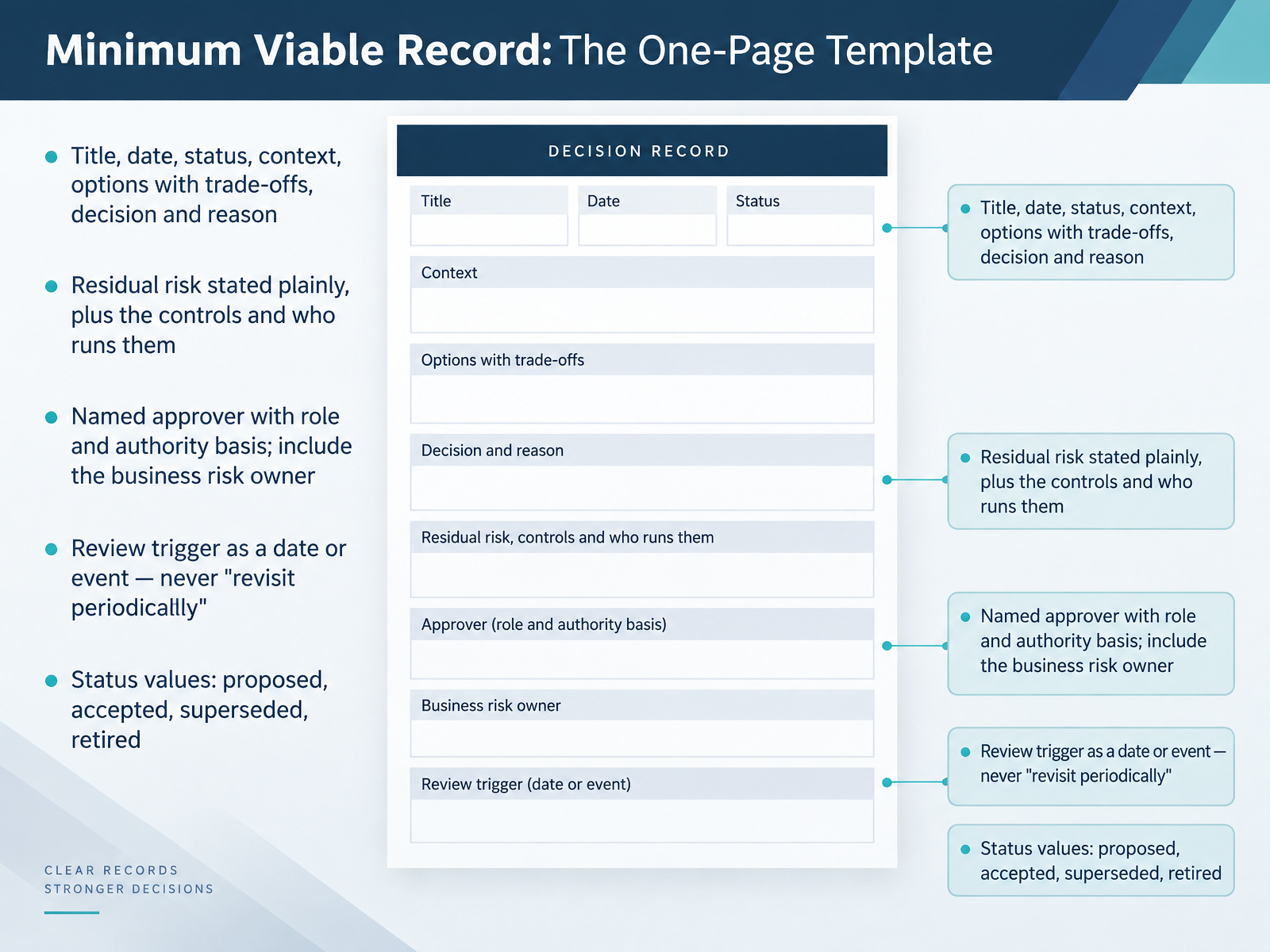
- 04Minimum Viable Record: The One-Page TemplateNow let's look at the minimum viable record itself, a one-page template you can reuse for any significant security decision. Start with the title, the date, and a status value, then write a short context paragraph. List two to four realistic options, each with its trade-offs, and state which one you chose and the main reason why.
Next, state the residual risk in plain words. Name the controls that reduce it, and who runs each one. Then name the approver, their role, and the basis of their authority, and include the business risk owner alongside them.
Give the record a review trigger, either a specific date or an event, such as a vendor change. Never write revisit periodically, because no one can act on that.
Finally, keep status consistent across the estate. A record is proposed, accepted, superseded, or retired. When it's replaced, mark it superseded and link to the new one. The history is the value. Let's see this applied in practice next, in annotating the record, a worked example.
 owasp.orgsafeguard.shcybersecurityaudit.services+22 min
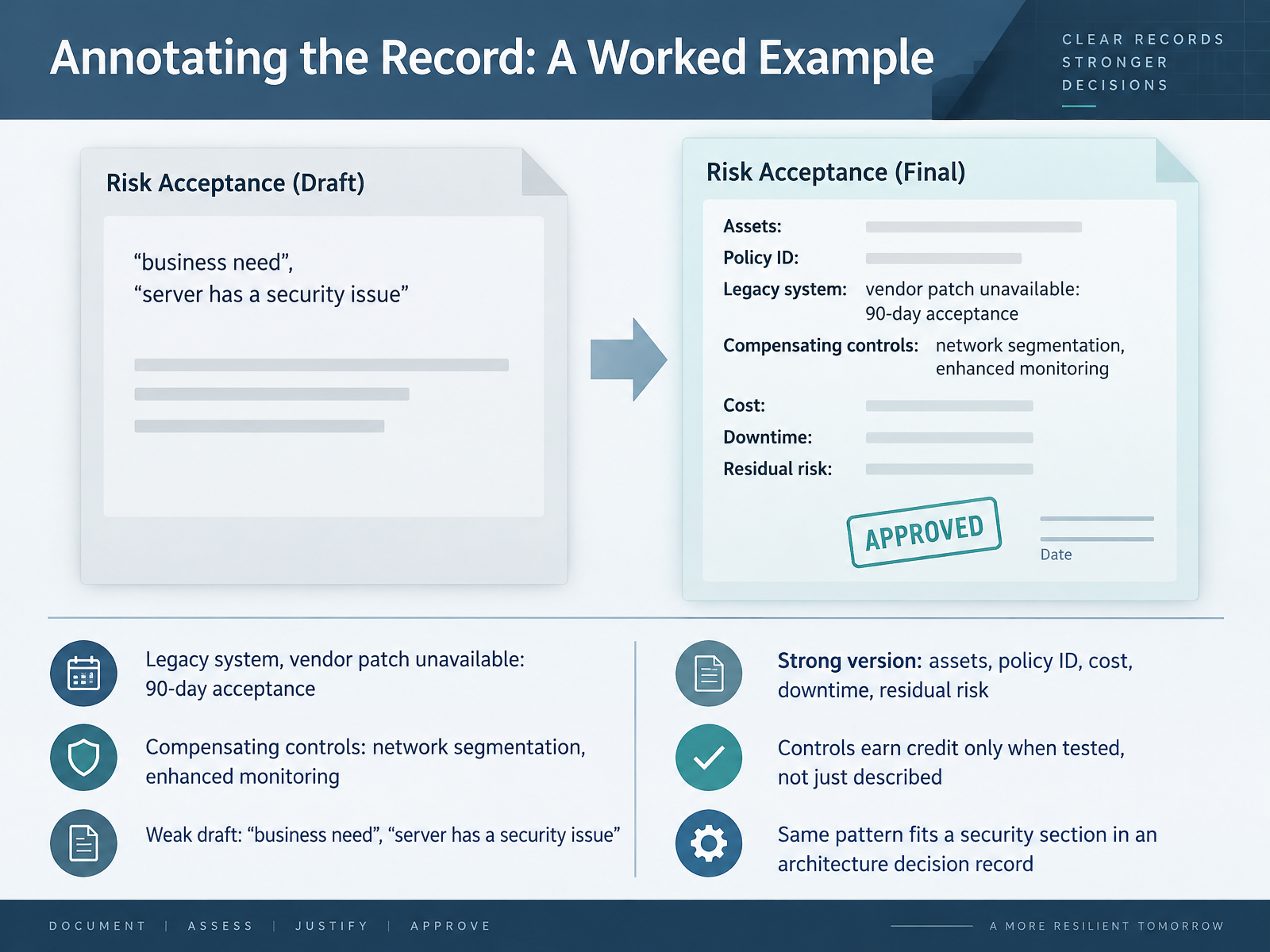
- 05Annotating the Record: A Worked ExampleLet's make this concrete with a worked example. Say a legacy system has a vulnerability, and the vendor has no patch available. You document a ninety-day acceptance. You name the compensating controls, such as network segmentation and enhanced monitoring. Then you write it down properly. A weak draft says business need, or the server has a security issue. That tells an auditor nothing. A strong version lists the affected assets, the policy identifier, the remediation cost, the expected downtime, and the residual risk after controls. One more point: controls earn credit only when they are tested, not merely described. Untested controls are assumptions. The same pattern fits the security section of an architecture decision record, so the reasoning lives alongside the decision. Next, we turn to roles, decision rights, and delegation of authority.
 orsmframework.orgsafeguard.shdocs.aws.amazon.com+21 min
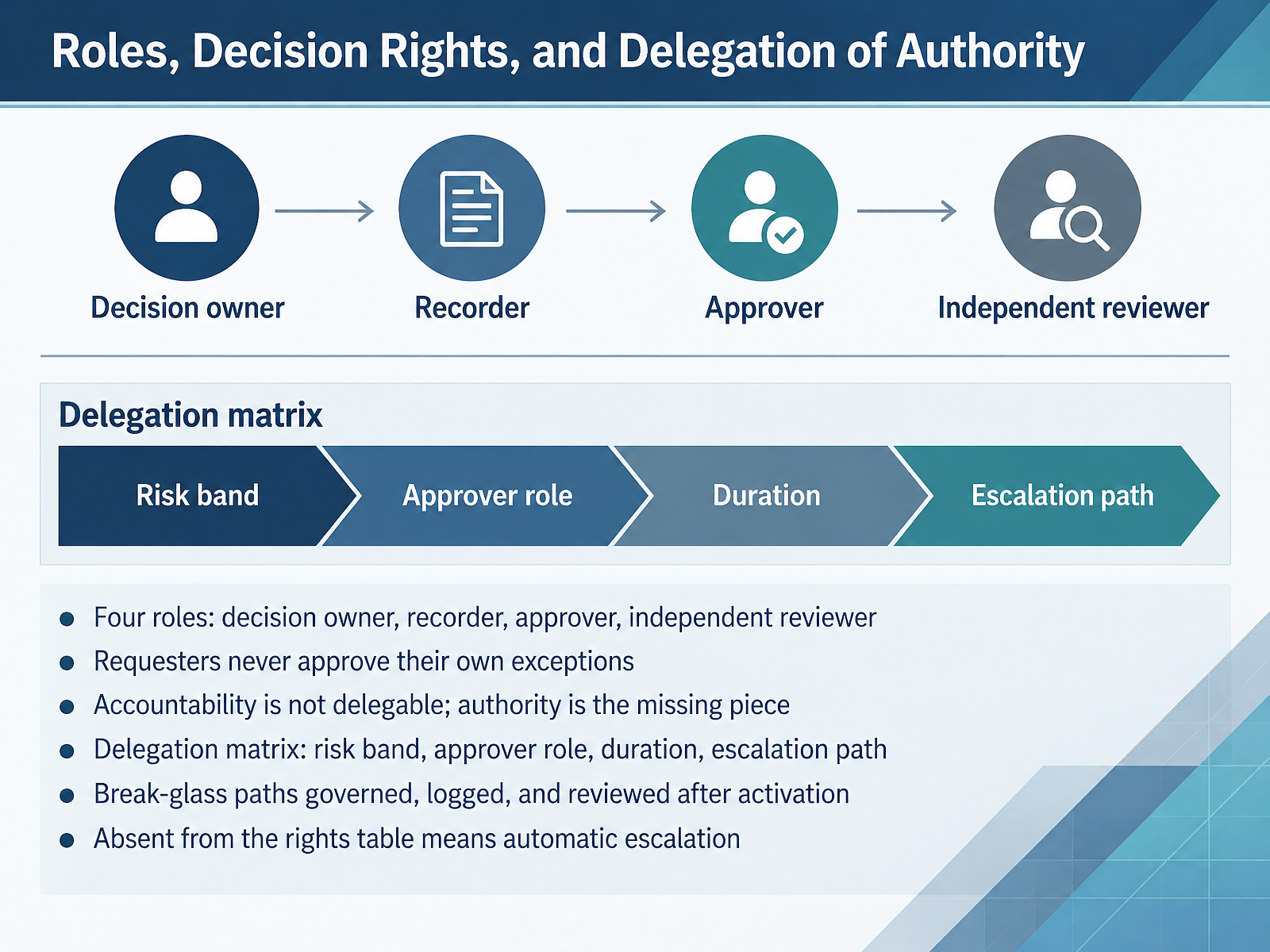
- 06Roles, Decision Rights, and Delegation of AuthorityNext, let's talk about who decides. Four roles carry a decision: the owner, who accepts the risk; the recorder, who documents it; the approver, who authorizes it; and an independent reviewer, who checks it. Requesters never approve their own exceptions. Keep that separation clean. Accountability stays with the role; what actually gets delegated is authority. So define a delegation matrix that maps each risk band to an approver role, a maximum duration, and an escalation path. Break-glass access is governed too, logged on activation and reviewed afterward. And here is the rule that keeps the table honest: if a decision is absent from the rights table, it escalates automatically rather than being assumed. That habit keeps your audit trail clean and your incident handoffs quick. Our next topic is mapping records to audit and regulatory expectations.
 ncsc.gov.uklearn.daydream.ainist-sp-800-37-r2.bsafes.com+21 min
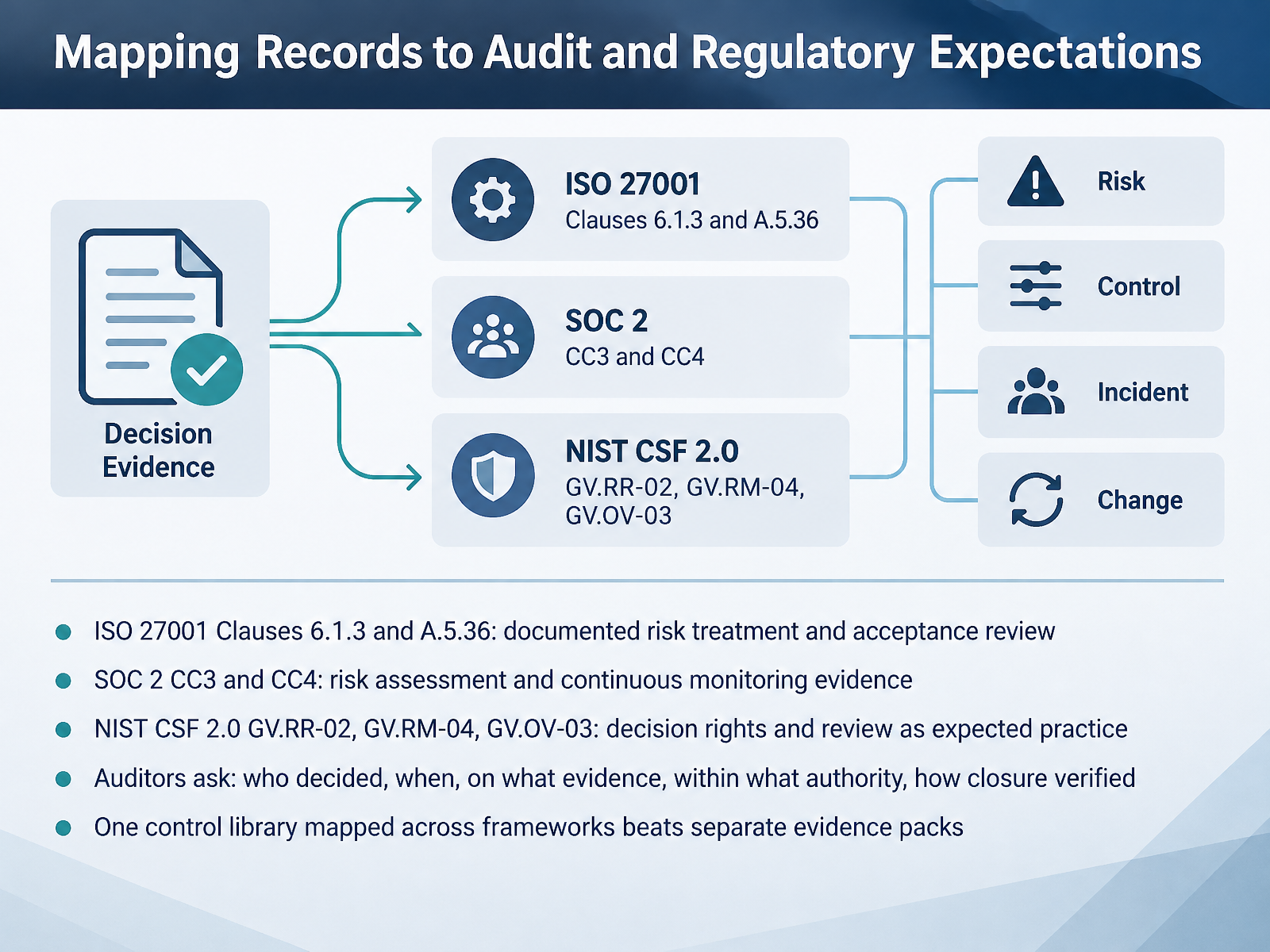
- 07Mapping Records to Audit and Regulatory ExpectationsNow let's map your decision records to what auditors and regulators actually expect. ISO 27001, through Clause 6.1.3 and control A.5.36, expects documented risk treatment and a documented review of risk acceptance. SOC 2, under Criteria CC3 and CC4, looks for evidence of risk assessment and continuous monitoring. And NIST CSF 2.0, in GV.RR-02, GV.RM-04, and GV.OV-03, treats decision rights and periodic review as expected practice. So when an auditor sits down with you, they ask a consistent set of questions: who decided, when, on what evidence, within what authority, and how was closure verified. Your record should answer all five without anyone needing to interview an analyst. Here is the practical payoff: build one control library and map it across frameworks. That beats maintaining separate evidence packs for each audit, which drift apart and quietly contradict one another. Next, where and how to capture decisions without friction.
 nvlpubs.nist.govquicktrustapp.comcisokit.com+22 min
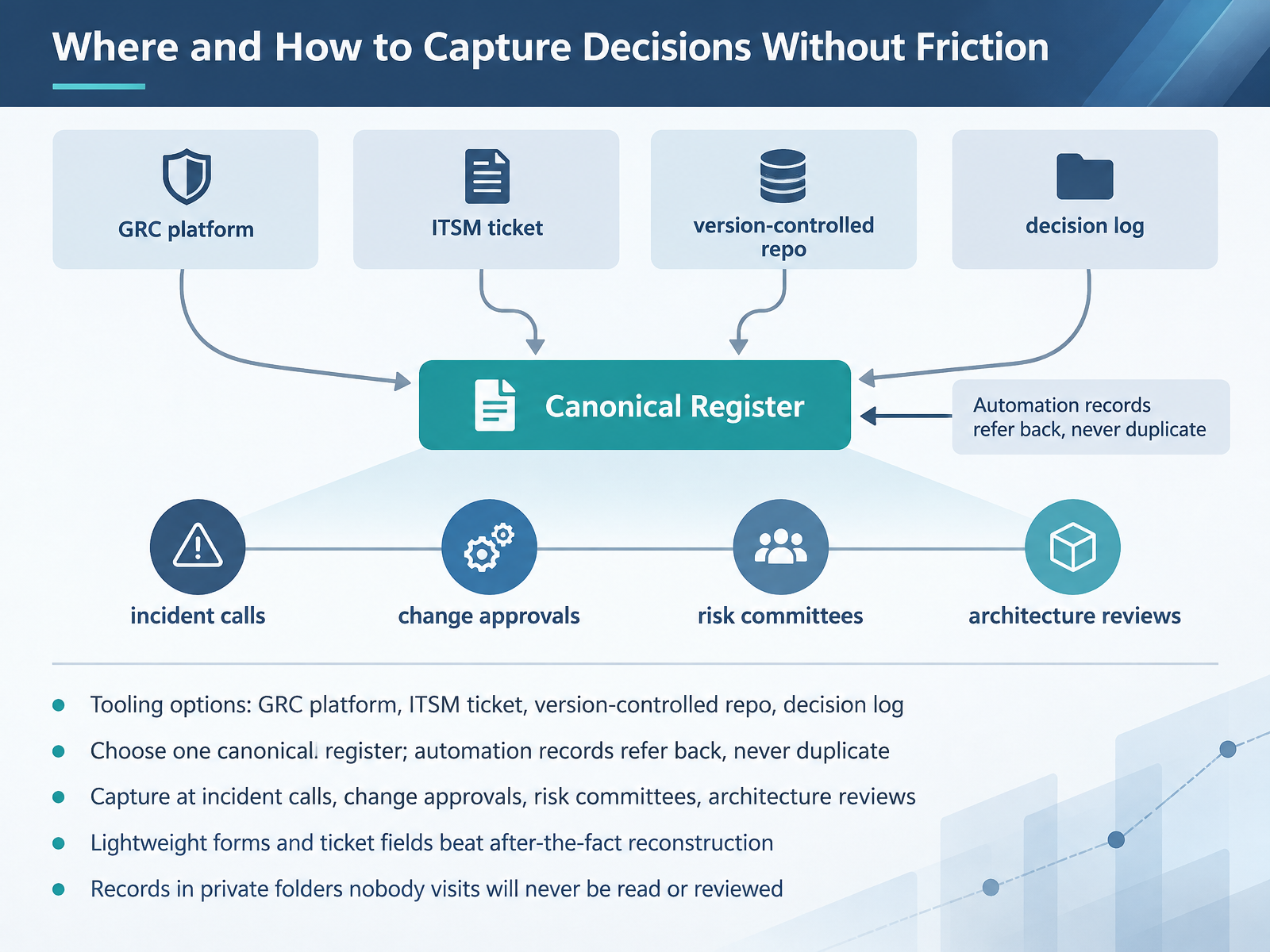
- 08Where and How to Capture Decisions Without FrictionLet's turn to where and how to capture decisions without adding friction. You have several tooling options: a GRC platform, an ITSM ticket, a version-controlled repository, or a standalone decision log. Pick one canonical register, and let automation records refer back to it rather than duplicate the entry. A duplicate register quickly becomes a conflicting one. Capture decisions where they actually happen: incident calls, change approvals, risk committees, and architecture reviews. Lighter weight is better. A short form or a few required ticket fields beat an after-the-fact reconstruction, every time. And be honest about access. Records in private folders nobody visits will never be read or reviewed, so put the register where auditors and responders can find it. Next, we'll look at writing rationale that survives challenge.
 orsmframework.orgsafeguard.shdocs.aws.amazon.com+21 min
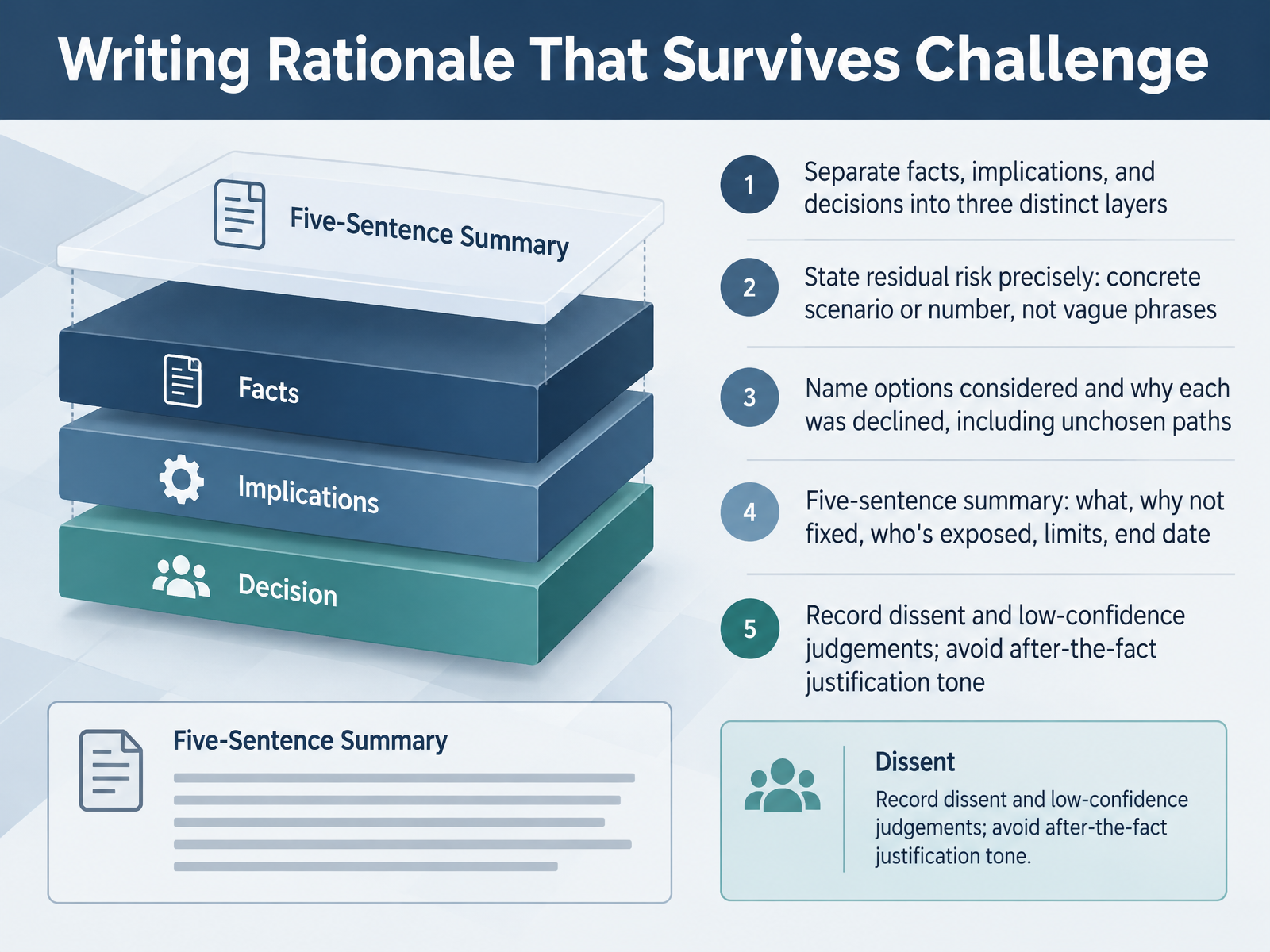
- 09Writing Rationale That Survives ChallengeLet's look at how to write rationale that holds up when someone challenges it. Start by separating three layers: the facts you observed, the implications you drew from them, and the decision you made. Keep them distinct, so a reviewer can see exactly where judgment entered. Then state residual risk precisely. Not "some exposure exists," but a concrete scenario or number, such as fewer than fifty requests affected per incident. Name the options you considered and why each was declined, including the paths you did not take. That shows the decision was informed, not assumed. A useful discipline is the five-sentence summary: what the issue is, why it is not fixed now, who is exposed, what limits the harm, and when the decision ends. Finally, record dissent and low-confidence judgements. Write it as a decision record, not as justification after the fact, because auditors and incident responders will read it cold. Next, we turn to Lifecycle: From Recording to Review and Retirement.
 owasp.orgsafeguard.shcybersecurityaudit.services+22 min
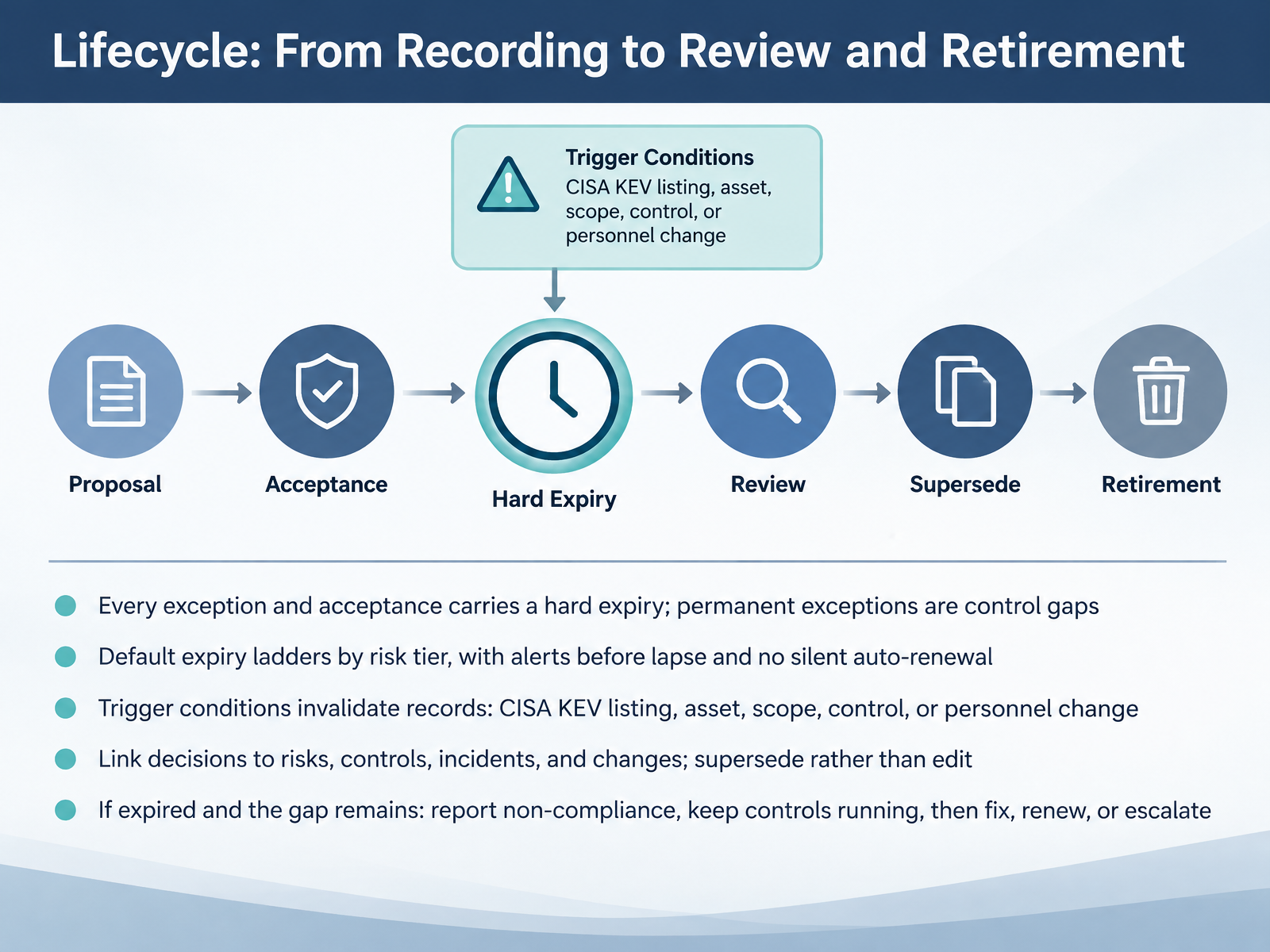
- 10Lifecycle: From Recording to Review and RetirementNow let's look at the full lifecycle, from recording a decision through review and retirement. Every exception and every risk acceptance carries a hard expiry. A permanent exception is not an exception. It is a control gap you are choosing to live with. Set default expiry ladders by risk tier, alert owners well before lapse, and never allow silent auto-renewal. A renewal is a fresh decision with fresh evidence. Records also carry trigger conditions that invalidate them inside the calendar window. A CISA KEV listing, a material change to the asset, scope, control, or named personnel, any of these forces the decision early. Link each decision to the risks, controls, incidents, and changes it touches, and supersede records rather than editing them, so history stays intact. And if an exception expires while the gap remains, treat it as non-compliance from the day after expiry. Tell the owners, keep the compensating controls running, then fix it, renew it late on a fresh score, or escalate it. Next, we turn to quality checks, metrics, and common pitfalls.
 orsmframework.orgsafeguard.shdocs.aws.amazon.com+22 min
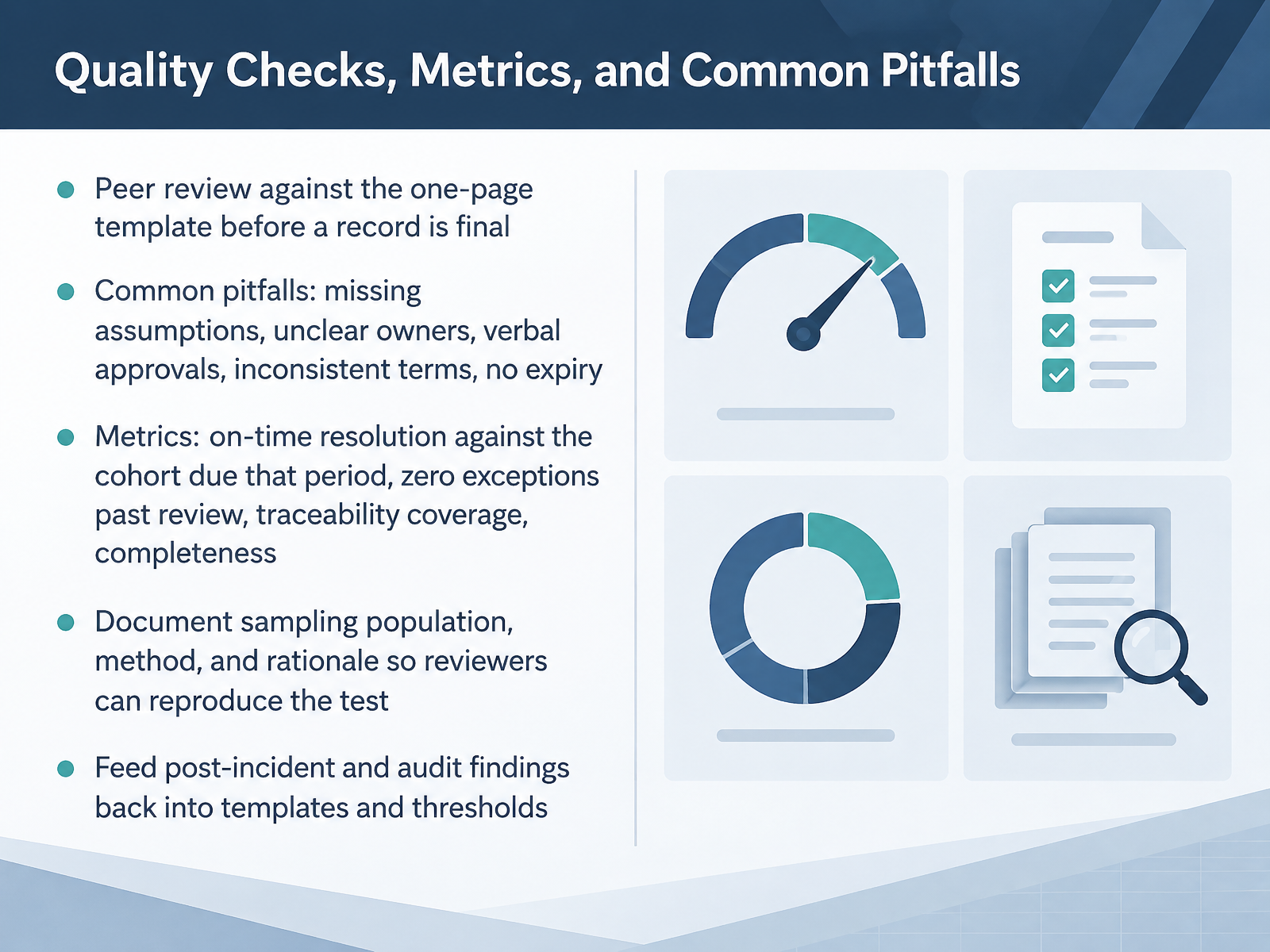
- 11Quality Checks, Metrics, and Common PitfallsNext, let's look at quality checks, metrics, and common pitfalls. Before any record is final, a peer should review it against the one-page template. That second set of eyes catches what the author cannot see. Watch for the recurring pitfalls: missing assumptions, unclear owners, verbal approvals, inconsistent terms, and no expiry date. Each one weakens a record under audit. For metrics, measure on-time resolution against the cohort whose deadline fell in that period, not the full population. Track exceptions past review, traceability coverage, and completeness. When you sample records, document the population, the method, and the rationale, so a reviewer can reproduce the test. And keep feeding post-incident and audit findings back into your templates and thresholds. Building the Habit: Adoption, Culture, and Leadership Signal.
 owasp.orgsafeguard.shcybersecurityaudit.services+22 min
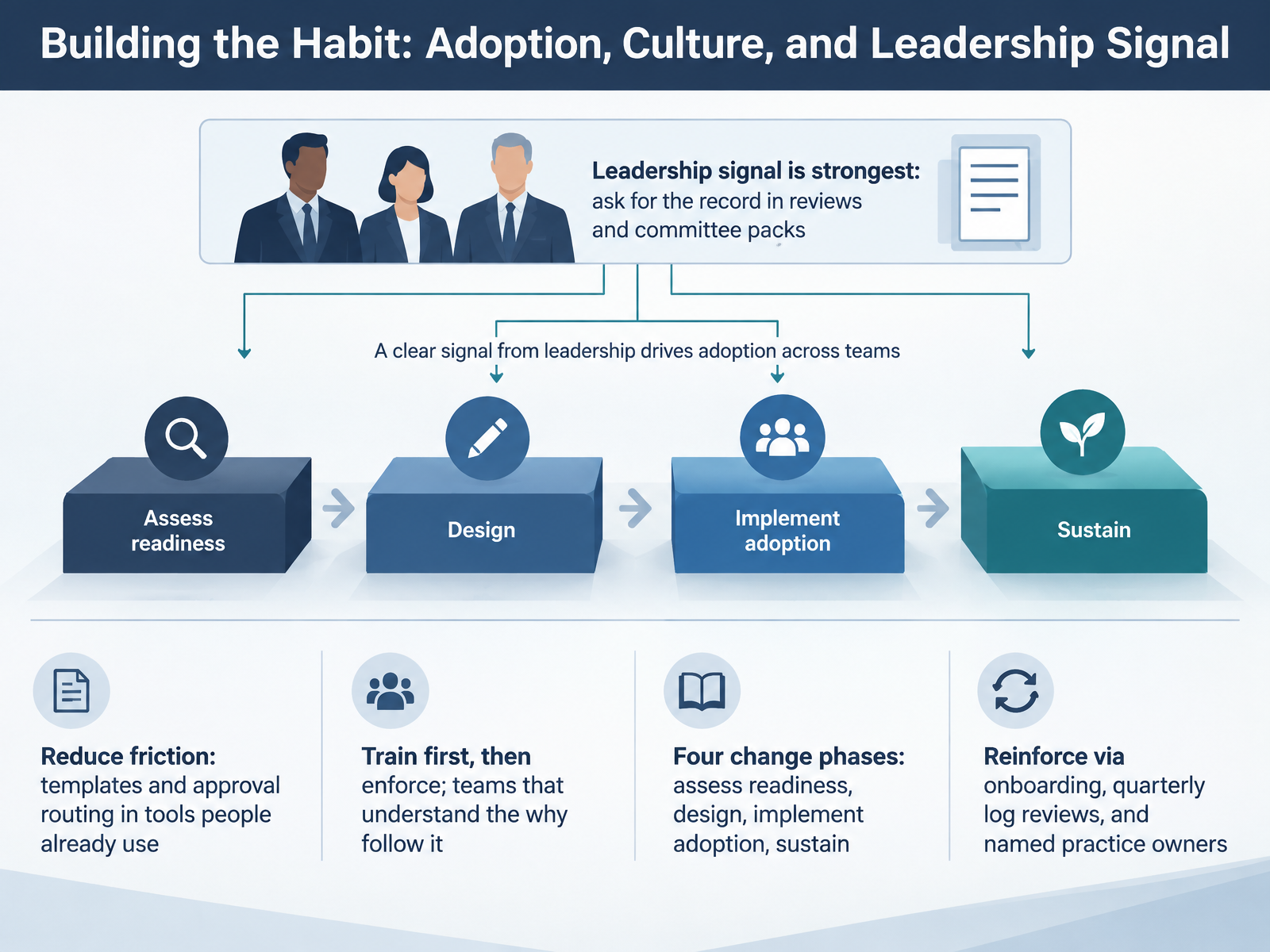
- 12Building the Habit: Adoption, Culture, and Leadership SignalLet's look at how documenting decisions becomes a habit rather than a one-time project. Start by reducing friction. Put templates and approval routing inside the tools people already use, so writing the record is part of the work, not a separate task. Leadership sends the strongest signal. When reviewers and committee packs actually ask for the record, teams notice and comply. Plan the change in four phases: assess readiness, design, implement adoption, then sustain. And train first, then enforce. Teams that understand the why will follow it. Reinforce through onboarding, quarterly log reviews, and named practice owners. Those owners keep the habit alive long after the rollout.
 nvlpubs.nist.govquicktrustapp.comcisokit.com+21 min
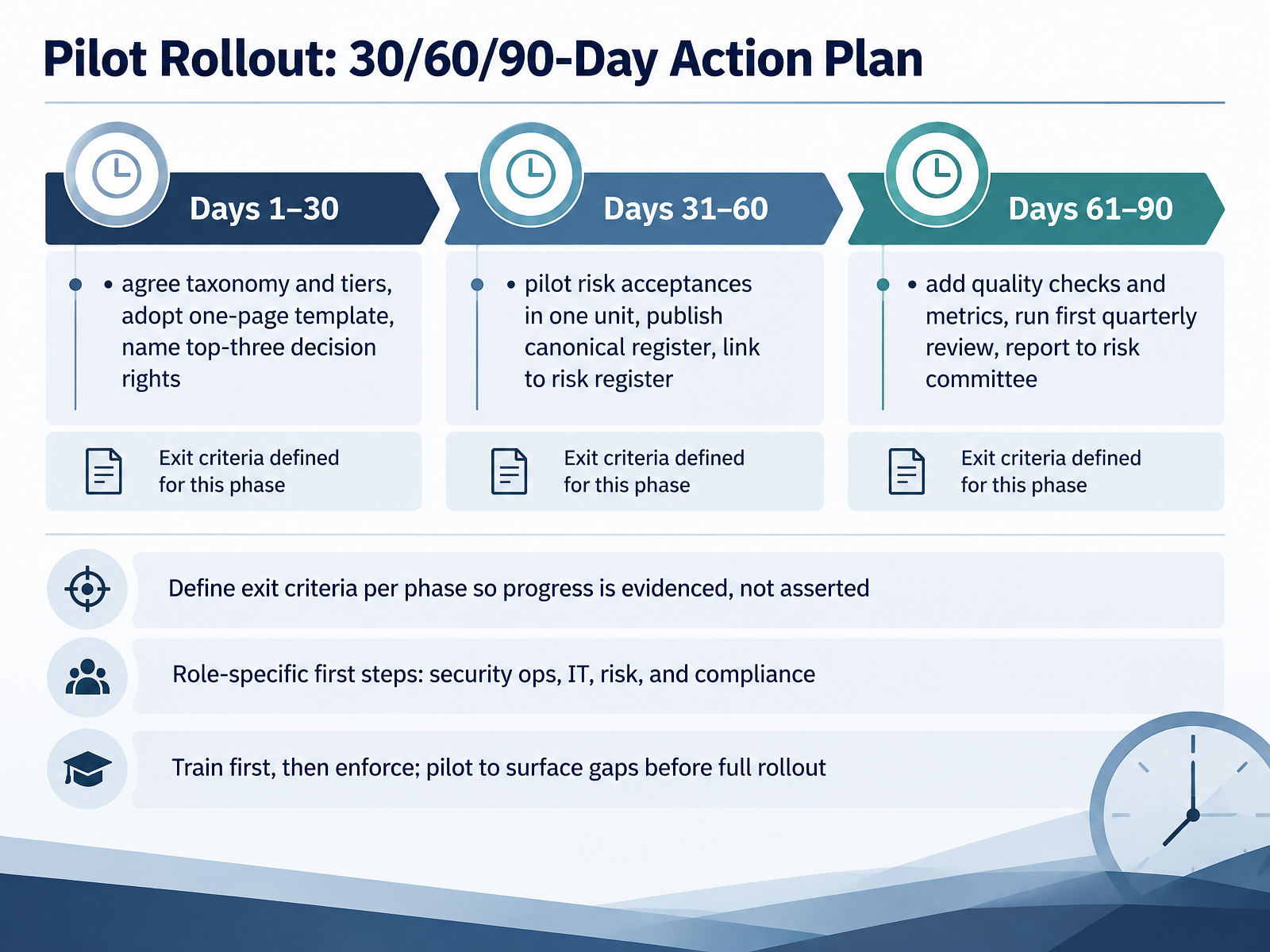
- 13Pilot Rollout: 30/60/90-Day Action PlanSo let's talk about how you actually roll this out. A phased plan keeps the work verifiable.
In the first thirty days, agree the taxonomy and tiers, adopt a one-page decision template, and name the top three decision rights. Your first two approvals should be reachable inside this window.
Days thirty-one to sixty: pilot risk acceptances in one unit, publish the canonical register, and link it to the risk register. That link matters because it gives audit one place to reconcile exposure.
Days sixty-one to ninety: add quality checks and metrics, run the first quarterly review, and report to the risk committee. Keep each phase's exit criteria written down, so progress is evidenced, not asserted.
Train first, then enforce. Then give each role its first step: security operations, IT, risk, and compliance.
Next, we will consolidate these into key takeaways and next steps.
 1 min
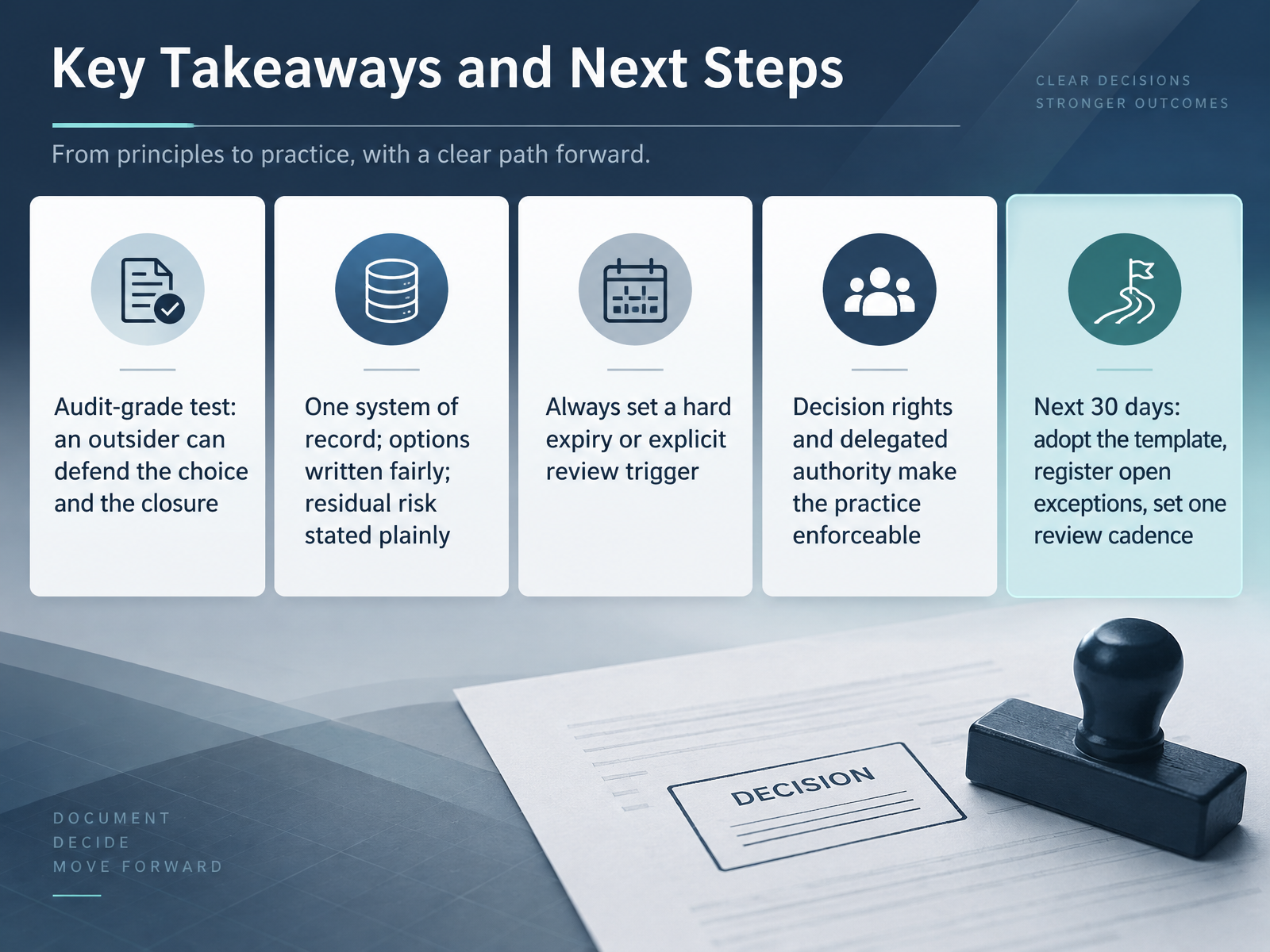
- 14Key Takeaways and Next StepsLet's bring this together, and leave you with something you can act on this month. The standard we've been working toward is simple. An outsider should be able to defend the choice and the closure without interviewing your team. So keep one system of record. Write your options fairly, including the one you didn't choose, and state residual risk in plain words. Always set a hard expiry or an explicit review trigger, because an open-ended exception quietly becomes a forgotten one. And clarify decision rights and delegated authority, so the practice is actually enforceable. For the next thirty days, pick three things. Adopt the template, register your open exceptions, and set one review cadence you can sustain. Thank you for working through this with me. You now have a defensible way to document decisions, and that's a solid step toward audit readiness.
 owasp.orgsafeguard.shcybersecurityaudit.services+22 min
Take the deck with you
Download this course as a file — free, no sign-up needed.
- PDF handoutEvery slide page, ready to print or share.15 pages · 3.3 MBDownload
- Narrated PowerPointThe deck that presents itself — every slide carries the digital human's narration video.15 pages · 14.2 MBDownload
- PowerPoint slidesThe full deck as a .pptx — open it in PowerPoint, Keynote, or Google Slides.15 pages · 3.2 MBDownload
Free to use in your own training — please keep the PersonWise credit page at the end.
Have your own deck? Turn it into a course
Sources consulted
Web sources consulted while building this course.
- Human Review Record Template — owasp.org
- Security decision records: how to document risk decisions — safeguard.sh
- Cybersecurity Audit Board Report | Turn Findings into Decisions — cybersecurityaudit.services
- How should security and governance teams document remediation decisions for auditors and regulators? — nhimg.org
- Auditability & Reproducibility: Implementation Guide — owasp.org
- Architecture Decision Record - ORSM — orsmframework.org
- An ADR template with a security section you can copy — safeguard.sh
- Architectural decision record process — docs.aws.amazon.com
- Maintain an architecture decision record (ADR) — learn.microsoft.com
- ADR Template - AegisLayer Architecture — vsdatta.github.io
- Risk management | Cyber security governance — ncsc.gov.uk
- GV.RR-02: Roles, responsibilities, and authorities relate... | Daydream — learn.daydream.ai
- • AUTHORIZATION DECISION, TASK R-4 | NIST SP 800-37 — nist-sp-800-37-r2.bsafes.com
- GV.OV-03: Organizational cybersecurity risk management pe... | Daydream — learn.daydream.ai
- GV.RR — Cyber Roles, Authority and Resources (NIST CSF 2.0) — normgrid.com
- The NIST Cybersecurity Framework (CSF) 2.0 — nvlpubs.nist.gov
- Risk Assessment Template: The Complete Guide to Conducting Security Risk Assessments for Compliance — QuickTrust — quicktrustapp.com
- Risk Management Policy — cisokit.com
- Risk Acceptance Workflow in SharePoint (ISO 27001 + SOC 2) — canadiancyber.ca
- Vulnerability Risk Acceptance and Exception Workflows — secure.com