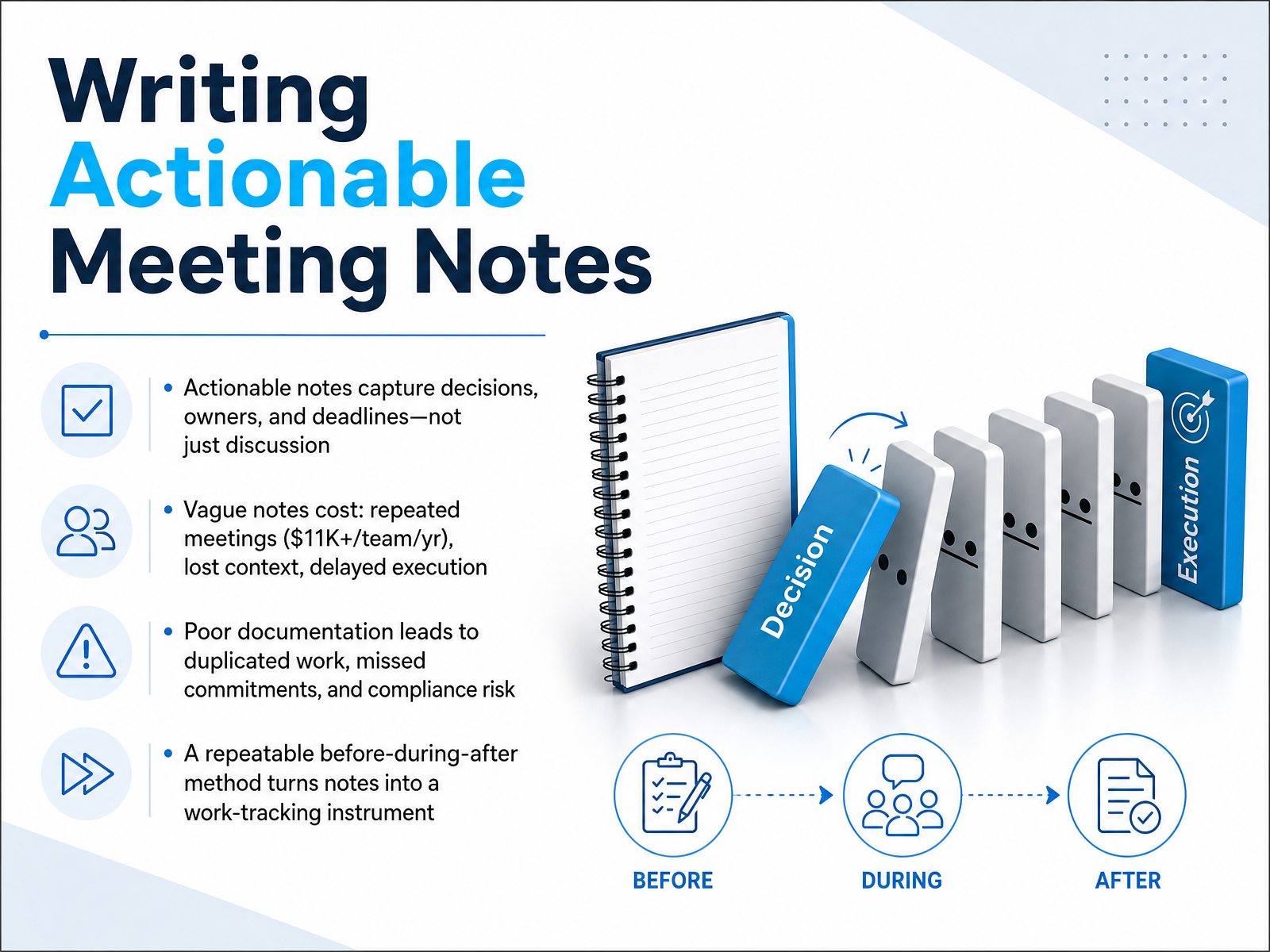
Actionable Meeting Notes
Begin
14 pages · ~28 min
Actionable Meeting Notes
This training teaches professionals how to capture and organize clear, actionable meeting notes to improve follow-through and team productivity.
What you’ll learn
- 01Writing Actionable Meeting NotesWelcome. In this course we focus on a skill that directly impacts your team's execution: writing actionable meeting notes. Not just a transcript of who said what, but a clear record of decisions, owners, and deadlines. When notes are vague, teams pay a steep price. Research shows one repeated decision-making meeting can cost a team over eleven thousand dollars per year. Poor documentation leads to duplicated work, compliance risks, and missed commitments. The good news is that shifting notes from passive summaries into active work-tracking instruments is a repeatable habit. We will walk through a simple before-during-after method that makes follow-through automatic. Let's get started by making the case for why this matters, in Part One: The Case for Actionable Notes.klu.sogenbacompass.comjusttalkingtech.medium.com+22 min
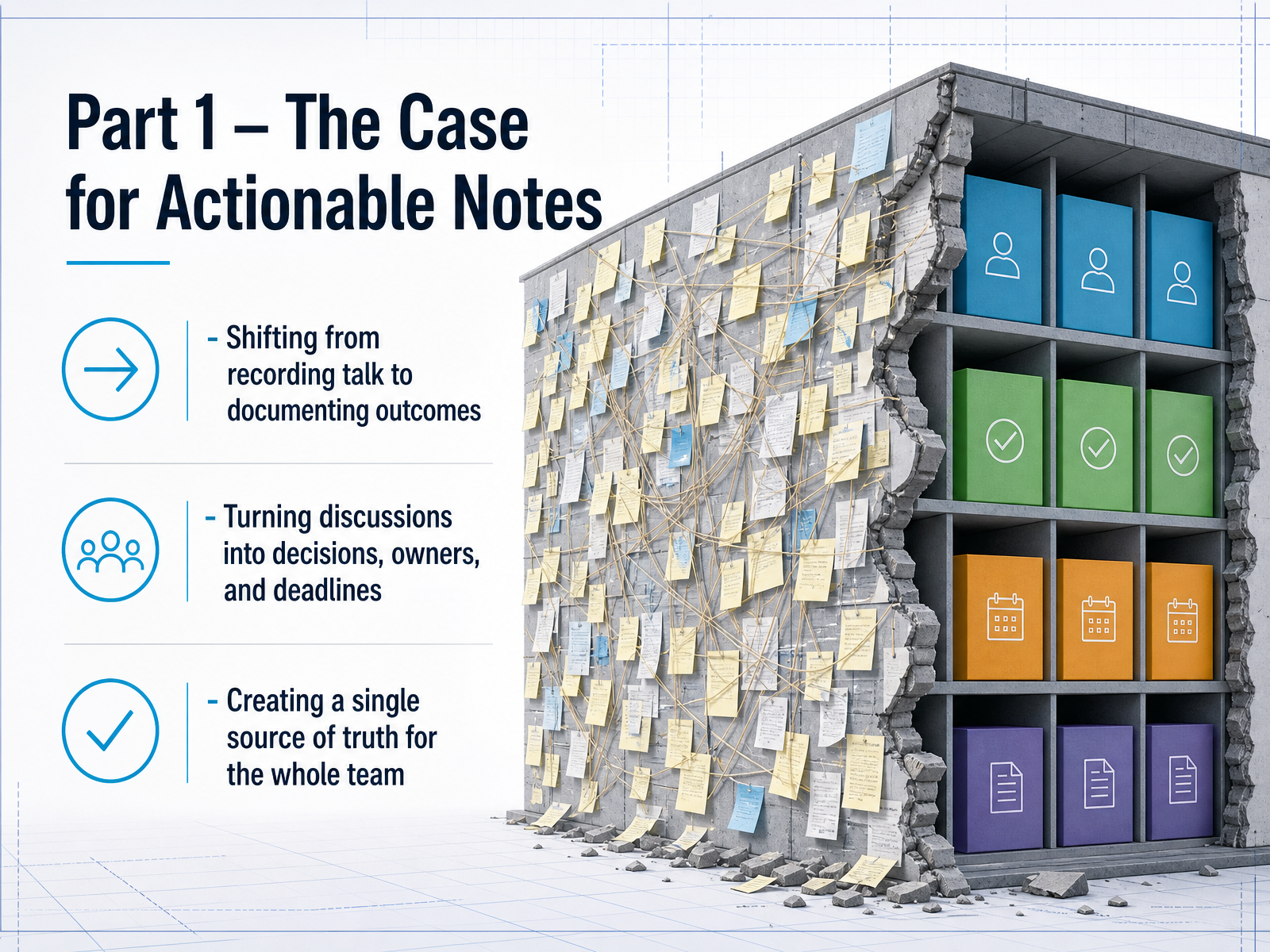
- 02Part 1 – The Case for Actionable NotesNow, let's get into Part 1: The Case for Actionable Notes. Think about your last meeting. What actually got done? We’re going to shift our mindset from just recording who said what to documenting clear outcomes. Instead of pages of talk, you’ll learn to capture decisions, assign a single owner to each task, and attach a real deadline. This creates a single source of truth that the whole team can trust, so nobody has to ask, 'Wait, what are we supposed to be doing?' Up next, we'll look at the high cost of bad meeting notes.
 1 min
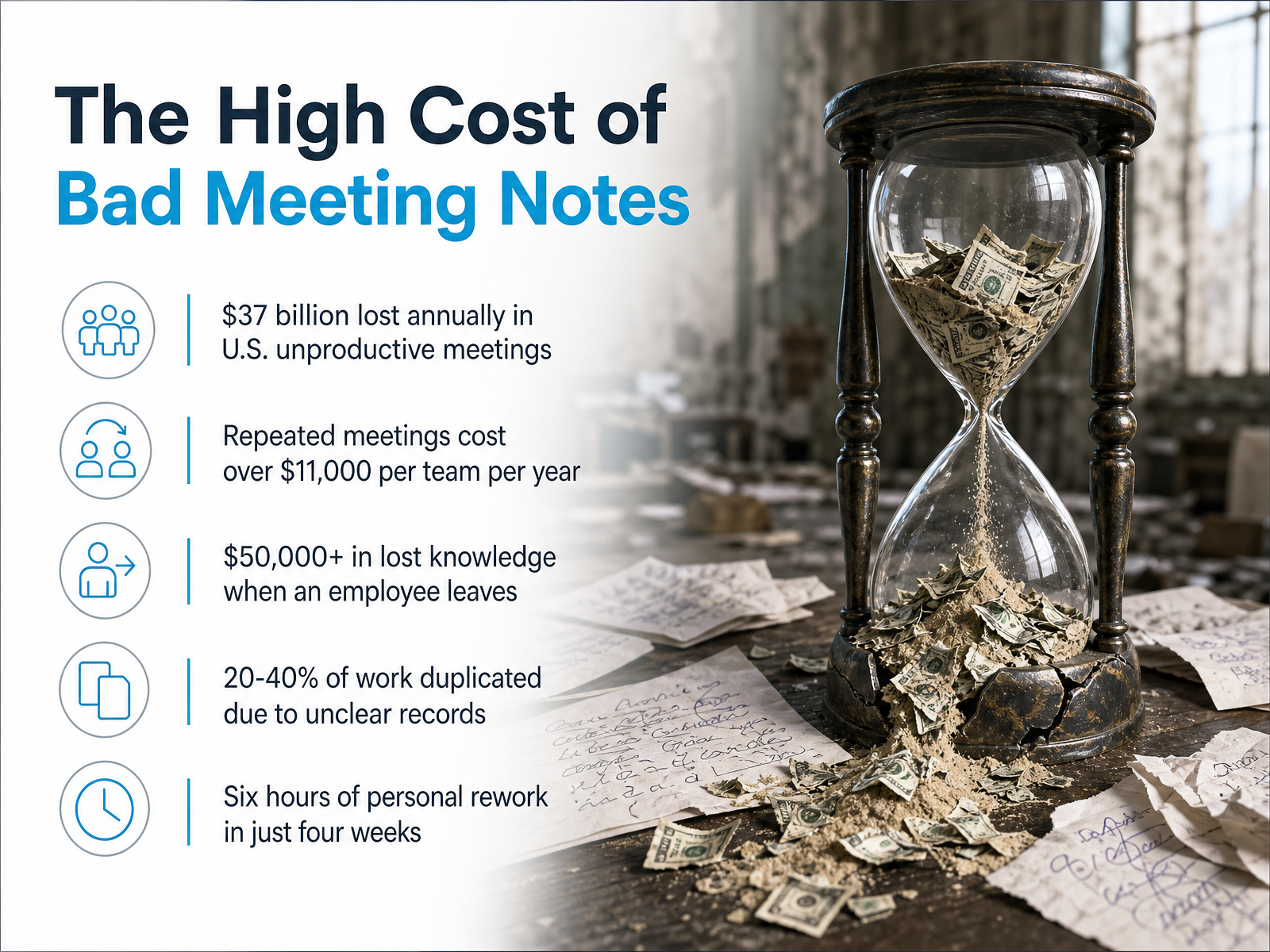
1 min - 03The High Cost of Bad Meeting NotesLet's put a real price tag on vague meeting notes. In the U.S. alone, unproductive meetings drain an estimated thirty-seven billion dollars every year. That's not just a big number. Think about a single team that has to repeat the same meeting because nobody captured the decisions. That can cost over eleven thousand dollars annually in wasted time. And when an experienced employee walks out the door, you can lose over fifty thousand dollars in institutional knowledge that simply wasn't written down anywhere. The daily impact hits even harder. Between twenty and forty percent of work gets duplicated because the records are unclear. In just four weeks, one person can spend six hours redoing work that was already finished but never properly documented. The next step is turning this around, so let's look at what 'actionable' really means.
 1 min
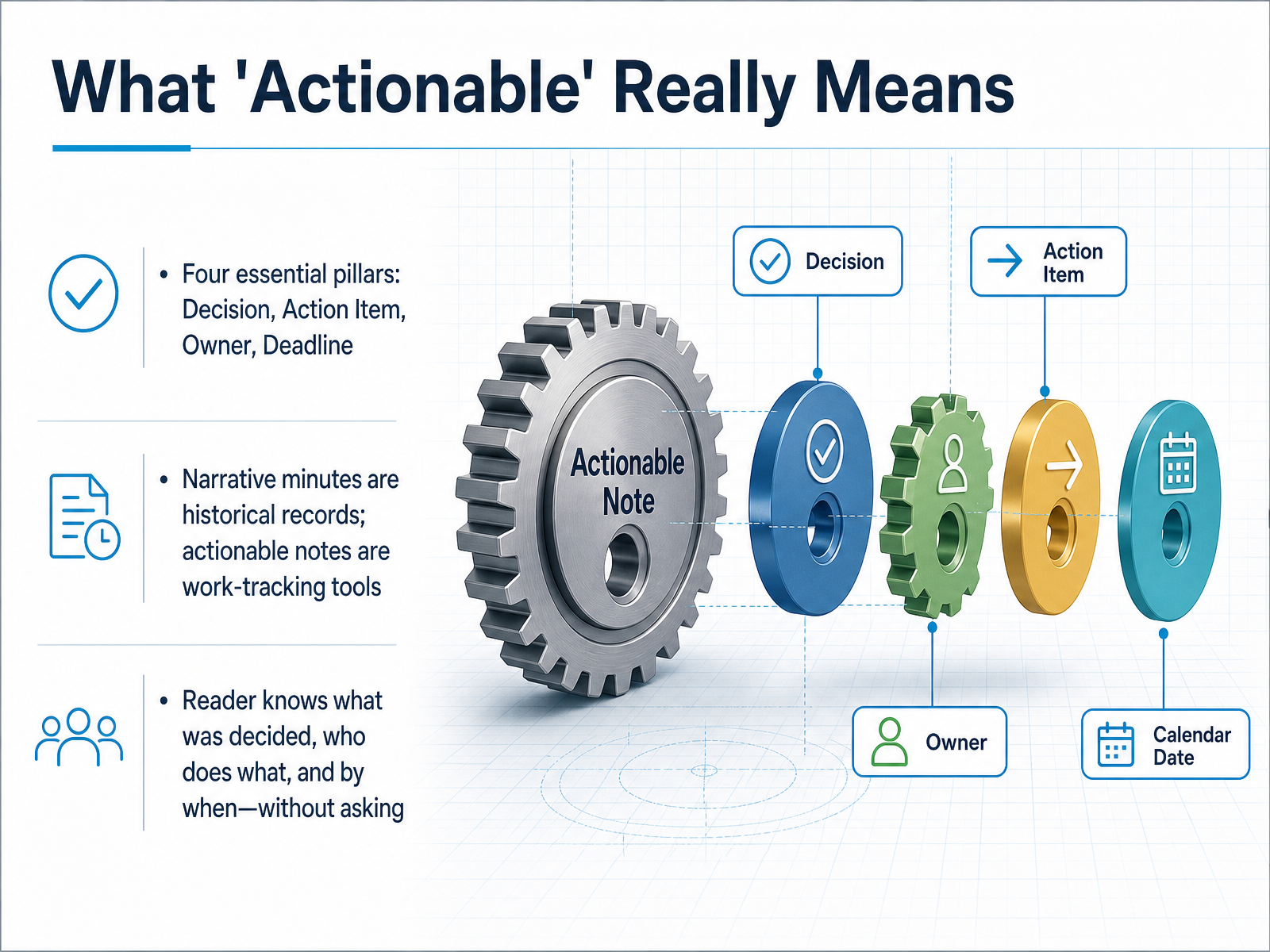
1 min - 04What 'Actionable' Really MeansWith that foundation in place, let's define what actionable really means. It comes down to four essential pillars: Decision, Action Item, Owner, and Deadline. Think of traditional meeting minutes as a historical record of what happened. Actionable notes, on the other hand, are a work-tracking tool. They capture the specific forward motion. This means the reader knows exactly what was decided, who is doing what, and by when, without having to send a single follow-up message or make a clarification call. Picture a note that says 'Marketing will draft the Q3 campaign brief by Thursday.' That one line contains the owner, the action, and the deadline, giving everyone instant clarity. Next, let's walk through the process that makes this happen. We'll explore the Three-Phase Method.
 1 min
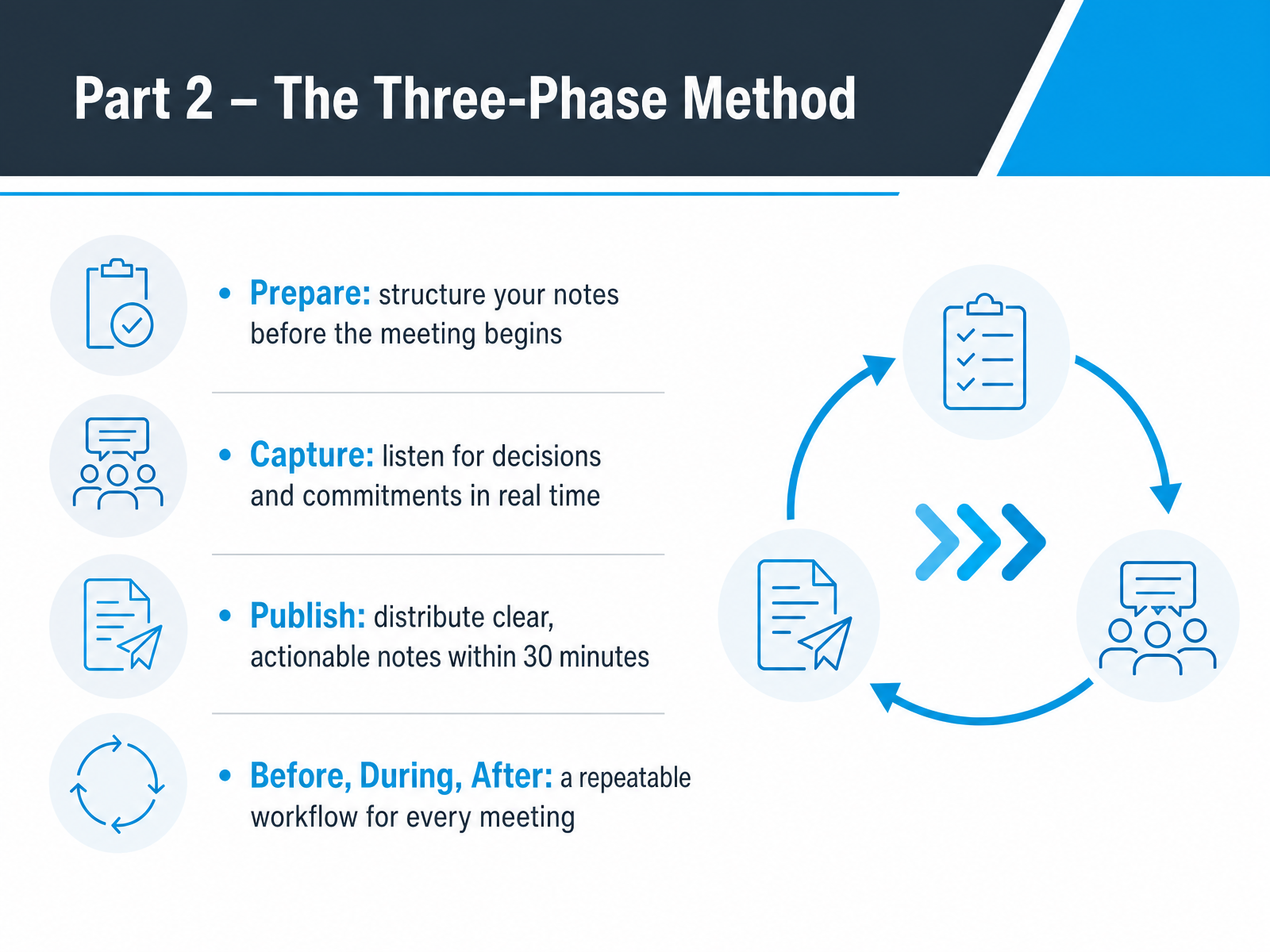
1 min - 05Part 2 – The Three-Phase MethodLet's walk through a simple, repeatable workflow that turns chaotic conversations into clear notes. We call it the Three-Phase Method. The first phase is Prepare. Before the meeting even starts, structure your notes with sections for decisions and action items. This primes your brain to listen for what actually matters. Phase two is Capture. During the meeting, filter the discussion in real time. Listen sharply for definitive decisions and explicit commitments. When you hear "Yes, we'll go with the vendor," or "I will own that by Friday," you write it down. The final phase is Publish. Within 30 minutes of the meeting ending, distribute your notes while the context is fresh for everyone. This Before, During, and After rhythm ensures nothing slips through the cracks. Next, let's dive deep into the first phase: how to prepare your framework before the meeting begins.
 2 min
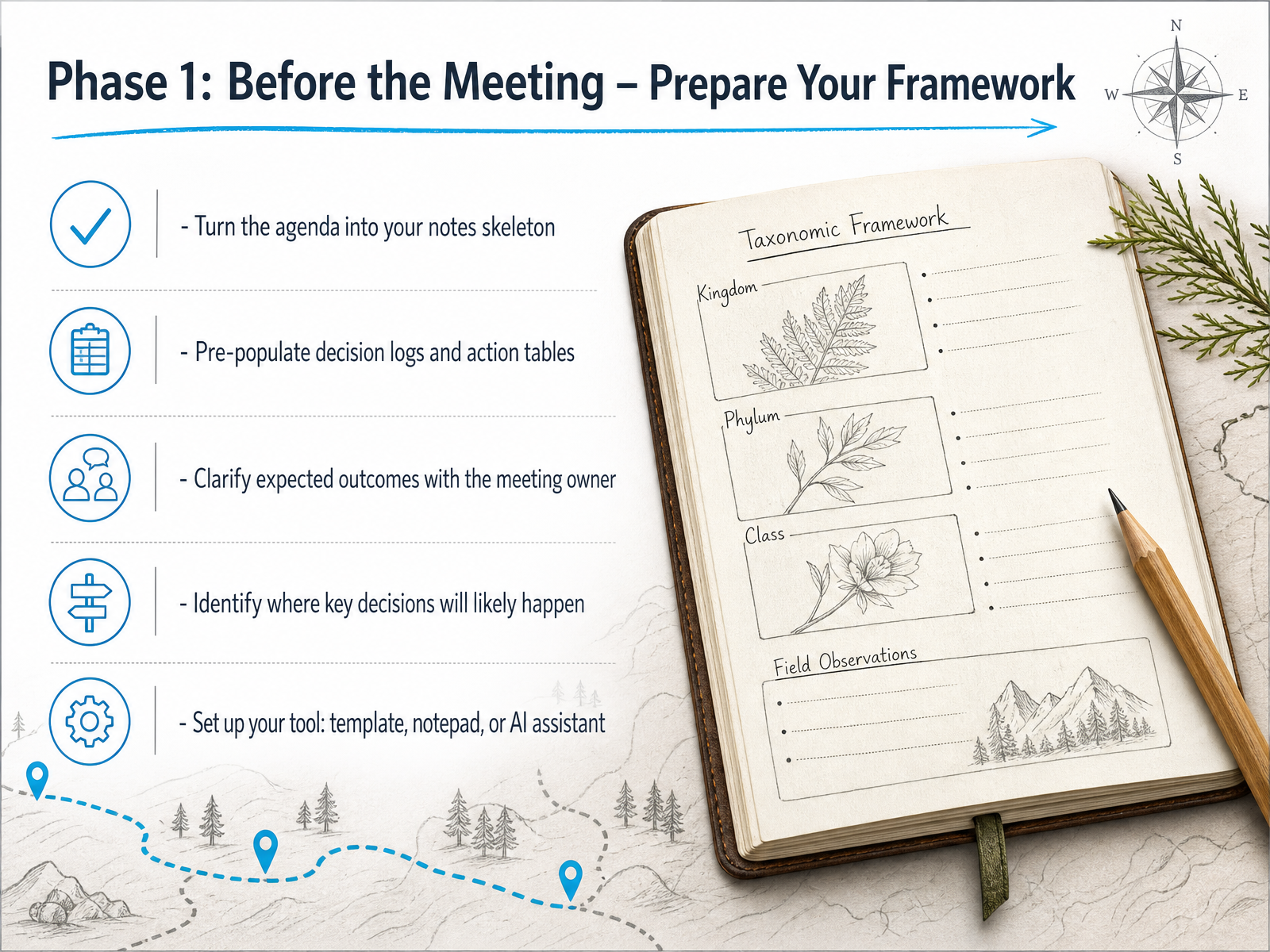
2 min - 06Phase 1: Before the Meeting – Prepare Your FrameworkLet's now focus on the first phase: what you do before the meeting even starts. This preparation turns you from a passive note-taker into an active participant. First, take the meeting agenda and transform it directly into your notes skeleton. Copy those agenda topics as headers, so your document structure is already built. Next, pre-populate decision logs and action tables. Create blank spaces for decisions, action items, owners, and deadlines. This visual cue acts as a prompt during the discussion. Then, clarify expected outcomes with the meeting owner. A quick message asking, 'What does a successful decision look like today?' ensures you're both aligned. Also, scan the agenda to identify where key decisions will likely happen. You can then pay extra attention during those critical moments. Finally, set up your tool. Whether it's a structured template, a simple notepad, or an AI assistant, have it open and ready. These five minutes of setup save massive effort later. Now, we're ready for the meeting itself. Let's move into Phase 2: During the Meeting, and learn how to Capture with Precision.
 2 min
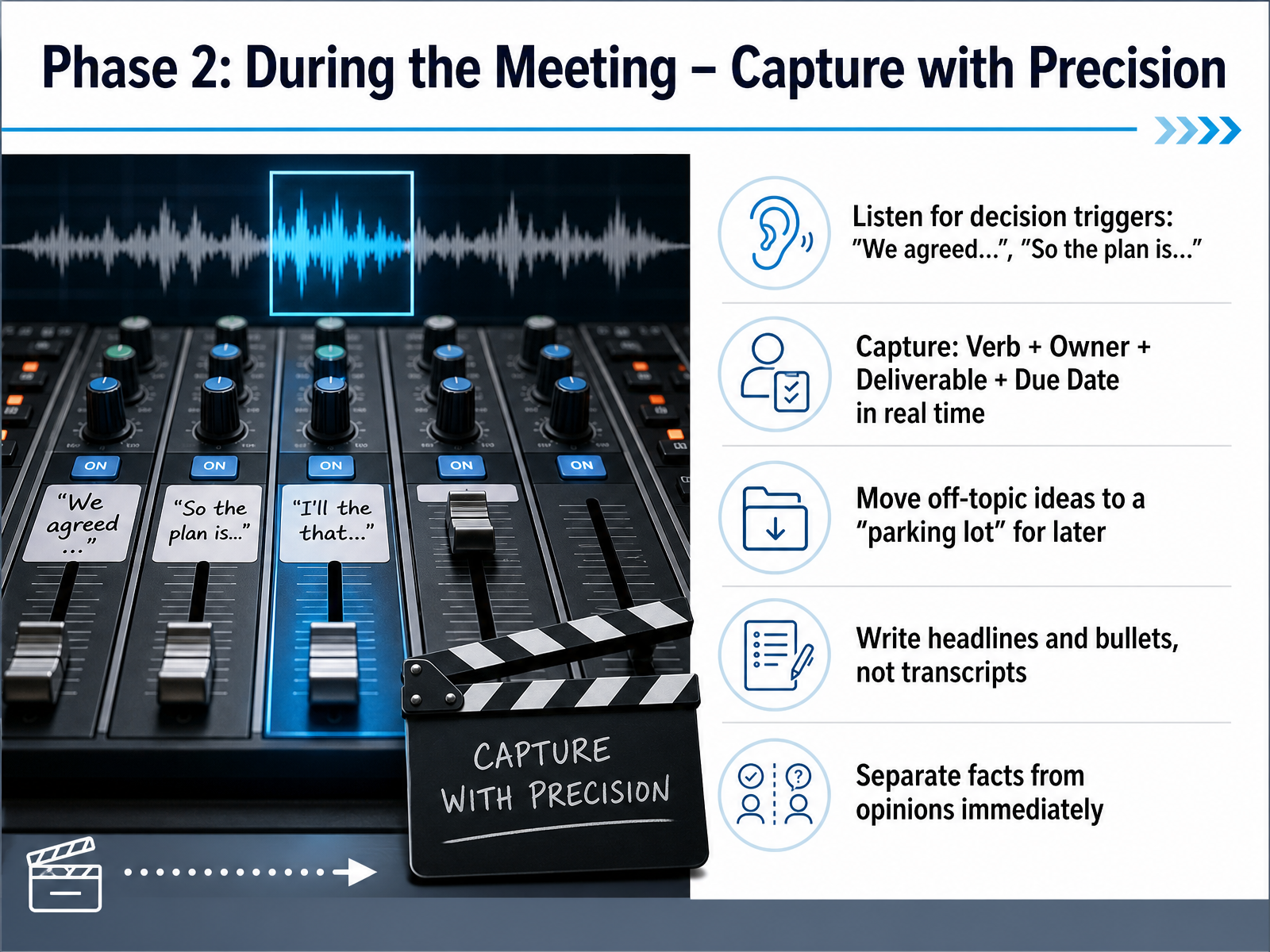
2 min - 07Phase 2: During the Meeting – Capture with PrecisionNow let's focus on capturing information with precision during the meeting itself. This is where many notes fall apart, so let's break it down. First, train your ear for decision triggers. Listen for phrases like "We agreed" or "So the plan is." When you hear these, you know a commitment has just been made. Next, capture the outcome immediately using this simple formula: a strong verb, plus an owner, plus a deliverable, plus a due date. For example, "John will draft the project charter by Friday." That single line is a complete, trackable action. Inevitably, off-topic ideas will surface. Don't ignore them, but don't let them derail your notes. Move them to a parking lot and revisit it at the end. Also, write in headlines and bullets, not full paragraphs. You are not producing a transcript. And finally, separate facts from opinions right away. If someone says "We might risk a delay because the vendor is behind," capture the measurable fact about the vendor separately from the stated opinion about risk. Next, we'll look at the anatomy of a decision record.
 2 min
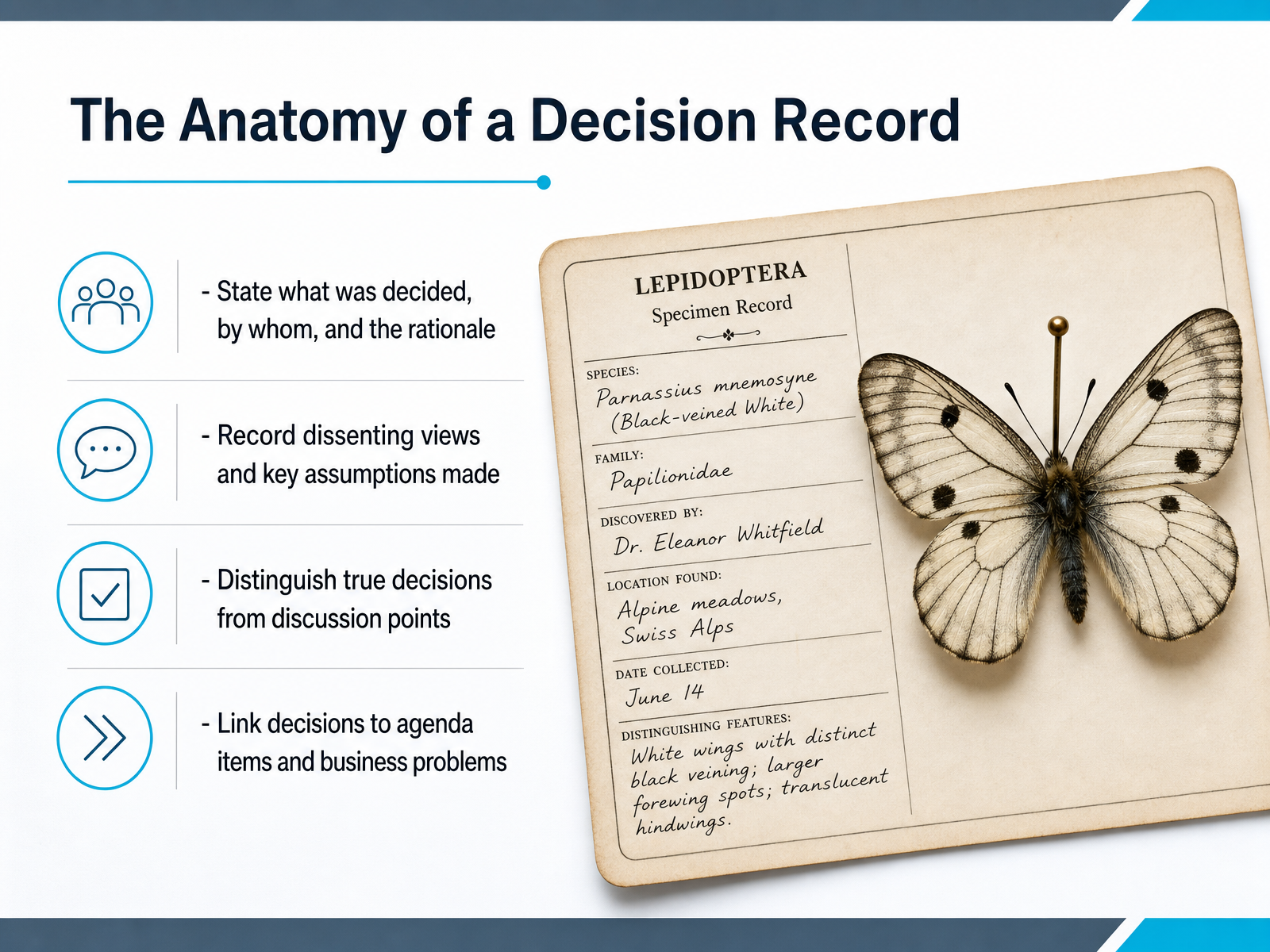
2 min - 08The Anatomy of a Decision RecordNow let's look at what makes a decision record actionable. First, state clearly what was decided, who made the decision, and the rationale behind it. For example, 'The marketing team decided to postpone the campaign launch by two weeks due to production delays.' Next, record any dissenting views and the key assumptions you relied on. This not only adds transparency but also protects the team if conditions change later. Another important skill is distinguishing true decisions from discussion points. A discussion is an exchange of ideas; a decision is a commitment to act. If no one stated a clear choice, it likely wasn't a decision. Finally, always link each decision back to a specific agenda item and the underlying business problem. This creates a clear thread from problem to resolution, making your notes far easier to scan weeks later. Up next, we'll break down the anatomy of an action item.
 1 min
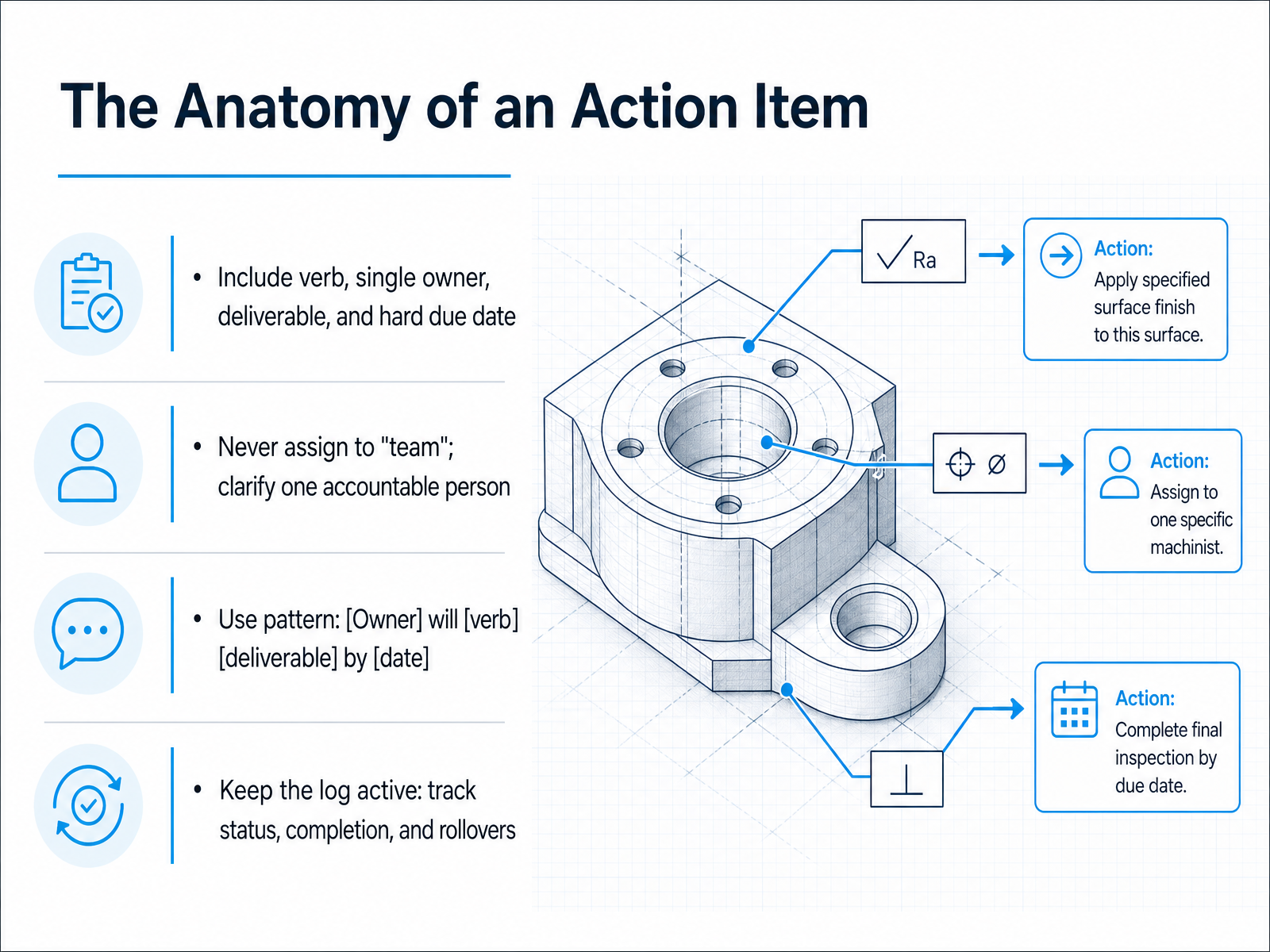
1 min - 09The Anatomy of an Action ItemLet's break down exactly what makes an action item truly actionable. Every action item needs four concrete parts: a strong verb describing the work, a single owner, a clear deliverable, and a hard due date. The most common mistake I see is assigning an action to a whole team. That almost guarantees nobody feels responsible. Instead, name exactly one accountable person, even if they'll involve others. A reliable pattern is: owner, then verb, then deliverable, then date. For example, 'Casey will draft the vendor comparison table by Thursday the twenty-second.' This format leaves no room for interpretation. Finally, treat your action log as a living document. Track each item's status, mark what's complete, and carry forward anything that didn't finish on time. Without that maintenance, even well-written actions lose their power. Up next, we move into Phase Three: After the Meeting, where I'll show you how to publish for frictionless follow-up.
 2 min
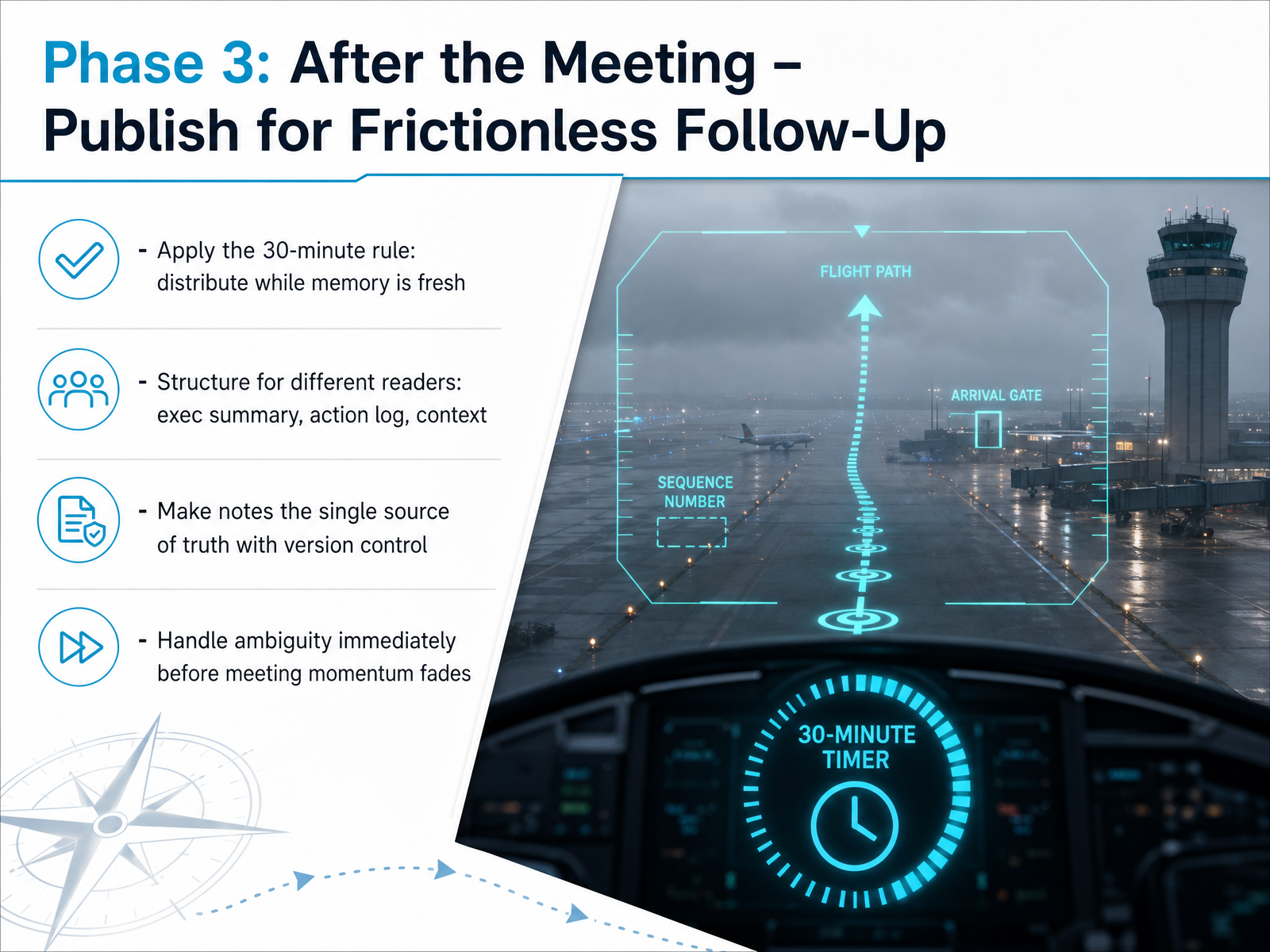
2 min - 10Phase 3: After the Meeting – Publish for Frictionless Follow-UpNow we move to what happens right after the meeting closes. This is the critical window where good notes become reliable follow-through. Let's look at phase three: publishing for frictionless follow-up. First, apply the thirty-minute rule. Distribute your notes while everyone's memory is still fresh. Waiting even a day invites forgotten context and lost momentum. Second, structure your document for different readers. Include a brief executive summary at the top for busy stakeholders, a clear action log with owners and deadlines for the doers, and enough context so anyone who missed the meeting can catch up quickly. Third, make your notes the single source of truth. If decisions evolve, update the document and note the revision. Do not let multiple versions circulate by email. Finally, handle ambiguity immediately. If something was unclear in the room, clarify it now while the meeting momentum is still strong. That quick call or message prevents weeks of misalignment. In short, your post-meeting discipline turns discussion into action. Next, we will get practical with Part Three: Tools, Practice, and Pitfalls.
 2 min
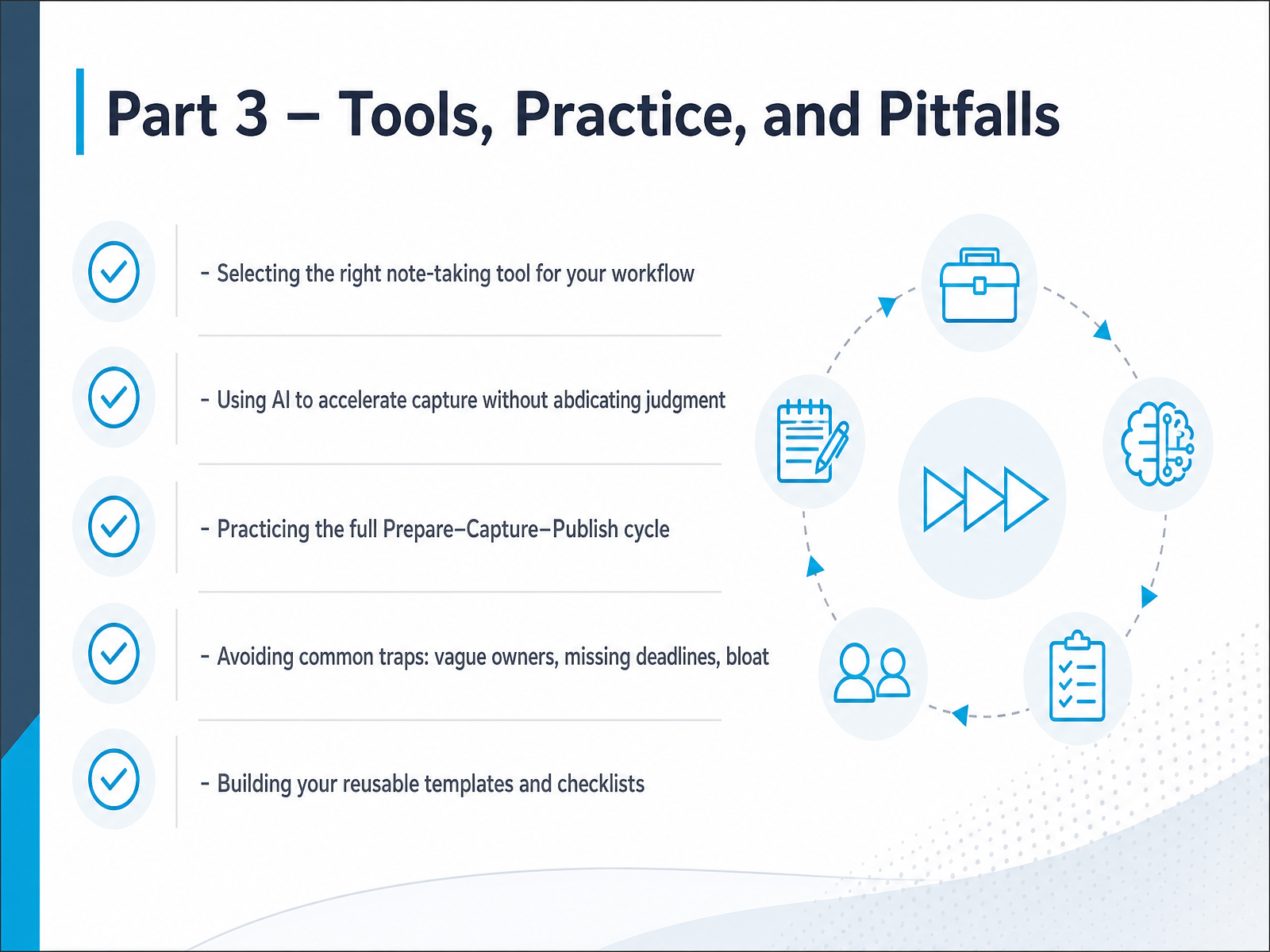
2 min - 11Part 3 – Tools, Practice, and PitfallsNow let's move into the practical side of things: tools, deliberate practice, and the pitfalls to watch out for. First, pick a note-taking tool that fits your existing workflow. Don't disrupt your whole system just to adopt something new. Whether it's a dedicated app, a shared document, or a project management platform, the best tool is the one you and your team will actually use consistently. Next, think about using AI to speed up transcription or drafting, but keep your own judgment firmly in the driver's seat. AI can capture the words, but only you can interpret the intent, nuance, and the real implications behind a decision. Then, make it a habit to actually run the full Prepare–Capture–Publish cycle end-to-end. This is a skill, and it improves with repetition. As you build that muscle, stay alert to the most common traps. Avoid vague owners like 'the team.' Always name a specific person. Never let an action item ship without a clear deadline. And ruthlessly cut the bloat. If a note doesn't drive a decision or an action, it's just noise. To make this easier, start building your own reusable templates and checklists right now. A simple capture template eliminates the blank page problem and ensures you never forget to log who does what by when. Let's carry this focus on judgment forward and talk about using AI responsibly: how to accelerate your work without abdicating your responsibility.
 2 min
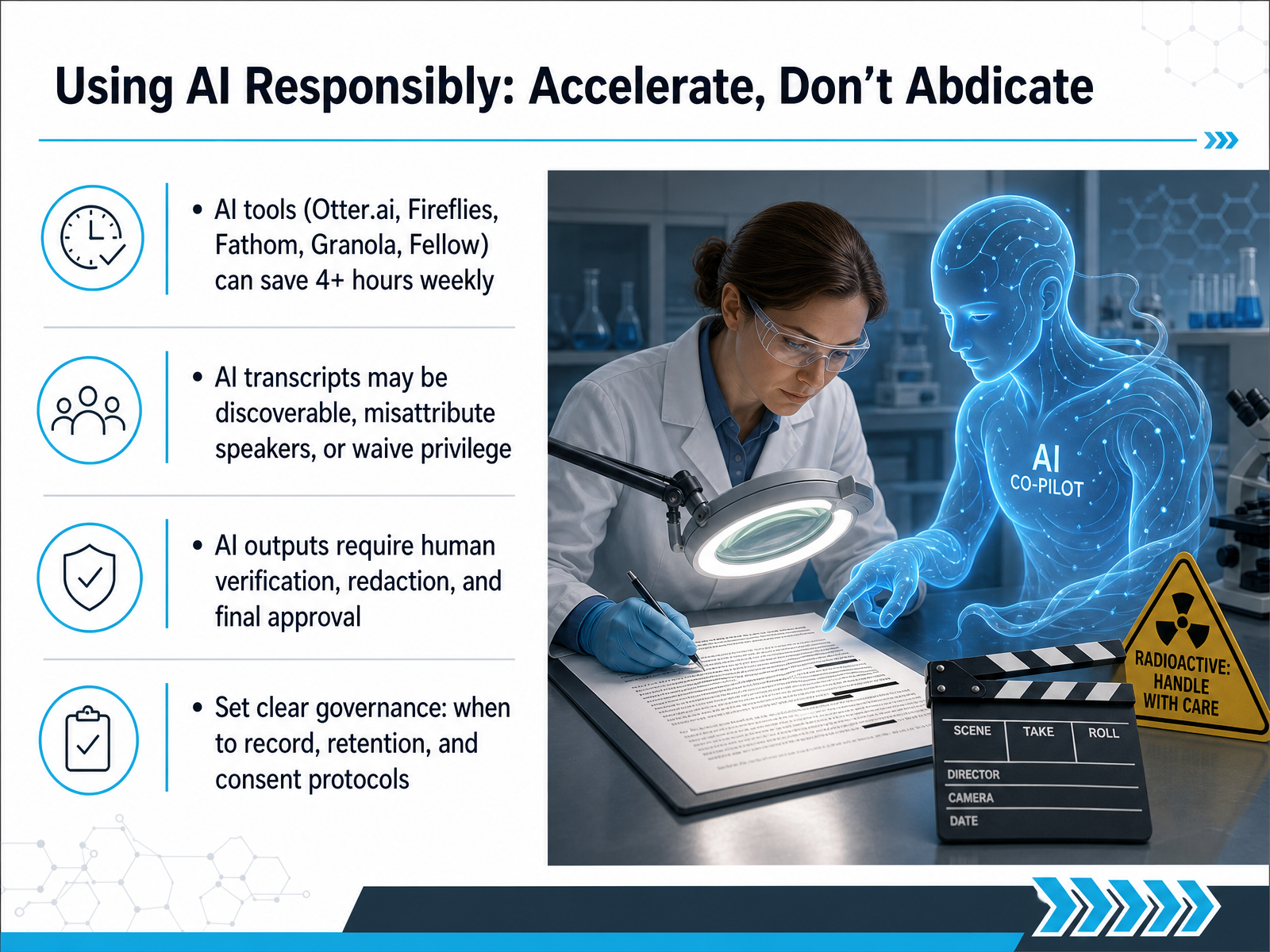
2 min - 12Using AI Responsibly: Accelerate, Don't AbdicateNow, let's talk about using AI responsibly. The goal is to accelerate your workflow, not abdicate your judgment. Tools like Otter, Fireflies, Fathom, Granola, and Fellow can save you over four hours a week. But you have to remember that AI transcripts are not just handy notes. They are discoverable business records that could be shared in litigation. They often misattribute speakers or miss sarcasm and tone. This is why human verification is non-negotiable. You must review, correct, and redact AI outputs before they become final. Never just forward a raw transcript. Finally, establish clear governance. Decide exactly when to record, set a retention schedule, and create a consent protocol so every participant knows the AI is listening. Up next, we will bring all these ideas together in our end-to-end practice: The Method in Action.
 corpgov.law.harvard.eduwhitecase.comdebevoise.com+22 min
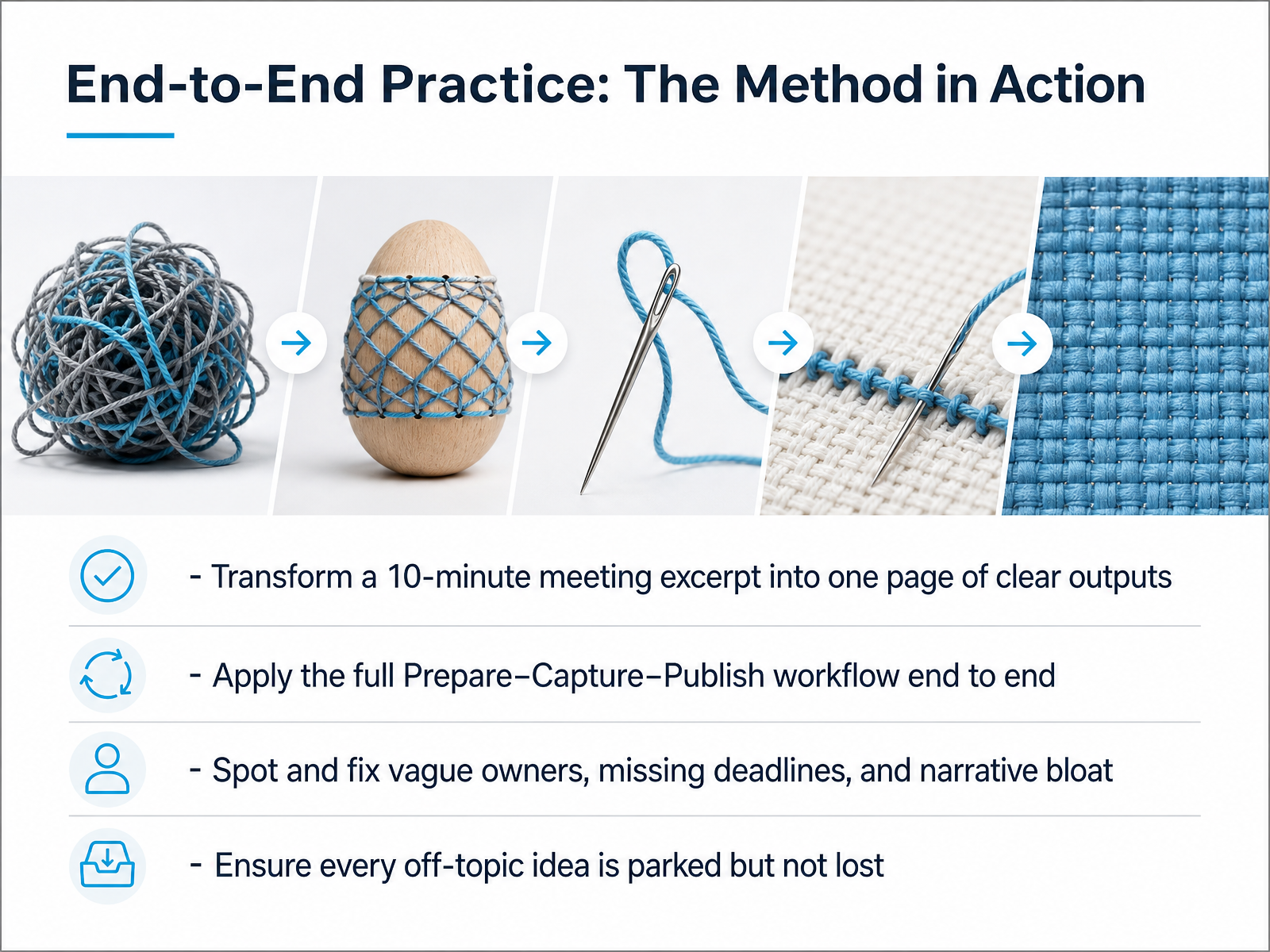
 - 13End-to-End Practice: The Method in ActionNow, let's put everything together in one end-to-end practice run. You'll take a real ten-minute meeting excerpt and transform it into a single page of clear, actionable outputs. Apply the full Prepare, Capture, and Publish workflow from start to finish. As you work through the material, watch for vague owners, missing deadlines, or narrative bloat, and correct them directly in your notes. When an off-topic idea surfaces, make sure it's parked in the parking lot so it isn't lost but also doesn't clutter the decisions and action items. This is your chance to build the muscle memory that makes the method stick. Next, let's wrap up with your actionable notes toolkit and final takeaways.
 1 min
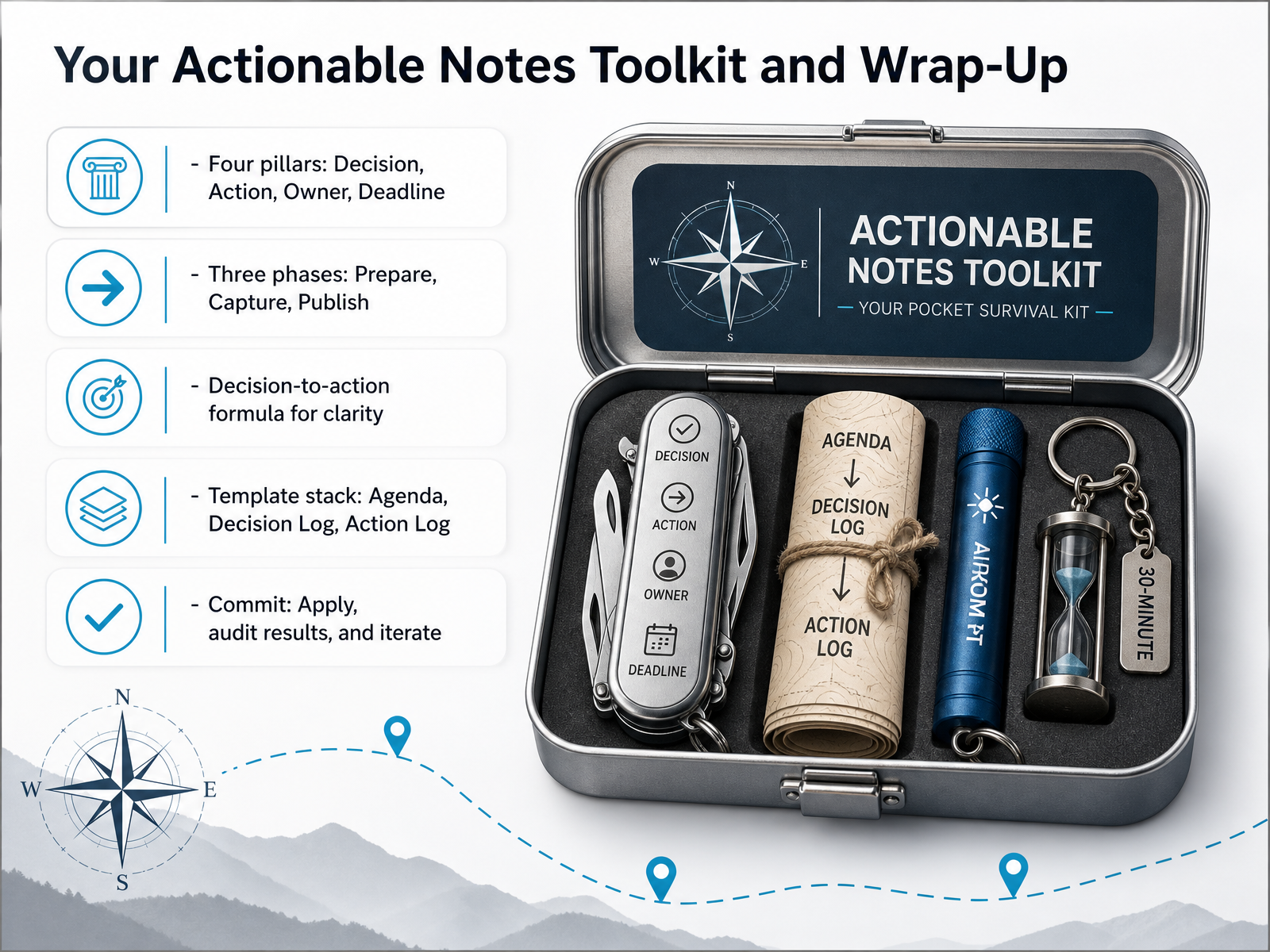
1 min - 14Your Actionable Notes Toolkit and Wrap-UpLet's pull everything together. Your toolkit rests on four pillars: Decision, Action, Owner, and Deadline. Commit those to memory. You also have three phases to work with: Prepare, Capture, and Publish. When you need clarity in the moment, use the decision-to-action formula. That means stating exactly what was decided and immediately linking it to the very next visible step. Your template stack supports all of this. You have the Meeting Agenda to start right, a Decision Log to record outcomes, and an Action Log to track who does what and when. Now the real work begins. I'm asking you to commit. Pick your very next meeting. Apply just one pillar or one template. Then after that meeting, audit your results. Did your notes actually drive follow-through? If not, adjust and iterate. Small, consistent improvements will transform your notes into a reliable execution engine. Thank you for investing this time. You now have everything you need to stop documenting discussions and start recording results.
 2 min
2 min
Take the deck with you
Download this course as a file — free, no sign-up needed.
- PDF handoutEvery slide page, ready to print or share.15 pages · 4.0 MBDownload
- Narrated PowerPointThe deck that presents itself — every slide carries the digital human's narration video.15 pages · 13.1 MBDownload
- PowerPoint slidesThe full deck as a .pptx — open it in PowerPoint, Keynote, or Google Slides.15 pages · 3.9 MBDownload
Free to use in your own training — please keep the PersonWise credit page at the end.
Have your own deck? Turn it into a course
Sources consulted
Web sources consulted while building this course.
- The Hidden Cost of Manual Meeting Notes in 2025 — klu.so
- The Hidden Cost of Poor Meeting Documentation | MinuteKeep Blog | 現場コンパス — genbacompass.com
- Medium — justtalkingtech.medium.com
- Laxis | The State of Meeting Note-Taking 2026: AI Adoption, ROI & Market Benchmarks — laxis.com
- The True Cost of Meetings in 2025: What the Research Says | Meeting Incinerator — meetingincinerator.com
- AI Drafting Board Minutes? Hold Up, Wait a Minute. It’s Complicated — corpgov.law.harvard.edu
- When every word is recorded: AI meeting tools and the new ... — whitecase.com
- https://www.debevoise.com/insights/publications/2025/06/ai-can-draft-board-minutes-but-should-it — debevoise.com
- AI Notetakers: Productivity Tool or Emerging Legal Risk? | Insights — mayerbrown.com
- AI and You: Confidentiality Risks of Using Transcription and Note- ... — americanbar.org