The instructor is ready
The Water Cycle and Earth Systems
The Water Cycle and Earth Systems
An overview of the water cycle and its role within Earth's systems, designed for learners to understand key processes and interactions.
My workspace24 minFree to watch
What you’ll learn
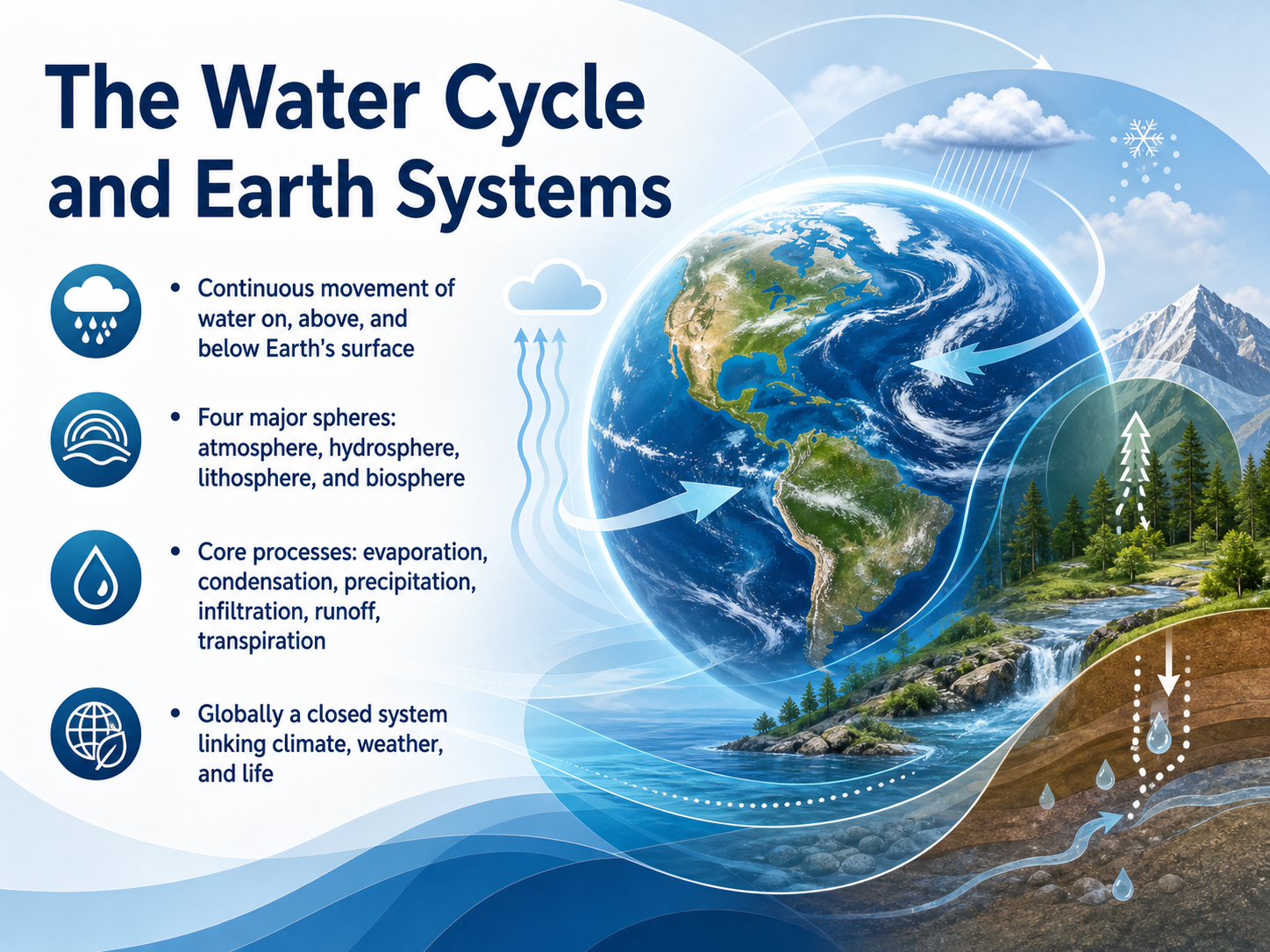
- 01The Water Cycle and Earth SystemsWelcome. In this session, we explore the water cycle and Earth systems. Our goal is to understand how water moves continuously among air, land, oceans, and living things. Think of water as a global commuter, traveling different paths every day. The cycle links four major spheres: the atmosphere, the hydrosphere, the lithosphere, and the biosphere. Core processes include evaporation, condensation, precipitation, infiltration, runoff, and transpiration. Together, these form a closed system that connects climate, weather, and life. To see how this system works, we first need to meet its two main drivers. Let's move to the next slide, Energy Drivers: Solar Radiation and Gravity.usgs.govearthdate.orgen.wikipedia.org+21 min
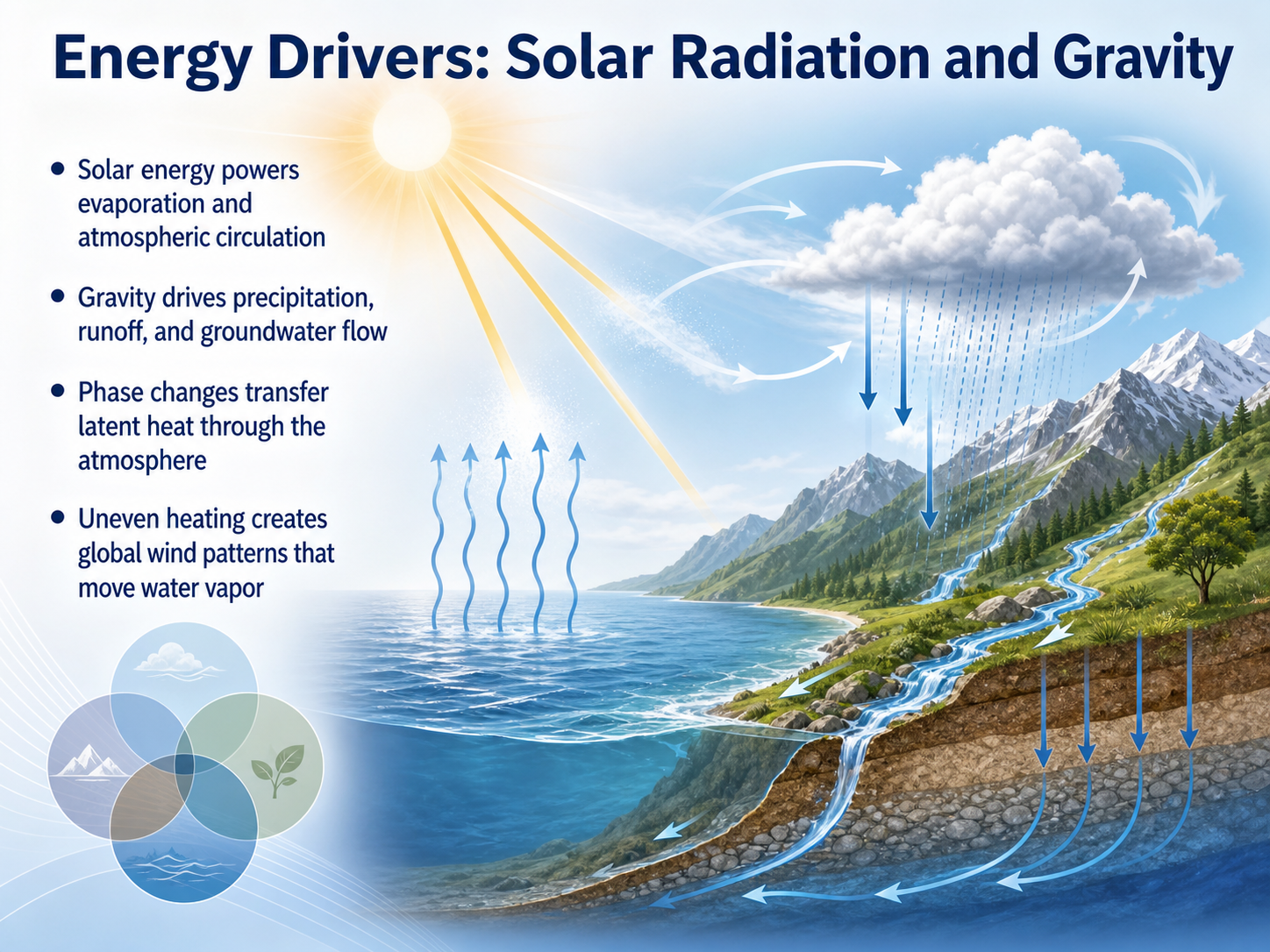
- 02Energy Drivers: Solar Radiation and GravityNow, let's look at the two main forces that keep water moving. Think of the sun and gravity as the engine and the steering wheel of the water cycle. First, solar radiation from the sun provides the energy. It heats the oceans, lakes, and soil, turning liquid water into invisible vapor through evaporation. This is like fuel lifting water into the sky. As that vapor rises and cools, it condenses into clouds, releasing heat into the atmosphere. This stored energy, called latent heat, helps drive winds that carry moisture around the globe. Then gravity takes over. It pulls rain and snow down to the ground as precipitation. It guides water as it runs downhill into streams, soaks into the soil, and slowly flows underground toward the sea. So, solar energy lifts the water, and gravity brings it back down. This constant push and pull keeps the cycle going. Up next, we'll explore the largest reservoir in this system: the oceans as the largest reservoir.
 usgs.govearthdate.orgen.wikipedia.org+21 min
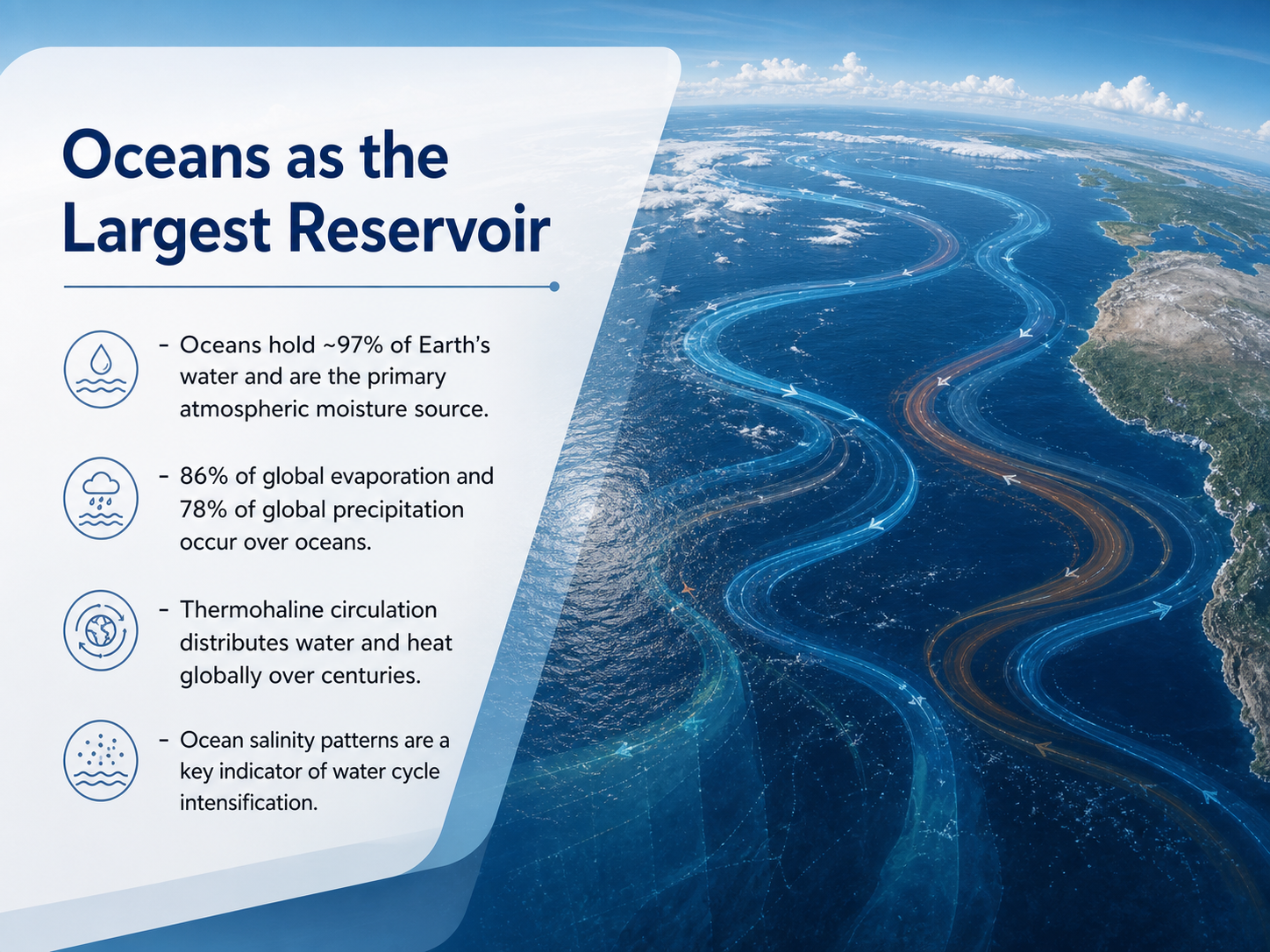
 - 03Oceans as the Largest ReservoirNow we turn to the single largest water reservoir on Earth: the oceans. They hold about ninety-seven percent of our planet's water, so it is no surprise they are the main source of moisture for the atmosphere. In fact, eighty-six percent of global evaporation and seventy-eight percent of global precipitation happen right over the ocean. Think of the ocean surface as a massive, gentle pump, constantly sending water vapor skyward. Much of that vapor eventually forms the rain that falls on land. But the ocean is not just a giant bucket. A deep, slow circulation called the thermohaline circulation acts like a global conveyor belt, moving water and heat across ocean basins over centuries. This is why ocean salinity, the saltiness of the water, is such a powerful indicator. When evaporation leaves salt behind, salinity rises. When rain or runoff from land dilutes the water, salinity drops. By tracking these salinity patterns, scientists can see how the entire water cycle is changing and intensifying over time. Next, we will follow that water vapor upward and explore the role of water in the atmosphere.
 doi.orgtos.orgdoi.org+21 min
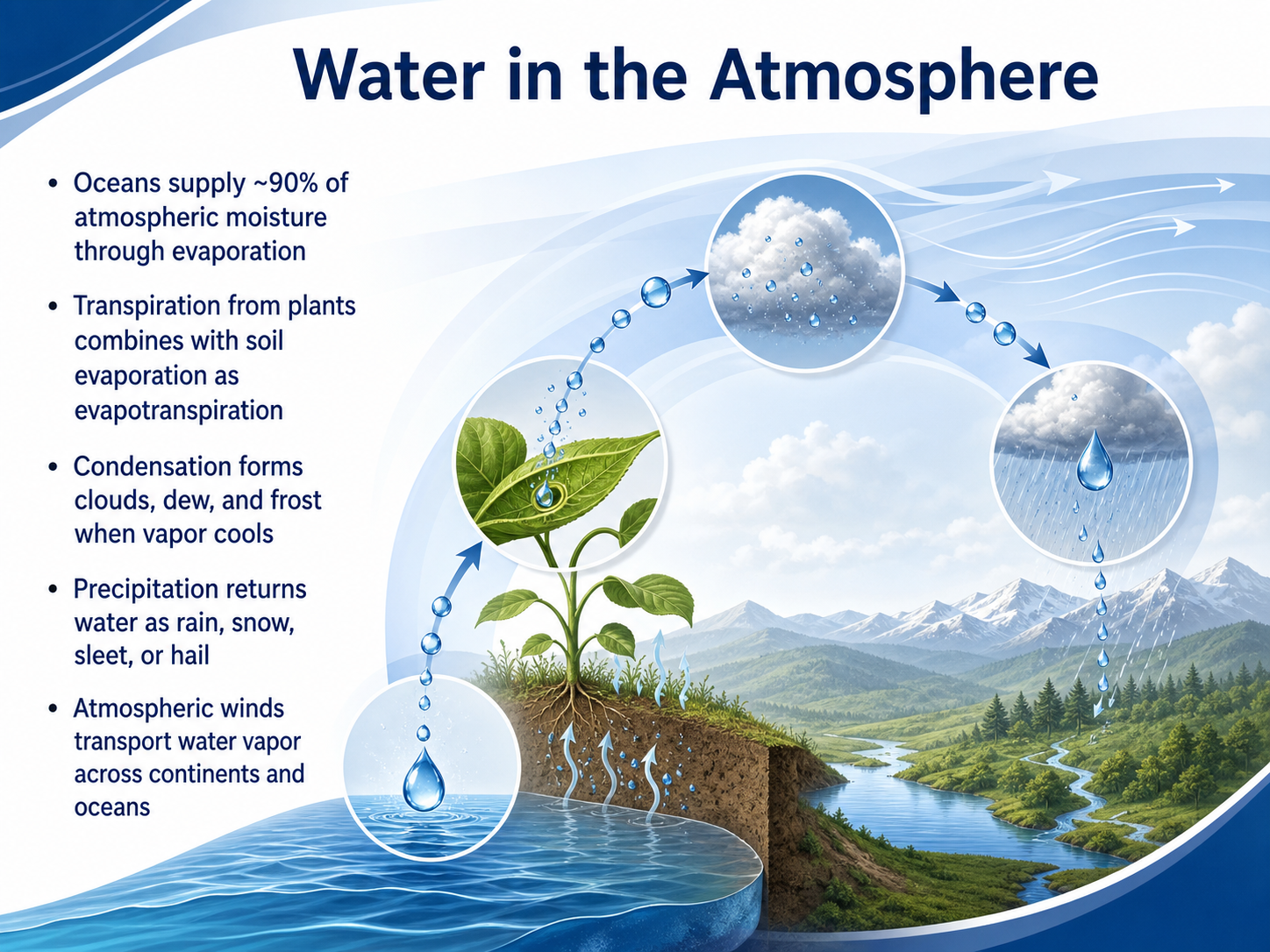
 - 04Water in the AtmosphereNow let's look at how water moves through the atmosphere. The oceans are the main engine here. They supply about ninety percent of the moisture in the air, simply through evaporation. Think of the ocean surface as a giant, invisible launch pad, sending water vapor skyward. On land, plants also add moisture through their leaves, a process called transpiration. When you combine that with evaporation from the soil, scientists call the total effect evapotranspiration. Once that water vapor is in the air, it cools and condenses. This is how we get clouds, and also morning dew on a leaf, or frost on a cold window. When the water droplets in clouds get heavy enough, gravity takes over and they fall as precipitation. This could be rain, snow, sleet, or even hail. Finally, winds act like a global conveyor belt, transporting all this water vapor across continents and oceans. So, a storm that soaks a local farm might actually be fueled by moisture from a distant sea. Next, we'll explore what happens when all that water reaches the ground. Let's move on to 'Water on and Below the Land Surface'.
 doi.orgtos.orgdoi.org+22 min
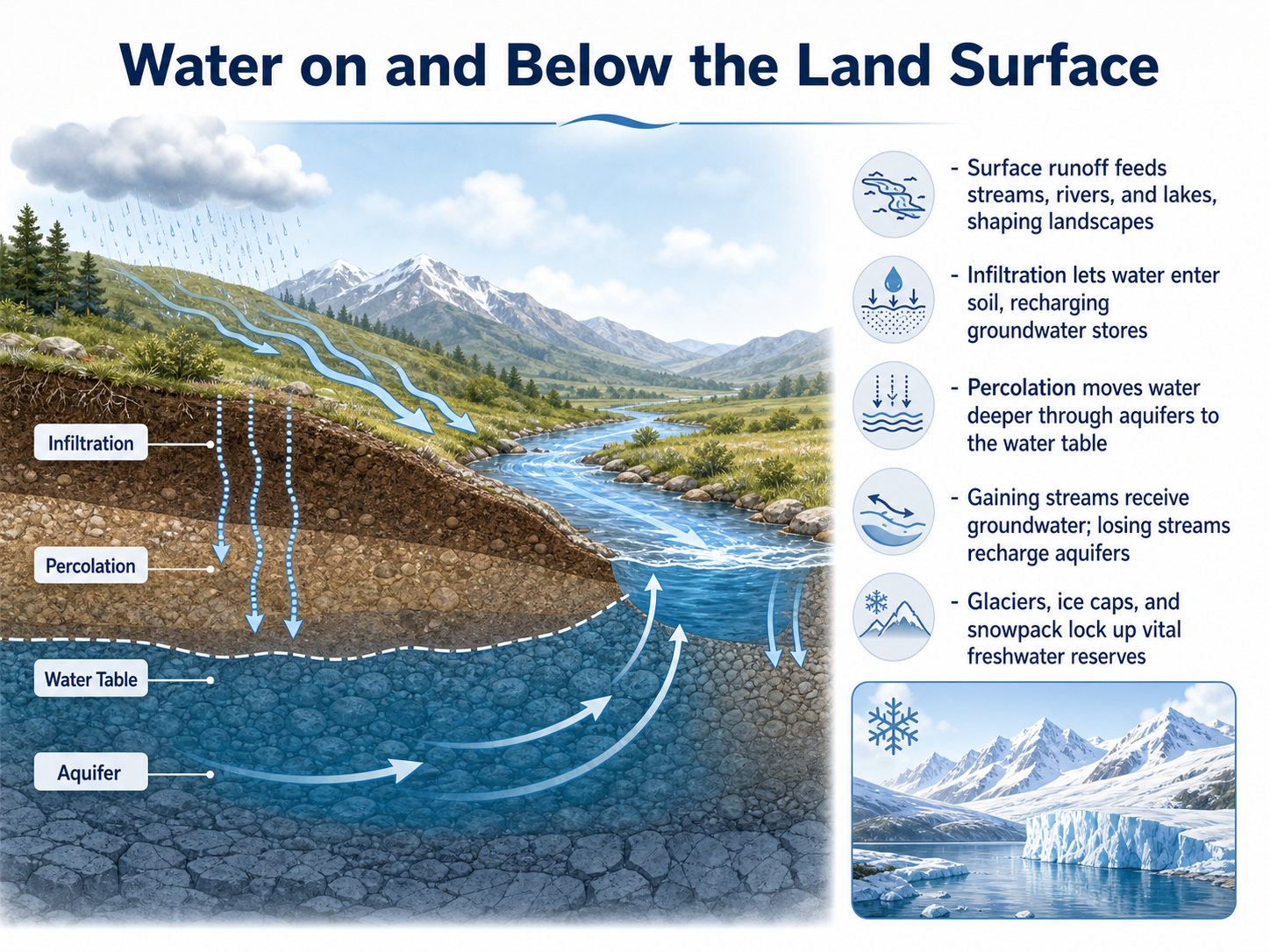
 - 05Water on and Below the Land SurfaceSo far we’ve watched water move through the air and fall as rain or snow. Now let’s look at what happens when it reaches the ground. On the surface, runoff feeds streams, rivers, and lakes, slowly carving valleys and shaping the landscapes we see every day. Think of a heavy storm: water that doesn’t soak in rushes downhill, filling roadside ditches, then creeks, then larger rivers. Some of that water seeps into the soil through a process called infiltration. Once it’s in the soil, it can percolate deeper, moving slowly through layers of sand and gravel until it reaches the water table and recharges underground aquifers. Streams and groundwater are closely connected too. In a gaining stream, the water table is higher than the stream, so groundwater feeds the channel. In a losing stream, the channel sits higher and water seeps downward to recharge the aquifer. And let’s not forget frozen stores: glaciers, ice caps, and mountain snowpack lock up huge amounts of freshwater, releasing it gradually as meltwater during warmer months. This interplay between surface water and groundwater is what keeps many farms and city water supplies going through dry seasons. Next, we’ll explore how living things—the biosphere—fit into this moving water system.
 annualreviews.orgusgs.govresolve.cambridge.org+22 min
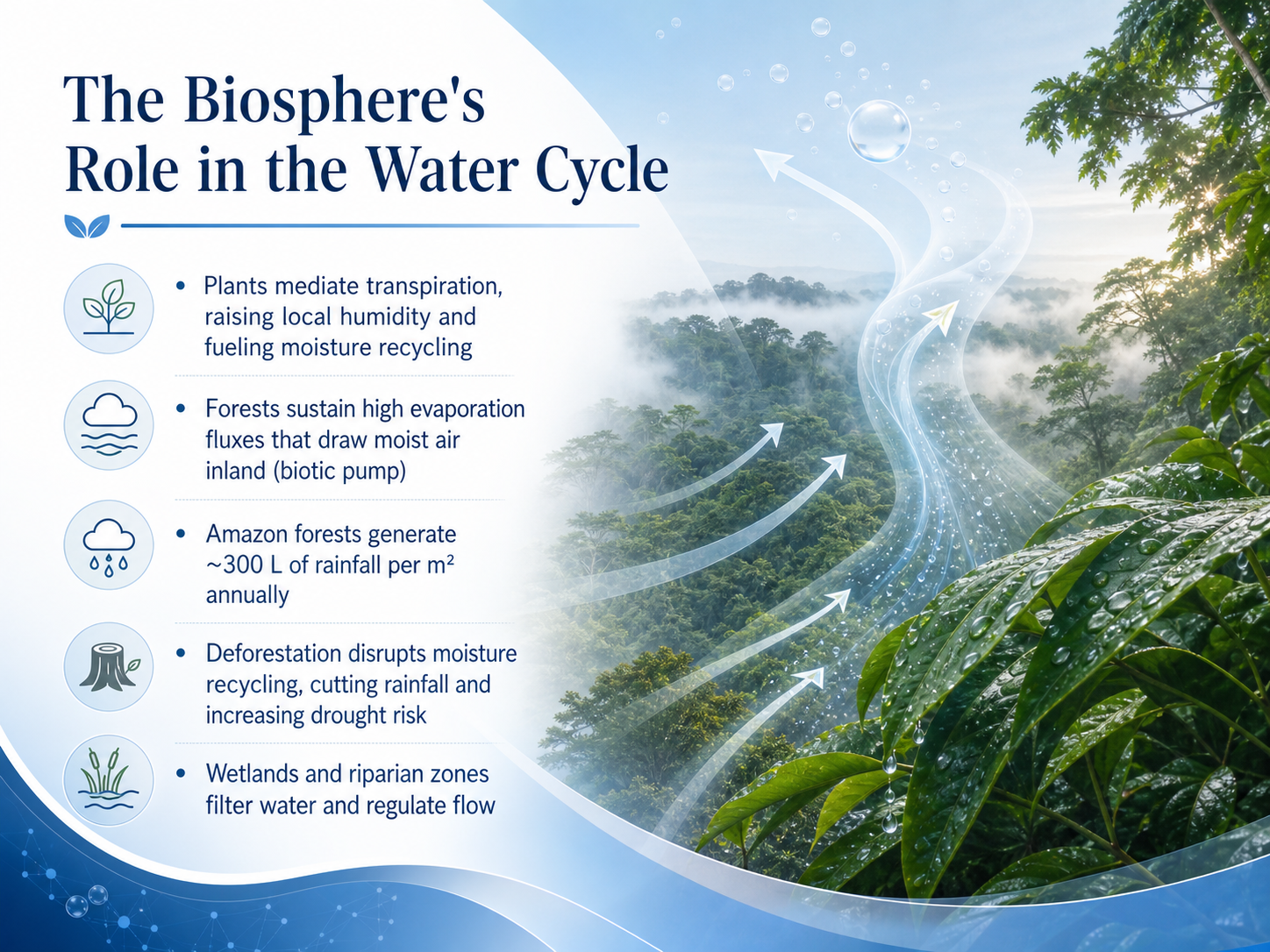
 - 06The Biosphere's Role in the Water CycleNow let’s bring the living world into the picture. Plants do much more than just use water—they actively move it. Through transpiration, trees and other vegetation pull moisture from the soil and release it as water vapor from their leaves. This raises local humidity and feeds moisture back into the air, helping rain form again downwind. Think of a large forest as a giant green pump. The high evaporation from so many leaves creates a zone of low pressure above the canopy, which draws moist air inland from the ocean. Scientists call this the biotic pump. The Amazon rainforest is a powerful example. Each square meter of Amazon forest contributes roughly 300 liters of water back to the atmosphere as rainfall every year. When forests are cleared, this recycling breaks down. Deforestation cuts moisture supply, reduces rainfall, and raises drought risk. Wetlands and healthy riverbanks also play a quiet but vital role, filtering water and slowing its flow so it can soak into the ground. When we protect these living systems, we protect the water cycle itself. Next, we’ll look at how long water stays in different parts of the cycle, exploring residence times and fluxes.
 preview-nature.comdoi.orgpreview-nature.com+22 min
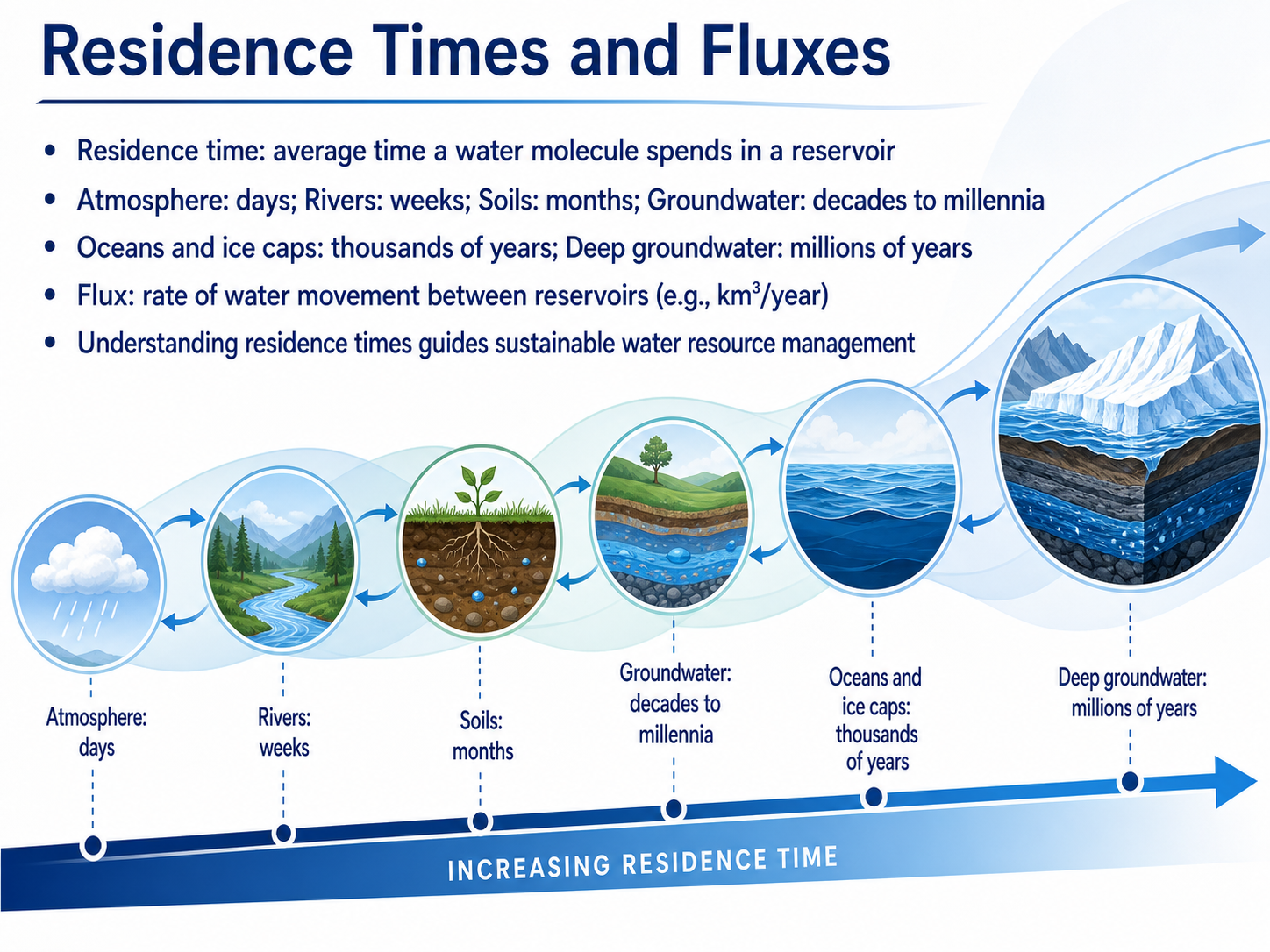
 - 07Residence Times and FluxesNow let's talk about how long water stays in one place, and how fast it moves between places. We call the average time a water molecule spends in a reservoir its residence time. In the atmosphere, water stays just days. In rivers, it's weeks. In soils, a few months. But in groundwater, it can range from decades to millennia. Oceans and ice caps hold water for thousands of years, and deep groundwater can be trapped for millions of years. The other key idea is flux, the rate water moves between reservoirs. Think of it like a commuter system. The atmosphere is like a busy subway, with passengers coming and going quickly. The deep ocean is more like a long-term parking lot, where a car might sit for a very long time. Understanding these time scales is crucial for managing water sustainably. For example, a farmer pumping from a shallow aquifer recharged by last season's rain is using a renewable resource. But pumping from a deep, ancient aquifer is like mining water that won't be replaced on a human timescale. Up next, we'll explore our own role in this cycle, with the slide on Human Influence on the Water Cycle.
 2 min
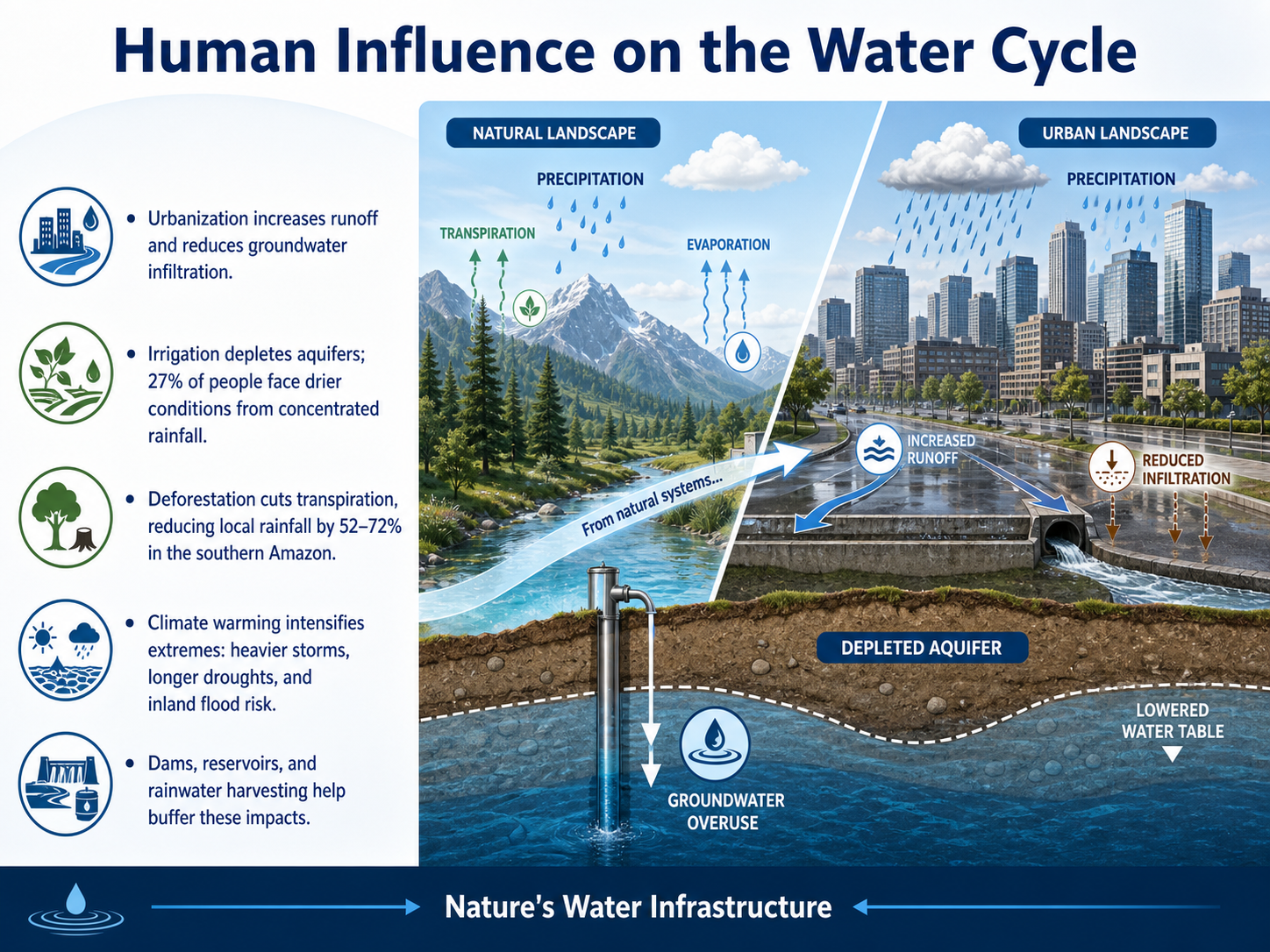
2 min - 08Human Influence on the Water CycleNow we turn to our own influence on the water cycle. When we pave roads and build cities, we create hard surfaces that send rainwater rushing into storm drains. That means less water soaks into the ground to recharge the groundwater farmers and wells rely on. At the same time, irrigation pulls water from underground aquifers faster than nature can replenish them. In fact, 27 percent of people globally now face drier conditions just from rainfall being concentrated into fewer, heavier bursts. Deforestation also plays a major role here. Trees pump moisture back into the air through transpiration. Removing them can cut local rainfall by 52 to 72 percent, as we see in the southern Amazon. Climate warming adds another layer: it intensifies the extremes, bringing heavier storms, longer droughts, and greater flood risk inland. The good news is that we can buffer some of these impacts with dams, reservoirs, and rainwater harvesting. Next, let's look more closely at how climate change and water cycle intensification are connected.
 2 min
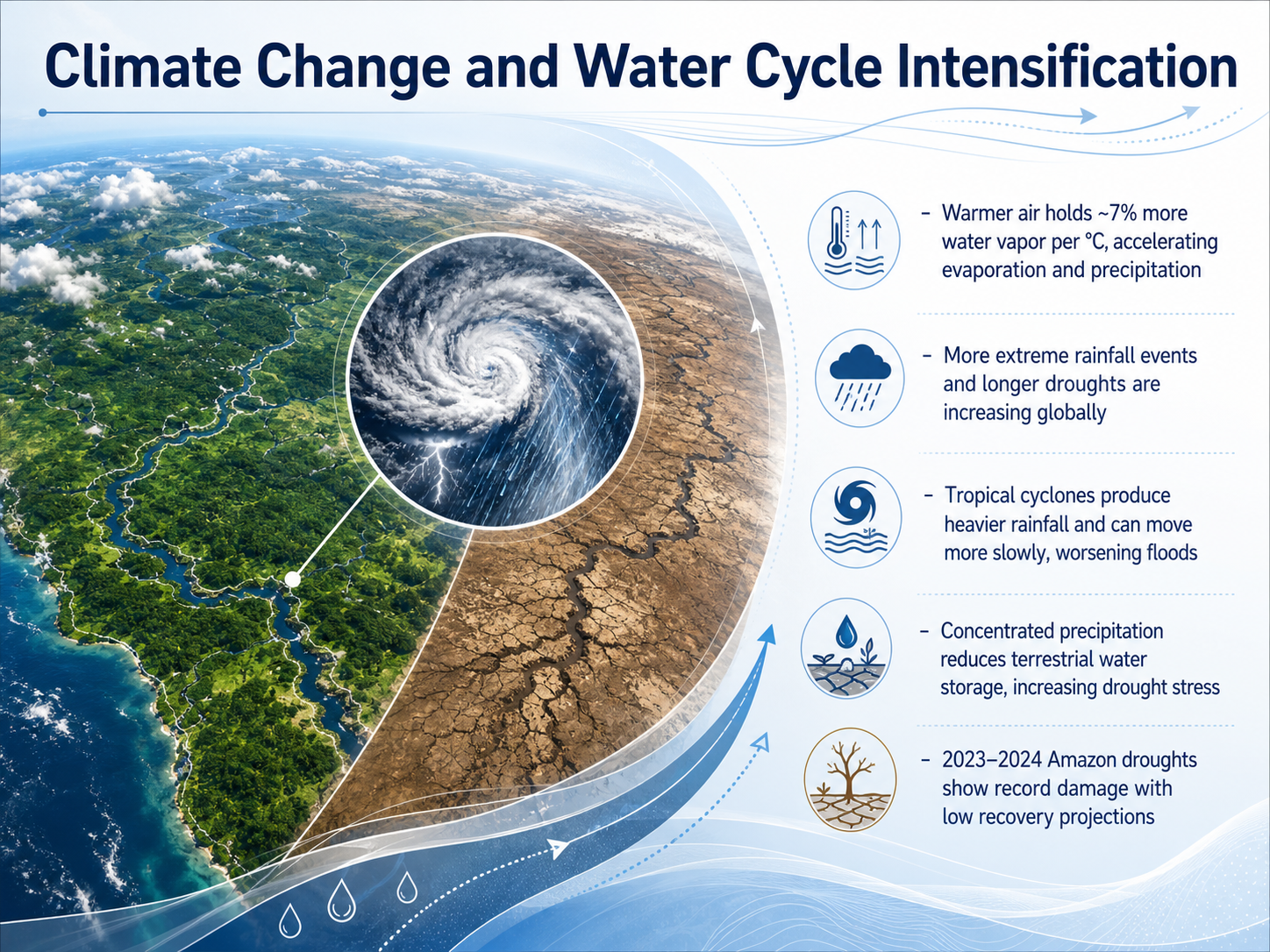
2 min - 09Climate Change and Water Cycle IntensificationNow we turn to how climate change is intensifying the water cycle. A simple rule helps explain it: for every degree Celsius of warming, fully saturated air can hold about seven percent more water vapor. Think of the atmosphere like a sponge that gets bigger as it heats up, soaking up more moisture from soils, plants, and oceans. That extra vapor fuels stronger evaporation and then releases more energy when it condenses, leading to heavier downpours. But the rainfall arrives in concentrated bursts separated by longer dry spells. Observations show that this shift toward fewer, heavier events actually reduces how much water stays stored in the land. More intense rain runs off quickly instead of soaking in, while sunnier gaps between storms increase evaporation. This means many regions experience both more extreme floods and longer droughts at the same time. A striking example is the Amazon. Record-breaking droughts in 2023 and 2024 caused the lowest forest moisture readings since satellite monitoring began in 1992, and projections show less than half of the affected forest may recover before the next drought arrives. Tropical cyclones are also changing. Warmer oceans supercharge hurricane rainfall, and some storms are moving more slowly over land, dumping extreme rain further inland. Studies show that the landward reach of heavy tropical cyclone rain has been increasing by about four kilometers per decade along Northern Hemisphere coasts. Understanding these changes helps us see why the same warming can deliver both too much water and too little. Next, we will explore how we observe and model the water cycle to track these shifts.
 2 min
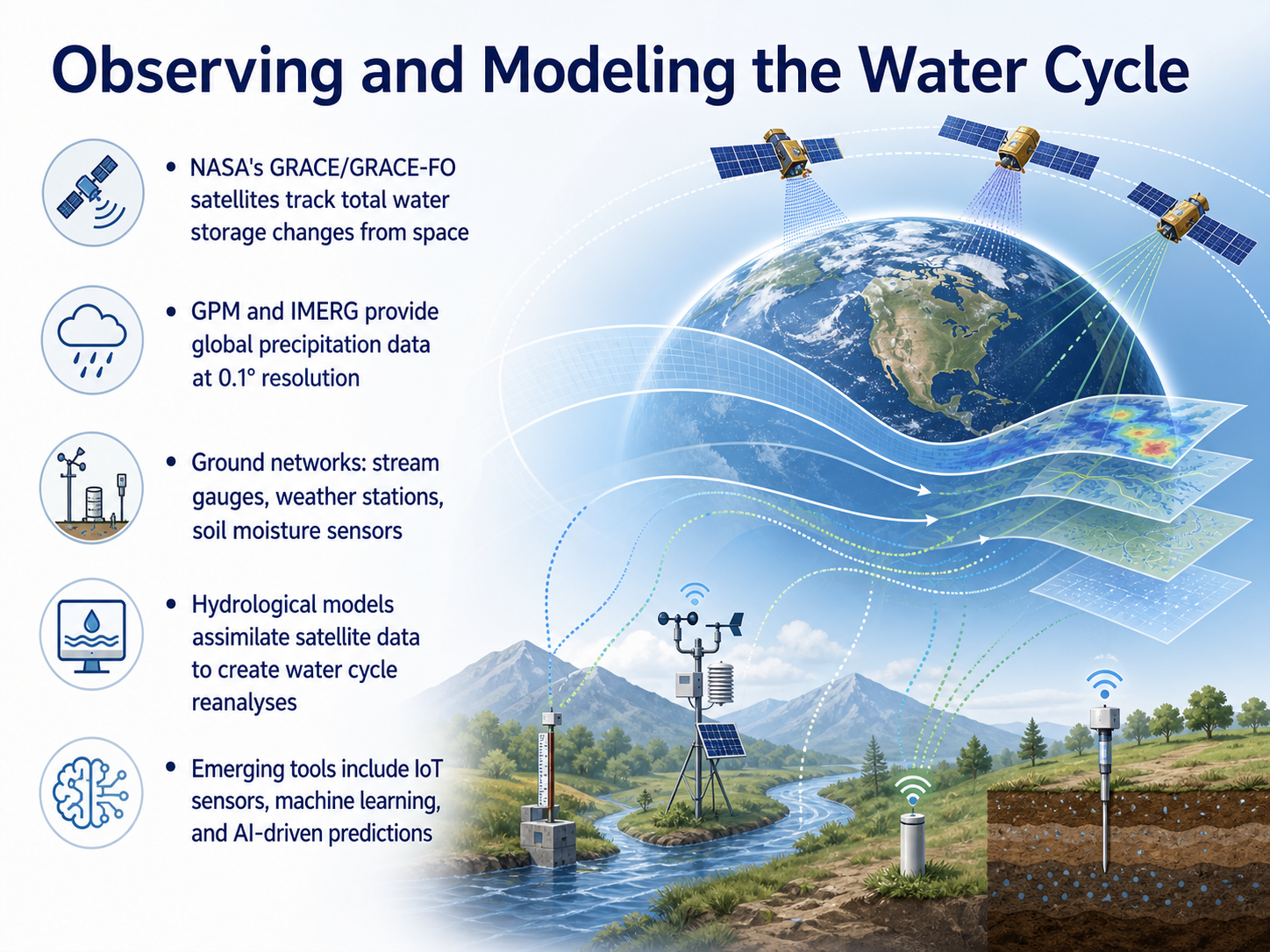
2 min - 10Observing and Modeling the Water CycleNow that we have explored how water moves, let's look at the tools scientists use to observe and model the entire water cycle. Think of these tools as different lenses that help us see the big picture and the fine details. From space, NASA's GRACE and GRACE Follow-On satellites act like a giant scale in the sky. They measure tiny changes in Earth's gravity to track total water storage, from deep groundwater to surface snow. Meanwhile, the GPM and IMERG missions give us global precipitation data at a 0.1-degree resolution, mapping rain and snow across the planet. On the ground, we have stream gauges, weather stations, and soil moisture sensors providing local ground truth. These ground networks are like spot checks that help validate what we see from space. Scientists then feed all this satellite data into hydrological models to create water cycle reanalyses, which are consistent, long-term records of our water history. Emerging tools are making this work even more powerful. Internet of Things sensors, machine learning, and AI are now helping us predict water cycle changes with greater accuracy. For a farmer, this might mean better drought forecasts, and for a city planner, it could lead to improved flood warnings. Next, we will bring all these concepts together in a real-world case study, exploring the Amazon Rainforest and its critical role in water cycle feedback.
 2 min
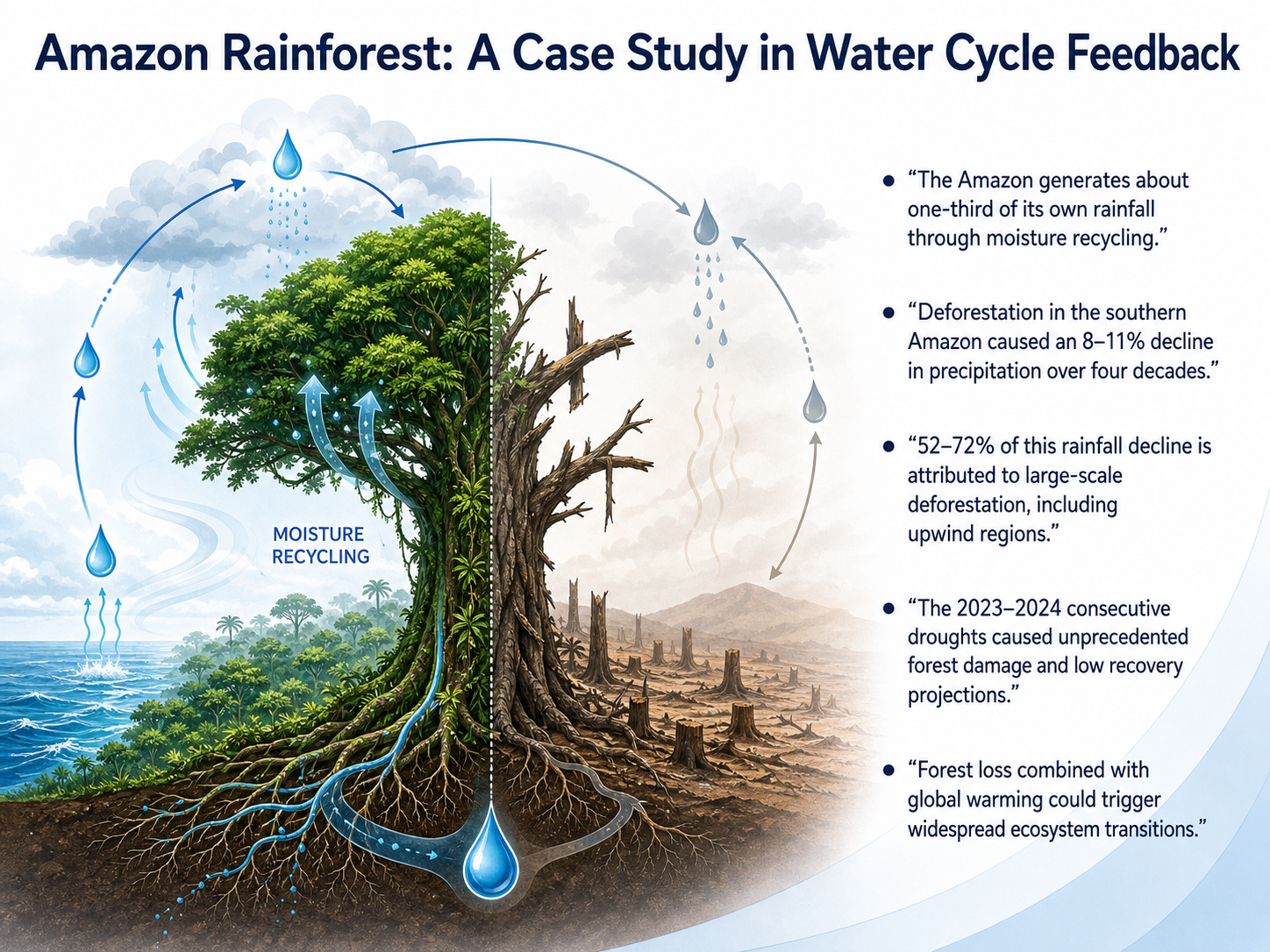
2 min - 11Amazon Rainforest: A Case Study in Water Cycle FeedbackNow let's see how these water cycle processes play out in a real place: the Amazon. This rainforest is a case study in water cycle feedback. The Amazon actually generates about one third of its own rainfall through moisture recycling. Trees pull water from the soil and release it as vapor; that vapor travels downwind and falls again as rain. When deforestation removes those trees, the system weakens. In the southern Amazon, forest loss over four decades caused an eight to eleven percent decline in precipitation. More than half of that rainfall drop is linked directly to large-scale deforestation, including clearing in upwind areas. The damage is accelerating. The back-to-back droughts of twenty twenty-three and twenty twenty-four caused unprecedented forest damage, and models project low recovery rates. If forest loss continues alongside global warming, we could trigger widespread ecosystem transitions, where lush rainforest grades into drier savanna. The Amazon isn't just a victim of climate change; it's an active player whose health influences rainfall for the entire region. Let's connect this broader view of the water cycle to Earth system health in our final slide.
 preview-nature.comdoi.orgpreview-nature.com+22 min
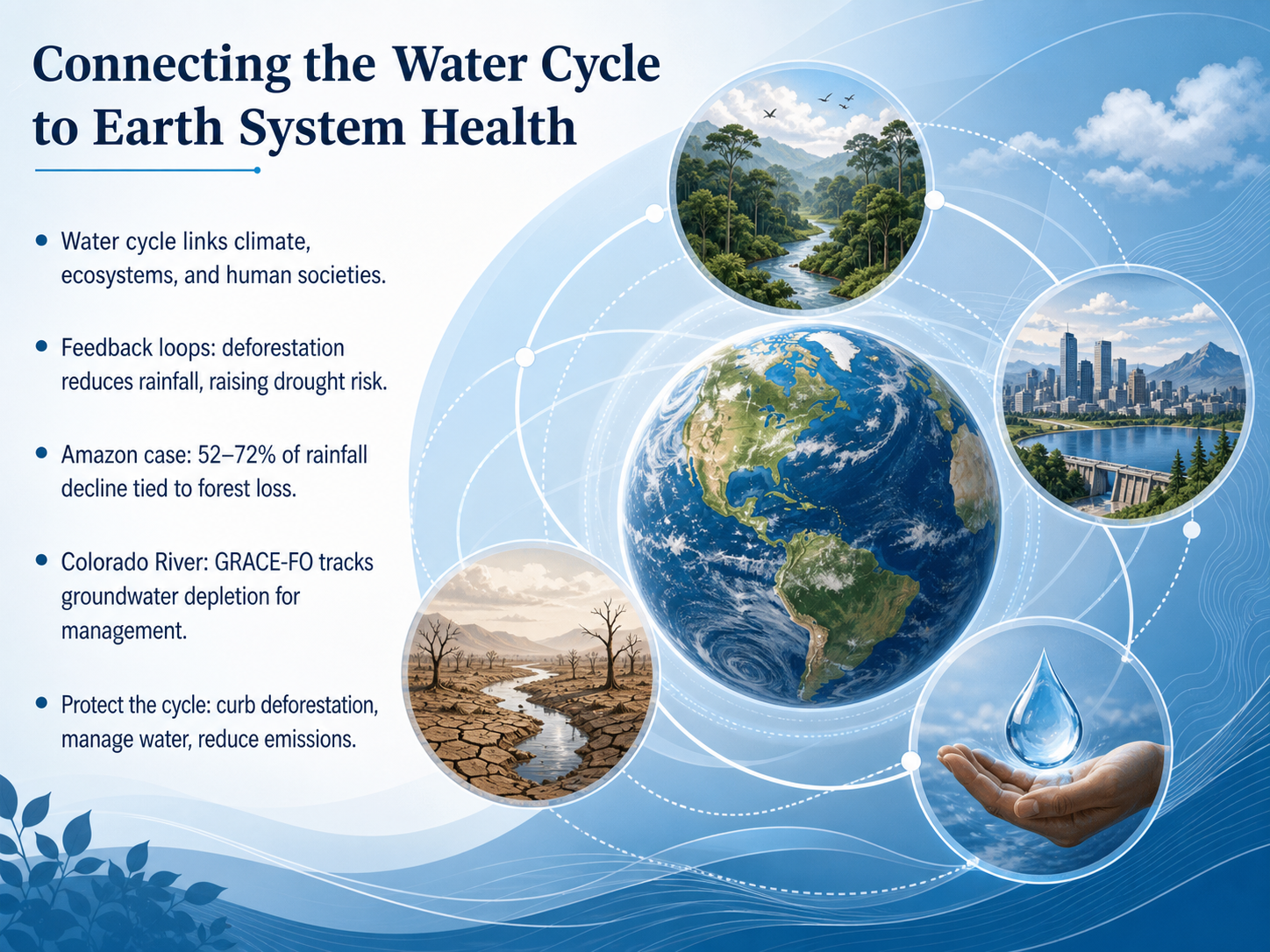
 - 12Connecting the Water Cycle to Earth System HealthAs we wrap up, let’s connect everything we’ve learned to the health of Earth’s systems. The water cycle isn’t just a series of steps—it tightly links climate, ecosystems, and our communities. One key takeaway is feedback loops. When we cut down forests, we lose the moisture trees pump into the air, which can reduce rainfall and raise drought risk. A powerful example is the southern Amazon, where studies show fifty-two to seventy-two percent of the rainfall decline over four decades is tied to forest loss. That’s a real number that affects farms and city water supplies. Closer to home, satellite missions like GRACE Follow-On are now tracking groundwater depletion in regions like the Colorado River Basin, giving managers the data they need to plan. Protecting the water cycle means curbing deforestation, managing water wisely, and reducing emissions. Every action to keep moisture recycling healthy helps stabilize the climate, support food production, and secure the water we all depend on. Thank you for joining this journey through the water cycle. With this understanding, you’re better equipped to read the signs of change around you and advocate for the systems that keep our planet alive.
 2 min
2 min
Sources consulted
Web sources consulted while building this course.
- Water cycle | U.S. Geological Survey — usgs.gov
- The Water Cycle | EarthDate — earthdate.org
- Water cycle — en.wikipedia.org
- Energy and gravity drive water movements (4.1.1) | IB DP ESS SL | TutorChase — tutorchase.com
- How Do Solar Energy and Gravity Drive the Processes of the Water Cycle? — alternative-energies.net
- The ocean component of the global water cycle — doi.org
- The Ocean and the Global Water Cycle — tos.org
- The global oceanic freshwater cycle: A state-of-the-art quantification — doi.org
- NASA Earth Science: Water Cycle | Precipitation Education — gpm.nasa.gov
- The Global Water Cycle — www2.whoi.edu
- Methods for Quantifying Interactions Between Groundwater and Surface Water | Annual Reviews — annualreviews.org
- Groundwater/Surface-Water Interaction | U.S. Geological Survey — usgs.gov
- 2 Hydrological processes, groundwater recharge and surface- ... — resolve.cambridge.org
- Groundwater-Surface water interactions research: Past trends ... — sciencedirect.com
- A Review on the Research Advances in Groundwater–Surface Water Interaction with an Overview of the Phenomenon — mdpi.com
- Quantifying tropical forest rainfall generation | Communications Earth & Environment — preview-nature.com
- The Biotic Pump: Condensation, atmospheric dynamics and climate — doi.org
- Forest-rainfall cascades buffer against drought across the Amazon | Nature Climate Change — preview-nature.com
- Biotic pump of atmospheric moisture as driver of the hydrological cycle on land — hess.copernicus.org
- Revisiting forest impact on atmospheric water vapor transport and precipitation — bioticregulation.ru