Begin
14 pages · ~28 min
API Development Roadmap Planning
Training on prioritizing API development work, setting milestones, and effectively communicating progress and decisions. Designed for developers and technical leads managing API projects.
A digital instructor presents all 14 pages. Hold “Ask” at any point and ask out loud — the answer comes from this course. No sign-up needed.
What you’ll learn
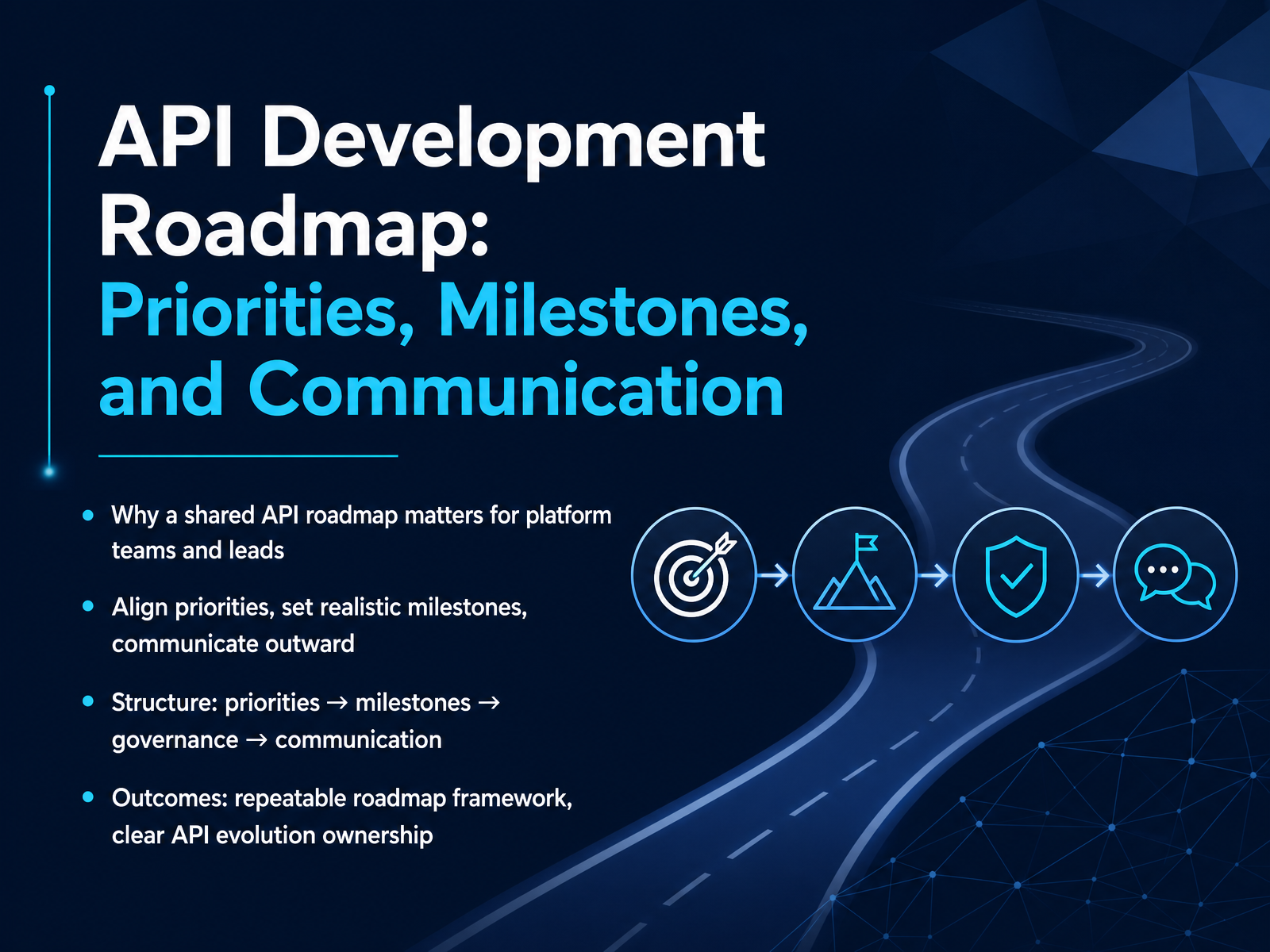
- 01API Development Roadmap: Priorities, Milestones, and CommunicationWelcome, everyone. If you lead an engineering team, manage API products, or own a platform, you know the pain of a roadmap that looks good on paper but falls apart in practice. Priorities shift, milestones slip, and communication breaks down. Today, we're going to fix that. This session is about building a shared API roadmap that actually works for platform teams and leads. We will align priorities, set realistic milestones, and communicate outward effectively. Our structure moves from priorities to milestones, into governance, and finally communication. By the end, you will have a repeatable framework and clear ownership for how your API evolves. Let's get started. First, let's look at why roadmaps fail without clear priorities.ideaplan.iocncf.iokindatechnical.com+21 min
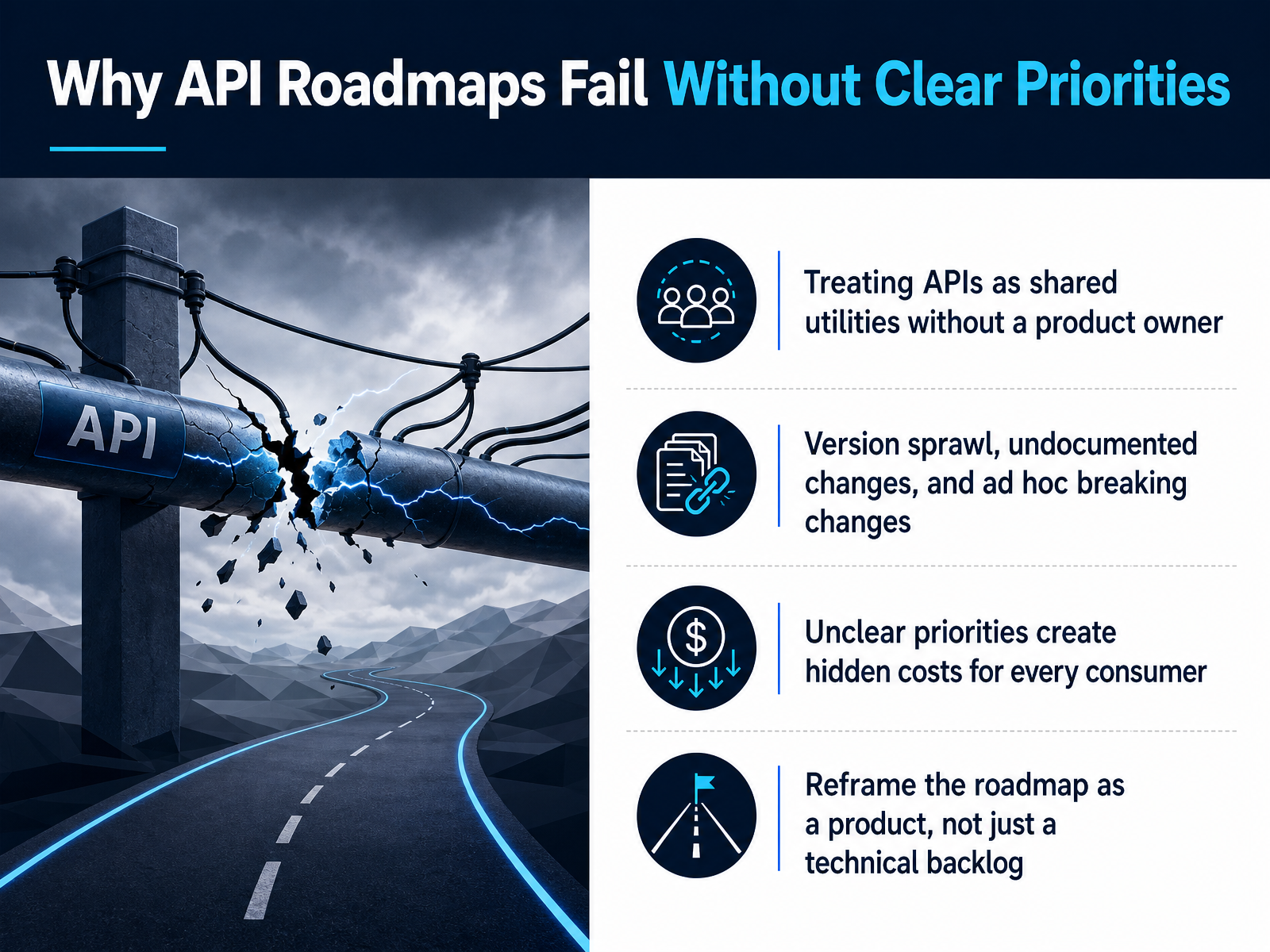
- 02Why API Roadmaps Fail Without Clear PrioritiesLet’s be direct about why most API roadmaps stall. Too often, APIs are treated as shared utilities, pipes that just need to stay open, with no single product owner accountable for their success. The result is predictable: version sprawl, undocumented changes, and breaking changes slipped in without warning. Each one lands as a hidden cost on every team downstream, and those costs compound quietly until integration becomes the bottleneck nobody planned for. The fix is to reframe the roadmap as a product, not just a technical backlog. That means naming the consumers, defining the outcomes, and accepting that every trade-off has a real user. When you treat the roadmap as a strategic product, every milestone has a purpose, and every change has an owner. That shift makes the difference between a platform that enables teams and one that slowly erodes them. So as we move forward, keep that lens on, because the cost of reactive API development is exactly what happens when we lose it.
 thenewstack.ioedilec.comtasrieit.com+22 min
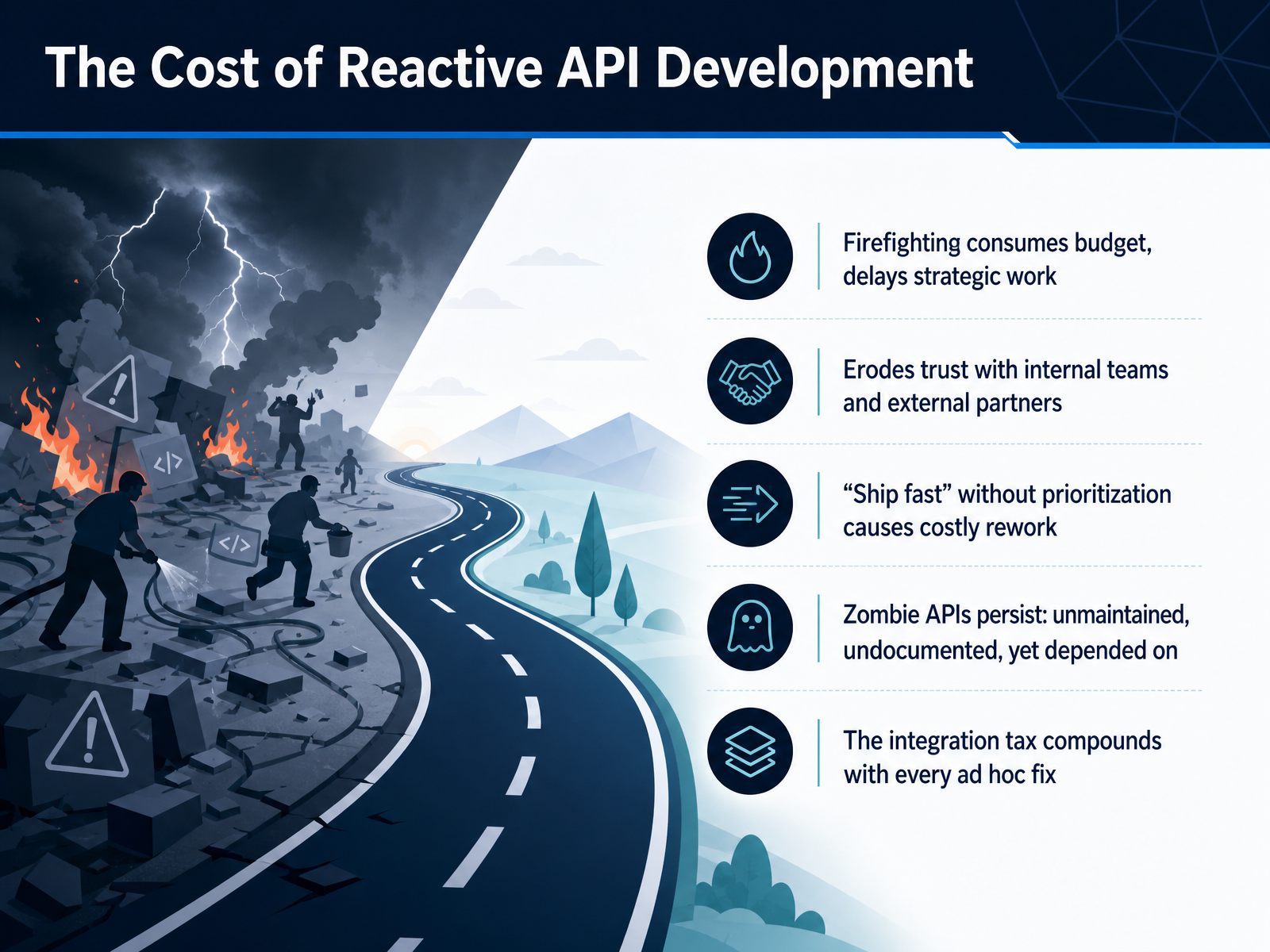
 - 03The Cost of Reactive API DevelopmentLet’s be honest about what reactive API development actually costs us. When every sprint turns into firefighting, we burn budget on incidents and emergency patches, and the strategic work that would prevent those fires keeps getting postponed. That pattern doesn't just strain our roadmap; it erodes trust. Internal teams and external partners start to see our APIs as unreliable, and once that confidence is gone, getting it back is slow and expensive. The pressure to ship fast without clear prioritization makes it worse. We cut corners, skip versioning discipline, and lock in designs we know are wrong, which guarantees costly rework later. Meanwhile, those zombie APIs keep accumulating. They stay unmaintained and undocumented, yet other services silently depend on them. Every ad hoc fix feels small in the moment, but collectively they compound into an integration tax that slows down every future initiative. The real cost isn't any single outage. It's the lost capacity for deliberate, strategic delivery.
 thenewstack.ioedilec.comtasrieit.com+21 min
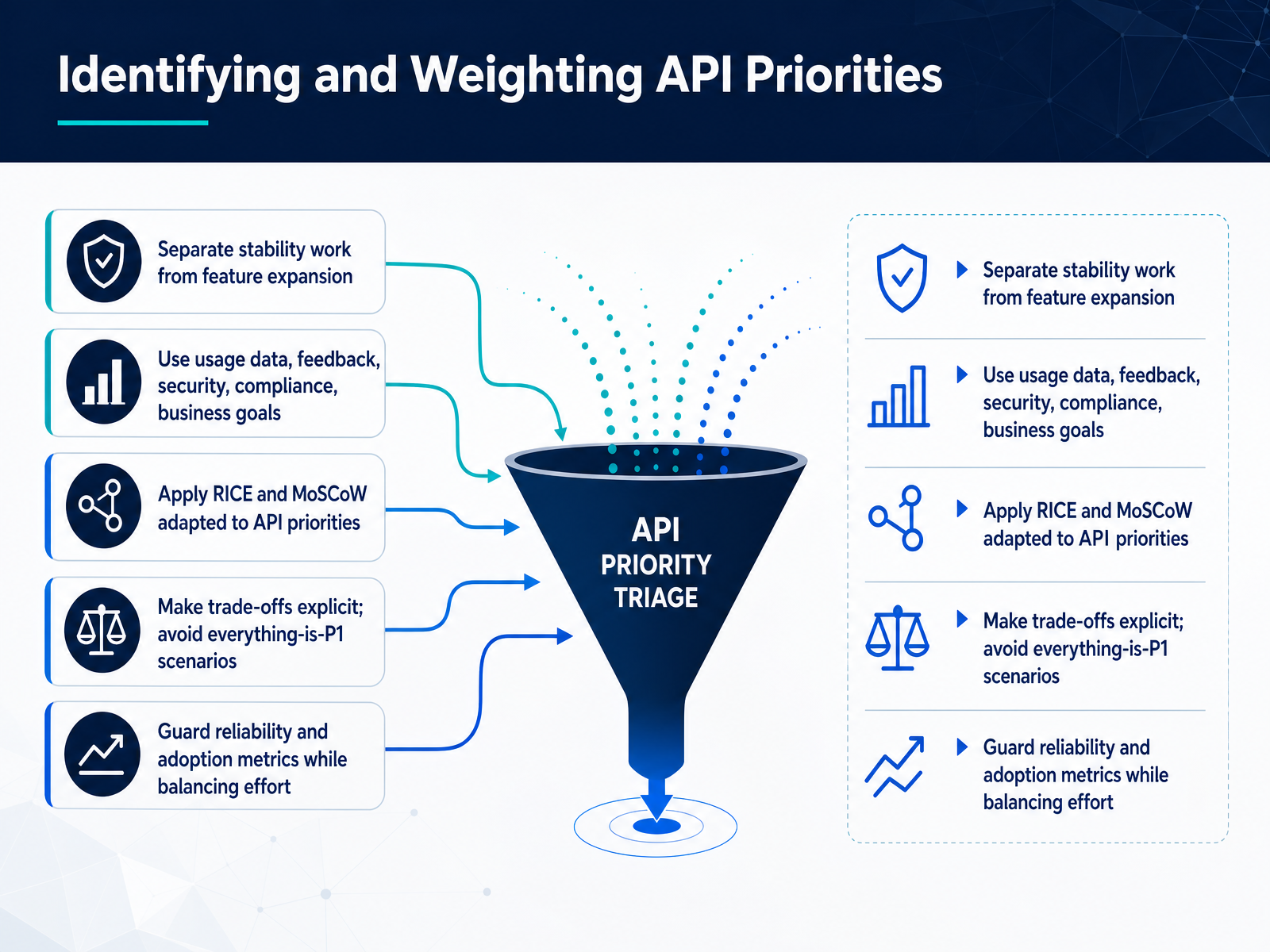
 - 04Identifying and Weighting API PrioritiesLet's talk about how we actually decide what goes on the roadmap. The first move is to separate stability work from feature expansion. They compete for the same engineering capacity, so they need distinct lanes. For weighting, we lean on usage data, developer feedback, security and compliance needs, and stated business goals. Frameworks like RICE or MoSCoW work well, but adapt them for API priorities. Reach might mean active consumers, and effort includes the migration burden we place on developers. The critical piece is making trade-offs explicit. We avoid the everything-is-P1 trap by forcing visible choices between reliability and new adoption. One useful pattern is tracking error rates per endpoint while watching time to first call. If we fix a shaky endpoint, we guard our adoption metrics at the same time. Guarding reliability and adoption while balancing effort is the goal. Now, let's turn to turning inputs into ranked work.
 ideaplan.iocncf.iokindatechnical.com+21 min
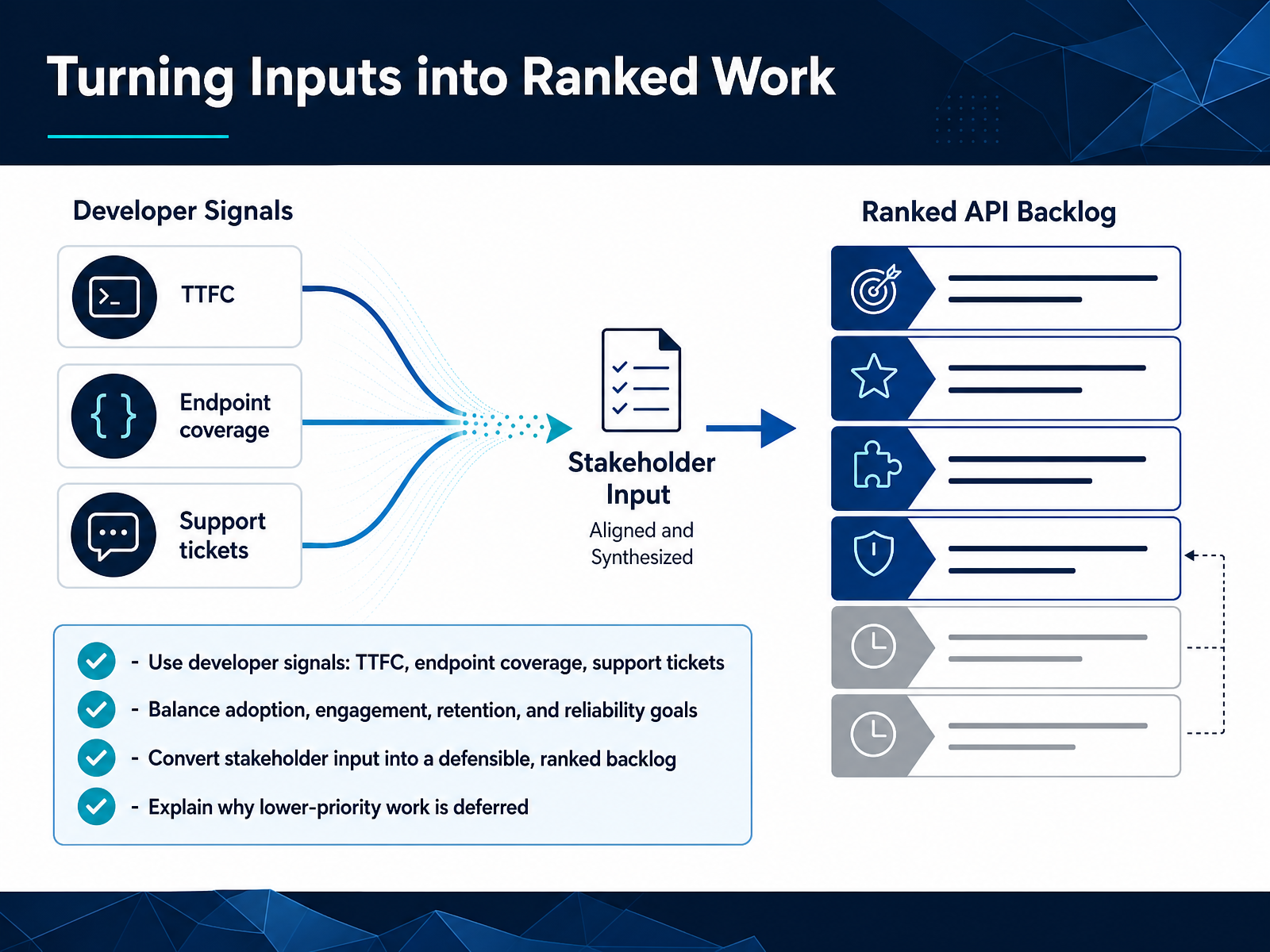
 - 05Turning Inputs into Ranked WorkSo how do we turn all that raw input into a ranked backlog we can defend? It starts with developer signals. Time to first call tells us if onboarding is smooth. Endpoint coverage shows us whether developers are actually using what we build, or just a fraction of it. And support tickets are pure gold, they point directly at friction and confusion. But we cannot optimize for those alone. We need balance. Adoption, engagement, retention, and reliability often pull in different directions, and the right mix shifts as the platform matures. Early on, adoption wins. Later, retention and reliability carry more weight. When we merge these signals with stakeholder requests, we end up with a defensible order of work. And the hard part is explaining the deferrals. Be transparent about why something waits. Maybe it serves too few developers, or the effort dwarfs the impact. Showing that reasoning builds trust and turns the roadmap into a genuine collaboration. With that ranked list ready, we can start thinking about how to sequence this work into concrete milestones.
 ideaplan.iocncf.iokindatechnical.com+21 min
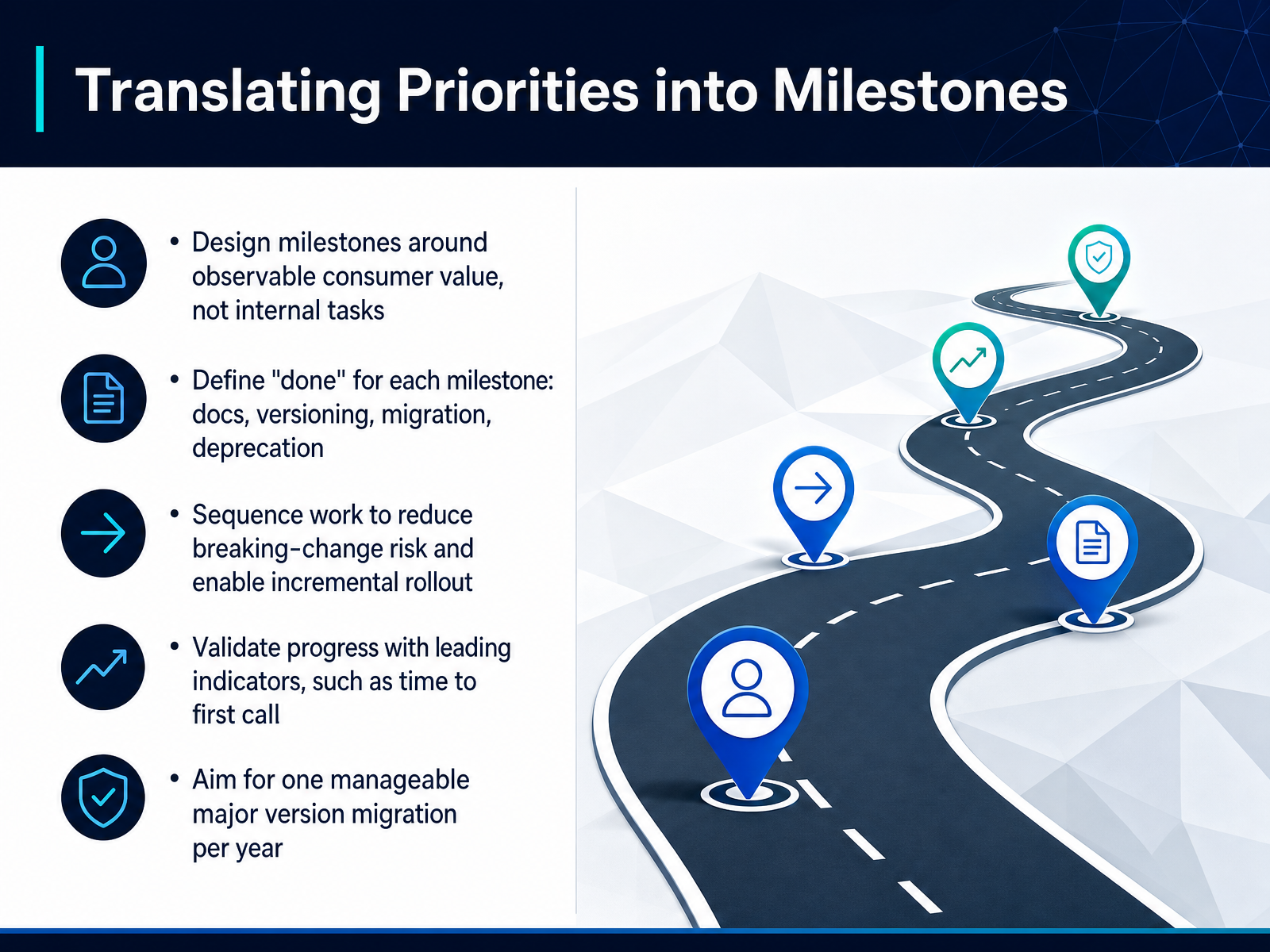
 - 06Translating Priorities into MilestonesNow let's translate those priorities into milestones that actually mean something. Design each milestone around observable consumer value, not internal tasks. Shipping a new endpoint isn't the milestone. Seeing developers successfully call it is. For every milestone, define what done really means: updated docs, versioning strategy, migration path, and deprecation plan. Then sequence the work to reduce breaking-change risk. Non-breaking additions first, clustered breaking changes into planned version bumps. Aim for one manageable major version migration per year. That's about all most consumers can absorb. Validate progress with leading indicators, not just output. Time to first call is your most diagnostic metric. If it's creeping up, your onboarding or documentation is falling behind. Concrete example: suppose you plan a v2 release. Done means a migration guide exists, deprecation headers are live on v1, and sunset is at least six months out. That gives your consumers time to move without panic. So the takeaway: milestones are promises to your developers, and you keep those promises by defining done, sequencing for safety, and measuring what matters. Up next, we'll look at dependencies, contracts, and cross-team alignment.
 ideaplan.iocncf.iokindatechnical.com+22 min
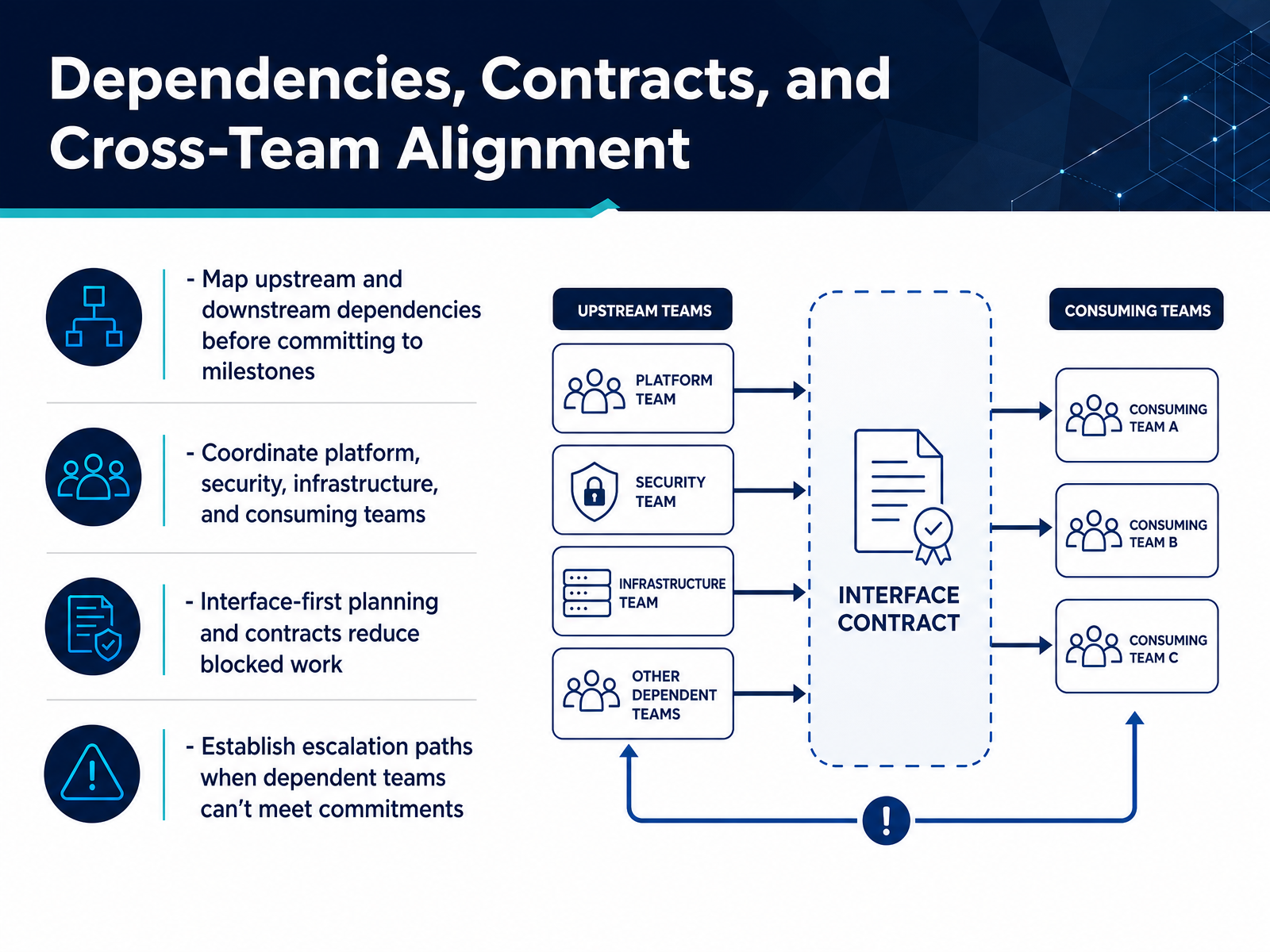
 - 07Dependencies, Contracts, and Cross-Team AlignmentNow let's talk about dependencies, contracts, and cross-team alignment. Before we commit to any milestone, we need to map the upstream and downstream dependencies. If the identity team is slammed and can't deliver the OAuth scopes we need, our timeline is fiction. So coordinate early with platform, security, infrastructure, and the teams who will consume your APIs. Interface-first planning is the key here. When we agree on contracts upfront, we reduce blocked work dramatically. Everyone builds against the same spec, and the integration risk drops off a cliff. And let's be realistic about the other part of this. We've all seen dependent teams miss their commitments. So establish escalation paths, like a weekly dependency review with executive sponsorship, before the slippage happens. That way, when a date slips, it's a planning conversation, not a fire drill.
 ideaplan.iocncf.iokindatechnical.com+21 min
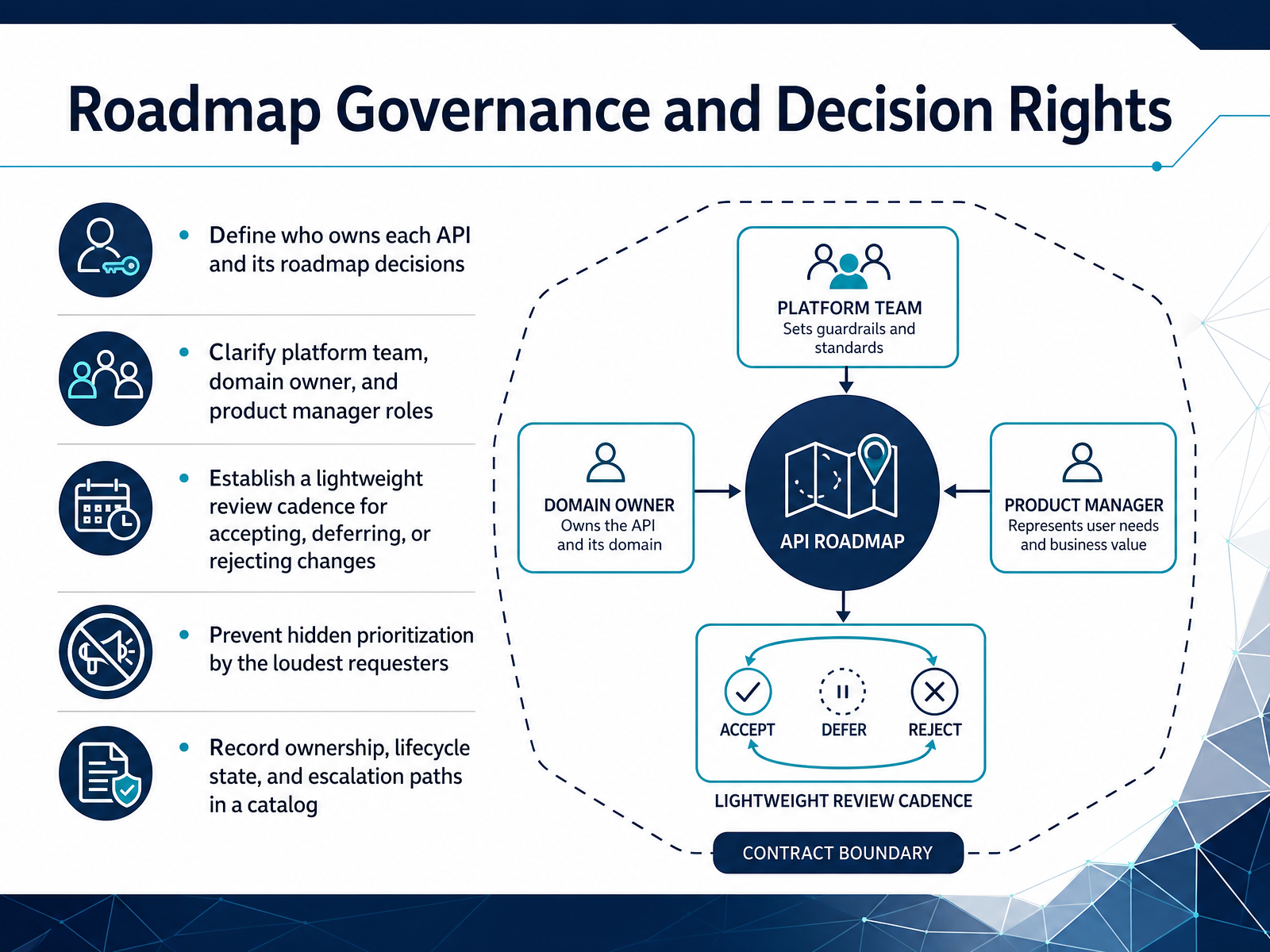
 - 08Roadmap Governance and Decision RightsNow let's talk about who actually makes the calls. Roadmap governance isn't about bureaucracy; it's about clarity. Every API needs a named owner with the authority to decide what changes go in, what gets deferred, and what gets rejected. Without that, you get hidden prioritization where the loudest internal team or the most urgent consumer shapes your roadmap by default. So define the roles explicitly. The platform team owns the shared infrastructure and governance baseline. Domain owners own the business outcomes and their API's roadmap within that baseline. Product managers own the sequencing and stakeholder communication. Then establish a lightweight review cadence, maybe monthly, where these three roles accept, defer, or reject proposed changes. Keep it short and evidence-based. Record every decision and the reasoning behind it in your API catalog, along with the lifecycle state and escalation path. That way, when someone asks why a feature slipped or an endpoint is being retired, you have a clear, auditable answer. Good governance isn't about slowing down; it's about making sure the right voices are heard in the right order. That clarity frees you to focus on the next challenge: balancing autonomy with guardrails.
 igtapi.comapiscout.devnewsletter.ikenna.co.uk+21 min
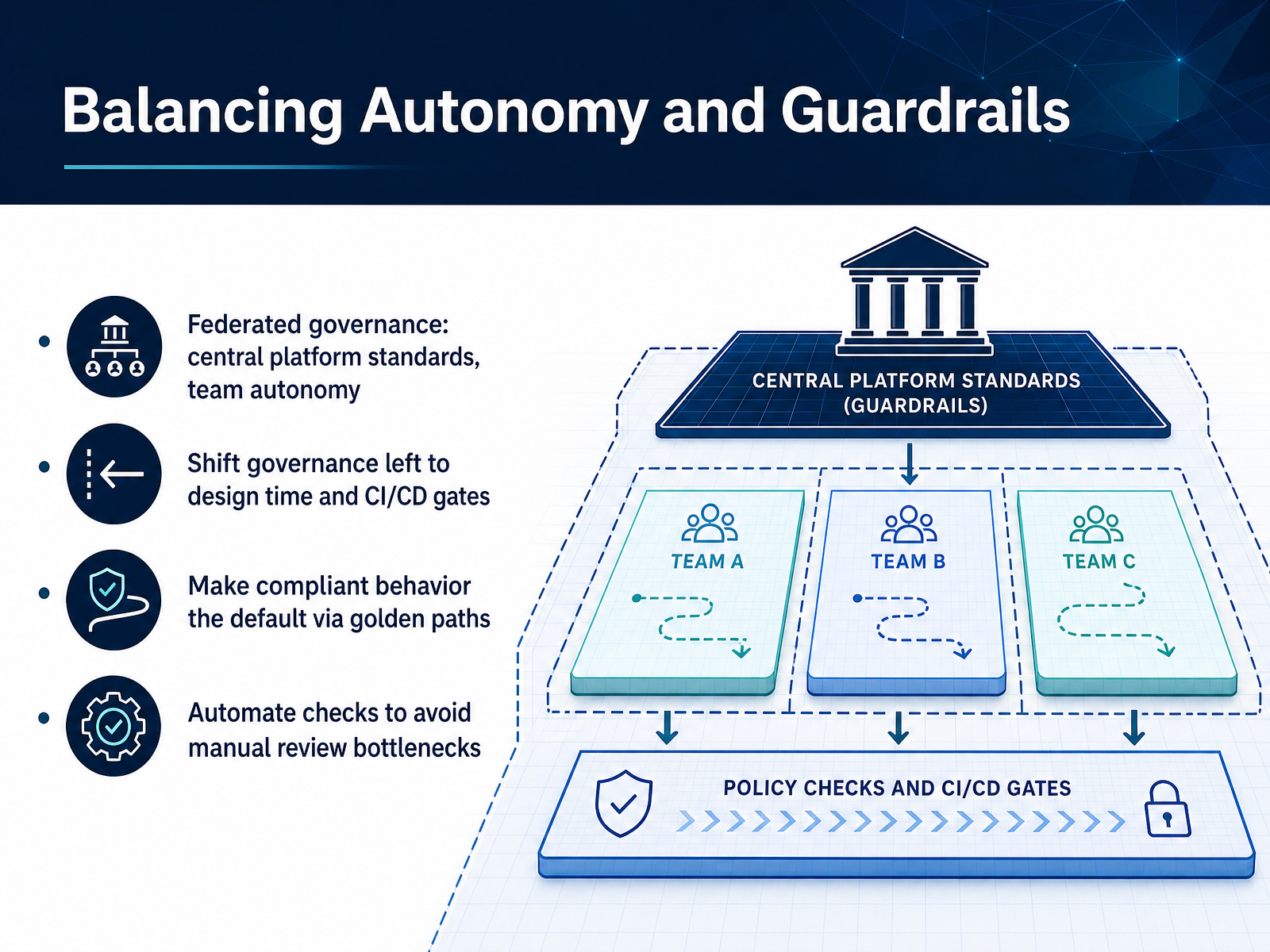
 - 09Balancing Autonomy and GuardrailsLet's talk about how we balance team autonomy with the guardrails that keep our platform consistent. The goal is federated governance, where central platform standards exist, but teams still own their API decisions within those boundaries. The key is to shift governance left, into design time and CI/CD gates, rather than reviewing everything after the fact. We want compliant behavior to be the default, not the exception. So we build golden paths, templates and patterns that make the right choices the easiest choices. When standards are enforced automatically through linting and contract checks, we avoid the manual review bottleneck that slows everyone down. Think of it this way, if engineers have to fight the process to do the right thing, they will find shortcuts. Our job is to make the right thing automatic. This sets the stage for how we'll communicate these decisions across the roadmap to different audiences.
 igtapi.comapiscout.devnewsletter.ikenna.co.uk+22 min
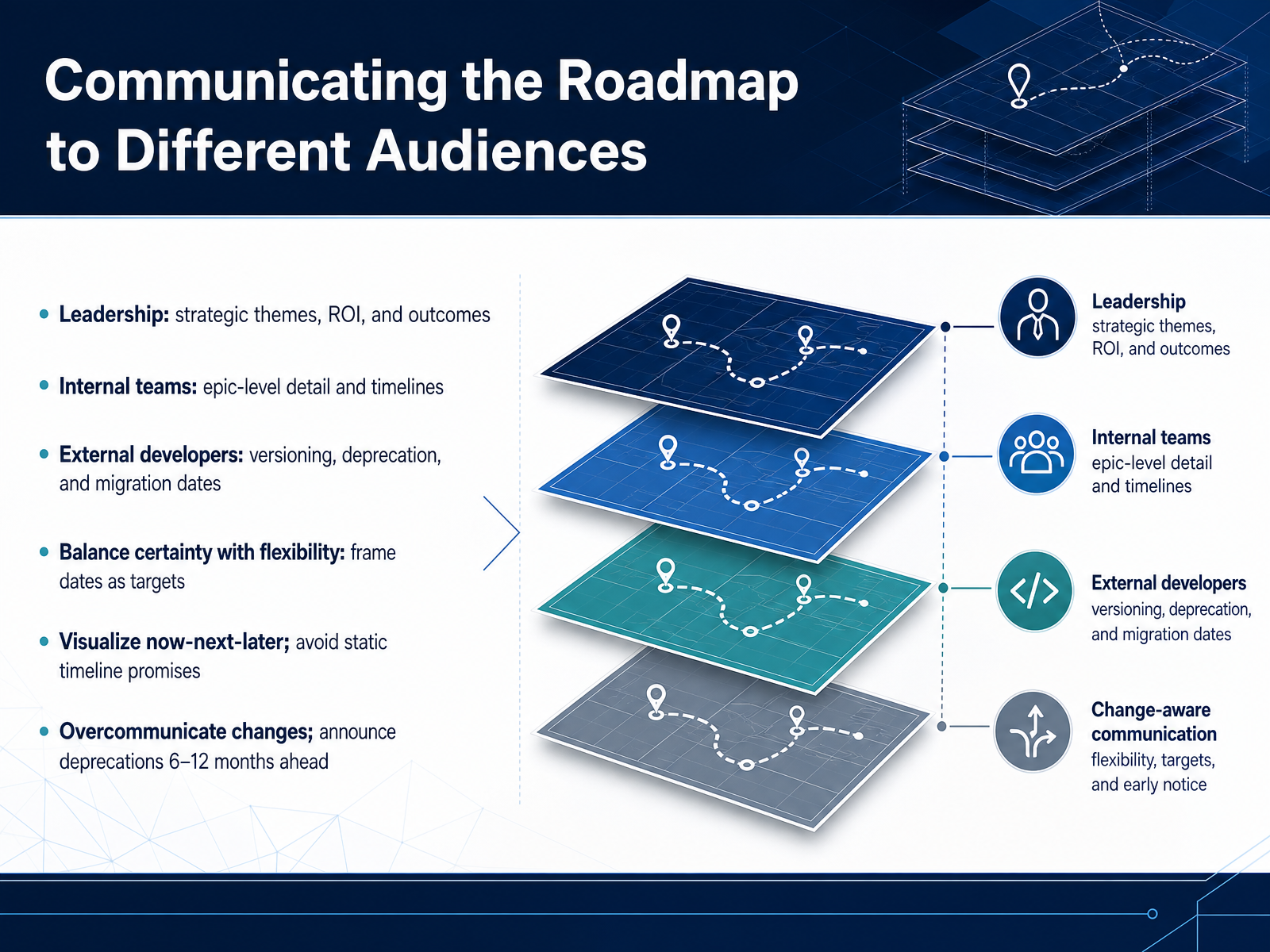
 - 10Communicating the Roadmap to Different AudiencesNow let’s talk about how we communicate this roadmap, because the same plan looks very different depending on who’s in the room. Leadership needs strategic themes, ROI, and outcomes. They want to know how this roadmap drives revenue or reduces risk. Internal engineering teams, though, need epic-level detail and timelines so they can plan dependencies and capacity with confidence. For external developers, the story is about versioning, deprecation, and migration dates. They need to know what’s changing, when they must act, and where the migration guide lives. And here’s the balancing act we all face: we have to frame dates as targets, not promises. Certainty is comforting, but flexibility is what keeps us credible when priorities shift. Use a now, next, later view. It shows momentum without locking us into a static timeline. Finally, overcommunicate. Announce deprecations six to twelve months ahead, and repeat the message through the changelog, email, and in API headers. If developers are surprised by a breaking change, we’ve failed as product managers. In short, tailor the message, protect the timeline, and treat communication as part of the product itself. Up next, we’ll dive into best practices for effective deprecation and change communication.
 daily.jovis.aiapiscout.devideaplan.io+22 min
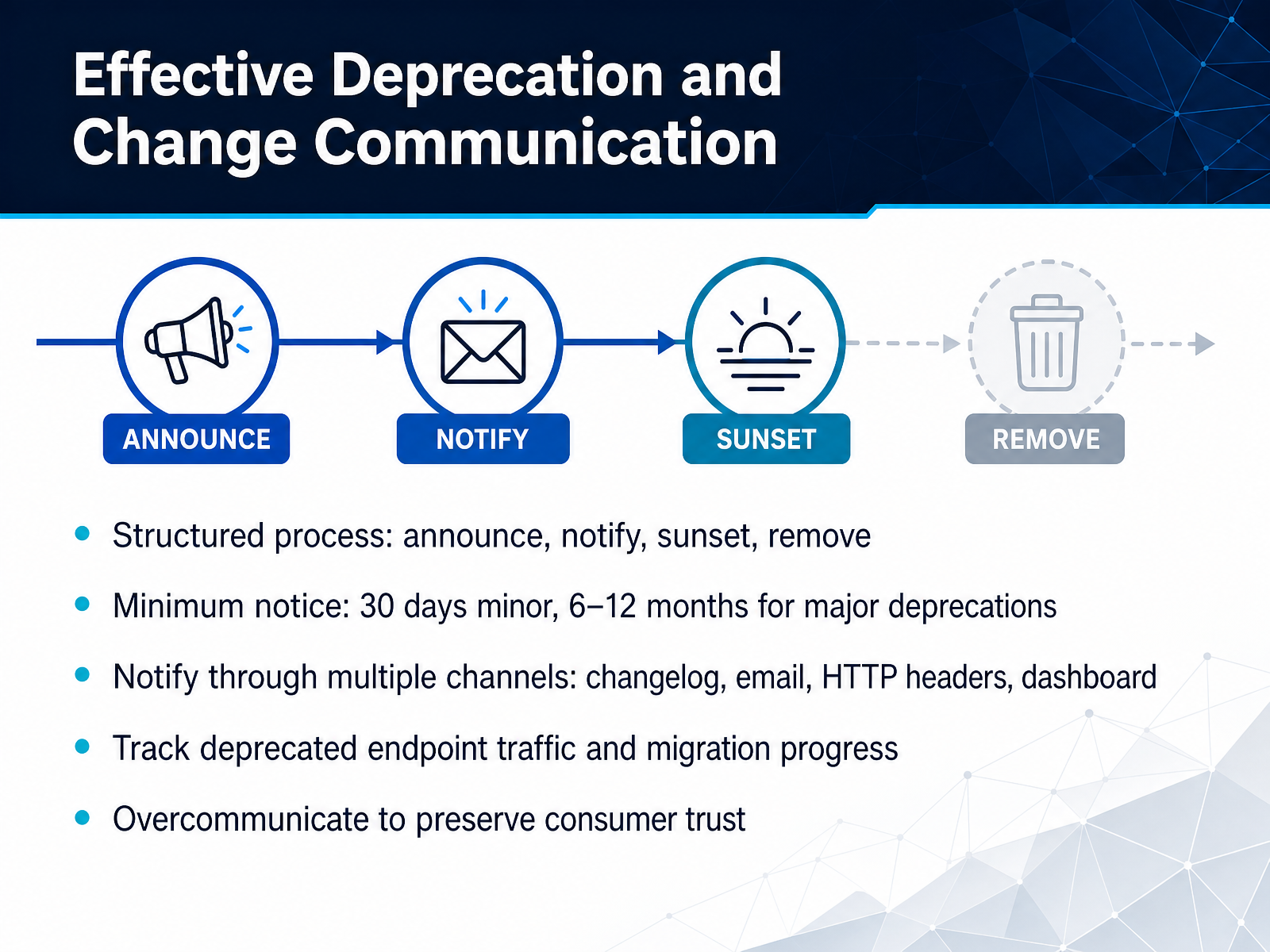
 - 11Effective Deprecation and Change CommunicationLet’s talk about the part of the roadmap that often gets the least attention but causes the most friction: deprecation and change communication. The goal is to make change feel predictable. Deprecation isn’t a single day; it’s a process. We announce, notify, sunset, and remove. Run those four steps publicly and consistently. For minor shifts, a thirty-day heads up is the floor. For major removals, plan six to twelve months of runway. Consumers build schedules around our API, so they need real time to migrate. Post updates where developers actually work: your changelog, targeted email, deprecation headers in the HTTP response, and dashboard notices. One channel is never enough. While that runs, watch the traffic. Which deprecated endpoints are still getting heavy calls? That data tells you who hasn’t migrated, so you can reach out directly before the cutoff. And overcommunicate. Developers forgive a delayed feature; they rarely forgive a silent break. A little extra notice preserves the trust that makes every future roadmap item easier to ship. We’ll move on to practical roadmap artifacts and formats.
 daily.jovis.aiapiscout.devideaplan.io+22 min
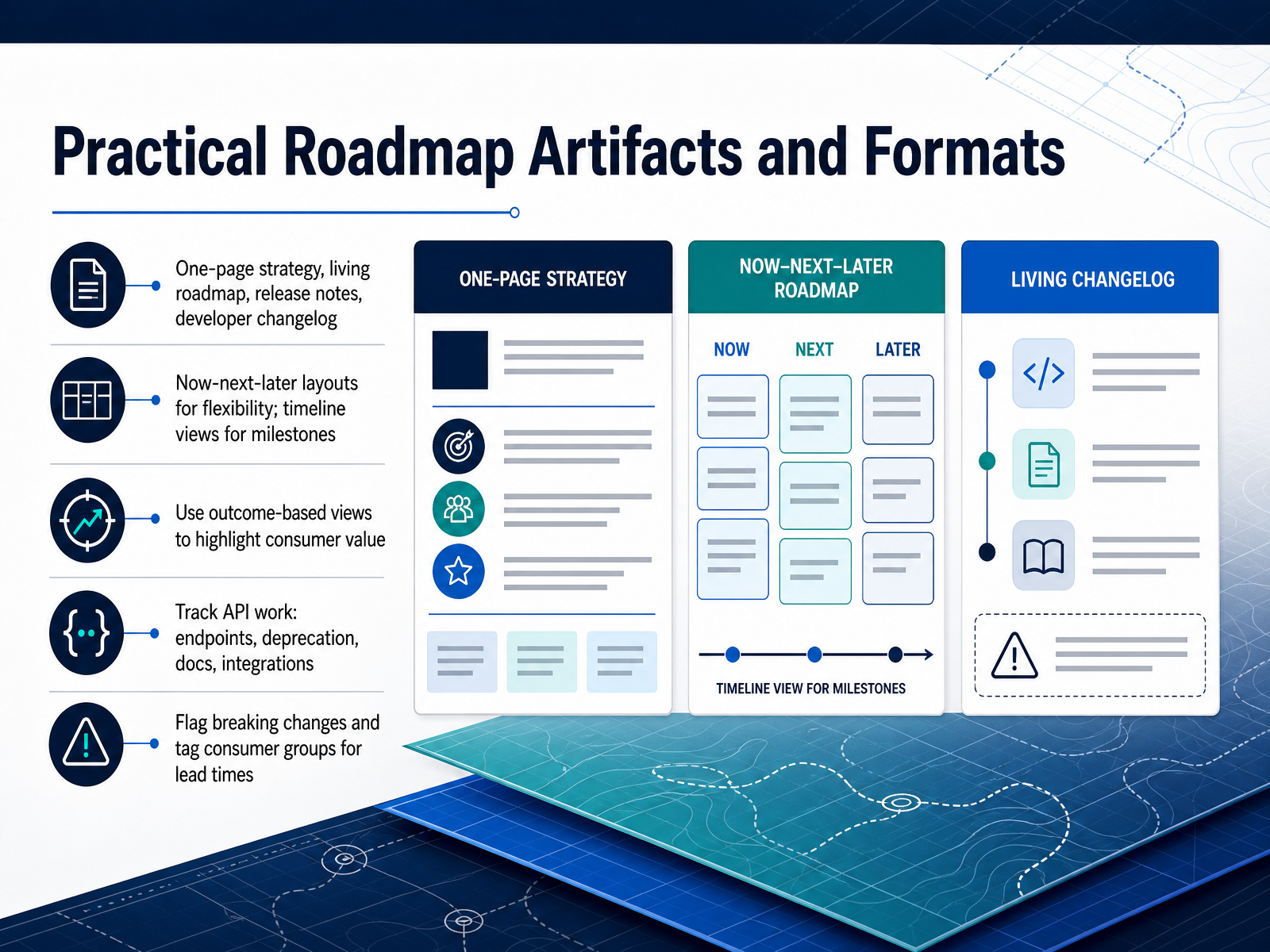
 - 12Practical Roadmap Artifacts and FormatsNow let's talk about the artifacts you'll actually use day to day. The core toolkit is simple: a one-page strategy, a living roadmap, release notes, and a developer changelog. The details live in the formats. For planning, use now-next-later layouts to preserve flexibility. Save timeline views for committed milestones where dates really matter to consumers. And wherever you can, frame items by outcome, not output. Say what value the consumer gains, not just which endpoint you're building. As you structure this work, track it across four dimensions: the API endpoints themselves, deprecations, documentation, and integrations. That way, nothing falls through the cracks. Finally, the non-negotiable: breaking changes get flagged visually and tagged to specific consumer groups. Internal teams can handle short lead times. Public developers cannot. Give them six to twelve months of notice, and make that timeline visible on the roadmap itself. If your roadmap doesn't show who is impacted and when they need to act, it's a schedule, not a communication tool. This lays the groundwork for the next question: how we actually measure whether that roadmap is hitting the mark.
 daily.jovis.aiapiscout.devideaplan.io+21 min
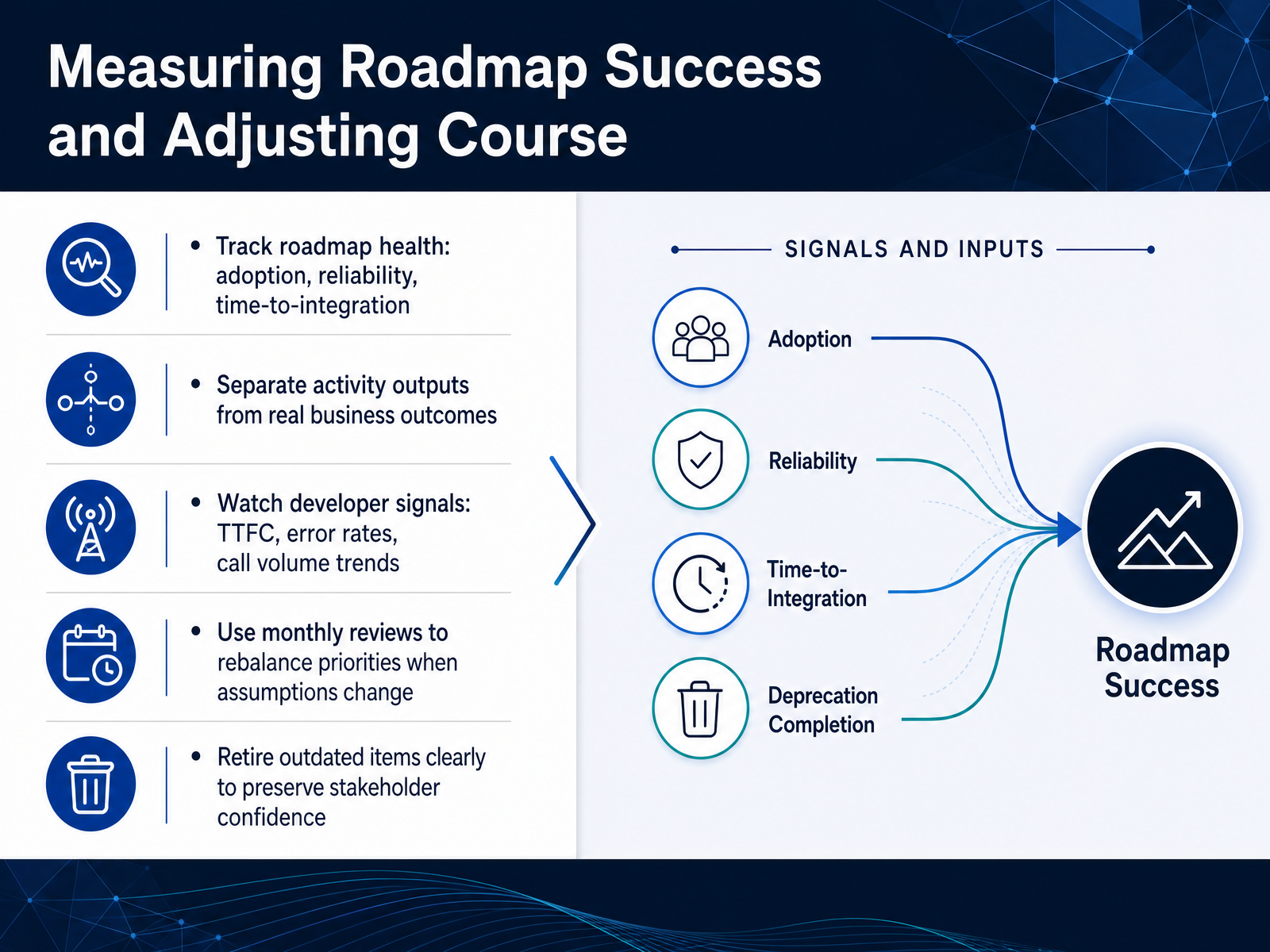
 - 13Measuring Roadmap Success and Adjusting CourseOnce your roadmap is in motion, measuring success becomes its own discipline. We track roadmap health across three dimensions. Adoption tells us if developers are actually integrating. Reliability tells us if they can trust it in production. Time to integration tells us if our onboarding friction is shrinking or growing. But here is the crucial distinction. Activity outputs like calls per day or endpoints deployed are not the same as business outcomes like revenue per developer or retention. Do not let a busy dashboard fool you into thinking value is being delivered. Watch the developer signals closely. Time to first call trends, error rates segmented by endpoint, and call volume direction. A flat volume from an active customer often means they have hit a limit or found an alternative. Use monthly reviews to rebalance priorities when assumptions change. Metrics are only useful if they reshape the roadmap. And when an item is no longer serving its purpose, retire it clearly and publicly. This protects stakeholder confidence far better than letting outdated commitments linger. Keep the discipline and the roadmap stays honest.
 ideaplan.iocncf.iokindatechnical.com+22 min
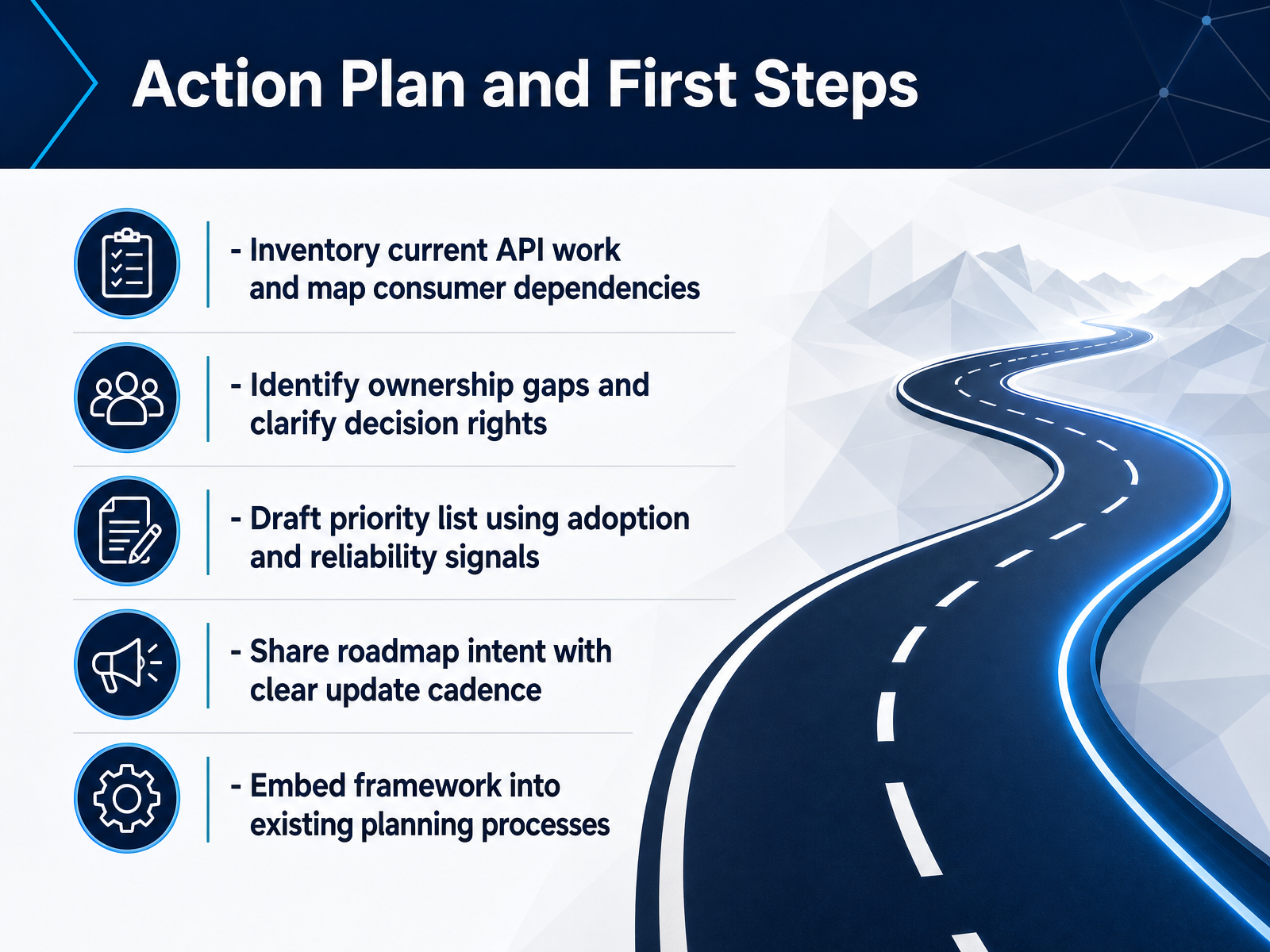
 - 14Action Plan and First StepsLet’s turn all of this into action—starting this week, not next quarter. First, take a hard look at the APIs you already run. Inventory that work, and map who actually depends on each endpoint. You cannot prioritize what you do not fully see. Next, close the ownership gaps. Every API needs a named owner and clear decision rights—who approves a breaking change, who sets the deprecation timeline. If that is fuzzy, every roadmap conversation will stall. Then build your priority list using the signals we covered: adoption depth, error rates, and time to first call. Let evidence, not volume, drive the sequence. Share that draft roadmap openly, with a stated cadence for updates. Stakeholders will tolerate tough trade-offs far better than silence. Finally, embed this framework into your existing planning cycles—your quarterly reviews, your backlog grooming, your OKRs. If it is not part of the rhythm, it will not survive. The goal is not a perfect plan. It is a transparent, measurable one that lets your whole organization move together. Thank you for your time today, and go make that first milestone real.
 ideaplan.iocncf.iokindatechnical.com+21 min
Take the deck with you
Download this course as a file — free, no sign-up needed.
- PDF handoutEvery slide page, ready to print or share.15 pages · 3.6 MBDownload
- Narrated PowerPointThe deck that presents itself — every slide carries the digital human's narration video.15 pages · 14.3 MBDownload
- PowerPoint slidesThe full deck as a .pptx — open it in PowerPoint, Keynote, or Google Slides.15 pages · 3.5 MBDownload
Free to use in your own training — please keep the PersonWise credit page at the end.
Have your own deck? Turn it into a course
Sources consulted
Web sources consulted while building this course.
- API Product Metrics: What to Track and Why It Matters — ideaplan.io
- 12 metrics to measure API strategy and business success | CNCF — cncf.io
- kindatechnical() | A Guide to API Design and Development - Building an API Platform Strategy — kindatechnical.com
- KPIs for APIs: Key Metrics to Elevate Your Business Strategy — blog.axway.com
- The Top 10 API Metrics to Demonstrate Performance and ... — readme.com
- Why Don’t API Platform Efforts Deliver? - The New Stack — thenewstack.io
- Common mistakes in API platform design and how to avoid them | Edilec — edilec.com
- Platform Engineering Failures: The 7 We See Most Often | Tasrie IT Services — tasrieit.com
- The Gateway Is the Easy Part — Rajeev Ramani — itfrombit.com.au
- The API-First Fallacy: Why Building APIs Before Products Fails — thegarnetjournal.com
- The IGT-API Framework - The IGT-API Framework — igtapi.com
- API Governance for Enterprise Teams 2026 | APIScout — apiscout.dev
- The Reason API Governance Fails at Scale — newsletter.ikenna.co.uk
- API Governance: Framework and Best Practices — apisix.apache.org
- API Governance Guide for Platform Engineering Teams — api7.ai
- From Technical Chaos to Strategic Alignment: Mastering the API Product Roadmap | Drafted by Machines — daily.jovis.ai
- API Changelog & Versioning Communication 2026 | APIScout — apiscout.dev
- API Roadmap Template for PowerPoint | IdeaPlan — ideaplan.io
- How to Communicate Your Roadmap to Stakeholders — productplan.com
- Mastering the Art of API Product Roadmaps: From Vision to Consumption | Drafted by Machines — daily.jovis.ai