Begin
14 pages · ~28 min
Teaching AI Literacy: Practical Workflow
A practical workflow for educators to teach AI literacy, covering core concepts and hands-on strategies for integrating AI skills into any classroom.
A digital instructor presents all 14 pages. Hold “Ask” at any point and ask out loud — the answer comes from this course. No sign-up needed.
What you’ll learn
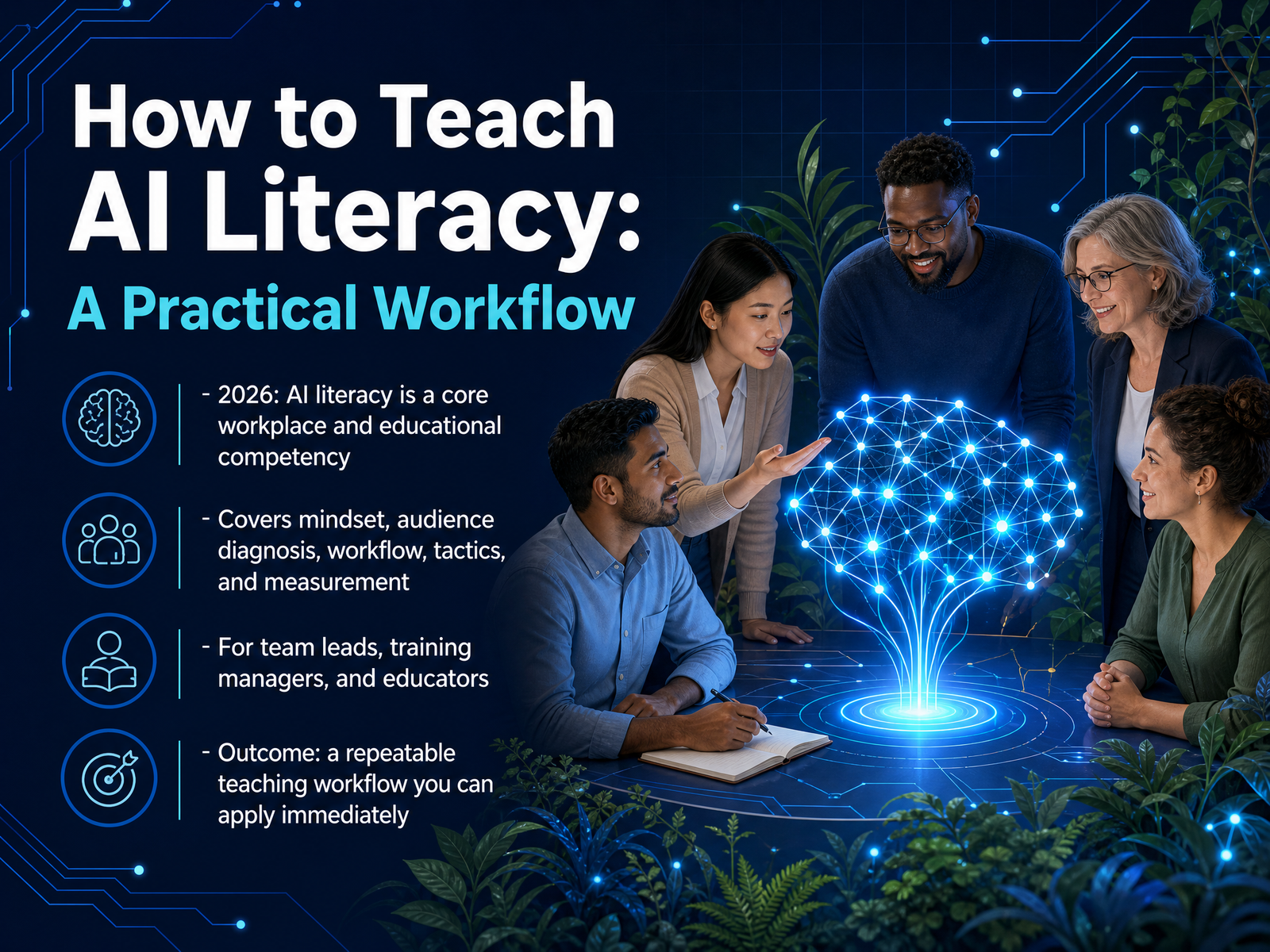
- 01How to Teach AI Literacy: A Practical WorkflowWelcome. By 2026, AI literacy is a core competency, not a technical specialty. It applies across every workplace and every classroom. In this session, we will walk through a practical, repeatable workflow for teaching AI literacy. We will cover the mindset shift, how to diagnose your audience, a proven teaching sequence, and the specific tactics that make it stick. You will leave with a method you can apply immediately. We will draw on established frameworks, like the US Department of Labor’s model, and focus on what actually works. The goal is simple. Equip your teams or learners to use, evaluate, and direct AI responsibly and effectively. Let's begin with what AI literacy really means. This will set the foundation for the entire workflow. Ready? Let's dive in.dol.govdol.govdol.gov+22 min
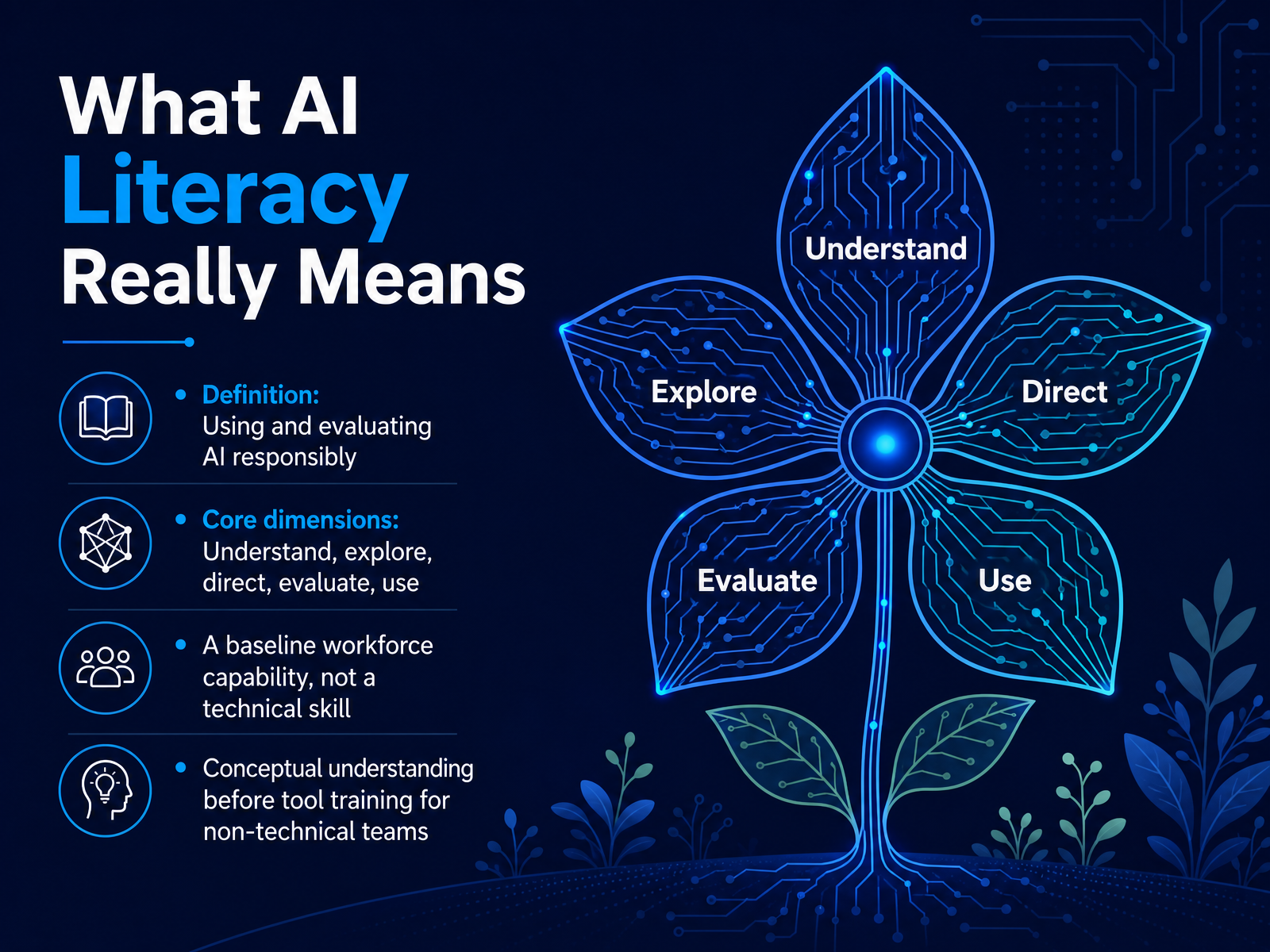
- 02What AI Literacy Really MeansLet’s clarify what we mean by AI literacy, because it’s not what most people think. It’s not a technical skill. It’s not about learning to code. AI literacy is a baseline workforce capability. It means using and evaluating AI responsibly, with a primary focus on generative AI. Think of it as the workplace equivalent of digital literacy. The framework we use has five core dimensions: understand, explore, direct, evaluate, and use. Let’s take them one at a time. Understand: know what AI is and how it works. Explore: see how AI applies to real tasks in your role. Direct: craft prompts that get useful results. Evaluate: check outputs for accuracy, relevance, and bias. And finally, use responsibly: protect sensitive information and follow your organization’s policies. Here’s the key takeaway for your team: you don’t need technical mastery. You need a clear mental model and the vocabulary to work with these tools confidently. For non-technical teams, start with conceptual understanding, not tool training. Build that foundation first. This matters not just for productivity, but also for governance and trust in your organization. Now, let’s talk about why this workflow matters in 2026.
 dol.govdol.govdol.gov+22 min
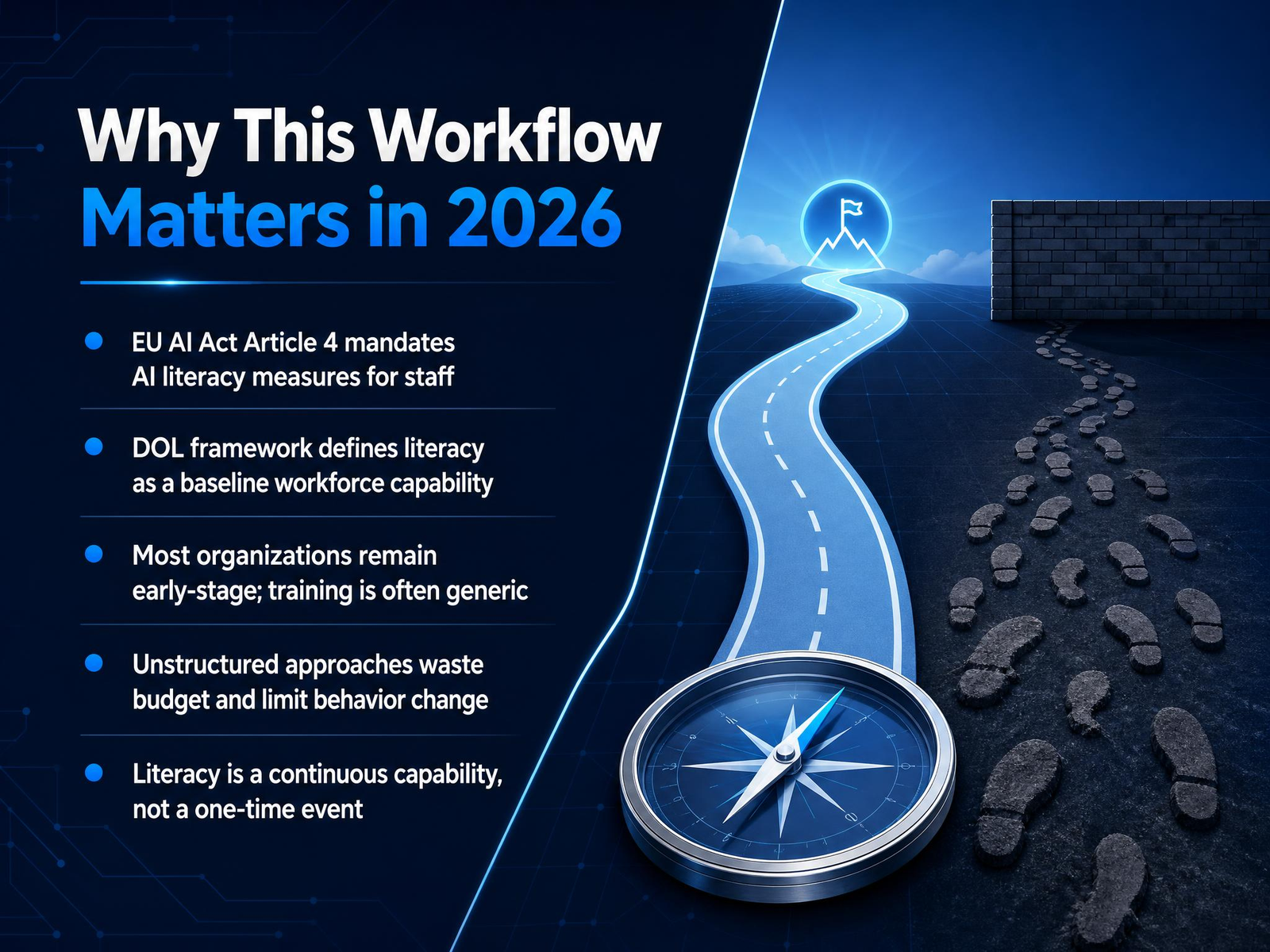
 - 03Why This Workflow Matters in 2026Let’s look at why this workflow matters in 2026. Compliance is now real. The EU AI Act, Article 4, requires you to ensure your staff have sufficient AI literacy. Enforcement begins in August 2026. And the U.S. Department of Labor now defines AI literacy as a baseline workforce capability, not a technical specialty. But here’s the gap. Most organizations are still early stage. Their training is generic. It’s a one-size-fits-all video that everyone clicks through and forgets. That approach wastes budget and, worse, it doesn’t change behavior. The key takeaway? Literacy isn’t a one-time event. It’s a continuous capability that must keep pace with the tools. This workflow builds that ongoing discipline. It connects compliance requirements to actual skill development, so you can show progress, measure impact, and stay ahead of the regulators. Now, let’s ground this in reality. Next, we’ll look at the audience reality check.
 dol.govdol.govparkerpoe.com+21 min
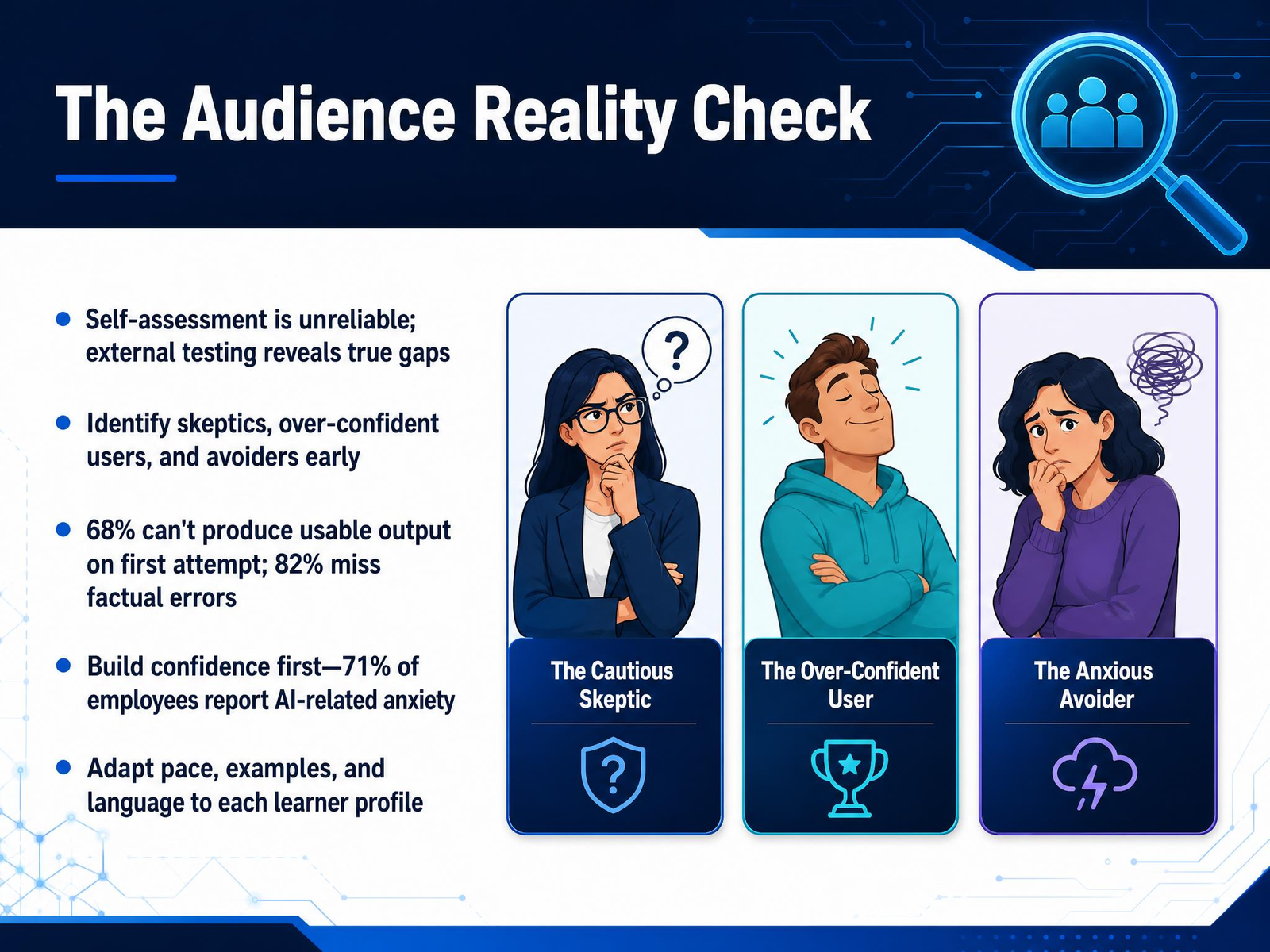
 - 04The Audience Reality CheckNow let's talk about the audience reality check. Here is the hard truth: your learners will tell you they are fine with AI, and then they will fail the actual test. Self-assessment is unreliable because AI tools feel easy to use. People overestimate their skills. So you need external testing to reveal the real gaps. Start by identifying your skeptics, your over-confident users, and your avoiders early. The numbers back this up. In one study, sixty-eight percent of people could not produce usable AI output on the first attempt. And eighty-two percent missed factual errors in what the AI generated. That is a massive hidden risk. But do not lead with the gaps. Build confidence first. Seventy-one percent of employees report anxiety about AI. If you lead with criticism, they will shut down. Instead, adapt your pace, your examples, and your language to each learner profile. Some need basics, some need verification skills, and some need to be challenged. Identify who is in the room, measure their real ability, and tailor the track to them. That is the foundation we will build on as we walk through the five-stage teaching workflow.
 aisa.togov.ukgov.uk+22 min
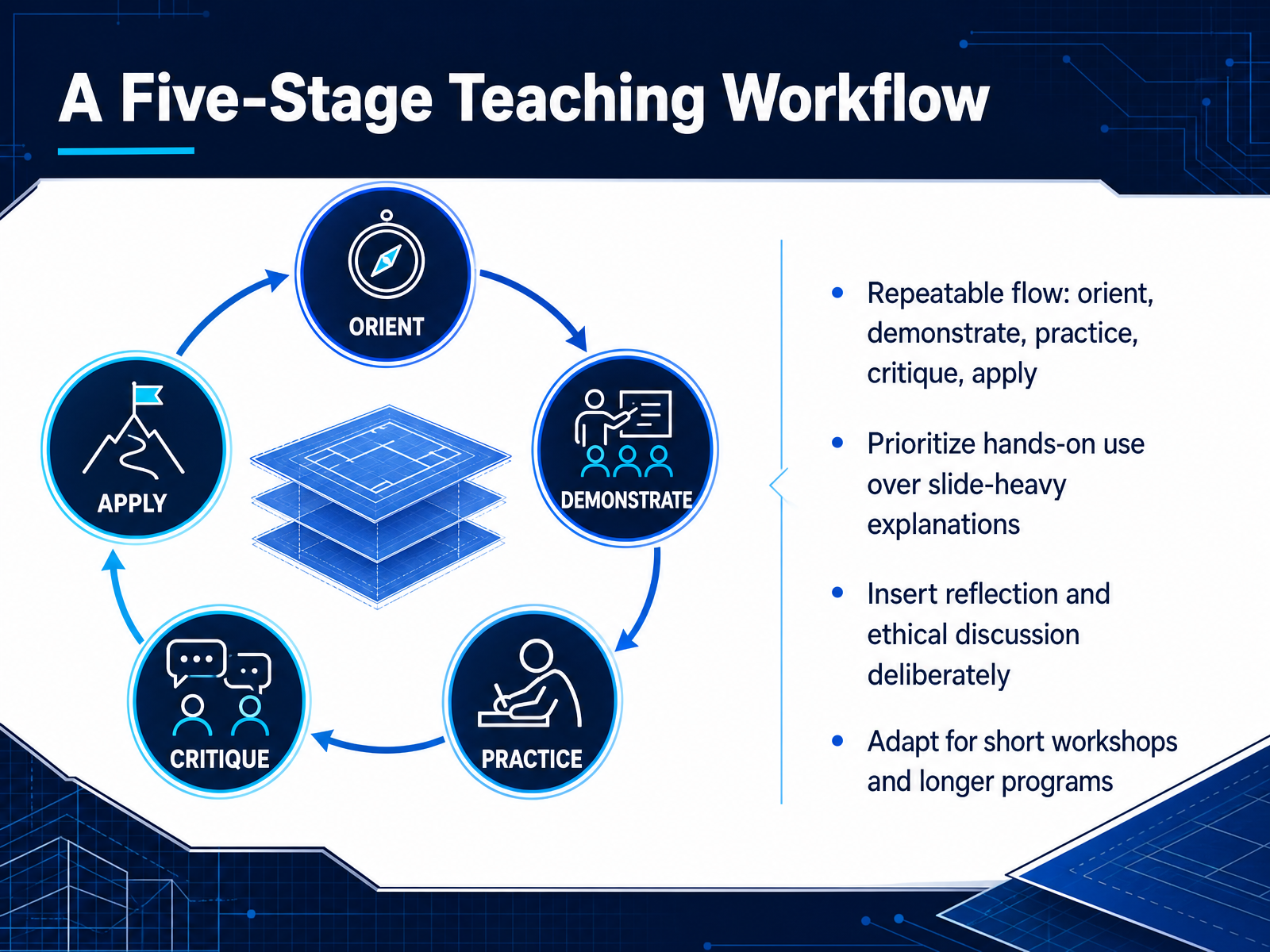
 - 05A Five-Stage Teaching WorkflowNow let’s put these ideas into a repeatable flow. Think of it as five stages: orient, demonstrate, practice, critique, and apply. You start by orienting learners to the tool and its purpose. Then you demonstrate a real task. Next, they practice hands-on. After that, they critique the output and their own process. Finally, they apply the skill to a realistic job scenario. This flow keeps the focus on doing, not just listening. So minimize slide-heavy explanations and get people using the tools early. Also, deliberately insert moments for reflection and ethical discussion. Don’t treat ethics as an add-on. Instead, weave it into the critique stage. And the beauty of this workflow is that it scales. You can run a condensed version in a two-hour workshop or stretch it across a multi-week program. The structure stays the same; you just adjust the depth and number of practice cycles. Now, let’s look at the core concepts you’ll want to teach first to make this workflow effective.
 ailitlab.orgdol.govedtechbooks.s3.us-west-2.amazonaws.com+22 min
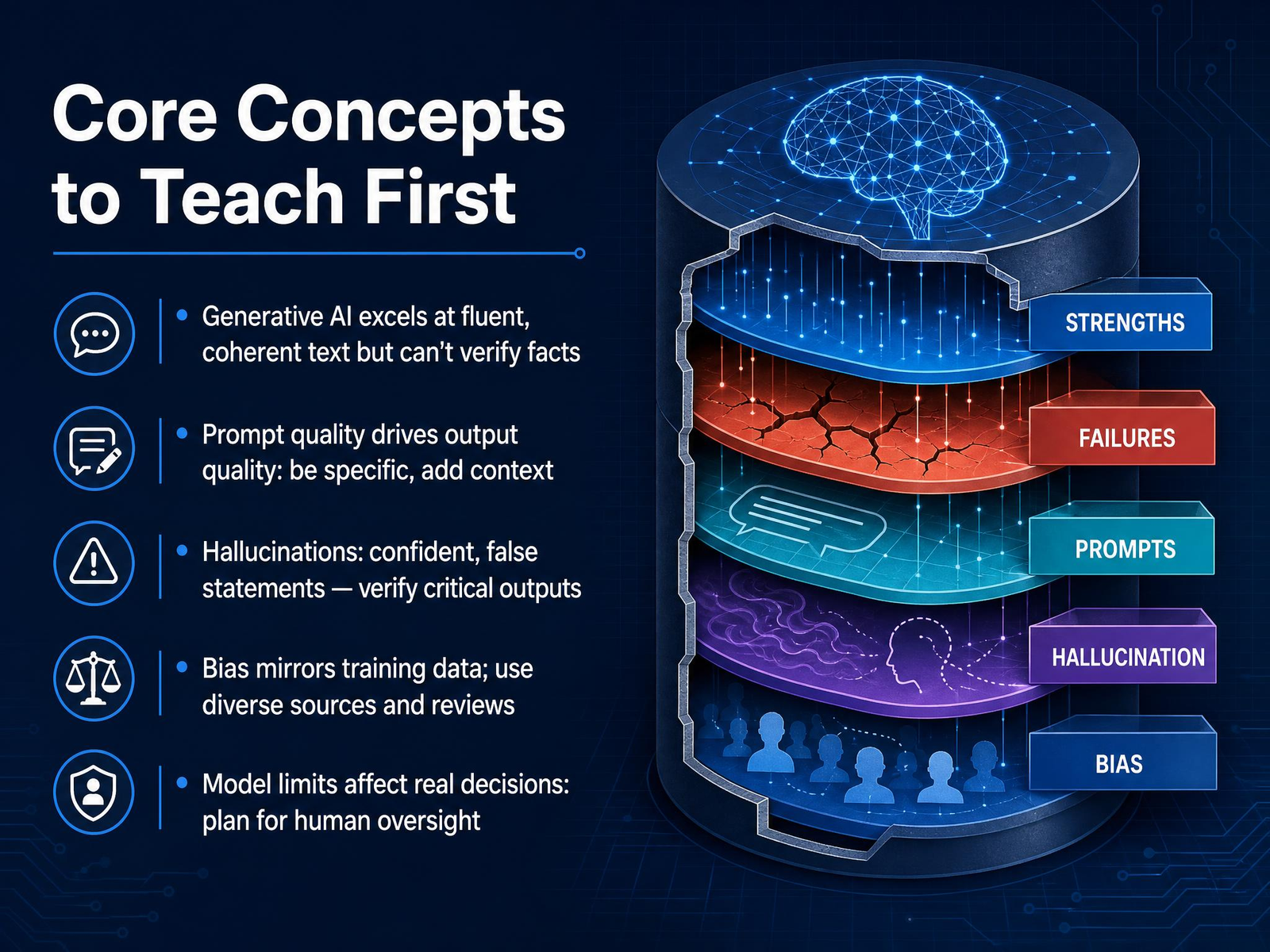
 - 06Core Concepts to Teach FirstNow let's cover the core concepts your team needs to understand before they start prompting. First, generative AI excels at producing fluent, confident text, but it cannot verify facts. Second, prompt quality directly drives output quality. Vague prompts yield vague answers, so teach your team to be specific and add context. Third, address hallucinations directly. These are confident, false statements that sound plausible. Explain that models are pattern predictors, not fact-checkers, and every critical output must be verified. Fourth, bias mirrors training data. AI can amplify stereotypes, so instruct your team to use diverse sources and get a second review on sensitive content. Finally, remember model limits affect real decisions. An AI can draft a plan, but human oversight is non-negotiable for anything that impacts people or projects. These five points form the foundation. Once your team internalizes them, they will use AI with healthy skepticism and better judgment. Next, we will look at designing safe practice activities.
 link.springer.com2 min
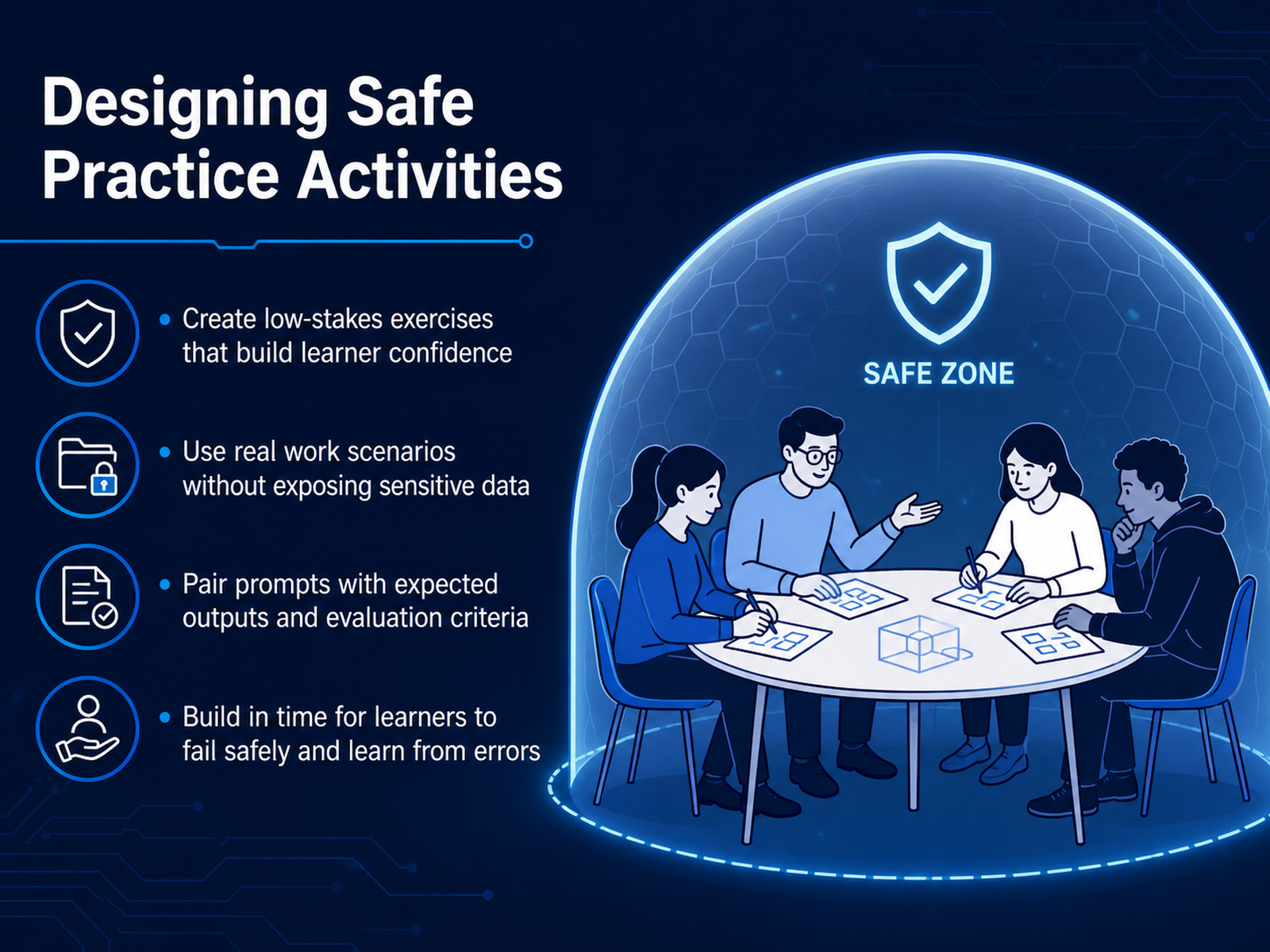
 - 07Designing Safe Practice ActivitiesNow let's talk about how we design practice activities that are safe. The goal here is to build confidence, not to test perfection. Start with low-stakes exercises where the cost of a mistake is low. A learner should feel comfortable trying a prompt, getting it wrong, and adjusting it. Next, use real work scenarios in the exercises, but never expose sensitive data. Strip out client names, internal figures, and anything confidential. You want the task to feel familiar without creating risk to your organization. Third, don't just give a prompt. Pair each prompt with the expected output and the criteria you'll use to evaluate it. This way, learners know exactly what good looks like and can self-check their work. Finally, build in time to fail safely. Have learners analyze a flawed AI output and fix it together. This teaches them to spot errors and correct course. Keep the practice focused on judgment, not just tool usage. This builds the habits they'll carry into their day-to-day work. Next, we'll look at how to teach learners to critically evaluate the outputs they receive.
 ailitlab.orggov.uk1 min
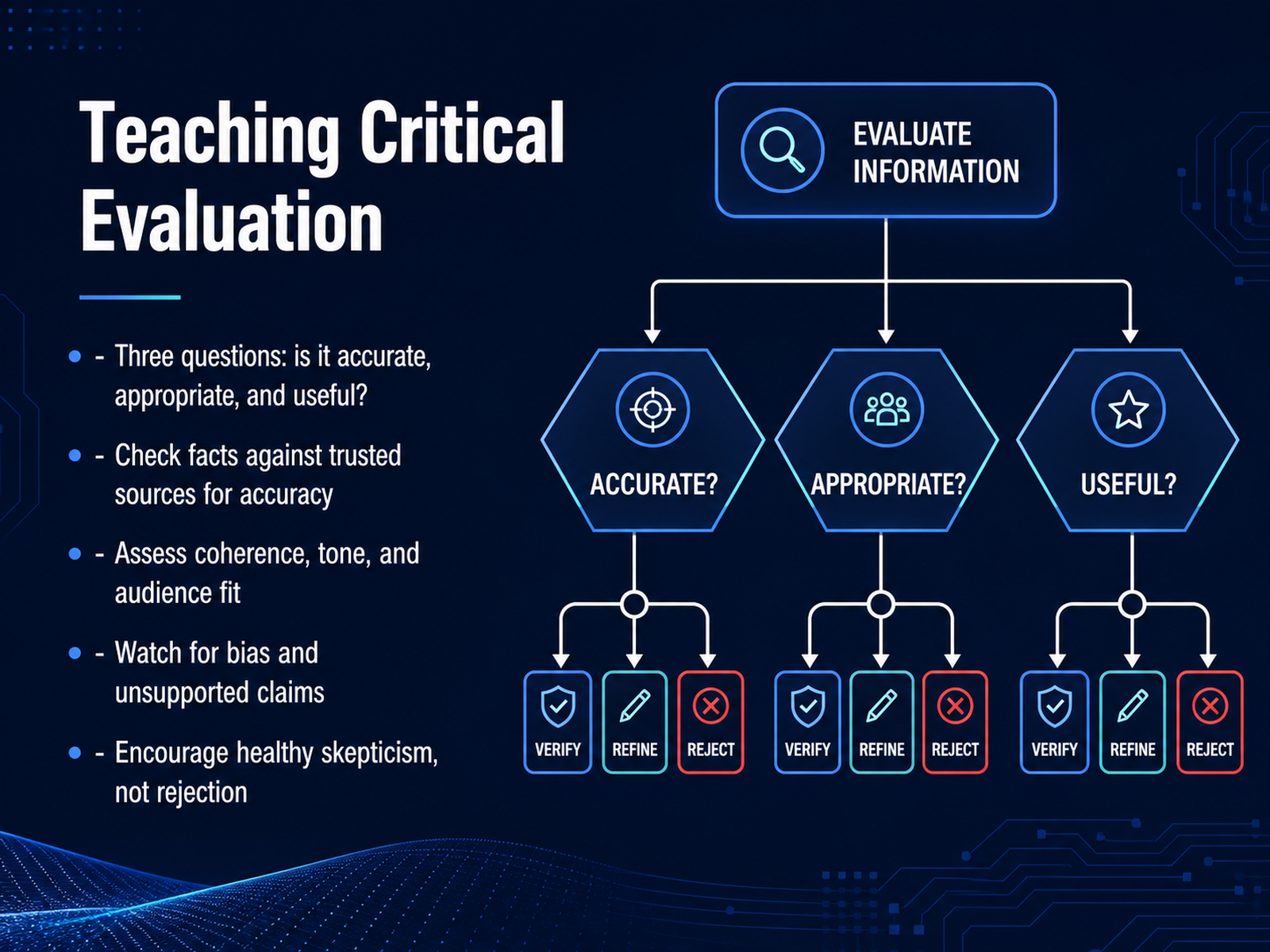
 - 08Teaching Critical EvaluationNow let's move into the heart of AI literacy: critical evaluation. The goal here isn't to reject AI output, but to review it with the same rigor you'd apply to any colleague's work. The most practical approach is to run every output through three questions. Is it accurate? Is it appropriate? And is it useful? Start with accuracy. Check the facts, figures, names, and dates against a trusted source. Don't assume the model got it right just because it sounds confident. Then assess appropriateness. Does the tone fit the audience? Is the level of detail right? Would an executive or a customer find this language suitable? Finally, the useful test. Does the content actually support the goal? Or is it generic filler that needs to be cut? Keep an eye out for bias and unsupported claims. A healthy skepticism means you verify before you trust. It doesn't mean you dismiss the tool entirely. Your review makes the output reliable. Next, we'll talk about the responsible use and guardrails that keep this evaluation process focused and safe.
 2 min
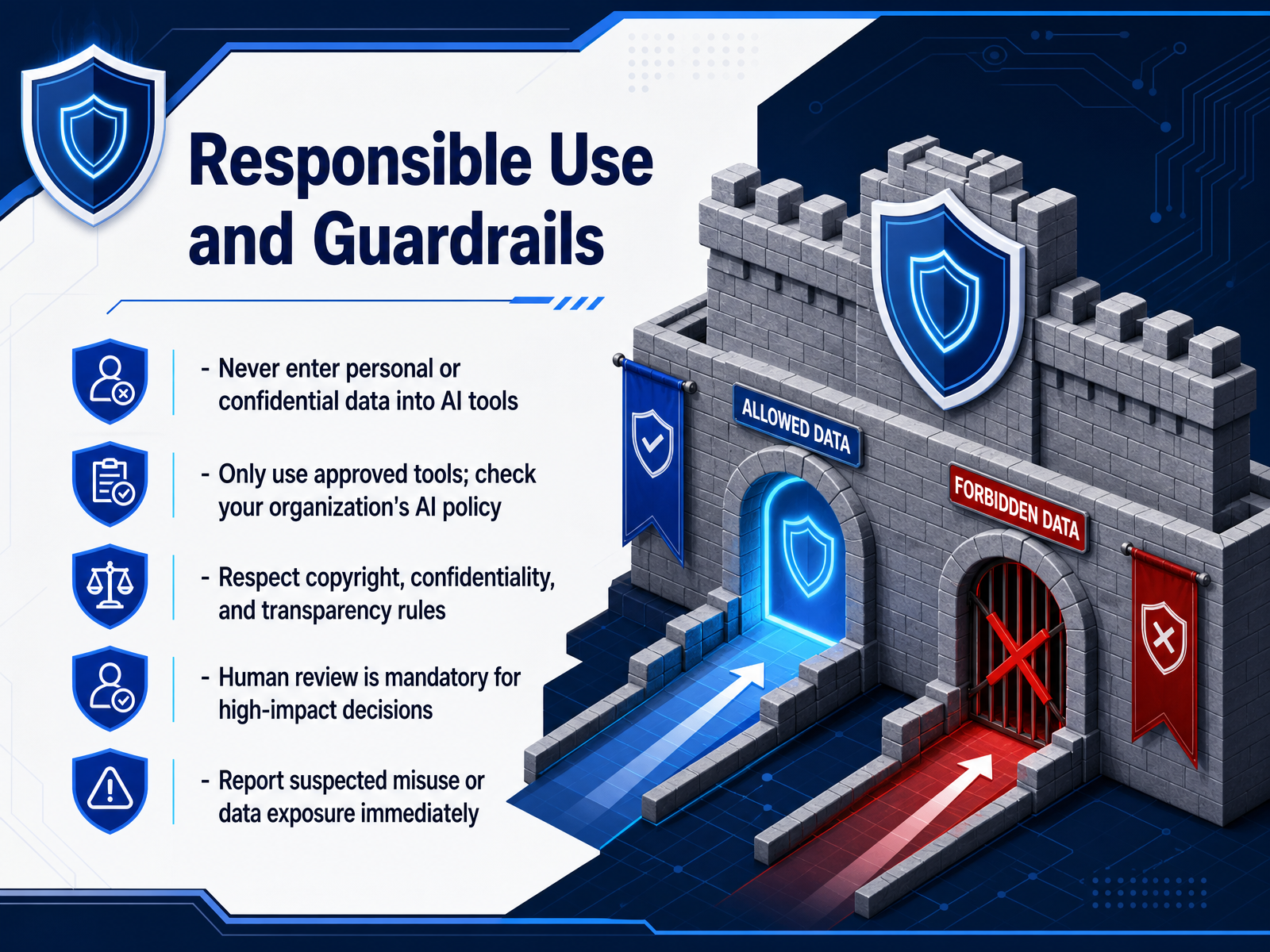
2 min - 09Responsible Use and GuardrailsNow let's talk about guardrails. Responsible use isn't about restricting your team; it's about protecting them and the organization. First rule: never enter personal or confidential data into AI tools. If you wouldn't post it publicly, don't paste it into a prompt. Second, only use approved tools. Check your organization's AI policy before experimenting. Free public tools often train on your data, so stick to what's vetted. Third, respect copyright and transparency rules. AI can reproduce protected content, so treat outputs like any other source material and disclose your AI use where required. Fourth, human review is mandatory for high-impact decisions. AI can draft a performance review, but a manager must verify and own the final call. Finally, report suspected misuse or data exposure immediately. A quick report prevents a small issue from becoming a compliance incident. Remember, these guardrails exist so your team can use AI with confidence, not fear. Next, we'll cover facilitation and handling resistance.
 1 min
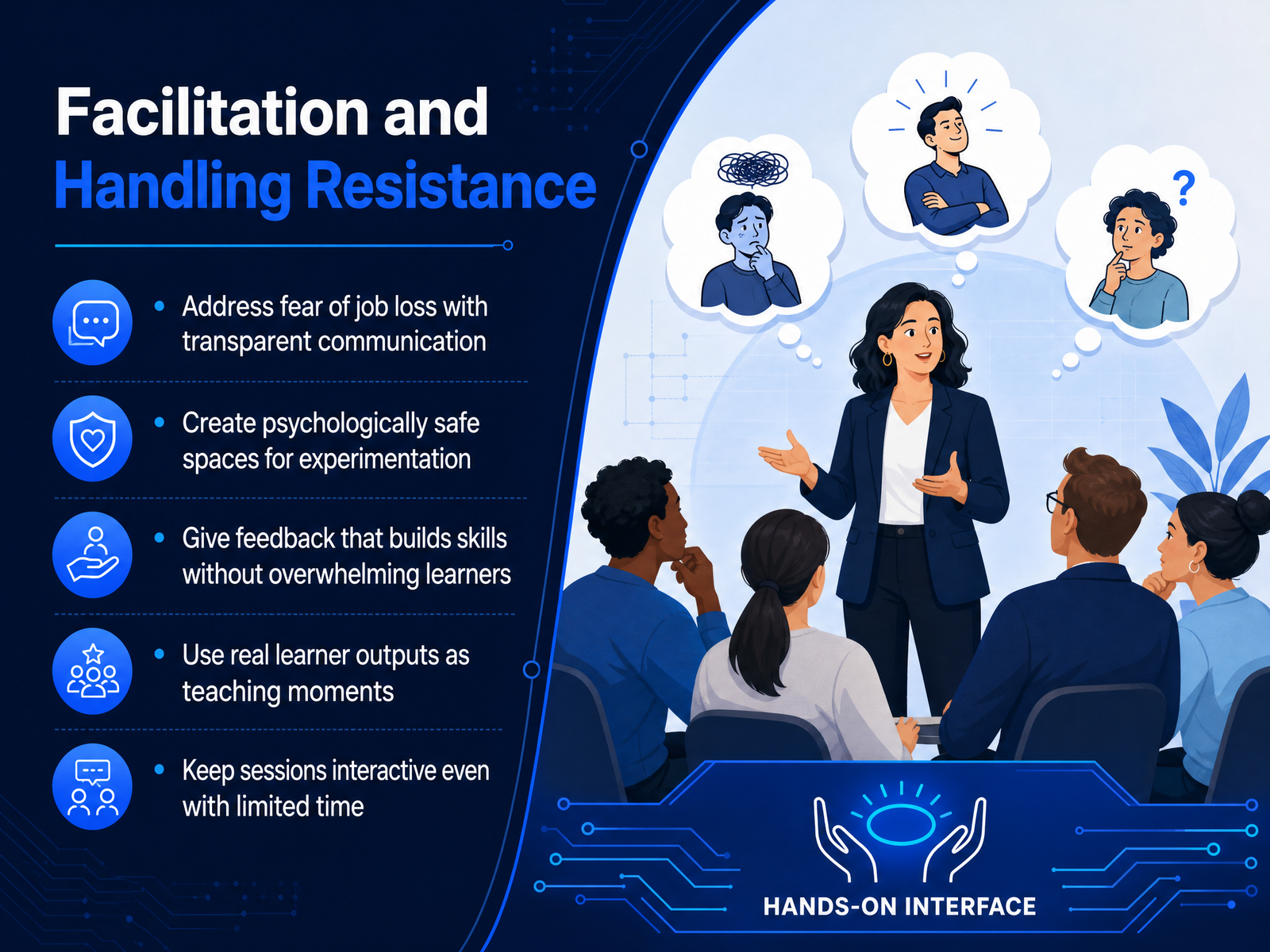
1 min - 10Facilitation and Handling ResistanceLet’s talk about facilitation and handling resistance. Start by addressing the fear of job loss head-on. Be transparent. Explain that AI will shift tasks, not eliminate every role. Acknowledge the concern directly, and then show how the training helps people adapt. Next, create a psychologically safe space. People need permission to experiment without feeling judged. Set clear boundaries, like a sandbox environment where mistakes are safe and expected. When you give feedback, focus on the work, not the person. Keep it skill-building. Say things like, “Try framing your prompt differently,” instead of “That’s wrong.” Use real learner outputs as teaching moments. Show an example of a good response and a poor response. Ask the group what the difference is. That turns individual work into shared learning. And keep sessions interactive, even with tight time. Use a quick poll, a two-minute pair discussion, or a live demo. Small touches keep people engaged and reduce anxiety. Remember, the goal is not to convince people that AI is great. It is to help them feel capable and informed. That confidence reduces resistance faster than any argument. Next, let’s look at measuring progress beyond completion rates.
 files.eric.ed.gov2 min
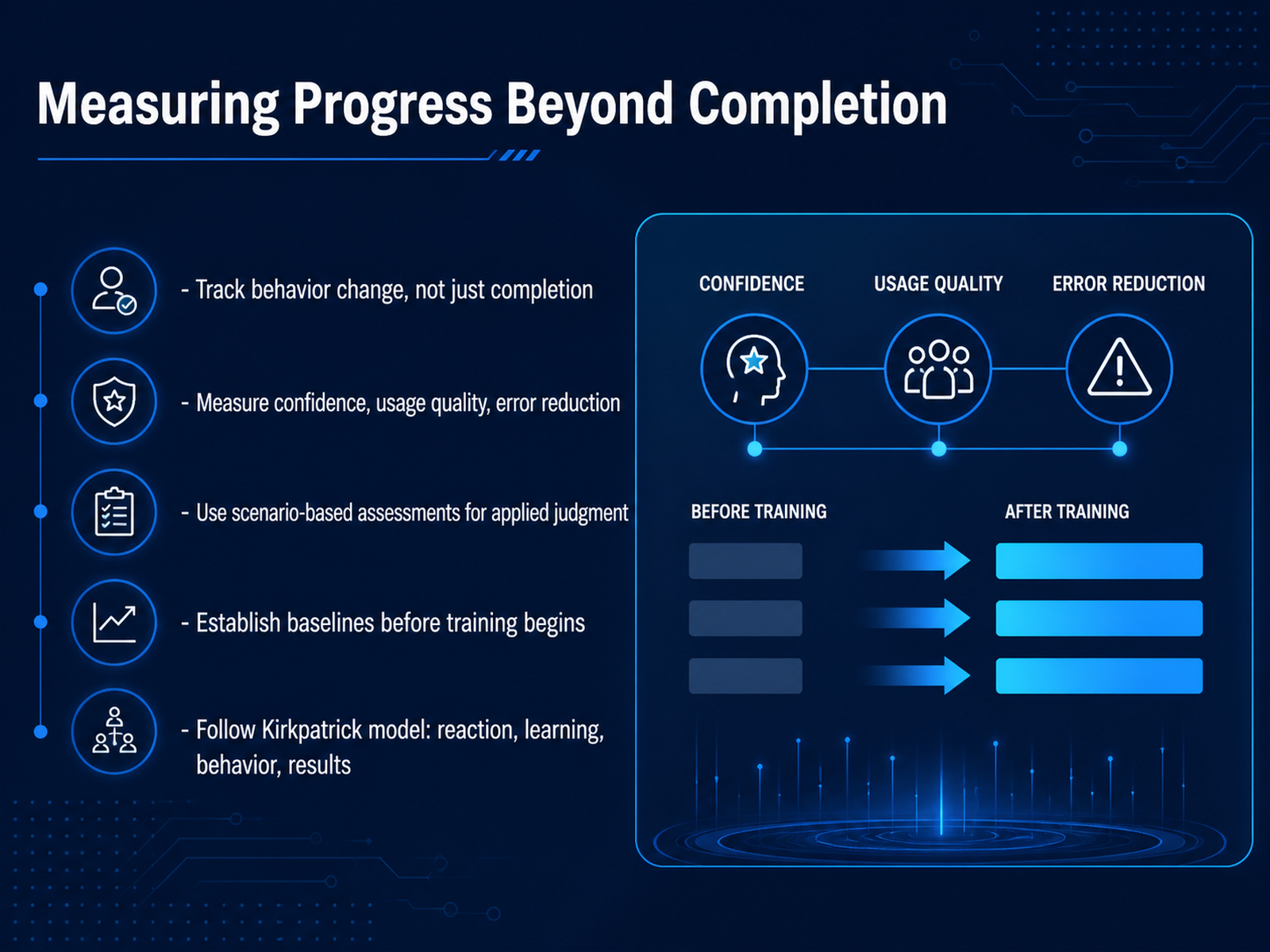
 - 11Measuring Progress Beyond CompletionNow let’s talk about measuring progress beyond completion. It’s tempting to celebrate when everyone finishes the training, but completion only tells you who showed up. What really matters is whether behavior changed on the job. So track metrics like tool adoption rates, error reduction, and how often employees apply human oversight to AI outputs. Measure confidence and usage quality, not just attendance. Use scenario-based assessments that test applied judgment, like asking employees to evaluate a realistic AI output for accuracy and bias. And don’t forget to establish baselines before training starts, or you won’t know how far you’ve come. The Kirkpatrick model gives you a useful structure: reaction, learning, behavior, and results. Most programs stop at the first two. Push through to behavior and results. For example, at 30 days, check if employees are using the approved AI tools. At 90 days, look for quality improvements and fewer incidents. That’s the evidence that makes your training defensible to leadership. Ready to build on this? Let’s look at how to reinforce these skills over time.
 dol.gov2 min
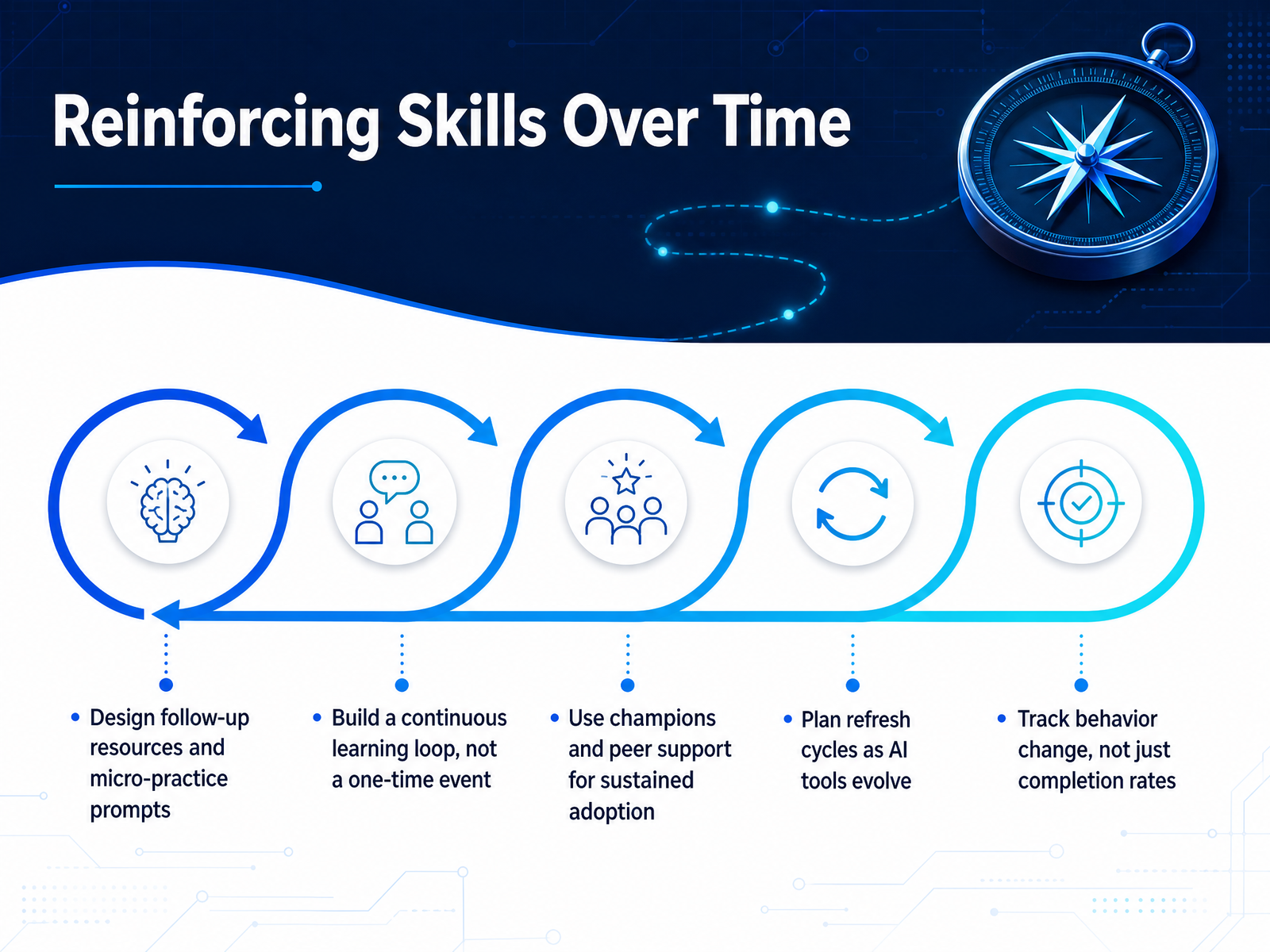
 - 12Reinforcing Skills Over TimeNow let's talk about keeping these skills alive. Training is not a one-time event. It's a continuous loop. Build a library of short follow-up resources and micro-practice prompts. Keep them tied to real tasks like summarizing a report or drafting an email. This refreshes the habit without pulling people away from their work for long. Next, rely on champions. Find the people who genuinely use these tools well and let them support their peers. Peer support drives sustained adoption far more effectively than a mandate from leadership. Then, plan your refresh cycles. AI tools change quickly, sometimes every few months. Schedule regular reviews of your curriculum so your examples stay current with what people actually use. Finally, track behavior change. Look at how often people apply the tools in their daily workflows. Completion rates measure attendance. Adoption and quality measure impact. That is what matters. And as you plan these refreshes, let's look at the common pitfalls that can derail even the best rollout.
 ailitlab.orgdol.govedtechbooks.s3.us-west-2.amazonaws.com+22 min
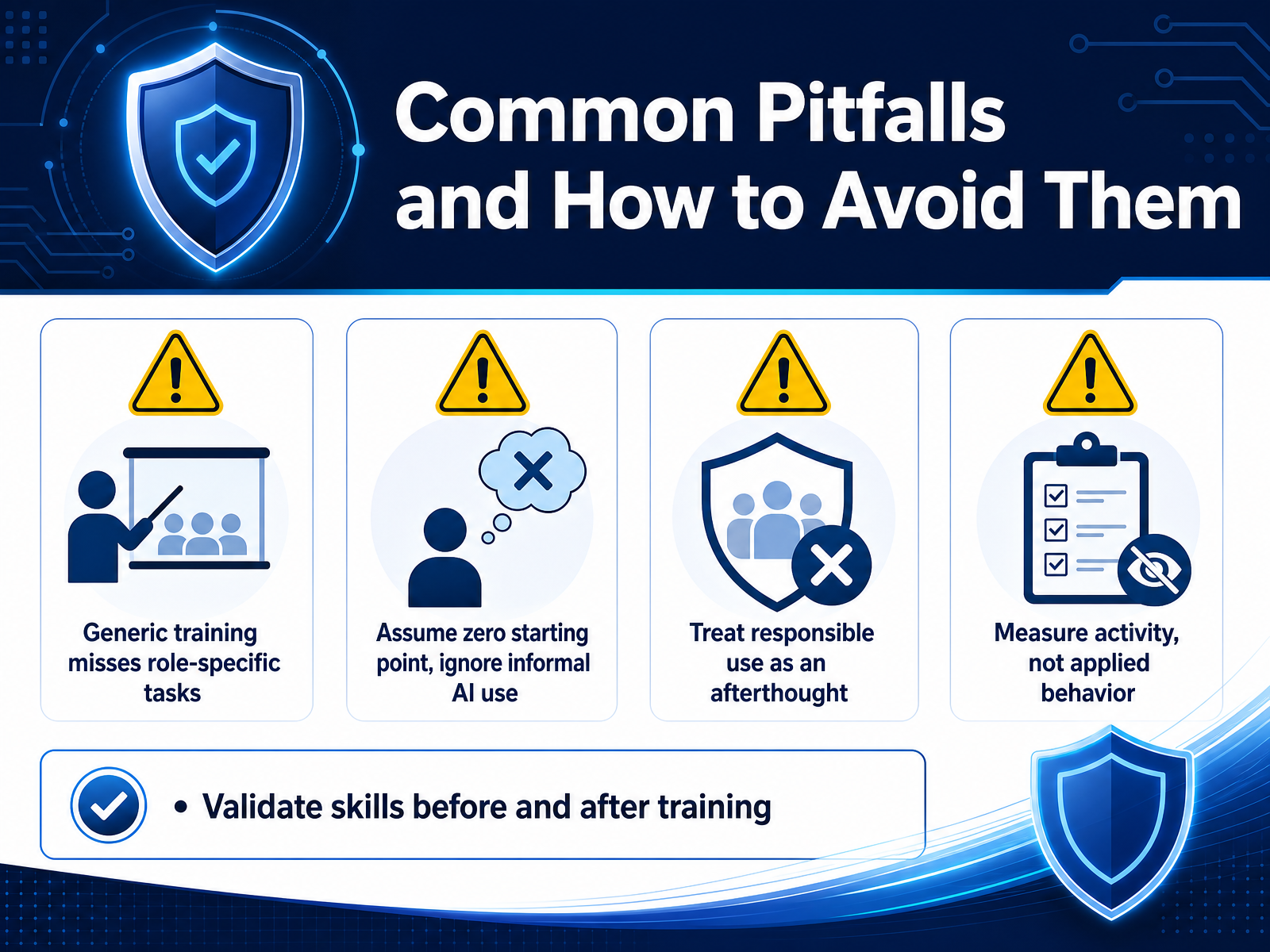
 - 13Common Pitfalls and How to Avoid ThemLet's look at the most common pitfalls in AI literacy training, and how to sidestep them. First, generic training that ignores role-specific tasks. A developer and a marketing manager need different skills. Map your training to real job functions, or you'll waste time and budget. Second, don't assume a zero starting point. Many employees already use AI informally. Survey them, and build on that existing knowledge instead of starting from scratch. Third, treat responsible use as a core part of the curriculum, not an afterthought. Weave safety, privacy, and ethics into every module from day one. Fourth, measure applied behavior, not just activity. Completion rates and satisfaction scores tell you little. Track whether employees actually change how they work with AI tools. Finally, validate skills before and after training. Use a performance-based assessment, not just self-reports, to establish a baseline. Then reassess after the program to measure real skill gain. Avoid these traps, and your training will produce lasting capability, not just checkboxes. Now, let's move to your action plan.
 aisa.togov.ukgov.uk+22 min
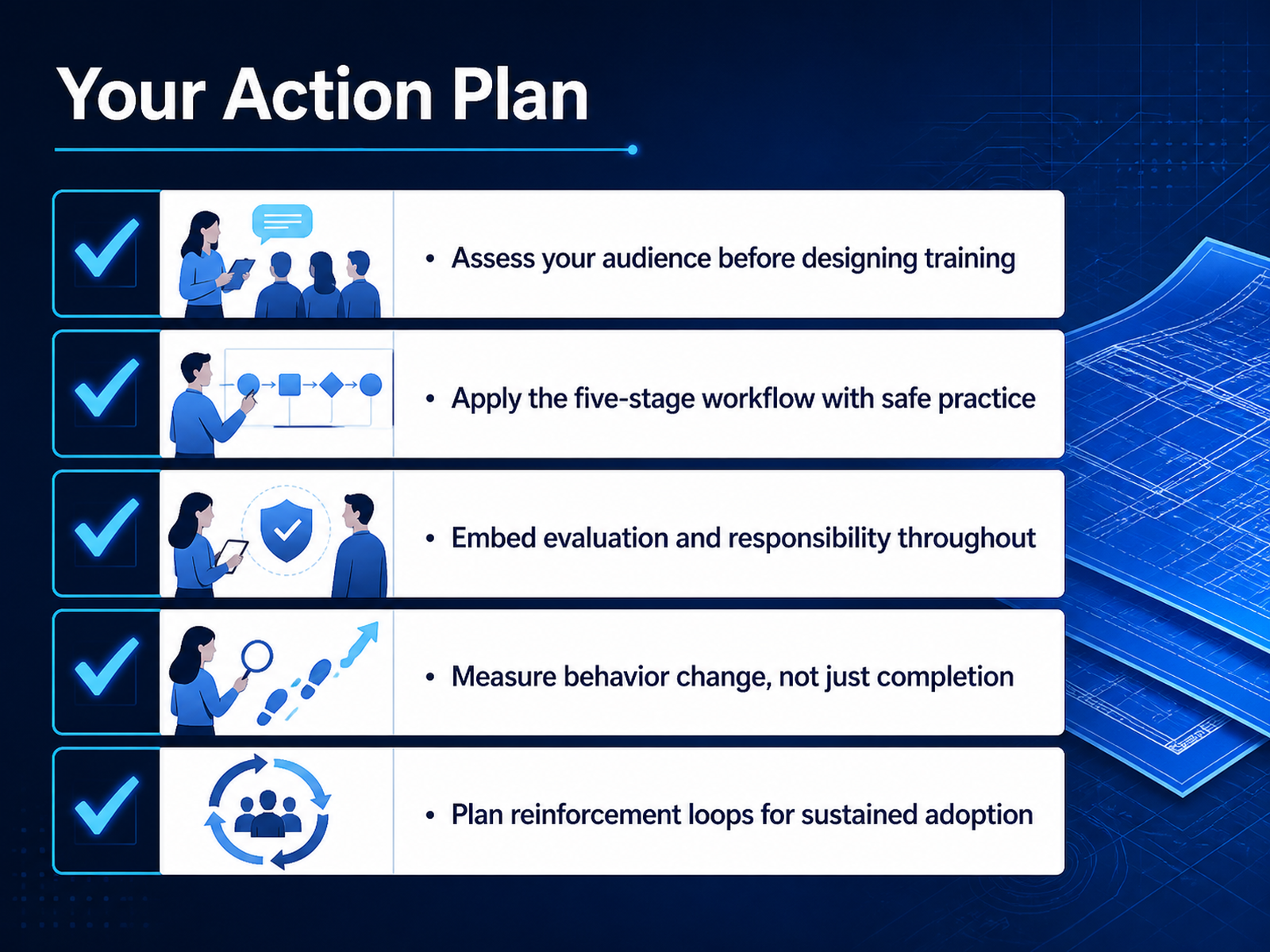
 - 14Your Action PlanLet’s turn what we’ve covered into your next steps. Start by assessing your audience before you design anything. Know their starting points and the tasks they do daily. Then apply the five-stage workflow, and make sure every stage includes safe, hands-on practice. Keep evaluation and responsibility woven through the entire program, not added at the end. And measure behavior change, not just completion. Look for real adoption of tools and sound judgment in real tasks. Finally, plan reinforcement loops. Schedule follow-up sessions and encourage peer sharing so the learning sticks after the initial training ends. Thank you for engaging with this material. You now have the workflow and the measurement tools. Go build AI literacy that makes a real difference in how your teams work.
 ailitlab.orgdol.govedtechbooks.s3.us-west-2.amazonaws.com+21 min
Take the deck with you
Download this course as a file — free, no sign-up needed.
- PDF handoutEvery slide page, ready to print or share.15 pages · 3.9 MBDownload
- Narrated PowerPointThe deck that presents itself — every slide carries the digital human's narration video.15 pages · 15.4 MBDownload
- PowerPoint slidesThe full deck as a .pptx — open it in PowerPoint, Keynote, or Google Slides.15 pages · 3.8 MBDownload
Free to use in your own training — please keep the PersonWise credit page at the end.
Have your own deck? Turn it into a course
Sources consulted
Web sources consulted while building this course.
- The U.S. Department of Labor’s Artificial Intelligence Literacy Framework — dol.gov
- TEN 07-25 | U.S. Department of Labor — dol.gov
- The U.S. Department of Labor’s Artificial Intelligence Literacy Framework — dol.gov
- Building AI Literacy in Adult Education: A Framework for Action - OTAN.us — otan.us
- AI Literacy in the Workforce — files.eric.ed.gov
- US Department of Labor releases AI literacy framework providing ... — dol.gov
- U.S. Department of Labor Issues AI Literacy Framework: What Employers Should Know | Parker Poe — parkerpoe.com
- AI Literacy - Questions & Answers | Shaping Europe’s digital future — digital-strategy.ec.europa.eu
- AI Literacy: Closing the Artificial Intelligence Skills Gap | IBM — ibm.com
- AI Training Needs Assessment: A Guide for L&D Teams | AISA — aisa.to
- Employer guide: What works for AI upskilling in the UK - GOV.UK — gov.uk
- AI skills tools package - GOV.UK — gov.uk
- AI Skills Gap Analysis: Multi-Layer Diagnostic Frameworks — pertamapartners.com
- Skills for AI: What works for AI upskilling in the UK - GOV.UK — gov.uk
- AI Literacy Lab — ailitlab.org
- The U.S. Department of Labor’s Artificial Intelligence Literacy Framework — dol.gov
- Designing for AI Literacy: “When life gives you LLMs, make LLMonade” — edtechbooks.s3.us-west-2.amazonaws.com
- Teaching AI skills: Seven teaching tips for adult educators | EPALE — epale.ec.europa.eu
- Introduction to AI Literacy Guidelines — tlos.vt.edu
- Hallucinations in generative artificial intelligence and large language models: tests, datasets, detection and correction methods | Language Resources and Evaluation | Springer Nature Link — link.springer.com