Begin
13 pages · ~26 min
Supply Chain Sales & Operations Planning
This training introduces participants to Sales and Operations Planning (S&OP) as a strategic process for aligning supply and demand, improving forecast accuracy, and enhancing cross-functional collaboration in supply chain management.
A digital instructor presents all 13 pages. Hold “Ask” at any point and ask out loud — the answer comes from this course. No sign-up needed.
What you’ll learn
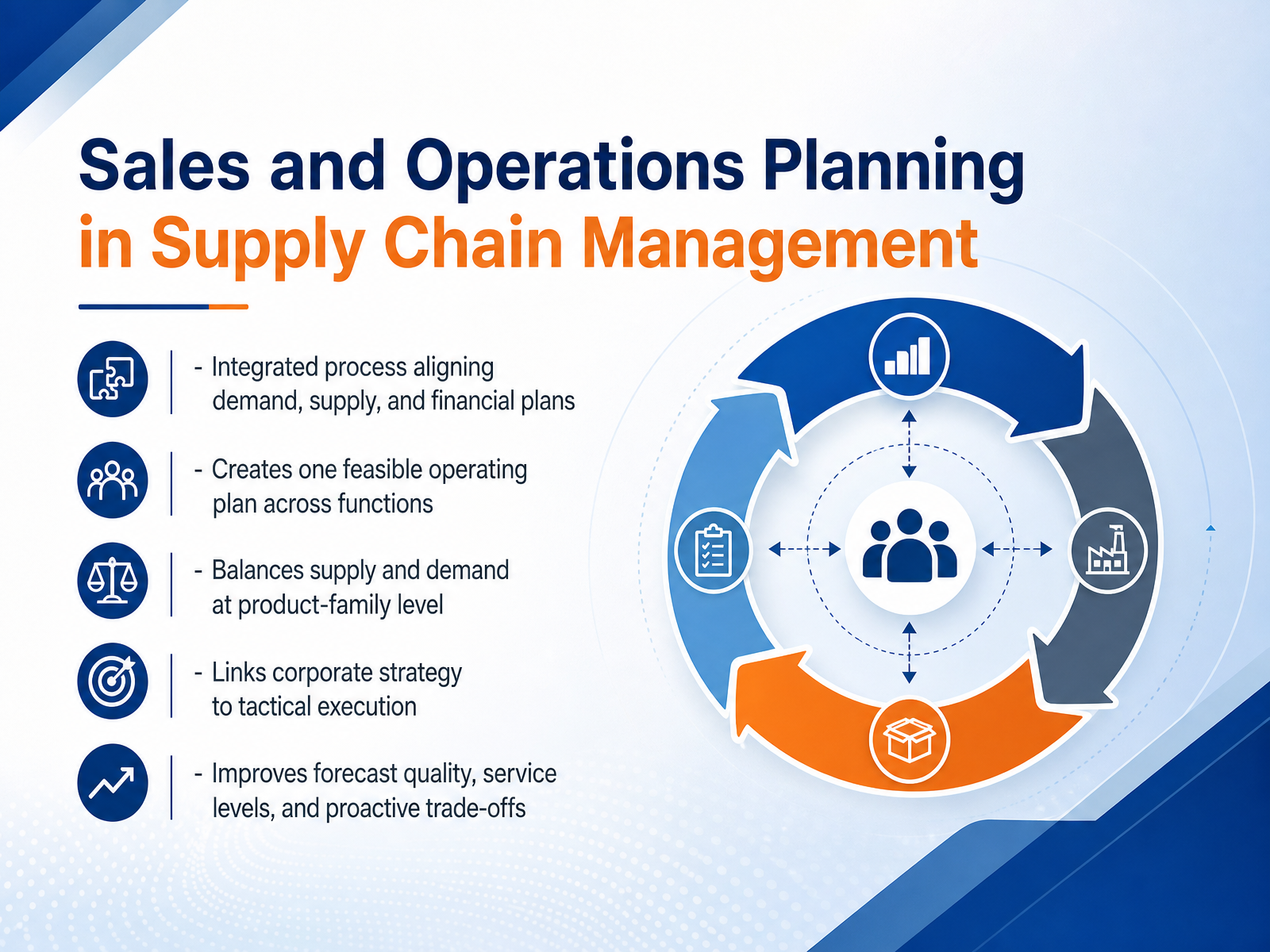
- 01Sales and Operations Planning in Supply Chain ManagementWelcome. In this course we are going to look at Sales and Operations Planning, or S and O P, as a formal business discipline. You probably already know the daily pressure of trying to balance what customers want, what operations can actually produce, and what leadership expects from a financial standpoint. S and O P exists to bring those competing forces into one structured conversation. On this slide, we see the core idea: S and O P is an integrated process that aligns demand, supply, and financial plans into a single feasible operating plan. It works at the aggregate level, typically at the product family level, so we are not debating every individual stock keeping unit in this meeting. Instead, we are looking at volume and timing. That allows the business to connect high level corporate strategy with tactical execution, and it improves forecast quality, service levels, and the ability to make proactive trade offs rather than reacting to surprises. In short, S and O P helps you run a more predictable and coordinated planning cycle. Next, we will look at how this process moves from basic production balancing into a true executive decision making forum.wc.ascm.orghclspdev.comjournals.sagepub.com+22 min
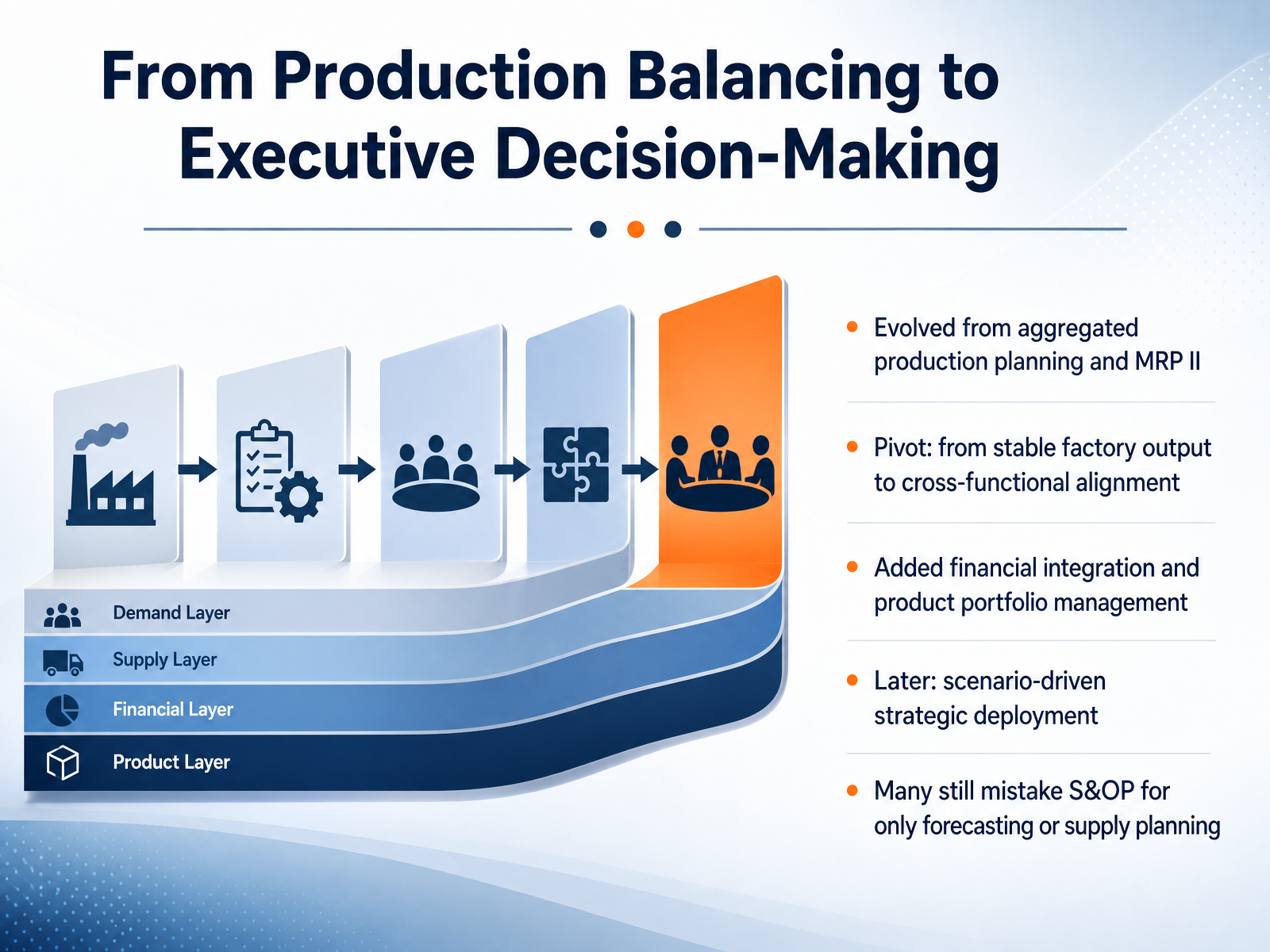
- 02From Production Balancing to Executive Decision-MakingLet’s step back and look at how Sales and Operations Planning evolved. S&OP grew out of aggregated production planning and MRP II, where the main goal was a stable factory schedule. Over time, the emphasis shifted from keeping output steady to aligning sales, operations, and other functions around one shared plan. Financial integration came next, so volume decisions were tied directly to revenue and cost. Later, product and portfolio management joined the process, which was a big change for businesses with frequent product turnover. Eventually, leading companies added scenario planning and strategic deployment, using S&OP to test different futures before committing resources. Even today, many still reduce S&OP to a forecasting exercise or a supply planning step. That misses the point. S&OP is a management routine, not a spreadsheet handoff. It is where demand, supply, finance, and product choices come together for executive decisions. In the next slide, we will look at the core principles and business objectives that keep this process working.
 stratabridge.comoliverwight-eame.comportal.research.lu.se+21 min
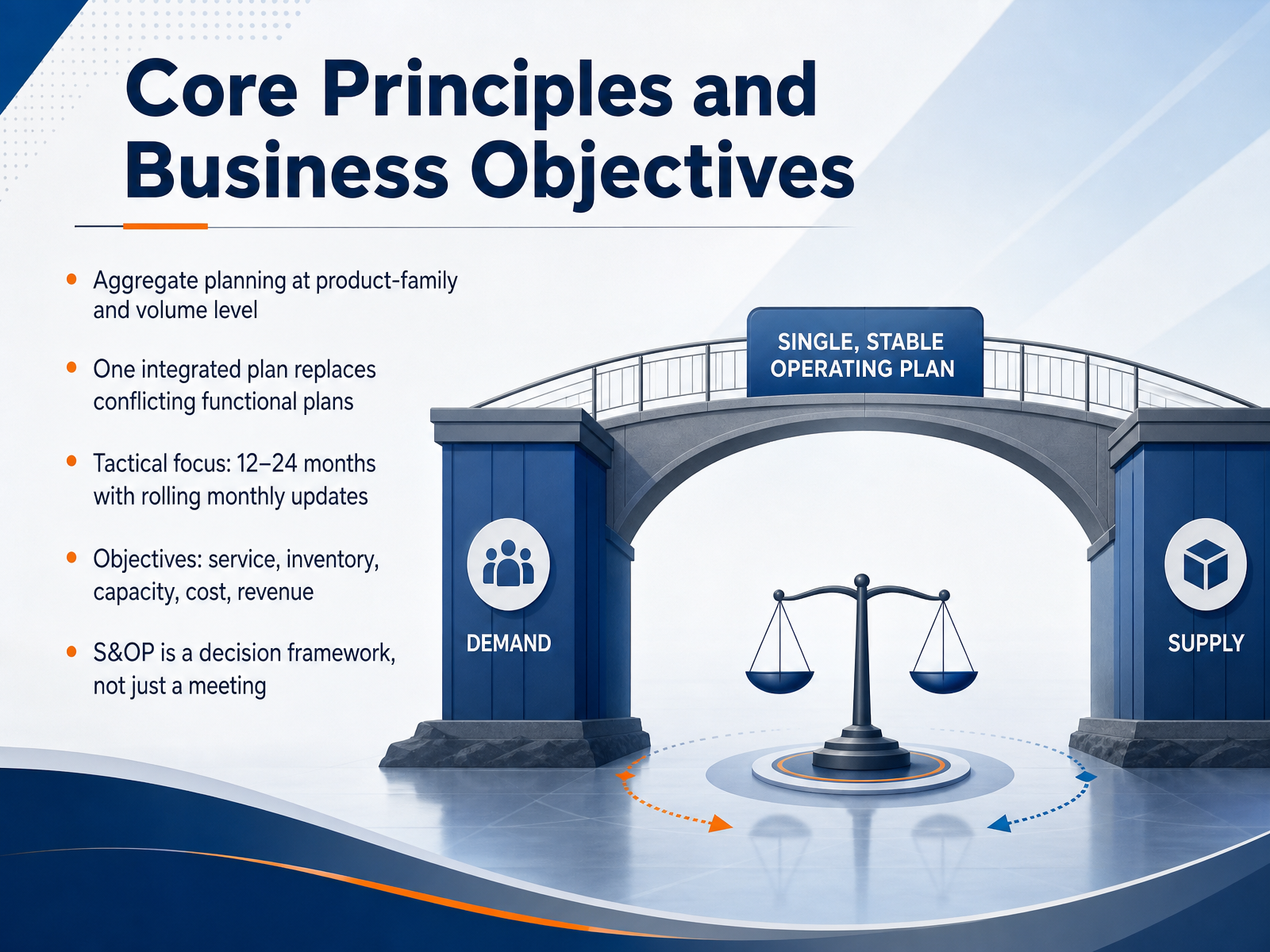
 - 03Core Principles and Business ObjectivesNow let's look at the core principles that make S and O P work. First, we plan at an aggregate level. That means we look at product families and overall volume, not every individual item. Second, one integrated plan replaces conflicting functional plans. Sales, marketing, manufacturing, and finance work from a single set of numbers. The horizon is tactical, typically twelve to twenty-four months ahead, with rolling updates every month. So each cycle extends the view forward and adjusts the plan. The objectives are balanced: service, inventory, capacity, cost, and revenue. None of these can be optimized in isolation. And importantly, S and O P is a decision framework, not just a calendar meeting. It gives leaders a structured way to resolve trade-offs and align on one path forward. Next, we'll walk through the monthly S and O P rhythm and process flow.
 wc.ascm.orghclspdev.comjournals.sagepub.com+21 min
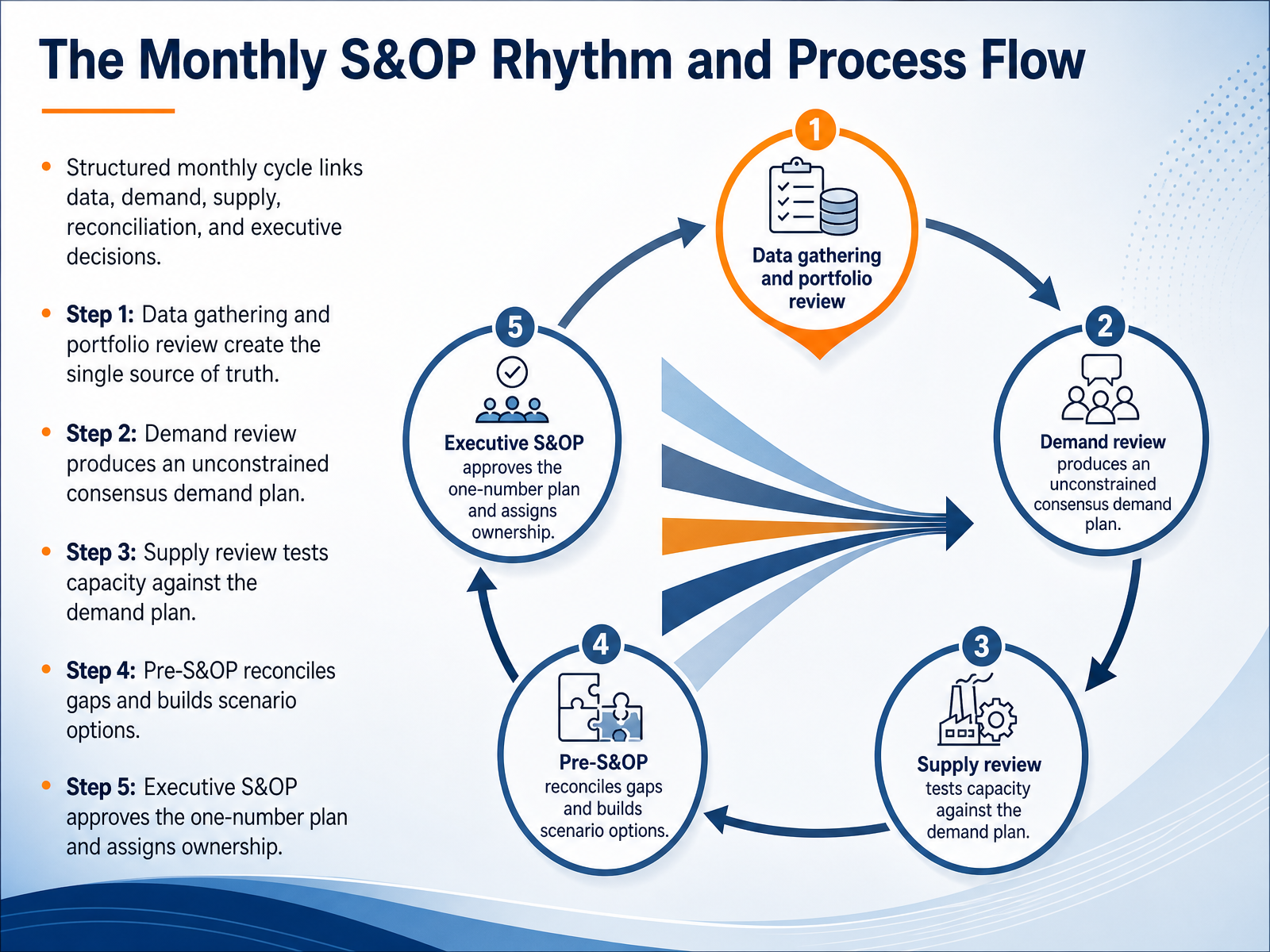
 - 04The Monthly S&OP Rhythm and Process FlowNow let's walk through the monthly S and OP rhythm, because the sequence is what makes the process work. The cycle usually runs over about four weeks and connects data, demand, supply, reconciliation, and executive decisions. It starts with data gathering and portfolio review. This is where actuals are closed and the team agrees on a single source of truth. From there, the demand review produces what we call an unconstrained consensus demand plan. That simply means the forecast reflects what customers want, before supply limits are considered. Next, the supply review tests capacity against that demand plan, so you can see where the gaps are. The pre S and OP step is where finance and the cross functional team reconcile those gaps and build realistic scenario options. The process then moves to executive S and OP, where leadership approves the one number plan and assigns clear ownership for execution. Each step has a defined output, and each one feeds the next. With that foundation in place, let's look more closely at the demand review and how a consensus forecast is built.
 dbmsys.comsupplychainmath.commasteringsap.com+22 min
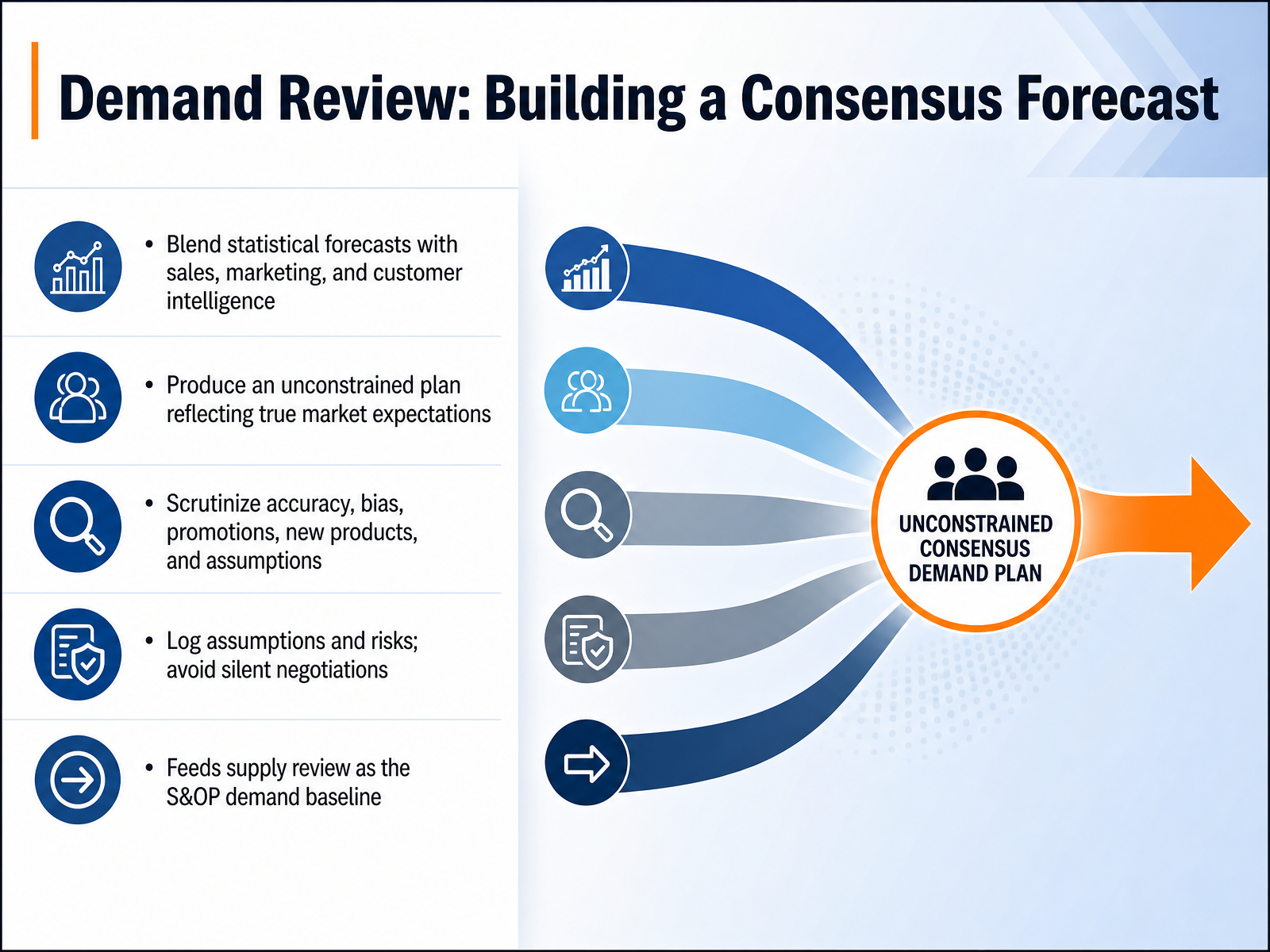
 - 05Demand Review: Building a Consensus ForecastNow let’s focus on the demand review, where we build the consensus forecast. This is the step where we bring together more than just a statistical model. We blend that baseline with input from sales, marketing, and direct customer intelligence. The goal here is to produce an unconstrained plan, meaning the forecast represents true market expectations, without already being limited by what we think the factory can produce. As we review this number, we need to scrutinize accuracy and bias, and challenge assumptions around promotions, new products, and shifting customer behavior. It is critical to log all assumptions and risks openly. We want to avoid silent negotiations, where people privately adjust the numbers without documenting why. That quiet editing is what creates distrust and misalignment later. The output of this review becomes the official demand baseline for the rest of the cycle. With that foundation set, we can move into the supply review, where we test this demand against capacity, constraints, and overall feasibility.
 techtarget.comelisaindustriq.commoxo.com+22 min
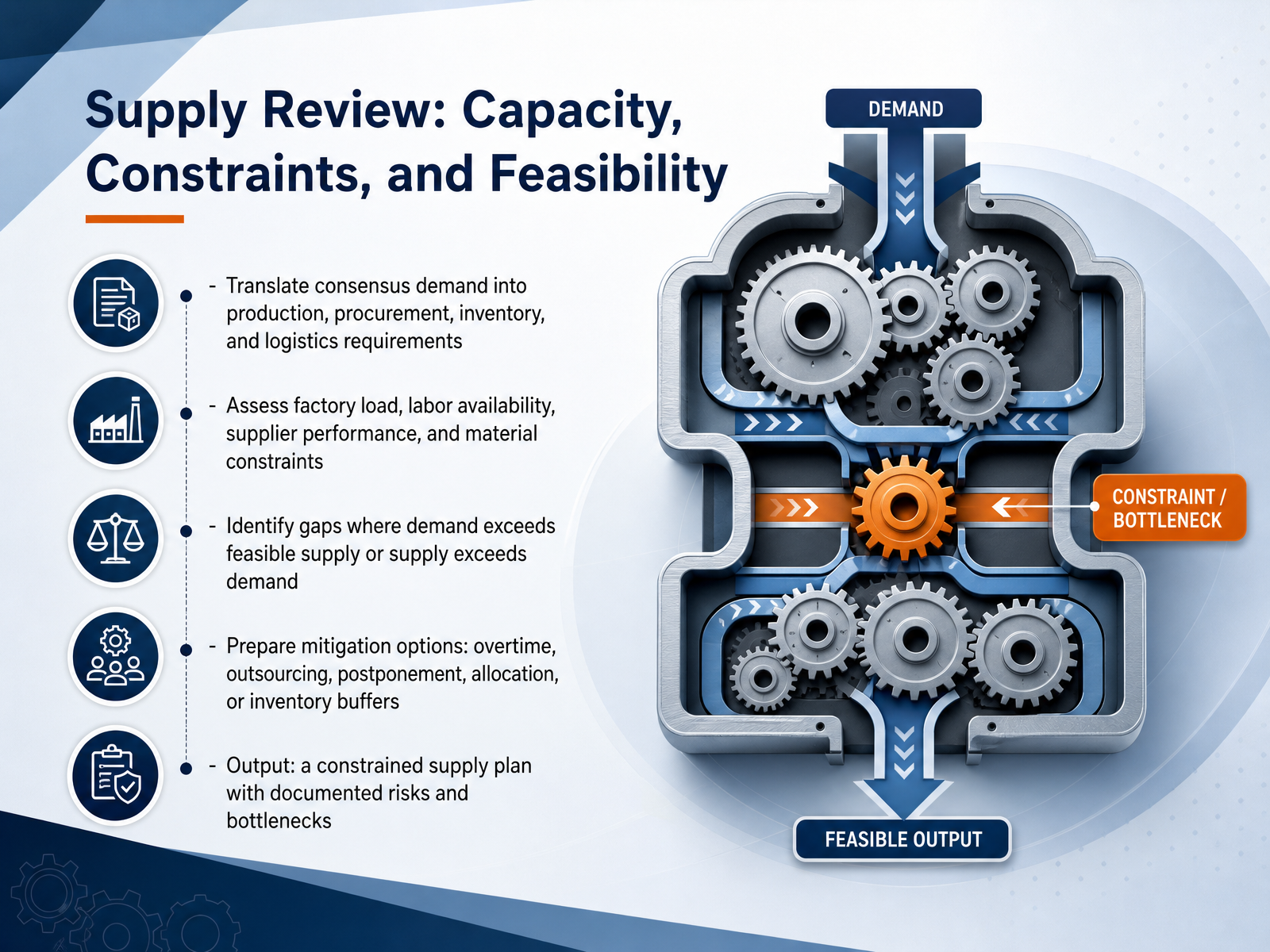
 - 06Supply Review: Capacity, Constraints, and FeasibilityMoving from the demand picture to the reality of what we can actually deliver, this is the supply review. The starting point is the consensus demand plan. We now need to translate that expected customer demand into specific requirements for production, procurement, inventory, and logistics. Think of it as converting a sales goal into a concrete operational workload. From there, we assess feasibility. We look at factory load, labor availability, supplier performance, and material constraints. The goal is to quickly identify gaps where demand exceeds what supply can support, or where supply might exceed demand and create excess inventory. Once gaps are visible, we prepare mitigation options. This could mean adding overtime, outsourcing to a contract manufacturer, postponing final assembly, allocating scarce product to priority customers, or building inventory buffers ahead of a known peak. The key output is a constrained supply plan. This is a realistic view of what operations can support, with the expected risks and bottlenecks clearly documented for leadership. Next, we will move into the governance that keeps this process running smoothly: roles, governance, and decision rights.
 techtarget.comelisaindustriq.commoxo.com+22 min
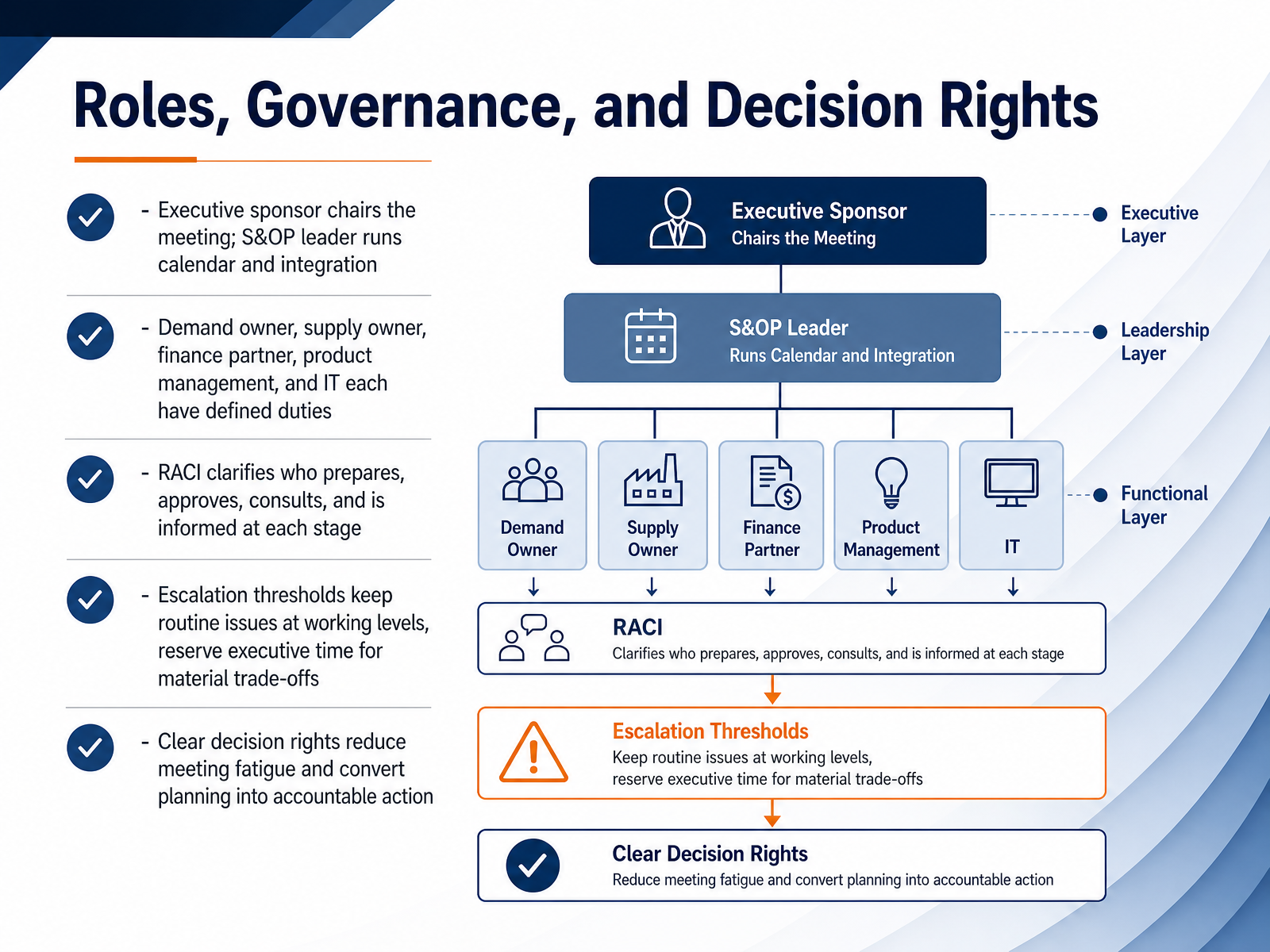
 - 07Roles, Governance, and Decision RightsNow let's talk about roles, governance, and decision rights, because this is where S&OP either becomes a real management system or stays a monthly reporting ritual. The executive sponsor chairs the meeting and owns the final decisions. The S&OP leader runs the calendar, keeps the data integrated, and makes sure everyone arrives prepared. Then you have the demand owner, supply owner, finance partner, product management, and IT. Each one has defined duties, not just a seat at the table. Finance translates volume plans into revenue, margin, and cash impact. Product management brings launch and phase-out timelines. IT keeps the data pipelines and systems available. To remove ambiguity, use a RACI structure. RACI stands for Responsible, Accountable, Consulted, and Informed. It clarifies who prepares, who approves, who must be consulted, and who simply needs to know. One important rule: there should be only one accountable owner per decision. Escalation thresholds also matter. Routine issues stay at working levels, while only material trade-offs go to executives. For example, a demand or supply gap within five percent of capacity can be resolved locally. But a gap above ten percent, or one with significant profit impact, escalates to the executive meeting. Clear decision rights reduce meeting fatigue and turn the plan into accountable action. Up next, we will look at the data, technology, and enabling systems that support this entire cadence.
 umbrex.comdbmsys.com2 min
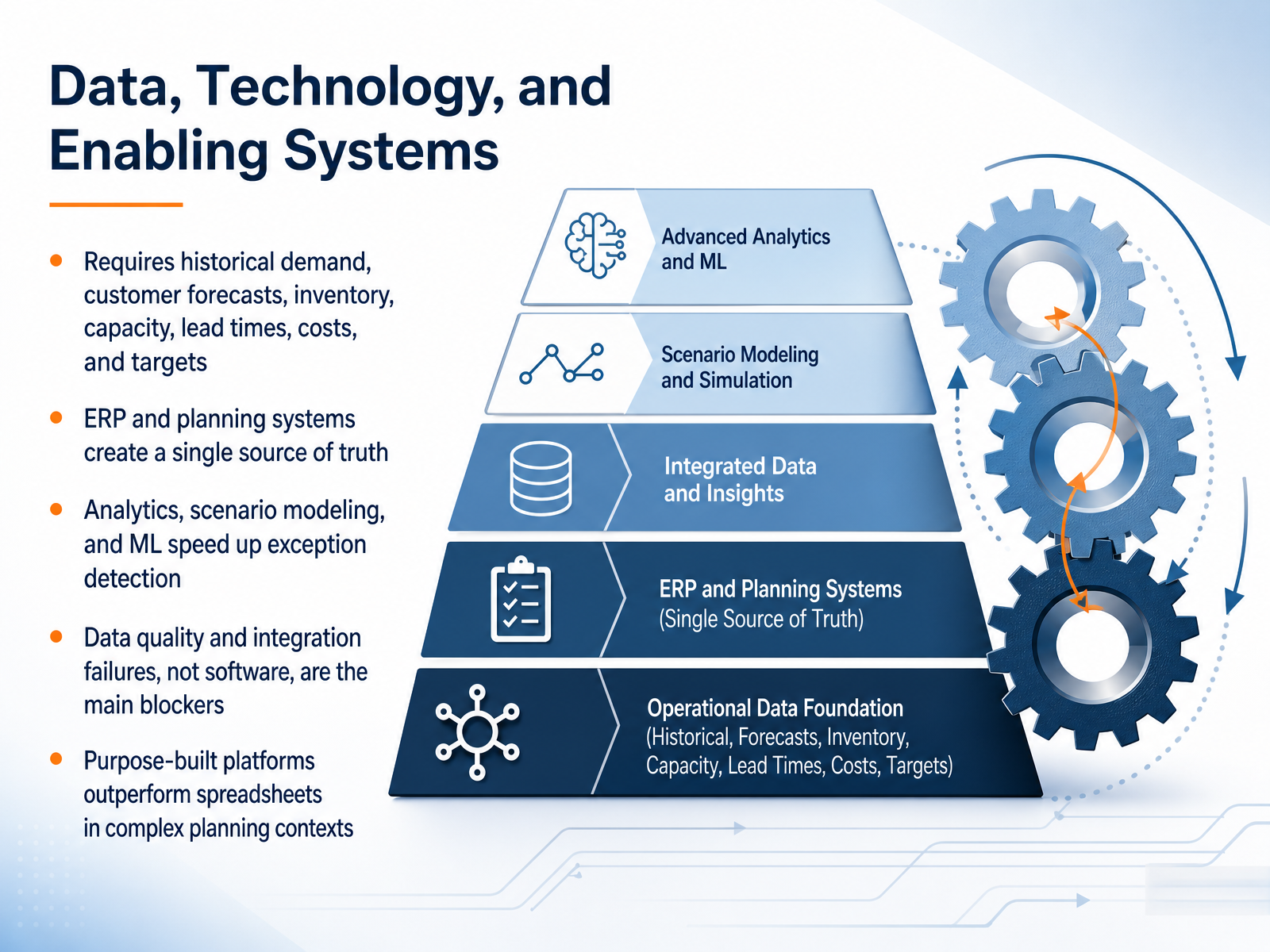
 - 08Data, Technology, and Enabling SystemsNow let's talk about the systems that make an S&OP process actually work. Effective planning depends on having the right data available. That includes historical demand, customer forecasts, current inventory, capacity constraints, lead times, cost data, and the financial targets we are trying to hit. When your ERP and planning systems are integrated, they act as a single source of truth. You are not arguing about whose spreadsheet has the right number. Modern analytics, scenario modeling, and machine learning can also help by flagging exceptions faster. For example, the system might alert you that a key supplier lead time just changed, so you can adjust the plan before the next meeting. But here is the key point from this slide. Most blockers are not caused by software limitations. They come from poor data quality and broken integration between systems. If the data going in is bad, the analytics coming out will be bad. That is why, in complex planning environments, purpose-built platforms tend to outperform spreadsheets. Spreadsheets are flexible, but they are hard to govern and cannot handle fast, continuous scenario testing. Next, we will move into the metrics that tell us how well this plan is actually performing.
 oracle.com2 min
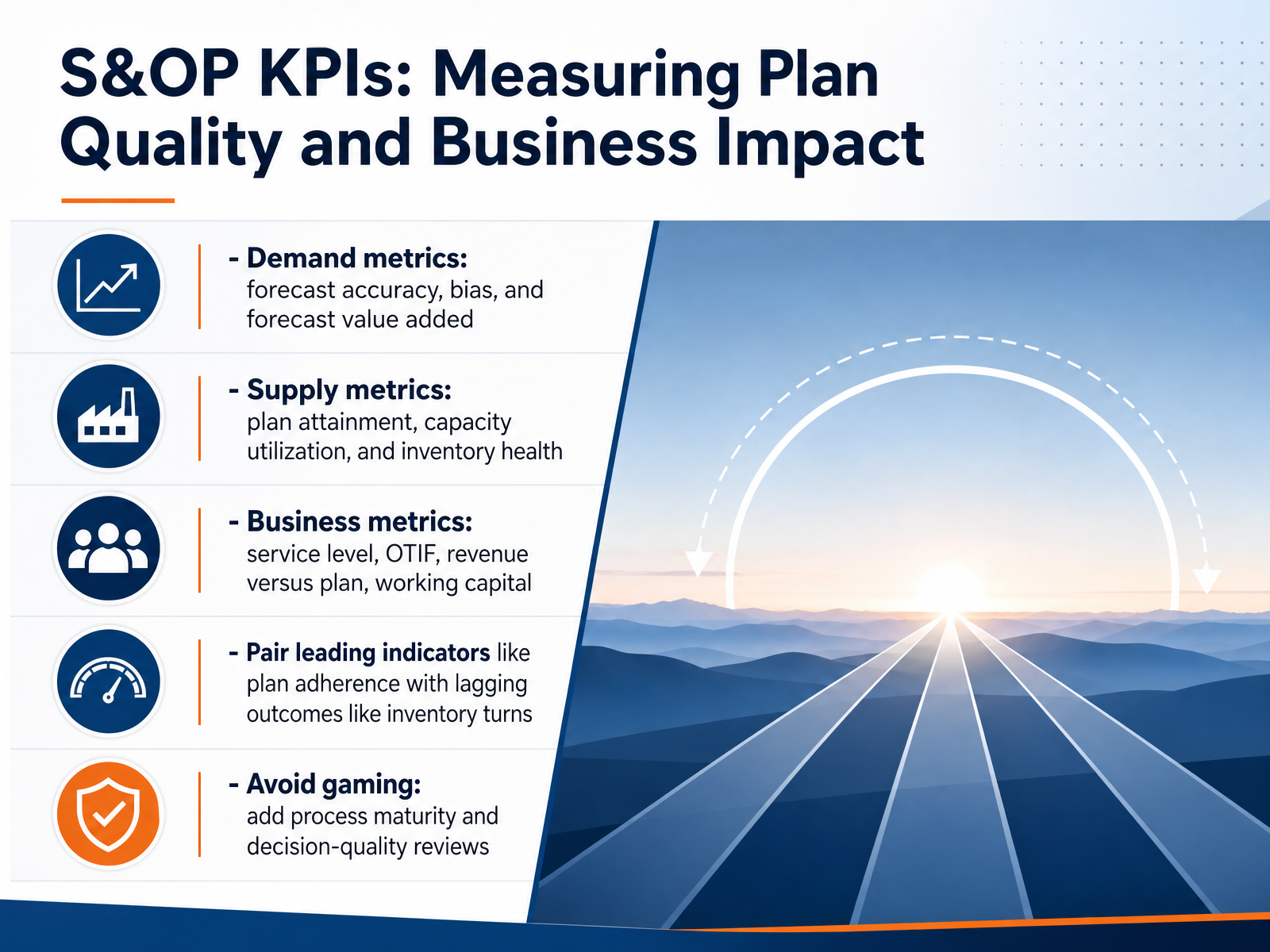
 - 09S&OP KPIs: Measuring Plan Quality and Business ImpactNow let's look at how we measure whether the S and OP process is actually working. The metrics on this slide fall into three groups. Demand metrics tell us if the forecast was realistic. We look at forecast accuracy, bias, and forecast value added. Bias matters a lot here, because a forecast that is consistently high inflates inventory, while one that is consistently low creates stockouts. Supply metrics show whether operations executed the plan. We track plan attainment, capacity utilization, and inventory health. Then business metrics connect the operating plan to outcomes that leadership cares about, such as service level, on time in full, revenue versus plan, and working capital. One useful habit is to pair leading indicators with lagging outcomes. For example, if plan adherence is slipping now, inventory turns will likely suffer a few cycles later. Finally, avoid gaming the numbers. When teams are pressured to hit a forecast accuracy target, they may make conservative forecasts or report adherence to outdated plans. Add process maturity reviews and decision quality checks so the conversation stays focused on improving the plan, not just polishing the dashboard. Next, we will move into implementation challenges and change management.
 supplychainmath.com2 min
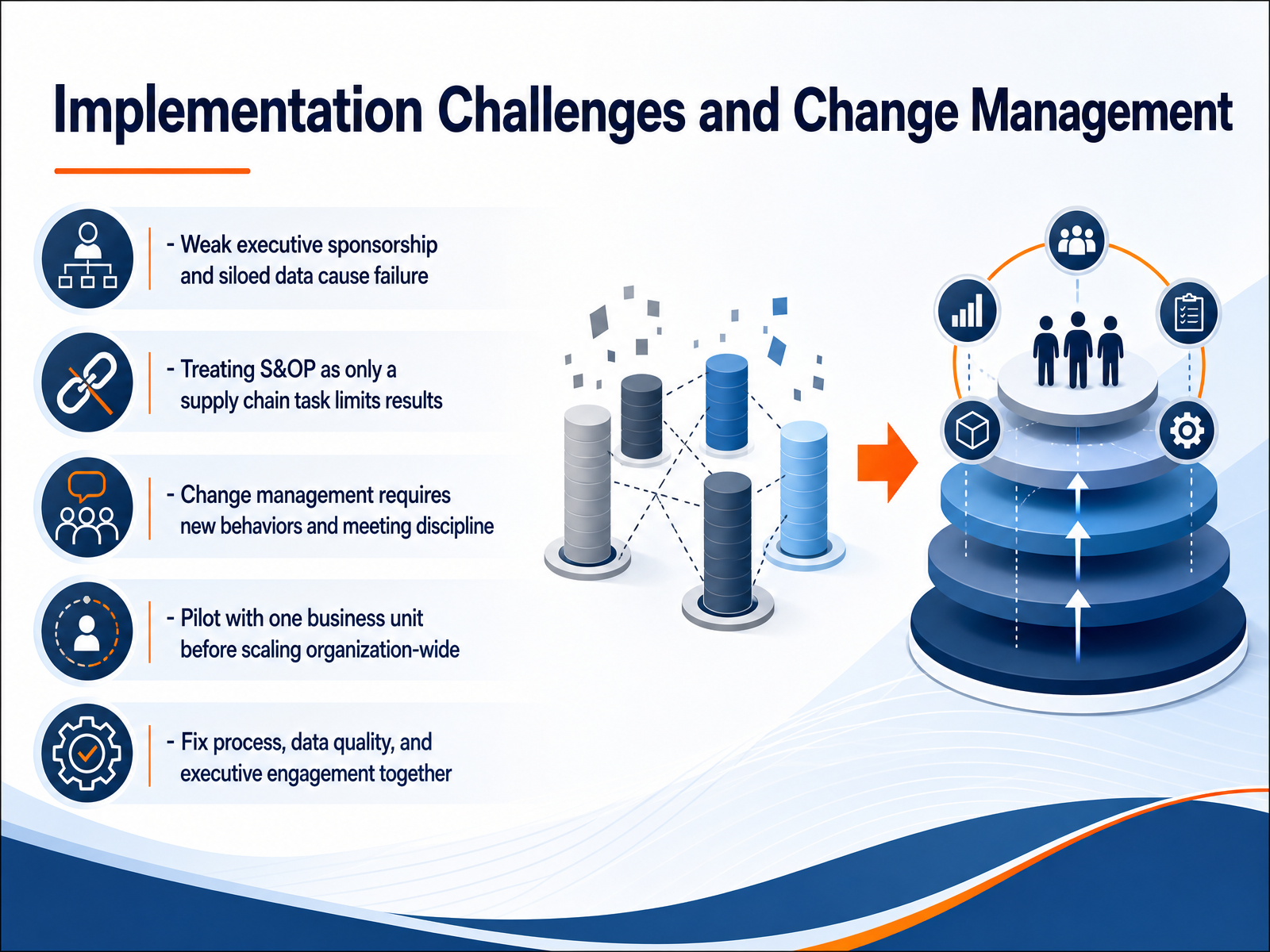
 - 10Implementation Challenges and Change ManagementNow let's talk about why S&OP implementations sometimes stall, and what change management really requires. The most common point of failure is weak executive sponsorship. If leadership treats this as a supply chain exercise, the rest of the organization will too. Siloed data creates the same problem. When sales, finance, and operations each trust only their own numbers, the meeting becomes a debate about whose spreadsheet is correct, not a decision forum. Change management is not a training session. It means new behaviors, new meeting discipline, and a shared accountability that leaders must model. It also means fixing process, data quality, and executive engagement at the same time. Improving just one pillar rarely works. A practical path is to pilot S&OP in one business unit first. Let that team build credibility, solve data problems, and demonstrate results before you scale organization-wide. Next, we'll look at practical strategies for supply chain teams trying to make this work day to day.
 1 min
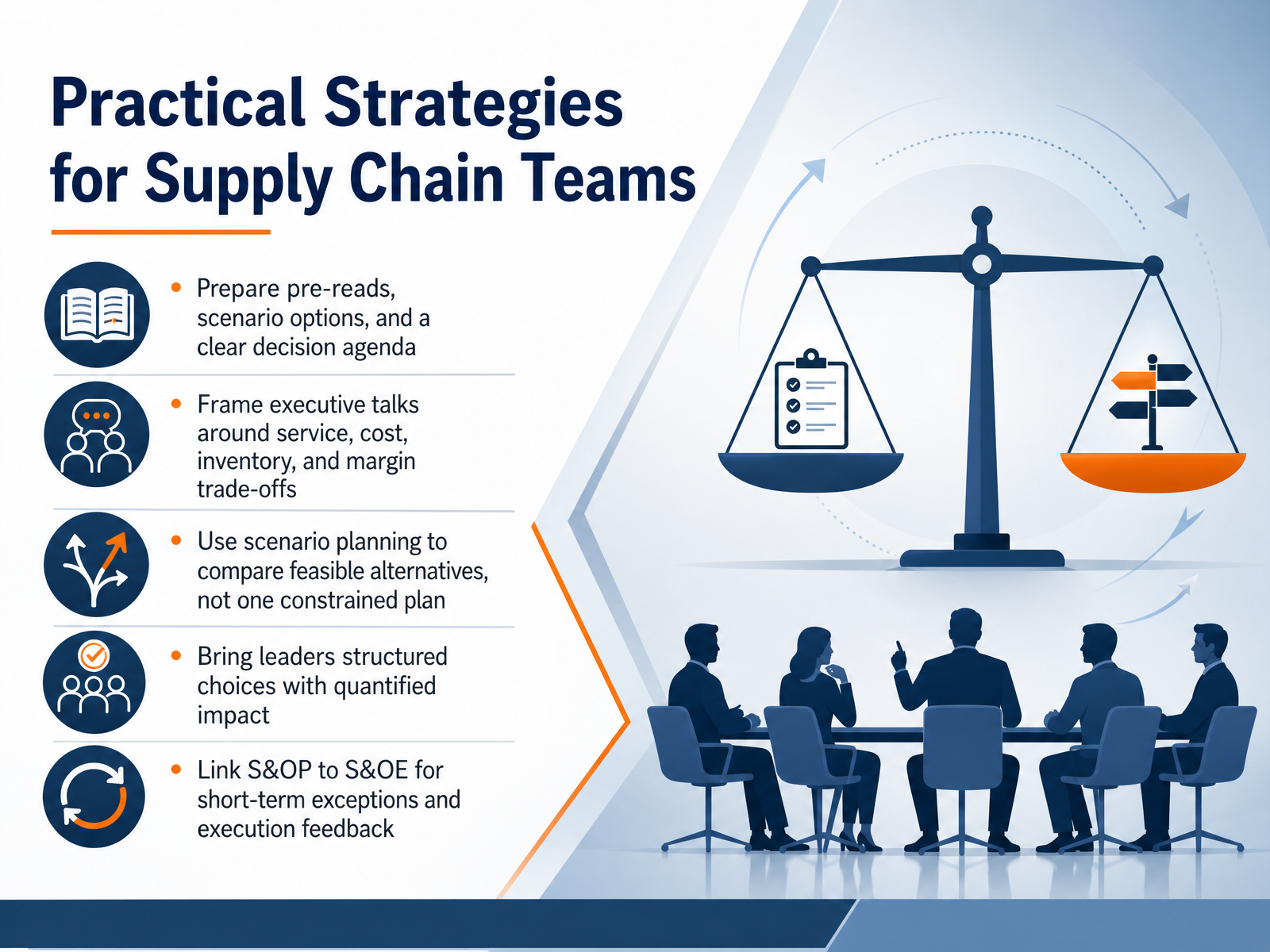
1 min - 11Practical Strategies for Supply Chain TeamsLet's turn this into practical habits your team can build into every monthly cycle. First, always arrive at the executive meeting ready. That means distributing pre-reads, modeling scenario options ahead of time, and circulating a clear decision agenda. When you frame the conversation, don't lead with detailed operational metrics. Structure the discussion around service, cost, inventory, and margin. Those are the trade-off dimensions leadership can actually resolve. Second, use scenario planning the right way. Don't bring one constrained plan and ask for approval. Bring feasible alternatives, each with a quantified impact on revenue, cost, cash, and service. Leaders need structured choices, not a single recommendation. Third, and this matters a lot in practice, connect S&OP to S&OE. S&OP sets the monthly tactical direction. S&OE handles short-term exceptions, execution feedback, and rapid adjustments. When the two stay linked, the monthly plan stays credible, and day-to-day firefighting has a clear home. This brings us naturally to the next step in the journey: moving from S&OP to Integrated Business Planning.
 supplychainmath.comelisaindustriq.com2 min
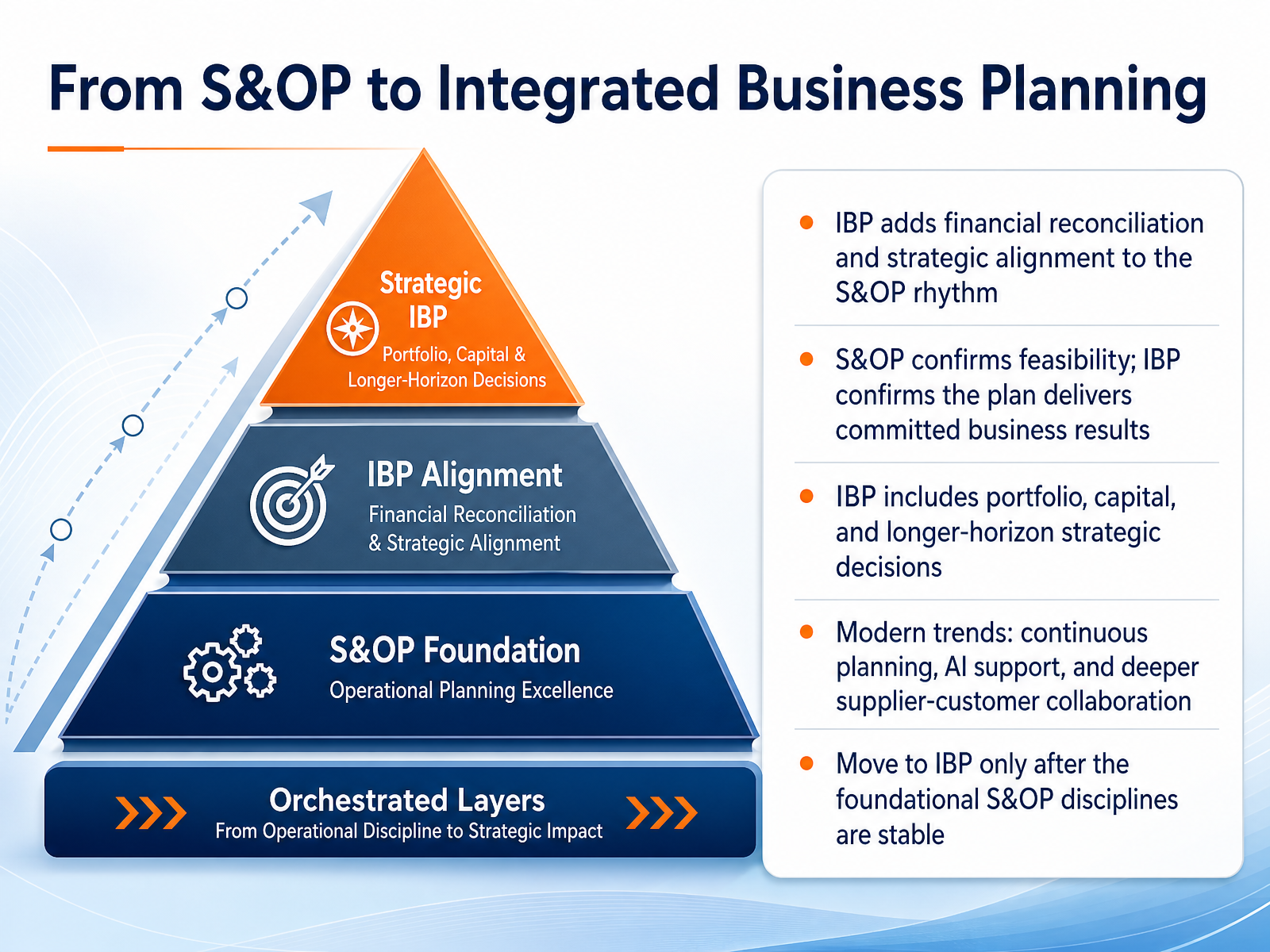
 - 12From S&OP to Integrated Business PlanningNow let’s talk about the step beyond S and O P: Integrated Business Planning, or I B P. If S and O P answers the question, can we build and deliver this plan, I B P adds a second question: does this plan actually deliver the financial results we committed to? That shift is important. I B P brings financial reconciliation and strategic alignment into the same monthly rhythm. Instead of planning in units and discovering margin problems later, the operational plan and the P and L stay connected from the start. I B P also expands the scope. Portfolio decisions, capital investments, and longer-horizon moves, like adding capacity or entering a new market, become part of the same planning cycle rather than separate side conversations. We are also seeing the practice itself evolve. More companies are moving toward continuous planning, using AI to compress cycles, and working more closely with both suppliers and customers on shared assumptions. But one caution here. Move to I B P only after your foundational S and O P disciplines are stable. If the basics are not working, adding financial complexity usually just amplifies the existing problems. In our final slide, we will pull this together with the key takeaways and a practical action plan.
 2 min
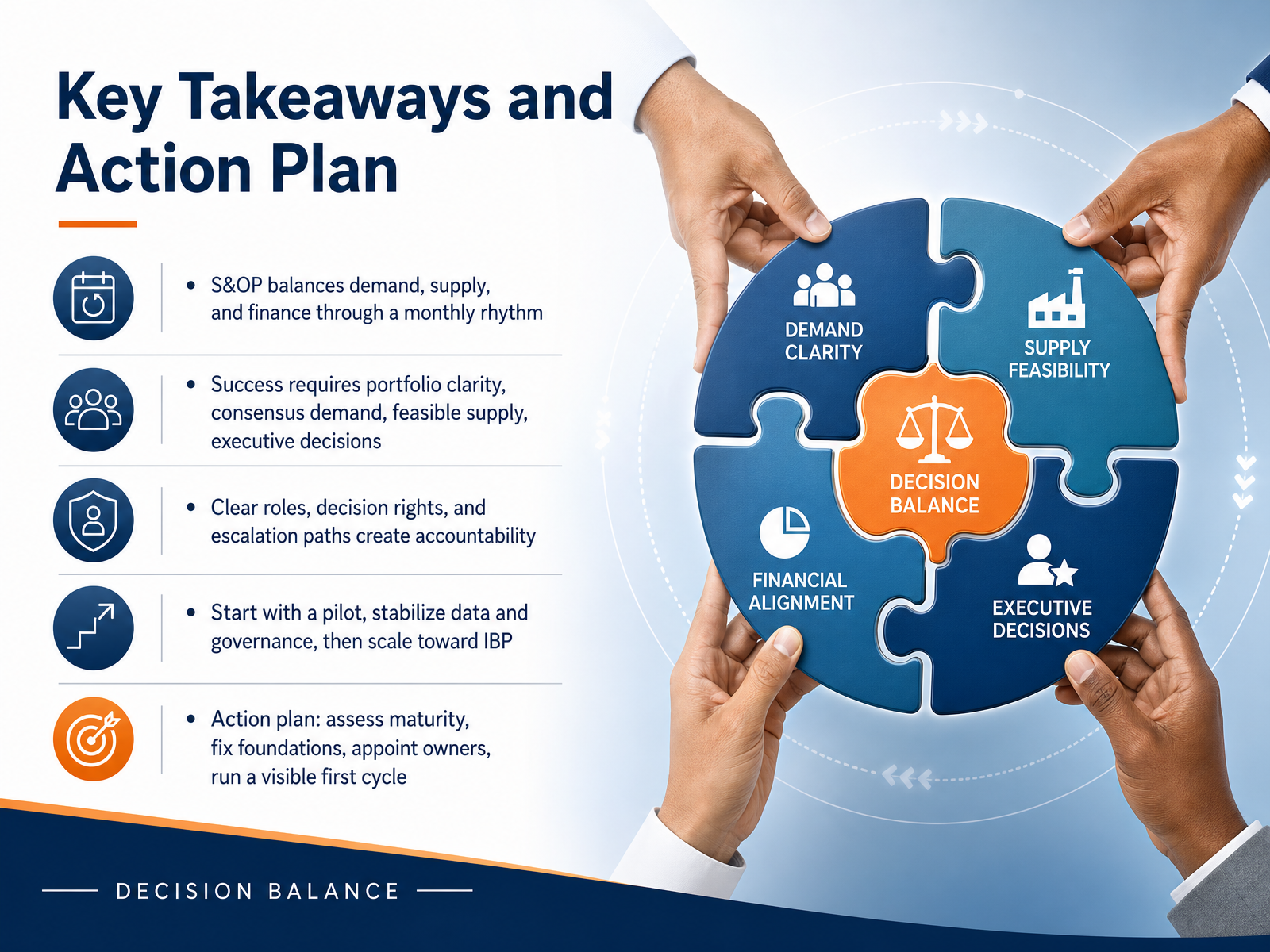
2 min - 13Key Takeaways and Action PlanLet's bring this together. Sales and operations planning is really a monthly management rhythm, and when it works, it brings demand, supply, and finance onto one balanced plan. Success does not come from a single meeting or tool. It comes from a few steady foundations. First, you need a clear product portfolio so everyone is planning the same categories. Then you need a consensus demand view that sales and marketing both own. Supply must be tested against real capacity, not hopes, and finance has to translate the plan into margin, cash, and revenue impact so executives can actually decide. Clear roles, decision rights, and escalation paths create accountability, and that is what turns meetings into decisions instead of status updates. If you are starting out, do not try to transform the whole company at once. Pick a focused pilot, stabilize the data and governance first, then scale toward integrated business planning step by step. A practical first action plan: assess your current maturity, fix data and process foundations, appoint clear owners for demand, supply, finance, and process leadership, and run a first visible cycle with fixed dates and named decisions. The goal is not perfection in the first month. The goal is a repeatable rhythm that gets stronger every cycle. Thank you for joining this session. I hope you leave with a clear next step for your own planning process, and I encourage you to start small and build confidence deliberately.
 umbrex.comdbmsys.comsupplychainmath.com+12 min
Take the deck with you
Download this course as a file — free, no sign-up needed.
- PDF handoutEvery slide page, ready to print or share.14 pages · 3.4 MBDownload
- Narrated PowerPointThe deck that presents itself — every slide carries the digital human's narration video.14 pages · 13.9 MBDownload
- PowerPoint slidesThe full deck as a .pptx — open it in PowerPoint, Keynote, or Google Slides.14 pages · 3.3 MBDownload
Free to use in your own training — please keep the PersonWise credit page at the end.
Have your own deck? Turn it into a course
Sources consulted
Web sources consulted while building this course.
- APICS Introduction to Sales and Operations Planning (S&OP) — wc.ascm.org
- Module 2: Sales and Operations Planning — hclspdev.com
- A Framework for Improving ‘Sales and Operations Planning’ — journals.sagepub.com
- Empirical and theoretical perspectives in sales and operations planning | Review of Managerial Science | Springer Nature Link — link.springer.com
- What Is Sales and Operations Planning (S&OP)? | Oracle — oracle.com
- Evolution of Sales & Operations Planning - From Production Planning to Integrated Decision Making — stratabridge.com
- Transitioning from Sales and Operations Planning to ... — oliverwight-eame.com
- Evolution of operations planning and control: from production to supply chains - Lund University — portal.research.lu.se
- Transitioning from S&OP to IBP — oliverwight-eame.com
- Sales and operations planning — en.wikipedia.org
- The Monthly Process Guide for your Sales and Operations Planning (S&OP) Process — dbmsys.com
- S&OP Guide: Process, Best Practices & Pitfalls — supplychainmath.com
- 5 Steps of S&OP to Achieve an Integrated Business Plan - Mastering SAP — masteringsap.com
- 5 Steps to Build an S&OP Process That Actually Works – LogiShift — en.logishift.net
- Sales and Operations Planning (S&OP) — ascm.org
- What is sales and operations planning (S&OP)? | Definition from TechTarget — techtarget.com
- What is S&OP? Definition, process, and best practices in 2026 — elisaindustriq.com
- A practical guide to sales and operations planning implementation (2026) | Moxo — moxo.com
- What is Sales and Operations Planning (S&OP)? — sap.com
- Roles, Responsibilities, and Governance Structures — umbrex.com