Begin
14 pages · ~28 min
Ethics and Responsible Project Management
This training equips project managers to apply ethical principles and responsible practices in their work, building the judgment needed to handle ethical challenges with integrity.
A digital instructor presents all 14 pages. Hold “Ask” at any point and ask out loud — the answer comes from this course. No sign-up needed.
What you’ll learn
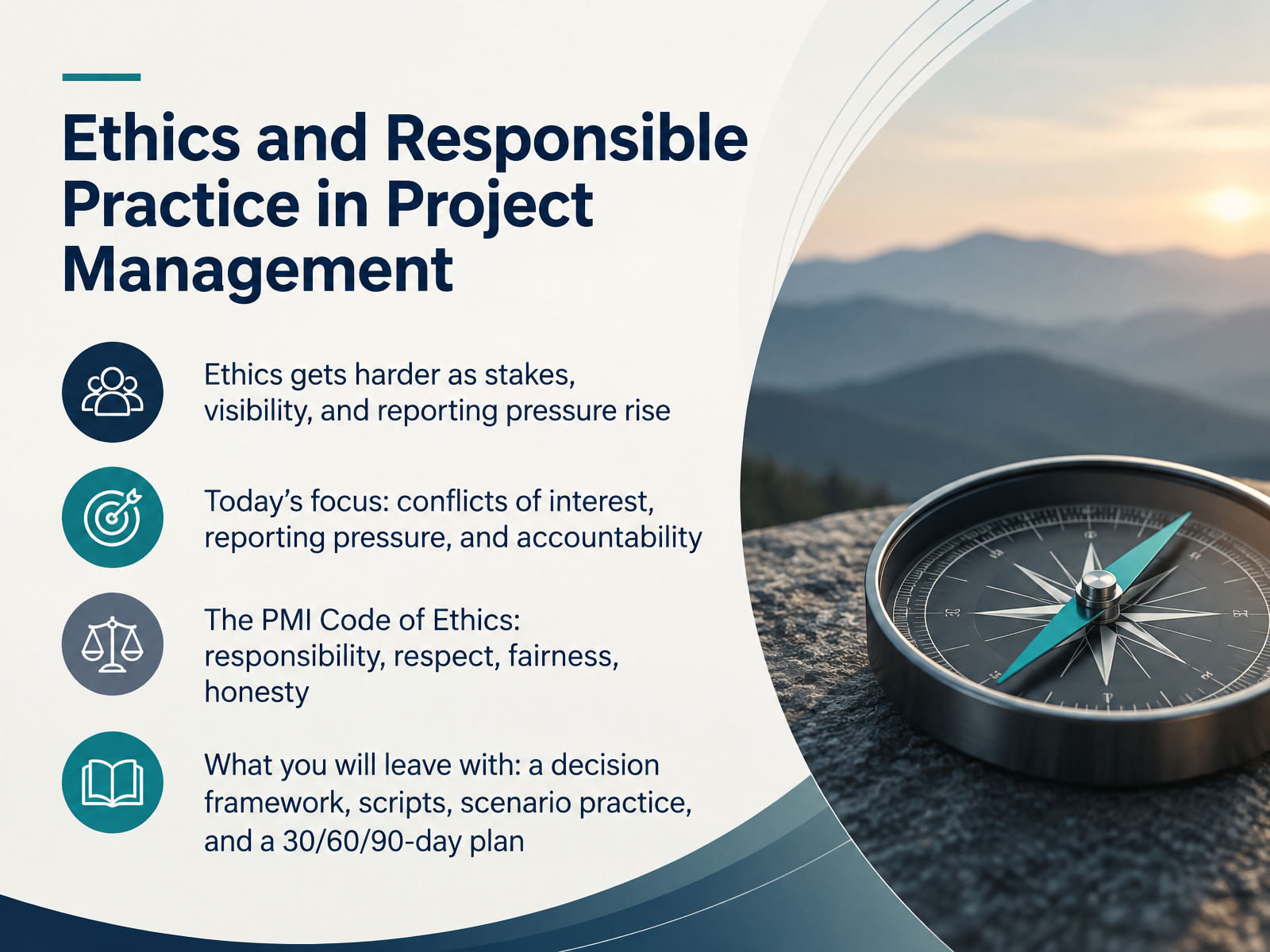
- 01Ethics and Responsible Practice in Project ManagementWelcome. I'm glad you're here. This course is about ethics and responsible practice in project management, and it's built for people who already know the concepts and need language for using them under pressure. Here's the honest starting point. Ethics gets harder as the stakes, the visibility, and the reporting pressure rise. The decisions that test you rarely arrive on a calm day. Today we'll focus on three areas you'll recognize: conflicts of interest, reporting pressure, and accountability. We'll anchor the work in the PMI Code of Ethics and Professional Conduct, which rests on four values: responsibility, respect, fairness, and honesty. You'll leave with a decision framework, some scripts you can actually say out loud, scenario practice, and a thirty, sixty, ninety day plan. For now, one practical prompt. This week, notice one moment where a deadline and a value pulled you in different directions. Hold onto it. We'll use situations like that throughout. Next, let's look at the 2026 Professional and Governance Context.pmi.orgpmi.orgpmi.org+22 min
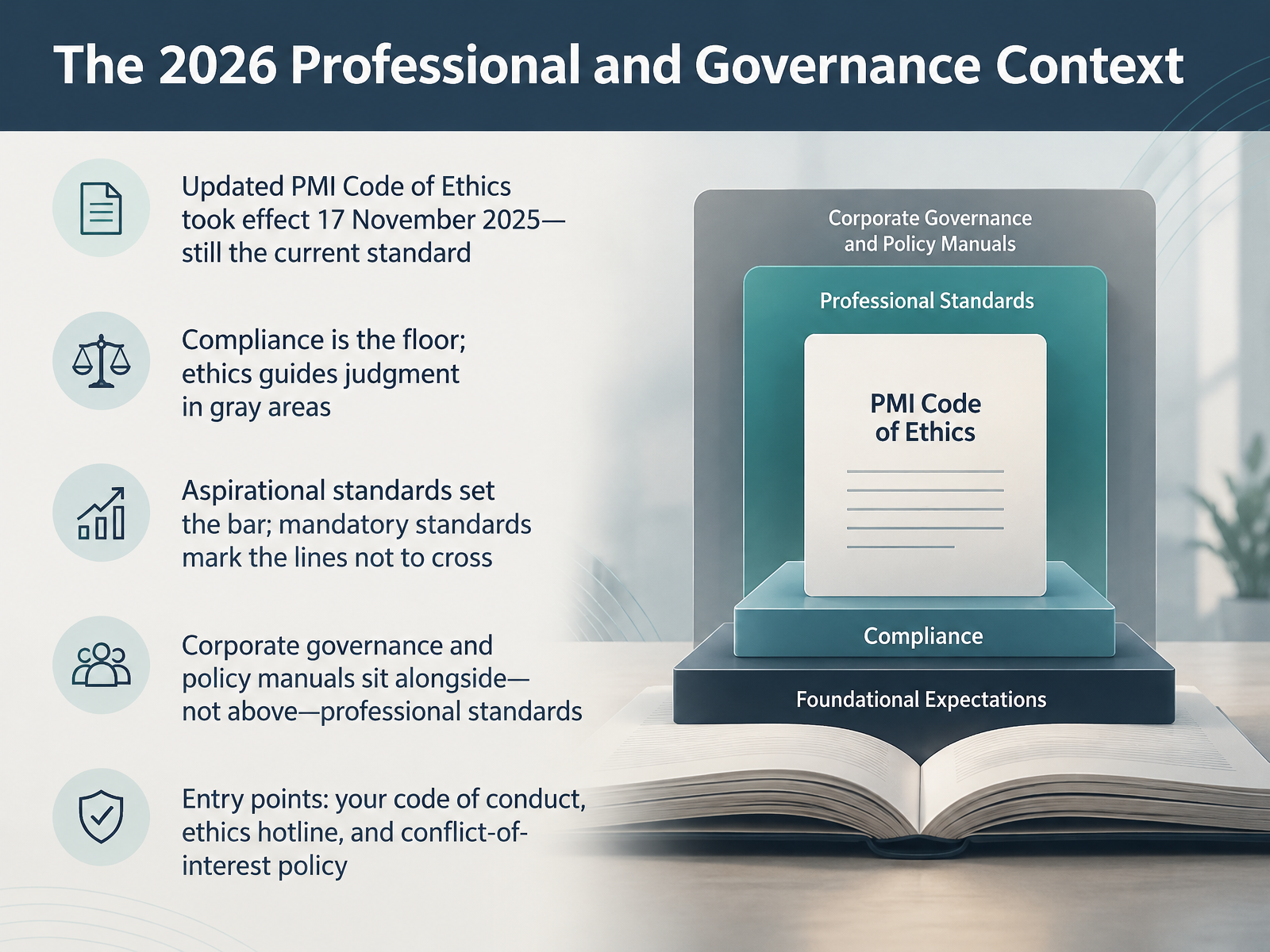
- 02The 2026 Professional and Governance ContextLet's start with the landscape you're working in. The updated PMI Code of Ethics took effect on the seventeenth of November, twenty twenty-five, and it's still the current standard. Treat compliance as the floor, not the ceiling. The Code gives you judgment for gray areas. Aspirational standards set the bar. Mandatory standards mark the lines you don't cross. Your corporate governance and policy manuals sit alongside the Code, not above it. When they point in different directions, that's a conversation, not a shortcut. Know your entry points before you need them: your code of conduct, the ethics hotline, and the conflict-of-interest policy. This week, open one of those and note the escalation path for your current project. That gives you a clear next step when a decision framework comes into play.
 pmi.orgpmi.orgpmi.org+21 min
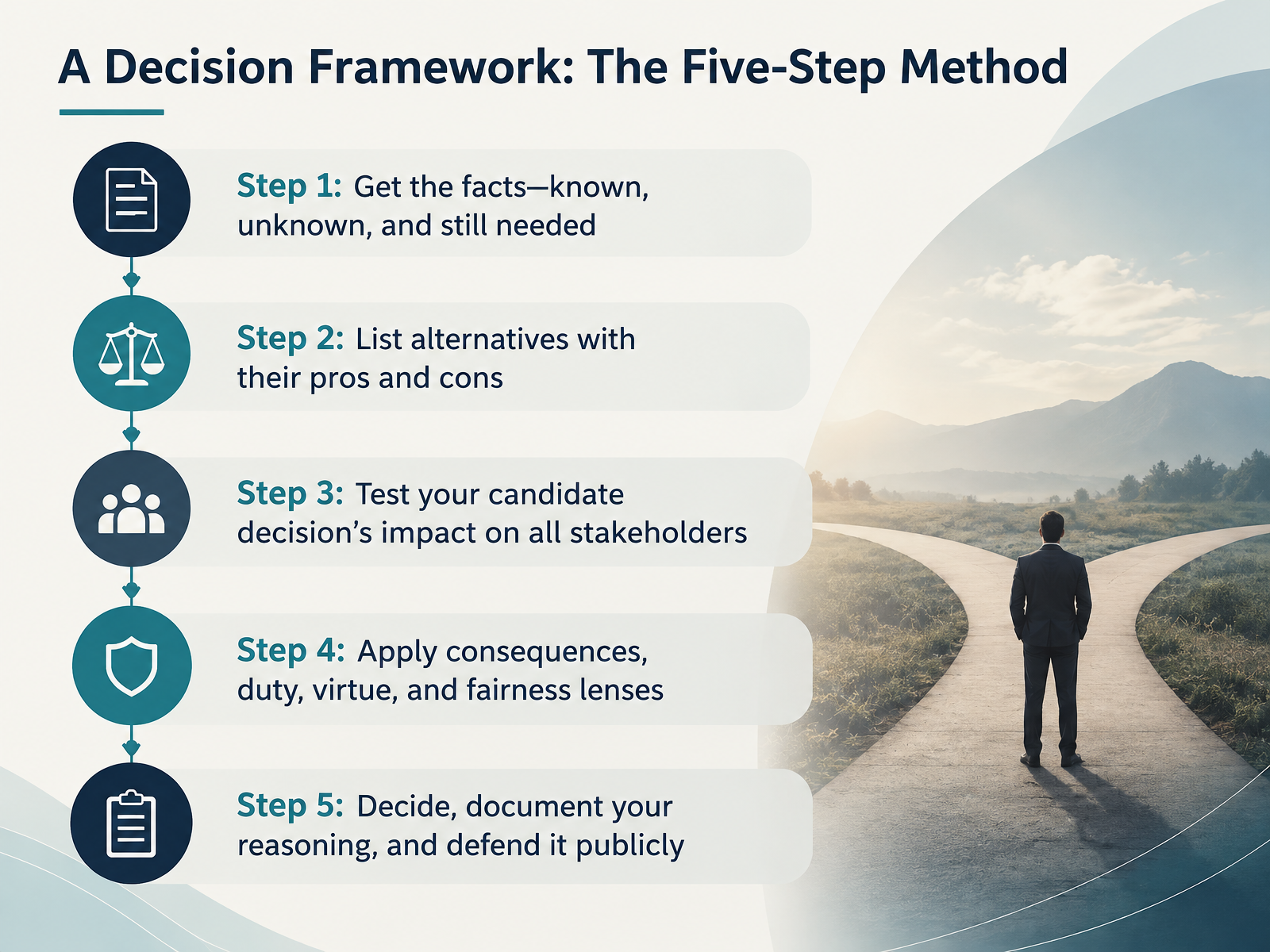
- 03A Decision Framework: The Five-Step MethodHere's a method you can actually run under deadline. Five steps. First, get the facts. Separate what you know, what you don't, and what you still need. Name the gap out loud before you decide. Second, list your alternatives with pros and cons. Include doing nothing as a real option. Third, test your candidate decision against every stakeholder. Ask who absorbs the downside if this goes wrong. Fourth, run four lenses. Consequences, duty, virtue, and fairness. If they disagree, that's useful information. Fifth, decide, document your reasoning in two or three lines, and make sure you could defend it publicly. It's a loop, not a straight line, so step back when a fact shifts. This week, take one live decision and write your five steps in a short note. Next, we'll look at conflicts of interest, actual, potential, and perceived.
 pmi.orgpmi.orgpmi.org+22 min
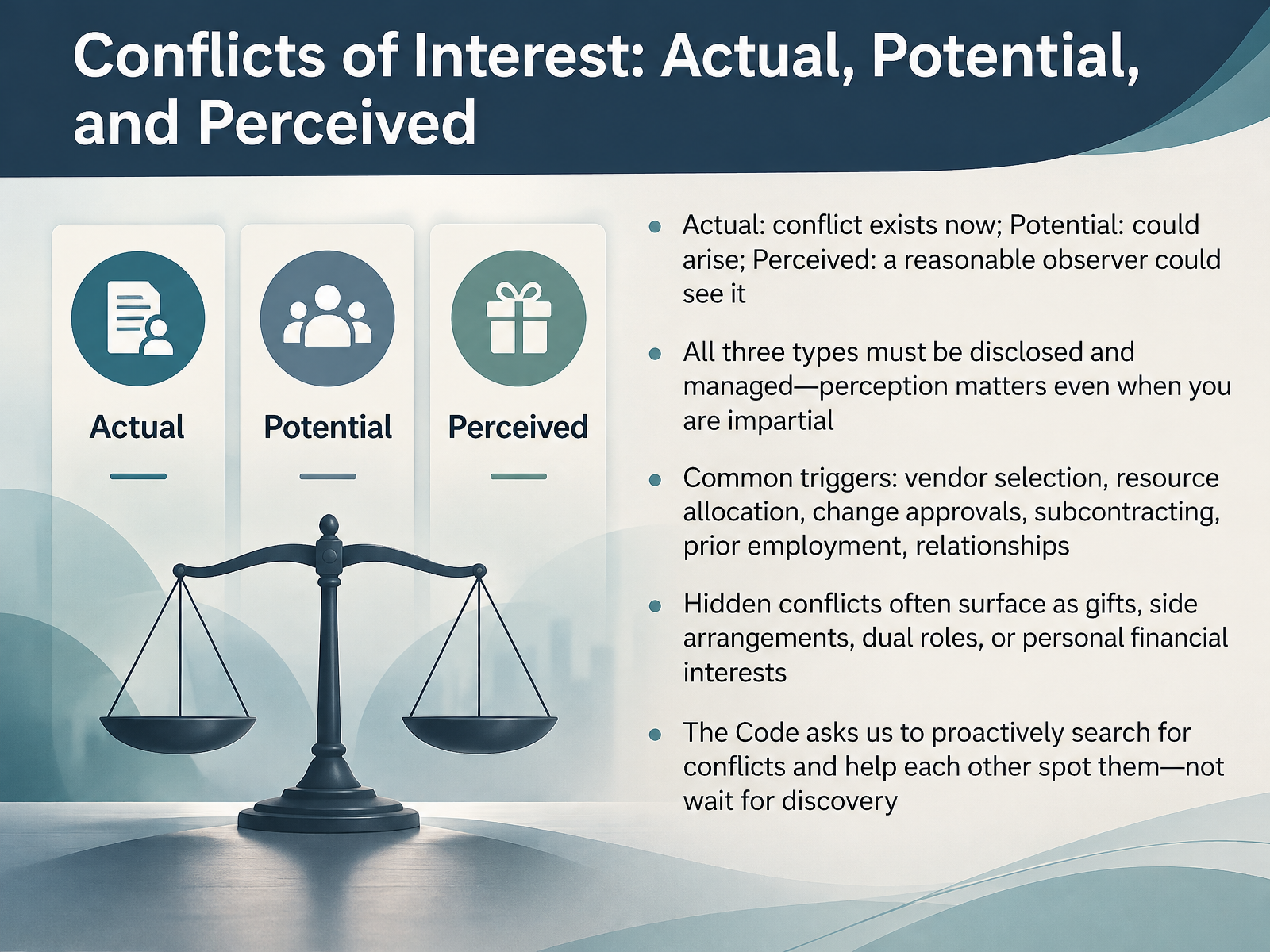
- 04Conflicts of Interest: Actual, Potential, and PerceivedNext, let's talk about conflicts of interest. They come in three forms. Actual means the conflict exists right now. Potential means it could reasonably arise later. Perceived means a reasonable observer could see it, even if you're impartial. All three need disclosure and management, because perception matters. Common triggers are vendor selection, resource allocation, change approvals, subcontracting, prior employment, and relationships. Hidden conflicts often surface as gifts, side arrangements, dual roles, or personal financial interests. The Code asks us to search for conflicts proactively and help each other spot them, not wait for discovery. So this week, map your current project against those triggers, and disclose one situation you've been unsure about, even if it turns out to be nothing. Now let's look at warning signs and organizational expectations.
 ojp.govmn.govtbs-sct.canada.ca+21 min
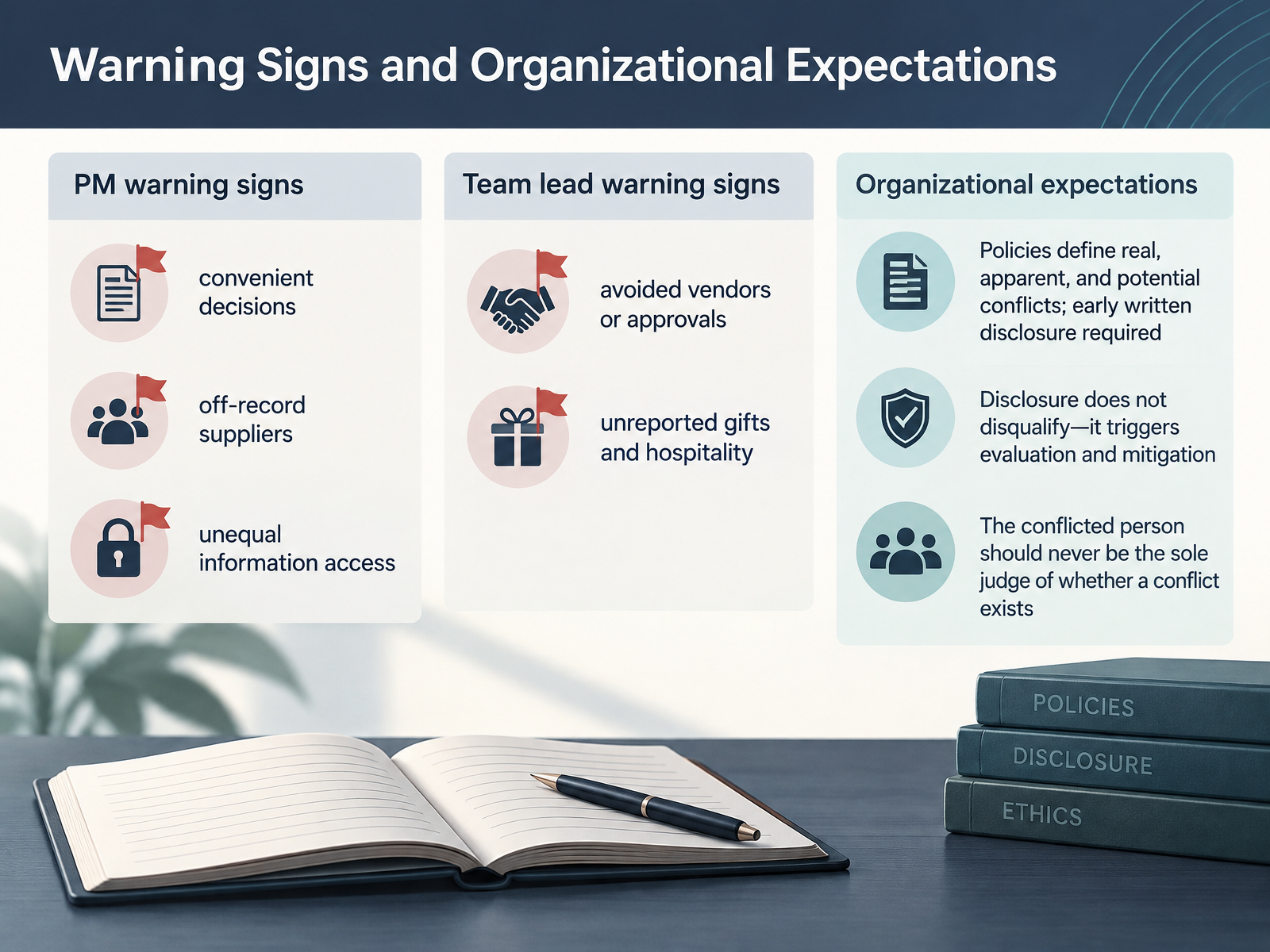
- 05Warning Signs and Organizational ExpectationsSo how do you spot trouble before it hardens into a problem? Start with patterns. For project managers, watch for decisions that land too conveniently. The same supplier keeps winning, or a shortlist appears after the fact. For team leads, the signal is avoidance. A vendor gets quietly skipped. An approval goes around the process. A gift or lunch stays off the record. Policies give us useful language here. They define real, apparent, and potential conflicts, and they ask for early written disclosure. Here is the part people get wrong. Disclosure does not disqualify anyone. It triggers an evaluation and a mitigation plan. And one more rule matters. The person with the conflict should never be the sole judge of whether the conflict exists. That judgment sits with someone independent. If you bring one thing from this slide into this week, pick a recent decision and ask who else should have reviewed it. Next, we look at prevention and disclosure in practice.
 ojp.govmn.govtbs-sct.canada.ca+22 min
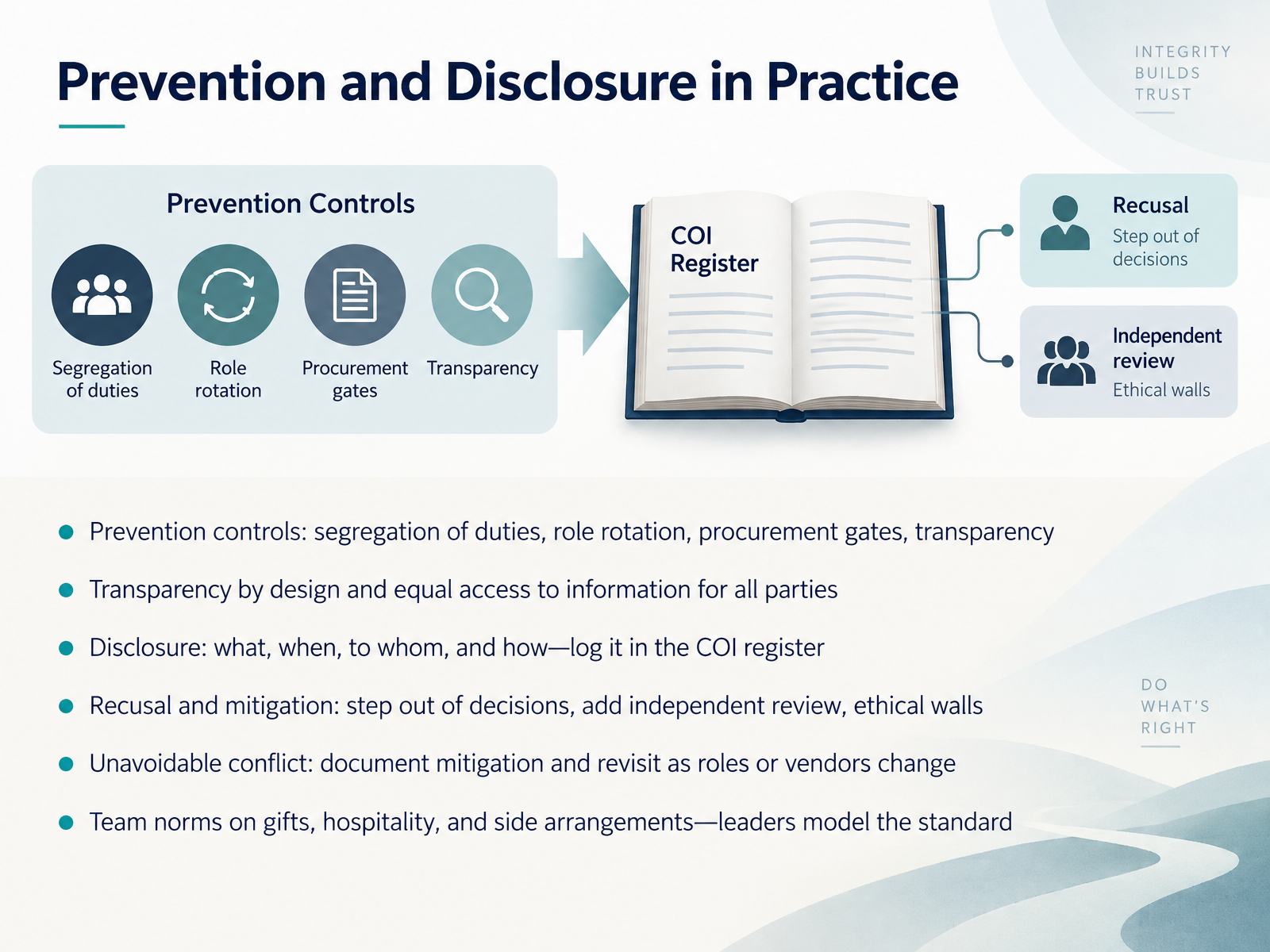
- 06Prevention and Disclosure in PracticeLet's talk about prevention and disclosure in practice. Prevention starts with structure. Separate duties so the person who evaluates is not the person who approves. Rotate roles when a relationship has grown too close. Put gates in procurement, and share information equally with all parties. Transparency by design means nobody gets a private channel. When a conflict appears, disclose it early. Be clear about what it is, when it started, who needs to know, and how you will manage it. Then log it in the conflict of interest register. If you are too close to a decision, step out. Add independent review, or set up an ethical wall. Some conflicts cannot be eliminated. When that happens, document the mitigation and revisit it as roles or vendors change. And agree as a team on gifts, hospitality, and side arrangements, with leaders modelling the standard. This week, check one live decision for a conflict, and log the mitigation. Next, we'll look at how to weigh these choices in Fit Check: Decisions in Four Lenses.
 media.umbraco.iodocuments1.worldbank.orgnao.org.uk+22 min
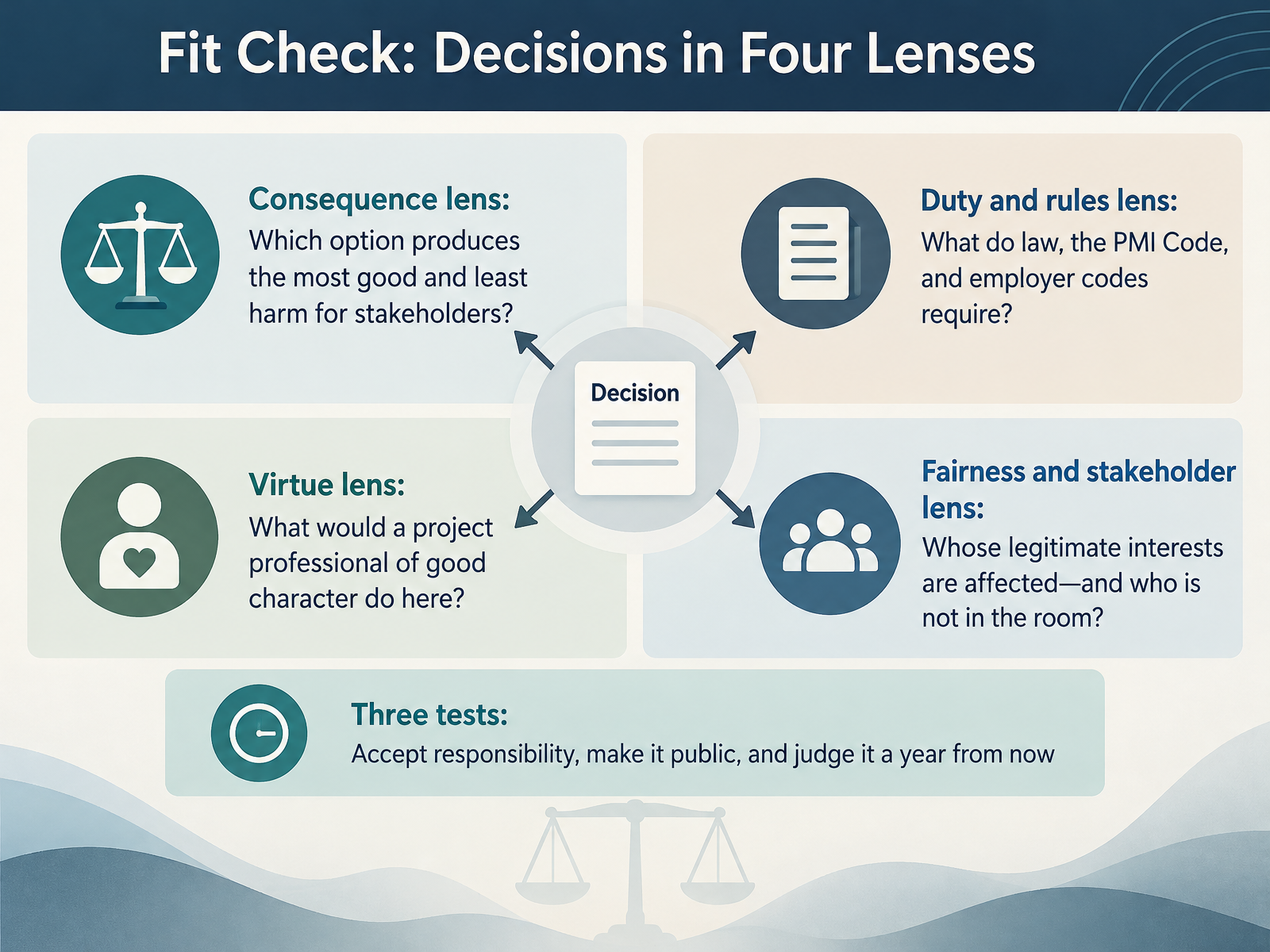
- 07Fit Check: Decisions in Four LensesNow let's run a fit check using four lenses. Take one decision on your plate right now, and look at it each way. The consequence lens asks which option produces the most good and least harm for stakeholders. The duty and rules lens asks what the law, the PMI Code, and your employer's code require. If the law is unclear, get counsel. The virtue lens asks what a project professional of good character would do here. The fairness and stakeholder lens asks whose legitimate interests are affected, and who is not in the room. Finally, run three tests. Accept responsibility for the decision. Make it public and feel good about it. And ask whether it will still look like a good idea a year from now. Those questions come straight from PMI's Ethical Decision-Making Framework. This week, run one live decision through all four lenses before you sign off. Next, we look at reporting pressure and the truthful status update.
 pmi.orgpmi.orgpmi.org+22 min
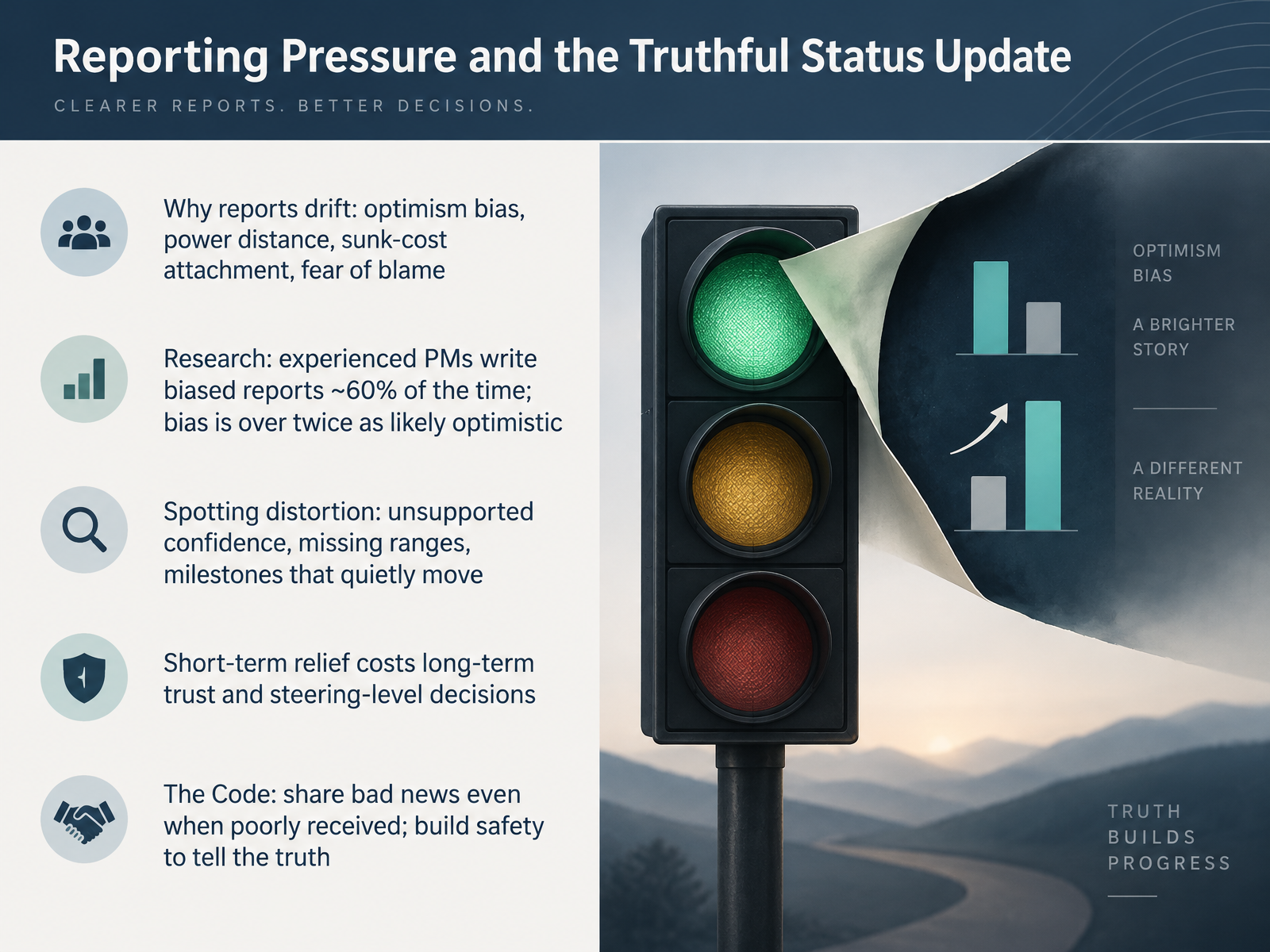
- 08Reporting Pressure and the Truthful Status UpdateLet's talk about reporting pressure and the truthful status update. Reports drift for ordinary reasons. Optimism bias, power distance, attachment to what you have already spent, and fear of blame. Research matters here. In a review of records from fifty six experienced project managers, they wrote biased reports sixty percent of the time. And that bias was more than twice as likely to be optimistic. So this is not a rare failure. It is a default. Watch for the signals. Unsupported confidence. No ranges, only single-point dates. Milestones that quietly move without a note. Short-term relief buys you one calm steering meeting, and it costs long-term trust and the decisions steering makes on your numbers. The Code is direct on this. Share bad news even when it may be poorly received, and build an environment where others feel safe to tell the truth. So this week, pick one milestone and publish a range with your confidence level, plus what would change it. Then invite one teammate to challenge it openly. That one move starts turning status reporting into a shared practice, not a personal risk. Next, we look at how to actually do it. Delivering Bad News: Scripts and Escalation.
 pmi.orgpmi.orgpmi.org+22 min
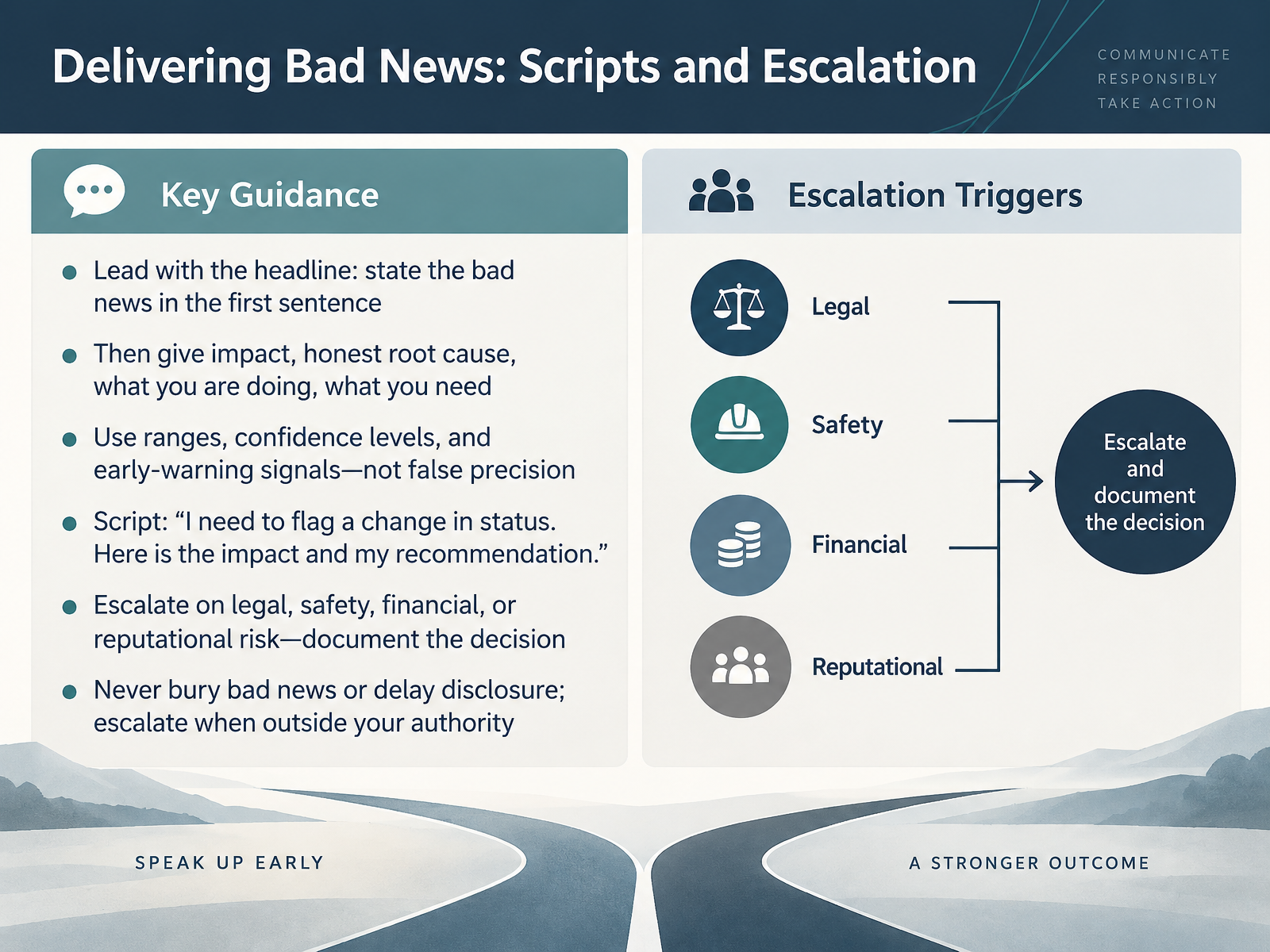
- 09Delivering Bad News: Scripts and EscalationNext, let's look at how you actually deliver bad news. Lead with the headline. State the bad news in your first sentence, not your third paragraph. Then give the impact, the honest root cause, what you're doing, and what you need. Use ranges and confidence levels, and flag early-warning signals instead of false precision. A simple script helps. Say, I need to flag a change in status. Here is the impact and my recommendation. Escalate on legal, safety, financial, or reputational risk, and document the decision. Never bury bad news or delay disclosure. If it sits outside your authority, it goes up, and it goes up early. This week, pick your riskiest open item and draft those four lines before your next status meeting. That sets up our next topic, Accountability Without Blame.
 1 min
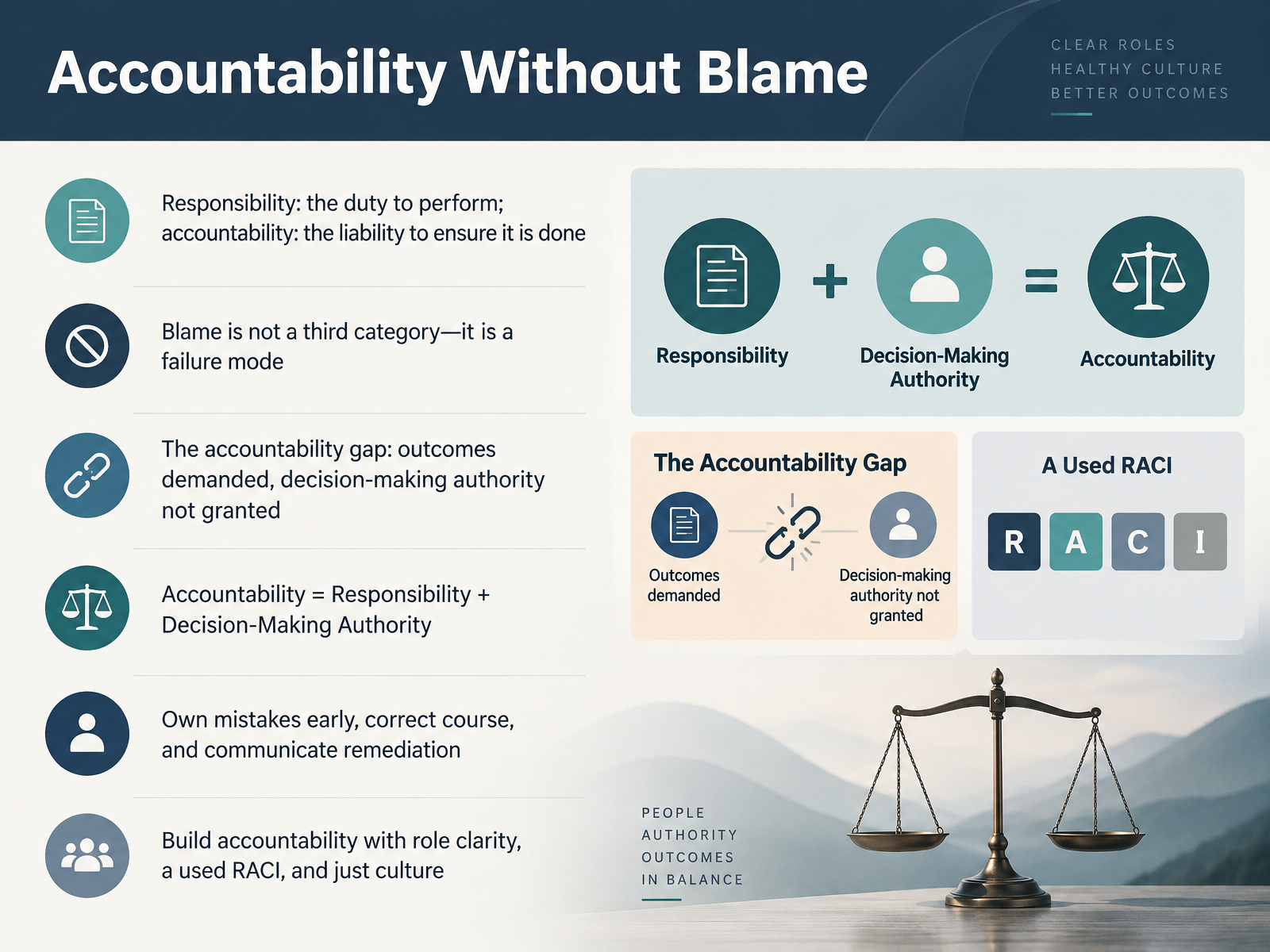
- 10Accountability Without BlameLet's talk about accountability without blame. Start with a simple distinction. Responsibility is the duty to perform the work. Accountability is the liability to ensure it gets done. Blame is not a third category. It's a failure mode, and it rarely improves delivery. Watch for the accountability gap. Teams are handed outcomes but not the authority to make decisions. Name that gap early, in writing. A useful rule: accountability equals responsibility plus decision-making authority. When you own a mistake, own it early. Correct the course, then communicate the remediation to the people who depend on it. Build accountability as a team practice: clear roles, a RACI you actually use, and a just culture where people can report problems safely. This week, check one decision you're accountable for and confirm you hold the authority to make it. Next, we'll look at psychological safety and just culture.
 pmi.orgpmi.orgpmi.org+22 min
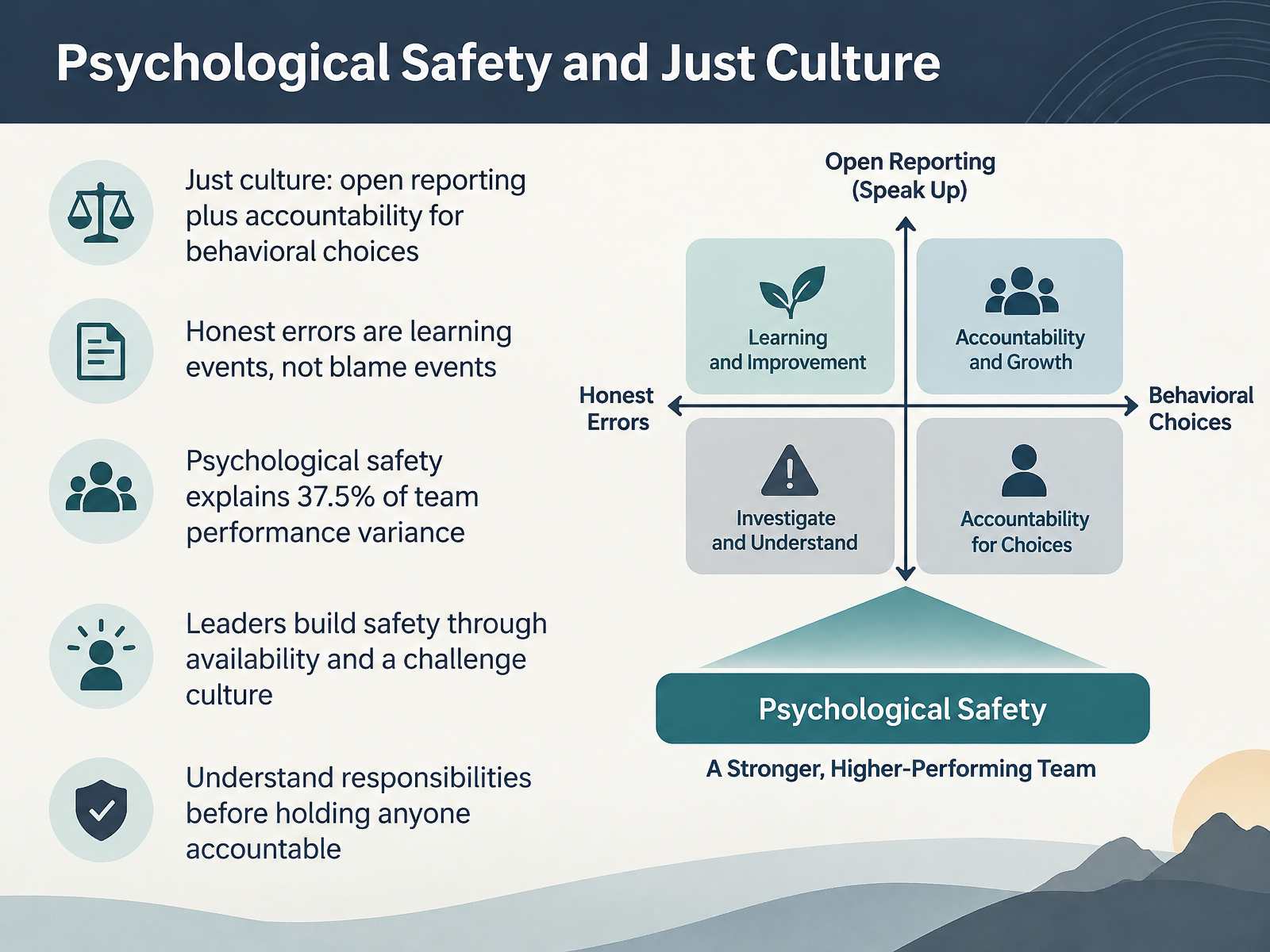
- 11Psychological Safety and Just CultureNext, let's talk about psychological safety and just culture. Just culture means two things at once. People report openly, and they stay accountable for their behavioral choices. An honest error is a learning event, not a blame event. The numbers back this up. Psychological safety explains thirty-seven point five percent of the variance in team performance. That is a large share, and it is something you can influence. Leaders build that safety through availability. Be present, be reachable, and make challenge normal. Encourage your team to push back on plans and estimates without fear. One more point. Understand responsibilities before you hold anyone accountable. If you do not know what someone was actually responsible for, your accountability conversation will misfire. This week, ask one team member what they would have flagged last month if it had felt safe. Then listen, and thank them for the answer. That is how a just culture becomes real, one conversation at a time. In the next section, we put this into practice with scenarios on conflicts, pressure, and accountability.
 pmi.org2 min
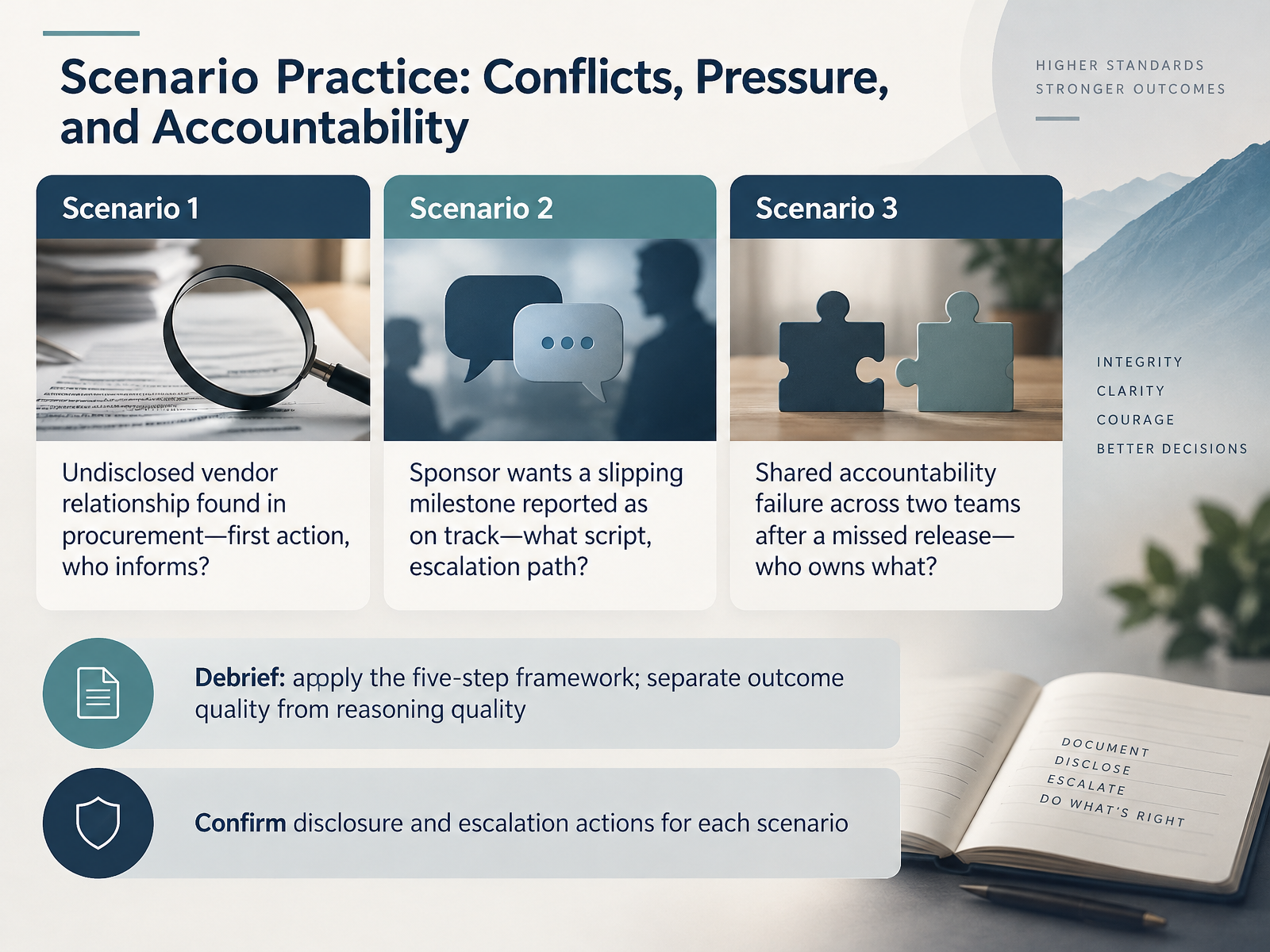
- 12Scenario Practice: Conflicts, Pressure, and AccountabilityLet's put this into practice with three scenarios. Scenario one: you find an undisclosed vendor relationship in procurement. First action: pause the award and document what you found. Then inform procurement leadership and your sponsor, and check your conflict of interest policy before anyone signs. Scenario two: your sponsor wants a slipping milestone reported as on track. Use a calm script: the milestone has moved, here is the new date, here is the impact, and here is our recovery plan. Then escalate through your PMO or governance channel, in writing. Scenario three: a missed release across two teams. Separate ownership by workstream. Name what each team owned, what handoffs failed, and who confirms the fix. In the debrief, apply the five-step framework and judge the reasoning, not just the outcome. Before you close this week, confirm the disclosure and escalation action for each scenario with your team, and note who owns it.
 pmi.orgpmi.orgpmi.org+22 min
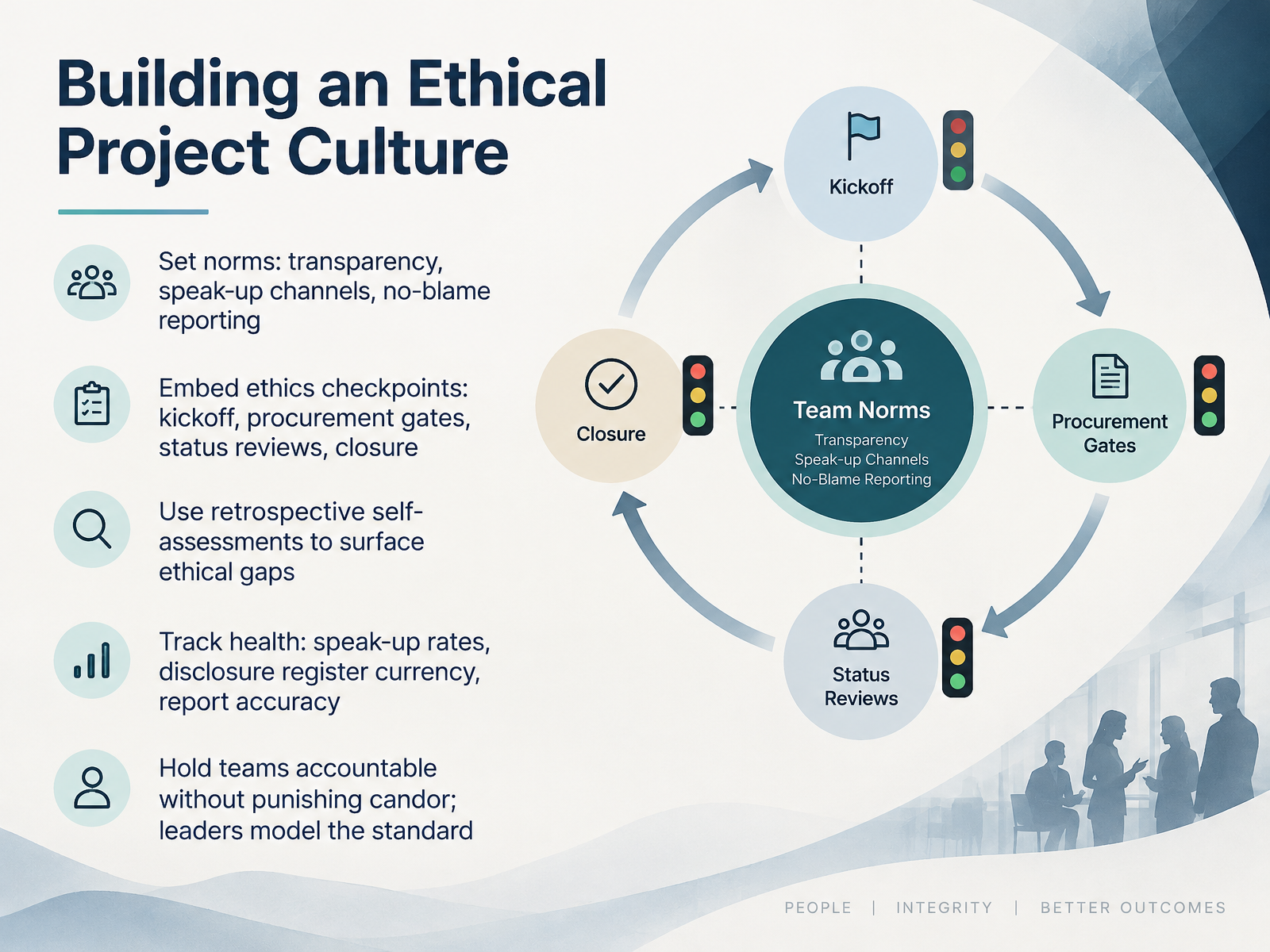
- 13Building an Ethical Project CultureLet's talk about building an ethical project culture. Culture isn't a poster. It's what your team does when a deadline is tight and the numbers look inconvenient. Start by setting norms. Make transparency routine, open real speak-up channels, and run no-blame reporting, so people raise issues early instead of hiding them. Then embed ethics checkpoints into work you already do: kickoff, procurement gates, status reviews, and closure. At each one, ask a simple question: is anything here unclear or unmanaged? Use retrospectives to surface gaps. Not to assign fault, but to fix the system. Track a few health measures: speak-up rates, how current your disclosure register is, and report accuracy. Watch the trends, not just single events. And hold the team accountable without punishing candor. Leaders model the standard first, because people copy what you tolerate. Here's your prompt for this week: at your next status review, add one ethics checkpoint and note one issue raised. That gives the next slide, Action Plan: Your Next 30 Days, something concrete to build on.
 pmi.orgmedia.umbraco.iodocuments1.worldbank.org+21 min
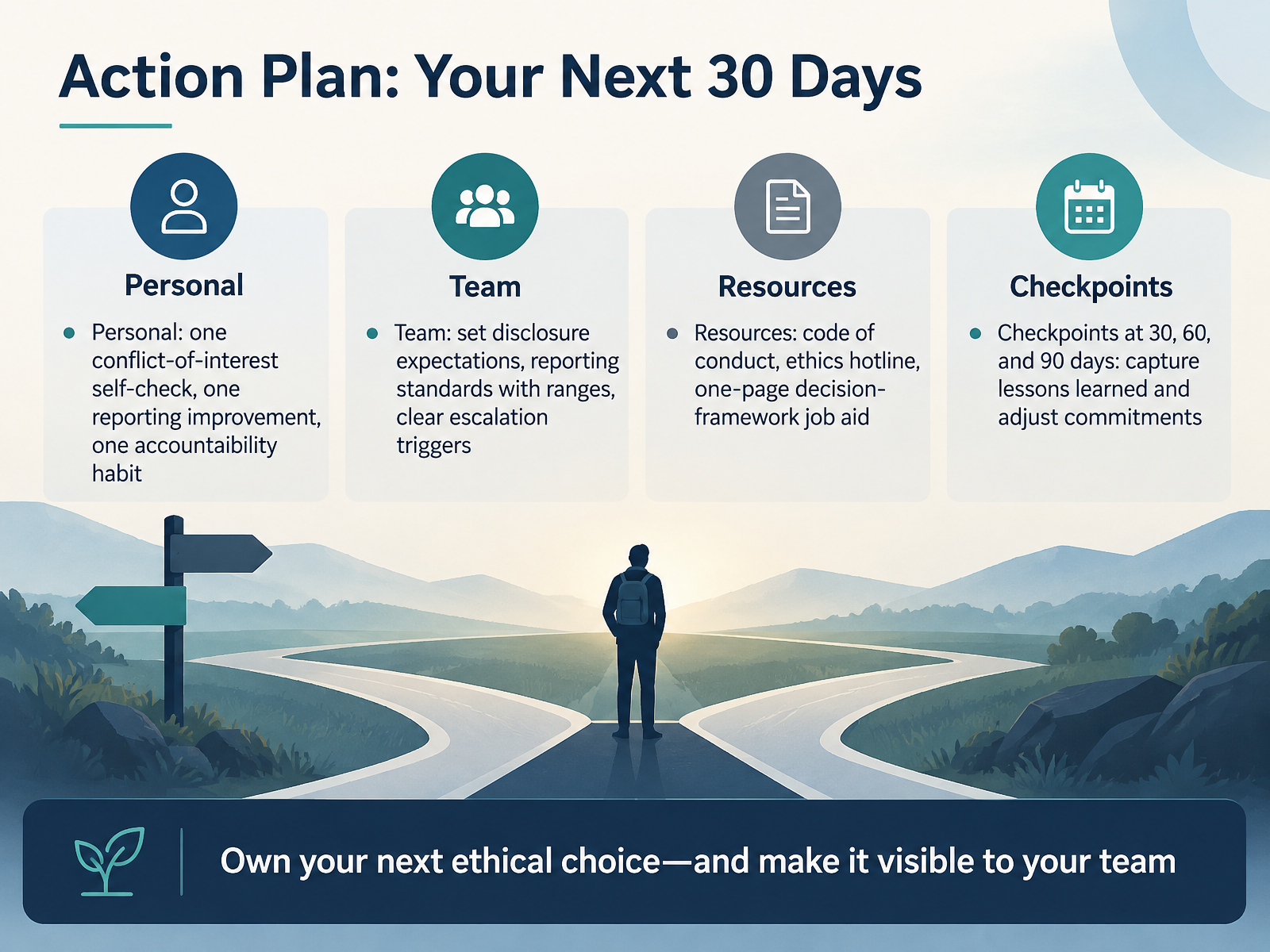
- 14Action Plan: Your Next 30 DaysLet's close with a plan you can actually run over the next thirty days. Keep it small and concrete. On the personal side, pick one conflict-of-interest self-check, one reporting improvement, and one accountability habit. For example, a weekly status range instead of a single green, or naming your own error in the same meeting where you report progress. With your team, set three expectations: what gets disclosed, what reporting with ranges looks like, and what triggers an escalation. Be specific about triggers so nobody has to guess in the moment. Then use the resources you already have: the code of conduct, the ethics hotline, and a one-page decision framework you can keep within reach. Schedule checkpoints at thirty, sixty, and ninety days. Capture lessons learned and adjust your commitments as you go. That mirrors how mature governance programs treat the first ninety days, as a loop rather than a launch. So here's your summary. You now have language for escalation, sign-off pressure, and reporting deadlines. Hold the line calmly, make your reasoning visible, and treat accountability as a shared team practice. Thank you for your attention and for the care you bring to this work. Pick one choice this week and make it visible. You are the person who sets the tone, and that is a real advantage.
 pmi.orgpmi.orgpmi.org+22 min
Take the deck with you
Download this course as a file — free, no sign-up needed.
- PDF handoutEvery slide page, ready to print or share.15 pages · 3.4 MBDownload
- Narrated PowerPointThe deck that presents itself — every slide carries the digital human's narration video.15 pages · 24.6 MBDownload
- PowerPoint slidesThe full deck as a .pptx — open it in PowerPoint, Keynote, or Google Slides.15 pages · 3.4 MBDownload
Free to use in your own training — please keep the PersonWise credit page at the end.
Have your own deck? Turn it into a course
Sources consulted
Web sources consulted while building this course.
- Ethics in Project Management — pmi.org
- Ethics Guidelines — pmi.org
- PMICodeOfEthics_8.5x11in — pmi.org
- Project Management Institute Certification Handbook — pmi.org
- Policy Manual for PMI Chapters — pmi.org
- PMI ® Ethical Decision-Making Framework — pmi.org
- Leader's Choice - Five Steps to Ethical Decision Making — pmi.org
- Ethics_Practitioners_8.5x11in — pmi.org
- Ethical project management — pmi.org
- Make time for ethics — pmi.org
- Conflict of Interest — ojp.gov
- OSP Policy 21-02: Procurement Conflict of Interest — mn.gov
- Guide to Mitigating Conflicts of Interest in Procurement- Canada.ca — tbs-sct.canada.ca
- Vendor Conflict of Interest Policy — assets.metrolinx.com
- Procurement Guidance Conflict of Interest — thedocs.worldbank.org
- Major Infrastructure Project Governance Guidance — media.umbraco.io
- Preventing and Managing Conflicts of Interest in the Public Sector — documents1.worldbank.org
- Good practice guide - Managing conflicts of interest — nao.org.uk
- 11. Conflicts of Interest | Anti-Bribery Guidance | Transparency International — antibriberyguidance.org
- Managing conflicts of interest at all levels in your projects PRINCE2 USA — prince2.com