World History Fundamentals
Begin
13 pages · ~26 min
World History Fundamentals
A foundational course exploring key events, civilizations, and global developments to build historical understanding and critical thinking skills.
What you’ll learn
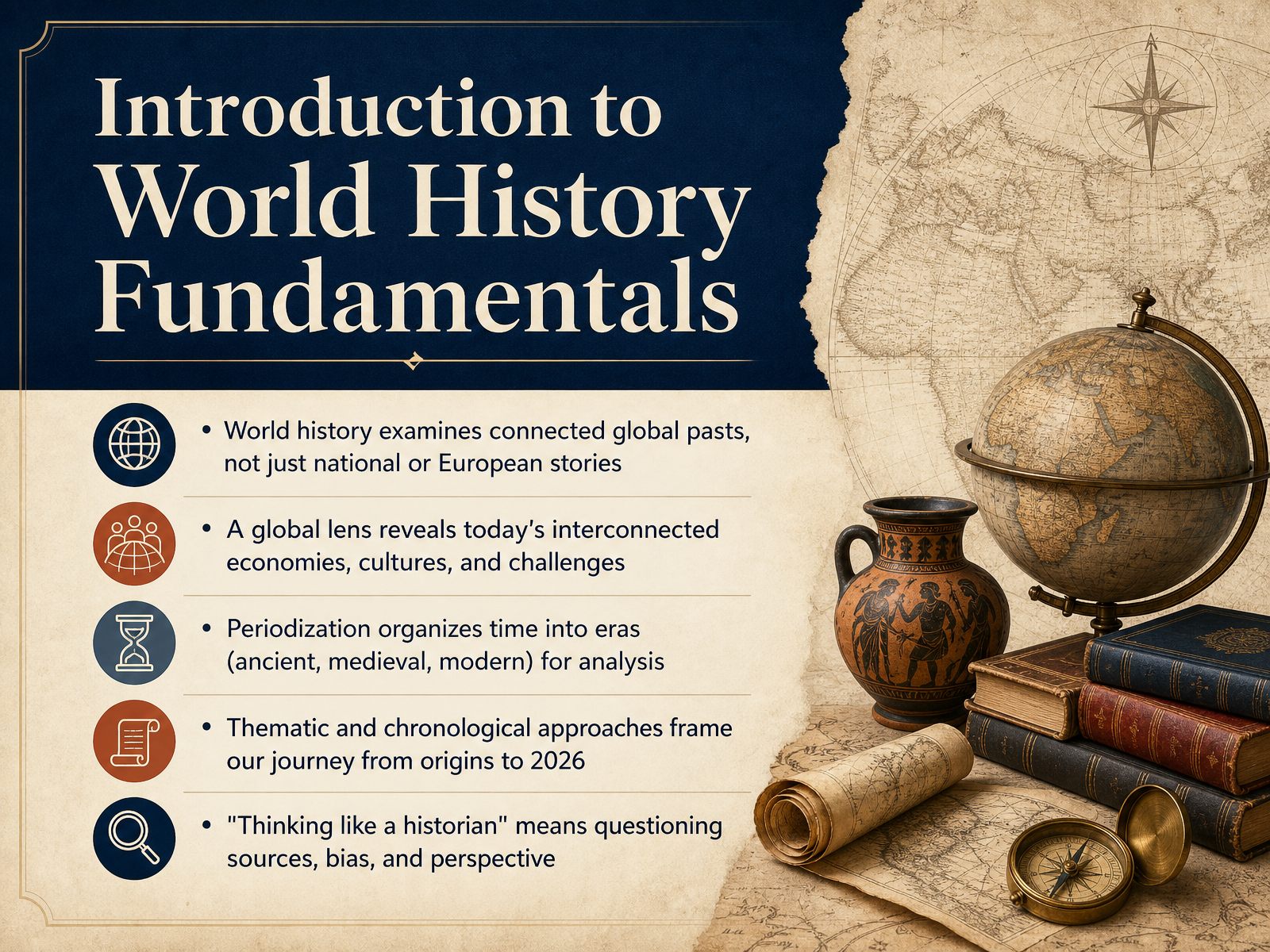
- 01Introduction to World History FundamentalsWelcome to World History Fundamentals. I'm glad you're here. In this course, we'll explore the connected stories of our shared past, not just one region or nation, but the global patterns that have shaped how we live today. Let's start by clarifying what that really means. World history examines linked human experiences across the planet. This wide-angle lens helps us understand today's interconnected economies, cultures, and challenges. To navigate such a vast story, we organize time into eras, like ancient, medieval, and modern, a practice historians call periodization. We'll weave together both chronological and thematic approaches, tracing our journey from early origins right up to the present. Most importantly, you'll learn to think like a historian. That means asking careful questions about sources, recognizing bias, and considering multiple perspectives. These skills will transform how you see not just the past, but the world around you. With that foundation set, let's begin at the beginning. Our next step is to explore Human Origins and the Great Migration.socialsciencelibrary.orgroutledge.comacademia.edu+22 min
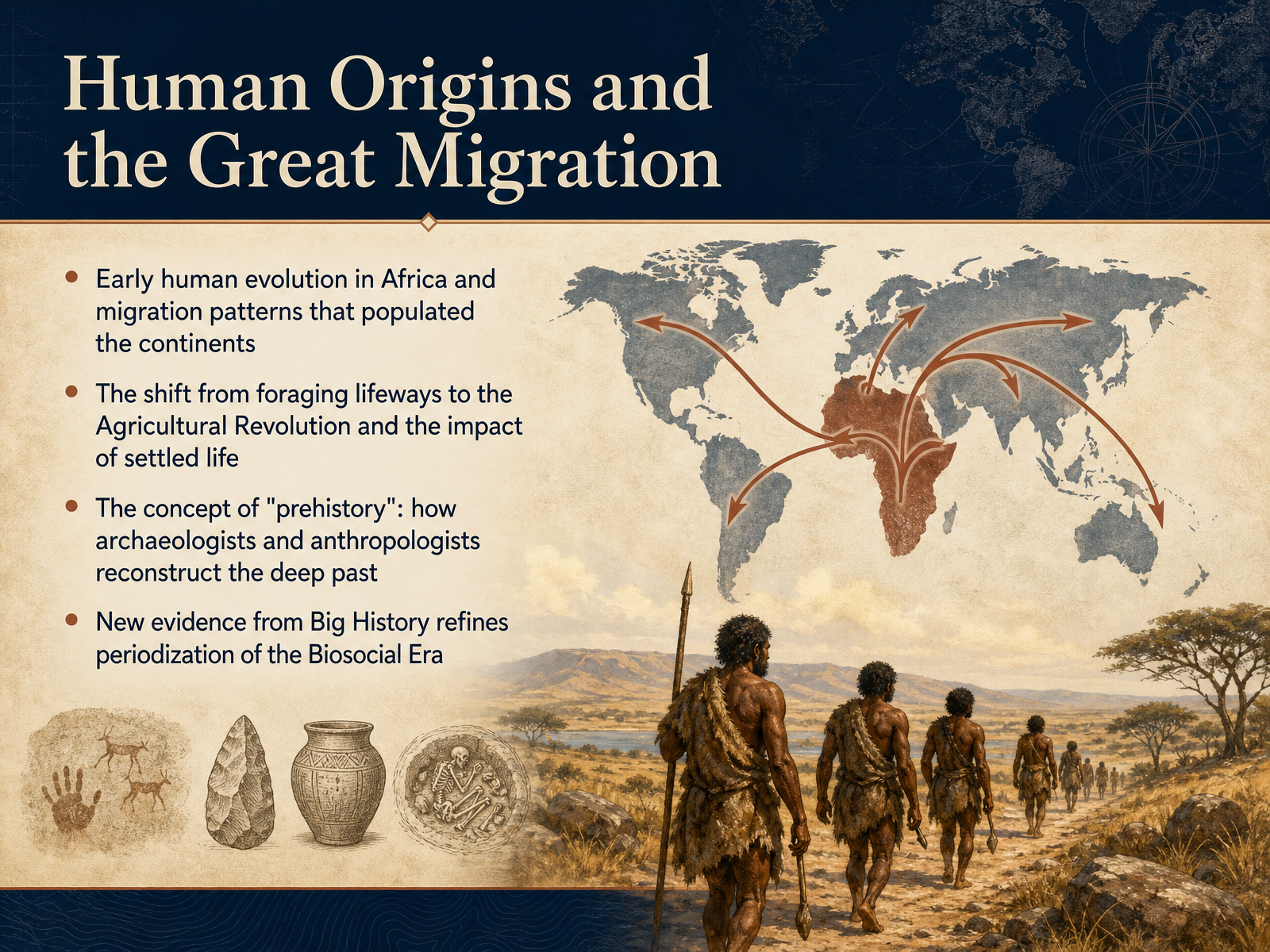
- 02Human Origins and the Great MigrationNow let's turn to where our shared story begins—with human origins and the first great migration. Our species evolved in Africa over hundreds of thousands of years. Then, in a series of movements, small bands of early humans walked out of the continent and slowly populated the rest of the planet. This was not a single journey but a branching, multi-generational expansion across continents. For most of that time, people lived as foragers, moving with the seasons and the herds. Then came a profound shift: the Agricultural Revolution. By planting crops and settling into villages, our ancestors changed not just how they ate, but how they related to land, to time, and to one another. Settled life brought new opportunities and new challenges—like storing surplus and organizing larger communities. Now, you might wonder, how do we know any of this? This deep past is what scholars call prehistory. Archaeologists and anthropologists reconstruct it by examining stone tools, bones, seeds, and even ancient trash heaps. Today, Big History researchers refine these timelines further. They talk about a Biosocial Era, marked by jumps in biological and social complexity—from the first stone tools to the earliest cave art and burials. When we study these distant beginnings, we are not just memorizing dates. We are learning to ask how small changes in daily life can reshape humanity's path on a global scale. That question remains just as urgent today. We will see it take a dramatic turn in our next session, as we explore the first river-valley civilizations.
 socialsciencelibrary.orgroutledge.comacademia.edu+22 min
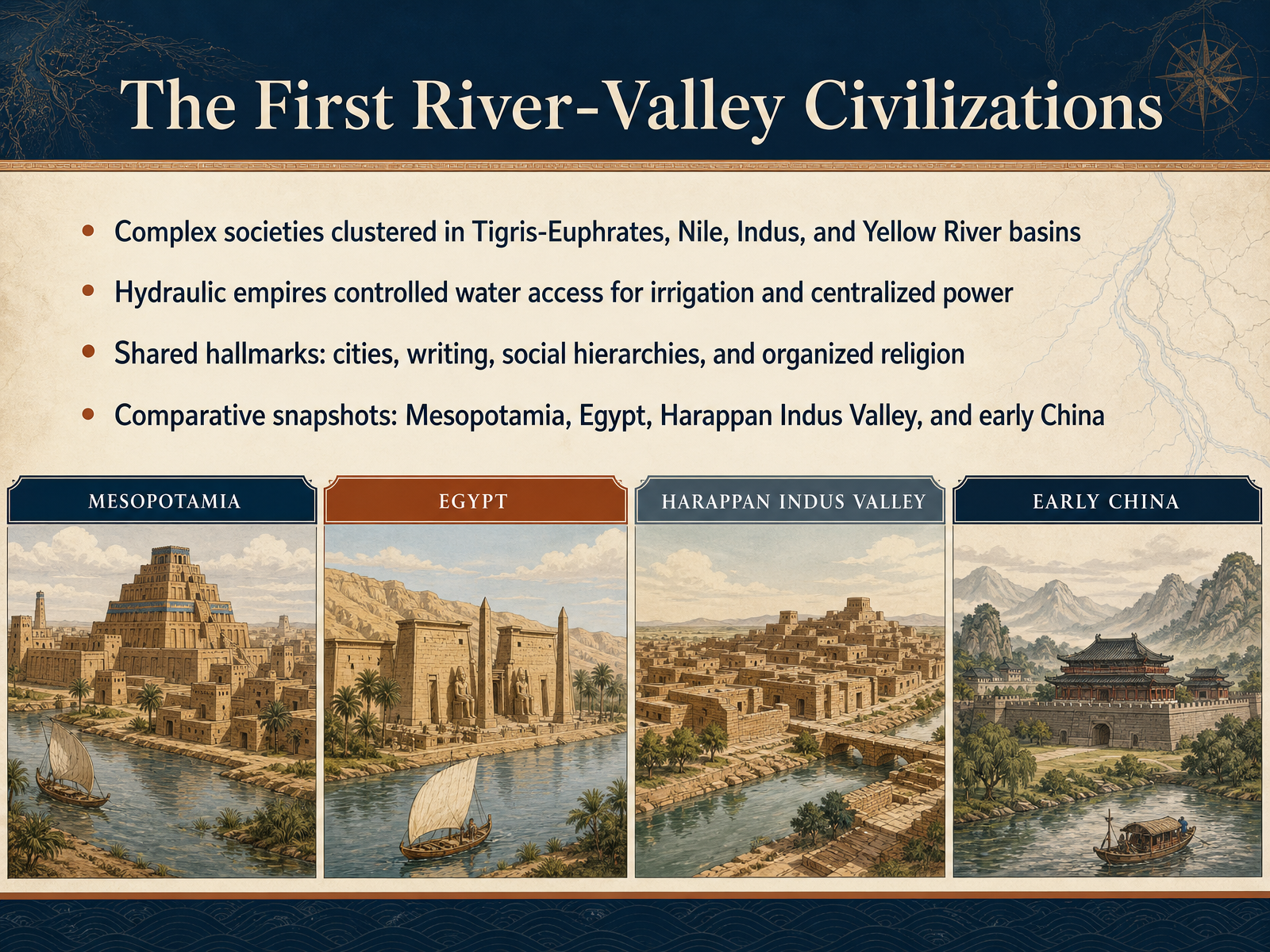
 - 03The First River-Valley CivilizationsNow let’s zoom in on the first river‑valley civilizations. By around thirty‑five hundred to two thousand BCE, complex societies emerged in four key regions: the Tigris‑Euphrates basin in Mesopotamia, the Nile valley in Egypt, the Indus basin in South Asia, and the Yellow River basin in China. Each of these civilizations can be described as a hydraulic empire because centralized governments controlled access to river water for irrigation. That control allowed them to coordinate large‑scale farming and generate food surpluses. From these surpluses, several shared hallmarks appeared: crowded cities, organized religion, writing systems, and clear social hierarchies. Think about Uruk in Mesopotamia, often called the world’s first true city. Its temples and walls defined a new way of life. Egypt offered a more unified kingdom along the Nile, while Harappan cities on the Indus gave us remarkable urban planning with advanced drainage. In early China, efforts to tame the Yellow River’s floods encouraged political unity. What stands out is that all four river‑valley cultures, despite unique paths, built the foundations of government, religion, and trade that still shape the world. Let’s build on that when we turn to classical empires and the Axial Age.
 nerd.wwnorton.comsocialsci.libretexts.orgwhfua.history.ucla.edu+22 min
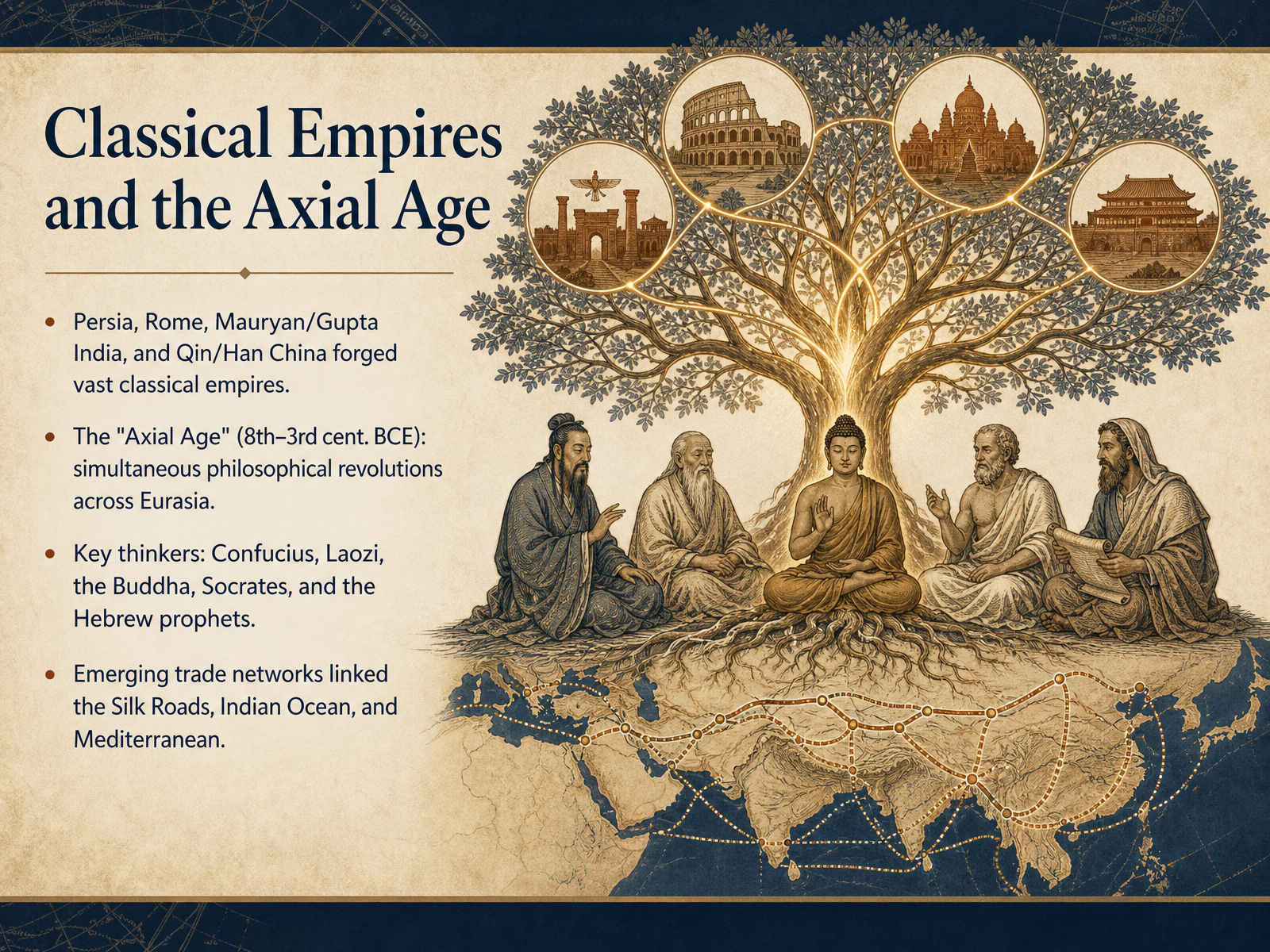
 - 04Classical Empires and the Axial AgeNow we move from the first river valley cities into an era of sprawling empires and bold new ideas. Between roughly the eighth and third centuries BCE, Persia, Rome, Mauryan and Gupta India, and Qin and Han China forged vast classical empires that connected huge populations. During this same stretch of time, thinkers across Eurasia began asking remarkably similar questions about ethics, meaning, and how to live a good life. Scholars call this the Axial Age. In China you find Confucius and Laozi, in India the Buddha, in Greece Socrates, and among the Hebrew people the great prophets. They did not share a single script or empire, yet each tradition challenged old assumptions and laid spiritual foundations that still shape our world. And as their ideas spread, so did goods. Trade networks began to link the Silk Roads, the Indian Ocean, and the Mediterranean into a single, buzzing web of exchange. Let's carry those connections forward and see how post-classical empires built on them in the next part of our journey.
 en.wikipedia.orgcambridge.orgnerd.wwnorton.com+22 min
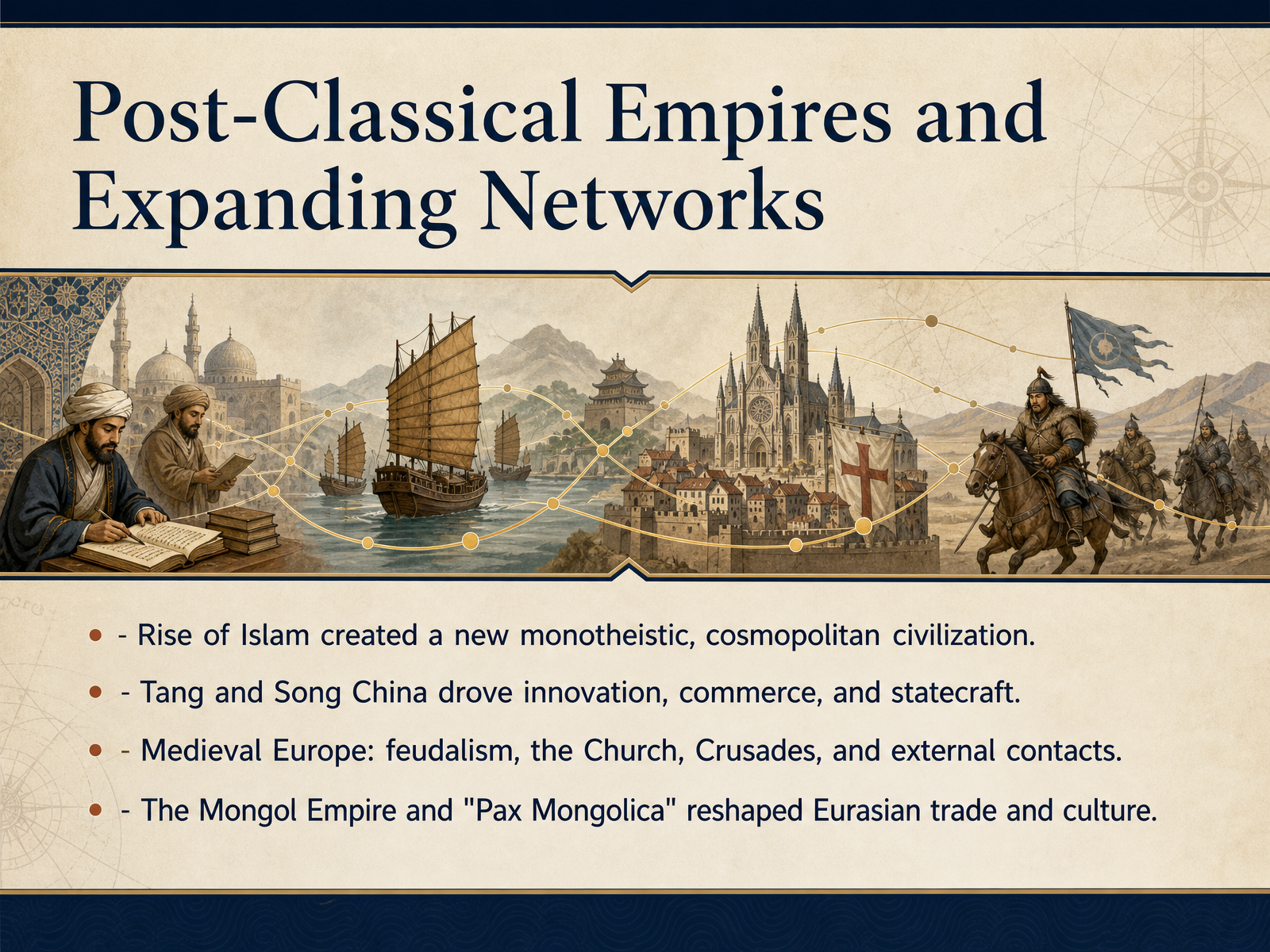
 - 05Post-Classical Empires and Expanding NetworksNow, let's move into a period of expanding connections—roughly the sixth to the fifteenth centuries. We are looking at a time when several powerful forces reshaped Eurasia. First, the rise of Islam created a vibrant new civilization that was both monotheistic and cosmopolitan, linking regions from Spain to India. At the same time, Tang and Song China saw remarkable advances in technology, commerce, and statecraft. Meanwhile, medieval Europe developed its own structures of feudalism and a powerful Church, launching the Crusades that brought it into intense contact with the Islamic world. But perhaps the most dramatic connector was the Mongol Empire. Their vast conquests established what became known as the Pax Mongolica, or Mongol Peace. For about a century, this security across the Silk Roads allowed goods like silk and spices, as well as ideas, to flow freely. Think of it this way: Marco Polo reached China, and Persian astronomers advised the Mongol court in Beijing. This unprecedented mobility set the stage for a truly interlinked world. Next, we’ll explore how these networks accelerated into the early modern world, a time of intense encounter, exchange, and empire.
 britannica.comafe.easia.columbia.edubrill.com+22 min
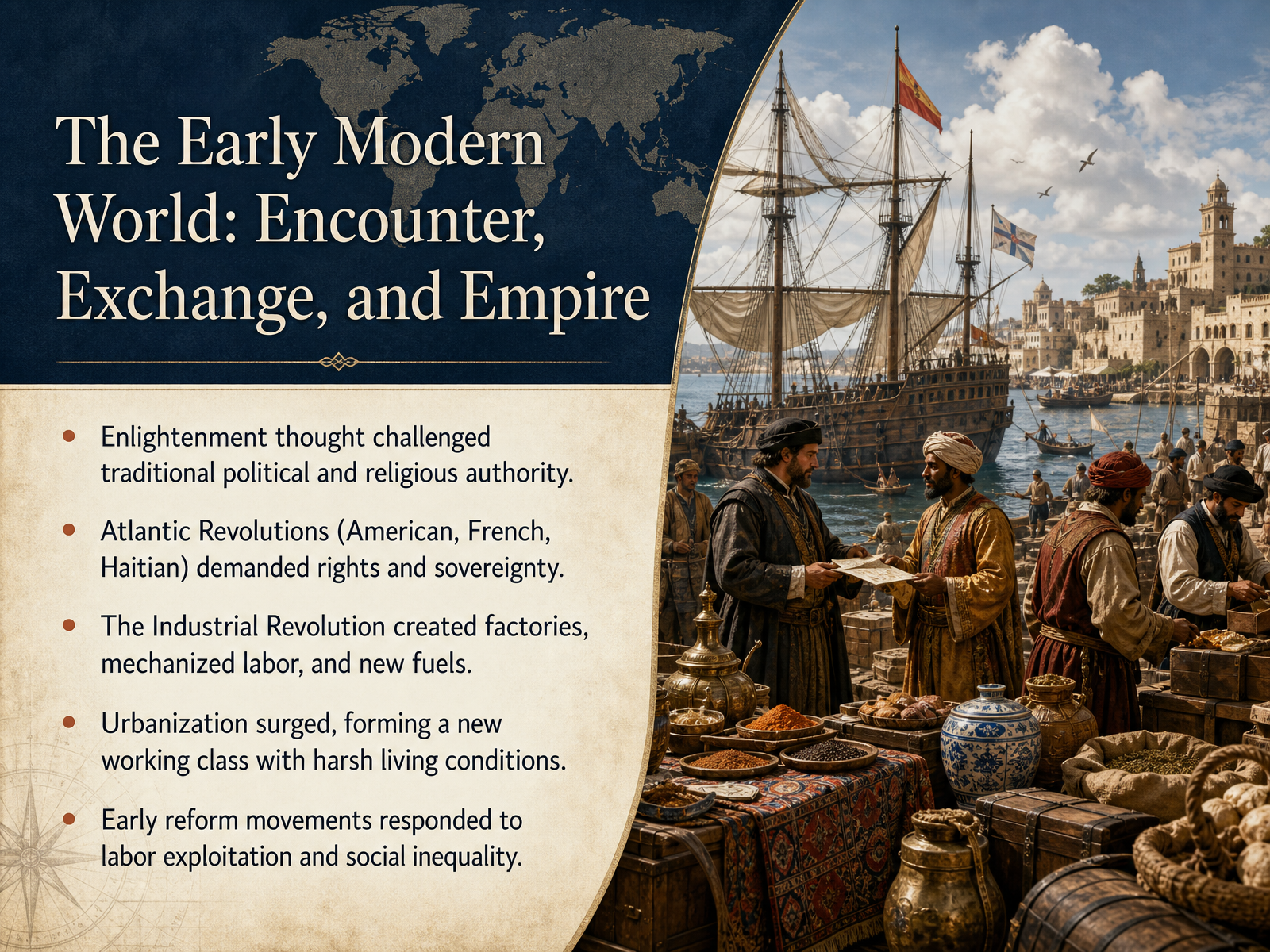
 - 06The Early Modern World: Encounter, Exchange, and EmpireLet's move from global encounters to a period of rapid transformation in ideas and industry. The Early Modern world was reshaped by new ways of thinking. The Enlightenment encouraged people to question traditional political and religious authority, championing reason and individual rights. These ideas fueled the Atlantic Revolutions. The American, French, and Haitian revolutions each demanded rights and sovereignty, shaking the foundations of old empires. At the same time, the Industrial Revolution began. Factories replaced workshops, mechanized labor became the norm, and new fuels like coal powered relentless production. This shift caused an enormous surge in urbanization. Millions moved to cities, forming a new working class that often faced harsh and overcrowded living conditions. In response, early reform movements emerged to challenge labor exploitation and social inequality. The seeds of modern political and social debate were planted here. Next, we will explore the dramatic changes of 'Revolutions: Ideas and Industry Reshape the Globe'.
 2 min
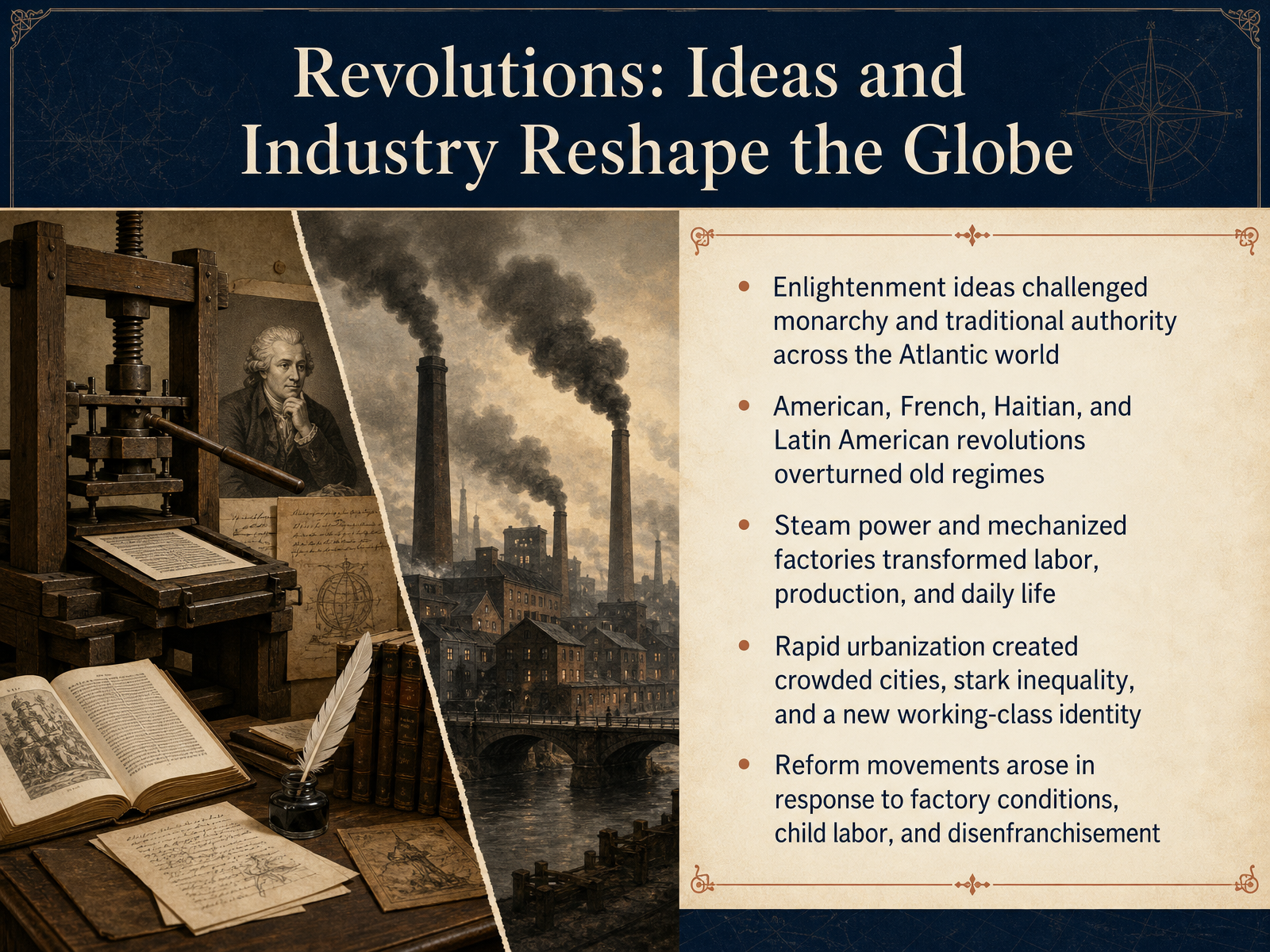
2 min - 07Revolutions: Ideas and Industry Reshape the GlobeTake a moment to consider the cascade of revolutions that reshaped the Atlantic world. Enlightenment thinkers began to question monarchy and inherited authority, arguing instead for reason, rights, and self-government. These ideas powered the American and French Revolutions, the Haitian Revolution, and the independence movements across Latin America. Old regimes crumbled, and new political experiments took their place. At the same time, a different kind of revolution was gathering force. Steam power and mechanized factories transformed how people worked and produced goods. Cities like Manchester grew explosively as workers poured in from the countryside. This rapid urbanization created crowded neighborhoods, stark wealth gaps, and a new working-class identity. In response, reformers organized to challenge factory conditions, child labor, and the lack of political representation. When we turn next to nationalism, unification, and the new imperialism, you will see how these revolutionary energies reshaped identities and borders around the world.
 2 min
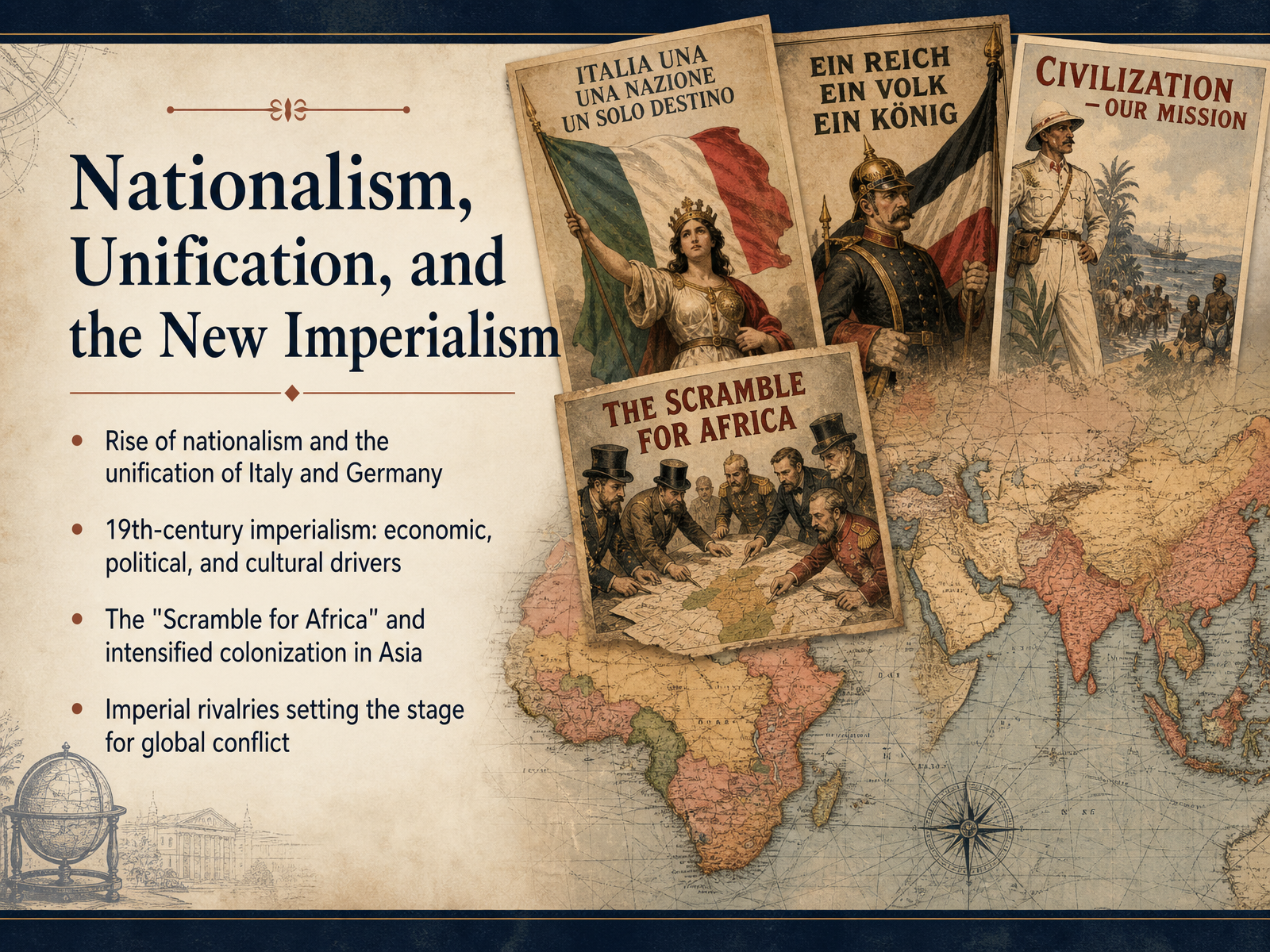
2 min - 08Nationalism, Unification, and the New ImperialismNow, let's look at how a powerful new idea called nationalism began to reshape the map of Europe. People started to identify strongly with shared language, culture, and history, often demanding their own unified nation and government. We see this dramatically in the unifications of Italy and Germany. For centuries, both regions were patchworks of small states. Through political strategy, war, and the passionate work of leaders and citizens, they each became a single, unified country by 1871. This idea of national strength didn't stop at the border. It fueled an intense period of empire building called the New Imperialism. European powers, driven by the need for raw materials, new markets for their goods, and a belief in their own cultural superiority, aggressively expanded across the globe. This led to the 'Scramble for Africa,' where European nations raced to claim almost the entire continent, and to an intensified push for colonies across Asia. These new imperial rivalries did not just create overseas empires; they raised tensions in Europe itself. The competition for global power and territory sowed deep distrust and built dangerous alliances, creating a tinderbox that would soon spark a global conflict. Next, we'll see how that tinderbox ignites, as we turn to the Twentieth Century and a world plunging into global crisis and conflict.
 socialsciencelibrary.orgroutledge.comacademia.edu+22 min
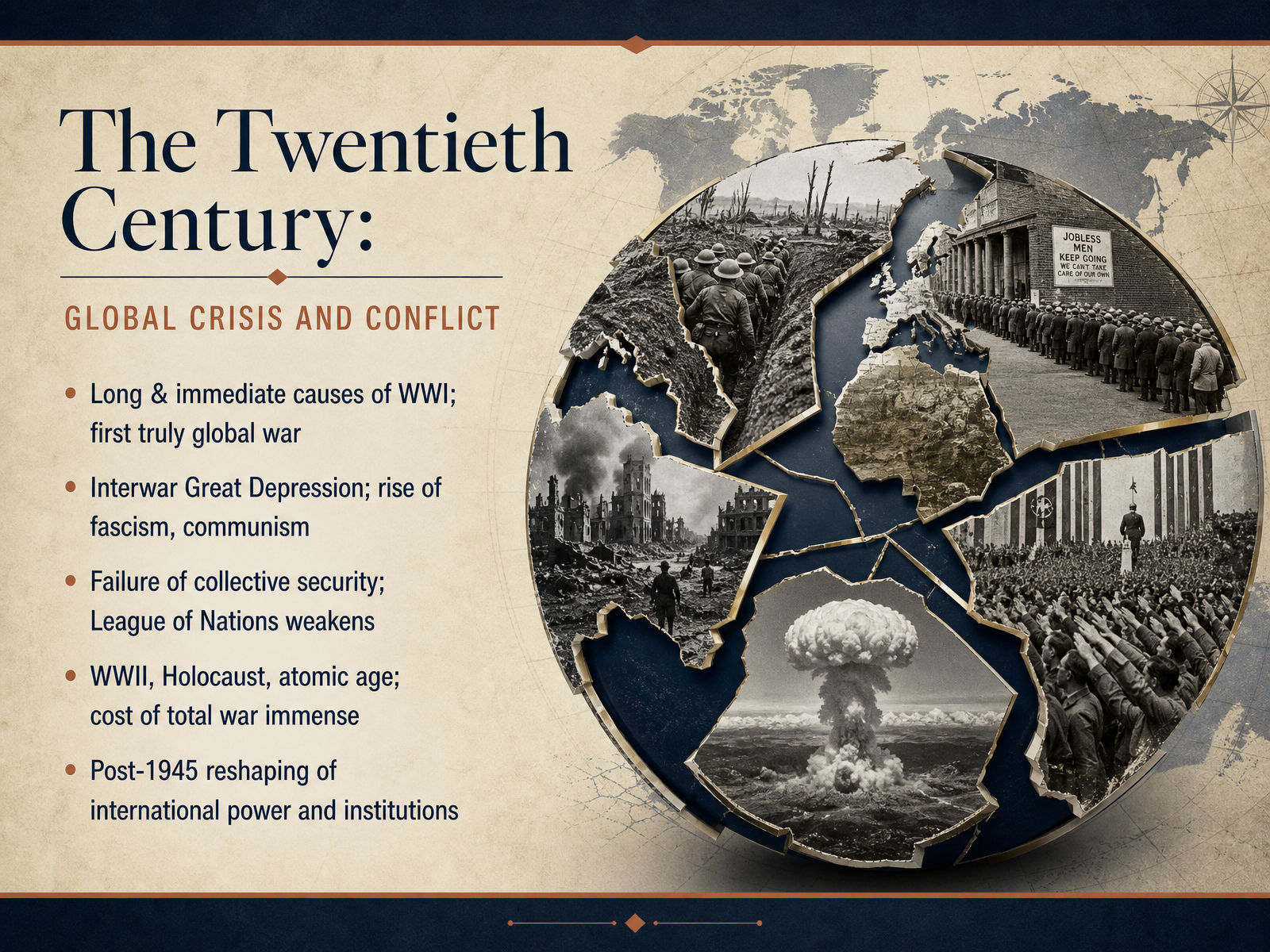
 - 09The Twentieth Century: Global Crisis and ConflictMoving into the twentieth century, we encounter a period defined by global crisis and devastating conflict. The First World War was triggered by a mix of long-term rivalries and an immediate assassination. It became the first truly global war, drawing in empires and colonies from around the world. The peace that followed was fragile. A worldwide Great Depression in the 1930s fueled mass unemployment and desperation, creating fertile ground for the rise of extreme ideologies like fascism and communism. The League of Nations, designed to keep the peace, failed as collective security crumbled. This failure opened the door to a Second World War, an even more catastrophic conflict defined by the Holocaust and the dawn of the atomic age. The human and material cost of total war was immense. But from this destruction came a swift reshaping of international power. Think for a moment about what holds a global community together once a system of shared rules fails. That question guided the post-1945 world as it built new institutions like the United Nations. Next, we will examine how this new global order played out in the long standoff of the Cold War and in the rapid dismantling of colonial empires.
 2 min
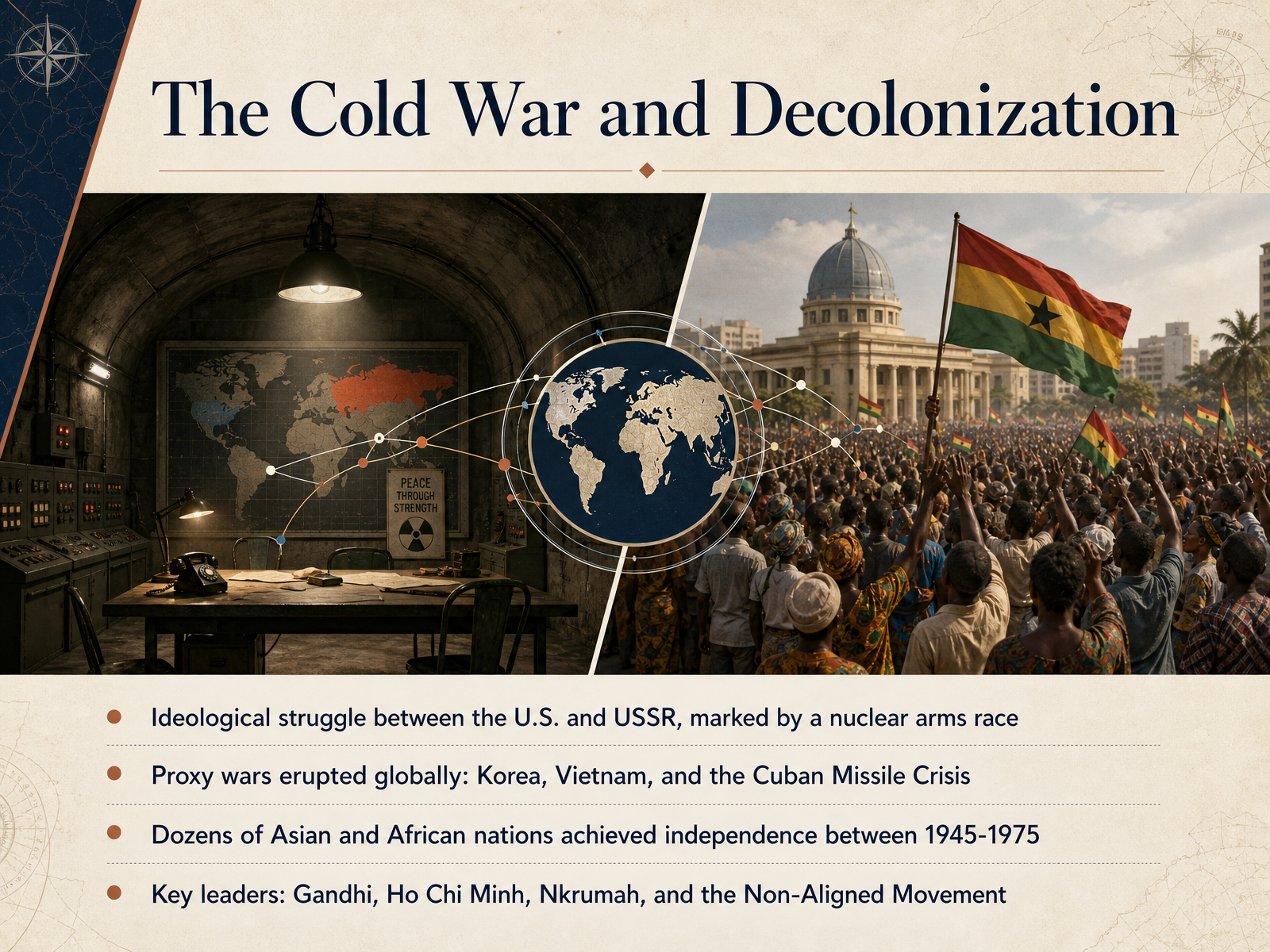
2 min - 10The Cold War and DecolonizationNow let's turn to a period where two massive global shifts unfolded at the same time: the Cold War and decolonization. After nineteen forty-five, an ideological struggle between the United States and the Soviet Union divided much of the world. This wasn't a direct war between the two superpowers, but a tense standoff fueled by a nuclear arms race. The conflict played out through proxy wars in places like Korea and Vietnam, and it brought the world to the brink during the Cuban Missile Crisis. At the very same time, the map of the world was being redrawn by decolonization. Dozens of nations in Asia and Africa achieved independence between nineteen forty-five and nineteen seventy-five. This wave created new states and brought forward influential leaders, such as Gandhi in India, Ho Chi Minh in Vietnam, and Kwame Nkrumah in Ghana. Many of these new countries tried to avoid being pulled into the superpower rivalry by forming the Non-Aligned Movement. Next, we will examine how these patterns set the stage for globalization and the contemporary era.
 2 min
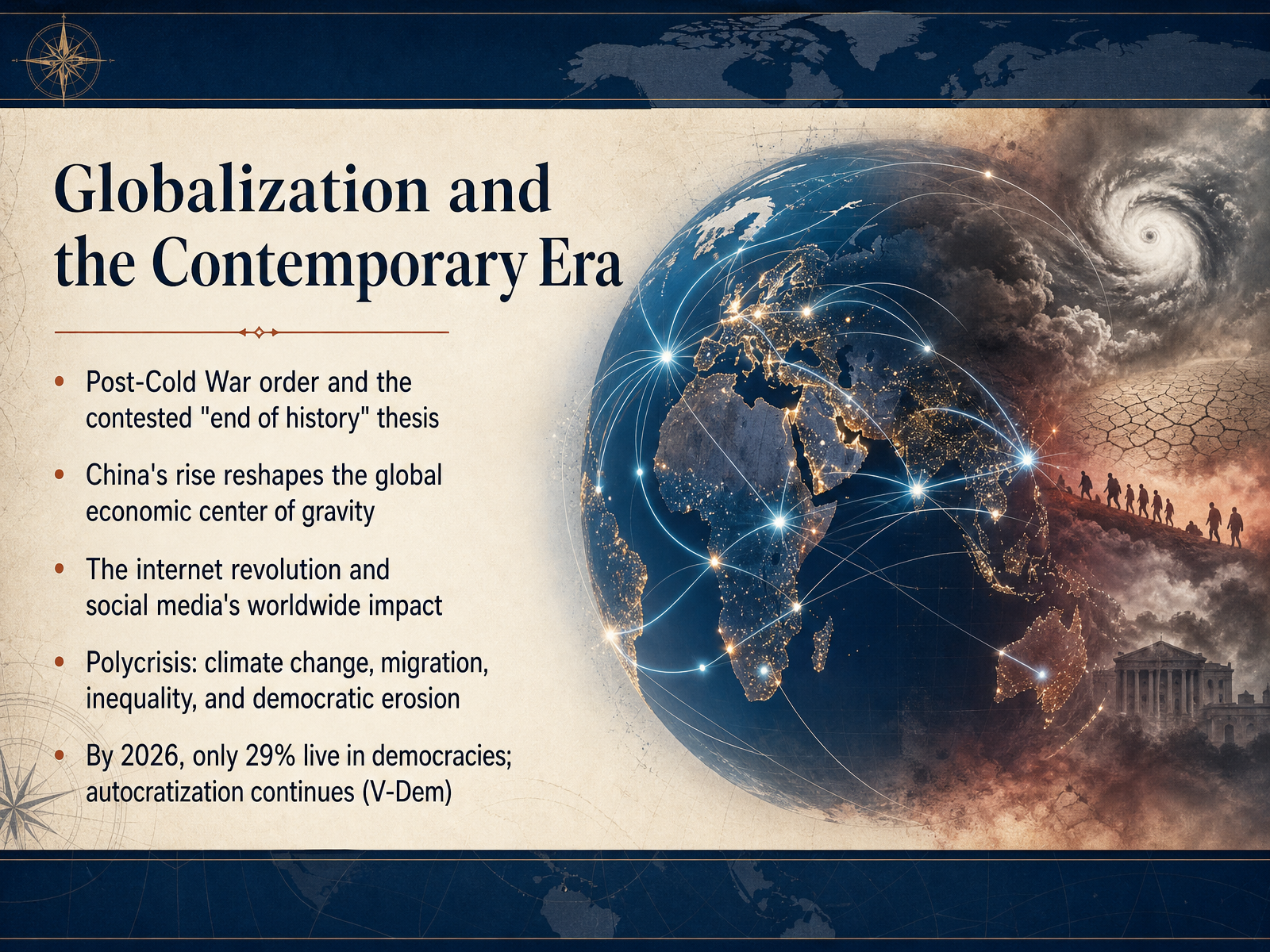
2 min - 11Globalization and the Contemporary EraLet's turn now to the forces driving our contemporary world. When the Cold War ended, some thinkers claimed we had reached an "end of history" where liberal democracy was the final form of government. That thesis turned out to be deeply contested. Instead, we have seen China's dramatic economic rise, which has shifted the global center of gravity and created a more multipolar order. At the same time, the internet revolution and social media have rewired how we communicate, organize politically, and understand the truth, creating new avenues for connection but also for division. These changes unfold inside what experts now call a polycrisis. Climate change, mass migration, widening inequality, and democratic erosion are not separate problems; they feed into each other. For instance, climate shocks drive migration, which authoritarian movements then exploit to weaken democratic norms. One stark data point from the Varieties of Democracy Institute illustrates the political dimension: by twenty twenty-six, only twenty-nine percent of the global population lives in a democracy, and the process of autocratization continues. So, what does this mean for our shared future? These overlapping crises are testing the resilience of societies and demanding new forms of cooperation. Next, we will step back and look at the recurring themes that run through all the eras we've explored.
 routledge.com2 min
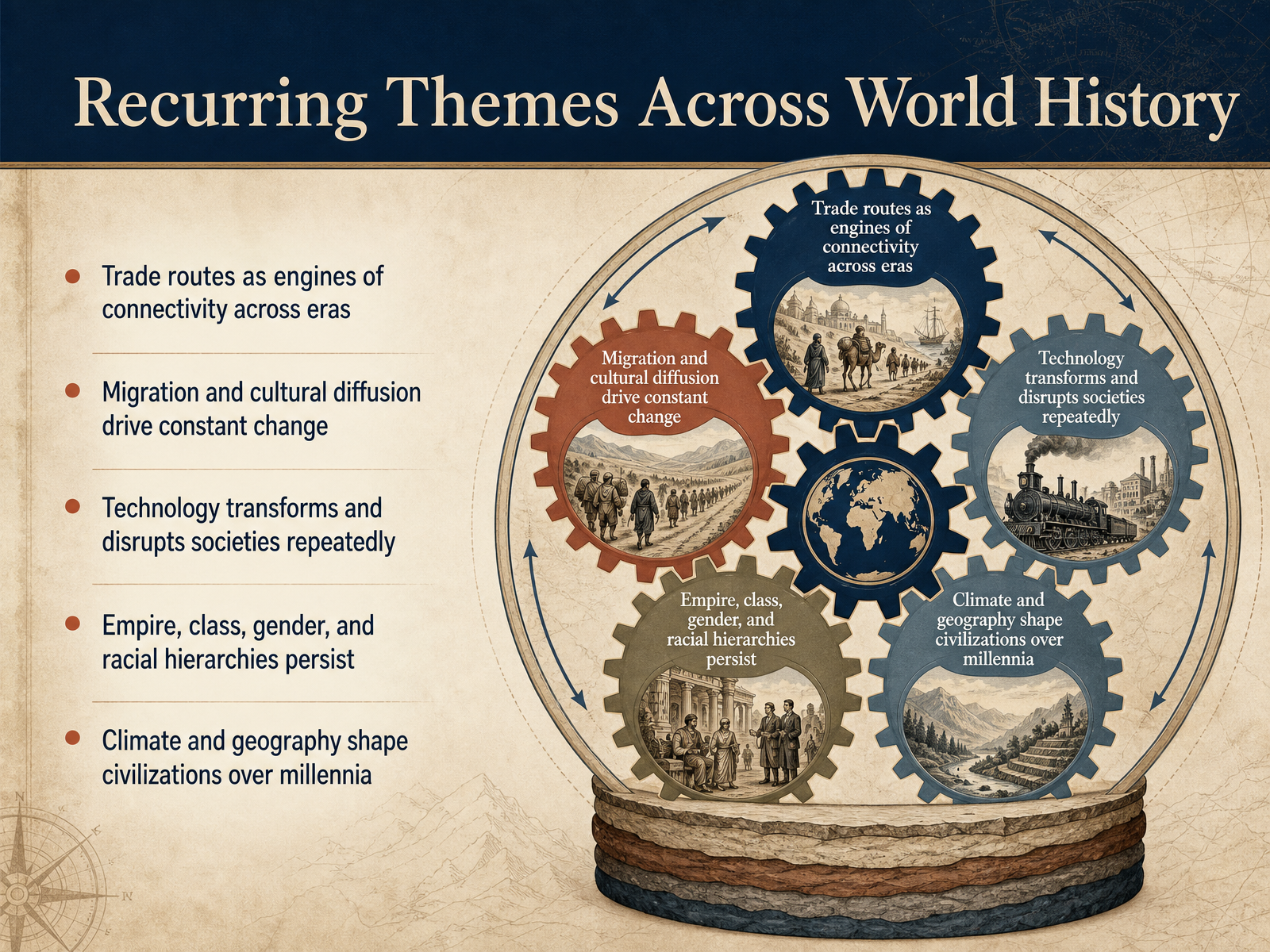
 - 12Recurring Themes Across World HistoryNow let's pull back and look at the recurring themes that weave through all the eras we've discussed. These patterns help us see connections across centuries. First, trade routes act as engines of connectivity. The Silk Road and the Indian Ocean networks moved not just goods like silk and spices, but also ideas and technologies. Second, migration and cultural diffusion constantly reshape societies. When people move, they carry their languages, beliefs, and farming practices, creating vibrant, blended cultures. Third, technology repeatedly transforms daily life. Think about how the printing press changed access to knowledge, much like the internet does today. Fourth, certain hierarchies have proven stubbornly persistent. Systems of empire, class, gender, and racial inequality have evolved but often reappear in new forms. Finally, climate and geography shape civilizations over millennia. River valleys nurtured early cities, while shifting weather patterns have challenged even powerful empires. These five forces don't act alone; they interact to create the world we inherit. As you consider these themes, ask yourself: which ones do you see most clearly in the news today? Next, we'll wrap up by discussing what it means to think like a world historian and how you can continue your own journey of discovery.
 socialsciencelibrary.orgroutledge.comacademia.edu+22 min
 - 13Thinking Like a World Historian and Continuing Your JourneyIn this final module, let's reflect on what it means to think like a world historian. It starts with carefully analyzing primary sources and secondary interpretations, always asking: who created this, and why? Recognize bias and perspective in every account, especially Eurocentric narratives that have long shaped traditional history. Use comparative analysis to connect ideas and events across time and space, finding patterns in how societies have faced similar challenges. These skills are not just academic. Applying world history helps you understand current global citizenship, from migration to climate change. Your journey can continue with gateway books like Peter Stearns' World History: The Basics or the visually rich National Geographic Ultimate Visual History of the World. Seek out documentaries, podcasts, and online courses that challenge your viewpoint. Thank you for learning with me. Stay curious, keep asking questions, and let the wider story of humanity deepen your perspective on today's world.
 routledge.com2 min
Take the deck with you
Download this course as a file — free, no sign-up needed.
- PDF handoutEvery slide page, ready to print or share.14 pages · 6.0 MBDownload
- Narrated PowerPointThe deck that presents itself — every slide carries the digital human's narration video.14 pages · 18.8 MBDownload
- PowerPoint slidesThe full deck as a .pptx — open it in PowerPoint, Keynote, or Google Slides.14 pages · 6.0 MBDownload
Free to use in your own training — please keep the PersonWise credit page at the end.
Have your own deck? Turn it into a course
Sources consulted
Web sources consulted while building this course.
- The Social Science Library » Periodizing World History — socialsciencelibrary.org
- World History: The Basics - 2nd Edition - Peter N. Stearns - Routledge — routledge.com
- (PDF) Global Periodization of World History: A Structural Model from Anthropogenesis to the Present — academia.edu
- Navigating Complexity in Big History: Exploring Periodization Across Cosmic and Biosocial Dimensions | Springer Nature Link — link.springer.com
- LI Youdong: On the Periodization of World History Since the 20th Century-欧洲文明研究院 — eshistory.tjnu.edu.cn
- Chapter 2: Rivers, Cities, and First States, 3500–2000 BCE — nerd.wwnorton.com
- 3.1: River Valley Civilizations - Social Sci LibreTexts — socialsci.libretexts.org
- Big Era Three Farming and the Emergence of Complex Societies 10,000 – 1000 BCE — whfua.history.ucla.edu
- 3.1 Early Civilizations - World History Volume 1, to 1500 | OpenStax — openstax.org
- Conclusion — nerd.wwnorton.com
- Axial Age — en.wikipedia.org
- what is axial about the axial age? — cambridge.org
- An “Axial Age” — nerd.wwnorton.com
- The Axial Age: 5 Fast Facts — britannica.com
- Inventing the axial age: the origins and uses of a historical concept — pressbooks.ulib.csuohio.edu
- Mongol empire | Time Period, Map, Location, & Facts | Britannica — britannica.com
- Mongols in World History | Asia for Educators — afe.easia.columbia.edu
- Introduction: Mobility Transformations and Cultural Exchange in Mongol Eurasia — brill.com
- Trade and economic relations in Mongol Eurasia — taylorfrancis.com
- The Cambridge History of the Mongol Empire — cambridge.org