Email Marketing Strategy: Goals & Tradeoffs
Begin
14 pages · ~28 min
Email Marketing Strategy: Goals & Tradeoffs
Learn to craft a strategic email marketing plan by defining clear goals, making informed choices, and evaluating key tradeoffs for measurable success.
What you’ll learn
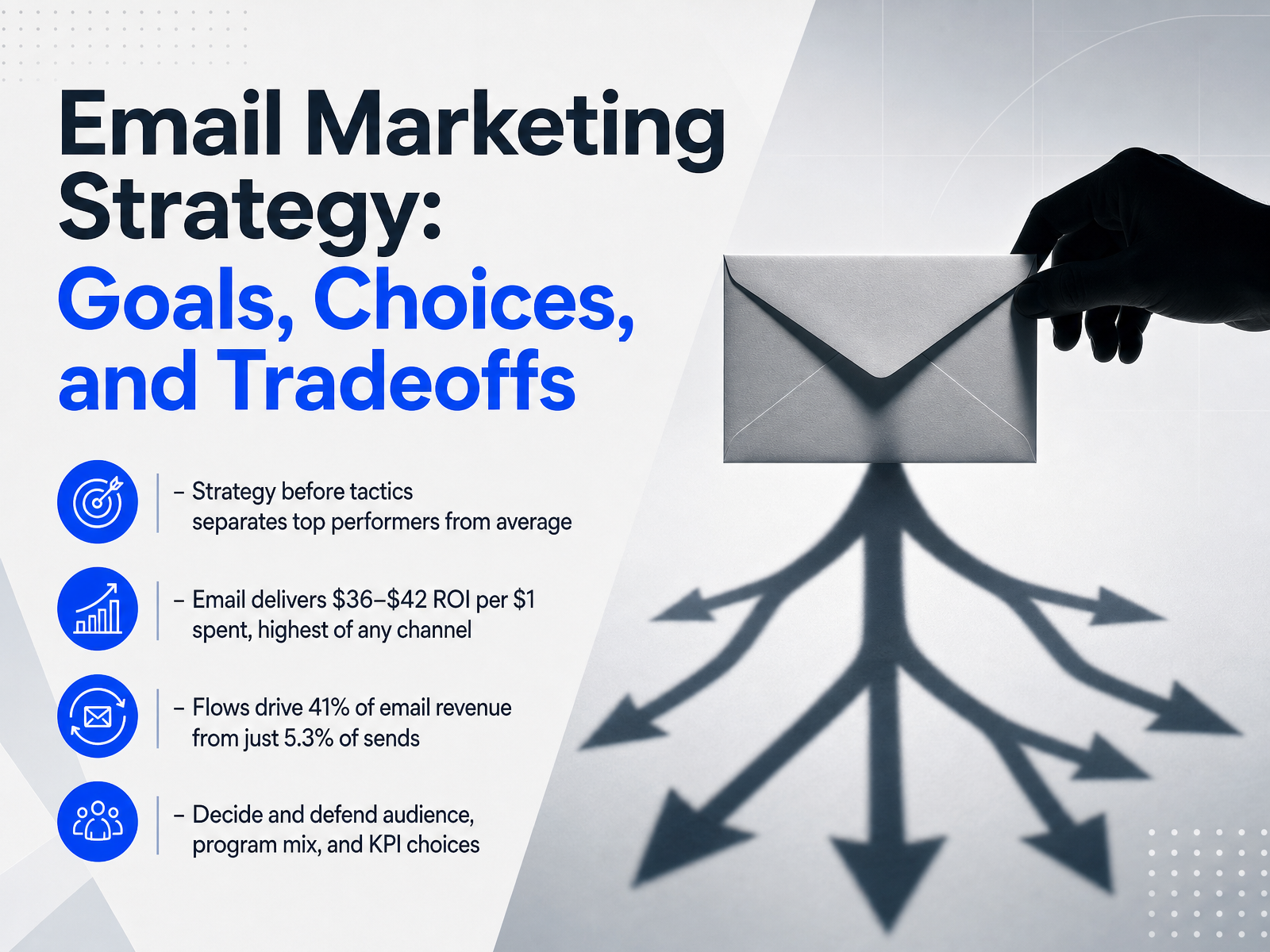
- 01Email Marketing Strategy: Goals, Choices, and TradeoffsWelcome. If you're responsible for email marketing strategy, you already know the mechanics. This session is about the decisions that separate average programs from top performers. Email delivers thirty-six to forty-two dollars in return for every dollar spent, the highest of any channel. That number isn't luck. It comes from deliberate choices. Automated flows, for example, drive forty-one percent of email revenue from just over five percent of sends. That's efficiency you can replicate. Today, we'll focus on three strategic decisions you own: your audience, your program mix, and your key performance indicators. Each comes with tradeoffs, and we'll name them honestly. By the end, you'll have a framework to defend your choices and push your ROI toward the top tier. Let's start with why email still wins.omnisend.comlitmus.comnutshell.com+21 min
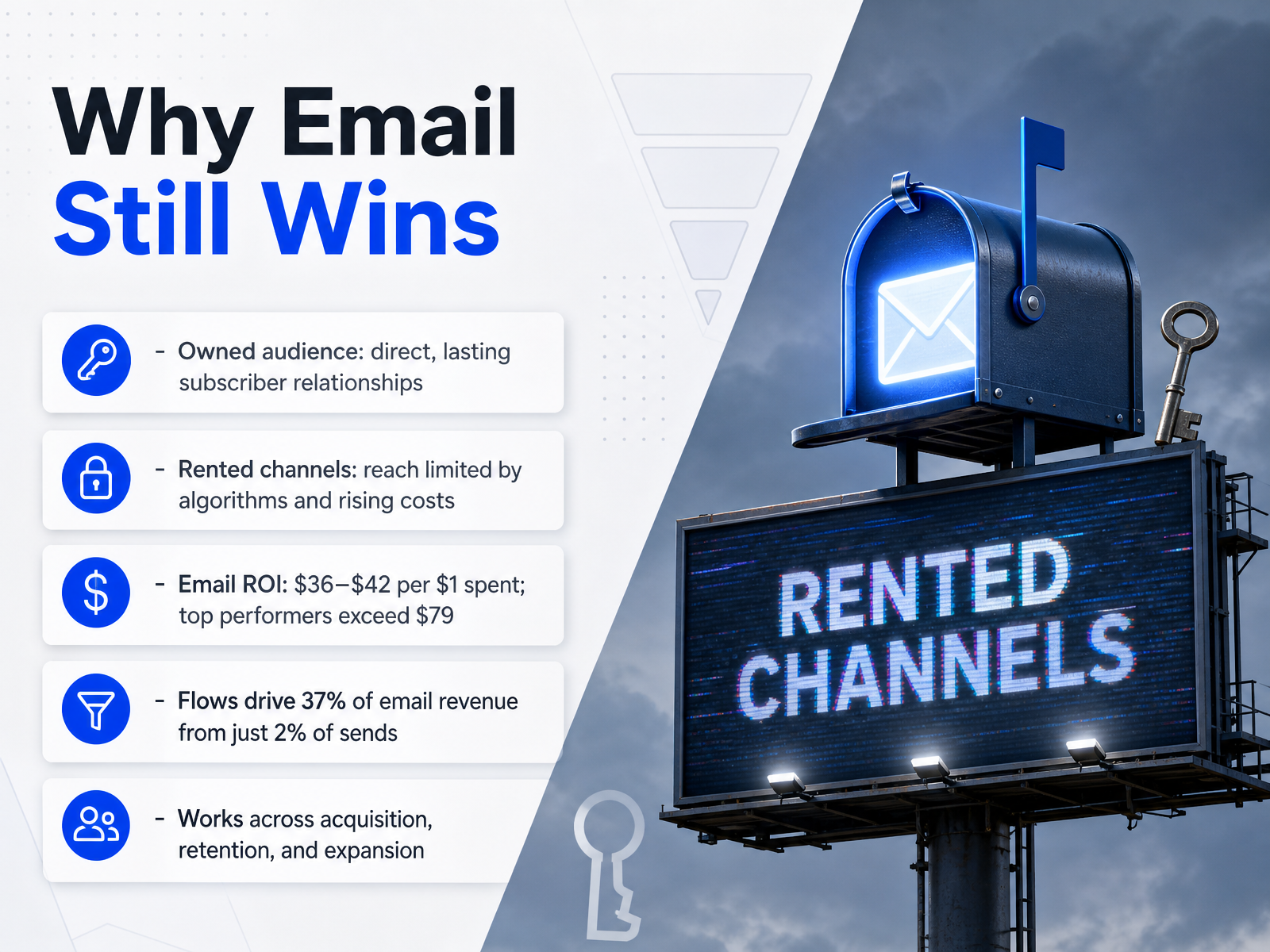
- 02Why Email Still WinsHere’s the strategic question: why does email still deserve priority in your channel mix when social budgets and paid media keep inflating? Because the math and the model both favor you. Email is an owned channel; the relationship is direct and durable, not rented by algorithm changes or platform costs. Compare the economics: email returns thirty-six to forty-two dollars for every dollar spent; top performers exceed seventy-nine dollars. Paid social, by contrast, brings back two to five dollars. Acquisition, retention, and expansion are all within reach. Consider this: automated flows drive thirty-seven percent of email revenue from just two percent of sends. That’s not incremental effort; it’s passive leverage working after setup. The tradeoff is real, though. Owning your list means taking responsibility for it—segmenting, maintaining relevance, and managing churn. No shortcut exists. That’s exactly why strategy before tactics matters, because the decisions you make here determine whether that return is average or exceptional.
 omnisend.comlitmus.comnutshell.com+21 min
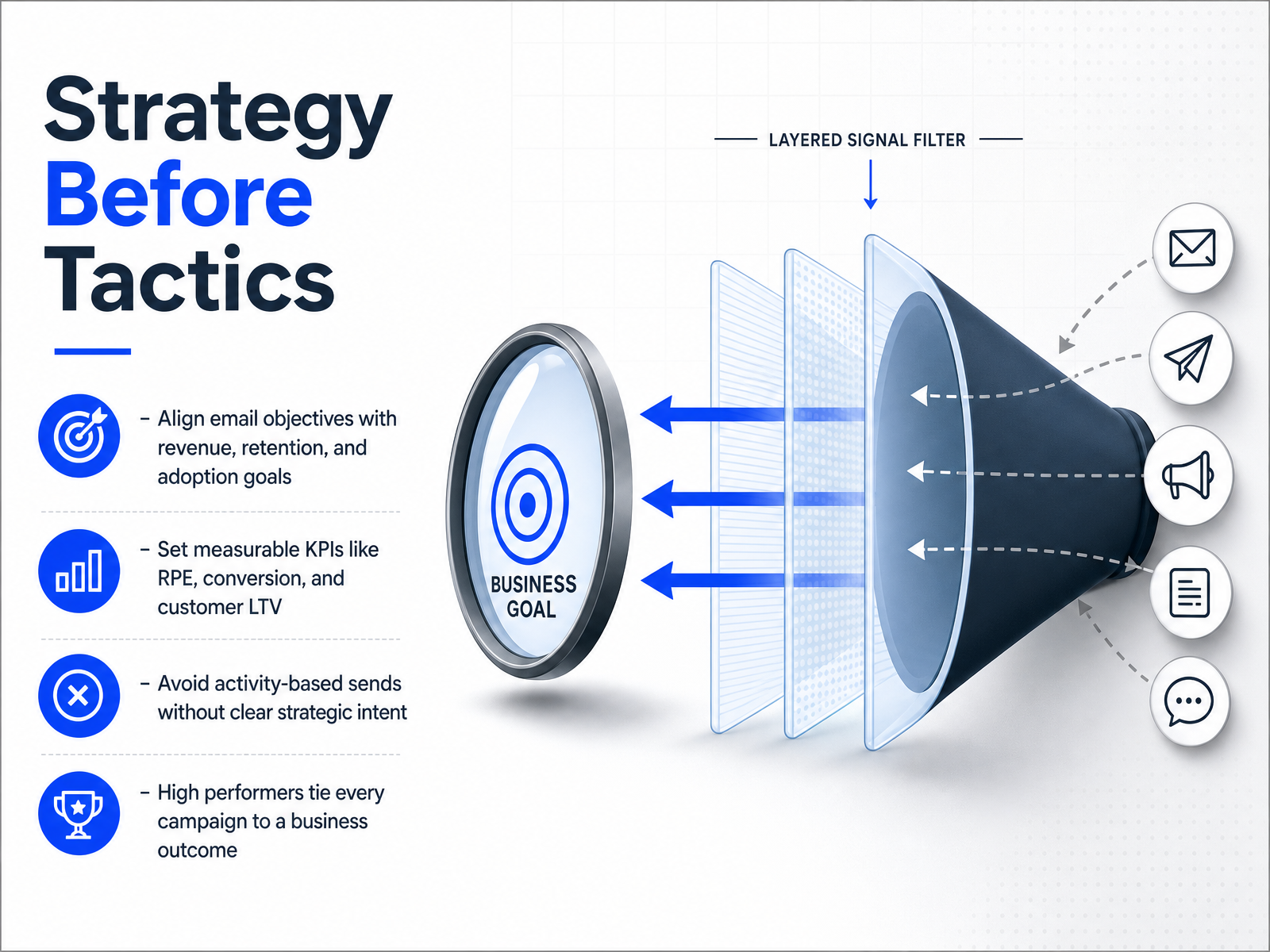
 - 03Strategy Before TacticsLet's talk about strategy before tactics. You already know the mechanics. The real question is whether every send is earning its place. High performers don't just track opens. They tie every campaign to revenue, retention, or adoption. Start by aligning your email objectives with those business outcomes. Then set measurable KPIs that matter: revenue per email, conversion lift, and customer lifetime value. Here's the tradeoff to weigh. An activity-based send might feel productive. But if it lacks strategic intent, it costs you list churn and inbox trust. The numbers support this discipline. The industry average ROI sits between thirty-six and forty-two dollars for every dollar spent. Top programs push past seventy. That gap doesn't come from sending more. It comes from tying every campaign to a clear business outcome. So before you build another blast, ask what outcome it serves. If you can't name the metric, rethink the send. Next, we'll look at how to align strategy with your audience and first-party data.
 omnisend.comlitmus.comnutshell.com+22 min
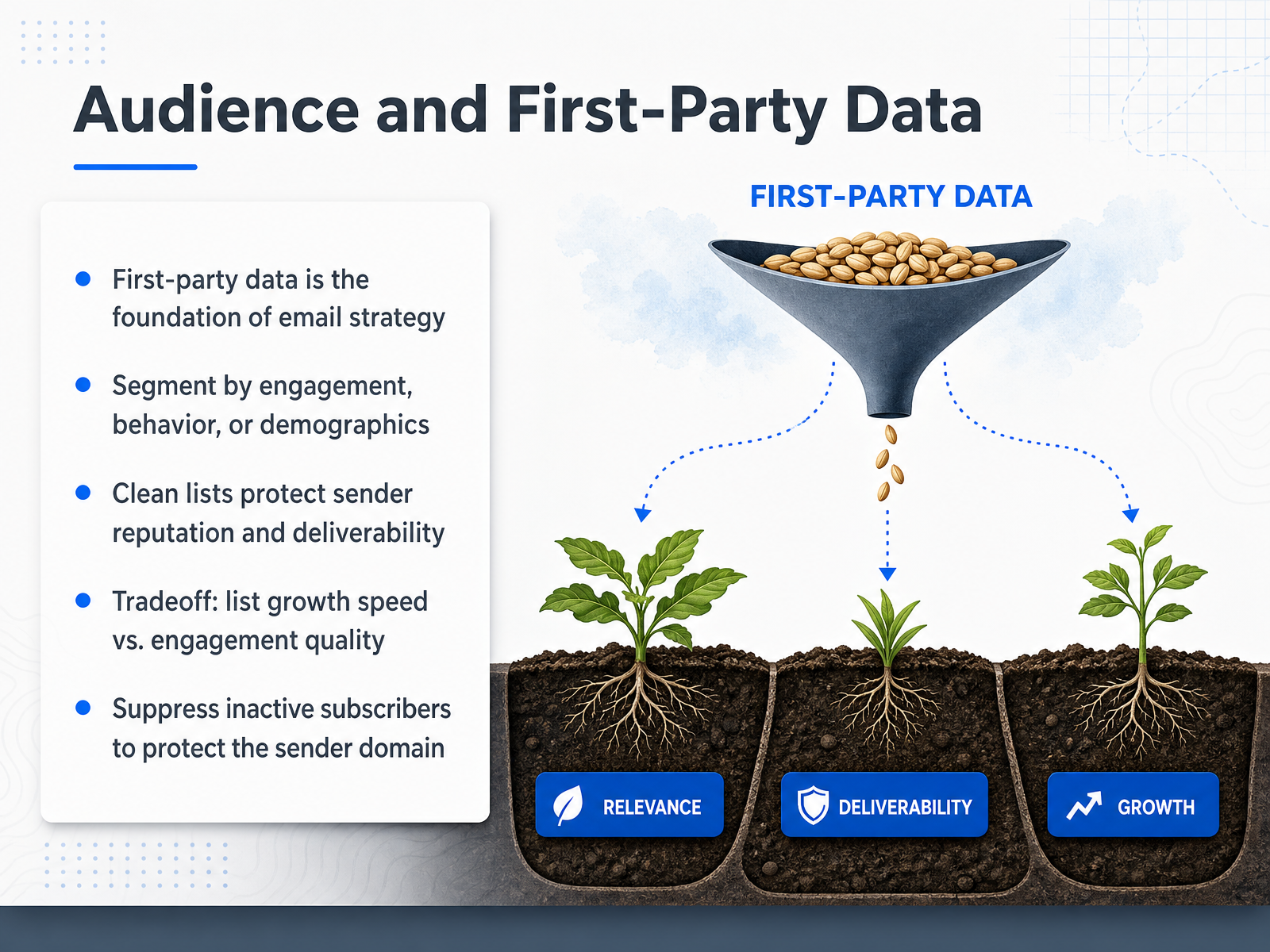
 - 04Audience and First-Party DataNow let's talk about the foundation of everything you send: your audience and the data that defines them. In today's landscape, third-party cookies are fading fast, which makes your first-party data the most valuable asset you own. This isn't about collecting more emails; it's about collecting the right ones and understanding their behavior. Start by segmenting your list based on engagement, behavior, or demographics. A subscriber who clicks every week deserves different content than someone who only opens your monthly newsletter. The core tradeoff you need to weigh is list growth speed versus engagement quality. You could buy a list and see your numbers spike tomorrow, but that choice destroys your sender reputation, tanks your open rates, and hurts your deliverability across the board. Instead, prioritize quality. Clean your lists regularly. Remove inactive subscribers. Suppress those who haven't engaged in months. This feels counterintuitive because shrinking your list feels like losing revenue, but a smaller, engaged list outperforms a large, disengaged one every time. Protecting your sender domain is non-negotiable. So, build your foundation on data you own, and segment ruthlessly. Up next, we'll get into the specifics of keeping that list healthy and your deliverability strong.
 wordstream.comtinysend.coemailcloud.com+21 min
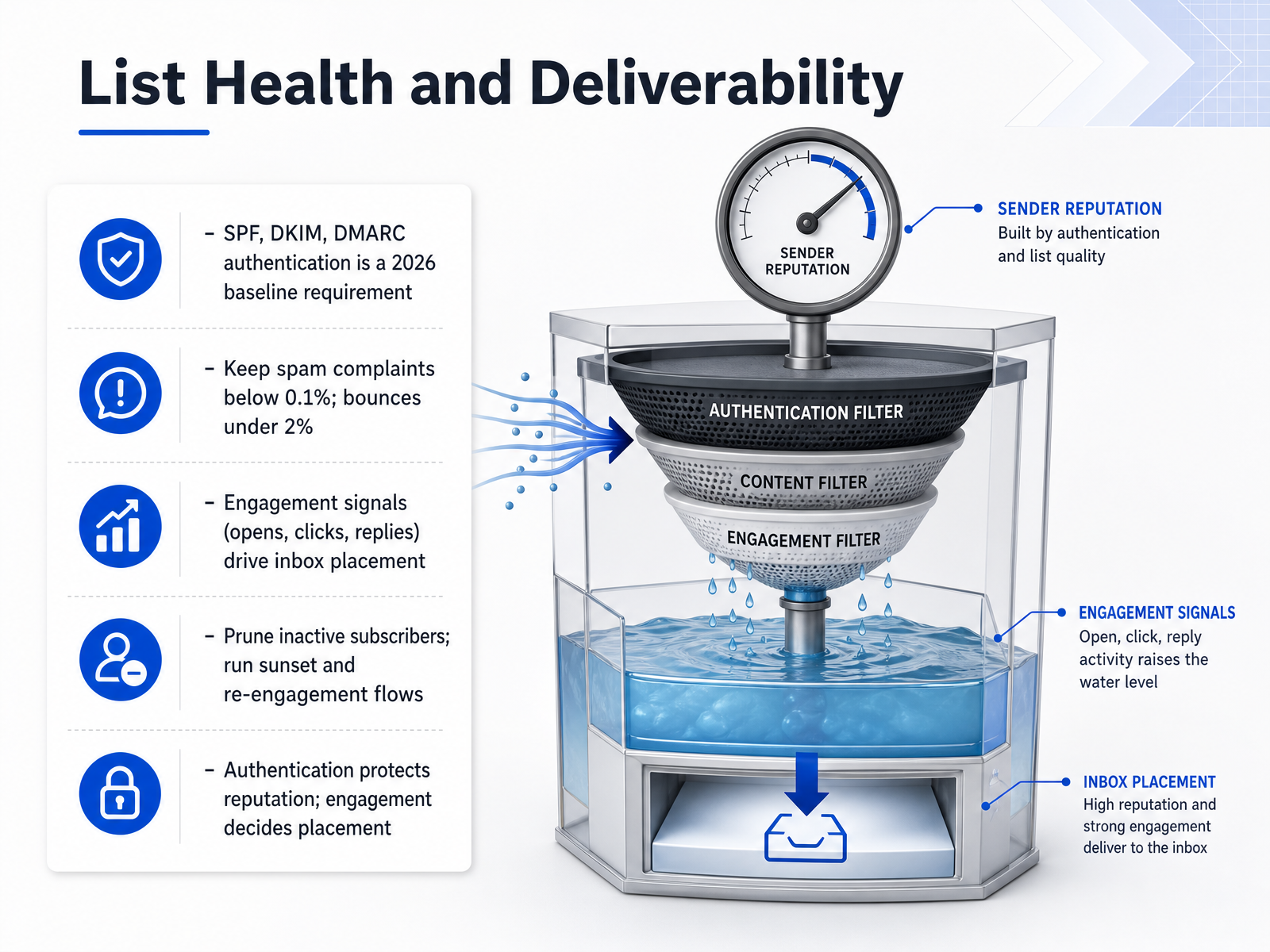
 - 05List Health and DeliverabilityNow let’s talk about the foundation that makes or breaks every campaign you send: list health and deliverability. Authentication is no longer optional — SPF, DKIM, and DMARC are the 2026 baseline. If your domain isn’t authenticated, you’re invisible before you start. Keep spam complaints under 0.1 percent and bounces below 2 percent. These aren’t abstract benchmarks — they’re the thresholds Google and Yahoo use to decide your fate. Engagement signals — opens, clicks, replies — determine inbox placement. A subscriber who never engages is dragging down your sender reputation for everyone else. That’s why you need to prune inactive contacts and run sunset or re-engagement flows. Remove the dead weight, and your metrics improve across the board. Here’s the tradeoff to weigh: pruning shrinks your list, but you’ll see higher open rates, lower complaints, and better deliverability. Smaller and engaged beats larger and disengaged every time. Let’s look at what that actually costs you — a temporary dip in list size. But the payoff is a healthier domain reputation that translates into more revenue per subscriber. Deliverability is not a one-time setup; it’s ongoing discipline. Authentication protects your reputation; engagement decides placement. Now, let’s shift to the next decision: which email program types fit your goals.
 wordstream.comtinysend.coemailcloud.com+21 min
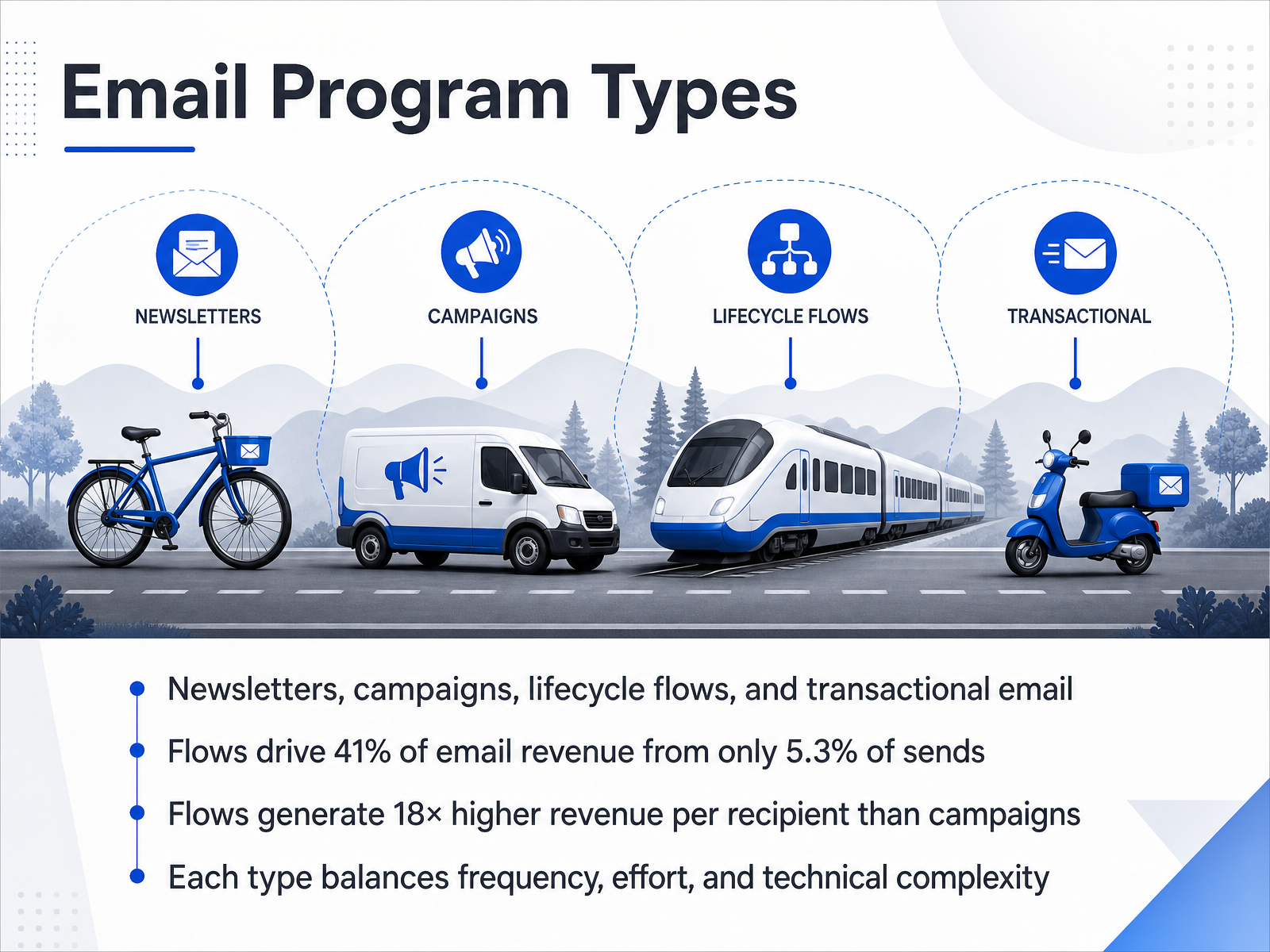
 - 06Email Program TypesNow let's talk about program types, because this is where most strategic misalignment happens. You likely run four distinct email types: newsletters, campaigns, lifecycle flows, and transactional emails. The critical insight is that they do not perform equally. Campaigns still consume most of your send volume, around ninety-five percent. But here is the tradeoff to weigh: flows produce roughly forty-one percent of your total email revenue from just over five percent of your sends. Those same flows generate revenue per recipient nearly eighteen times higher than campaigns. They outperform campaigns on click rates by over three times, and they drive thirteen times higher placed order rates. Why? Because relevance and timing outweigh frequency in driving action. So when you're allocating effort this quarter, remember the data. The question is not whether to run campaigns, but how much of your creative energy flows into mapping the customer journey triggers that follow a purchase. Automation is the primary revenue engine, and transactional moments are your highest-intent touchpoints. We'll get into lifecycle email as a growth system next, but start viewing these types as a portfolio with different return profiles.
 klaviyo.comvisionary-marketing.co.ukmailerlite.com+22 min
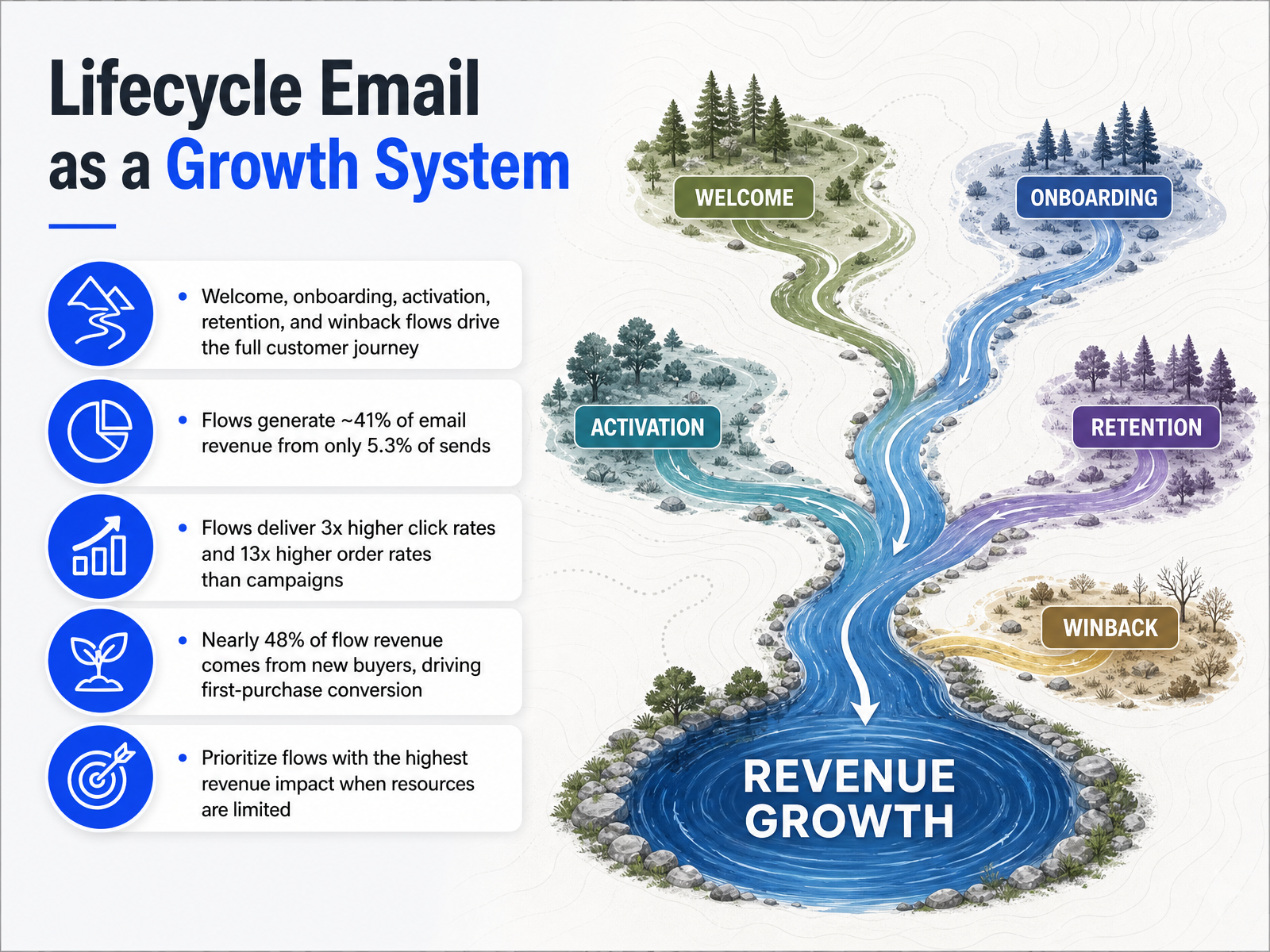
 - 07Lifecycle Email as a Growth SystemLet's shift from single campaigns to the infrastructure that actually compounds. Think of lifecycle emails as your growth system. These flows—welcome, onboarding, activation, retention, winback—map to the entire customer journey. Here's the tradeoff to weigh: flows generate nearly forty-one percent of your email revenue from just over five percent of your sends. That's the efficiency story. They drive over three times higher click rates and thirteen times higher order rates than your standard campaigns. And here's a number that surprises most teams: almost half of flow revenue comes from new buyers. Welcome and post-purchase flows are quietly doing your first-purchase conversion work. What this means for you is resource allocation. When your team is stretched, prioritize the flows with the highest revenue impact first. Your abandoned cart and welcome series outperform the rest. Build those out before you optimize the winback flow. The efficiency gap between flows and campaigns is the single biggest lever you have. Now let's talk about what makes the content in those flows actually convert.
 klaviyo.comvisionary-marketing.co.ukmailerlite.com+22 min
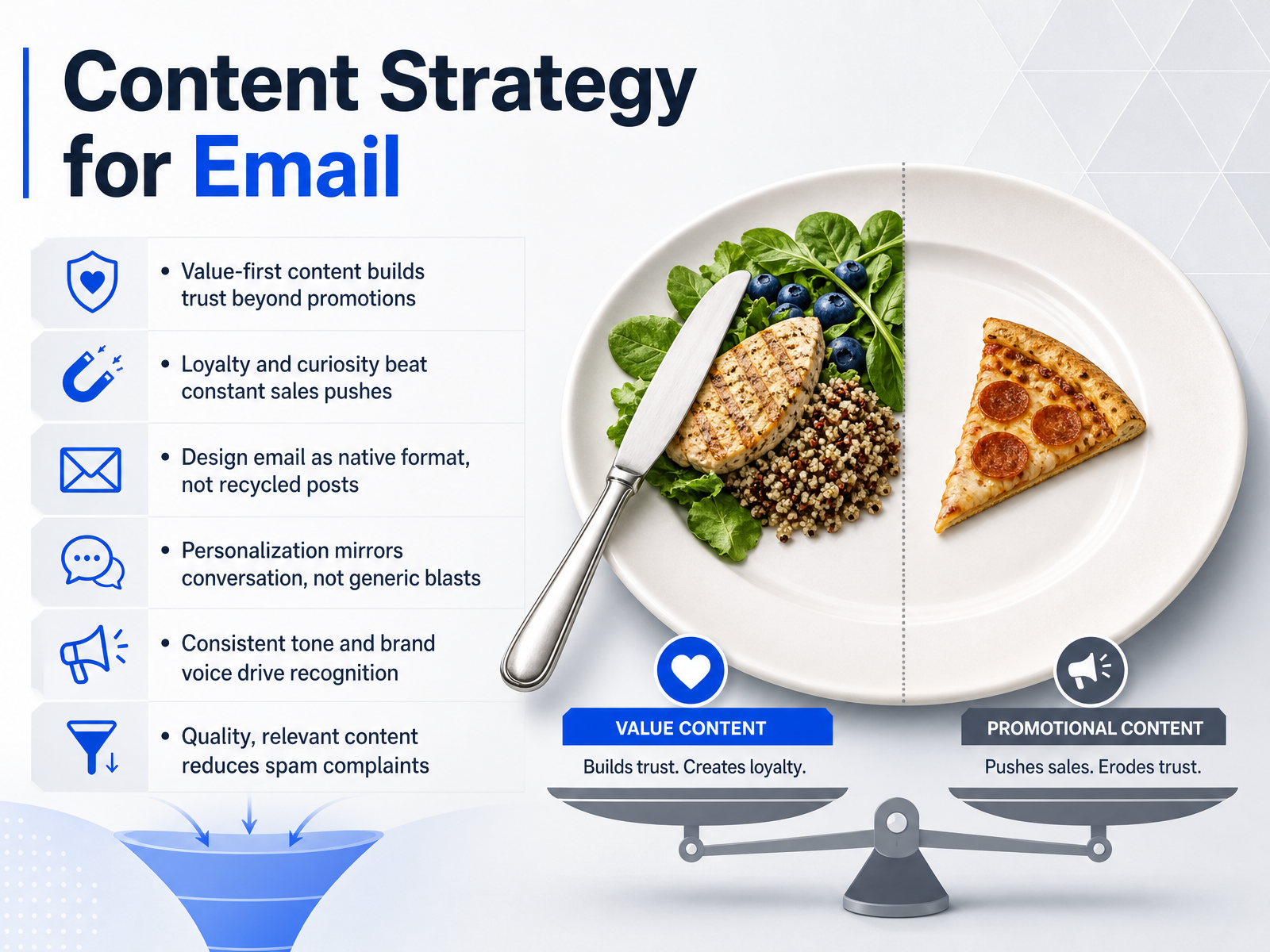
 - 08Content Strategy for EmailNow let's talk about what actually goes inside the email. The core decision here is value-first content. And the reason is simple: trust. If your subscribers trust that every email delivers something useful, they'll open. If they suspect it's just another sales push, they'll ignore you or mark you as spam. And spam complaints above zero point one percent will tank your deliverability. So the tradeoff is this: constant promotional pressure gets short-term clicks but burns your list. Loyalty and curiosity build a channel that compounds. Design your email as its native format. Don't recycle a blog post or a social caption. Readers can tell. It reads as lazy. Personalization should mirror a conversation, not a generic blast. Use the data you have to acknowledge where they are in their journey. Consistency in tone and brand voice matters. It drives recognition and reduces confusion, which is exactly what filtering algorithms look for. The bottom line: quality, relevant content lowers spam complaints. And lower complaints mean better inbox placement. That's the foundation. Which leads us to the metrics that actually prove your strategy is working: the metrics that matter.
 wordstream.comtinysend.coemailcloud.com+21 min
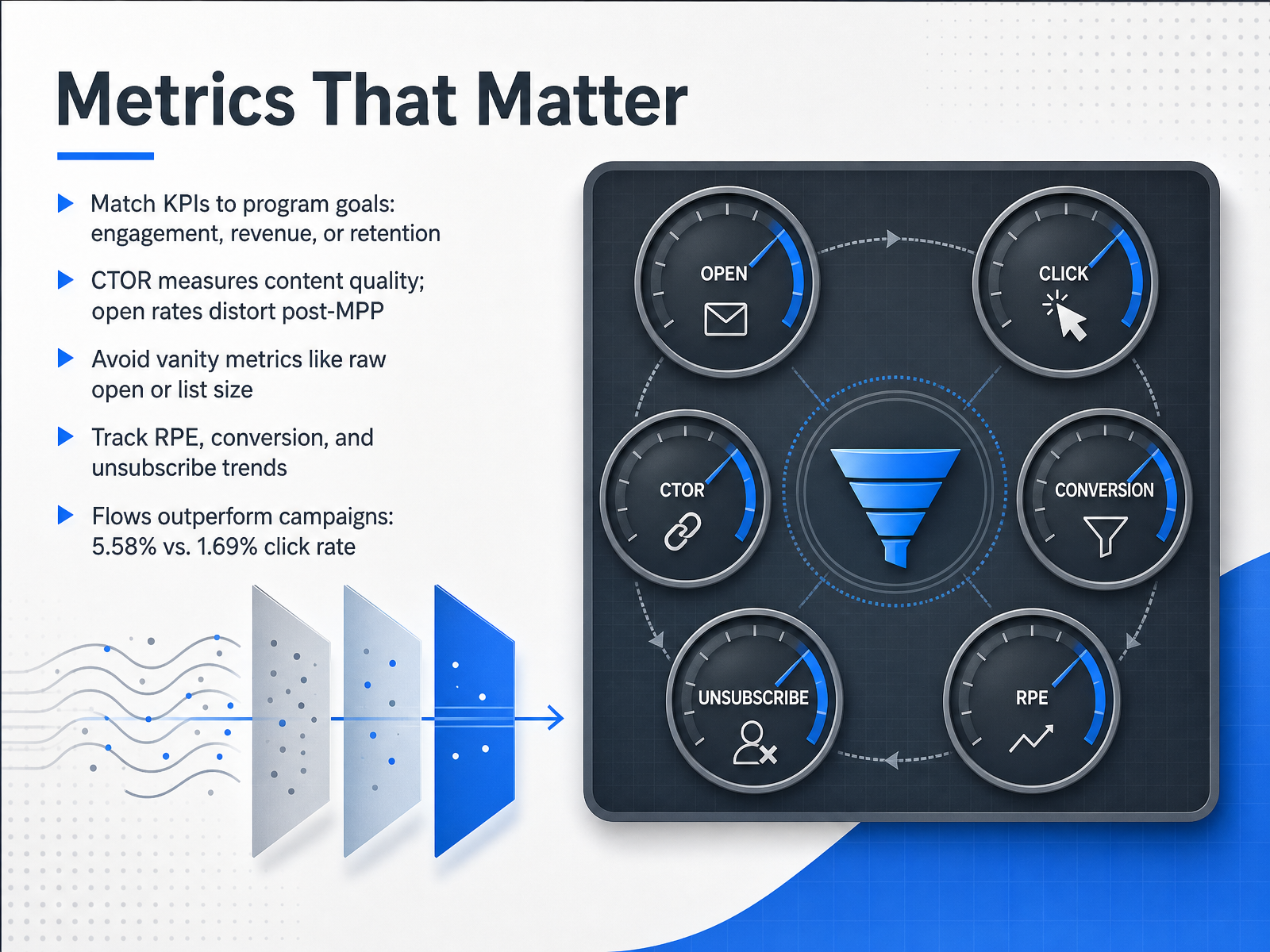
 - 09Metrics That MatterLet’s talk about the metrics that actually matter. Every email program needs to be tied to a goal: engagement, revenue, or retention. Your KPIs should mirror that. If your goal is engagement, watch your click-to-open rate. That metric tells you if your content is resonating with the people who actually open. Open rates are distorted by Apple’s Mail Privacy Protection, so treat them as directional at best. If your goal is revenue, track revenue per recipient and conversion rate. These are the numbers that connect email activity to business outcomes. And don’t obsess over raw open counts or list size—those are vanity metrics. What you should watch closely is your unsubscribe trend. A sudden spike is a signal that your frequency or content is off. Now, one pattern worth noting: automated flows consistently outperform campaigns. Click rates for flows are over five and a half percent, versus under two percent for campaigns. This isn’t about effort per send; it’s about relevance and timing. So, when you report to stakeholders, benchmark flows and campaigns separately. Don’t blend them. Next, let’s see how benchmarks provide the context to interpret these numbers.
 klaviyo.comvisionary-marketing.co.ukmailerlite.com+21 min
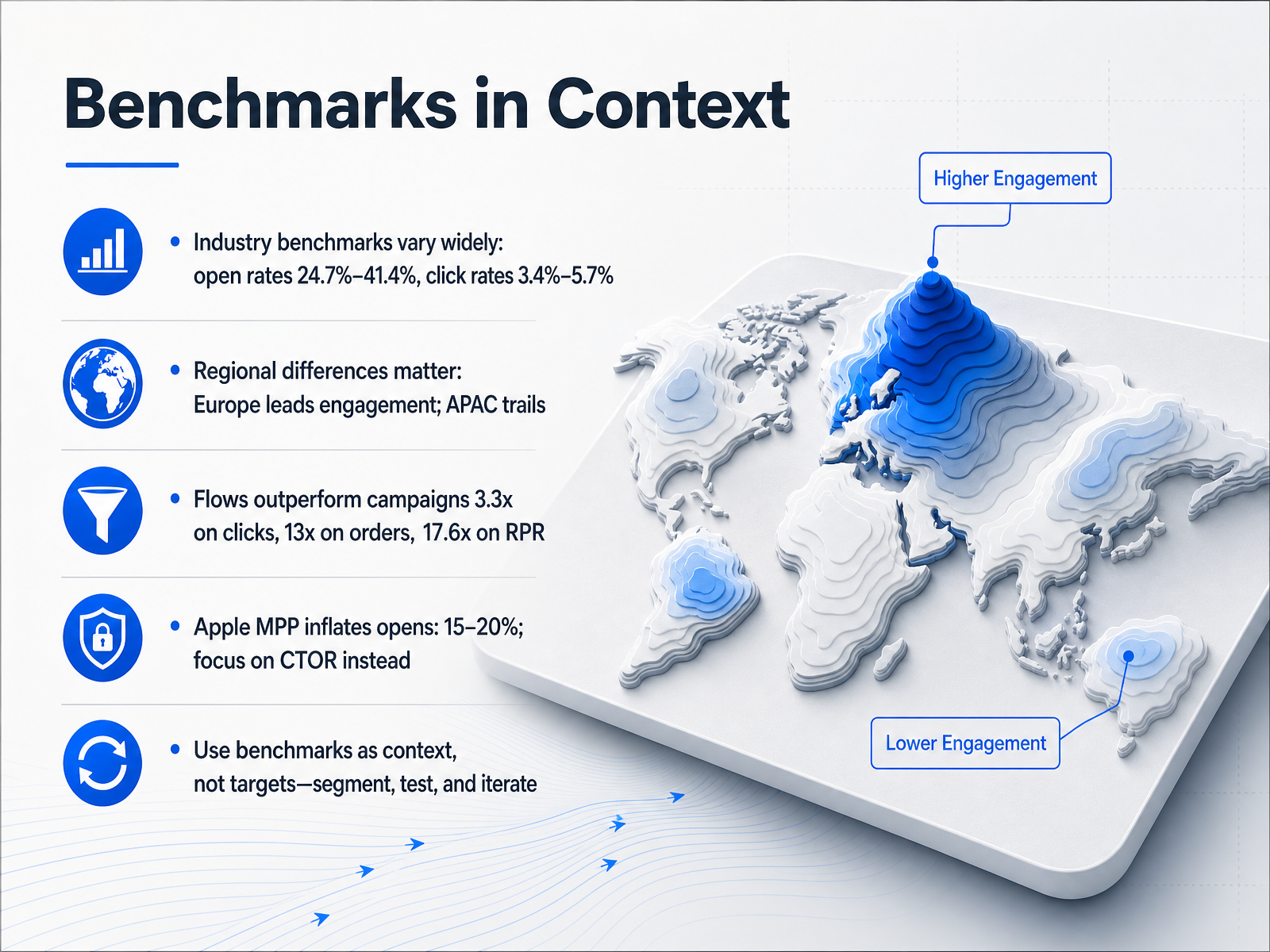
 - 10Benchmarks in ContextNow, let's put industry benchmarks in context, and here's the reality: they range widely. Open rates stretch from about 24.7% to 41.4%, and click rates hover between 3.4% and 5.7%. Region matters too—Europe leads engagement thanks to stricter consent practices, while APAC trails notably lower. But the headline numbers can mislead. Flows, not campaigns, are where your revenue engine lives. They outperform campaigns by 3.3 times on clicks, 13 times on orders, and a staggering 17.6 times on revenue per recipient. And here's the tradeoff to weigh: Apple's privacy protection inflates your open rates by up to 20%. So if you're chasing opener numbers, you're chasing a ghost. Focus on click-to-open rate instead. That is the reliable signal of content resonance. The real takeaway is to treat benchmarks as context, not targets. Your industry is a starting point, not a performance bar. Segment your list, test your approaches, and iterate continuously. And as you scale, the next set of decisions—tradeoffs in frequency, automation, and personalization—will be where you actually win.
 klaviyo.comvisionary-marketing.co.ukmailerlite.com+22 min
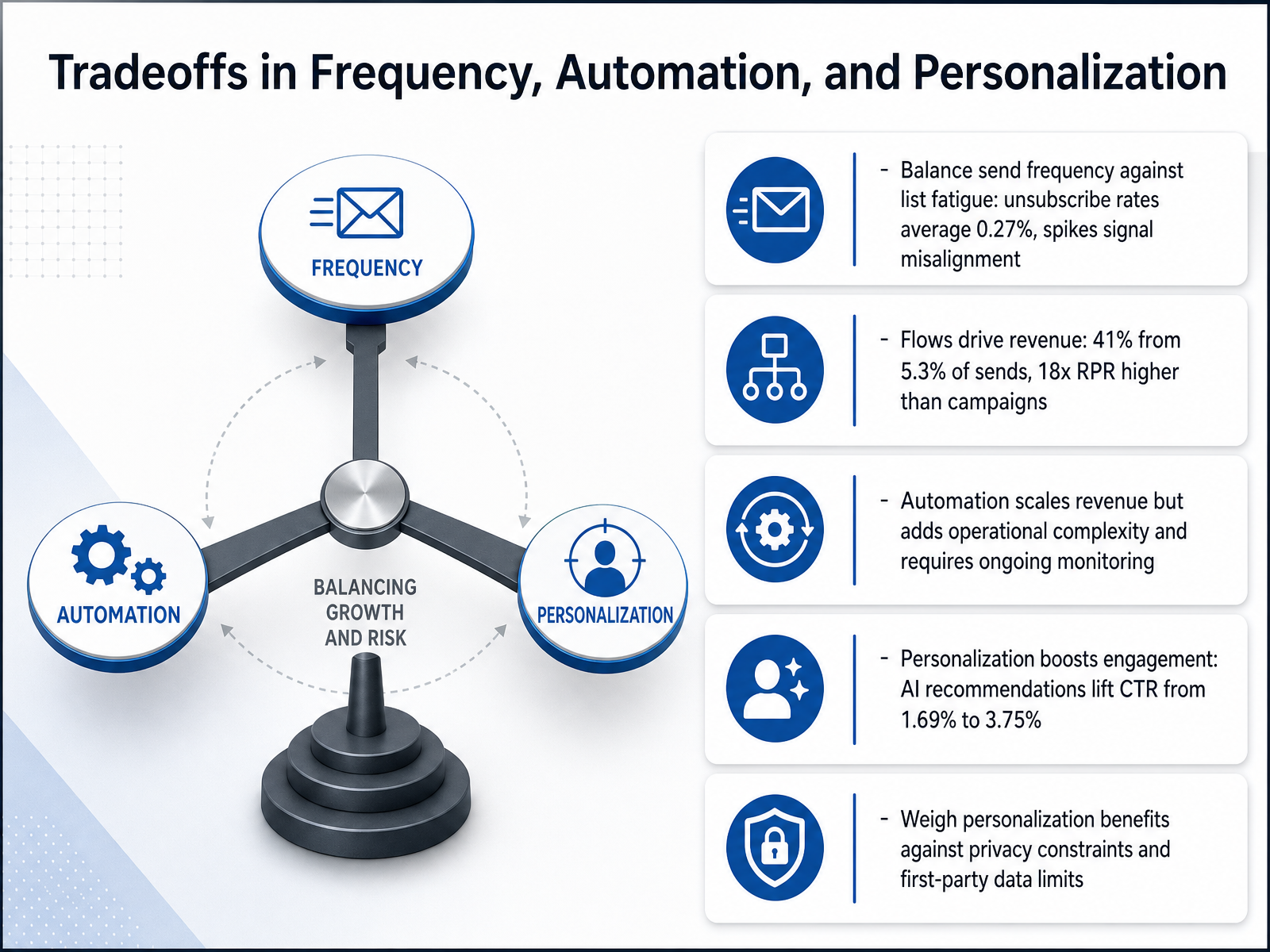
 - 11Tradeoffs in Frequency, Automation, and PersonalizationNow let's talk about the tradeoffs you'll face in frequency, automation, and personalization. These three levers drive revenue, but each one comes with a cost.
Start with frequency. The average unsubscribe rate sits around zero point two seven percent. That's the benchmark. When you see a spike, that's your first signal of misalignment. You're sending too often, or the content isn't matching what your subscribers expect.
Automation is where the real revenue lives. Flows generate about forty-one percent of total email revenue from just five point three percent of sends. And revenue per recipient is nearly eighteen times higher than campaigns. That's the why behind flow investment. But automation isn't free. It adds operational complexity, ongoing monitoring, and the need for continual optimization. The payoff is real, but it requires dedicated ownership.
Personalization is the third lever. AI-driven recommendations can lift click-through rates from one point six nine percent to three point seven five percent. That's a significant jump. But weigh that against privacy constraints and the limits of your first-party data. If your data is thin, over-personalization can backfire.
Here's the takeaway: balance these levers deliberately. Frequency protects your list. Automation scales revenue. Personalization lifts engagement. Each one has a cost.
Next, let's look at the guardrails that protect your sending reputation: privacy and deliverability.
 klaviyo.comvisionary-marketing.co.ukmailerlite.com+21 min
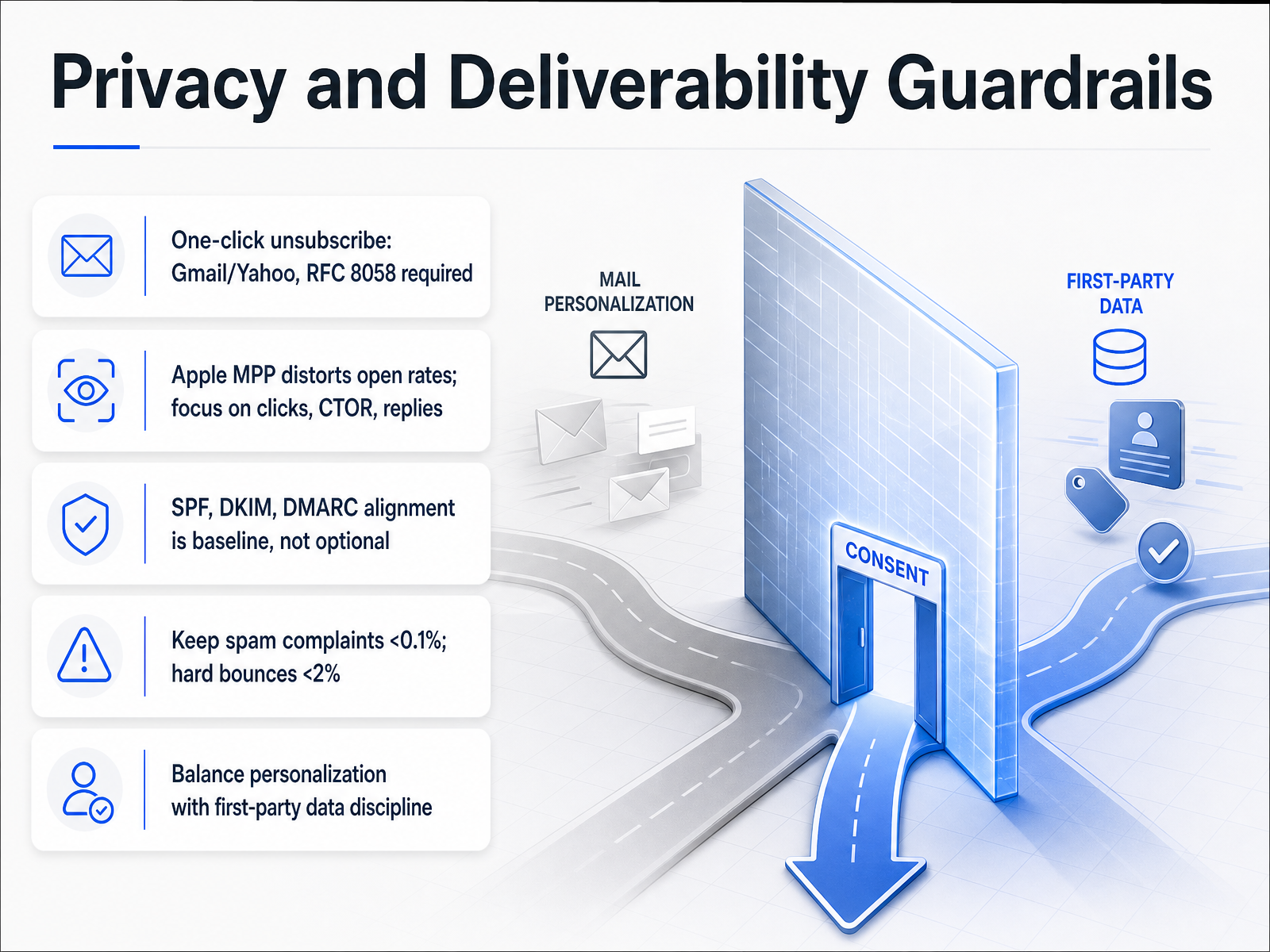
 - 12Privacy and Deliverability GuardrailsNow, let's talk about the guardrails that keep your program alive: privacy and deliverability. One-click unsubscribe is not optional anymore. Gmail and Yahoo require the RFC 8058 header, and they enforce it. Make it work in one click, no confirmation pages. Remember, a frustrated subscriber who can't opt out easily will hit the spam button instead, and that hurts you far more than an unsubscribe ever will. Next, Apple's Mail Privacy Protection has made open rates unreliable. They're inflated, plain and simple. So stop using opens as your north star. Shift your focus to clicks, click-to-open rate, and replies. Those are actual engagement signals you can trust. On the infrastructure side, SPF, DKIM, and DMARC alignment is the baseline. It's not a best practice, it's the entry fee. If you don't have that stack configured and aligned, your deliverability is broken. Keep your spam complaints below one tenth of one percent, and hard bounces under two percent. These are hard thresholds, not suggestions. Finally, balance personalization with first-party data discipline. Personalization drives revenue, but respect the data your audience gave you. Use it to tailor messages, not to creep them out. Let's look at what that actually costs you in the long run. Prioritizing your roadmap is next.
 wordstream.comtinysend.coemailcloud.com+22 min
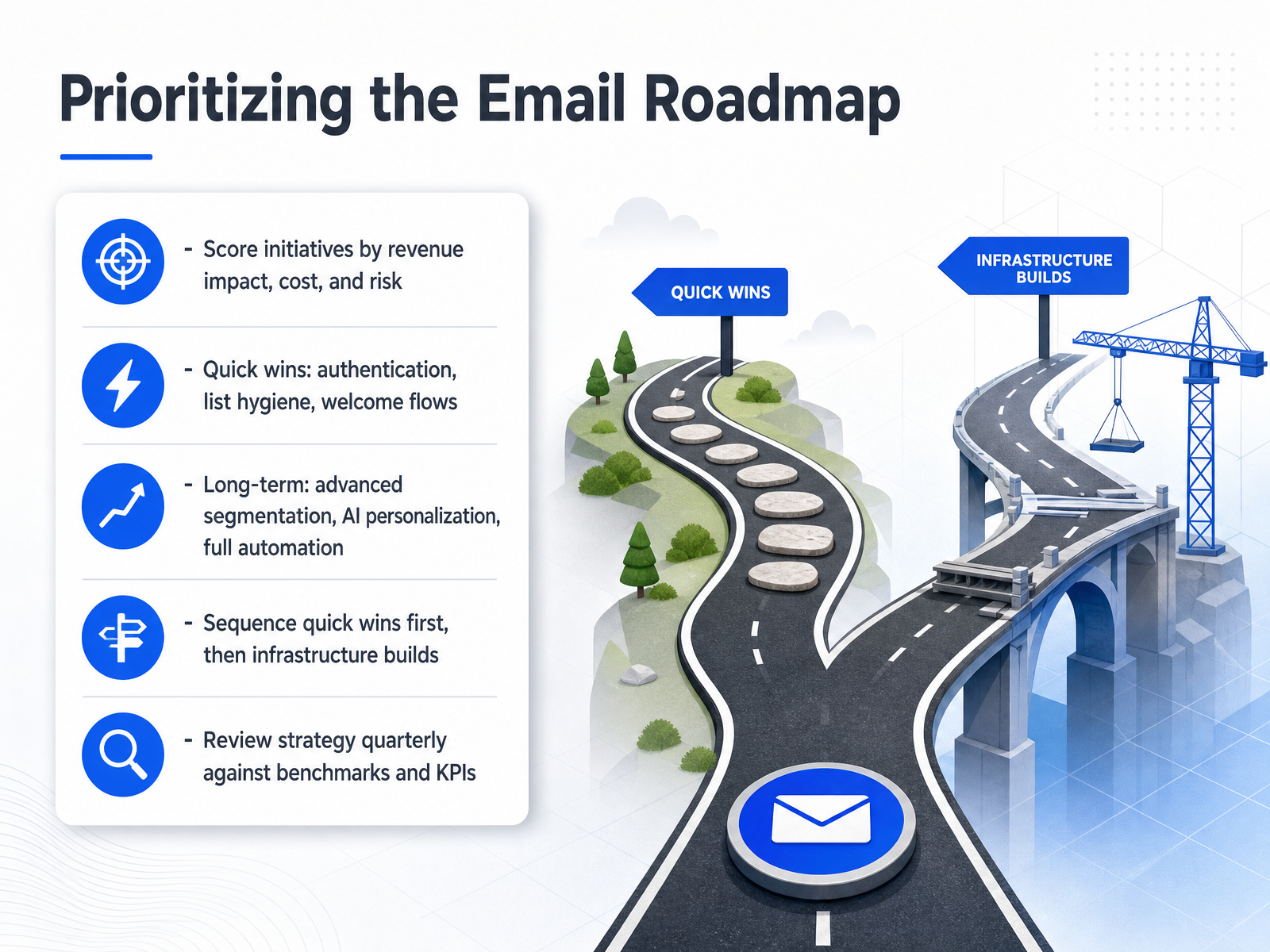
 - 13Prioritizing the Email RoadmapNow that you understand the strategic choices, let's talk about sequencing. You can't do everything at once. So, score your initiatives based on three factors: revenue impact, cost, and risk. This gives you a clear view of where to put your effort first. Start with the quick wins. Authentication, list hygiene, and welcome flows. These are low-cost, low-risk, and they protect your sender reputation. Without proper authentication like SPF, DKIM, and DMARC, even your best emails may never reach the inbox. Think of this as the foundation. Then, move to the longer-term infrastructure builds. Advanced segmentation, AI personalization, and full automation. These deliver the outsized returns. Automated emails drive thirty-seven percent of email-generated sales from just two percent of sends. The sequence matters. Quick wins first to stabilize your base. Then, build the infrastructure that scales. Finally, review your strategy quarterly against benchmarks and KPIs. Not just open rates, but revenue per email, list churn, and conversion lift. This keeps your roadmap aligned with business impact. We'll wrap up with an action plan you can take back to your team.
 omnisend.comlitmus.comnutshell.com+22 min
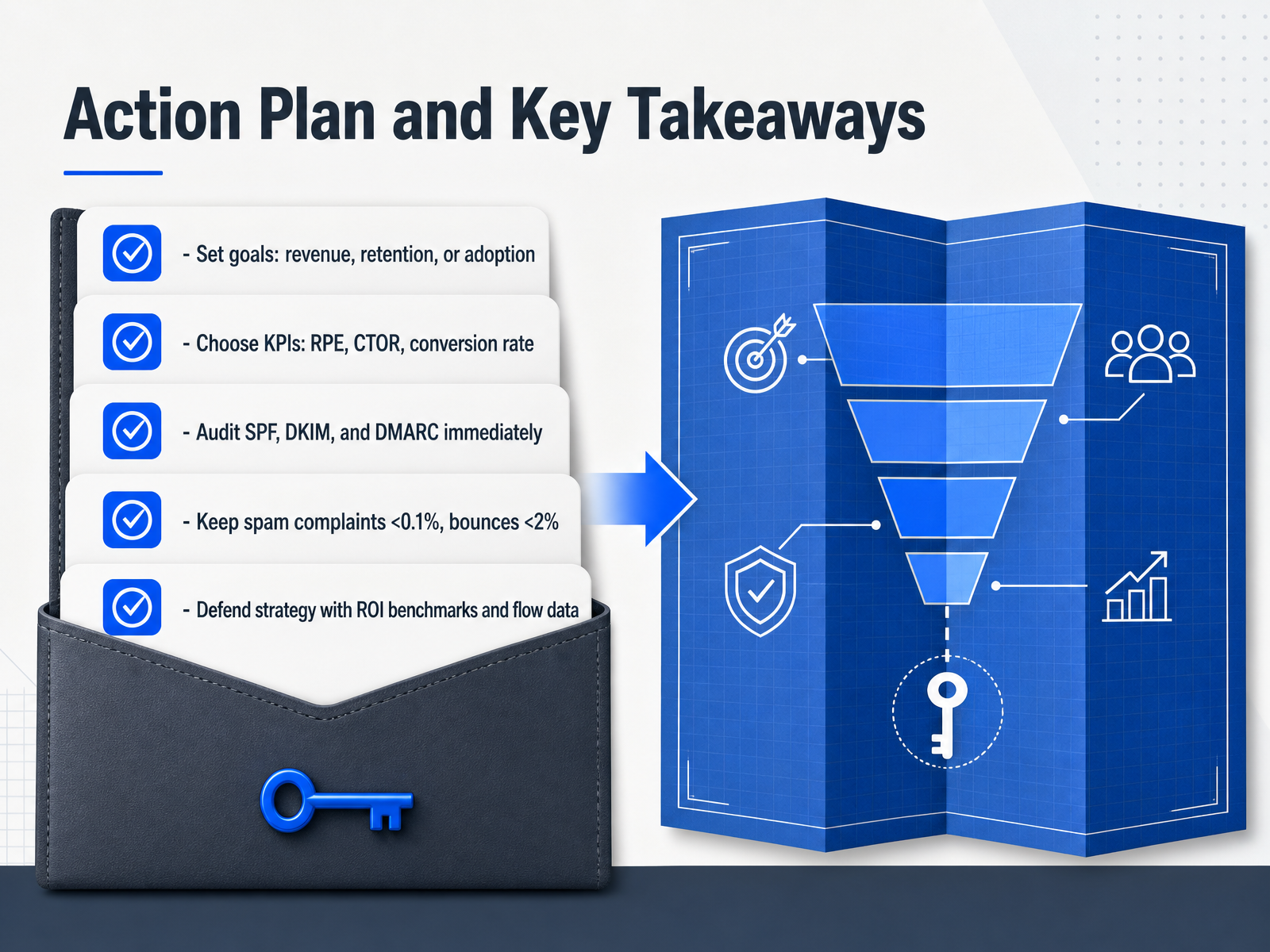
 - 14Action Plan and Key TakeawaysLet's pull everything together into a plan you can execute this week. First, set your goal. Are you driving revenue, retention, or product adoption? That single choice determines everything else. Second, pick the KPI that matches. Revenue per email if you're optimizing spend. Click-to-open rate if you're improving relevance. Conversion rate if you're building a business case. Do not track all three as priorities. Pick one. Third, audit your deliverability foundations today. SPF, DKIM, and DMARC are no longer optional; they are baseline compliance, so verify your DNS records now. Fourth, hold your list to a high standard. Keep spam complaints below one tenth of one percent and bounces below two percent. These are hard thresholds, not suggestions. Finally, when you defend your strategy to stakeholders, use ROI benchmarks and flow-level data. Email returns thirty-six to forty-two dollars for every dollar spent, and automated flows drive eighteen times the revenue per recipient of campaigns. That is your evidence. You now have the framework, the metrics, and the tradeoffs. Go make the strategic calls with confidence. Thank you for your time, and good luck.
 klaviyo.comvisionary-marketing.co.ukmailerlite.com+22 min
Take the deck with you
Download this course as a file — free, no sign-up needed.
- PDF handoutEvery slide page, ready to print or share.15 pages · 3.9 MBDownload
- Narrated PowerPointThe deck that presents itself — every slide carries the digital human's narration video.15 pages · 16.7 MBDownload
- PowerPoint slidesThe full deck as a .pptx — open it in PowerPoint, Keynote, or Google Slides.15 pages · 3.8 MBDownload
Free to use in your own training — please keep the PersonWise credit page at the end.
Have your own deck? Turn it into a course
Sources consulted
Web sources consulted while building this course.
- Email Marketing ROI: 2026 Benchmarks + Free Calculator — omnisend.com
- State of Email Reports 2025-2026: Email Marketing Trends - Litmus — litmus.com
- Email Marketing ROI: Statistics, Benchmarks, & Calculator for 2026 — nutshell.com
- Email marketing ROI: Key stats & proven effectiveness — blog.hubspot.com
- Email marketing benchmark report 2026: Open rates, CTR & ROI across 12 industries — siteimpact.com
- The Complete Email Deliverability Checklist for 2026 (+Tools & Tips) | WordStream — wordstream.com
- Email Deliverability Guide: How to Reach the Inbox (2026) — tinysend.co
- Email Deliverability Best Practices 2026 | EmailCloud — emailcloud.com
- Email Deliverability Best Practices: How to Reach the Inbox in 2026 — Signet — withsignet.com
- Email Deliverability: Complete Guide + Best Practices for 2026 — monday.com
- 2026 Email Marketing Benchmarks by Industry — klaviyo.com
- Email Marketing Benchmarks by Industry 2026 | Visionary — visionary-marketing.co.uk
- Email Marketing Benchmarks 2025: Is Your Open Rate on Track - MailerLite — mailerlite.com
- Email Marketing Benchmarks & Industry Statistics — mailchimp.com
- Email Marketing Benchmarks: Region & Industry Data (2026) — brevo.com