Begin
14 pages · ~28 min
English Prepositions in Context
This training helps English learners use prepositions accurately in real-world contexts, building confidence in everyday communication.
A digital instructor presents all 14 pages. Hold “Ask” at any point and ask out loud — the answer comes from this course. No sign-up needed.
What you’ll learn
- 01English Prepositions in ContextWelcome. In this course, we work on English prepositions in real context. Prepositions are small words, but they cause big problems. You meet them in every sentence. And they are one of the top error areas for learners at A2 to B2. So let's make them easier. Our roadmap goes step by step. We start with form and meaning. Then we move to space, then time. After that, we look at fixed chunks. Then we put prepositions in context. We finish with diagnosis, practice, and assessment. Along the way, keep three working categories in mind. Grammatical prepositions, like the word to in I go to school. Semantic prepositions, where meaning matters, like in the box versus on the box. And dependent prepositions, which come as part of a chunk, like interested in or good at. You may already know some of these, and that is fine. By the end, you will learn to choose the right preposition, correct your own mistakes, and produce prepositions that fit the context. Here is your takeaway for now. Learn prepositions as chunks in real sentences, not as single words. Now let's look at the evidence, and why prepositions are hard.doi.orgfiles.eric.ed.govdoi.org+22 min
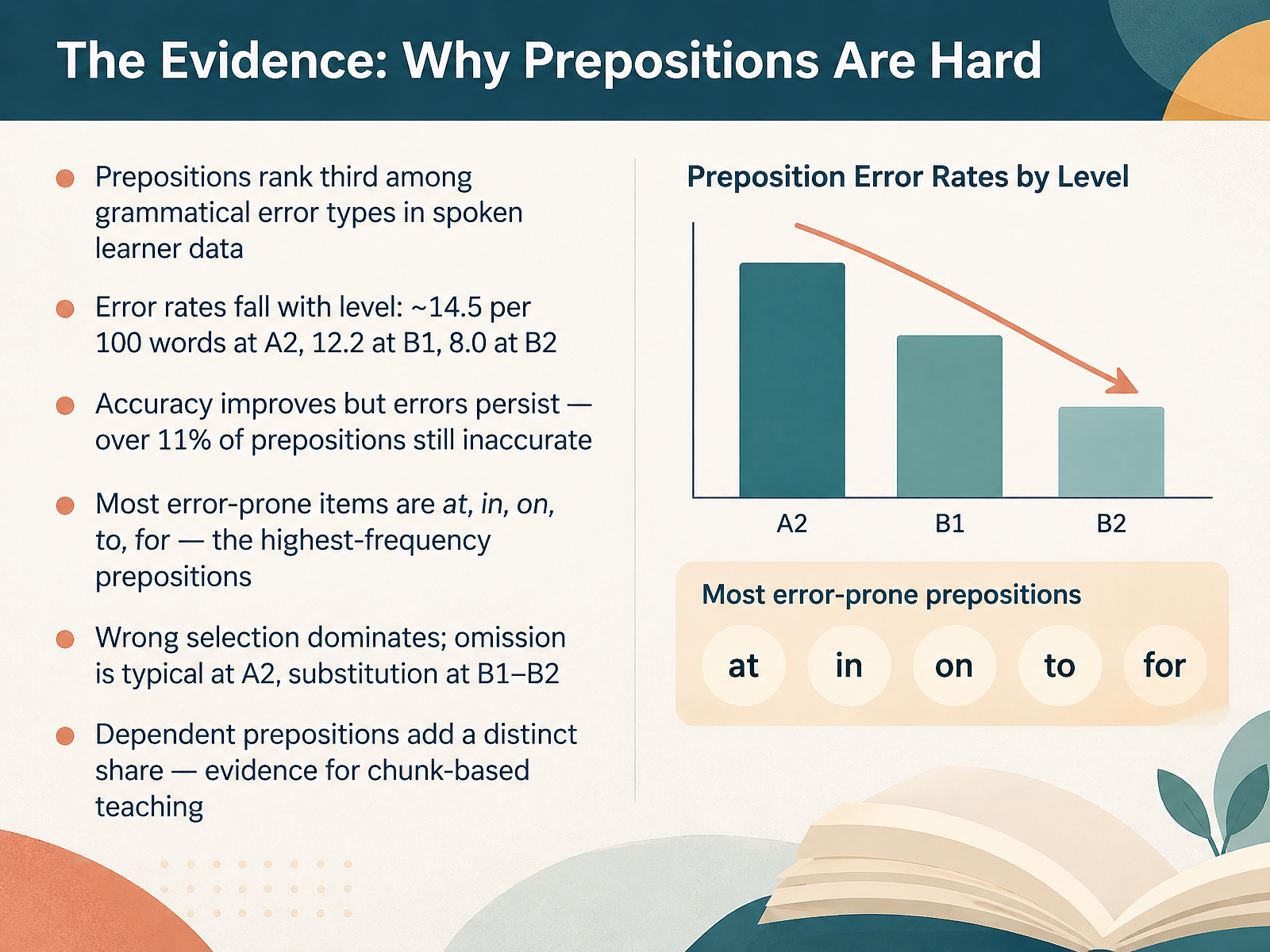
- 02The Evidence: Why Prepositions Are HardSo why do prepositions cause so much trouble? Let's look at the evidence. In spoken learner data, prepositions rank third among grammatical error types. Error rates fall as you improve. At A2, learners make about fourteen point five errors per hundred words. At B1, twelve point two. At B2, eight point zero. Accuracy improves, but errors persist. Over eleven percent of prepositions are still inaccurate. You'll hear this when a learner says on Monday correctly, but at next Monday. The most error-prone items are at, in, on, to, and for. These are simply the most frequent prepositions. Wrong selection is the dominant error type. Omission is typical at A2, while substitution is more common at B1 and B2. Dependent prepositions add a separate share, like married to or depend on. That supports teaching prepositions in chunks. Your takeaway here is simple. Track your own common preposition errors, and learn the whole phrase, not just the single word. Next, we'll build a working framework: form, meaning, and function.
 doi.orgfiles.eric.ed.govdoi.org+22 min
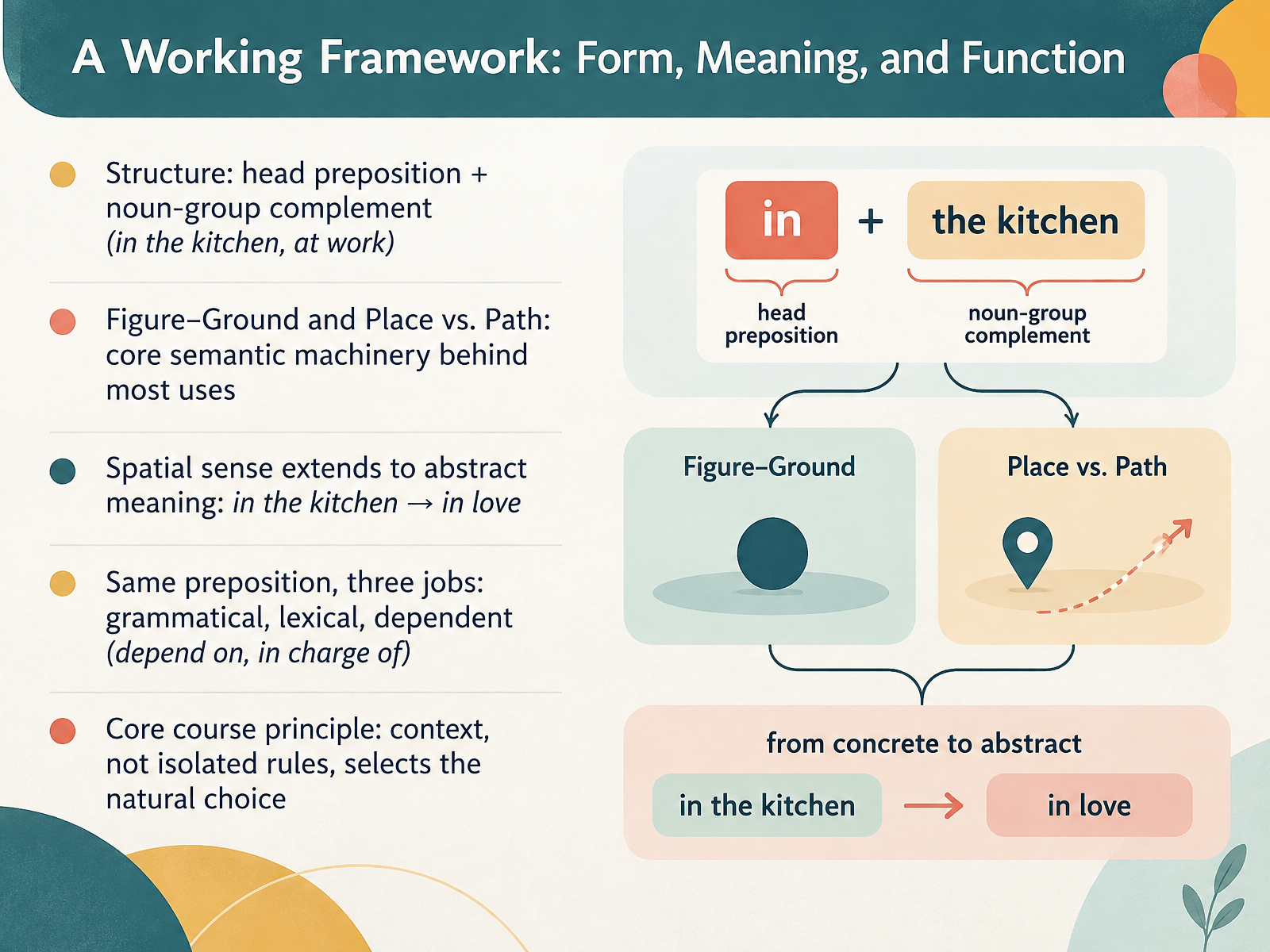
- 03A Working Framework: Form, Meaning, and FunctionLet's build a simple framework you can use all through this course. Every preposition phrase has a form: a head preposition plus a noun group, as in in the kitchen or at work. Behind most uses sits a basic meaning pattern: figure and ground, and place versus path. That spatial sense then stretches into abstract meaning. The same phrase in the kitchen becomes in love. And one preposition can do three jobs: grammatical, lexical, and dependent, as in depend on or in charge of. So here is your takeaway. Context, not isolated rules, picks the natural choice. Next, we look at space and place: in, on, at, and beyond.
 1 min
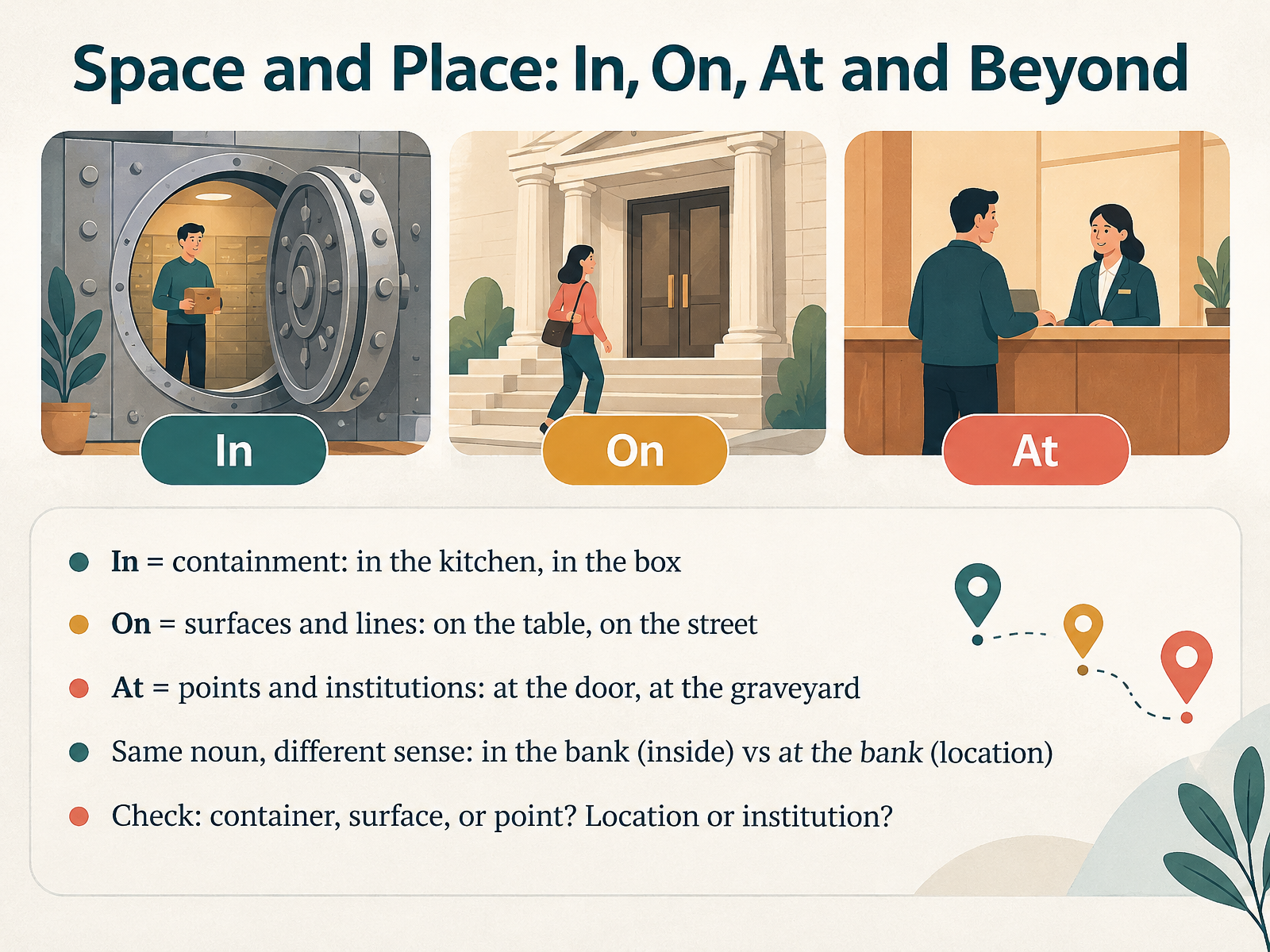
- 04Space and Place: In, On, At and BeyondNow let's look at place. Think of three shapes: a container, a surface, and a point. In is for containers. You'll hear this when someone says the milk is in the fridge, or the keys are in the box. On is for surfaces and lines. The book is on the table. The shop is on Main Street. At is for points and institutions. Wait at the door. She works at the hospital. Here is the key idea. The same noun can take different prepositions, and the meaning changes. In the bank means inside the building. At the bank means the location, as in I'll meet you at the bank. So before you choose, ask two quick questions. First, is it a container, a surface, or a point? Second, do I mean inside, or just the location? That check will fix many common mistakes. Next, we move into movement and direction. That is Path, Source, and Goal.
 suppescorpus.stanford.edusemanticsarchive.netdoi.org+21 min
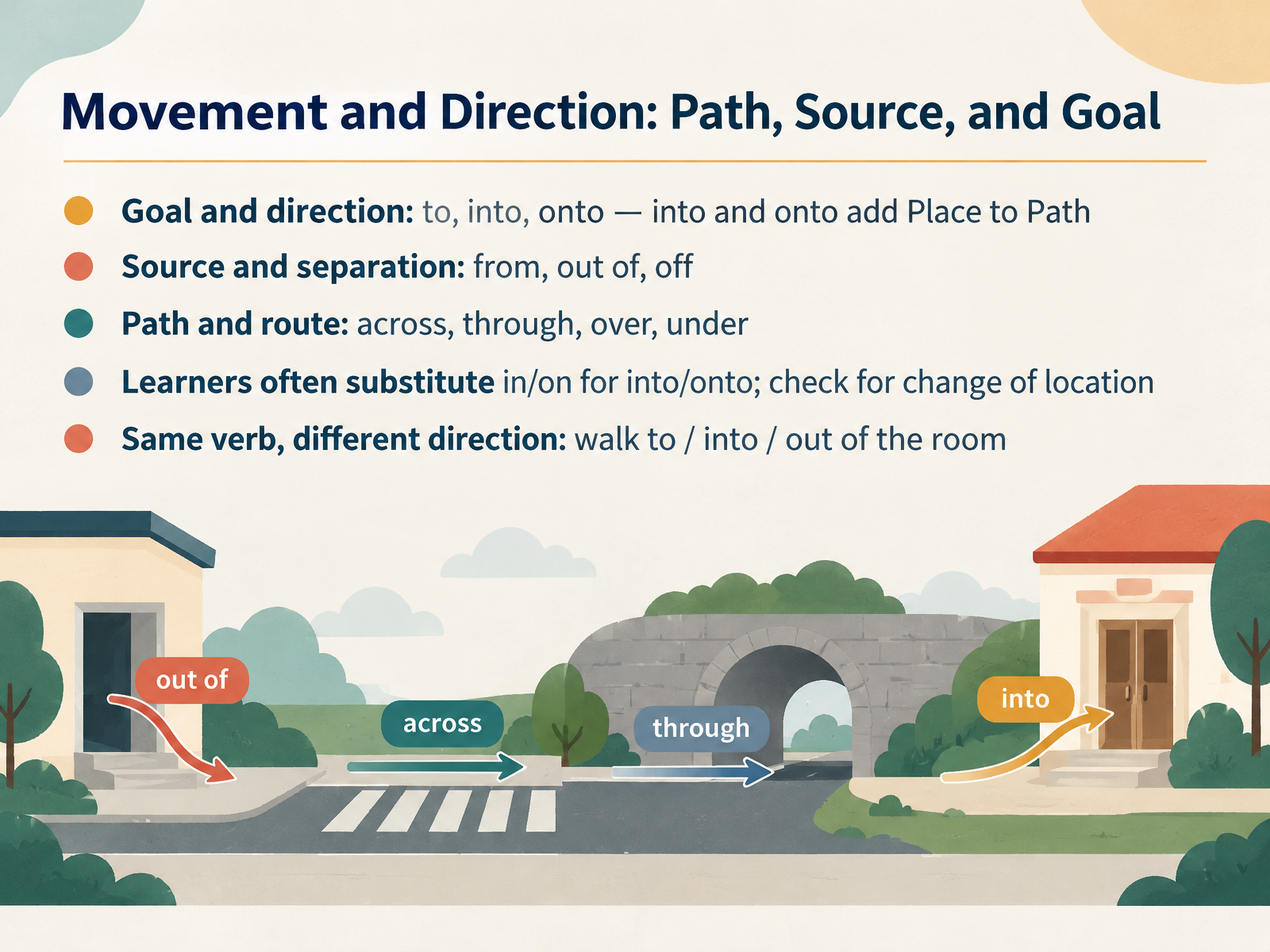
- 05Movement and Direction: Path, Source, and GoalNow let's look at movement and direction. These prepositions describe a path, a source, or a goal. For a goal, we use to, into, and onto. Into and onto add place to path. You'll hear this when someone says she walked into the room, or he put the keys onto the table. For a source or separation, we use from, out of, and off. For example, he came out of the building, or she took the book off the shelf. For a path or route, we use across, through, over, and under. You'll hear this when someone says we walked across the bridge, or the train went through the tunnel. Learners often substitute in or on for into or onto. Check for a change of location. For example, compare she is in the room with she walked into the room. The same verb can take different directions: walk to the room, walk into the room, walk out of the room. So here is a simple takeaway. When you hear a motion verb, ask yourself: is there a change of location? If yes, use into or onto. Next, we'll move on to time and duration: points, periods, and deadlines.
 suppescorpus.stanford.edusemanticsarchive.netdoi.org+22 min
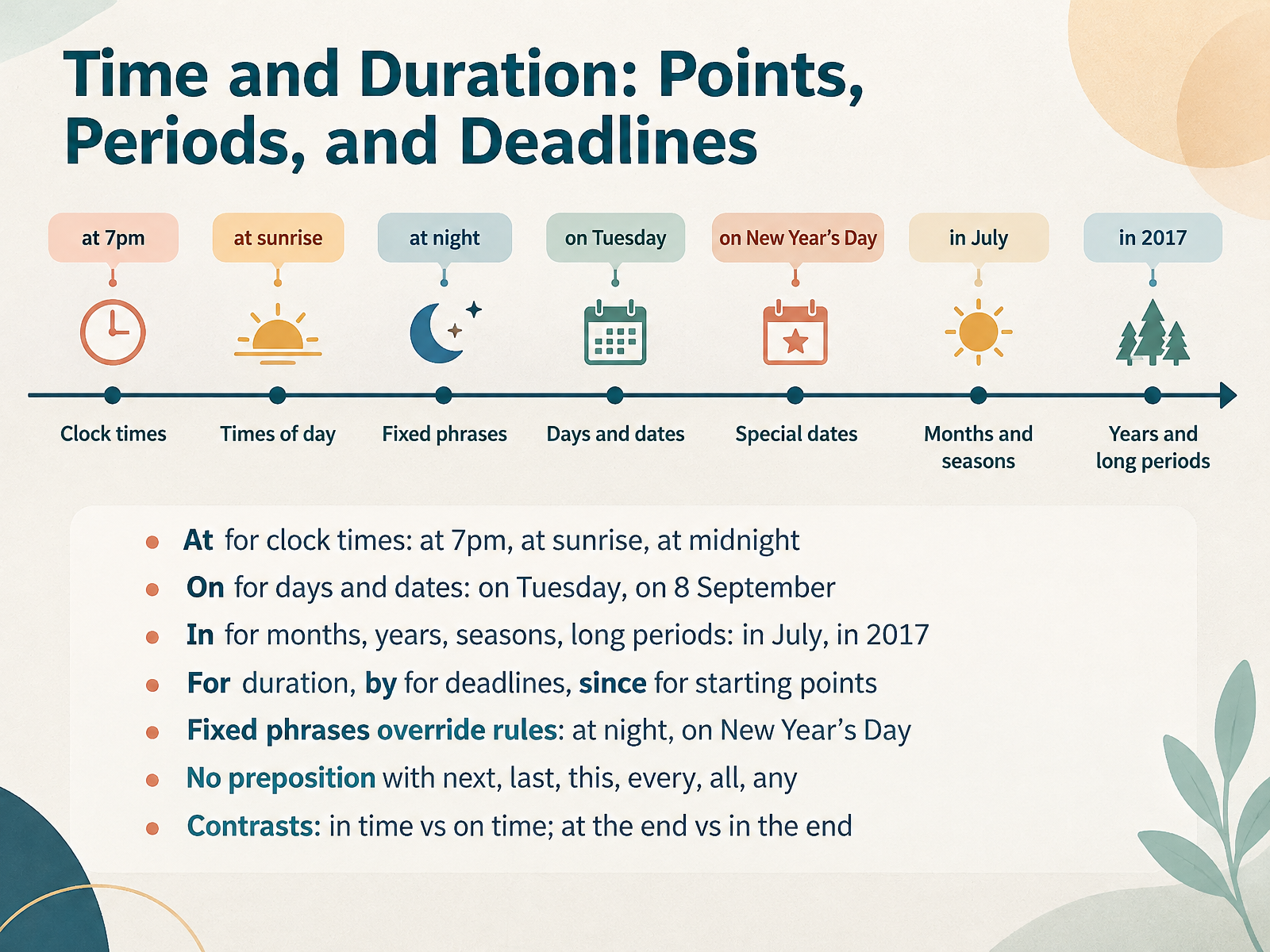
- 06Time and Duration: Points, Periods, and DeadlinesNow let's look at time and duration. English uses three small prepositions here, and each one marks a different size of time. Use at for a point on the clock: at seven p.m., at sunrise, at midnight. Use on for days and dates: on Tuesday, on the eighth of September. Use in for longer periods, like months, years, and seasons: in July, in twenty seventeen. Then we have three helpers. For marks how long something lasts, by marks a deadline, and since marks a starting point. You'll hear this when someone says, please send the report by Friday. Two more things to remember. Fixed phrases override the rules, so we say at night and on New Year's Day. And we use no preposition with next, last, this, every, all, or any. So say next Monday, not on next Monday. Also watch these contrasts: in time means early enough, while on time means exactly at the scheduled time. At the end refers to a point where something finishes, but in the end means finally, after a long time. Here is your takeaway. Before you speak, ask yourself one question: is this a point, a period, or a deadline? That answer usually picks the preposition for you. Next, we move on to dependent prepositions, with adjective, verb, and noun patterns.
 dictionary.cambridge.orgenglishleap.comuvic.ca+22 min
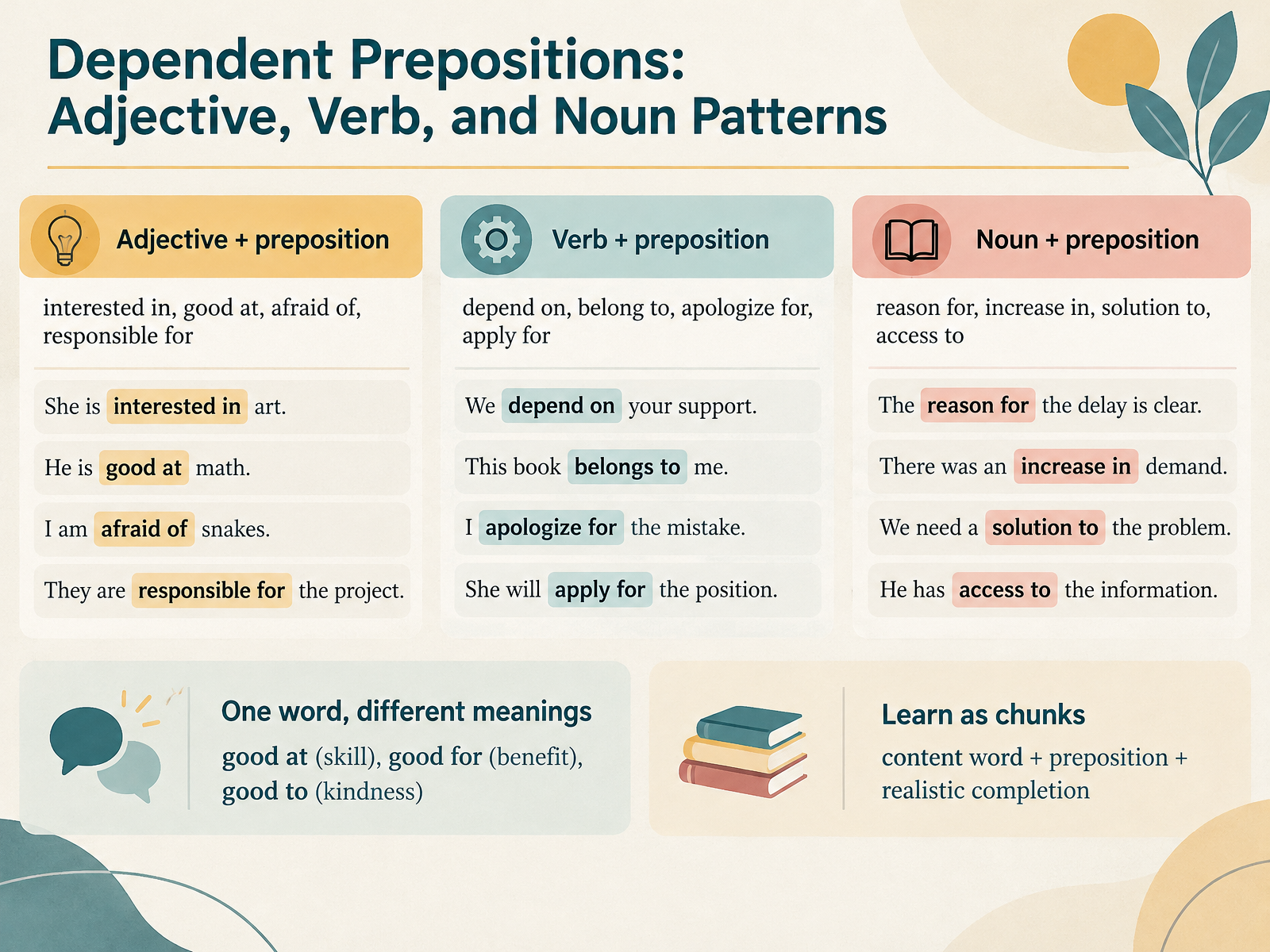
- 07Dependent Prepositions: Adjective, Verb, and Noun PatternsLet's look at dependent prepositions, where an adjective, verb, or noun picks its own preposition. Some adjectives: interested in a course, good at chess, afraid of spiders, responsible for the team. Some verbs: depend on the weather, belong to a club, apologize for the delay, apply for a job. Some nouns: the reason for a change, an increase in costs, a solution to the problem, access to the building. Watch one word with different meanings. Good at means a skill, like good at cooking. Good for means benefit, like fruit is good for you. Good to means kindness, like she was good to us. When you check answers, you'll hear these patterns in emails, reports, and everyday talk. Don't guess the preposition. Learn each one as a chunk: content word, preposition, and a realistic completion, such as apply for the position. Keep it in a phrase you would really say. Next, we move on to phrasal verbs and idiomatic prepositional phrases.
 magoosh.combreakoutenglish.comopen-exam-prep.com+22 min
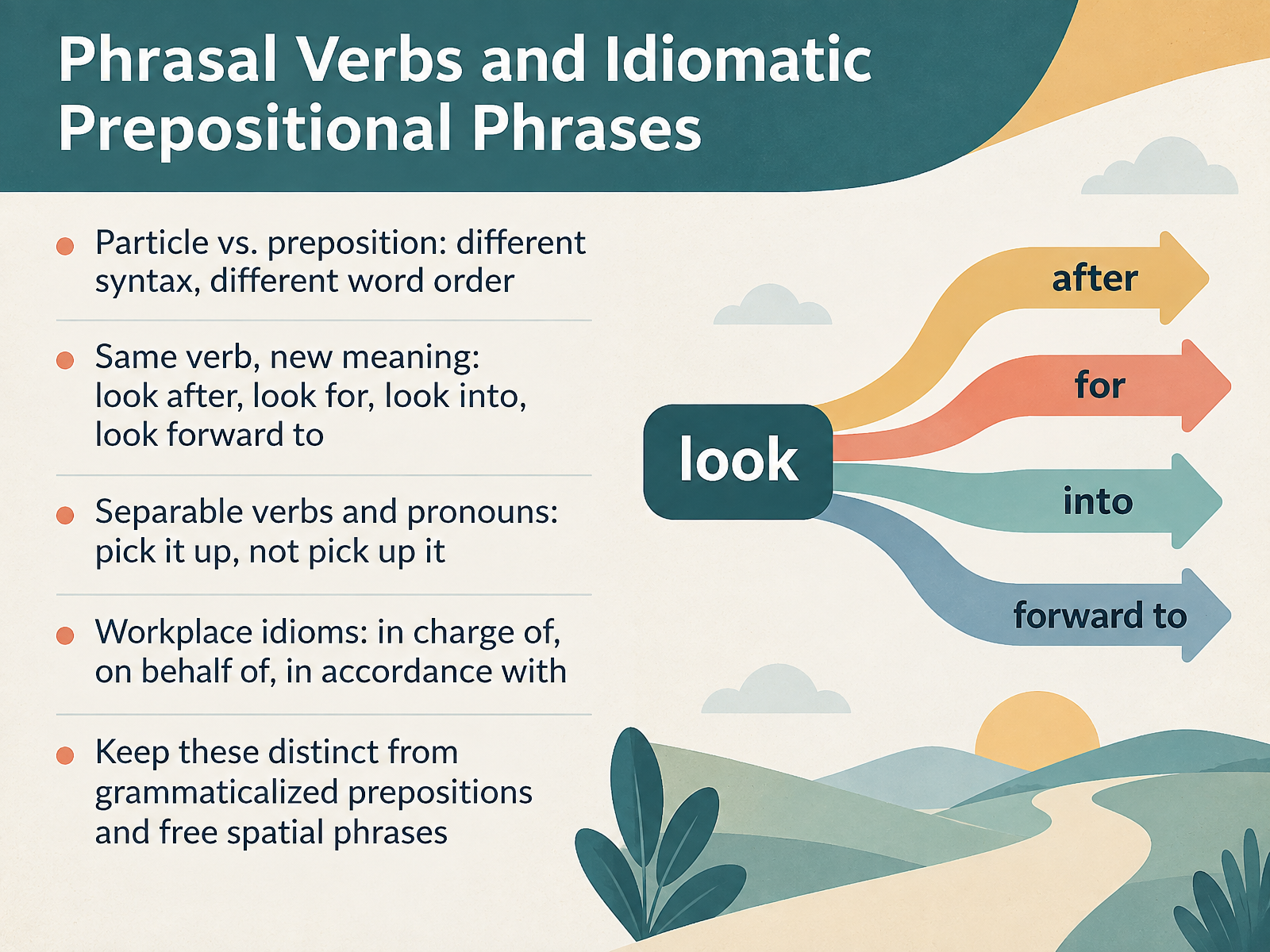
- 08Phrasal Verbs and Idiomatic Prepositional PhrasesLet's move on to phrasal verbs and idiomatic prepositional phrases. In a phrasal verb, the small word is a particle, not a true preposition. It changes the meaning and can move. Look after, look for, look into, and look forward to all use look, but each means something different. You'll hear these constantly at work. Some phrasal verbs are separable, so we say pick it up, not pick up it. Pronouns must sit in the middle. Also watch workplace phrases like in charge of, on behalf of, and in accordance with. Keep them separate from free spatial phrases. For example, she walked in the garden is just a location. Your takeaway is this. Learn each phrasal verb and fixed phrase as one complete chunk, with its word order. Next, we look at register and variety: choosing the natural option.
 suppescorpus.stanford.edusemanticsarchive.netdoi.org+21 min
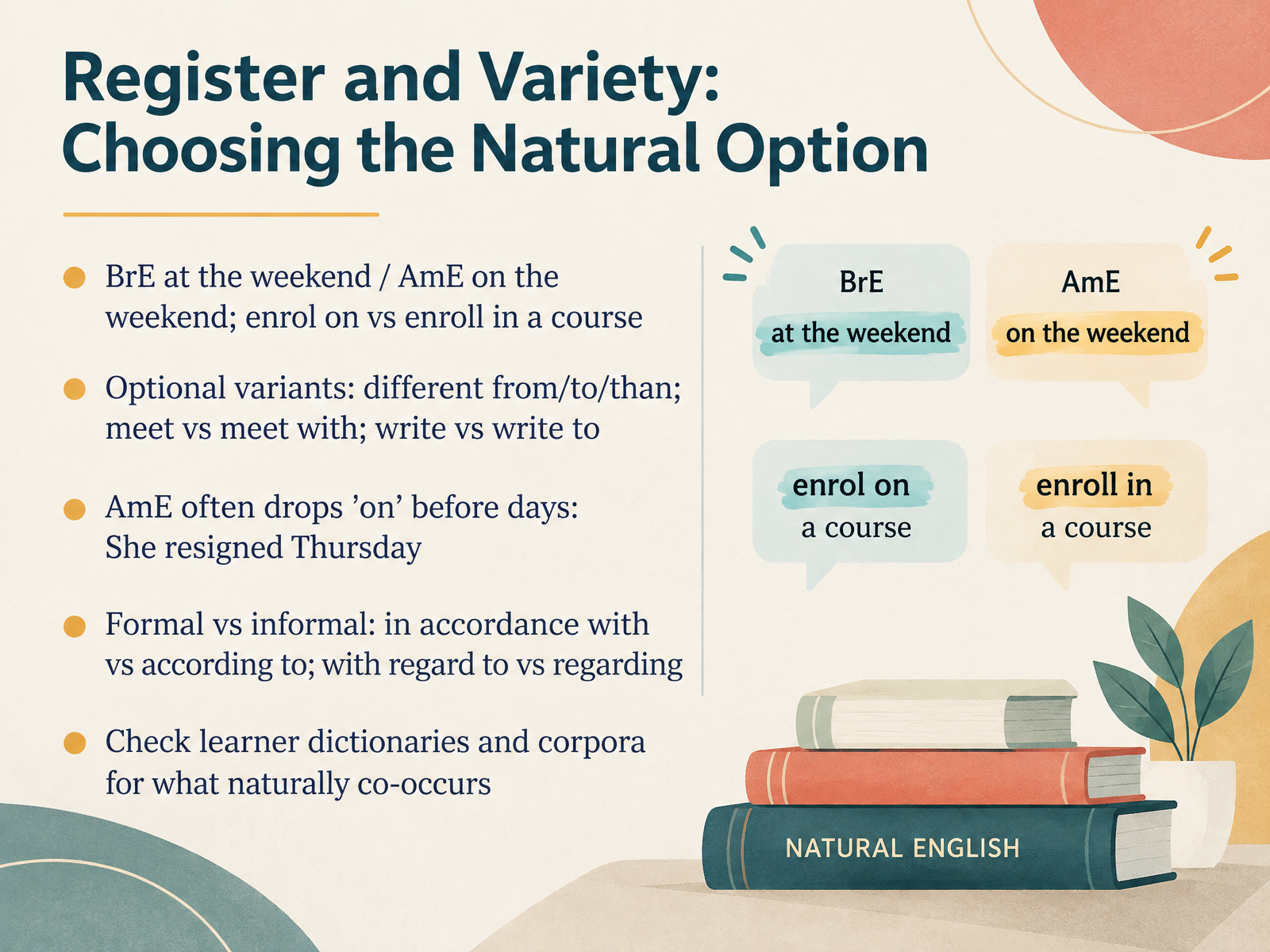
- 09Register and Variety: Choosing the Natural OptionNow let's talk about register and variety. Sometimes two options are both correct, and you just need the natural one. In British English you say at the weekend. In American English, on the weekend. You enrol on a course in British English, but enroll in a course in American English. Some variants are optional, not wrong. Different from, different to, and different than all appear. You'll hear meet with in American business talk, and write to in British writing. American English often drops on before days. So She resigned Thursday sounds natural in the US. Register matters too. In accordance with and with regard to sound formal. According to and regarding sound neutral and everyday. When you're unsure, check a learner dictionary or a corpus. Look at what naturally co-occurs with the word, and copy that pattern. Your takeaway is simple. Choose the option that fits the variety and the situation, and let real examples guide you. Next, we'll look at diagnosing and correcting preposition errors.
 bbc.com2 min
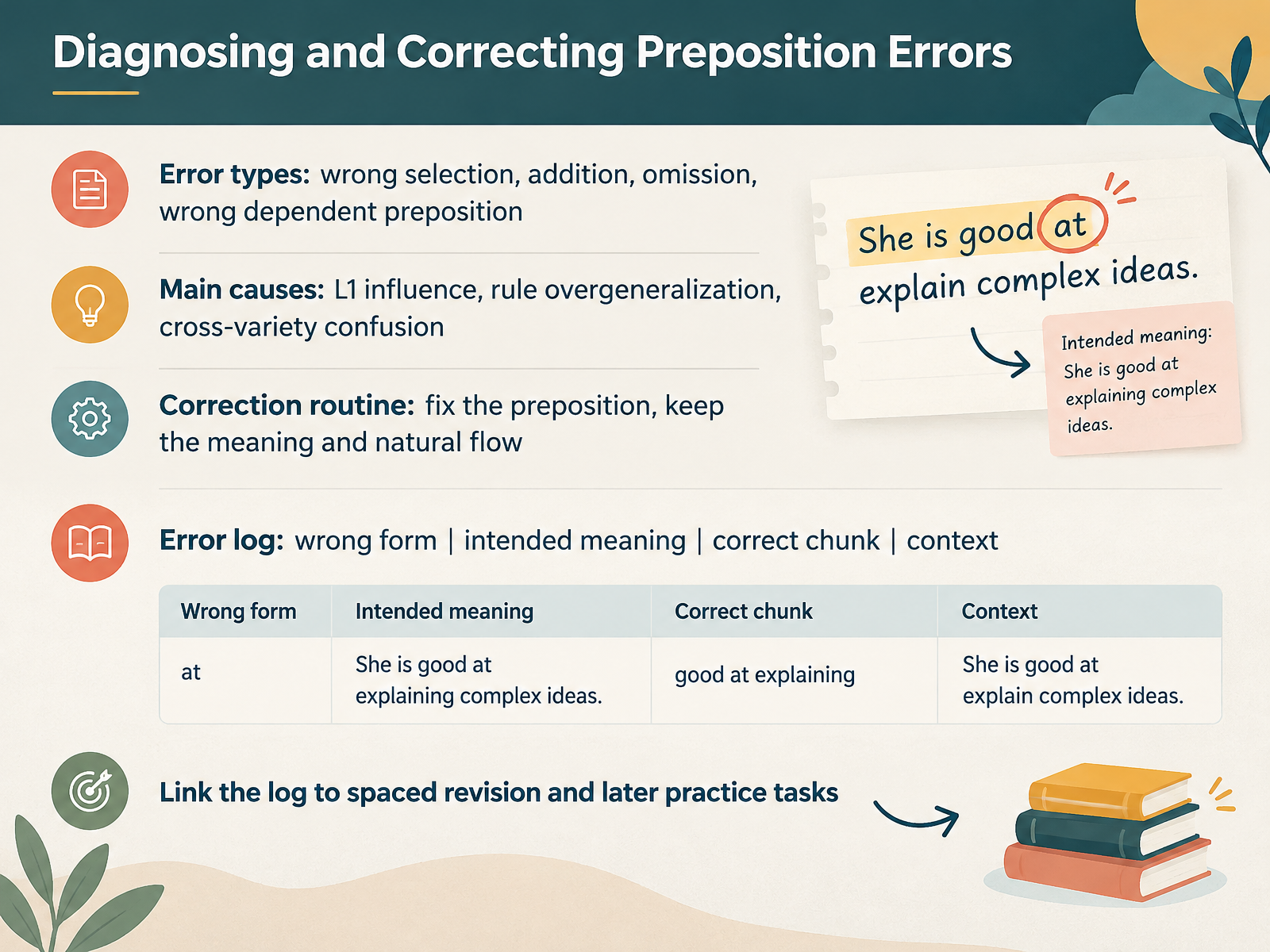
- 10Diagnosing and Correcting Preposition ErrorsNow let's talk about finding and fixing your preposition errors. There are four common error types. Wrong selection, like saying in Monday instead of on Monday. Addition, where a preposition is not needed. Omission, where one is missing. And the wrong dependent preposition, like married with instead of married to. The main causes are your first language, overgeneralizing a rule, and mixing varieties. You may see this when a phrase feels right in your language but sounds off in English. Here is a routine. Fix the preposition. Keep the meaning and the natural flow. Then write it in an error log. Record the wrong form, the intended meaning, the correct chunk, and the context. Link that log to spaced revision and later practice tasks. Your takeaway is simple. Log every missed chunk with its context, and review it on a schedule. Next, we look at practice design, tasks that make prepositions stick.
 doi.orgfiles.eric.ed.govdoi.org+22 min
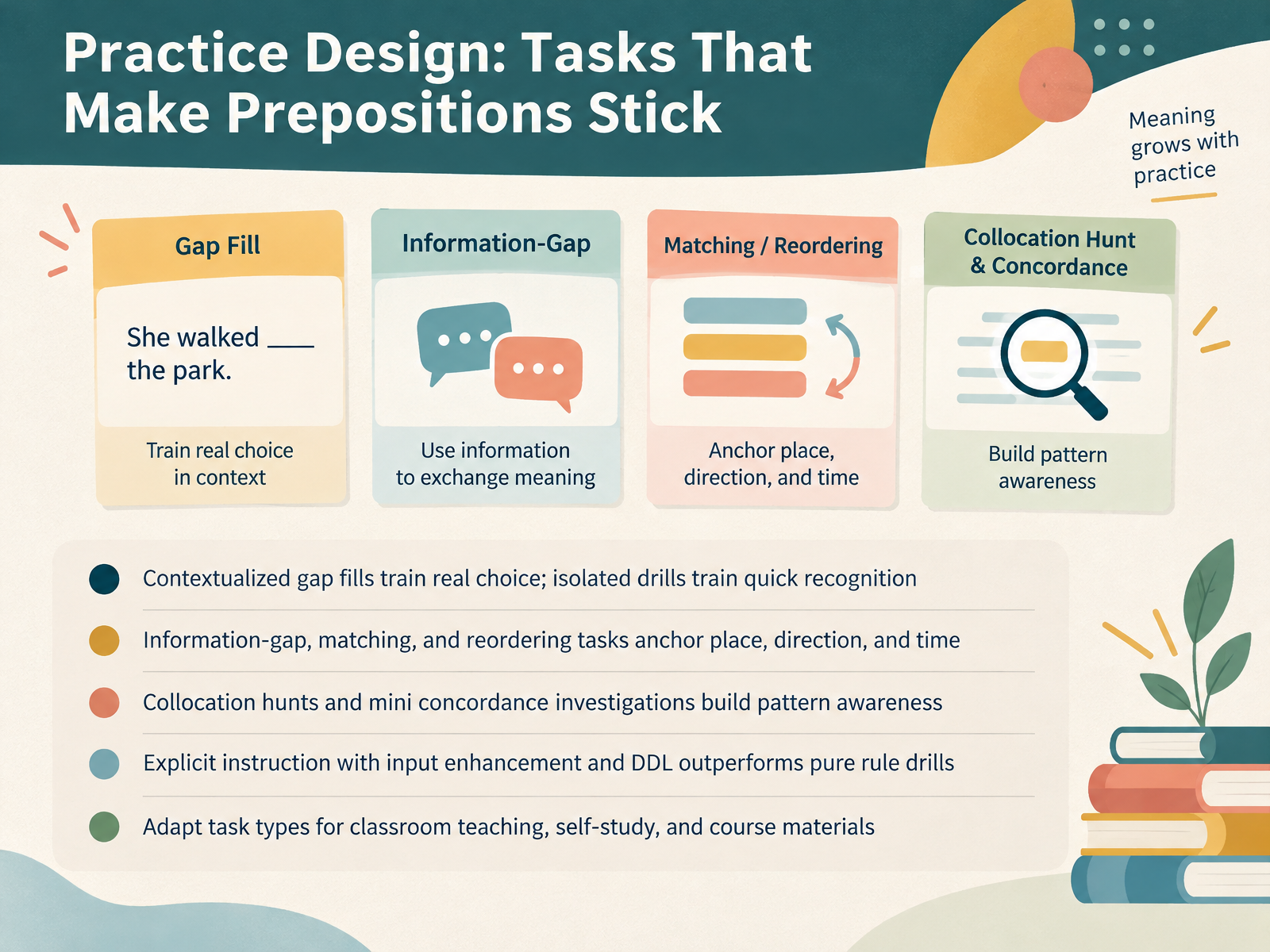
- 11Practice Design: Tasks That Make Prepositions StickNow let's look at practice design. The goal is tasks that make prepositions stick. Contextualized gap fills train real choice. You read a short situation and choose the right preposition. Isolated drills train quick recognition, so both have a place. Information-gap, matching, and reordering tasks anchor place, direction, and time. For example, two learners describe a room and find the differences. Collocation hunts and mini concordance investigations build pattern awareness. You will hear this when you search a corpus for depend on and notice the pattern. Research suggests explicit instruction with input enhancement and data-driven learning outperforms pure rule drills. Finally, adapt task types for classroom teaching, self-study, and course materials. Your takeaway for this slide is simple. Choose one task type that fits your setting today, and link it to a real situation your learners will meet. Next, we turn to assessment: measuring accuracy, naturalness, and context fit.
 suppescorpus.stanford.edusemanticsarchive.netdoi.org+22 min
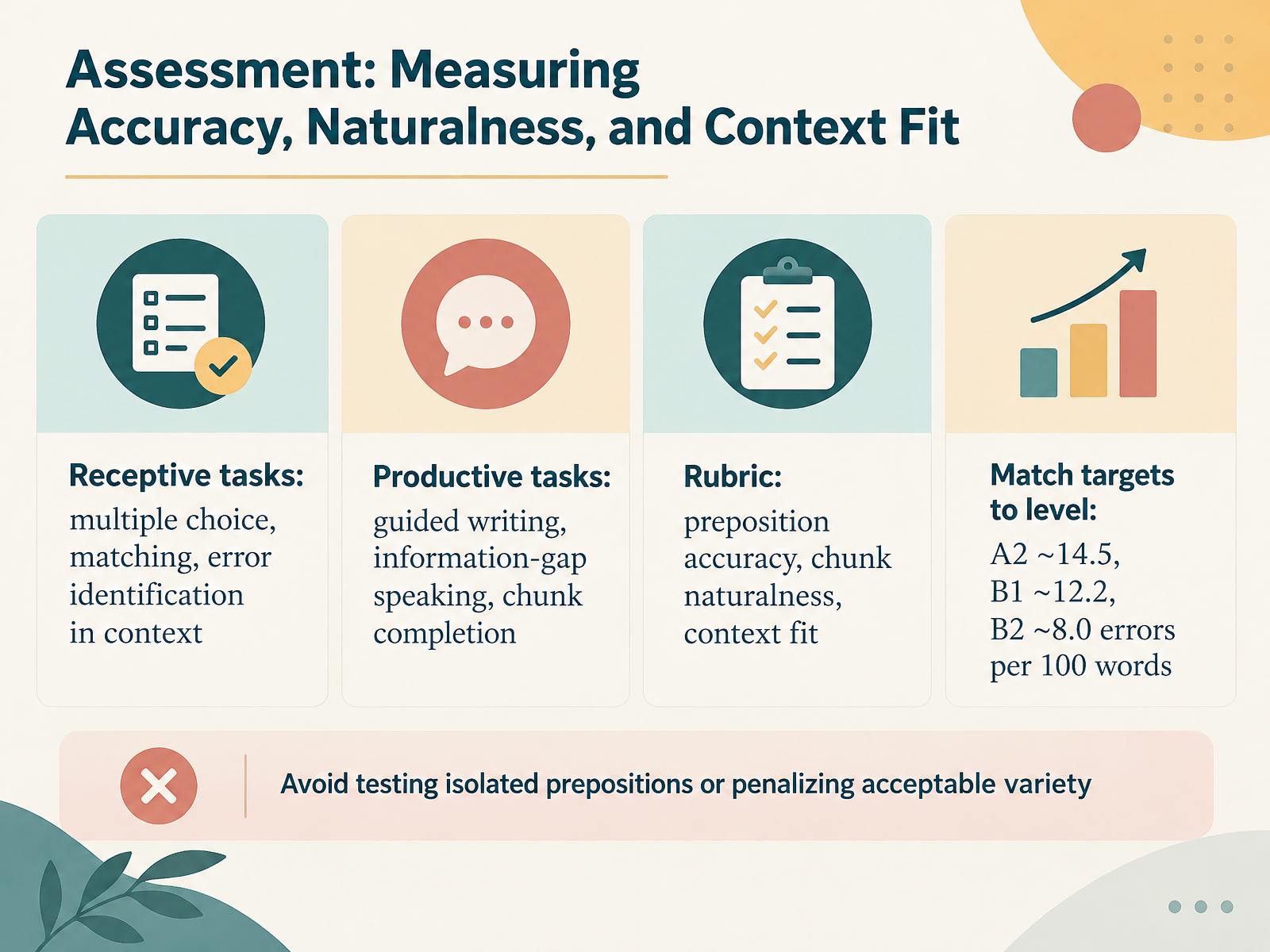
- 12Assessment: Measuring Accuracy, Naturalness, and Context FitNow let's talk about assessment. You want to measure three things at once: accuracy, naturalness, and context fit. Use receptive tasks first. Multiple choice, matching, and error identification in context all work well. Then add productive tasks: guided writing, information gap speaking, and chunk completion. For example, you'll hear this when a learner says married with instead of married to. Your rubric should score preposition accuracy, chunk naturalness, and context fit. Match targets to level. A two learners average about fourteen point five errors per one hundred words. B one learners average about twelve point two. B two learners average about eight. One clear takeaway: avoid testing isolated prepositions. And do not penalize acceptable variety, like two correct ways to say the same thing. Next, we'll look at how to put this into practice with a four week action plan.
 doi.orgfiles.eric.ed.govdoi.org+22 min
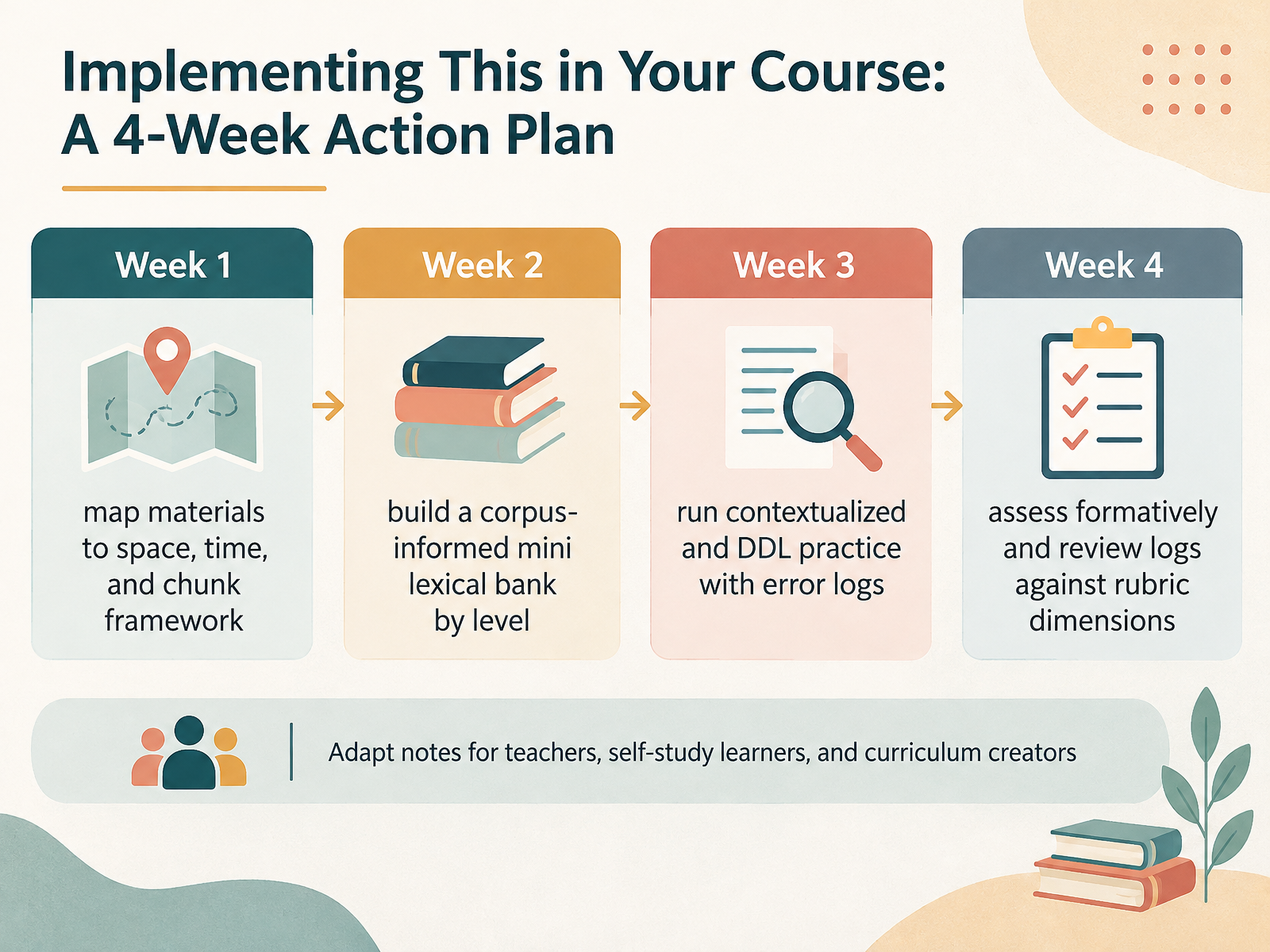
- 13Implementing This in Your Course: A 4-Week Action PlanLet's turn all of this into a four-week action plan. In week one, map your materials to the three frameworks: space, time, and chunks. You'll hear this when you check a unit and ask, "Does this teach at, on, in for place, and does it teach chunks like interested in?" In week two, build a small lexical bank by level, using corpus frequency to choose what to teach. In week three, run contextualized practice and data-driven learning, and keep error logs. Finally, in week four, assess formatively and review those logs against your rubric. Adapt the notes for teachers, self-study learners, and curriculum creators. Your takeaway is simple: start with week one and map one unit this week. Next, we'll look at review and next steps: resources, targets, and a personal plan.
 1 min
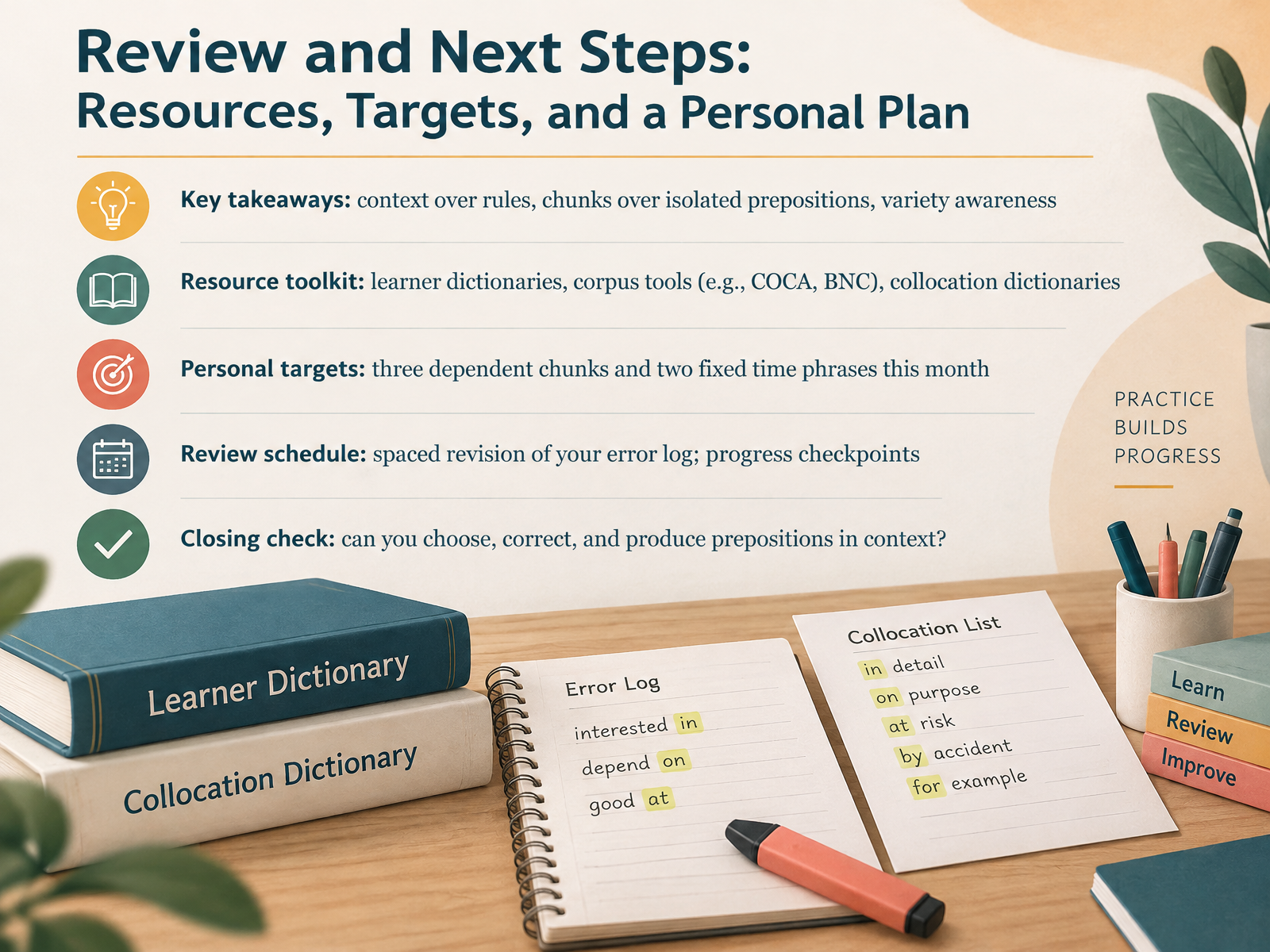
- 14Review and Next Steps: Resources, Targets, and a Personal PlanLet's bring it all together. The big idea is context over rules. Learn prepositions as chunks, like interested in or reason for, not as single words. And stay aware of variety, because different from and different to are both used. For your toolkit, use learner dictionaries, collocation dictionaries, and corpus tools like C O C A and B N C to check real examples. Now make a plan. This month, choose three dependent chunks and two fixed time phrases, and use them often. Keep an error log, and review it on a spaced schedule with regular checkpoints. Here is your final check. Can you choose, correct, and produce prepositions in context? If not yet, that is normal. Keep noticing chunks, and you will improve. Thank you for joining me. You have done solid work, so trust your plan and keep going.
 magoosh.combreakoutenglish.comopen-exam-prep.com+22 min
Take the deck with you
Download this course as a file — free, no sign-up needed.
- PDF handoutEvery slide page, ready to print or share.15 pages · 3.8 MBDownload
- Narrated PowerPointThe deck that presents itself — every slide carries the digital human's narration video.15 pages · 13.8 MBDownload
- PowerPoint slidesThe full deck as a .pptx — open it in PowerPoint, Keynote, or Google Slides.15 pages · 3.7 MBDownload
Free to use in your own training — please keep the PersonWise credit page at the end.
Have your own deck? Turn it into a course
Sources consulted
Web sources consulted while building this course.
- L2 English preposition use by Czech university learners: A learner corpus study — doi.org
- UHBAB — files.eric.ed.gov
- Automatic Detection of Preposition Errors in Learner Writing — doi.org
- L2 Preposition Errors in a Learner Corpus — doi.org
- A Corpus-based Study on the Influence of L1 on EFL Learners’ Use of Prepositions — doi.org
- The Syntax and Semantics of English Prepositional Phrases — suppescorpus.stanford.edu
- Literal and Metaphoric Readings in Spatial — semanticsarchive.net
- Spatial, temporal and other relationships: The Prepositional Phrase — doi.org
- Syntax and Semantics of Spatial P — api.pageplace.de
- ON THE SPATIAL USES OF PREPOSITIONS — aclanthology.org
- At, on and in (time) - Grammar - Cambridge Dictionary — dictionary.cambridge.org
- Prepositions of time: at, on, in, since, and by — englishleap.com
- Grammar: Using Prepositions — uvic.ca
- Prepositions of time: 'at', 'in', 'on' | LearnEnglish — learnenglish.britishcouncil.org
- BBC Learning English | Ask about English | Prepositions — bbc.com
- Dependent Prepositions: Usage, Examples, and 200 You ... — magoosh.com
- Dependent Prepositions Exercises - Breakout English — breakoutenglish.com
- Dependent Prepositions, Idiomatic Expression | Free Guide 2026 | OpenExamPrep — open-exam-prep.com
- Dependent Prepositions: 40 Key Chunks | Simmonds — englisch-lehrer.com
- Dependent Prepositions ESL Activities, Games and ... — teach-this.com