Transformation Process in Operations Management
Begin
14 pages · ~28 min
Transformation Process in Operations Management
Learn how the transformation process converts inputs into outputs within operations management, and understand its role in creating value for organizations.
What you’ll learn
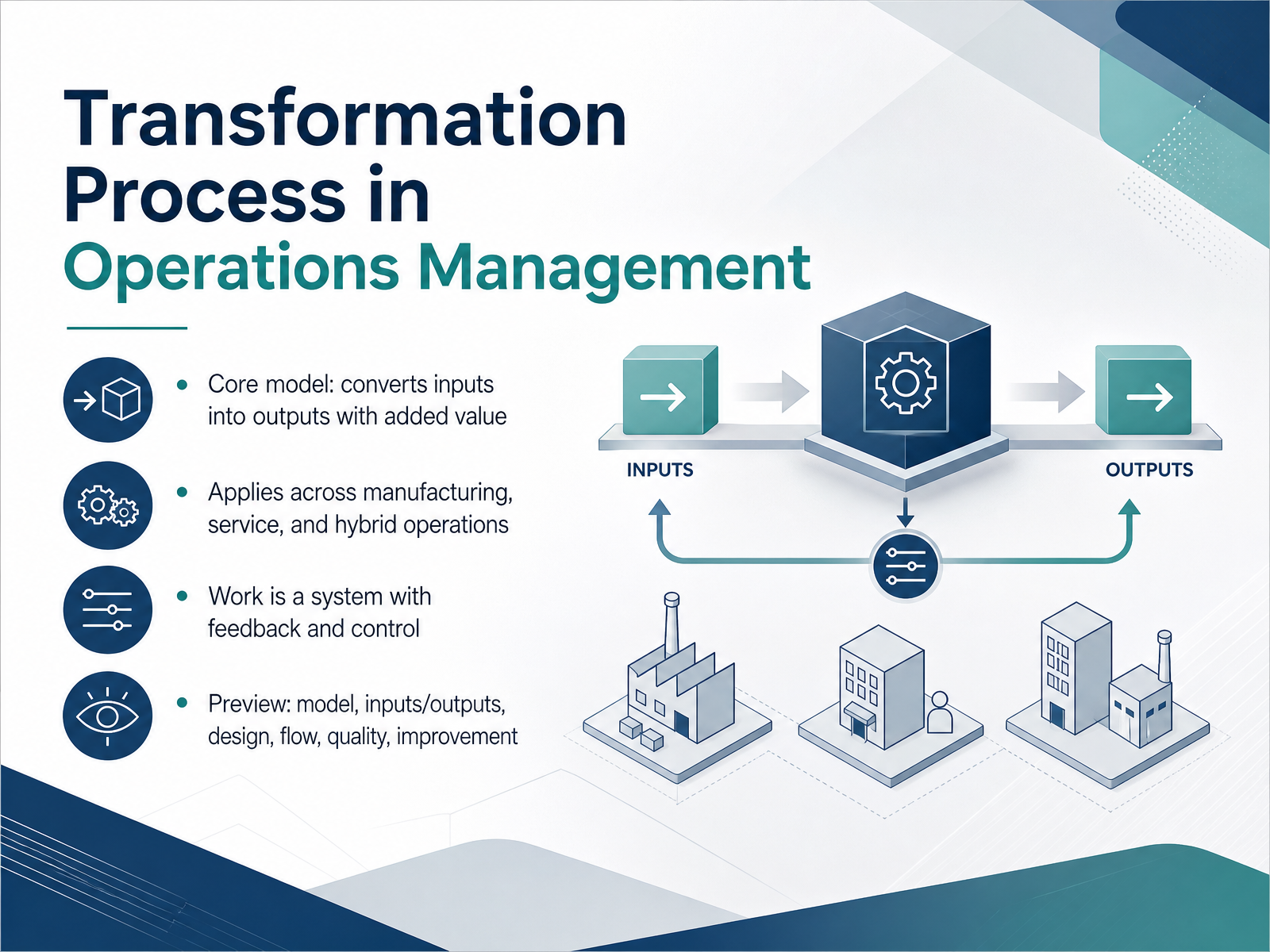
- 01Transformation Process in Operations ManagementWelcome. If you are an operations student, a frontline manager, or a process owner, this course is built for you. We are going to look at the transformation process. That is the engine of every organization. It is the core model that takes inputs, shapes them, and adds value to create outputs for customers. This is not just factory talk. It applies across manufacturing, services, and hybrid operations. Think of a hospital, a bank, or a bakery. They all take something in, change it, and send it out better. Work is a system, and like any system, it needs feedback and control to stay on track. In the sessions ahead, we will walk through the model, break down inputs and outputs, and cover design, flow, quality, and improvement. Some of this will feel familiar. Some of it will challenge how you see your daily operations. Stick with me, and we will turn complexity into clear, manageable actions. Let's get started. First, let's introduce the transformation system and how work flows through it.biz.libretexts.orgopen.eduopen.edu+22 min
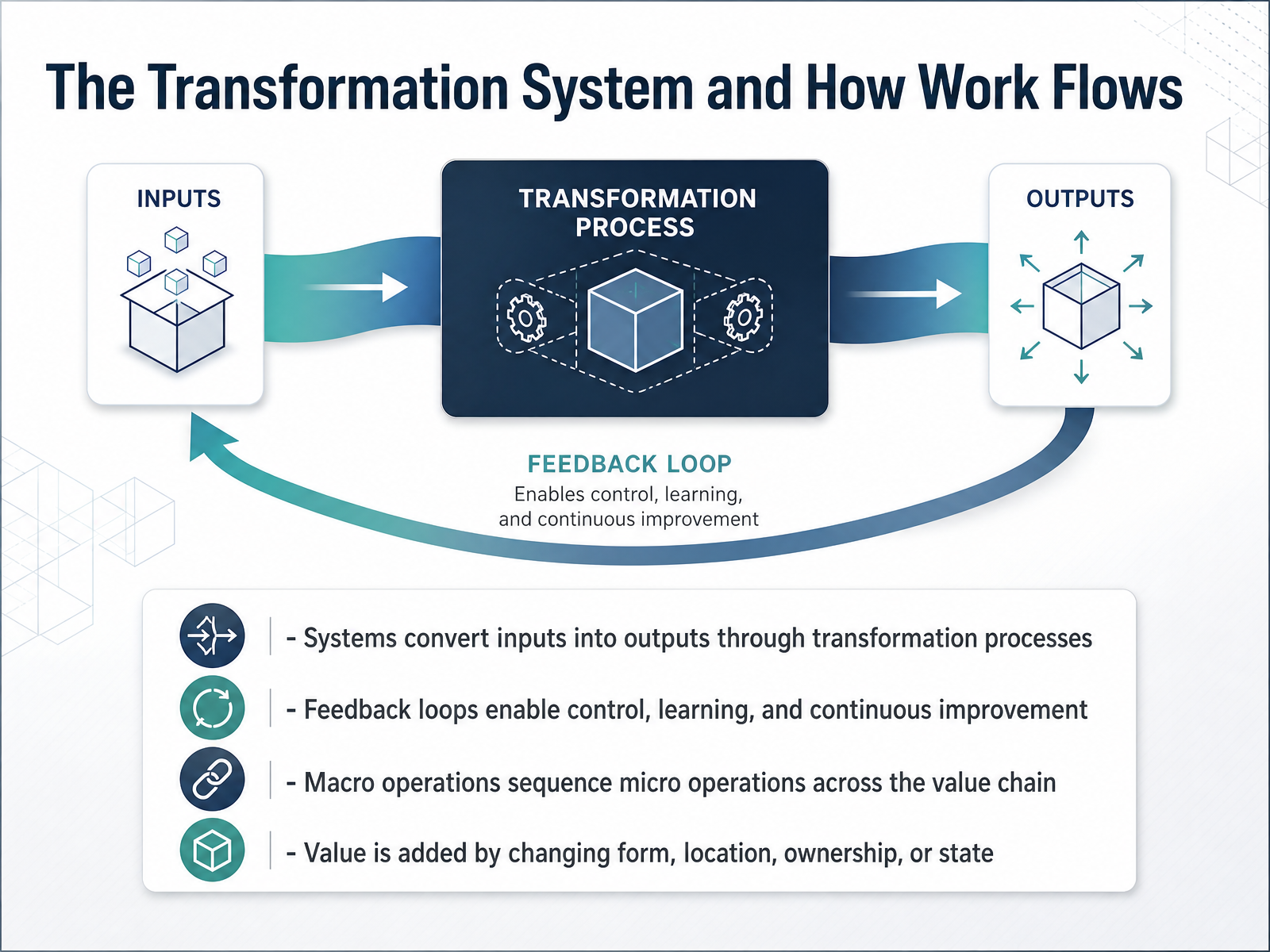
- 02The Transformation System and How Work FlowsLet’s step back and look at operations as a complete system. Every operation, from a hospital to a factory floor, takes inputs and converts them into outputs. That conversion is the transformation process. It is the core of what we do. Now, what makes this system smart is feedback. Feedback loops give us control. They show us what’s working and what’s not, and they fuel continuous improvement. Without feedback, we’re just guessing. Think of the macro process this way. Your overall operation is a sequence of smaller micro operations. Each one sits in the value chain, contributing to the final product or service. And here’s the key point about value. Value is added at each step through change. You can change the form of something, like assembling parts. You can change its location, like shipping it out. You can change ownership through a sale, or you can change its state, like cooling it or curing it. That’s how work flows through a system. From start to finish, we are managing a series of transformations. Next, let’s look at the resources themselves, the inputs that make this whole system possible.
 umbrex.comrowtonstraining.comfinancialexpress.com+21 min
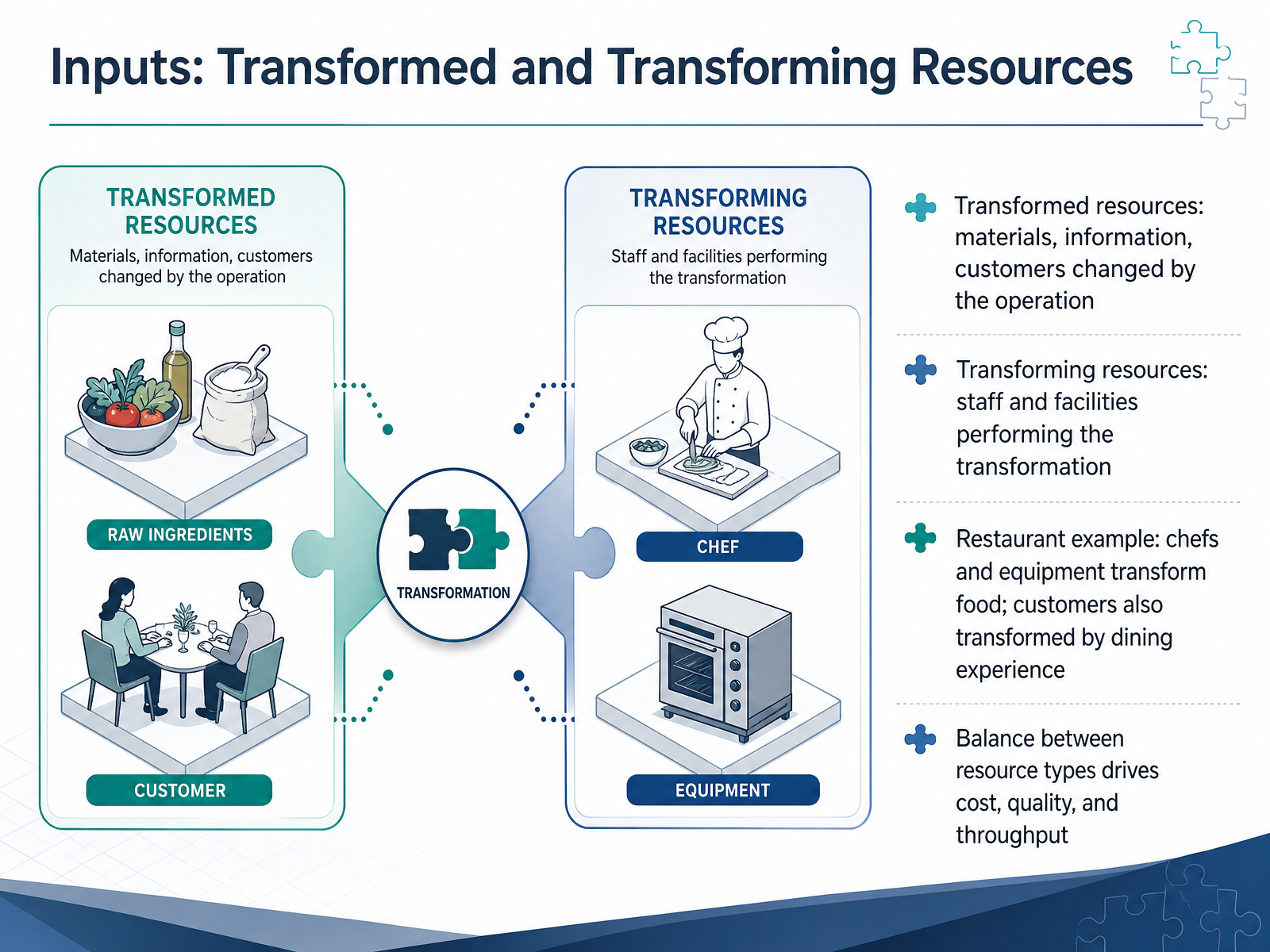
 - 03Inputs: Transformed and Transforming ResourcesSo let’s talk about inputs, because this is where every operation begins. Inputs fall into two categories. First, transformed resources: these are the things that actually get changed through the process. They can be materials, like raw food in a kitchen. They can be information, like account data in a bank. Or they can be customers, like patients in a hospital. Second, transforming resources: these are the ones doing the changing. That means the staff, and the facilities, the equipment and technology they work with. Think of a restaurant. The ingredients are transformed resources. The chefs, the ovens, even the layout of the kitchen, those are transforming resources. And here’s the interesting part: customers are transformed too. They walk in hungry and stressed, and walk out fed and relaxed. That dining experience changes them. Now, why does this matter for you as a manager? Because the balance between these two resource types directly drives your cost, your quality, and your throughput. If you have top chefs but poor ingredients, output suffers. If you have excellent ingredients but slow equipment, you’ll miss service targets. Get the balance right, and the whole process flows. So as you look at any operation, start by asking: what’s being transformed, and what’s doing the transforming? That clarity is the foundation for everything else. Next, we’ll look at outputs, value, and customer outcomes.
 open.eduresources.saylor.orgthisvsthat.io+22 min
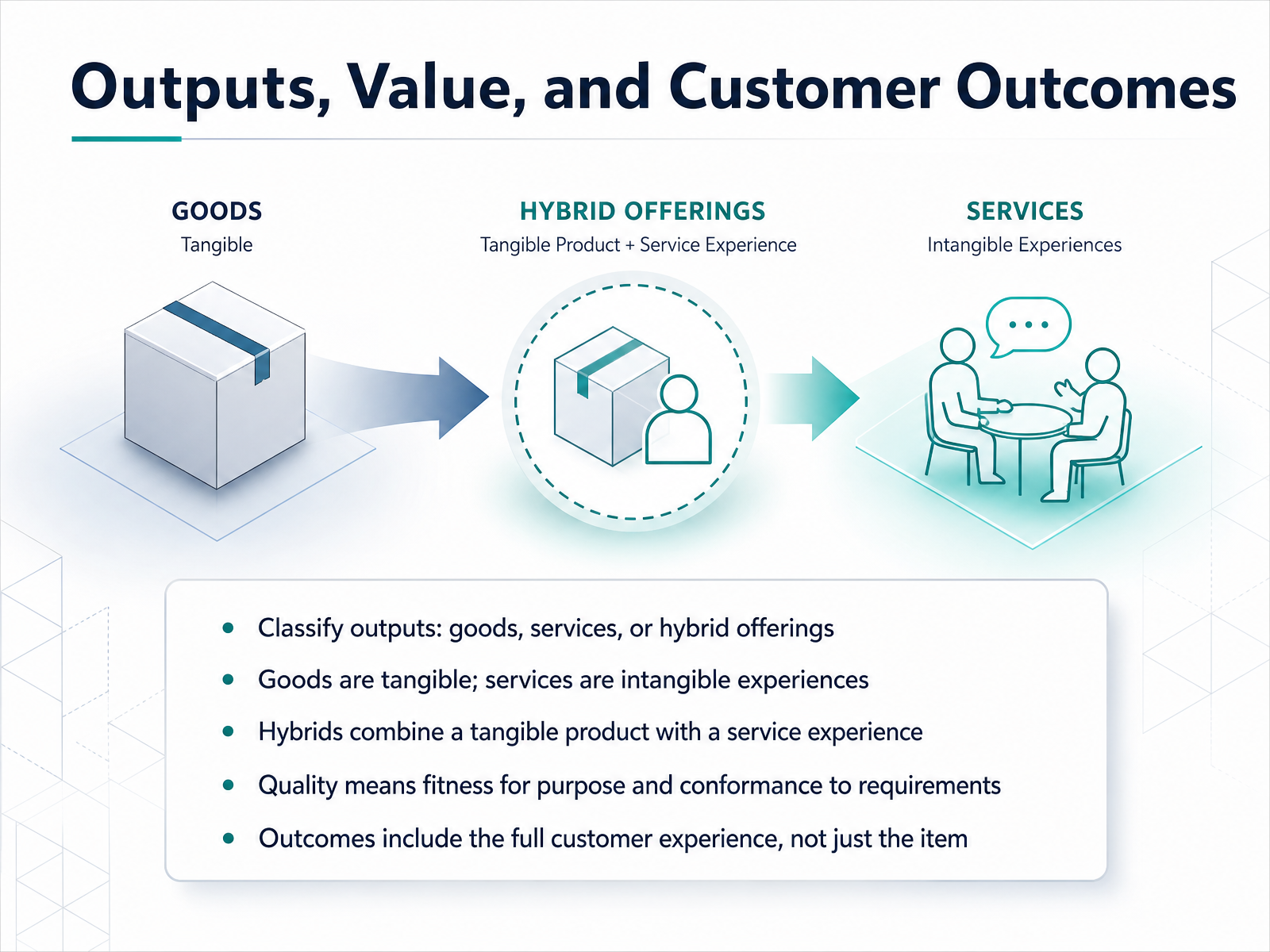
 - 04Outputs, Value, and Customer OutcomesLet's talk about what actually comes out of your transformation process. It helps to classify your outputs. You might be producing goods, you might be delivering services, or—quite often—you’re doing both. Goods are tangible. You can hold them, store them, ship them. A service, on the other hand, is an experience. It’s intangible. Think about a haircut, a legal consultation, or a medical exam. Now, hybrids. This is where a tangible product is combined with a service experience. A restaurant meal is a great example. You get the food, but you also get the service and the atmosphere. That’s a hybrid output. And here’s the key part: quality. In operations, quality is fitness for purpose and conformance to requirements. Does it do what it should? Does it meet the spec? But the outcome is bigger than just the item itself. Outcomes include the full customer experience—everything from how easy the process was to how they felt at the end. Your job is to create value across that entire journey, not just ship a product out the door. Now, let’s look at how operations differ from each other with the Four V’s.
 open.eduresources.saylor.orgthisvsthat.io+22 min
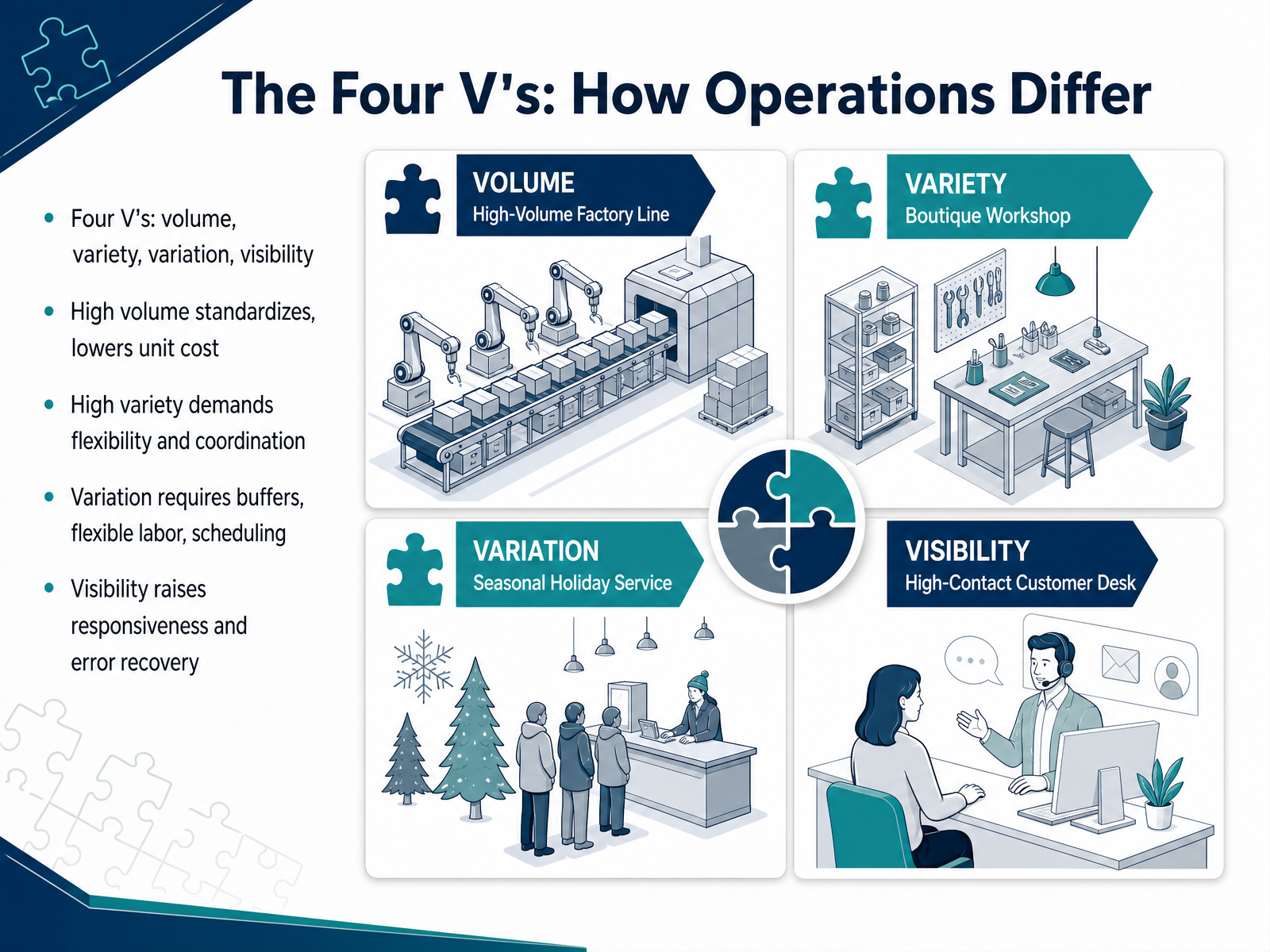
 - 05The Four V's: How Operations DifferLet's look at how operations actually differ. The Four V's give us a practical lens: volume, variety, variation, and visibility. Volume is about quantity. High volume means more repetition, which supports automation and lowers unit cost. Low volume means broader skills and higher unit cost. Variety is about range. High variety demands flexibility and coordination. Low variety supports standard work and tight control. Variation is about how demand shifts over time. High variation requires buffers, flexible labor, and dynamic scheduling. Low variation enables level loading and better asset use. Visibility is how much of the process the customer sees. High visibility raises the stakes for responsiveness and error recovery. Low visibility allows for more back-office efficiency. The key isn't that one end is better than the other. It's about fit. Design your process to match the nature of the work. Get that fit right, and you'll see why some operations run smoothly while others struggle. With that profile clear, we can now talk about choosing the right process type.
 umbrex.comrowtonstraining.comfinancialexpress.com+21 min
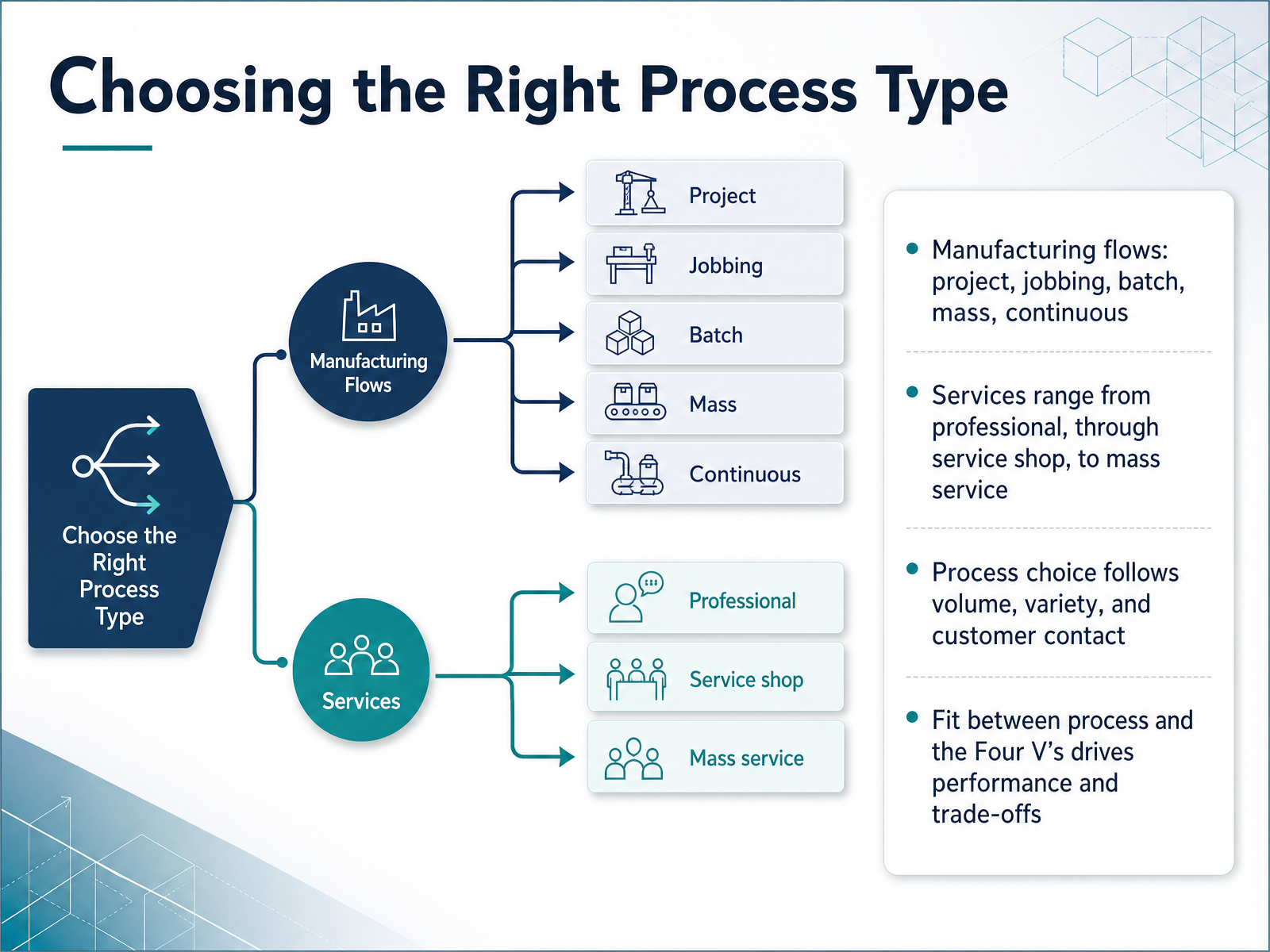
 - 06Choosing the Right Process TypeNow let us talk about choosing the right process type. This is where theory meets your actual floor. Think of process types as a spectrum. On one end, you have project and jobbing work: unique, custom, low volume. On the other end, mass and continuous production: highly standardized, high volume, low unit cost. Batch sits comfortably in the middle. Services mirror this as well, from professional experts solving one client at a time, to service shops handling moderate volume, to mass services like a fast-food chain built on repeatability. So, how do you pick? You match the process to the four Vs. High volume with low variety and low visibility pushes you toward automation and capital-intensive processes. Low volume with high variety and high customer contact demands flexibility and skilled judgment. And do not ignore variation in demand. If demand swings wildly, you need buffers: flexible labor or dynamic scheduling. A stable process that suits stable demand will buckle under unpredictable spikes. There is no best process, only the best fit. Getting fit right is what drives performance, cost control, and customer satisfaction. Remember, forcing a square process into a round demand profile creates exactly the friction you are trying to eliminate. With that fit in mind, our next step is mapping the transformation flow itself.
 umbrex.comrowtonstraining.comfinancialexpress.com+21 min
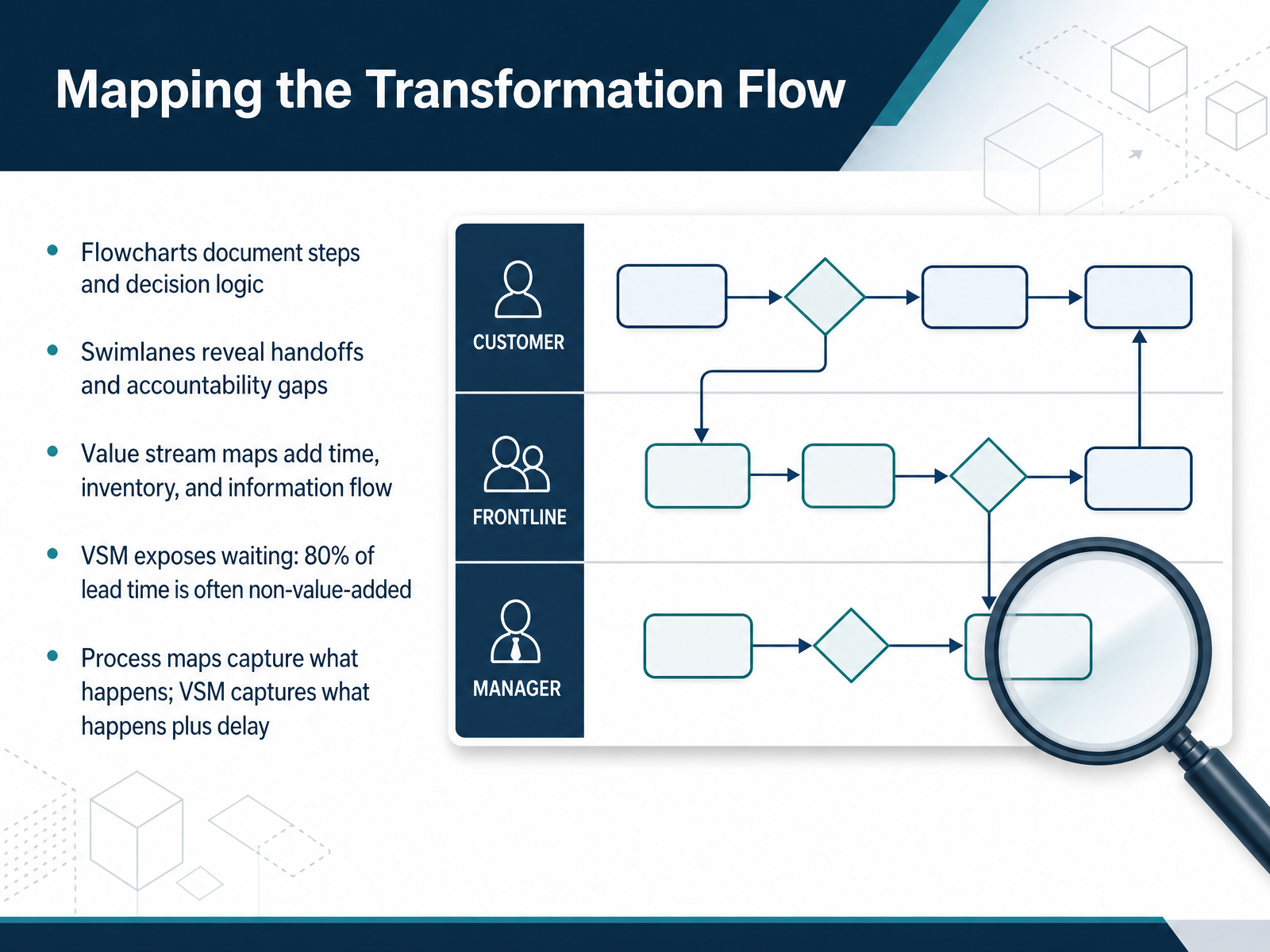
 - 07Mapping the Transformation FlowNow let’s look at how we actually map the transformation flow. A basic flowchart is where you start. It documents each step and the decision logic. It answers the question: what happens? But if you want to see who does what, and where accountability breaks down, you need a swimlane diagram. That lays out each role on its own lane, so handoffs become visible. Value stream mapping takes this further. It adds time, inventory, and information flow on top of the process steps. That’s the critical difference. A process map captures what happens. A value stream map captures what happens, plus the delay between steps. And here’s the number to keep in mind: in most processes, about eighty percent of total lead time is waiting, not working. The value stream map exposes exactly where that waiting hides. That’s where your real improvement opportunity lives. From here, we’ll look at how to pinpoint those delays and bottlenecks.
 flowdit.comasq.orgresources.rework.com+21 min
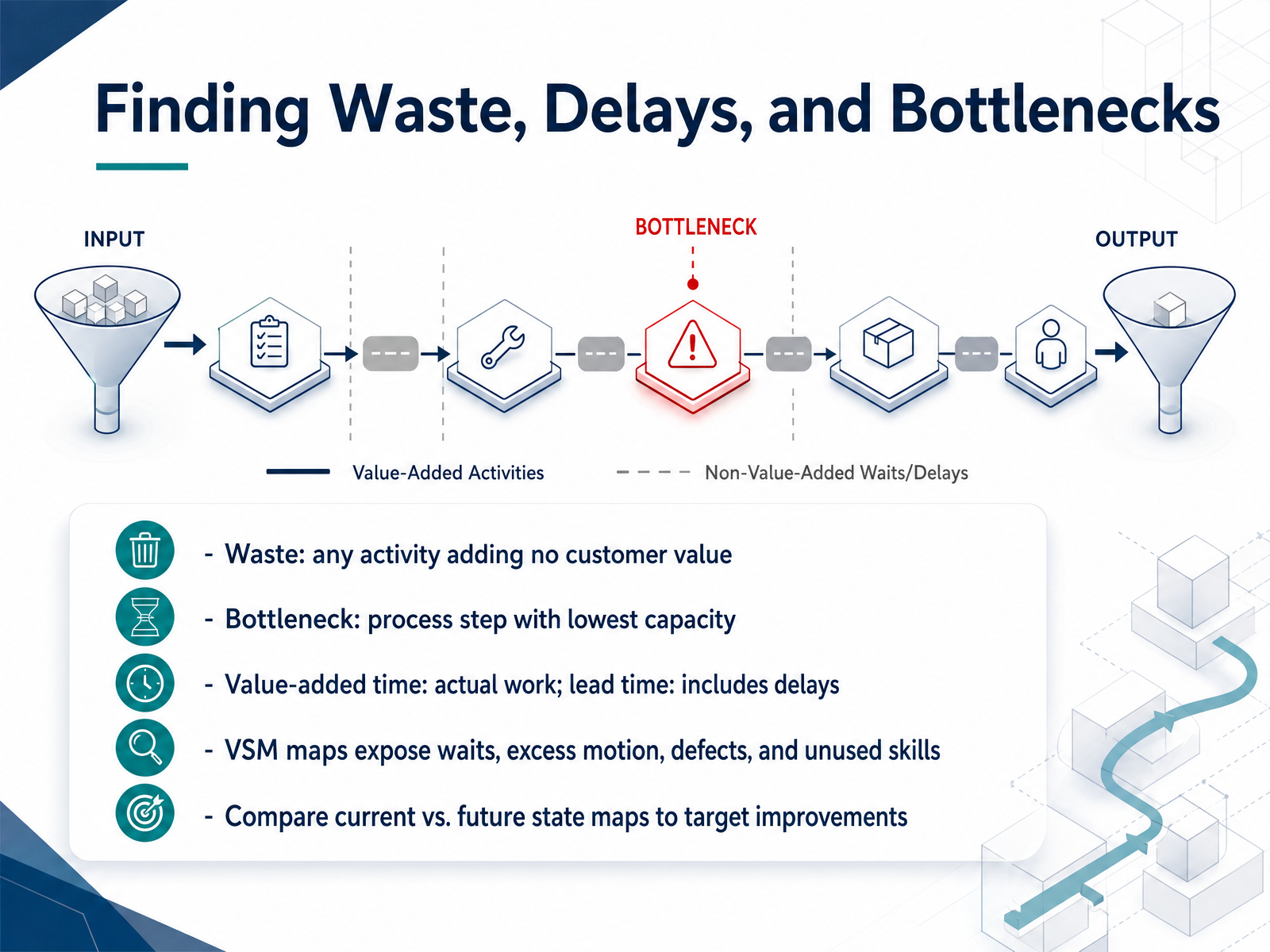
 - 08Finding Waste, Delays, and BottlenecksNow let's talk about finding waste, delays, and bottlenecks. Waste is any activity that doesn't add value for the customer. Think of it as effort you can't bill for. A bottleneck is the step with the lowest capacity. It sets the pace for everything else. There's a difference between value-added time, the actual work being done, and lead time, which includes all the waiting in between. Often, the waiting dwarfs the work. A value stream map makes these delays visible: the waits, the excess motion, the defects, and even the skills you're not using. You walk the actual process, measure real times, and draw what truly happens. Then compare it to your future state map. That gap shows you exactly where to focus your improvements. Most teams find that value-added time is a tiny fraction of total lead time. Seeing that gap is the first step to closing it. Now, let's look at how capacity and demand shape the flow you've just mapped.
 flowdit.comasq.orgresources.rework.com+21 min
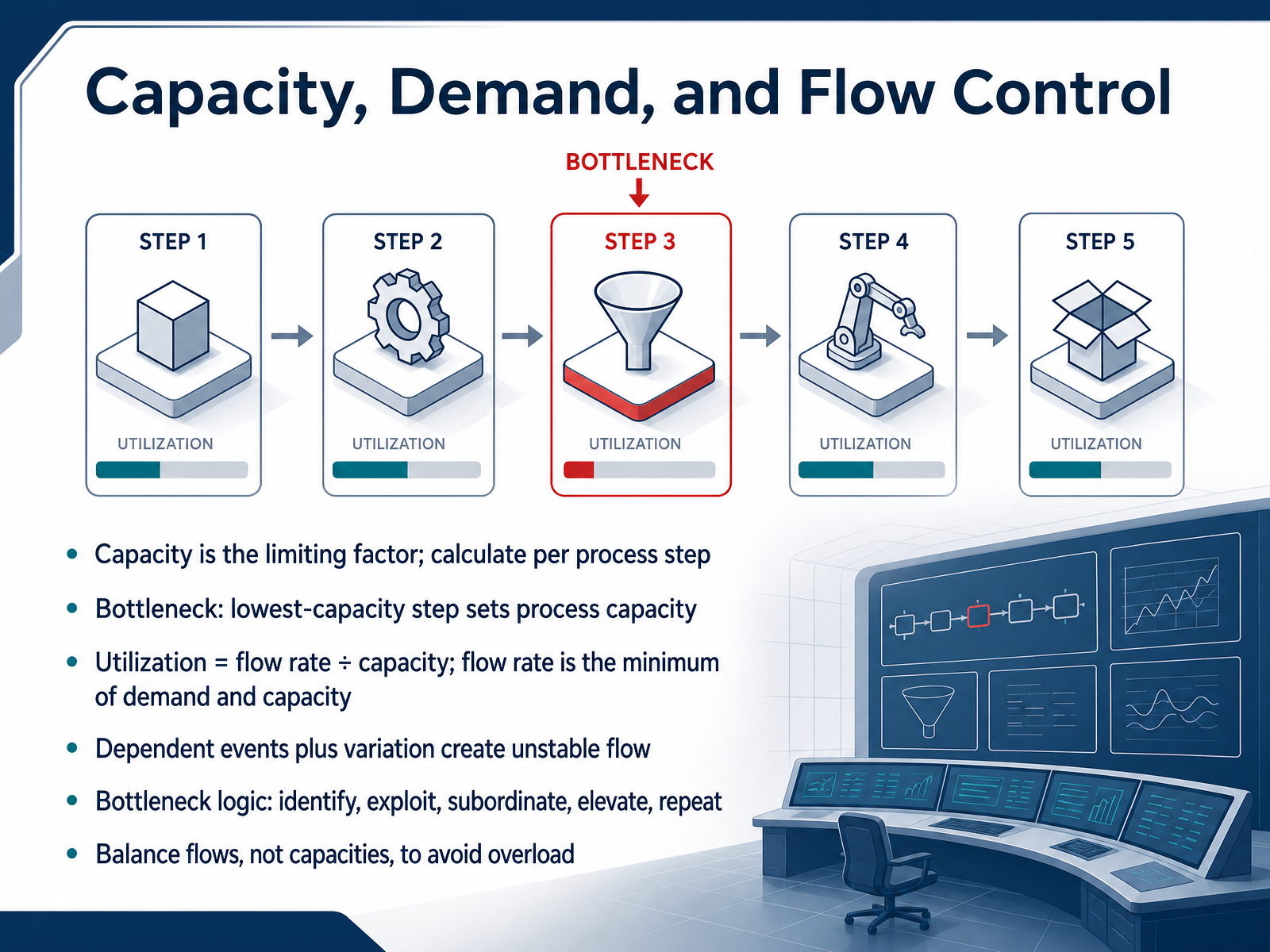
 - 09Capacity, Demand, and Flow ControlLet’s talk about how capacity, demand, and flow control actually work together on the floor. Capacity is simply the limiting factor of each step. You have to calculate it per process step, not just for the line as a whole. The bottleneck is the step with the lowest capacity, and it sets the pace for the entire process. That’s your process capacity. Now, utilization is the flow rate divided by capacity. And the flow rate is the minimum of demand and capacity. In plain terms, you can’t push more through than the bottleneck allows, and you won’t push more than customers actually want. Here’s the catch. When you have dependent events, where one step feeds the next, and variation in timing or quality, the flow becomes unstable. That instability creates waiting, WIP, and missed due dates. So you apply the bottleneck logic. First, identify the constraint. Then, exploit it by maximizing its output. Next, subordinate everything else so the bottleneck never starves. Then, elevate its capacity by reducing setup or adding resources. Finally, repeat because constraints shift over time. A key takeaway is to balance the flow, not the capacity. Matching capacities step for step sounds good, but it overloads the system when variation hits. Protect the bottleneck, protect the flow, and you’ll get predictable results. Now, let’s look at how quality gets built into this transformation.
 ocw.mit.edu2 min
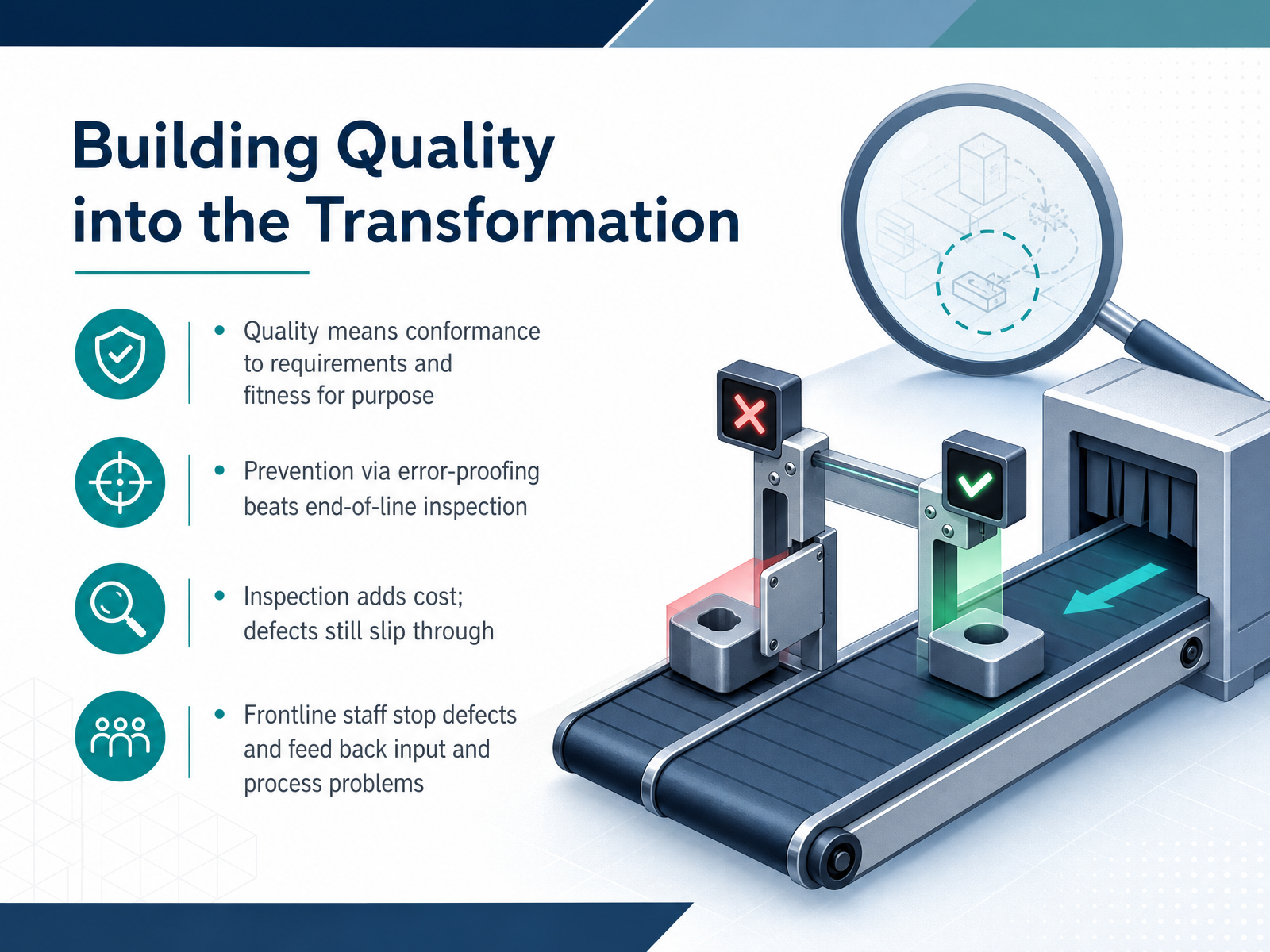
 - 10Building Quality into the TransformationLet's talk about building quality directly into your transformation. Quality means conformance to requirements and fitness for purpose. Simple in theory, but it demands clarity about what your customer actually needs and what your process must deliver. The real shift is moving from detection to prevention. Error-proofing stops defects before they happen. Inspection, on the other hand, adds cost and still lets defects slip through. You pay for materials, labor, and energy on a product that may end up scrapped or reworked. And inspectors get tired, they get distracted. Mistakes happen. Relying on end-of-line inspection is a reactive bet. The people at the frontline are your best defense. They see the process every day. They spot the small deviations before they become big problems. Give them the authority to stop the line and the feedback channel to tell you what is wrong with the inputs or the process itself. Their insight is how you build improvements that stick. So, remember: prevention beats inspection. Build the quality in, and let your team be the source of that insight. That naturally leads us into continuous improvement and lean thinking.
 2 min
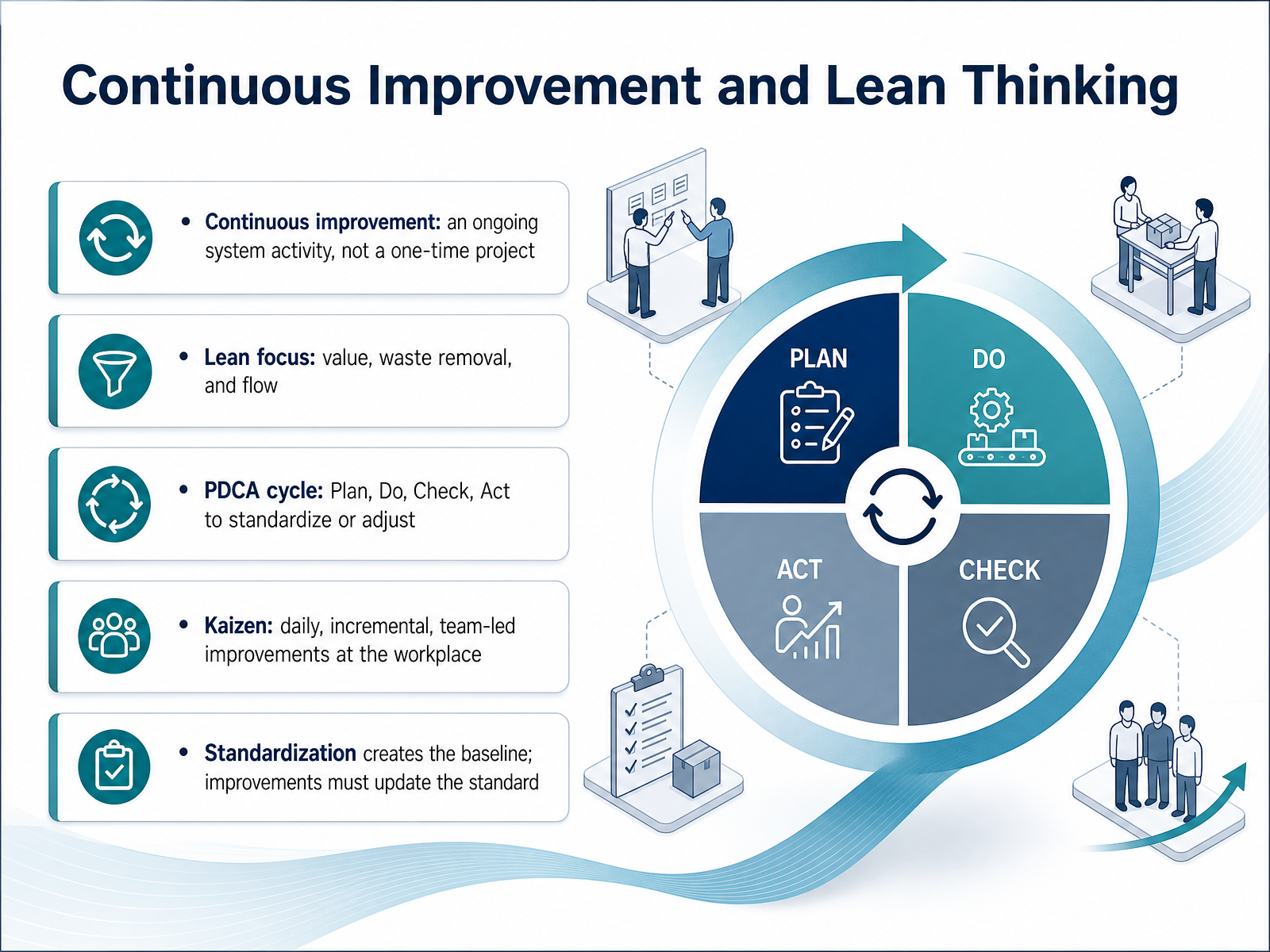
2 min - 11Continuous Improvement and Lean ThinkingNow, let's talk about how transformation becomes a habit, not a one-off push. That's the heart of continuous improvement and lean thinking. In lean, we focus on three things: value, waste removal, and flow. What does the customer truly value? Everything else is a candidate for elimination. And the engine that drives this is the PDCA cycle: Plan, Do, Check, Act. Plan a small change, test it, check the results honestly, then act—either to standardize it, if it worked, or to adjust and try again. This isn't bureaucratic. It's just disciplined learning. And it brings us to Kaizen: daily, incremental, team-led improvements. This is the practice where the people closest to the work spot a problem and solve it. One team repositions a tool to save a few seconds per cycle. Another changes a labeling process to avoid a recurring error. Small, steady, and continuous. Now, the crucial piece: standardization creates your baseline. You cannot improve what isn't stable. So when you find something better, you must update the standard to lock in the gain. It's a loop: standardize, improve, re-standardize. Keep the loop moving, and transformation becomes the culture, not a project. Next, we'll look at how to measure whether this transformation is actually working.
 2 min
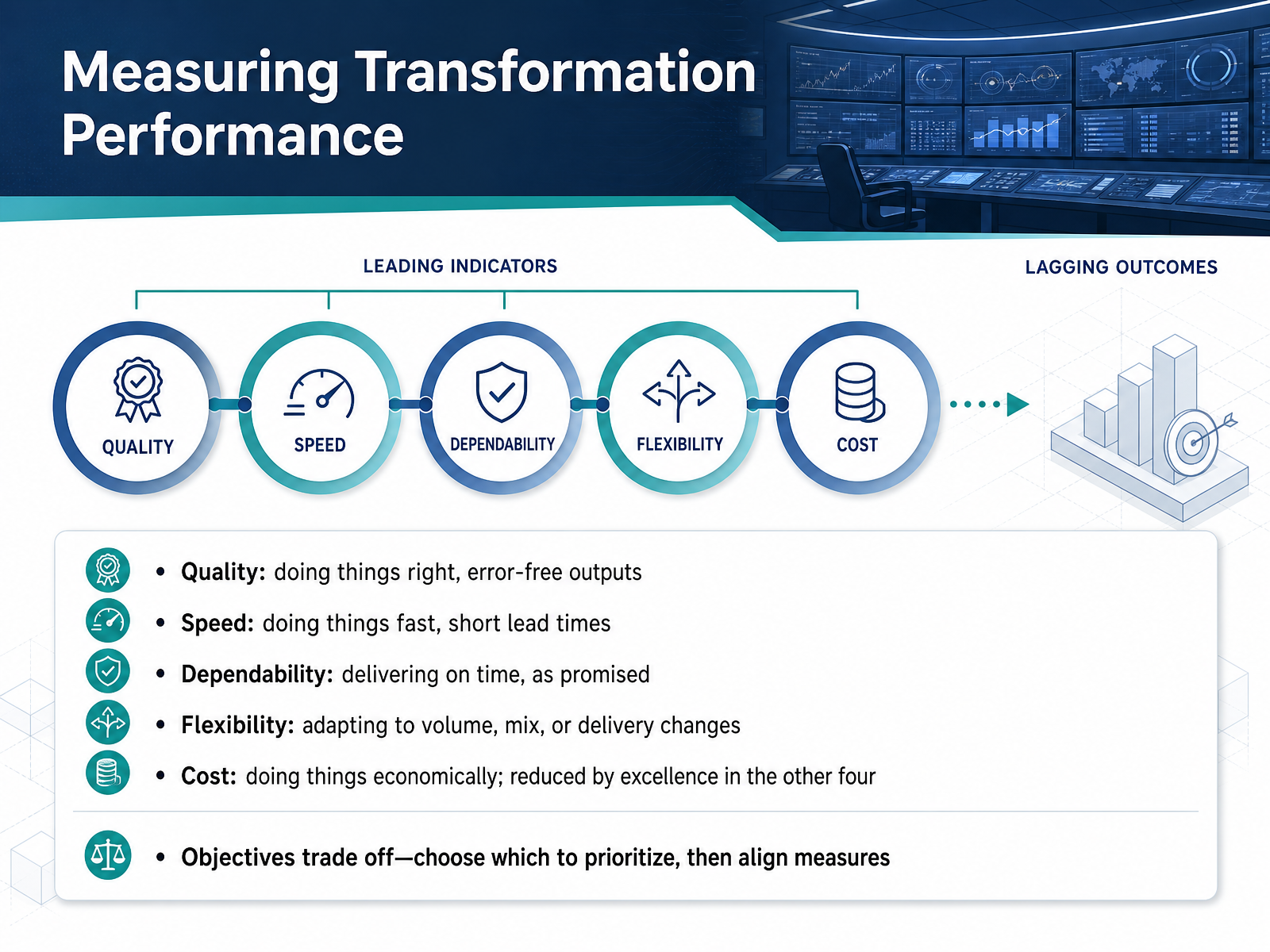
2 min - 12Measuring Transformation PerformanceNow let’s talk about how we actually measure whether transformation is working. You can’t manage what you don’t measure, so we use five core performance objectives. Think of them as the operating system of your processes. Quality means doing things right, producing error-free outputs every time. Speed means doing things fast, compressing the time between order and delivery. Dependability means delivering on time, as promised, so customers can plan around you. Flexibility is your ability to adapt when volume, mix, or delivery needs change. And cost is doing things economically, which is the natural result of excellence in the other four. When quality improves, defects drop and rework disappears, which cuts cost. When speed improves, lead times shrink and inventory costs fall. The same logic flows through dependability and flexibility. But here’s the reality check: you usually can’t optimize all five at once. There’s a trade-off. A delivery service that promises one-hour delivery likely sacrifices cost efficiency. A factory running at full capacity sacrifices flexibility. So your job is to decide which objective matters most for your customers right now, prioritize that one, then align your measures accordingly. Define what good looks like, track it, and review regularly. Excellence in transformation comes from making deliberate choices, not from trying to be everything to everyone. Next, we’ll walk through how to diagnose a transformation process when things go off track.
 2 min
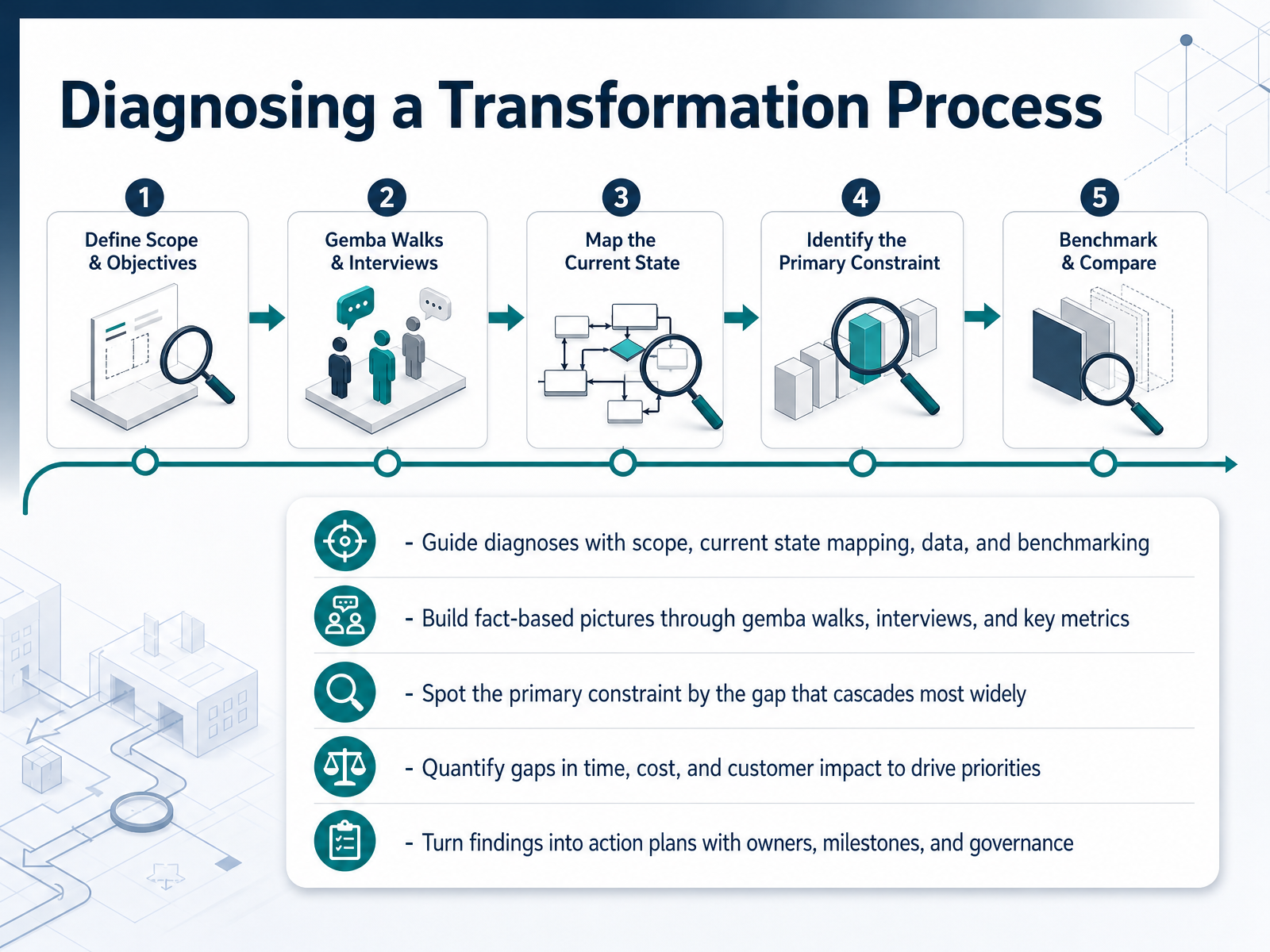
2 min - 13Diagnosing a Transformation ProcessSo how do you know where to start? That's what a solid diagnostic phase is for. First, you set the scope. Decide what processes matter most and what good looks like. Then, you build a fact-based picture. Walk the floor, talk to the people doing the work, and pull key metrics. You will find that some gaps are deep and some are shallow. Here is the trick. Look for the primary constraint, not the lowest score. It is the gap that cascades most widely and holds back everything else. Then, you need to quantify the impact. Turn those findings into numbers. How much time is lost? What is it costing in dollars? How does it affect the customer? That is what makes the problem real. Finally, turn those insights into an action plan. Assign owners, set milestones, and establish a governance rhythm to keep the work moving. Remember, facts over opinions. Now that we know what to fix, the next step is getting the team behind the plan and moving forward together.
 ocw.mit.edu2 min
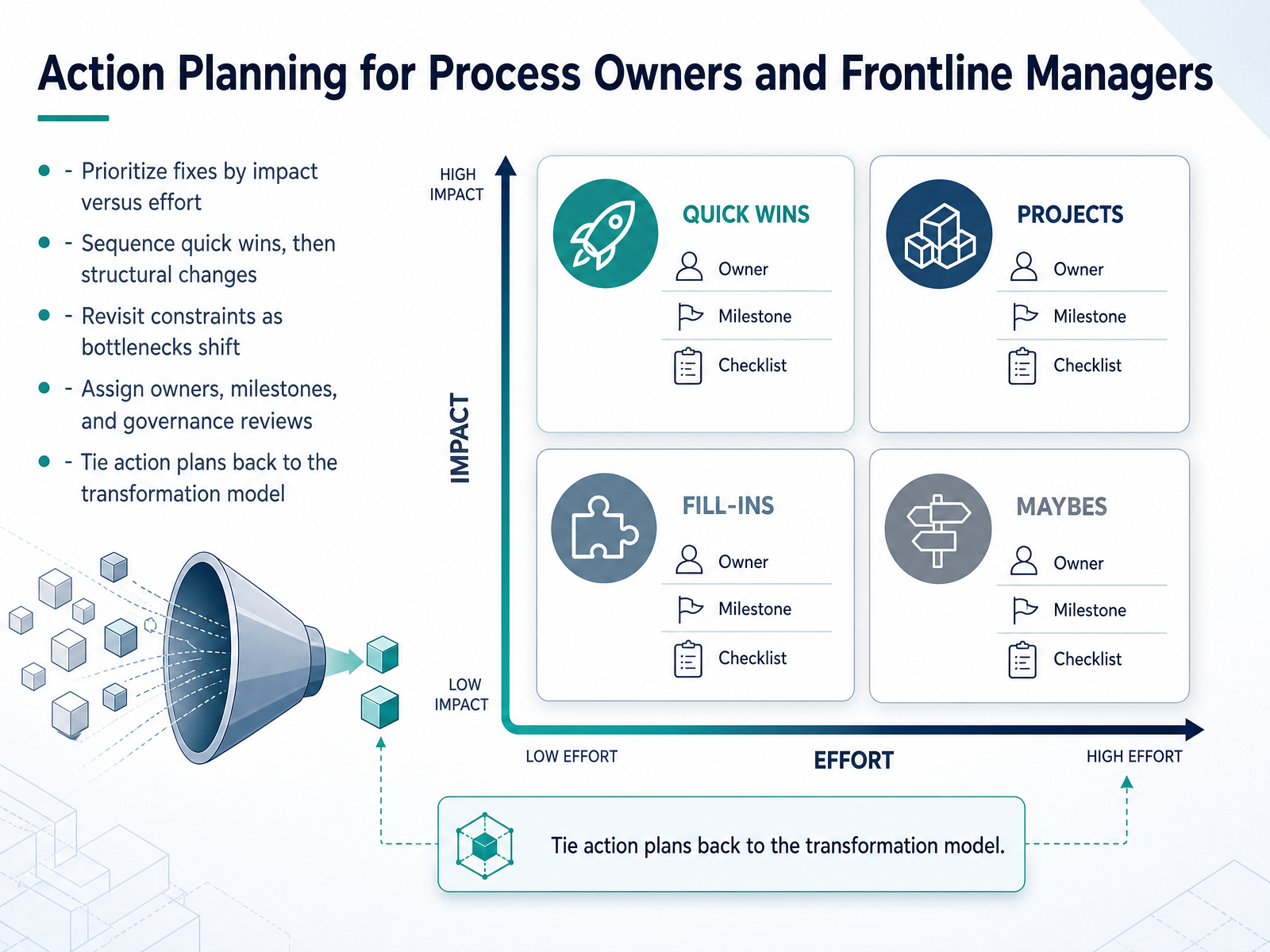
 - 14Action Planning for Process Owners and Frontline ManagersLet’s bring this to the ground. Action planning is where the transformation becomes real. Start by prioritizing your fixes. Plot each one on impact versus effort. High impact, low effort? Do those first. They build momentum and show your team the process works. Sequence matters. Quick wins first, then the structural changes that need more time and investment. Don’t rush the big moves. You are building a foundation, not just putting out fires. As your bottlenecks shift, revisit your constraints. What held you back last quarter may not be the issue today. Keep your analysis honest and current. Then assign owners, set milestones, and schedule regular governance reviews. A plan without an owner is just a wish. Make sure every action ties back to the transformation model we have walked through. That link keeps the work connected to the bigger picture, so today’s fixes become tomorrow’s standard way of working. This is how process change becomes lasting capability. Now, go make it happen.
 ocw.mit.edu2 min
Take the deck with you
Download this course as a file — free, no sign-up needed.
- PDF handoutEvery slide page, ready to print or share.15 pages · 3.6 MBDownload
- Narrated PowerPointThe deck that presents itself — every slide carries the digital human's narration video.15 pages · 17.5 MBDownload
- PowerPoint slidesThe full deck as a .pptx — open it in PowerPoint, Keynote, or Google Slides.15 pages · 3.5 MBDownload
Free to use in your own training — please keep the PersonWise credit page at the end.
Have your own deck? Turn it into a course
Sources consulted
Web sources consulted while building this course.
- 1.2: Transformation Process - Business LibreTexts — biz.libretexts.org
- Introduction to operations management: 2.2 Transformation processes | OpenLearn - Open University — open.edu
- 3.4 Transformation processes | OpenLearn — open.edu
- 1.4: The Transformation Process — biz.libretexts.org
- 1.2 Transformation Processes – Fundamentals of ... — ecampusontario.pressbooks.pub
- Four Vs of Operations | Umbrex — umbrex.com
- The "4Vs" - The 4 Dimensions of Operations - Detail Overview — rowtonstraining.com
- Understanding the four Vs of operations management – volume, variety, variation and visibility - Opinion News | The Financial Express — financialexpress.com
- The 4Vs of Operations: Where do your operations fit in? - Rowtons Training — hub.rowtonstraining.com
- Understanding the 4Vs of Operations Management for Business Success — timetrackapp.com
- Understanding operations management: 3.2 Inputs — open.edu
- https://resources.saylor.org/wwwresources/archived/site/wp-content/uploads/2013/04/BUS300-1.3_Understanding-Operations-Management-The-Transformation-Model.pdf — resources.saylor.org
- Transformed Resources vs. Transforming Resources - What's the Difference? | This vs. That — thisvsthat.io
- The Vital Cogs of Operations Management — bigtalks.com.au
- Value Stream vs. Process Mapping: Key Differences & ... — flowdit.com
- Value Stream Mapping Tutorial - What is VSM? | ASQ — asq.org
- "Value Stream Mapping: How to Map and Improve a Process (Symbols + Examples)" — resources.rework.com
- Value Stream Mapping Template: A Lean Guide for Process Improvement | Deckary — deckary.com
- Value Stream Mapping: See the Waste Your Flowchart Hides — factoryinvestigator.com
- Lecture 06: Capacity Planning and Production Flow Control — ocw.mit.edu