Leadership vs Management Fundamentals
Begin
15 pages · ~30 min
Leadership vs Management Fundamentals
Learn to distinguish leadership from management, exploring their distinct purposes and real-world examples to enhance your professional effectiveness.
What you’ll learn
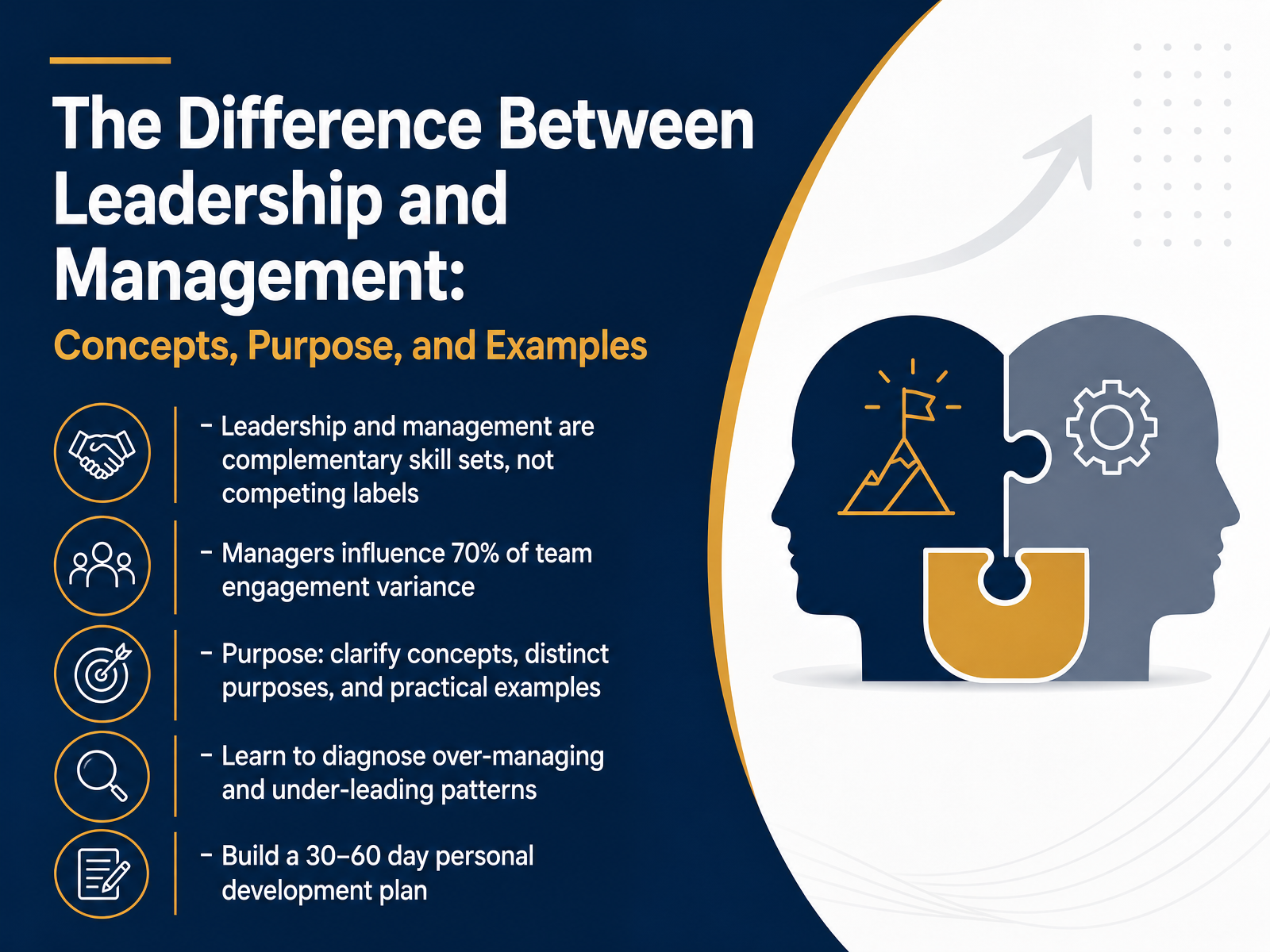
- 01The Difference Between Leadership and Management: Concepts, Purpose, and ExamplesWelcome. Today, we're tackling a question that shapes how we work every day: what's the real difference between leadership and management? For a long time, we treated them as competing labels. You were either a leader with vision, or a manager who gets things done. But that's a false choice. The research is clear. Managers influence a full seventy percent of the variance in team engagement. That means your daily behavior has a massive impact on how your people feel and perform. So, in this session, we're going to clarify these concepts, explore their distinct purposes, and ground them in practical examples. We'll help you diagnose patterns of over-managing and under-leading in your own work. And, most importantly, you'll leave with a framework to build your own thirty-to-sixty-day personal development plan. Let's get started by looking at why getting this balance right is so critical for you and your team.leadershipiq.comtrainingjournal.comgallup.com+22 min
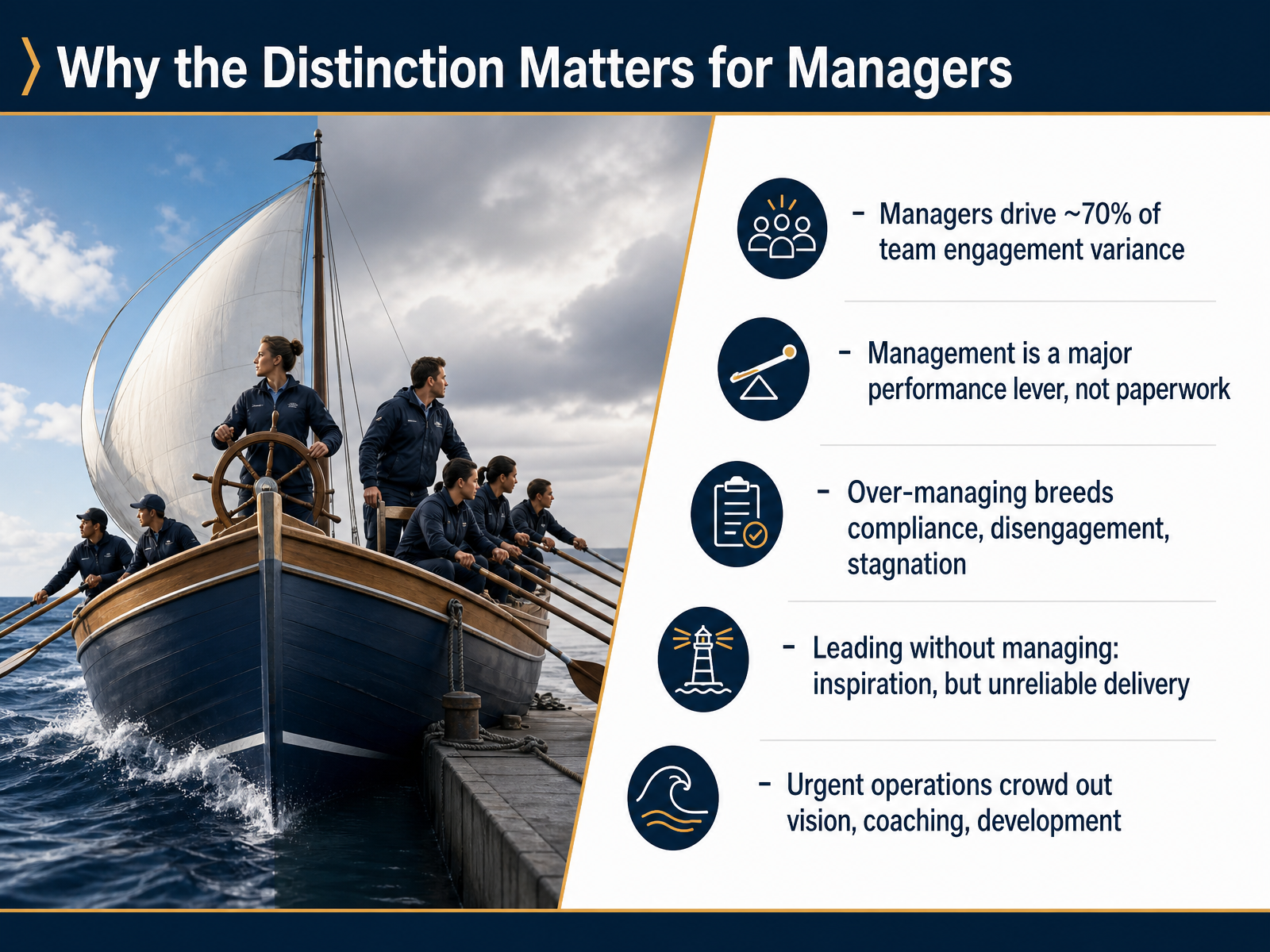
- 02Why the Distinction Matters for ManagersLet’s talk about why this distinction matters so much for your daily work. Research consistently shows that managers account for roughly seventy percent of the variance in team engagement. That means your behavior, not just your title, is a massive performance lever. Management is not paperwork; it is the engine of execution. But here’s the trap. Over-managing creates compliance. People do what they are told, but they stop thinking, stop caring, and the team stagnates. On the flip side, leading without managing gives you inspiration but unreliable delivery. Vision without systems creates chaos. And in the urgency of everyday operations, it is all too easy to let vision, coaching, and development get crowded out. The real skill is not choosing between the two, but knowing when to shift. Keep this balance in mind as we move into defining leadership more precisely.
 leadershipiq.comtrainingjournal.comgallup.com+22 min
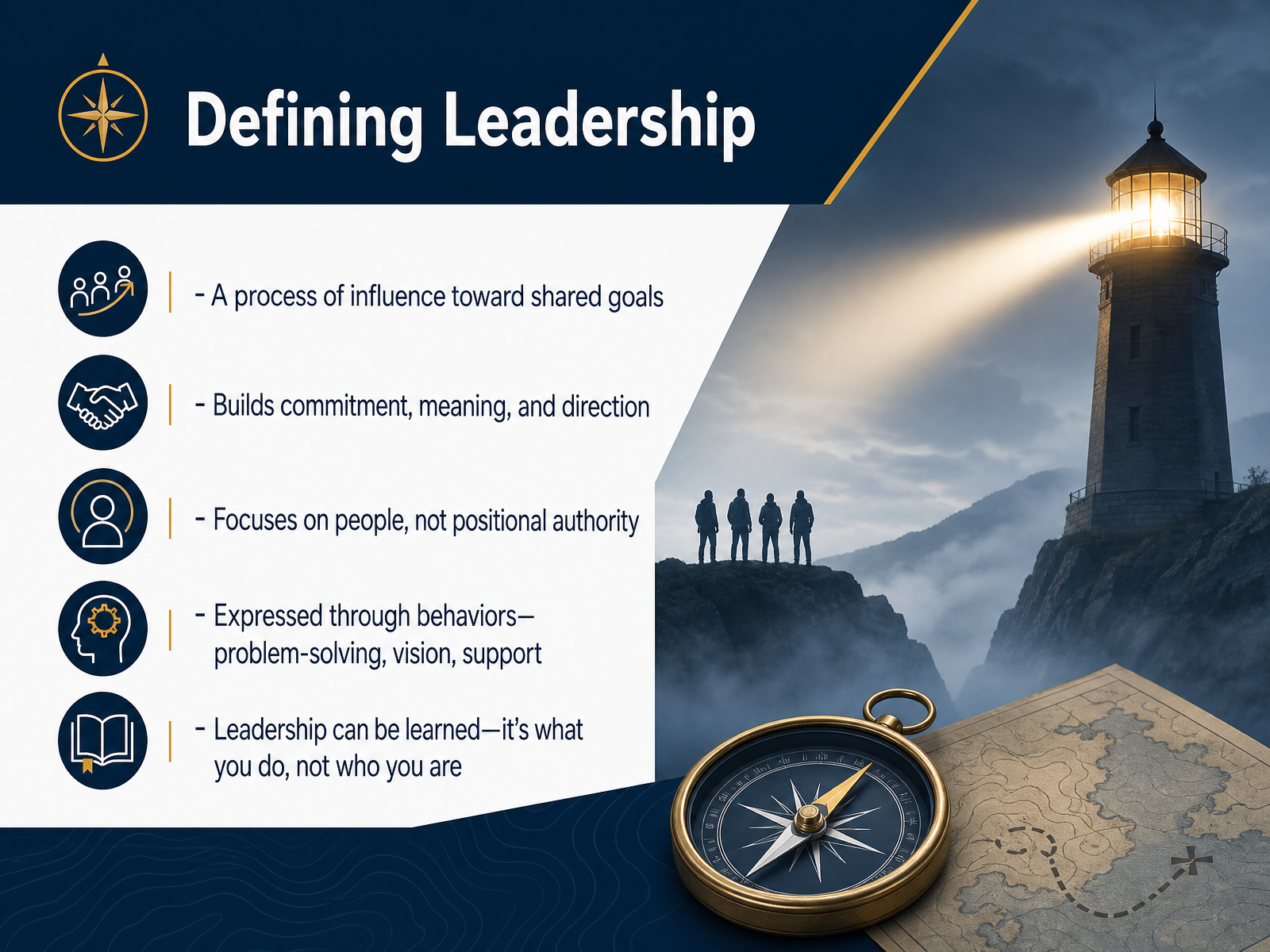
 - 03Defining LeadershipSo let’s pin down what leadership really is. At its core, leadership is a process of influence directed toward shared goals. It’s not about your title or your position on the org chart. It’s about building commitment, creating meaning, and giving people a clear sense of direction. Think about a colleague who rallied the team during a tough project—not because they had to, but because people trusted their judgment and wanted to follow their lead. That’s leadership in action. It shows up in concrete behaviors: solving problems effectively, painting a compelling vision, and being genuinely supportive of the people around you. And here’s the encouraging part: leadership isn’t something you’re born with. It’s a skill you can learn. It’s what you do, not who you are. Every conversation, every decision, every moment of stepping up is a chance to practice it. Now, with a clear picture of leadership, let’s look at how management differs.
 mckinsey.comccl.orggallup.com+21 min
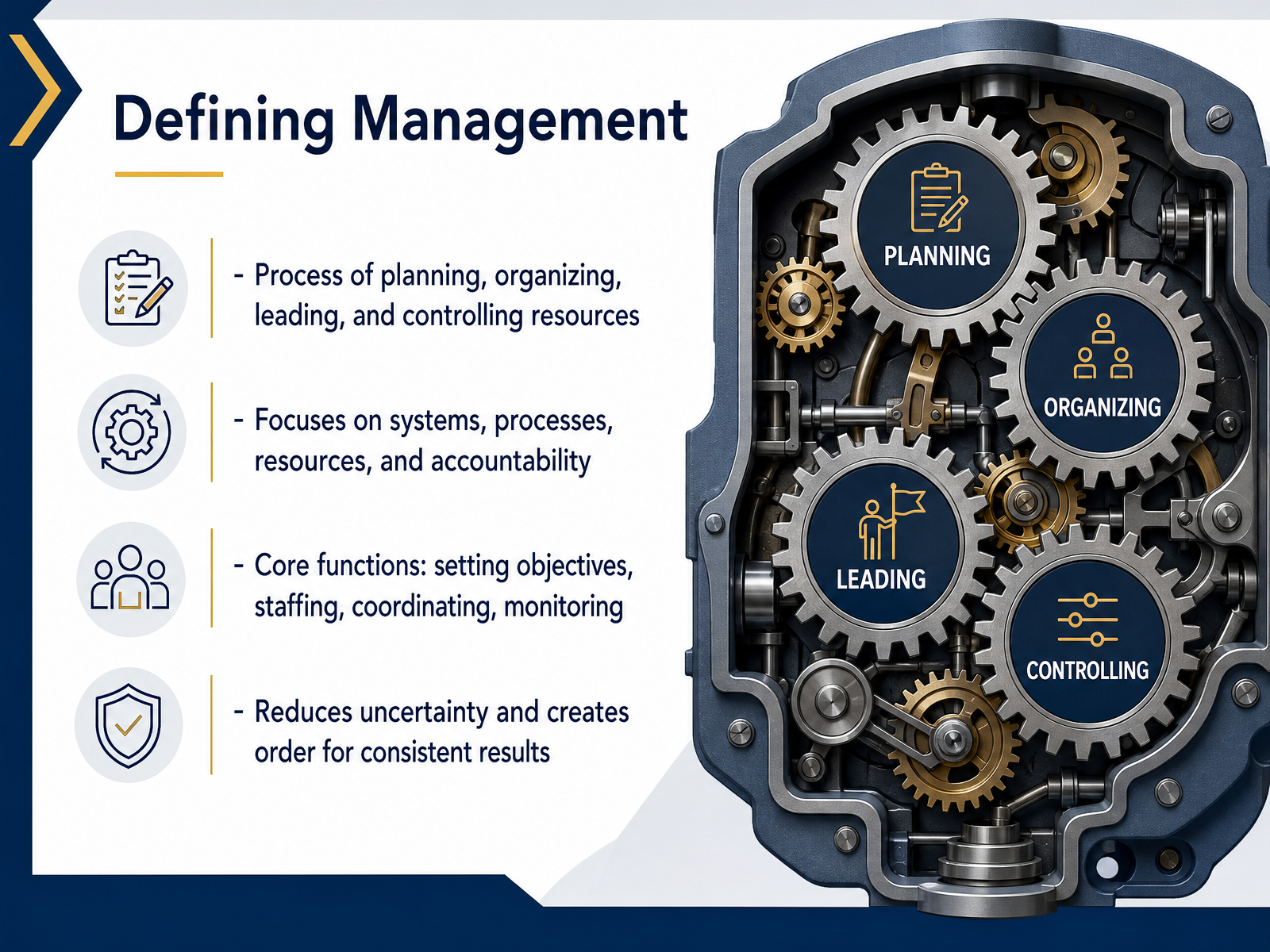
 - 04Defining ManagementNow, let's define management clearly. At its core, management is the process of planning, organizing, leading, and controlling resources to achieve specific goals. If leadership is about the destination, management is about building the reliable vehicle to get there. It focuses on systems, processes, and accountability, making sure that every piece of the machine works together efficiently. Think of the core functions: setting objectives, staffing the right roles, coordinating efforts, and monitoring progress. For example, a project manager keeps a product launch on schedule by managing the budget, breaking down tasks, and tracking milestones. The goal of management is to reduce uncertainty and create order so the organization gets consistent, predictable results. It turns the vision into a structured, repeatable process. Now, let's look at the key concepts that truly separate leadership from management.
 openstax.orgcourses.lumenlearning.comdde.pondiuni.edu.in+22 min
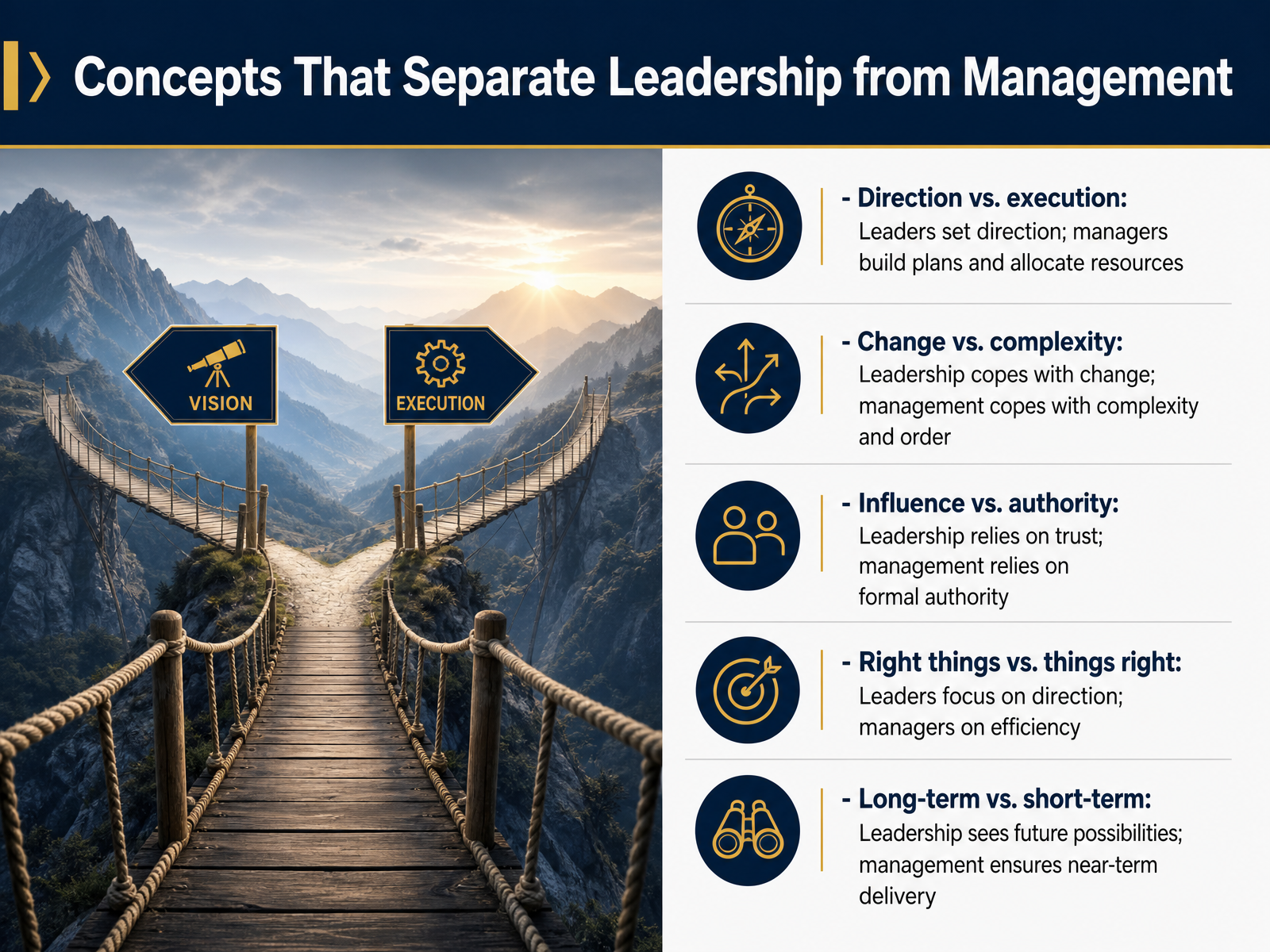
 - 05Concepts That Separate Leadership from ManagementSo, what truly separates leadership from management? Think of it as two sides of the same coin. Leaders set the direction—they define the vision and the destination. Managers, on the other hand, build the plans and allocate the resources to actually get there. Leadership copes with change; it navigates uncertainty and inspires movement. Management copes with complexity, bringing order and consistency to daily operations. There's also a fundamental difference in how each one gets things done. Leadership relies on influence and trust, on people choosing to follow. Management relies on the formal authority that comes with a position. A classic way to say it: leaders do the right things, focusing on long-term vision. Managers do things right, focusing on efficiency and execution. Leaders see future possibilities. Managers ensure near-term delivery. Neither is better; both are essential. You need a leader to champion the why, and a manager to orchestrate the how. We'll explore the purpose and outcomes of each next.
 pon.harvard.eduemerald.comnationalforum.com+22 min
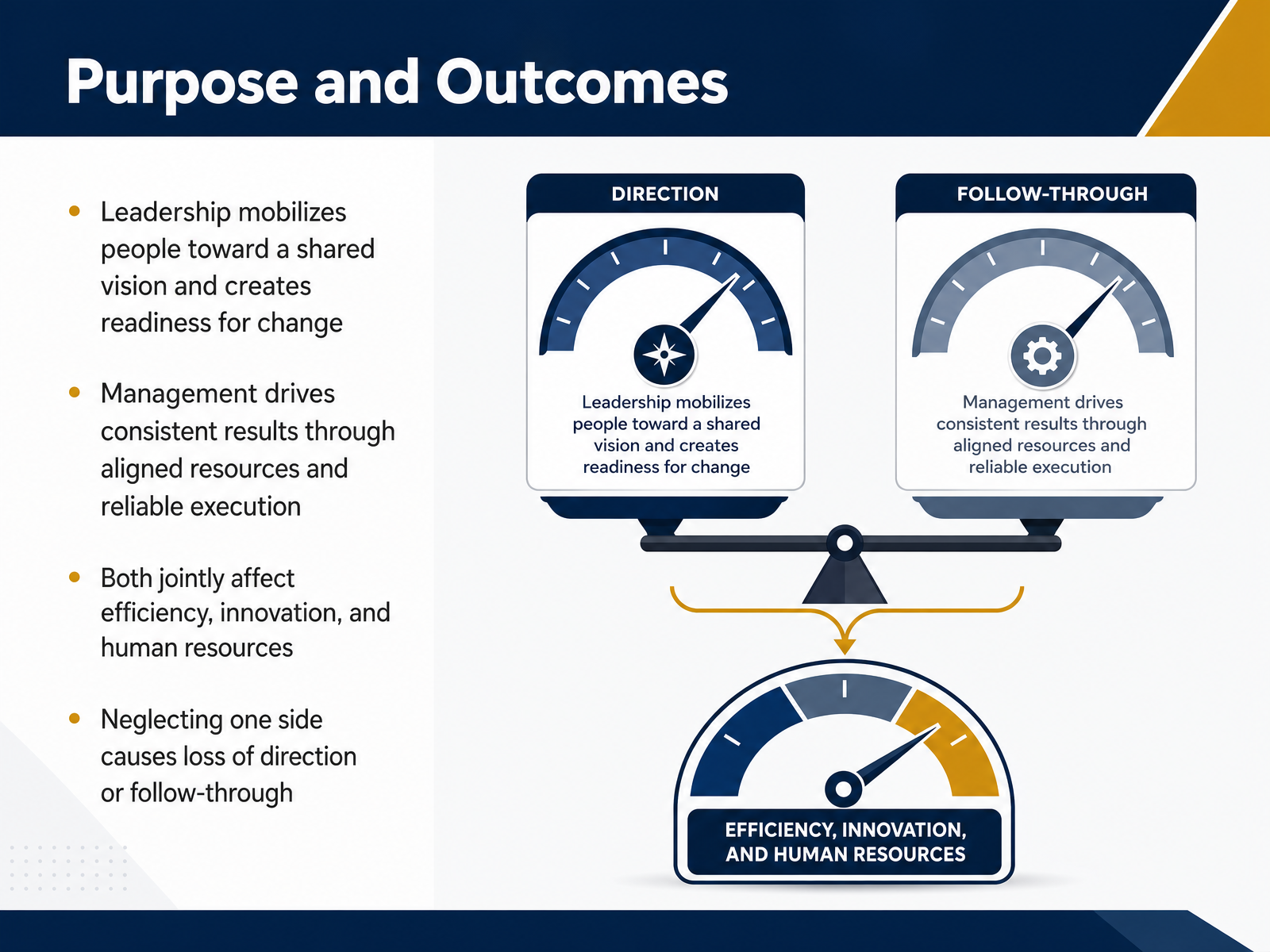
 - 06Purpose and OutcomesLet’s talk about purpose and outcomes, because this is where the difference between leadership and management really shows up in results. Leadership mobilizes people toward a shared vision. It creates readiness for change, especially when the path ahead is uncertain. Management, on the other hand, drives consistent results by aligning resources and ensuring reliable execution. Think of it this way: leadership sets the destination, and management builds the road to get there. Both together affect efficiency, innovation, and your people. Efficiency comes from solid management—clear processes, good planning, timely follow-through. Innovation comes from leadership—encouraging new ideas, challenging the status quo. And human resources, your people, thrive when they have both direction and structure. Here’s the caution: neglect one side, and you pay a price. Too much leadership without management means great ideas that never land—loss of follow-through. Too much management without leadership means things run smoothly, but the team loses direction and purpose. The most effective professionals hold both. They inspire the vision, and they build the systems to make it real. Next, let’s look at what that balance actually looks like in everyday work.
 leadershipiq.comtrainingjournal.comgallup.com+22 min
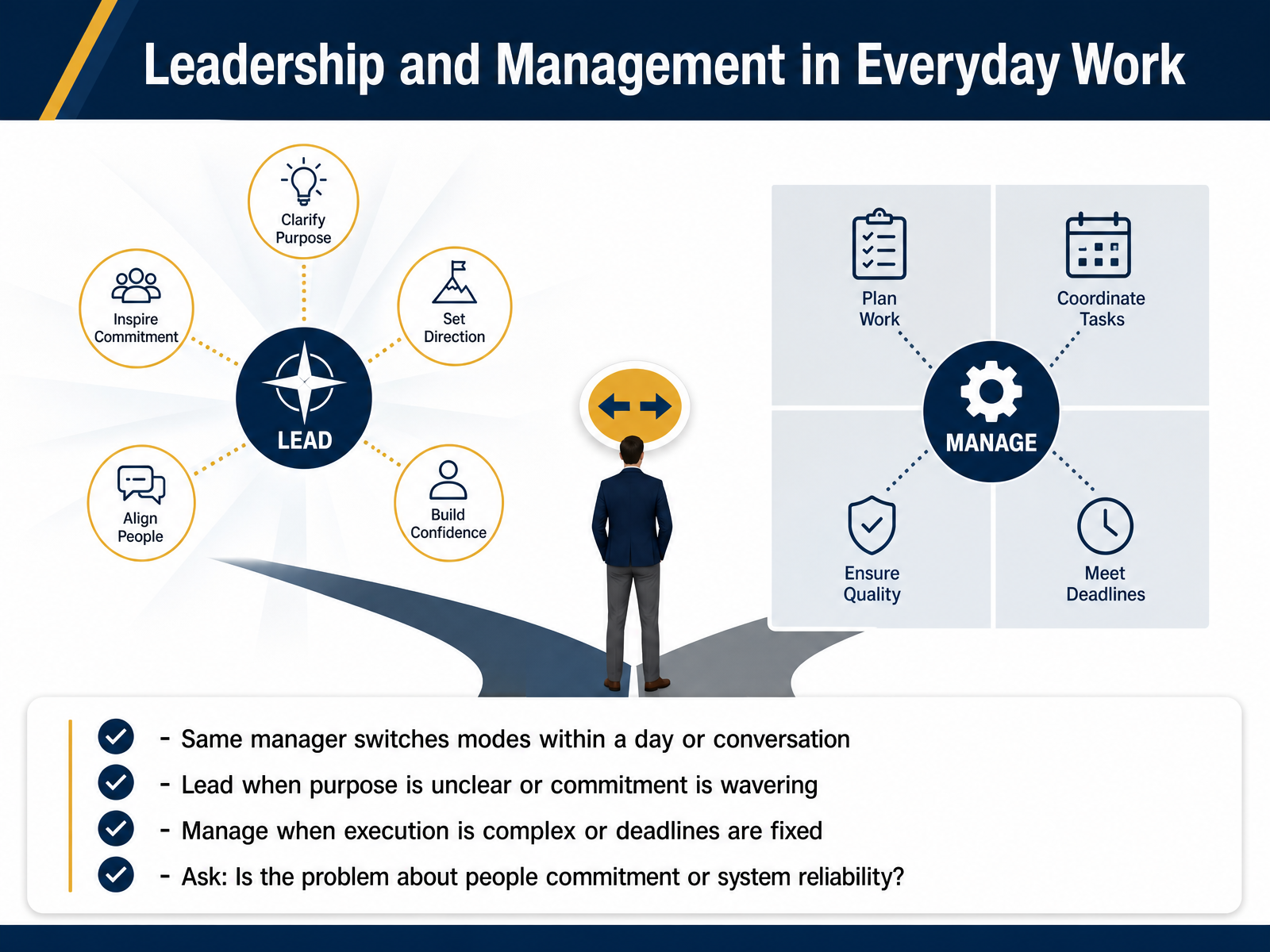
 - 07Leadership and Management in Everyday WorkNow, let's look at how this plays out in everyday work. The key insight here is that you don't choose to be either a leader or a manager. You switch between those modes, sometimes within a single conversation. So, when do you lead? When the purpose feels unclear, or when your team's commitment starts to waver. That's the moment to step back from the details and reconnect people with the 'why'. And when do you manage? When execution is complex, or you have fixed deadlines that are non-negotiable. That's the time for structure, clear plans, and tight coordination. Here's a simple question to guide you in the moment: is my problem about people's commitment, or is it about system reliability? If it's about commitment and belief, you need to lead. If it's about reliability and process, you need to manage. Recognizing the distinction is the first step to doing both well. Coming up next, we'll walk through some specific workplace scenarios to help you spot when to lead.
 leadershipiq.comtrainingjournal.comgallup.com+21 min
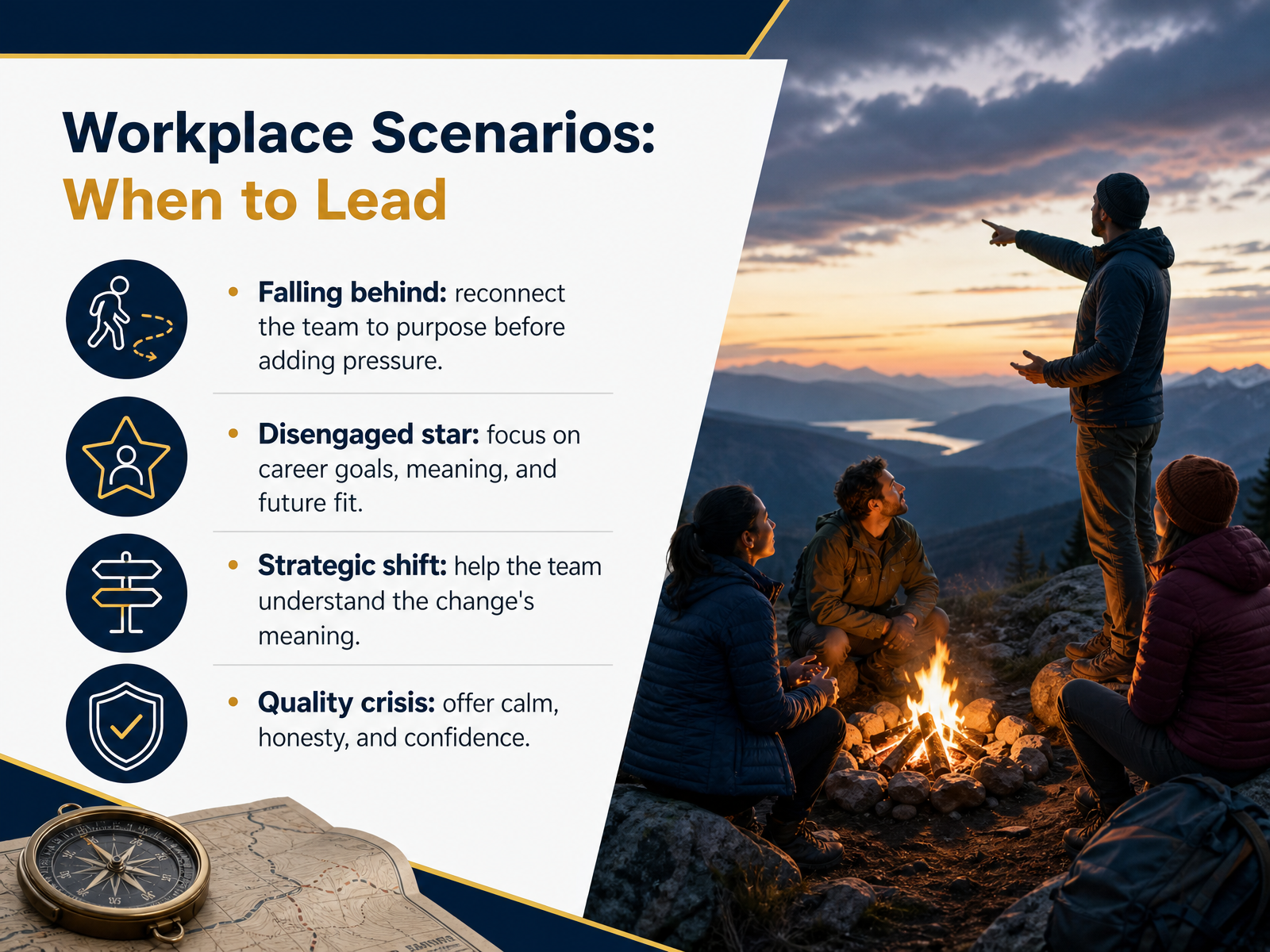
 - 08Workplace Scenarios: When to LeadLet’s look at some real workplace moments where leadership is what the situation calls for. When a project is falling behind, the instinct is to add pressure. But leadership says: pause, and reconnect the team with why the work matters, and restore their commitment to the goal. When your star performer starts to disengage, resist the urge to simply assign more tasks. Leadership focuses on their career goals, what gives them meaning, and whether their future still fits here. When a strategic shift lands from above, don’t just reallocate resources. Help your people understand what the change truly means for them. And in a quality crisis, when fear and blame start to spread, leadership offers calm, honesty, and genuine confidence in the team’s ability to recover. In all these moments, the work itself matters, but the people matter more, and that’s the leader’s focus. Next, we’ll look at the situations that call for strong management instead.
 leadershipiq.comtrainingjournal.comgallup.com+21 min
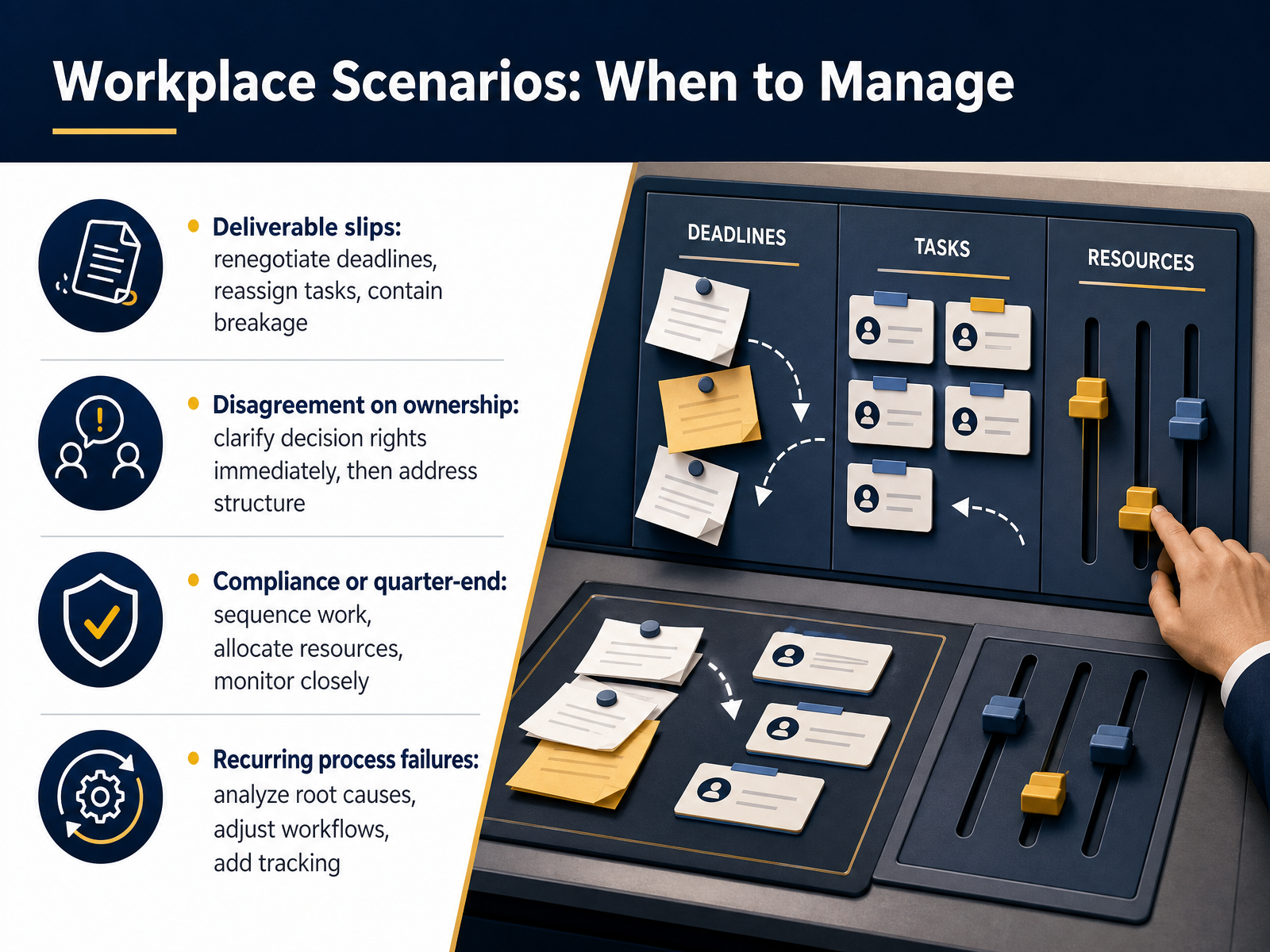
 - 09Workplace Scenarios: When to ManageSo when does management take the lead? Let’s look at a few everyday situations. When a deliverable is about to slip, your job is to renegotiate the deadline, reassign tasks, and contain the damage. Don’t turn it into a coaching moment yet—that comes later. If two people are arguing over who owns a task, clarify decision rights immediately. That’s the manager’s call. Then you can dig into the deeper structure that caused the confusion. During compliance season or quarter-end, you need to sequence the work, allocate resources, and monitor progress closely. People don’t need a speech then—they need cleaner handoffs and faster decisions. And when a process keeps failing? That’s a signal to analyze root causes, adjust the workflow, and add proper tracking. In each case, you’re creating order, clarity, and reliability. That’s the gift of good management. Now, let’s see what it looks like when one person has to shift between both modes in a single situation.
 pon.harvard.eduemerald.comnationalforum.com+21 min
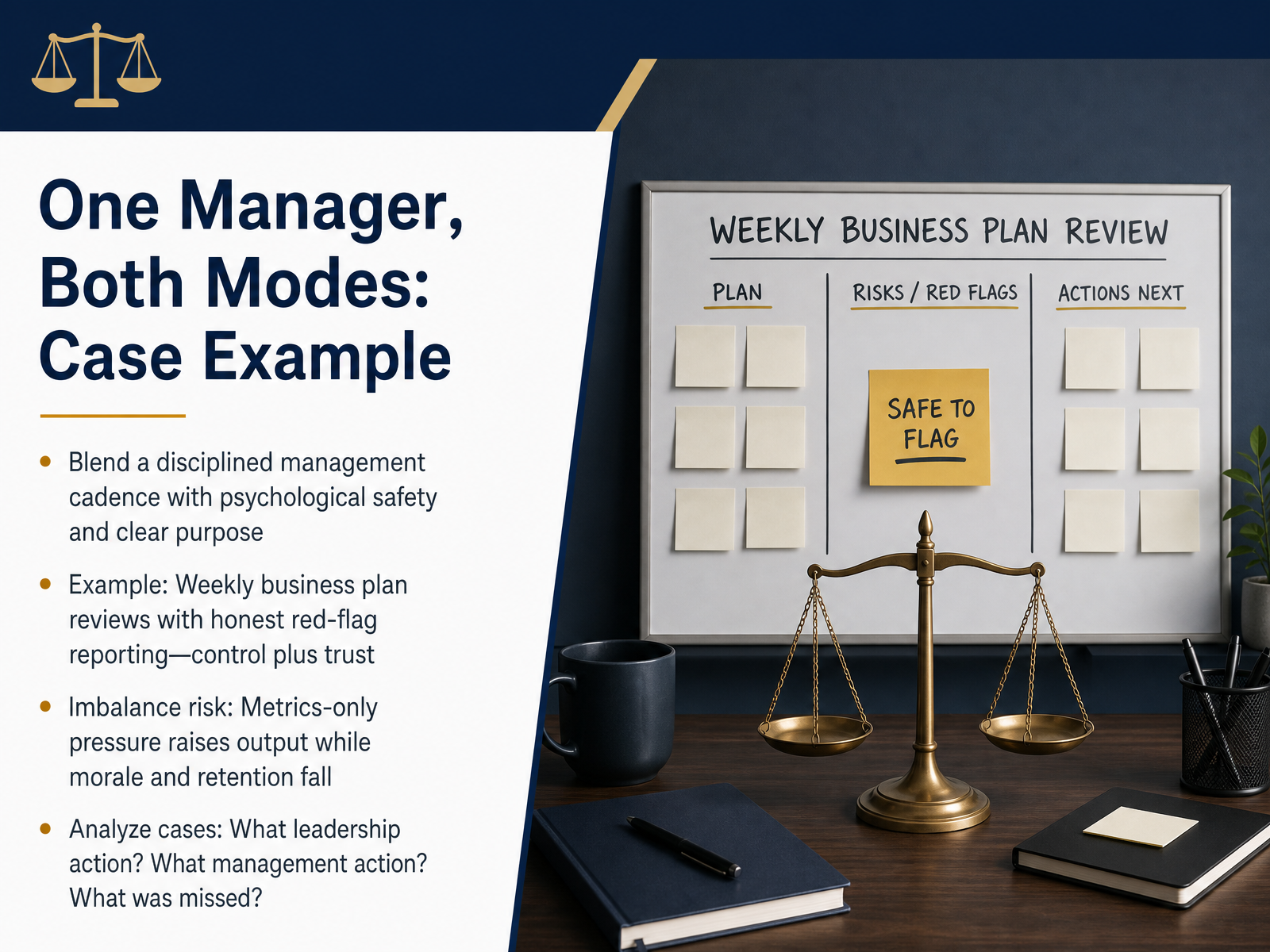
 - 10One Manager, Both Modes: Case ExampleSo what does it look like when one person does both well? Picture a team manager who runs a weekly business review. She has a clear agenda, tracks metrics, and follows up on action items. That is solid management. But here's the key: she also tells her team it is safe to flag problems early, to raise a red flag when something is off track, without fear of blame. That is leadership. Control plus trust. Now imagine the opposite: a manager who only pushes the numbers. In the short term, output might go up. But morale drops, people burn out, and before long, your best performers start looking elsewhere. That is the cost of neglecting one side. So when you look at a case like this, ask yourself: what is the leadership action here? What is the management action? And what might have been missed if only one mode was used? The strongest teams need both, working together. And recognizing the cost of neglecting one side is exactly what we will look at next.
 leadershipiq.comtrainingjournal.comgallup.com+22 min
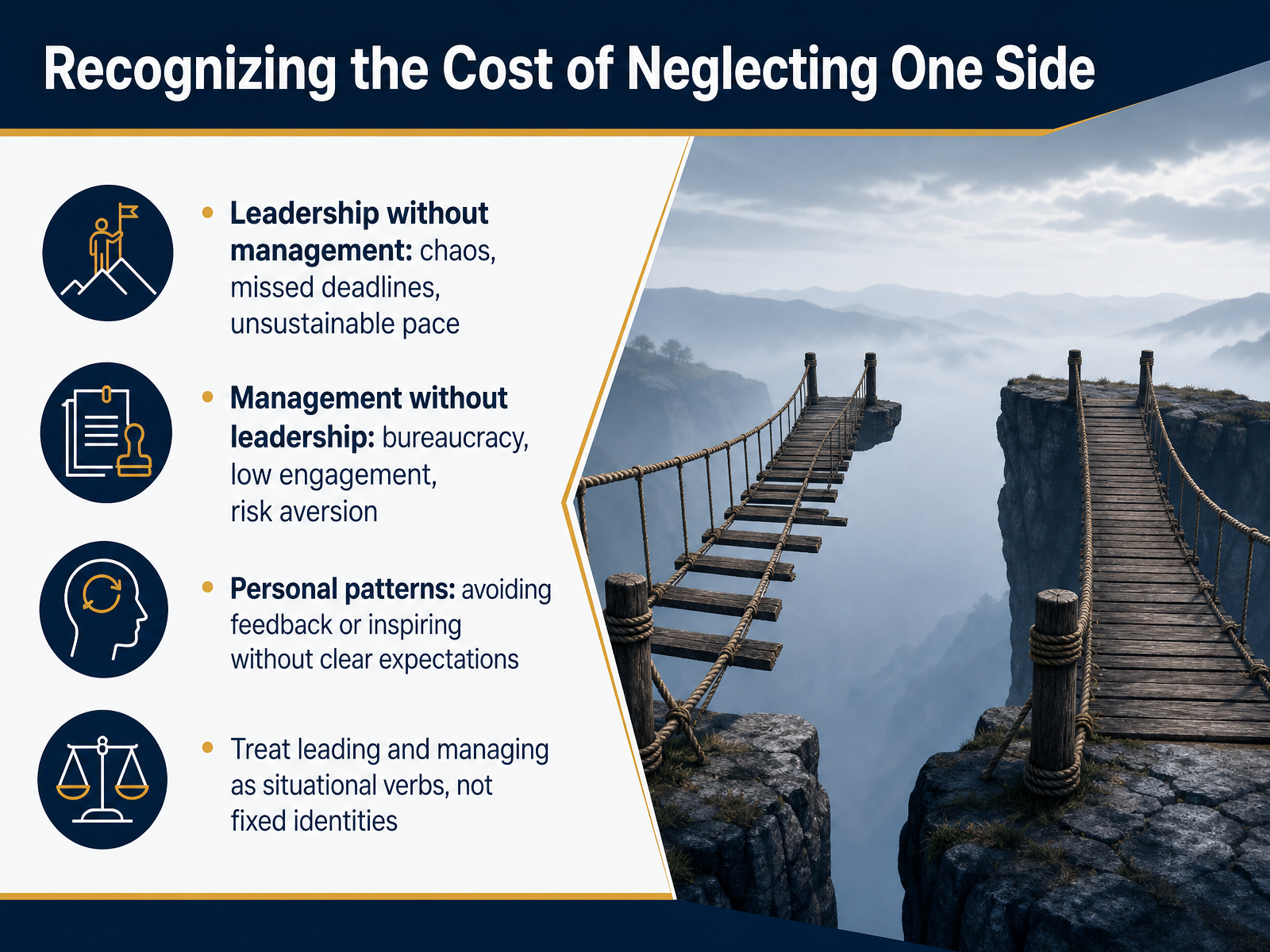
 - 11Recognizing the Cost of Neglecting One SideNow let's look at what happens when we lean too far in one direction. Strong leadership without solid management can create real chaos. Think about a team with a compelling vision but no clear deadlines or ownership. Ideas fly, excitement builds, but work slips, deadlines pass, and people burn out. On the flip side, management without leadership feels different. You get smooth processes and efficient systems, but the work feels hollow. People show up, do their tasks, but no one feels inspired. Engagement drops, risk-taking disappears, and the team becomes cautious and bureaucratic. You might also notice personal patterns here. Do you avoid giving tough feedback because it feels too managerial? Or do you inspire your team with big ideas but leave them without clear expectations? These are common signs of imbalance. Here's the key insight: leading and managing aren't fixed identities. They're situational verbs. Some moments call for vision and inspiration. Others call for structure and accountability. The best professionals move between the two nimbly, depending on what the situation demands. As you reflect on your own tendencies, let's turn to assessing your current balance.
 leadershipiq.comtrainingjournal.comgallup.com+21 min
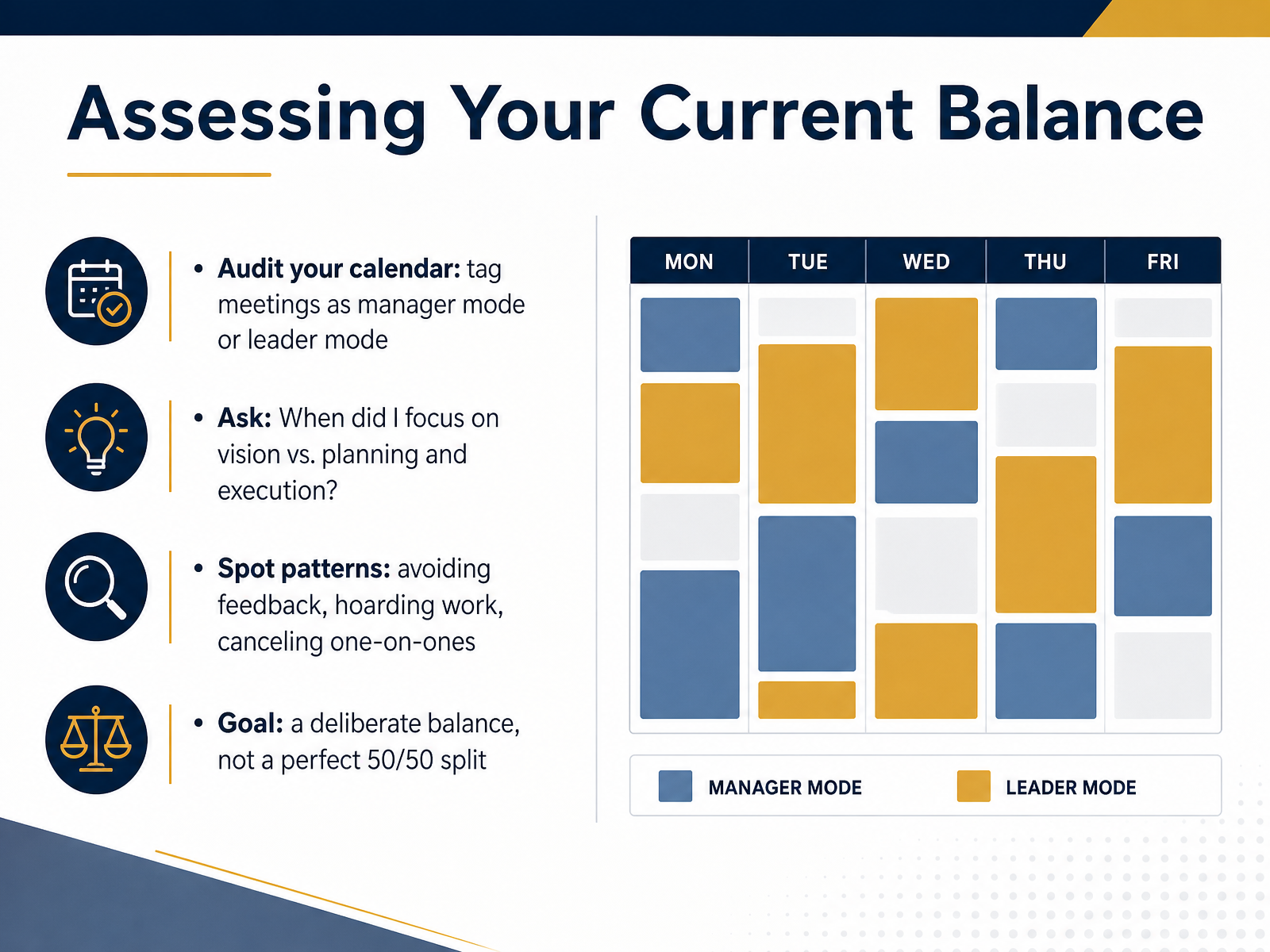
 - 12Assessing Your Current BalanceNow let's turn that understanding into action with a personal audit. First, look at your calendar for the past four weeks. Tag each meeting—manager mode if you were running the system, leader mode if you were changing it or developing people in it. A status update one-on-one is manager mode. A career conversation is leader mode. Next, ask yourself: when did I focus on vision versus planning and execution? Be honest about where your time actually went. Third, spot patterns you might be avoiding—hesitating to give feedback, holding onto work you should delegate, or quietly canceling one-on-ones. The goal isn't a perfect fifty-fifty split. It's a deliberate balance, calibrated to what your team needs right now. For most new managers, leader mode is only five to ten percent of the week. The fix is simple: block ninety minutes of leader-mode work on your calendar, in red, and protect it like a meeting with your most important stakeholder. Now, let's look at some practical behaviors that will help you strengthen your leadership muscle.
 2 min
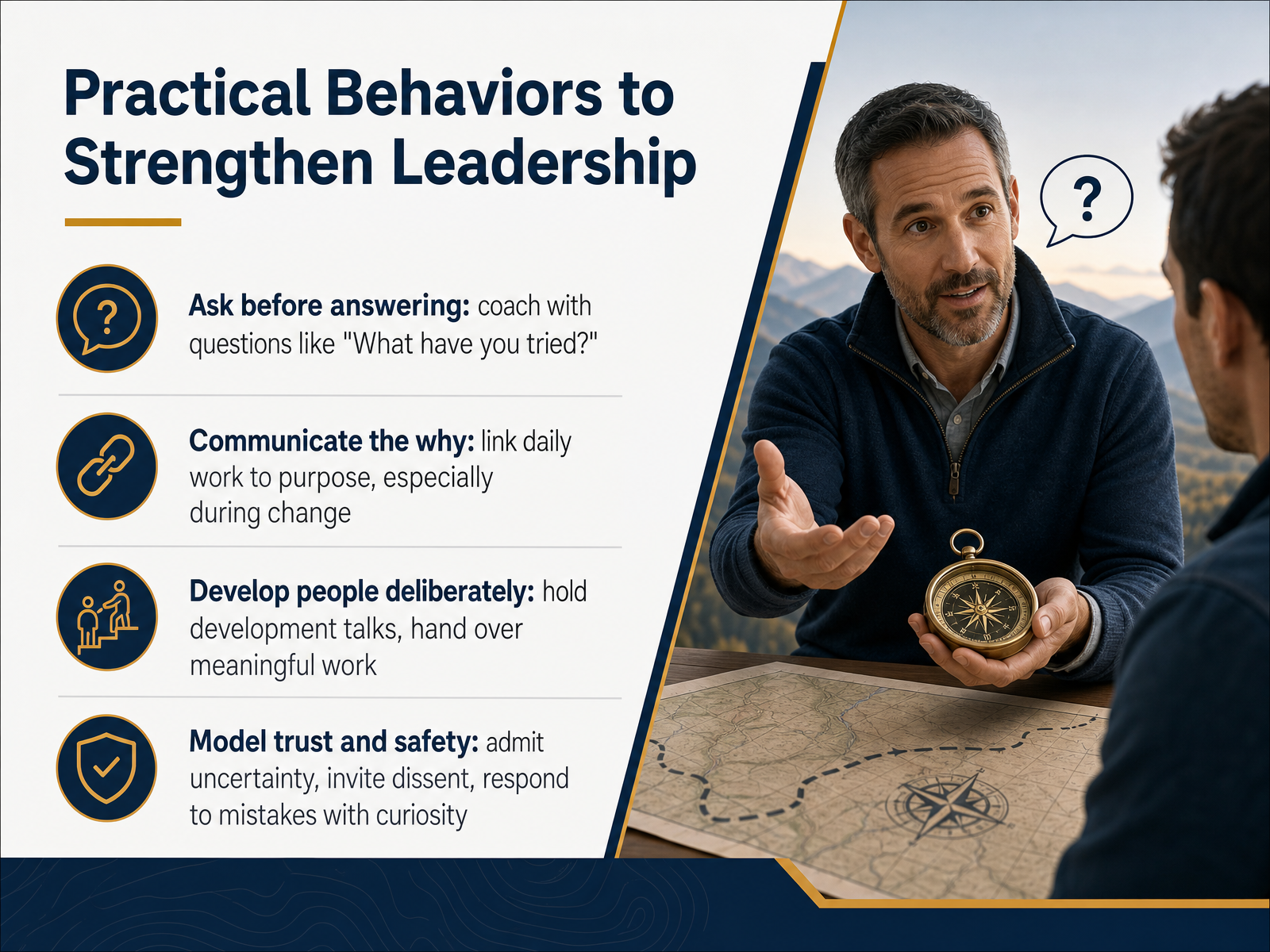
2 min - 13Practical Behaviors to Strengthen LeadershipHere are four practical behaviors you can start using today to strengthen your leadership. First, ask before you answer. When someone brings you a problem, resist the urge to solve it. Instead, ask, what have you tried? This simple question builds their confidence and your trust in their judgment. Second, communicate the why. Especially during change, people need to see how daily work connects to a bigger purpose. A team that feels connected is far more committed. Third, develop people deliberately. Hold regular development talks and hand over meaningful work, not just the tasks you want to offload. Growth is what keeps talent engaged. Finally, model trust and safety. Admit when you are uncertain, invite differing opinions, and when mistakes happen, respond with curiosity rather than blame. This creates the kind of environment where people speak up and challenge thinking, and that is where high performance really comes from. Now, let's turn to the practical behaviors that strengthen the management side of your role.
 mckinsey.comccl.orggallup.com+21 min
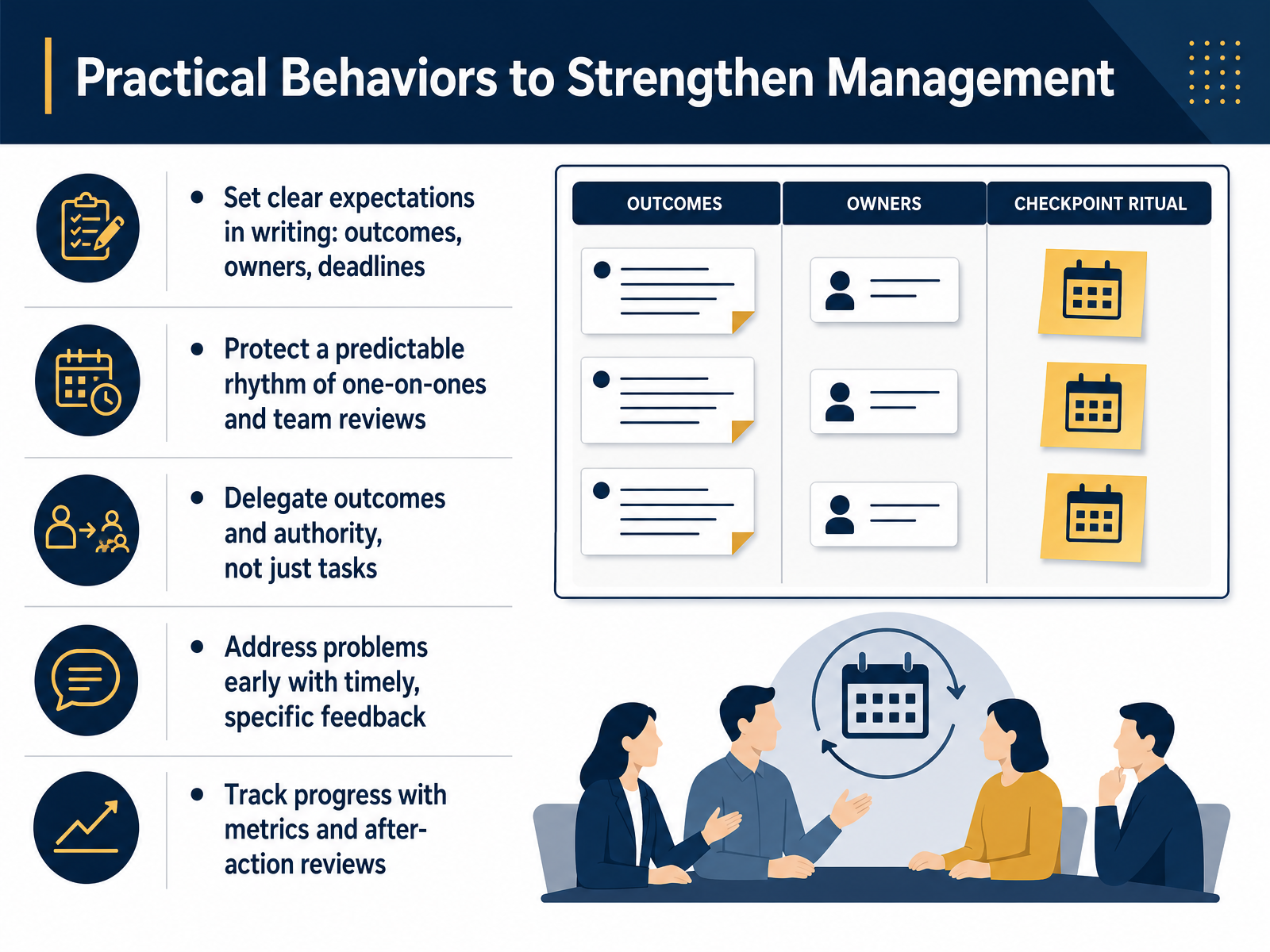
 - 14Practical Behaviors to Strengthen ManagementLet’s turn these ideas into daily habits. Strong management doesn’t come from big gestures—it comes from consistent, practical behaviors. Start by setting clear expectations in writing. Don’t rely on memory or good intentions. Spell out the outcome, who owns it, and when it’s due. Next, protect a predictable rhythm. Keep your one-on-ones and team reviews sacred. Skip them twice, and you’ve taught your team they’re not a priority. When you delegate, hand over the outcome and the authority, not just the task. Give people the freedom to solve problems their own way. Address problems early, with specific and timely feedback. Waiting only makes the conversation harder. Finally, track progress with metrics and after-action reviews. Ask what we expected, what actually happened, and what we’ll do differently. These habits may feel small, but repeated week after week, they build a team that delivers consistently. Up next, we’ll pull everything together into key takeaways and a concrete 30-to-60-day action plan for you.
 openstax.orgcourses.lumenlearning.comdde.pondiuni.edu.in+22 min
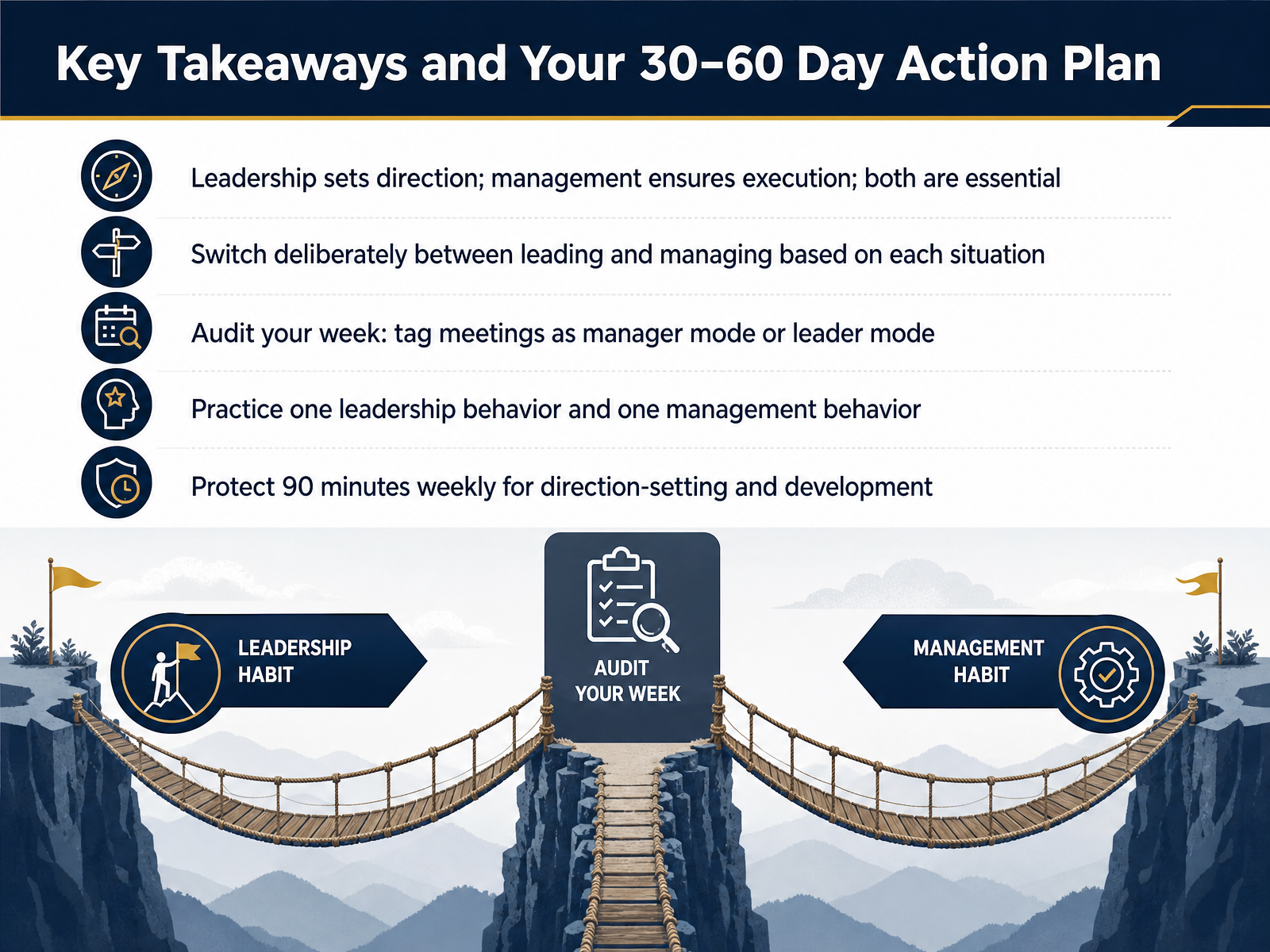
 - 15Key Takeaways and Your 30–60 Day Action PlanHere’s where we land. Leadership sets direction, and management ensures execution. You need both. The key is switching deliberately between them, moment by moment. Try an audit this week. Look back at your calendar and tag each meeting as manager mode or leader mode. You’ll likely see the imbalance. Then, practice. Pick one leadership behavior, like coaching someone, and one management behavior, like clarifying a process. Build the habit. And protect ninety minutes each week. Block it in red. This is time for direction-setting and development, not tasks. It’s what makes the difference between running your team and growing it. Even a small shift changes things. Thanks for learning with us. Now, start your first audit today. You’ve got this.
 leadershipiq.comtrainingjournal.comgallup.com+22 min
Take the deck with you
Download this course as a file — free, no sign-up needed.
- PDF handoutEvery slide page, ready to print or share.16 pages · 4.1 MBDownload
- Narrated PowerPointThe deck that presents itself — every slide carries the digital human's narration video.16 pages · 15.0 MBDownload
- PowerPoint slidesThe full deck as a .pptx — open it in PowerPoint, Keynote, or Google Slides.16 pages · 4.1 MBDownload
Free to use in your own training — please keep the PersonWise credit page at the end.
Have your own deck? Turn it into a course
Sources consulted
Web sources consulted while building this course.
- Leadership vs. Management: Key Differences, Similarities, and Why Both — leadershipiq.com
- The myth of leadership versus management: Why the best managers do both - Training Journal — trainingjournal.com
- Why Managers Need Leadership Development Too - Gallup.com — gallup.com
- Strong Leadership, Strong Management: A Dual Necessity for Organizational Success — innovativehumancapital.com
- Leadership and Management: Both Skill Sets Are Required in Business ... — td.org
- What is leadership? — mckinsey.com
- 12 Essential Qualities of Effective Leadership — ccl.org
- Effective Leadership: What Makes a Good Leader - Gallup — gallup.com
- 13.1 The Nature of Leadership - Principles of Management | OpenStax — openstax.org
- TRAIT AND BEHAVIORAL THEORIES OF LEADERSHIP: AN INTEGRATION AND META‐A... — bishtref.com
- 6.1 The Role of Management - Introduction to Business | OpenStax — openstax.org
- Primary Functions of Management | Principles of ... - Lumen Learning — courses.lumenlearning.com
- Pondicherry University — dde.pondiuni.edu.in
- What is Management? Meaning, Definition and Why It Matters - Management Study Guide — managementstudyguide.com
- Management - Wikipedia — en.wikipedia.org
- Leading vs. Managing: What’s the Difference? - PON - Program on Negotiation at Harvard Law School — pon.harvard.edu
- Conceptualisation of management and leadership — emerald.com
- Leadership versus Management: A Key Distinction—At Least in Theory — nationalforum.com
- Management Versus Leadership: A Key Theoretical Distinction — ideas.repec.org
- Leaders vs Managers – Key Differences and Commonalities — fisher.osu.edu