Begin
14 pages · ~28 min
API Development Skills
This training equips developers with core API development skills, covering design, implementation, and best practices for building and integrating APIs.
A digital instructor presents all 14 pages. Hold “Ask” at any point and ask out loud — the answer comes from this course. No sign-up needed.
What you’ll learn
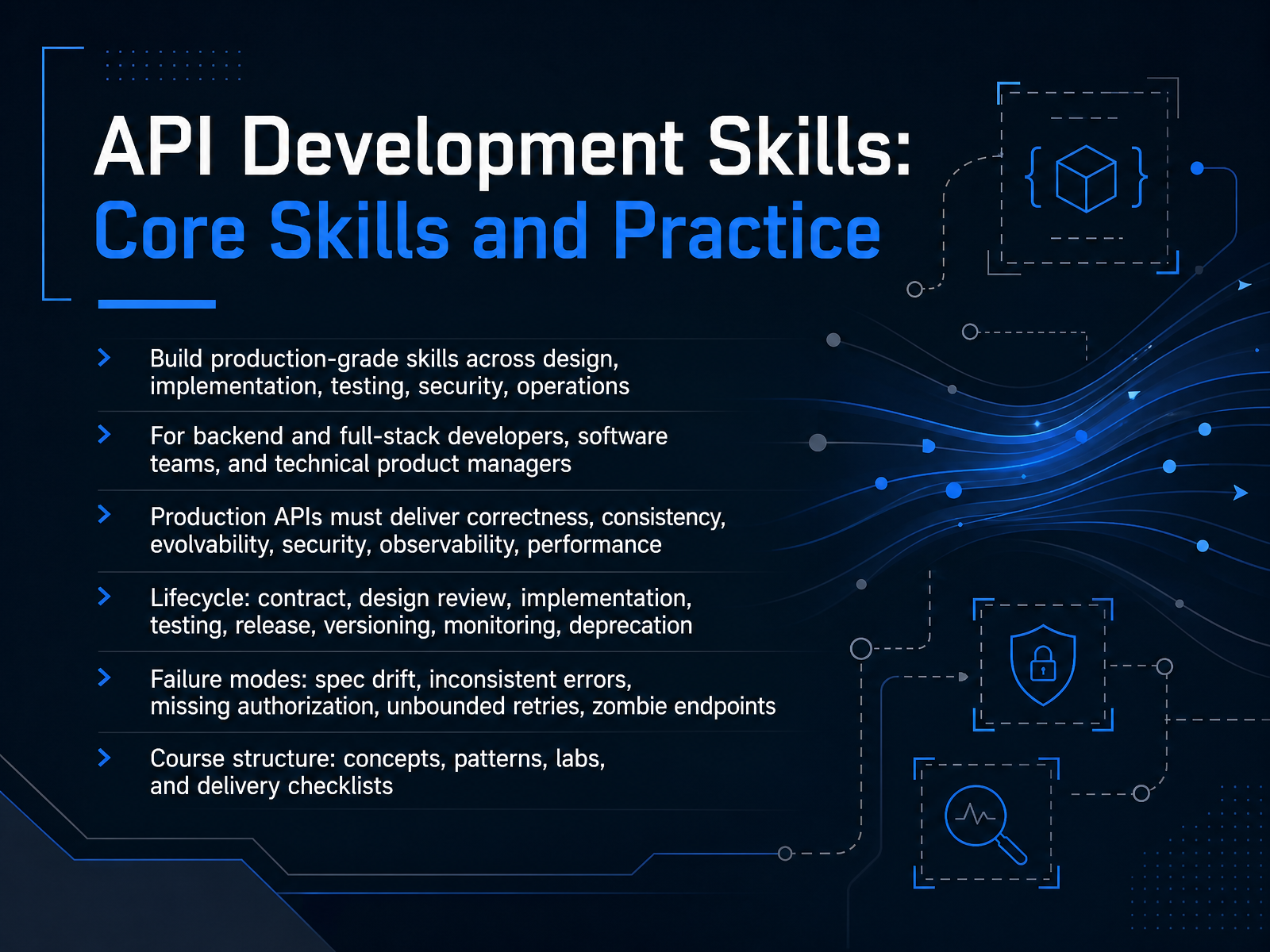
- 01API Development Skills: Core Skills and PracticeWelcome. This course is about building production-grade APIs, not just endpoints that work on your machine. We'll cover core skills across design, implementation, testing, security, and operations. It's built for backend and full-stack developers, software teams, and technical product managers who ship real integrations. Here's the bar. Production APIs must deliver correctness, consistency, evolvability, security, observability, and performance. That means following a full lifecycle: contract, design review, implementation, testing, release, versioning, monitoring, and deprecation. Skipping steps causes familiar failure modes: spec drift, inconsistent errors, missing authorization, unbounded retries, and zombie endpoints that nobody owns. Think of a renamed field shipped without a new version. Existing clients break, and you get the three a.m. support ticket. We'll work through concepts, patterns, labs, and delivery checklists you can apply immediately. Before we go further, let's ground ourselves in how APIs actually work and where they fit in the stack.cloud.google.comcadence.withremote.aireference.apios.info+21 min
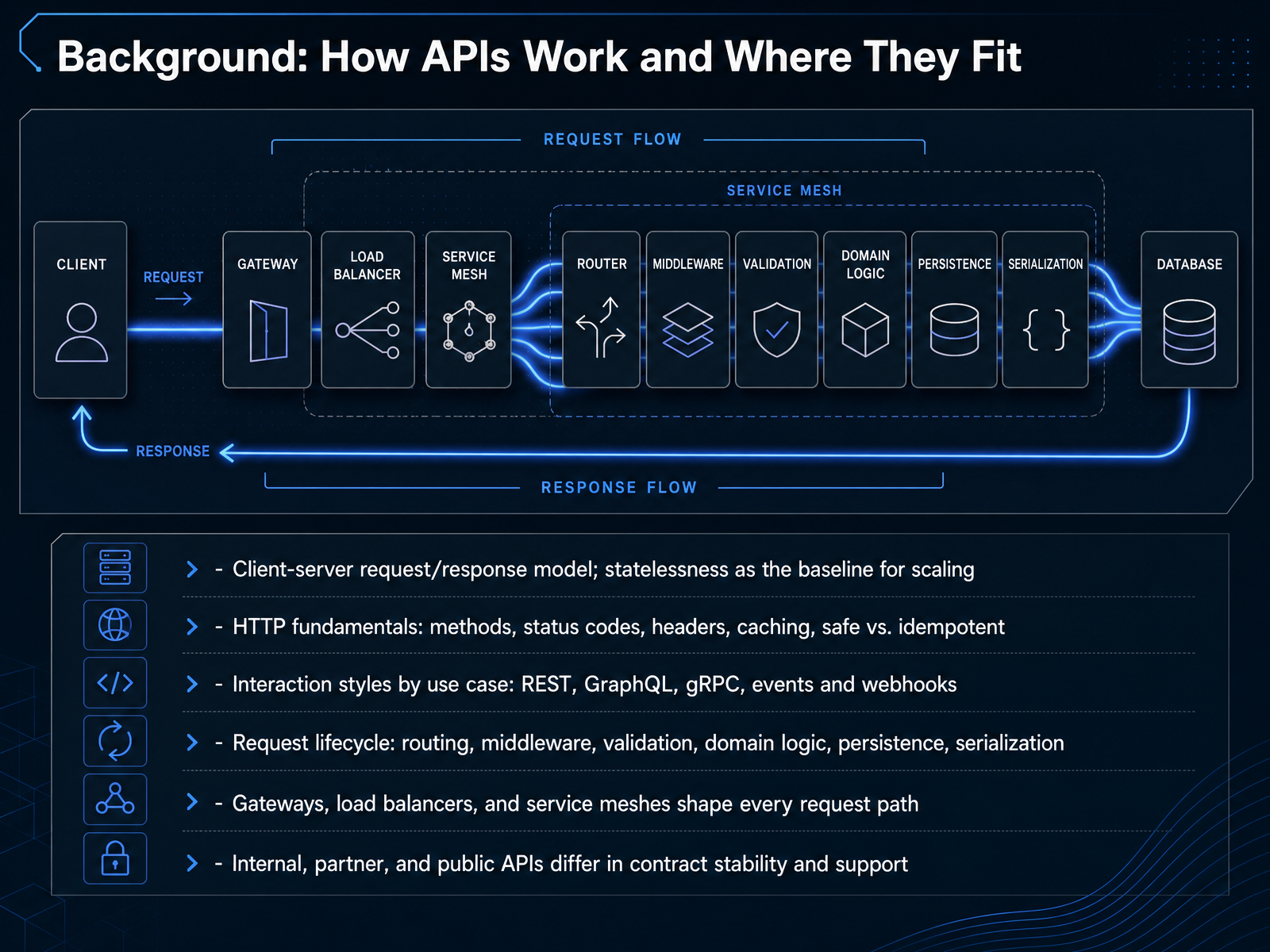
- 02Background: How APIs Work and Where They FitLet's ground this in how APIs actually work. The baseline is the client-server request and response model, and statelessness is what makes it scale. Every request carries everything the server needs, so any instance can handle it without remembering the last one. On top of that, HTTP gives you the vocabulary: methods, status codes, headers, and caching. Know which operations are safe, meaning they don't change data, and which are idempotent, meaning repeating them gives the same result. That distinction decides how clients retry safely. Now match the interaction style to the use case. REST fits external and partner APIs because it is cacheable and needs no special tooling. GraphQL earns its place when many different clients need different slices of one graph. gRPC wins for high-volume internal service calls, where binary payloads and streaming cut latency. Events and webhooks handle work that does not need a synchronous reply. Next, trace a single request. It hits routing, then middleware for auth and logging, then validation, then domain logic, then persistence, then serialization. Gateways, load balancers, and service meshes shape that path before your code ever runs. And remember, internal, partner, and public APIs are not the same contract. Public APIs need long stability and real support windows. Internal ones can change faster because you own both ends. That boundary is exactly how you should decide your protocol. Choosing an API Style Per Boundary.
 backendbytes.comdev.todev.to+22 min
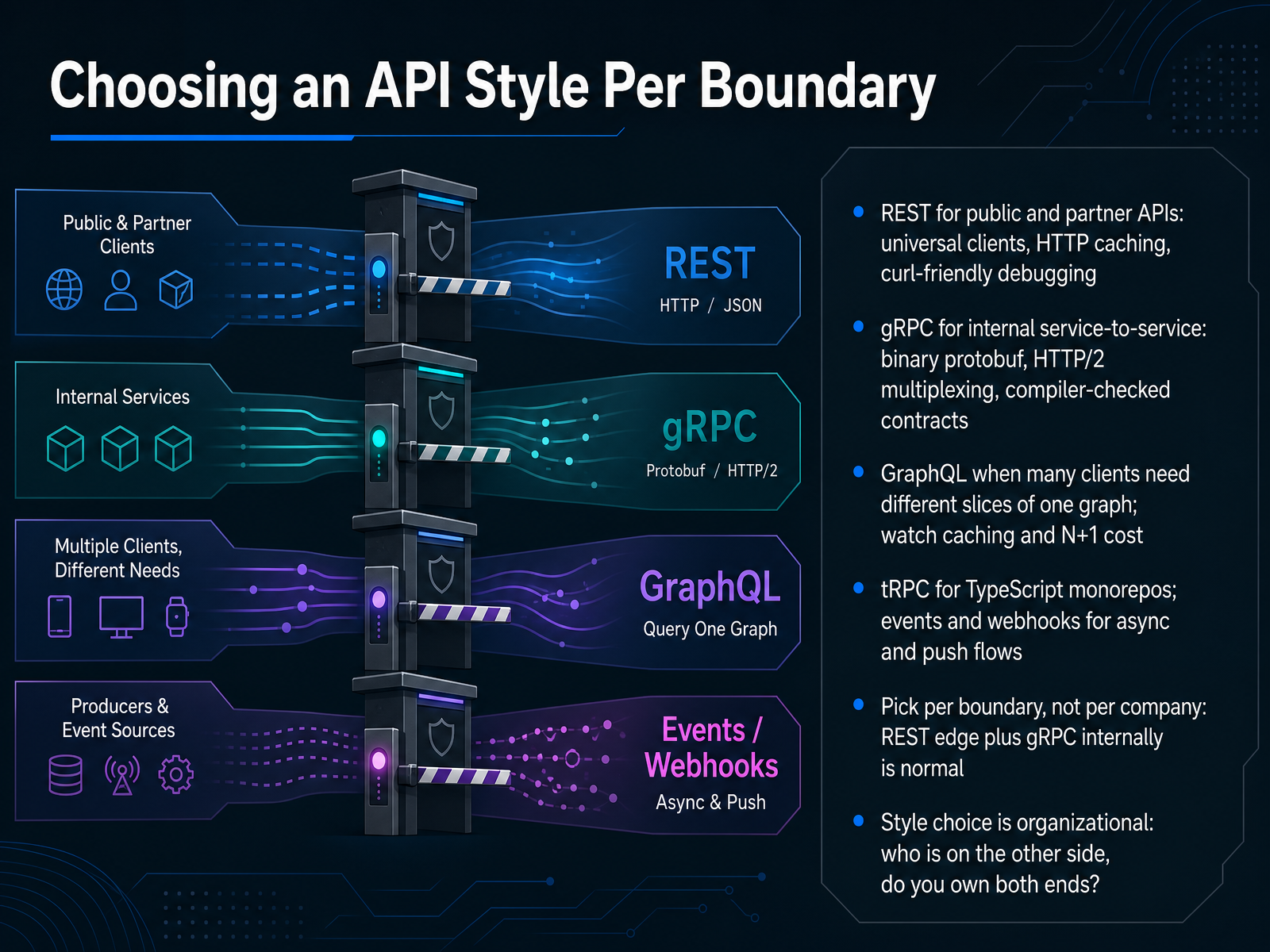
- 03Choosing an API Style Per BoundaryLet's talk about picking a style for each boundary, not one winner for the whole company. Start with REST for public and partner APIs. The other side is a stranger: every HTTP client speaks it, CDNs and ETags cache it for free, and any integrator can debug it with curl at three in the morning. Next, gRPC for internal service-to-service calls. You own both ends, so you can spend on compact protobuf over HTTP/2, multiplexed streams, and a proto contract the compiler checks. You cannot curl it, so plan on grpcurl and reflection. GraphQL earns its place when many clients need different slices of one graph, mobile, web, admin. It kills over-fetching, but watch two costs: caching mostly disappears because queries are POSTs, and naive resolvers trigger the N plus one problem. Batch with DataLoader. In a TypeScript monorepo, tRPC gives you end-to-end types with no code generation. And for async work, reach for events and webhooks instead of a synchronous call. The real rule: pick per boundary. REST at the edge plus gRPC internally is normal, not a contradiction. The deeper question is organizational. Who is on the other side, and do you own both ends? If you do, take a strict contract. If you don't, stay forgiving and debuggable. Next, we'll go contract-first and look at resource modeling.
 backendbytes.comdev.todev.to+22 min
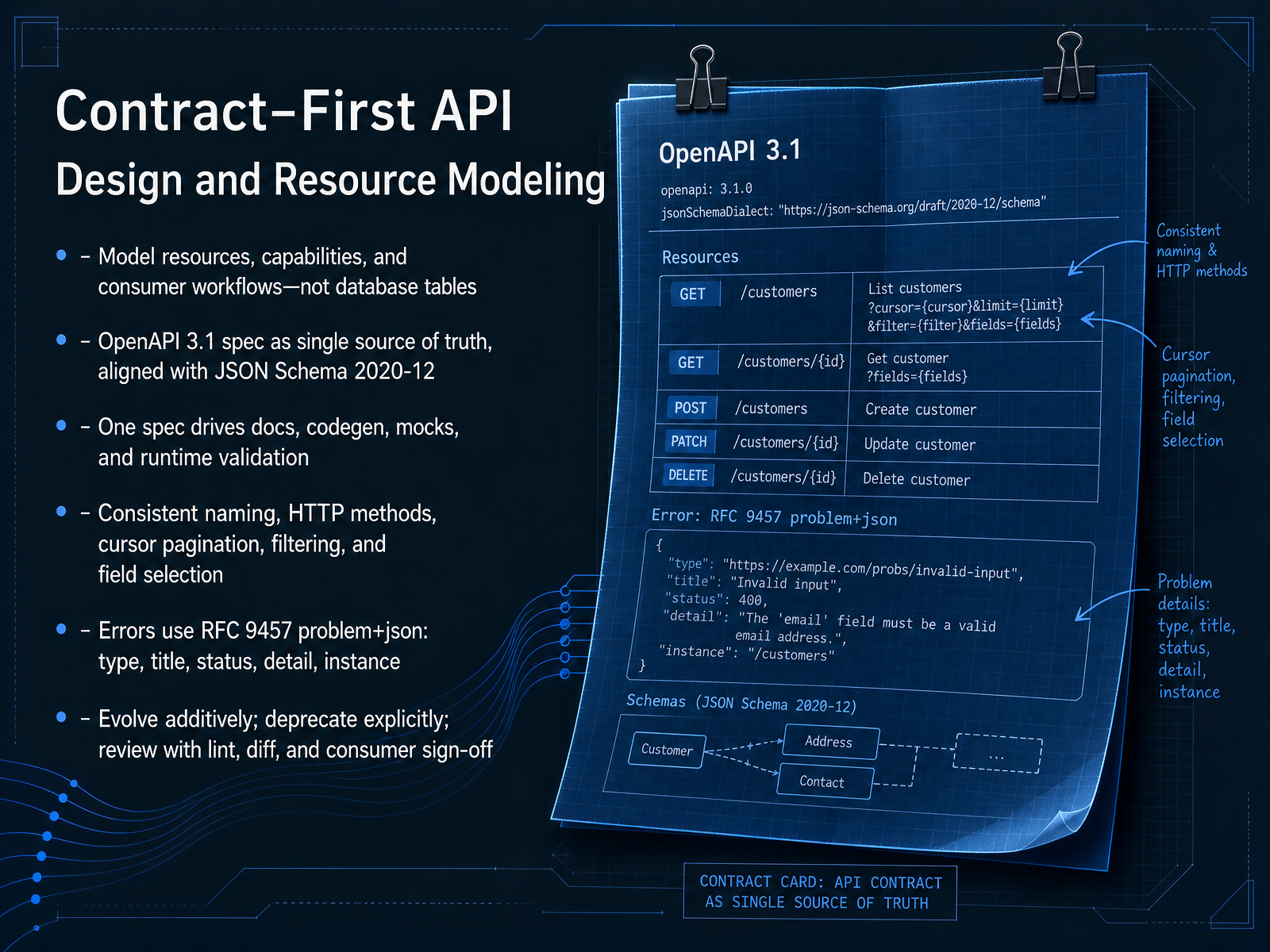
- 04Contract-First API Design and Resource ModelingNow let's talk about contract-first API design and resource modeling. Start by modeling resources, capabilities, and consumer workflows, not your database tables. If you expose a table, every schema migration becomes an API breaking change. Instead, ask what the consumer is trying to accomplish, then name the resource for that. Next, treat the OpenAPI 3.1 spec as the single source of truth. It aligns with JSON Schema 2020-12, so one file drives your docs, code generation, mocks, and runtime validation. No more keeping types in three places. Keep conventions consistent across every endpoint. Nouns in paths, standard HTTP methods, cursor pagination, filtering, and field selection. For errors, use RFC 9457 problem plus json: type, title, status, detail, and instance. That gives clients, and now AI agents, something they can parse mechanically. Finally, evolve additively. New optional fields are safe. Removing or tightening them is breaking. Deprecate explicitly, and gate every change with linting, spec diffing, and consumer sign-off. The takeaway: the spec is the product. Next, we move into implementation patterns and backend architecture.
 asoasis.techcadence.withremote.aimdsanwarhossain.me+22 min
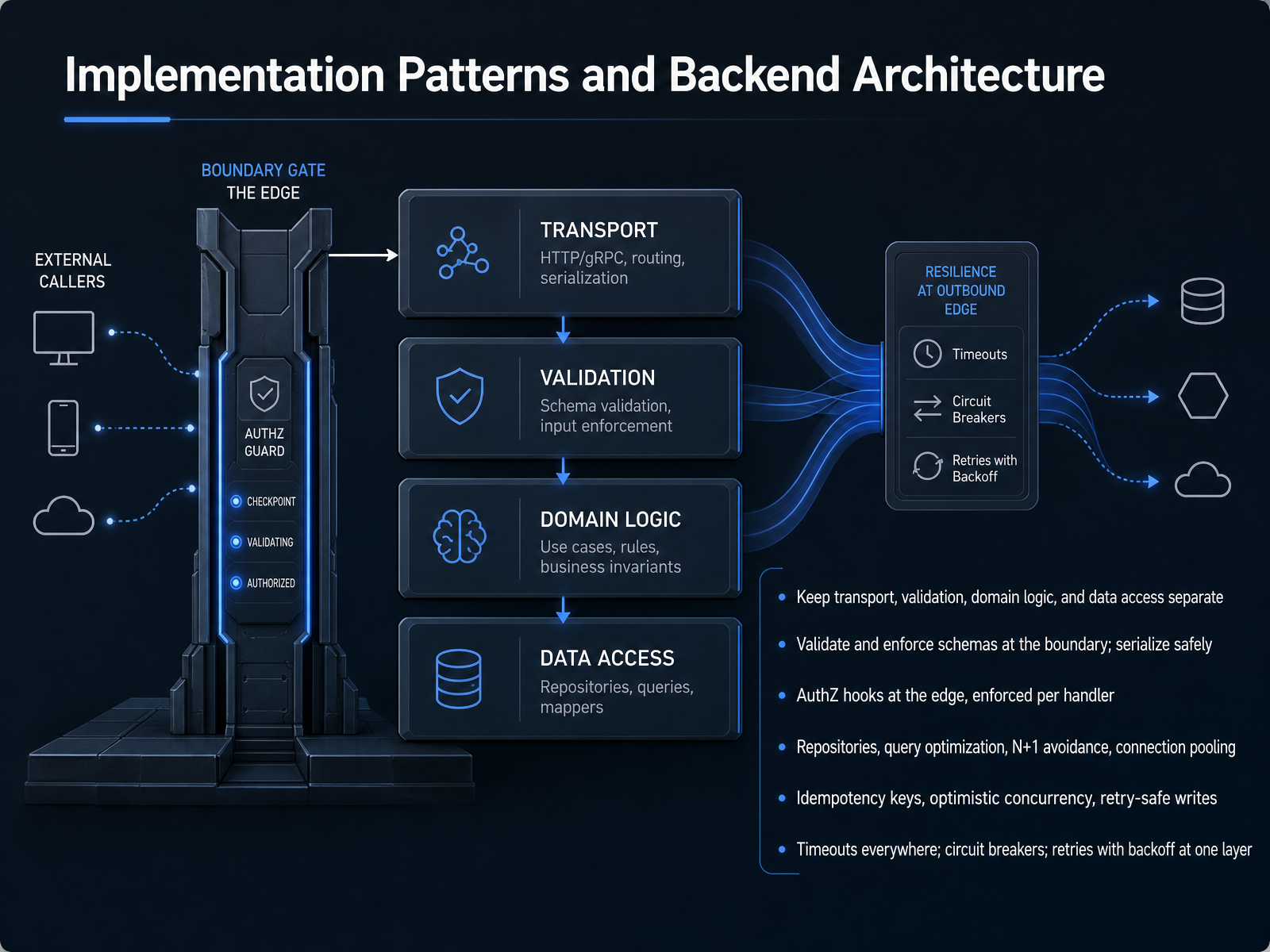
- 05Implementation Patterns and Backend ArchitectureNow let's look at implementation patterns and backend architecture.
The core rule is separation. Keep transport, validation, domain logic, and data access in distinct layers. When one handler does all four, changes ripple unpredictably. So validate and enforce schemas at the boundary, serialize safely, and put authorization hooks at the edge, then enforce per handler.
For data access, use repositories, optimize queries, and avoid N+1 calls. On writes, idempotency keys, optimistic concurrency, and retry-safe design keep duplicate requests from corrupting state. And set timeouts everywhere. Add circuit breakers, and retry with backoff at exactly one layer. If three layers each retry three times, that compounds into roughly two hundred forty-three times the load downstream.
Make those decisions explicitly, and the rest of your API stays predictable. Next, we'll dig into safe retries and idempotent write design.
 distributedrequest.comchiraghasija.ccdigitarise.com+21 min
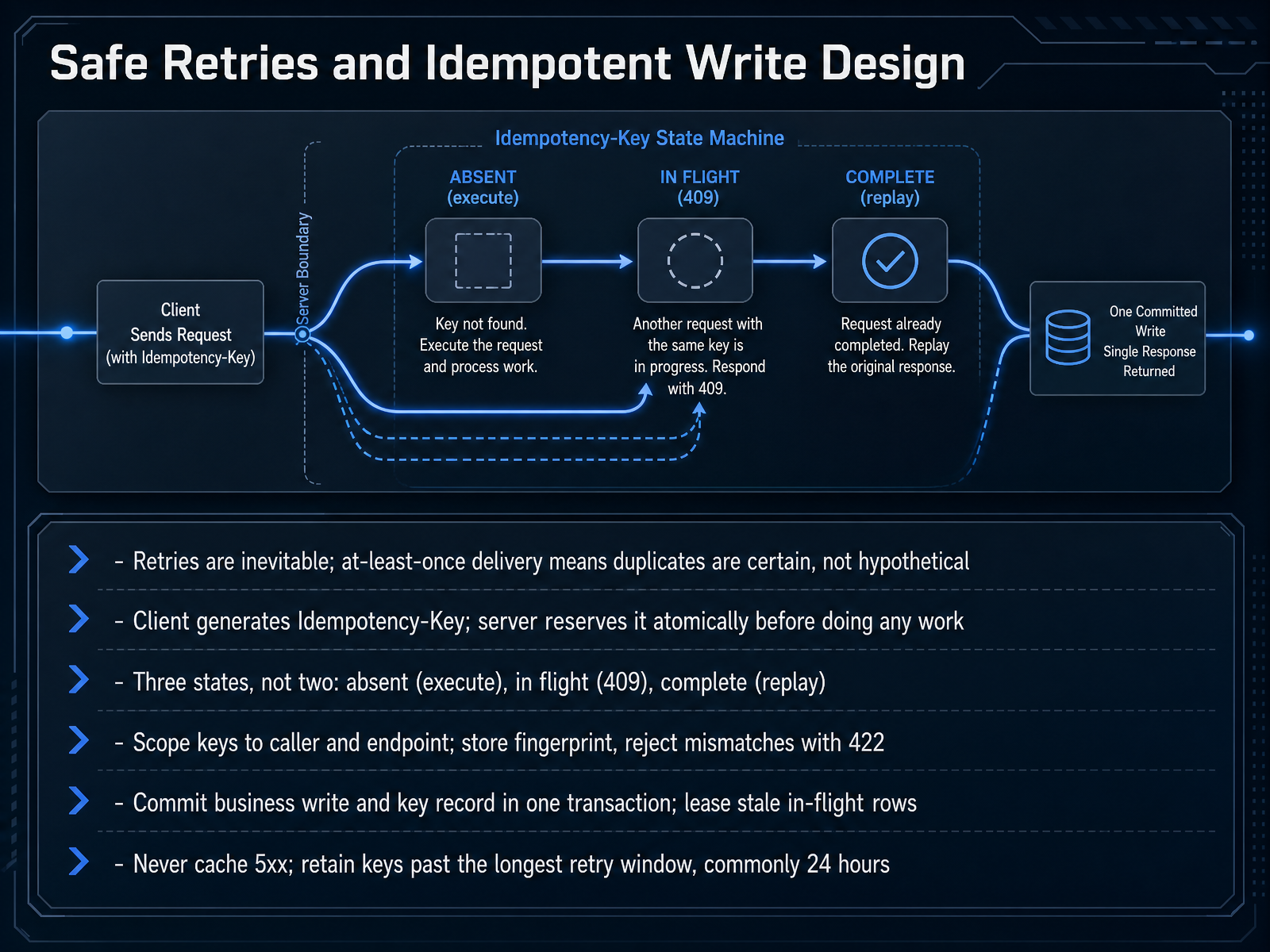
- 06Safe Retries and Idempotent Write DesignLet's talk about making retries safe through idempotent write design. Retries are inevitable. At-least-once delivery means duplicates are certain, not hypothetical, so every write endpoint has to assume the same request may arrive twice. The pattern is simple to state: the client generates an Idempotency-Key, and the server reserves it atomically before doing any work. Think in three states, not two. If the key is absent, execute the operation. If it is in flight, return a 409 so the client backs off. If it is complete, replay the stored response. Scope each key to the caller and the endpoint, and store a fingerprint of the request. If the same key arrives with a different payload, reject it with a 422. Then commit the business write and the key record in one transaction, so a crash cannot move money without recording the key. Give stale in-flight rows a lease and reclaim them after a timeout. Never cache 5xx responses, because a server error is uncertainty, not an outcome. And keep keys past the longest retry window your clients use, commonly twenty-four hours. That combination is what turns unreliable at-least-once plumbing into effectively-once behavior. Next, let's look at security and access control with Security, Authentication, and Authorization.
 distributedrequest.comchiraghasija.ccdigitarise.com+22 min
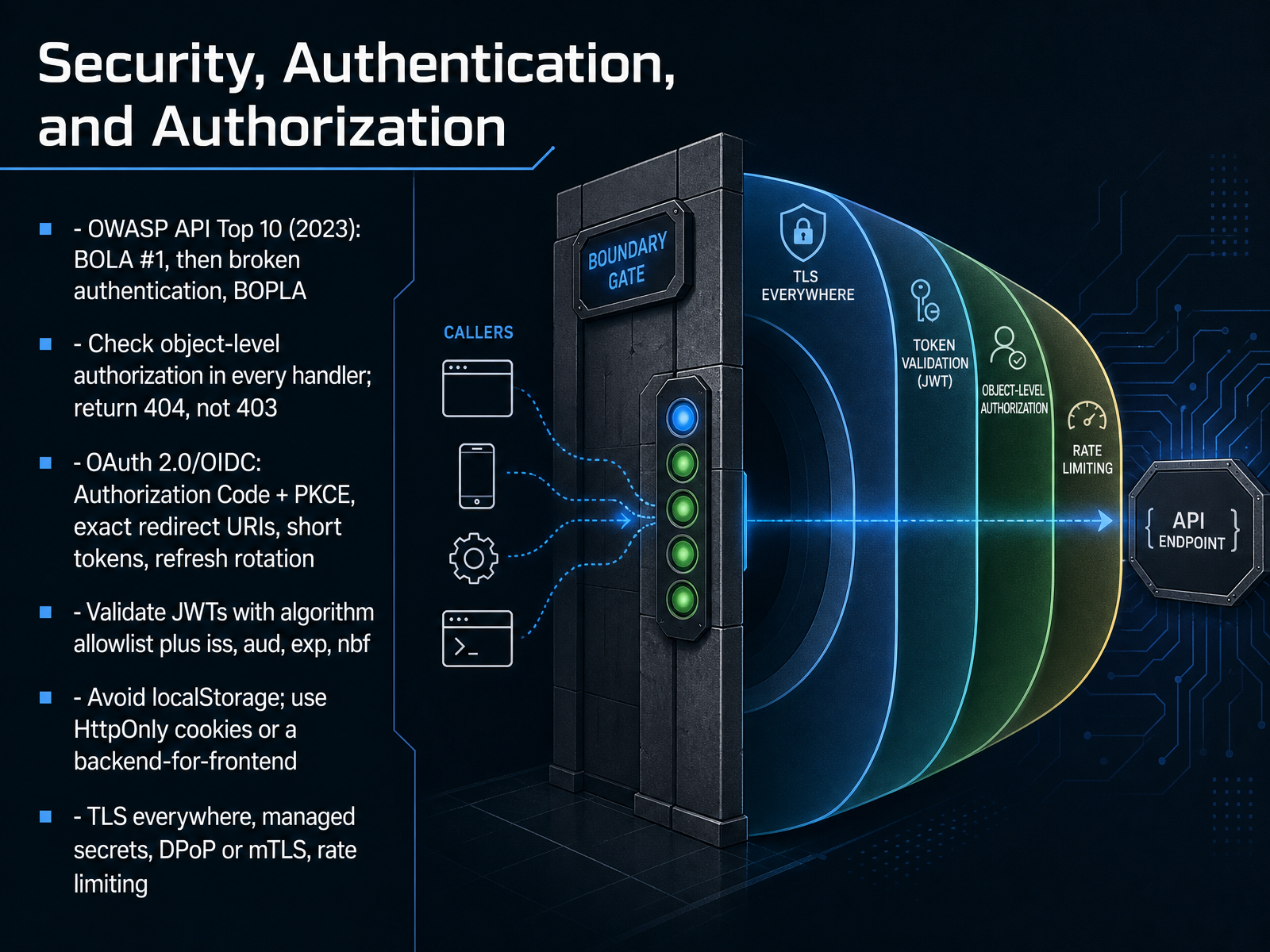
- 07Security, Authentication, and AuthorizationNext, let's talk about security, authentication, and authorization. On the OWASP API Top 10 from 2023, Broken Object Level Authorization, or BOLA, still ranks number one, followed by broken authentication, then broken object property level authorization. Why does BOLA stay on top? Because it is easy to exploit. You are logged in, so the API trusts you. But it never checks whether that specific object belongs to you. Change one ID in the URL, and you read someone else's data. So enforce object-level authorization in every handler. When access fails, return a four-oh-four, not a four-oh-three. A forbidden response confirms the object exists, which leaks information. For authentication, use OAuth two point oh with OpenID Connect. Authorization Code with PKCE for all clients. Match redirect URIs exactly. Keep access tokens short-lived, and rotate refresh tokens. Validate JWTs with a strict algorithm allowlist, plus issuer, audience, expiration, and not-before claims. Never trust the algorithm header. For token storage, avoid localStorage. Use HttpOnly cookies or a backend-for-frontend. And across the board, enforce TLS everywhere, store secrets in a managed vault, add DPoP or mTLS for high-value calls, and rate limit endpoints, especially authentication. The throughline is simple: authenticate the caller, authorize every object, and constrain every token. That sets up the next topic, testing and contract verification in your pipeline. Testing, Contract Verification, and CI Quality Gates.
 2 min
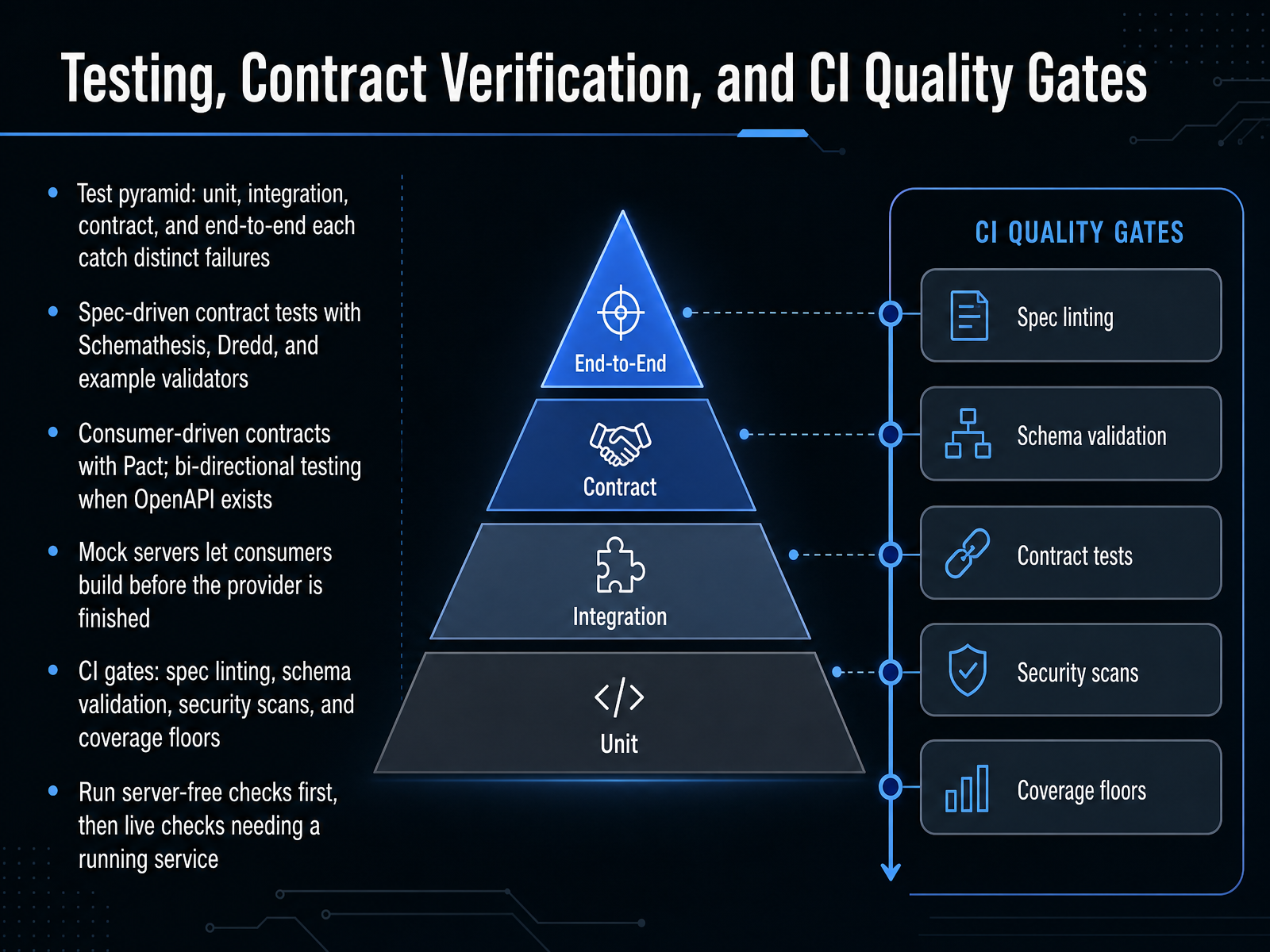
- 08Testing, Contract Verification, and CI Quality GatesLet's look at testing, contract verification, and C I quality gates. The test pyramid still holds: unit, integration, contract, and end-to-end tests each catch distinct failures. Unit tests catch logic errors fast. Contract tests catch mismatches between services. Use spec-driven tools like Schemathesis, Dredd, and example validators to check your implementation against the OpenAPI document. When OpenAPI exists, bi-directional contract testing with Pact is the pragmatic default, and full consumer-driven contracts fit your highest-risk integrations. Mock servers let consumers build before the provider is finished, so front-end and partner teams stop waiting. Now, the C I gates. Run spec linting, schema validation, security scans, and coverage floors on every pull request. A useful rule: run server-free checks first, things like linting, example validation, and breaking-change diffs. They finish in seconds. Then run live checks that need a running service, like Schemathesis and Dredd against staging. Wire them in order so a malformed example fails fast instead of wasting a staging run. Coming up next, observability with Open Telemetry.
 asoasis.techcadence.withremote.aimdsanwarhossain.me+22 min
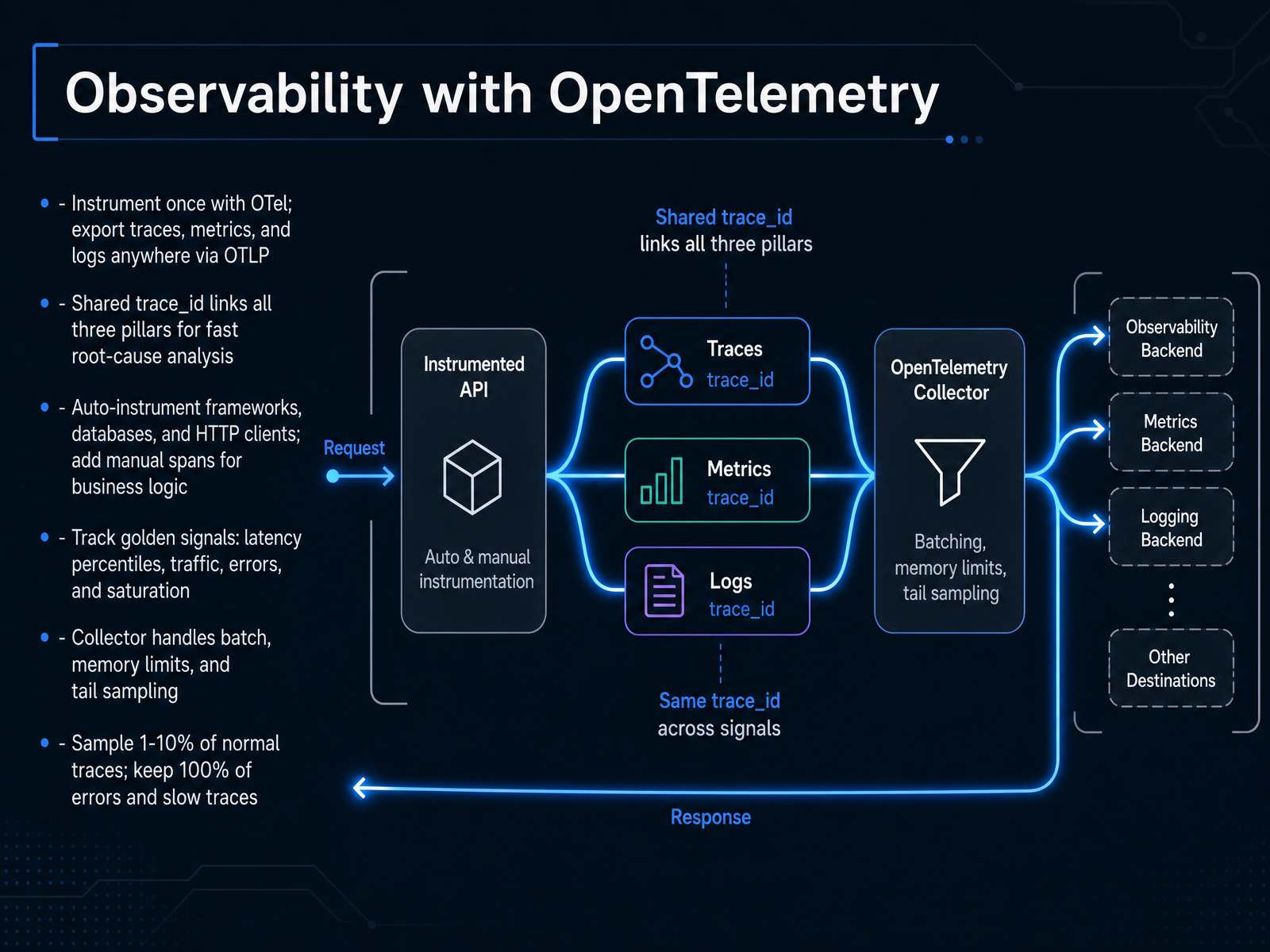
- 09Observability with OpenTelemetryLet's look at observability with OpenTelemetry, and how to instrument once for all three signals.
OpenTelemetry, or OTel, is the open standard here. You instrument once in your code, then export traces, metrics, and logs anywhere through OTLP, the wire protocol every major backend now accepts. No vendor lock-in. The shared trace_id is the key. It links all three pillars, so you jump from an error spike in your metrics to the exact trace, and from that trace to the related log lines. That is fast root-cause analysis.
In practice, start with auto-instrumentation. Frameworks, databases, and HTTP clients get covered with no code changes. Then add manual spans where business logic matters.
Track the golden signals: latency percentiles, traffic, errors, and saturation. Put an OTel Collector in front of your backends. It handles batching, memory limits, and tail sampling, so those decisions stay out of your app code.
For volume control, sample one to ten percent of normal traces, but keep one hundred percent of errors and slow traces. That is where the debugging value lives.
Let's move on to performance, caching, and load testing.
 1 min
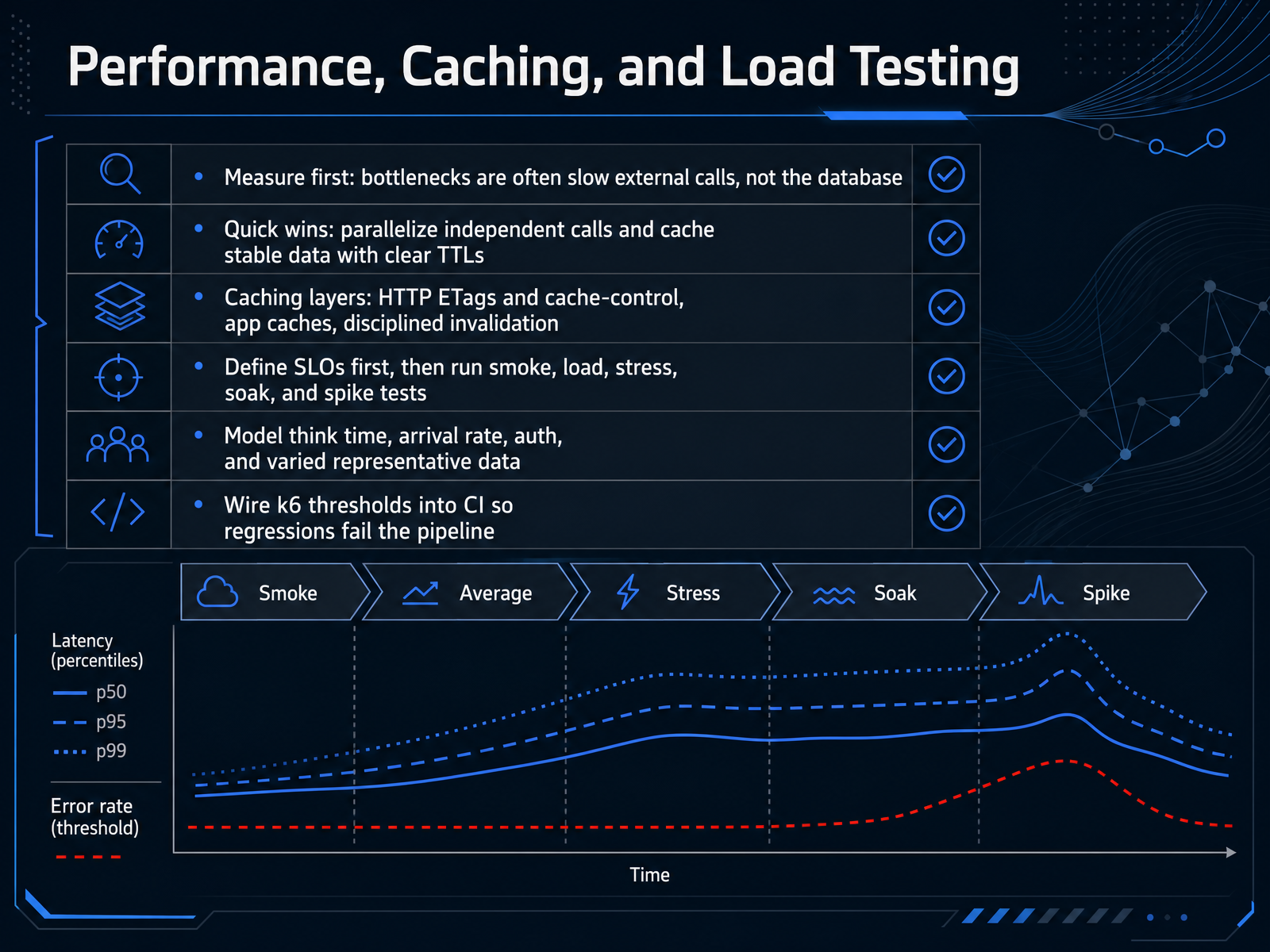
- 10Performance, Caching, and Load TestingLet's turn to performance, caching, and load testing. Once correctness and security are in place, this is usually where production incidents and expensive rework come from, so it deserves the same engineering discipline. Start by measuring. In real systems, the biggest bottleneck is often a slow external call, not the database. One team found that seventy-one percent of their latency came from third-party APIs. So instrument first, then optimize.
Then take the quick wins. Parallelize independent calls, and cache stable data with clear time to live values. For HTTP, use ETags and cache control so clients and gateways can reuse responses. In the application layer, cache data like user settings or analytics summaries in Redis, and define invalidation rules up front.
For load testing, define your service level objectives before touching a tool. Then work through smoke, load, stress, soak, and spike tests. Model think time, arrival rate, authentication, and varied representative data, because a hardcoded request hides real behavior. Finally, wire k six thresholds into continuous integration so a latency or error-rate regression fails the pipeline. Measure, cache carefully, and let SLOs drive the test.
Next, we'll cover versioning, deprecation, and lifecycle management.
 2 min
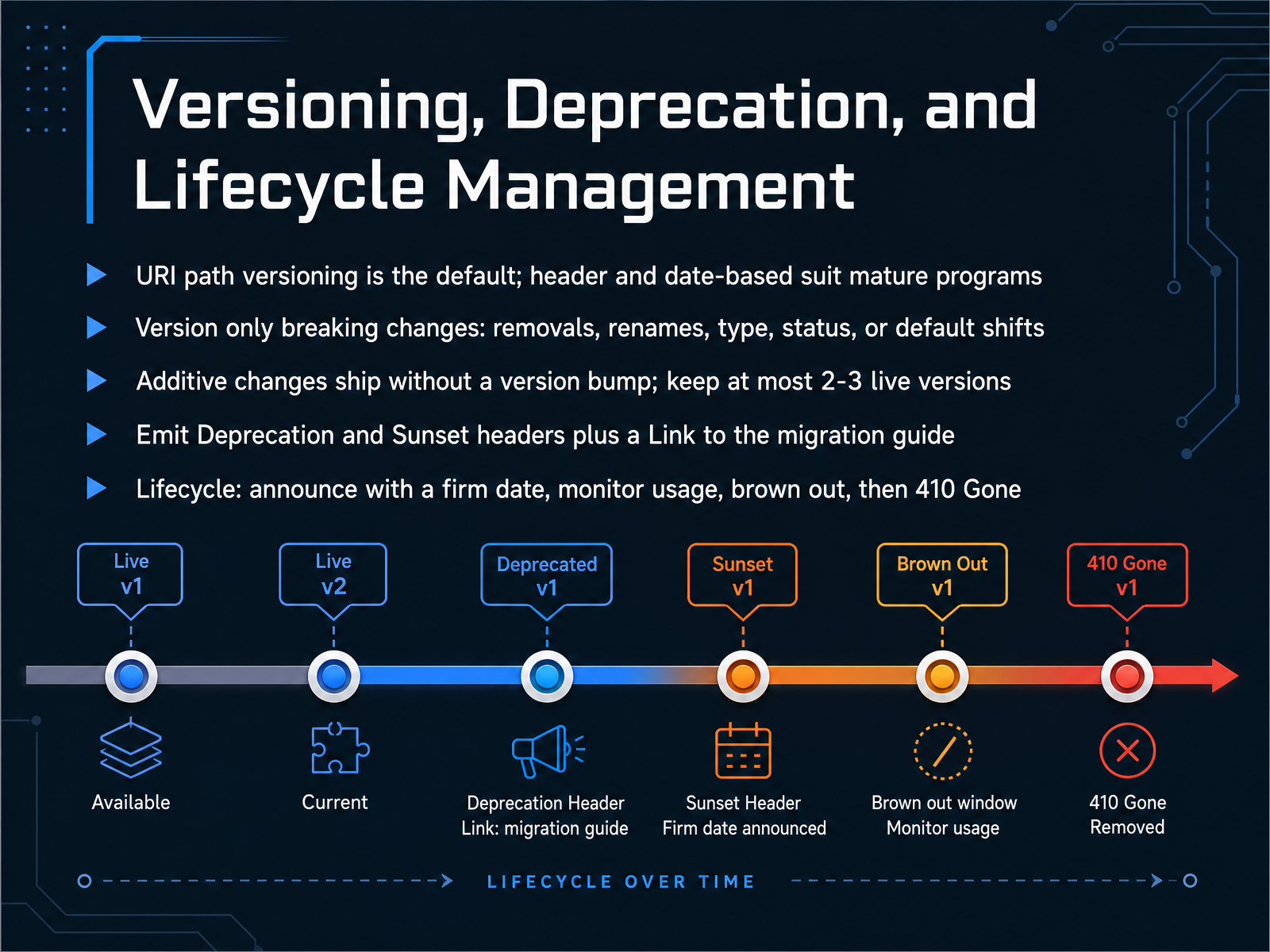
- 11Versioning, Deprecation, and Lifecycle ManagementLet's talk about versioning, deprecation, and lifecycle management. URI path versioning is the default, because the version sits right in the URL, so any request is easy to debug and route. Header and date-based versioning suit mature programs that ship changes often. Version only breaking changes: removals, renames, type changes, status code shifts, or default changes. Everything additive ships without a bump, and keep at most two or three live versions. When you deprecate, emit a Deprecation header, a Sunset header with the removal date, and a Link to the migration guide. Then follow the lifecycle: announce with a firm date, monitor usage, brown out the old version to flush out stragglers, and finish with four ten Gone. Next, we move into documentation, developer experience, and governance.
 cloud.google.comcadence.withremote.aireference.apios.info+21 min
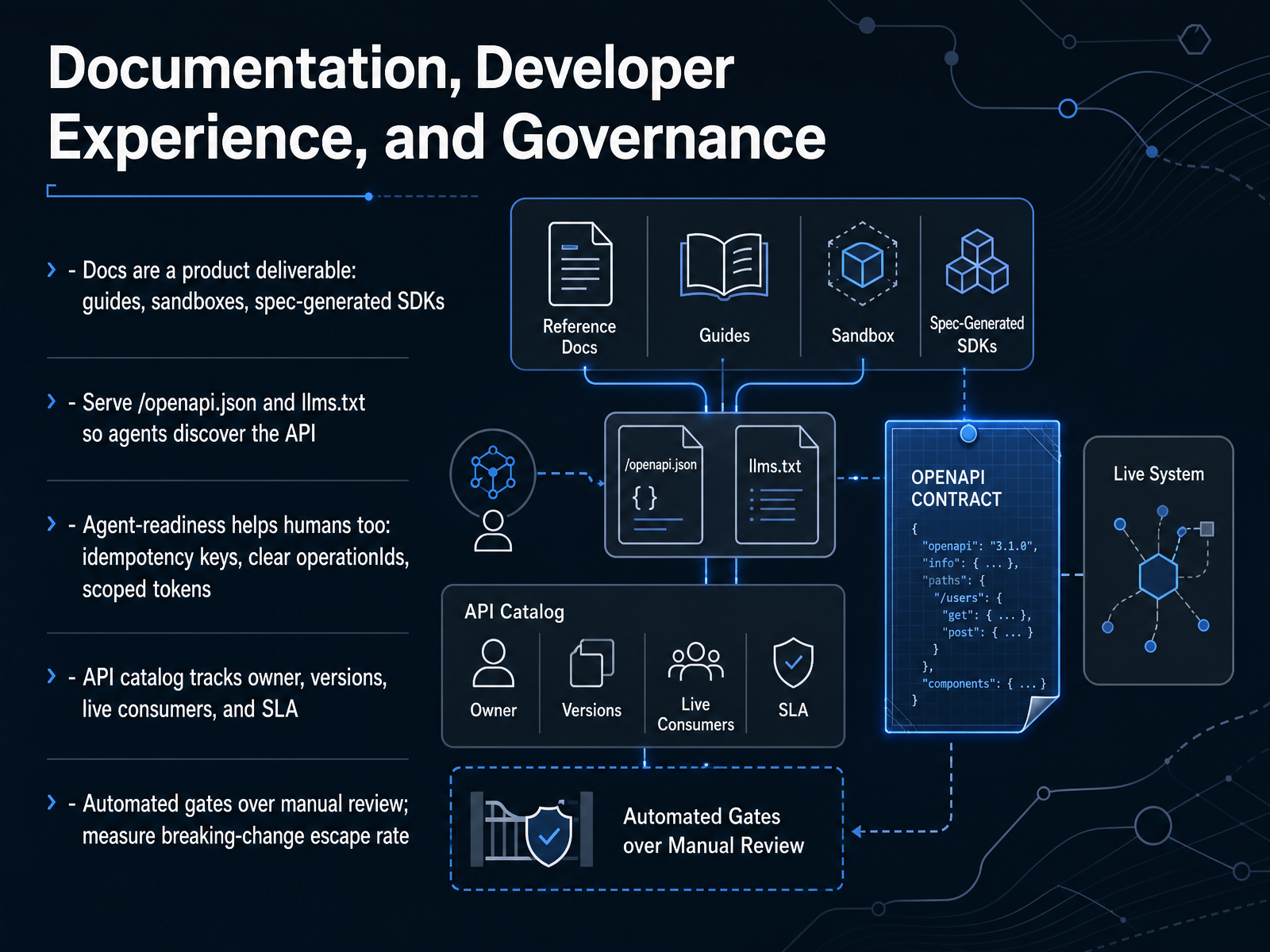
- 12Documentation, Developer Experience, and GovernanceLet's close on documentation, developer experience, and governance. Treat docs as a product deliverable, not an afterthought. That means real guides, a sandbox developers can hit safely, and SDKs generated straight from your OpenAPI spec, so they never drift.
Also serve your spec at a stable path like openapi dot json, plus an llms dot txt summary. Why? So agents can discover the API. And agent-readiness helps humans too. Idempotency keys stop duplicate charges when clients retry. Clear operationIds help both agents and codegen pick the right endpoint. Scoped tokens enforce least privilege.
Finally, run an API catalog that tracks owner, versions, live consumers, and SLA. Then rely on automated gates over manual review, and measure your breaking-change escape rate. That's the number that tells you governance is actually working.
Next, we put this into practice: Hands-On Practice: Designing and Shipping an API Slice.
 cadence.withremote.ai2 min
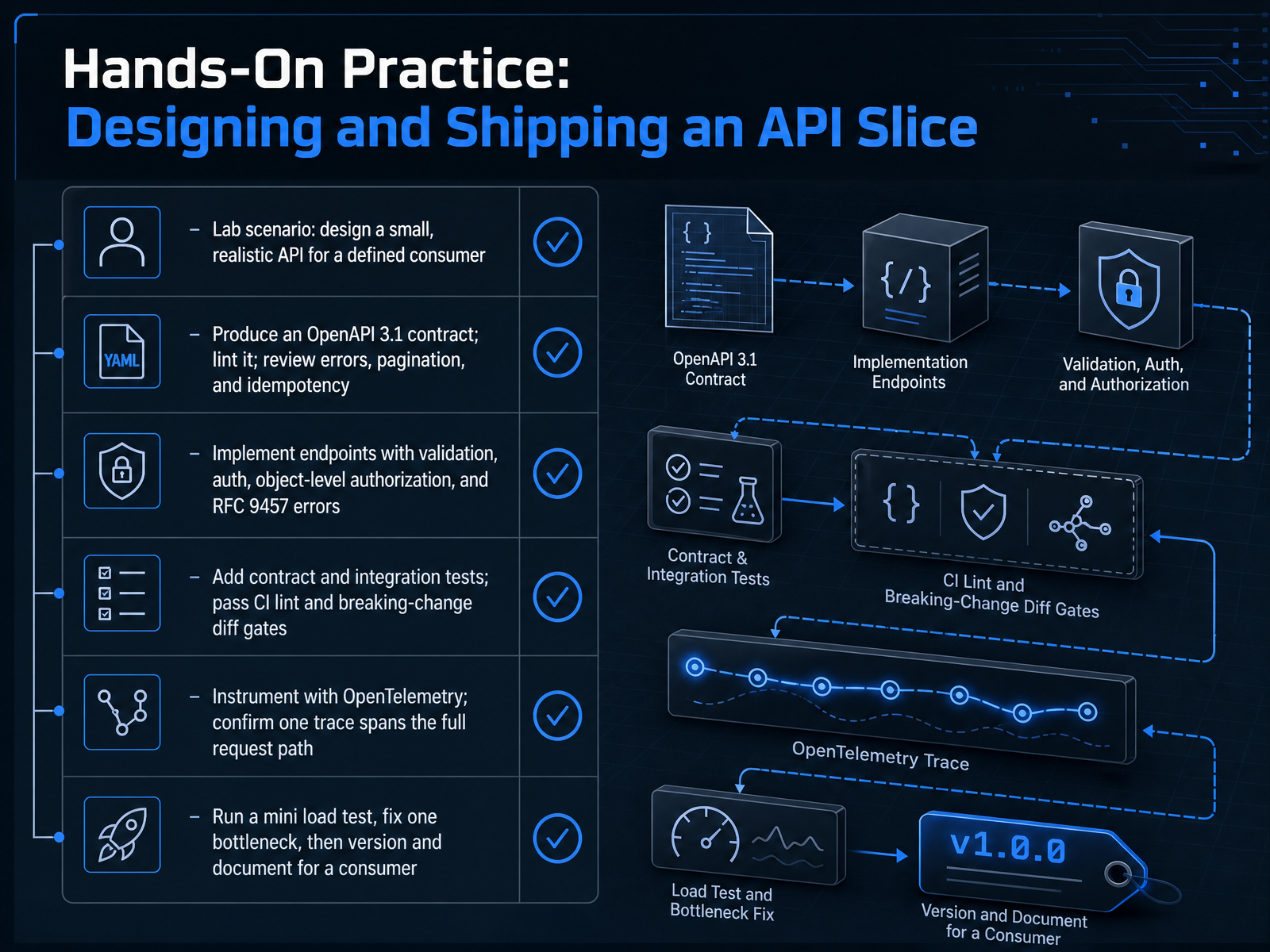
- 13Hands-On Practice: Designing and Shipping an API SliceLet's put everything into one lab. Design a small, realistic API for a defined consumer, not a generic one. Start by writing an OpenAPI three point one contract first. Lint it with Spectral, then review errors, pagination, and idempotency before you write any handler. Next, implement the endpoints. Add request validation, authentication, object level authorization, and RFC nine four five seven problem details for errors. Then write contract and integration tests and make CI pass two gates: spec lint and a breaking change diff. After that, instrument with OpenTelemetry and confirm one trace spans the full request path, so you can see every span in a single trace. Finally, run a mini load test, fix one real bottleneck, then version and document the API for your consumer team. Keep the slice small enough to finish, and fix one bottleneck rather than chasing every metric.
 mdsanwarhossain.measoasis.techcadence.withremote.ai+22 min
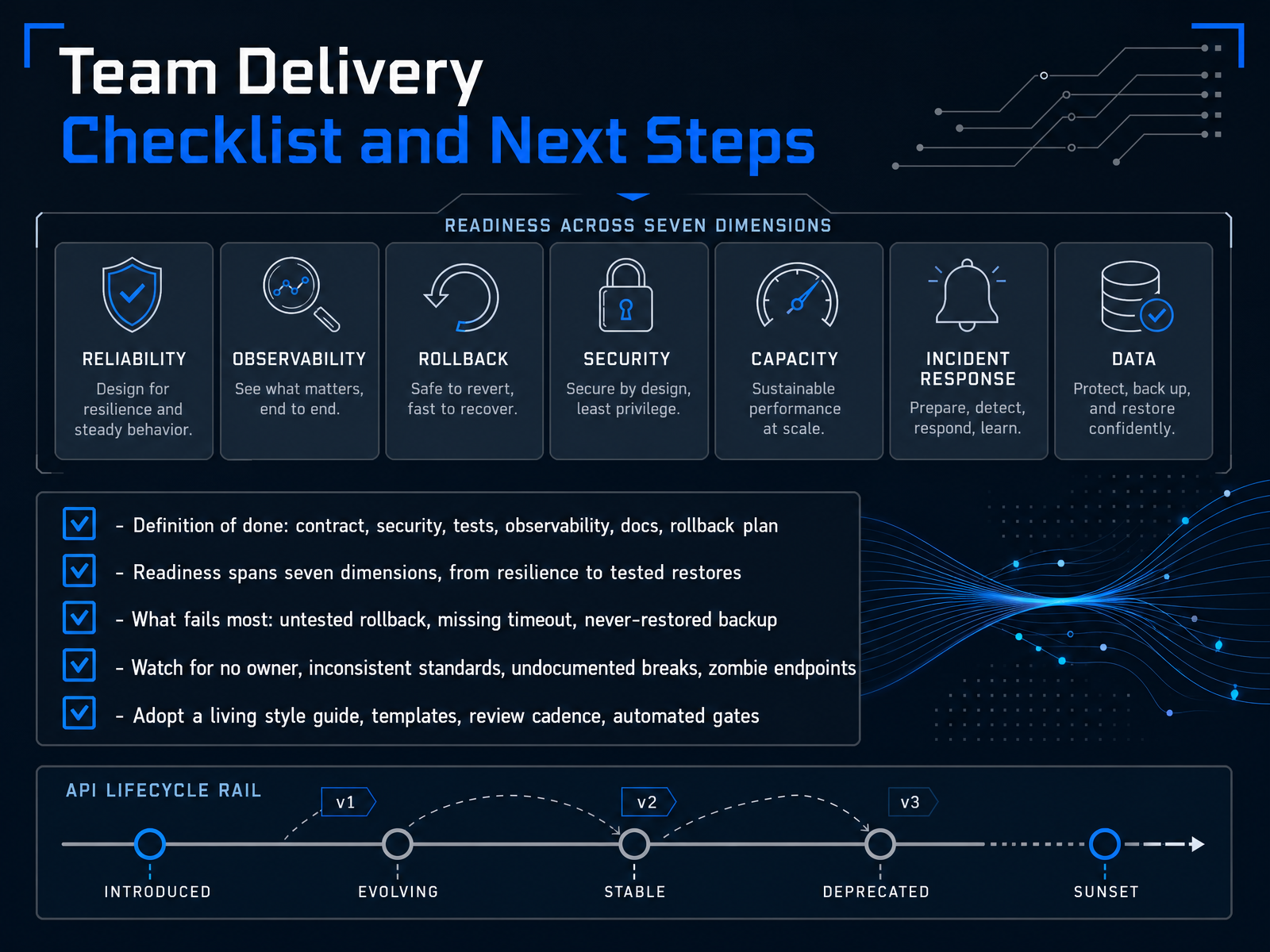
- 14Team Delivery Checklist and Next StepsLet's close with the checklist you'll actually use. Definition of done means six things, not one: a clear contract, security controls, tests, observability, docs, and a rollback plan. Missing any one of those turns a launch into an incident. Readiness spans seven dimensions, from resilience and observability to security, capacity, incident response, and tested restores. What fails most often? An untested rollback, a missing timeout on an outbound call, and a backup that has never been restored. Those are concrete, and they're preventable. Watch for the slow killers too: no clear owner, inconsistent standards across teams, undocumented breaking changes, and zombie endpoints nobody maintains. Here's your next step. Adopt a living style guide, plus templates, a regular review cadence, and automated gates in your pipeline. Encode your standards as linting, contract tests, and security scans, so most changes pass without human review. Automate the ninety-five percent, and save people for the judgment calls. That's the whole course. You now have a practical path from design to delivery. Thank you for sticking with it, and go ship something solid.
 2 min
Take the deck with you
Download this course as a file — free, no sign-up needed.
- PDF handoutEvery slide page, ready to print or share.15 pages · 3.7 MBDownload
- Narrated PowerPointThe deck that presents itself — every slide carries the digital human's narration video.15 pages · 18.4 MBDownload
- PowerPoint slidesThe full deck as a .pptx — open it in PowerPoint, Keynote, or Google Slides.15 pages · 3.6 MBDownload
Free to use in your own training — please keep the PersonWise credit page at the end.
Have your own deck? Turn it into a course
Sources consulted
Web sources consulted while building this course.
- Versioning | Cloud APIs | Google Cloud — cloud.google.com
- How to do API versioning correctly in 2026 | Cadence blog — cadence.withremote.ai
- API Versioning and Lifecycle | API/OS Reference — reference.apios.info
- API Versioning Best Practices — Complete Guide (2026) | DevWithTools — devwithtools.org
- API Versioning: The Complete 2026 Guide With Examples | Docsio — docsio.co
- REST vs gRPC vs GraphQL: A Production Decision Guide | BackendBytes — backendbytes.com
- REST vs GraphQL vs gRPC in 2026: An Architect's Decision Matrix - DEV Community — dev.to
- REST vs GraphQL vs gRPC: When to Use Which in 2026 - DEV Community — dev.to
- REST vs GraphQL vs gRPC: Pick Per Boundary, Not Per Company — andriiboyko.com
- GraphQL vs REST vs gRPC: A 2026 Decision Framework | Fordel Studios — fordelstudios.com
- Contract‑First API Design with OpenAPI: A Practical Guide for Teams — asoasis.tech
- Best practices for API design in 2026 | Cadence blog — cadence.withremote.ai
- Contract-First API Development: OpenAPI 3.1, Code Generation, Schema Validation & Breaking Change Detection in CI | Md Sanwar Hossain — mdsanwarhossain.me
- API design best practices guide (March 2026) - Fern: Docs — buildwithfern.com
- API Development Series Part 3: OpenAPI Specification - Wasil Zafar — wasilzafar.com
- Backend Storage Patterns for Idempotency — DistributedRequest — distributedrequest.com
- Idempotency Keys Are How You Make Retries Safe in Distributed Systems | Chirag Hasija — chiraghasija.cc
- Idempotency keys for safe HTTP retries | Digitarise — digitarise.com
- API Error Handling and Resilience: 2026 Reference Guide — digitalapplied.com
- The API Idempotency Threat Model: Safely Handling Retries — newsletter.securepatterns.dev