English Verb Tenses Mastery
Begin
14 pages · ~28 min
English Verb Tenses Mastery
This training explains English verb tenses, helping learners use past, present, and future forms correctly in writing and speaking.
What you’ll learn
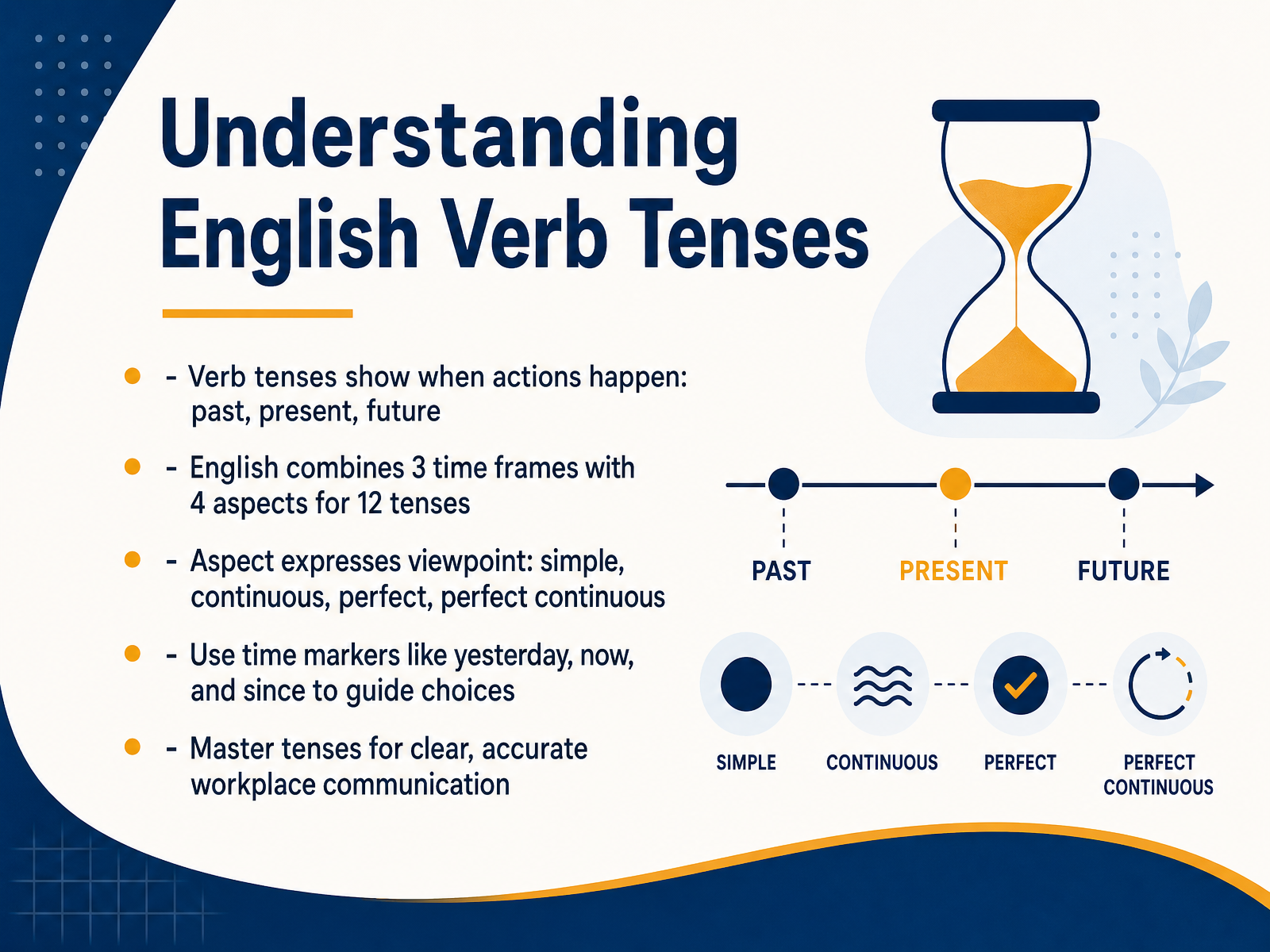
- 01Understanding English Verb TensesWelcome! I'm so glad you're here. Today, we're going to tackle something that can feel a bit daunting at first, but I promise it's more logical than it seems: English verb tenses. Think of tenses as your time machine for language. They tell your listener exactly when something happens—whether it's in the past, the present, or the future. But English does something special. It combines those three time frames with four different viewpoints, which we call aspects. Those aspects are simple, continuous, perfect, and perfect continuous. When you mix them together, you get twelve distinct tenses. Don't worry about memorizing them all right now. Instead, focus on this idea: each tense is like a different camera angle on an event. And here's a little secret to guide you—words like 'yesterday,' 'now,' and 'since' are your time markers. They give you clues about which tense to use. Master this system, and you'll communicate with clarity and confidence in any workplace. So, let's begin our journey. We'll start by looking at why these tenses can feel so tricky in the first place.blog.rosettastone.comenglish.lingolia.comgrammarly.com+21 min
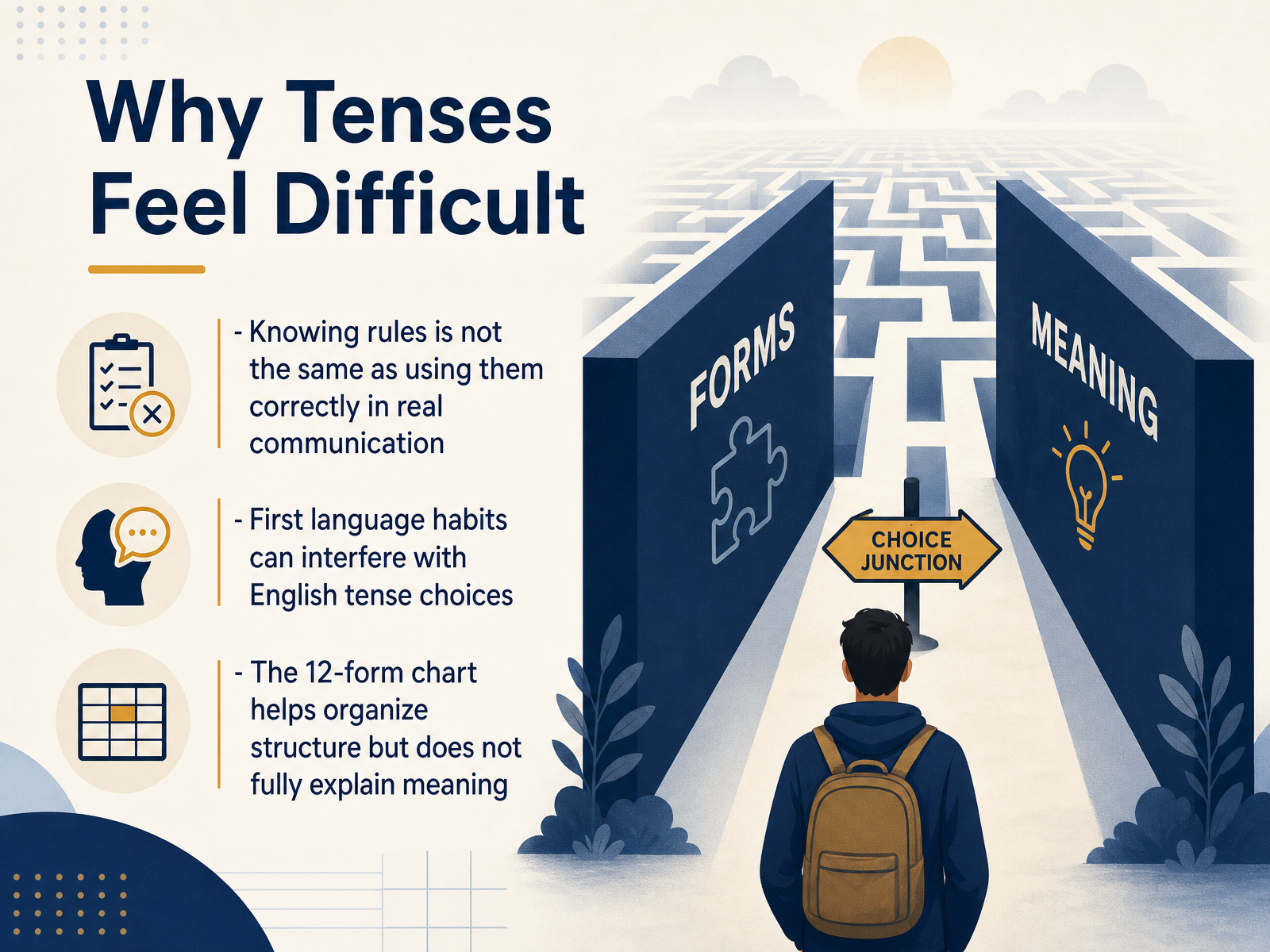
- 02Why Tenses Feel DifficultLet's start by admitting something that many learners feel but rarely say out loud: English tenses can be frustrating. It's not because the rules are impossible. It's because knowing a rule and using it naturally in real conversation are two very different skills. You might memorize that we add 'ed' for the past, and then freeze when you need to tell a story about your weekend. That gap—between knowledge and real use—is where the difficulty lives. Another layer is your first language. If your language doesn't mark time the way English does, your brain will quietly follow old habits. For example, in some languages, you can say 'I live here for three years' and it sounds fine. In English, that needs a different form. And then there's the famous chart with twelve tenses. It looks neat. Four present, four past, four future. But that chart is just a map of forms. It doesn't show you the thinking behind each choice. So you end up with the right form for the wrong moment. Here's the encouraging part: once you understand that tenses are about viewpoint, not just time, the fog starts to lift. Next, we'll look at the key ideas of tense, time, aspect, and voice—the building blocks that make the whole system click.
 eflcafe.netmylanguageclasses.indoi.org+22 min
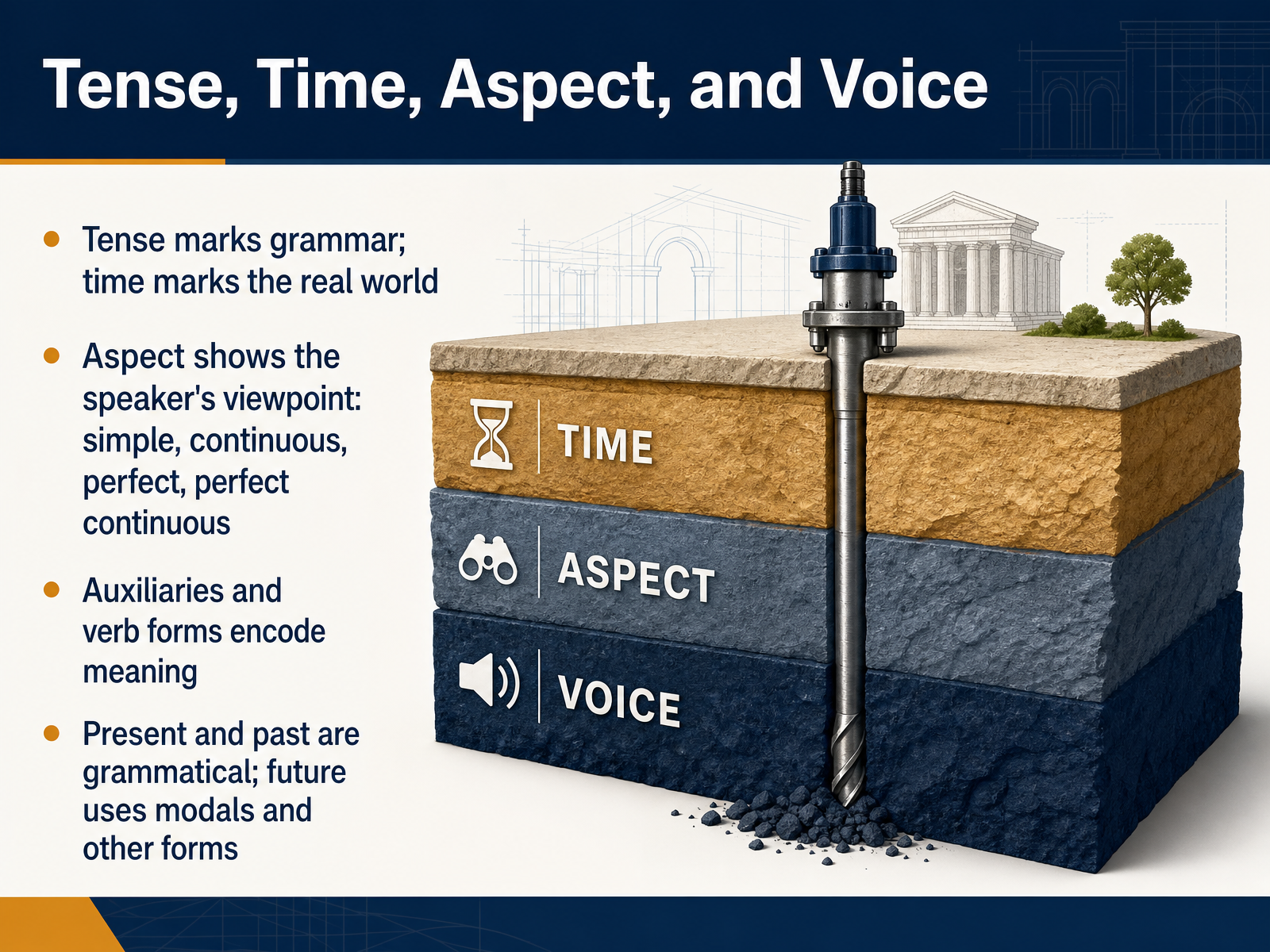
 - 03Tense, Time, Aspect, and VoiceLet’s clear up something important before we dive into the twelve forms. In English, we need to separate tense, time, aspect, and voice. Tense is a grammatical label. Time is the real world. For example, the present tense is a set of verb forms, but it does not always mean "right now." We can say "The train leaves at six" to talk about the future, using the present tense. Aspect is different. It shows the speaker’s viewpoint. Do we see an action as a simple fact, as ongoing, as completed, or as ongoing and completed? That gives us simple, continuous, perfect, and perfect continuous. These meanings are built with auxiliary verbs and verb forms. And here is a helpful truth: English only has two grammatical tenses, present and past. The future is expressed with modals like will, or with other forms. So when you hear about twelve tenses, you are really combining two grammatical tenses with four aspects, plus future forms. Keep this framework in mind, and the twelve forms become much easier to organize. Now, let’s look at the 12 main tense forms at a glance.
 blog.rosettastone.comenglish.lingolia.comgrammarly.com+21 min
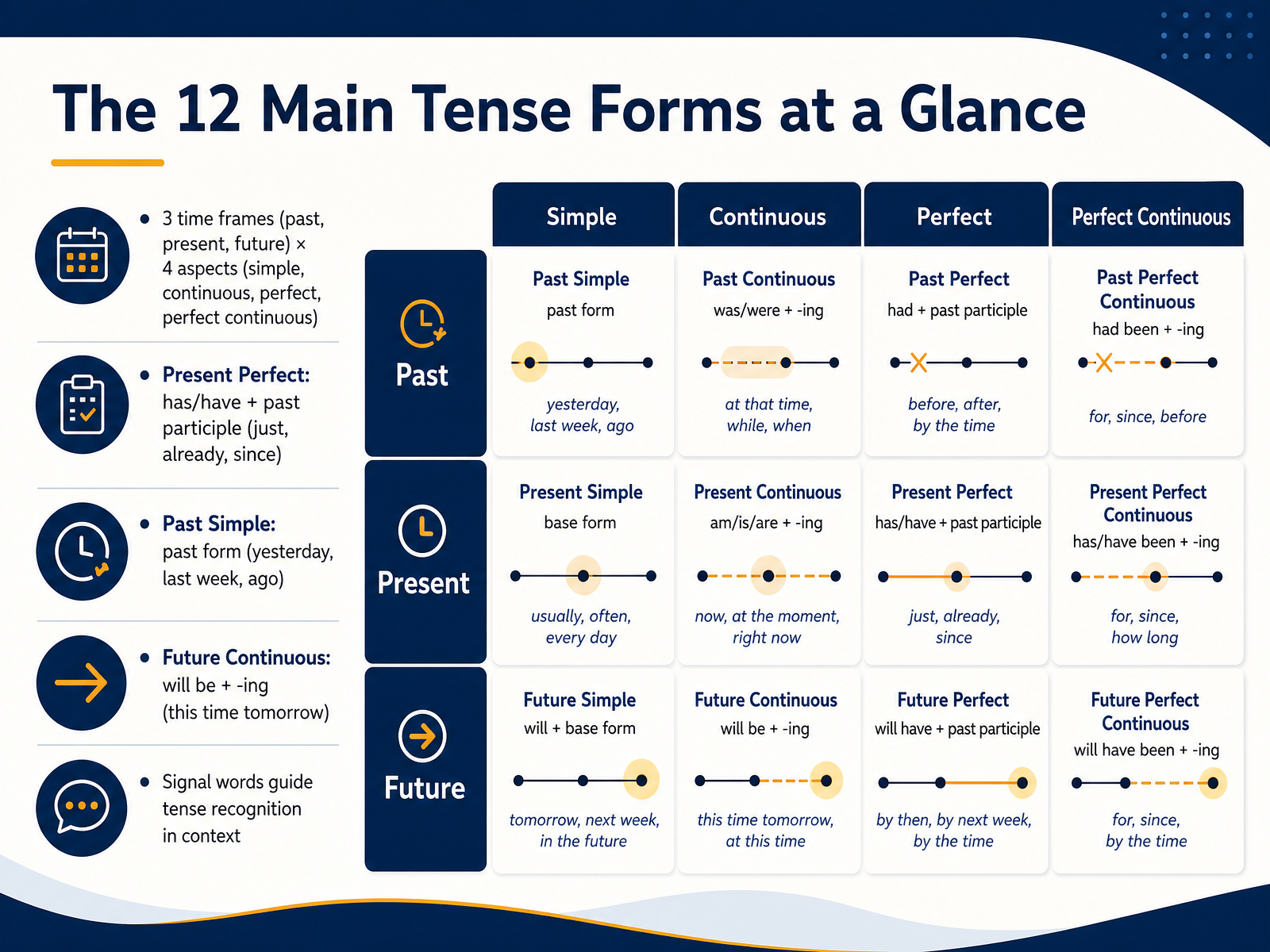
 - 04The 12 Main Tense Forms at a GlanceNow that we’ve seen how tenses are built, let’s put the whole picture together. English has twelve main tense forms, and they come from a simple grid. You take three time frames — past, present, and future — and combine them with four aspects: simple, continuous, perfect, and perfect continuous. That’s three times four, giving us twelve distinct forms. Here’s what a few of them look like in practice. The present perfect is formed with have or has plus the past participle, like “I have finished.” Words like just, already, and since often appear with it. Then we have the past simple, which uses the past form of the verb — think “She walked yesterday.” Signal words here include yesterday, last week, and ago. And the future continuous is will be plus the ing form, as in “This time tomorrow, I will be flying to Tokyo.” Notice how signal words guide us. They act like signposts, helping you recognize which tense fits the situation. When you see just or already, your brain should think present perfect. When you see yesterday, it’s past simple. Next, we’ll focus on the present tenses in use.
 blog.rosettastone.comenglish.lingolia.comgrammarly.com+22 min
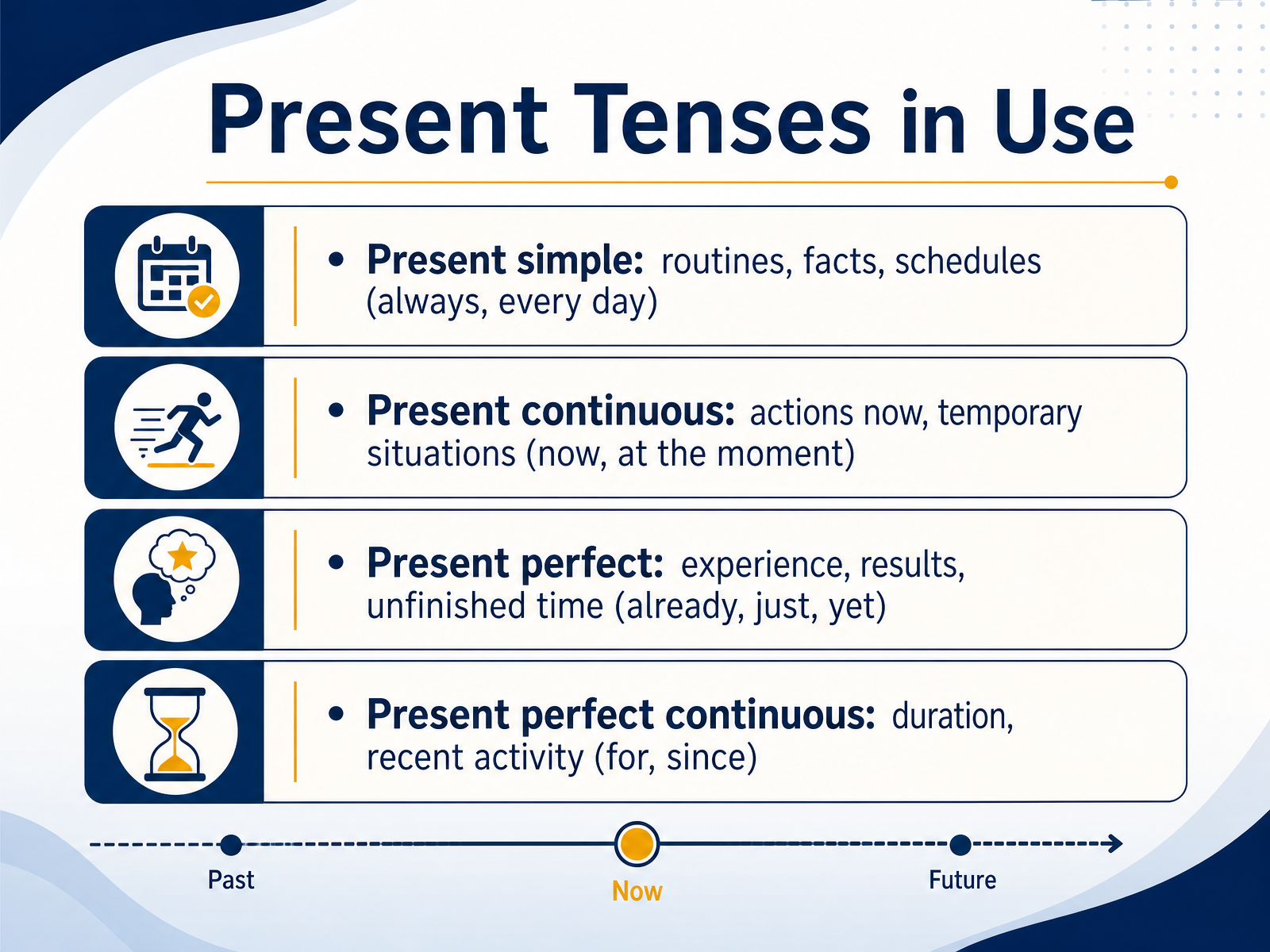
 - 05Present Tenses in UseNow let's put the present tenses to work. Think of each one as a different camera angle on the present. Present simple is your wide shot. Use it for routines, facts, and fixed schedules: water boils at a hundred degrees, or we meet every Monday. Next, zoom in with present continuous for actions happening right now or temporary situations: I am recording this lesson. Present perfect is the replay mode. It connects past actions to now, showing experience, results, or unfinished time. You use it with words like already, just, and yet: I have finished the report. Finally, present perfect continuous emphasizes duration. It tells how long an activity has been going on, using for or since: we have been working since nine. Four tenses, four perspectives. When you speak, your choice is your meaning. Now let's look at how the past tenses work in the same practical way.
 blog.rosettastone.comenglish.lingolia.comgrammarly.com+21 min
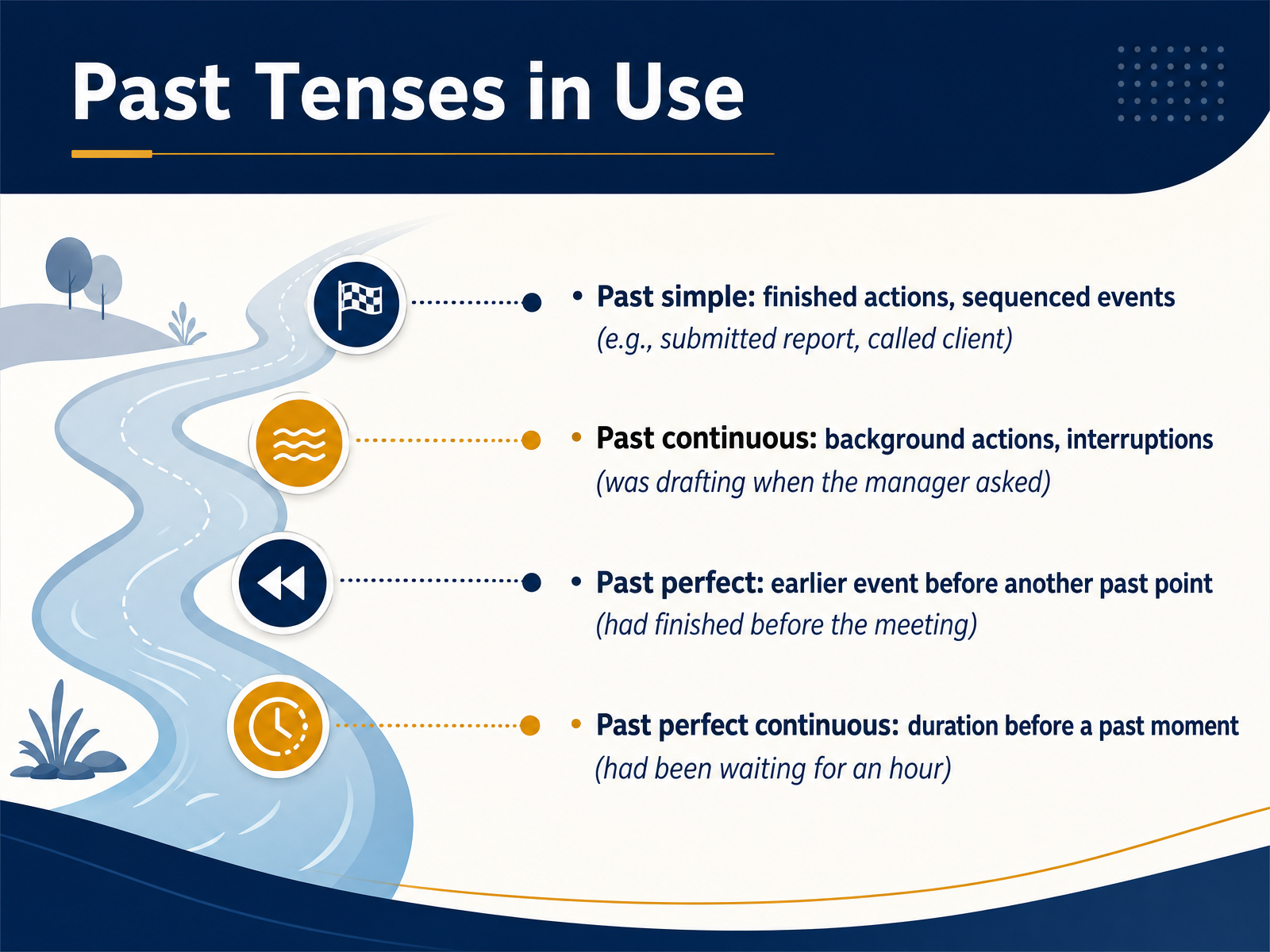
 - 06Past Tenses in UseNow let’s look at how we actually use the past tenses in real situations. There are four of them, and each one has a specific job. First, the past simple. We use this for finished actions and events that happen one after another. For example, you submitted the report, and then you called the client. Bam, done. Next, the past continuous. This sets the scene or describes a background action. Think of it as the camera rolling while something else interrupts. For instance, you were drafting an email when the manager asked for an update. The drafting was in progress, and the asking interrupted it. Then we have the past perfect. This is for an earlier event that happened before another point in the past. Say, you had finished the report before the meeting started. The finishing happened first. Finally, the past perfect continuous. This one shows the duration of an action before a past moment. For example, you had been waiting for over an hour before the interview began. Now, let's move on and see how these compare to the future forms in use.
 blog.rosettastone.comenglish.lingolia.comgrammarly.com+22 min
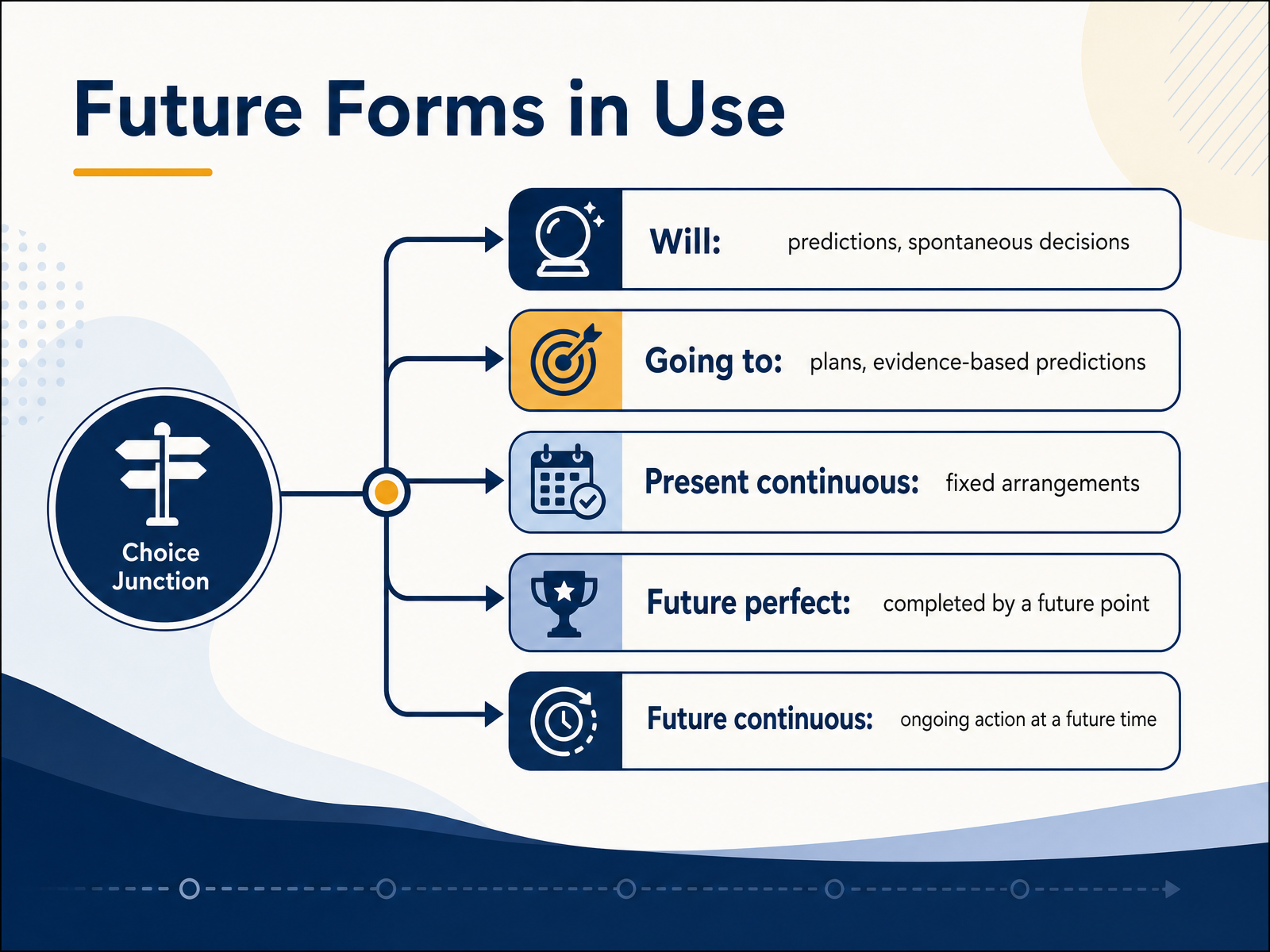
 - 07Future Forms in UseNow let's put the future tenses into action. When you make a prediction or decide something on the spot, use 'will.' Like, 'I will call you later.' For plans you've already made, use 'going to.' 'We are going to visit the office next week.' If it's a fixed arrangement, the present continuous works best. 'I am meeting the client at three.' The future perfect shows a completed action. 'By noon, I will have finished the report.' And the future continuous describes an action in progress. 'At this time tomorrow, I will be flying to New York.' Each form gives the listener a clear signal about your timing. Now, let's look at how to choose the right tense in communication.
 blog.rosettastone.comenglish.lingolia.comgrammarly.com+21 min
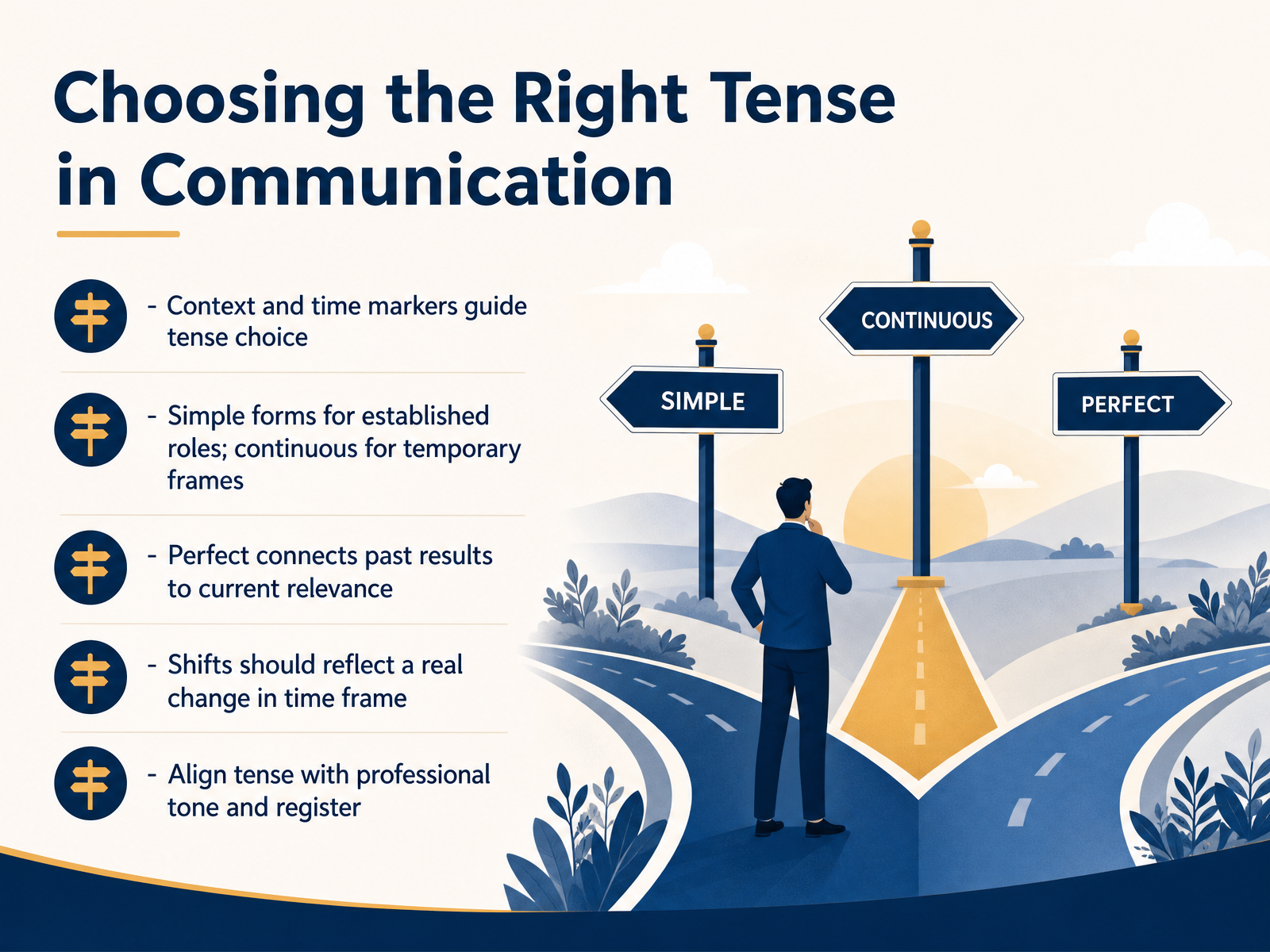
 - 08Choosing the Right Tense in CommunicationSo how do you actually choose the right tense when you're speaking or writing? It comes down to context. Look for time markers, like 'yesterday,' 'now,' or 'since March.' They guide your choice. Use simple forms when you describe a regular responsibility, for instance, 'I manage the Lyon account.' But if you're talking about something temporary, switch to continuous: 'I am managing the transition this quarter.' Perfect tenses connect the past to now. Say 'I have sent the agenda' when that action makes the next step possible. You can shift tenses, but only when the time frame really changes. In professional communication, consistency builds trust. Accidental shifts feel sloppy. Intentional shifts show you understand the timeline. Match your tense to the tone: simple and concrete for updates, precise for reports. Keep the reader's perspective in mind. Next, let's look at tense choices in professional writing.
 pressbooks.bccampus.caeditage.comtrinka.ai+22 min
 - 09Tense Choices in Professional WritingNow let's look at how tense choices work in professional writing. In the workplace, your tense sends a quiet signal about time and responsibility. Use the past tense for completed work, like “We deployed the patch on Tuesday.” Use the present tense for the current state, such as “The system handles two thousand requests per minute.” Use the future tense for commitments, like “We will deliver the report by Friday.” And here is a powerful one: the present perfect links a past result to the present moment. Saying “We have completed the audit” means the result matters right now. It is not just history. One more key point: keep your tense consistent within a sentence or paragraph. Only switch when the time frame truly changes. Consistency builds clarity and shows attention to detail, which builds trust. Next, we look at frequent tense errors and how to fix them.
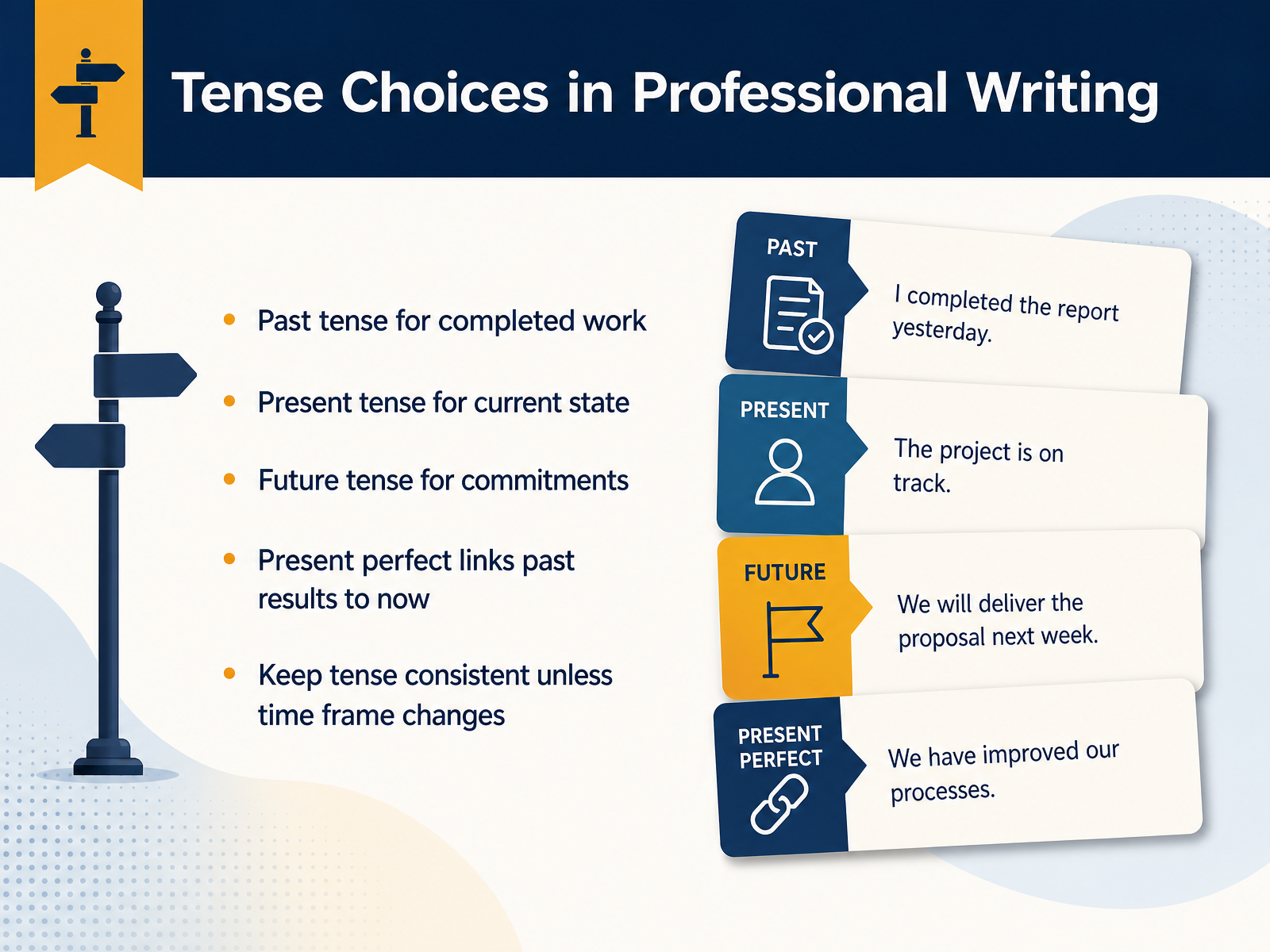 pressbooks.bccampus.caeditage.comtrinka.ai+21 min
 - 10Frequent Tense Errors and How to Fix ThemLet's look at some of the most frequent tense errors and, more importantly, how to fix them. First, mixing up the past simple and the present perfect. If you say, I've seen him yesterday, that's not quite right. Because yesterday is a finished time, we use the past simple: I saw him yesterday. A quick tip: if a specific past time is mentioned, use the past simple. Next, forgetting the third-person s. We say he works, she goes, it seems. Also, watch your do and does in questions and negatives: he doesn't like pizza, not he don't. Now, stative verbs. These describe states, not actions, so we don't use the continuous form. Instead of I am knowing, say I know. Finally, avoid shifting tense mid-sentence without a reason. If you start telling a story in the past, keep it in the past. Remember, these are common hurdles, so don't be discouraged. Identifying them is the first step. Next, we'll explore some practical strategies you can use on your own to correct these errors.{
"slide_index": 9,
"script": "Let's look at some of the most frequent tense errors and, more importantly, how to fix them. First, mixing up the past simple and the present perfect. If you say, I've seen him yesterday, that's not quite right. Because yesterday is a finished time, we use the past simple: I saw him yesterday. A quick tip: if a specific past time is mentioned, use the past simple. Next, forgetting the third-person s. We say he works, she goes, it seems. Also, watch your do and does in questions and negatives: he doesn't like pizza, not he don't. Now, stative verbs. These describe states, not actions, so we don't use the continuous form. Instead of I am knowing, say I know. Finally, avoid shifting tense mid-sentence without a reason. If you start telling a story in the past, keep it in the past. Remember, these are common hurdles, so don't be discouraged. Identifying them is the first step. Next, we'll explore some practical strategies you can use on your own to correct these errors.
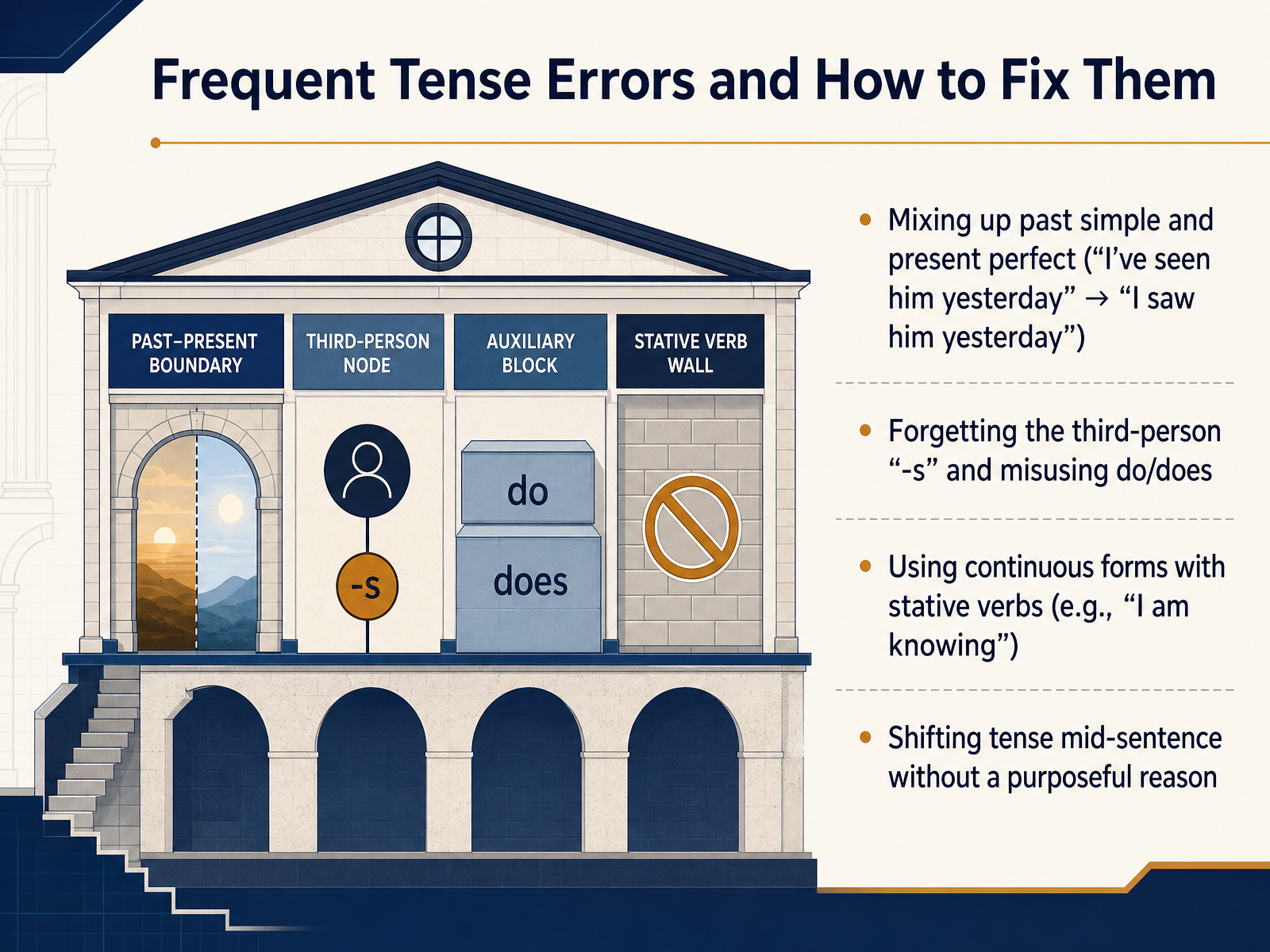 professorscottsenglish.comyourdictionary.comenglish.stackexchange.com+21 min
 - 11Error Correction Strategies for Self-StudyNow, let's talk about how you can catch and correct your own tense errors when you're studying on your own. First, focus on your most common mistakes. For many learners, that means mixing up the present perfect and the past simple. Remember, we use the past simple for finished actions at a specific time, like, I saw him yesterday. The present perfect is for actions that connect to now, like, I have already seen that movie. Also watch out for confusing do and does, and forgetting the s on third-person singular verbs, like he goes or she does. Second, use time markers as clues. Words like yesterday and last week signal past simple. Words like already and since signal present perfect. When you see them, choose the right tense. Third, read your own writing out loud. Hearing your words helps you notice those accidental tense shifts that your eyes skip right over. Finally, keep an error log. A simple notebook where you write down the mistakes you keep making. Revisit it each week and you'll be amazed at your progress. Coming up, we'll put all this into practice with some hands-on exercises. Let's keep going.
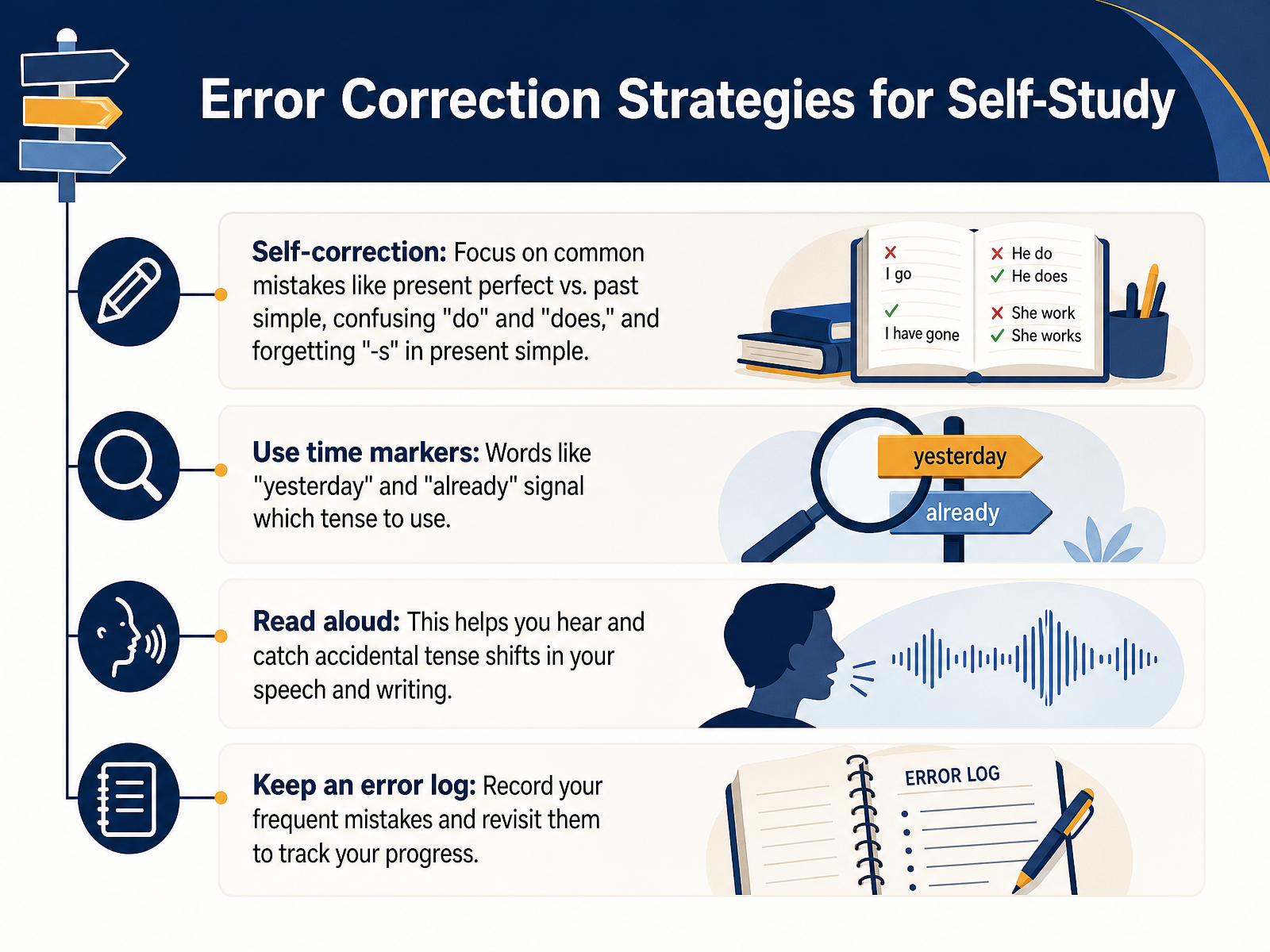 professorscottsenglish.comyourdictionary.comenglish.stackexchange.com+22 min
 - 12Practice and ApplicationNow, it's time to put all of this into practice. We will use diagnostic drills to identify which tense forms you already know well and which ones need more attention. These drills are quick checks, not tests. They help you see your own patterns. Next, we will move to writing tasks. You will write emails, reports, and meeting summaries. These are the real situations where tense choices matter most. For example, in an email, use the past tense for what you already did, the present tense for what is happening now, and the future tense for what you will do next. Then, we will practice speaking with planned timelines. You will narrate events in order, which builds your confidence with the present perfect and past perfect. Finally, we will do peer review. You will read each other's work and give feedback on common errors, like switching tenses without a reason. This practice turns knowledge into a skill you can use every day. Up next, we will review the main tense forms and the simple rules for choosing between them.
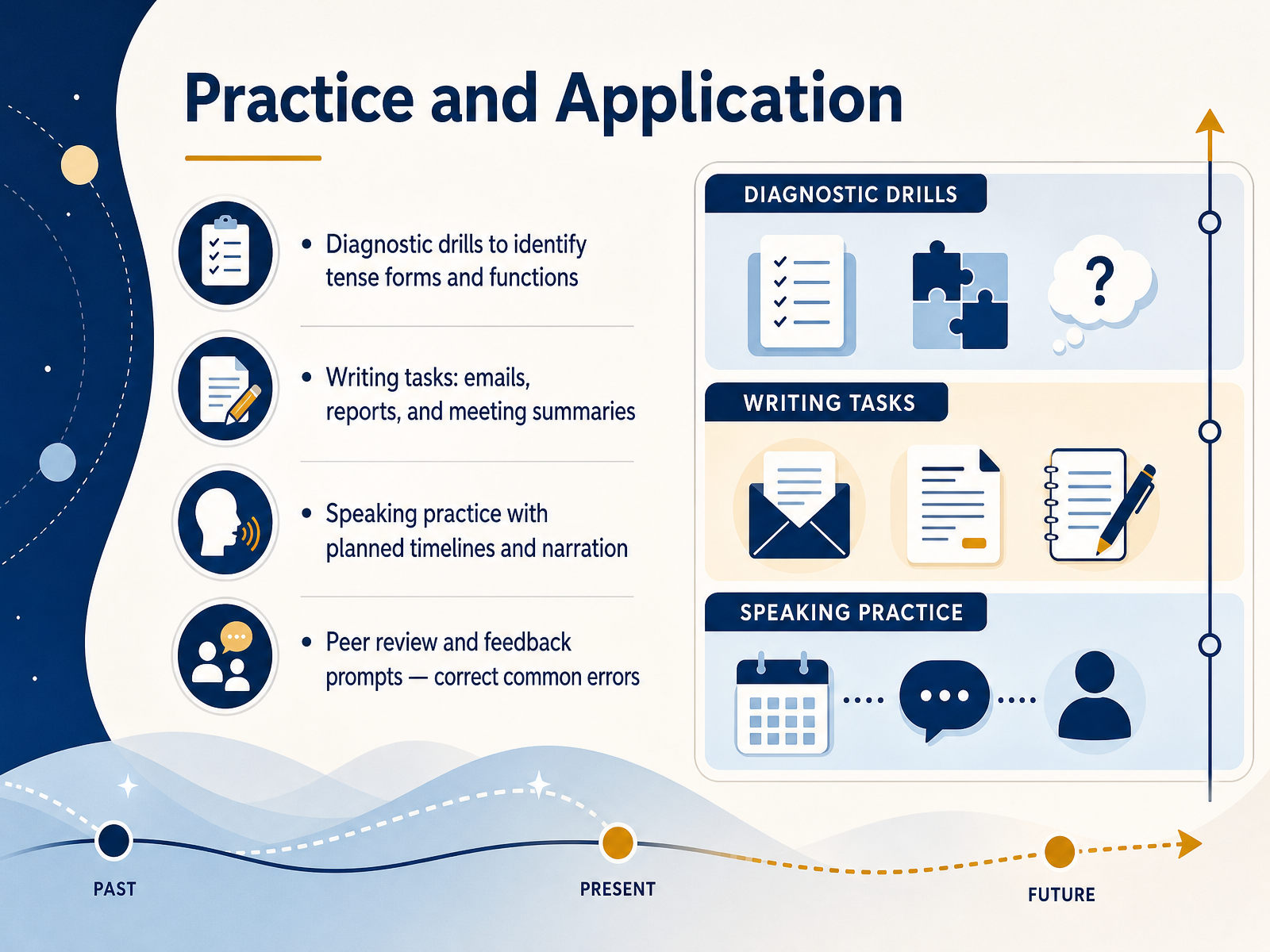 blog.rosettastone.comenglish.lingolia.comgrammarly.com+22 min
 - 13Review of Main Tense Forms and Decision RulesLet’s bring everything together with a quick review. Think of the main tense forms as four tools. Simple tense handles routines, facts, finished actions, and future plans. Continuous tense describes actions in progress at a specific time. Perfect tense shows completed actions that still matter now. And perfect continuous tense focuses on the duration of an ongoing action. Here’s a simple way to choose: ask yourself, is this a habit, a process, a result, or a duration? If it’s a habit or a fact, go simple. If it’s an action happening right now, go continuous. If it’s a result that matters now, go perfect. And if it’s about how long something has been happening, go perfect continuous. Keep this question in mind, and tense choices become much easier. Now, let’s look at next steps for continued practice.
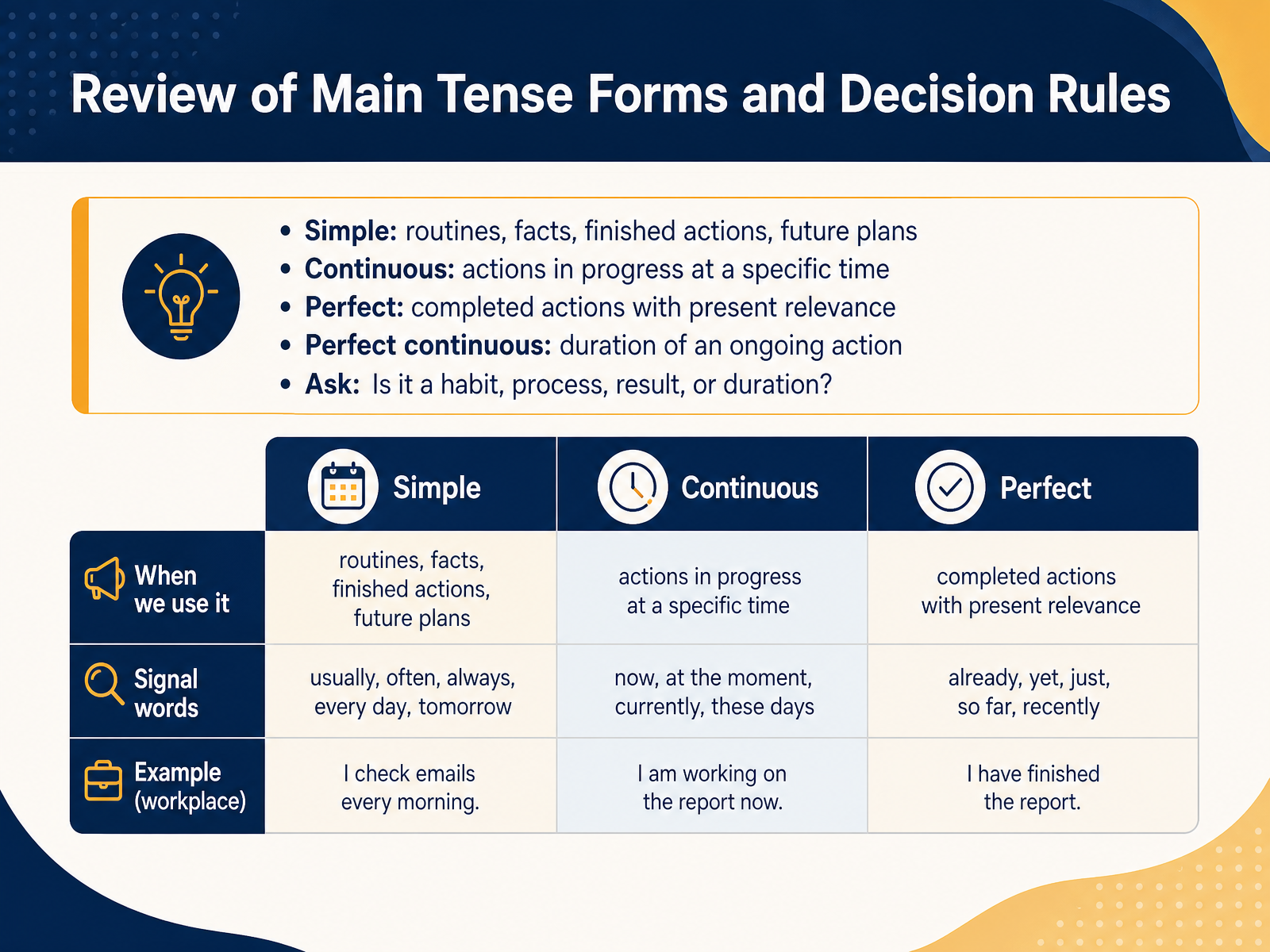 blog.rosettastone.comenglish.lingolia.comgrammarly.com+21 min
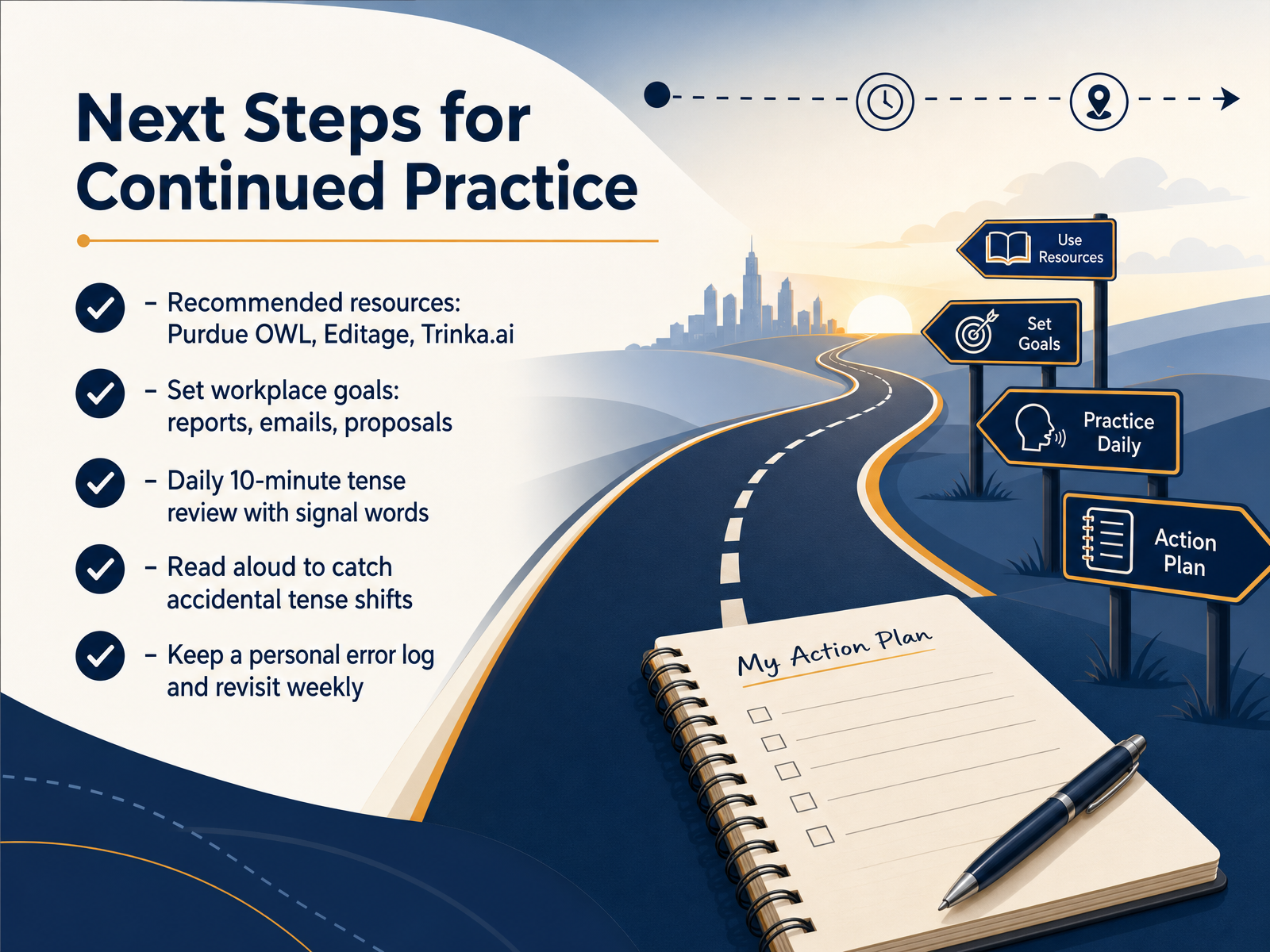
 - 14Next Steps for Continued PracticeWe've covered a lot of ground with English tenses, so let's look at how you can keep building on this progress. For reliable reference tools, remember resources like Purdue OWL, Editage, and Trinka.ai. They're great for checking tricky rules and getting your questions answered. Now, don't just study in a vacuum. Think about your own workplace goals. When you write a report or an email, take a moment to notice which tenses you're naturally using. Is the action in the past, or is it happening now? That awareness is where real progress starts. Try to set aside ten minutes a day to review tenses, focusing on the signal words like 'yesterday' or 'since' that guide your choice. And here's a simple but powerful technique: read your writing aloud. Your ear will often catch accidental tense shifts that your eyes might miss. Finally, keep a personal error log and revisit it every week. It helps you spot patterns and turn small mistakes into lasting improvement. These steps are simple, but they really add up. Thanks for your focus today, and keep practicing. You're doing great.
 pressbooks.bccampus.caeditage.comtrinka.ai+22 min
Take the deck with you
Download this course as a file — free, no sign-up needed.
- PDF handoutEvery slide page, ready to print or share.15 pages · 3.6 MBDownload
- PowerPoint slidesThe full deck as a .pptx — open it in PowerPoint, Keynote, or Google Slides.15 pages · 3.5 MBDownload
Free to use in your own training — please keep the PersonWise credit page at the end.
Have your own deck? Turn it into a course
Sources consulted
Web sources consulted while building this course.
- Easy Verb Conjugation in English (All 12 Tenses With Charts) - Rosetta Stone — blog.rosettastone.com
- Table of Verb Tenses in English Grammar — english.lingolia.com
- Verb Tenses Explained, with Examples - Grammarly — grammarly.com
- 12 Tense Formula Chart – Print & Study — englishgrammarzone.com
- All 12 English Tenses Explained: Chart, Examples, and Practice Tips — International English Test — internationalenglishtest.com
- The Ultimate Guide to English Verb Tenses for ESL Learners – EFLCafe.net — eflcafe.net
- Why English Tenses Feel Difficult: Clear Solutions — mylanguageclasses.in
- The Acquisition of English Verb Tense and Aspect of L2 Learners — doi.org
- English Tenses: 12 Tenses Chart + How to Teach Them — tahricteaches.com
- Exploring the Linguistic Obstacles in Mastering English Tenses: A Study of Non-English Major University Students’ Perceptions | INTERACTION: Jurnal Pendidikan Bahasa — e-journal.unimudasorong.ac.id
- Verb Tense – Professional Writing in the Digital Age — pressbooks.bccampus.ca
- Verb Tenses: Checklist, Rules, and Examples for Academic Writing - Educational Articles For Researchers, Students And Authors - Editage Blog — editage.com
- Grammar for Business Communication: Reports, Emails, Proposals | Trinka.ai — trinka.ai
- Verb Precision: Mastering Business English Writing - EGG — englishgrammargenius.com
- Struggling With Tenses? Consider Their Purpose — gcwritingcenter.commons.gc.cuny.edu
- What Are Common Grammar Mistakes with Verb Tenses? - Professor Scott's English — professorscottsenglish.com
- 7 Common Verb Tense Mistakes — yourdictionary.com
- What are the most common tense mistakes made in English? — english.stackexchange.com
- Error Analysis of Verb Tenses: A Case Study of International English Language Testing System Preparation Courses — scirp.org
- COMMON ERRORS IN USING ENGLISH TENSES BY EFL STUDENTS — doi.org