Begin
14 pages · ~28 min
Understanding Numbers, Dates & Times in English
This training helps English learners understand and use numbers, dates, and times accurately in spoken English. Ideal for intermediate learners seeking clearer everyday communication.
A digital instructor presents all 14 pages. Hold “Ask” at any point and ask out loud — the answer comes from this course. No sign-up needed.
What you’ll learn
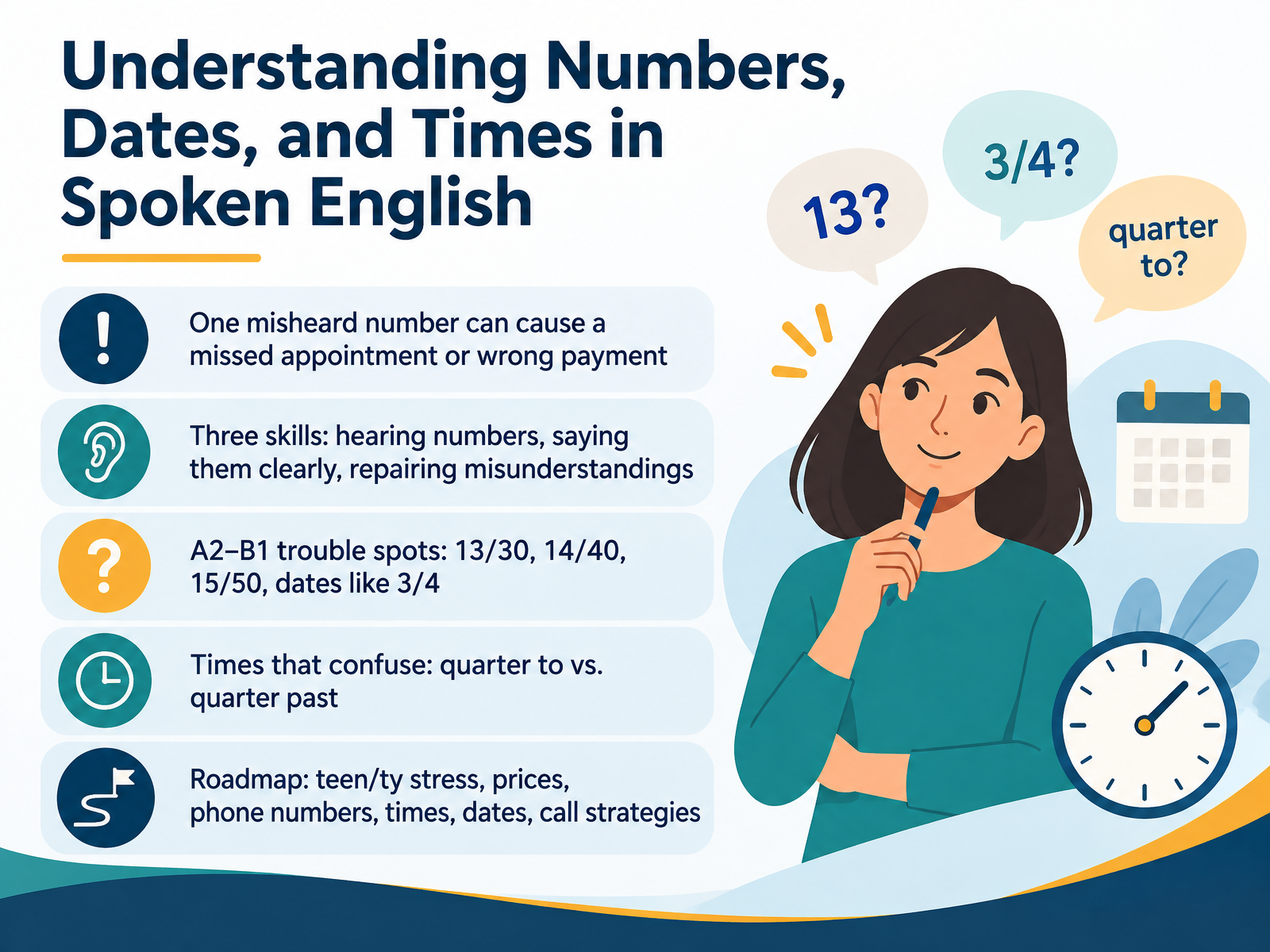
- 01Understanding Numbers, Dates, and Times in Spoken EnglishWelcome. In this course, we will work on numbers, dates, and times in spoken English. This matters because one misheard number can cause a missed appointment or a wrong payment. Here, you will build three skills: hearing numbers, saying them clearly, and repairing misunderstandings. Many learners at your level find some pairs hard. For example, thirteen and thirty, fourteen and forty, fifteen and fifty. Dates can be tricky too, like the third of April, written as three slash four. And times like quarter to nine and quarter past nine are easy to mix up. Over the next slides, we will practice teen and ty stress, prices, phone numbers, times, dates, and simple call strategies. Say each number clearly, and repeat it back to confirm. Let's begin with why numbers are hard to hear in English.2 min
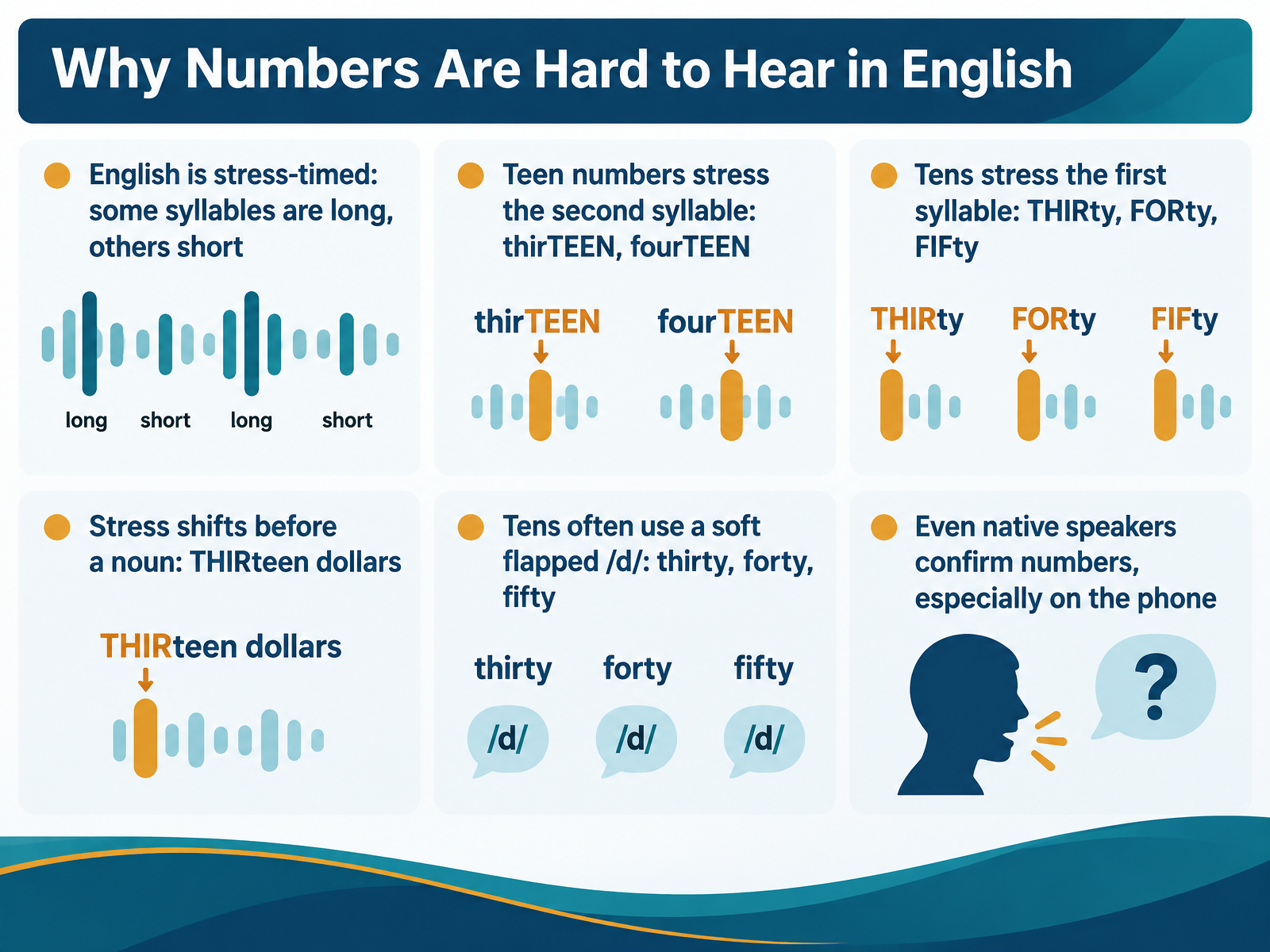
- 02Why Numbers Are Hard to Hear in EnglishNow, let's look at why numbers are hard to hear in English. English is stress-timed. Some syllables are long, and others are short. This makes numbers easy to confuse. Listen to teen numbers. The stress is on the second syllable. ThirTEEN. FourTEEN. Now listen to tens. The stress is on the first syllable. THIRty. FORty. FIFty. But stress can shift before a noun. For example, THIRteen dollars. Also, tens often use a soft flapped d sound. Thirty. Forty. Fifty. The d is light, not strong. Even native speakers confirm numbers, especially on the phone. So when you hear a number, repeat it back. Say each digit separately. This helps you check and avoid mistakes. Next, we will practice core patterns for saying numbers clearly.
 1 min
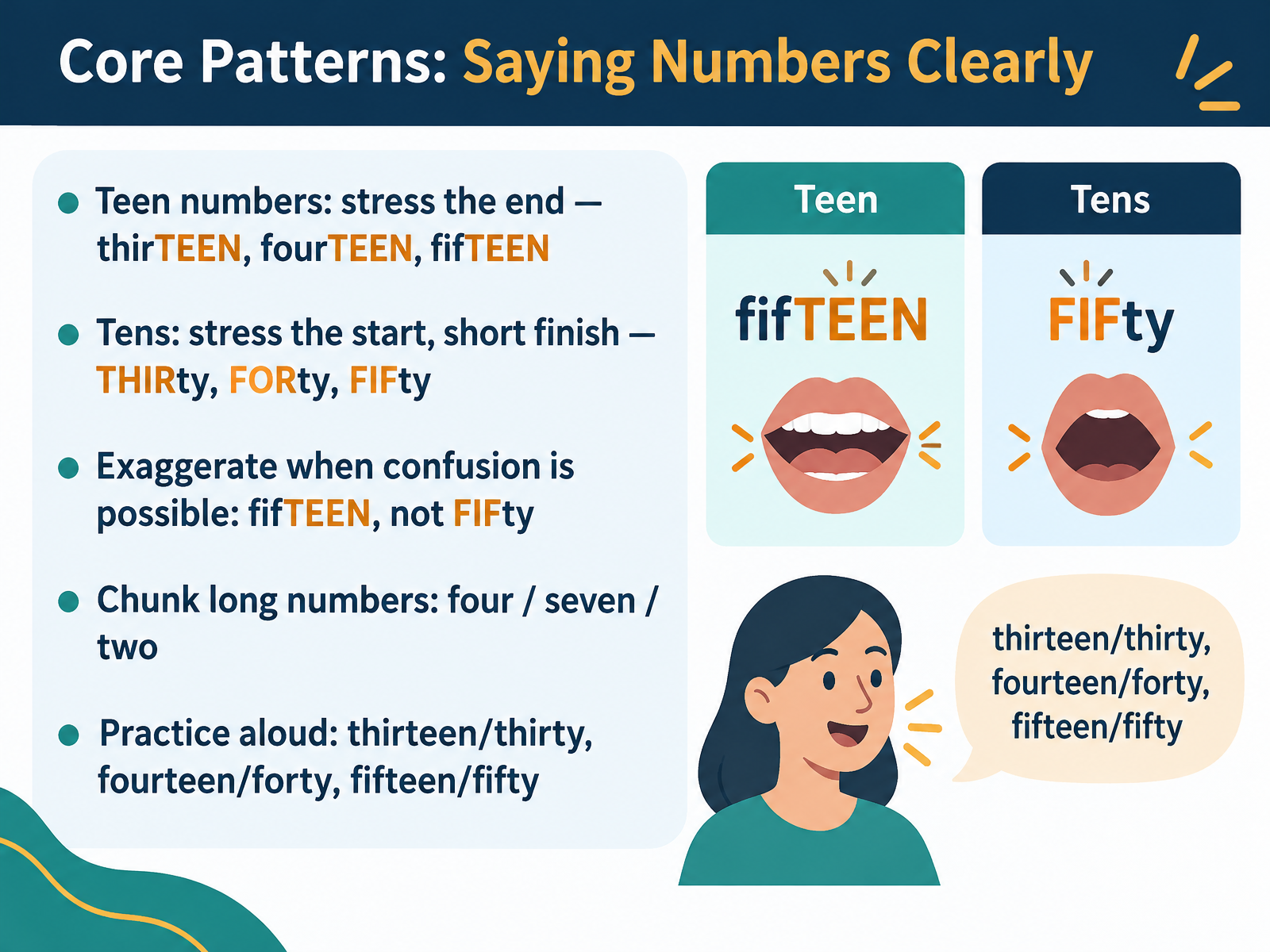
- 03Core Patterns: Saying Numbers ClearlyNow let's look at core patterns for saying numbers clearly. Some numbers sound very similar, so clear stress helps a lot. Start with teen numbers. Stress the end of the word. Say thirTEEN. FourTEEN. FifTEEN. For tens, stress the start and keep the finish short. Say THIRty. FORty. FIFty. When confusion is possible, exaggerate the difference. Say fifTEEN, not FIFty. Now repeat after me. ThirTEEN. THIRty. FourTEEN. FORty. FifTEEN. FIFty. Next, chunk long numbers into small groups. For example, four, seven, two. Pause between each part. This helps the listener follow you. Finally, practice these pairs aloud: thirteen and thirty, fourteen and forty, fifteen and fifty. Stress the end for teens. Stress the start for tens. That small change makes your numbers much clearer. Next, we will practice listening for prices, quantities, and phone numbers.
 2 min
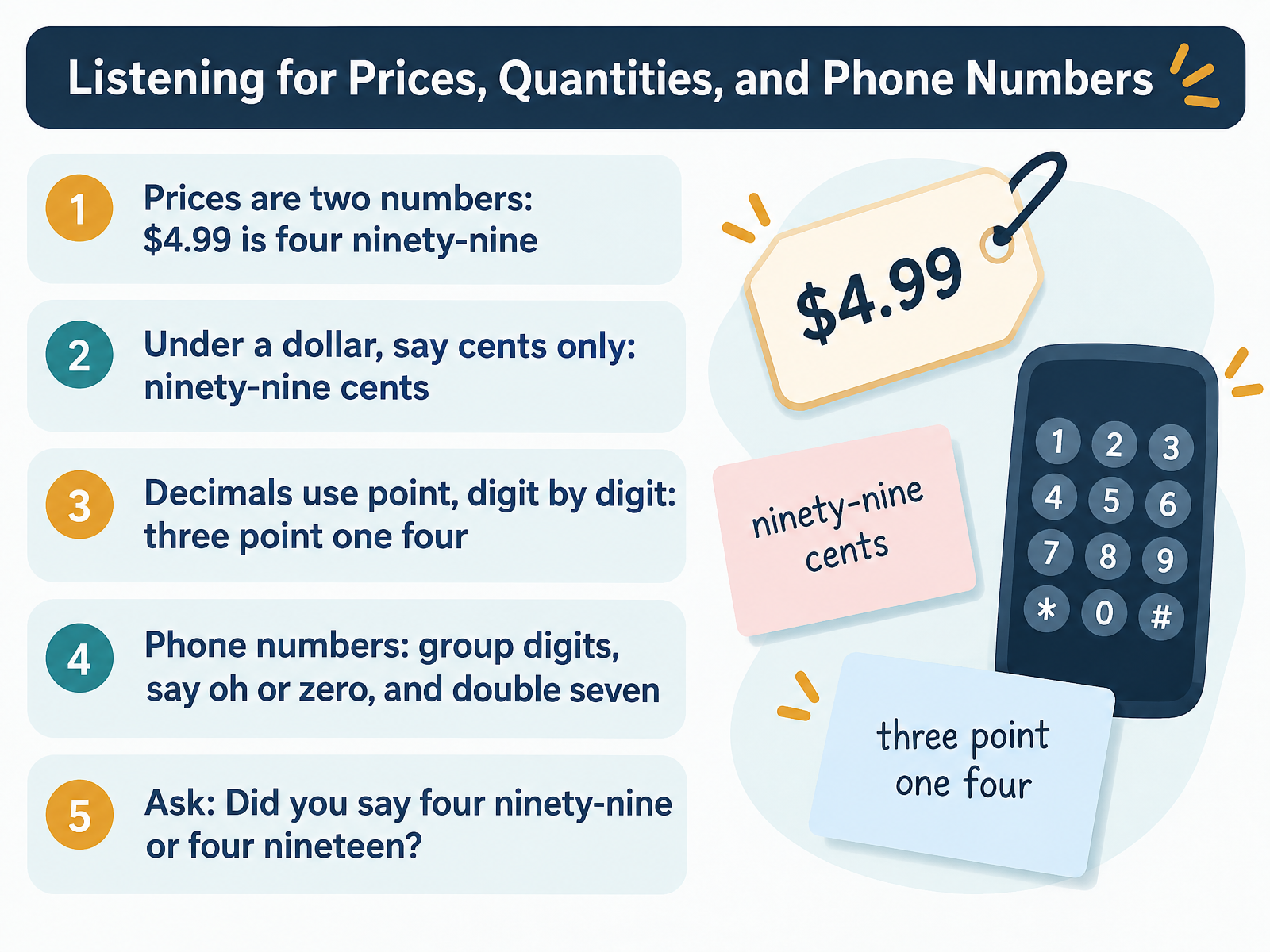
- 04Listening for Prices, Quantities, and Phone NumbersNow let's focus on listening for prices, quantities, and phone numbers. Say each part slowly and clearly. For prices, you often hear two numbers. Four ninety-nine means four dollars and ninety-nine cents. Under one dollar, say cents only. So, ninety-nine cents. For decimals, use the word point, then say each digit. Three point one four. For phone numbers, group the digits. Say oh or zero for the number zero, and double seven for two sevens in a row. Always confirm. Ask, did you say four ninety-nine or four nineteen? Repeat the number back to check. This simple habit helps you avoid mistakes in real calls and conversations. Next, we will look at telling time and two common systems for it.
 1 min
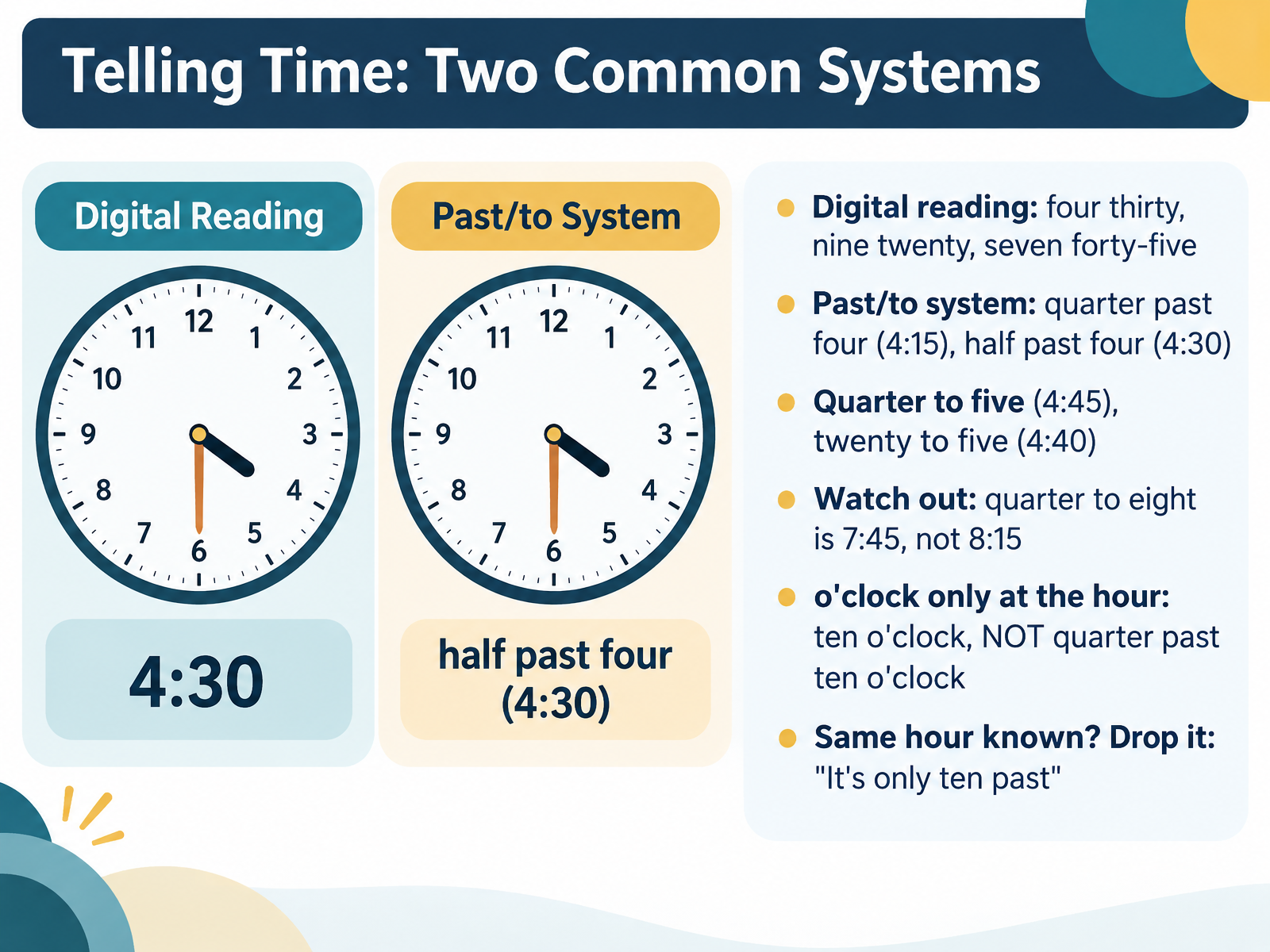
- 05Telling Time: Two Common SystemsNow let's look at telling time. English has two common systems. First, the digital reading. You simply say the hour, then the minutes. Four thirty. Nine twenty. Seven forty-five. Say each number clearly, then pause.
Second, the past and to system. For minutes after the hour, use past. Quarter past four is four fifteen. Half past four is four thirty. For minutes before the next hour, use to. Quarter to five is four forty-five. Twenty to five is four forty.
Watch out for one common mistake. Quarter to eight is seven forty-five, not eight fifteen. The word to means you count back from the next hour.
Also, use o'clock only at the exact hour. Say ten o'clock. Do not say quarter past ten o'clock.
And if the hour is already clear, you can drop it. For example, It's only ten past. Repeat the time back to confirm.
Next, let's look at Telling Time: US and UK Differences.
 2 min
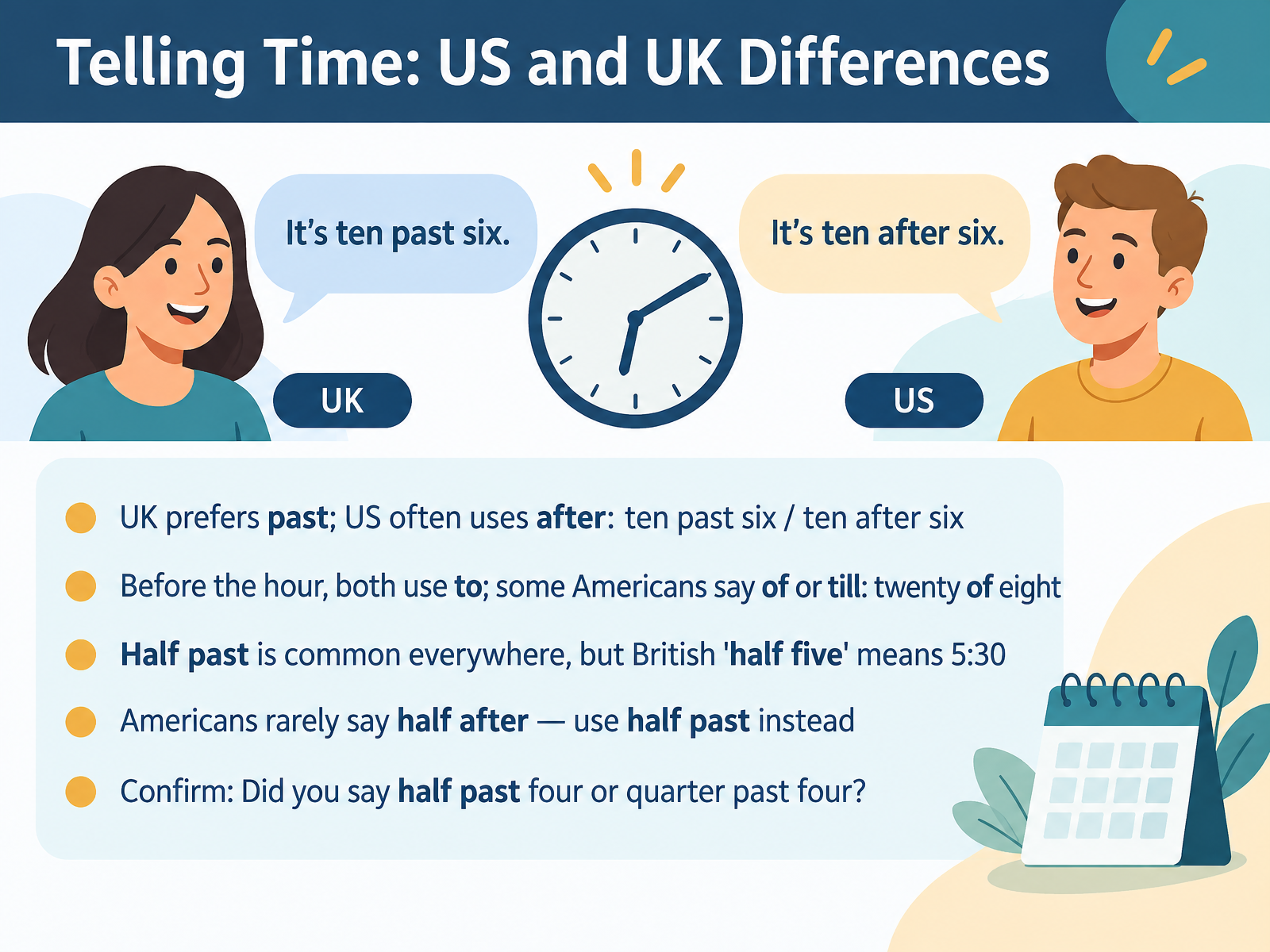
- 06Telling Time: US and UK DifferencesNow, let's look at how to tell time in the US and the UK. The differences are small, but they matter on calls. In the UK, people often say past. For example, ten past six. In the US, many people say after. So, ten after six. Both mean six ten. Say the time clearly. Now, before the hour, both countries use to. Some Americans also say of or till. For example, twenty of eight. That means seven forty. Repeat that: twenty of eight. Next, half past is common everywhere. Half past six means six thirty. But be careful. In British English, half five means five thirty. It does not mean four thirty. In the US, people rarely say half after. Use half past instead. Say: half past five. Last, always confirm. Ask: Did you say half past four or quarter past four? That one question can prevent a big mistake. So, remember: past and after for minutes after the hour, to or of for minutes before, and half past for thirty minutes. In the next part, we will look at approximate times and scheduling language.
 2 min
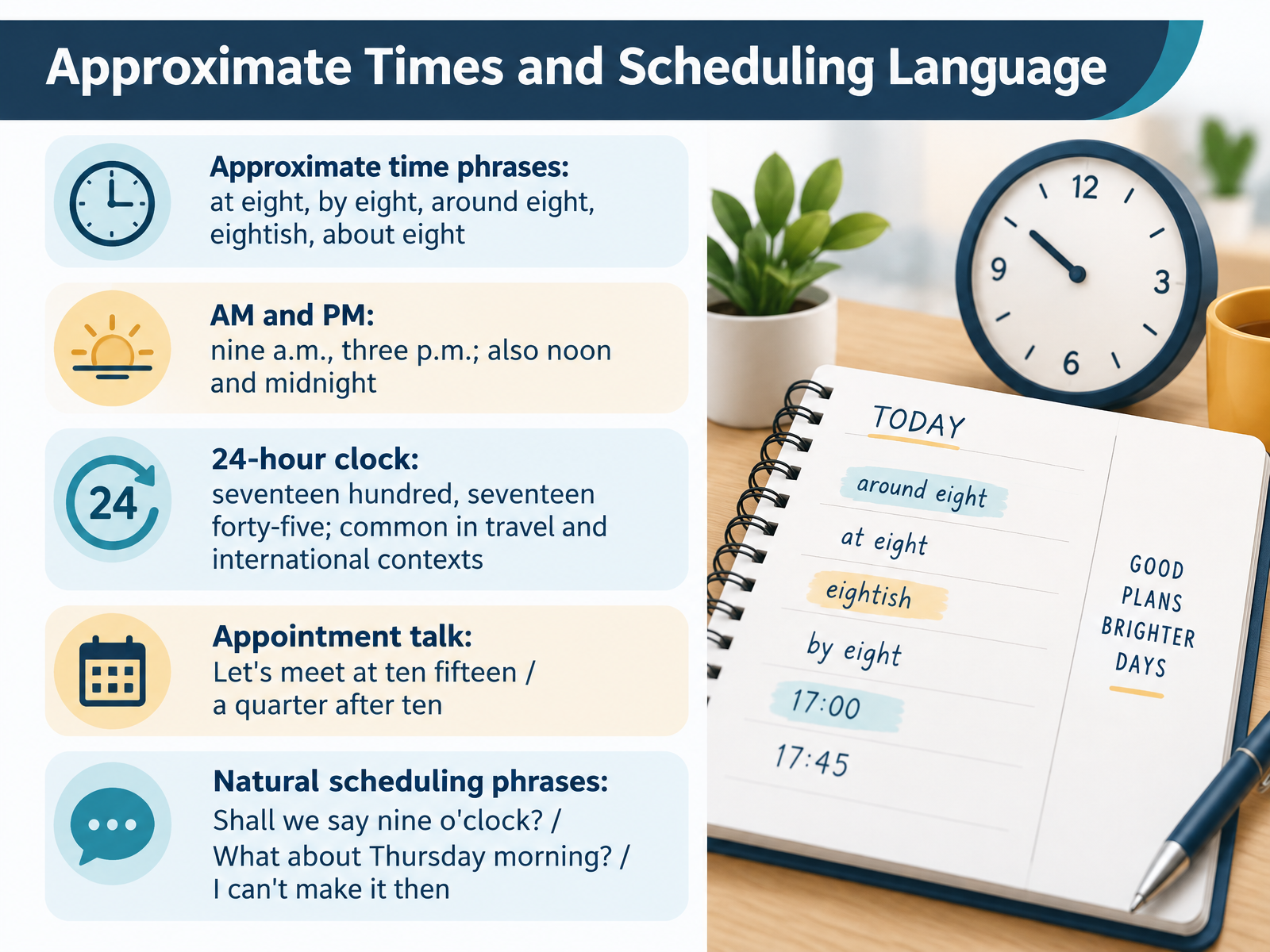
- 07Approximate Times and Scheduling LanguageNow let's talk about approximate times and scheduling. Sometimes you do not need an exact time. You can say, at eight, by eight, around eight, or about eight. Eightish is also common. Now repeat one. Around eight.
Next, a m and p m. We say nine a m and three p m. We also use noon for twelve in the day, and midnight for twelve at night. Repeat. Nine a m. Three p m. Noon. Midnight.
In travel and international settings, you may hear the twenty four hour clock. Seventeen hundred means five p m. Seventeen forty five means five forty five p m. Say each number clearly. Seventeen forty five.
For appointments, you can say, let's meet at ten fifteen, or a quarter after ten. To schedule, ask, shall we say nine o'clock? What about Thursday morning? If you are busy, say, I can't make it then. Repeat that. I can't make it then.
Remember to repeat the time back to confirm. Around eight. Nine a m. Seventeen forty five.
Next, we will look at dates, month day versus day month.
 2 min
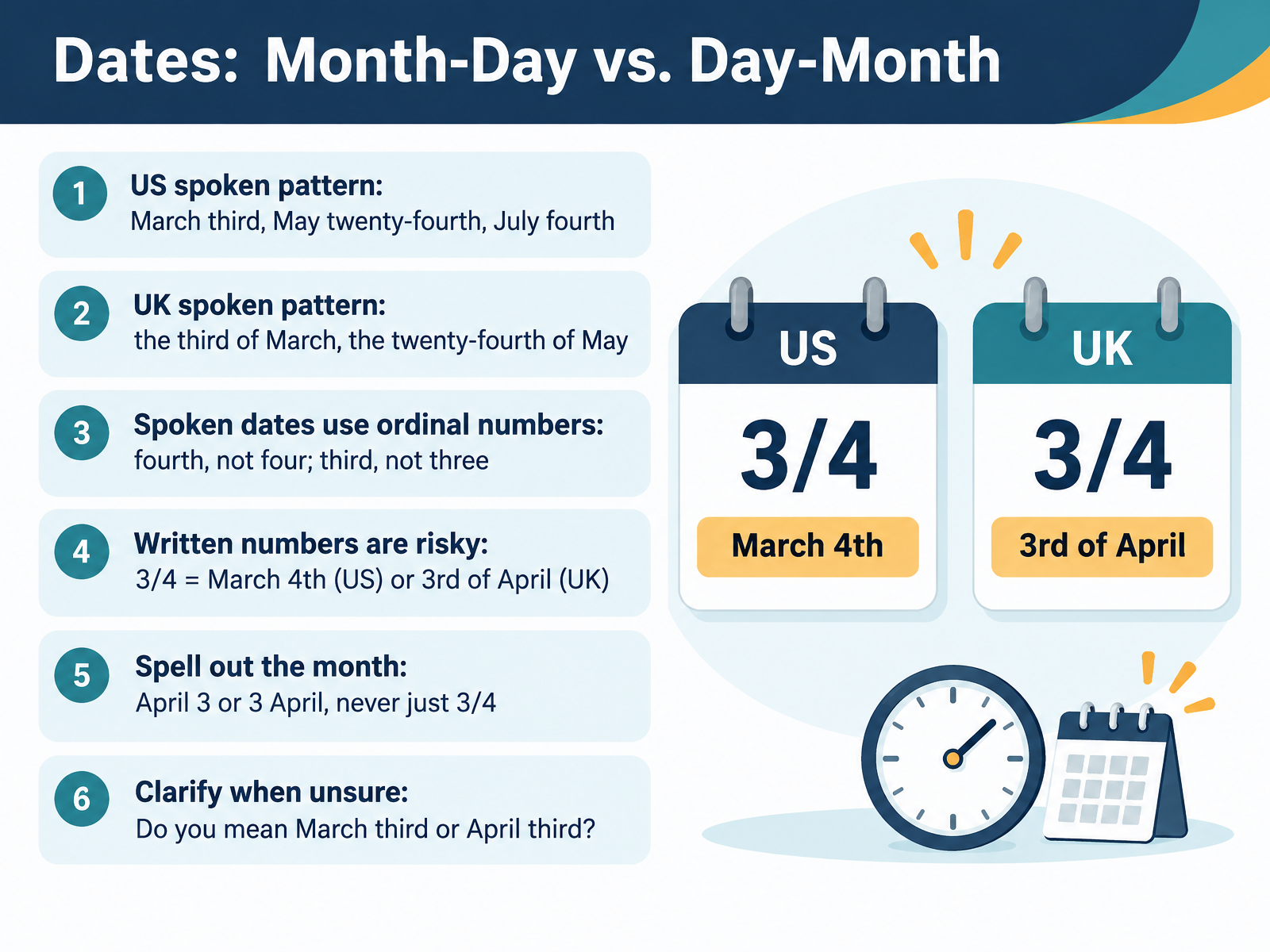
- 08Dates: Month-Day vs. Day-MonthNow let's look at dates. The spoken order can be different in the United States and the United Kingdom. In the US, we usually say the month first, then the day. For example, March third. May twenty-fourth. July fourth. In the UK, the day often comes first. For example, the third of March. Or the twenty-fourth of May. Notice that spoken dates use ordinal numbers. Say fourth, not four. Say third, not three. Written numbers can be risky. For example, three slash four can mean March fourth in the US, or the third of April in the UK. So spell out the month. Write April third, or third April. Never write just three slash four. When you are unsure, ask a clear question. Do you mean March third, or April third? Repeat the date back to confirm. That simple step prevents many mistakes in calls and appointments. Next, we will move on to years, decades, and ordinal numbers.
 2 min
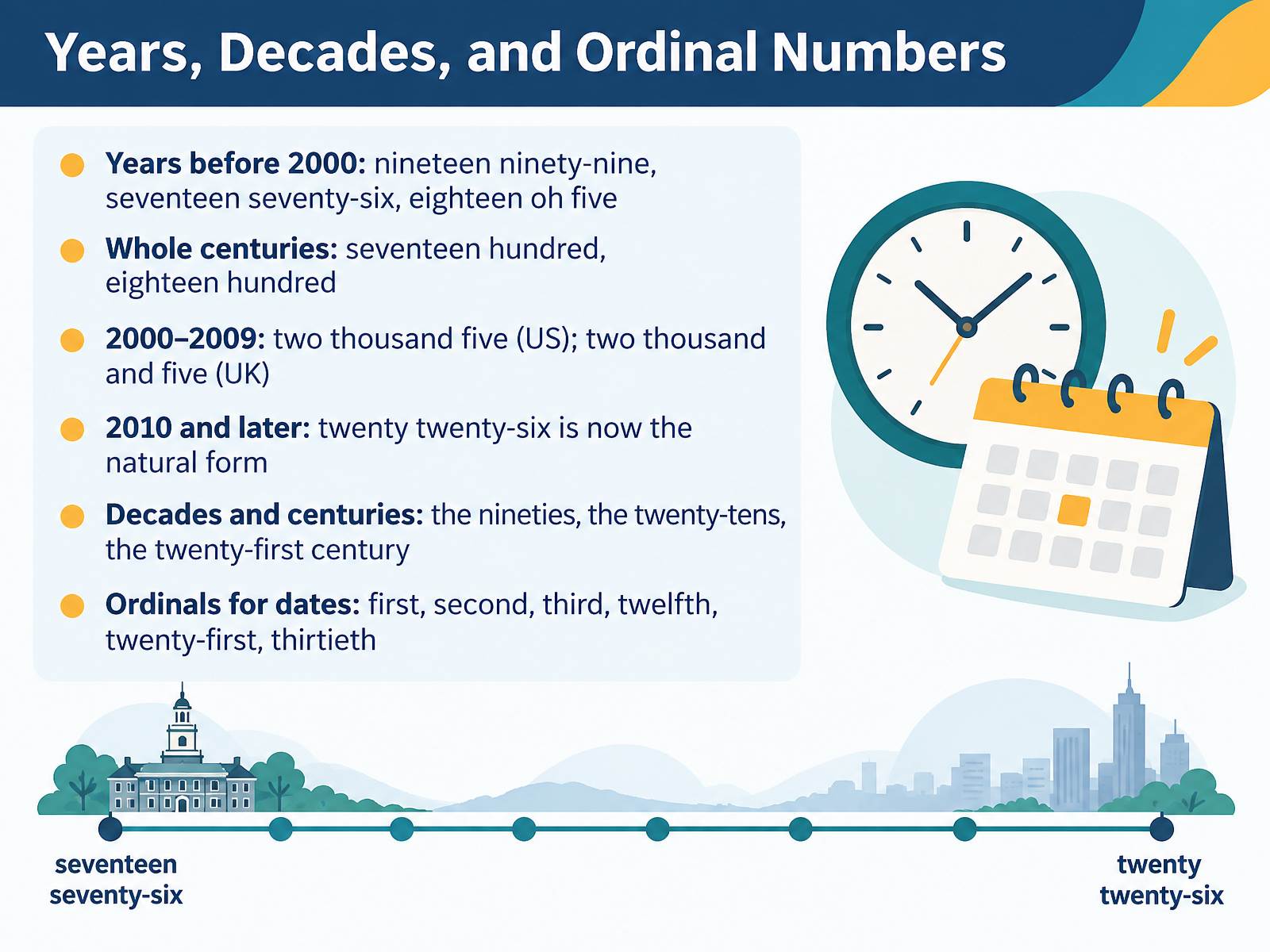
- 09Years, Decades, and Ordinal NumbersNow let's look at years, decades, and ordinal numbers. For years before two thousand, say them as two pairs. Nineteen ninety-nine. Seventeen seventy-six. Eighteen oh five. For whole centuries, you can say seventeen hundred or eighteen hundred. Say those again. For two thousand to two thousand nine, say two thousand five in the US, or two thousand and five in the UK. For two thousand ten and later, the natural form is twenty twenty-six. For decades, say the nineties. For centuries, the twenty-first century. For dates, use ordinal numbers. First, second, third, twelfth, twenty-first, thirtieth. Repeat those after me. So the key point is this. Say years clearly, choose the natural form, and use ordinals for dates. Next, let's move on to practical strategies for calls and appointments.
 1 min
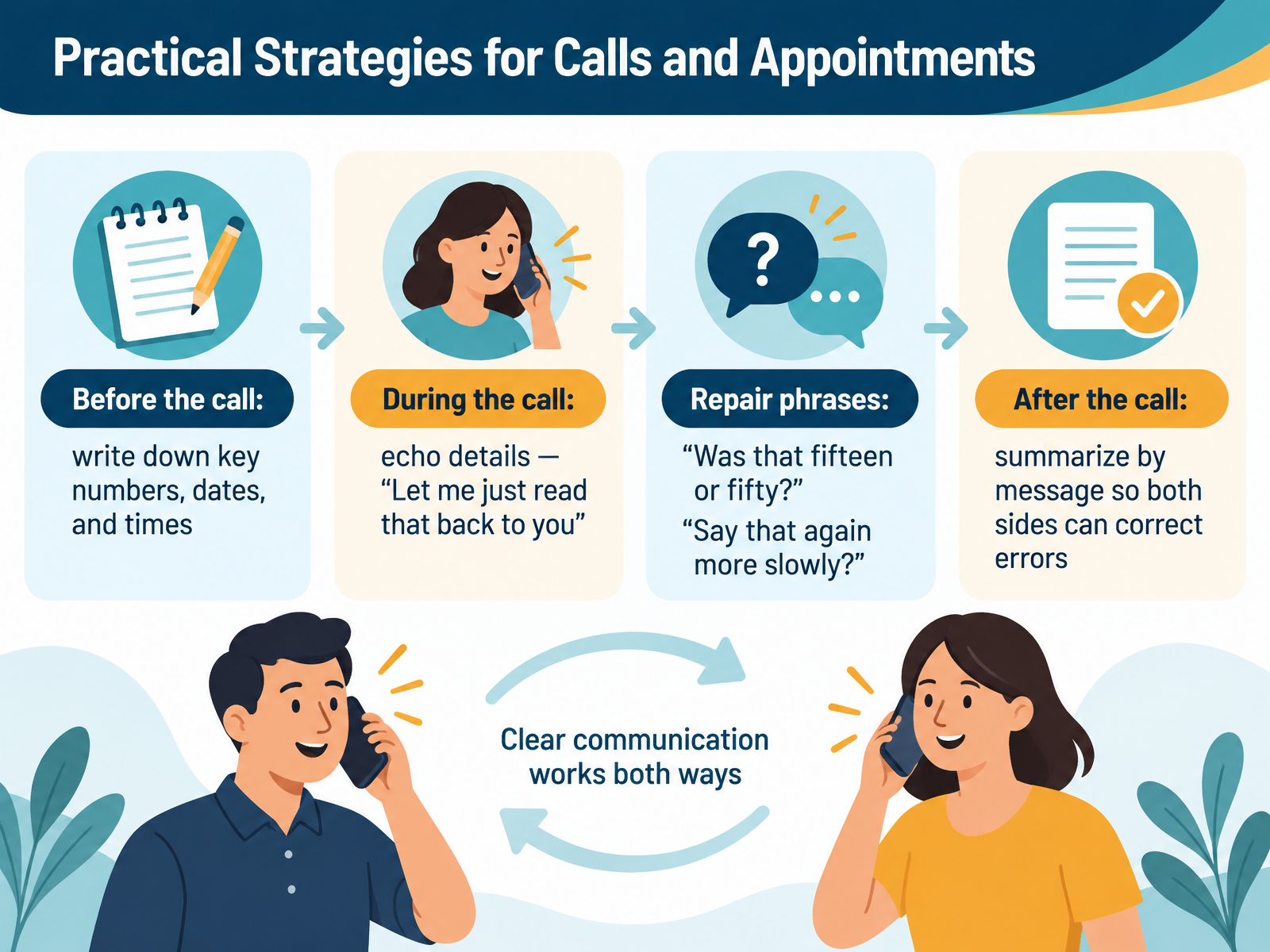
- 10Practical Strategies for Calls and AppointmentsNow let's look at some practical strategies for calls and appointments. These simple habits help you avoid mistakes with numbers, dates, and times. Before the call, write down the key numbers, dates, and times. Keep them in front of you. During the call, echo the details back. Say, Let me just read that back to you. Then repeat the number clearly. If you are not sure, use a repair phrase. Ask, Was that fifteen or fifty? Or say, Say that again more slowly, please. For very important details, spell them out. For example, say zero five double seven. That means zero, five, seven, seven. After the call, send a short message. Summarize the key details. Then both sides can check and correct any errors. So remember: write it down, read it back, ask when unsure, spell it out, and confirm by message. Next, let's move to the Practice Lab: Hear It, Say It, Check It.
 2 min
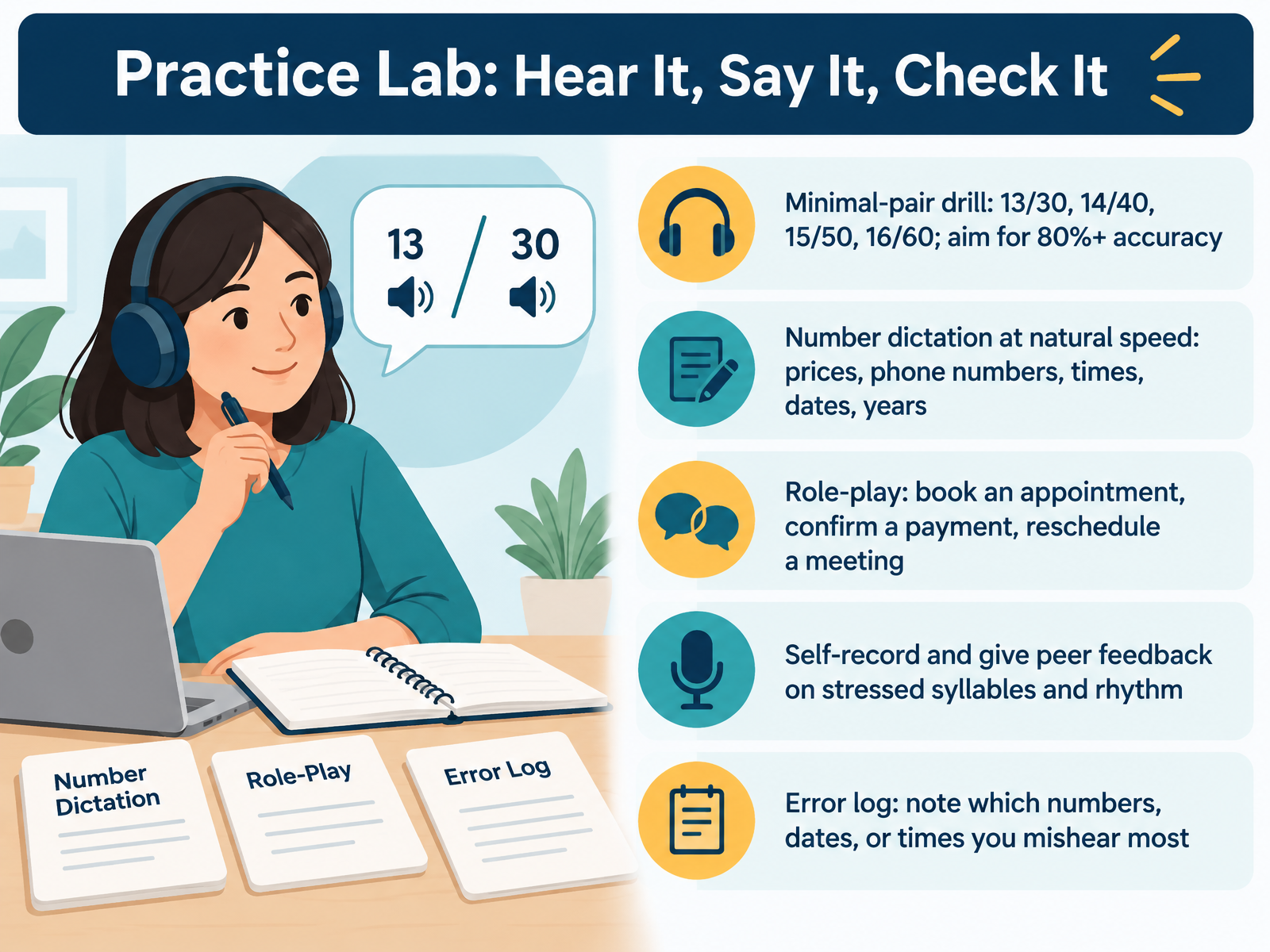
- 11Practice Lab: Hear It, Say It, Check ItNow let's put it all into practice. This is your practice lab. Hear it, say it, check it.
First, a minimal pair drill. Listen to these pairs. Thirteen and thirty. Fourteen and forty. Fifteen and fifty. Sixteen and sixty. Say each one slowly. Stress the teen sound clearly. Aim for at least eighty percent accuracy.
Next, number dictation at natural speed. You will hear prices, phone numbers, times, dates, and years. Say each digit separately for phone numbers. Repeat the time back to confirm it.
Then, role play. Book an appointment. Confirm a payment. Reschedule a meeting. Use the numbers and times you hear.
After that, record yourself. Then give peer feedback on stressed syllables and rhythm.
Finally, keep an error log. Note which numbers, dates, or times you mishear most.
This practice builds real call confidence. Next, we look at common traps and how to avoid them.
 2 min
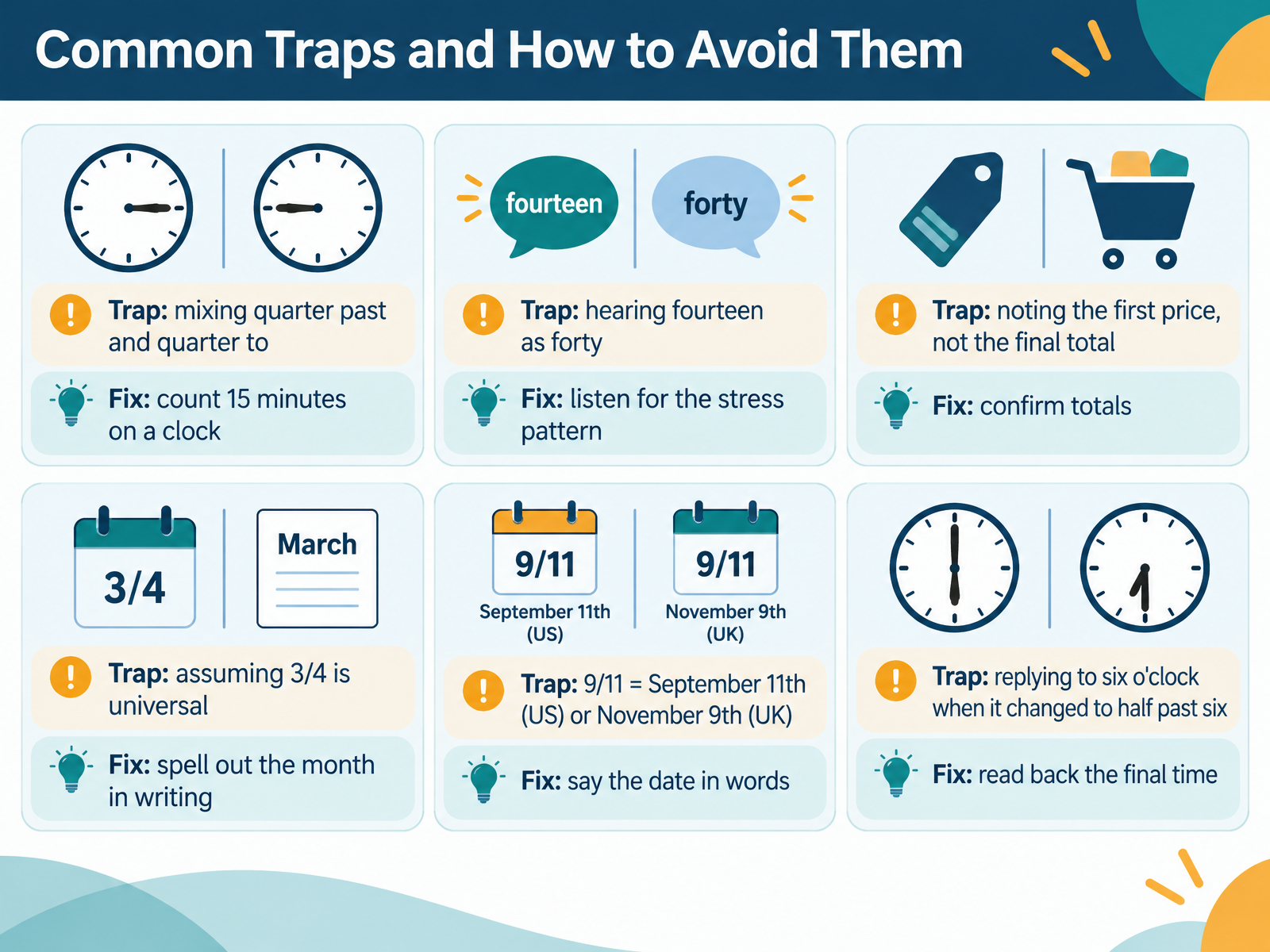
- 12Common Traps and How to Avoid ThemNow let's look at common traps, and how to avoid them. First, people often mix up quarter past and quarter to. If you are not sure, picture a clock and count fifteen minutes from the hour. Next, fourteen can sound like forty. Listen for the stress. Fourteen has the stress on the second part. Forty has the stress on the first part. Repeat each one back to check. Another trap is noting the first price instead of the final total. Always confirm the total at the end. Be careful with dates too. In some countries, three slash four means March fourth. In others, it means the third of April. When you write a date, spell out the month. Also, nine eleven can mean September eleventh in the United States, or November ninth in the United Kingdom. So say the date in words, like November ninth. Finally, times can change during a call. If someone says six o'clock, but later changes it to half past six, read back the final time to confirm. Say each digit separately when you repeat numbers. Repeat the time back to confirm. These small habits help you avoid big mistakes. Next, we will put everything together in a quick reference cheat sheet.
 2 min
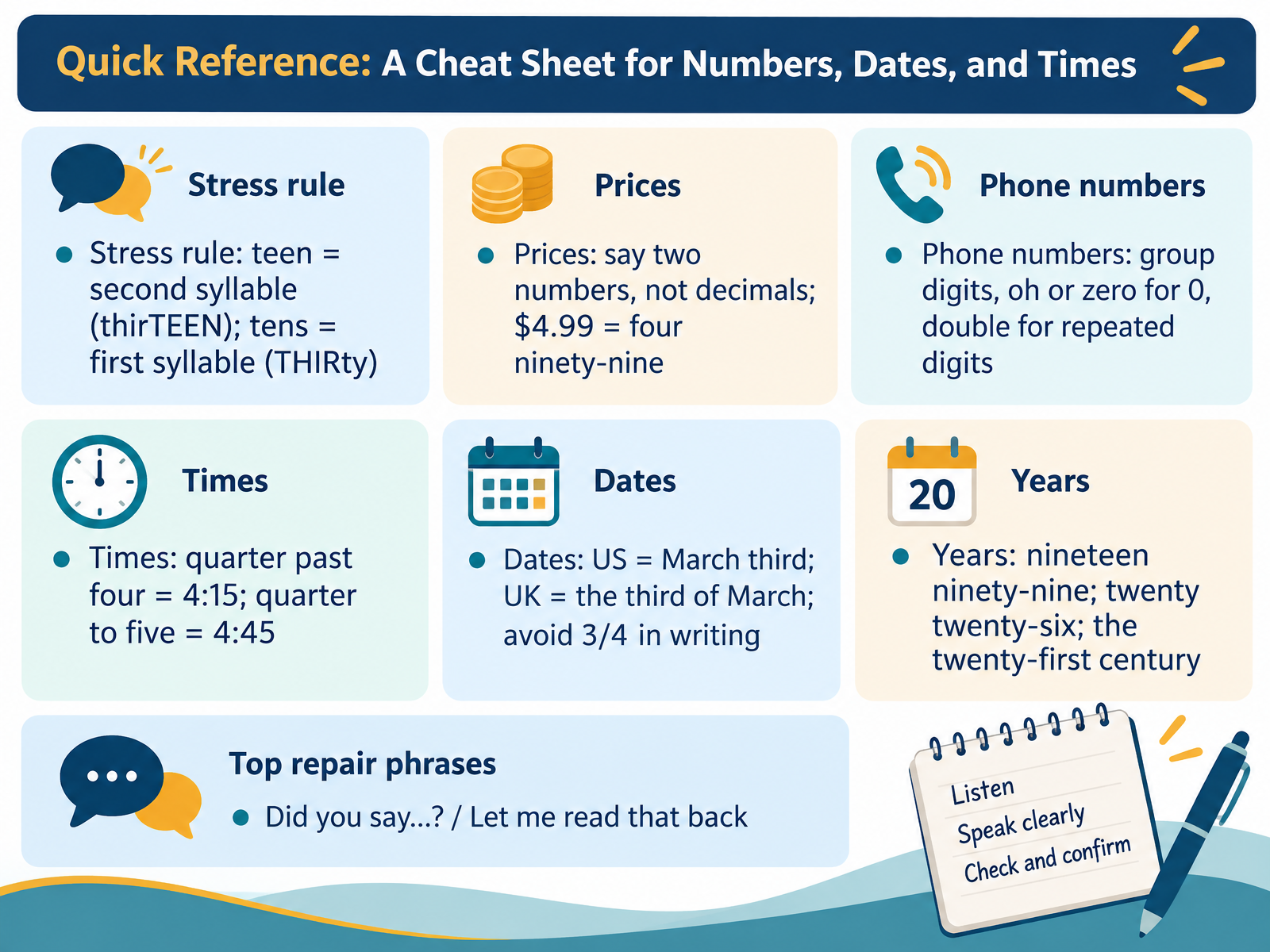
- 13Quick Reference: A Cheat Sheet for Numbers, Dates, and TimesLet's finish with a quick cheat sheet you can use in any call. First, the stress rule. Teen numbers stress the second syllable: thirTEEN. Tens stress the first syllable: THIRty. Next, prices. Say two numbers, not decimals. Four dollars ninety-nine becomes four ninety-nine. For phone numbers, group the digits, say oh or zero for zero, and say double for repeated digits. For times, quarter past four is four fifteen. Quarter to five is four forty-five. For dates, in the US, say March third. In the UK, say the third of March. In writing, avoid three slash four, because it is unclear. For years, say nineteen ninety-nine and twenty twenty-six. We are in the twenty-first century. Finally, keep two repair phrases ready. Did you say that? And let me read that back. Use them calmly, and you will catch mistakes fast. Now, let's move on to your action plan and final check.
 2 min
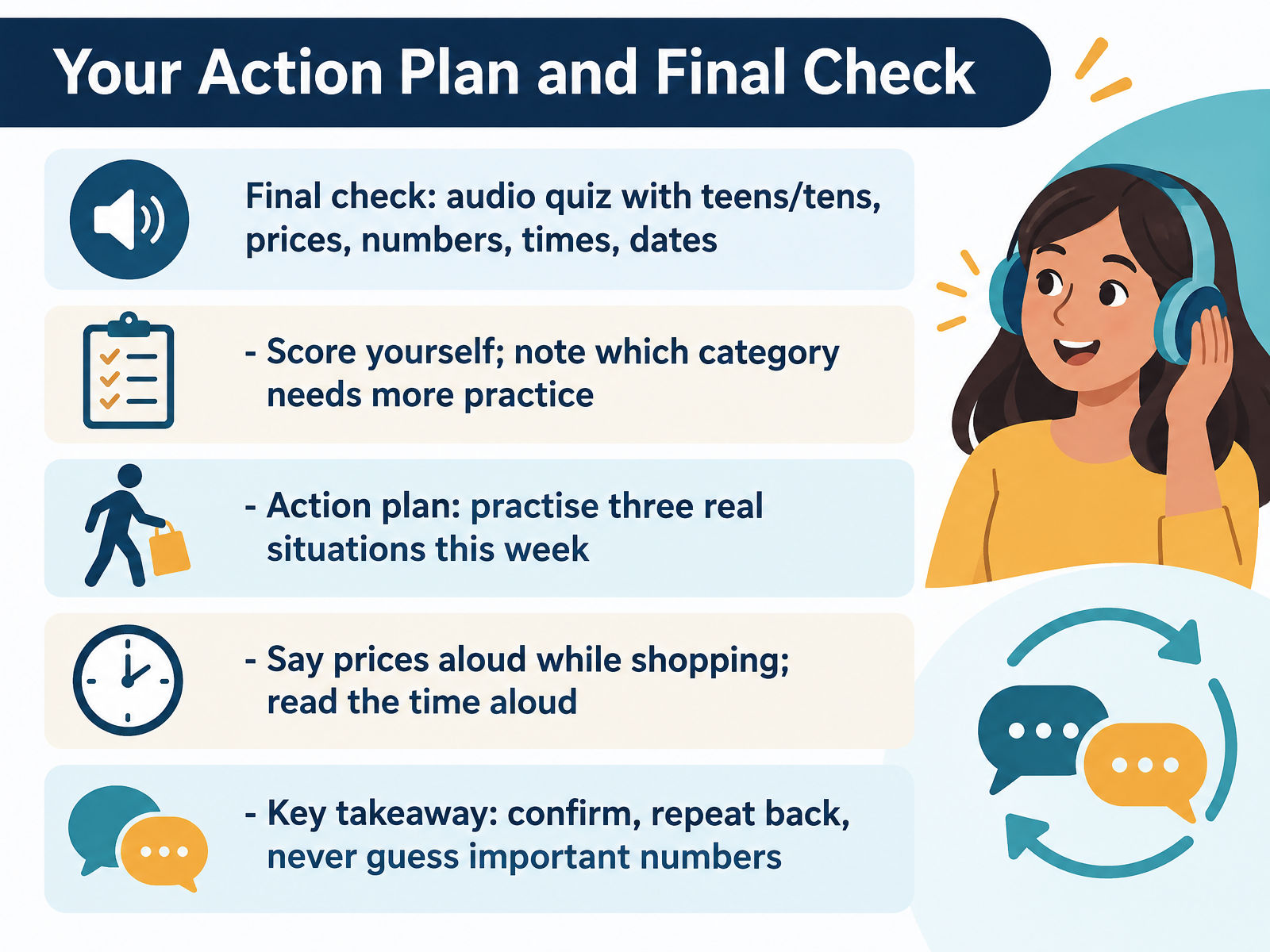
- 14Your Action Plan and Final CheckNow let's finish with your action plan and a final check. First, do a short audio quiz. You will hear teens and tens, prices, numbers, times, and dates. Write down what you hear. Then score yourself. Notice which category needs more practice. Maybe teens and tens are difficult, like thirteen and thirty. Maybe prices are hard, like fifteen dollars and fifty cents. Next, make a simple plan. Practise three real situations this week. At the store, say the price aloud. At home, read the time aloud. On a call, repeat a number back to confirm it. Here is your key takeaway. Confirm. Repeat back. Never guess important numbers. You have worked well today. Keep practising a little every day, and your listening will improve. Thank you, and good luck.
 2 min
Take the deck with you
Download this course as a file — free, no sign-up needed.
- PDF handoutEvery slide page, ready to print or share.15 pages · 3.5 MBDownload
- Narrated PowerPointThe deck that presents itself — every slide carries the digital human's narration video.15 pages · 13.2 MBDownload
- PowerPoint slidesThe full deck as a .pptx — open it in PowerPoint, Keynote, or Google Slides.15 pages · 3.4 MBDownload
Free to use in your own training — please keep the PersonWise credit page at the end.
Have your own deck? Turn it into a course