Foundations of Linguistics: Sounds, Words, Meaning
Begin
14 pages · ~28 min
Foundations of Linguistics: Sounds, Words, Meaning
An introductory course on linguistics exploring how sounds, words, and meaning shape human language for beginners.
What you’ll learn
- 01Introduction to Linguistics: Sounds, Words, and MeaningWelcome. In this course, we will explore the fascinating systems that make up human language. Think of it as a guided tour through the sounds we produce, the words we build, and the meanings we share. We are going to move beyond old myths about 'correct' grammar and adopt a descriptive, scientific perspective instead. Our goal is to build a systematic, foundational understanding for professionals, learners, and everyday communicators. We will map out how the core subsystems—phonetics and phonology for sounds, morphology for word structures, and semantics and pragmatics for meaning—all interact seamlessly in real communication. Let's begin this journey by first asking a fundamental question: what exactly is language, when viewed as a system of systems?en.wikipedia.orgpeople.cs.georgetown.eduopen.umn.edu+21 min
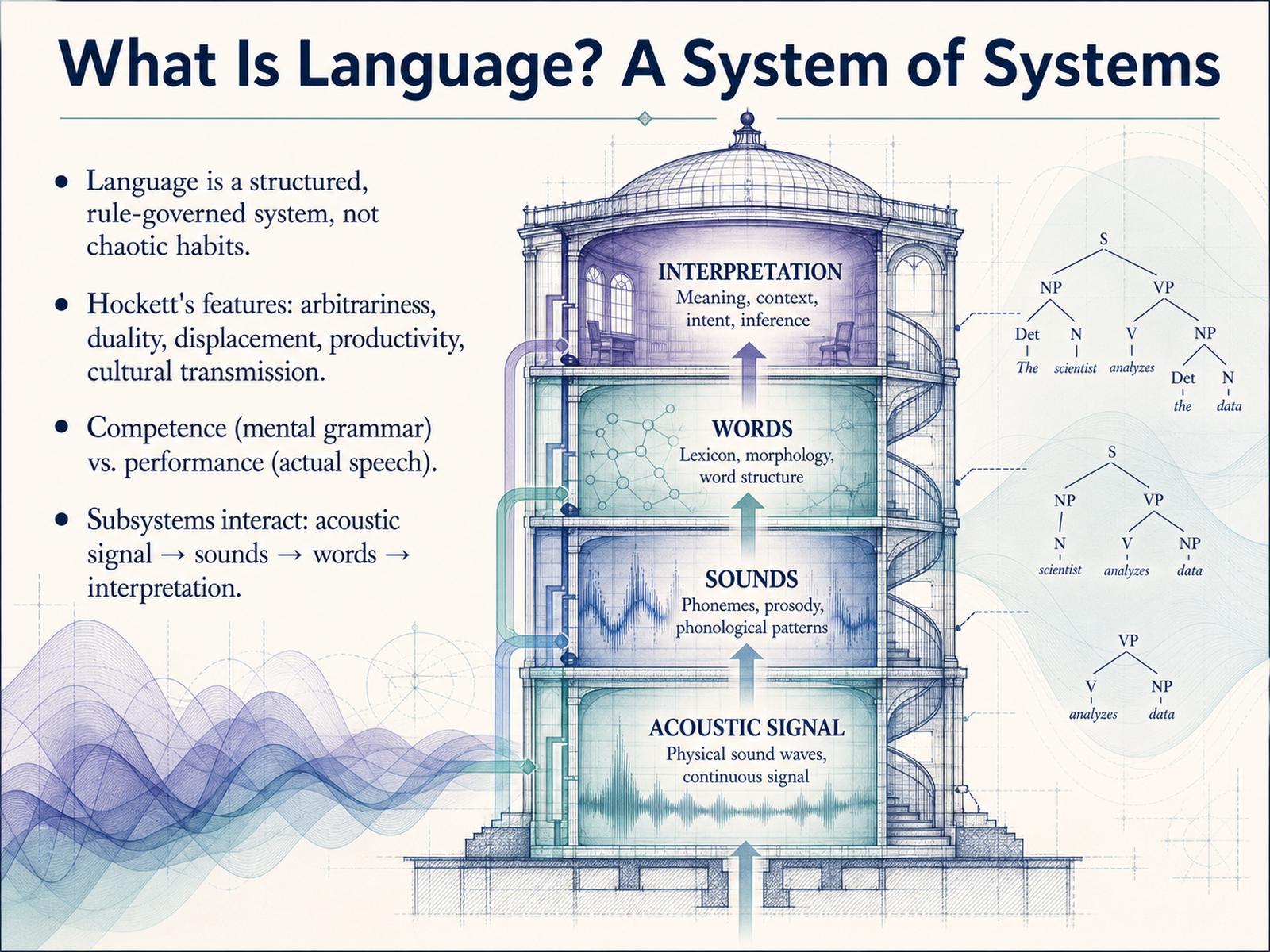
- 02What Is Language? A System of SystemsBuilding on that introduction, let's look more closely at what language actually is. Think of it not as a random collection of habits, but as a structured, rule-governed system—really, a system of systems that all interact. To understand this, we turn to a classic framework from linguist Charles Hockett. He identified key design features that set human language apart. For example, arbitrariness means there’s usually no natural connection between a word's sound and its meaning. The word 'car' doesn’t sound like a car; we just all agree it means one. Duality of patterning is another. It's the two-level structure where a small set of meaningless sounds, like 'c', 'a', and 't', combine to make a meaningful word, 'cat'. Then, those words recombine to make phrases and sentences. Productivity means we can use these rules to create and understand brand-new sentences we’ve never heard before. Displacement lets us talk about things not in the here and now—like yesterday's rain or tomorrow's plans. And none of this is purely genetic; it’s passed down through cultural transmission. Now, behind every sentence you speak is a mental grammar, your deep competence. This is separate from performance, which is the actual speech you produce, with all its little hesitations and imperfections. All these subsystems work together, transforming a simple acoustic signal into sounds, then words, and finally, a full interpretation. Next, we’ll zoom in on the most fundamental layer of this system: the sounds themselves, as we explore the sound system and phonetics.
 en.wikipedia.orglangev.comphon.ox.ac.uk+22 min
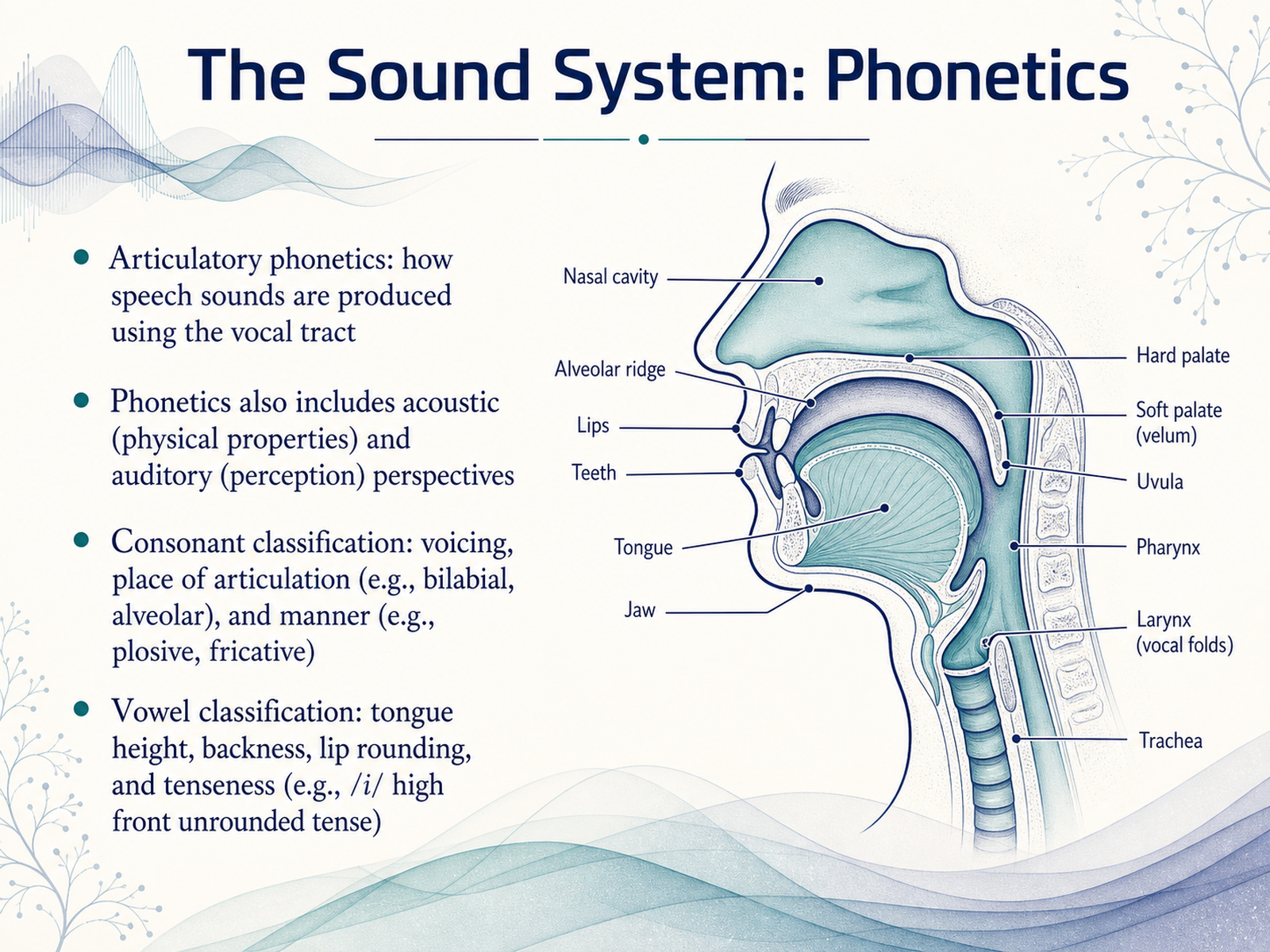
 - 03The Sound System: PhoneticsNow, let’s start building the very foundation of language: the sound system. This first step is called phonetics. Think of phonetics as the study of the physical properties of speech sounds themselves. We’ll focus on articulatory phonetics, which is simply how we move our vocal tracts—our lips, tongue, and jaw—to produce sounds. For any consonant in English, we classify it using a three-part description. First is voicing: are your vocal folds vibrating? Put your hand on your throat and feel the difference between 'ssss' and 'zzzz'. That’s voiceless versus voiced. Second is place of articulation: where is the airflow constricted? For 'p' and 'b', both lips come together, so that’s a bilabial place. For 't' and 'd', the tongue tip touches the ridge behind your teeth, an alveolar place. Third is manner of articulation: how is the airflow constricted? A plosive like 'p' has a complete stop and release, while a fricative like 'f' creates turbulent friction. Vowels are mapped by the position of the tongue. We describe them by height, like the high tongue position for the sound 'ee' in 'heat'; backness, like the back vowel 'oo' in 'hoot'; lip rounding; and tenseness. The symbol for that 'ee' sound is a high, front, unrounded, tense vowel. With just these parameters, we can precisely identify any speech sound across languages. Let’s move from these physical sounds to how they function as a system inside the mind, in our next slide on phonology.
 cambridge.orginternationalphoneticassociation.orgielp.ehe.osu.edu+22 min
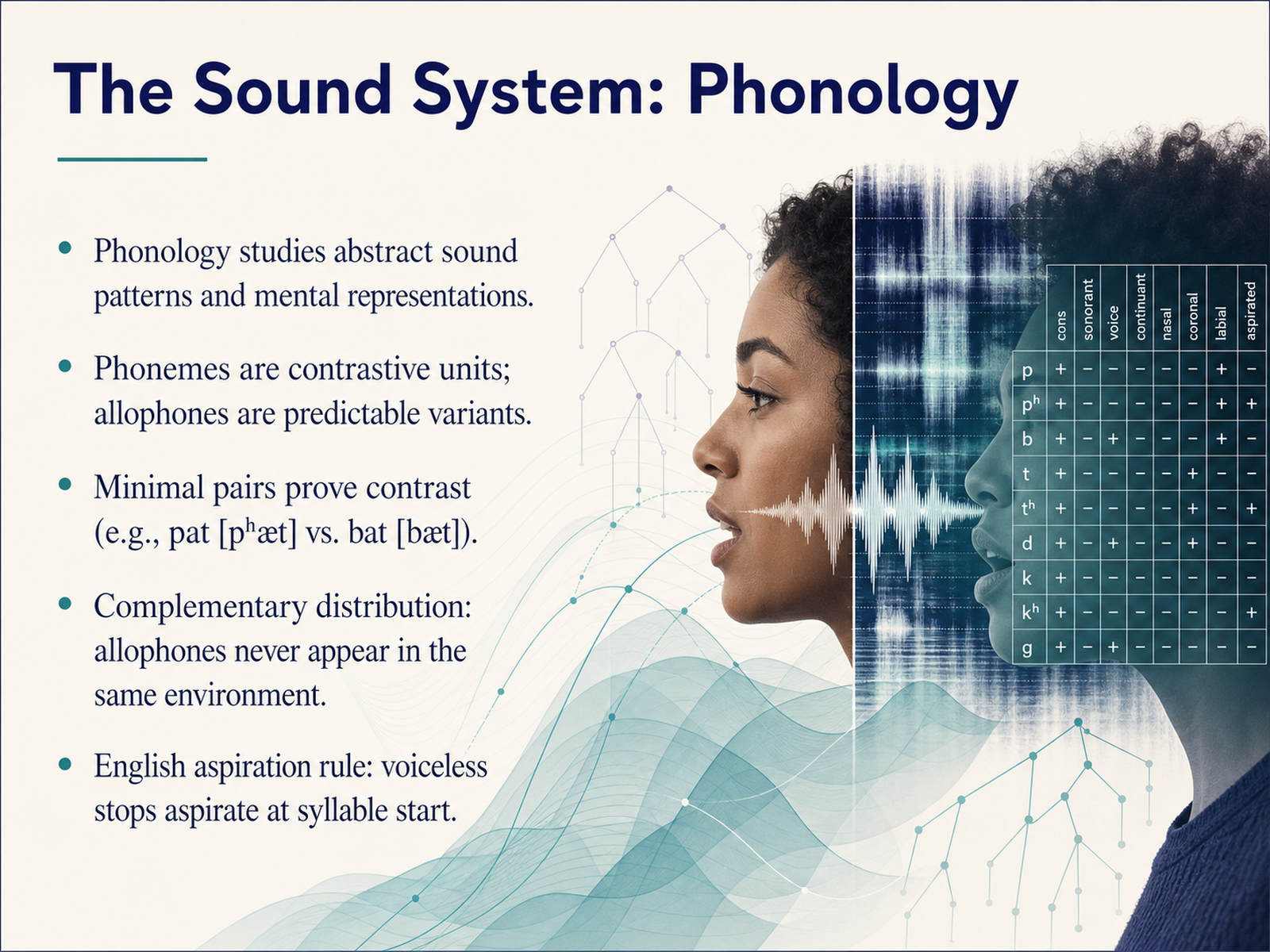
 - 04The Sound System: PhonologyNow let's explore the sound system, or phonology. This is where we move from the physical sounds we can hear to the abstract mental patterns we use to organize them. Think of it as the rulebook your mind uses to decide which sounds matter for meaning and which ones are just predictable variations. A core idea here is the phoneme. A phoneme is a contrastive sound unit, meaning if you swap one for another, you change the word. We prove this with minimal pairs, like 'pat' and 'bat'. The only difference is the initial sound, which tells us that 'p' and 'b' are distinct phonemes in English. Now, a single phoneme can actually be pronounced in different ways. These predictable variants are called allophones. For example, the 'p' in 'pat' has a little puff of air, we say it's aspirated. But the 'p' in 'spat' does not. They sound different, but they are both perceived as the same 'p' sound. These allophones are in complementary distribution, meaning they never appear in the same environment. The aspirated 'p' appears at the start of a syllable, and the unaspirated one appears after an 's'. This is a predictable rule. So, phonology connects abstract categories, like the phoneme, with the predictable, physical realizations we call allophones. This system of rules creates the organized sound pattern of a language. Next, we'll see how these sounds combine to build the meaningful units we call words in morphology.
 slam.lin.ufl.edumq.edu.aulaits.utexas.edu+22 min
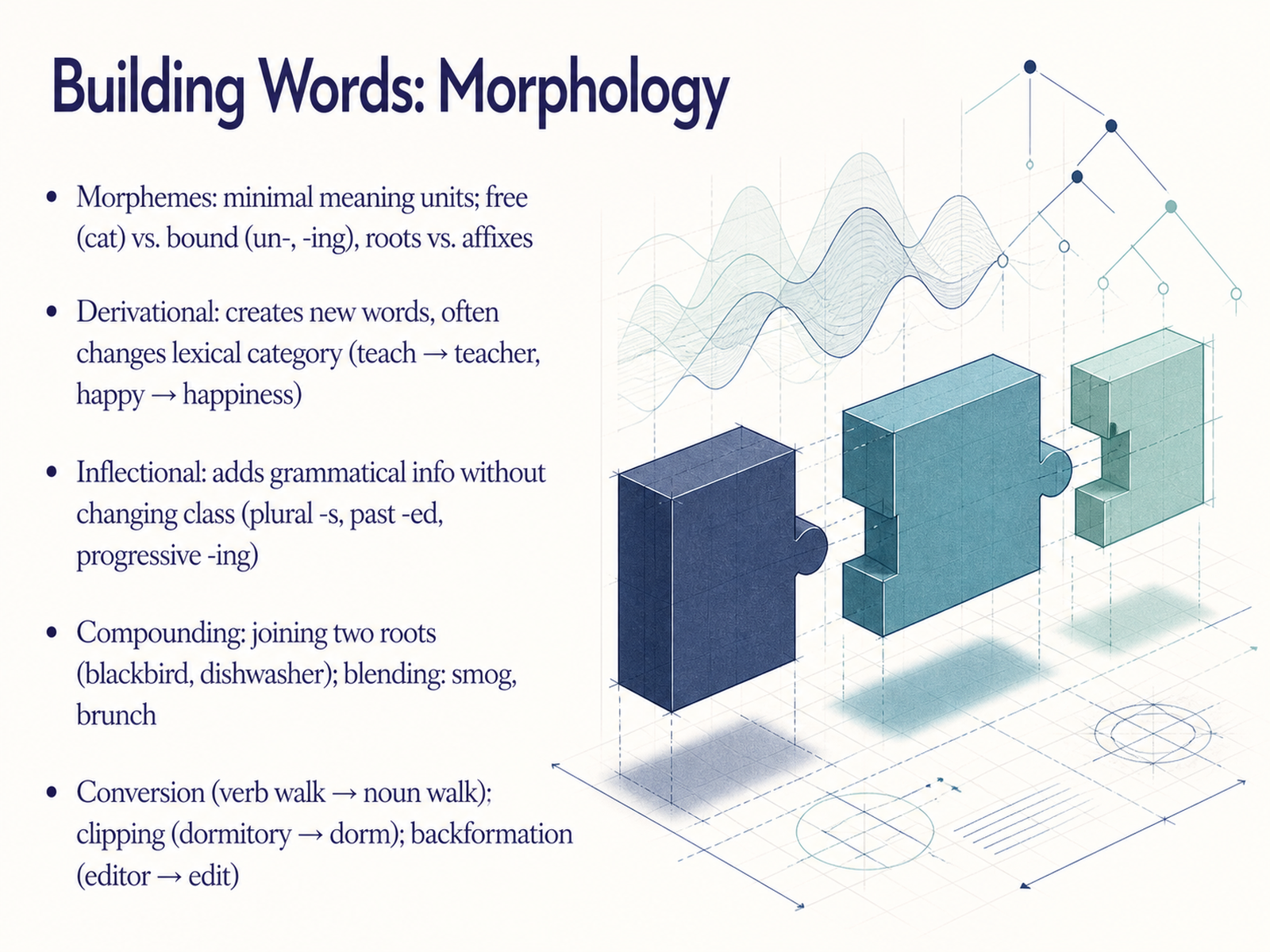
 - 05Building Words: MorphologyNow let's turn from individual sounds to the architecture of words. This is morphology. We start with the morpheme, which is the smallest unit of meaning in a language. Some morphemes stand alone as free morphemes, like the word 'cat'. Others are bound morphemes that must attach to a base, like 'un-' in 'undo' or '-ing' in 'walking'. Within a word, the core is the root, and we build upon it with affixes. Affixes come in two main varieties. Derivational morphemes often create a new word, and they frequently change the lexical category. For instance, adding '-er' to the verb 'teach' gives us the noun 'teacher'; adding '-ness' to the adjective 'happy' yields the noun 'happiness'. Inflectional morphemes are different. They add grammatical information without creating a new lexeme or changing the word's part of speech. Think of the plural '-s' in 'cats', the past tense '-ed' in 'walked', or the progressive '-ing' in 'walking'. Beyond affixation, English forms words through other lively processes. Compounding joins two roots, as in 'blackbird' or 'dishwasher'. Blending fuses parts of two words, like 'smog' from smoke and fog, or 'brunch' from breakfast and lunch. We also see conversion, where a verb like 'walk' becomes a noun without any change in form. Clipping shortens a longer word, as when 'dormitory' becomes 'dorm'. And backformation reverses the process, so from 'editor' we historically derived the verb 'edit'. All these strategies work together, constantly renewing our vocabulary. Next, we'll step up from the word level to see how these building blocks are arranged. That brings us to organizing words: syntax and sentence structure.
 2 min
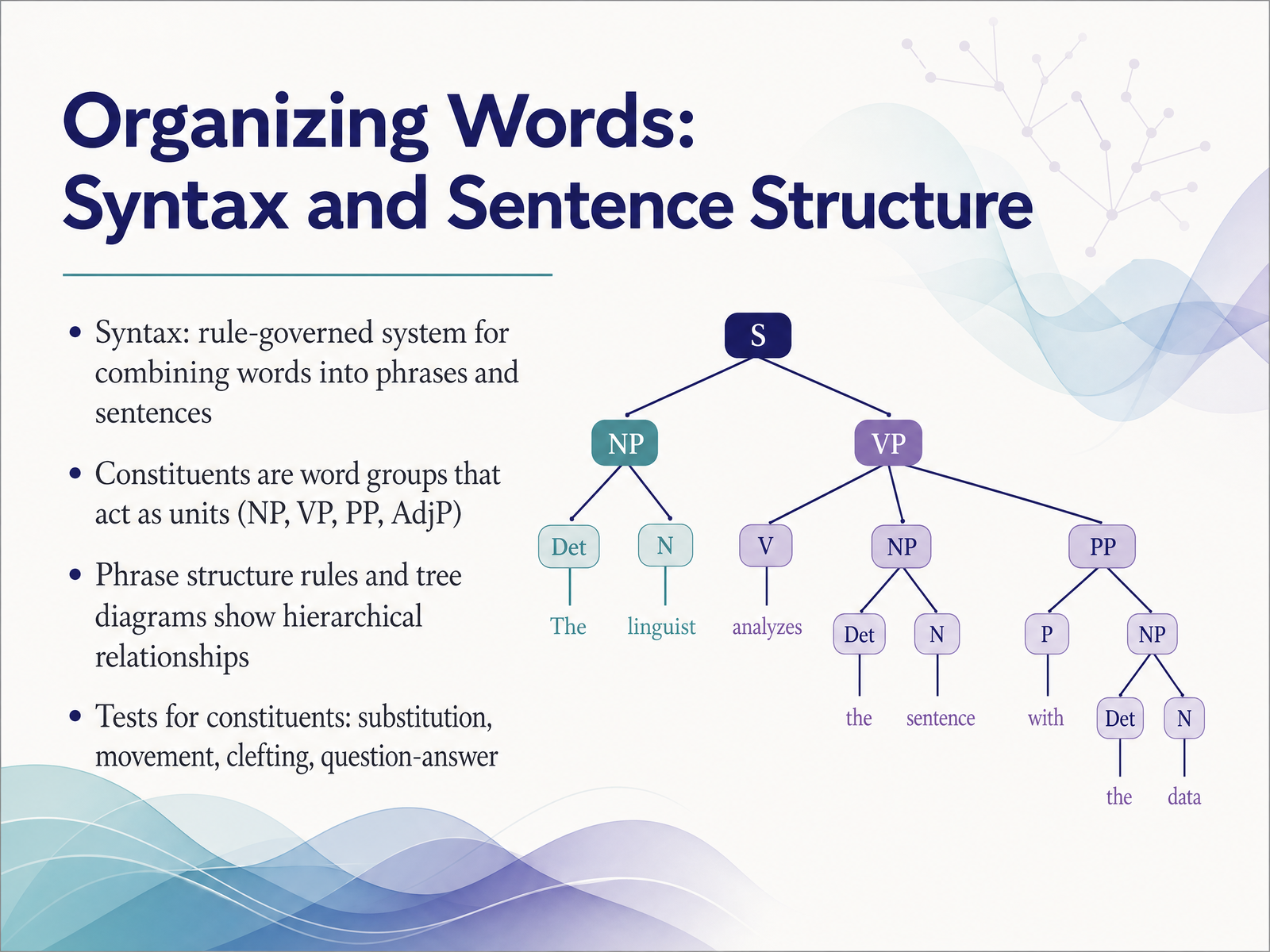
2 min - 06Organizing Words: Syntax and Sentence StructureLet’s move from individual words to how we organize them. This is the domain of syntax: a rule-governed system for combining words into phrases and sentences. To uncover these rules, we look for constituents—groups of words that act as single units. The main types you will see are noun phrases, verb phrases, prepositional phrases, and adjective phrases. We can test whether a group of words is a constituent using a few simple tools. For example, try replacing the group with a single word. If we can replace “the small robots” with “they,” we have evidence of a constituent. We can also move a group to the front of a sentence or put it into a cleft structure, like “It was the small robots that arrived first.” Linguists represent these hidden groupings visually using tree diagrams. A tree diagram maps the hierarchical relationships inside a sentence, showing how small units nest inside larger phrases according to phrase structure rules. These rules and diagrams help us make testable, precise claims about how the mind structures language. Next, we will explore how these structured sentences carry meaning in our session on semantics.
 2 min
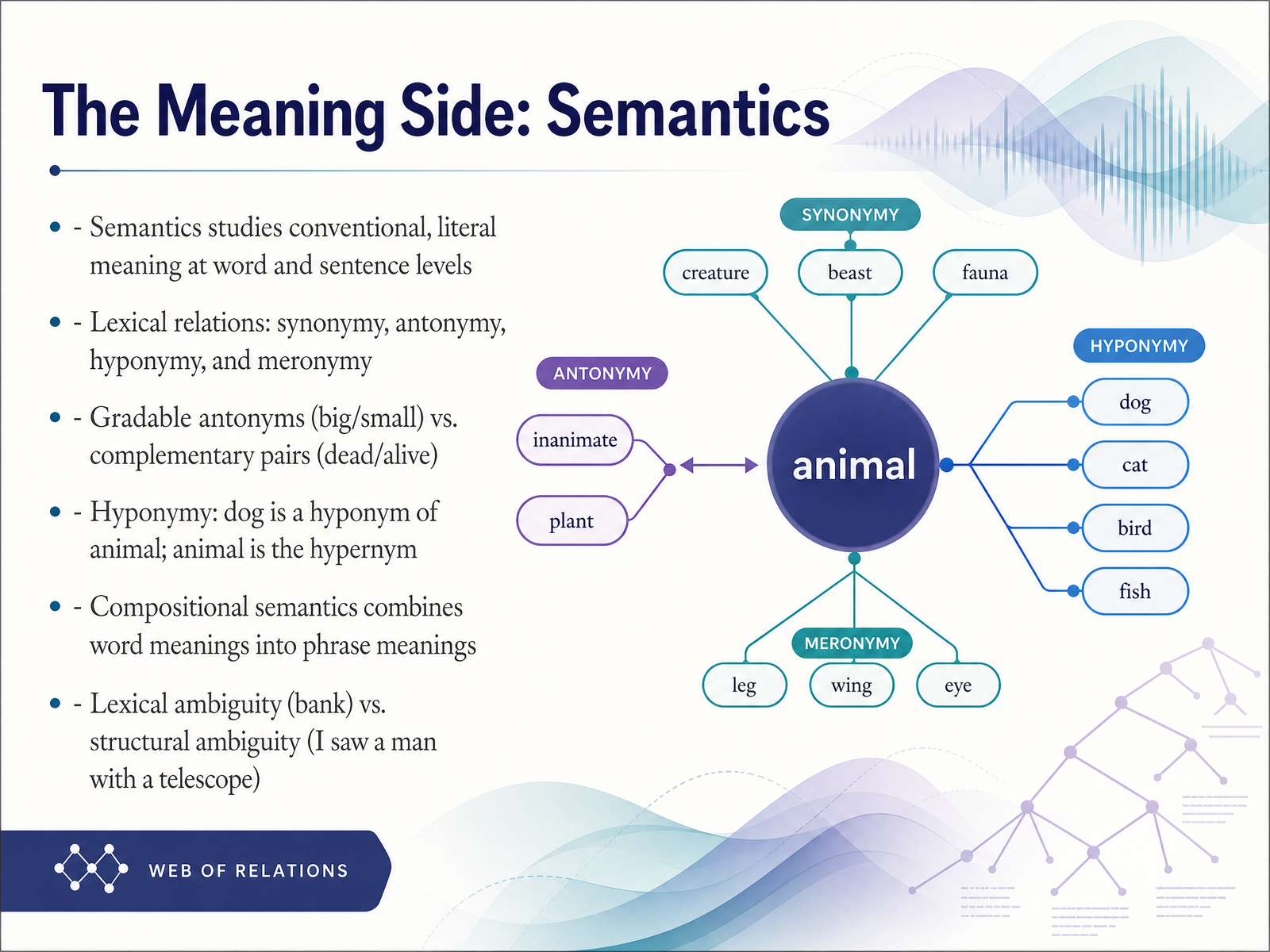
2 min - 07The Meaning Side: SemanticsNow that we have looked at the shape of language, let’s consider the meaning side with semantics. Here, we study the conventional, literal meaning of words and sentences. One key idea is lexical relations, the systematic links between words. Synonymy describes words with very similar meanings, like 'big' and 'large.' Antonymy, in contrast, deals with opposites. We distinguish between gradable antonyms, like 'big' versus 'small,' which sit on a scale, and complementary pairs, like 'dead' versus 'alive,' which are strictly either one or the other. Another relation is hyponymy, a kind of hierarchical link. For example, 'dog' is a hyponym of 'animal,' while 'animal' is the broader hypernym. Semantics also asks how individual word meanings combine. In compositional semantics, putting words together builds phrase meaning. But meaning can be tricky: lexical ambiguity occurs when a single word like 'bank' has multiple senses, while structural ambiguity arises from a sentence’s organization, as in 'I saw a man with a telescope.' These distinctions give us the core toolkit for literal interpretation. Next, we will explore how context shapes interpretation in pragmatics.
 2 min
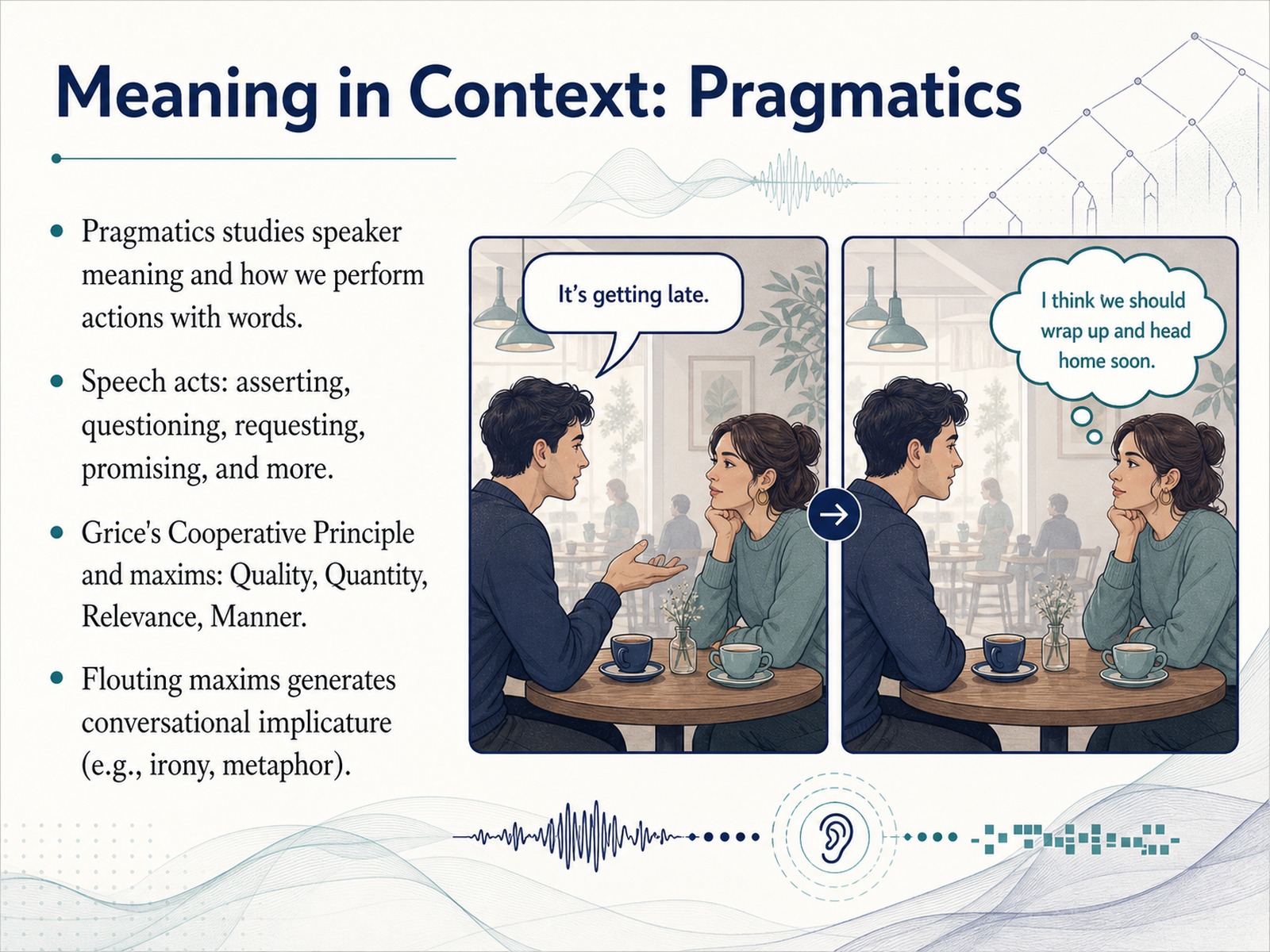
2 min - 08Meaning in Context: PragmaticsNow let's step into the space where language meets real life: pragmatics. When we talk about meaning in context, we are moving beyond the definitions of words themselves. Pragmatics studies what speakers actually mean, and how we perform actions with our words. Think about it. With language, we don't just make statements; we assert, we question, we request, and we promise. Every sentence does something. To navigate this, the philosopher Paul Grice proposed that conversation is a cooperative effort. He described a Cooperative Principle with four conversational maxims. First, the maxim of Quality: we try to say what is true. Then, Quantity: we give just the right amount of information. There's the maxim of Relevance: we stay on topic. And finally, Manner: we aim to be clear and brief. The real magic happens when we flout these maxims. That means we obviously break a rule, and the listener knows we're doing it. When you say 'He's a real genius' after someone makes a silly mistake, you're flouting Quality. The listener understands you don't mean it literally; the extra, hidden meaning is called conversational implicature. It's where irony and metaphor come alive in everyday talk. So we've explored sounds, words, and context-driven meaning. Next, we'll look at how all these layers fit together in the interfaces between them.
 2 min
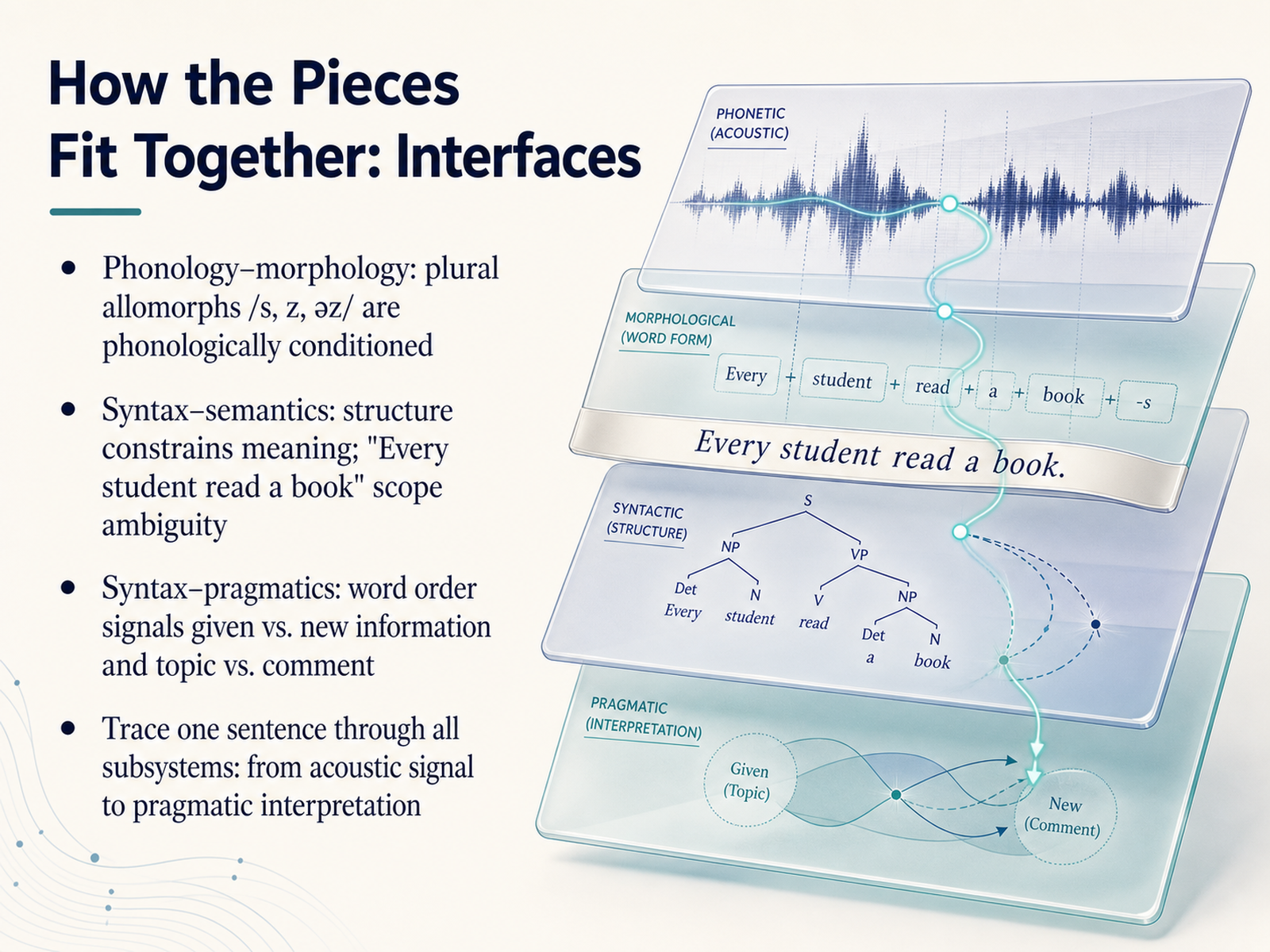
2 min - 09How the Pieces Fit Together: InterfacesNow we get to the heart of how the language system works together, at the interfaces where these subsystems meet. Let’s start with how phonology and morphology talk to each other. The English plural morpheme, spelled '-s' or '-es', actually has three regular pronunciations: the 's' sound in 'cats', the 'z' sound in 'dogs', and the 'iz' sound in 'horses'. Which one we use isn’t random; it’s phonologically conditioned. The last sound of the noun root dictates which allomorph we select. Next, consider syntax and semantics. Structure constrains meaning. Take the sentence 'Every student read a book.' Did every student read the same book, or did each student read a potentially different book? This is scope ambiguity. A single syntactic structure generates two possible interpretations, showing how tightly structure and meaning are linked. The interface between syntax and pragmatics is equally important. Word order often signals what is given versus new information, or what is the topic versus the comment. For instance, changing the placement of a phrase can shift the focus of a sentence without changing its core truth. Let’s trace one sentence through all these subsystems. A simple acoustic signal enters the ear, gets parsed into phonemes, which build morphemes and words. These words form a syntactic structure that receives a semantic interpretation. Finally, context and pragmatics let us infer the speaker's full intended meaning, from raw sound to rich understanding. Next, we’ll see these principles in action as we apply linguistics to language teaching and learning.
 2 min
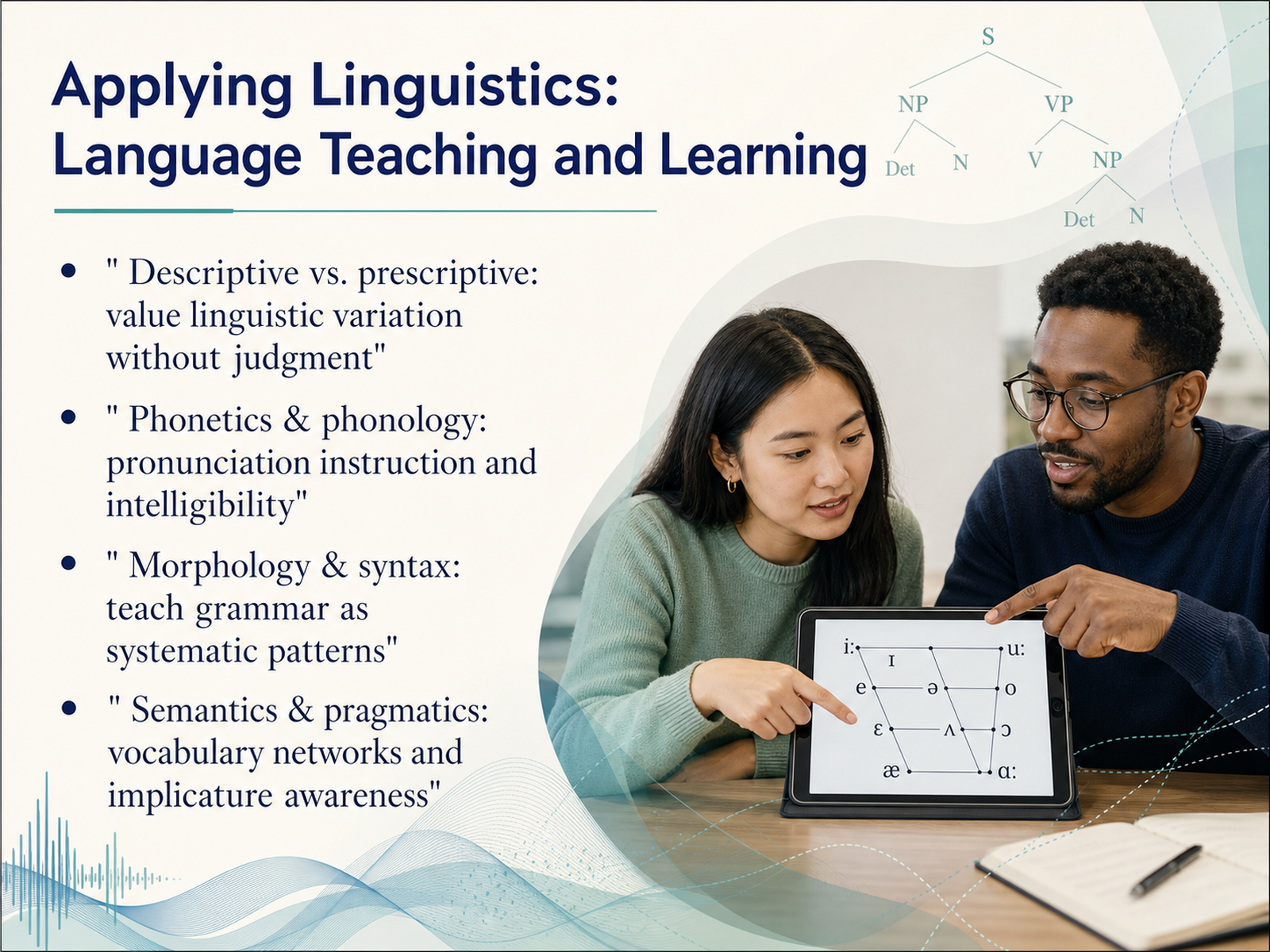
2 min - 10Applying Linguistics: Language Teaching and LearningContinuing our exploration, let's look at how these core concepts come alive in the classroom. When we move from theory to teaching and learning, a fundamental shift happens. We move from a prescriptive mindset, judging language as correct or incorrect, to a descriptive one that values linguistic variation without judgment. This is the foundation. Think about pronunciation. Phonetics and phonology guide us not toward accent elimination, but toward clear, intelligible instruction. Grammar, through morphology and syntax, is reframed. Instead of a list of rules to memorize, we teach it as a system of meaningful patterns. Semantics and pragmatics connect vocabulary through rich networks and help learners grasp what a sentence implies, not just what it says. In essence, we are equipping learners with tools to understand the architecture of language. Next, we'll step into the world of technology to see how these principles power speech technology and artificial intelligence.
 2 min
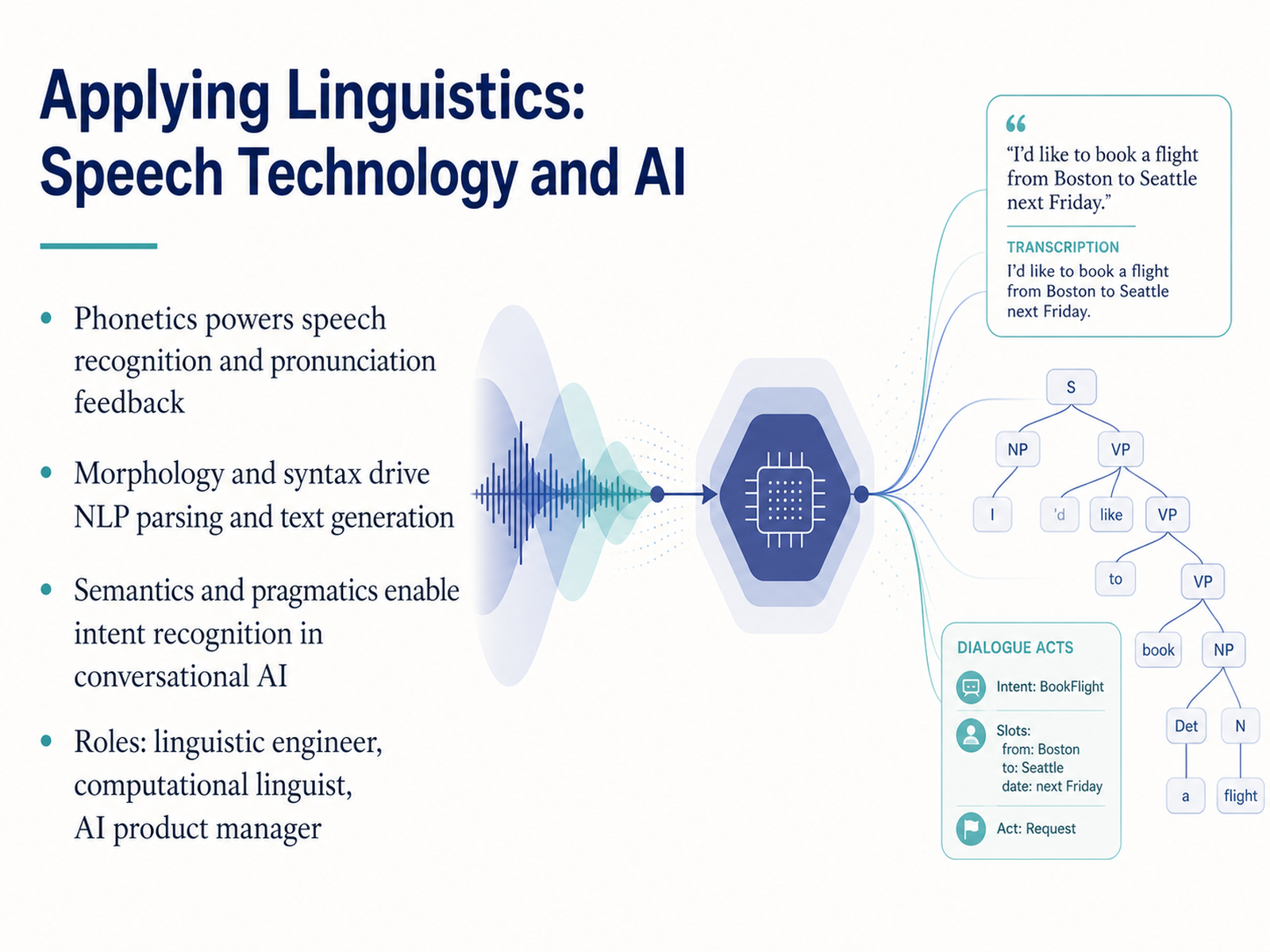
2 min - 11Applying Linguistics: Speech Technology and AINow let’s see how our core areas of linguistics come alive in speech technology and artificial intelligence. Think of phonetics as the ear of a system. It powers speech recognition, like when a pronunciation app hears you say a word and gives you real-time feedback on your accent. Morphology and syntax act as the grammar engine. They drive natural language processing, or NLP, so a machine can parse a sentence’s structure and even generate new, coherent text. Then semantics and pragmatics bring real understanding. They enable intent recognition, helping a conversational AI figure out whether you’re asking a question, making a request, or just being polite. These pieces come together in real-world roles. A linguistic engineer tunes systems for accurate speech and intent. A computational linguist builds the models that parse and generate language. An AI product manager shapes the vision, ensuring the technology meets human needs. Up next, we apply linguistics to communication, translation, and the law.
 2 min
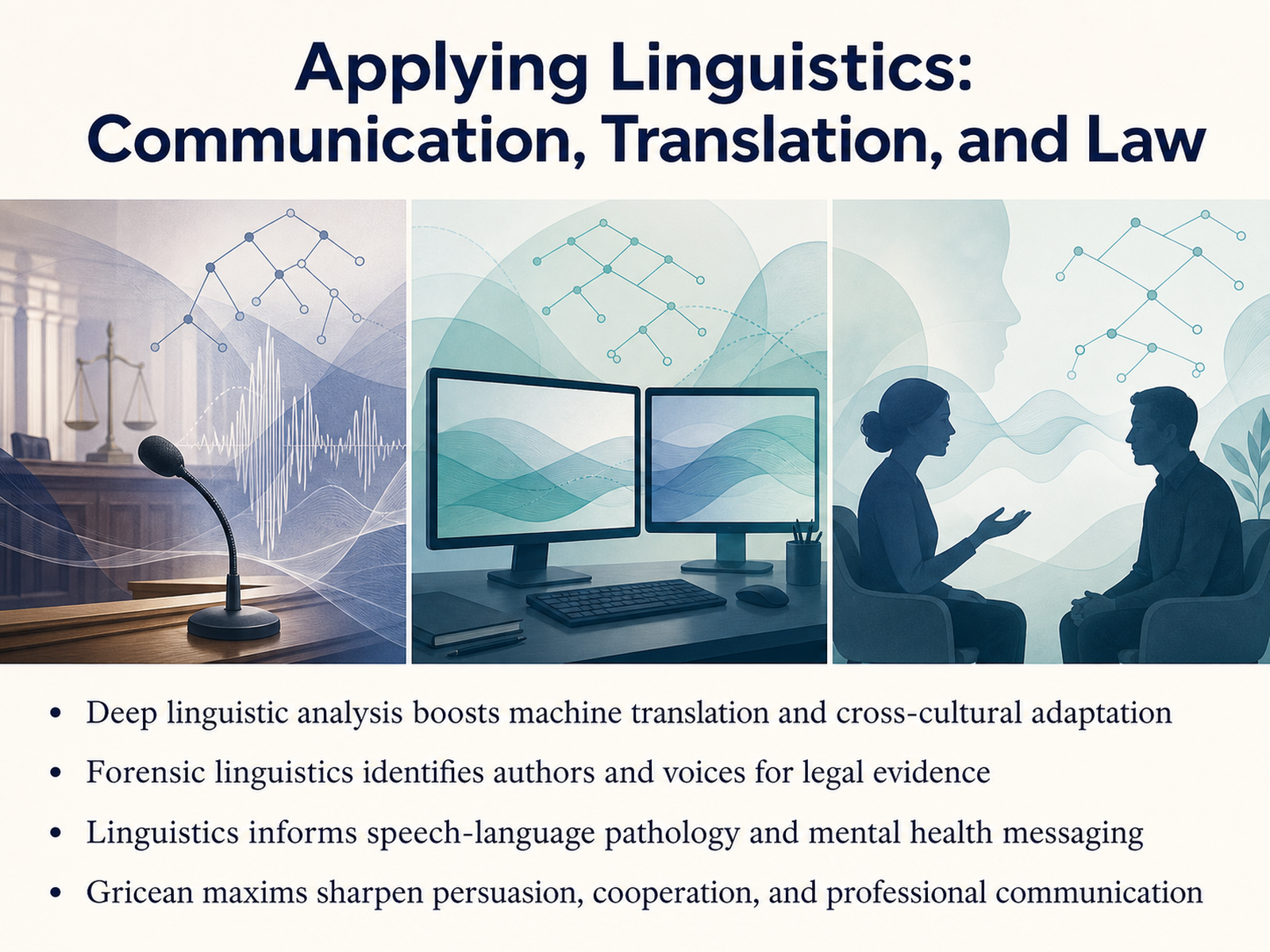
2 min - 12Applying Linguistics: Communication, Translation, and LawLet's now see how these linguistic concepts translate into powerful real-world tools. Deep linguistic analysis is what drives modern machine translation, helping it capture not just words but cultural nuance. In the legal world, forensic linguistics now identifies authorship and analyzes voice patterns, turning language itself into critical evidence. Linguistics also plays a healing role, directly informing speech-language pathology and the crafting of clear, effective mental health messaging. And in any professional setting, understanding the Gricean maxims—those unwritten rules of conversation—sharply improves your persuasion and cooperation. Next, we'll step back and see how linguistics acts as a lens for analysis and critical thinking.
 1 min
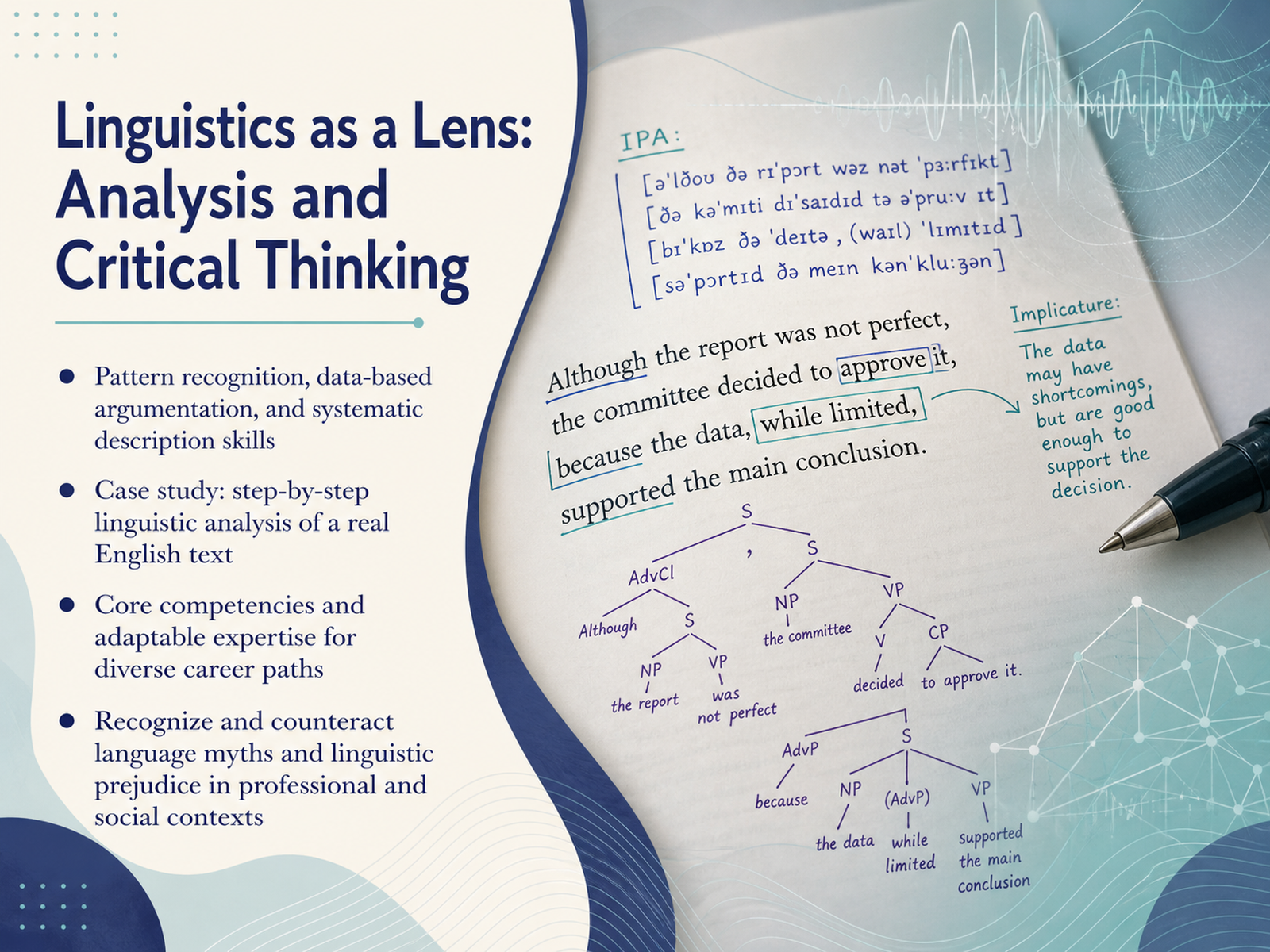
1 min - 13Linguistics as a Lens: Analysis and Critical ThinkingSo far, we have explored the internal architecture of language. Now let us step back and consider what linguistics actually trains you to do. At its core, linguistic analysis builds three portable skills: pattern recognition, data-based argumentation, and systematic description. You learn to observe language like a scientist observes data. Let me walk you through a brief case study. Imagine we analyze a real English text, perhaps a short news article. First, we might identify the frequency of certain sounds, a phonetic pattern. Then we would segment words into morphemes, noticing how prefixes like 'un-' or suffixes like '-ing' are used. Next, we examine the syntax, asking why sentences are structured in a certain order to build meaning. Finally, we look at the context, the pragmatics, to understand what the writer implies beyond the literal semantics. This step-by-step method is not just about language; it refines your critical thinking for any career path. Crucially, this lens also allows you to recognize and counteract language myths and linguistic prejudice. For instance, the common belief that some dialects are just 'broken' versions of a language crumbles under systematic description, which reveals that every variety has its own consistent, rule-governed grammar. These competencies offer you adaptable expertise, a valuable toolkit for professional and social contexts where evidence and clarity matter. Now, let us bring everything together in our final session, Key Takeaways and Continuing Your Journey.
 en.wikipedia.orgpeople.cs.georgetown.eduopen.umn.edu+22 min
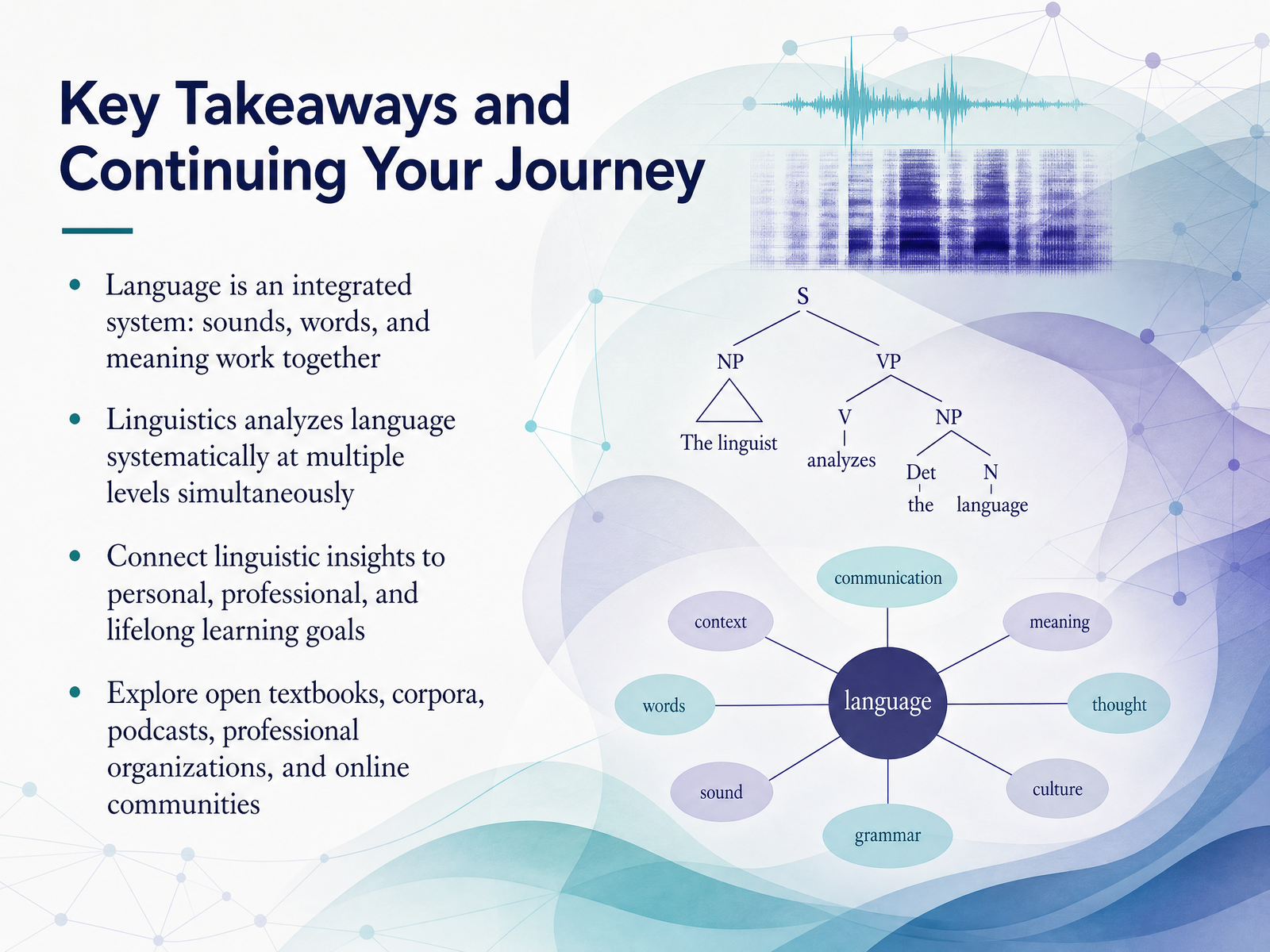
 - 14Key Takeaways and Continuing Your JourneyWe have reached the end of our introduction, but this is really just the beginning of your journey. Let's take a moment to reflect on what we have explored together. We learned that language is not a collection of random sounds, but an integrated system. Phonetics, morphology, syntax, and semantics all weave together seamlessly to create meaning. You have also seen how linguistics gives us the tools to analyze this system at multiple levels simultaneously, from the smallest distinctive sound to the intentions behind a full conversation. I encourage you to connect these insights to your own goals, whether that is learning a new language, improving your writing, or diving into speech technology. There are so many ways to continue exploring, from open textbooks and linguistic corpora to fascinating podcasts and professional communities. Thank you for joining me on this guided exploration of how language works. Keep listening closely to the words around you and stay curious.
 en.wikipedia.orgpeople.cs.georgetown.eduopen.umn.edu+22 min
Take the deck with you
Download this course as a file — free, no sign-up needed.
- PDF handoutEvery slide page, ready to print or share.15 pages · 4.0 MBDownload
- Narrated PowerPointThe deck that presents itself — every slide carries the digital human's narration video.15 pages · 16.3 MBDownload
- PowerPoint slidesThe full deck as a .pptx — open it in PowerPoint, Keynote, or Google Slides.15 pages · 4.0 MBDownload
Free to use in your own training — please keep the PersonWise credit page at the end.
Have your own deck? Turn it into a course
Sources consulted
Web sources consulted while building this course.
- Linguistics — en.wikipedia.org
- What is Linguistics? — people.cs.georgetown.edu
- Essentials of Linguistics, 2nd Edition - 2nd Edition - Open Textbook Library — open.umn.edu
- Basic concepts of linguistics — ufal.mff.cuni.cz
- Introduction to Linguistics | Department of Speech and Language Therapy — slt.uop.gr
- Hockett's design features — en.wikipedia.org
- The Origin of Speech — langev.com
- Hockett's "design features" of language — phon.ox.ac.uk
- What is duality of patterning, anyway? — degruyterbrill.com
- New perspectives on duality of patterning - PMC - NIH — pmc.ncbi.nlm.nih.gov
- The International Phonetic Alphabet (IPA) — cambridge.org
- Full IPA Chart | International Phonetic Association — internationalphoneticassociation.org
- https://ielp.ehe.osu.edu/files/2022/09/English_IPA_20220828.pdf — ielp.ehe.osu.edu
- Articulatory Phonetics and the International Phonetic Alphabet — people.umass.edu
- Describing consonants — home.cc.umanitoba.ca
- English Sounds in Context: — slam.lin.ufl.edu
- Phoneme and allophone — mq.edu.au
- Handout #1 — laits.utexas.edu
- 4.3 Contrastive distribution and minimal pairs – ENG 200: Introduction to Linguistics — pressbooks.nvcc.edu
- Determining the distribution of segments in a language — users.castle.unc.edu