Begin
13 pages · ~26 min
Data Science Workshop Facilitation
This training prepares facilitators to lead data science workshops, covering planning, delivery, and audience engagement for effective, hands-on learning.
A digital instructor presents all 13 pages. Hold “Ask” at any point and ask out loud — the answer comes from this course. No sign-up needed.
What you’ll learn
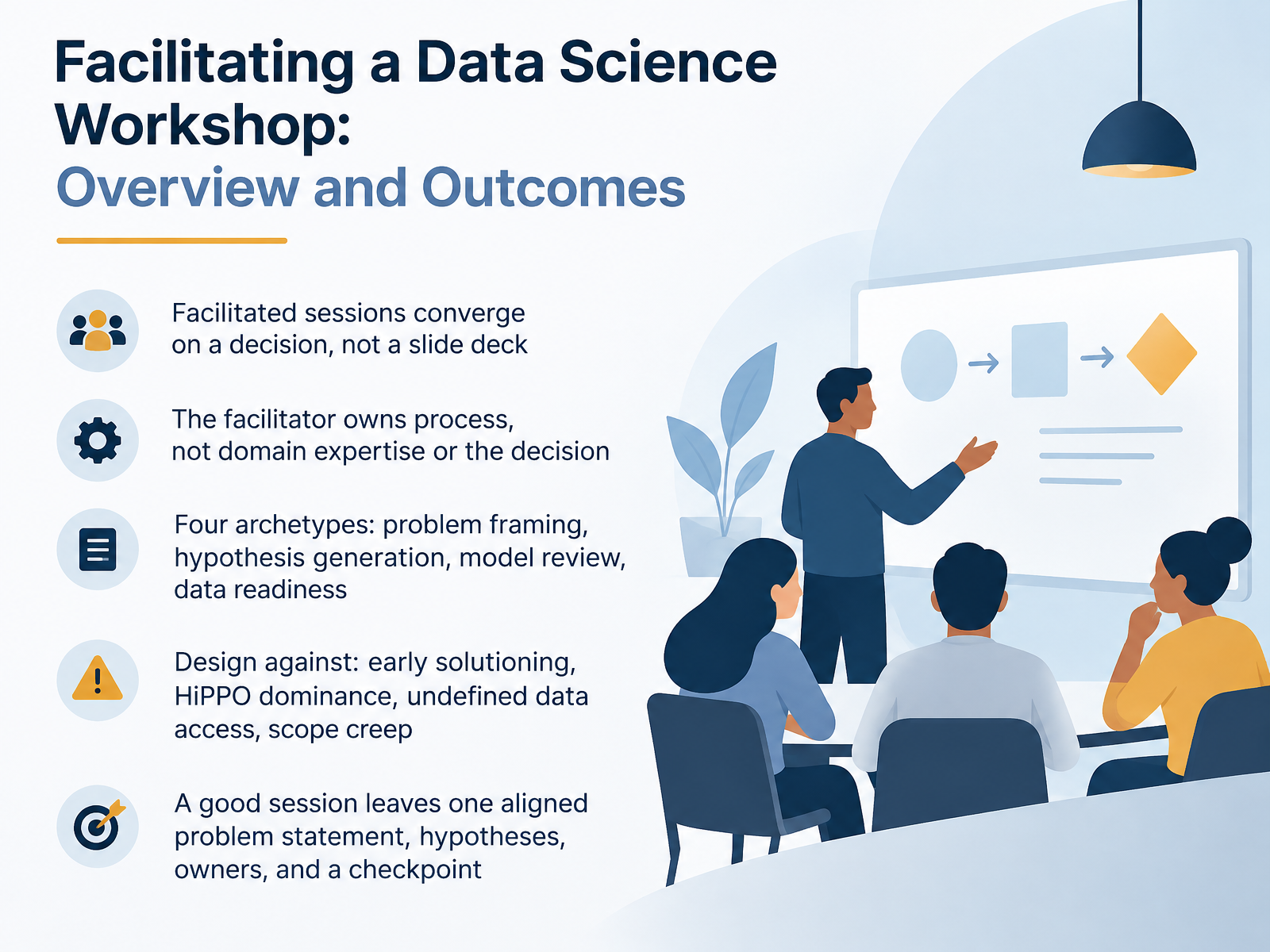
- 01Facilitating a Data Science Workshop: Overview and OutcomesWelcome. Over the next few minutes, we'll focus on facilitating a data science workshop, and the outcome we're aiming for on this opening slide. Here's the mindset that changes everything. A facilitated session converges on a decision, not a slide deck. Your job is process, not domain expertise, and not the decision itself. You'll work across four archetypes: problem framing, hypothesis generation, model review, and data readiness. You'll also design against four familiar failure modes: early solutioning, the HiPPO's dominance, undefined data access, and scope creep. A strong session ends with something concrete: one aligned problem statement, a set of testable hypotheses, named owners, and a checkpoint on the calendar. For example, you might redirect a dominant stakeholder by saying, hold that thought, let's hear from someone who hasn't spoken. Or you might convert a vague question into a testable one by asking what we'd measure and how we'd know. So keep this anchor in mind: before you build the agenda, decide what decision this room needs to make. Let's move into why facilitation is the highest-leverage skill in analytics work.journals.plos.orgjournals.plos.orgsaberbio.org+22 min
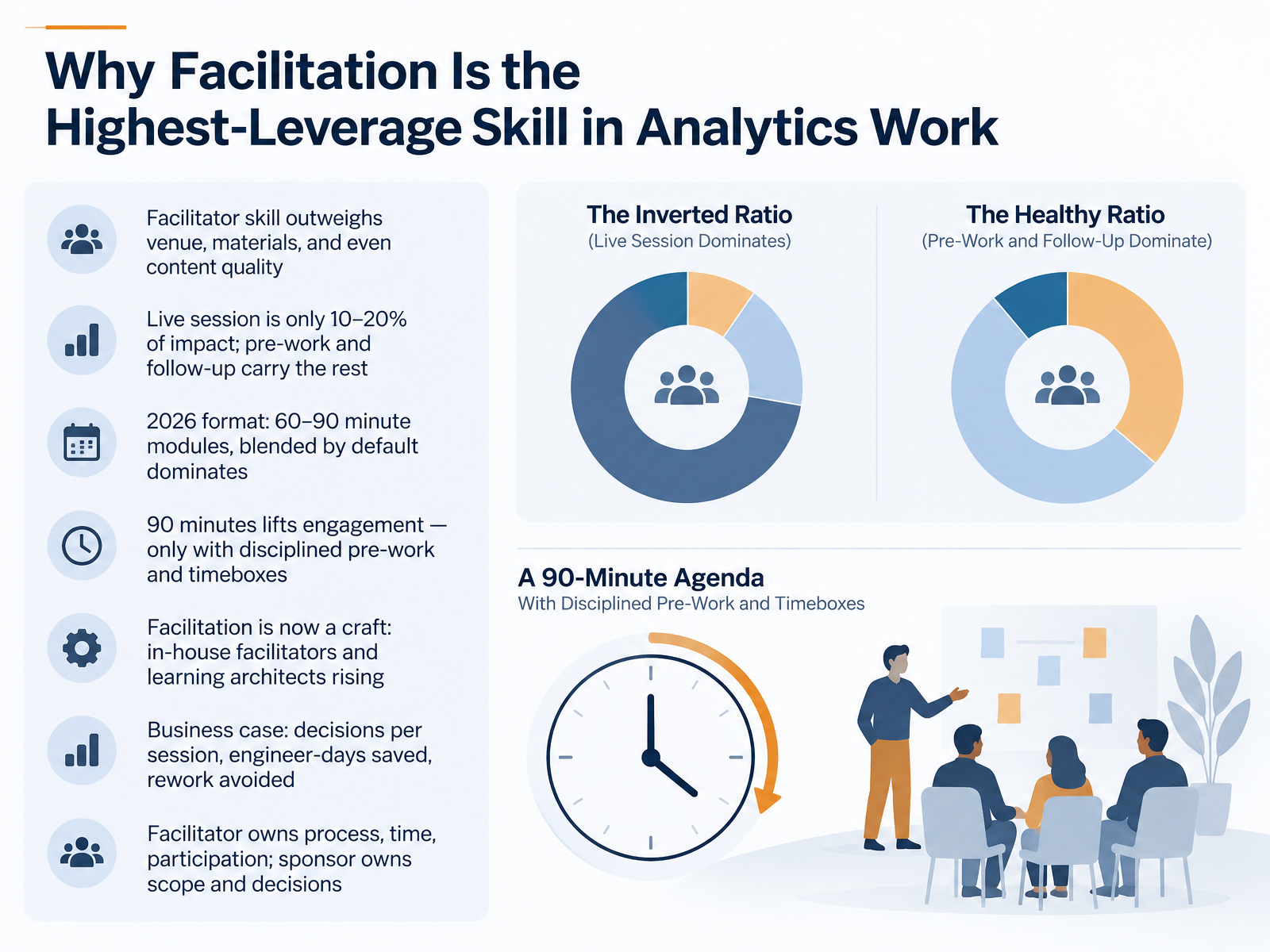
- 02Why Facilitation Is the Highest-Leverage Skill in Analytics WorkLet's start with the core claim. In analytics work, facilitator skill outweighs the venue, the materials, even the quality of your content. A strong facilitator rescues a mediocre agenda. A weak one kills a brilliant one. Here's the part most teams get wrong. The live session is only ten to twenty percent of your impact. The rest lives in pre-work and follow-up. In twenty twenty-six, the format has shifted. Modular sessions of sixty to ninety minutes, blended by default, now dominate. Compression to ninety minutes lifts engagement by about thirty percent, but only with disciplined pre-work and ruthless timeboxes. Facilitation is now a craft. In-house facilitators and learning architects are on the rise. And the business case is concrete. Decisions per session. Engineer-days saved. Rework avoided. One boundary to hold. You own process, time, and participation. The sponsor owns scope and the decisions. Keep that line clear. Next, we'll diagnose the room before anyone arrives.
 journals.plos.orgjournals.plos.orgsaberbio.org+22 min
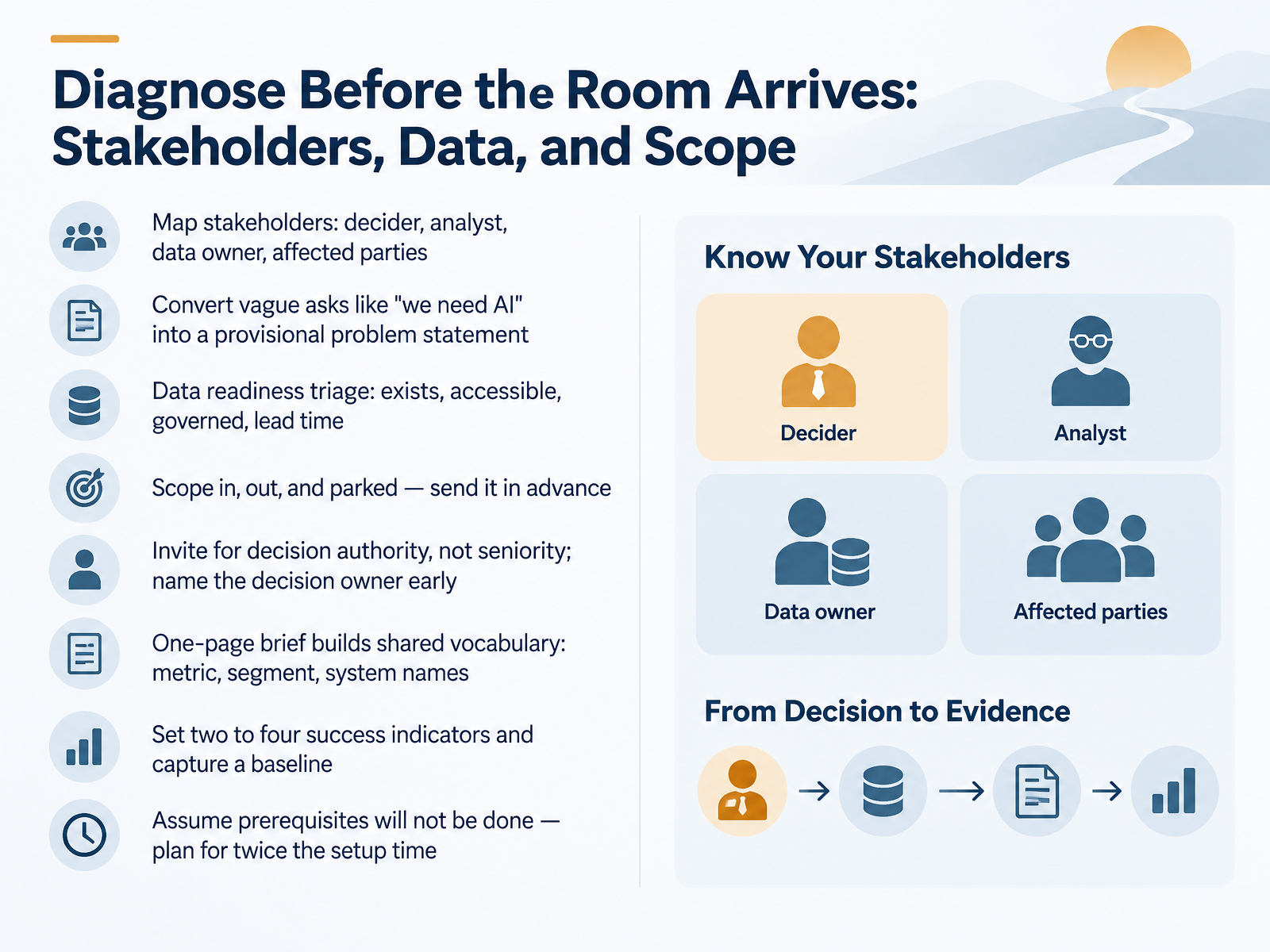
 - 03Diagnose Before the Room Arrives: Stakeholders, Data, and ScopeBefore you design anything, diagnose. Start by mapping the room: who decides, who analyzes, who owns the data, and who is simply affected by the outcome. Name the decision owner early, and invite for decision authority rather than seniority. Then take a vague ask, something like we need AI, and convert it into a provisional problem statement you can actually test. Run a quick data readiness triage: does the data exist, is it accessible, is it governed, and what is the lead time? Scope in, out, and parked items clearly, and send that one-page brief in advance. It builds shared vocabulary around metrics, segments, and system names, and lets you set two to four success indicators with a baseline. Finally, assume prerequisites will not be done. Plan for twice the setup time and design around it. Now let's move on to designing the session itself: flows, timeboxes, and working artifacts.
 journals.plos.orgjournals.plos.orgsaberbio.org+22 min
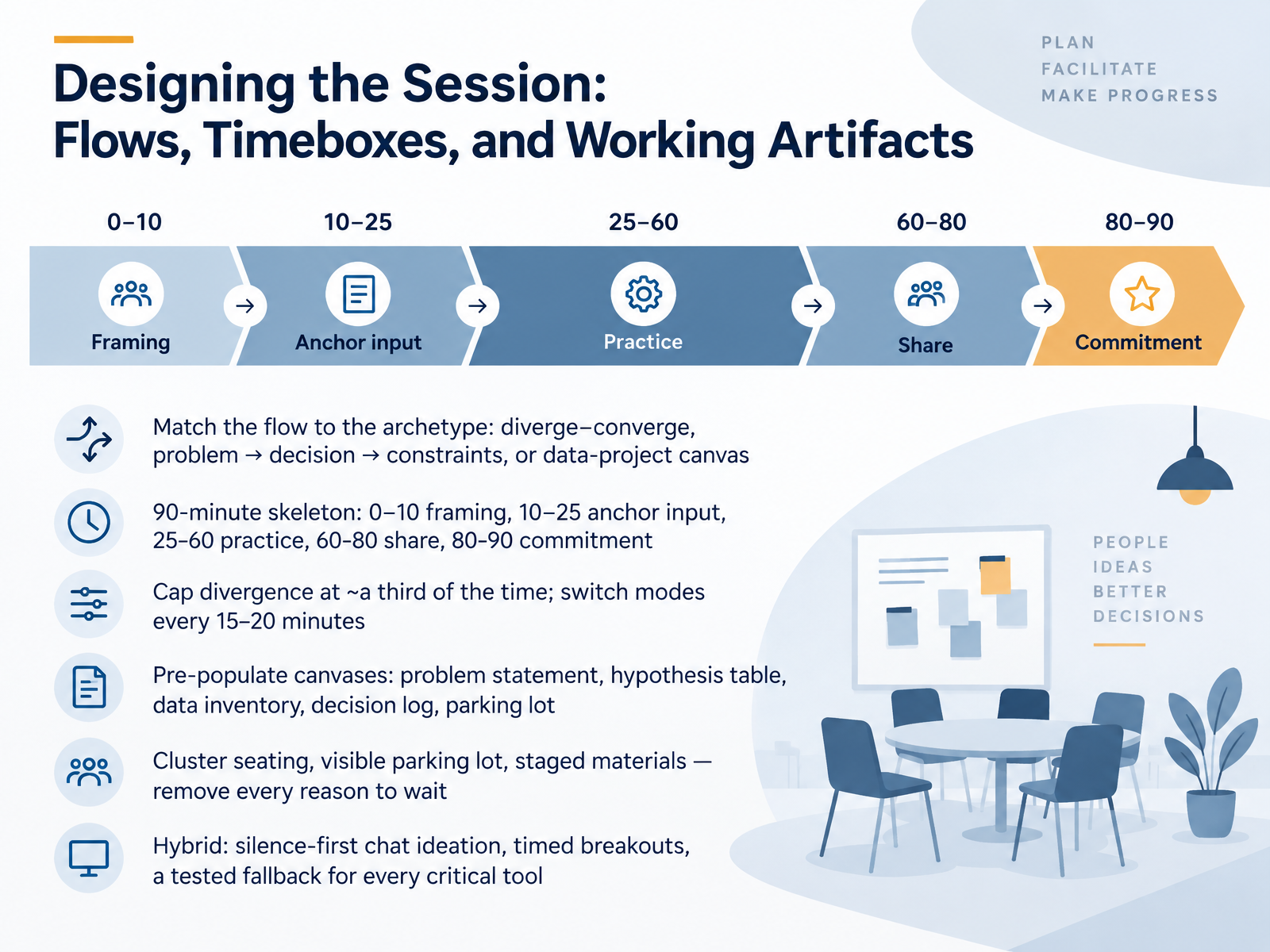
 - 04Designing the Session: Flows, Timeboxes, and Working ArtifactsNow let's talk about the architecture of the session itself. The first decision is matching your flow to the archetype. If the goal is generating options, use diverge then converge. If it's a decision, run problem, then decision, then constraints. For exploratory work, the data project canvas anchors everything. Your ninety-minute skeleton works well: ten minutes framing, fifteen minutes anchor input, thirty-five minutes practice, twenty minutes share, ten minutes commitment. Here's the discipline that makes it work. Cap divergence at about a third of the time total, and switch modes every fifteen to twenty minutes. Pre-populate every artifact: the problem statement, hypothesis table, data inventory, decision log, and parking lot. Cluster the seating, make the parking lot visible, and stage all materials before people arrive. Remove every reason for anyone to wait. For hybrid sessions, start with silence-first chat ideation. Use timed breakouts. And test a fallback for every critical tool, because something will fail. The throughline is simple. Design the container so the thinking can happen without friction. Next, we'll look at framing the problem with the team.
 itk.mitre.orgitk.mitre.orgitk.mitre.org+22 min
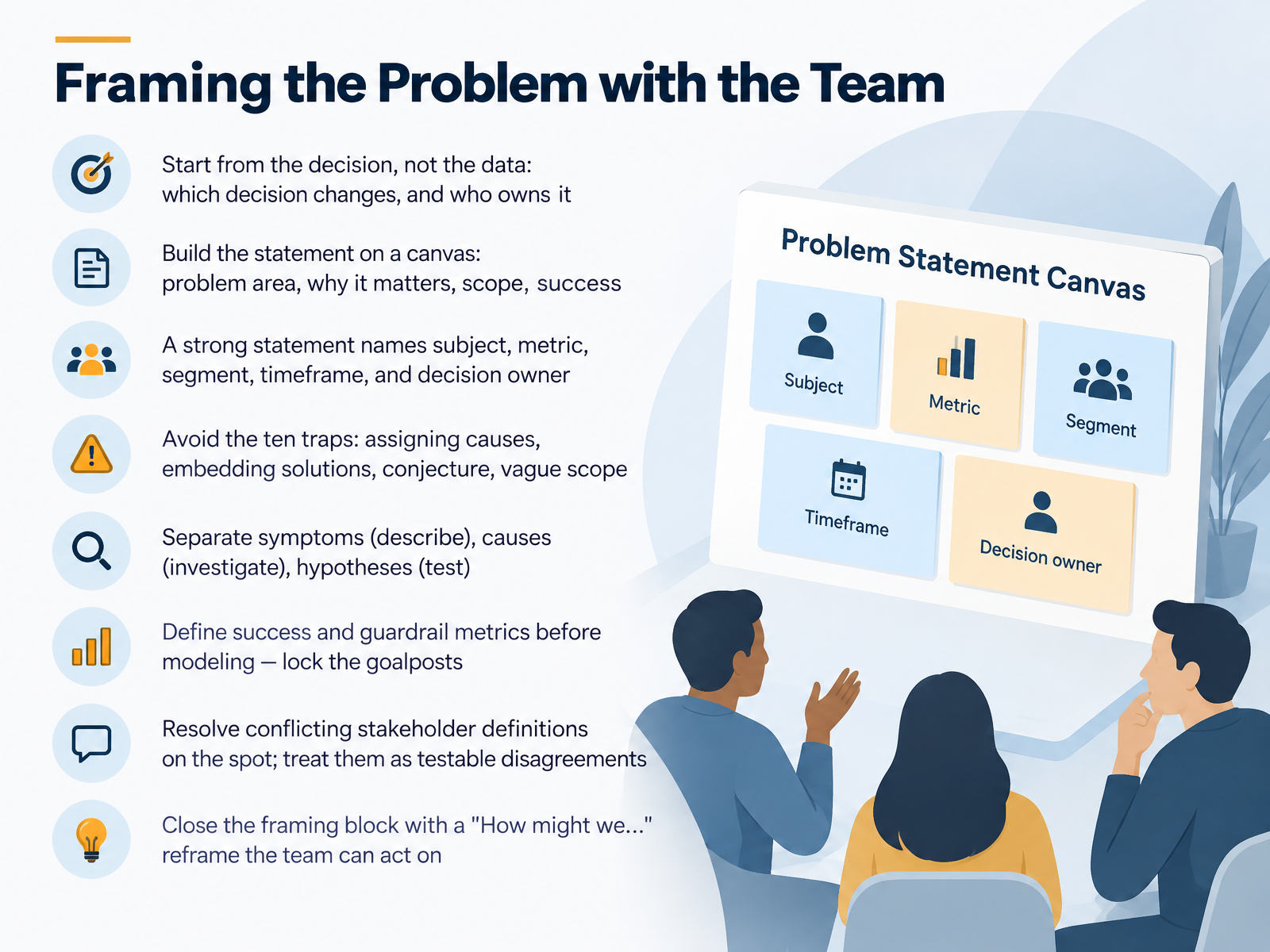
 - 05Framing the Problem with the TeamLet's move into framing the problem with the team, which is where most workshops are won or lost. Start from the decision, not the data. Ask: which decision changes, and who owns it? Then build the statement on a canvas: problem area, why it matters, scope, and success. A strong statement names the subject, metric, segment, timeframe, and decision owner. Watch the ten traps. Avoid assigning causes, embedding solutions, leaning on conjecture, or leaving scope vague. Separate symptoms, which you describe, from causes, which you investigate, and hypotheses, which you test. Lock the goalposts early by defining success and guardrail metrics before anyone models. When stakeholders clash on definitions, resolve it on the spot and treat it as a testable disagreement. Close the framing block with a How might we reframe the team can act on. Next, we move into generating and prioritizing testable hypotheses.
 itk.mitre.orgitk.mitre.orgitk.mitre.org+22 min
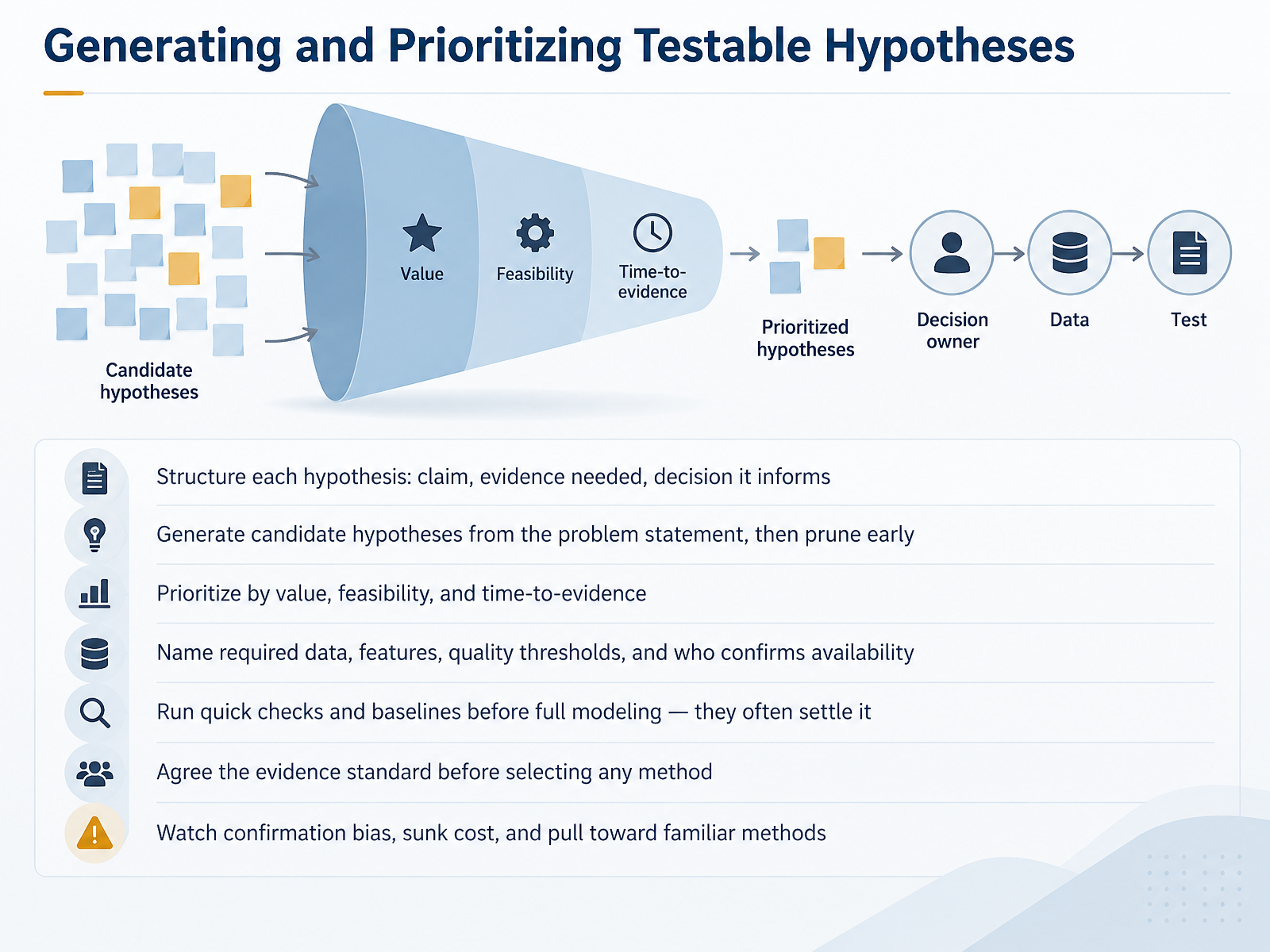
 - 06Generating and Prioritizing Testable HypothesesNow let's talk about turning a messy problem statement into hypotheses you can actually test. Structure each one in three parts: the claim, the evidence needed, and the decision it informs. Generate candidates from the problem statement first, then prune early and hard. Prioritize by value, feasibility, and time-to-evidence. Then name the required data, the features, your quality thresholds, and who confirms availability. Before full modeling, run a quick check or a baseline. They often settle the question on their own. And agree your evidence standard before you pick any method. Watch for confirmation bias, sunk cost, and the pull toward familiar methods. Next, we'll look at managing dynamics, conflict, and cognitive bias.
 github.comlearningloop.iogithub.com+21 min
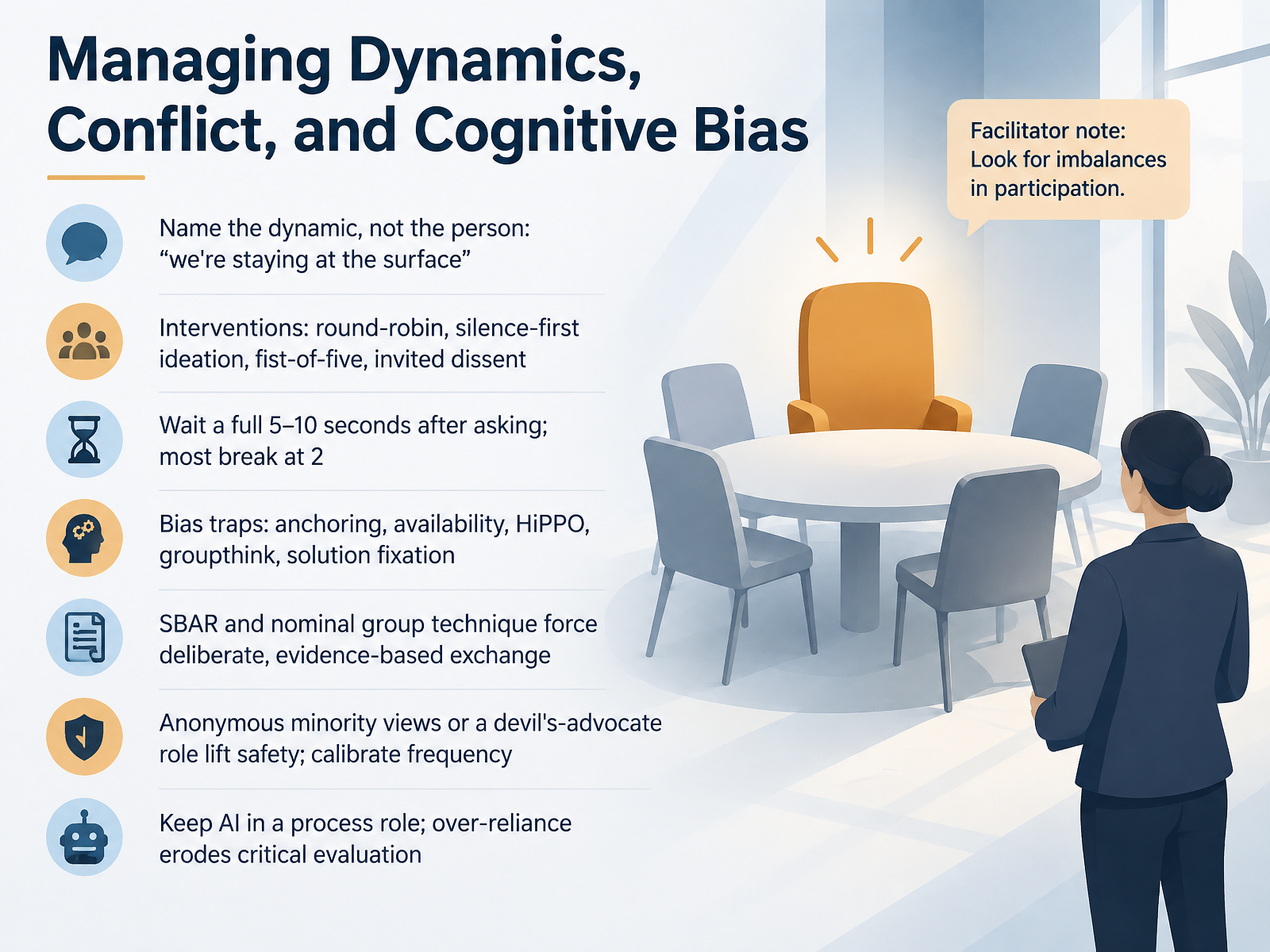
 - 07Managing Dynamics, Conflict, and Cognitive BiasLet's talk about managing the human dynamics in the room. When tension rises, name the pattern, not the person. Try saying, "I notice we're staying at the surface." That keeps it safe. Then intervene with structure. Round-robin, silence-first ideation, fist-of-five, or an invited dissenter. And after you ask a question, wait a full five to ten seconds. Most facilitators break at two. Watch for the usual traps. Anchoring. Availability. The HiPPO, the highest-paid person's opinion. Groupthink. And solution fixation. To force deliberate exchange, use SBAR or nominal group technique. Anonymous minority views and a devil's-advocate role can lift psychological safety, so calibrate how often you use them. Finally, keep any AI in a process role. It can prompt and summarize, but over-reliance erodes your group's critical evaluation. Next, we move into closing the session, decisions, owners, and data commitments.
 arxiv.orgarxiv.orgarxiv.org+21 min
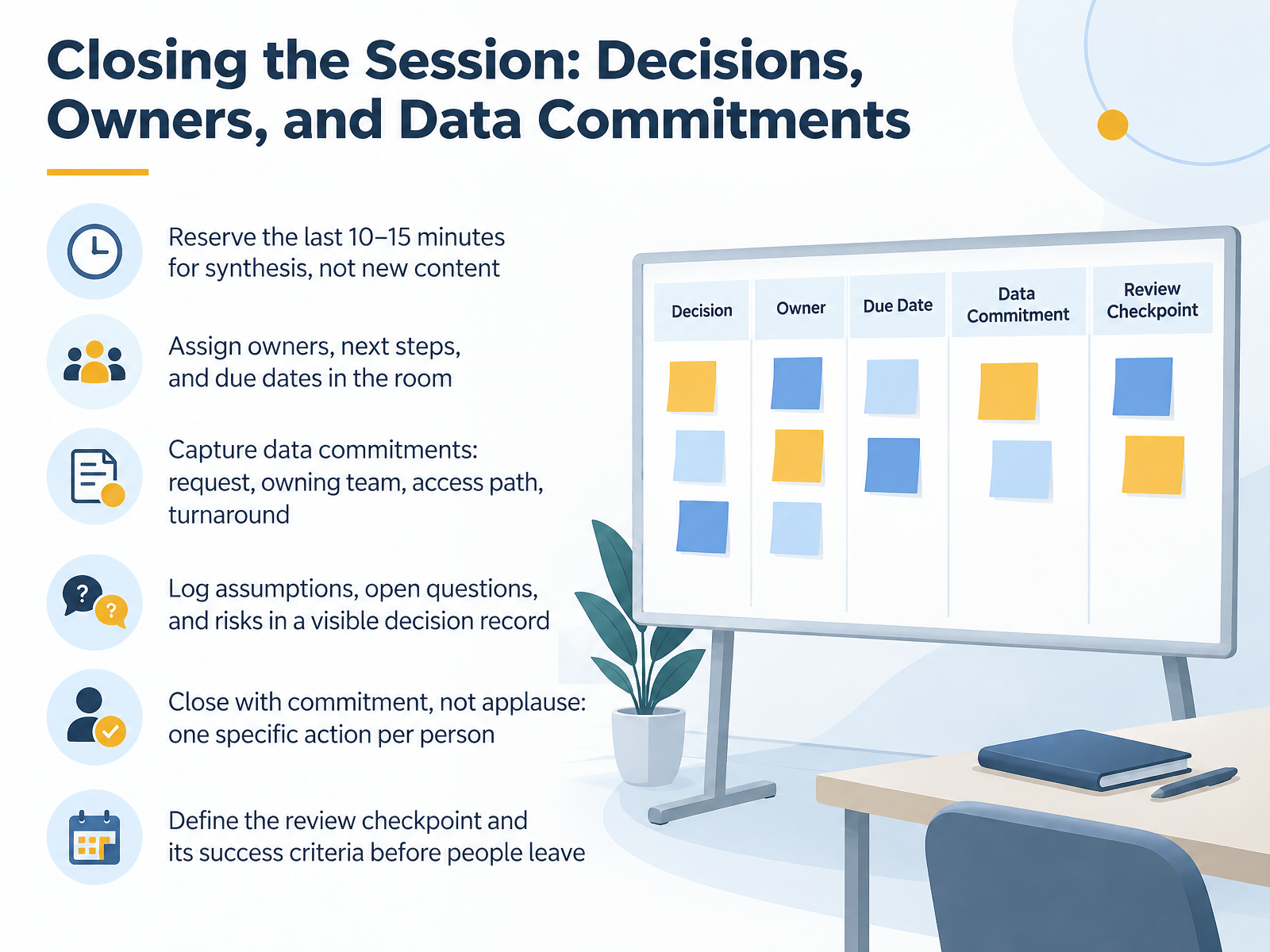
 - 08Closing the Session: Decisions, Owners, and Data CommitmentsLet's talk about how you close the session. Reserve the last ten to fifteen minutes for synthesis, not new content. If you're still introducing ideas, you've lost the room. In that window, assign owners, next steps, and due dates out loud, while everyone is still present. Don't let a task leave the room unowned. Capture data commitments explicitly: the request, the owning team, the access path, and the turnaround time. Then log assumptions, open questions, and risks in a decision record everyone can see. Here's a concrete moment. Instead of ending with applause, close with commitment. Go around the room and ask each person for one specific action they'll take this week. Finally, define the review checkpoint and its success criteria before anyone leaves. That single habit is what keeps the workshop's momentum alive long after the room clears. Next, we'll look at follow-through and feedback loops after the workshop.
 journals.plos.orgjournals.plos.orgsaberbio.org+22 min
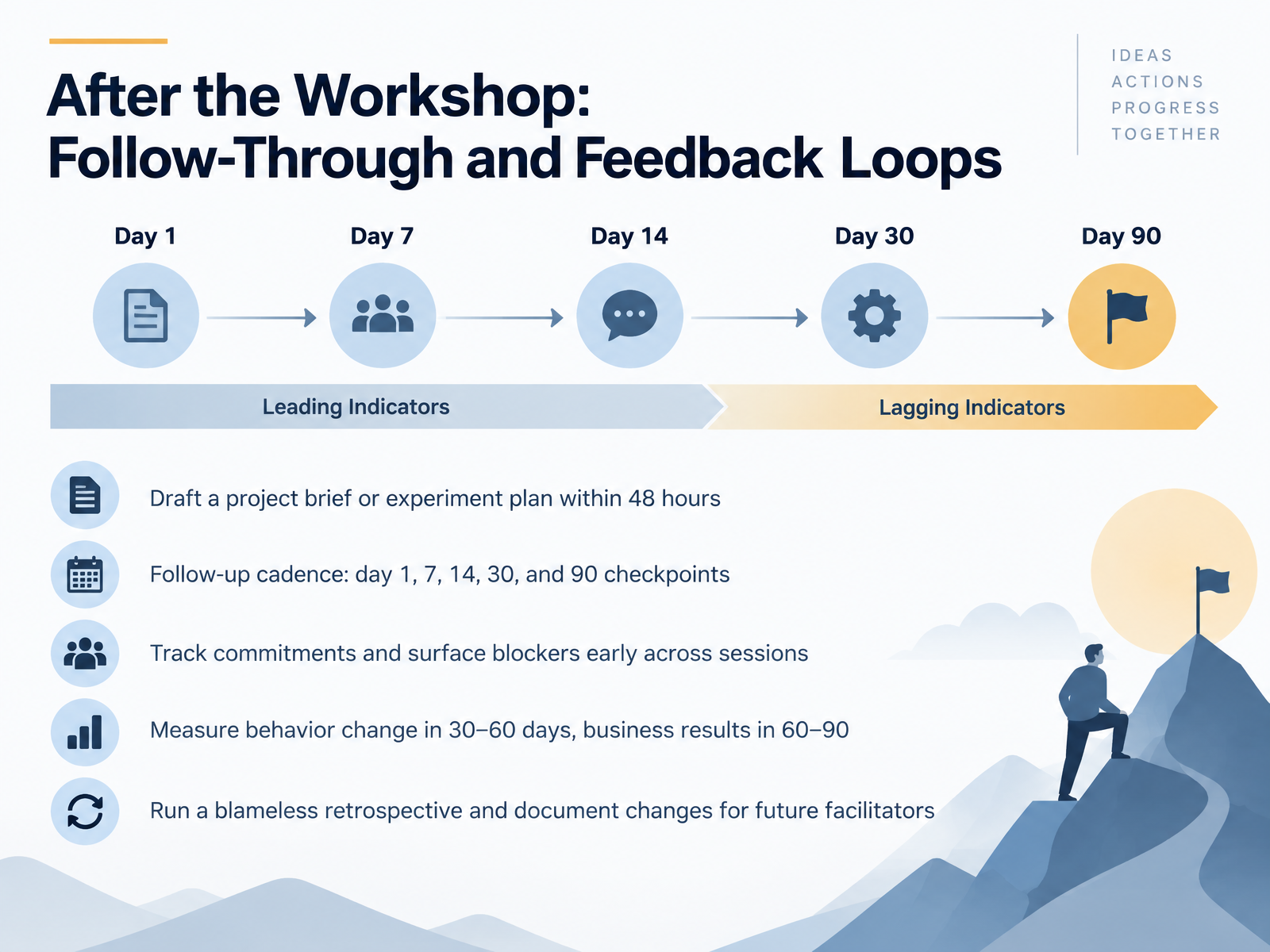
 - 09After the Workshop: Follow-Through and Feedback LoopsLet's talk about what happens after the workshop ends, because the real work starts there. Within forty-eight hours, draft a project brief or experiment plan while the energy is still fresh. Then set a follow-up cadence at day one, seven, fourteen, thirty, and ninety. Your goal here is simple: track commitments and surface blockers early across sessions. When someone goes quiet, reach out before the next checkpoint. Measure behavior change in thirty to sixty days, and business results in sixty to ninety. At the end, run a blameless retrospective, and document what you'd change for next time. That documentation becomes your facilitation playbook. Next, let's look at the facilitator toolkit: templates, agendas, and question banks.
 1 min
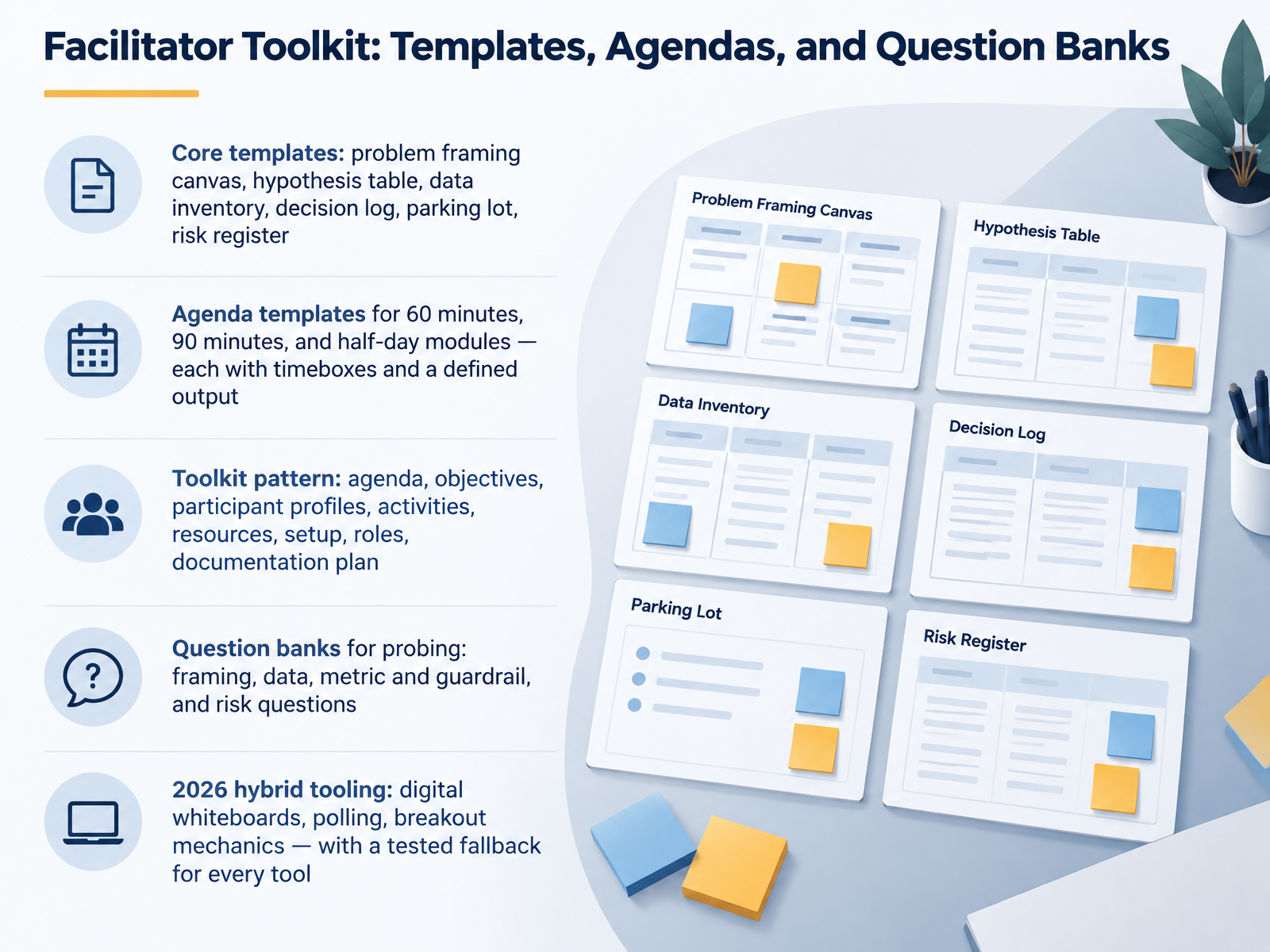
1 min - 10Facilitator Toolkit: Templates, Agendas, and Question BanksNow let's open the toolkit itself. Think of these as reusable assets, not one-off artifacts. On templates, you have six workhorses: a problem framing canvas, a hypothesis table, a data inventory, a decision log, a parking lot, and a risk register. The decision log and parking lot matter most, because they protect your time and your credibility. For agendas, build three versions: sixty minutes, ninety minutes, and a half-day. Each with timeboxes and one defined output. Next, the toolkit pattern that holds it together: agenda, objectives, participant profiles, activities, resources, setup, roles, and a documentation plan. Question banks are your leverage. Prepare framing questions, data questions, metric and guardrail questions, and risk questions. So when someone says, we need better insights, you can ask what decision changes and by when. On hybrid tooling, keep it simple: digital whiteboards, polling, breakout mechanics, and a tested fallback for every tool. Run the fallback once before the session, not during it. The takeaway: templatize the repeatable, so you can spend your energy on the room. Next, we move to Facilitator Craft: Behaviors That Make a Session Work.
 itk.mitre.orgitk.mitre.orgitk.mitre.org+22 min
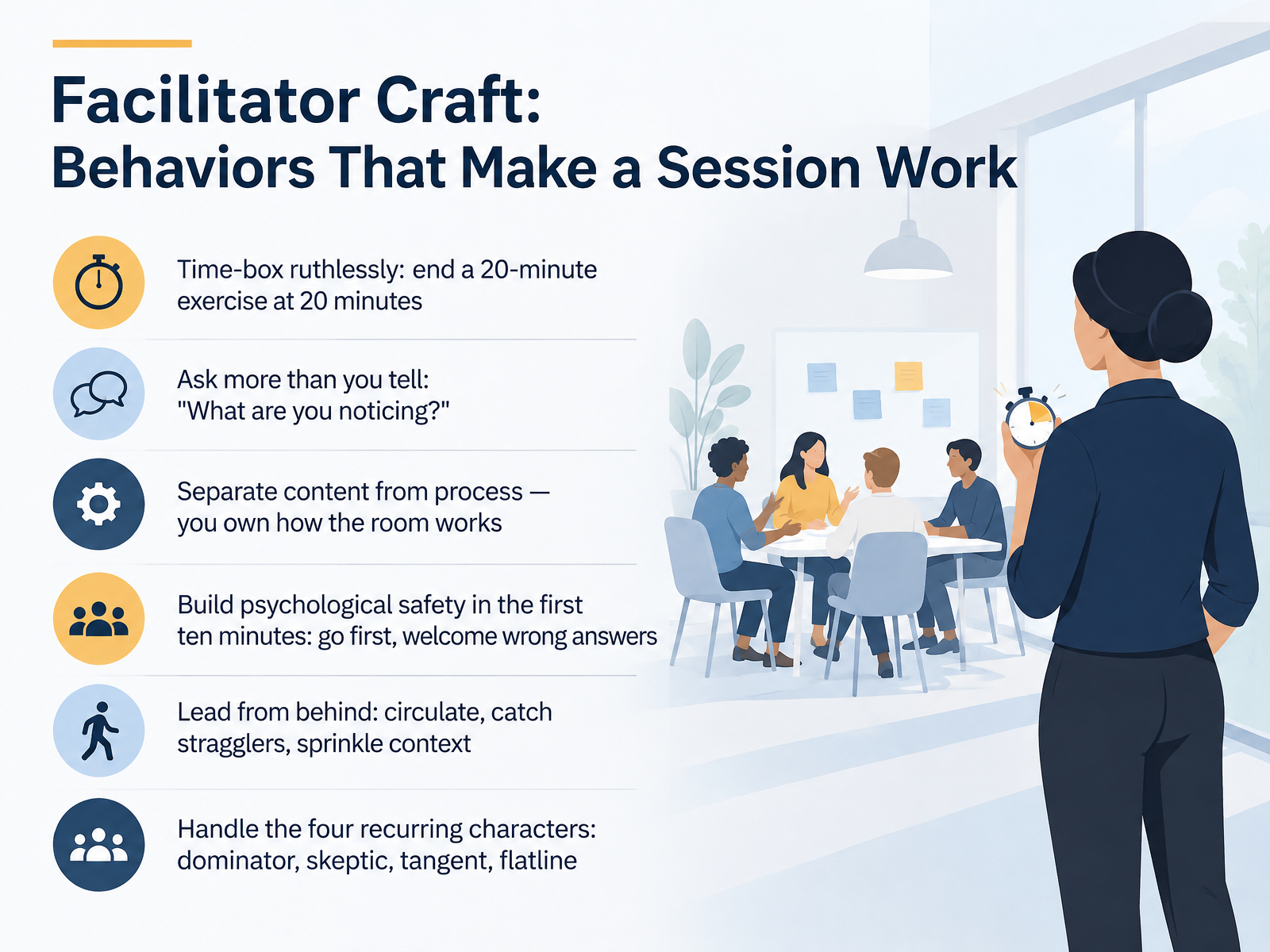
 - 11Facilitator Craft: Behaviors That Make a Session WorkNow let's talk about the behaviors that make a session actually work. First, time-box ruthlessly. If an exercise is scheduled for twenty minutes, end it at twenty minutes, even when it was just getting good. Consistent time discipline trains the room to produce under constraint. Second, ask more than you tell. Trade explanations for open questions like, what are you noticing, or what surprises you here. Then hold the silence for five to ten full seconds so people can think. Third, separate content from process. You are not the subject-matter expert in the room. You own how the room works. Fourth, build psychological safety in the first ten minutes. Go first with what is hard about the topic, and explicitly welcome messy first drafts of thinking. Fifth, lead from behind. Circulate, catch the stragglers, and sprinkle context as you go. And prepare for the four recurring characters: the dominator, the skeptic, the tangent, and the flatline. Name the dynamic, not the person. That keeps it safe and keeps the session moving. Next, we look at common pitfalls and how to avoid them.
 journals.plos.orgjournals.plos.orgsaberbio.org+22 min
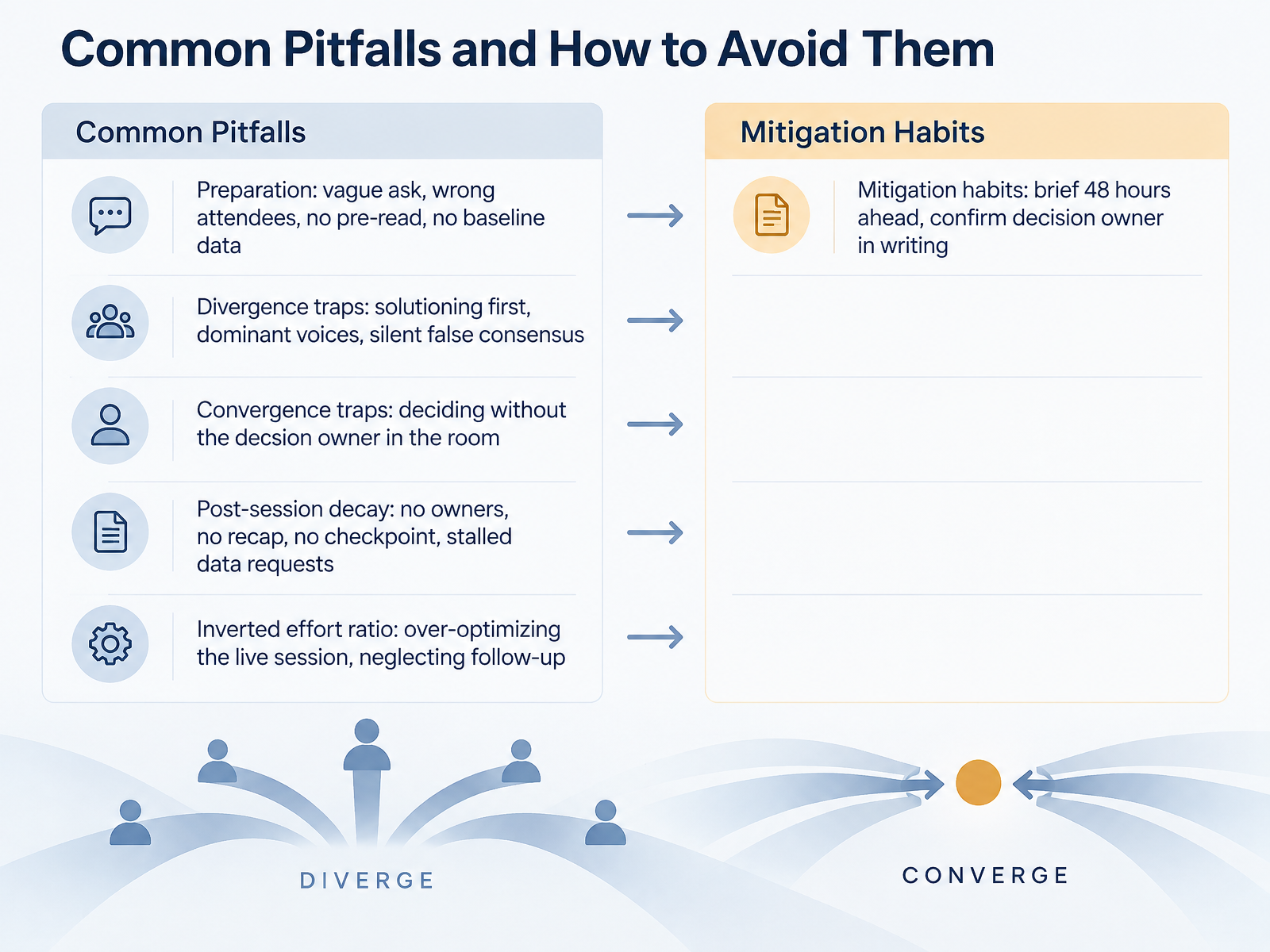
 - 12Common Pitfalls and How to Avoid ThemLet's talk about where these sessions usually go wrong, and the habits that keep them on track. Preparation is the first failure point. A vague ask, the wrong attendees, no pre-read, and no baseline data will sink a session before it starts. The fix is small: send a brief forty-eight hours ahead, and confirm the decision owner in writing. Next, watch your divergence traps. Teams jump to solutioning, one dominant voice takes over, or quiet agreement masks real disagreement. Name the pattern, not the person. Then convergence traps: you cannot land a decision when the decision owner is not in the room. Finally, post-session decay. No owners, no recap, no checkpoint, stalled data requests. And notice the inverted effort ratio. If you spend ninety percent of your energy on the live session, you are optimizing the smallest part. The work lives in the follow-up. So protect the brief, the owner, and the recap. Next, we will put all of this into practice with a worked scenario and your personal action plan.
 journals.plos.orgjournals.plos.orgsaberbio.org+22 min
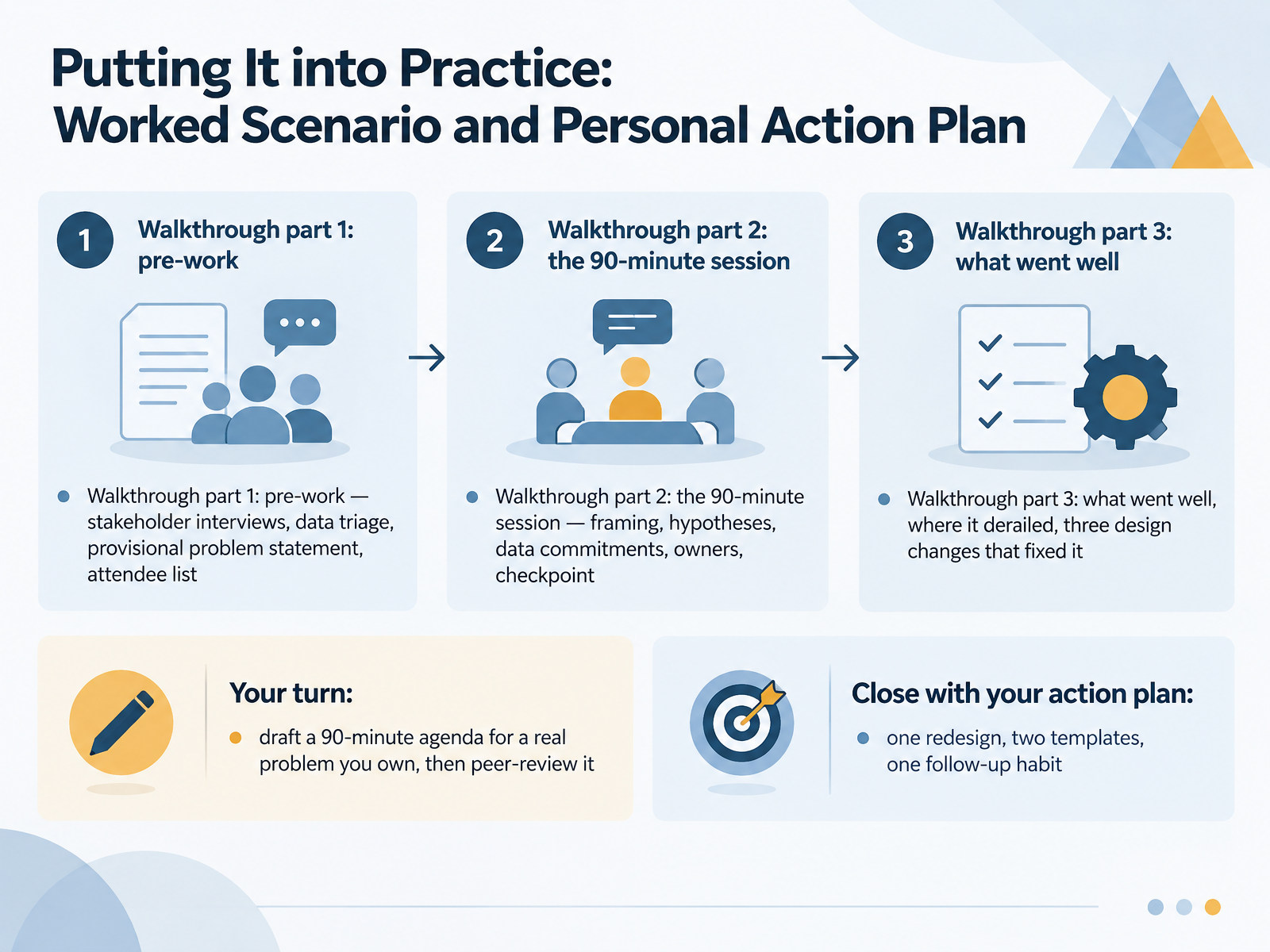
 - 13Putting It into Practice: Worked Scenario and Personal Action PlanLet's bring it all together. Picture a worked scenario. In pre-work, you interview stakeholders, triage the data, draft a provisional problem statement, and lock the attendee list. Then the ninety-minute session: framing, hypotheses, data commitments, owners, and a checkpoint. Afterward, you name what went well, where it derailed, and the three design changes that fixed it. Now it's your turn. Draft a ninety-minute agenda for a real problem you own, then peer-review it. Remember, engagement rises when sessions are compressed, but only with clear pre-work and disciplined facilitation. Close with your action plan: one redesign, two templates, and one follow-up habit. Thank you for your work here. You already run sharp sessions. Now go make the next one sharper.
 journals.plos.orgjournals.plos.orgsaberbio.org+21 min
Take the deck with you
Download this course as a file — free, no sign-up needed.
- PDF handoutEvery slide page, ready to print or share.14 pages · 3.0 MBDownload
- Narrated PowerPointThe deck that presents itself — every slide carries the digital human's narration video.14 pages · 12.8 MBDownload
- PowerPoint slidesThe full deck as a .pptx — open it in PowerPoint, Keynote, or Google Slides.14 pages · 2.9 MBDownload
Free to use in your own training — please keep the PersonWise credit page at the end.
Have your own deck? Turn it into a course
Sources consulted
Web sources consulted while building this course.
- Ten simple rules for organizing a data science workshop | PLOS Computational Biology — journals.plos.org
- Ten simple rules for teaching data science | PLOS Computational Biology — journals.plos.org
- 2026 SABER National Workshop Template (final) — saberbio.org
- Enagagement strategies for workshops — exa.ai
- Workshop & Training Event Planning Guide for 2026 · EventCortex — eventcortex.com
- PROBLEM FRAMING CANVAS: Defining the Right Problem — itk.mitre.org
- Problem Framing - Innovation Toolkit — itk.mitre.org
- Problem Framing - Innovation Toolkit — itk.mitre.org
- The Problem Framing Canvas — designsprint.academy
- Problem Framing Canvas Handbook: Making sense of problems for better responses — griffith.edu.au
- GitHub - Tanya-Khanna/Data-Science-Workshop---Spring-2025---NBL- · GitHub — github.com
- Experiment Ideation exercise. How it Works and Instructions. — learningloop.io
- linkedin/ghc25-ds-workshop — github.com
- Hypothesis Testing – College Pal — collepals.com
- 4-activity-explore-hypothesis-testing.ipynb — github.com
- Bringing Everyone to the Table: An Experimental Study of LLM-Facilitated Group Decision Making — arxiv.org
- Conversational Agents as Catalysts for Critical Thinking: Challenging Social Influence in Group Decision-making — arxiv.org
- Amplifying Minority Voices: AI-Mediated Devil’s Advocate System for Inclusive Group Decision-Making — arxiv.org
- Mitigating Cognitive Bias to Improve Organizational Decisions: An Integrative Review, Framework, and Research Agenda — journals.sagepub.com
- An agentic framework to achieve systematic facilitation in group consensus building — exa.ai