Begin
14 pages · ~28 min
Avoiding Common AI Literacy Mistakes
A concise training that helps professionals identify and avoid common AI literacy mistakes, building the skills to use AI tools accurately, responsibly, and effectively.
A digital instructor presents all 14 pages. Hold “Ask” at any point and ask out loud — the answer comes from this course. No sign-up needed.
What you’ll learn
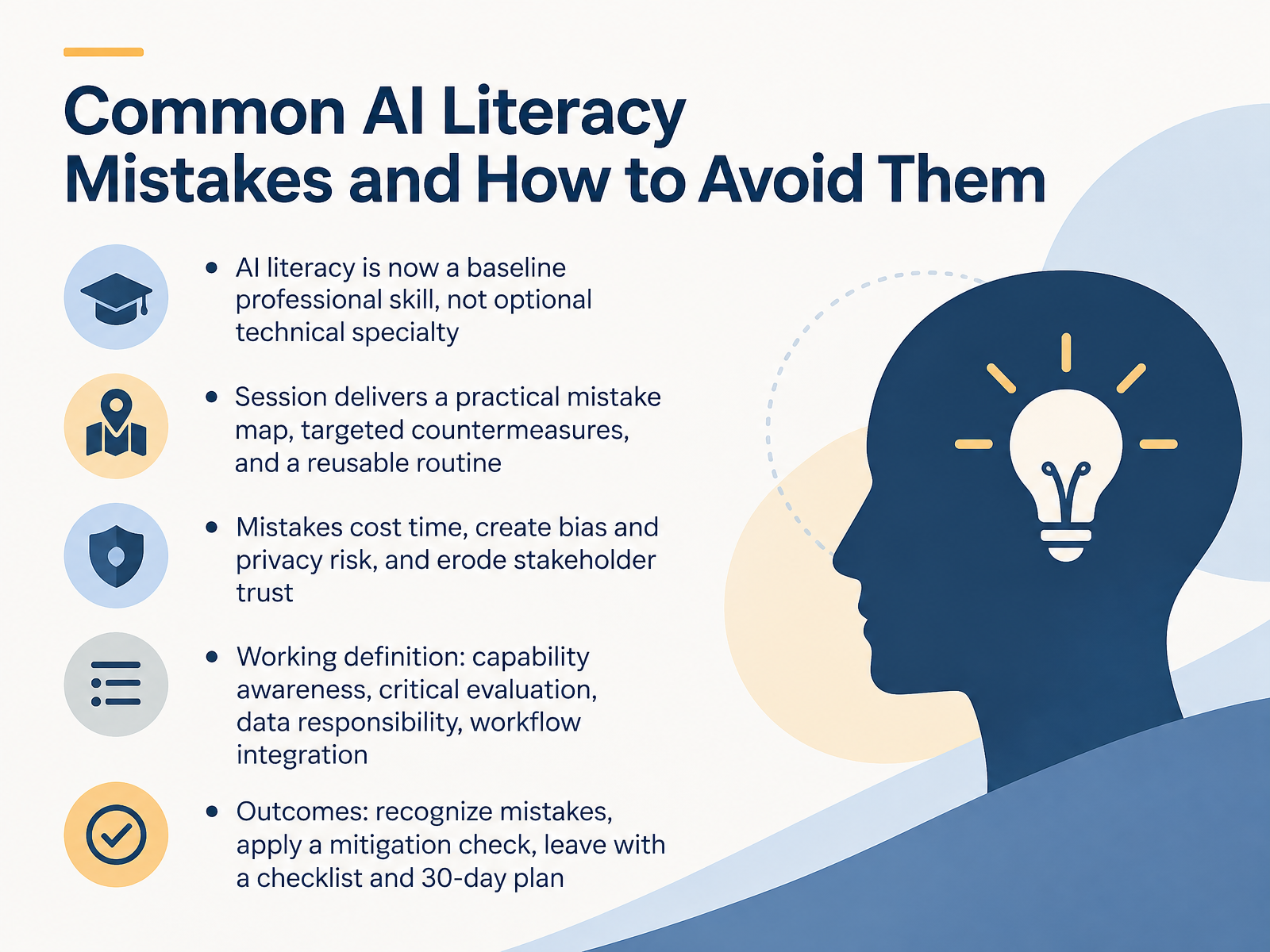
- 01Common AI Literacy Mistakes and How to Avoid ThemWelcome. This session is called Common AI Literacy Mistakes and How to Avoid Them. AI literacy is now a baseline professional skill, not an optional technical specialty. So here is our plan. You will get a practical mistake map, targeted countermeasures, and one reusable routine you can apply tomorrow. We will be honest about the cost. These mistakes waste time, create bias and privacy risk, and erode stakeholder trust. For a shared working definition, AI literacy means capability awareness, critical evaluation, data responsibility, and workflow integration. By the end, you will recognize the common mistakes, apply a quick mitigation check, and leave with a checklist and a thirty day plan. Next, we set ground rules and scope, so you know exactly what this training is and is not.dol.govdol.govailiteracyframework.org+21 min
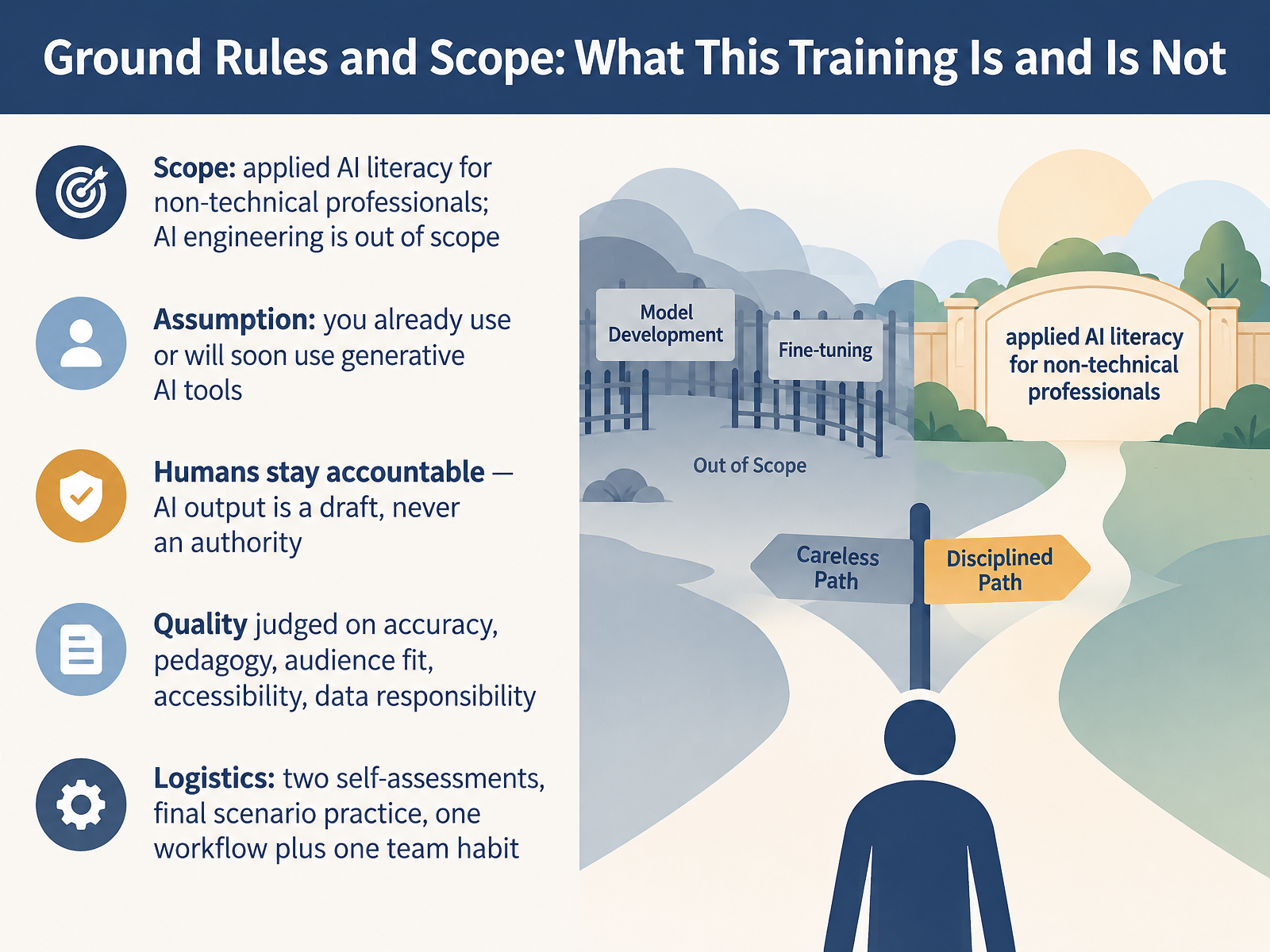
- 02Ground Rules and Scope: What This Training Is and Is NotLet's set the ground rules and scope for this training. We focus on applied AI literacy for non-technical professionals. AI engineering is out of scope, so we won't build models or tune systems. We assume you already use generative AI tools, or you will soon. In classrooms and team workflows, AI output is a draft, never an authority. Humans stay accountable for every decision and every final product. We judge quality on five things. Accuracy, pedagogy, audience fit, accessibility, and data responsibility. For example, a lesson plan is accurate, but too dense for eighth graders. That fails audience fit. For logistics, you will complete two self-assessments and a final scenario practice. You will also apply one workflow and one team habit in your own setting. Next, we map the common mistakes you will learn to avoid. The Mistake Map: Four Clusters Where AI Use Goes Wrong.
 dol.govdol.govailiteracyframework.org+22 min
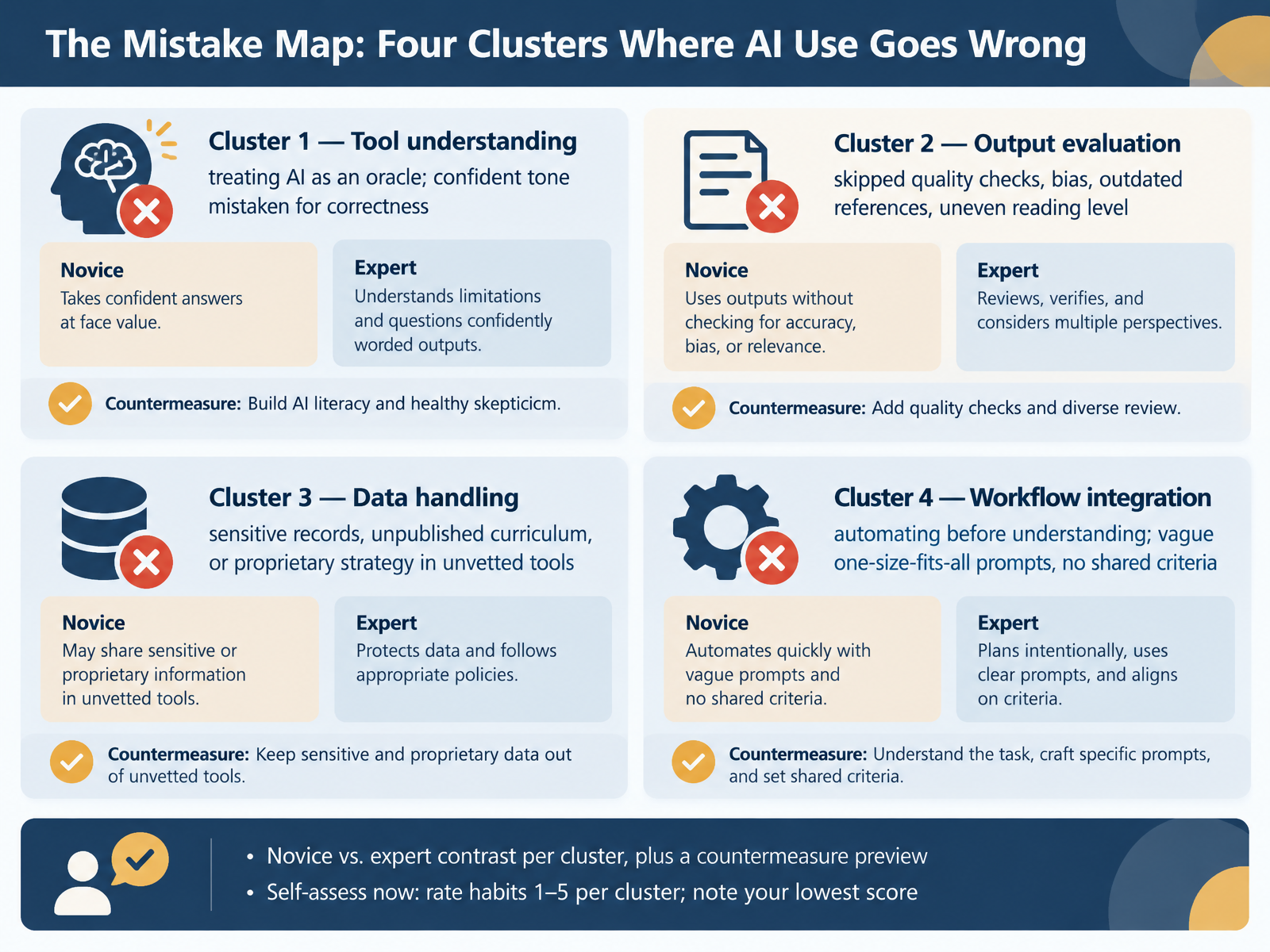
- 03The Mistake Map: Four Clusters Where AI Use Goes WrongLet's map where AI use most often goes wrong. There are four clusters, and each one shows up in real classrooms, training rooms, and team workflows. First, tool understanding: people treat AI as an oracle and mistake a confident tone for correctness. The fix is to verify names, numbers, and citations before you use them. Second, output evaluation: teams skip quality checks, so bias, outdated references, and uneven reading levels slip through. The fix is a short review checklist with shared criteria. Third, data handling: sensitive records, unpublished curriculum, or proprietary strategy land in unvetted tools. The fix is to confirm the tool is approved before you type anything confidential. Fourth, workflow integration: people automate before they understand the task, then rely on vague one-size-fits-all prompts. The fix is to define the task first, then write specific prompts and agree on shared standards. For each cluster, compare a novice habit with an expert habit, and notice the countermeasure that follows. Now rate your own habits from one to five in each cluster, and write down your lowest score. That score is your starting point. Next, we'll look at how generative AI actually works, and why these mistakes happen.
 mitsloanedtech.mit.eduopen.lib.umn.edudoi.org+22 min
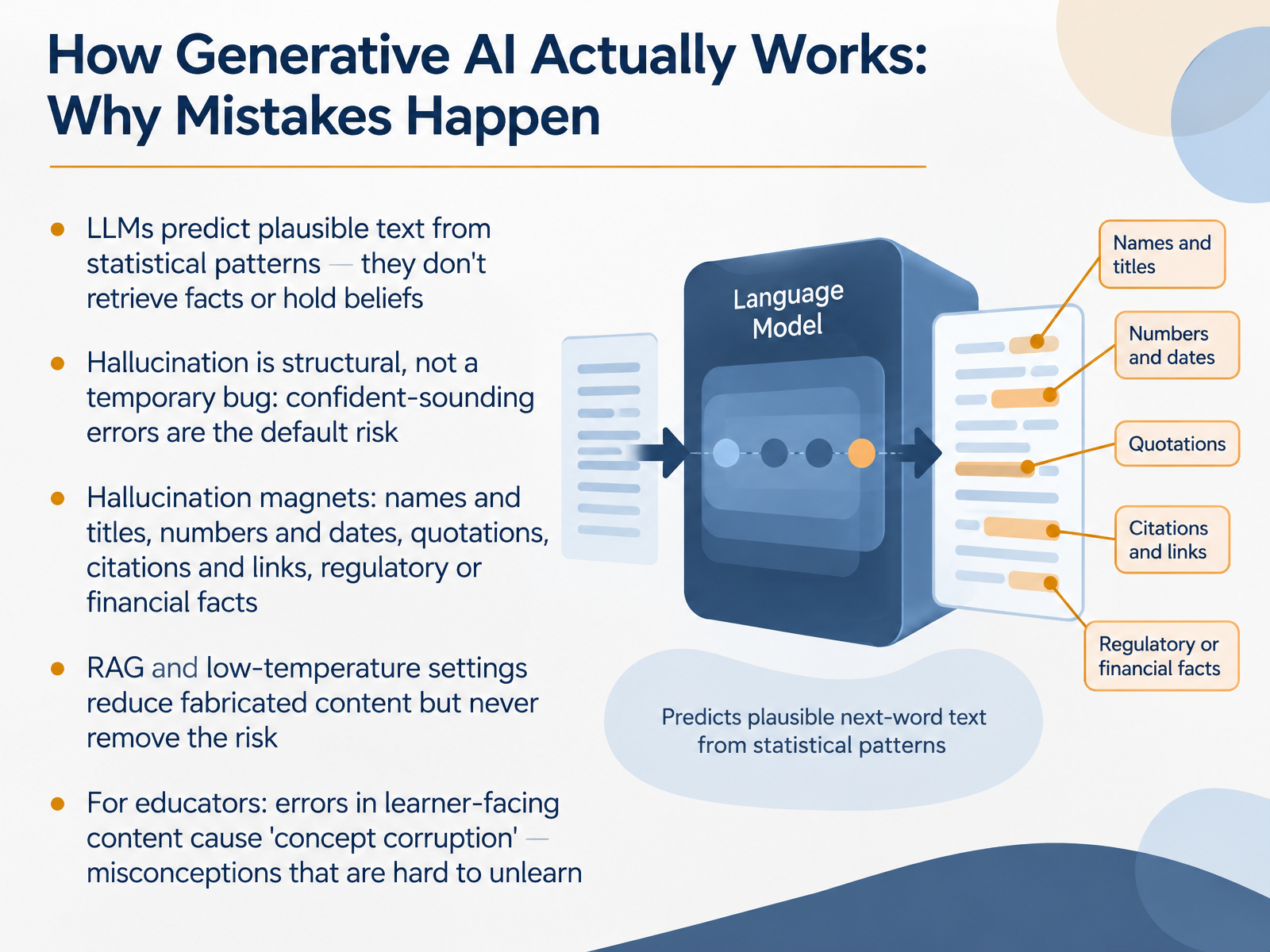
- 04How Generative AI Actually Works: Why Mistakes HappenHere is the mechanism behind these mistakes. Large language models predict plausible text from statistical patterns. They do not retrieve facts, and they hold no beliefs. Hallucination is structural, not a temporary bug. Confident-sounding errors are the default risk. Watch these hallucination magnets: names and titles, numbers and dates, quotations, citations and links, and regulatory or financial facts. Retrieval-augmented generation and low-temperature settings reduce fabrication, but they never remove the risk. For educators, this matters most. Errors in learner-facing content cause concept corruption. Learners build misconceptions that are hard to unlearn. So before anything reaches your students or your team, check the names, numbers, and sources against a second reliable reference. Next, let's look at the first common mistake: treating AI as an oracle.
 mitsloanedtech.mit.eduopen.lib.umn.edudoi.org+21 min
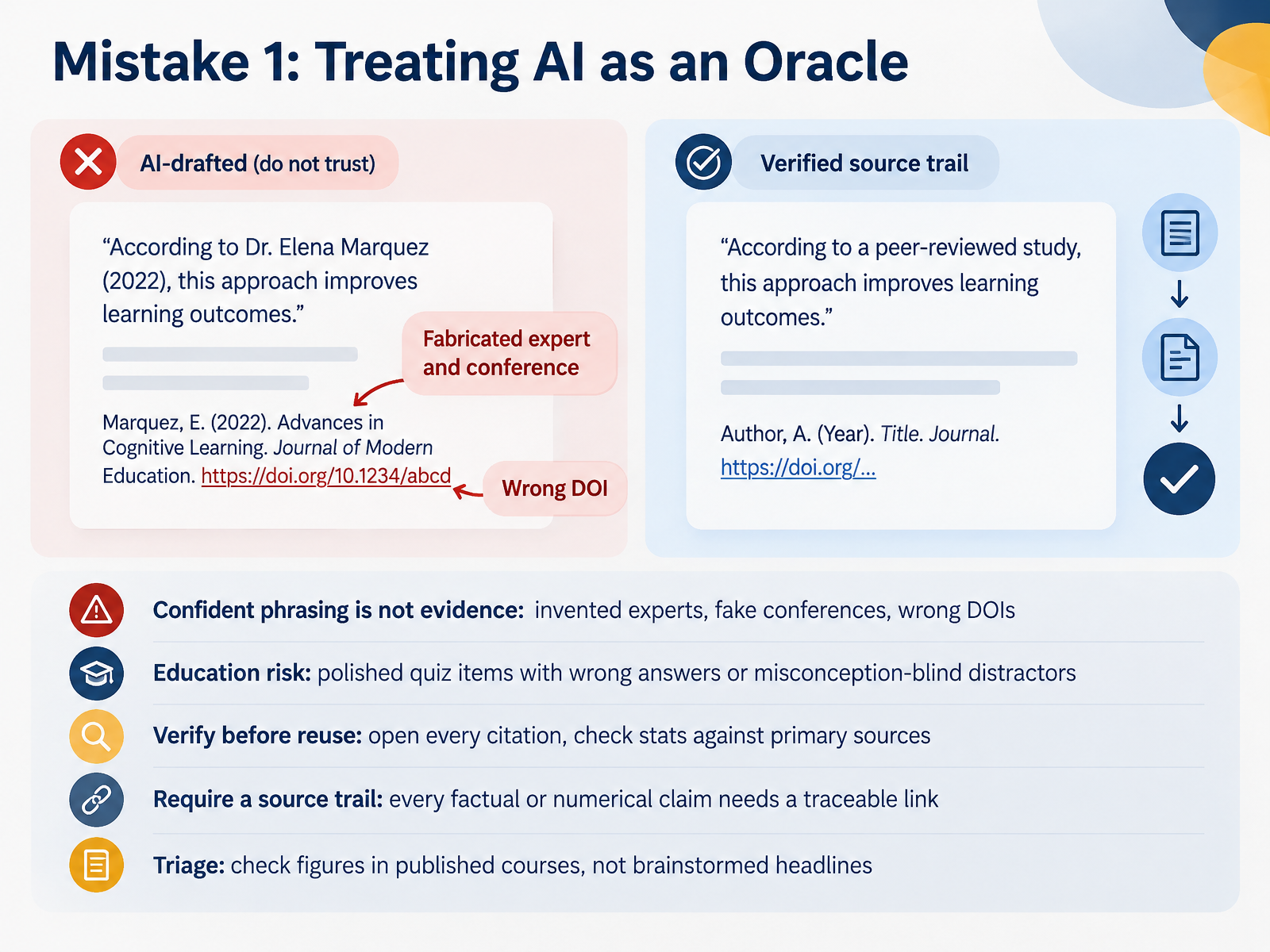
- 05Mistake 1: Treating AI as an OracleLet's look at the first common mistake: treating AI as an oracle. Confident phrasing is not evidence. AI will invent experts, fabricate conferences, and hand you a wrong DOI with total composure. In education, this gets risky. You can generate polished quiz items with wrong answers, or distractors that ignore common misconceptions. So verify before you reuse anything. Open every citation. Check statistics against primary sources. Require a source trail, so every factual or numerical claim carries a traceable link. And triage your effort. Check figures in published courses, not brainstormed headlines. That keeps your review time where it matters. Next, we'll cover Mistake 2: Skipping the Quality Check on AI Output.
 mitsloanedtech.mit.eduopen.lib.umn.edudoi.org+21 min
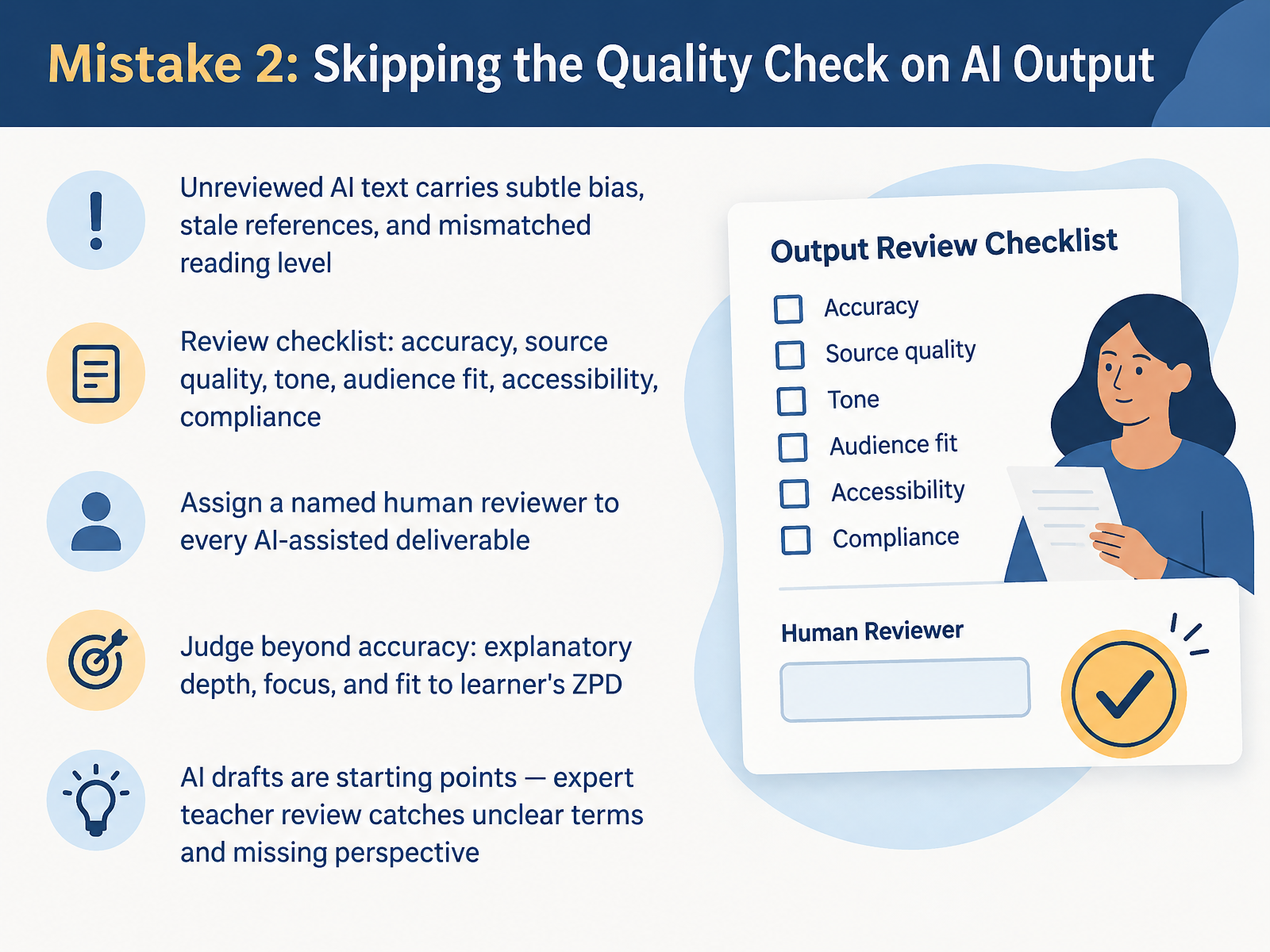
- 06Mistake 2: Skipping the Quality Check on AI OutputLet's move to the second mistake: skipping the quality check on AI output. Unreviewed AI text carries subtle bias, stale references, and a reading level that may not fit your audience. So give every AI-assisted deliverable a named human reviewer. Use a short checklist: accuracy, source quality, tone, audience fit, accessibility, and compliance. And judge beyond accuracy. Ask whether the explanation has real depth, stays focused, and fits the learner's zone of proximal development. Treat AI drafts as starting points. An expert teacher review still catches unclear terms and missing perspectives. Next, let's look at Mistake 3: Sharing Sensitive Data Without Guardrails.
 eprints.gla.ac.ukarxiv.orgurn.kb.se+21 min
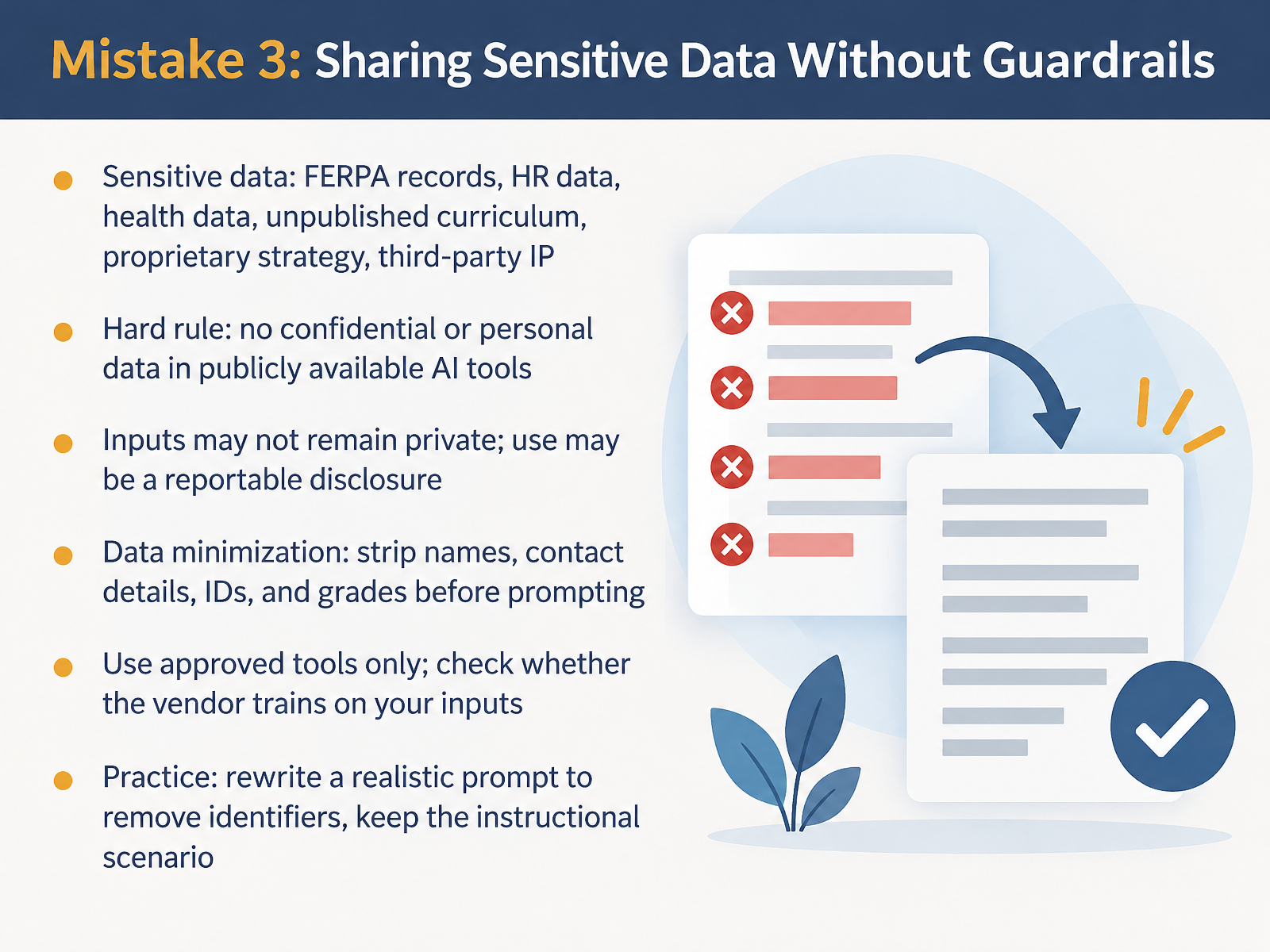
- 07Mistake 3: Sharing Sensitive Data Without GuardrailsLet's move on to mistake three, sharing sensitive data without guardrails. Sensitive data covers FERPA records, HR data, health data, unpublished curriculum, proprietary strategy, and third-party intellectual property. The impact is real: once entered, your inputs may not stay private, and the use may count as a reportable disclosure. So set a hard rule. No confidential or personal data goes into publicly available AI tools. Practice data minimization instead. Strip names, contact details, IDs, and grades before you prompt, and keep only the instructional scenario. Use approved tools only, and check whether the vendor trains on your inputs. Here is the exercise. Take a realistic prompt, rewrite it to remove every identifier, and preserve the teaching scenario. That keeps the learning value while protecting the people in it. Now let's look at mistake four: automating before understanding the task.
 cdt.ca.govminnesota.eduoaktrust.org+22 min
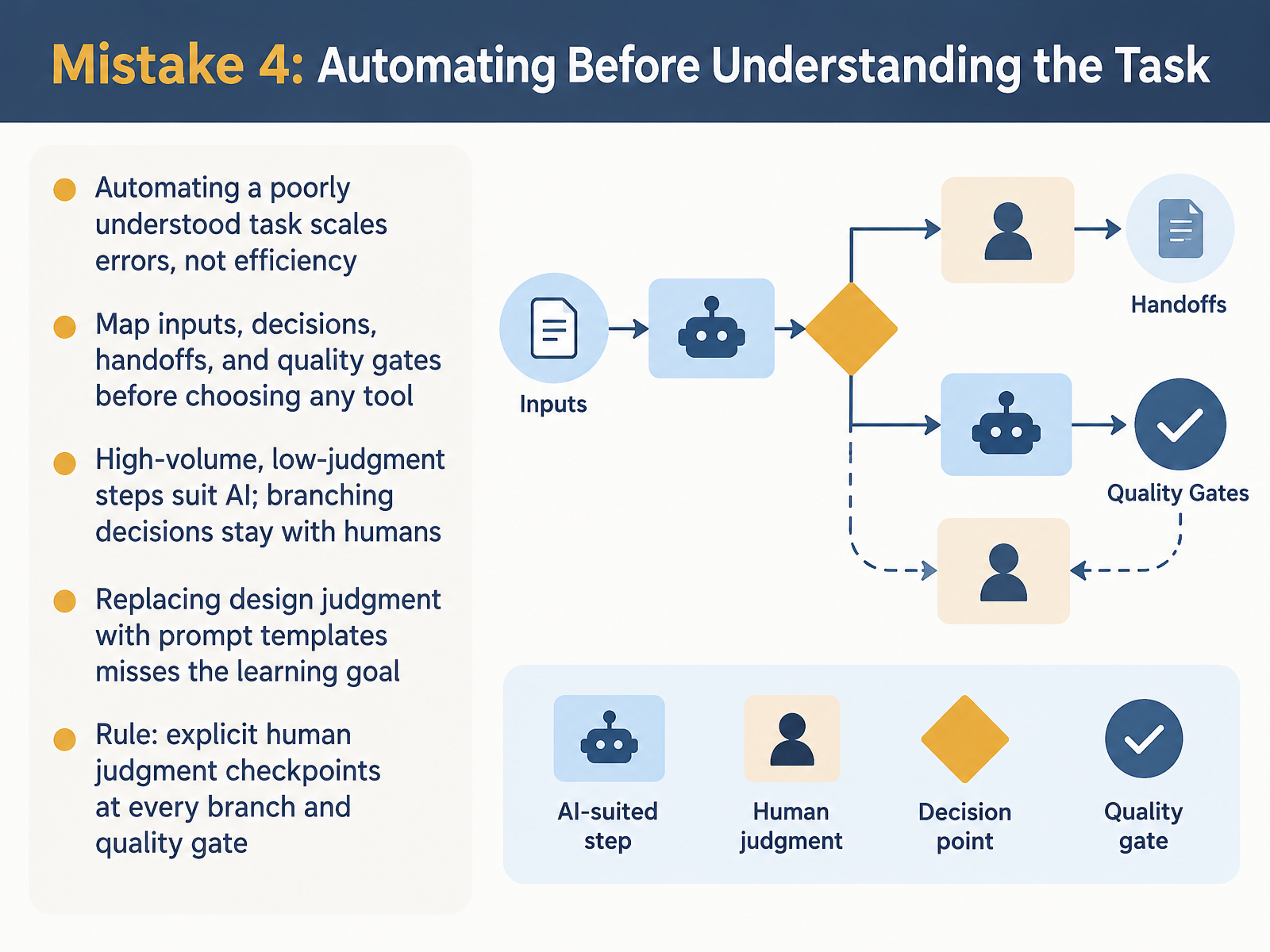
- 08Mistake 4: Automating Before Understanding the TaskLet's look at mistake four: automating a task before you understand it. When you automate a poorly understood task, you scale errors, not efficiency. So map the inputs, decisions, handoffs, and quality gates before you choose any tool. High-volume, low-judgment steps suit AI well. Branching decisions should stay with humans. For example, let AI draft routine feedback comments, but a teacher or supervisor makes the judgment call. Replacing design judgment with prompt templates misses the learning goal. So set one rule: place explicit human judgment checkpoints at every branch and every quality gate. Next, we turn to mistake five: generic prompting and evaluation by feel.
 dol.govdol.govailiteracyframework.org+21 min
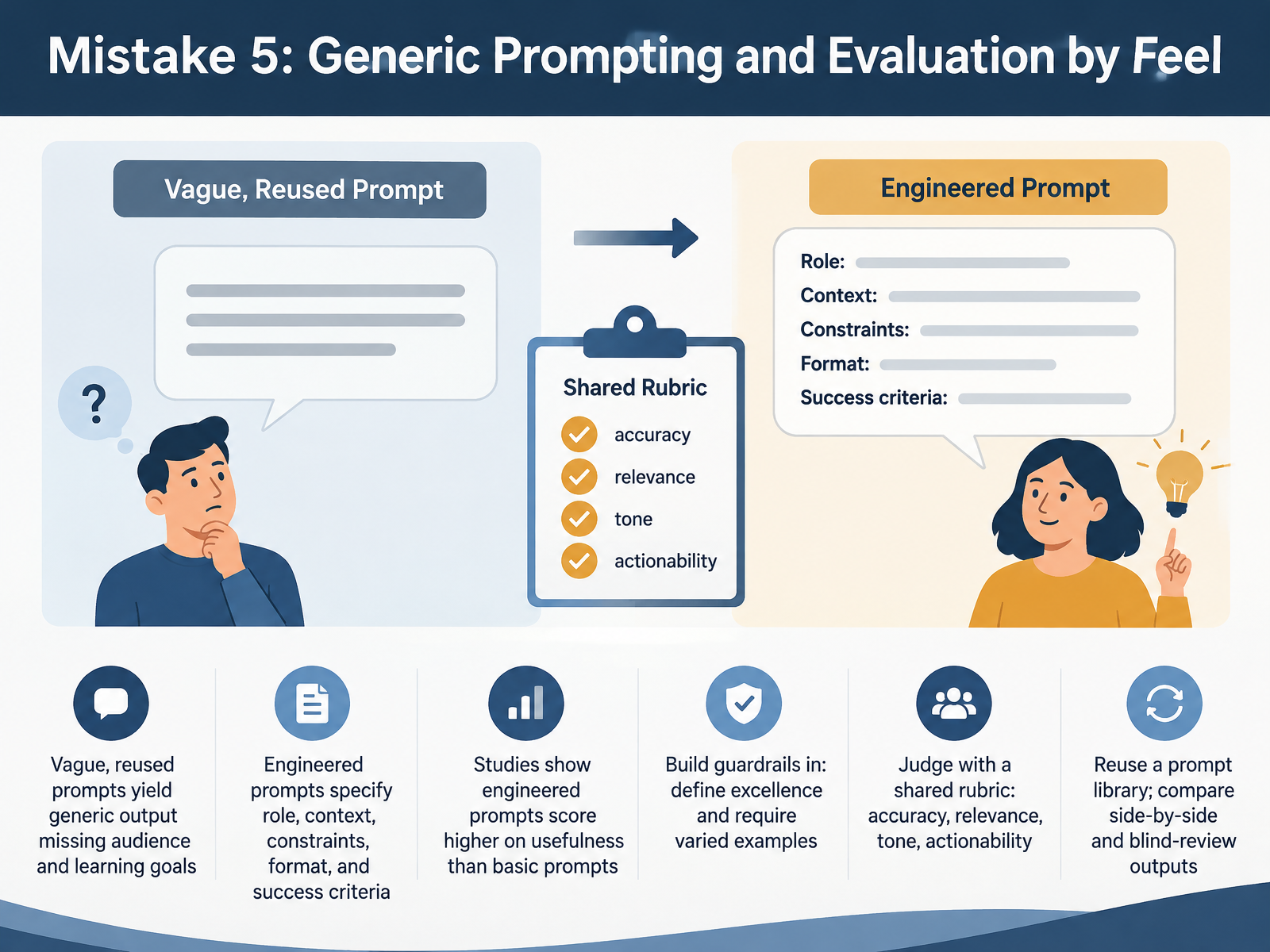
- 09Mistake 5: Generic Prompting and Evaluation by FeelLet's look at mistake five, generic prompting and evaluation by feel. When you reuse a vague prompt, you get generic output that ignores your audience and learning goals. Instead, engineer the prompt. Specify the role, the context, the constraints, the format, and the success criteria. Studies show engineered prompts score higher on usefulness than basic prompts. Build guardrails in by defining what excellence looks like and requiring varied examples. Then judge outputs with a shared rubric, covering accuracy, relevance, tone, and actionability. Reuse a prompt library, compare outputs side by side, and blind-review them. Next, we'll examine mistake six, letting AI erode learner agency and equity.
 eprints.gla.ac.ukarxiv.orgurn.kb.se+21 min
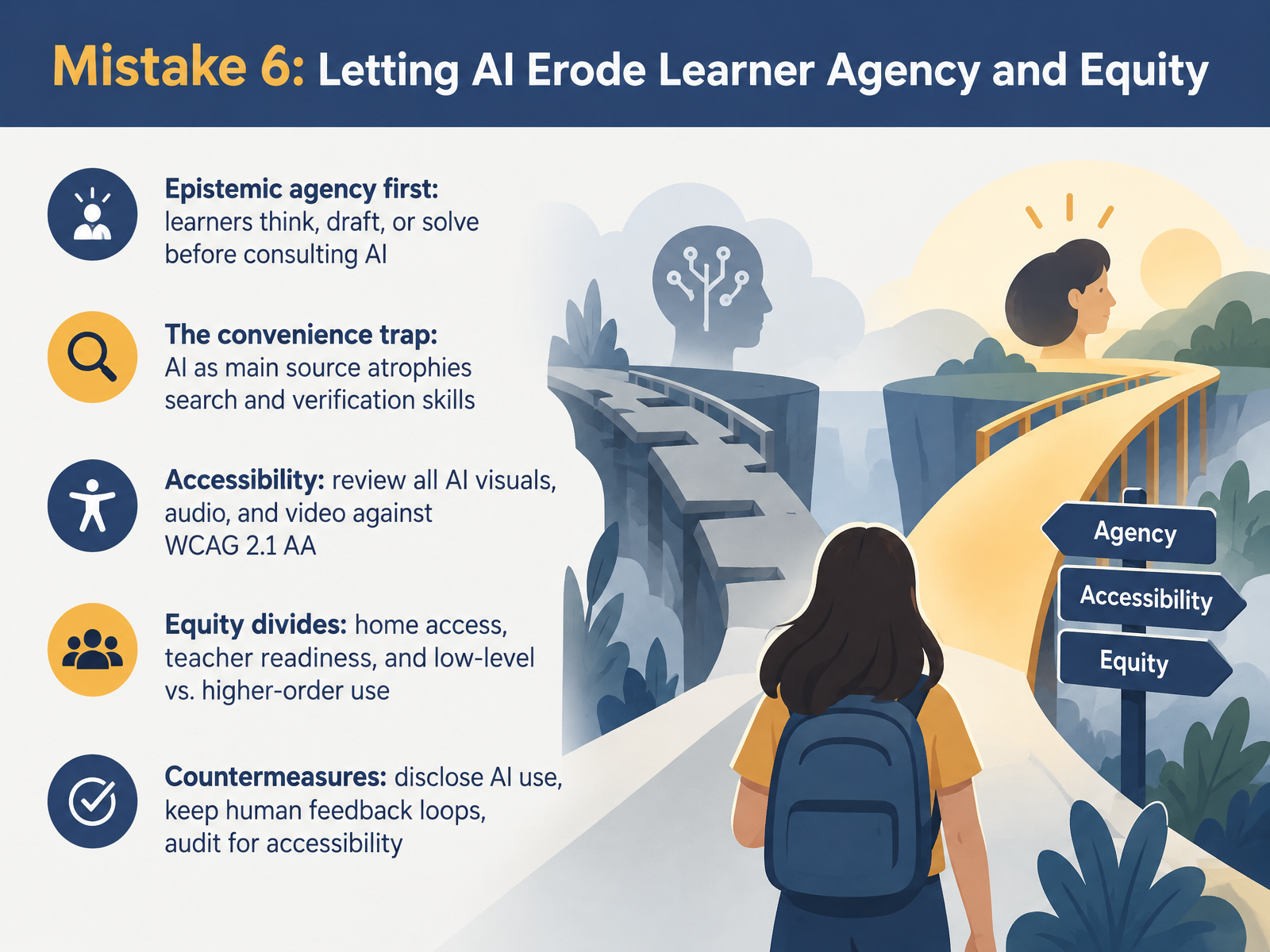
- 10Mistake 6: Letting AI Erode Learner Agency and EquityNow let's look at mistake six, letting AI erode learner agency and equity. Start with epistemic agency first. Ask learners to think, draft, or solve before they consult AI. Then watch the convenience trap. When AI becomes the main source of answers, search and verification skills quietly weaken. Give learners some productive friction, so they cross-check sources and justify their reasoning. Accessibility matters too. Review every AI visual, audio, and video against WCAG 2.1 Level AA, adding alt text, captions, and transcripts. Equity divides show up in three places: home access, teacher readiness, and low-level versus higher-order use. So use clear countermeasures. Require disclosure of AI use, keep human feedback loops, and audit materials for accessibility. Next, we move into practical strategies, starting with the before-during-after AI use routine.
 2 min
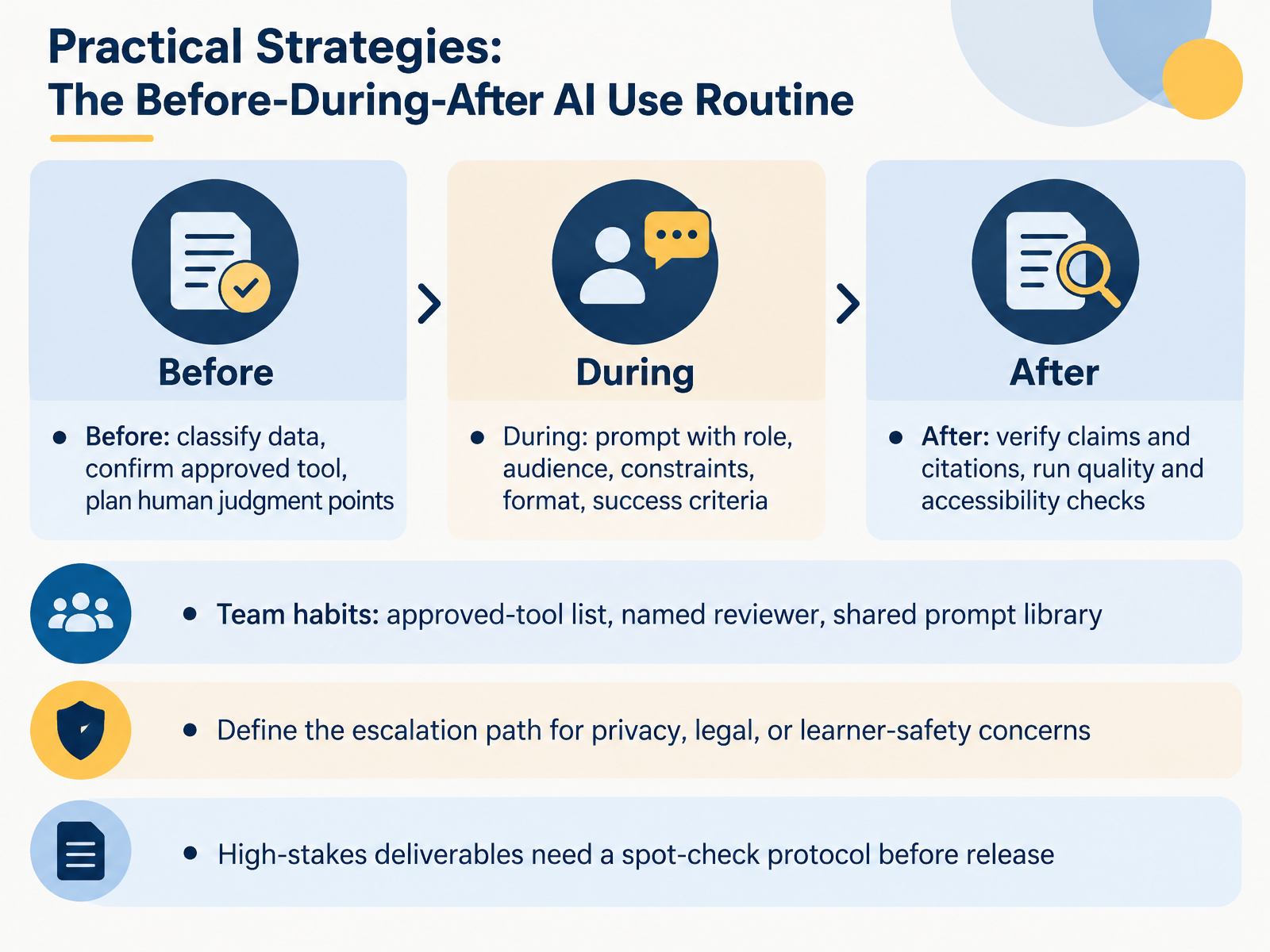
- 11Practical Strategies: The Before-During-After AI Use RoutineNow let's turn these ideas into a simple routine you can use every time. Before you prompt, classify your data and confirm the tool is approved. Then plan where human judgment must enter the process. During prompting, give the model a role, an audience, constraints, a format, and clear success criteria. After the output arrives, verify claims and citations, then run quality and accessibility checks. Build team habits around this routine: keep an approved-tool list, name a reviewer, and share a prompt library. Define an escalation path for privacy, legal, or learner-safety concerns. For high-stakes deliverables, add a spot-check protocol before release. For example, a course designer drafts quiz items in an approved tool, a reviewer checks the answer key, and anything involving learner records escalates to the privacy lead. Treat this routine as your default workflow. Next, let's practice applying it. Scenario Practice: Spot the Mistake, Choose the Countermeasure.
 cdt.ca.govminnesota.eduoaktrust.org+22 min
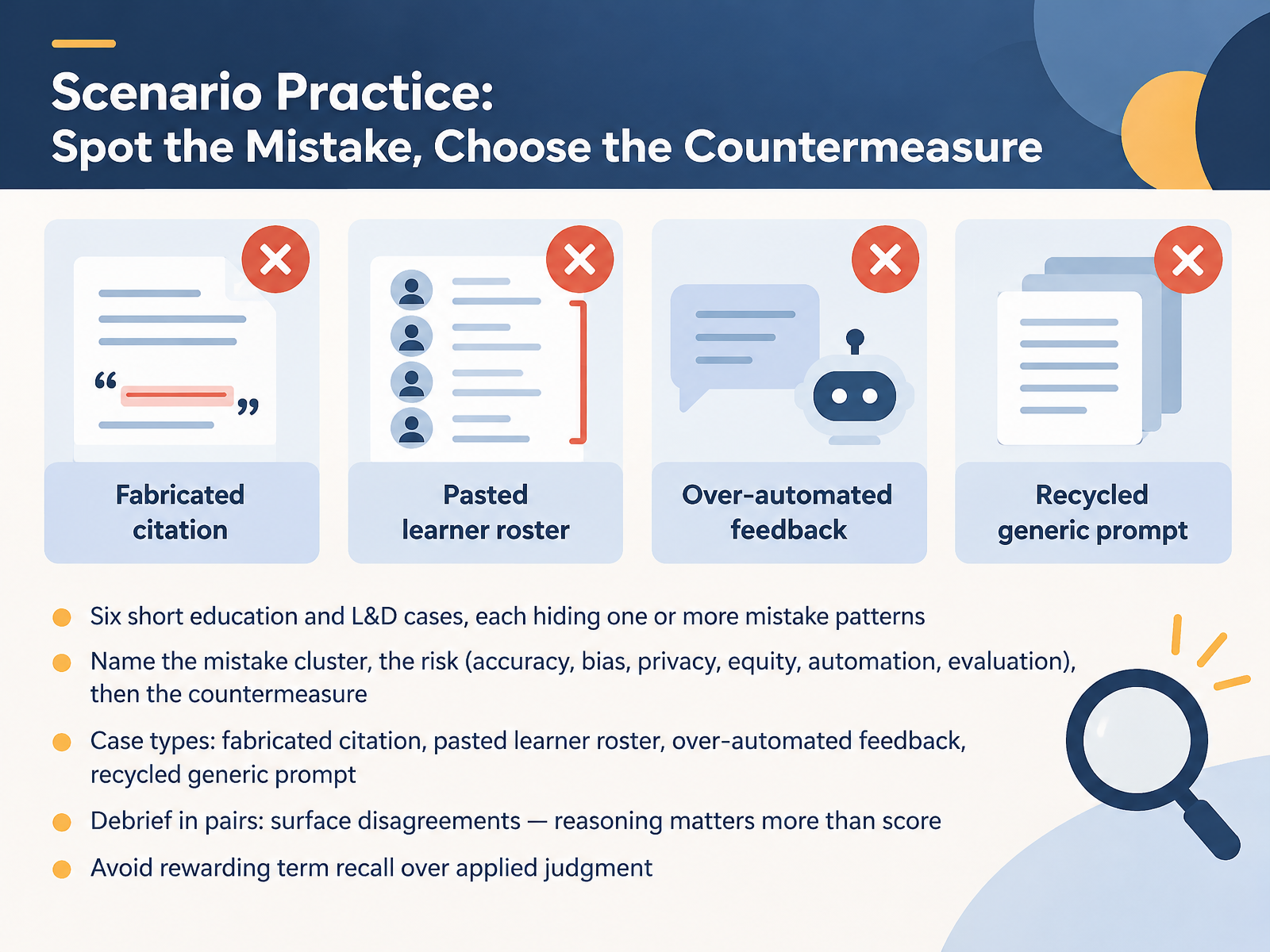
- 12Scenario Practice: Spot the Mistake, Choose the CountermeasureNow let's put this into practice. Here you have six short cases from classrooms, training rooms, and team workflows, and each one hides at least one mistake pattern. Your job is to name the mistake cluster, then the risk, then the countermeasure. For example, a case may show a fabricated citation in a slide deck. That is an accuracy risk, so the countermeasure is opening the link and cross-checking the source. Another case may show a pasted learner roster with names and grades. That is a privacy risk, so you strip the identifiers before you prompt. You may also spot over-automated feedback, where no teacher reviews the comments, or a recycled generic prompt that produces vague, off-target content. After the cases, debrief in pairs. Surface your disagreements out loud, because your reasoning matters more than your score. Do not reward term recall over applied judgment. Ask each other why the countermeasure fits the actual risk. Next, let's build your own plan in Self-Audit and Your 30-Day Action Plan.
 mitsloanedtech.mit.eduopen.lib.umn.edudoi.org+22 min
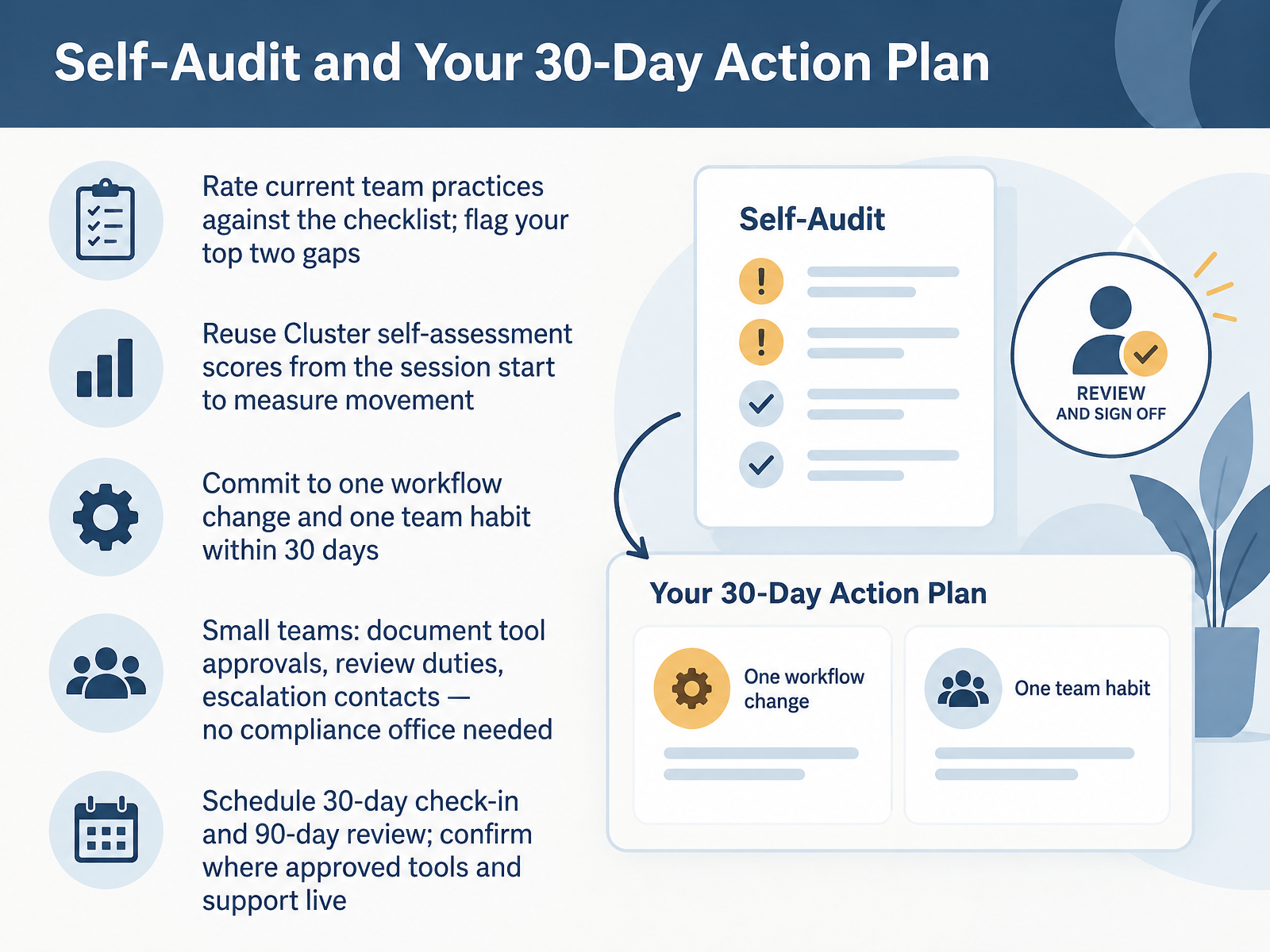
- 13Self-Audit and Your 30-Day Action PlanNow let's turn this into a plan you can act on. Start by rating your current team practices against the checklist, and flag your top two gaps. Reuse the Cluster self-assessment scores from the session start, so you can measure real movement later. Then commit to one workflow change and one team habit within thirty days. For small teams, document tool approvals, review duties, and escalation contacts. You do not need a compliance office to do that. Finally, schedule a thirty-day check-in and a ninety-day review, and confirm where approved tools and support live. In short, two gaps, two commitments, two dates. That is a plan you can actually keep. Next, we will pull everything together in Key Takeaways and Next Steps.
 dol.govdol.govailiteracyframework.org+22 min
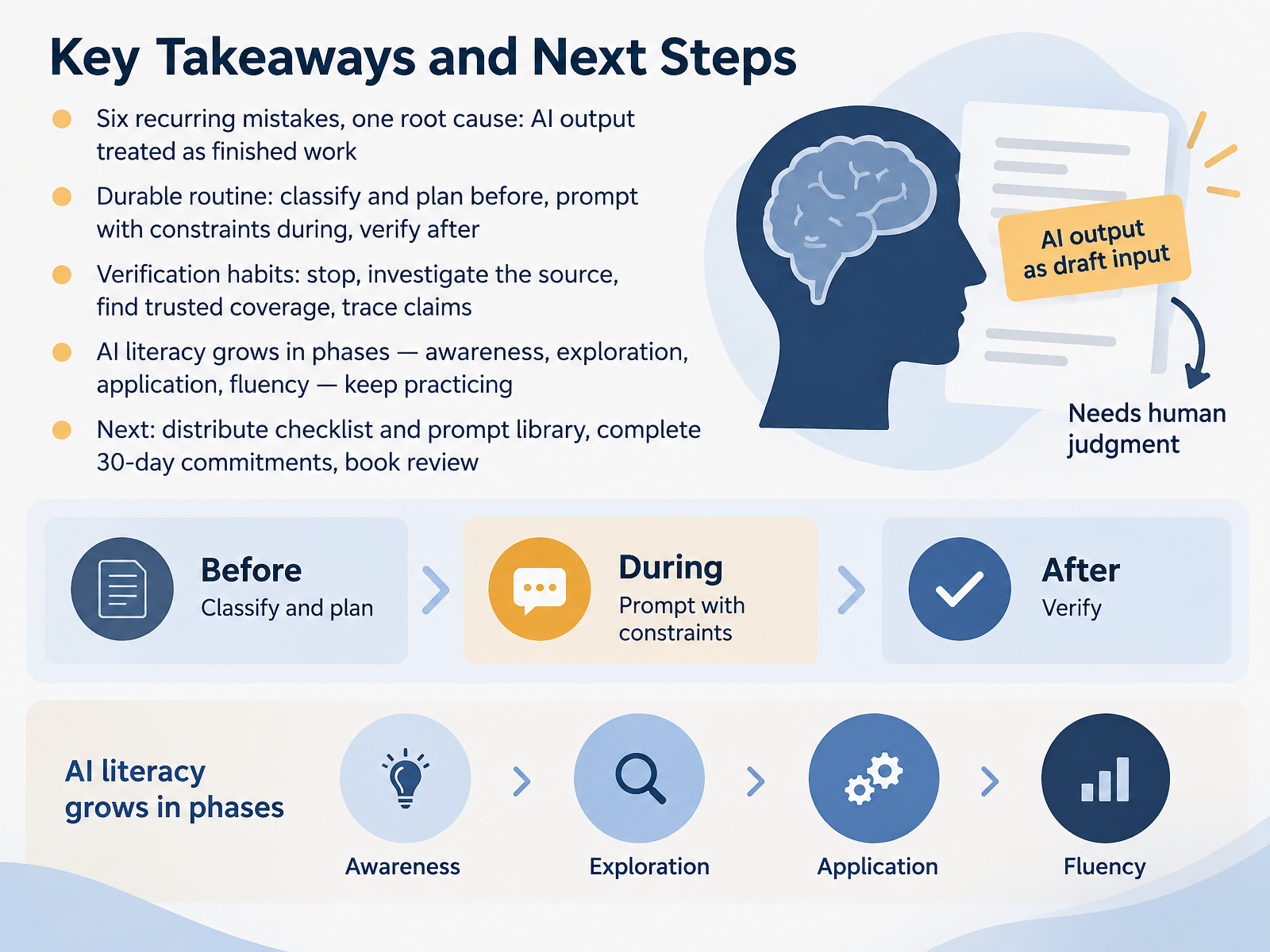
- 14Key Takeaways and Next StepsLet's pull this together. You covered six recurring mistakes, but they share one root cause. In each case, AI output gets treated as finished work. The fix is a routine you can repeat. Classify and plan before you prompt. Prompt with clear constraints during. Then verify after, before anything reaches learners or your team. Make verification a habit, not a mood. Stop, investigate the source, find trusted coverage, and trace claims back to their origin. This matters most for names, numbers, quotations, citations, and anything you will publish. Expect your AI literacy to grow in phases. Awareness, exploration, application, and fluency. Fluency comes from practice, not from one workshop. You will not skip stages, and you should not try. For next steps, distribute the checklist and prompt library to your team. Complete your thirty-day commitments, and book a review so we can compare notes. You now have a practical routine and a clear path forward. Thank you for your attention and your honest questions throughout this course. Keep practicing, keep verifying, and trust your professional judgment. You are ready for this work.
 mitsloanedtech.mit.eduopen.lib.umn.edudoi.org+22 min
Take the deck with you
Download this course as a file — free, no sign-up needed.
- PDF handoutEvery slide page, ready to print or share.15 pages · 3.4 MBDownload
- Narrated PowerPointThe deck that presents itself — every slide carries the digital human's narration video.15 pages · 13.0 MBDownload
- PowerPoint slidesThe full deck as a .pptx — open it in PowerPoint, Keynote, or Google Slides.15 pages · 3.3 MBDownload
Free to use in your own training — please keep the PersonWise credit page at the end.
Have your own deck? Turn it into a course
Sources consulted
Web sources consulted while building this course.
- The U.S. Department of Labor’s Artificial Intelligence Literacy Framework — dol.gov
- Attachment I (Accessible PDF).pdf | U.S. Department of Labor — dol.gov
- AILit Framework: Home — ailiteracyframework.org
- Designing AI Professional Learning for Educators — sreb.org
- Empowering Learners for the Age of AI — oecd.org
- When AI Gets It Wrong: Addressing AI Hallucinations and Bias - MIT Sloan Teaching & Learning Technologies — mitsloanedtech.mit.edu
- Output reliability and GenAI – GenAI+U: A Student Learning Experience — open.lib.umn.edu
- Addressing “Hallucinations” in AI-Generated Content: Strategies for Developing Student Fact-Checking and Information Evaluation Skills — doi.org
- How AI actually works — worldassessmentcouncil.org
- Generative Artificial Intelligence: Policy Intersections, Considerations, and Recommendations — minnstate.edu
- A Rubric for Evaluating Prompt Design in LLM-based Feedback: Pilot Validation — eprints.gla.ac.uk
- https://arxiv.org/pdf/2602.15531 — arxiv.org
- Designing and Evaluating Prompt Strategies for Educational Content Creation : A Comparison of Basic and Engineered ChatGPT Prompts for Higher Education — urn.kb.se
- [2610.15231] Using Evidence-Centered Design to Guide Prompt Engineering in Measurement: An Illustration with Automated Essay Scoring — arxiv.org
- Reflective Prompt Engineering for Assessment Rubric Optimization: An Empirical Study of Human–AI Alignment | Technology, Knowledge and Learning | Springer Nature Link — link.springer.com
- Comprehensive GenAI Training Guide — cdt.ca.gov
- Artificial Intelligence (AI) in the Workplace Policy | M State — minnesota.edu
- Use of Artificial Intelligence (AI) Policy — oaktrust.org
- Use of artificial intelligence in Adult Learning policy 2025 to 2026 - Surrey County Council — surreycc.gov.uk
- Generative Artificial Intelligence (AI) Policy — woking.moderngov.co.uk