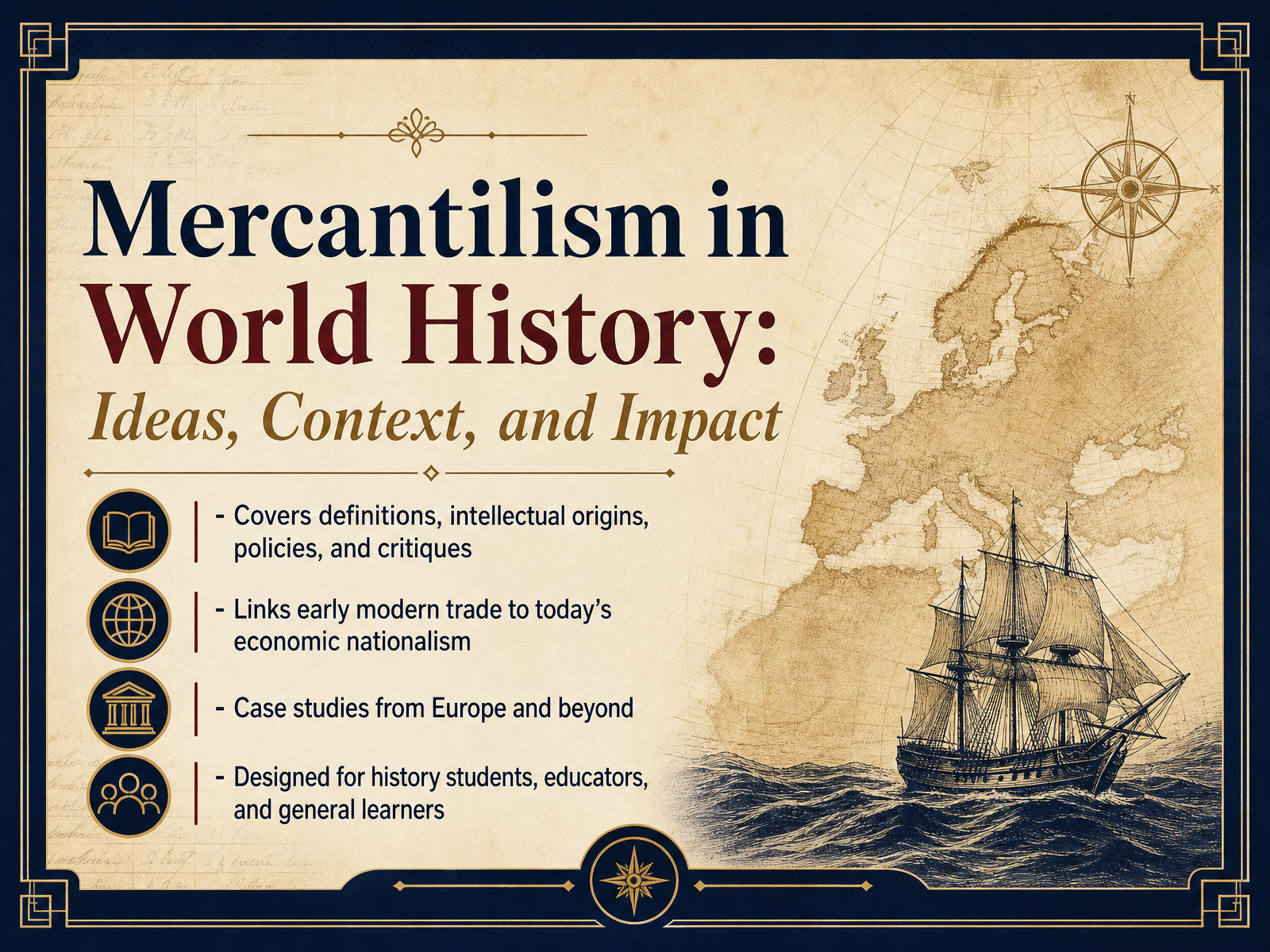
Mercantilism in World History
Begin
14 pages · ~28 min
Mercantilism in World History
This training examines mercantilism's ideas, historical context, and global impact, equipping learners to analyze its role in shaping early modern economies and colonial systems.
What you’ll learn
- 01Mercantilism in World History: Ideas, Context, and ImpactWelcome to this course on mercantilism in world history. Over the next several lessons, we will explore one of the most influential economic ideas ever devised. Think of mercantilism as a playbook that guided kings, queens, and trading companies for nearly three hundred years. It rested on a simple but powerful belief: a nation is wealthy only if it stockpiles more gold and silver than its rivals. In this course, we will unpack that idea, trace its intellectual origins, and examine the policies it inspired, from colonial monopolies to strict trade barriers. We will also look closely at the critiques, including Adam Smith's famous challenge, and ask a question that feels surprisingly modern. Are we seeing a comeback of these old ideas today? Through case studies from Europe, Asia, and the Americas, we will connect the early modern trading world to current debates about economic nationalism. Whether you are a history student, an educator, or simply curious about how the past shapes our economy, this course will give you a clear framework for understanding the rise and fall of merchant empires. Let's begin by defining exactly what the term mercantilism means.britannica.comcambridge.orgcambridge.org+22 min
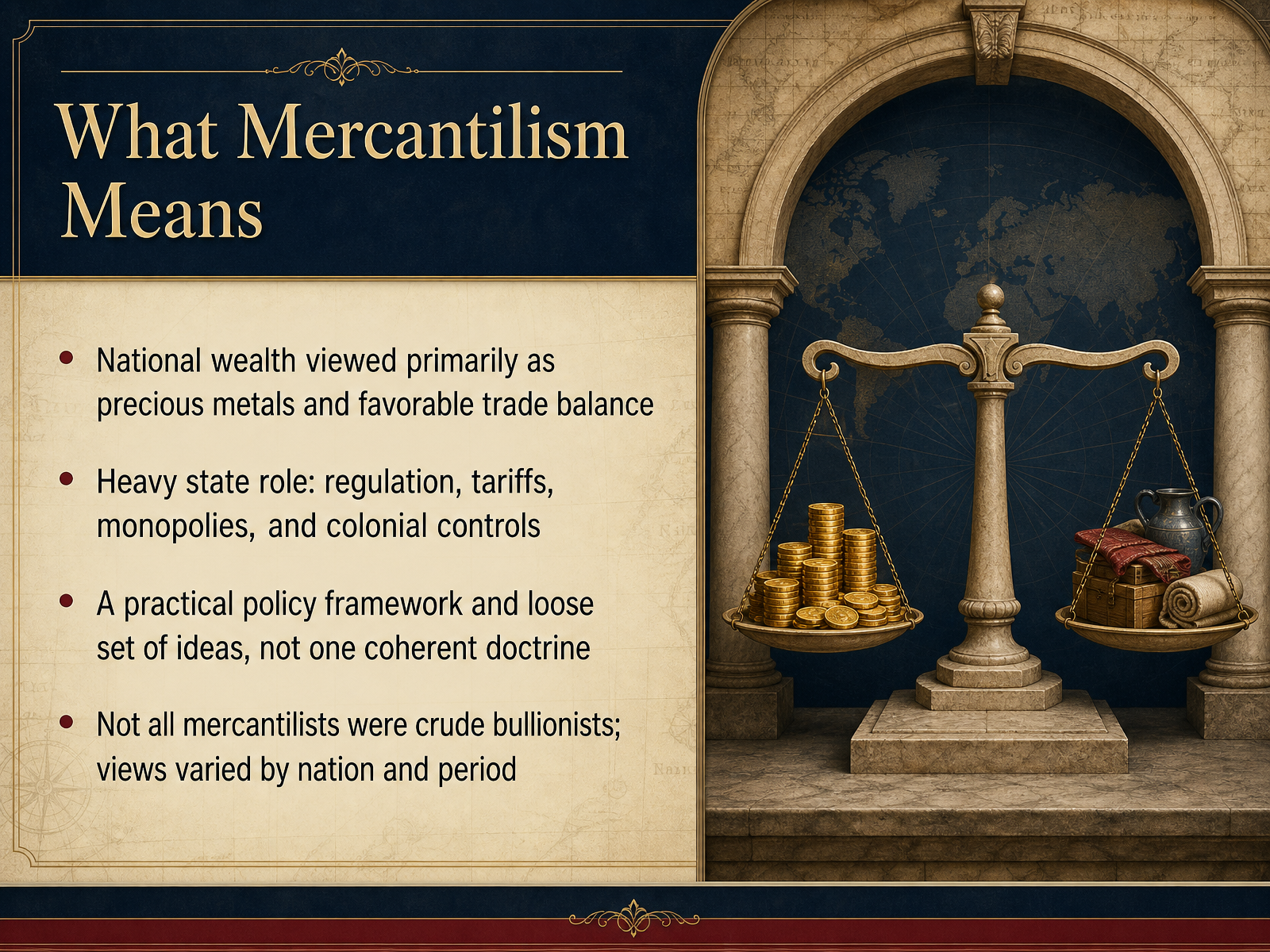
- 02What Mercantilism MeansSo, what exactly is mercantilism? At its core, it was a way of seeing national wealth as something you could count in gold and silver. Think of a country like a household trying to keep more money coming in than going out. For early modern states, that meant exporting more than they imported, and carefully guarding their supply of precious metals. But this was not just an abstract idea. It relied on a very active government. States imposed tariffs, granted monopolies to companies, and tightly controlled what their colonies could produce and trade. In many ways, colonies existed to serve the mother country. Now, here is an important nuance. Mercantilism was never one single, tidy doctrine. It was more like a practical toolbox of policies, and the tools changed depending on the country and the century. Not every thinker was obsessed with hoarding bullion. Some focused on production, shipping, or national security. And not every mercantilist was, in Adam Smith's phrase, a "crude bullionist." Even in England and France, the most famous mercantilist powers, writers and ministers disagreed about how much control the state should have. So as we move forward, keep that flexibility in mind. It will help us understand why these policies worked differently in Spain, England, and France. Next, let's look at where the term itself comes from.
 britannica.comcambridge.orgcambridge.org+21 min
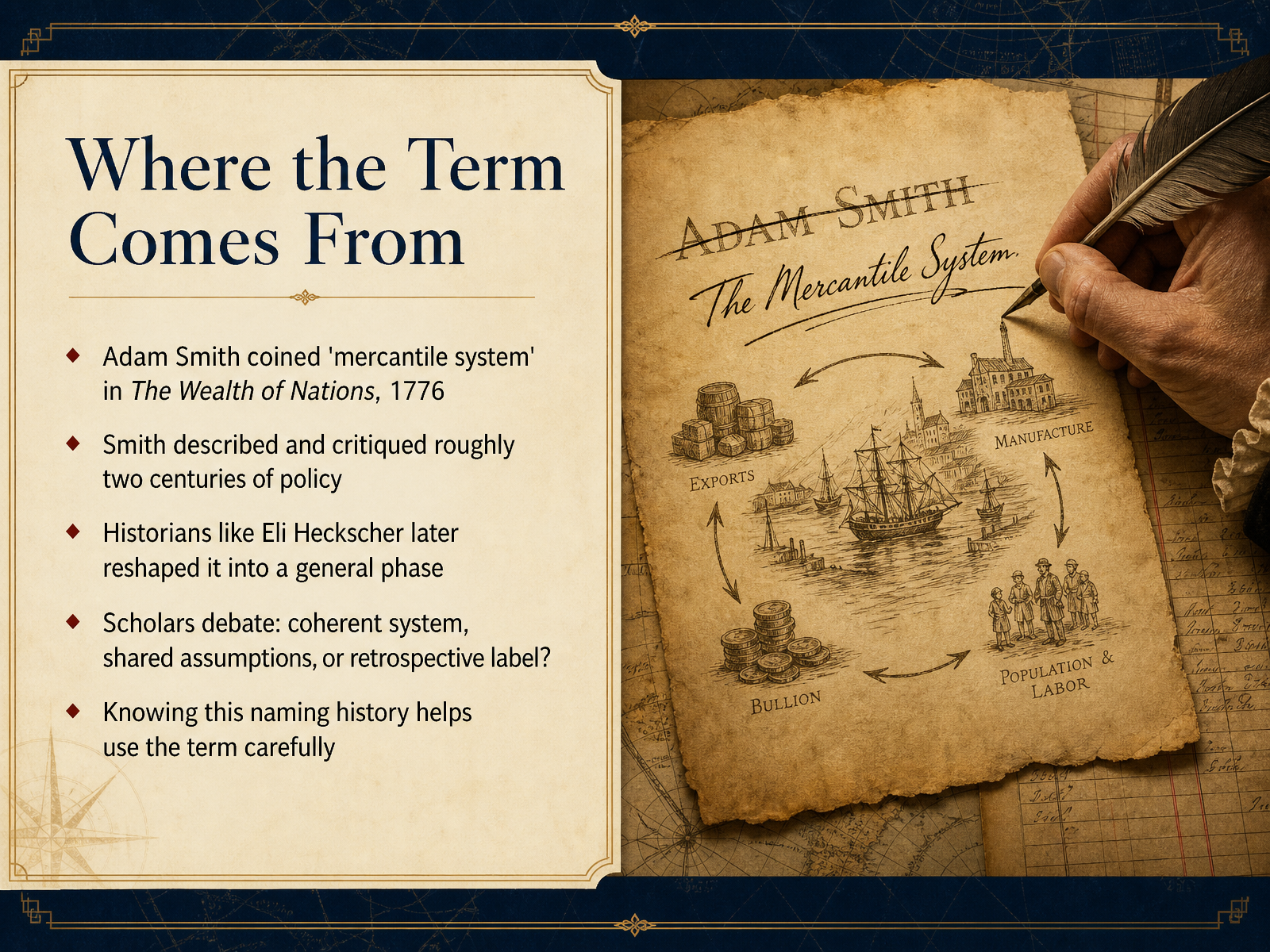
 - 03Where the Term Comes FromThat brings us to something important: where the term mercantilism actually comes from. It was Adam Smith, in his famous book The Wealth of Nations in 1776, who first used the phrase mercantile system. He used it not to celebrate the policies, but to describe and criticize about two centuries of economic thinking across Europe. Here is the key part: later historians, especially Eli Heckscher in the early twentieth century, took Smith's label and broadened it. They turned it into a general phase, a stage of history between the medieval world and the age of free trade. But scholars still debate what mercantilism really was. Was it a coherent, unified system? Was it just a set of shared assumptions? Or is it simply a retrospective label we apply to a messy reality? Think of it like a net we throw over a very diverse period to catch things that share some resemblance. Knowing this naming history does not just settle a trivia question. It helps us use the term carefully and reminds us that the people living through those centuries did not wake up saying, we are mercantilists today. With that careful framing in mind, let's turn next to the intellectual origins of these ideas.
 britannica.comcambridge.orgcambridge.org+22 min
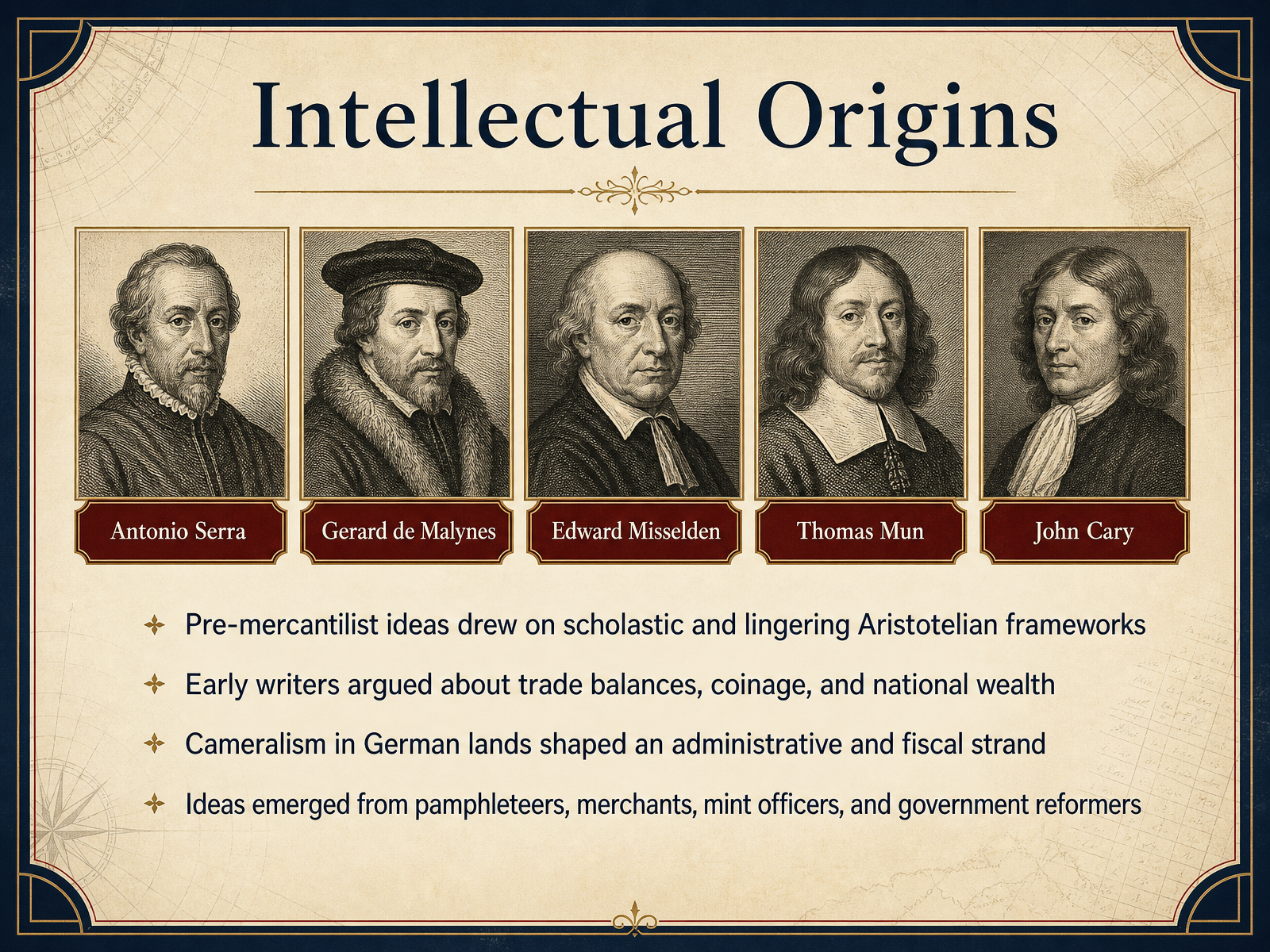
 - 04Intellectual OriginsNow let's trace where these ideas actually came from. Mercantilism didn't appear overnight—it grew from older ways of thinking, including ideas inherited from Aristotle and the scholastic tradition. Many early writers looked back to classical authorities while arguing about very practical problems: trade balances, coin shortages, and what truly made a nation wealthy. These were not abstract debates. Pamphleteers, merchants, and even mint officers wrote to solve real crises of their day. In the German lands, a related strand called Cameralism developed with a more administrative focus—training future officials in finance and resource management. So mercantilism was never one single voice. It emerged from a messy mix of reformers and officials, all trying to answer a new question: how should a strong state manage its economy? Next, we'll look at the historical context of early modern Europe that shaped these ideas.
 plato.stanford.eduideas.repec.orgejpe.org+21 min
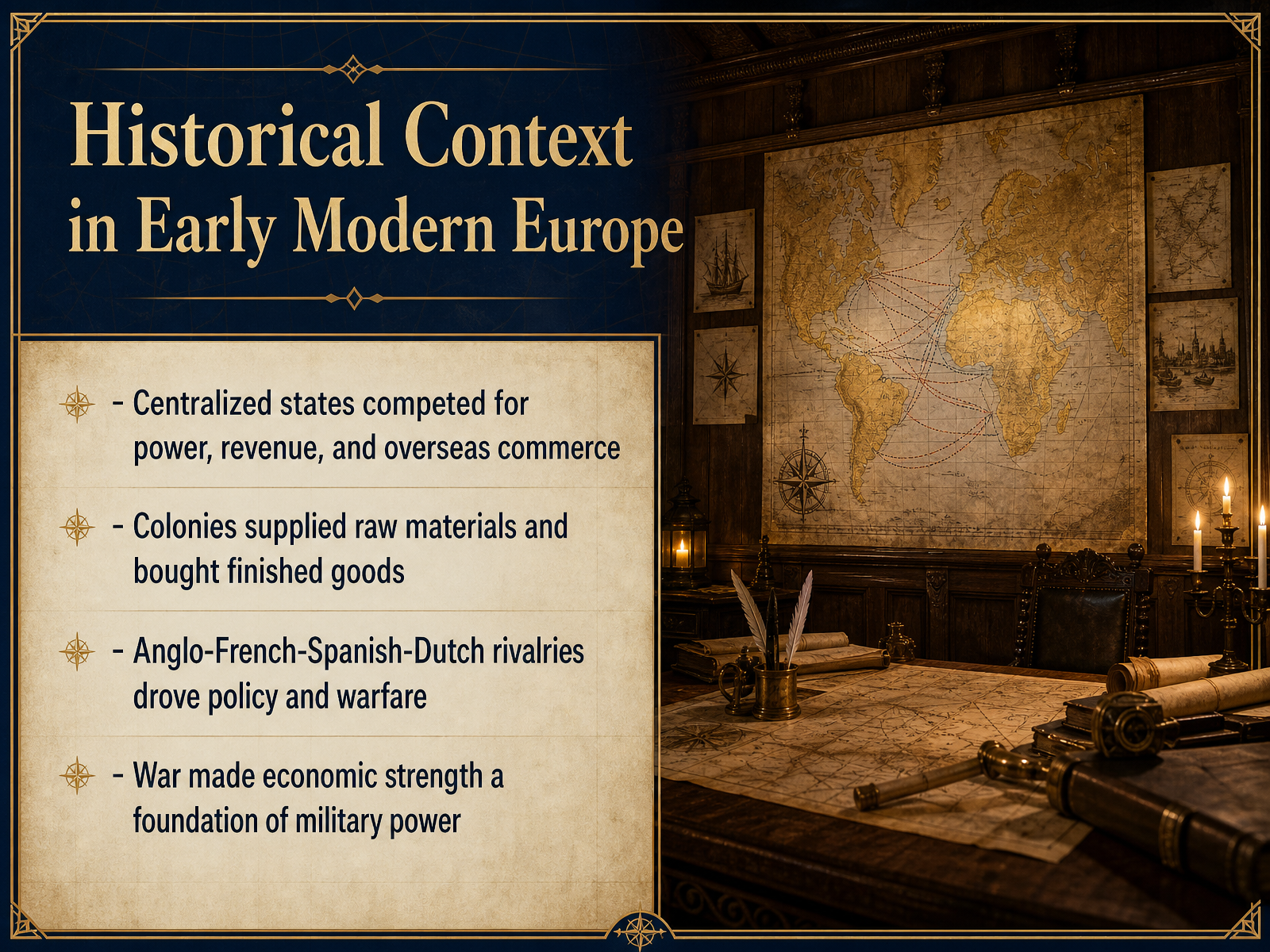
 - 05Historical Context in Early Modern EuropeNow let's consider the historical context that shaped mercantilism in early modern Europe. Picture a group of ambitious, centralized states, each trying to outdo the others in power, revenue, and overseas commerce. Their colonies played a specific role: they supplied raw materials and served as guaranteed markets for finished goods made back home. Rivalries among England, France, Spain, and the Dutch Republic drove both policy and frequent warfare. In this environment, war and economic strength became tightly linked. A state that could fund a larger navy or army had a decisive advantage, so trade, taxation, and military power were part of the same strategic loop. In other words, mercantilism was not just an economic theory; it was a practical response to intense competition and recurring conflict. Next, let's look at the key policies and tools that states used to put these ideas into action.
 britannica.comcambridge.orgcambridge.org+22 min
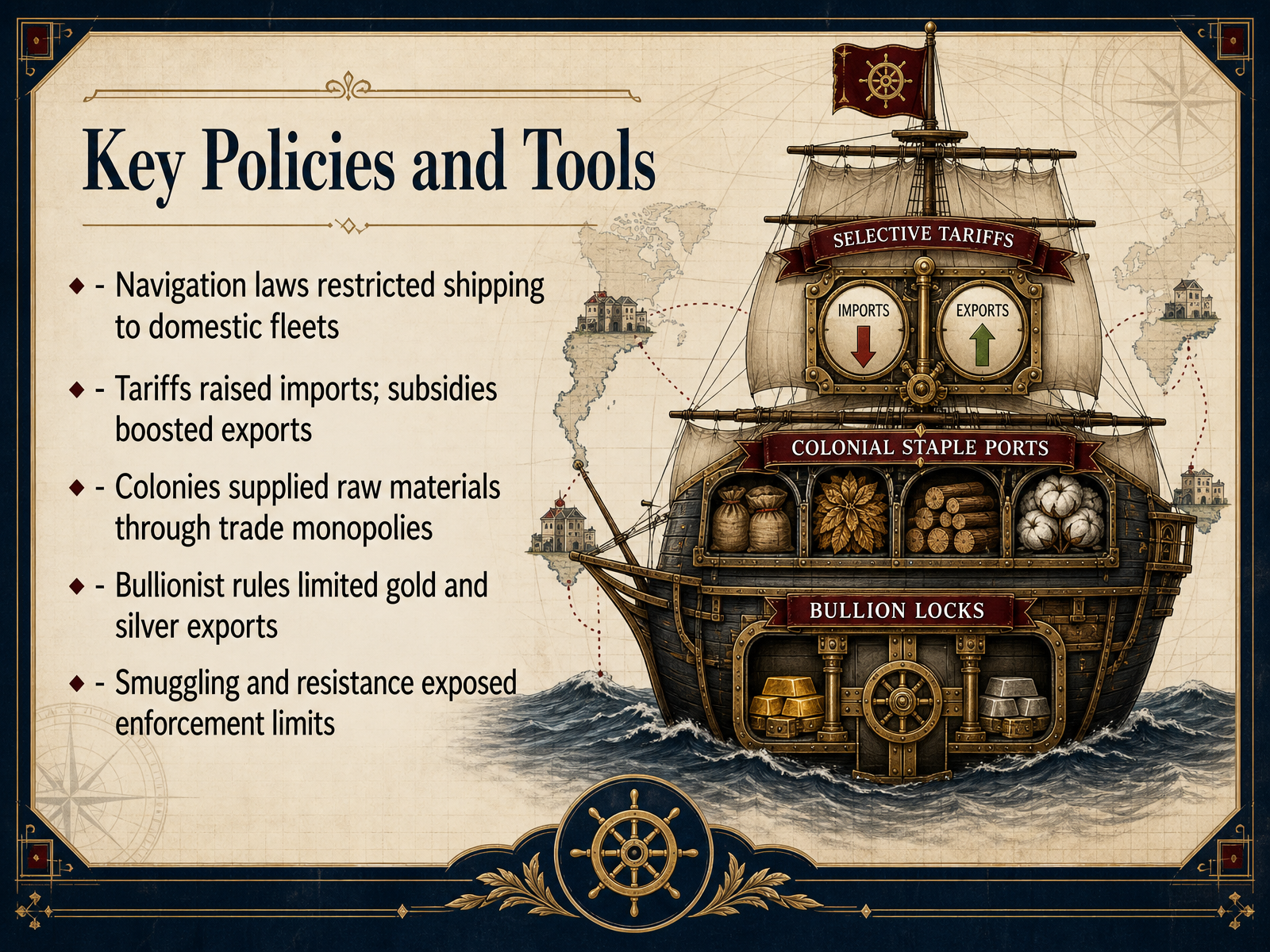
 - 06Key Policies and ToolsSo far, mercantilism might sound like a theory, but this slide gets to the machinery that made it real. Think of policies as the levers governments pulled to control trade. Navigation laws required that goods be carried in domestic fleets. Tariffs made imports more expensive, while subsidies made exports cheaper. Colonies were locked into monopolies, sending raw materials to the mother country and buying finished goods back. Bullionist rules tried to keep gold and silver from flowing out. But enforcement was always the weak point. Smuggling flourished, and resistance revealed how hard it was to police every port and coastline. The system looked powerful on paper, but in practice it leaked everywhere. That tension between control and reality shaped how different nations adapted mercantilism. Let's look next at some of those national varieties of mercantilism.
 britannica.comcambridge.orgcambridge.org+22 min
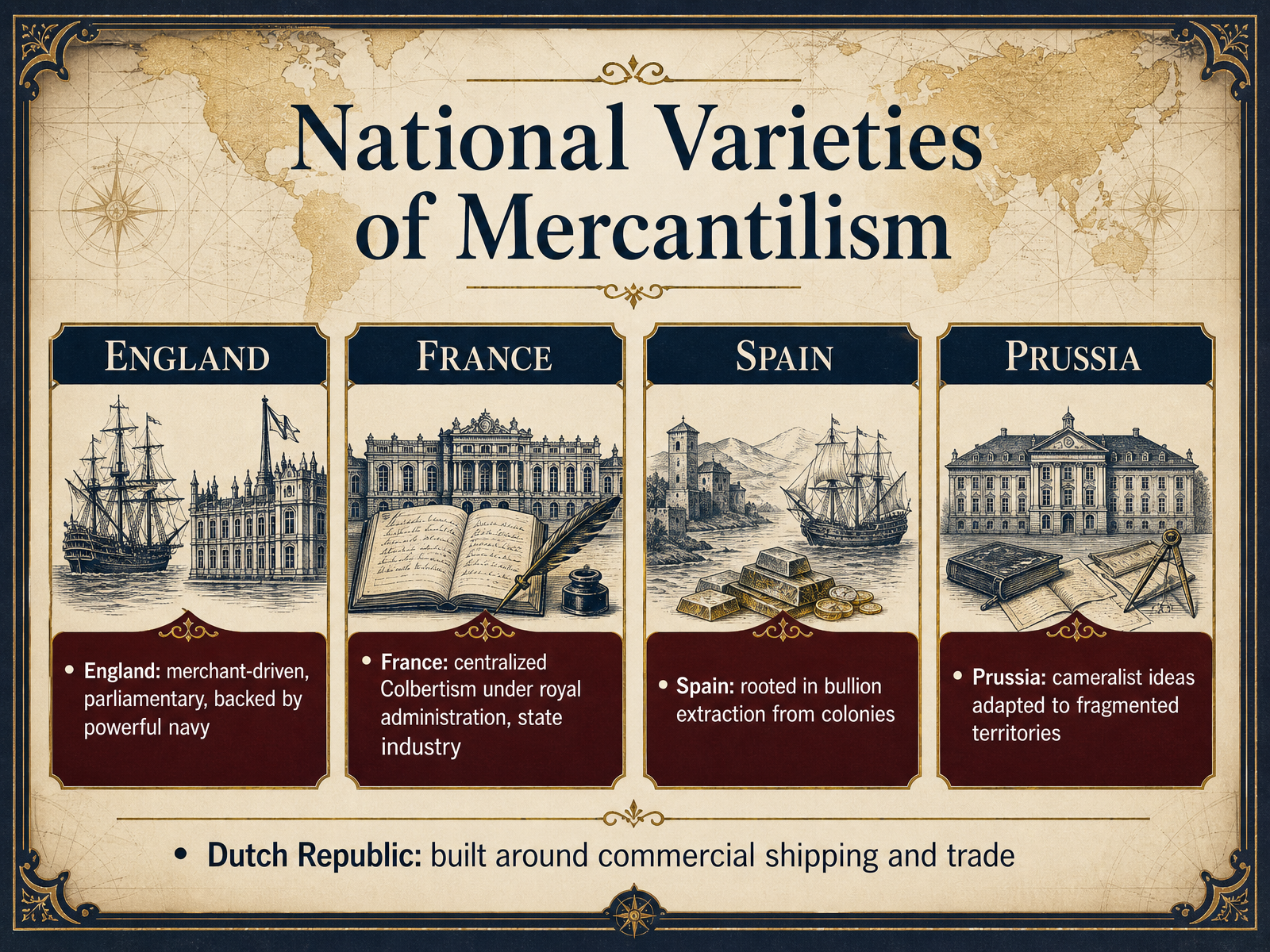
 - 07National Varieties of MercantilismMercantilism was not one identical system everywhere. Different states adapted the same core idea to their own political realities. In England, merchants drove the process through Parliament, backed by a powerful navy that protected trade routes and colonies. France followed a more centralized path under Jean-Baptiste Colbert, with royal administration closely directing state sponsored industries. Spain remained focused on extracting gold and silver from its colonies, a strategy that brought wealth but masked deeper economic weaknesses. The Dutch Republic built its power on commercial shipping, acting as a carrier and trading hub more than a traditional land empire. Meanwhile, Prussia developed cameralist ideas for its fragmented territories, training officials to manage resources and state finances efficiently. So the same mercantilist instinct, strengthening the state through economic control, produced very different results depending on local conditions. That pattern becomes even clearer when we look beyond Europe, at mercantilism's global reach and unintended consequences, our next topic.
 britannica.comcambridge.orgcambridge.org+21 min
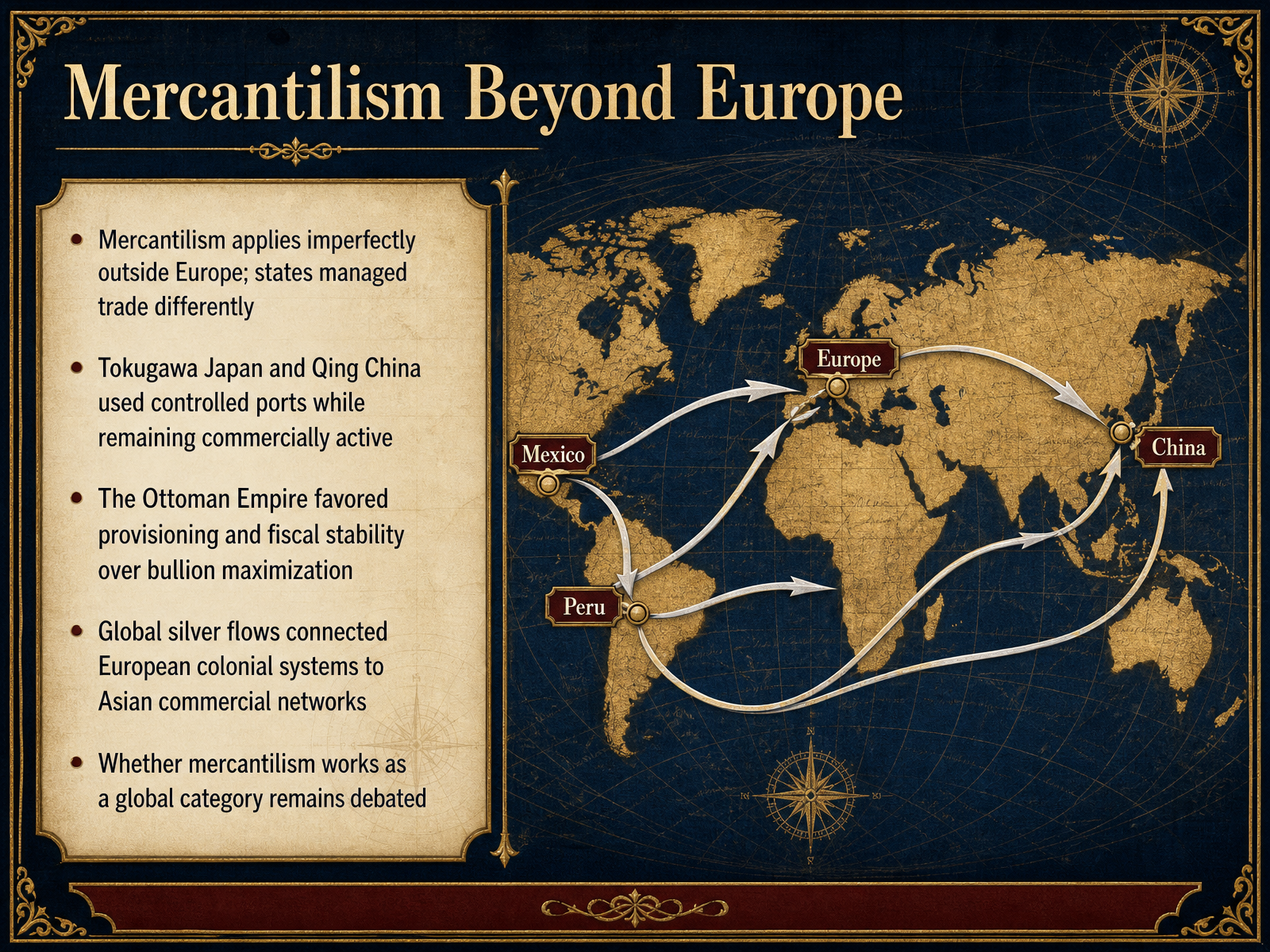
 - 08Mercantilism Beyond EuropeLet us widen the lens and look beyond Europe. Mercantilism may have been named and formalized in the West, but the rest of the early modern world was far from inactive. In Tokugawa Japan, trade was carefully managed through the controlled port of Nagasaki, with merchants moving goods under close supervision. Qing China took a similar approach, restricting foreign commerce to the Canton system while still running a massive and lucrative export economy, especially in tea, silk, and porcelain. The Ottoman Empire pursued yet another path. Ottoman rulers cared less about hoarding silver and more about provisioning their cities, keeping food affordable, and maintaining fiscal stability across a vast empire. This does not mean these states were shut off from the world. On the contrary, global silver flows tied European colonial mines to booming Asian markets, linking Manila, Nagasaki, Canton, and Istanbul in one immense commercial web. So does the term mercantilism actually work as a global category? That remains a real debate among historians. What we can say is that trade management was widespread, but its goals and tools varied greatly from place to place. These differences set the stage for the next part of our story, when critics began to question the entire mercantilist framework and the idea of free trade began to rise.
 britannica.comcambridge.orgcambridge.org+22 min
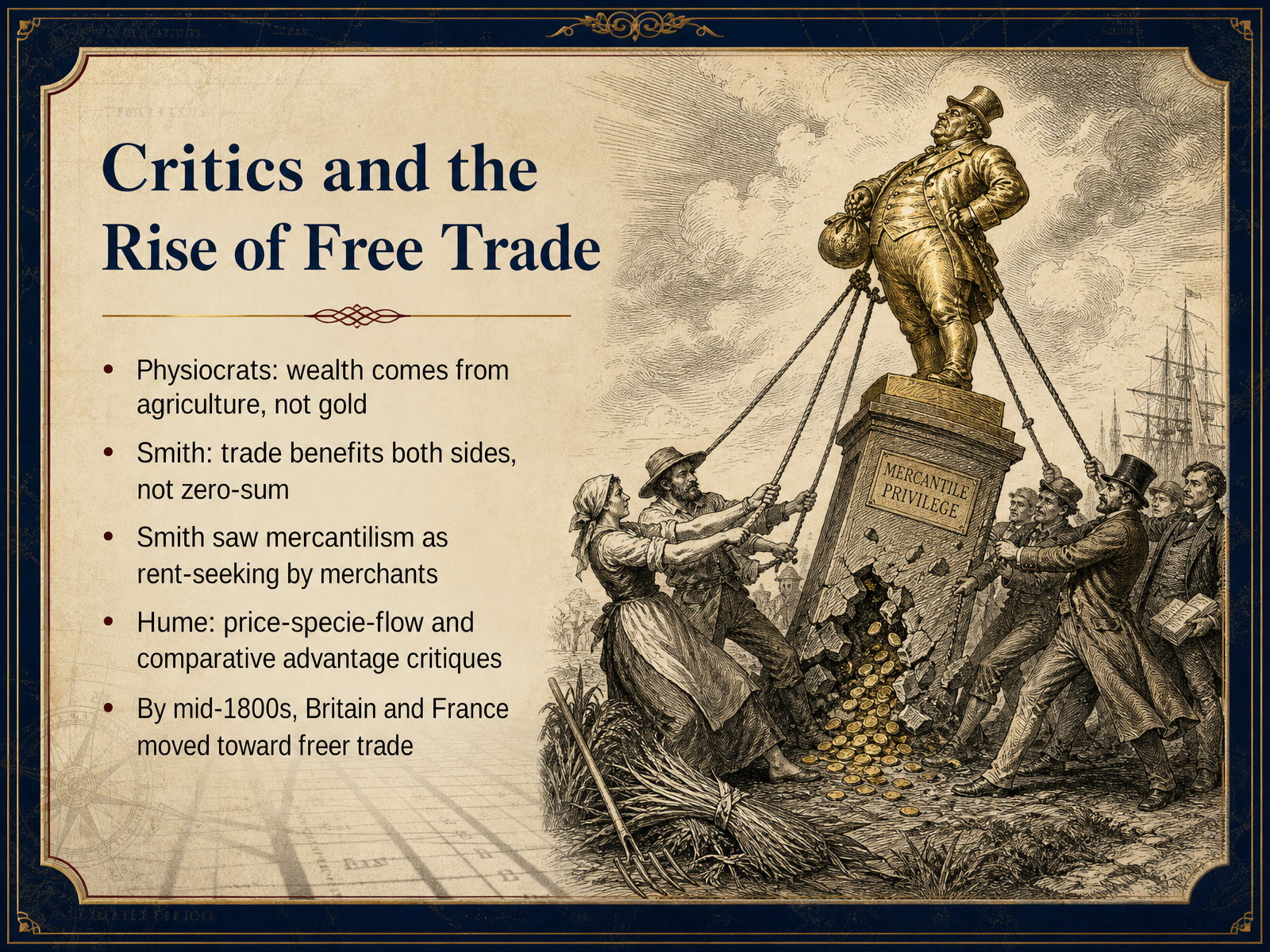
 - 09Critics and the Rise of Free TradeNow we come to the turning point, the moment when those old mercantilist assumptions began to crack. In France, a group called the Physiocrats argued that true wealth came from the land, from agriculture, not from piling up gold in a treasury. Around the same time, Adam Smith delivered an even more powerful challenge. He said trade is not a zero-sum contest where one nation wins and another loses. When two countries trade freely, both sides can gain. Smith also saw mercantilism for what it often was in practice: merchants using government rules to protect their own profits, what we would now call rent-seeking. David Hume added another sharp insight. He showed that if a country keeps hoarding gold, prices rise, its goods become less competitive, and the metal eventually flows out again. By the mid eighteen hundreds, Britain and France were steadily lowering trade barriers, moving toward a freer system. That shift did not happen overnight, and it was never complete, but it marked a real change in how nations understood prosperity. Up next, we will see how these tensions played out in a very unexpected place: mercantilism and the American Revolution.
 plato.stanford.eduideas.repec.orgejpe.org+22 min
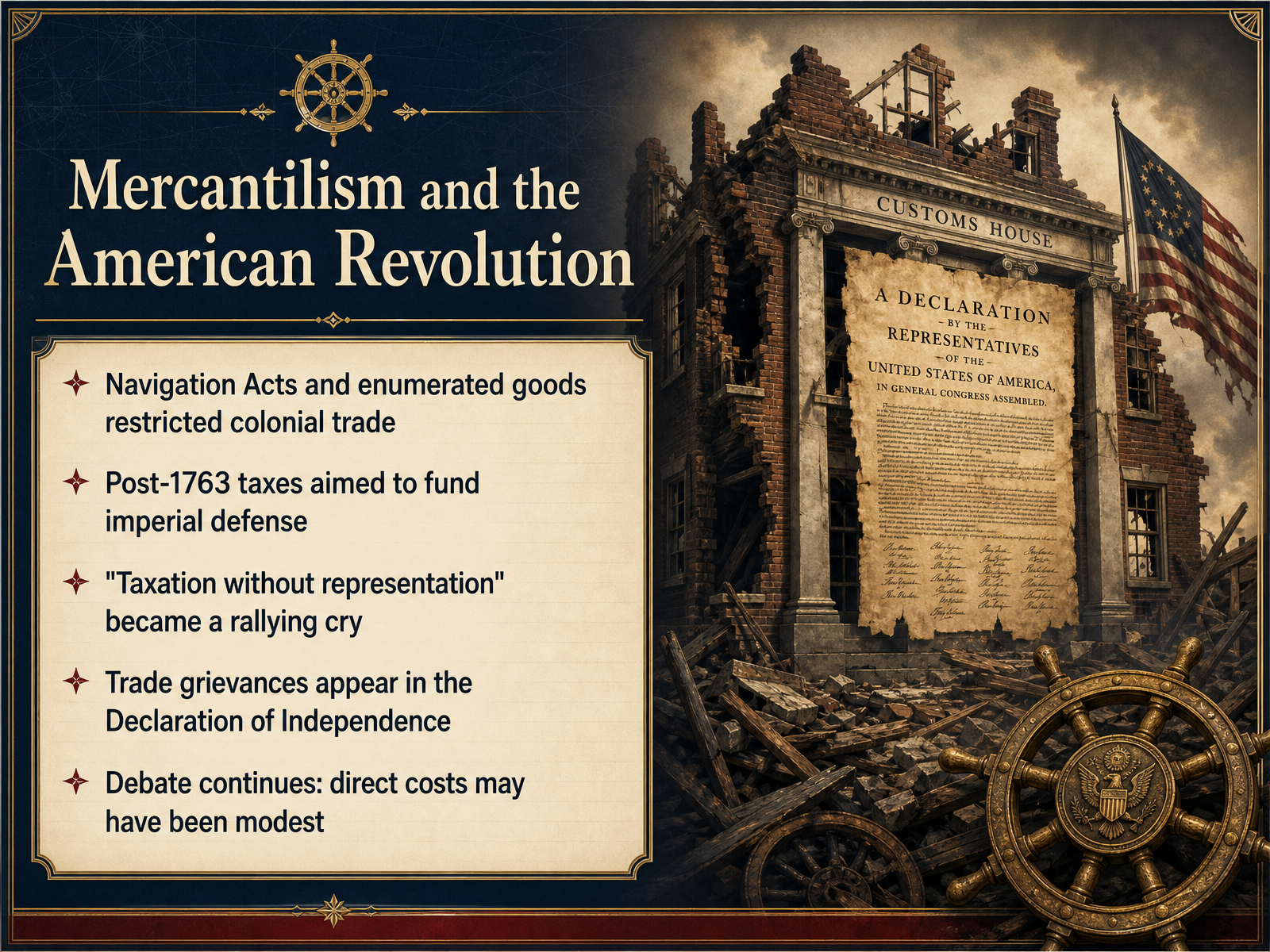
 - 10Mercantilism and the American RevolutionNow we come to a turning point where economic rules helped spark a political revolution. The Navigation Acts told the American colonies what they could trade, where they could ship it, and whose ships could carry it. Certain goods, called enumerated goods, had to pass through British ports first, which added cost and limited colonial choices. After 1763, Britain tried to raise new taxes on the colonies to help pay for imperial defense, following a very expensive war. To many colonists, this felt less like shared empire and more like being told to pay rent on a house they could not furnish themselves. The phrase taxation without representation became a powerful rallying cry. The Declaration of Independence even listed trade grievances, including cutting off trade with other parts of the world and imposing taxes without consent. Yet historians still debate how heavy the direct economic burden really was. Some estimates suggest the direct costs were modest, around a small fraction of colonial income. The deeper issue may have been control over future economic opportunity, not just the size of the bill. That sense of lost control helps explain why mercantilist trade rules became part of the language of revolution. Next, we will see how empire, slavery, and colonial economies connected this struggle to a much larger Atlantic system.
 britannica.combritannica.comen.wikipedia.org+21 min
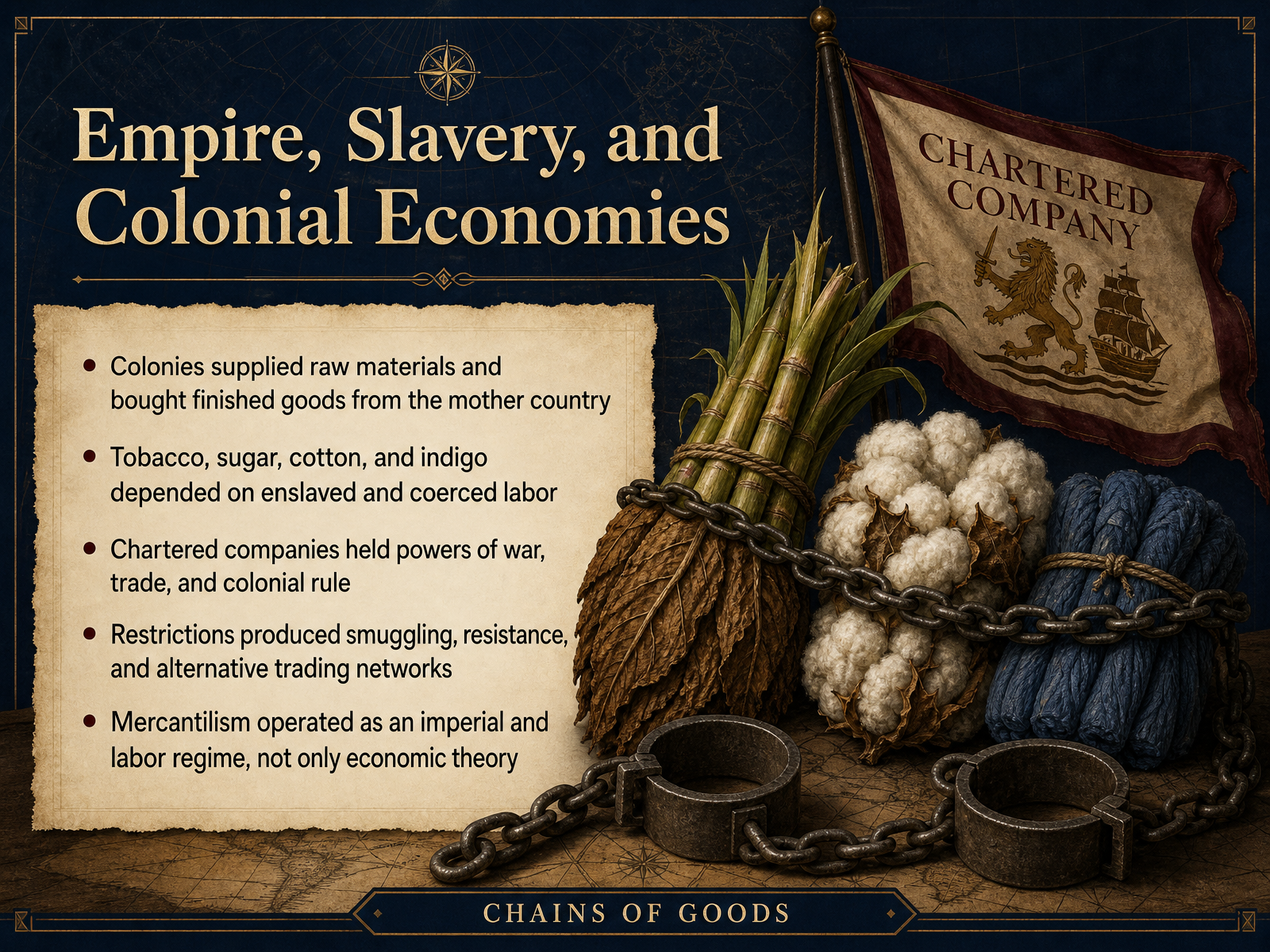
 - 11Empire, Slavery, and Colonial EconomiesNow let's look at how mercantilism actually operated on the ground in colonial empires. The basic arrangement sounds simple. Colonies supplied raw materials, and in return they were expected to buy finished goods from the mother country. But think about what that really required. Tobacco, sugar, cotton, and indigo were not produced by free and willing workers. They depended on enslaved and coerced labor. So mercantilism was never just an economic theory. It was an imperial and labor regime built on human exploitation. To manage this system, European states relied on chartered companies. These were hybrid ventures that could make war, control trade, and rule colonial territory, all in pursuit of profit. In effect, companies outsourced empire. And when the rules felt oppressive, people pushed back. Restrictions produced smuggling, resistance, and whole alternative trading networks that operated outside official control. So the takeaway here is powerful. Mercantilism was not just a set of policies on paper. It was a system of imperial power and coerced labor whose effects still echo today. Next, we will examine its decline, persistence, and rival narratives.
 britannica.comcambridge.orgcambridge.org+22 min
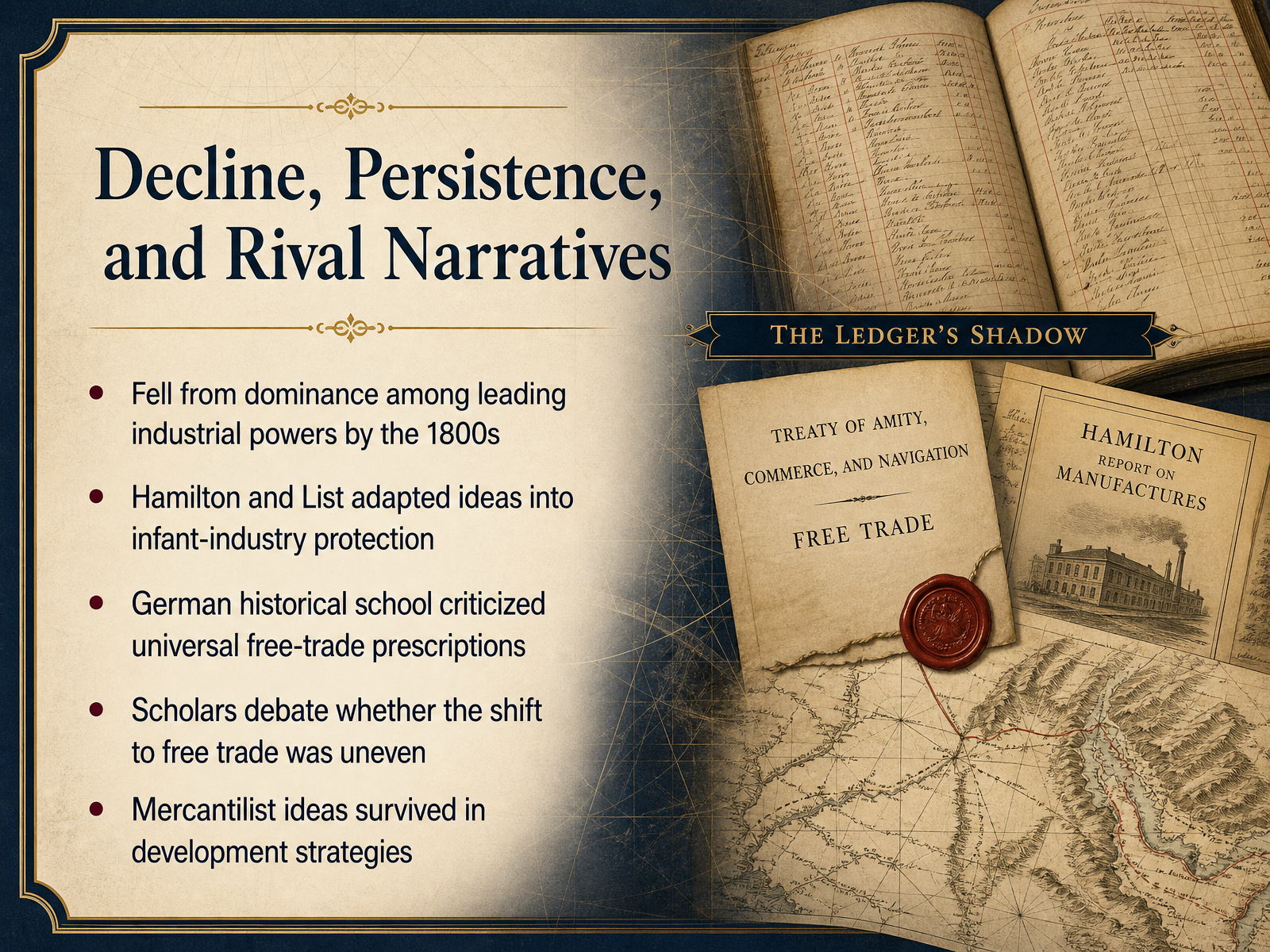
 - 12Decline, Persistence, and Rival NarrativesNow, by the eighteen hundreds, mercantilism was no longer the dominant policy among leading industrial powers. Yet its ideas didn't simply disappear. Think of it like a family recipe that gets adapted, not forgotten. In the United States, Alexander Hamilton argued for protecting young industries until they were strong enough to compete. In Germany, Friedrich List made a similar case. Their ideas became known as infant-industry protection. Meanwhile, a group of German economists criticized the idea that one single free-trade rule fits all nations. Scholars still debate whether the shift away from mercantilism was a steady march or an uneven, winding road. What’s clear is this: the core ideas survived. They resurfaced in development strategies, where governments deliberately nurtured local industries. So the story isn't a clean ending. It's a fork in the road that leads directly to our next topic, neomercantilism and its modern echoes.
 ft.comlink.springer.comrepository.cam.ac.uk+21 min
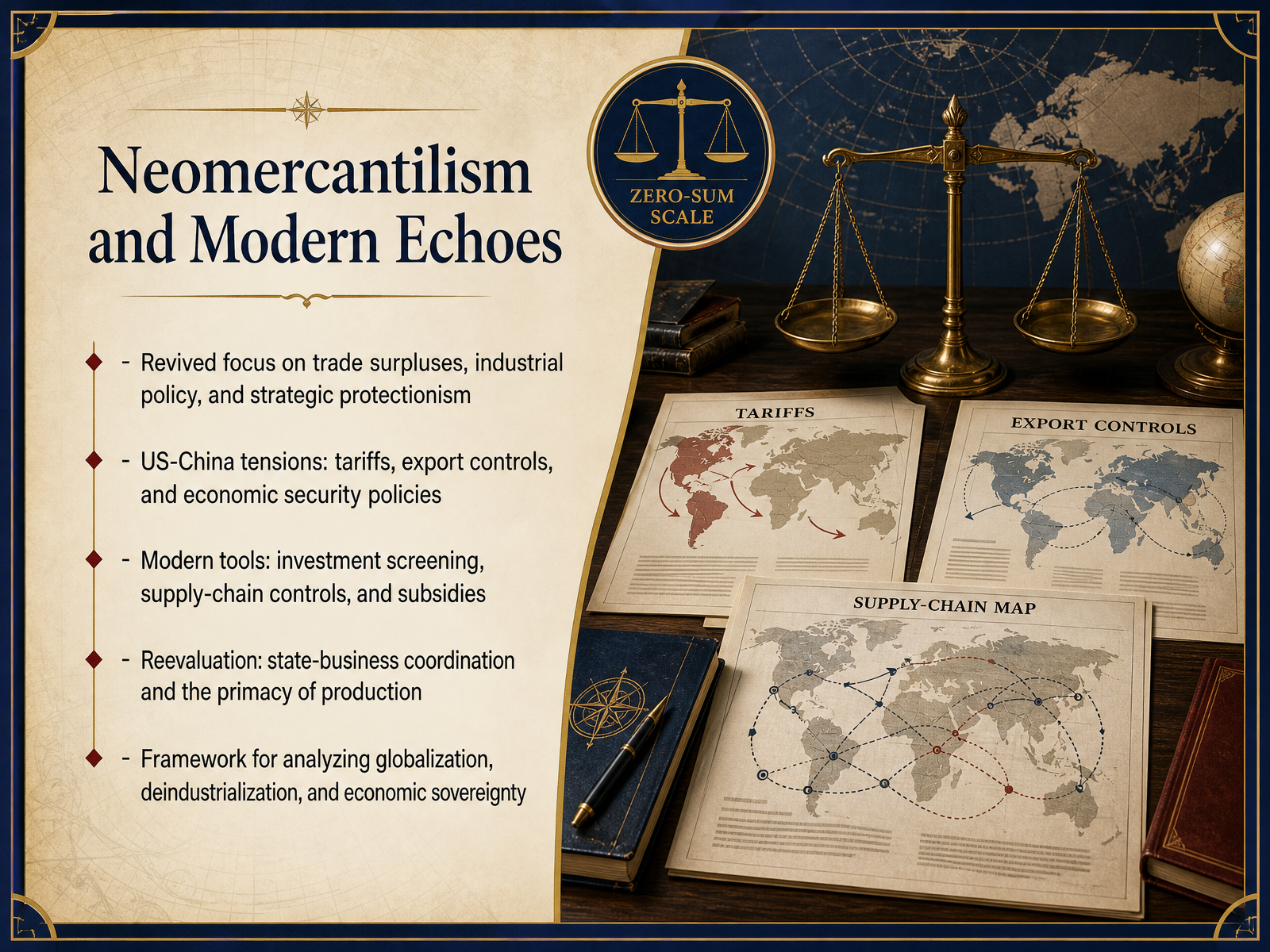
 - 13Neomercantilism and Modern EchoesNow let's bring this history into the present. The ideas we've discussed never truly went away, and today they're back in a form scholars call neomercantilism. We see it in a renewed focus on trade surpluses, industrial policy, and strategic protectionism. The tensions between the U S and China are a clear example, with tariffs, export controls, and policies framed around economic security. The tools have simply evolved. Instead of just taxing imports, modern governments use investment screening, supply chain controls, and subsidies to support favored industries. This has led to a major reevaluation of how states and businesses should work together, pushing the primacy of domestic production back to the center of policy debates. Ultimately, this framework helps us analyze the forces behind globalization, deindustrialization, and the modern struggle for economic sovereignty. Next, we'll wrap up with a summary and some discussion questions.
 ft.comlink.springer.comrepository.cam.ac.uk+21 min
 - 14Summary and Discussion QuestionsWe have reached the end of our journey through mercantilism, so let me leave you with a compact review. Mercantilism tied national wealth, state power, and government regulation together in early modern Europe. It was not one single system, though. We saw French Colbertism, German cameralism, and similar impulses far beyond Europe. Its legacy is heavy. It shaped colonial empires, contributed to the American Revolution, and provoked Adam Smith's powerful free-trade critique. So here is a question worth sitting with: how much of that old logic still echoes when modern governments talk about trade surpluses, strategic industries, or economic nationalism? As you move into discussion, compare different interpretations. Then try analyzing Smith's critique of mercantilism directly. Finally, debate whether neomercantilism is a fair label for today's policies. Your goal is not to settle every debate, but to read these ideas historically and connect them to the present. Thank you for working through this material, and I hope these questions spark a lively conversation.
 britannica.comcambridge.orgcambridge.org+22 min
Take the deck with you
Download this course as a file — free, no sign-up needed.
- PDF handoutEvery slide page, ready to print or share.15 pages · 6.8 MBDownload
- Narrated PowerPointThe deck that presents itself — every slide carries the digital human's narration video.15 pages · 18.0 MBDownload
- PowerPoint slidesThe full deck as a .pptx — open it in PowerPoint, Keynote, or Google Slides.15 pages · 6.8 MBDownload
Free to use in your own training — please keep the PersonWise credit page at the end.
Have your own deck? Turn it into a course
Sources consulted
Web sources consulted while building this course.
- Mercantilism, Trade, Empires - Western colonialism — britannica.com
- European Economic Institutions and the New World; the Chartered Companies (Chapter IV) - The Cambridge Economic History of Europe from the Decline of the Roman Empire — cambridge.org
- The Organisation of Global Trade: the Monopoly Companies, 1600–1800 | European Review | Cambridge Core — cambridge.org
- Outsourcing Empire | Princeton University Press — press.princeton.edu
- PARTING COMPANIES: THE GLORIOUS REVOLUTION, COMPANY POWER, AND IMPERIAL MERCANTILISM * — cambridge.org
- Economics in Early Modern Philosophy (Stanford Encyclopedia of Philosophy) — plato.stanford.edu
- In search of a ‘crude fancy of childhood’: deconstructing mercantilism — ideas.repec.org
- The survival of Aristotelianism in early English mercantilism: An illustration from the debate between Malynes and Misselden | Erasmus Journal for Philosophy and Economics — ejpe.org
- Mercantilism: a materialist approach: Scandinavian Economic History Review: Vol 66, No 2 — tandfonline.com
- HET: Antonio Serra — hetwebsite.net
- Navigation Acts | Definition, Purpose, Effects, & Facts | Britannica — britannica.com
- Mercantilism — en.wikipedia.org
- British Mercantilism and the Economic Development of the Thirteen Colonies — cambridge.org
- Mercantilist | Britannica — britannica.com
- The dangerous triumph of neo-mercantilism - Financial Times — ft.com
- Geoeconomics and the return of economic nationalism in international trade law | Discover Global Society | Springer Nature Link — link.springer.com
- The new economic nationalism: industrial policy and national security in the United States, China, and the European Union — repository.cam.ac.uk
- Global economic governance: Navigating the Thucydides and Kindleberger traps | Brookings — brookings.edu
- Global Imbalances, Industrial Policy and Tariffs — imf.org