Begin
14 pages · ~28 min
Leadership Skills in Management
This training explores leadership styles, patterns, and practical examples to help managers develop effective leadership skills and enhance team performance.
A digital instructor presents all 14 pages. Hold “Ask” at any point and ask out loud — the answer comes from this course. No sign-up needed.
What you’ll learn
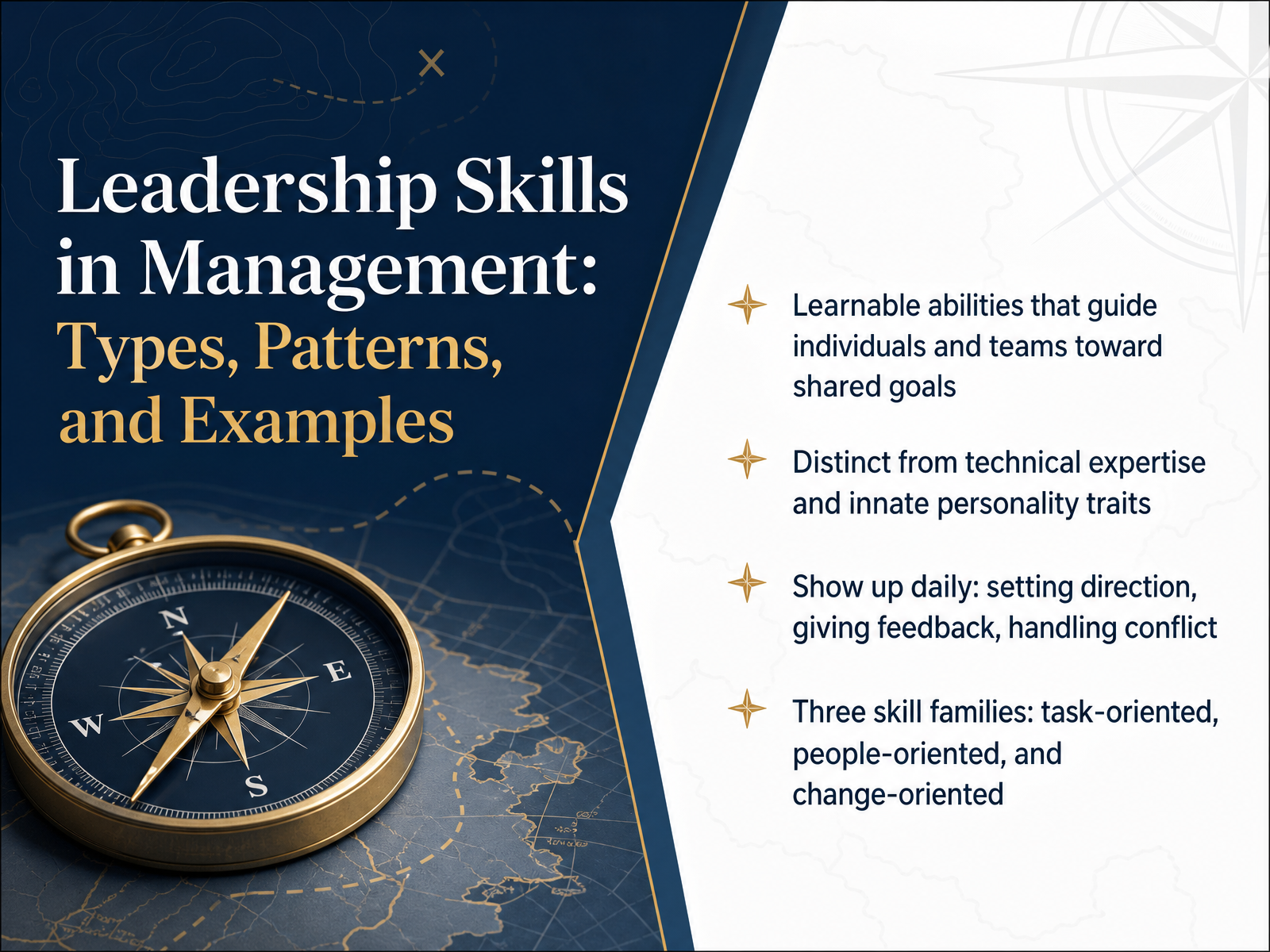
- 01Leadership Skills in Management: Types, Patterns, and ExamplesWelcome. If you manage people, you already know that getting the work done is only part of the job. The bigger part is guiding a group of individuals toward a shared goal. That is what this course is about. Leadership is not some innate quality you are born with. It is a set of learnable abilities, distinct from technical know-how or personality. You show these skills every day, whether you are setting direction for a project, giving someone tough feedback, or handling a conflict before it escalates. To make this practical, we will organize these abilities into three families: task-oriented skills, people-oriented skills, and change-oriented skills. Each one shows up in different moments of your week. As we move through the course, we will look at what each family actually looks like in practice. Let's start with the foundation. Up next, we will define what leadership skills really are and why they matter.us2.sagepub.cominvestopedia.comamanet.org+22 min
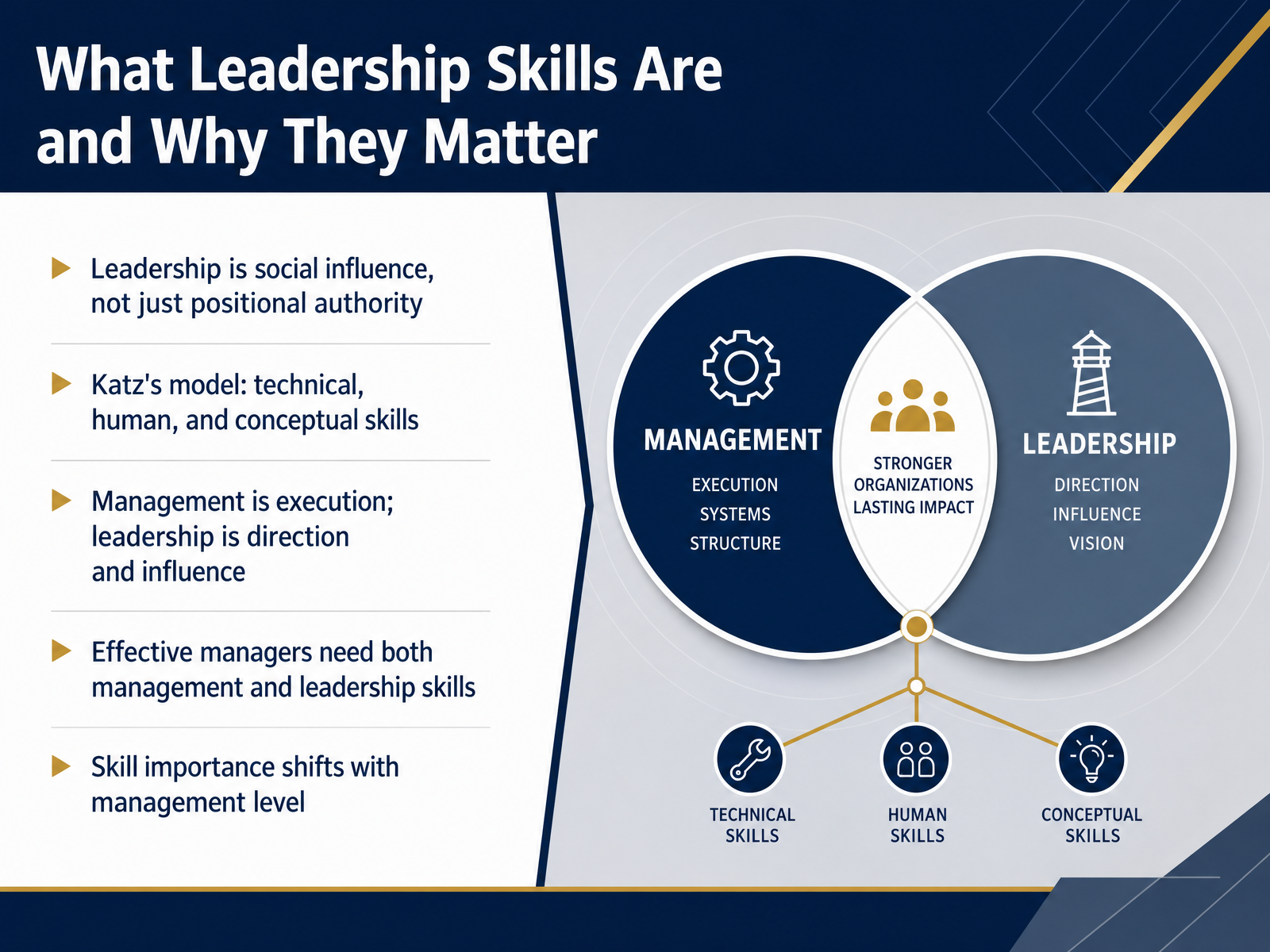
- 02What Leadership Skills Are and Why They MatterLet’s start with what leadership skills actually are. At the most basic level, leadership is social influence. It’s not just the authority that comes with your title. You can be a manager with a team reporting to you, but real leadership happens when people choose to follow your direction because they trust your judgment and buy into the goal. A classic way to understand this comes from Katz’s three skill model. He identified technical skills, human skills, and conceptual skills. Technical skills are your expertise in the specific work, like knowing the software your team builds or the accounting standards your department applies. Human skills are about working with people, communicating clearly, coaching, and resolving conflict. Conceptual skills are about working with ideas, seeing the big picture, and connecting daily decisions to long term strategy. Now, management and leadership are related but not the same. Management is often about execution, planning, organizing, and controlling work so deadlines are met. Leadership is more about direction and influence, helping people understand why the work matters and where the team is going. In practice, effective managers need both. You still need to manage the schedule, but you also need to lead the people who make the schedule work. One more thing to keep in mind. The mix of skills changes as you move up. Early in your management career, technical and human skills matter most. As you grow into more senior roles, conceptual skills become much more important, while daily technical work tends to fade into the background. So the key takeaway is this: leadership is a set of skills you can develop, not just a title you hold. Next, we’ll look at how those skills break into task oriented, people oriented, and change oriented leadership.
 us2.sagepub.cominvestopedia.comamanet.org+22 min
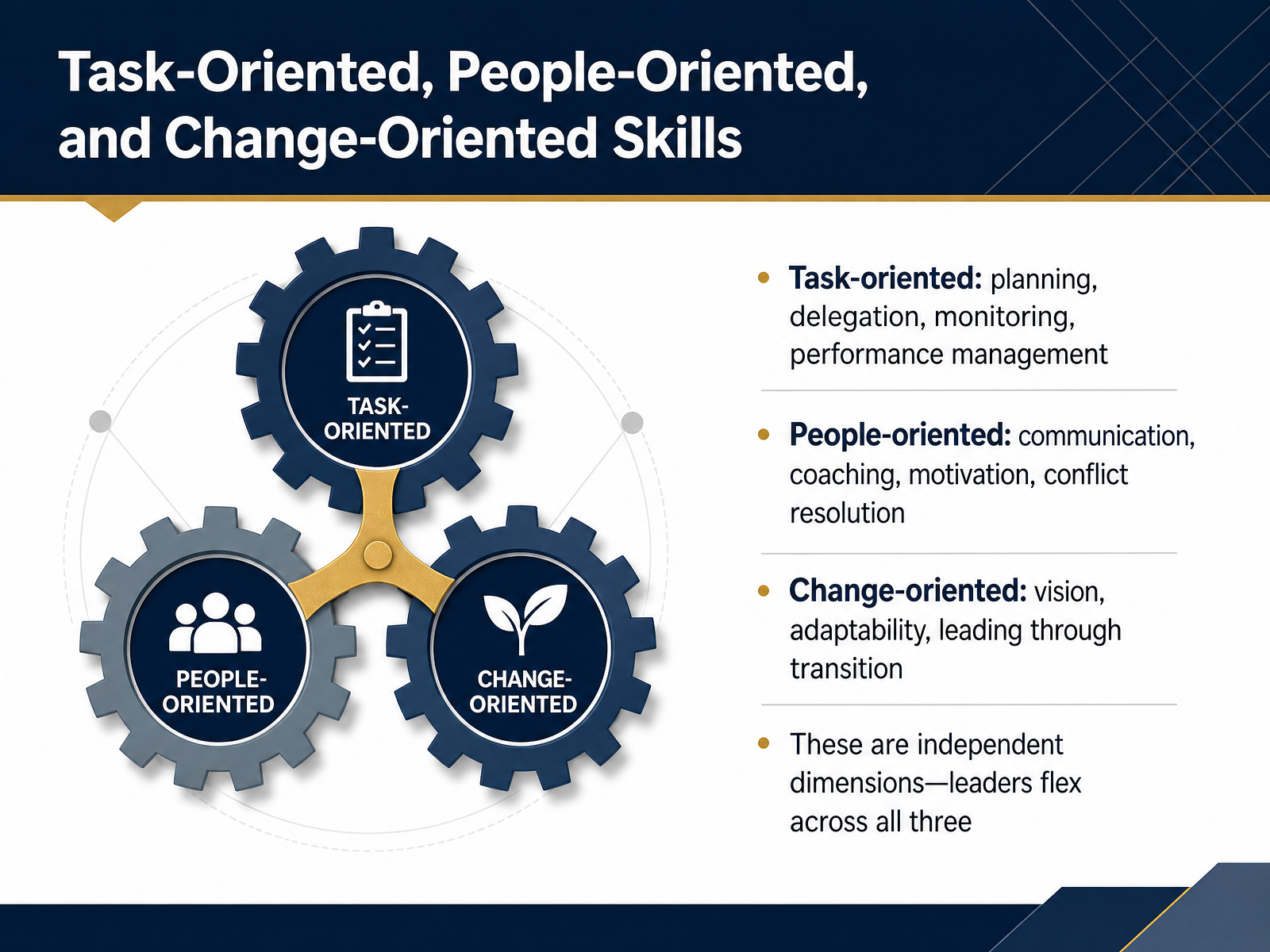
 - 03Task-Oriented, People-Oriented, and Change-Oriented SkillsNow, let's break leadership down into three core skill sets you can actually use. Think of them as three different lenses, not three personality types. First, there are task-oriented skills. This is about getting things done efficiently: planning the work, delegating clearly, monitoring progress, and managing performance. Imagine you're handing off a critical project; these skills ensure nothing falls through the cracks. Second, there are people-oriented skills. This is the human side, and it includes communication, coaching, motivation, and resolving conflict. When two strong performers clash, these are the skills that turn a tense situation into a productive conversation. Finally, there are change-oriented skills. This is about vision, adaptability, and leading your team through transition. Think about scaling a new process or adapting to a market shift; that requires leading people through the unknown. Here's the key takeaway: these dimensions are independent. You aren't just one type of leader. You flex across all three, shifting your focus depending on what the moment requires. A layoff announcement needs a different balance than a quarterly planning session. Next, we'll look at how to match your style to your team's readiness with situational leadership.
 glenn.osu.edusciencedirect.comarken.nmbu.no+22 min
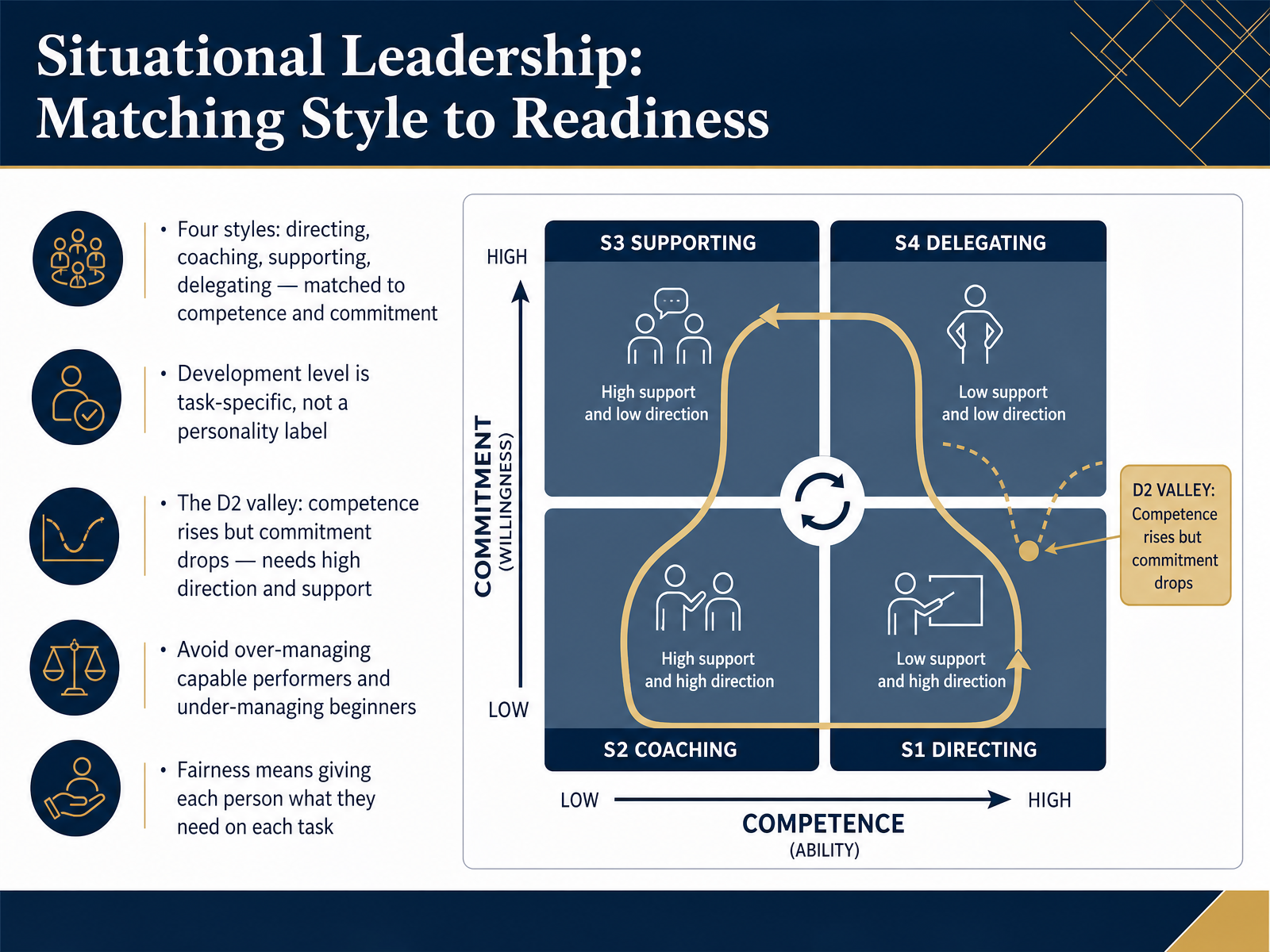
 - 04Situational Leadership: Matching Style to ReadinessNow let's talk about situational leadership, and why it's the most practical tool you can use as a manager. The core idea is simple. You match your style to the person's readiness on a specific task. There are four styles. Directing, coaching, supporting, and delegating. Each one balances how much direction you give against how much support you provide. But here's the key. Readiness isn't a personality label. It's about competence and commitment on one task, right now. Your best engineer might be highly ready on coding, but a complete beginner on running interviews. Same person, two tasks, two different versions of you required. Watch out for the D2 valley. That's when someone's competence goes up, but their commitment drops. They've learned enough to realize the task is hard. This is when people quit. They need more direction and more support, not less. And be careful not to over-manage your capable performers or under-manage your beginners. Fairness doesn't mean treating everyone the same. It means giving each person what they need to succeed on each task. Next, we'll look at how to apply this in your daily management.
 firsttimemanagers.comdoortraining.comblog.perceptyx.com+21 min
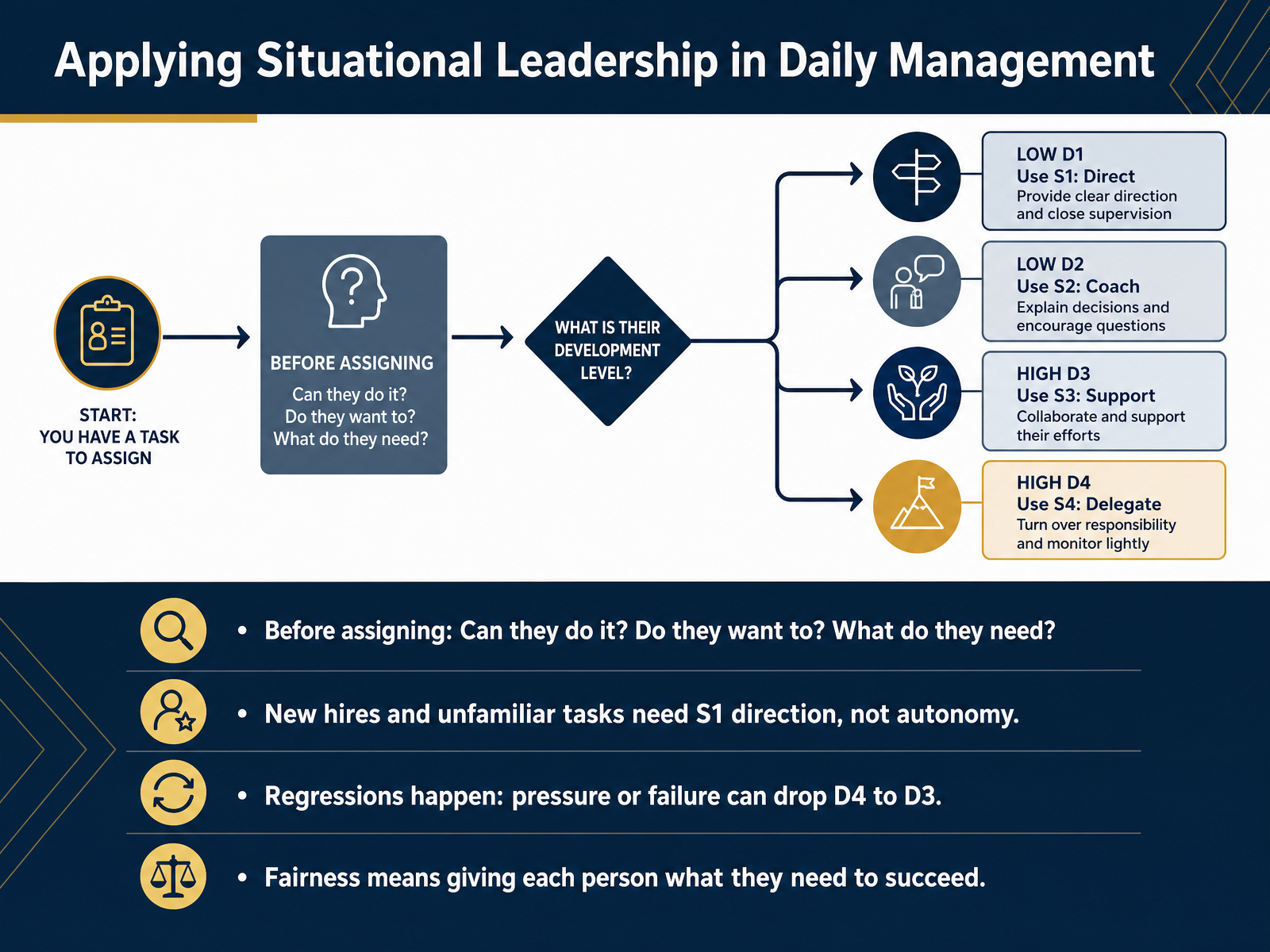
 - 05Applying Situational Leadership in Daily ManagementSo how do you use this on a busy Tuesday, with three different people waiting at your door? It starts with three quick questions before you assign anything. Can they do this specific task? Do they want to do it right now? And what do they need from me to succeed? Answer those honestly, and your approach picks itself. A new hire on an unfamiliar process? That is not the moment for, you've got this. They need direction. Walk them through it, give them a checklist, and check in early. But here is the part that surprises most managers. People regress. Your best contributor can drop from confident to hesitant after one bad client call or a public failure. When that happens, resist the urge to push harder on the work. They have not lost the skill. They have lost the confidence. Shift to support. Ask them what they think, and back their decisions until their footing returns. And remember, fairness is not treating everyone the same. It is giving each person what they need on this task, this week. Sometimes that is a checklist. Sometimes that is your trust and your silence. Both are right. And this kind of self-awareness and flexibility flows directly into our next topic: emotional intelligence as a leadership foundation.
 firsttimemanagers.comdoortraining.comblog.perceptyx.com+22 min
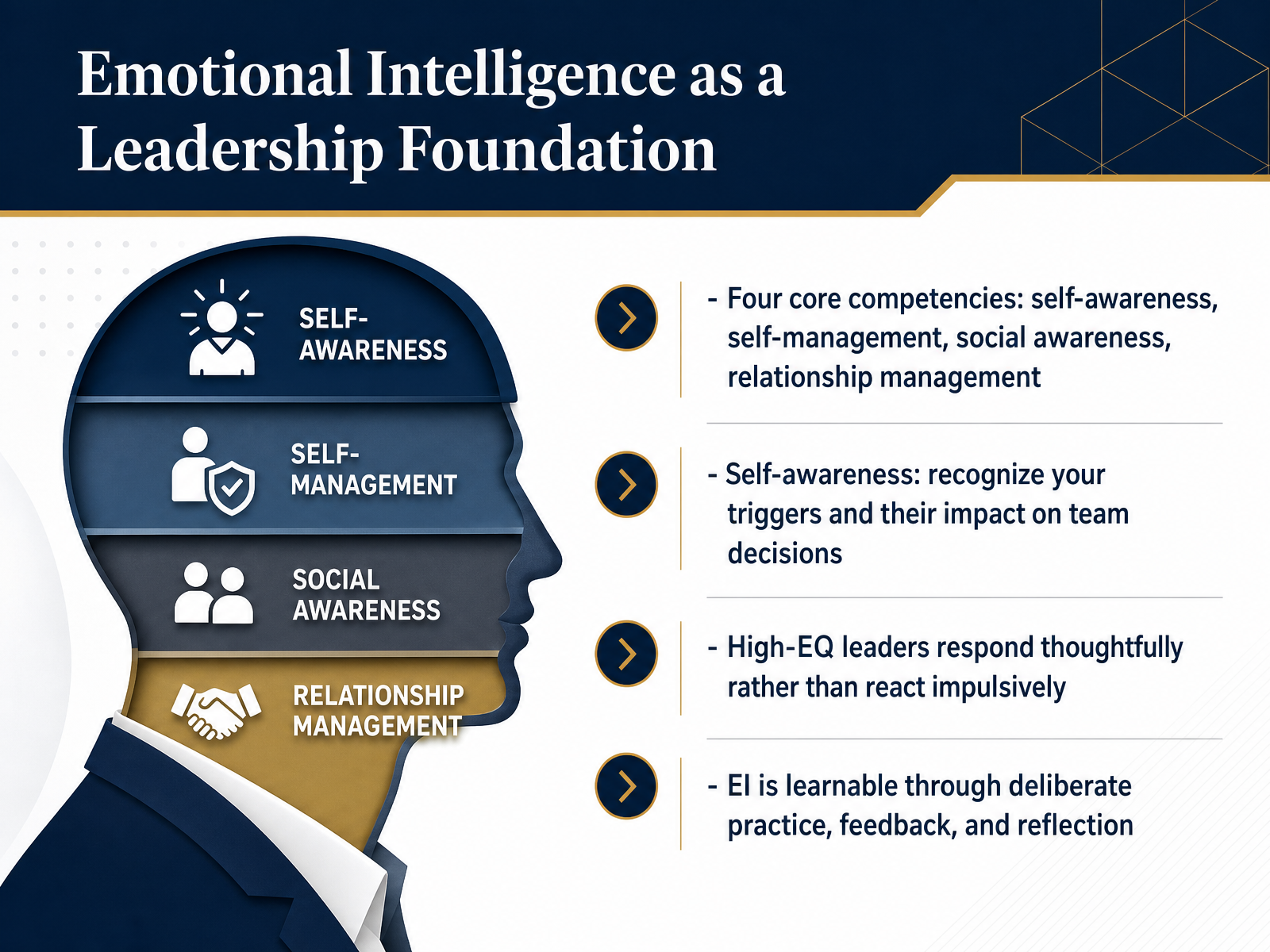
 - 06Emotional Intelligence as a Leadership FoundationNow let's talk about emotional intelligence, or EQ, and why it's the foundation of strong leadership. At its core, EQ is built on four competencies. First, self-awareness: knowing your own emotional triggers and how your mood affects your team's decisions. Second, self-management: the ability to pause and choose a response, especially under pressure. Third, social awareness: reading the room and picking up on what your team is feeling without them saying a word. And fourth, relationship management: using that awareness to coach, give feedback, and resolve conflicts in a way that builds trust. Here's the key shift I want you to remember. A high-EQ leader doesn't just react to a tense moment. They respond thoughtfully. For example, if a direct report misses a deadline, an impulsive reaction might sound like blame. A thoughtful response starts with noticing your own frustration, then asking a clear question like, 'What got in the way, and what do we need to do next?' The best news here is that EQ is not a fixed trait. You can build it through deliberate practice, honest feedback, and a few minutes of reflection after tough conversations. Small, consistent actions make a big difference. Coming up next, we'll get practical with specific EQ techniques you can use with your team right away.
 ddi.comcorporatecoachgroup.comlattice.com+22 min
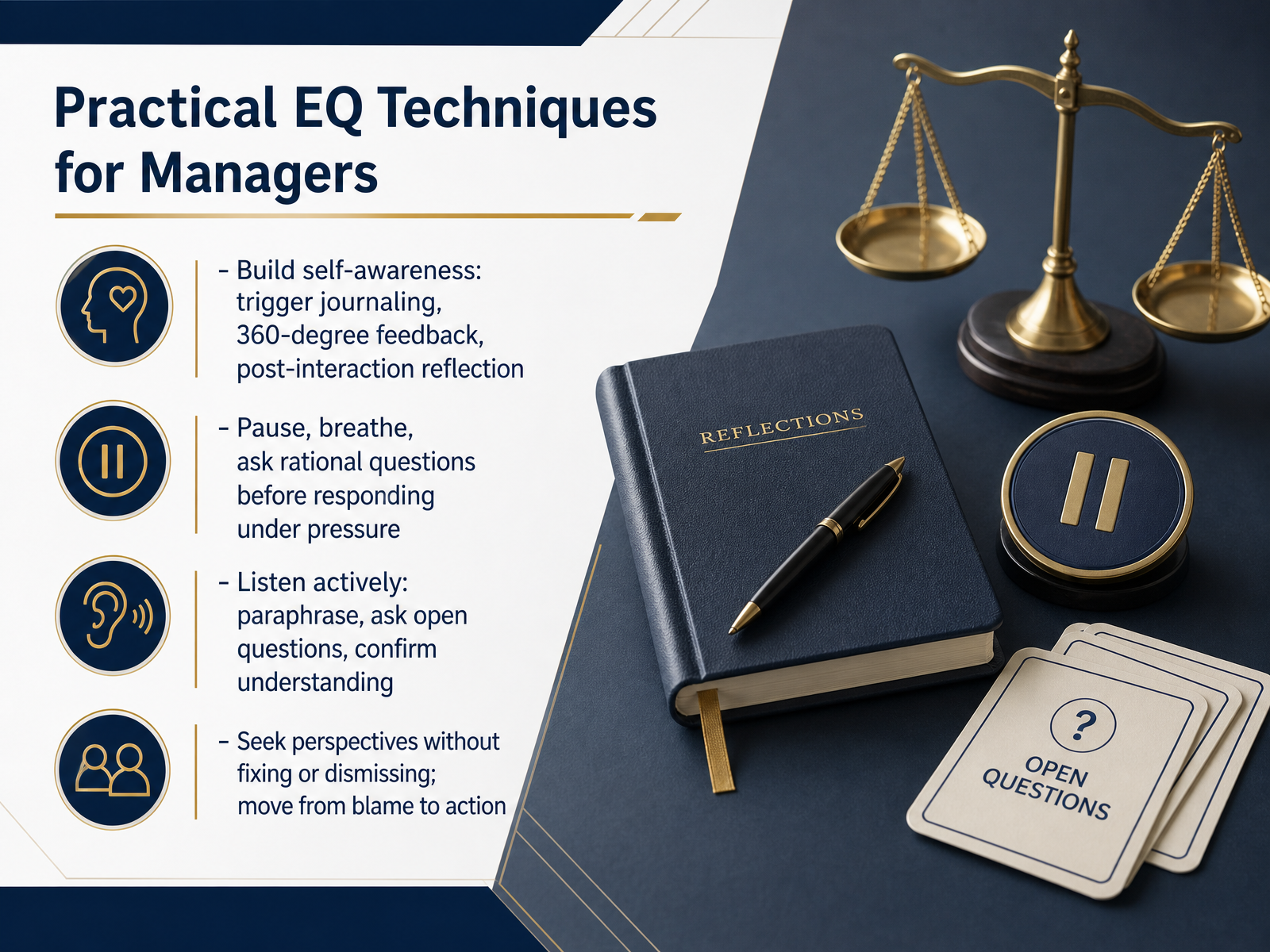
 - 07Practical EQ Techniques for ManagersLet's get practical. Building emotional intelligence starts with knowing your own patterns. Try a simple trigger journal. For one week, note the moments when you felt a strong reaction. What happened right before? What did you do next? You can also ask for three-sixty feedback to see how others experience you. When the pressure hits, the goal is to respond, not react. Pause. Take a breath. Ask yourself a rational question like, what are the facts here? What do I actually know? This small gap changes everything. Next, listen actively. Paraphrase what you heard and ask open questions to confirm you truly understand. If a team member is frustrated, don't rush to fix it. Just seek their perspective without judgment. This moves the conversation away from blame and toward a clear next action. These aren't personality traits. They're deliberate practices you can start using this week. Up next, we'll connect these skills to communication and constructive feedback.
 ddi.comcorporatecoachgroup.comlattice.com+22 min
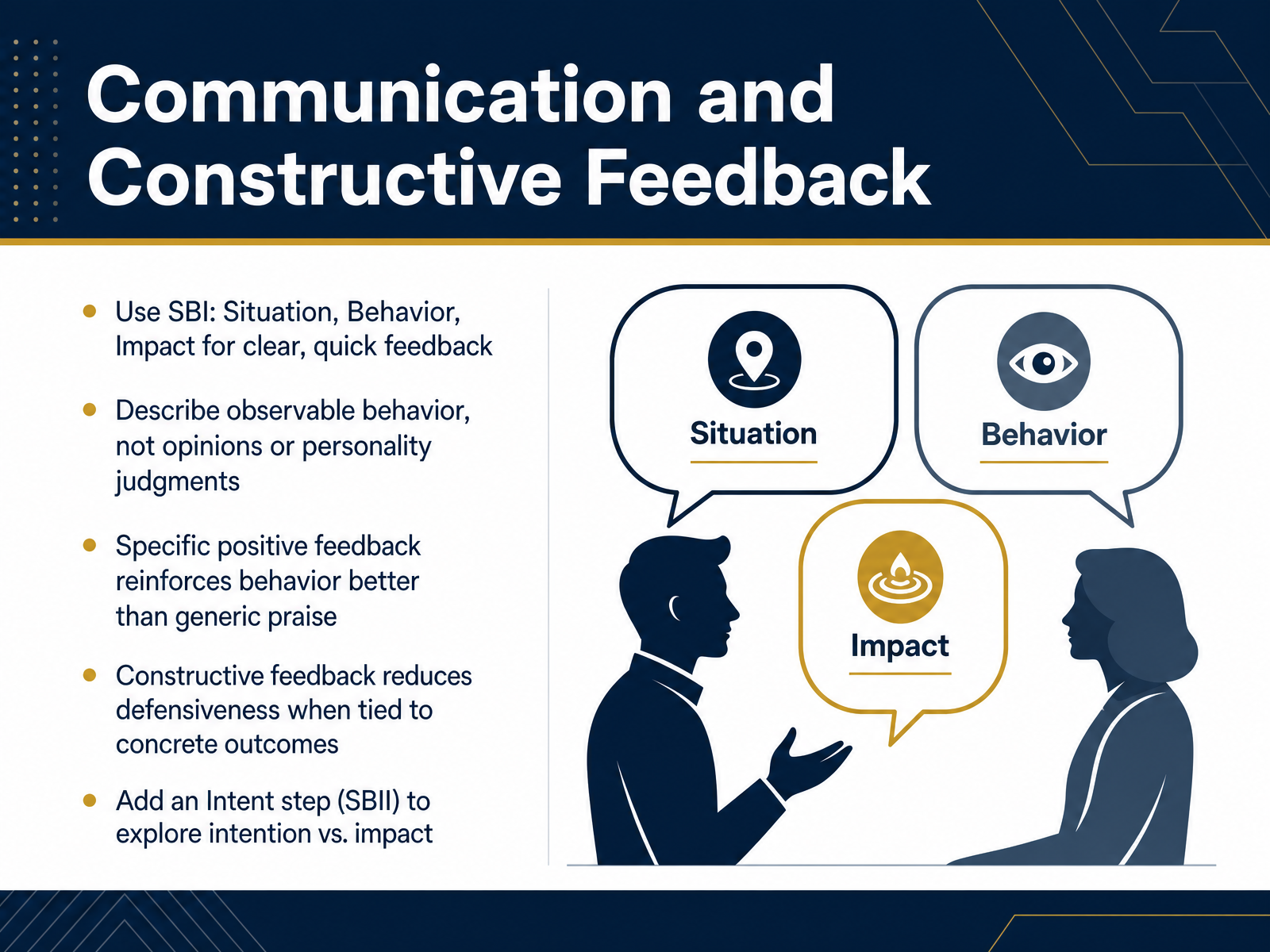
 - 08Communication and Constructive FeedbackLet's talk about communication, specifically how you deliver feedback without it turning into a courtroom drama. A model that works well is SBI: Situation, Behavior, Impact. Start by anchoring the moment. Instead of saying 'last week,' say 'in this morning's stand-up.' Then, describe the behavior like a camera would. Not 'you were rude,' but 'you interrupted Julia while she was giving her update.' Finally, explain the impact. 'The team missed the details on the server migration.' This removes personality judgments and focuses on observable facts, which drastically reduces defensiveness. Now, this works for praise too. Specific feedback like 'the way you summarized the client's concerns saved us twenty minutes,' reinforces the action better than a generic 'good job.' If you want to go deeper, add an Intent step, making it SBII. Ask, 'What were you hoping to accomplish?' This clarifies the gap between what they meant and how it landed, which opens the door to real coaching. Master this, and you are ready for the next step: coaching and developing team members.
 1 min
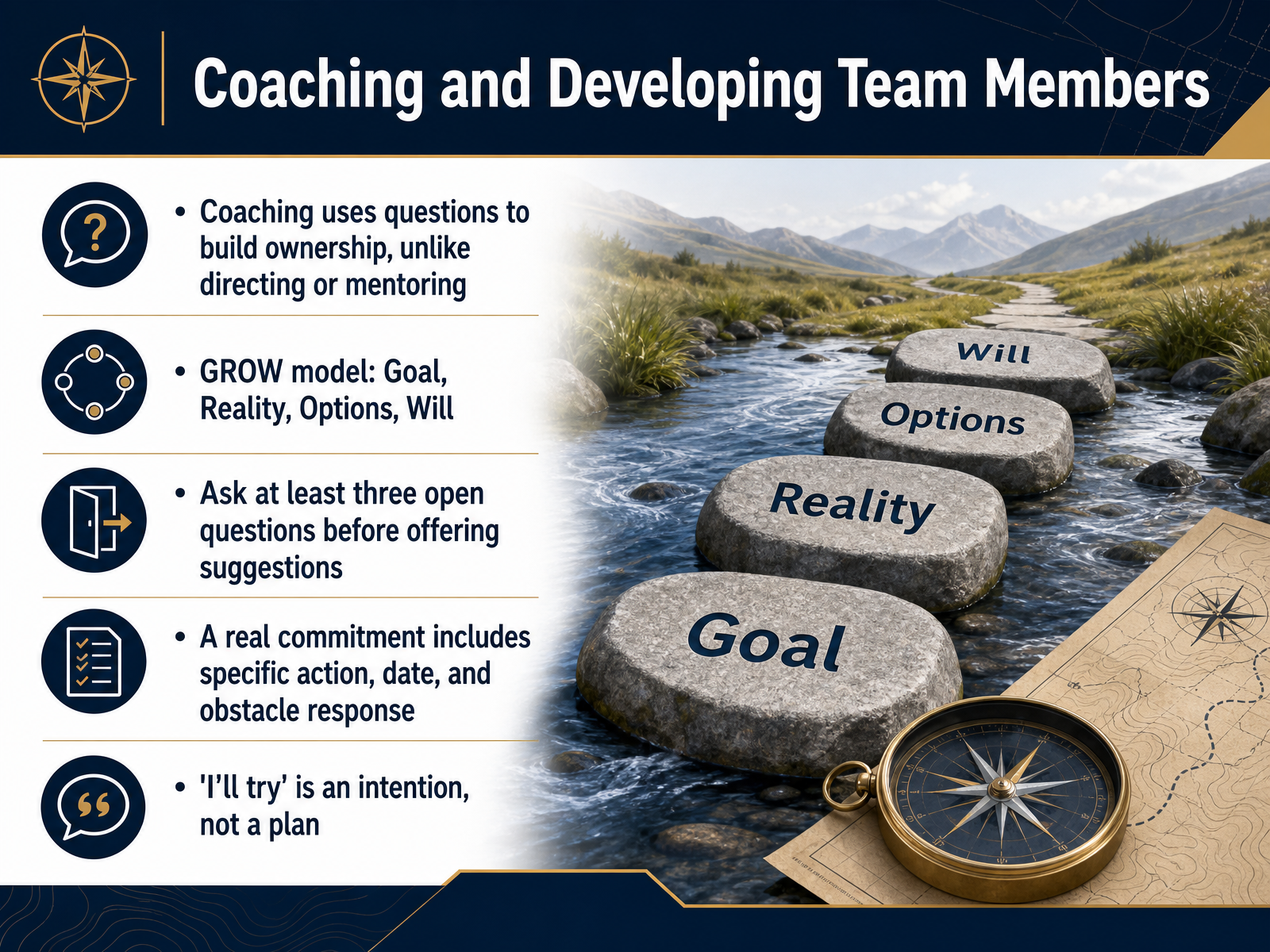
1 min - 09Coaching and Developing Team MembersNow let's talk about coaching and developing the people on your team. Coaching is different from directing or mentoring. When you direct, you give the answer. When you coach, you ask questions so the other person builds ownership of the solution. One simple framework to structure these conversations is the G R O W model. G R O W stands for Goal, Reality, Options, and Will. Start with the goal. What does the person actually want to achieve? Then move to reality. What is happening right now, and what has already been tried? After that, explore options. This is the hard part for many managers. Your instinct is to jump in with a suggestion. Instead, ask at least three open questions before you offer anything yourself. You may be surprised by the ideas your team member already has. Finally, move to will. This is where you turn talk into a real commitment. A real commitment has three parts. A specific action, a target date, and a plan for what to do if an obstacle gets in the way. If someone says, I'll try to do that, that is an intention, not a plan. Your job is to help them make it concrete. Once your team member owns the plan, you can step in to support them as they put it into action. That is where true empowerment begins. In the next part, we will build on this with delegation and empowerment done right.
 1 min
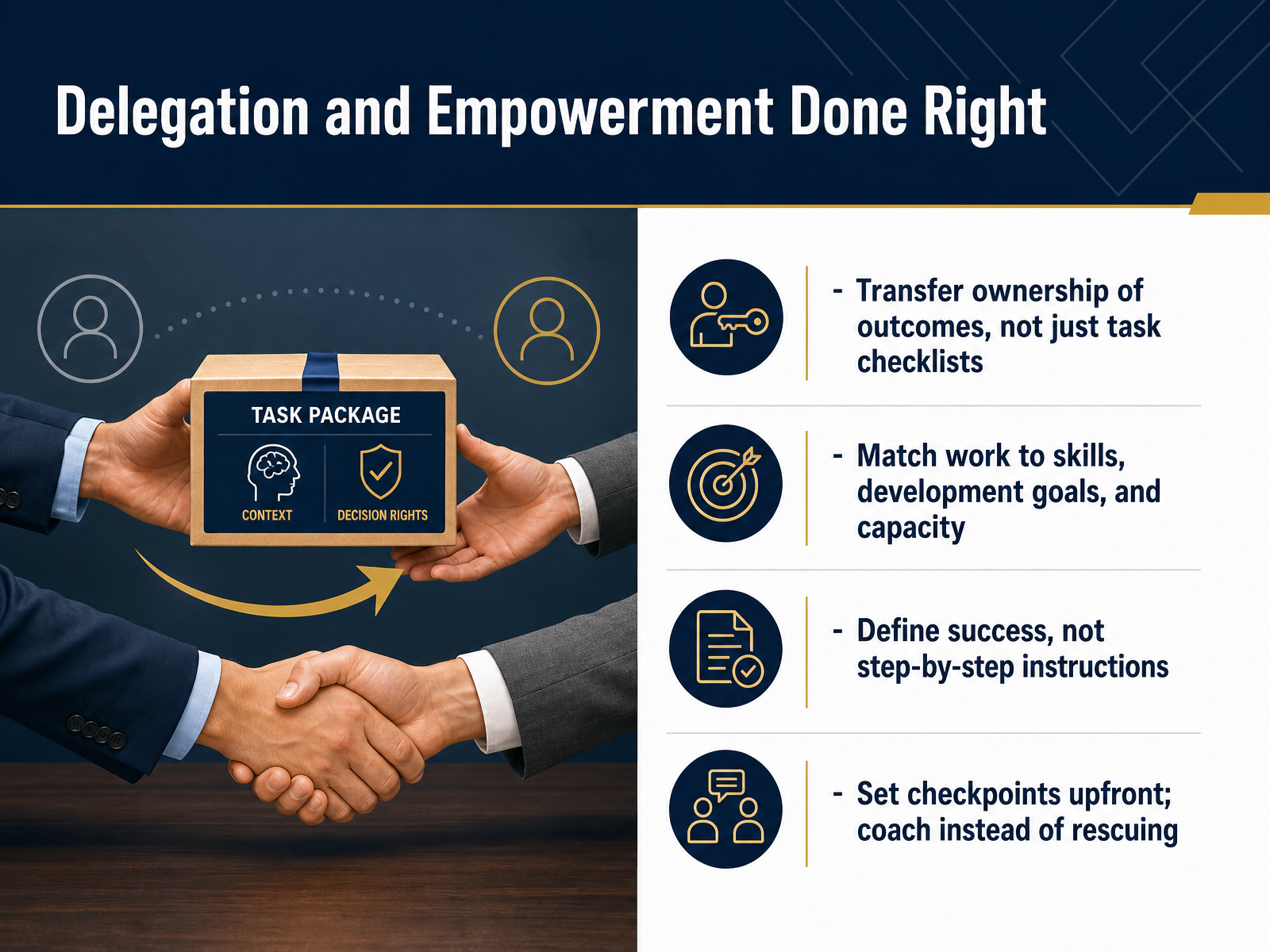
1 min - 10Delegation and Empowerment Done RightNow let's talk about delegation that actually builds your team, not just your to-do list. The shift starts with ownership. Transfer the outcome, not a checklist of steps. When you say, you now own the reporting process and here is the result we need, that develops people. But when you only assign tasks, you create dependency. Next, match the work to three things: current skills, development goals, and real capacity. Do not just hand everything to your strongest performer. That burns them out and blocks everyone else from growing. Then define success clearly. Tell them what good looks like, the deadline, and the metrics. But resist the urge to script every move. Your way is not the only way, and letting people find their own path builds confidence. Finally, set checkpoints upfront. This is not hovering. Agree on when you will review progress, and when they hit a problem, coach them. Ask what options they see, what they recommend, what support they need. Do not rescue. That is how reverse delegation happens. In short, delegate the outcome, give real authority, and coach through challenges. Up next, we will tackle conflict resolution and difficult conversations.
 1 min
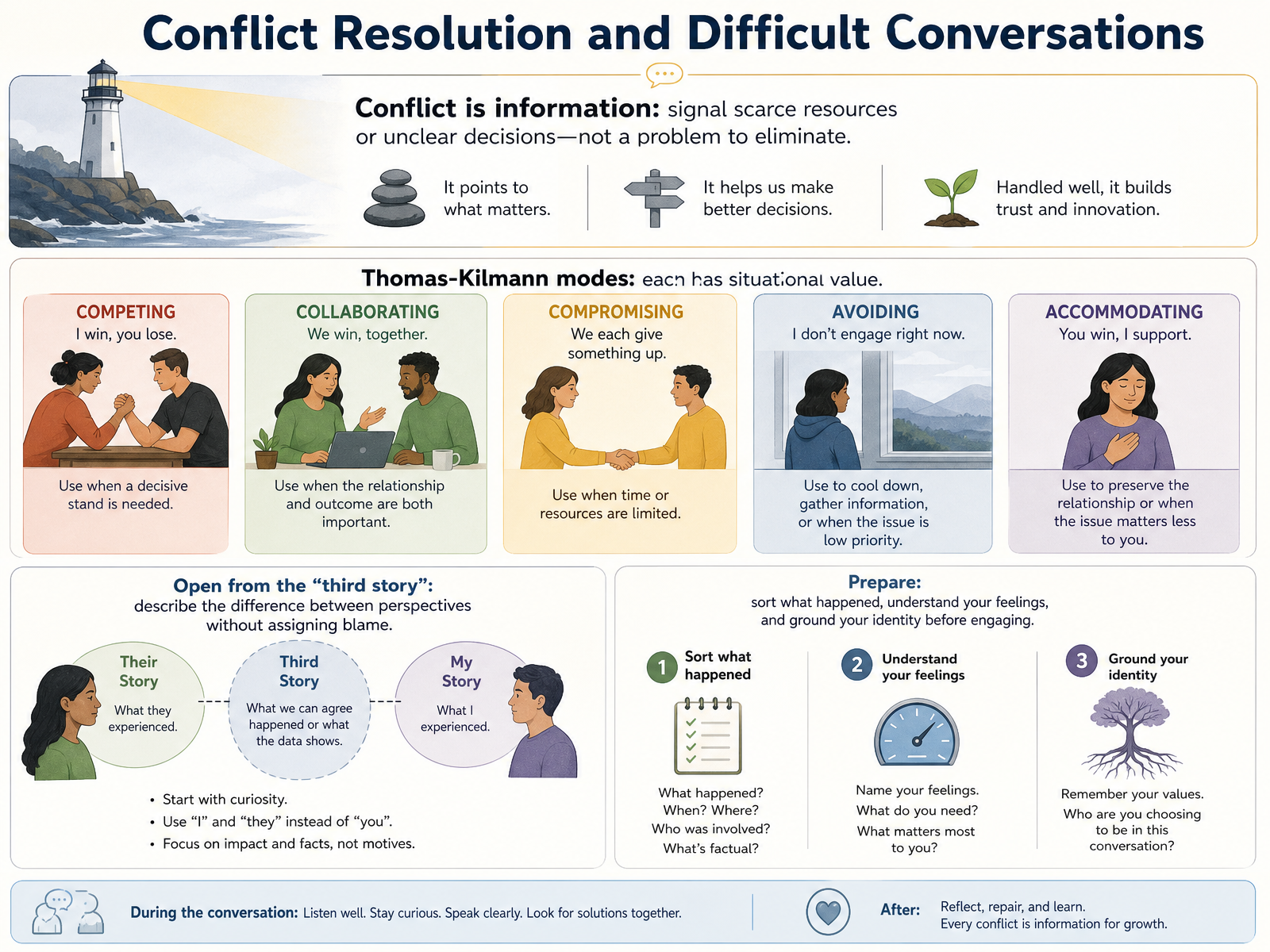
1 min - 11Conflict Resolution and Difficult ConversationsNow let's talk about conflict and difficult conversations. Here's a reframe that can change how you lead. Conflict isn't a problem to eliminate. It's information. It usually signals scarce resources, unclear decisions, or competing priorities. So instead of rushing to make it go away, slow down and read what it's telling you. The Thomas Kilmann model gives you five practical modes. Competing is for fast, decisive calls. Collaborating is for high stakes issues where you need buy in. Compromising keeps work moving. Avoiding buys time, and accommodating preserves the relationship. None of these is wrong. The skill is choosing the right one for the situation. When you do raise a tough issue, open from what's called the third story. Describe the gap between perspectives without blame. For example, you might say, we seem to have different expectations about deadlines. And before you even walk in, prepare. Sort out what happened, name your own feelings, and check how the issue might be threatening your sense of identity. That preparation keeps you steady. Up next, we'll look at leading through change and uncertainty.
 2 min
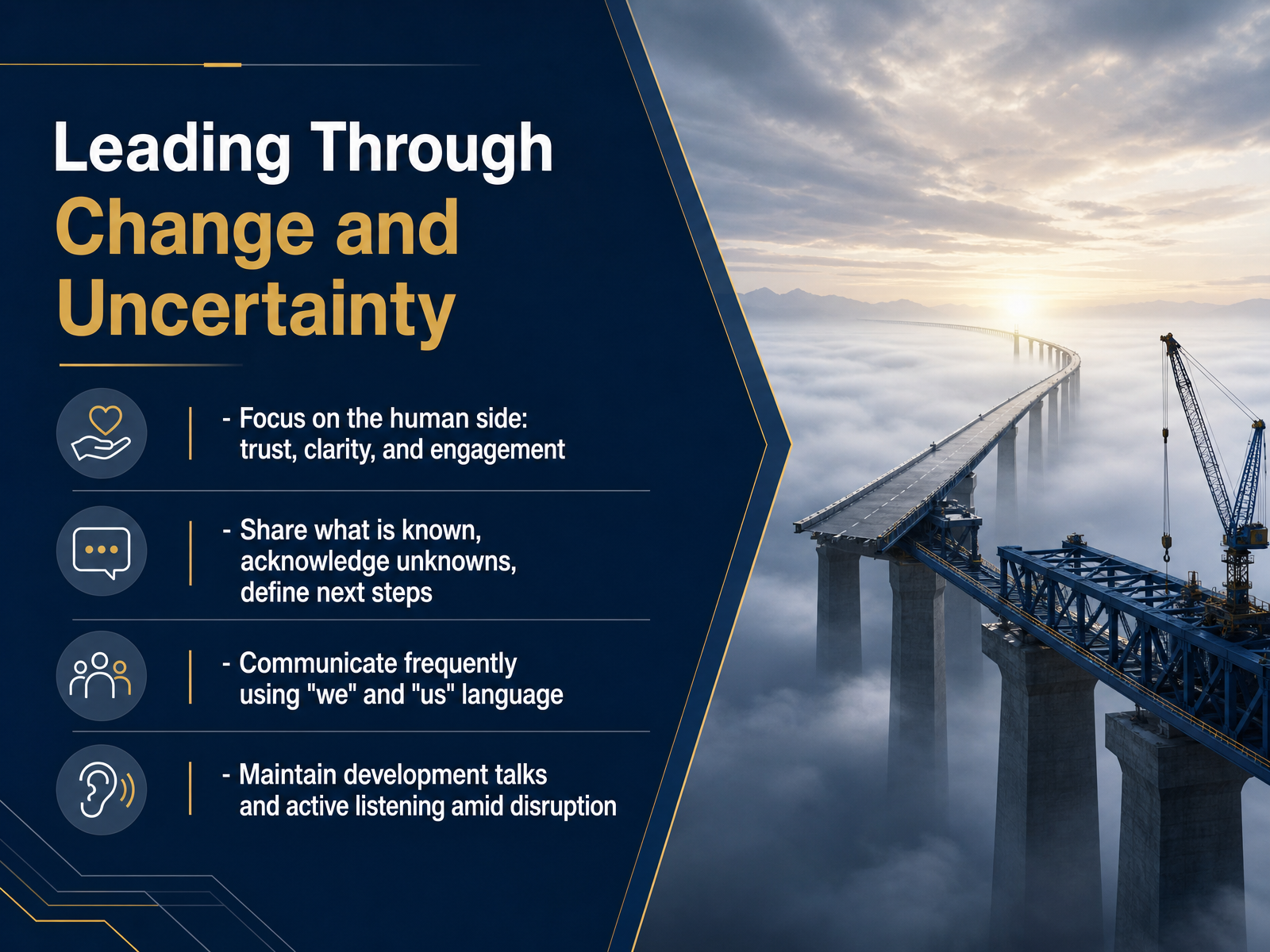
2 min - 12Leading Through Change and UncertaintyWhen things are shifting, your team's eyes are on you. The process matters, but your real job is the human side. Trust, clarity, engagement. Those are your anchors. Start by being straight about what you know. What you still do not know, and what the next step actually is. Silence gets filled with rumors, so communicate often. Watch your language too. Say we and us, not you all and them. It is a small shift that builds a sense of shared safety. And do not let the one on ones slip. In the middle of disruption, people still need to know their growth matters. Listen more than you talk. Ask how they are doing with the change, and actually sit with the answer. You do not need every answer. You just need to be real, present, and consistent. That is what turns uncertainty into something a team can move through. Up next, we will look at how you can assess your own leadership skills to see where to grow next.
 1 min
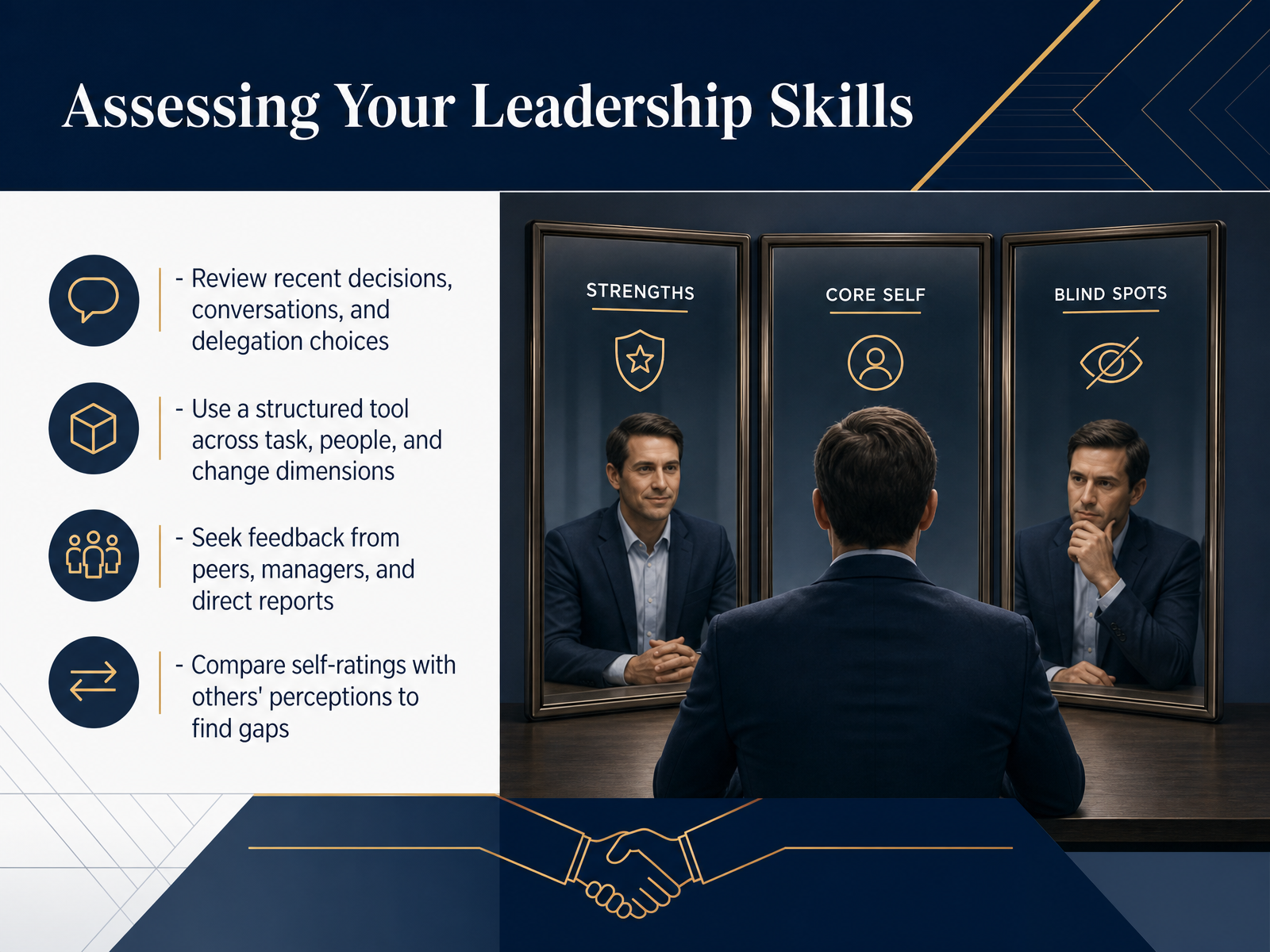
1 min - 13Assessing Your Leadership SkillsLet's bring this down to the practical level and look at how you actually assess your own leadership. First, take a few minutes to review recent moments. Think back on a key decision you made, a difficult conversation you had, or a task you chose to delegate. What did you do well, and what would you do differently next time? To go deeper, use a structured tool. A good self-assessment should look at three dimensions: how you manage tasks, how you manage people, and how you lead through change. This keeps you from just focusing on your favorite area. Next, seek feedback from the people around you. Ask your peers, your manager, and especially your direct reports for their perspective. The most valuable insight comes from comparing your self-rating with what others actually see. That gap between your intention and your impact is exactly where your real growth opportunity lives. Remember, the goal is not a perfect score. It is a clear, honest baseline. In the next section, we will take that baseline and turn it into a concrete plan with the steps to build your personal leadership action plan.
 2 min
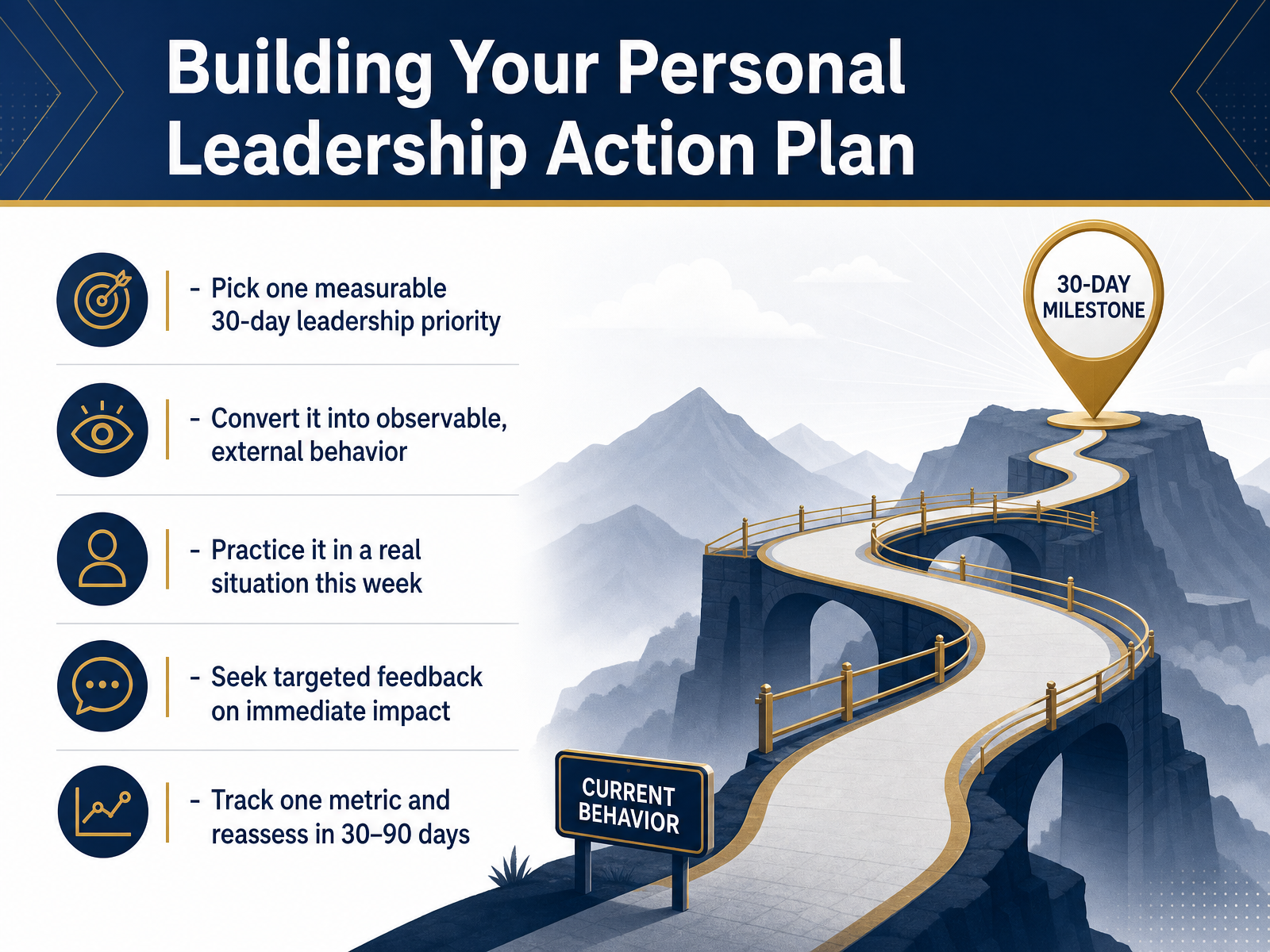
2 min - 14Building Your Personal Leadership Action PlanLet's put this into a personal action plan you can start now. First, pick one leadership priority that matters in your current role. Make it specific and measurable, not something broad like improve communication. Maybe you want to delegate more or give clearer project handoffs. Then turn that priority into a behavior someone could actually see. For example, instead of saying communicate better, commit to summarizing action items at the end of every team meeting. This week, practice it in a real situation. Don't wait for the perfect moment. Then ask one person for specific feedback. A simple question like, what's one thing I did that helped or got in the way, gives you useful signal without a formal review. Track one simple metric, like the number of times you followed through or a short weekly check-in note. Finally, set a date to reassess in thirty to ninety days. Look back, compare what changed, and pick your next focus. That's the whole framework for building leadership skill through small, deliberate practice. Thank you for working through this with me. Pick your one priority this week, act on it, and let the feedback guide your next step.
 2 min
2 min
Take the deck with you
Download this course as a file — free, no sign-up needed.
- PDF handoutEvery slide page, ready to print or share.15 pages · 3.9 MBDownload
- Narrated PowerPointThe deck that presents itself — every slide carries the digital human's narration video.15 pages · 17.5 MBDownload
- PowerPoint slidesThe full deck as a .pptx — open it in PowerPoint, Keynote, or Google Slides.15 pages · 3.8 MBDownload
Free to use in your own training — please keep the PersonWise credit page at the end.
Have your own deck? Turn it into a course
Sources consulted
Web sources consulted while building this course.
- Skills Approach — us2.sagepub.com
- Leadership in Business: Definition, Key Components, and Examples — investopedia.com
- Leadership Skills: 7 Fundamental Skills & How to Develop Them | AMA — amanet.org
- Individuals as Leaders — uk.sagepub.com
- LEADERSHIP SKILLS definition and meaning | Collins English Dictionary — collinsdictionary.com
- Effectiveness of Broad and Specific Leadership Behaviors | John Glenn — glenn.osu.edu
- Leadership competencies for implementing planned organizational change — sciencedirect.com
- A Hierarchical Taxonomy of Leadership Behavior: Half Century of Behavior Research — arken.nmbu.no
- How to take employees on the digital transformation journey: An experimental study on complementary leadership behaviors in managing organizational change — ideas.repec.org
- Leadership for Change: Seven Enduring Skills for Experienced and Aspiring Change Leaders - Background Note - Faculty & Research - Harvard Business School — hbs.edu
- Situational Leadership for New Managers: A Practical Guide — firsttimemanagers.com
- The leadership model every modern manager should know - DOOR International — doortraining.com
- Situational Leadership Theory for Trust and Performance — blog.perceptyx.com
- Situational leadership: A guide to adapting to individual needs — businessmanagementdaily.com
- Situational Leadership Practices: Essential For Today's Leaders — forbes.com
- Emotional Intelligence in Leadership | DDI — ddi.com
- Emotional Intelligence for Managers: A Practical Management Skill | Corporate Coach Group — corporatecoachgroup.com
- Emotional Intelligence for Managers: A Guide | Article - Lattice — lattice.com
- Why emotional intelligence (or EQ) remains a core skill - CMI — managers.org.uk
- Emotional intelligence at work: 7 key skills for managers — execed.unil.ch