Product Management Roadmap Essentials
Begin
14 pages · ~28 min
Product Management Roadmap Essentials
This course helps product managers prioritize roadmap items, set milestones, and communicate plans effectively to stakeholders.
What you’ll learn
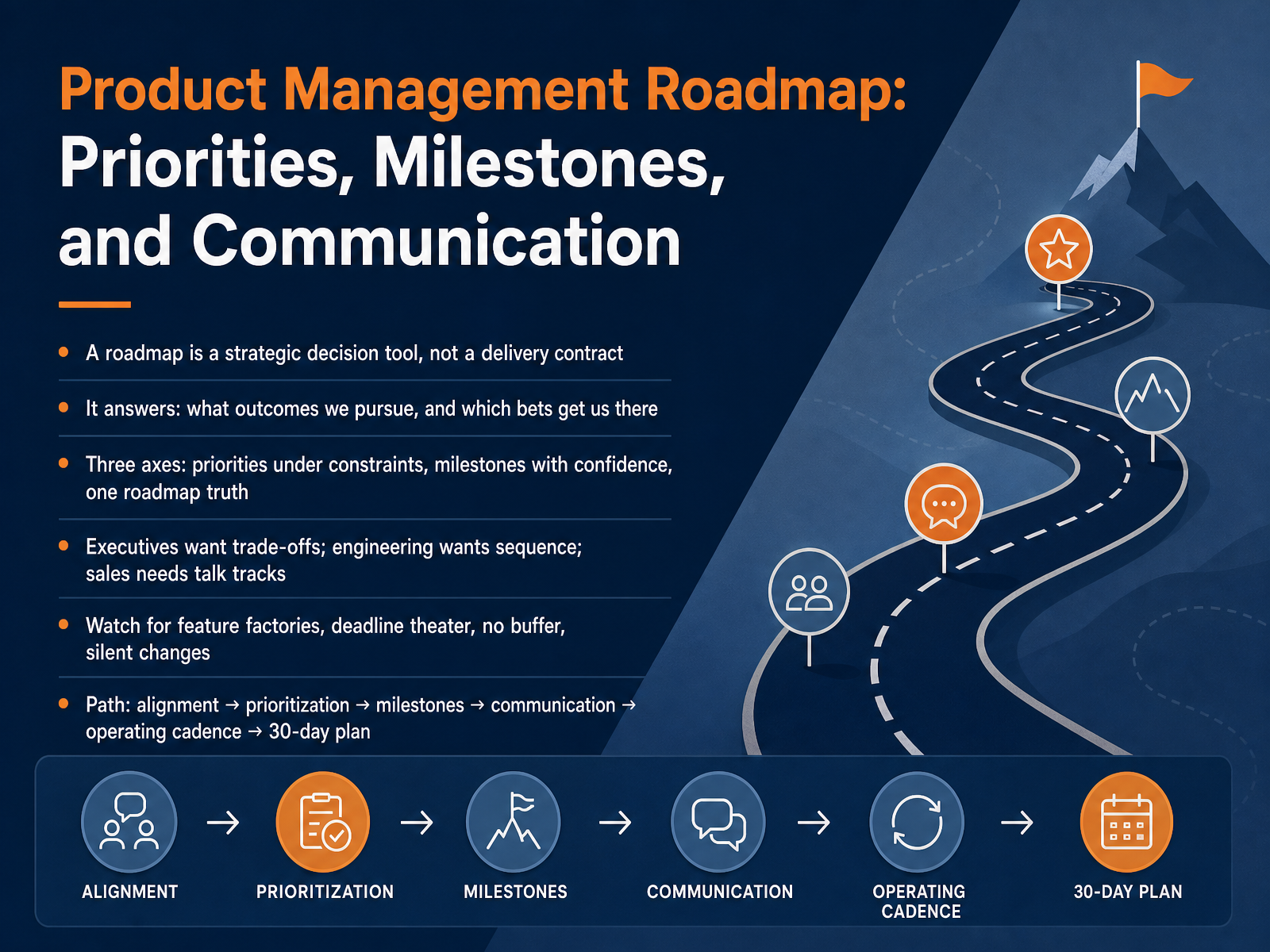
- 01Product Management Roadmap: Priorities, Milestones, and CommunicationWelcome. Over the next fourteen slides, we are going to work through how to build and communicate a product roadmap that actually holds up under scrutiny. Our focus is threefold: priorities under real constraints, milestones with honest confidence levels, and one shared roadmap truth across your stakeholders.
Start with the core distinction. A roadmap is a strategic decision tool, not a delivery contract. It answers two questions: what outcomes are we pursuing, and which bets get us there. Executives want trade-offs. Engineering wants sequence. Sales needs talk tracks they can repeat. One artifact has to serve all three without pretending to know exactly when everything ships.
We will also name the failure modes early: feature factories, deadline theater, zero buffer, and silent changes. Then we will walk a practical path, from alignment and prioritization, through milestones and communication, into an operating cadence and a thirty-day plan you can run.
Let us build that foundation now. Ground Rules: What a Roadmap Is and Is Not.senseandrespond.coroadmap.onemindbacklog.com+22 min
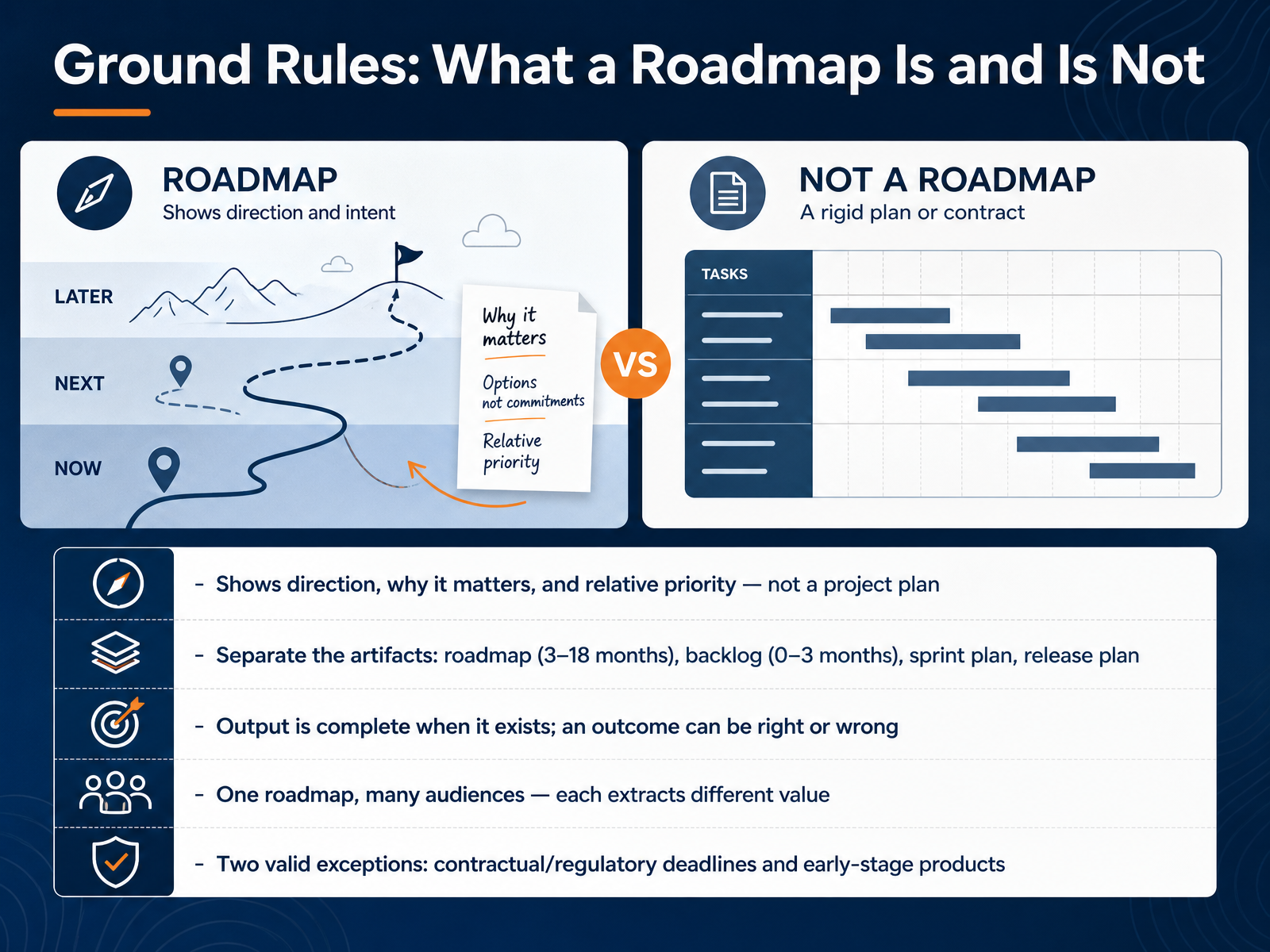
- 02Ground Rules: What a Roadmap Is and Is NotLet's set some ground rules. A roadmap shows direction, why it matters, and relative priority. It is not a project plan. Separate the artifacts clearly. The roadmap covers three to eighteen months. The backlog covers zero to three months. Sprint and release plans handle execution detail. Keep each one in its lane. Next, an output versus an outcome. An output is complete when it exists. An outcome can be right or wrong, because it names a behavior change with a measurement. Then, remember there is one roadmap but many audiences. Executives want strategic themes. Sales wants what they can discuss. Engineering wants dependencies. Each extracts different value from the same source. Finally, two valid exceptions: contractual or regulatory deadlines, and early-stage products, where learning velocity matters more than a metric. Treat these as trade-offs, not absolutes. Strategy to Roadmap: The Alignment Chain.
 senseandrespond.coroadmap.onemindbacklog.com+21 min
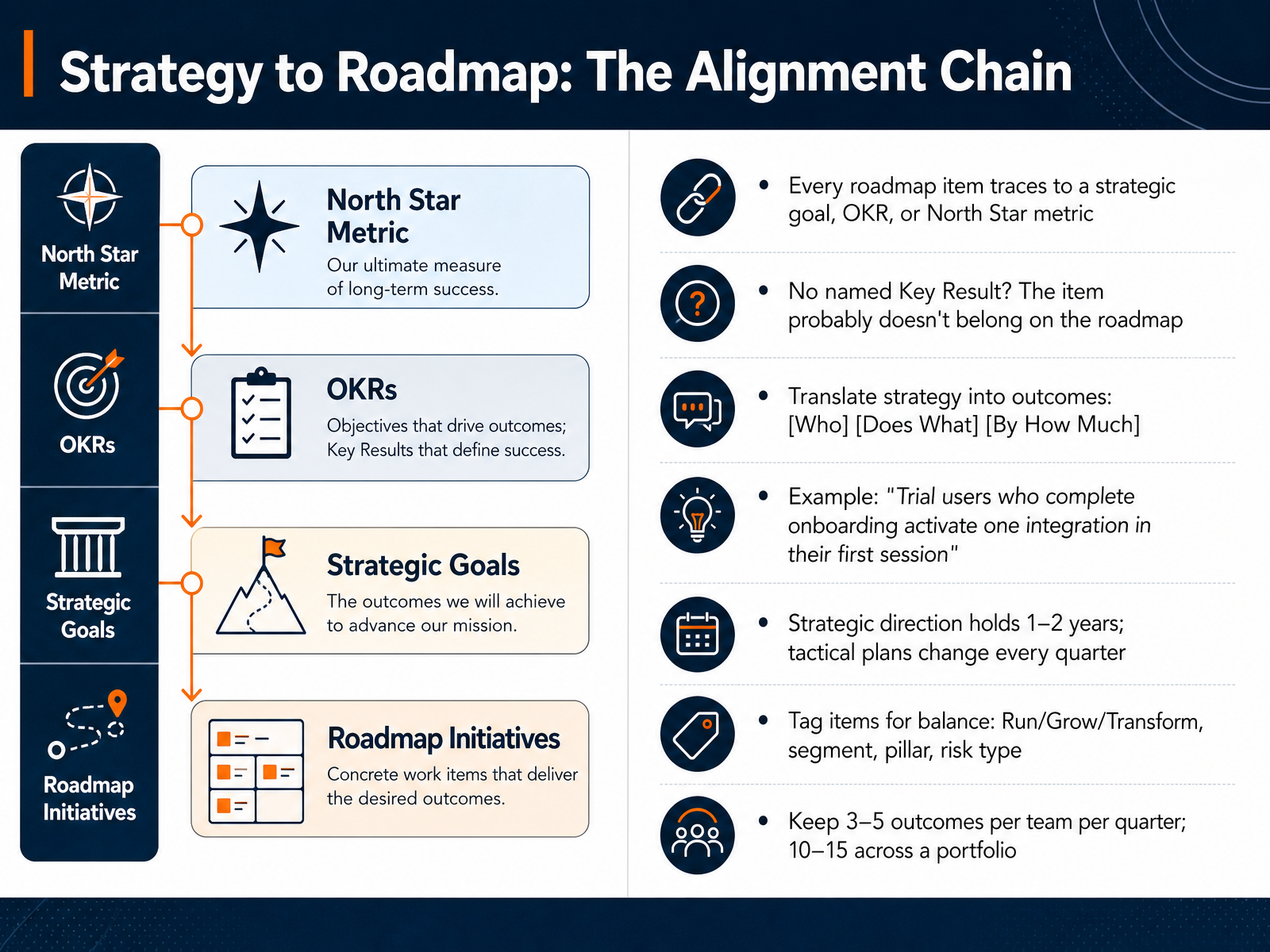
 - 03Strategy to Roadmap: The Alignment ChainLet's trace the chain from strategy to roadmap. The rule is simple: every roadmap item traces to a strategic goal, an O K R, or a North Star metric. If you cannot name the Key Result an item serves, that is a strong signal it does not belong on the roadmap. So translate strategy into outcomes using a fixed frame: who, does what, by how much. For example, trial users who complete onboarding activate one integration in their first session. That is a behavior you can measure, not a feature you can ship. Now, a distinction worth pausing on. Strategic direction holds for one to two years. Tactical plans change every quarter. Do not conflate the two. To keep the portfolio honest, tag each item for balance: Run, Grow, or Transform, plus segment, pillar, and risk type. Then cap the work. Keep three to five outcomes per team per quarter, and ten to fifteen across the portfolio. More than that, and you are spreading thin rather than committing. With that chain in place, let's look at how it shows up over time, in Horizons: Now, Next, Later and Confidence Horizons.
 senseandrespond.coroadmap.onemindbacklog.com+22 min
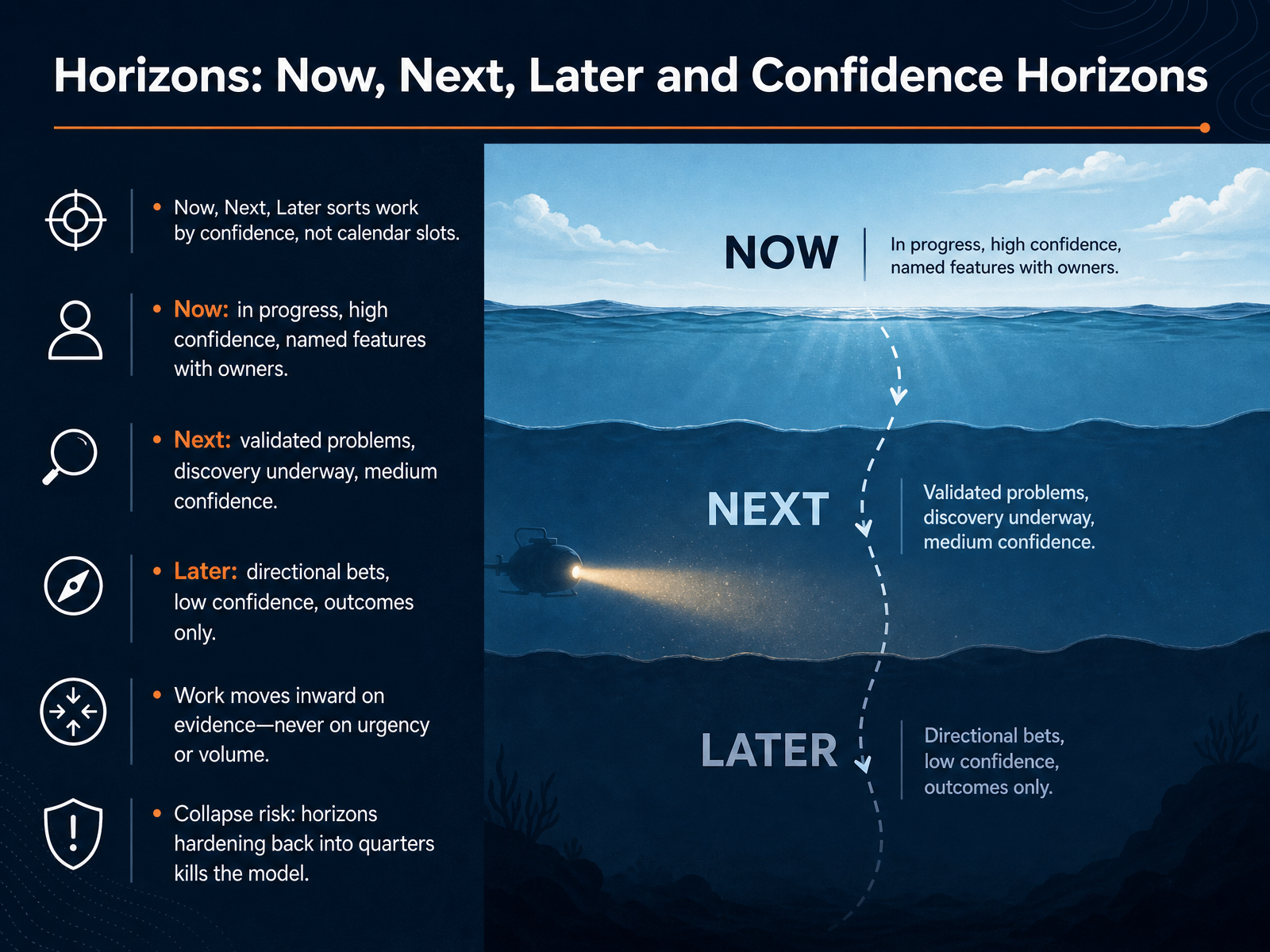
 - 04Horizons: Now, Next, Later and Confidence HorizonsLet's look at how the Now, Next, and Later format actually works. The key distinction is this. Now, Next, and Later are horizons of confidence, not calendar slots. If they ever harden back into quarters, the model collapses into a timeline with friendlier labels, and you lose the honesty it was designed to create.
Start with Now. Now means work in progress, high confidence, with named features and named owners. This is the only horizon where dates generally make sense, because the team understands the problem, has scoped the solution, and engineering has a real sense of the effort.
Next holds validated problems where discovery is underway. Confidence is medium. You know the problem is worth solving, but you have not settled on the solution yet. A team might know that clinician onboarding is driving early churn, and be testing three approaches without knowing which one wins.
Later holds directional bets at low confidence, stated as outcomes only. A fintech team might place expand into embedded lending here because it fits the strategy, while knowing almost nothing about how it plays out.
Here is the rule that keeps the model alive. Work moves inward on evidence, never on urgency or volume. Urgency tells you how badly someone wants something. The horizon tells you how much you actually know. When everything gets dragged into Now because it all feels urgent, you lose the capacity for bets. So keep asking what would have to be true for an item to move inward, and answer that with research, not a calendar.
Next, let us compare the prioritization frameworks and what each one actually answers.
 senseandrespond.coroadmap.onemindbacklog.com+22 min
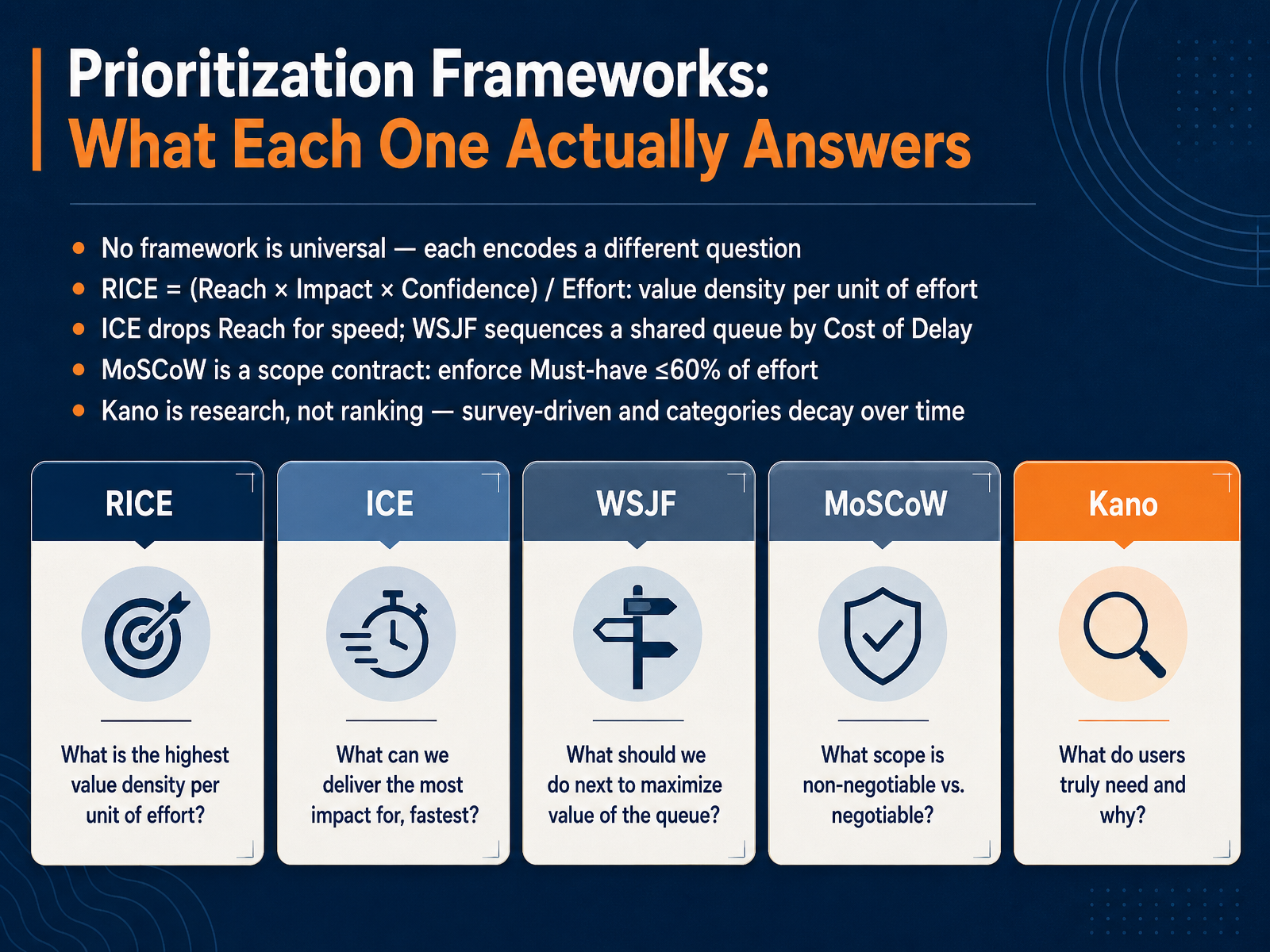
 - 05Prioritization Frameworks: What Each One Actually AnswersPrioritization frameworks are not competing answers to one question. Each one encodes a different question. So pick by the question you actually have. RICE asks about value density per unit of effort: Reach times Impact times Confidence, divided by Effort. ICE drops Reach so you can move faster, which works when reach is roughly uniform across candidates. WSJF divides Cost of Delay by job size, and it sequences a shared queue when several teams compete for the same capacity. MoSCoW is different again. It is a scope contract, not a ranking, so enforce a guardrail: Must-haves stay at or below sixty percent of effort, or the plan is undeliverable before work starts. And Kano is research, not ranking. It classifies how satisfaction responds to a feature, and those categories decay as the market matures, so labels need re-surveying. Prioritization Under Real Constraints.
 ideaplan.ioblog.lionet.vnideaplan.io+21 min
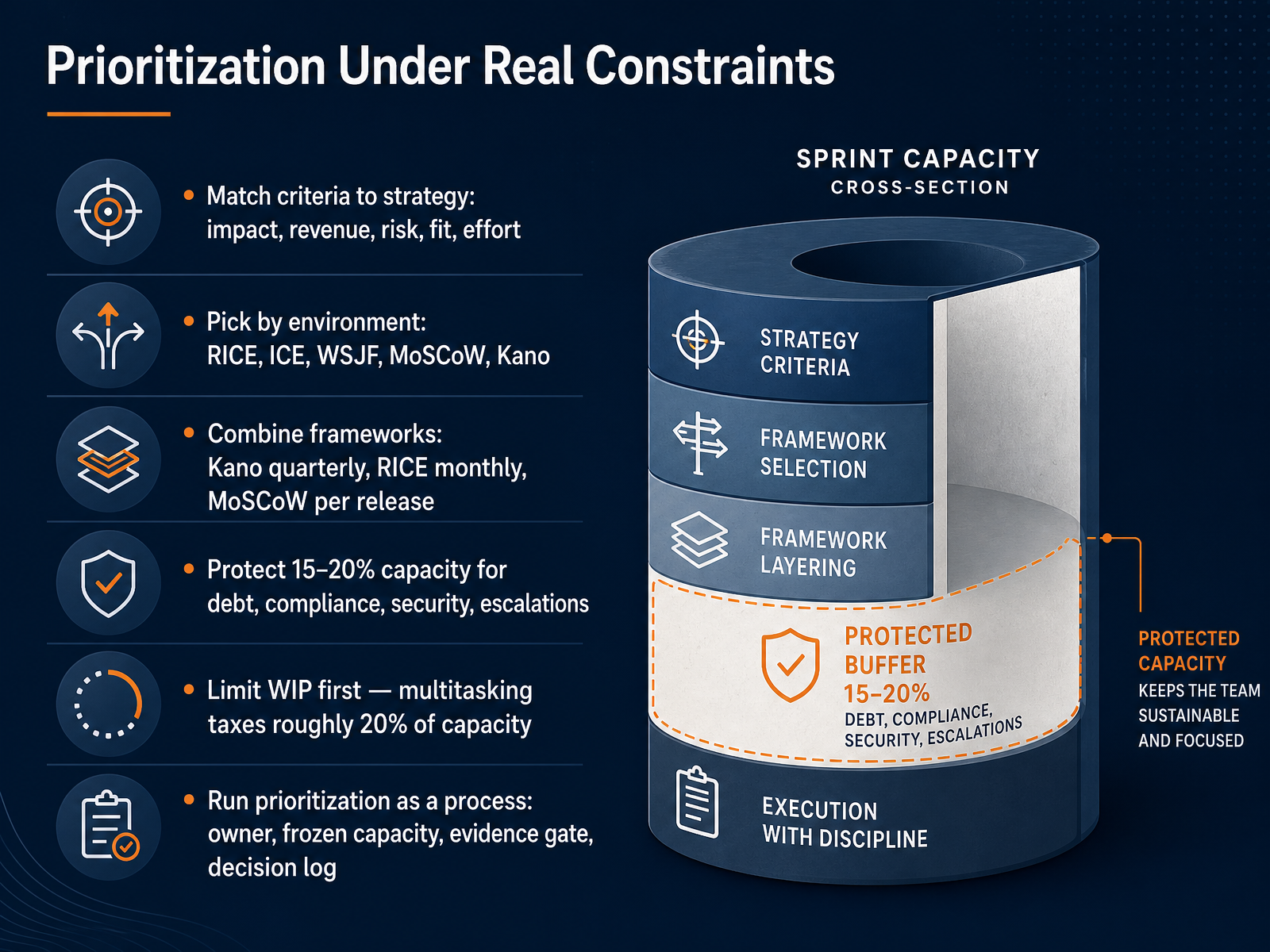
 - 06Prioritization Under Real ConstraintsLet's talk about prioritization under real constraints. First, match your criteria to strategy. Decide whether impact, revenue, risk, fit, or effort matters most, then score accordingly. Second, pick the framework that fits your environment. RICE suits teams with solid usage data. Weighted Shortest Job First fits shared queues where delay has measurable cost. MoSCoW works for release scope, and Kano is a research method, not a ranking tool. So combine them. Run Kano quarterly, RICE monthly, and MoSCoW per release. Third, protect fifteen to twenty percent of capacity for debt, compliance, security, and escalations. That buffer keeps commitments real. Fourth, limit work in progress before anything else, because multitasking taxes roughly twenty percent of capacity. Finally, treat prioritization as a process, with a named owner, frozen capacity, an evidence gate, and a decision log. When a stakeholder asks why their item slipped, you point to the trade-off, not to opinion. Next, we look at defining milestones that mean something.
 ideaplan.ioblog.lionet.vnideaplan.io+22 min
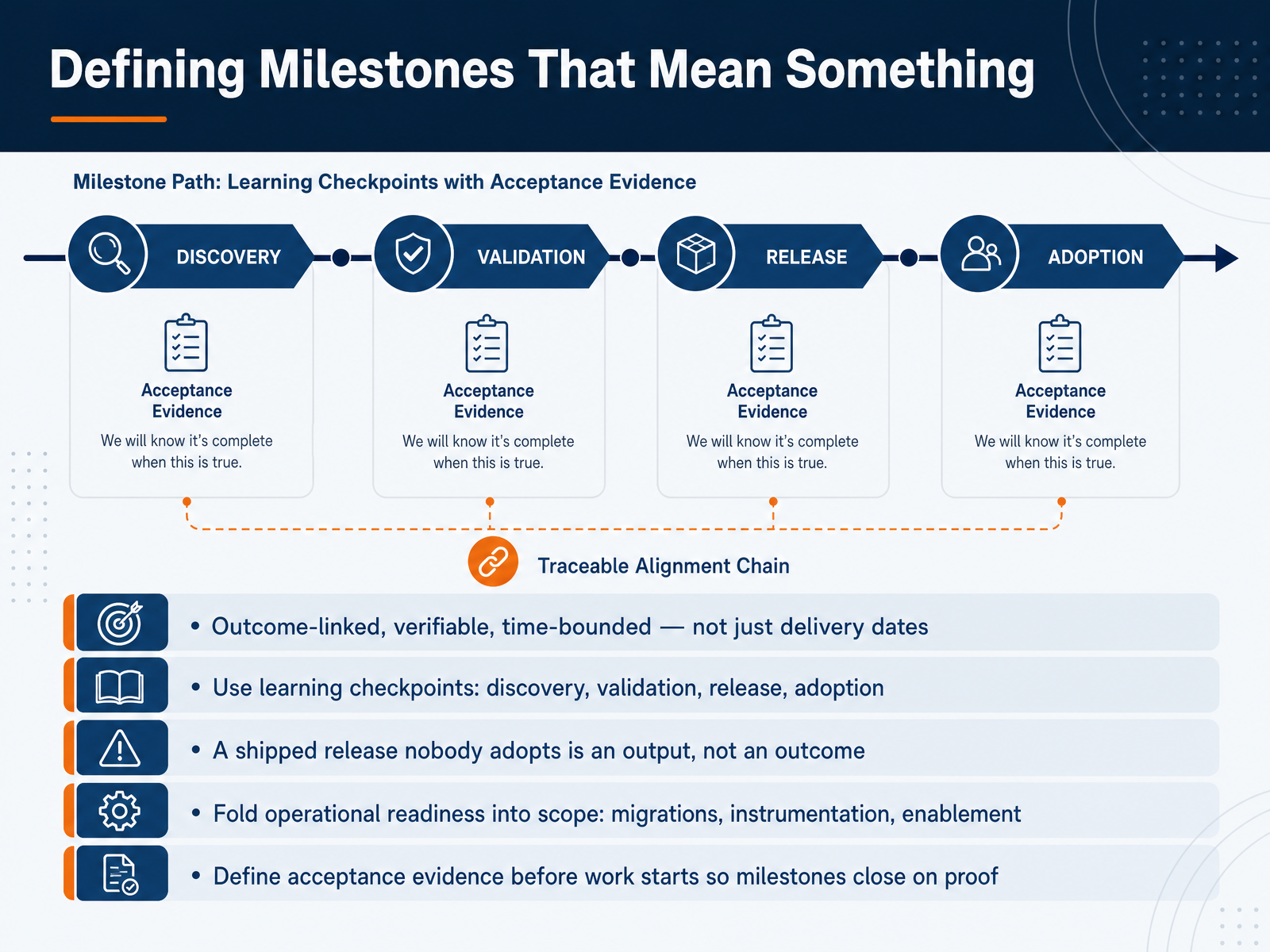
 - 07Defining Milestones That Mean SomethingLet's turn to milestones that actually mean something. A milestone is not a delivery date. It is an outcome-linked, verifiable, time-bounded checkpoint. So define each one with an action and a decision criterion: what changes, and what evidence proves it changed.
Use learning checkpoints across the lifecycle: discovery, validation, release, and adoption. Discovery confirms the problem is real. Validation confirms the solution works. Release confirms it shipped. Adoption confirms people use it. A shipped release nobody adopts is an output, not an outcome.
Fold operational readiness into scope from the start: migrations, instrumentation, and enablement. These carry real effort, and hiding them guarantees slippage.
Most importantly, define acceptance evidence before work starts, so milestones close on proof rather than optimism. That shifts milestone conversations from defending dates to presenting evidence. Next, we'll look at confidence levels and probabilistic forecasting.
 ideaplan.ioideaplan.iomindbacklog.com+22 min
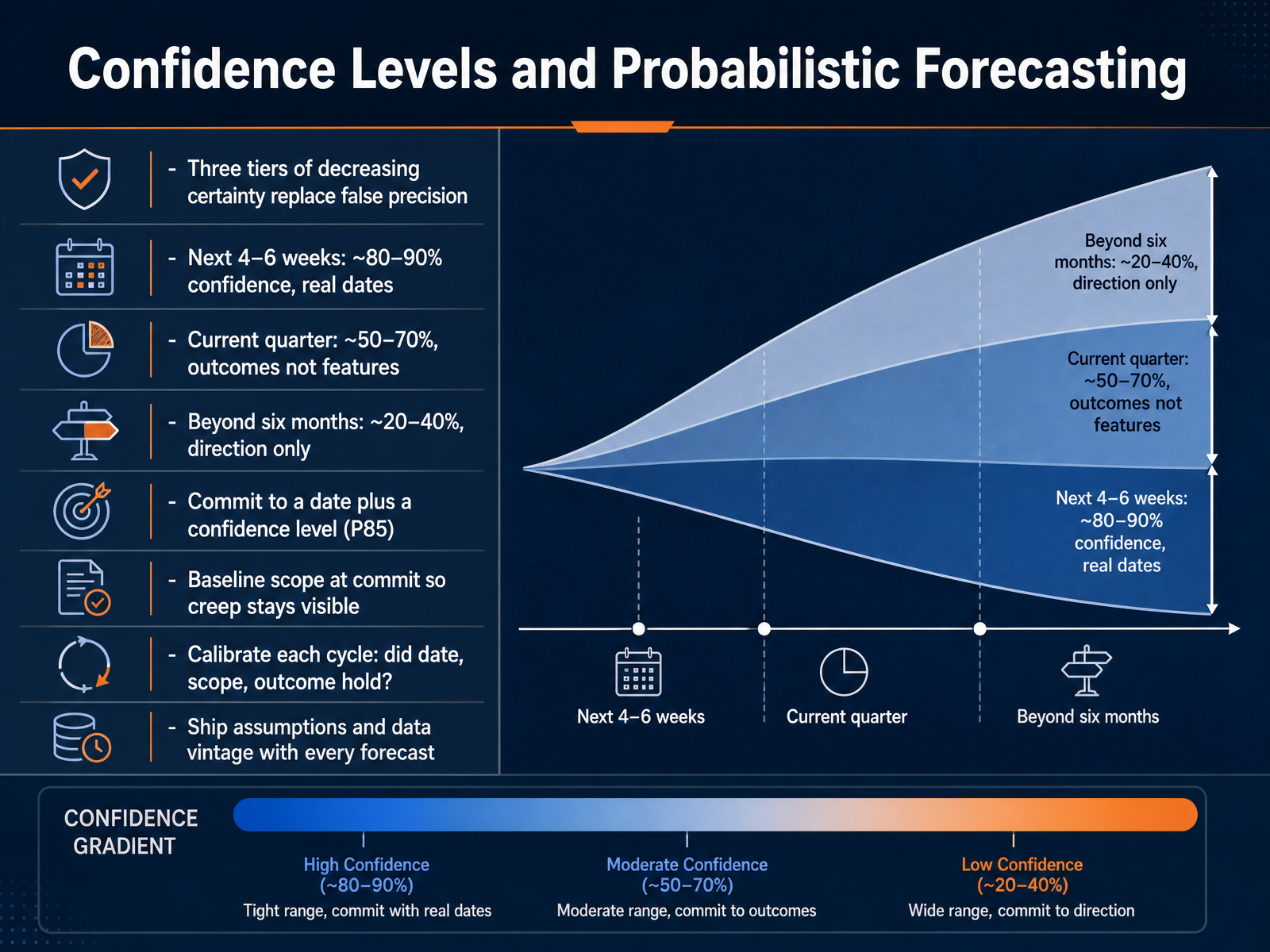
 - 08Confidence Levels and Probabilistic ForecastingNow, let's talk about how to set confidence levels and forecast probabilistically. Instead of false precision, use three tiers of decreasing certainty. In the next four to six weeks, you can hold roughly eighty to ninety percent confidence, and real dates make sense. For the current quarter, confidence drops to about fifty to seventy percent. Here, commit to outcomes, not features. Beyond six months, you are around twenty to forty percent. Communicate direction only. When you do commit to a date, pair it with a confidence level, like the eighty-fifth percentile. That means an eighty-five percent chance of hitting it. Baseline your scope at commit time, so any additions show up as visible creep rather than quiet erosion. Then calibrate each cycle. Ask: did the date hold, did the scope hold, did the outcome land? Finally, ship your assumptions and data vintage with every forecast, so stakeholders can see what the numbers rest on. Next, we look at milestone theater and the anti-patterns to retire.
 prodpad.comdivim.iopluralsight.com+22 min
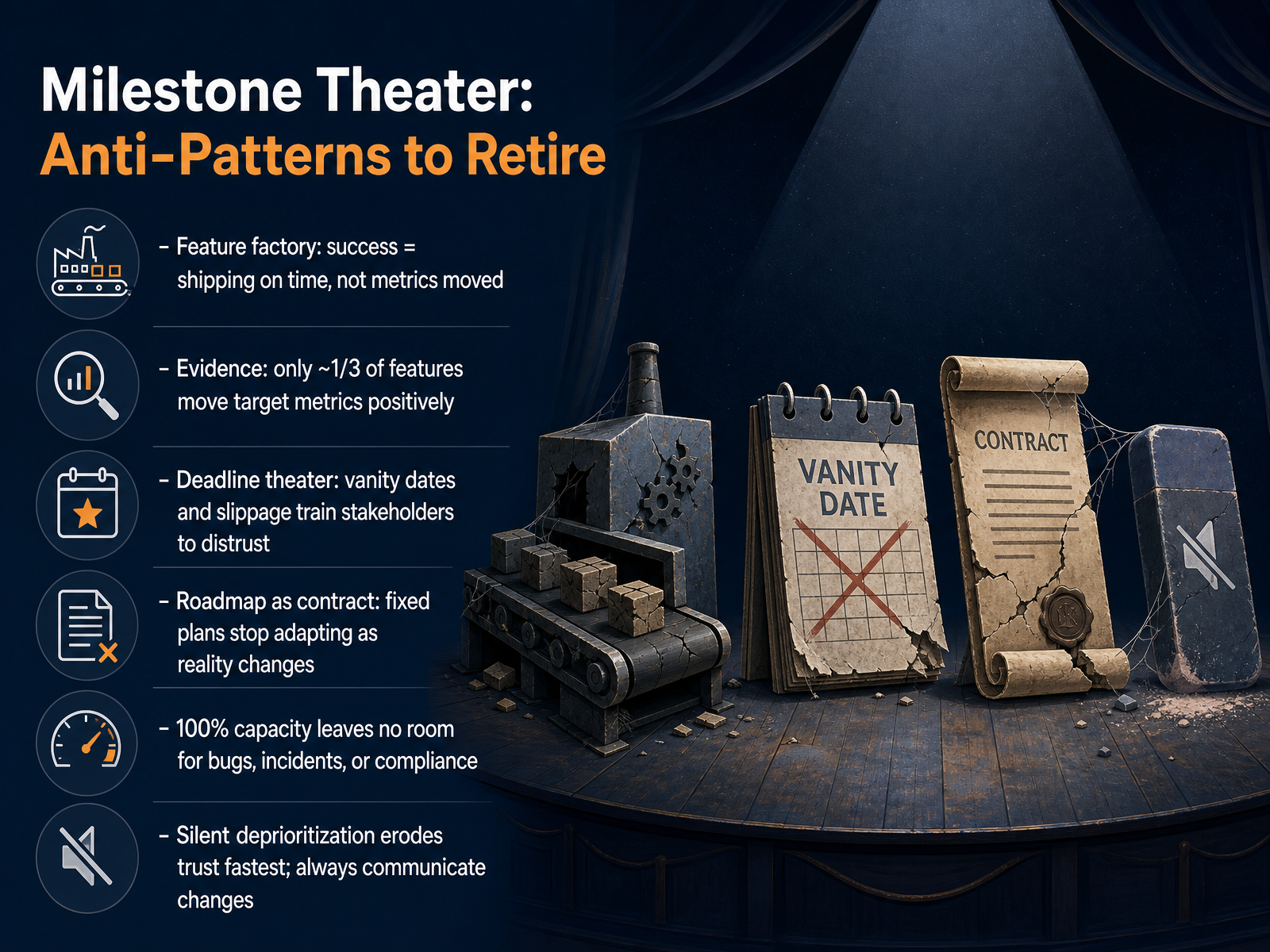
 - 09Milestone Theater: Anti-Patterns to RetireLet's look at the milestone habits worth retiring. First, the feature factory. Success becomes shipping on time rather than metrics moved. The evidence is sobering. Only about one third of features move their target metrics positively. Another third move them negatively, and the rest stay flat. So before a feature enters the build queue, write down the metric you expect it to move. If you cannot write that sentence, it is not ready to build. Next, deadline theater. Vanity dates and repeated slippage train stakeholders to distrust every date you publish. Use quarter-level horizons and confidence labels for anything more than six weeks out. Third, treating the roadmap as a contract. A fixed plan stops adapting as reality changes. Frame it as your best current hypothesis, and say so out loud. Fourth, running at one hundred percent capacity. With no buffer, a single bug, incident, or compliance change breaks the quarter. Reserve fifteen to twenty percent for unplanned work. Finally, silent deprioritization. Quietly dropping or moving work erodes trust faster than any delay. Always communicate the change, the reason, and the trade-off. Next, we will cover managing dependencies, change, and replanning.
 roadmap.oneblog.logrocket.comideaplan.io+22 min
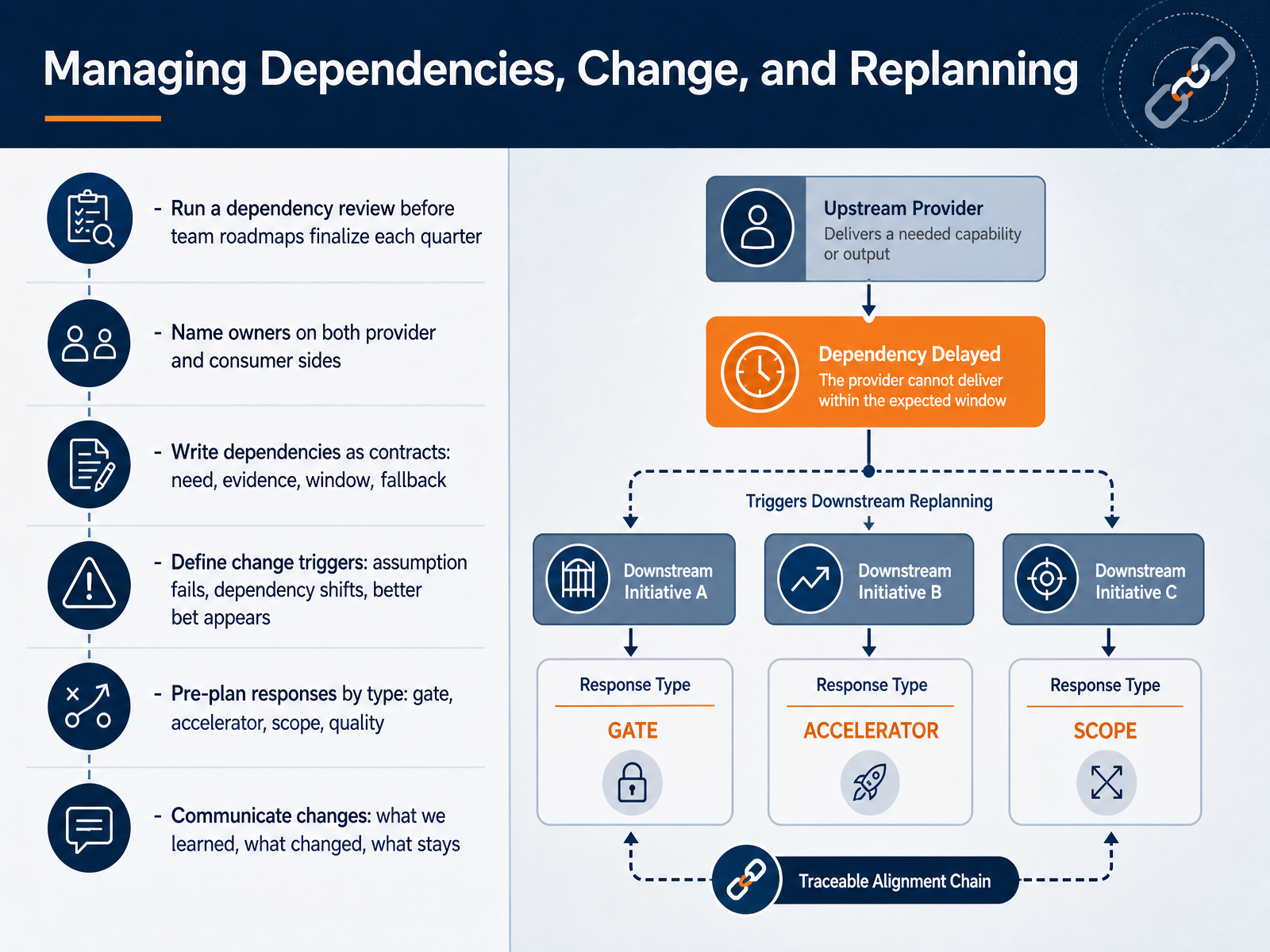
 - 10Managing Dependencies, Change, and ReplanningLet's talk about managing dependencies, change, and replanning. Most replanning cascades trace back to dependencies you spotted too late, so run a dependency review before team roadmaps finalize each quarter. Map what depends on shared services, regulatory timelines, or platform capabilities, and name an owner on both the provider and consumer sides. Write each dependency as a contract: the need, the readiness evidence, the window, and the fallback. That turns a vague arrow into a real agreement. Next, define your change triggers. Common ones are an assumption failing, a dependency shifting, or a better bet appearing. Decide in advance how you'll respond by dependency type: a gate dependency shifts the timeline, an accelerator shifts the ramp, a scope change adjusts the target, and a quality issue adds a buffer. Then communicate clearly: what you learned, what changed, and what stays the same. Pre-planned responses keep you from scrambling mid-quarter. Next, we'll look at communicating one roadmap to many audiences.
 ideaplan.iocodazz.com2 min
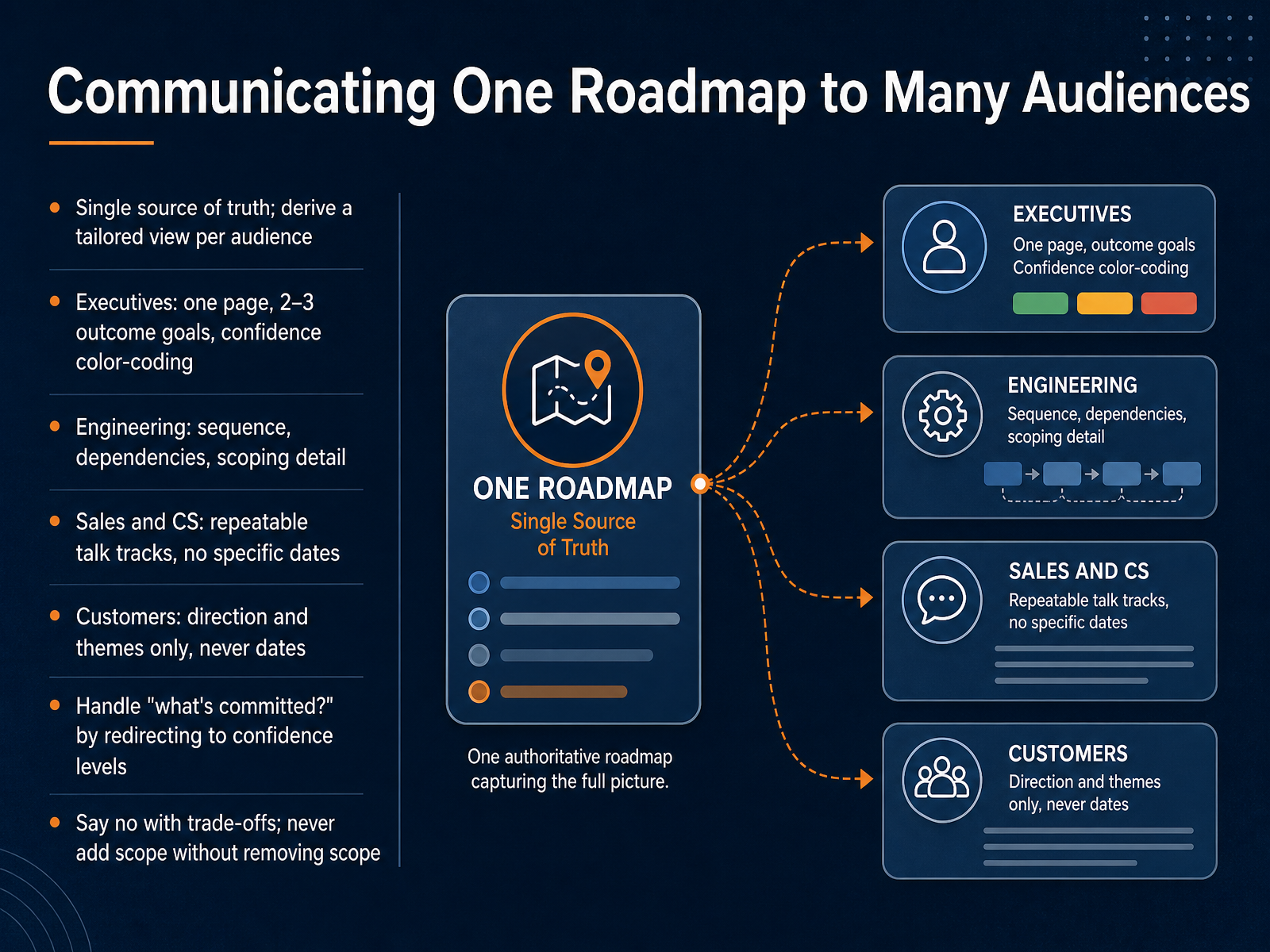
 - 11Communicating One Roadmap to Many AudiencesNow let's look at one roadmap, many audiences. Keep a single internal source of truth, then derive a tailored view from it. For executives, use one page with two or three outcome goals and confidence color-coding. Engineering needs sequence, dependencies, and scoping detail. Sales and customer success need repeatable talk tracks with no specific dates. Customers should see direction and themes only, never dates. When someone asks what's committed, redirect to confidence levels rather than confirming a date. And when you say no, say it with trade-offs. Never add scope without removing scope. Next, we'll cover the operating cadence: rituals, reviews, and metrics.
 ideaplan.iocodazz.comideaplan.io+21 min
 - 12Operating Cadence: Rituals, Reviews, and MetricsNow let's turn to the operating cadence that keeps a roadmap alive: your rituals, reviews, and metrics.
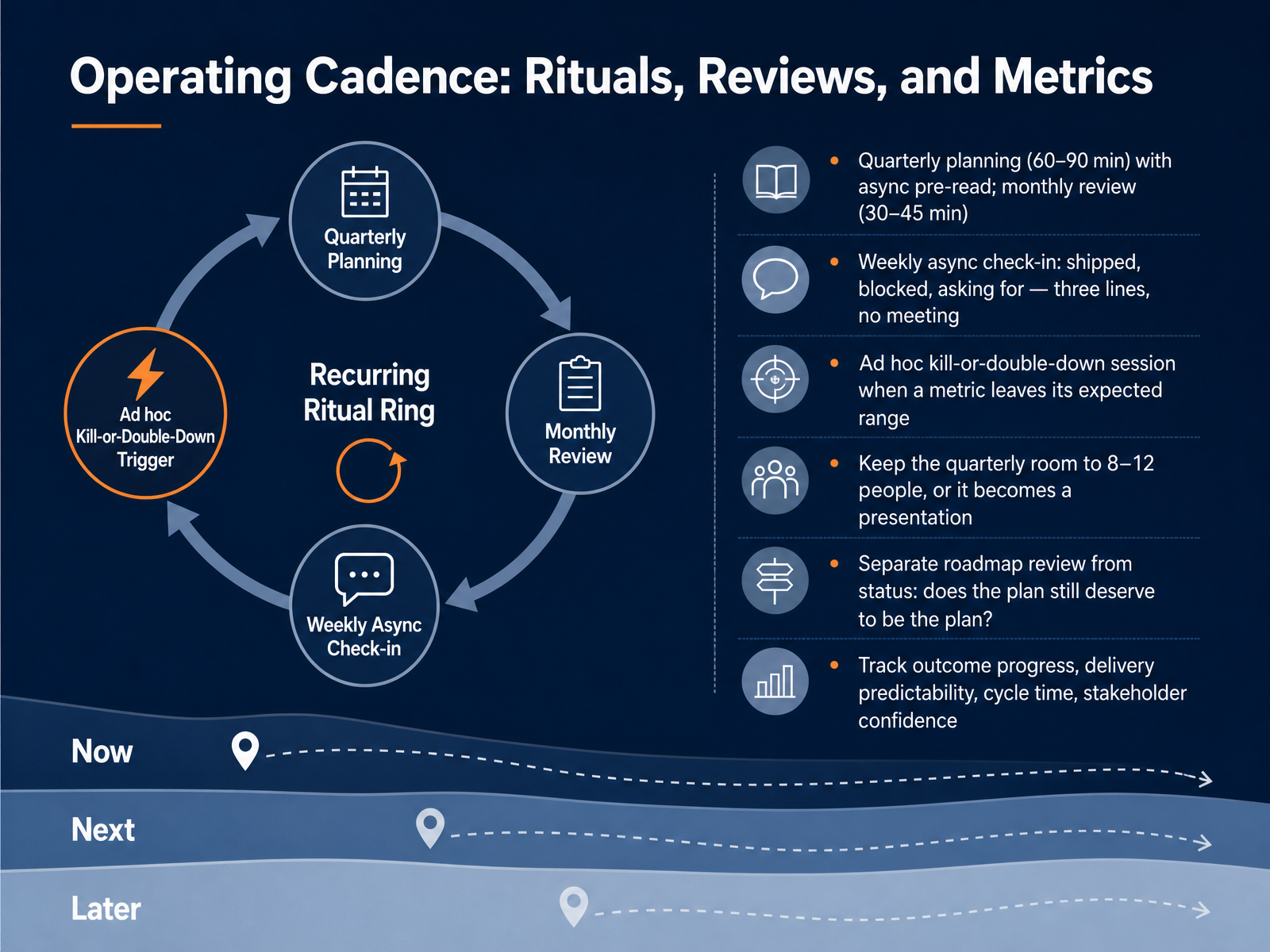
The backbone is quarterly planning. Block sixty to ninety minutes and send an async pre-read forty-eight hours ahead. Follow it with a monthly review of thirty to forty-five minutes. Between those, run a weekly async check-in, just three lines per owner: shipped, blocked, and asking for. No meeting. And when a key metric leaves its expected range, call an ad hoc kill-or-double-down session. Treat that as a circuit breaker, not a recurring ritual.
One sizing note. Keep the quarterly room to eight to twelve people. Go larger and it turns into a presentation instead of a working session.
The key distinction: separate roadmap review from status. Status asks what shipped. A roadmap review asks whether the plan still deserves to be the plan.
Finally, track outcomes, not activity: outcome progress, delivery predictability, cycle time, and stakeholder confidence.
Next, we'll look at tools and artifacts without tool-driven strategy.
 codazz.comideaplan.ioideaplan.io+22 min
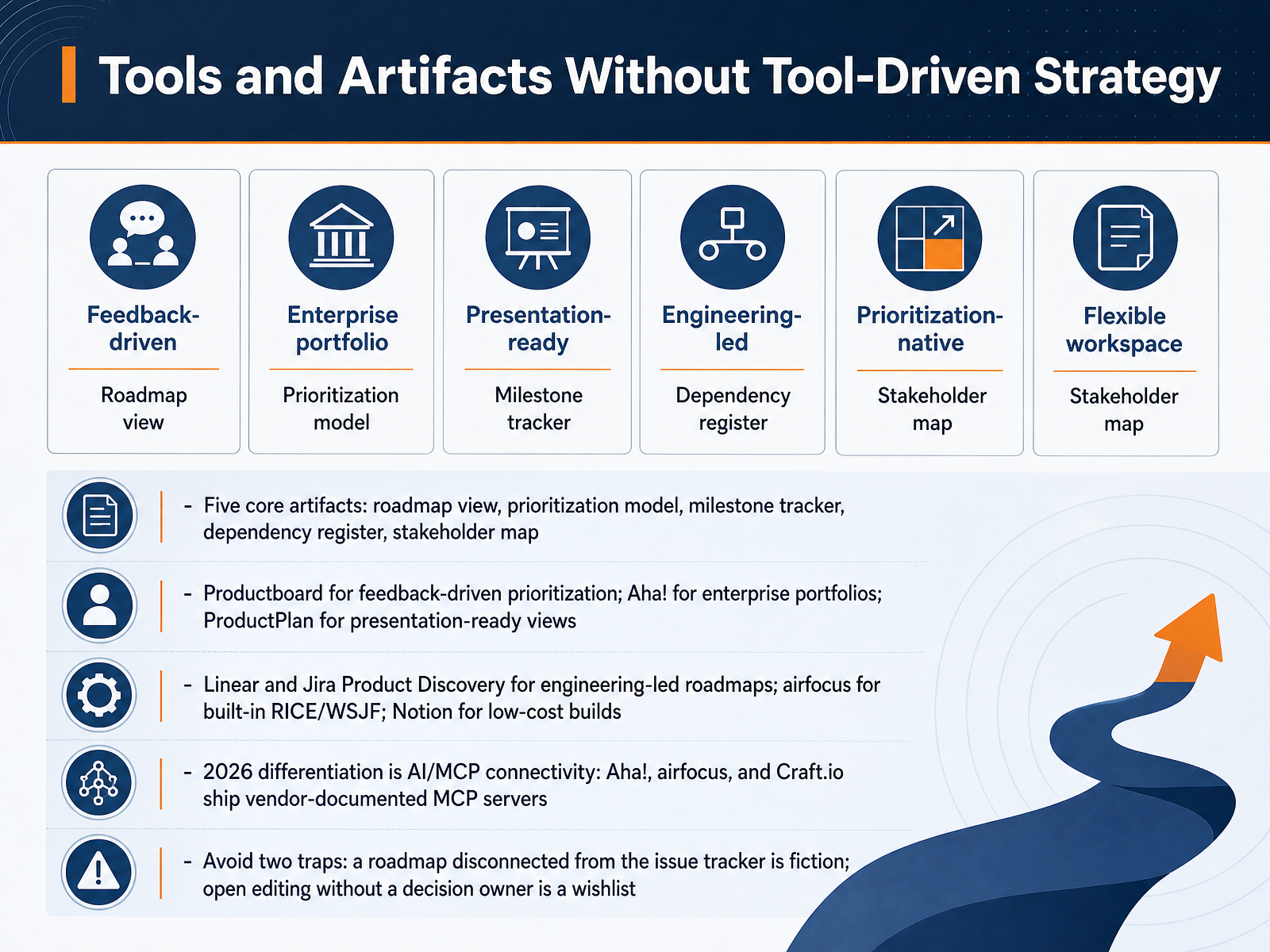
 - 13Tools and Artifacts Without Tool-Driven StrategyLet's talk about tools and artifacts, and how to keep tools from quietly becoming your strategy. Start with five core artifacts: a roadmap view, a prioritization model, a milestone tracker, a dependency register, and a stakeholder map. Those are the deliverables your tooling has to support. Tool choice follows workflow fit. Productboard suits feedback-driven prioritization. Aha! fits enterprise portfolios. ProductPlan is strongest for presentation-ready views. Linear and Jira Product Discovery work when the roadmap is genuinely engineering-led. airfocus brings built-in RICE and WSJF scoring, and Notion is a low-cost build. In 2026, the real differentiator is AI and MCP connectivity. Aha!, airfocus, and Craft.io ship vendor-documented MCP servers, with airfocus supporting bidirectional read and write access. Hold the rest to a proof of concept, not a promise. Two traps to avoid. First, a roadmap disconnected from the issue tracker is fiction. Second, open editing without a decision owner produces a wishlist. Next, we'll turn this into an action plan you can run.
 ideaplan.ioideaplan.iomindbacklog.com+22 min
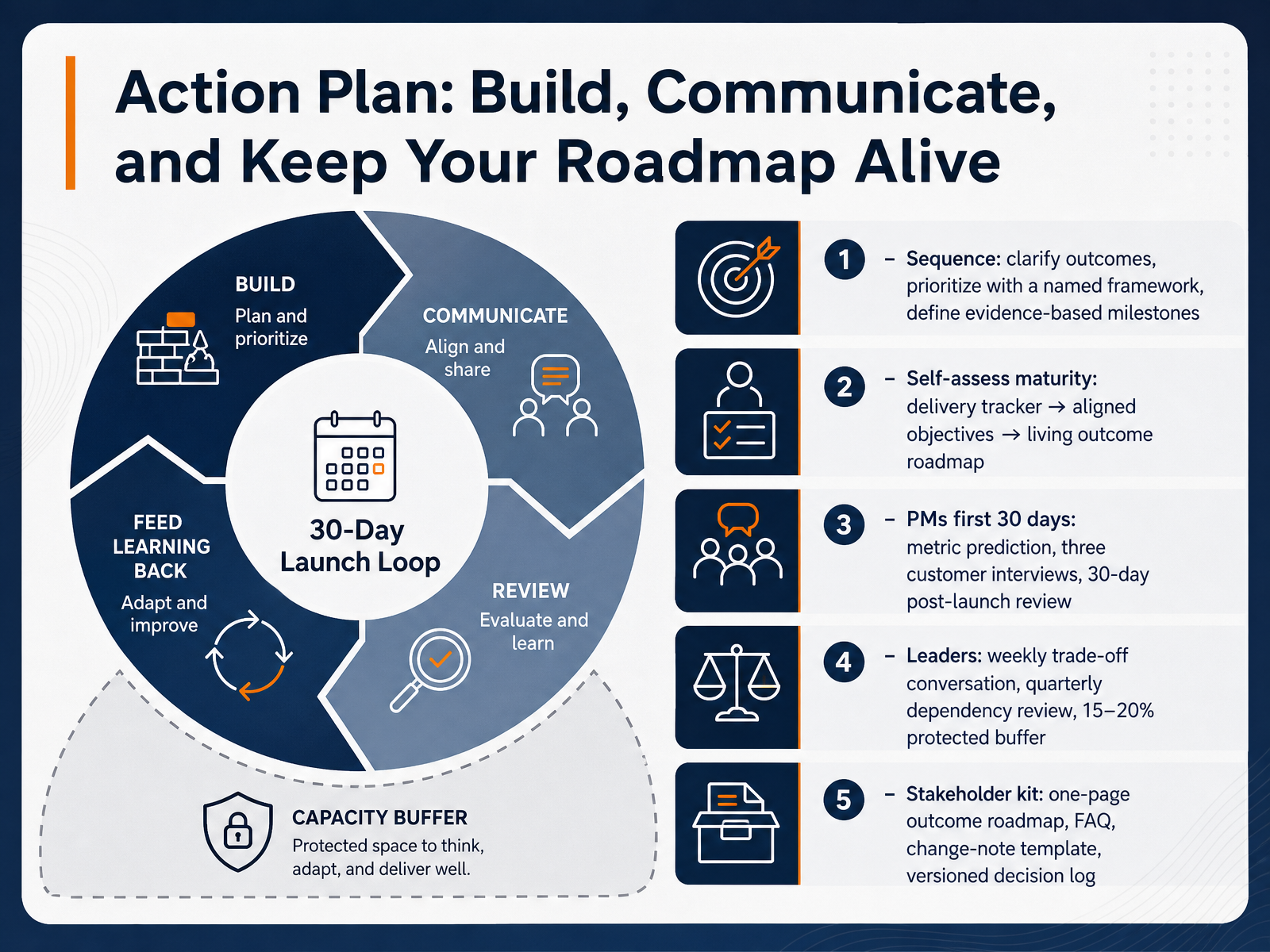
 - 14Action Plan: Build, Communicate, and Keep Your Roadmap AliveLet's close with a practical action plan. Sequence your work in three moves: clarify outcomes first, prioritize with a named framework, then define milestones that rest on evidence, not dates alone. Check your maturity honestly. Low maturity is a delivery tracker. Mid is aligned objectives. High is a living outcome roadmap you actually revise. For product managers, start with three habits in your first thirty days: write a metric prediction before building, run three customer interviews, and hold a thirty-day post-launch review. If you cannot write that prediction, the work is not ready.
Leaders, protect the system. Hold a weekly trade-off conversation instead of a status update, run a quarterly dependency review, and keep fifteen to twenty percent buffer protected rather than consumed.
Finally, build your stakeholder kit: a one-page outcome roadmap, a short FAQ, a change-note template, and a versioned decision log. Those four artifacts let you communicate uncertainty without defensiveness.
So remember the through line: outcomes before features, evidence before commitments, and a roadmap you keep alive. Thank you for working through this course, and good luck putting it into practice.
 senseandrespond.coroadmap.onemindbacklog.com+22 min
Take the deck with you
Download this course as a file — free, no sign-up needed.
- PDF handoutEvery slide page, ready to print or share.15 pages · 3.9 MBDownload
- Narrated PowerPointThe deck that presents itself — every slide carries the digital human's narration video.15 pages · 14.3 MBDownload
- PowerPoint slidesThe full deck as a .pptx — open it in PowerPoint, Keynote, or Google Slides.15 pages · 3.8 MBDownload
Free to use in your own training — please keep the PersonWise credit page at the end.
Have your own deck? Turn it into a course
Sources consulted
Web sources consulted while building this course.
- Moving from Dates to Deliverables: How to Build an Outcome-Based Roadmap — Sense & Respond Learning — senseandrespond.co
- Outcome-Based Roadmaps: A Practical Guide for Product Teams - RoadmapOne Blog — roadmap.one
- Product Roadmap Best Practices 2026: AI-Driven Planning — mindbacklog.com
- How to build an impactful outcome-based roadmap — dualoop.com
- Product Roadmap Guide 2026: Frameworks & Templates — codazz.com
- Product Prioritization Guide: Frameworks & Tools (2026) — ideaplan.io
- Prioritization frameworks — RICE, ICE, MoSCoW, Kano, WSJF (and where each one breaks) — Technical Notes — blog.lionet.vn
- How to Prioritize Features: 7 Frameworks Compared — ideaplan.io
- Product Prioritization Frameworks: The Complete Guide For 2026 — monday.com
- Product Prioritization Frameworks: 10 Methods Compared (2026) | Usero — usero.io
- 50 Product Roadmap Best Practices Every PM (2026) — ideaplan.io
- Product Roadmap Guide: Templates & Examples (2026) — ideaplan.io
- Strategic Roadmap Management: Navigating Product Growth in 2026 — getproductpeople.com
- What Are Confidence Horizons? | ProdPad Glossary — prodpad.com
- Probabilistic Release Planning: Manage to a Commitment — divim.io
- How to create realistic engineering roadmaps | Pluralsight — pluralsight.com
- Flexible Product Roadmaps That Survive Market Shifts — lucaligreci.com
- Probabilistic Forecasting for Projects: A Practical Guide to Confidence Interval Forecasting — corasystems.com
- Feature Factory to Outcome Team: Breaking the Pattern That's Killing Your Product - RoadmapOne Blog — roadmap.one
- The build trap: Dangers of a feature factory mindset - LogRocket Blog — blog.logrocket.com