Begin
14 pages · ~28 min
Sales Enablement Career Entry Workflow
This training guides aspiring and current professionals through a practical workflow for breaking into sales enablement, covering the key steps and skills needed to land the role.
A digital instructor presents all 14 pages. Hold “Ask” at any point and ask out loud — the answer comes from this course. No sign-up needed.
What you’ll learn
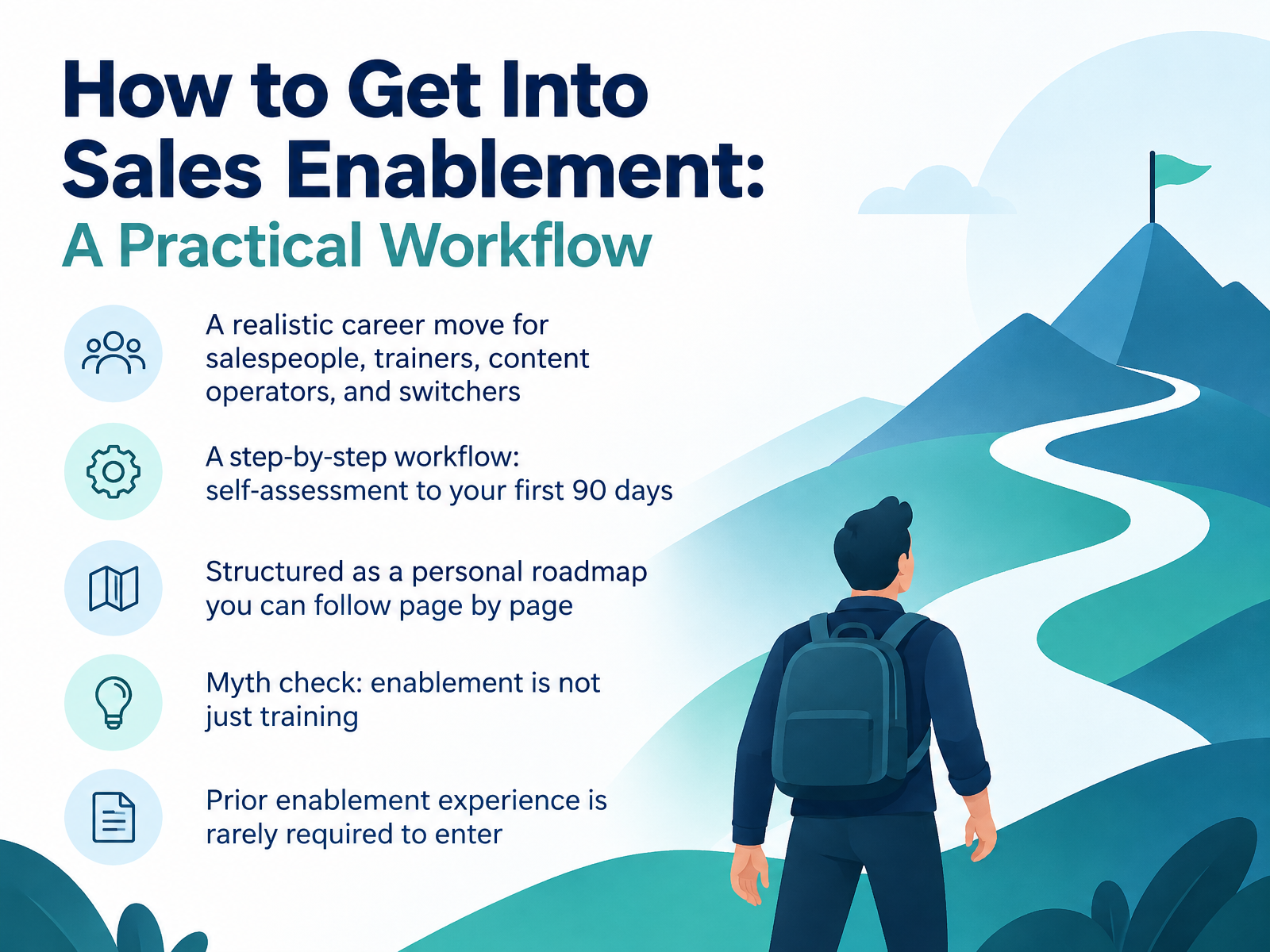
- 01How to Get Into Sales Enablement: A Practical WorkflowWelcome. If you're in sales, training, content operations, or planning a career switch, you've probably wondered how people actually get into sales enablement. Maybe the roles feel vague, or you're not sure your current skills count. They do. Over the next few slides, I'll walk you through a practical workflow, from honest self-assessment to your first ninety days on the job. You'll build a personal roadmap you can follow page by page. We'll also clear up a common myth. Enablement is not just training. It includes content, coaching, tools, and measurement. And here's the good news. Prior enablement experience is rarely required to enter. Most people come from roles like yours. Let's start by getting clear on what this field really is, and what it isn't.senablers.comspekit.comclimbtheladder.com+21 min
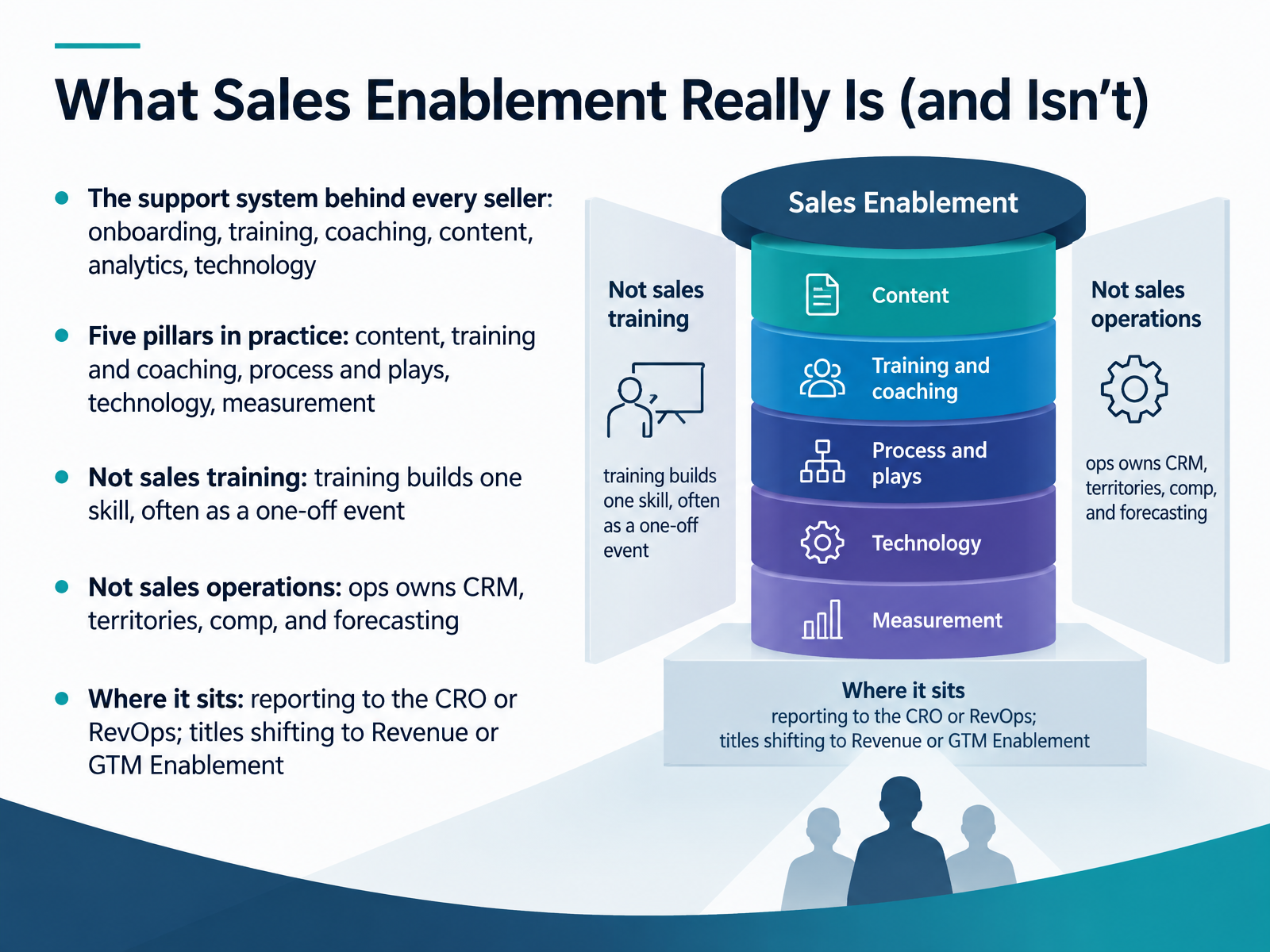
- 02What Sales Enablement Really Is (and Isn’t)Let's clear up what sales enablement actually is, because the title confuses a lot of people. Think of it as the support system behind every seller. It covers onboarding, training, coaching, content, analytics, and technology. In practice, that usually means five pillars: content, training and coaching, process and plays, technology, and measurement. Here's what it isn't. It isn't sales training. Training builds one skill, like running a discovery call, and it's often a one-off event. Enablement reinforces that skill and tracks whether it sticks. It also isn't sales operations. Ops owns the CRM, territories, comp, and forecasting. Ops keeps the machine running. Enablement makes the people running it better. And where does it sit? Most often it reports to the CRO or RevOps, and titles are shifting toward Revenue or GTM Enablement. So if a job description lists content, coaching, and tool adoption together, you're looking at enablement, not training. Next, we'll look at who enters the field and from where.
 pandadoc.comsalesforce.comtechtarget.com+22 min
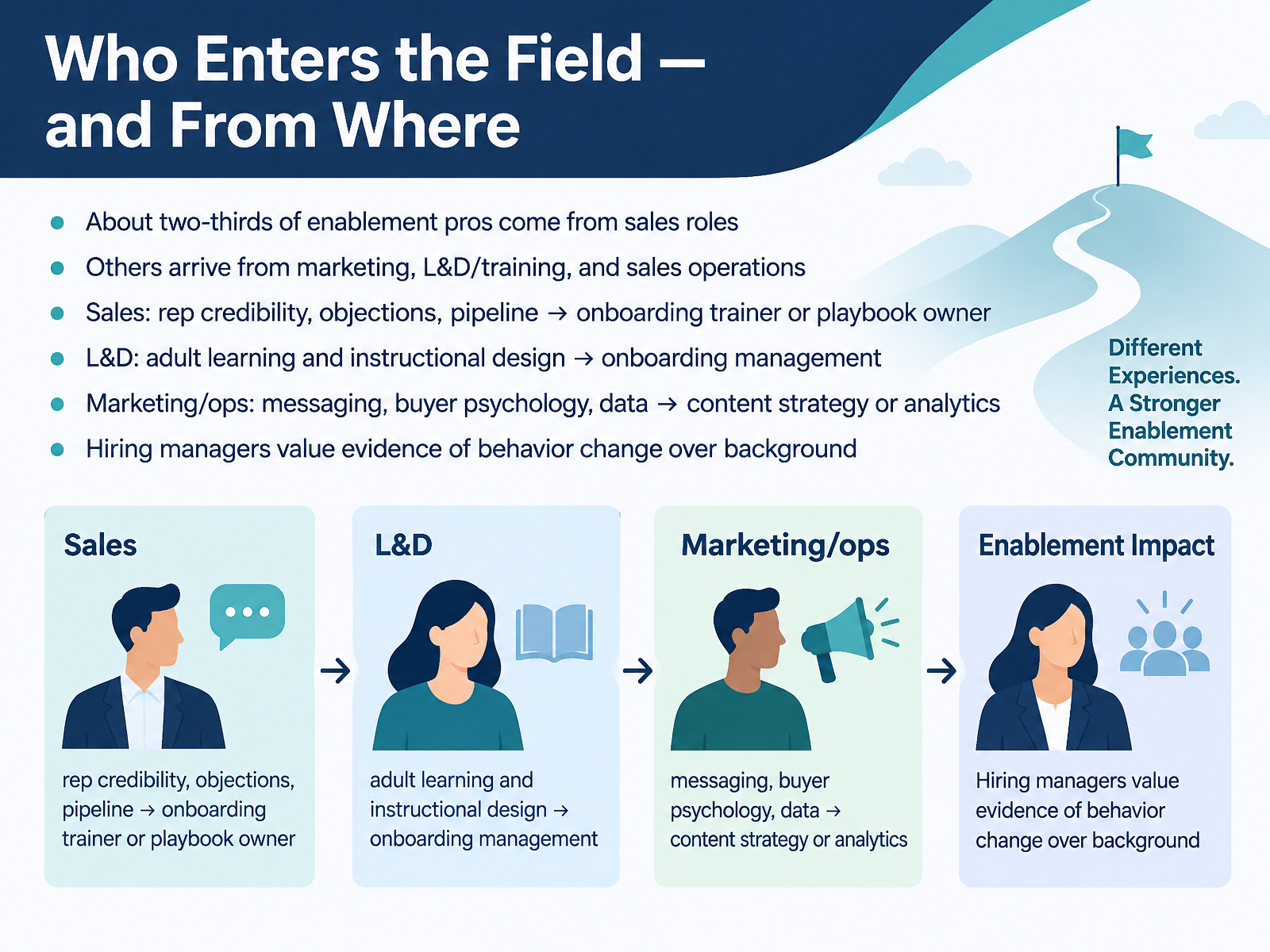
- 03Who Enters the Field — and From WhereIf you're unsure whether your background fits, here's the good news. There's no single entry path. About two-thirds of enablement professionals come from sales roles. The rest arrive from marketing, learning and development, or sales operations. So your starting point matters less than how you translate it. From sales, you bring rep credibility, objection handling, and pipeline knowledge. That maps well to an onboarding trainer or playbook owner. From L and D, your adult learning and instructional design skills lead naturally into onboarding management. From marketing or ops, your messaging, buyer psychology, and data skills point toward content strategy or analytics. Notice the pattern. Each path has a clear first role. When you apply, lead with evidence of behavior change, not your job title. A short onboarding plan or a battle card your team actually used says more than a resume summary. Next, we'll assess your fit by mapping your transferable skills and gaps.
 senablers.comspekit.comclimbtheladder.com+22 min
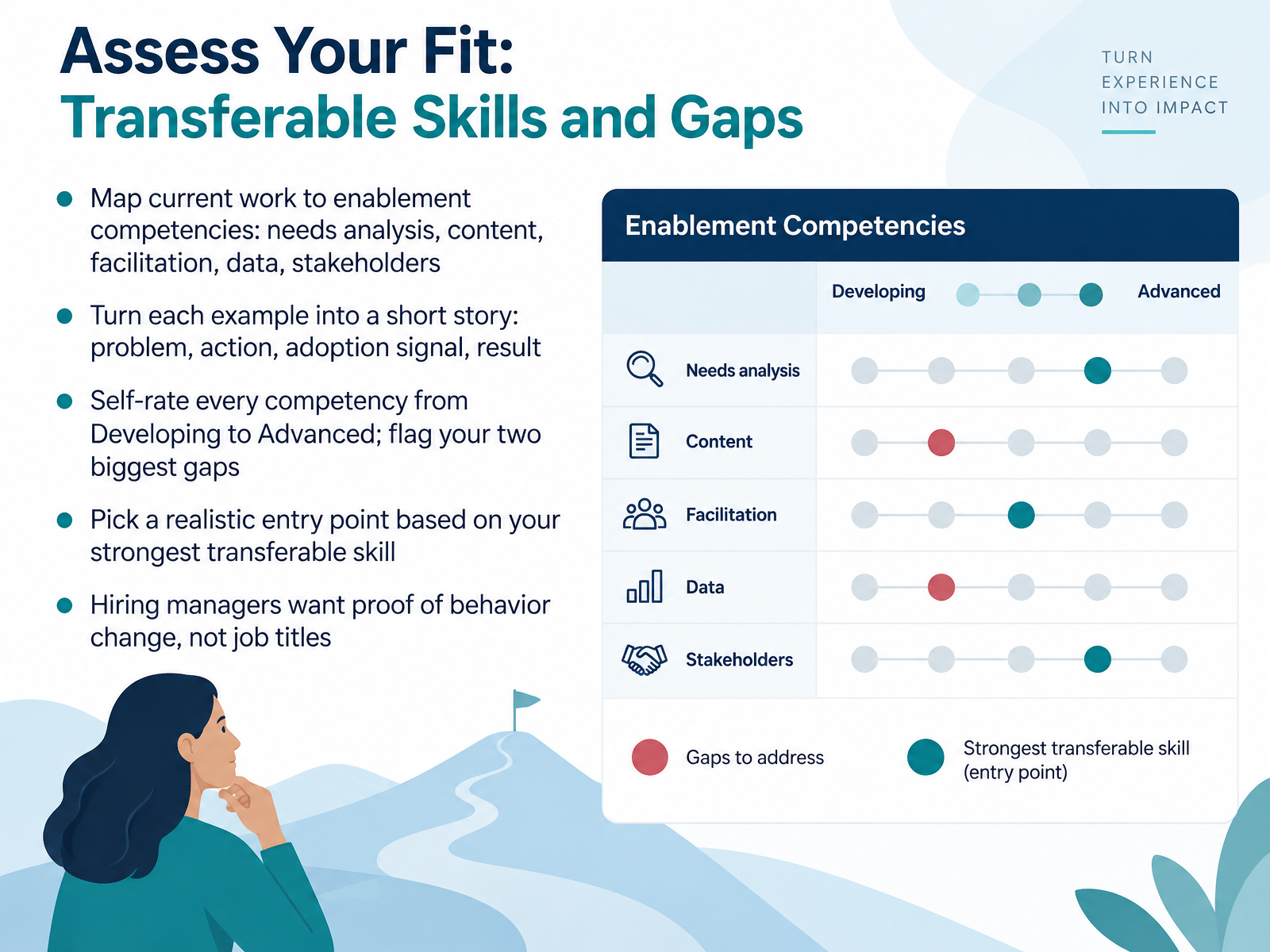
- 04Assess Your Fit: Transferable Skills and GapsNow let's talk fit. Maybe your title doesn't say enablement, and that makes this feel like a leap. So start by mapping what you already do to five competencies: needs analysis, content, facilitation, data, and stakeholders. Ran new-hire onboarding? Designed a workshop? That counts. Next, turn each example into a short story: the problem, your action, the adoption signal, and the result. Adoption is the part hiring managers listen for. Then rate yourself on each competency, from Developing to Advanced, and flag your two biggest gaps. Be honest, because that honesty shapes your plan. From there, pick one realistic entry point based on your strongest transferable skill. If facilitation is strongest, target onboarding or sales trainer roles. And remember, hiring managers want proof of behavior change, not job titles. Next, let's map the roles and the career ladder.
 senablers.comspekit.comclimbtheladder.com+22 min
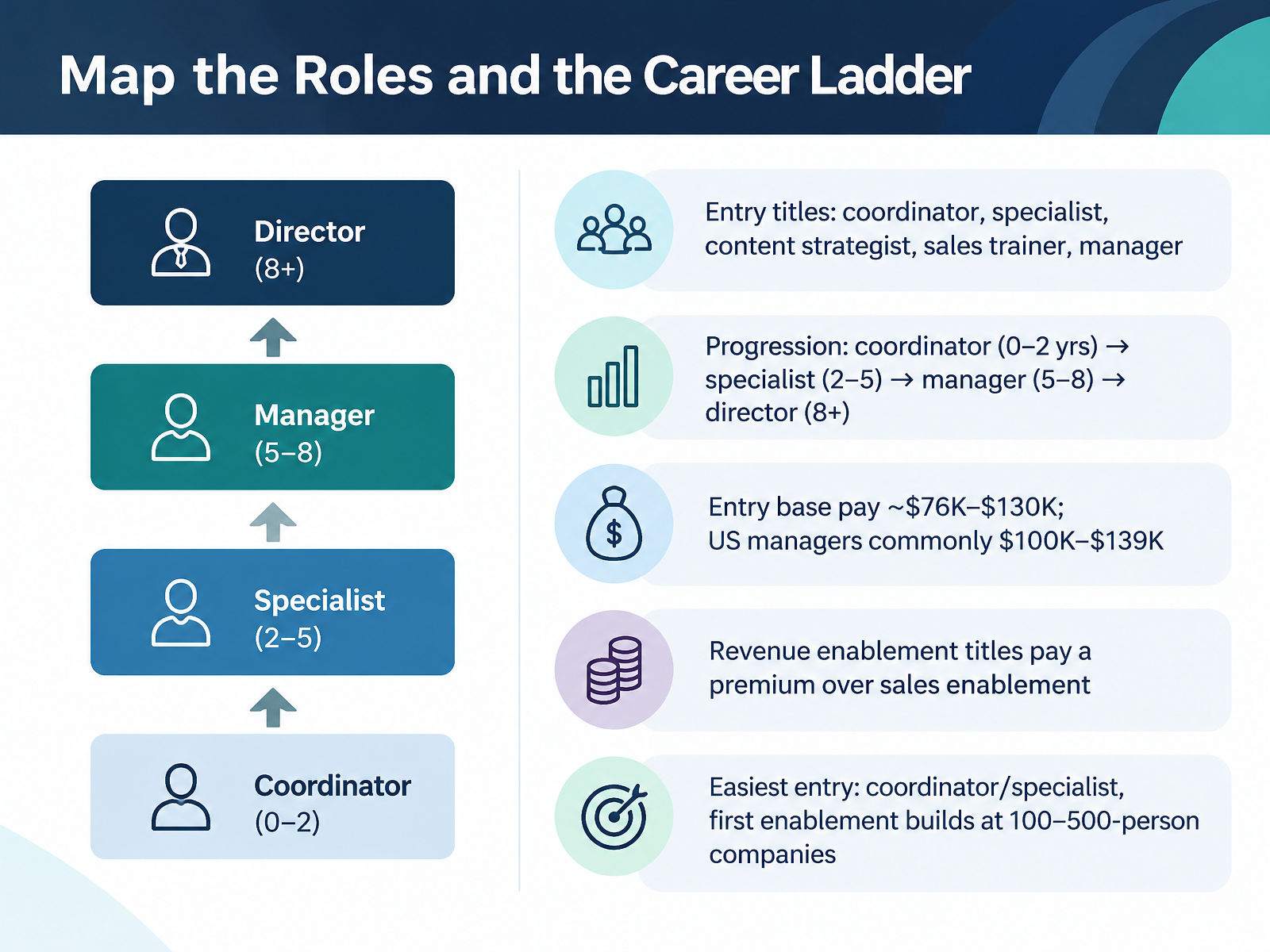
- 05Map the Roles and the Career LadderNow let's map the roles and the career ladder, so you know exactly where you're aiming. Entry titles include coordinator, specialist, content strategist, sales trainer, and manager. The path usually runs from coordinator in your first zero to two years, to specialist at two to five, to manager at five to eight, and to director after eight. On pay, entry base runs roughly seventy-six thousand to one hundred thirty thousand dollars, and US managers commonly land between one hundred thousand and one hundred thirty-nine thousand. Here's a detail worth remembering: revenue enablement titles pay a premium over sales enablement titles. The easiest way in is a coordinator or specialist role at a company of one hundred to five hundred people that's building enablement for the first time. Next, build the skills: a focused learning plan.
 senablers.comexec.comupliftgtm.com+21 min
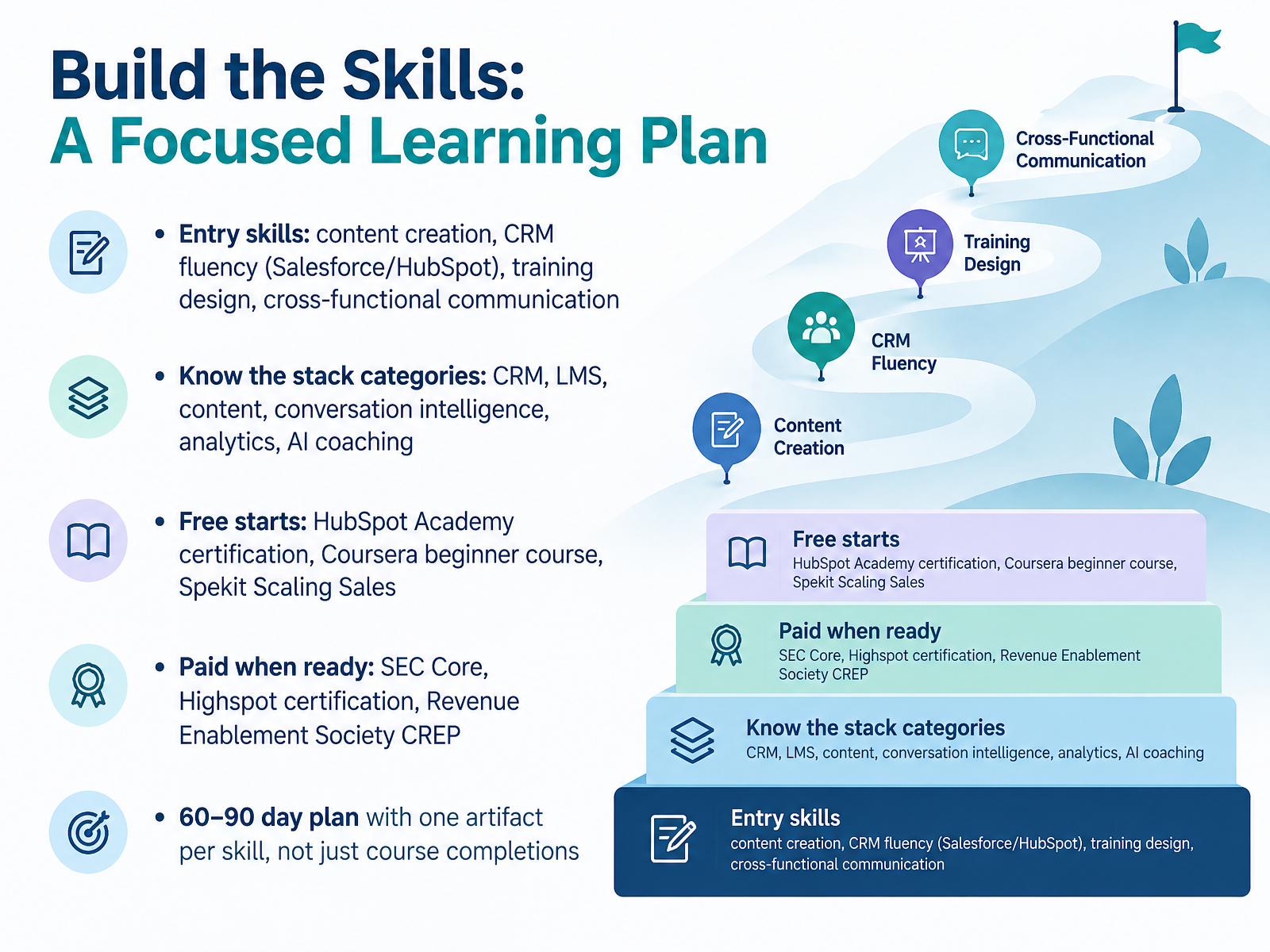
- 06Build the Skills: A Focused Learning PlanNow let's turn that into a focused learning plan. You've probably noticed that job postings list a lot of skills. Don't try to learn them all at once. Start with four: content creation, CRM fluency in Salesforce or HubSpot, training design, and cross-functional communication. Then learn the stack categories by name: CRM, learning management system, content, conversation intelligence, analytics, and AI coaching. You don't need to master every tool. You need to know how reps and managers use them. For free starts, take the HubSpot Academy certification, a beginner Coursera course, and Spekit's Scaling Sales course. When you're ready to invest, look at Sales Enablement Certified Core, Highspot certification, and the Revenue Enablement Society's CREP program. Here's the part that matters most. Build a sixty to ninety day plan with one artifact per skill. That means a sample onboarding plan, a battle card, a training outline, and a CRM report. Course completions alone won't convince a hiring manager. Artifacts will. So next, let's look at how to turn those artifacts into a portfolio that gets noticed: Prove It: Portfolio Projects That Get Noticed.
 coursera.orgsalesenablementcollective.comcroclub.com+22 min
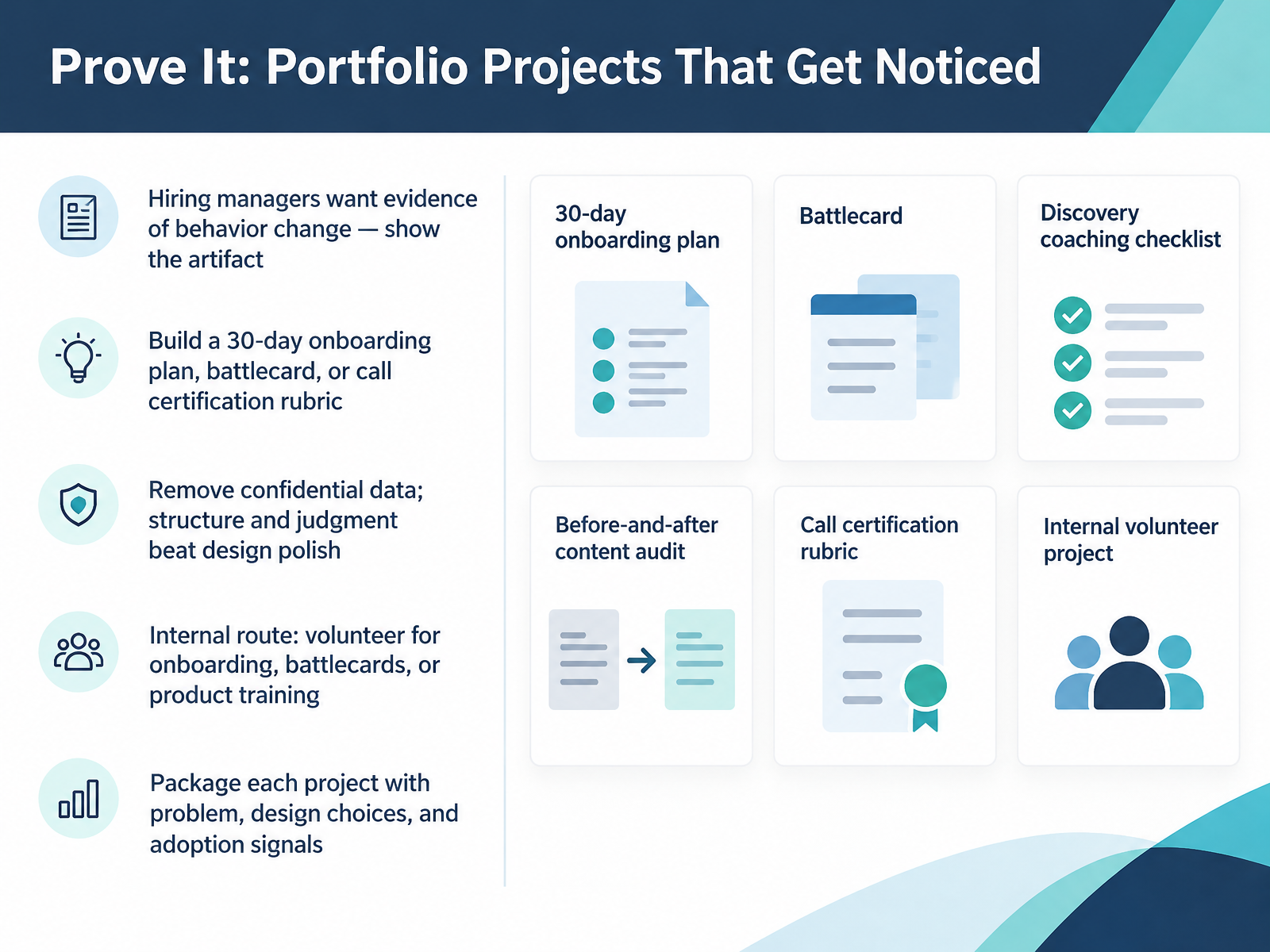
- 07Prove It: Portfolio Projects That Get NoticedNow let's talk about proof. When you apply for an enablement role, hiring managers want evidence that you can change behavior, not just talk about training. So show the artifact. Build one of three things: a thirty-day onboarding plan, a battlecard, or a call certification rubric. Then remove any confidential company data. Structure and judgment matter far more than design polish. If you're already inside a company, volunteer to run onboarding, refresh a battlecard, or deliver product training. That gives you real adoption signals. And package every project the same way: the problem, the design choices you made, and the adoption signals you saw. For example, say the problem was slow rep ramp, the decision was a thirty-day plan, and the signal was five new hires completing it in week one. That's the story that gets noticed. Next, we'll look at how to position yourself through your resume, LinkedIn, and community.
 oxygenexp.comsenablers.comspekit.com+22 min
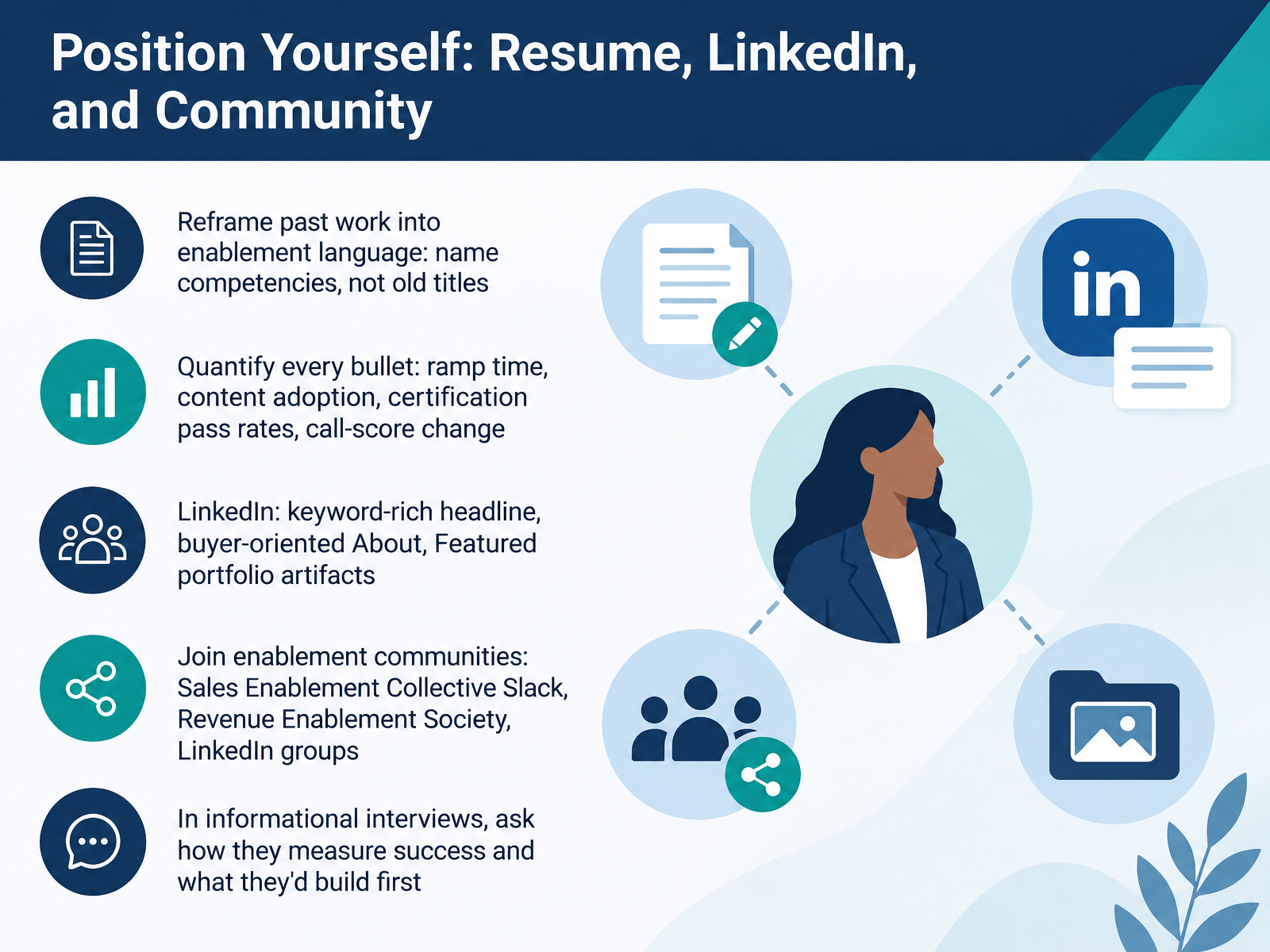
- 08Position Yourself: Resume, LinkedIn, and CommunityNow let's talk about positioning yourself. If you're moving into enablement, your old job titles may not say much to a hiring manager. So reframe your past work in enablement language. Name the competency, not the title. Coaching new hires, building battle cards, running training sessions. Then quantify every bullet. How much did you cut ramp time? What was content adoption? What were certification pass rates? Did call scores move?
On LinkedIn, use a keyword-rich headline and a buyer-oriented About section. Feature your portfolio artifacts, like an onboarding plan or a sample battle card. And join the communities where enablement people actually talk: the Sales Enablement Collective Slack, the Revenue Enablement Society, and relevant LinkedIn groups.
In informational interviews, ask two things. How do you measure success here? And what would you build first? That tells you how they think.
Next, we'll cover how to interview and land the role.
 senablers.comspekit.comclimbtheladder.com+22 min
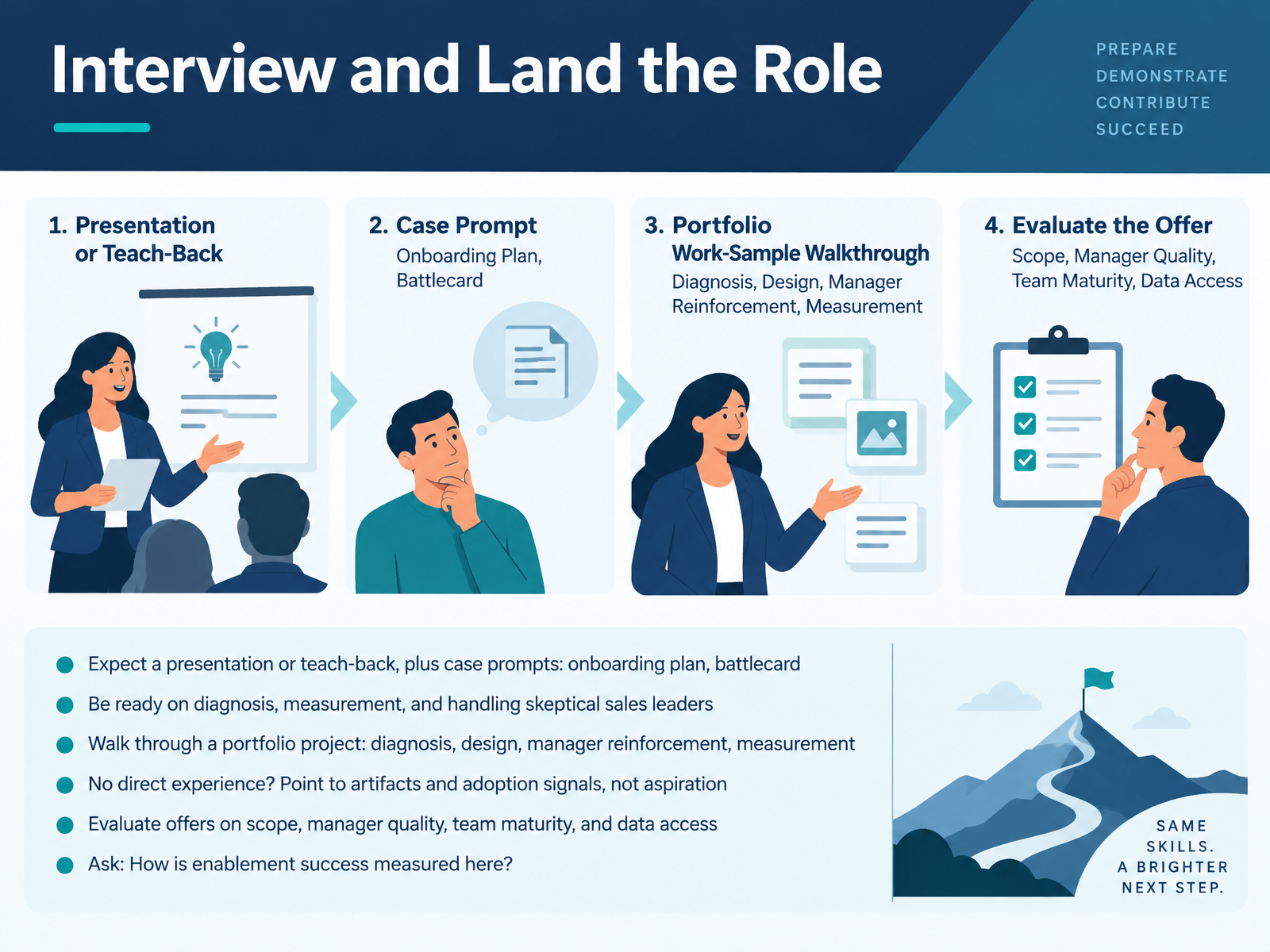
- 09Interview and Land the RoleNow let's talk about the interview itself. Plan for a presentation or a teach-back, plus case prompts like an onboarding plan or a battlecard. Be ready to explain how you diagnose a problem, how you measure success, and how you handle a skeptical sales leader. When you walk through a portfolio project, use one clear chain: diagnosis, design, manager reinforcement, then measurement. If you have no direct enablement experience, point to real artifacts and adoption signals. Show that something you built was actually used. When you evaluate offers, look at scope, manager quality, team maturity, and data access. And always ask, how is enablement success measured here? That answer tells you what the job will really look like. First 90 Days: From Hired to Productive.
 senablers.comspekit.comclimbtheladder.com+22 min
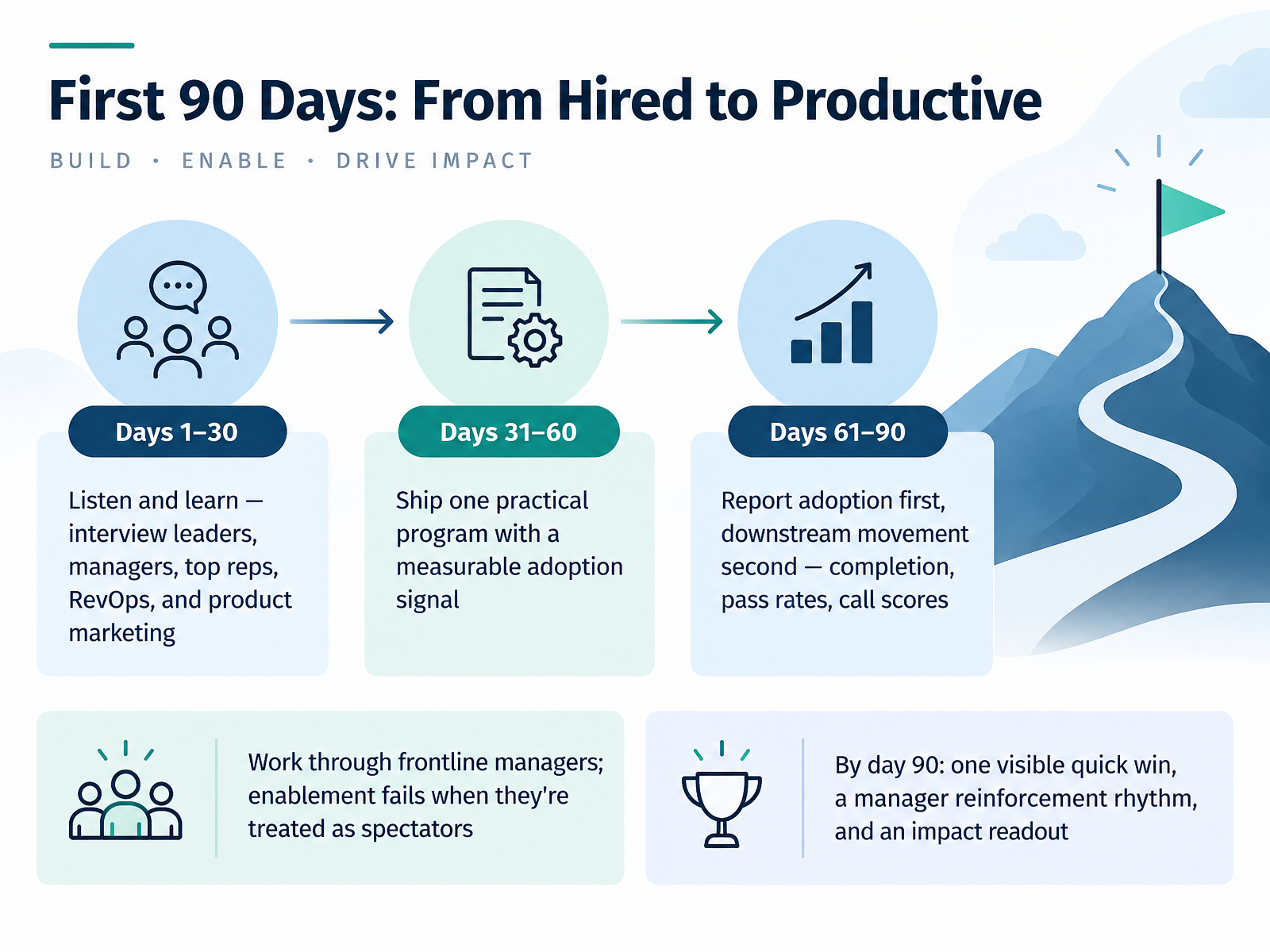
- 10First 90 Days: From Hired to ProductiveNow let's talk about your first ninety days, when you move from hired to genuinely productive. A common worry here is pressure to prove yourself fast, so pace it in phases. Days one to thirty, listen and learn. Interview leaders, frontline managers, top reps, RevOps, and product marketing. Ask what slows them down. Days thirty-one to sixty, ship one practical program with a measurable adoption signal, so you can show it is actually being used. Days sixty-one to ninety, report adoption first and downstream movement second, like completion, pass rates, and call scores. And work through frontline managers. Enablement fails when they are treated as spectators. By day ninety, you want one visible quick win, a manager reinforcement rhythm, and a clear impact readout. Next, we look at workflow and action plans by audience segment.
 oxygenexp.com1 min
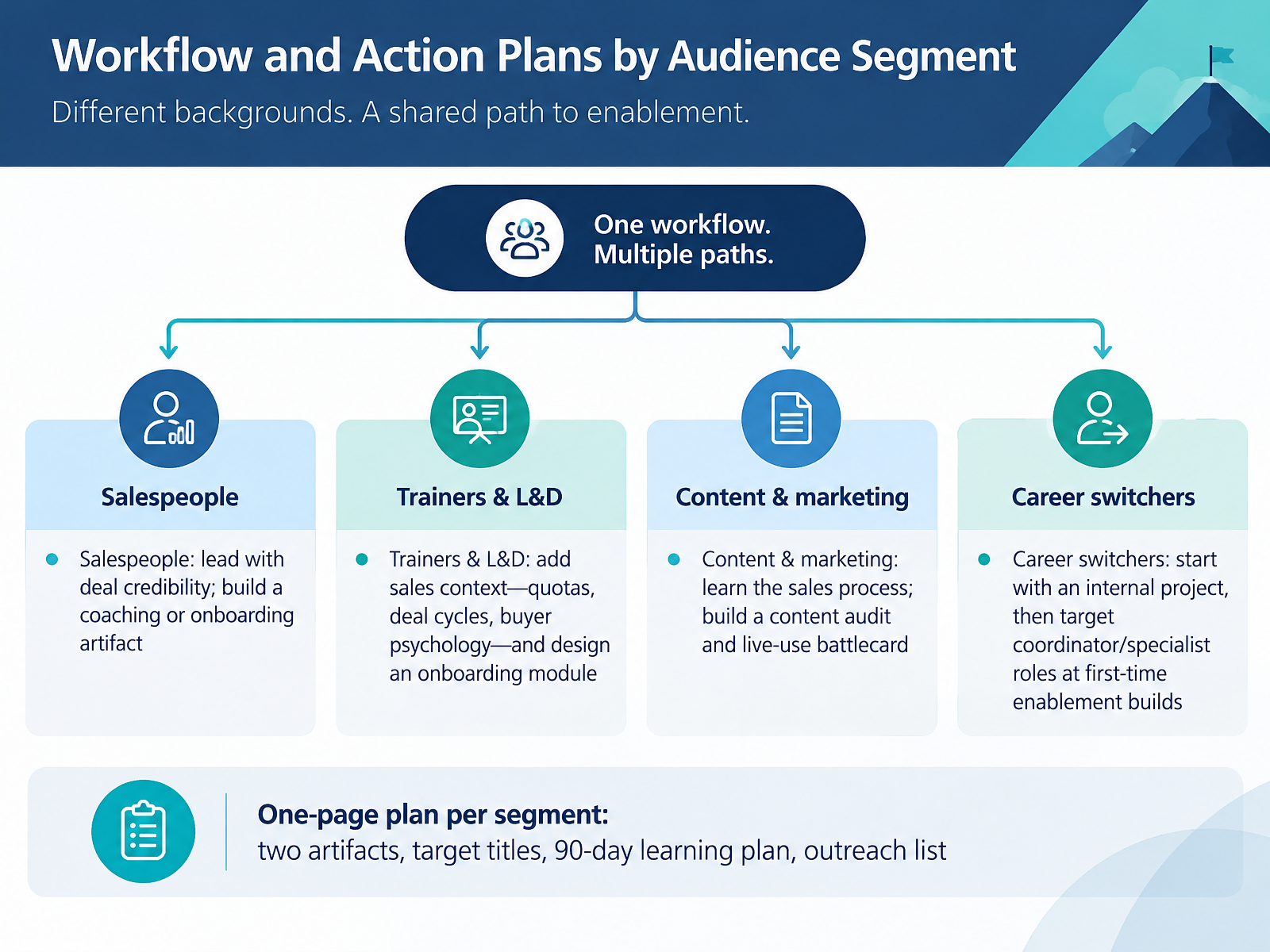
- 11Workflow and Action Plans by Audience SegmentNow let's turn this into a plan, based on where you're starting from. If you're in sales, lead with deal credibility. Build one coaching or onboarding artifact you'd actually hand a new rep. If you're a trainer or in learning and development, add sales context first: quotas, deal cycles, buyer psychology. Then design one onboarding module. If you come from content or marketing, learn the sales process, then build two things: a content audit and a battlecard reps use live on calls. And if you're switching careers, start with an internal project, then target coordinator or specialist roles at companies building enablement for the first time. For every segment, keep it to one page: two artifacts, your target titles, a ninety-day learning plan, and an outreach list. That page keeps you focused and gives you something concrete to show. Next, we'll look at common pitfalls and how to avoid them.
 senablers.comspekit.comclimbtheladder.com+22 min
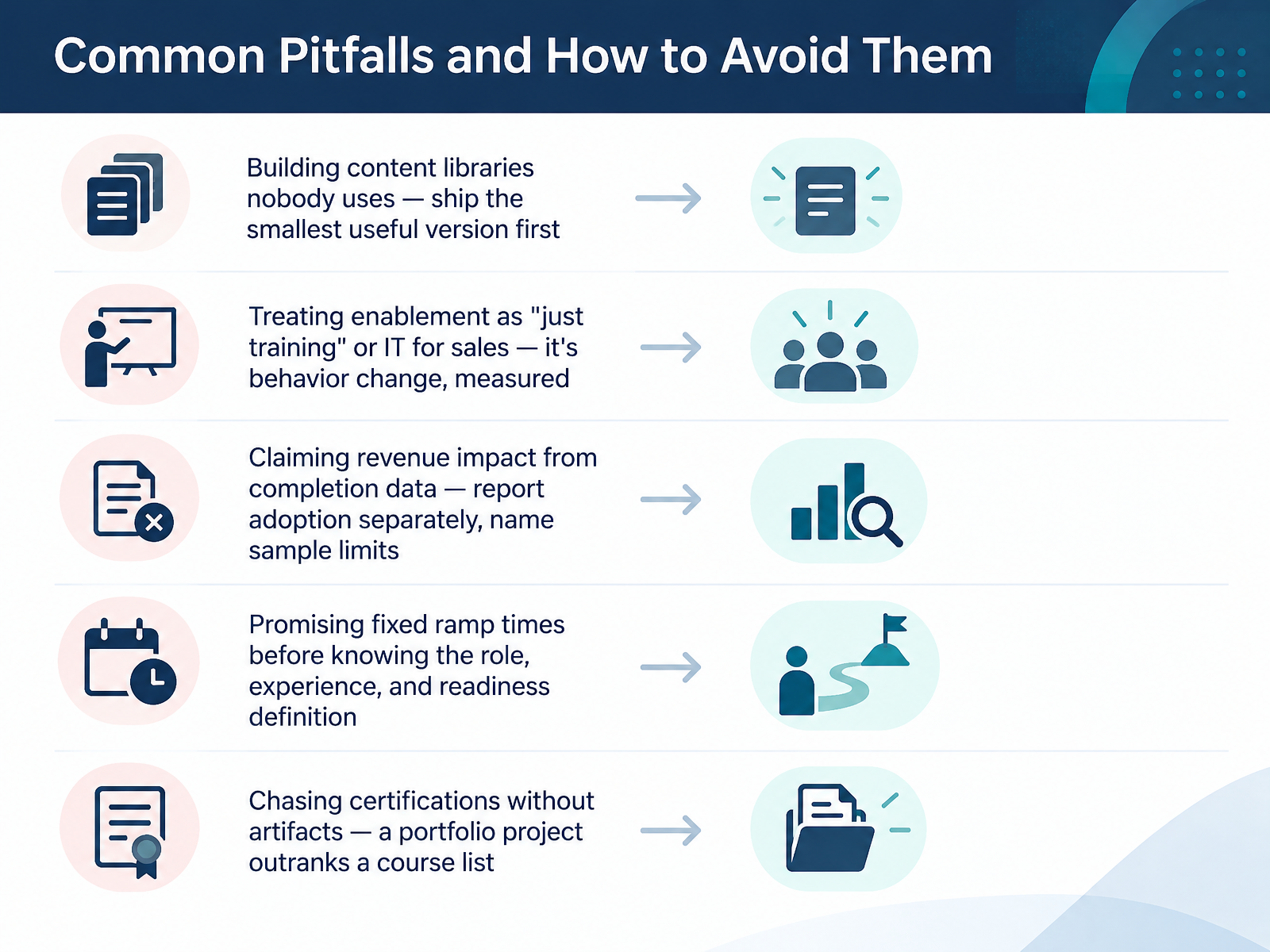
- 12Common Pitfalls and How to Avoid ThemLet's talk about the mistakes that trip people up in sales enablement. If you've worried about proving your work matters, this is for you.
First, don't build a big content library nobody uses. Ship the smallest useful version first. A single battlecard reps actually open beats fifty decks sitting in a folder.
Second, enablement is not just training, and it's not IT for sales. It's behavior change, measured. Pick one behavior, like asking clearer next-step questions, and track whether it shows up in live calls.
Third, don't claim revenue impact from completion data. Report adoption separately from outcomes, and name your sample limits. If ten reps finished a course, that's adoption. It doesn't prove revenue moved.
Fourth, don't promise fixed ramp times before you know the role, prior experience, and how you define readiness.
And fifth, don't chase certifications without artifacts. A small portfolio project you can walk someone through outranks a long course list every time.
Pick one pitfall you're closest to right now, and fix that first.
Next, let's move into Reflection and Self-Check.
 pandadoc.comsalesforce.comtechtarget.com+22 min
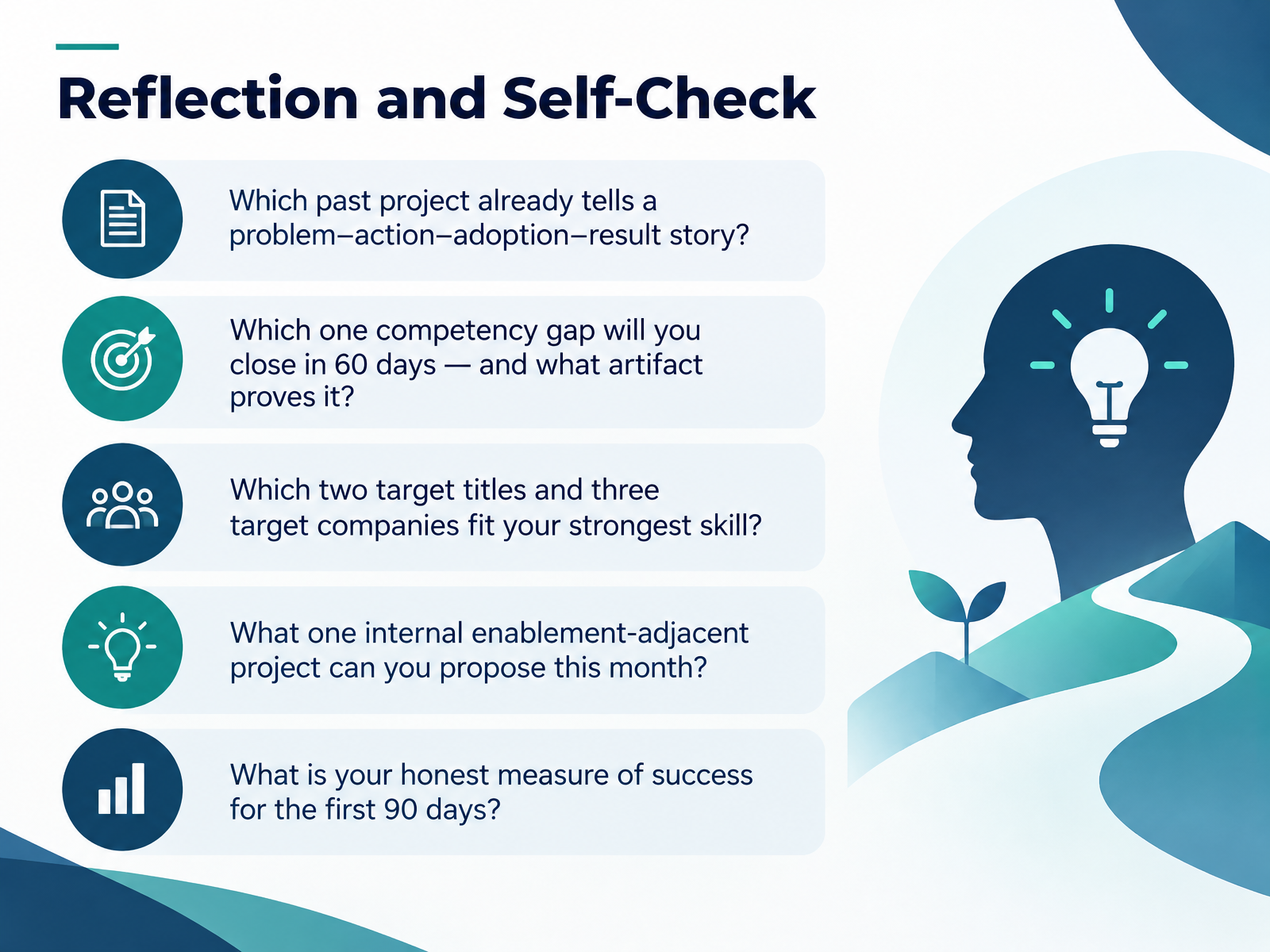
- 13Reflection and Self-CheckLet's pause and turn the work inward. Grab a pen, because reflection only counts when it ends in a decision. Start with a past project. Pick one that already tells a problem, action, adoption, result story. You'll need that story in interviews. Next, choose one competency gap. Just one. Name it, and decide what artifact will prove you closed it within sixty days. It could be a recorded role-play, a scorecard, or a short playbook. Then get specific about the market: which two target titles and three target companies fit your strongest skill, such as discovery or content design? And this month, what one internal project can you propose that sits next to enablement? Maybe a rep onboarding refresh, or a battlecard update. Finally, write your honest measure of success for the first ninety days. Not a title. Something observable, like shipping two enablement assets that reps actually use. Write these answers down today. Next, we'll look at next steps and continued development.
 2 min
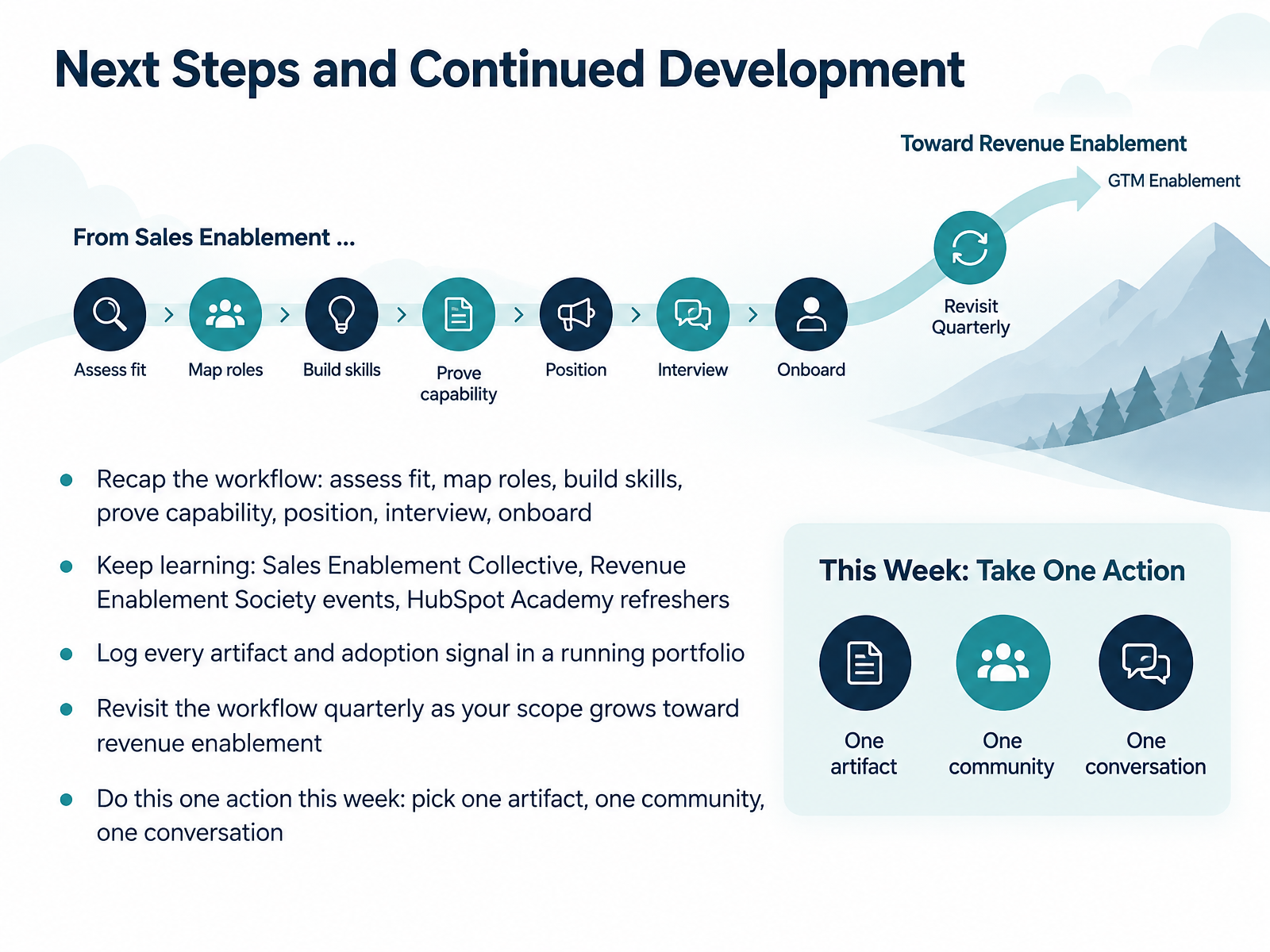
- 14Next Steps and Continued DevelopmentLet's close with where this goes next. You've walked the whole workflow: assess fit, map roles, build skills, prove capability, position yourself, interview, and onboard. Here's how to keep it working for you. First, keep learning. Join the Sales Enablement Collective, attend Revenue Enablement Society events, and revisit HubSpot Academy refreshers as your scope grows. Second, log every artifact and every adoption signal in one running portfolio. That could be a training deck, a playbook, or a note that thirteen reps used your template. Third, revisit this workflow quarterly, because your scope will slowly shift toward revenue enablement. And here's your one action this week: pick one artifact, one community, and one conversation. That's it. Thank you for working through this with me. You already have the steps, so start with one small move, and build from there.
 coursera.orgsalesenablementcollective.comcroclub.com+22 min
Take the deck with you
Download this course as a file — free, no sign-up needed.
- PDF handoutEvery slide page, ready to print or share.15 pages · 3.3 MBDownload
- Narrated PowerPointThe deck that presents itself — every slide carries the digital human's narration video.15 pages · 13.3 MBDownload
- PowerPoint slidesThe full deck as a .pptx — open it in PowerPoint, Keynote, or Google Slides.15 pages · 3.2 MBDownload
Free to use in your own training — please keep the PersonWise credit page at the end.
Have your own deck? Turn it into a course
Sources consulted
Web sources consulted while building this course.
- How to Break Into Sales Enablement in 2026 - SEnablers — senablers.com
- How to launch and grow your sales enablement career — spekit.com
- How to Break Into Sales Enablement: Skills and First Roles - CLIMB — climbtheladder.com
- How to get a job in sales enablement | Seismic — seismic.com
- State of Sales Enablement in 2026: What 40+ Job Postings Reveal | Exec Learn — exec.com
- What is sales enablement? | PandaDoc — pandadoc.com
- What is Sales Enablement? A Complete Strategy Guide | Salesforce — salesforce.com
- Sales enablement vs. sales operations: What’s the difference? | TechTarget — techtarget.com
- What are the key pillars of sales enablement? — pedowitzgroup.com
- What is Sales Enablement? | ATD — td.org
- Sales Enablement Salary by Seniority Level 2026 - SEnablers — senablers.com
- Sales Enablement Salary [2026 Data] · UpliftGTM — upliftgtm.com
- Sales enablement salary guide | 2026 earnings data & analysis — salesenablementcollective.com
- Sales Enablement Manager Job Description | FirstHR — firsthr.app
- Sales Enablement — coursera.org
- Sales enablement certifications | Learn today, apply tomorrow — salesenablementcollective.com
- 16 Best Sales Enablement Certifications To Take In 2026 — croclub.com
- Sales Training — hubspot.com
- Certified Revenue Enablement Professional — resociety.global
- How DXC created a business case for modern sales enablement — oxygenexp.com