Freelance Technical Writing
Begin
14 pages · ~28 min
Freelance Technical Writing
This training prepares freelancers to succeed in technical writing by covering documentation, client work, and professional practices to deliver clear, effective content.
What you’ll learn
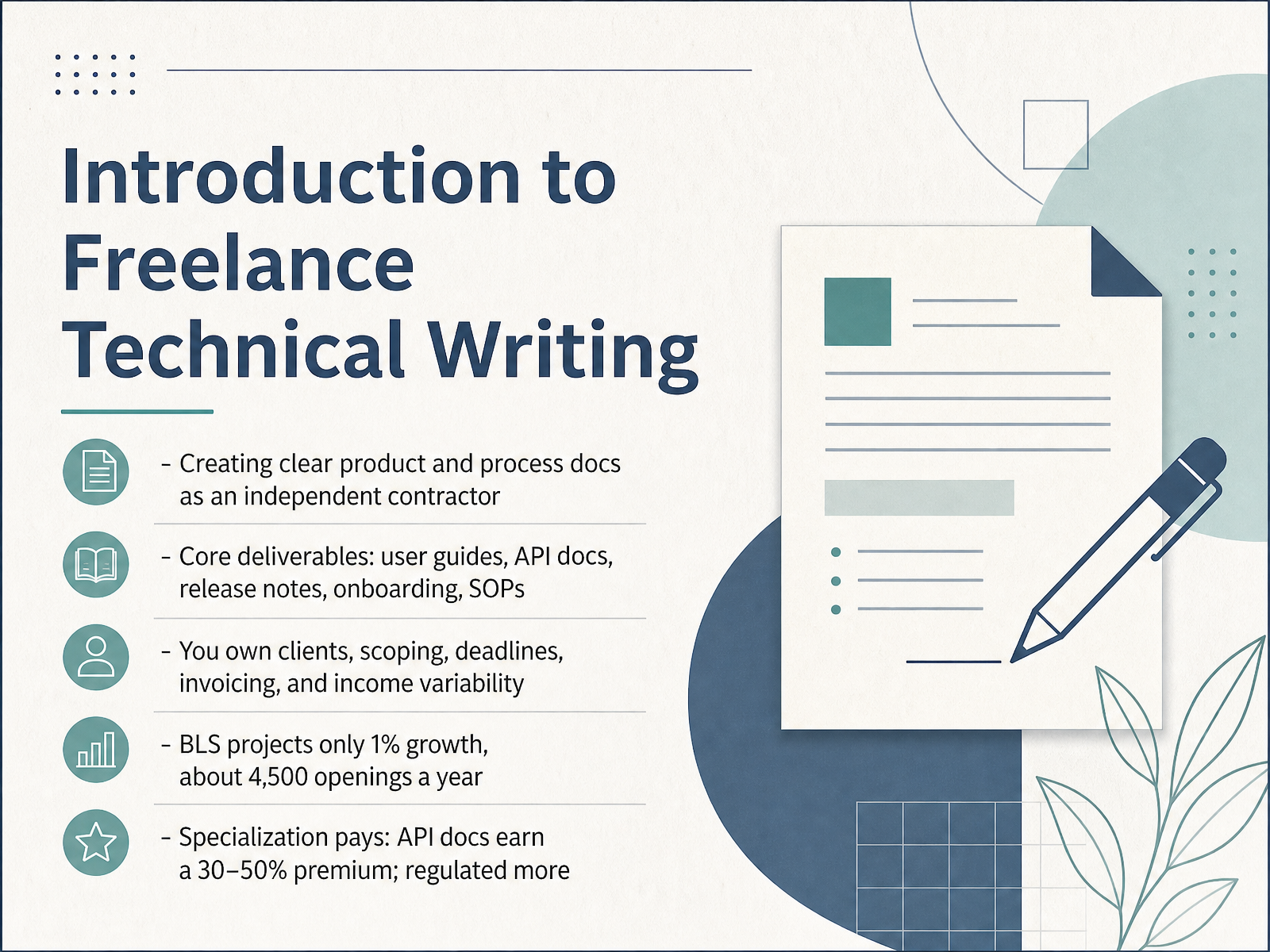
- 01Introduction to Freelance Technical WritingWelcome. This course is about building a freelance technical writing practice, and our goal is simple: help you turn documentation skills into steady client work and predictable income. Freelance technical writing means creating clear product and process docs as an independent contractor. Your core deliverables are user guides, API docs, release notes, onboarding material, and standard operating procedures. The big shift from a salaried job is ownership. You own clients, scoping, deadlines, invoicing, and income variability. So what does the market look like? The Bureau of Labor Statistics projects only one percent growth for technical writers from 2024 to 2034, but about four thousand five hundred openings appear each year, mostly from people leaving or retiring. That means you are not chasing a booming field. You are competing for replacements and for specialization. And specialization pays. API documentation earns a thirty to fifty percent premium, and regulated work like pharma or medical device docs often commands even more. Here is your takeaway for slide one: pick one specialty before you need it. Write it down, then line up two sample pieces in that niche this month. In the next section, we will look at what the 2026 market actually pays.bls.govstealthagents.combiztoolkit.co+22 min
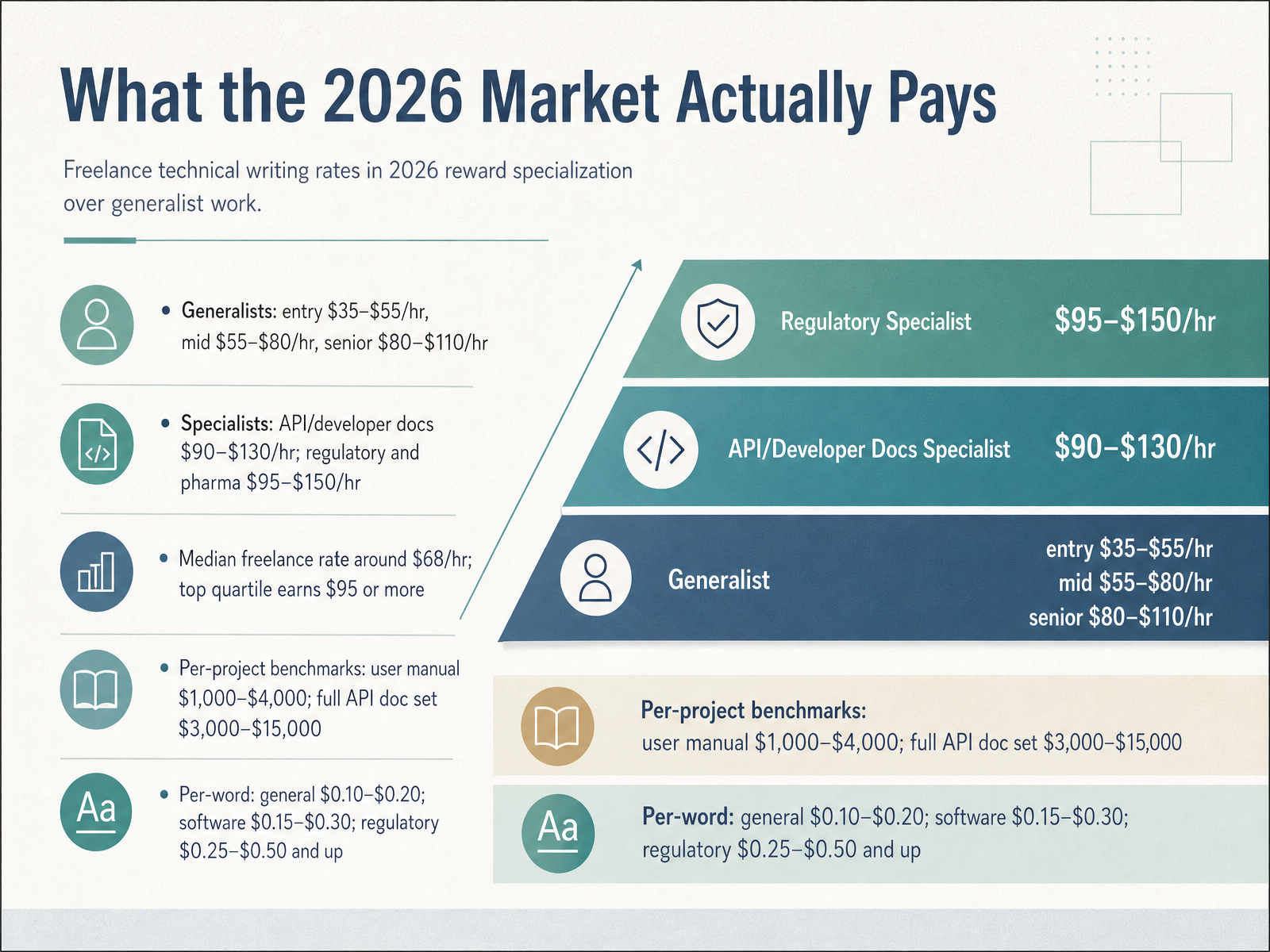
- 02What the 2026 Market Actually PaysNow, let's talk money. In 2026, freelance technical writing rates reward specialization over generalist work. If you write broadly, expect entry rates around thirty-five to fifty-five dollars an hour, mid-level fifty-five to eighty, and senior eighty to one hundred ten. Specialists pull ahead quickly. API and developer documentation runs ninety to one hundred thirty dollars an hour, while regulatory and pharma work goes ninety-five to one hundred fifty. The median freelance rate sits around sixty-eight dollars an hour, and the top quartile earns ninety-five or more. Project fees follow the same pattern. A user manual typically pays one thousand to four thousand dollars. A full API documentation set runs three thousand to fifteen thousand. On per-word work, general content sits at ten to twenty cents, software at fifteen to thirty, and regulatory at twenty-five to fifty cents and up. Here's your takeaway. Pick one specialization, and price against these benchmarks on your next quote, not against generalist rates. Next up, Demand Signals and Where the Work Is.
 biztoolkit.coearnifyhub.comstealthagents.com+22 min
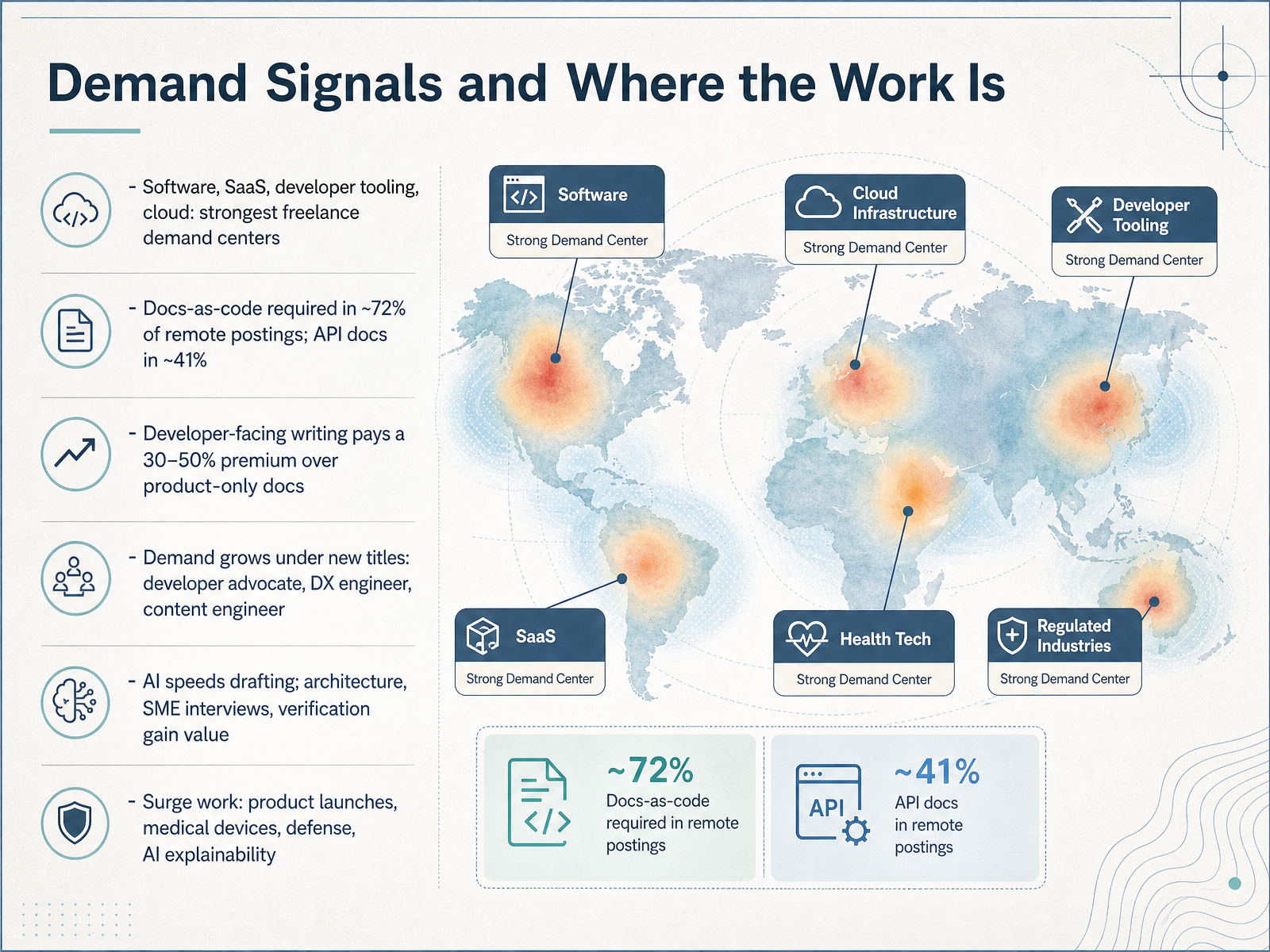
 - 03Demand Signals and Where the Work IsLet's talk about where the work actually is. Software, SaaS, developer tooling, and cloud are the strongest freelance demand centers right now. In a study of over twelve hundred remote postings, seventy-two percent required docs-as-code skills, and forty-one percent wanted API documentation experience. That distinction matters for your rates: developer-facing writing pays roughly thirty to fifty percent more than product-only docs. The same demand shows up under new titles, including developer advocate, DX engineer, and content engineer. And here's the tradeoff with AI. It speeds up drafting, sure, but architecture, SME interviews, and verification gain value, not less. So if you want surge work, target product launches, medical devices, defense, and AI explainability. Your takeaway: pick one of those niches this quarter, and rewrite your portfolio sample to match it. Next, we'll cover core writing and research skills.
 bls.govstealthagents.combiztoolkit.co+22 min
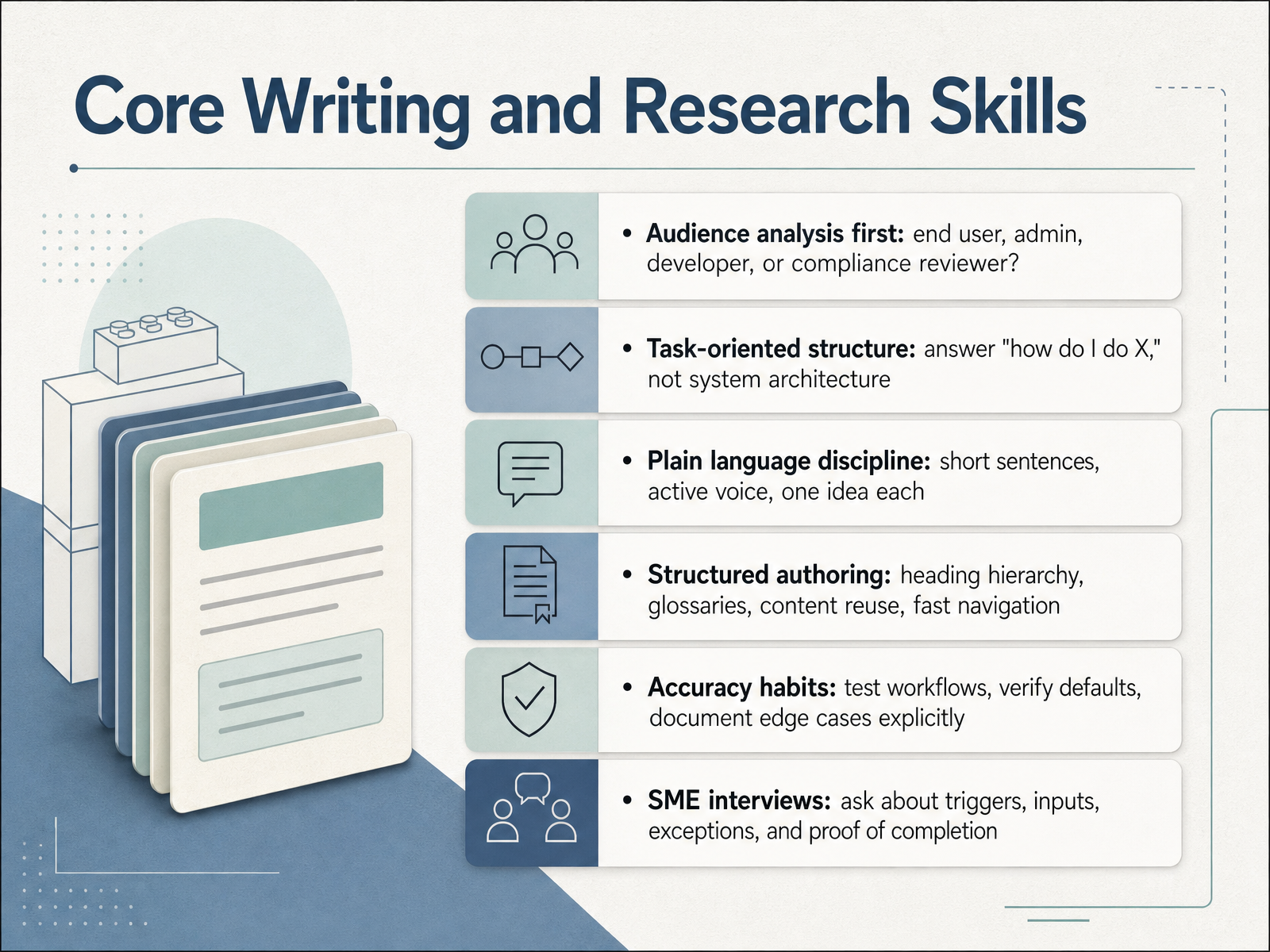
 - 04Core Writing and Research SkillsLet's get into the core writing and research skills that separate a competent technical writer from a great one. It starts with audience analysis. Before you write a word, ask who this is for. An end user, an administrator, a developer, or a compliance reviewer? Each one needs a different document. Then structure around tasks. Answer how do I do this, not how the system is architected. Keep your language plain: short sentences, active voice, one idea each. Structured authoring matters too. Use a clear heading hierarchy, glossaries, content reuse, and navigation that lets readers find things fast. Accuracy is where trust is won or lost. Test your workflows, verify the defaults, and document edge cases explicitly. When you interview a subject matter expert, ask about triggers, inputs, exceptions, and how the user knows the task is done. Here's your takeaway. On your next engagement, before you draft, write one sentence naming your primary audience and the exact question they need answered. Toolchain: Docs-as-Code, Git, and API Formats.
 techiecv.combeingtechnicalwriter.comwritetechhub.org+22 min
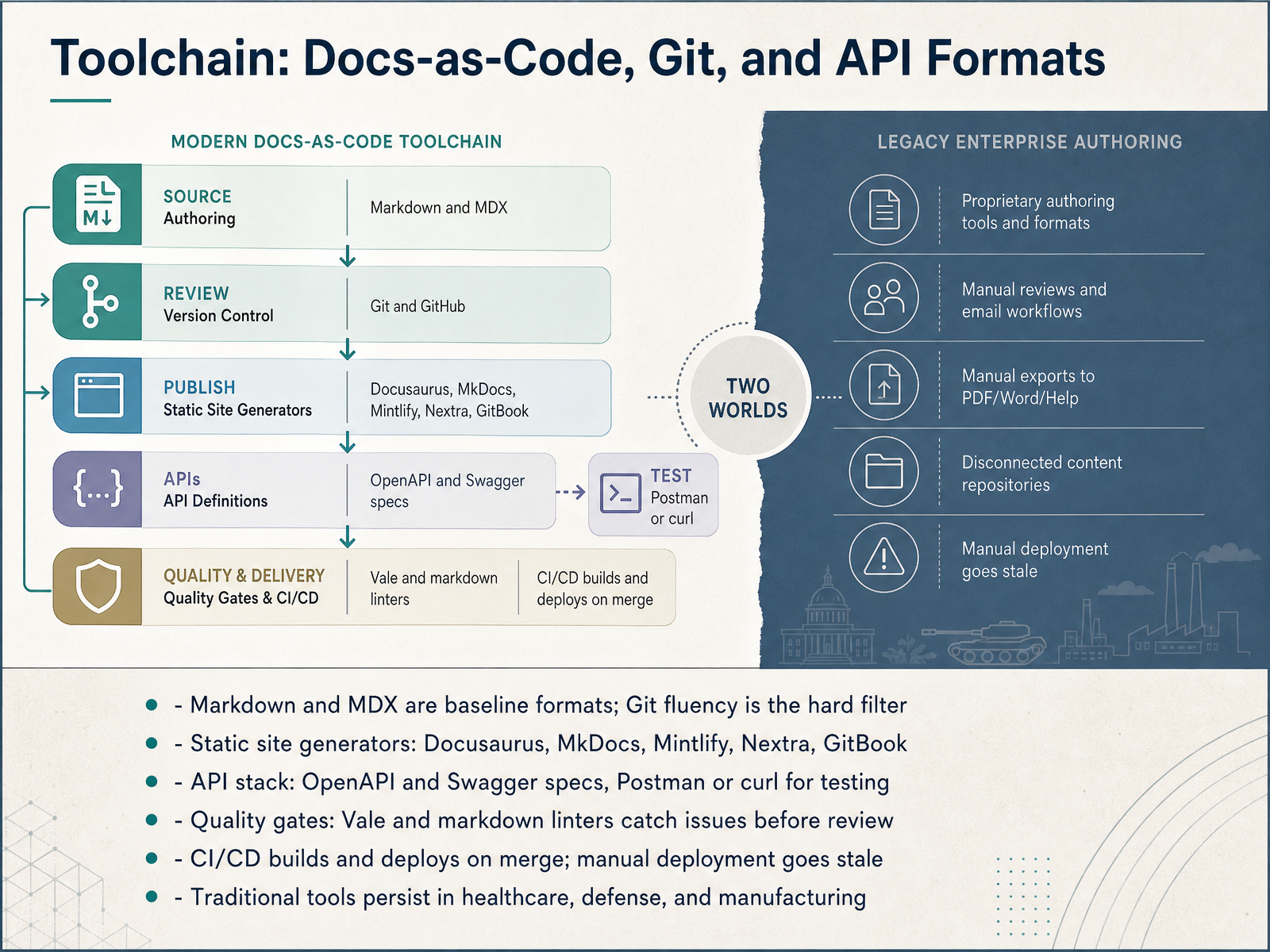
 - 05Toolchain: Docs-as-Code, Git, and API FormatsLet's talk about the toolchain, because this is where a lot of freelance work gets won or lost. Markdown and M D X are your baseline formats. But Git fluency is the hard filter. Clients treat Git as the non-negotiable, and a merged pull request is how your work actually ships. If you can branch, commit, and resolve a conflict, you're already ahead of many experienced writers. For publishing, static site generators like Docusaurus, MkDocs, Mintlify, Nextra, and GitBook are common. You don't need to master all of them. Pick one, build a real site, and you can learn the rest quickly. On the A P I side, expect OpenAPI or Swagger specs, plus Postman or curl for testing endpoints yourself. Quality gates matter too. Vale and Markdown linters catch style issues before a human reviewer ever sees your draft, which protects your reputation and saves revision rounds. And automate your build and deploy through continuous integration so content goes live on merge. Manual deployment goes stale, fast. One caveat. Traditional tools like MadCap Flare and FrameMaker still dominate healthcare, defense, and manufacturing. Those are solid, well-paid niches, so don't dismiss them. Your takeaway this week: set up one docs site with Vale running in continuous integration. That single project proves the whole toolchain. Next, we'll look at building a portfolio that wins clients.
 techiecv.combeingtechnicalwriter.comwritetechhub.org+22 min
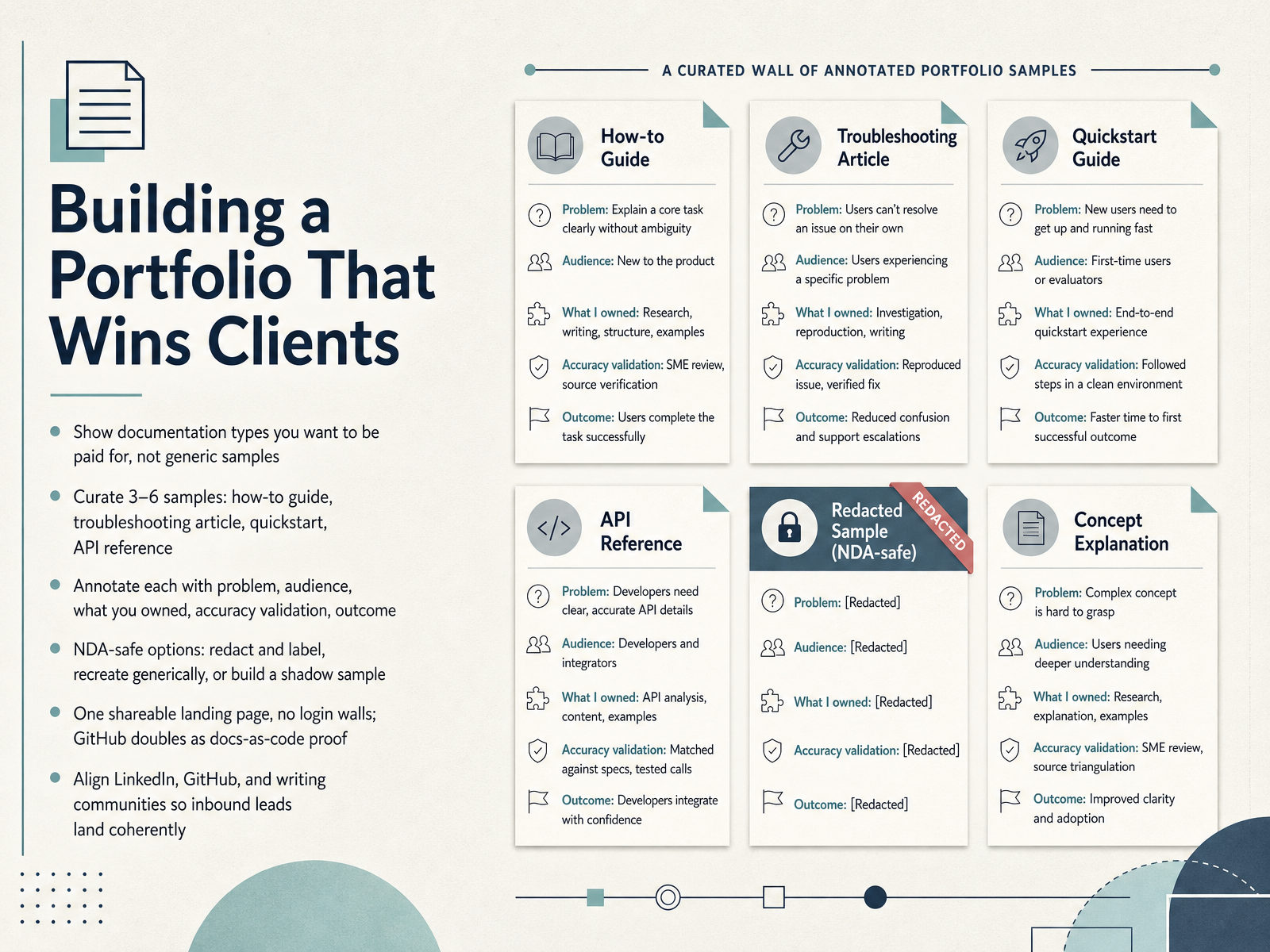
 - 06Building a Portfolio That Wins ClientsNow let's talk about building a portfolio that actually wins clients. The first rule: show the documentation types you want to be paid for, not generic writing samples. If you want API work, include API reference samples, not just blog posts. Aim for three to six curated pieces: a how-to guide, a troubleshooting article, a quickstart, and an API reference. Annotate each one. Problem, audience, what you owned, how you validated accuracy, and the outcome. Think of it as a caption, not an essay. If your work is under an NDA, you have options. Redact and label it clearly, recreate it generically with fictional product names, or build a shadow sample that mirrors the same structure. Then put everything behind one shareable landing page with no login walls. GitHub works well here, because it doubles as proof you can handle docs-as-code workflows. Finally, align your LinkedIn, GitHub, and writing communities so inbound leads land in a coherent place. Here's your takeaway: don't wait for the perfect portfolio. Curate three strong samples this week, annotate them, and share one link. Next, let's look at finding clients and winning work.
 technicalwriterhq.comgithub.comdatafield.dev+22 min
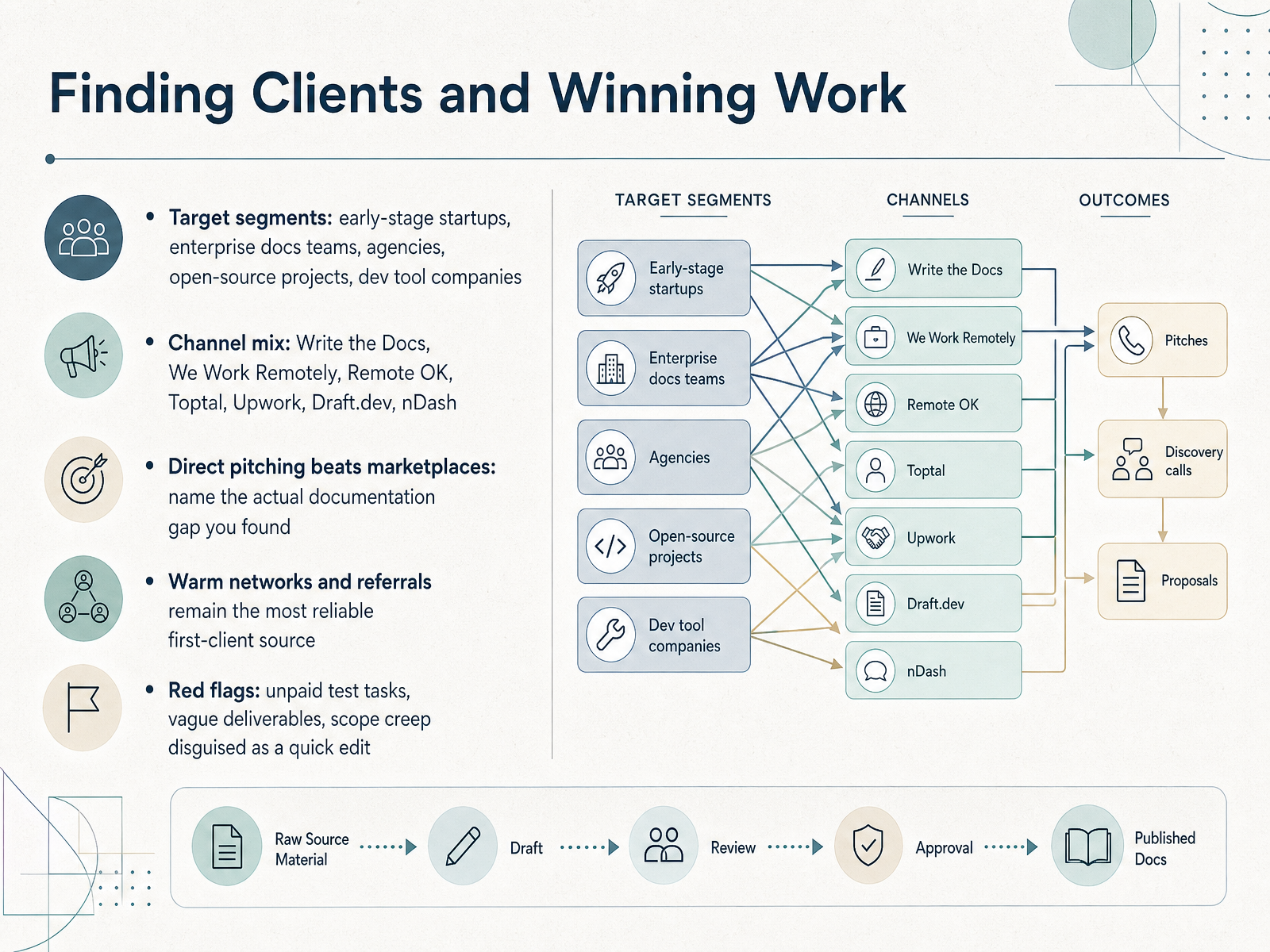
 - 07Finding Clients and Winning WorkLet's talk about finding clients and winning work. Start with your target segments: early-stage startups, enterprise docs teams, agencies, open-source projects, and dev tool companies. Each one buys differently, so pick two or three where your background gives you an edge. Then build a channel mix. Write the Docs, We Work Remotely, and Remote OK are strong for documentation roles. Toptal, Upwork, Draft.dev, and nDash round things out. But here's the key point. Direct pitching beats marketplaces. Name the actual documentation gap you found. For example, open with their broken quickstart guide, not a generic pitch. Warm networks and referrals remain the most reliable source of a first client. Before you commit, watch for red flags: unpaid test tasks, vague deliverables, and scope creep disguised as a quick edit. Your takeaway: pitch five specific gaps this week. Next, we'll look at scoping, pricing models, and contracts.
 skilldential.comupwork.comallfreelancewriting.com2 min
 - 08Scoping, Pricing Models, and ContractsLet's talk about the part of freelancing that trips up even great writers: scope, pricing, and contracts.
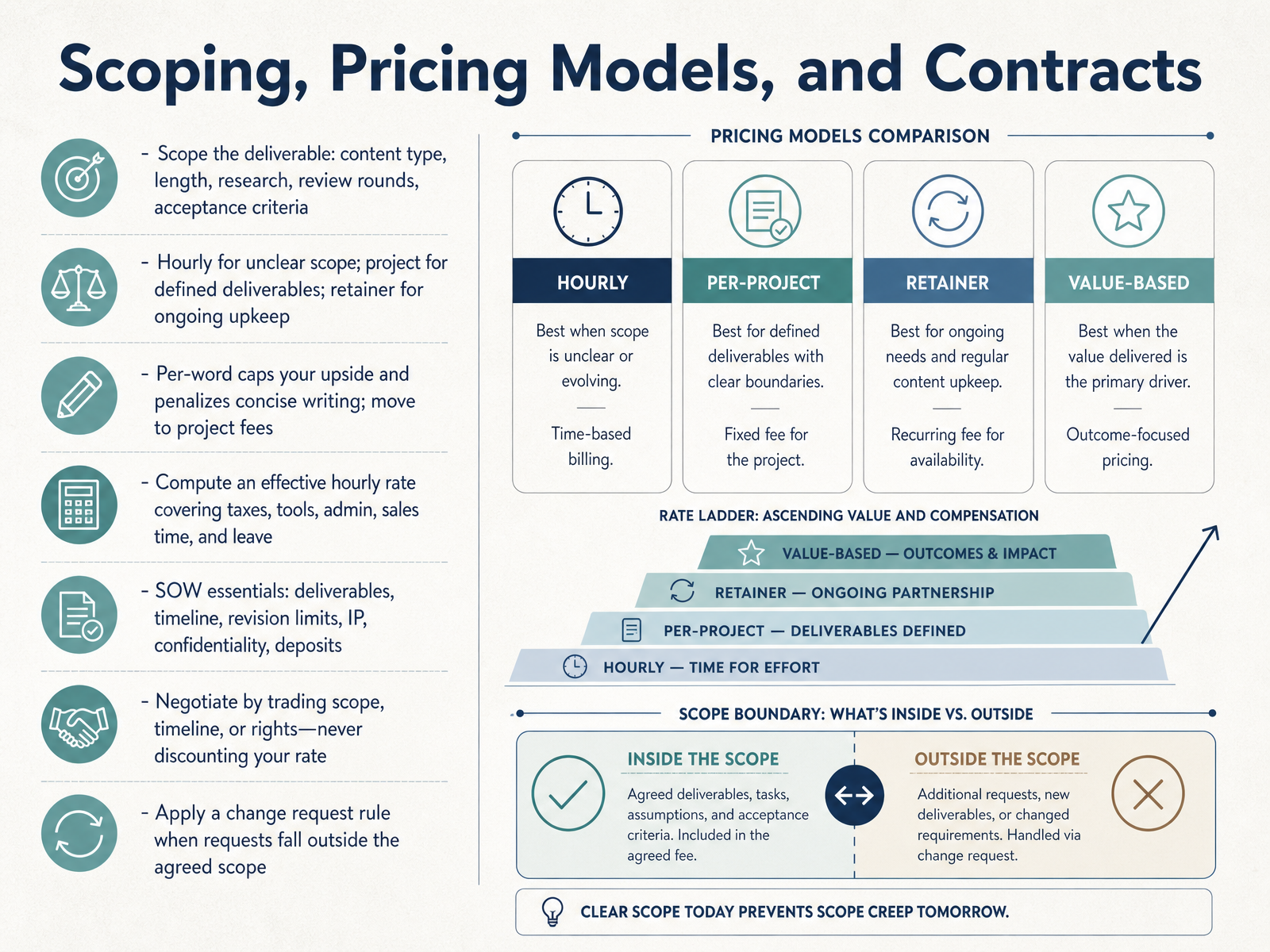
Start by scoping the deliverable in writing. Content type, length, research required, review rounds, and acceptance criteria. If a client says they'll know it when they see it, that is not acceptance criteria. That is a blank check.
On pricing models: use hourly when the scope is genuinely unclear. Use a fixed project fee when the deliverable is well-defined. Use a retainer for ongoing upkeep, like keeping a doc set current as a product ships releases.
Be careful with per-word rates. Per-word is easy to quote, but it caps your upside. It also penalizes concise writing. Once you can scope reliably, move toward project fees.
And know your effective hourly rate. It has to cover taxes, tools, admin time, sales time, and leave. A client-facing rate of one hundred dollars is not one hundred dollars in your pocket.
Every statement of work needs deliverables, a timeline, revision limits, IP terms, confidentiality, and a deposit. When a client pushes on price, trade scope, timeline, or rights. Never discount the rate itself.
One takeaway: write a change request rule into your next agreement, and apply it the first time a request falls outside scope. Delivery Workflow: Kickoff to Handoff is next.
 biztoolkit.coearnifyhub.comstealthagents.com+22 min
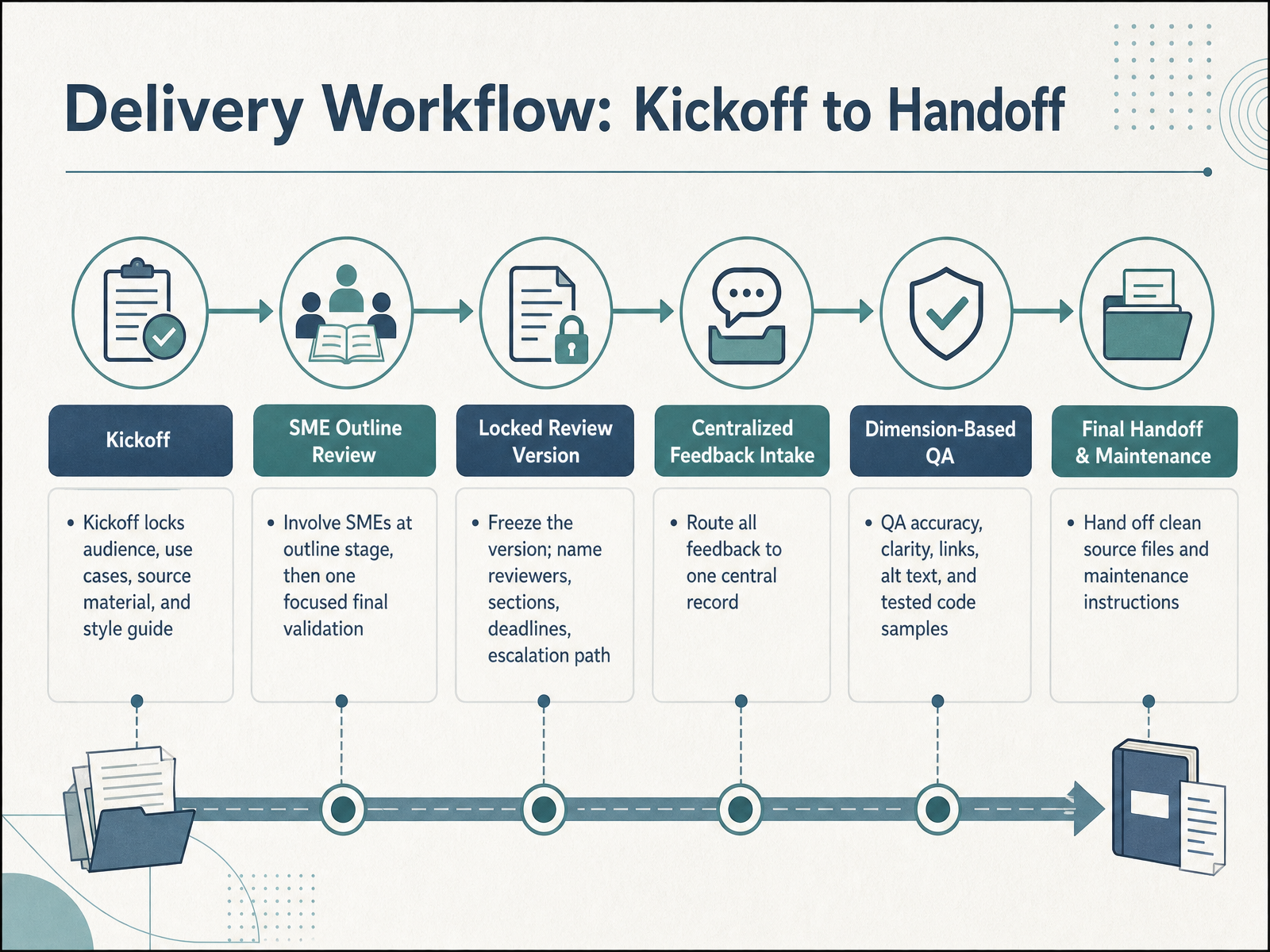
 - 09Delivery Workflow: Kickoff to HandoffNow let's walk through the delivery workflow, from kickoff to handoff. On a freelance engagement, this is the part you actually control, so it's worth getting tight.
Kickoff locks four things: the audience, the use cases, the source material, and the style guide. Get those agreed in writing before you draft. Then bring subject-matter experts in at the outline stage, not after the draft. That one early review catches wrong assumptions cheaply. Later, ask for one focused final validation.
When you send that review request, freeze the version. Name each reviewer, the sections they own, their deadline, and the escalation path. And route every comment into one central record, not email threads and chat. Skipping reconciliation is exactly why conflicting feedback stalls releases.
Before handoff, run quality assurance: accuracy, clarity, links, alt text, and code samples you've actually executed. Then hand off clean source files and short maintenance instructions, so the client isn't stuck with a broken document and you're not rehired to fix it.
One takeaway for your next project: write the review plan at kickoff, not when the draft is late and you're chasing sign-off.
Next, we'll look at working with subject-matter experts without bottlenecks.
 2 min
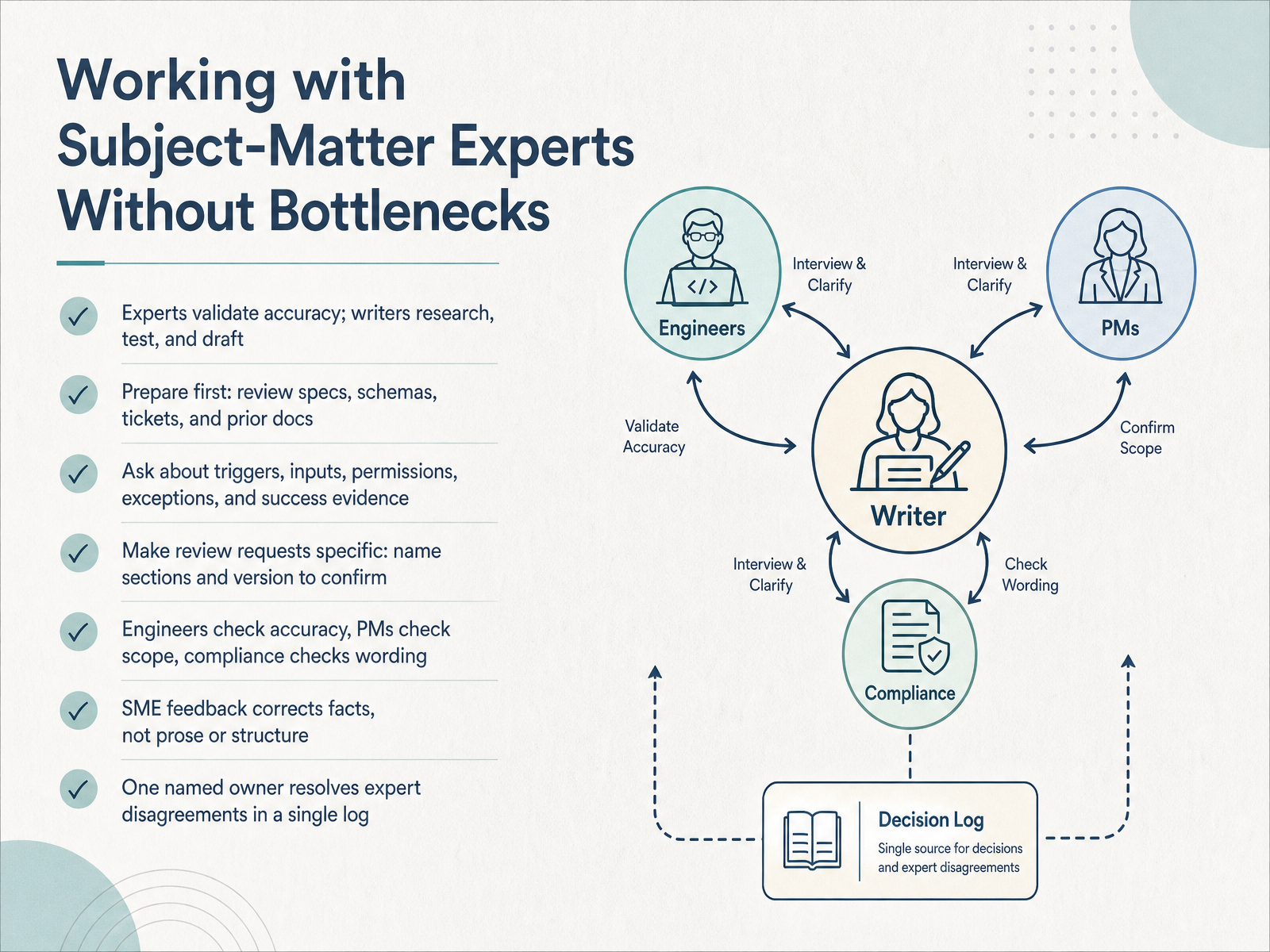
2 min - 10Working with Subject-Matter Experts Without BottlenecksLet's talk about the expert review stage, because this is where a lot of freelance projects quietly stall. Here's the division of labor. Experts validate accuracy. You research, test, and draft. So do your preparation first. Review the specs, schemas, tickets, and prior docs before you ever book time with anyone. Then ask about triggers, inputs, permissions, exceptions, and success evidence. Those five questions get you most of what you need. When you send a review request, make it specific. Name the sections you need checked and the version you want confirmed. That one habit prevents a lot of drift. Also, match the reviewer to the job. Engineers check accuracy. Product managers check scope. Compliance checks wording. And remember that expert feedback corrects facts, not prose or structure. When two experts disagree, one named owner resolves it in a single log. That keeps you out of the middle. Your takeaway: on your next engagement, name one decision owner before review starts.
 2 min
2 min - 11AI-Assisted Writing: Workflow, Verification, and EthicsLet's talk about AI-assisted writing, and how to use it without putting your reputation at risk.
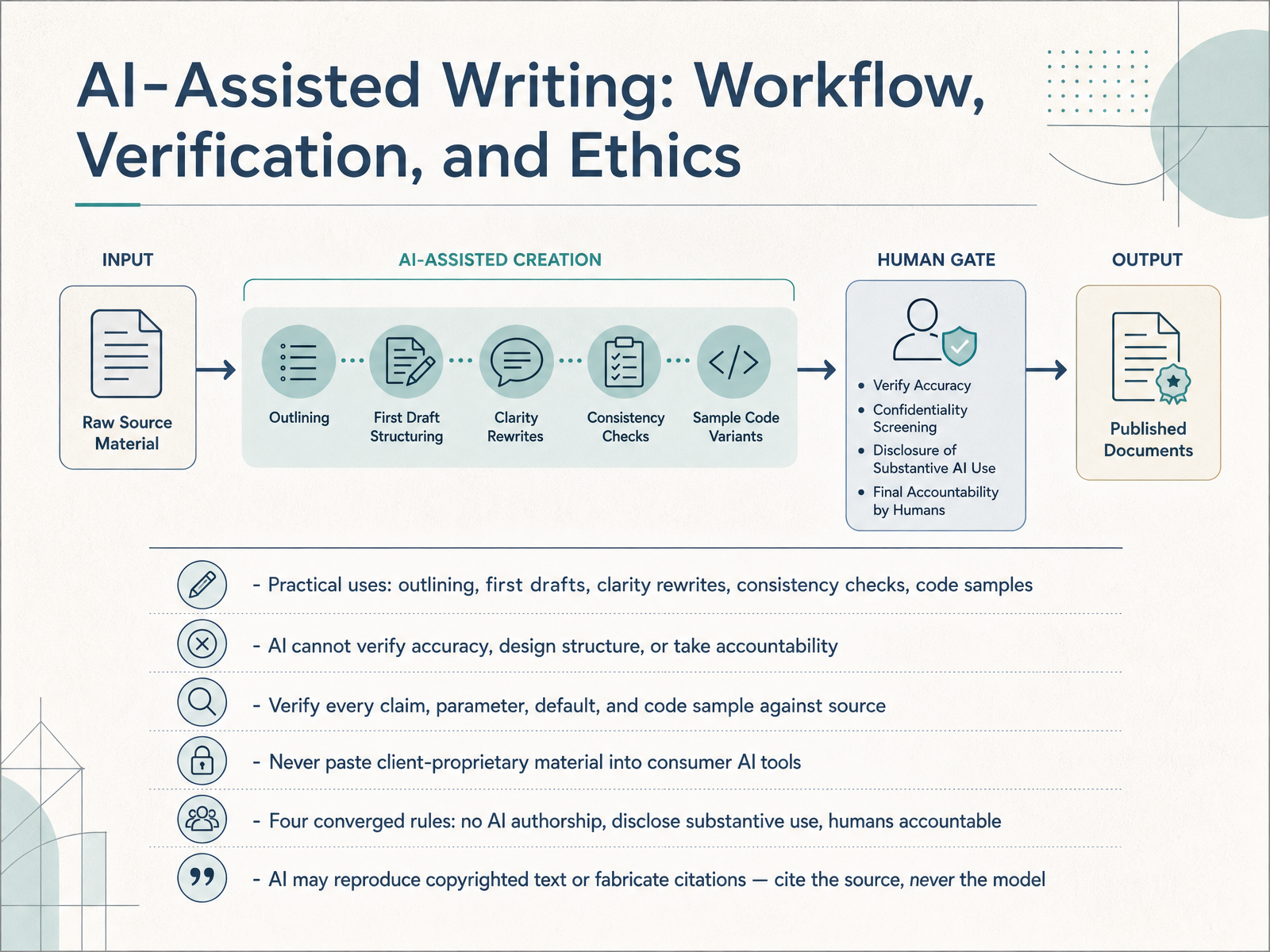
AI is genuinely useful for outlining, first drafts, clarity rewrites, consistency checks, and even code samples. Good uses. But it cannot verify accuracy, design structure, or take accountability. So verify every claim, parameter, default, and code sample against the source. Every time.
Also, never paste client-proprietary material into consumer AI tools. Use enterprise tools with no-training guarantees, or keep sensitive content out entirely.
On ethics, the rules have converged. Four points. AI cannot be an author. Disclose substantive use. A human stays accountable for the final work. And AI may reproduce copyrighted text or fabricate citations, so cite the source, never the model.
Here's your takeaway. Build a verification checklist into every engagement, and put your AI disclosure in writing before the project starts.
Next, we move into the business side of freelancing: Business Operations for Independent Professionals.
 techiecv.combeingtechnicalwriter.comwritetechhub.org+22 min
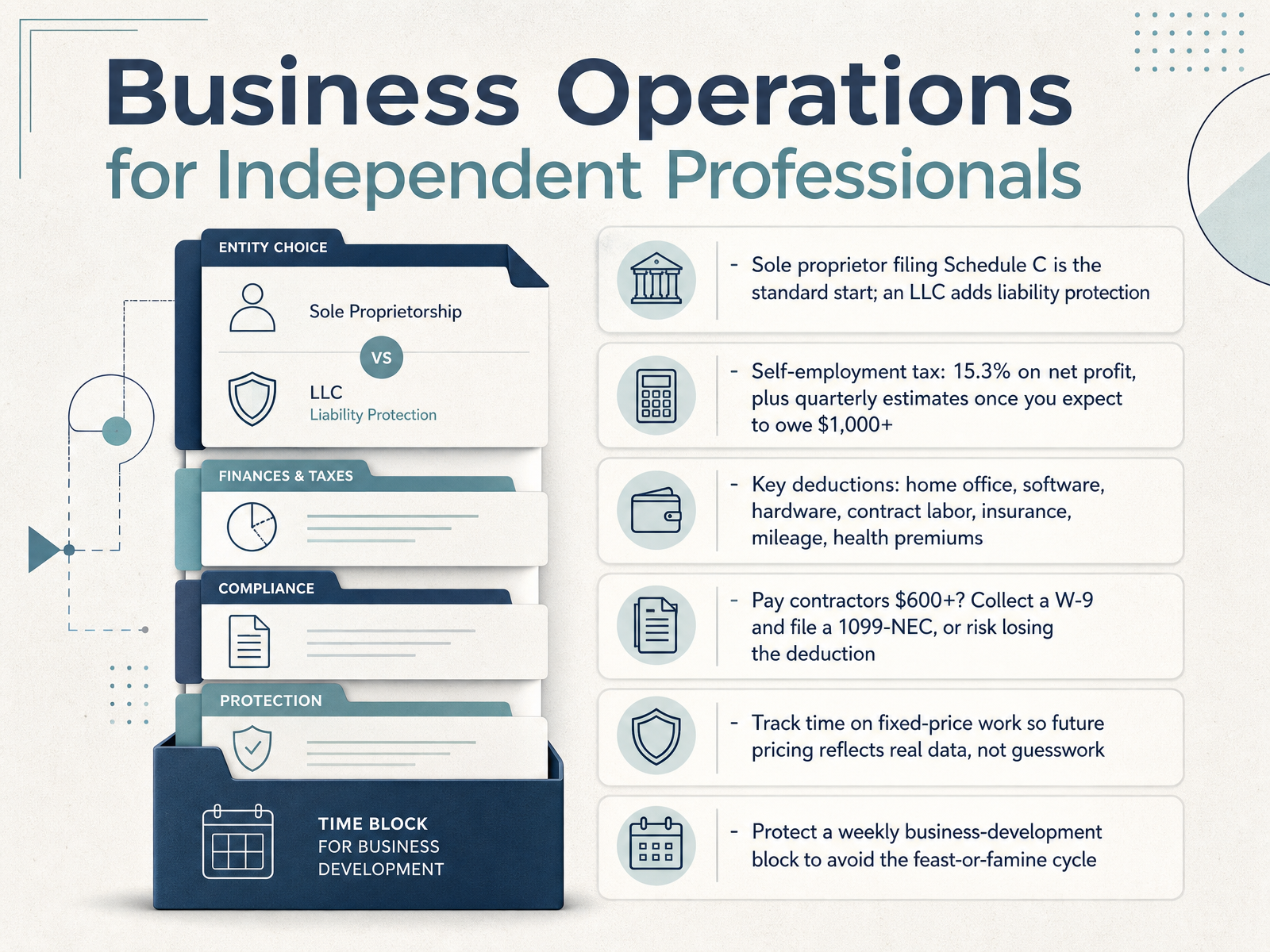
 - 12Business Operations for Independent ProfessionalsNow let's talk about the business side of your practice, the part clients never see. Most independent technical writers start as sole proprietors, filing Schedule C. It's simple. An LLC adds liability protection, but it's optional, so weigh the tradeoff. On taxes, expect self-employment tax of fifteen point three percent on net profit, plus quarterly estimates once you expect to owe a thousand dollars or more. Deductions matter here. Home office, software, hardware, contract labor, insurance, mileage, health premiums. Each one lowers both your income tax and your self-employment tax. One rule to remember. If you pay a contractor six hundred dollars or more, collect a W-N nine and file a ten ninety-nine N E C, or you risk losing that deduction entirely. Two habits protect your margins. First, track time on fixed-price work so future pricing reflects real data, not guesswork. Second, protect a weekly business-development block, so you never fall into the feast-or-famine cycle. Pick your takeaway. This week, block that business-development hour, and set up a simple spreadsheet to log time and expenses on your current engagement. Next, we'll look at specialization, scaling, and rate growth.
 2 min
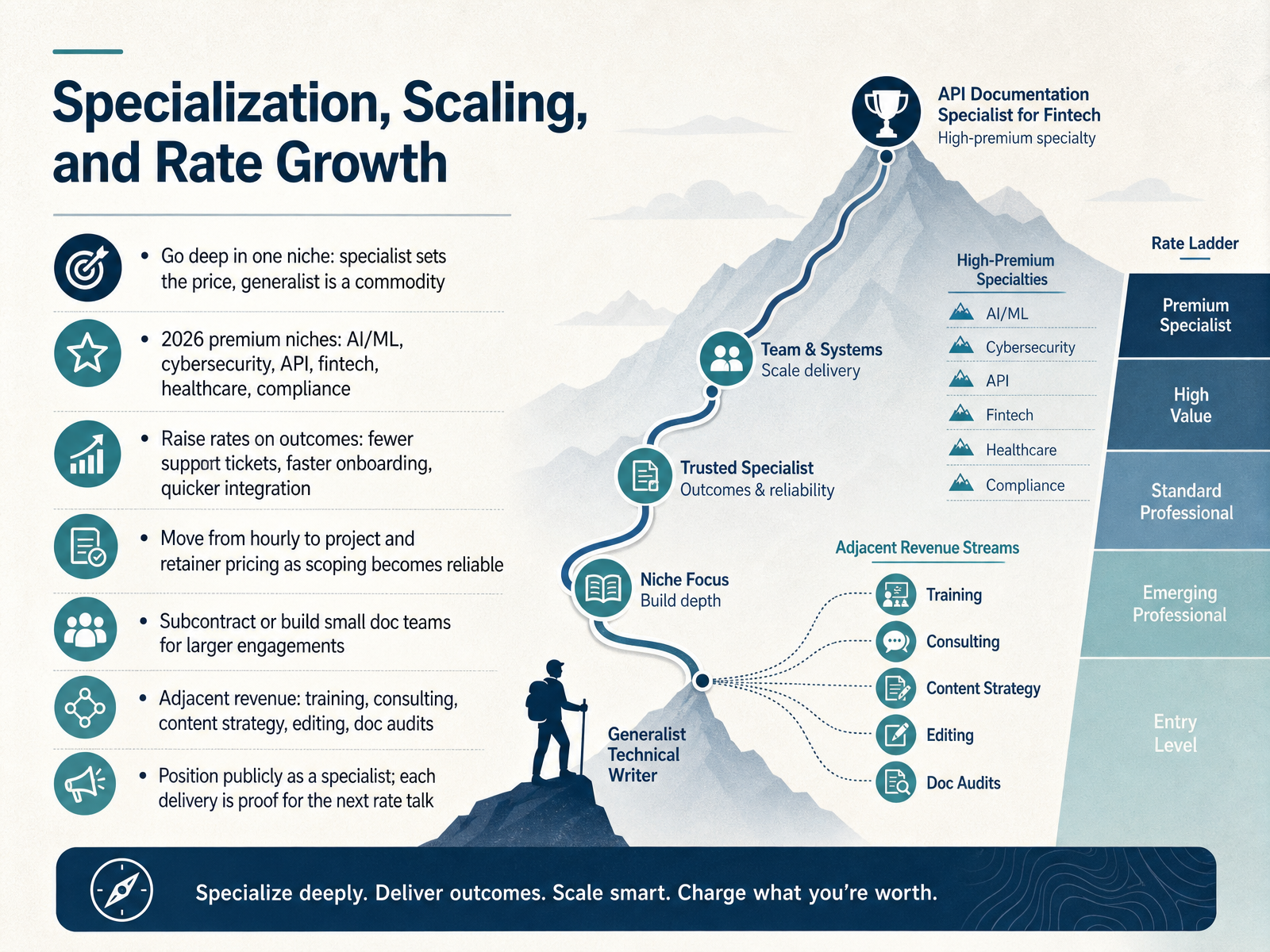
2 min - 13Specialization, Scaling, and Rate GrowthNow let's talk about the moves that raise your ceiling: specialization, scaling, and rate growth. The core idea is simple. A generalist is a commodity. A specialist sets the price. So pick one niche and go deep. In 2026, premium niches include AI and machine learning, cybersecurity, API documentation, fintech, healthcare, and compliance work.
Then connect your rate to outcomes. Not word count, but results. Fewer support tickets. Faster onboarding. Quicker integration. When you can show that, a rate conversation stops being about your hourly cost and becomes about the client's return.
As your scoping gets reliable, shift away from hourly billing. Move to project fees first, then monthly retainers. For bigger engagements, subcontract or build a small documentation team rather than turning work down. And stack adjacent revenue on top of writing: training, consulting, content strategy, editing, documentation audits. Finally, position yourself publicly as a specialist. Every delivery becomes proof for your next rate talk. Here's your takeaway: choose one niche this week, and rewrite one case study to lead with the outcome you produced. From there, let's map your first ninety days: the action plan and the metrics that tell you it's working.
 biztoolkit.coearnifyhub.comgolance.com+22 min
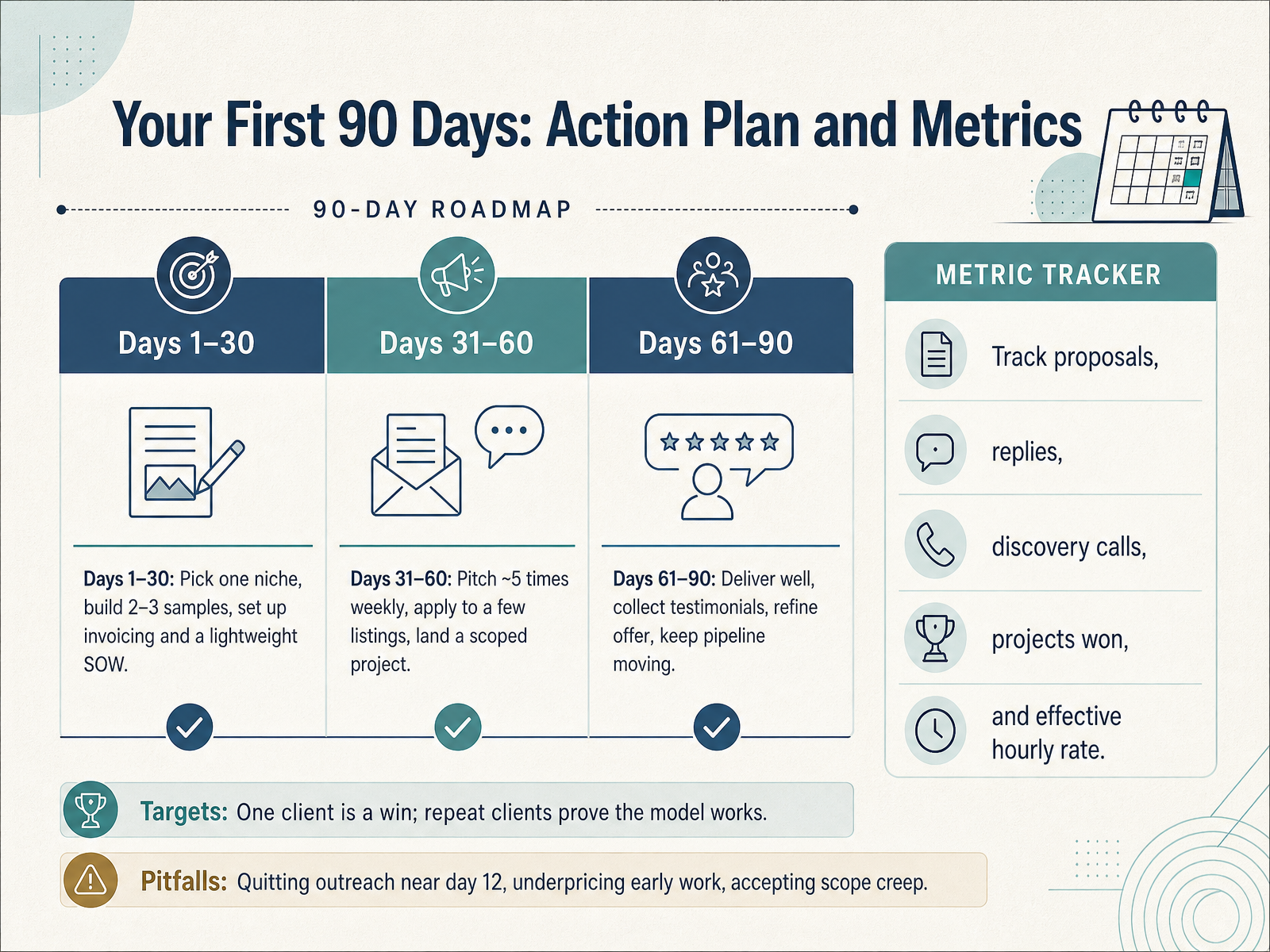
 - 14Your First 90 Days: Action Plan and MetricsLet's pull the whole course together with a simple ninety-day plan. Days one through thirty: pick one niche, build two or three samples, and set up invoicing and a lightweight statement of work. Keep it light. In days thirty-one through sixty, pitch about five times a week, apply to a few listings, and land one properly scoped project. Then days sixty-one through ninety, deliver well, collect testimonials, sharpen your offer, and keep that pipeline moving. Now, targets and tracking. One client is a win. A repeat client proves the model works. Track proposals sent, replies, discovery calls, projects won, and your effective hourly rate, which is simply total project fee divided by actual hours worked. Watch two pitfalls: quitting outreach around day twelve, right when replies usually start, and underpricing early work or accepting scope creep. Here's your takeaway. Keep the ninety-day loop running: position, pitch, deliver, refine. You will not feel finished, but you will feel started. Thanks for sticking with me, and good luck out there. You've got this.
 biztoolkit.coearnifyhub.comgolance.com+22 min
Take the deck with you
Download this course as a file — free, no sign-up needed.
- PDF handoutEvery slide page, ready to print or share.15 pages · 4.5 MBDownload
- Narrated PowerPointThe deck that presents itself — every slide carries the digital human's narration video.15 pages · 16.7 MBDownload
- PowerPoint slidesThe full deck as a .pptx — open it in PowerPoint, Keynote, or Google Slides.15 pages · 4.5 MBDownload
Free to use in your own training — please keep the PersonWise credit page at the end.
Have your own deck? Turn it into a course
Sources consulted
Web sources consulted while building this course.
- Technical Writers : Occupational Outlook Handbook — bls.gov
- Cost to Hire a Technical Writer 2026: $81,050/yr — stealthagents.com
- Freelance Technical Writer Rates 2026 — biztoolkit.co
- 12 predictions for tech comm in 2026 | I'd Rather Be Writing Blog and API doc course — idratherbewriting.com
- Remote Technical Writer Jobs: Salary, Skills & Who's Hiring | Remote Job Assistant Blog — remotejobassistant.com
- Technical Writing Rates 2026: Why $1/Word Is Normal for | EarnifyHub — earnifyhub.com
- Technical Writer Hourly Rate Guide 2026 — golance.com
- Technical Writer Hourly Rate Guide 2026 — How Much to Pay | goLance — golance.com
- Technical Writer Resume Skills & ATS Keywords (2026) | TechieCV — techiecv.com
- The technical writer's survival kit for 2026 (and beyond) | Being technical writer — beingtechnicalwriter.com
- 5 Critical Skills Technical Writers Need in 2026 - WriteTech Hub — writetechhub.org
- Essential Technical Writing Skills that Matter in 2026 — technicalwriterhq.com
- Top Technical Writing Portfolio Examples I'd Use for Inspiration in 2026 — technicalwriterhq.com
- alxawl/technical-writer-portfolio — github.com
- Chapter 40: The Communication Portfolio: Bringing It All To... | Technical Writing — datafield.dev
- How to Write a Resume for a Technical Writer Role (with Portfolio Tips) | PrismResume — prismresume.com
- GitHub - Gokul-Techwriter/technical-writing-portfolio: Technical Writing Portfolio — Gokul S Anand 10 documents (MD + PDF) across User Guides, Installation Guides, Troubleshooting Guides, FAQs, and API Documentation. Covers tools and platforms including VS Code, Postman, WhatsApp, Zoom, Gmail, Googl — github.laiyagushi.com
- Where to Find Freelance Technical Writing Jobs Online — skilldential.com
- Technical Writing Freelance Jobs: Work Remote & Earn ... — upwork.com
- Freelance Technical Writing Jobs | All Freelance Writing — allfreelancewriting.com