Begin
20 pages · ~40 min
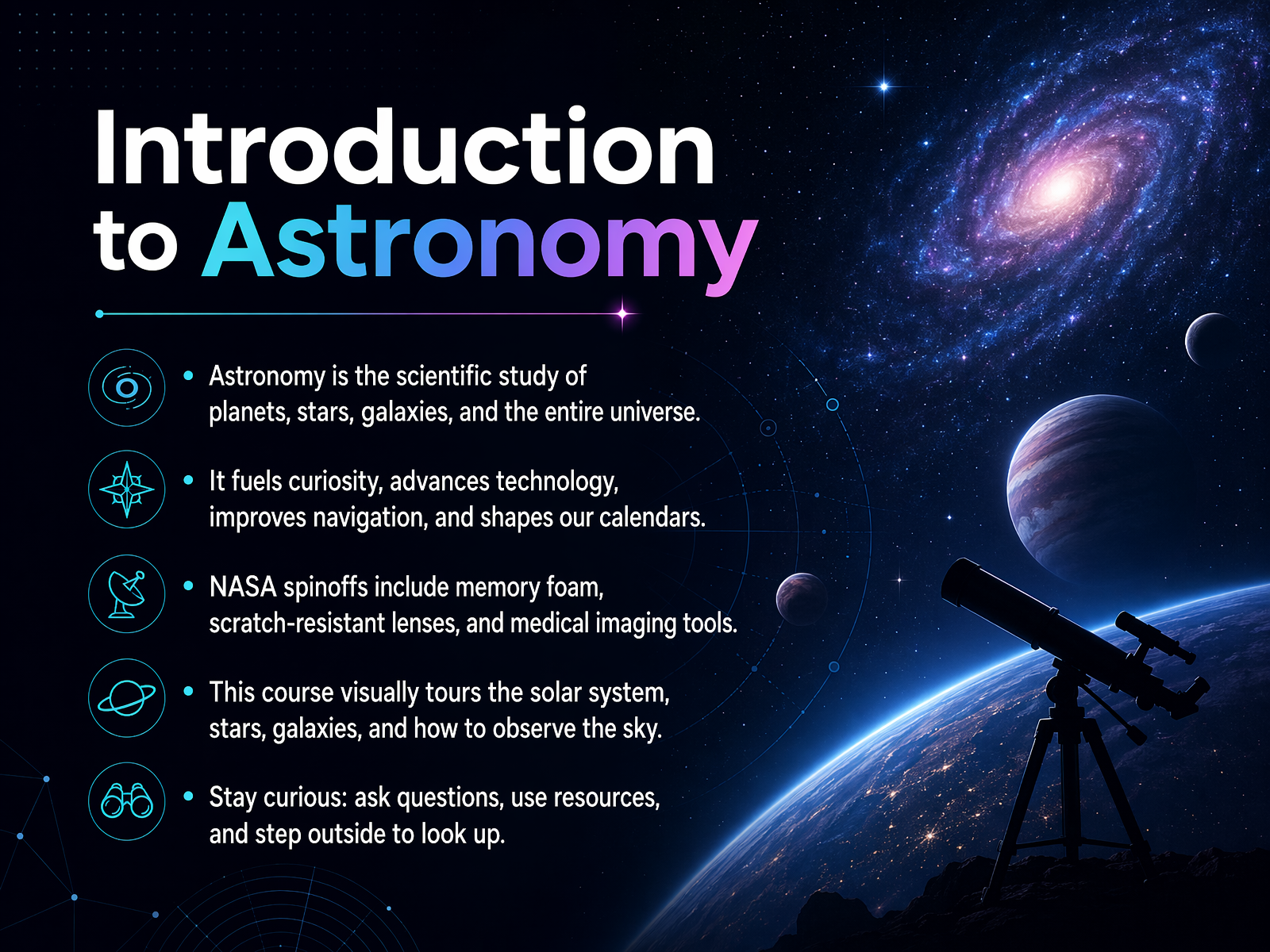
Introduction to Astronomy
A beginner-friendly course exploring the fundamentals of astronomy, teaching learners about celestial objects, the solar system, and basic observational techniques.
A digital instructor presents all 20 pages. Hold “Ask” at any point and ask out loud — the answer comes from this course. No sign-up needed.
What you’ll learn
- 01Introduction to AstronomyWelcome to Introduction to Astronomy. This course explores planets, stars, galaxies, and the wider universe. We will focus on enduring scientific ideas, how observations work, and questions that remain open.ntts-prod.s3.amazonaws.comscience.nasa.govnasa.gov+22 min
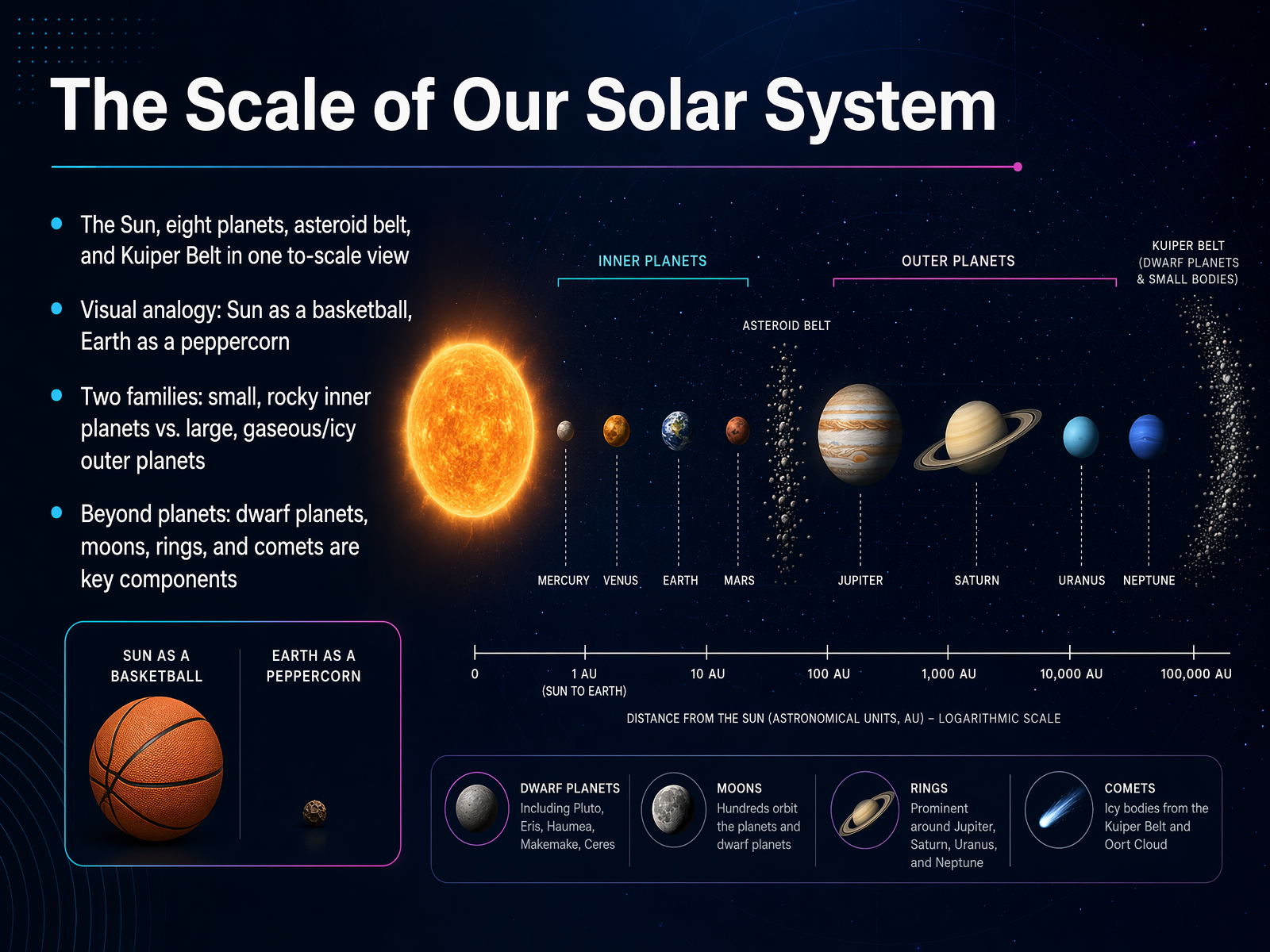
- 02The Scale of Our Solar SystemOur solar system is a family of objects orbiting the Sun. Rocky planets lie closer to the Sun, while larger planets, smaller bodies, and distant icy regions show the range of worlds astronomers study.
 beta.iopscience.iop.orgspace.comsciencenews.org+22 min
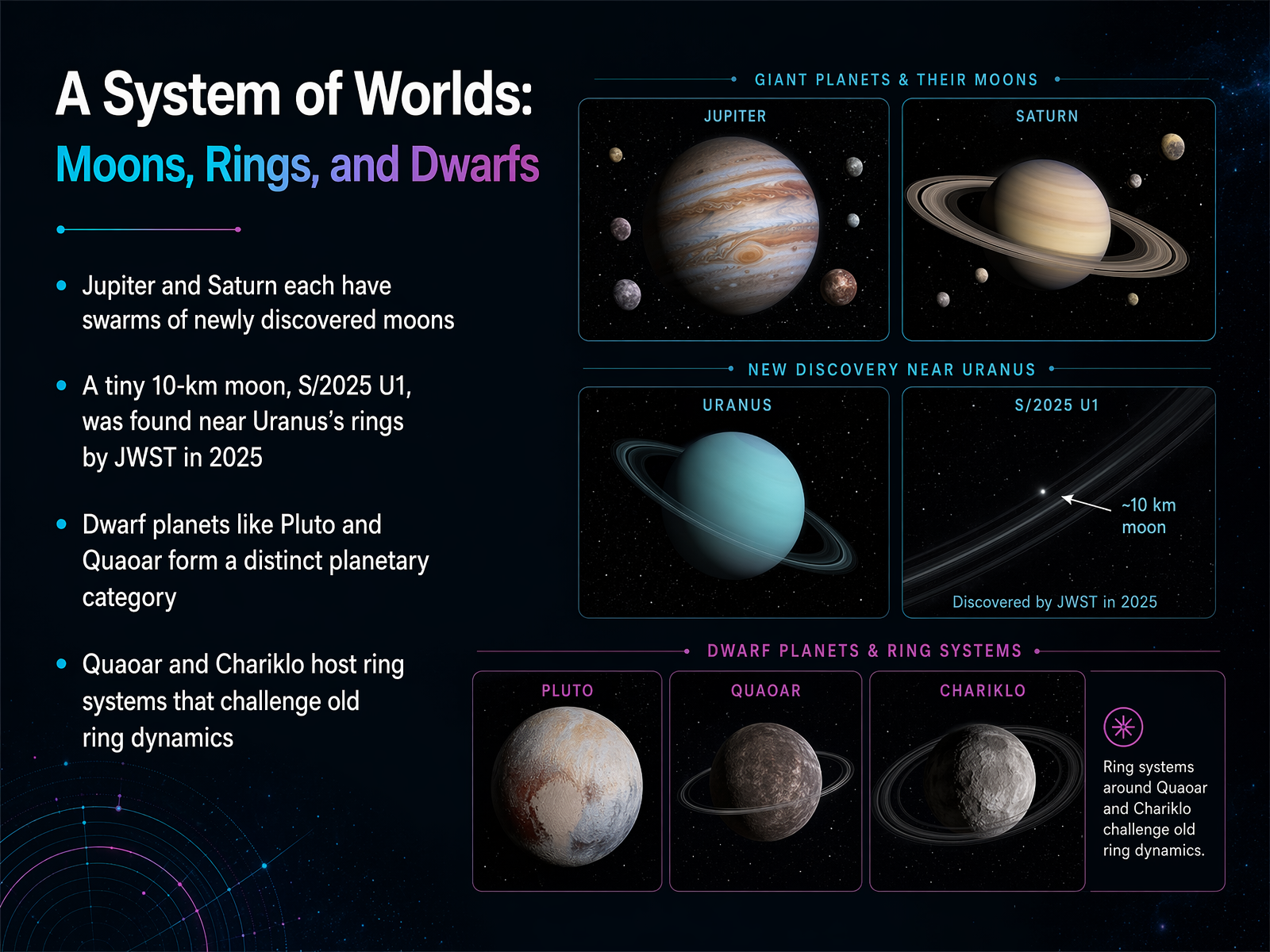
 - 03A System of Worlds: Moons, Rings, and DwarfsMoons, rings, and dwarf planets show that planetary systems contain many kinds of objects. Astronomers compare their surfaces, motions, and histories to understand how systems change.
 beta.iopscience.iop.orgspace.comsciencenews.org+22 min
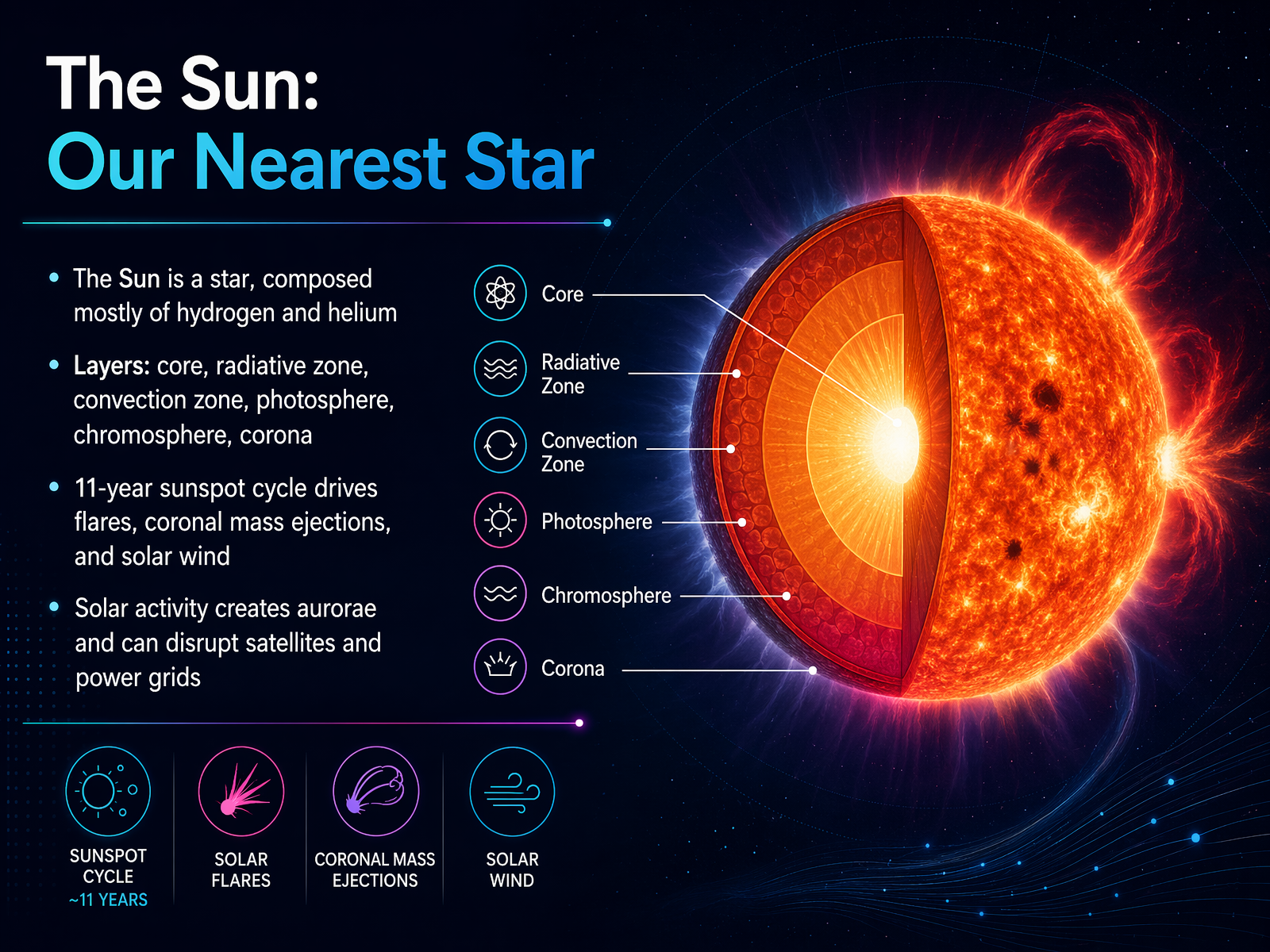
 - 04The Sun: Our Nearest StarThe Sun is a star whose energy supports life on Earth. Its visible surface and outer atmosphere can change, so scientists observe it to understand solar activity.
 en.wikipedia.orgscience.nasa.govarxiv.org+22 min
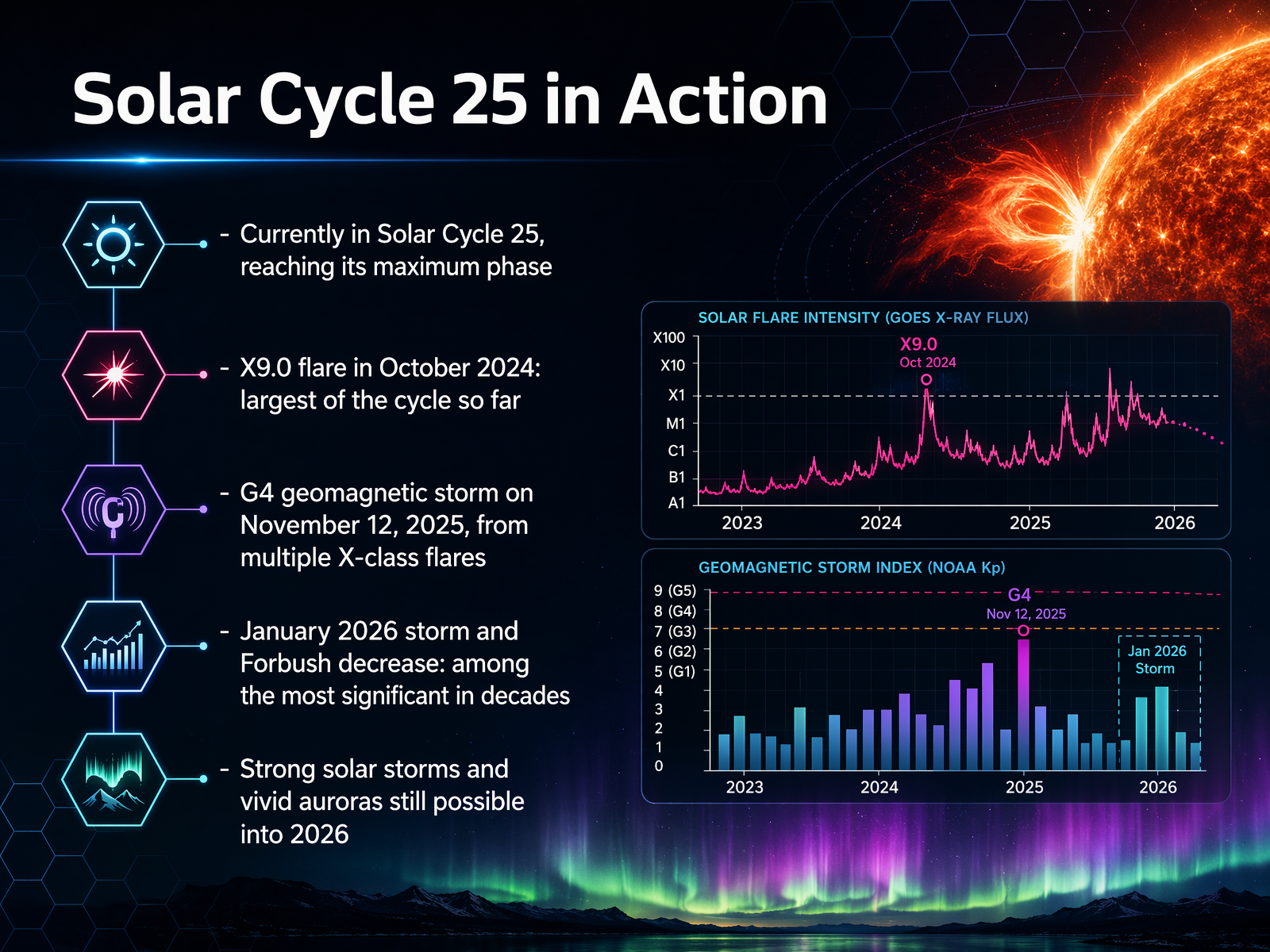
 - 05The Sun as an Active StarSolar activity can include bright flares and streams of particles. These can interact with planetary magnetic environments and help create auroras.
 en.wikipedia.orgscience.nasa.govarxiv.org+21 min
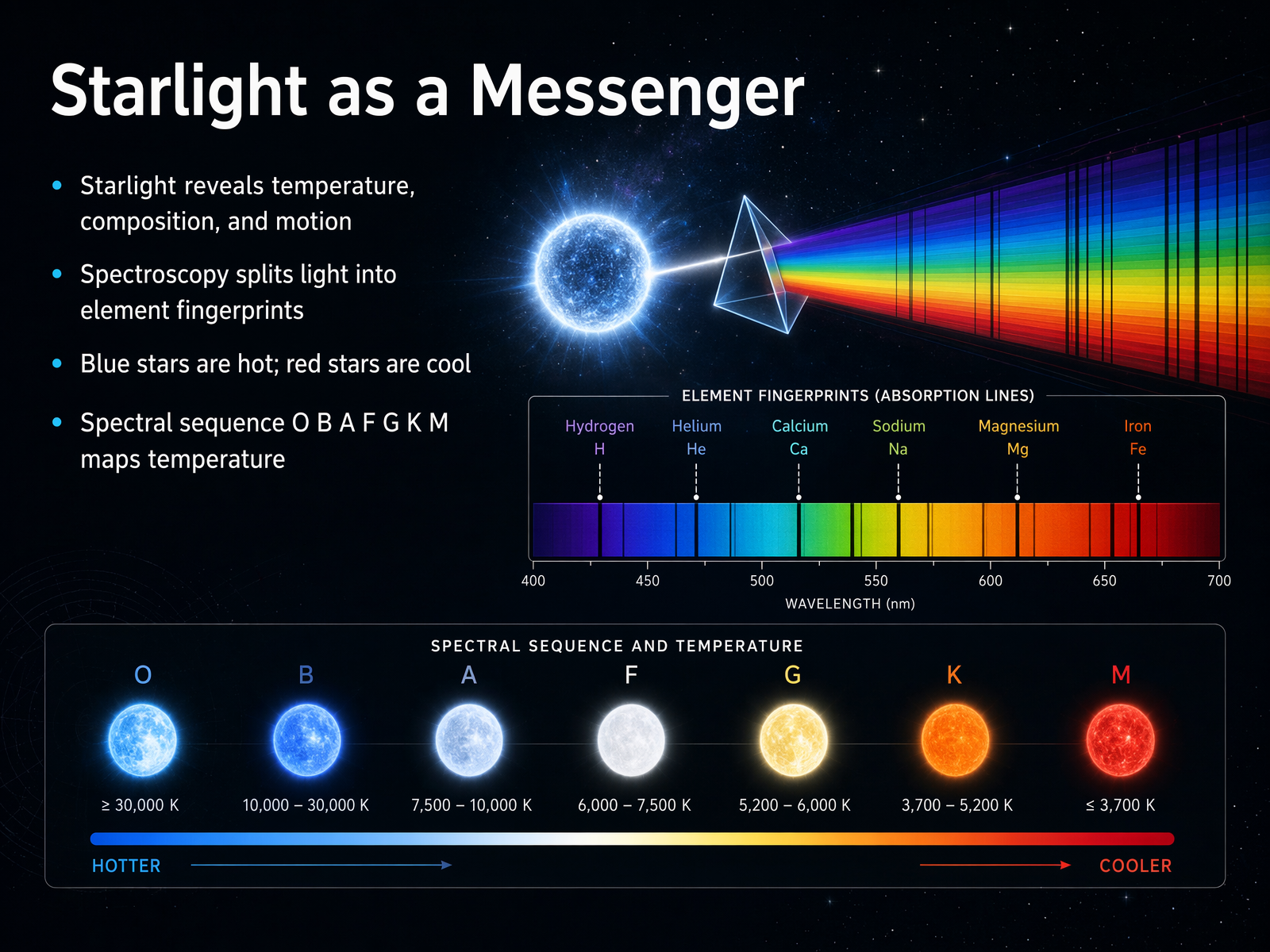
 - 06Starlight as a MessengerNow, let's see how starlight becomes a messenger. Every tiny beam of light traveling across space carries a surprising amount of information. It tells us about a star's temperature, its chemical makeup, and even how it's moving. But how do we decode this message? We use a technique called spectroscopy. It splits light into a beautiful rainbow we call a spectrum. Think of it as a star's unique barcode. By studying the dark and bright lines in this spectrum, we can identify the fingerprints of chemical elements, like hydrogen and helium. The color of the star also gives us a direct clue. Blue stars are incredibly hot, while red stars are much cooler. Astronomers organize these starlight patterns into a sequence: O, B, A, F, G, K, and M. Our own Sun is a G-type star. Up next, we'll learn how astronomers use these and other tools to map out the cosmos on the Cosmic Distance Ladder.
 2 min
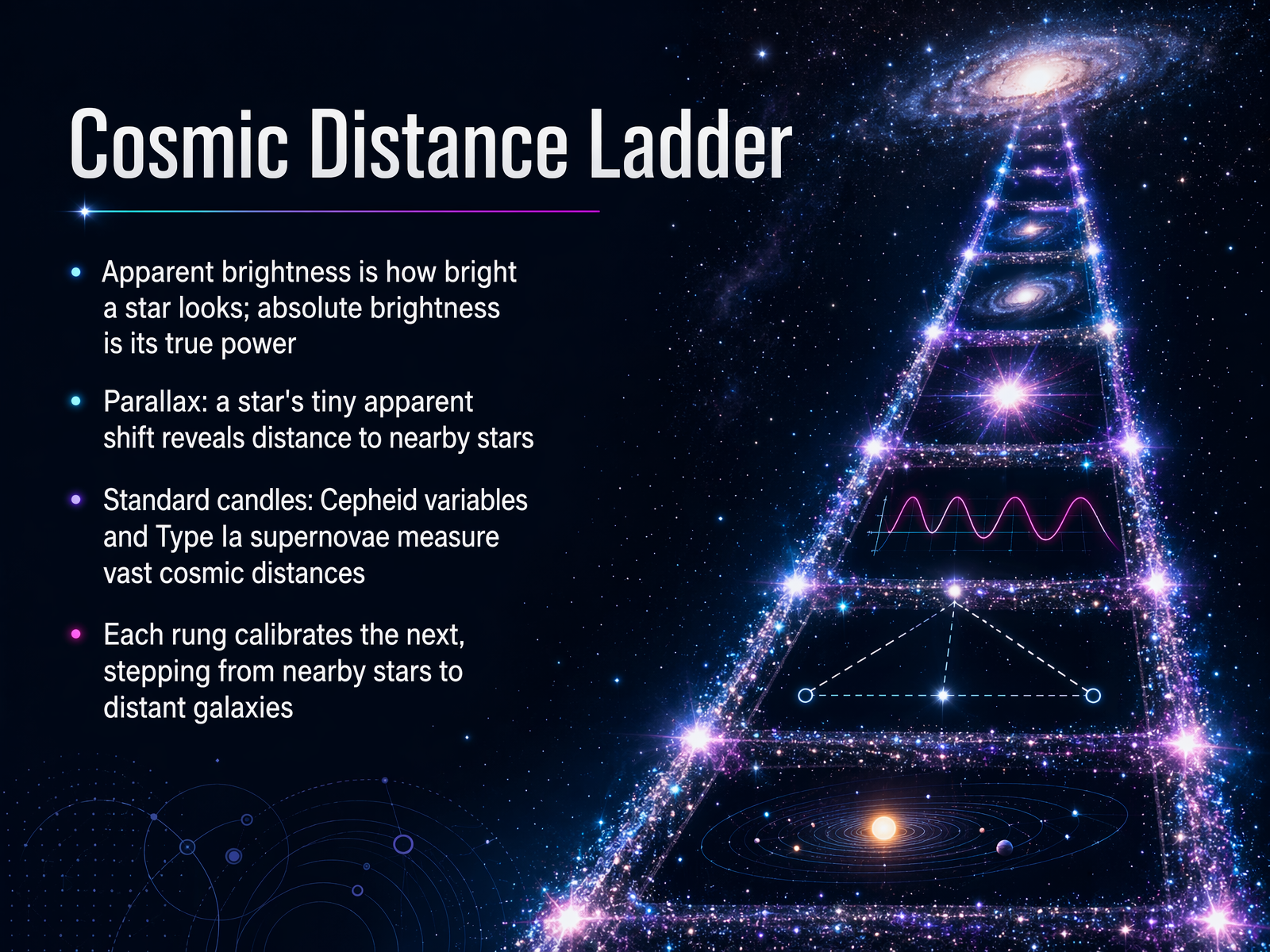
2 min - 07Cosmic Distance LadderNow let's take that idea of brightness and build a ladder into deep space. We call this the cosmic distance ladder. Here's the first step. A star might look bright in our sky, but is it really powerful, or just very close? Astronomers distinguish between apparent brightness, what we see from Earth, and absolute brightness, the star's true light output. To tell them apart, we need to measure distance. For nearby stars, we use a method called stellar parallax. Hold your thumb out and blink one eye, then the other. Your thumb seems to jump against the background. Astronomers do the same thing, watching a star against distant stars from opposite sides of Earth's orbit. That tiny apparent shift reveals the star's distance. But for stars much farther away, that shift is too small to see. We climb to the next rung, using standard candles. These are objects with a known absolute brightness, like a bulb with a fixed wattage. Cepheid variable stars pulse in a way that reveals their true power. And type Ia supernovae are colossal explosions so uniformly bright we can see them in distant galaxies. By comparing how bright they appear to how bright we know they are, we calculate their distance. Each rung of this ladder is calibrated by the one below it, letting us measure out across the universe. This same laddering technique will help us understand the very birth of stars, which is where we're heading next.
 2 min
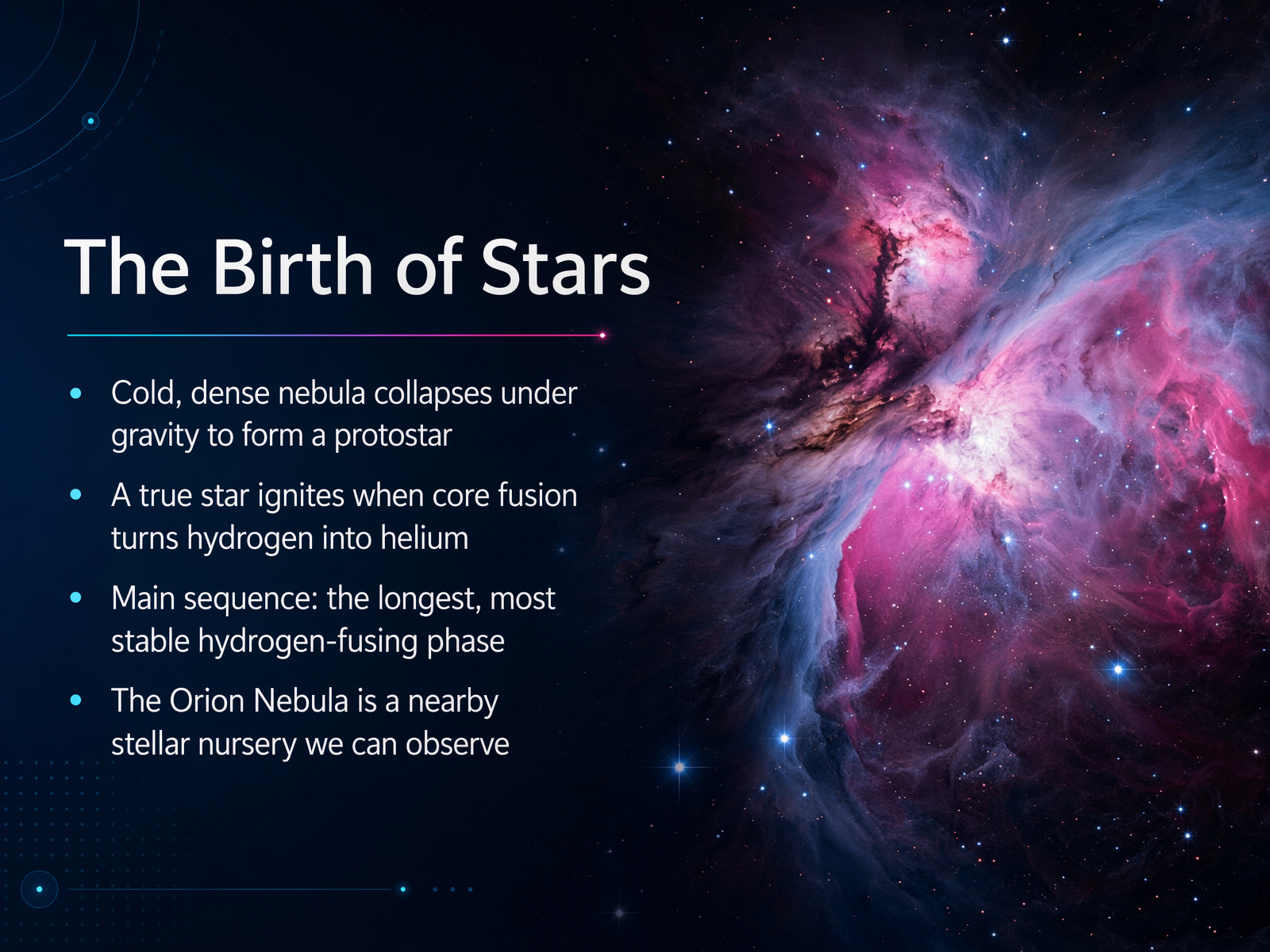
2 min - 08The Birth of StarsNow, let’s witness the birth of stars. It all begins in a nebula. A nebula is a vast, cold cloud of gas and dust. Gravity slowly pulls clumps of this material together. As the cloud collapses, it flattens into a spinning disk and a hot, dense core forms at the center. We call this a protostar. The protostar keeps heating up, growing denser and hotter, until its core reaches a staggering temperature. At that point, nuclear fusion ignites. This is the moment a true star is born. Fusion converts hydrogen into helium, releasing an immense amount of energy. This energy creates an outward pressure that balances gravity’s inward pull. The star settles into a long, stable period called the main sequence. Our own sun is a main sequence star. You can see this process happening right now in the Orion Nebula, a giant stellar nursery visible even with binoculars. Next, we’ll discover what happens when stars exhaust their fuel. Let’s explore the lives and deaths of stars.
 2 min
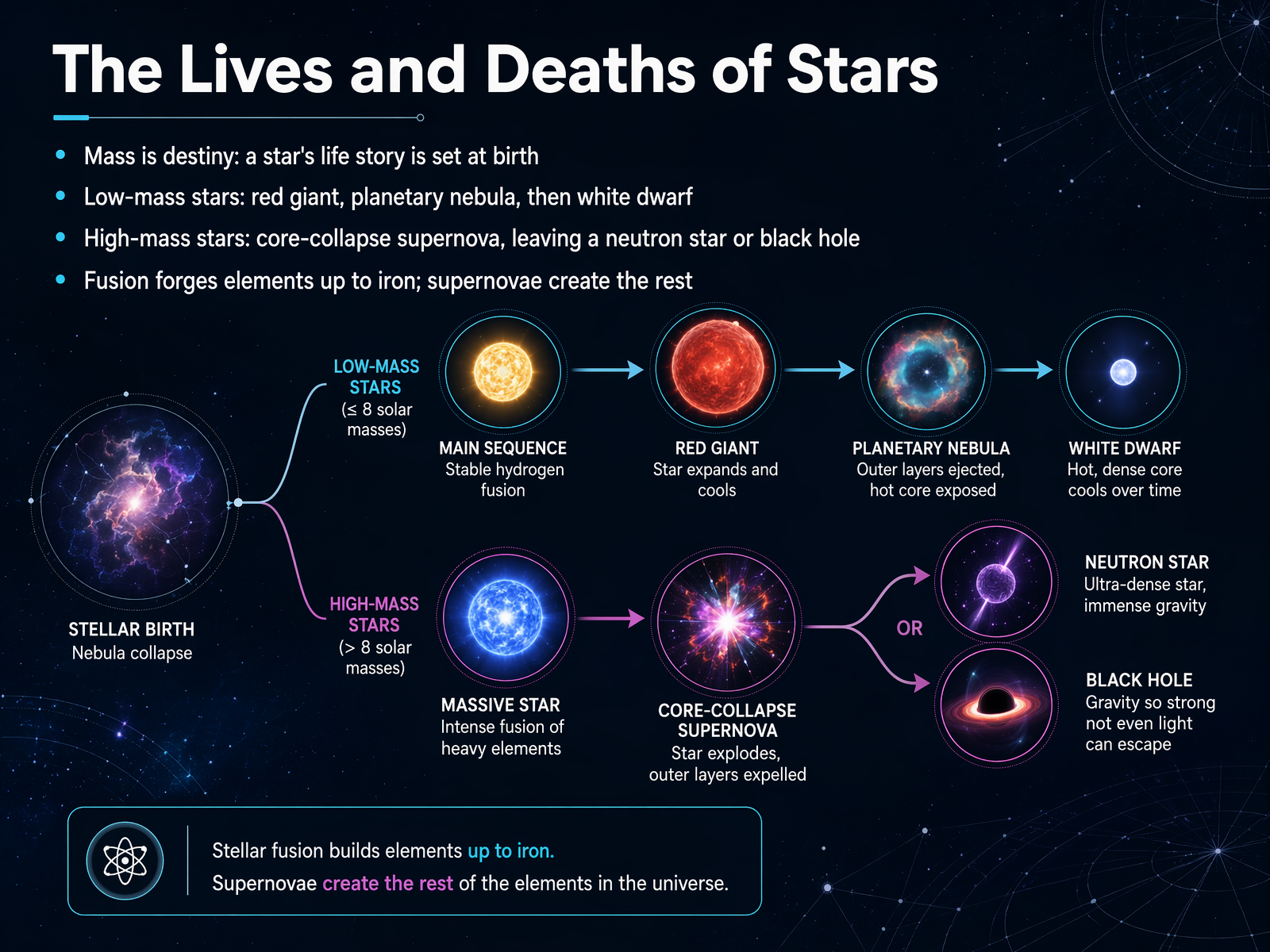
2 min - 09The Lives and Deaths of StarsStars change over long timescales. Their mass influences how they shine, evolve, and return material to space.
 2 min
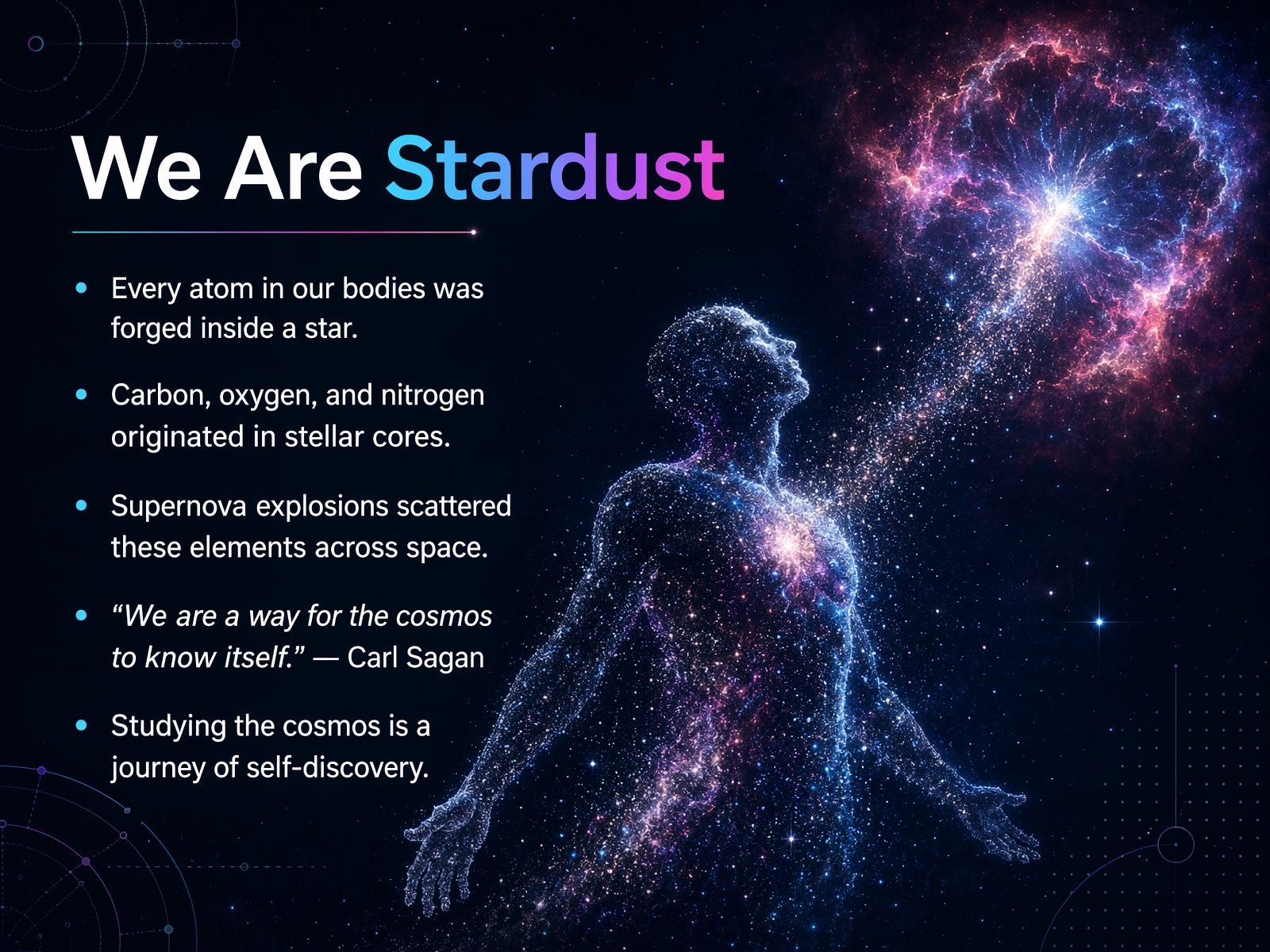
2 min - 10We Are StardustElements found in planets and living things have a cosmic history. Studying stars helps astronomers understand how matter is created and recycled.
 2 min
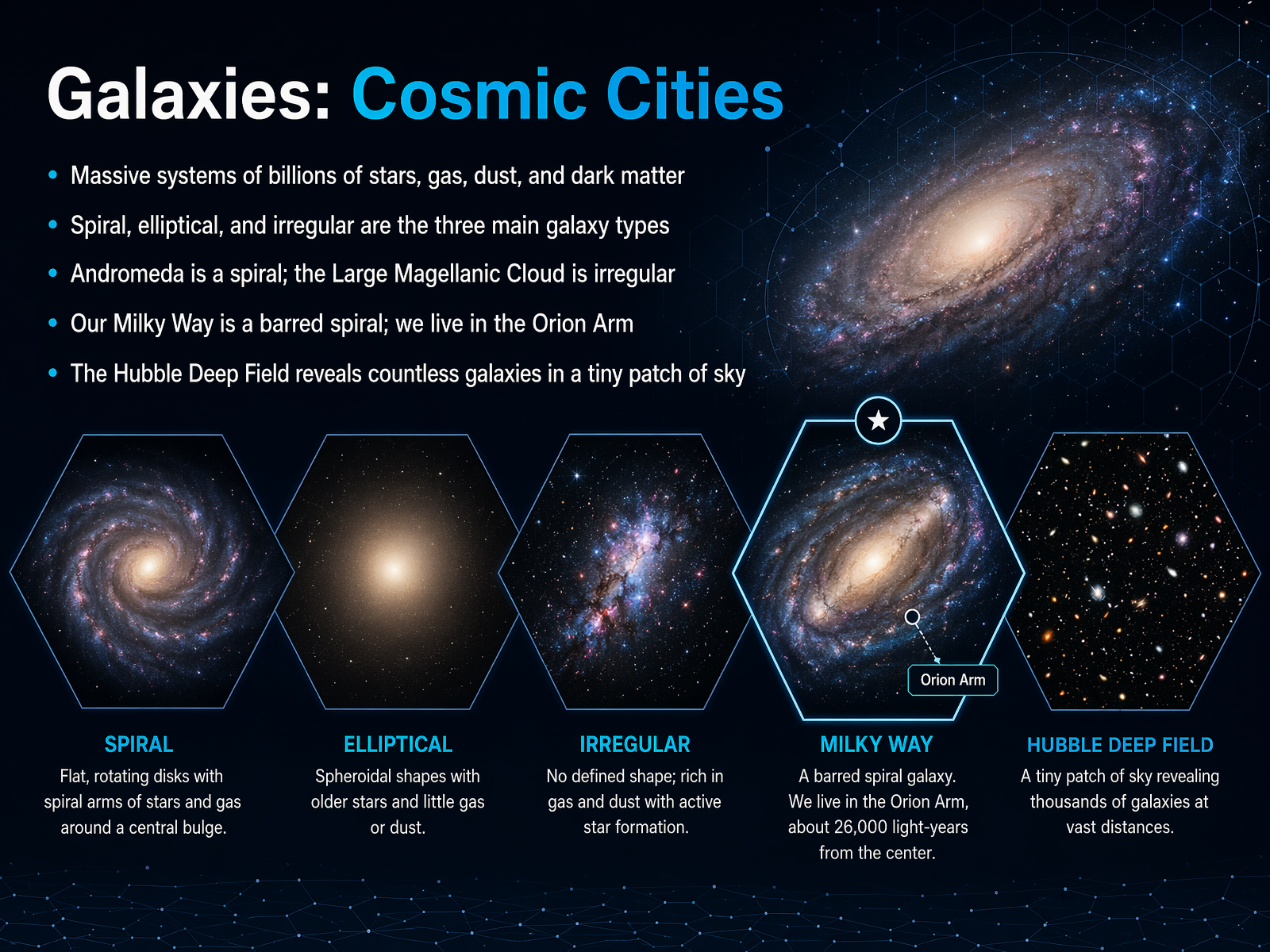
2 min - 11Galaxies: Cosmic CitiesA galaxy is a gravitationally bound collection of stars, gas, dust, and dark matter. Galaxies come in varied shapes and sizes, and their patterns reveal how they evolve.
 2 min
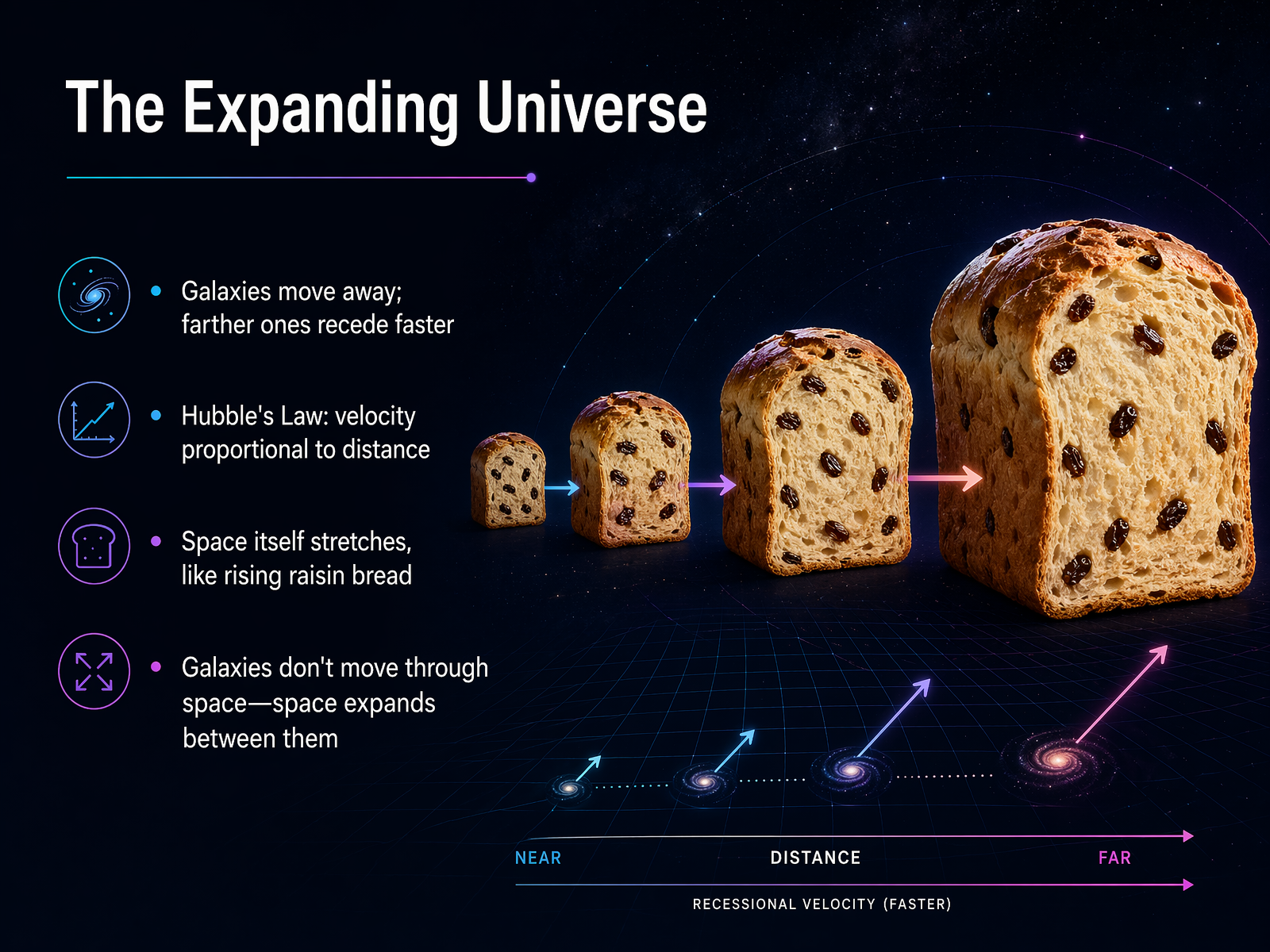
2 min - 12The Expanding UniverseObservations of distant galaxies show that the universe changes over time. Scientists use light and motion to test models of cosmic expansion.
 2 min
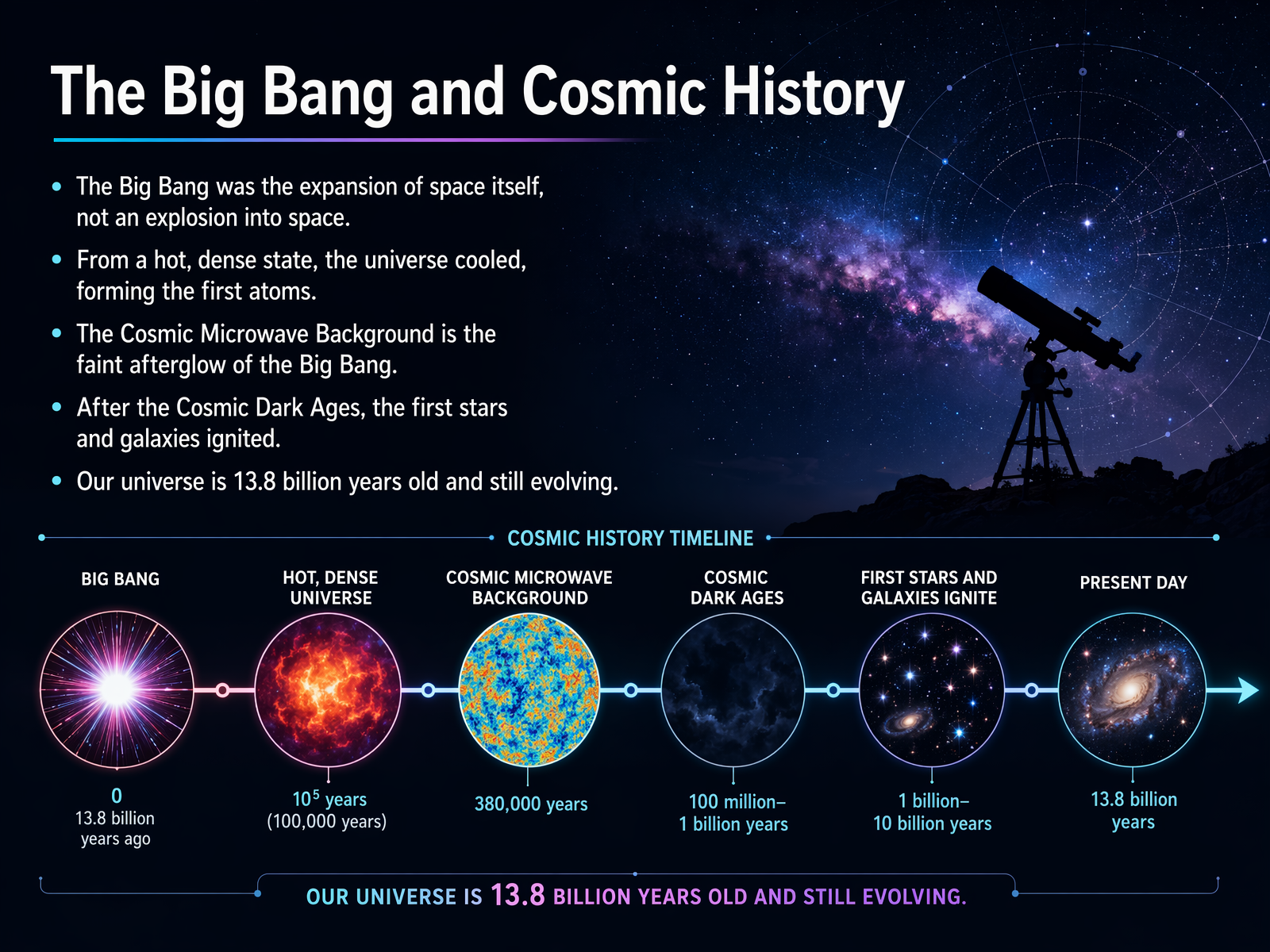
2 min - 13The Big Bang and Cosmic HistoryNow we journey back to the very beginning of everything. The Big Bang wasn't an explosion in space, but rather the rapid expansion of space itself from an incredibly hot, dense state. As the universe cooled, the first simple atoms formed, kicking off a long period astronomers call the Cosmic Dark Ages. For a time, the universe was a vast, lightless fog. Then, gravity pulled matter together, igniting the very first stars and galaxies, whose brilliant light finally pierced the darkness. We can still detect a faint afterglow from that fiery start, a signal that fills the entire sky known as the Cosmic Microwave Background. It is a baby picture of the cosmos. And the story continues, because the universe is still evolving and being actively studied today. Next, we will look at one of the most exciting discoveries in modern astronomy, the exoplanet revolution.
 1 min
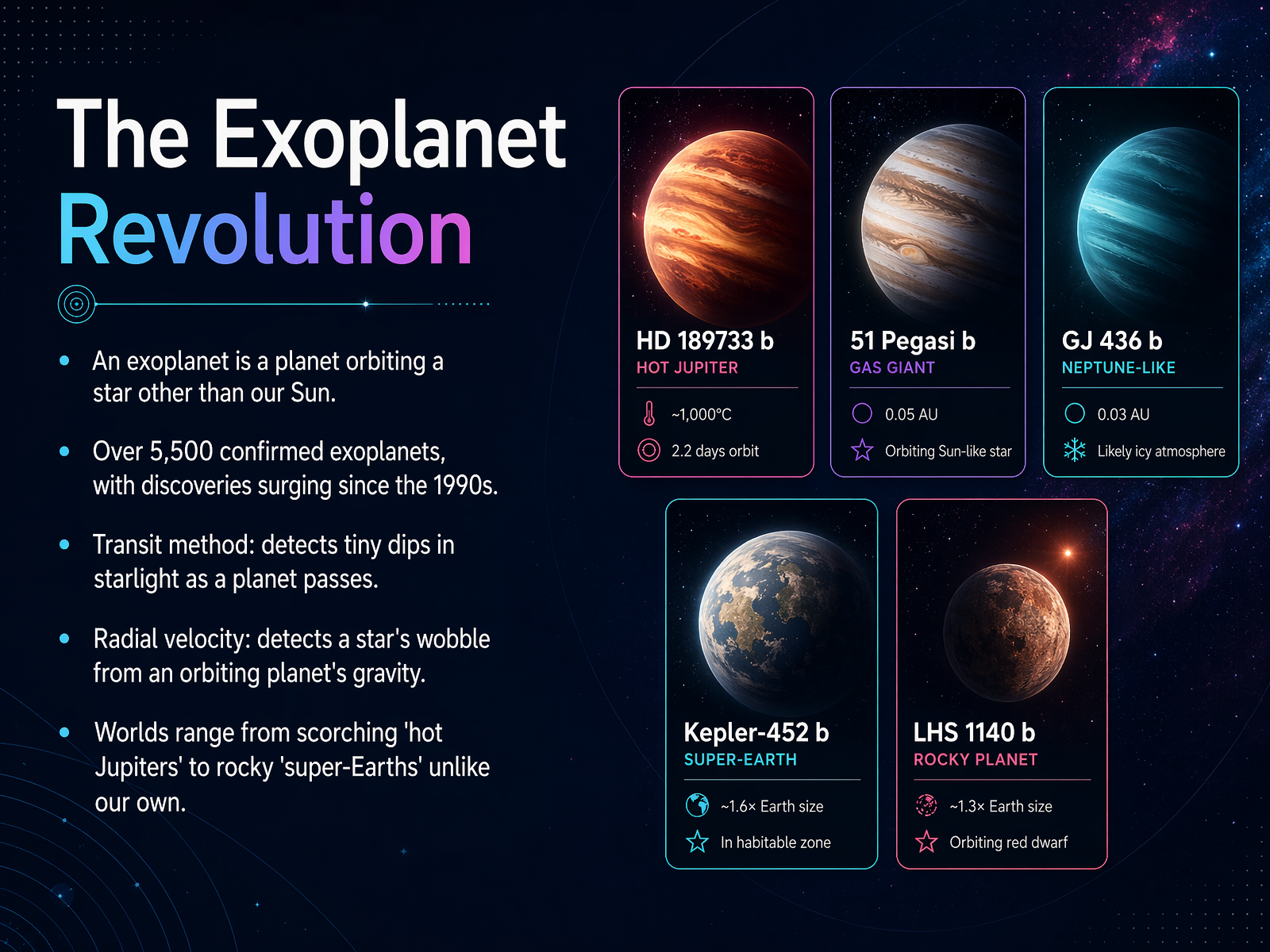
1 min - 14The Exoplanet RevolutionAn exoplanet is a planet that orbits another star. Astronomers detect them by studying small changes in starlight and motion, then compare many systems.
 bbc.comnpr.orgphys.org+22 min
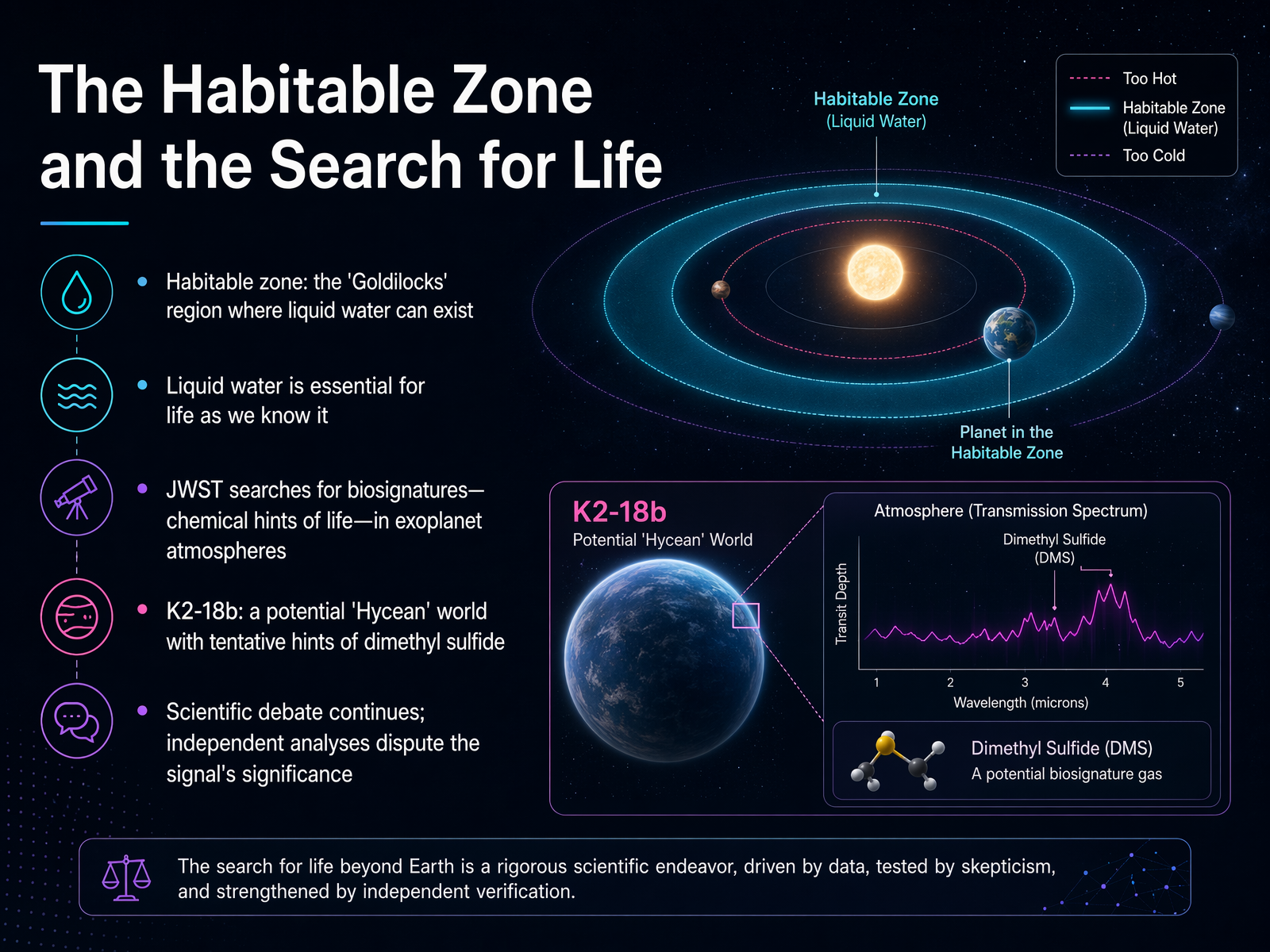
 - 15The Habitable Zone and the Search for LifeThe habitable-zone idea is one way to think about conditions that might allow liquid water. It is a starting point for investigation, not proof that life exists.
 bbc.comnpr.orgphys.org+21 min
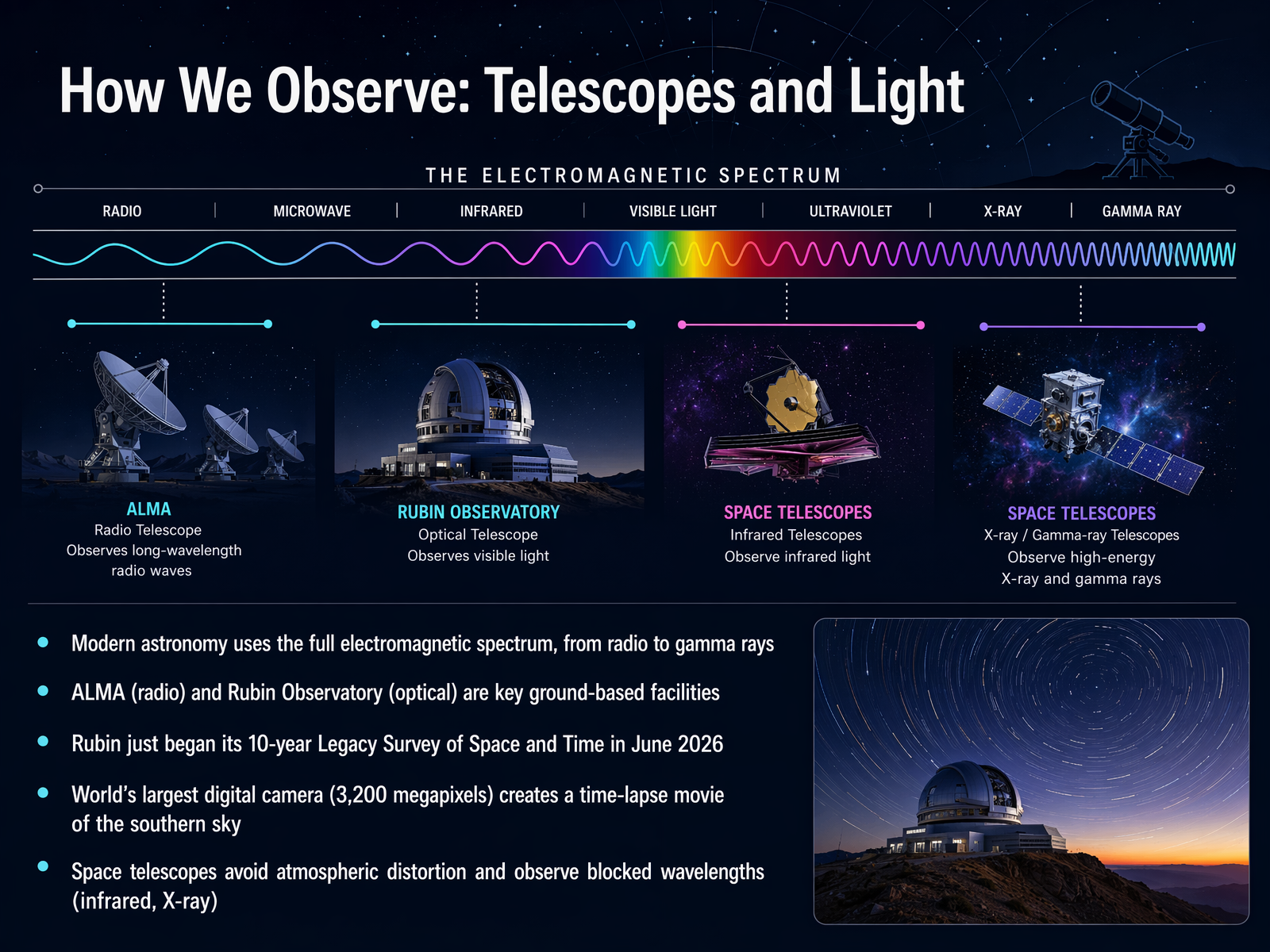
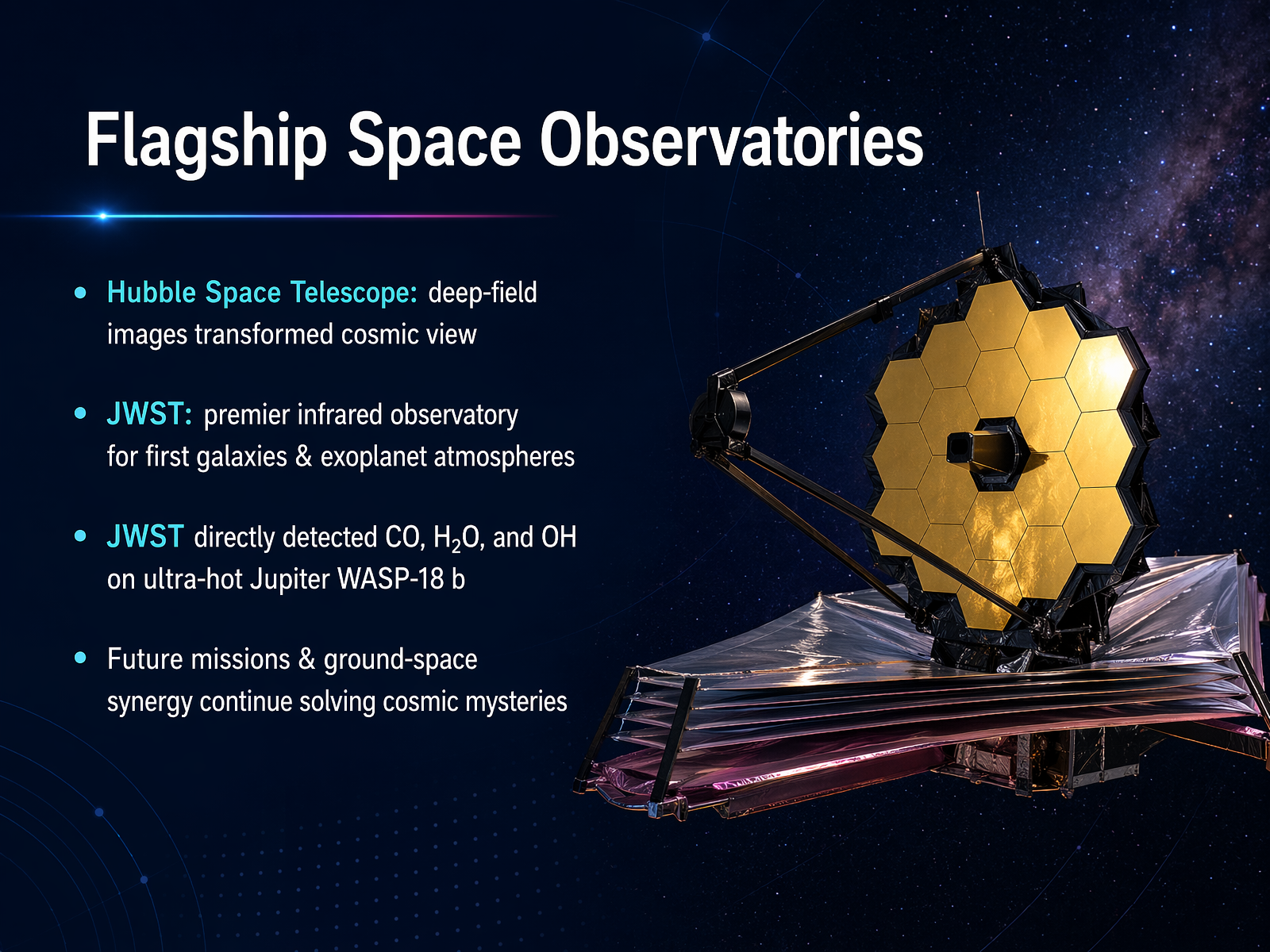
 - 16How We Observe: Telescopes and LightAstronomers use many kinds of light and combine ground-based and space-based observations. Each wavelength reveals different features of the universe.
 1 min
1 min - 17Telescopes That Extend Our ViewTelescopes extend human sight by collecting light and measuring its properties. Different instruments reveal complementary details about distant objects.
 bbc.comnpr.orgphys.org+22 min
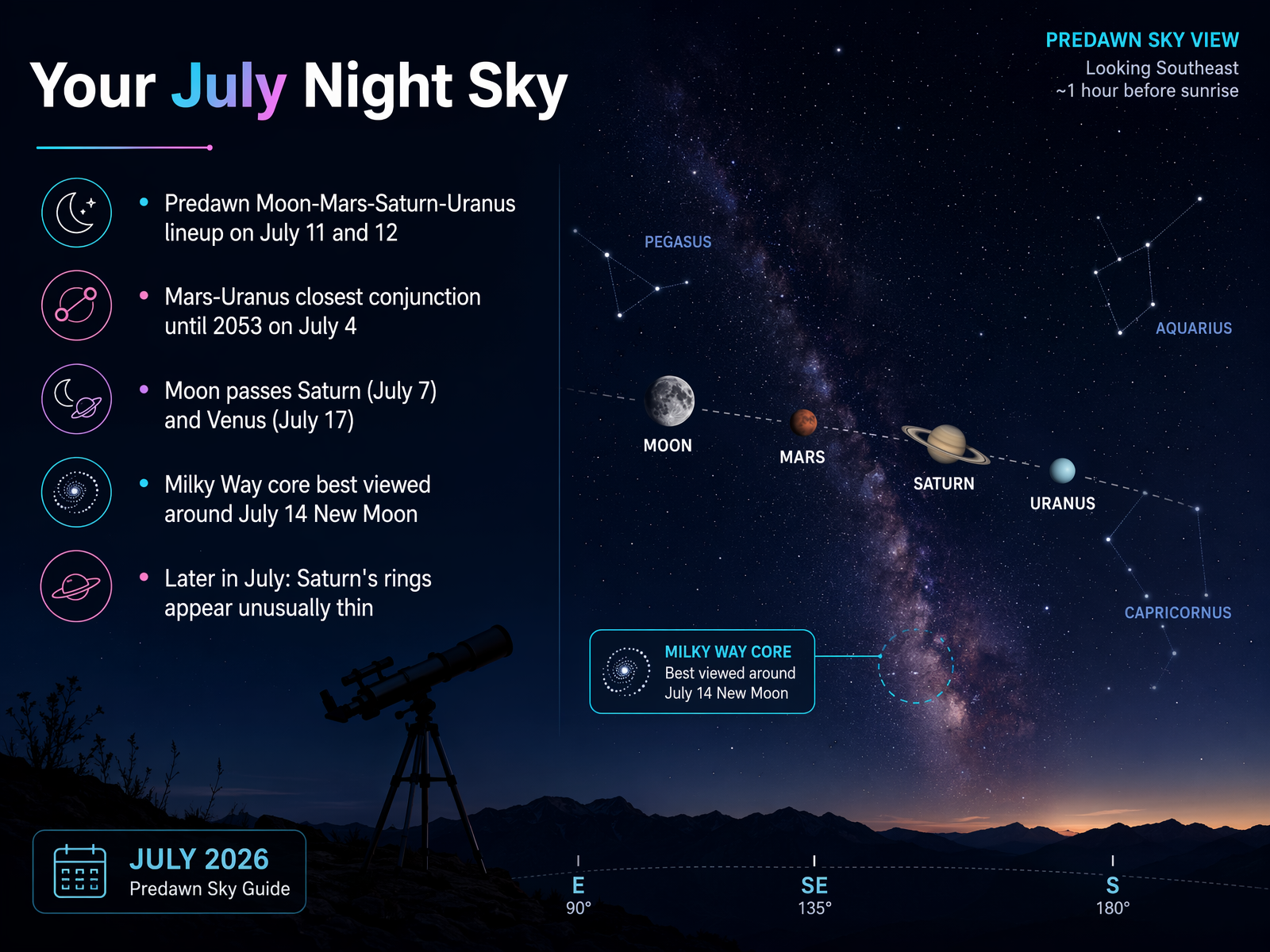
 - 18Planning a Simple Night-Sky ObservationA simple night-sky observation can begin with a safe, dark location and a sky map. Record what you notice, then return on later nights to compare changing patterns.
 2 min
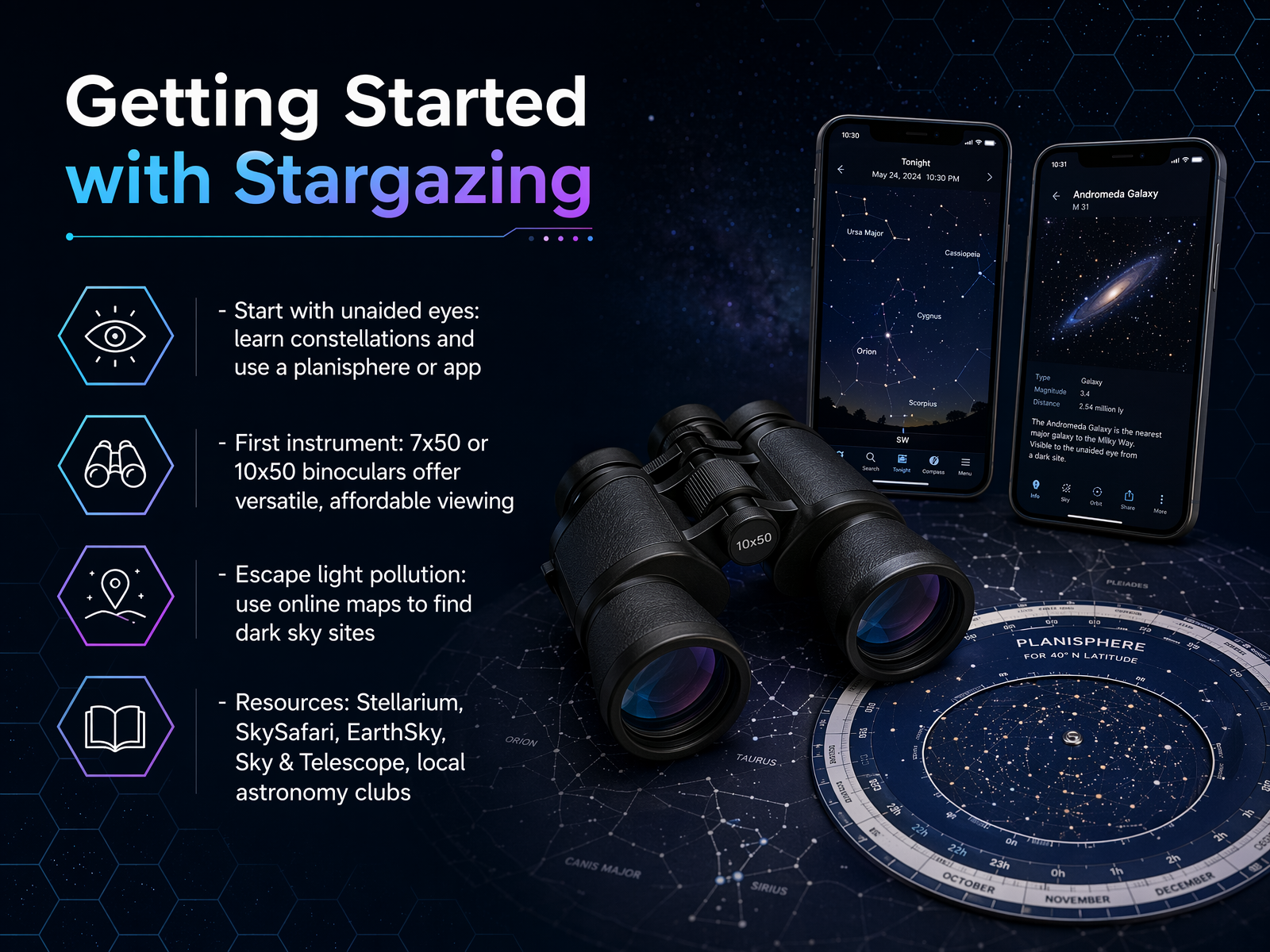
2 min - 19Getting Started with StargazingNow, let's turn our eyes skyward and talk about how you can actually start stargazing tonight. You don't need a big, expensive telescope to begin. Your first and best instrument is simply your unaided eyes. Start by learning a few constellations, like the Big Dipper or Orion. A simple tool like a planisphere, which is a rotating star map, or a smartphone app can show you exactly what's overhead right now. When you're ready for a closer look, a pair of affordable binoculars can be transformative. Look for seven by fifty or ten by fifty models. They are easy to handle and will suddenly reveal the craters on the Moon and the moons of Jupiter. One of the biggest secrets to a great view is escaping light pollution. Use a dark sky map online to find a park or a dark sky reserve near you where the Milky Way becomes visible to the naked eye. Finally, you're not alone in this journey. Wonderful free resources like Stellarium and SkySafari can be your personal planetarium, and websites like EarthSky offer daily guides. I also highly recommend joining a local astronomy club to look through telescopes and learn from experienced stargazers. Now, let's bring everything together in our final recap and your cosmic journey.
 2 min
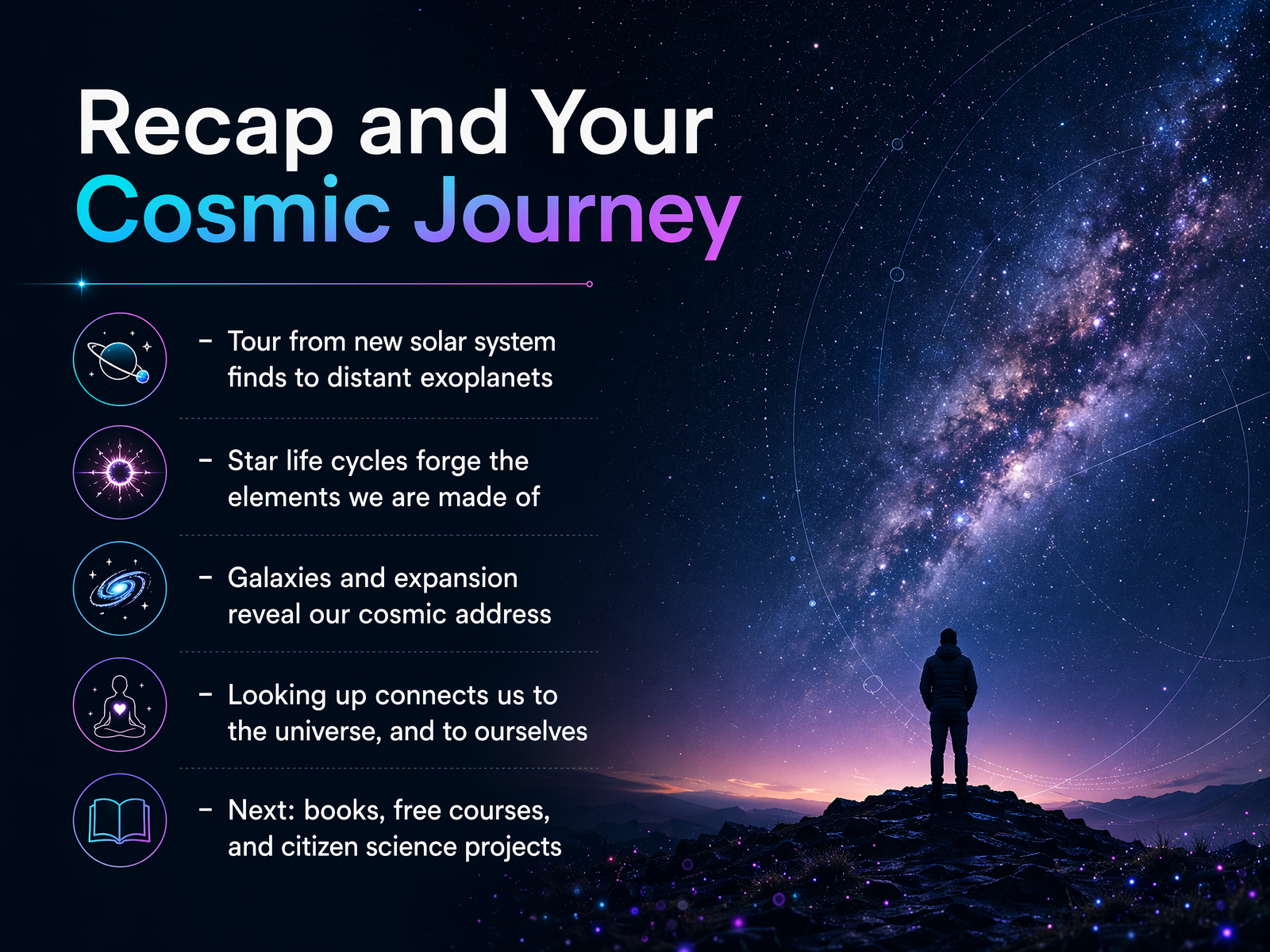
2 min - 20Recap and Your Cosmic JourneyWe have covered a lot of ground together. We toured our solar system, from the rocky inner planets to the giant outer worlds. We sailed out into the Milky Way, seeing stars born in glowing nebulas, and we visited distant galaxies that swirl like giant pinwheels of starlight. We even discovered planets around other suns, called exoplanets. Along the way, we learned how astronomers decode starlight using spectroscopy, and how we build a cosmic distance ladder to measure the vast space between stars and galaxies. And here is the most wonderful part. The iron in your blood, the calcium in your bones, all of it was forged inside ancient stars that lived and died long ago. We are truly made of stardust. Your cosmic journey is just beginning. You can continue exploring with a great book, a free online course, or by joining a citizen science project and helping real astronomers. I encourage you to keep looking up. The sky is a lifelong invitation to curiosity. Thank you for joining me.
 2 min
2 min
Take the deck with you
Download this course as a file — free, no sign-up needed.
- PDF handoutEvery slide page, ready to print or share.21 pages · 6.1 MBDownload
- Narrated PowerPointThe deck that presents itself — every slide carries the digital human's narration video.21 pages · 13.0 MBDownload
- PowerPoint slidesThe full deck as a .pptx — open it in PowerPoint, Keynote, or Google Slides.21 pages · 6.0 MBDownload
Free to use in your own training — please keep the PersonWise credit page at the end.
Have your own deck? Turn it into a course
Sources consulted
Web sources consulted while building this course.
- https://ntts-prod.s3.amazonaws.com/t2p/prod/spinoff/NASA-Spinoff-2026.pdf — ntts-prod.s3.amazonaws.com
- How NASA’s Astrophysics Missions Power Life on Earth - NASA Science — science.nasa.gov
- Technology Transfer and Spinoffs — nasa.gov
- NASA Technology Brings Golden Age of Exploration to Earth | NASA Spinoff — spinoff.nasa.gov
- NASA Technology Brings Golden Age of Exploration to Earth - NASA — nasa.gov
- Evidence of a New Arc or a Belt of Small Satellites around (50000) Quaoar - IOPscience — beta.iopscience.iop.org
- Astronomers keep finding new moons of Jupiter and Saturn | Space — space.com
- A possible new dwarf planet skirts the solar system’s edge — sciencenews.org
- Weywot, an Unusually Low-albedo Satellite in the Trans-Neptunian Region - IOPscience — iopscience.iop.org
- A moon only 10 kilometres wide was hiding around Uranus for decades. Voyager 2 missed it. Hubble missed it. But in 2025, Webb finally caught the faint speck circling near the planet’s inner rings, raising Uranus’s known moon count to 29. — spacedaily.com
- Solar cycle 25 — en.wikipedia.org
- NASA, NOAA: Sun Reaches Maximum Phase in 11-Year Solar Cycle - NASA Science — science.nasa.gov
- Continued activity of the 25th cycle: largest in 20 years. Ground-level enhancement and Forbush decrease — arxiv.org
- Solar Cycle 25 - Top 50 solar flares | Solar activity | SpaceWeatherLive.com — spaceweatherlive.com
- Will 2026 bring strong auroras? What the sun's recent activity tells us | Space — space.com
- Scientists find promising hints of life on distant planet K2-18b — bbc.com
- Biosignatures or noise? New analysis of K2-18b data casts doubt : NPR — npr.org
- Astronomers detect strongest sign yet of possible life on a planet beyond our own — phys.org
- An exoplanet 124 light-years away may harbour a global ocean beneath a hydrogen-rich atmosphere. Webb has produced two tentative hints of dimethyl sulfide—a gas produced mainly by marine microorganisms on Earth—but independent analyses dispute whether the molecule has been detected at all, leaving s — spacedaily.com
- Prospects for detecting signs of life on exoplanets in the JWST era | PNAS — pnas.org