Data Science Tools and Workflow Design
Begin
14 pages · ~28 min
Data Science Tools and Workflow Design
Learn to select the right data science tools and design efficient workflows. This training helps aspiring data scientists match tools to project needs.
What you’ll learn
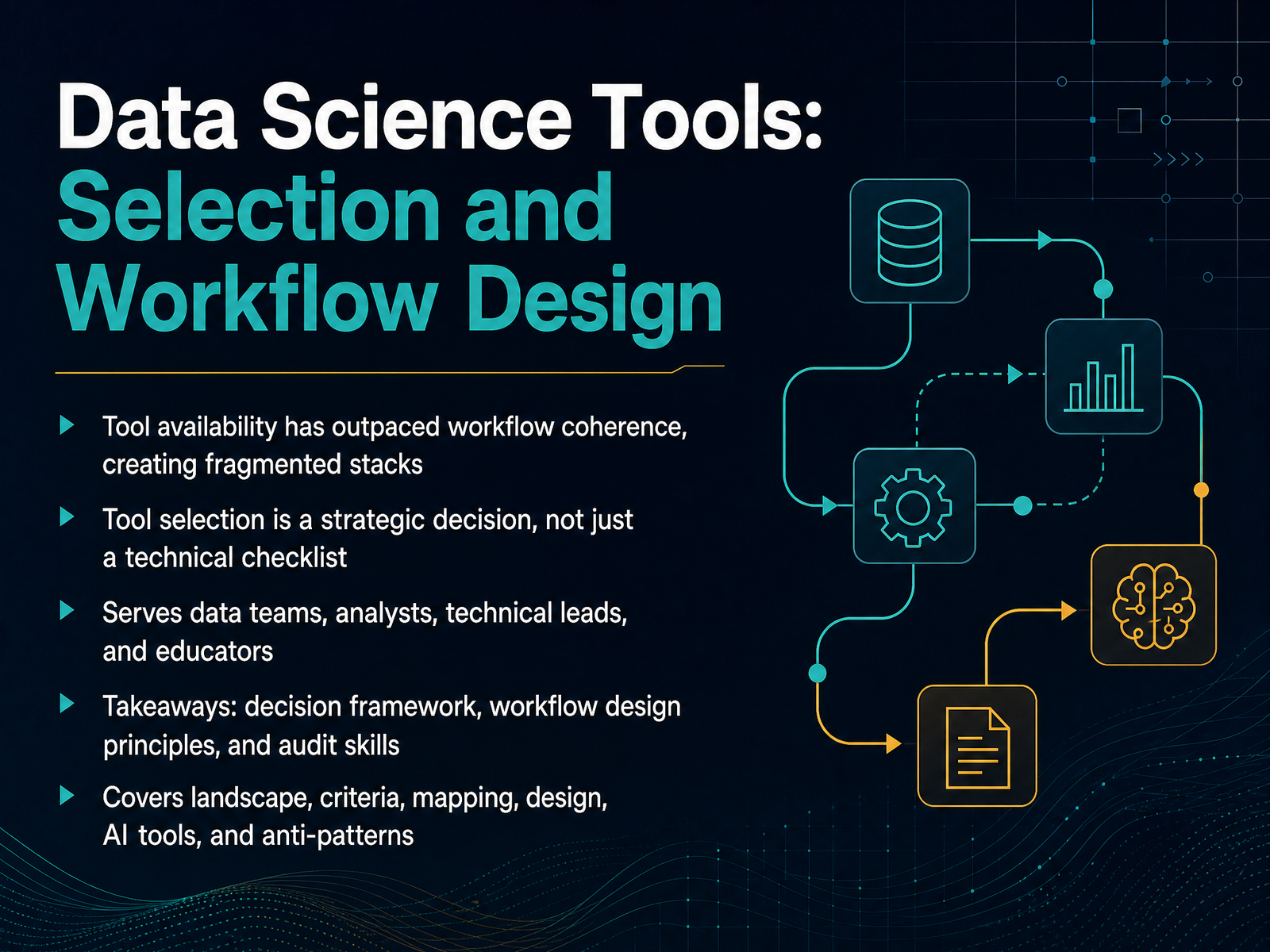
- 01Data Science Tools: Selection and Workflow DesignWelcome. Today we're going to tackle a challenge that every data team eventually faces: moving from a scattered collection of tools to a coherent, reproducible workflow. Tool availability has far outpaced workflow design, and the result is often a fragmented stack that slows you down more than it helps. This course treats tool selection as the strategic decision it actually is—not a feature checklist, but an architecture choice that shapes how your team collaborates, governs, and ships. Whether you're an analyst, a technical lead, or an educator, you'll leave with a decision framework you can apply immediately, workflow design principles you can trust, and the audit skills to diagnose what's breaking in your current stack. We'll cover the landscape, mapping criteria to real use cases, pipeline design, AI-native tools, and the anti-patterns that cost teams the most time. Let's begin by surveying the 2026 data-science tool landscape.mlflow.orgtechietory.compharmasug.org+22 min
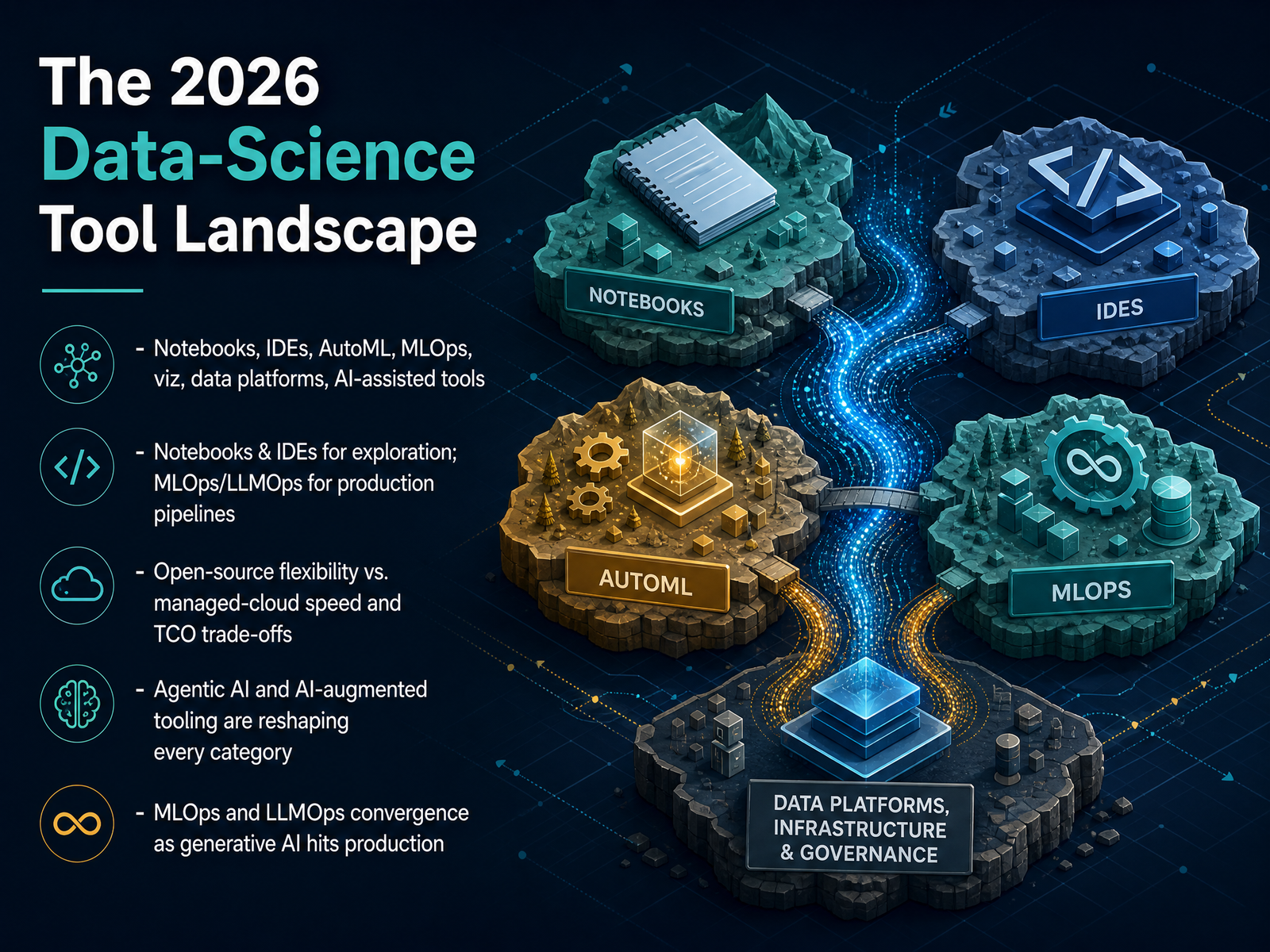
- 02The 2026 Data-Science Tool LandscapeMoving into the broader tool landscape as it stands this year. The stack now spans familiar categories: notebooks and IDEs, AutoML, MLOps platforms, visualization layers, and data platforms. To those we're adding a rapidly maturing class of AI-assisted tools. In practice, your team likely uses notebooks and IDEs for exploration and rapid prototyping, then shifts to MLOps or LLMOps components for production pipelines. That boundary is where the real architectural decisions show up. A central tension you'll encounter is the open-source flexibility path versus managed-cloud speed, with total cost of ownership often becoming the tiebreaker. Meanwhile, agentic AI and AI-augmented tooling are actively reshaping every category, not just adding features but changing interaction models and automation boundaries. One more trend worth noting: as generative AI moves into production, the tooling around MLOps and LLMOps is converging. We're seeing evaluation, monitoring, and orchestration patterns that increasingly look the same whether you're serving traditional models or large language models. Let's ground that discussion next in Selection Criteria That Actually Matter.
 2 min
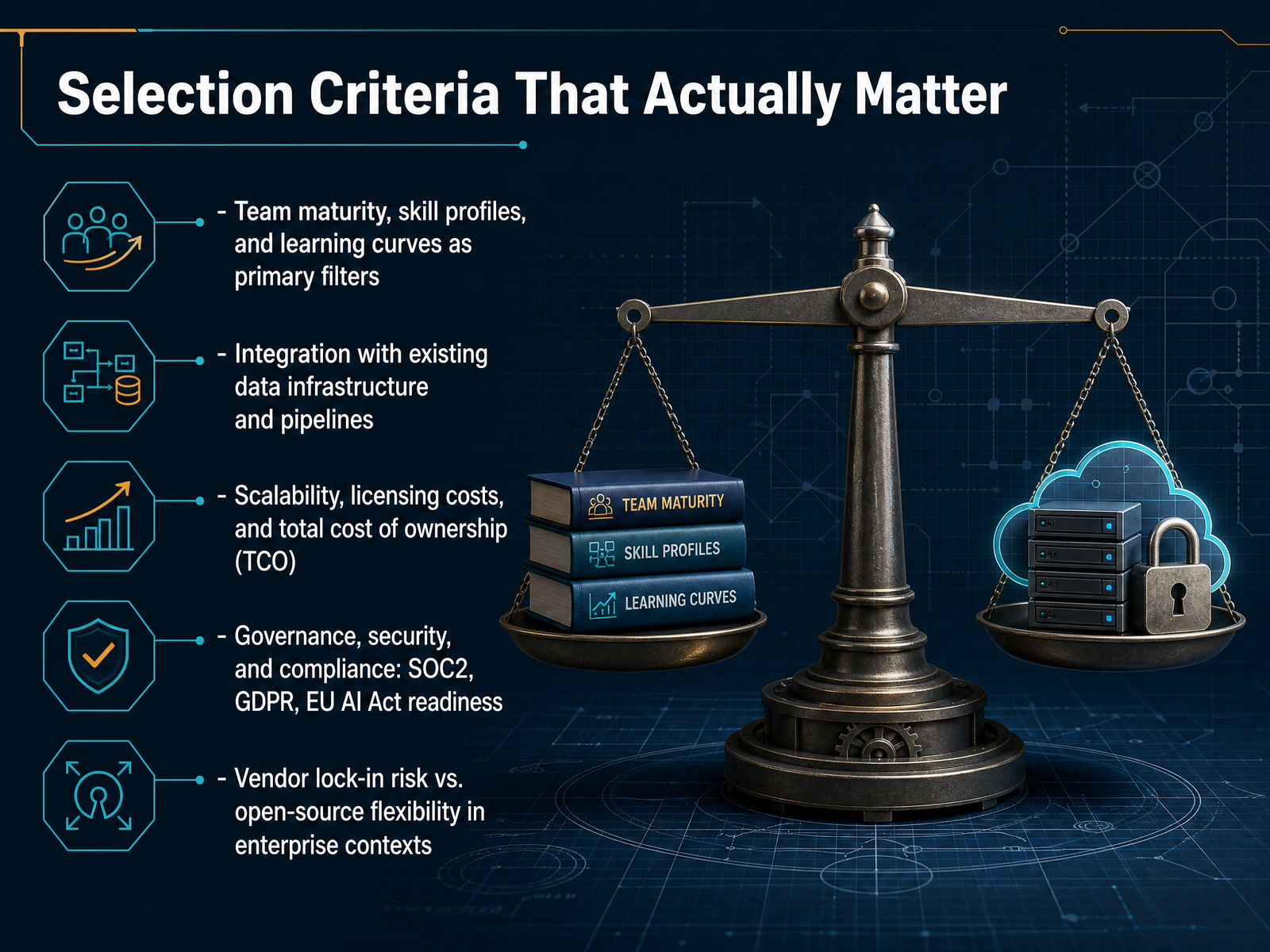
2 min - 03Selection Criteria That Actually MatterWith the landscape set, let's focus on selection criteria that actually matter. You'll want to filter first by team maturity and skill profiles, because the best tool is the one your team can effectively operate. Integration is an equally hard gate. Look at your existing data infrastructure and pipelines; a tool that doesn't connect cleanly will stall before it delivers value. Next, weigh scalability and total cost of ownership, not just license fees. Your cost model should account for compute, storage, and the operational burden of managing the system over time. Governance and compliance are non-negotiable. Verify SOC two readiness, GDPR alignment, and emerging requirements like the EU AI Act. If you're exploring agentic or copilot capabilities, assess whether the platform provides native guardrails for identity, data access, and prompt-level security. Finally, evaluate vendor lock-in risk directly against the flexibility of open-source components. In enterprise contexts, portability and the ability to audit or switch providers often outweigh bundling convenience. These five dimensions give you a repeatable, defensible framework. As we move forward, we'll map these criteria onto real workflow stages.
 microsoft.comoecd.orgrootstack.com+22 min
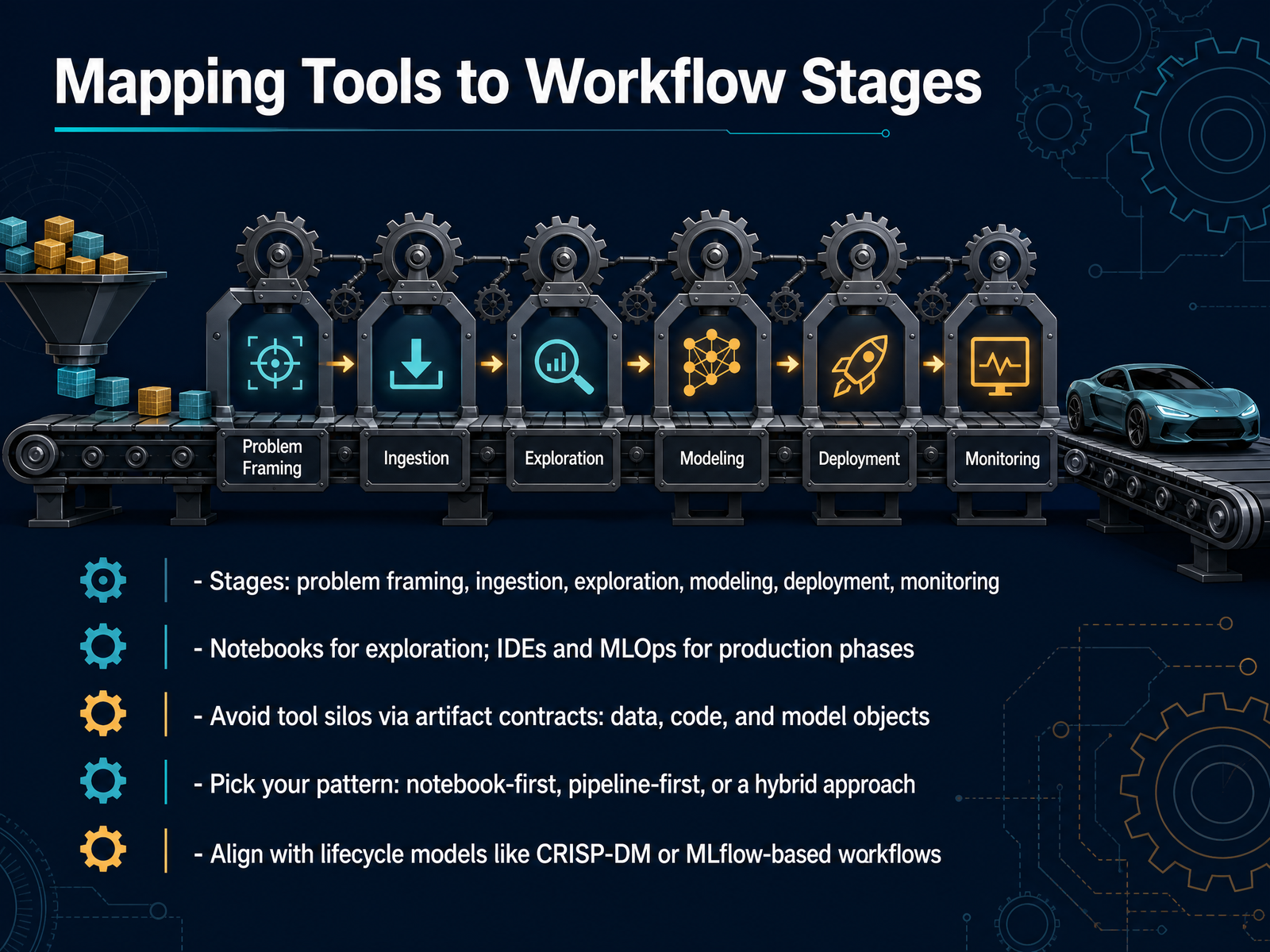
 - 04Mapping Tools to Workflow StagesNow let's map tools to the distinct stages of a data science workflow. A typical progression moves from problem framing and data ingestion, through exploration and modeling, and finally into deployment and monitoring. As your team considers this lifecycle, you'll want to match the tool to the phase. Notebooks excel during exploration, where visual feedback and rapid iteration are key. For production phases, you shift toward IDEs and MLOps platforms that support testing, versioning, and orchestration. A common risk here is tool silos. You can avoid them by defining artifact contracts. Treat data, code, and model objects as the interfaces between stages, not proprietary file formats. In practice, you'll pick a dominant pattern. Some organizations are notebook-first, others are pipeline-first, and many adopt a hybrid. What matters is aligning the pattern with a lifecycle model you already trust, such as CRISP-DM or an MLflow-based workflow. Next, we'll move into the core principles for designing these coherent workflows.
 2 min
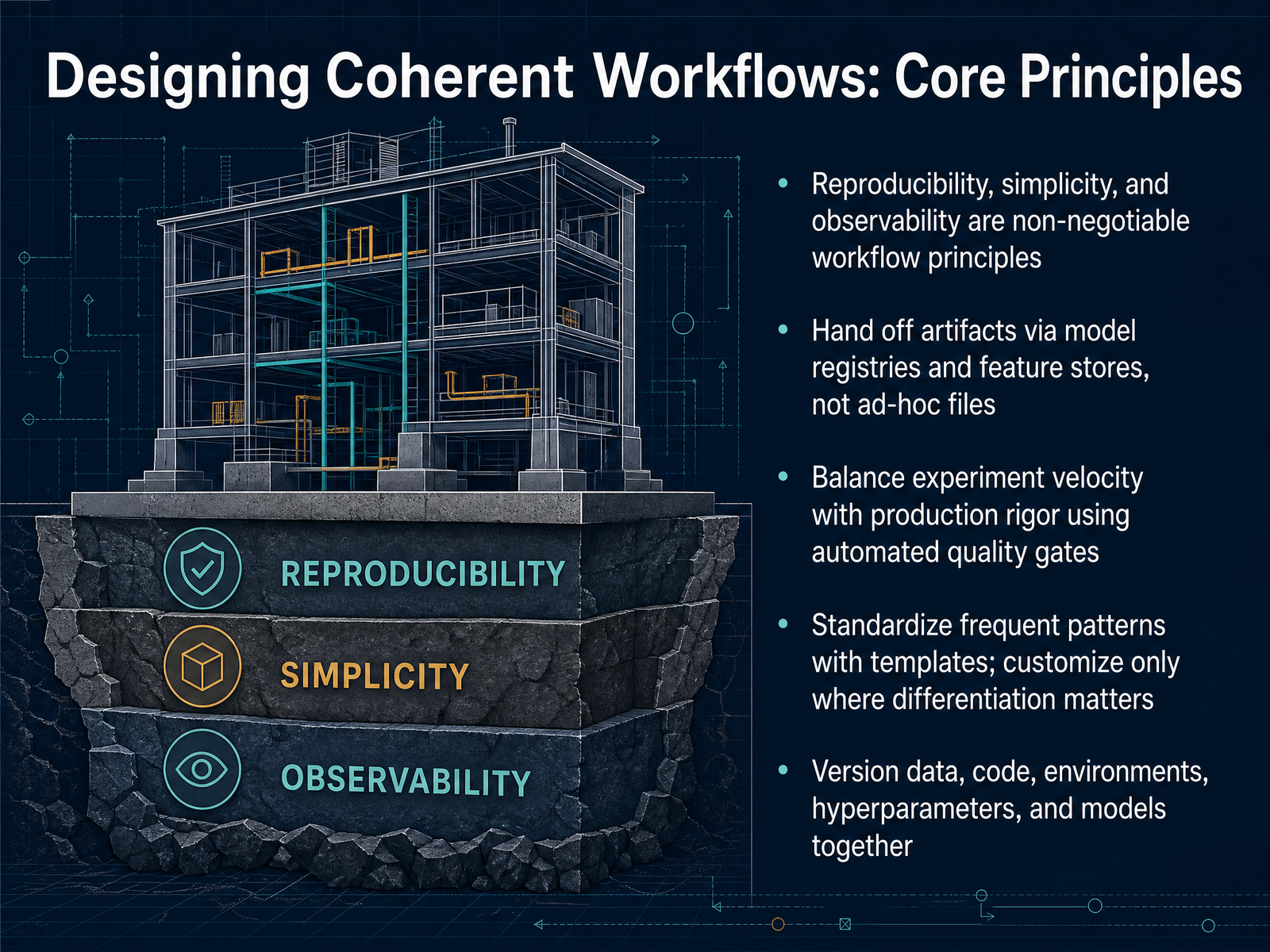
2 min - 05Designing Coherent Workflows: Core PrinciplesMoving to workflow design, let’s anchor on three non-negotiable principles: reproducibility, simplicity, and observability. You’ll want to weight every tooling decision against these before anything else. In practice, that means handing off artifacts through model registries and feature stores, not passing around ad-hoc files or notebook snapshots. Next, think about balance. Automated quality gates let you maintain experiment velocity while enforcing production rigor. Data validation and model evaluation checks should run long before a bad model reaches staging. Standardize your frequent patterns with templates so the team isn’t reinventing infrastructure, and reserve custom work for where differentiation actually matters. Finally, version data, code, environments, hyperparameters, and models as a single unit. If you can’t recreate a past training run exactly, you haven’t achieved reproducibility yet. Up next, we’ll translate these principles into concrete steps for building reproducible pipelines from day one.
 mlflow.orgtechietory.compharmasug.org+21 min
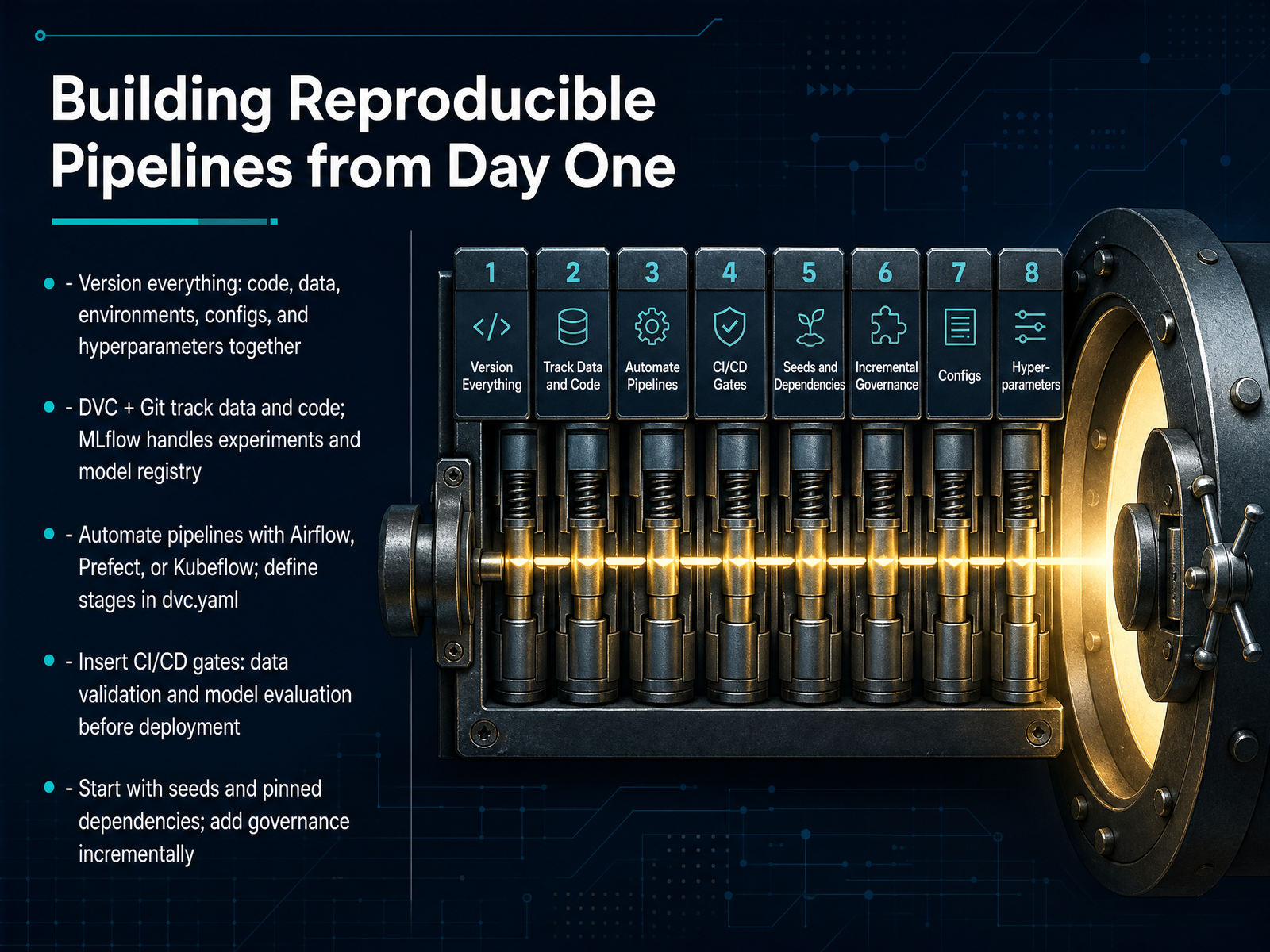
 - 06Building Reproducible Pipelines from Day OneSo how do you actually build reproducibility in from day one? The foundation is versioning everything together: code, data, environments, configuration files, and hyperparameters. DVC plus Git tracks your data and code as a unit, while MLflow handles experiment runs and the model registry. On the orchestration side, Airflow, Prefect, or Kubeflow let you automate pipelines, with stages defined cleanly in a dvc.yaml file. A critical step many teams skip is inserting CI/CD gates. You'll want automated data validation and model evaluation checks that block deployment before a bad model ever reaches production. The smartest path forward is to start with seeds and pinned dependencies, then add governance layers incrementally as your team's maturity grows. Coming up next, we'll explore how this pipeline thinking extends into working with AI-assisted and agentic tools.
 mlflow.orgtechietory.compharmasug.org+21 min
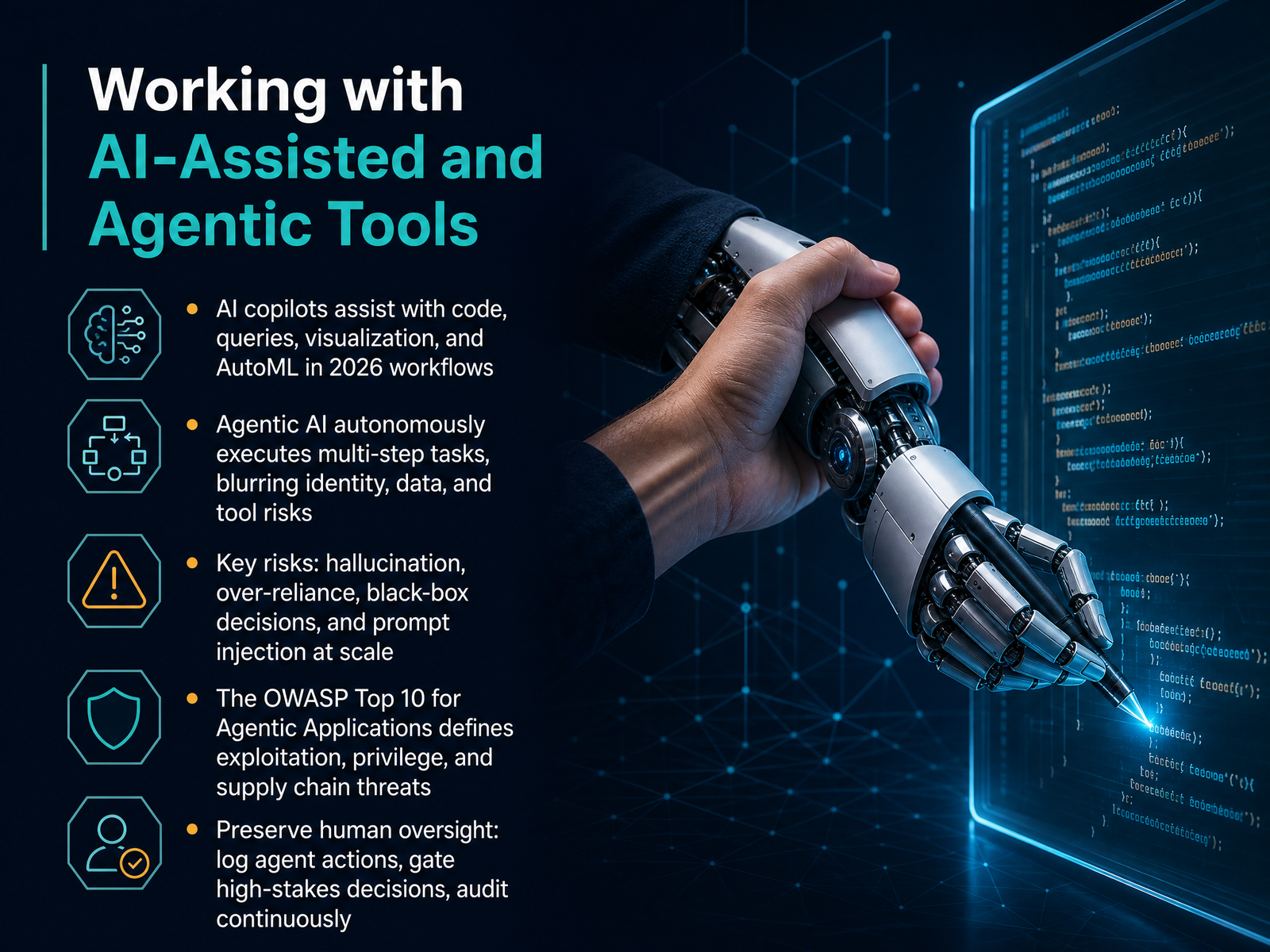
 - 07Working with AI-Assisted and Agentic ToolsLet’s shift focus to the tools themselves—specifically, AI-assisted and agentic systems now entering data science workflows. You’ll recognize the landscape. AI copilots are already generating code, writing queries, and accelerating visualization. But 2026 workflows are different: these copilots don’t just suggest, they act. Agentic AI can autonomously execute multi-step tasks—retrieving data, invoking tools, and pushing results—all using real identities and permissions. That collapses identity risk, data risk, and tool risk into a single operating model. The failure modes are serious. Hallucinations stop being curiosities and become operational errors. Over-reliance erodes critical review. Black-box decisions become impossible to trace. And prompt injection at scale now means hidden instructions in emails or shared documents can redirect agent behavior without detection. For security teams, the OWASP Top Ten for Agentic Applications maps these threats directly: goal hijacking, privilege abuse, supply chain compromise, and more. Our mitigation posture must be practical. You’ll want to log every agent action, gate high-stakes decisions with human approval, and audit behavior continuously—treating agents as privileged, auditable applications, not unchecked automation. Next, we’ll build on this by examining governance and compliance in the age of agentic AI.
 microsoft.comoecd.orgrootstack.com+22 min
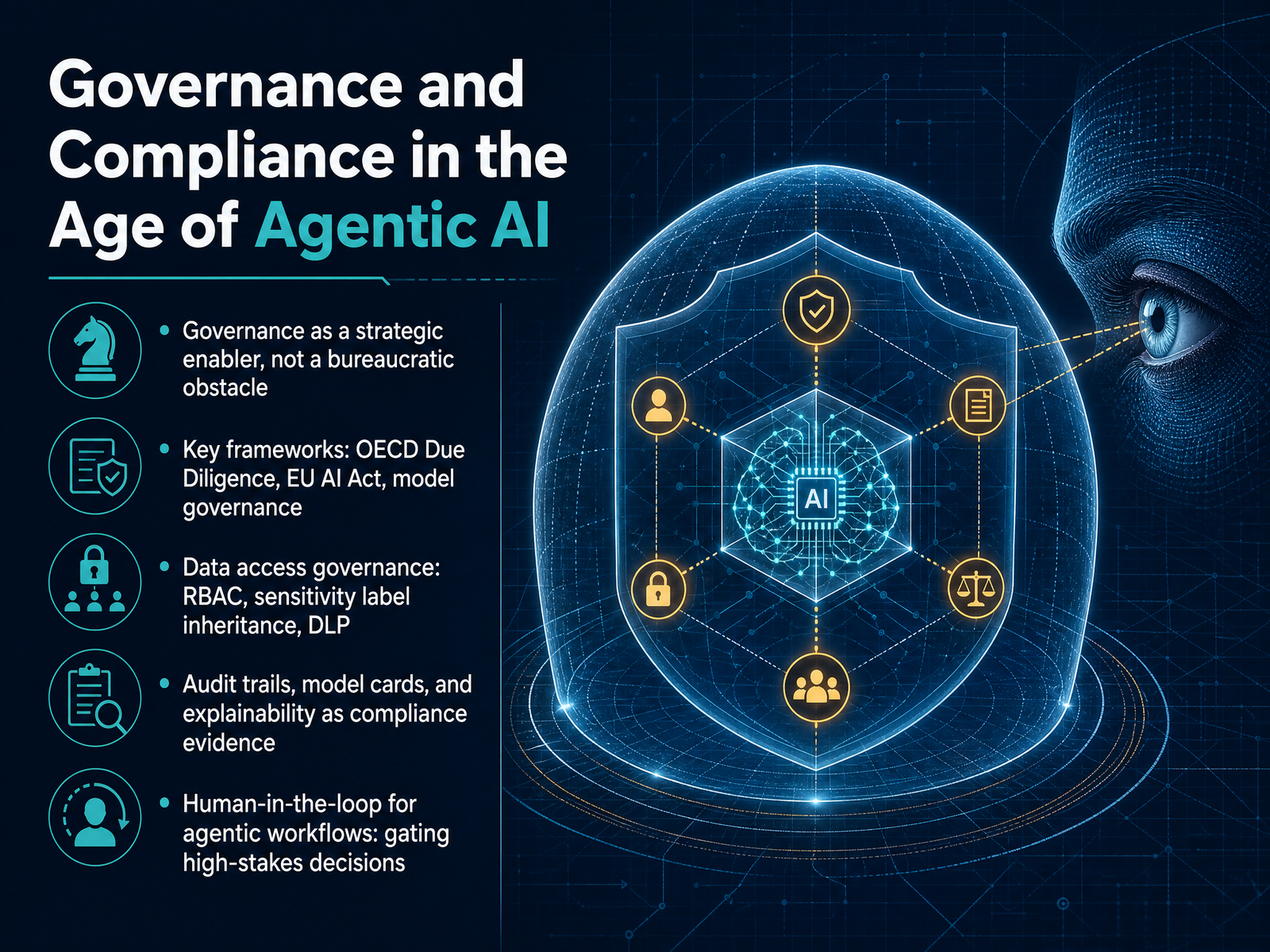
 - 08Governance and Compliance in the Age of Agentic AIGovernance isn't a bureaucratic hurdle; it's a strategic enabler that lets your team scale agentic AI with confidence. As you move agents into production, treat frameworks like the OECD Due Diligence Guidance and the EU AI Act not as checklists, but as practical design inputs. On the data front, the core work is access governance. That means enforcing role-based access controls, ensuring sensitivity labels follow data into agent outputs, and applying DLP policies that cover agent prompts and responses. For compliance, audit trails, model cards, and explainability artifacts are your primary evidence. With agentic workflows, autonomy demands a human-in-the-loop approach. Gate high-stakes or irreversible actions with explicit human approval checkpoints. These controls don't slow you down; they give you the operational sovereignty to innovate safely. Next, let's translate these principles into a practical decision framework.
 microsoft.comoecd.orgrootstack.com+22 min
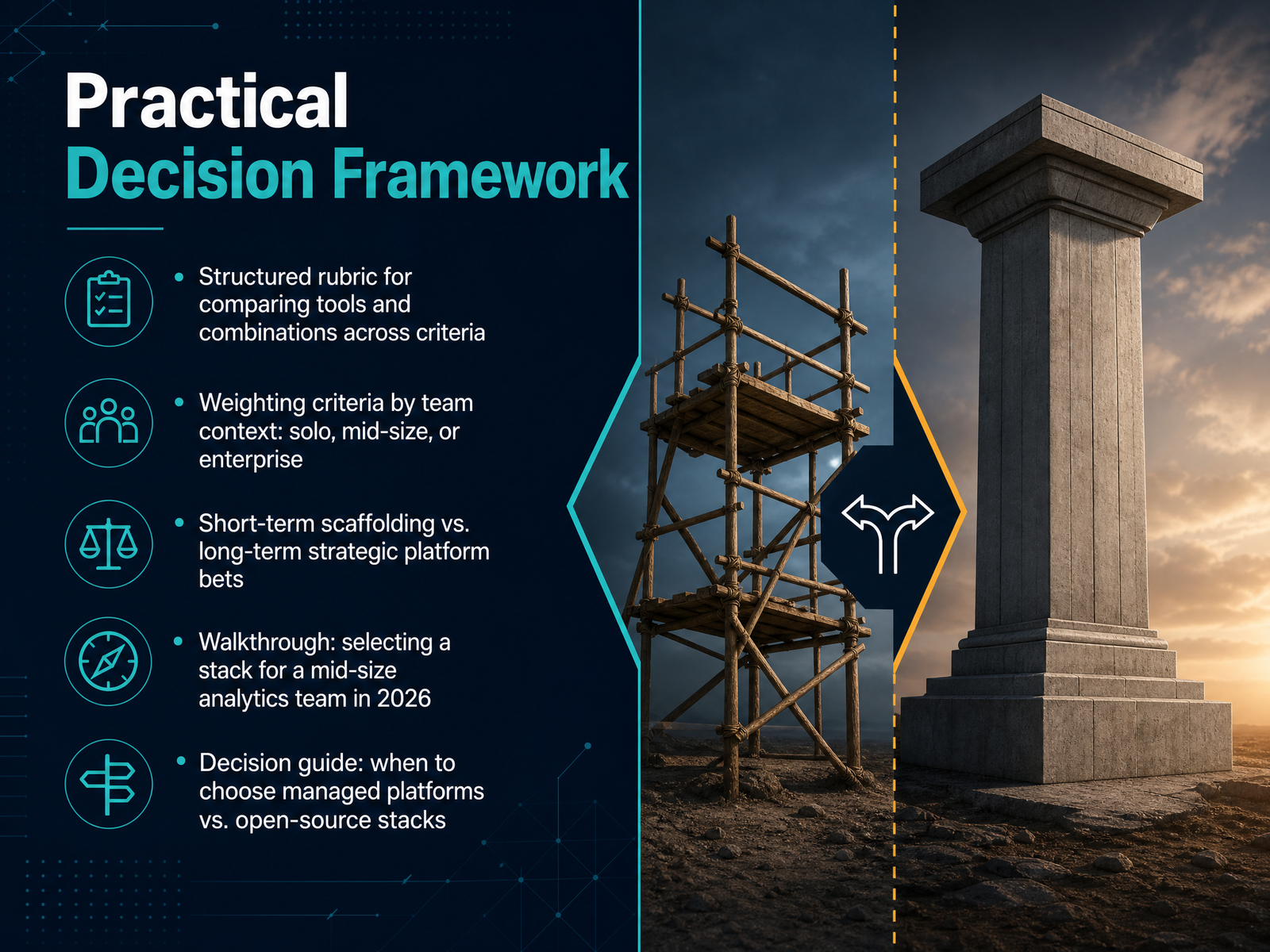
 - 09Practical Decision FrameworkLet's ground the theory in a practical decision framework. You'll want a structured rubric that scores tools and their combinations across clear criteria—think scalability, integration cost, and talent availability, not just feature lists. The real power comes from weighting. A solo analyst may prioritize speed and simplicity, while an enterprise team must weigh governance and multi-cloud portability much higher. You also need to distinguish short-term scaffolding from long-term platform bets. A tactical tool that solves today's data wrangling pain might be a wise scaffold, but you need to ensure your strategic platform of record isn't undermined. To make this concrete, imagine designing a stack for a mid-size analytics team in twenty twenty-six. You're probably balancing a cloud data warehouse like Snowflake against an open lakehouse architecture, with a decision guide that pits managed platforms against open-source stacks. Let's now examine the common anti-patterns that derail even the most careful plans.
 2 min
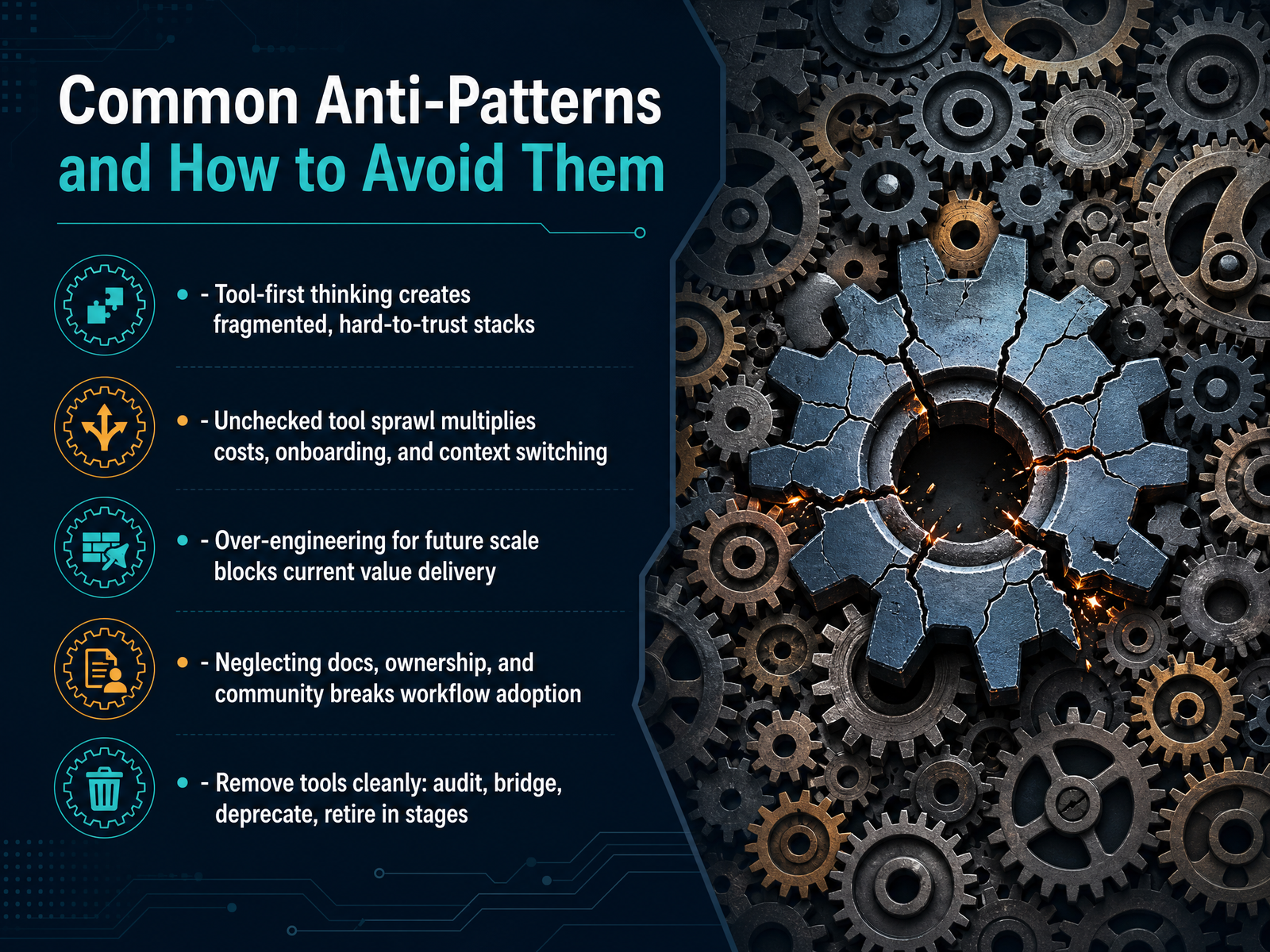
2 min - 10Common Anti-Patterns and How to Avoid ThemLet's talk about the patterns that quietly erode trust in a data stack. The first and most common is tool-first thinking. This happens when a team selects a shiny new orchestrator or feature store and then forces their workflow to fit it. The result is a fragmented stack where provenance breaks between tools, and nobody fully trusts the lineage. You'll want to flip this—design the workflow first, then map tools to that design. The second pattern is unchecked tool sprawl. Without a lightweight adoption process, you end up paying a tax in onboarding time, context switching, and overlapping licenses. As your team considers new additions, weigh the total cost of ownership against the marginal benefit. A third trap is over-engineering for future scale. Building for millions of records before you have a reliable pipeline on a thousand records just delays delivering actual value. Start simple, then layer governance as your maturity grows. Finally, neglecting documentation, ownership, and community signals is a silent killer. A tool without a named owner and clear adoption guides will be abandoned. When it's time to remove a tool, do it cleanly: audit dependencies, bridge critical flows, formally deprecate, and retire in stages. No orphaned dashboards, no broken scripts. That clean retirement process is what we'll cover next in the workflow health check.
 mlflow.orgtechietory.compharmasug.org+22 min
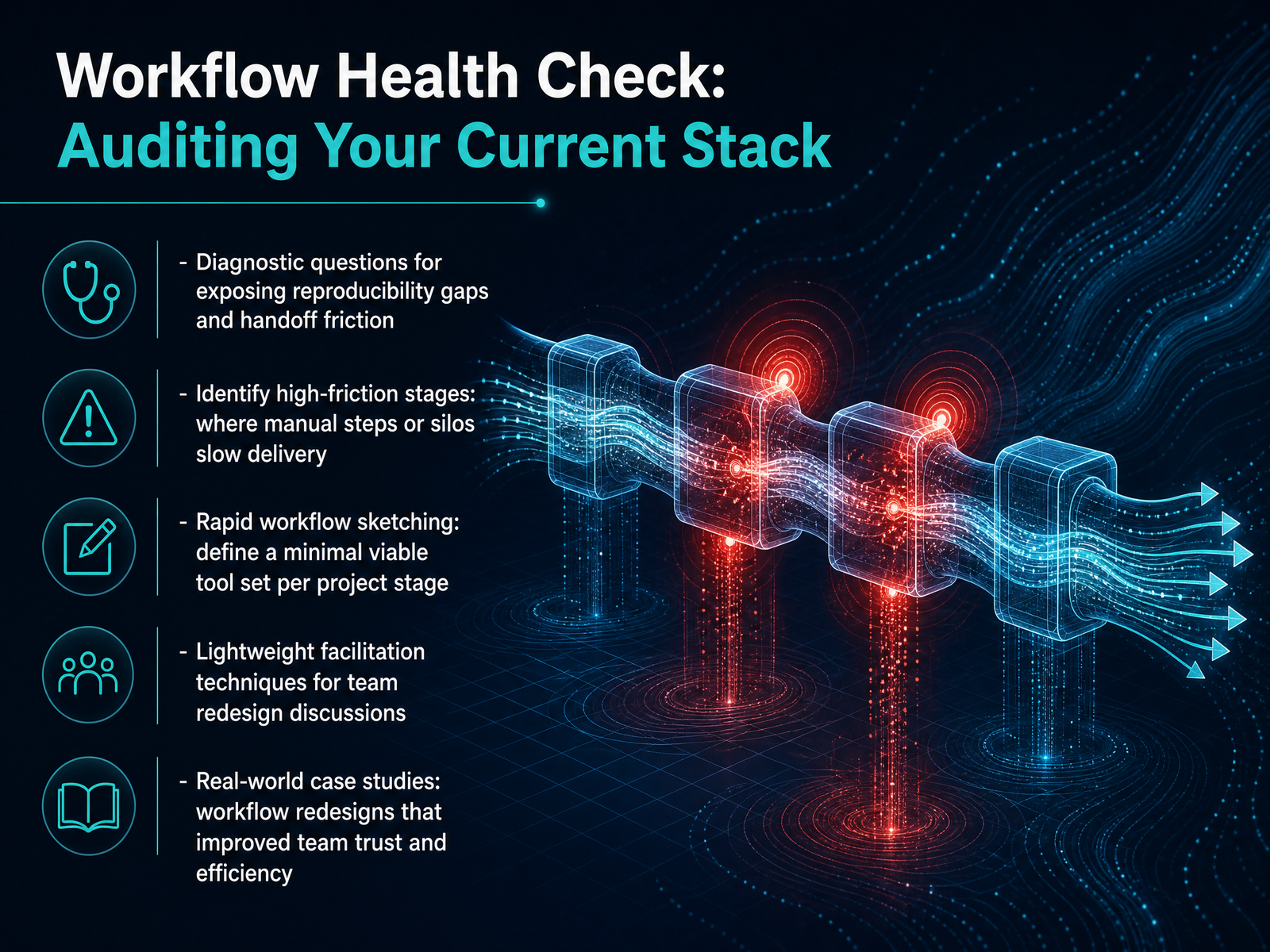
 - 11Workflow Health Check: Auditing Your Current StackLet's turn the lens on your current toolchain. A workflow health check isn't about finding the perfect stack. It's about locating the friction that slows delivery and erodes trust in results. Start with a diagnostic. Can a new team member recreate a training run from three months ago without calling the original author? If not, you have a reproducibility gap. Trace your delivery path from raw data to deployed model. Where do you see manual handoffs, emailed spreadsheets, or notebooks that only one person can run? Those are high-friction stages. Silently, they compound into significant delay. One effective technique is rapid workflow sketching. For each project stage, define the minimal viable tool set. Resist the urge to automate everything at once. Focus on the two or three controls that prevent the most common failures. In many teams, that means a data validation gate and a model evaluation gate. To surface these pain points, use lightweight facilitation. Ask the team to map the real journey of a model, not the ideal one. Document where the process actually breaks. Finally, learn from redesign case studies. Teams that invested in a reproducible pipeline command, environments pinned with containers, and versioned data saw faster onboarding and fewer production incidents. The payoff is a workflow your team genuinely trusts. Next, we'll apply this directly in a hands-on exercise to redesign a workflow stage.
 mlflow.orgtechietory.compharmasug.org+22 min
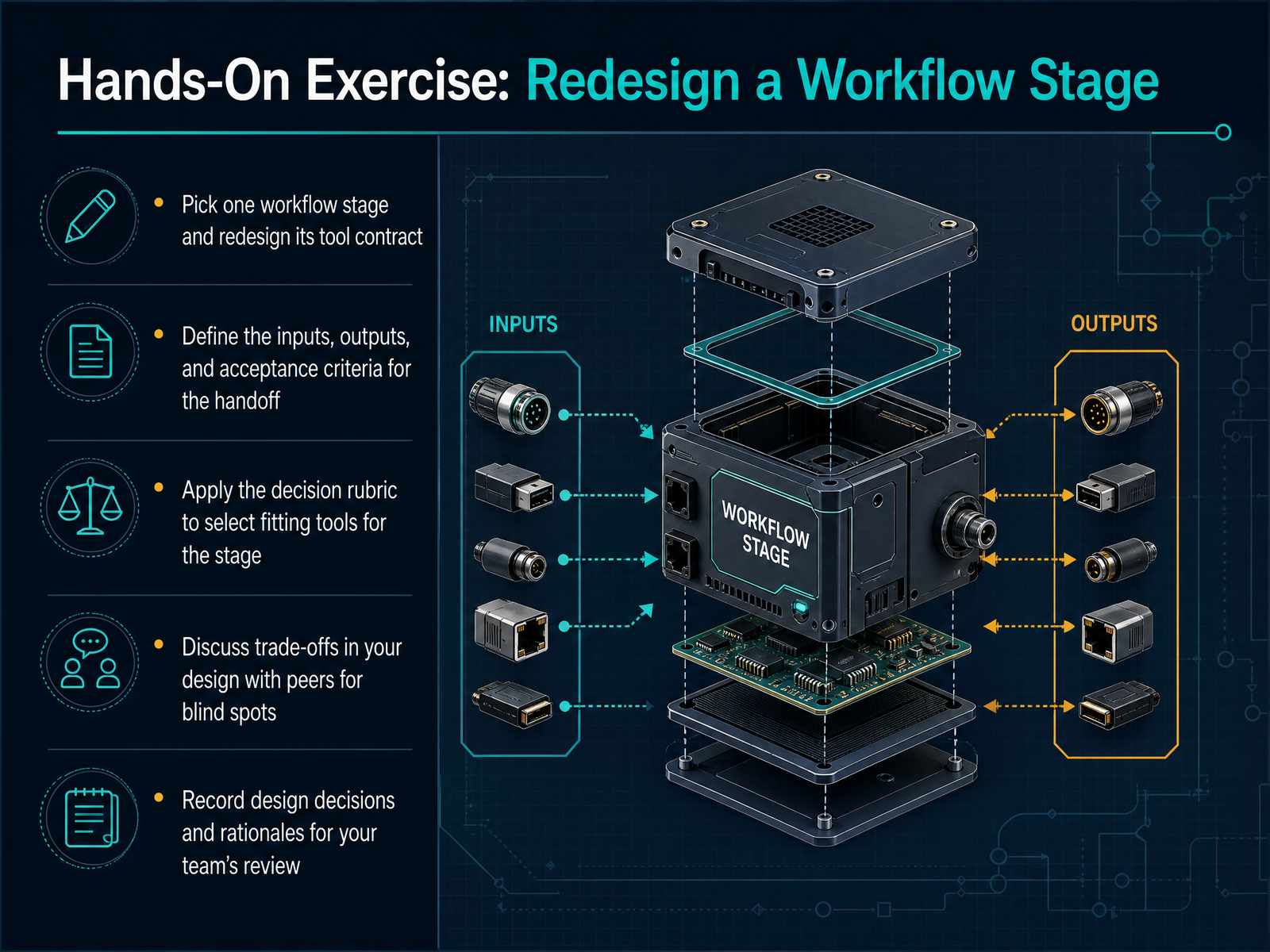
 - 12Hands-On Exercise: Redesign a Workflow StageNow let's put the evaluation framework into practice. In this exercise, you'll pick a single workflow stage from your current pipeline and redesign its tool contract. Start by defining the explicit inputs, outputs, and acceptance criteria for the handoff. That means pinning schemas, data hashes, and expected metric thresholds so the stage can be validated in isolation. Then apply the decision rubric we covered earlier to select fitting tools for that stage, weighing reproducibility guarantees against operational overhead. Discuss the trade-offs in your design with a peer. That step often surfaces blind spots around environment pinning, seed control, or hidden data dependencies that undermine reproducibility. Finally, record your design decisions and the rationale behind them. This written record becomes the foundation your team reviews before committing to implementation, saving you the cost of retrofitting governance later. In the next slide, we'll look at staying current with the evolving tool landscape.
 mlflow.orgtechietory.compharmasug.org+21 min
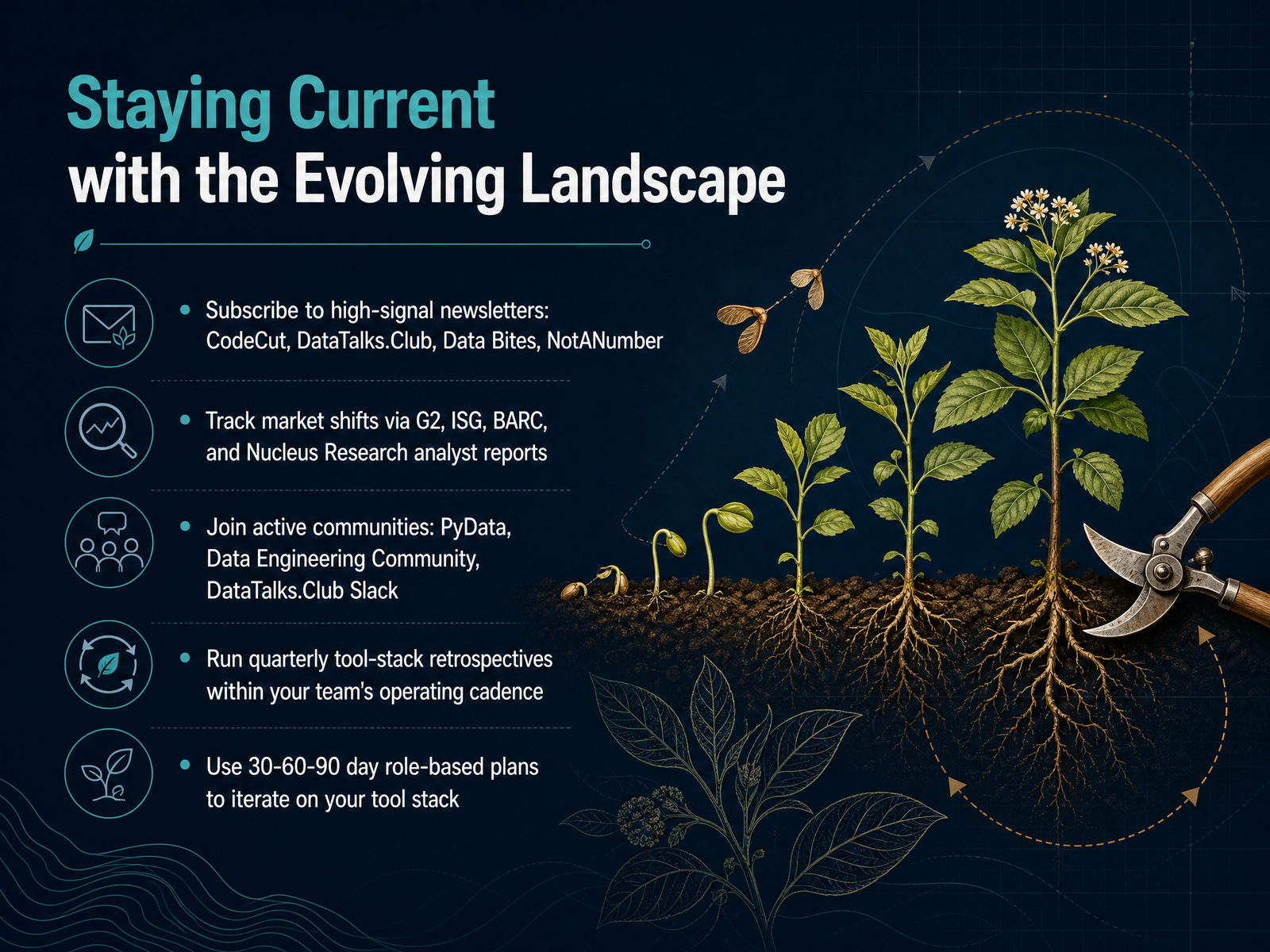
 - 13Staying Current with the Evolving LandscapeNo tool stack stands still, and staying current requires a deliberate signal-to-noise strategy. You will want to layer four practices together. First, be selective with high-signal newsletters. CodeCut delivers concise technical deep dives. Ian Ozsvald's NotANumber focuses on tools and process for faster, correct results. Data Bites and DataTalks.Club round out a manageable weekly feed. Second, triangulate market shifts with structured analyst research. G2 reviews, ISG Buyers Guides, BARC Scores, and Nucleus Research Value Matrices each apply different evaluation lenses, surface vendor consolidation, and benchmark enterprise readiness. Third, join communities where practitioners troubleshoot real stacks. PyData, the Data Engineering Community, and the DataTalks.Club Slack connect you to what is breaking, what is scaling, and what is being quietly abandoned. Fourth, embed a quarterly tool-stack retrospective into your operating cadence. Review what slowed delivery, where lock-in is creeping, and which experiments graduated to production. Pair that review with 30-60-90 day role-based plans to iterate pragmatically rather than chasing every new launch. These habits move tool selection from reactive firefighting to an evidence-based, continuous process. Next, let's pull everything together with key takeaways and next steps.
 codecut.ainewsletter.codecut.ainotanumber.email+22 min
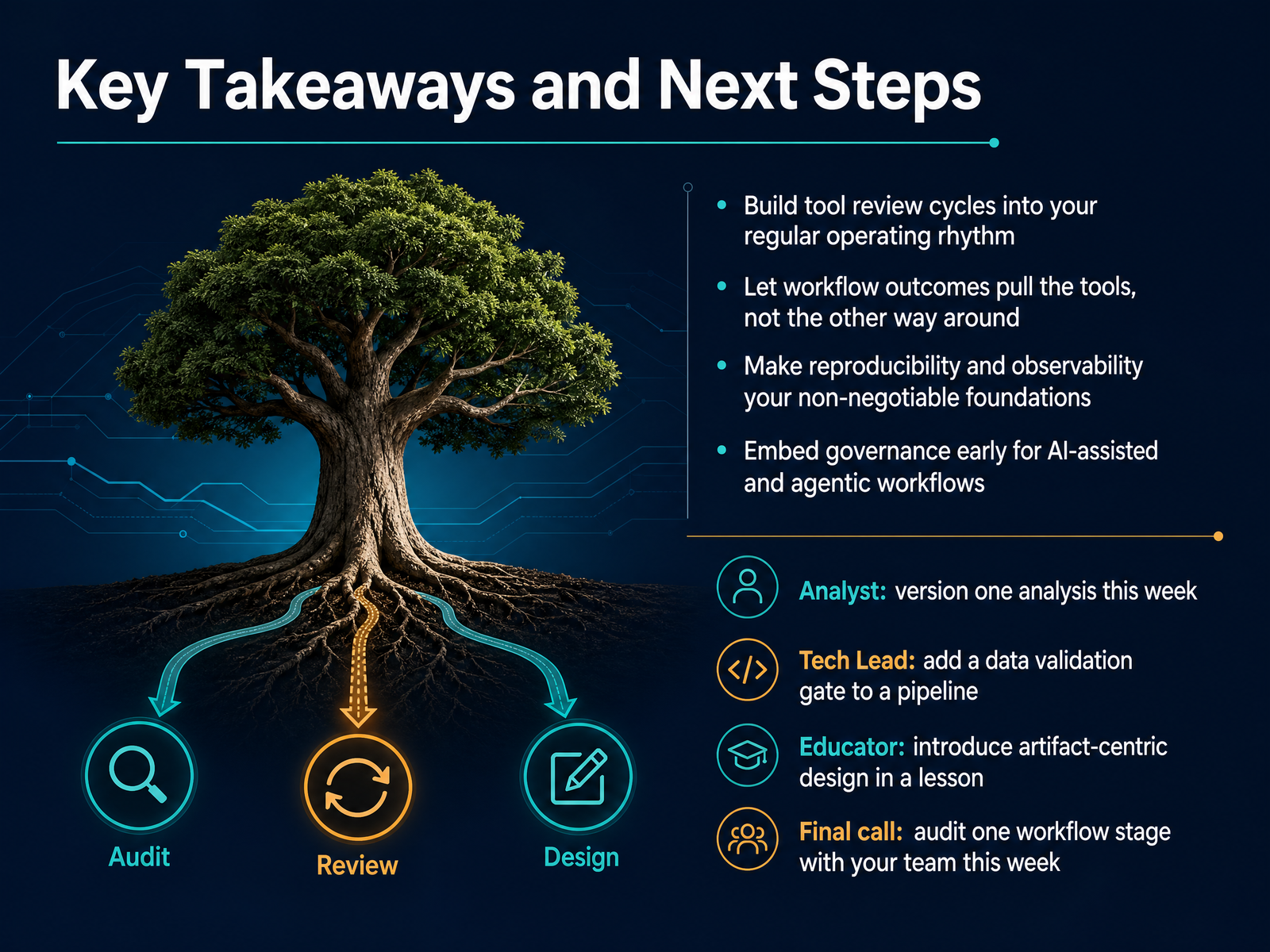
 - 14Key Takeaways and Next StepsLet's turn all of this into immediate, concrete action. You'll want to build tool review cycles into your regular operating rhythm. Evaluation should be a continuous process, not an annual panic. The foundational rule here is pull: let your workflow outcomes determine which tools you adopt, never the other way around. Throughout this entire journey, make reproducibility and observability your non-negotiable foundations. If you can't rerun a result or see why a pipeline failed, you are building on sand. And as your team considers AI-assisted and agentic workflows, embed governance early. Don't try to bolt on controls after agents are already making autonomous decisions. For analysts, I encourage you to complete a version one of an analysis this week using pinned environments and configs. Tech leads, add a single data validation gate to one existing pipeline. Educators, introduce the concept of artifact-centric design in your next lesson. My final call to action for every team is this: audit just one stage of your current workflow this week. Identify where reproducibility breaks or where a missing gate risks a production incident. Fix that one stage. That single action will build the trust and operational integrity we have discussed. Thank you for your time and your focus. The discipline you build around your tools will define the reliability of every decision your data touches.
 mlflow.orgtechietory.compharmasug.org+22 min
Take the deck with you
Download this course as a file — free, no sign-up needed.
- PDF handoutEvery slide page, ready to print or share.15 pages · 4.8 MBDownload
- Narrated PowerPointThe deck that presents itself — every slide carries the digital human's narration video.15 pages · 16.5 MBDownload
- PowerPoint slidesThe full deck as a .pptx — open it in PowerPoint, Keynote, or Google Slides.15 pages · 4.7 MBDownload
Free to use in your own training — please keep the PersonWise credit page at the end.
Have your own deck? Turn it into a course
Sources consulted
Web sources consulted while building this course.
- MLOps Pipeline Automation Best Practices in 2026 | MLflow — mlflow.org
- Writing Reproducible Data Science Code: Complete Guide — techietory.com
- Building Better Data Science Workflows: Best Practices with Git, GitHub, and Data Version Control (DVC) for Effective Collaboration — pharmasug.org
- Your first production-grade pipeline (with a Nextflow example) — reproducible-science.com
- taclab-research/science-repo-practices — github.com
- Addressing the OWASP Top 10 Risks in Agentic AI with Microsoft Copilot Studio | Microsoft Security Blog — microsoft.com
- OECD Due Diligence Guidance for Responsible AI (EN) — oecd.org
- AI Governance in 2026: How to scale artificial intelligence - Rootstack — rootstack.com
- MODEL AI GOVERNANCE FRAMEWORK FOR AGENTIC AI — imda.gov.sg
- Managing Data Risk in the Age of Agentic AI | BCG — bcg.com
- CodeCut | Python Tips, Data Science Tools & AI Tutorials — codecut.ai
- CodeCut Newsletter | Substack — newsletter.codecut.ai
- NotANumber.email — notanumber.email
- Data Bites | Train in Data — trainindata.com
- Welcome to DataTalks.Club — datatalks.club