Managing Project Dependencies
Begin
14 pages · ~28 min
Managing Project Dependencies
Learn to identify, analyze, and manage project dependencies to ensure smooth workflow and timely delivery.
What you’ll learn
- 01Managing Project DependenciesWelcome to Managing Project Dependencies. If your team sequences work across multiple groups, you already know the friction of a missed handoff or a hidden blocker. This training is about turning that friction into reliable, collaborative flow. We start by defining what a dependency really is: a relationship where one task, team, or system must deliver before the next can move forward. When these relationships are left unmanaged, you get cascading delays, rework, silos, and bottlenecks that hide until they hurt. The goal here is to connect dependency thinking directly to reliable delivery, flow efficiency, and cross-team collaboration. You will work with several types today: finish-to-start relationships, handoffs, resource dependencies, technical dependencies, and knowledge dependencies. Each type behaves differently, and understanding that difference is the first step toward taking control. Let's begin by looking at the real cost of unmanaged dependencies.nkdagility.comscrum.orgem-tools.io+21 min
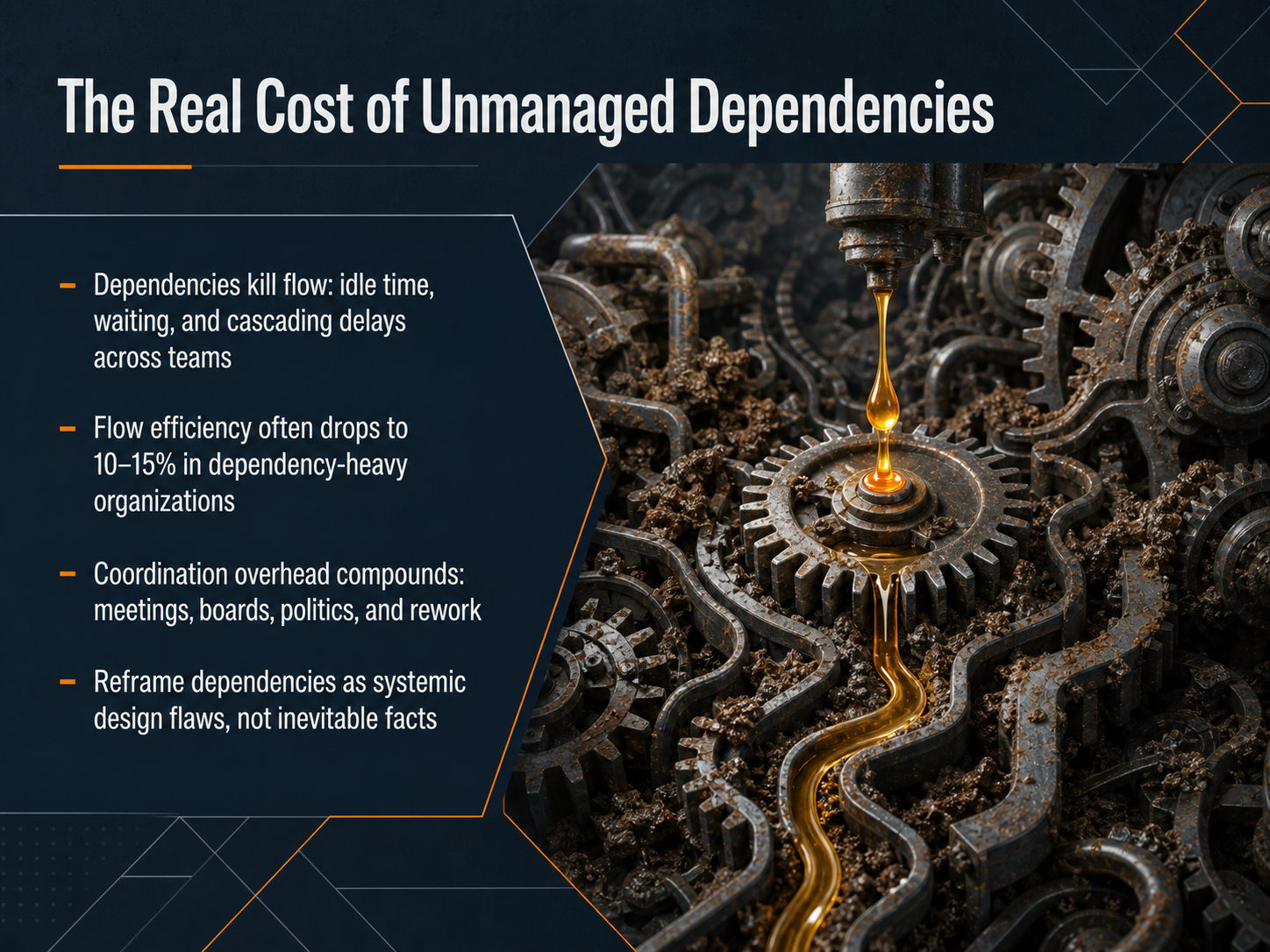
- 02The Real Cost of Unmanaged DependenciesSo let's talk about the real cost of unmanaged dependencies. When work sits idle waiting for a handoff, flow breaks down. One team's blocker cascades into delays for the entire program. In organizations that are heavy with dependencies, we often see flow efficiency drop to ten or fifteen percent. That means most of the time a work item spends in the system is actually waiting, not progressing. Then there's the coordination overhead. You spend more time in sync meetings, managing dependency boards, and navigating politics than you do building value. The key reframe here is to stop treating dependencies as just facts of life. Instead, see them as symptoms of systemic design flaws. They are signals that your team structures, architecture, or work decomposition need attention. When you view dependencies this way, you shift from constantly managing symptoms to actively removing the root causes. Next, let's look at dependency types and classification so you can map what you're really dealing with.
 nkdagility.comscrum.orgem-tools.io+21 min
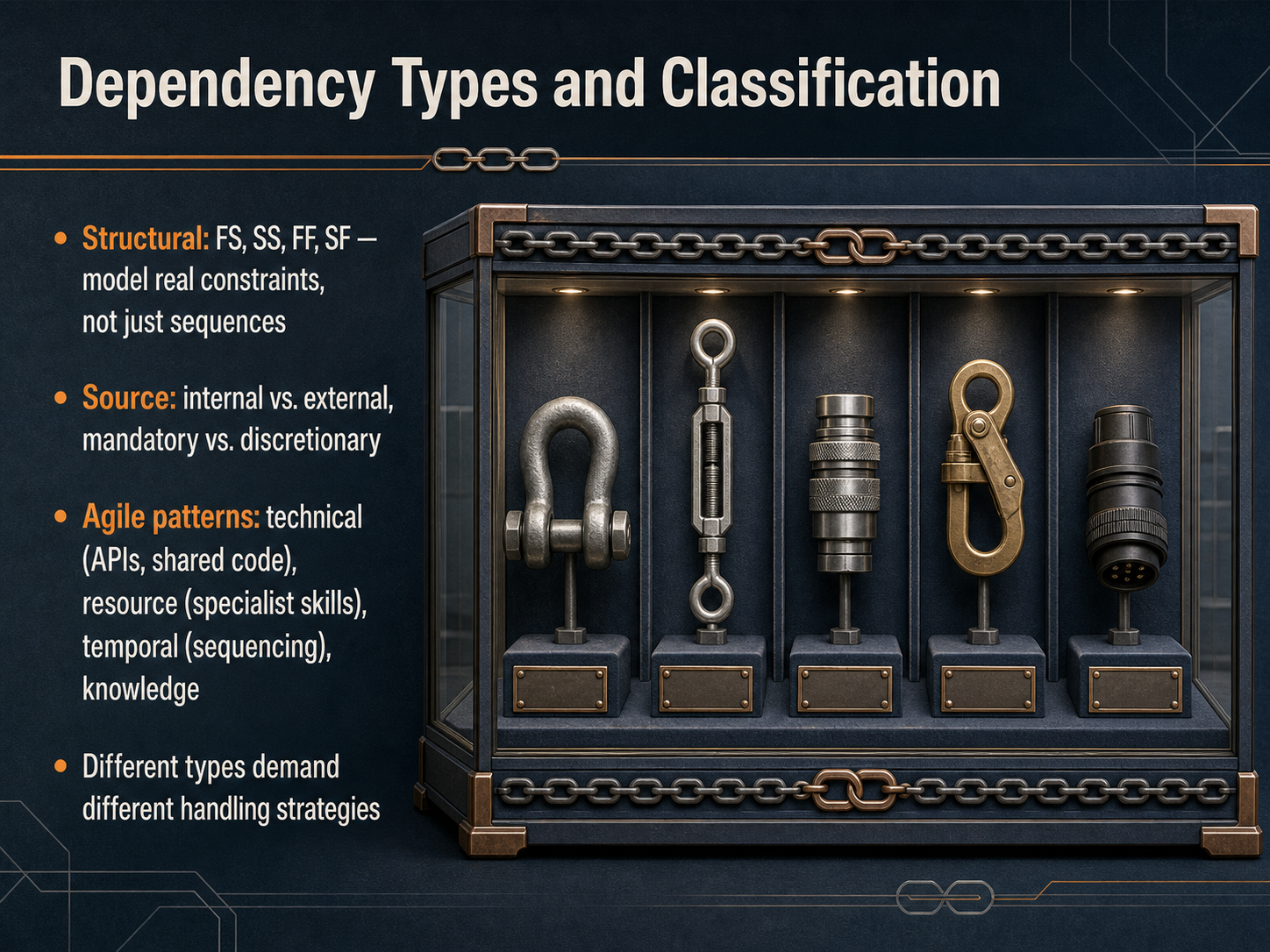
 - 03Dependency Types and ClassificationNow let's look at the different types of dependencies and how we classify them. Understanding these categories is the first step to choosing the right handling strategy. First, we have the structural types: FS, SS, FF, and SF. These are more than just sequencing labels; they model real-world constraints. For example, you can't start testing until the code is finished, which is a Finish-to-Start relationship. Beyond structure, we think about the source. Is this dependency internal to our team or external, like a vendor deliverable? Is it mandatory, meaning we have no choice, or is it discretionary, a best practice we chose to follow? In modern Agile work, we also see patterns like technical dependencies on shared code or APIs, resource dependencies when we need a specific specialist, and temporal dependencies driven by sequencing. Knowledge dependencies are common too, where progress depends on a decision from another group. Each of these categories demands a different approach. A mandatory external dependency requires much more active tracking and escalation than a discretionary internal one. Next, we'll apply this thinking by mapping your dependency landscape.
 planisware.comatlassian.comsimpliaxis.com+22 min
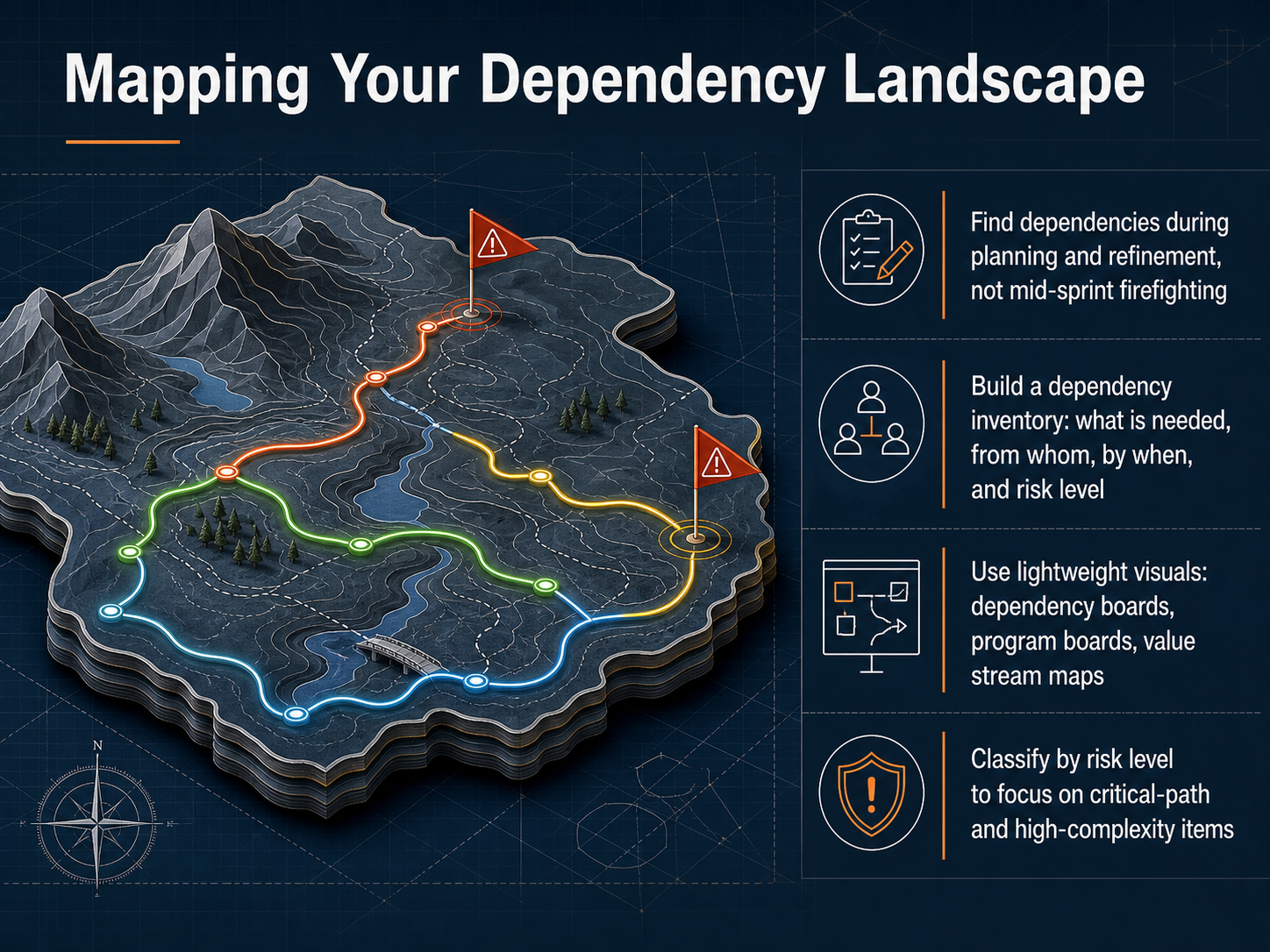
 - 04Mapping Your Dependency LandscapeNow let's get practical: how do you map your dependency landscape before it maps you? The goal is to identify dependencies during planning and refinement, not mid-sprint when they become firefights. Start by building a dependency inventory. For each dependency, ask four questions: what is needed, from whom, by when, and what is the risk level. Then make these relationships visible. Use lightweight visuals like a dependency board, a program board, or a value stream map. A simple visual can replace a dozen status emails. Finally, classify each dependency by risk level. Focus your team's attention on the critical path and high-complexity items first. A risk-based classification helps you know where to place your coordination energy. Next, we'll look at coordination tactics that work.
 miro.comcreately.comatlassian.com+21 min
 - 05Coordination Tactics That WorkNow let's get practical with coordination tactics that actually work. First, align your cadences. When sprints, PI planning, and release cycles are synchronized across teams, you stop creating accidental blocks. Next, run lightweight syncs. A quick Scrum of Scrums, a dependency check-in, or a short tech lead huddle can surface blockers early without drowning everyone in meetings. For complex work, use communication patterns. Think ambassadors, liaisons, or even temporary embeds who sit with the other team. This builds trust and speeds up resolution. And finally, establish the dependency handshake. This is an explicit agreement with named owners, clear timelines, and a defined escalation path. It turns a vague hope into a real commitment and gives you a clear trigger if things start to drift. In the next slide, we'll go deeper into making those dependencies explicit with contracts and handoffs.
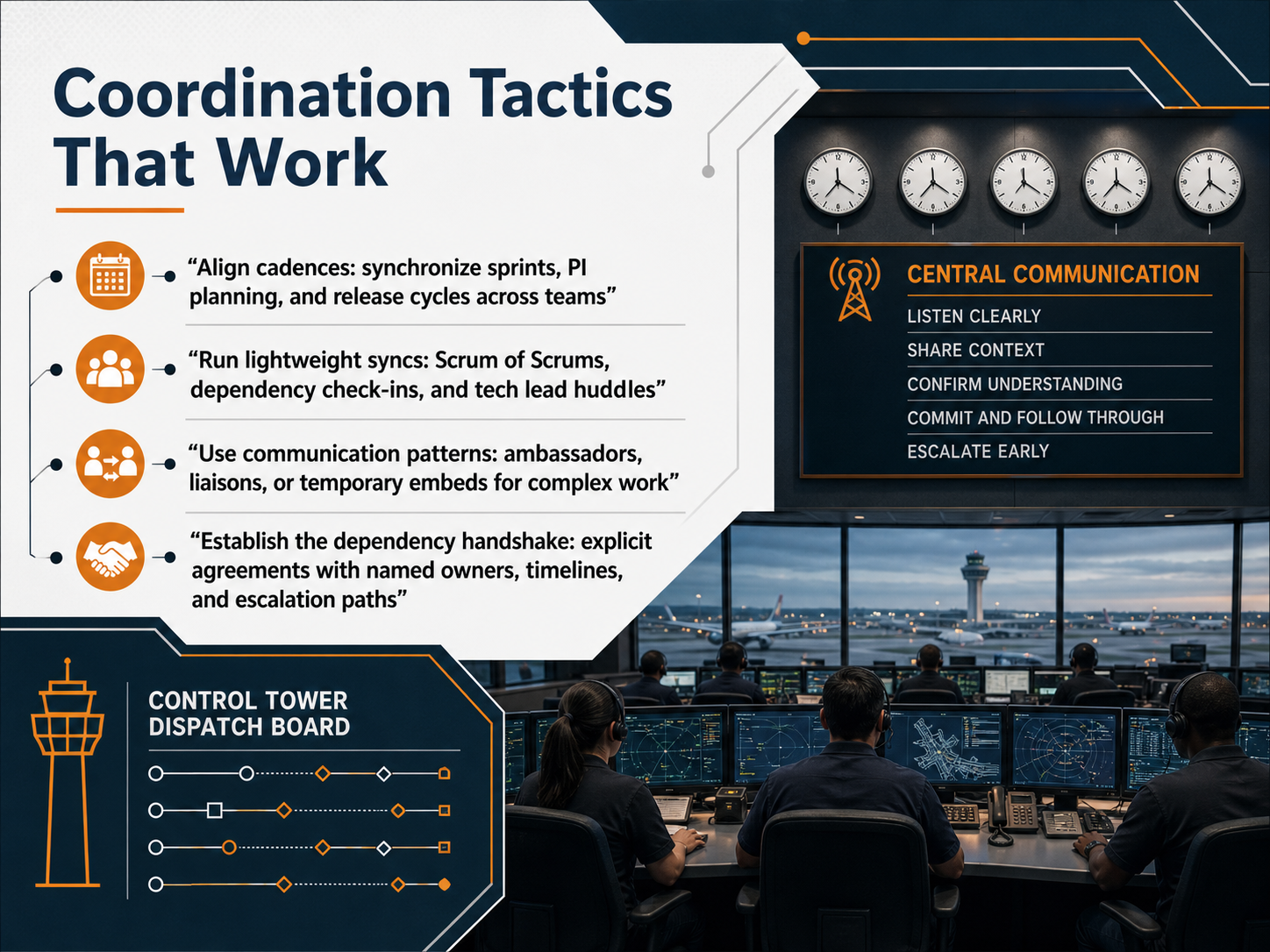 em-tools.iogrowingscrummasters.comronbofan.com+21 min
 - 06Making Dependencies Explicit with Contracts and HandoffsNow, let's talk about making those dependencies explicit. Instead of just hoping for the best, we can define clear contracts and handoff standards. This means getting concrete about interfaces early. Think about your APIs, shared schemas, and even consumer-driven contracts. These documents turn invisible expectations into testable agreements. Beyond that, establish clear handoff standards. For example, a definition of ready and a definition of done, paired with simple checklists, can eliminate ambiguity between teams. To avoid waiting, use contract testing and mock implementations. This enables parallel development, so one team can work against a simulated API while another team builds the real one. Finally, treat every dependency as a first-class backlog item. Give it clear ownership and a resolution target instead of letting it hide as a silent blocker. This approach makes dependencies visible and manageable, not just a source of delay. Next, we'll move into reducing unnecessary dependencies altogether.
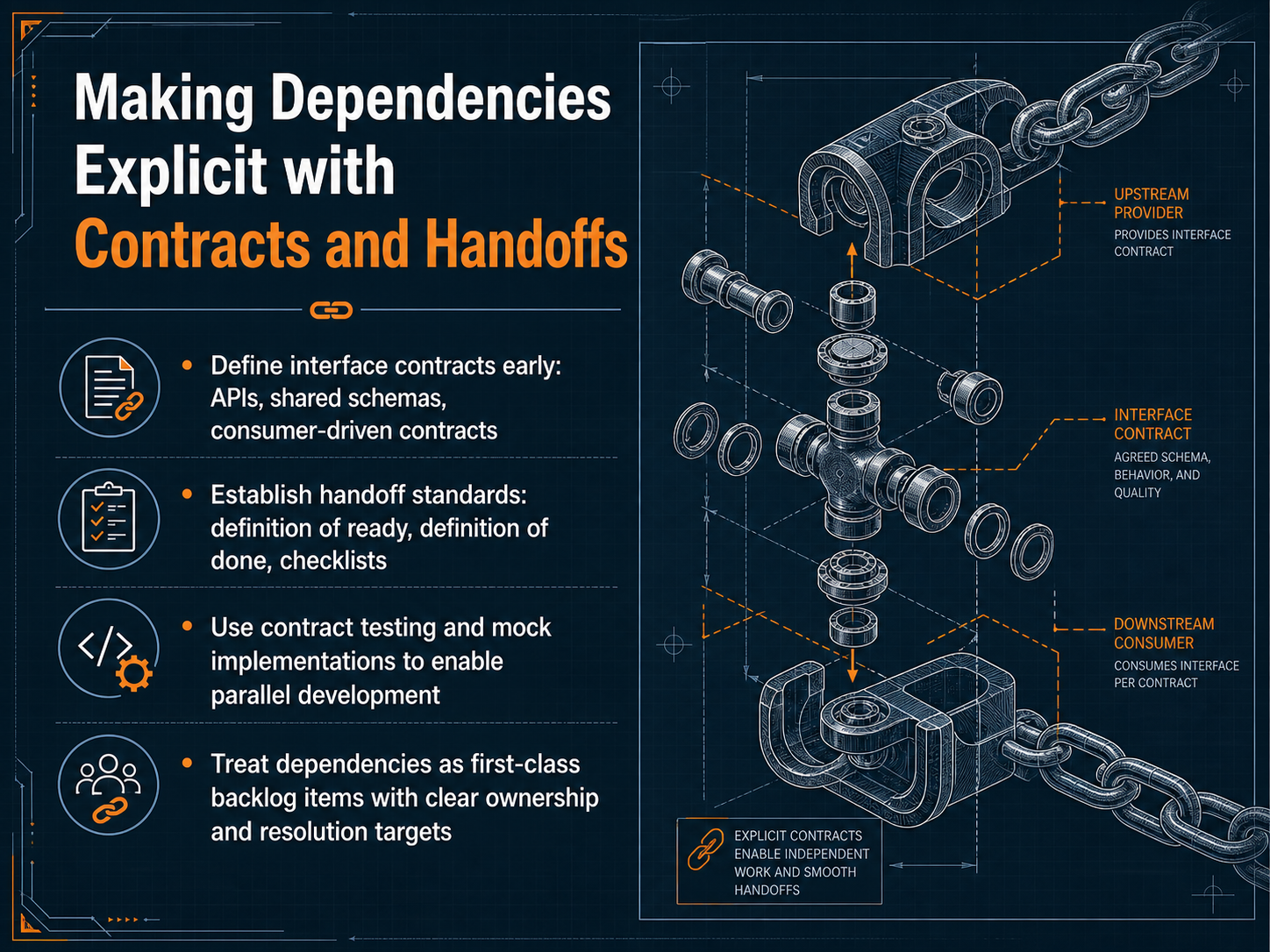 nkdagility.comscrum.orgem-tools.io+22 min
 - 07Reducing Unnecessary DependenciesNow let's shift the goal from coordinating handoffs to eliminating them entirely. Dependencies aren't just a scheduling challenge; they are often a signal of poor system design. When feature teams own a vertical slice of value, those handoffs collapse. A cross-functional team has all the skills it needs to deliver, which means you don't have to wait for a separate UI team, a database team, or a testing group. Architecturally, you can support this independence with loosely coupled services, event-driven patterns, and self-service platforms, so your work doesn't get stuck waiting for another team's release. You also reduce structural drag through team topology. Building T-shaped skills and forming cross-functional teams spreads expertise and breaks down silos, making the work flow smoother without constant coordination. Next, let's apply this mindset to a practical skill: Proactive Risk Management for Dependencies.
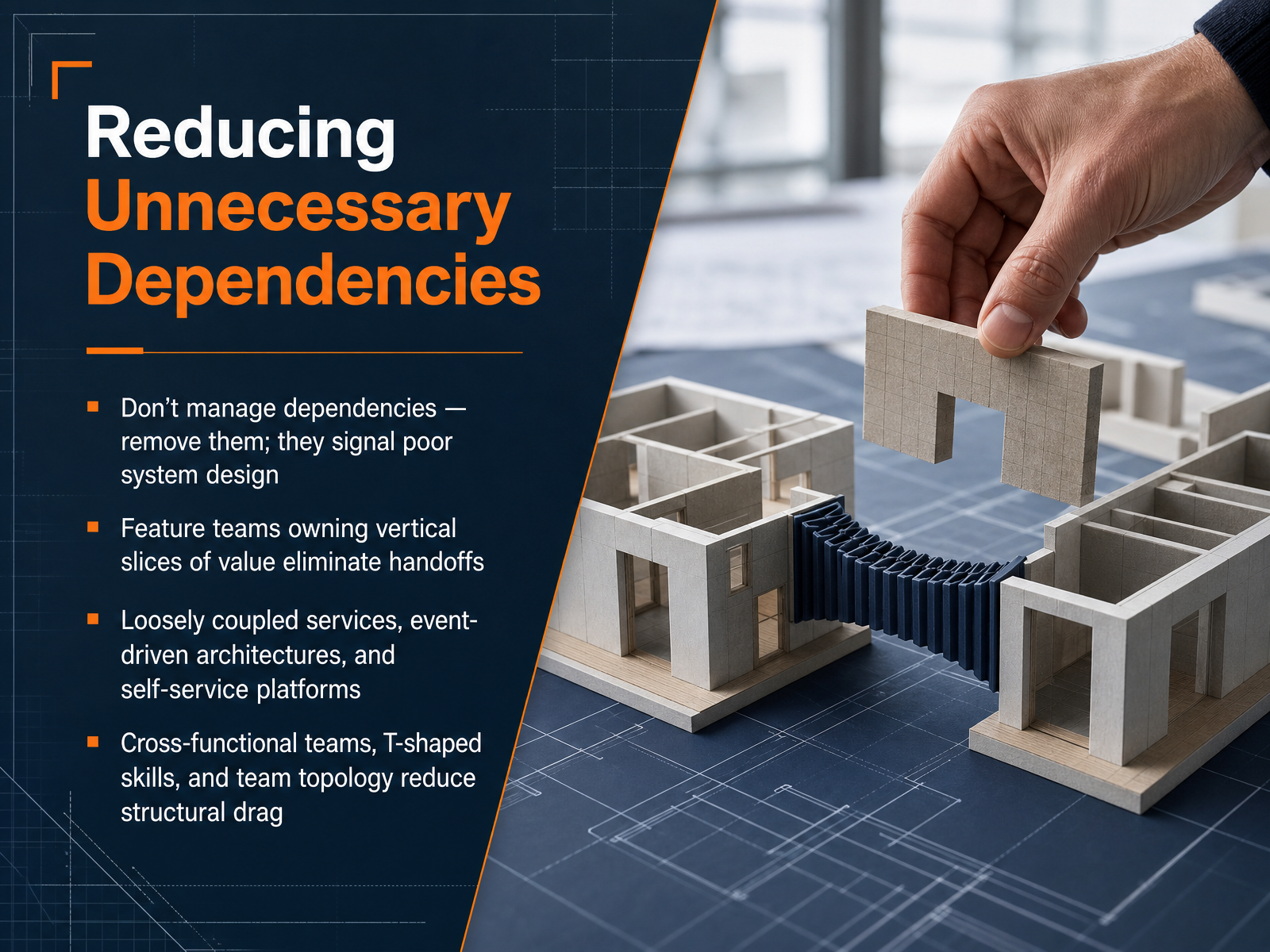 nkdagility.comscrum.orgem-tools.io+21 min
 - 08Proactive Risk Management for DependenciesLet's move into proactive risk management for dependencies. The most effective strategy starts before the project does. Map every cross-team touchpoint during kickoff, not mid-sprint. This means identifying exactly what you need from other teams, who the contact is, and when it's due. Think of this as a dependency inventory that makes hidden assumptions visible to everyone. Once you have that map, build a realistic buffer into your timelines. A 20 to 30 percent cushion on work that depends on external teams isn't pessimism, it's the practical reality of coordination. You can use that buffer time for independent tasks or building against mock interfaces while you wait. For critical-path dependencies, run scenario planning. Ask what happens if a key delivery slips by one week, or if the owning team picks up a competing priority. Having a contingency plan means you can re-sequence work instead of stalling. When a dependency does drift, escalate early, but frame it as a shared prioritization challenge. Come to the conversation with options, a clear impact statement, and a collaborative tone. You're not complaining, you're coordinating to unblock shared progress. Next, we'll look at the tools and tracking systems that keep these dependencies visible week after week.
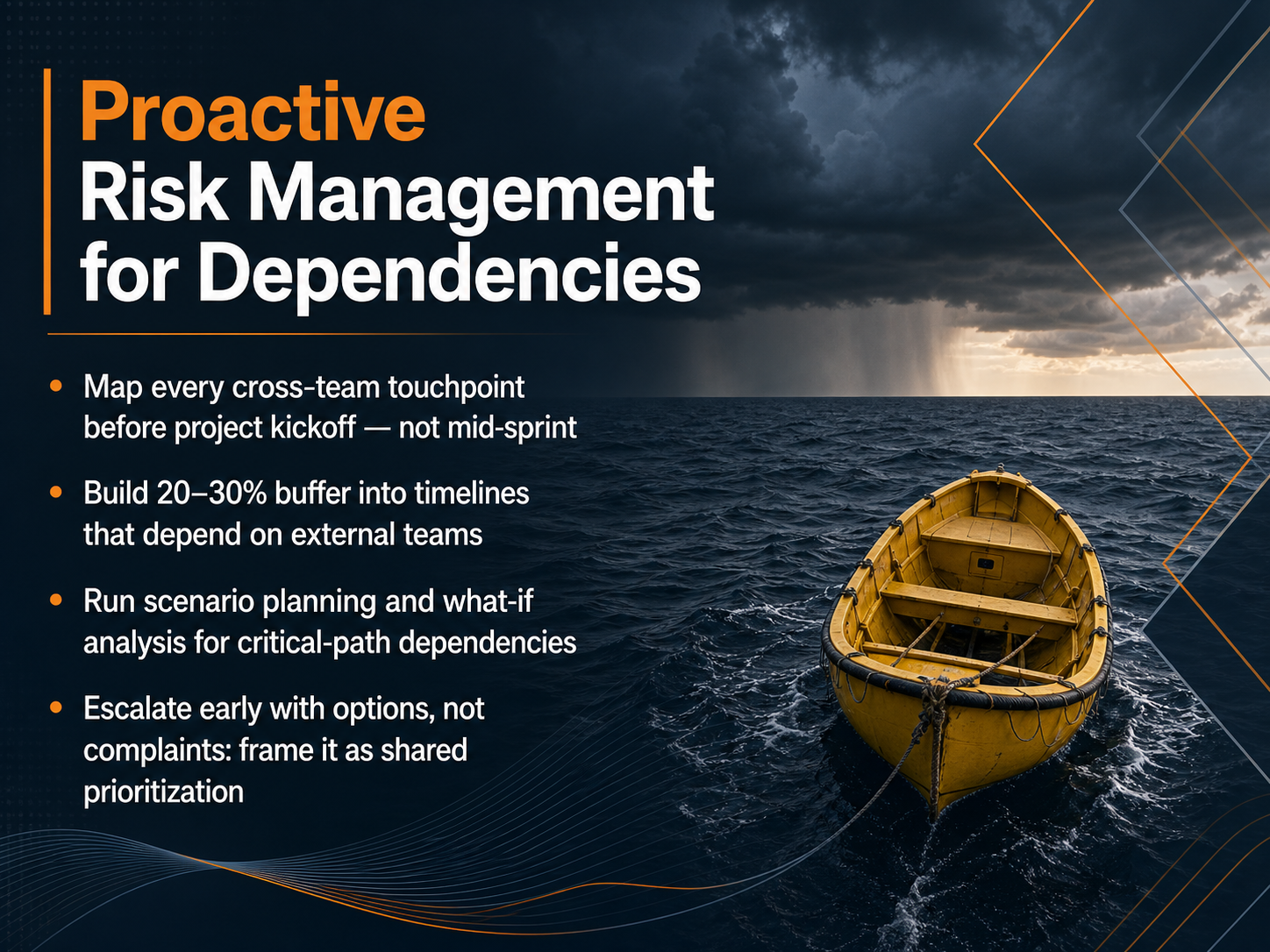 em-tools.iogrowingscrummasters.comronbofan.com+22 min
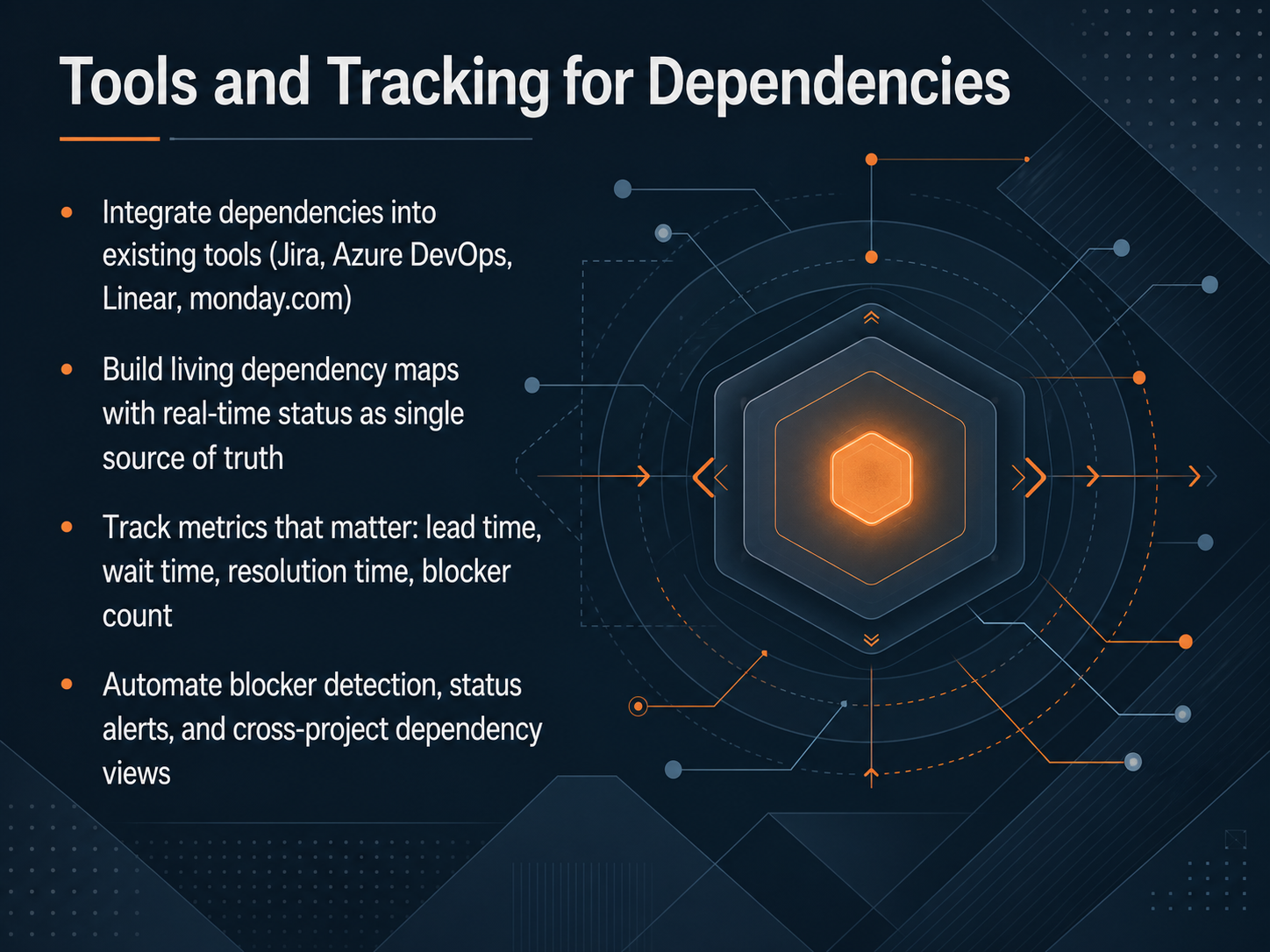
 - 09Tools and Tracking for DependenciesNow let's bring all that dependency logic into your actual tools. You don't need a separate system to track handoffs. Most teams already have the right platform, whether it's Jira, Azure DevOps, Linear, or monday.com. The key is integrating dependency tracking directly into your existing workflows so it becomes a natural part of how the team works, not an extra step. Once you have that, build a living dependency map. This should be your single source of truth, with real-time status updates. When a blocker clears or a predecessor task shifts, everyone sees it immediately. Then, track the metrics that actually matter for flow. Focus on lead time, wait time, resolution time, and a simple blocker count. These numbers tell you where work is slowing down. Finally, automate what you can. Set up automatic blocker detection, status alerts, and cross-project dependency views. This way, you're not constantly polling for updates. The system flags issues and you can coordinate with the team to unblock them fast. Next, let's look at the metrics that reveal hidden bottlenecks.
 scrumbuiss.comstoryflow.so2 min
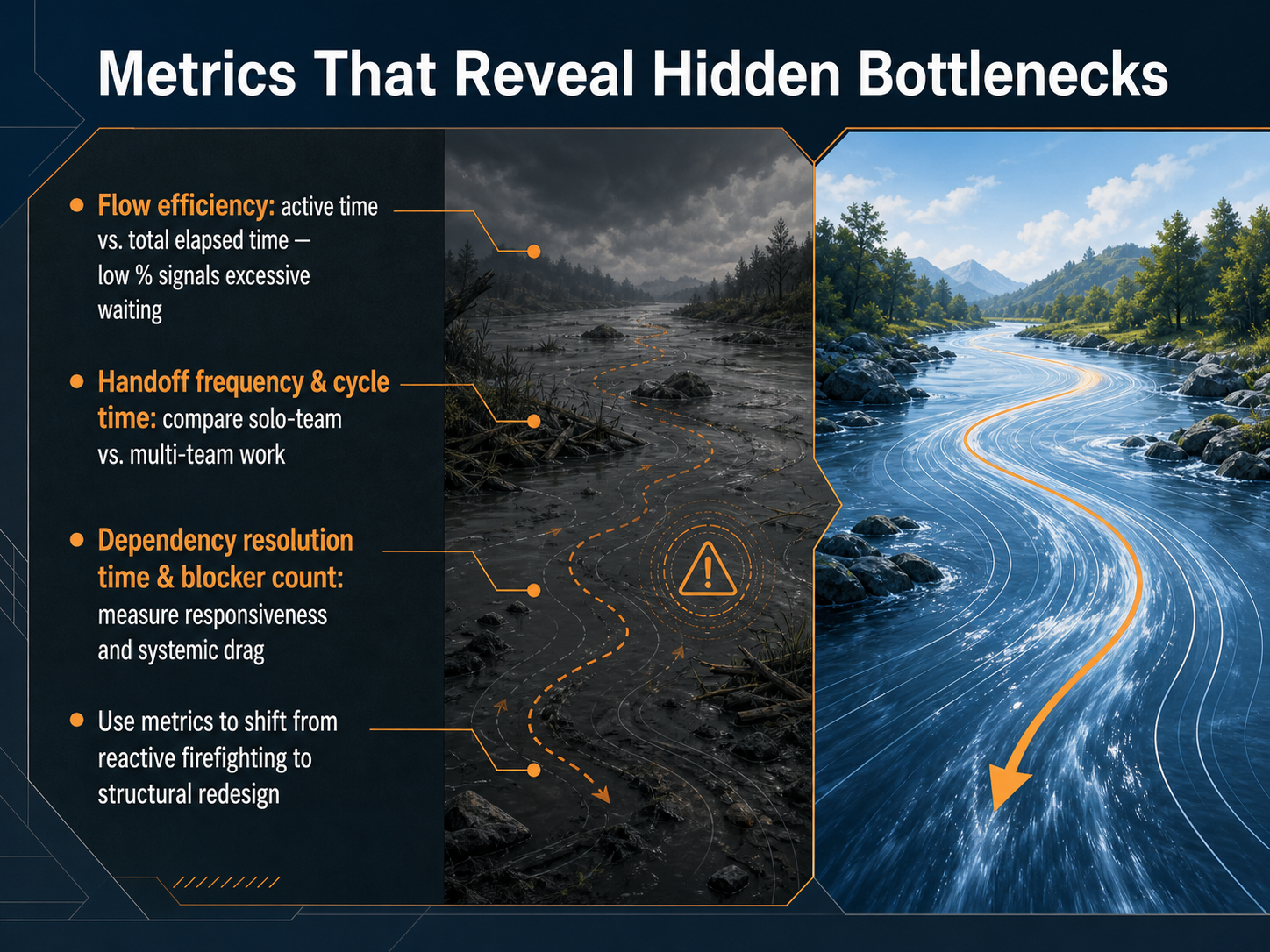
 - 10Metrics That Reveal Hidden BottlenecksNow let's talk about metrics that reveal the hidden bottlenecks teams often feel but can't quite name. When a handoff keeps slipping or a blocker stays open for weeks, the right metrics make the problem visible and actionable. Start with flow efficiency. Compare active work time against total elapsed time from request to delivery. A low percentage, say below fifteen percent, usually signals excessive waiting between handoffs. Next, look at handoff frequency and cycle time. Track whether work that touches a single team moves faster than work that bounces across three or four teams. That gap often points to where coordination drag is eating your throughput. Then measure dependency resolution time and blocker count. If a blocker sits for days without an owner, it's not a one-off incident; it's a systemic drag that needs a structural fix, not a fire drill. Use these metrics to shift from reactive firefighting to intentional redesign. When you can see the pattern, you can start reshaping the workflow. Next, let's apply that mindset to building a dependency-conscious culture.
 planisware.comatlassian.comsimpliaxis.com+22 min
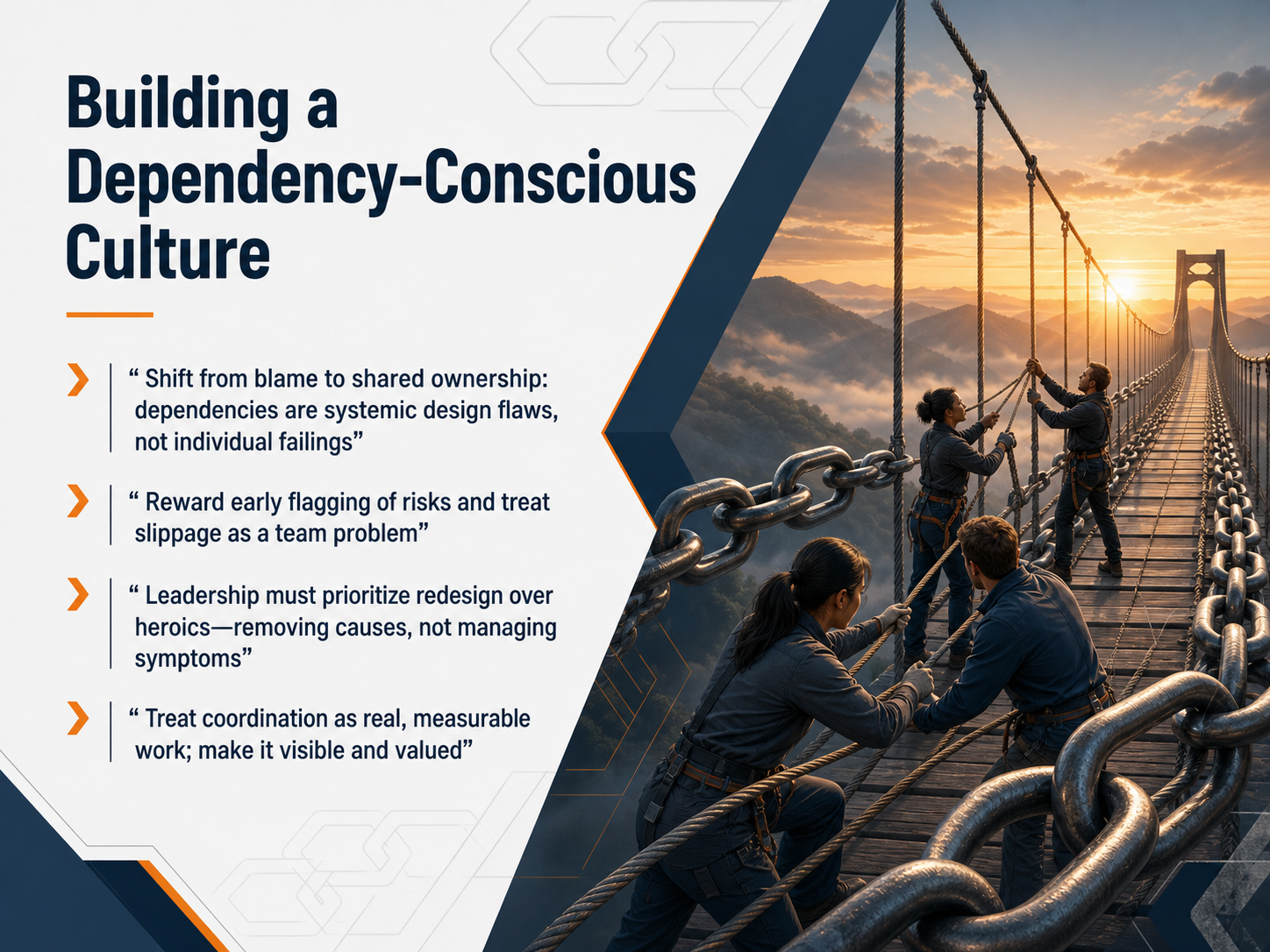
 - 11Building a Dependency-Conscious CultureLet's talk about the cultural shift that makes all of this stick. Building a dependency-conscious culture means moving from blame to shared ownership. Dependencies are usually systemic design flaws, not individual failings, so the focus should be on fixing the system, not pointing fingers. Reward early flagging of risks and treat any slippage as a team problem to solve together. Leadership plays a key role here—they must prioritize redesign over heroics, removing the root causes instead of just managing the symptoms. And finally, coordination is real, measurable work. Make it visible and valued, not an afterthought. When you treat coordination as legitimate effort, you start to see the true cost of dependencies and build the case for lasting change. Next, we'll look at escalation and conflict resolution.
 nkdagility.comscrum.orgem-tools.io+22 min
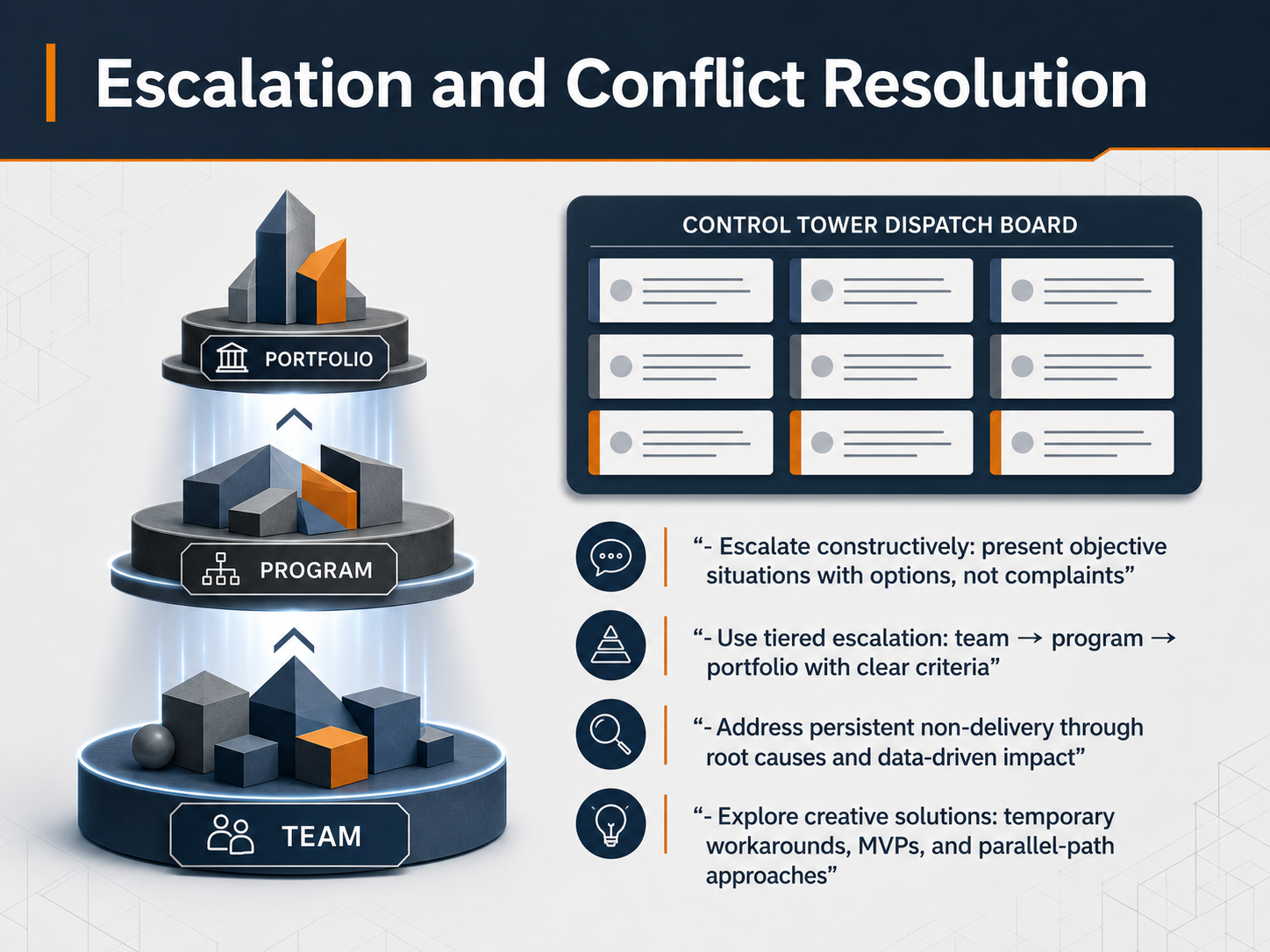
 - 12Escalation and Conflict ResolutionNow, let's talk about escalation and conflict resolution. When a dependency is truly stuck, escalation isn't complaining—it's responsible communication. Present the situation objectively. Frame it as a shared problem: lay out the facts, the impact, and two or three options, rather than just saying you're blocked. Use a tiered approach to match the severity. Start at the team level with a direct conversation or a Scrum of Scrums. If a dependency stays unresolved for more than a sprint, escalate to the program level. For issues that need budget or org changes, that goes to the portfolio level. Document these criteria so escalation is routine, not political. If a team persistently fails to deliver, dig into the root causes. They might be overwhelmed or have conflicting priorities. Present the data-driven impact to leadership, and in the meantime, work to insulate your team. Finally, explore creative solutions before accepting a full stop. Can you negotiate a temporary workaround, deliver a minimum viable product, or agree on a mock interface so both teams can pursue parallel paths? Remember, the binary choice of 'they do it now' or 'we wait' can often be avoided with a more nuanced move. Next, we'll shift from theory to practice with our final slide: 'Action Plan: Assessing Your Team's Dependency Health'.
 em-tools.iogrowingscrummasters.comronbofan.com+22 min
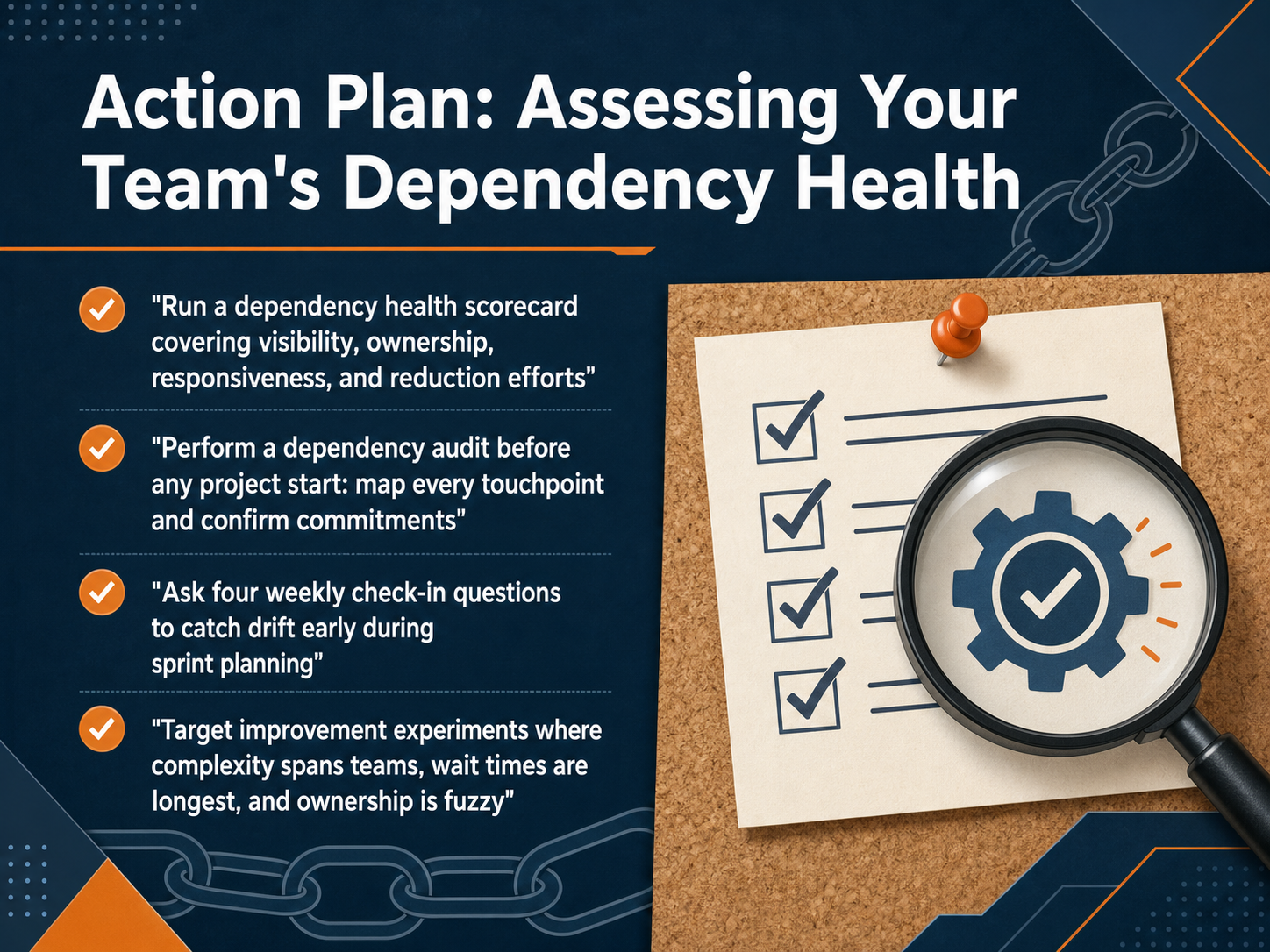
 - 13Action Plan: Assessing Your Team's Dependency HealthLet's turn these concepts into a practical action plan. You can start by running a dependency health scorecard that evaluates four areas: visibility, ownership, responsiveness, and reduction efforts. This gives you a clear baseline. Before any new project begins, perform a dependency audit. Map every touchpoint and confirm commitments early, so you don't discover blockers after work is already underway. During sprint planning, build a habit of asking four weekly check-in questions to catch drift before it becomes a delay. Finally, focus your improvement experiments where complexity spans multiple teams, wait times are longest, and ownership is fuzzy. Those are the places where a small fix often yields the biggest gain. Next, we'll walk through your thirty, sixty, and ninety-day dependency improvement roadmap.
 planisware.comatlassian.comsimpliaxis.com+21 min
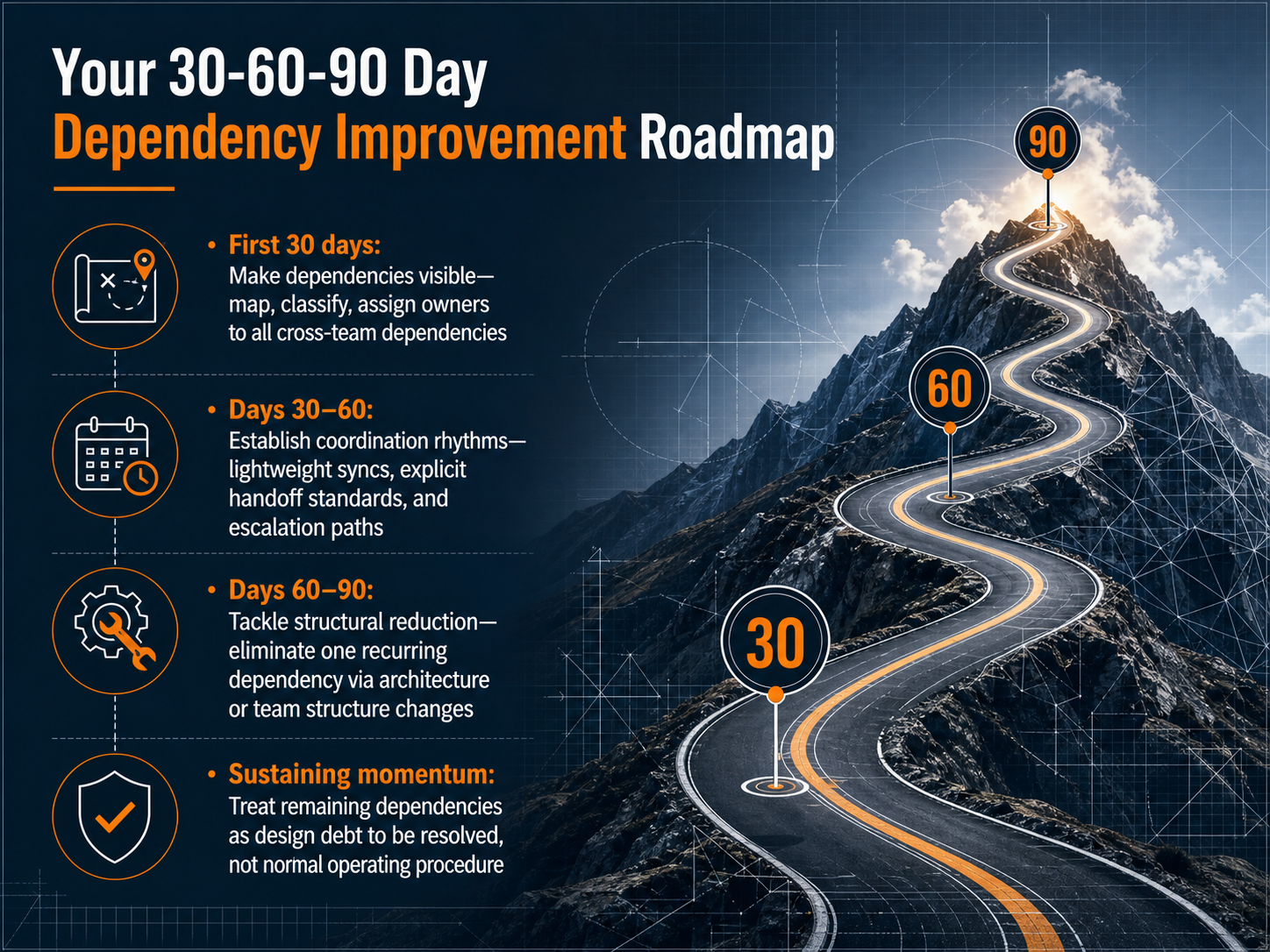
 - 14Your 30-60-90 Day Dependency Improvement RoadmapLet's pull this together into a clear path forward. Your 30-60-90 day improvement roadmap gives you a practical sequence, starting with visibility. In the first 30 days, map and classify every cross-team dependency, and assign a clear owner. You can't fix what you can't see. Then, during days 30 to 60, set up lightweight coordination rhythms, like brief syncs, explicit handoff standards, and escalation paths. This keeps things moving without overwhelming the teams. In the 60 to 90 day window, tackle structural reduction. Pick one recurring dependency and eliminate it through an architecture change or a team-structure shift. Finally, for sustaining momentum, treat any remaining dependencies as design debt to be resolved, not as normal operating procedure. Every dependency you remove is a gift to your teams and your customers. Thank you for investing this time, and I'm confident you'll make a real difference in your project flow.
 nkdagility.comscrum.orgem-tools.io+22 min
Take the deck with you
Download this course as a file — free, no sign-up needed.
- PDF handoutEvery slide page, ready to print or share.15 pages · 4.6 MBDownload
- Narrated PowerPointThe deck that presents itself — every slide carries the digital human's narration video.15 pages · 14.3 MBDownload
- PowerPoint slidesThe full deck as a .pptx — open it in PowerPoint, Keynote, or Google Slides.15 pages · 4.6 MBDownload
Free to use in your own training — please keep the PersonWise credit page at the end.
Have your own deck? Turn it into a course
Sources consulted
Web sources consulted while building this course.
- Don’t Manage Dependencies, Remove Them | naked Agility with Martin Hinshelwood — nkdagility.com
- Eliminate dependencies, don't manage them — scrum.org
- Cross-Team Dependencies: How to Map and Reduce Them | Engineering Manager Tools — em-tools.io
- Balancing Coordination Costs Between Product Teams and Specialist Teams in Your Agile Framework | Scrum.org — scrum.org
- Three Strategies to Reduce the Pain of Cross-Team Dependencies — humanizingwork.com
- Managing Agile Dependencies and Release Trains Across ... — planisware.com
- Project dependencies | Atlassian — atlassian.com
- Effective Management of Dependencies in Agile Projects — simpliaxis.com
- Managing Dependencies in Scrum — resources.scrumalliance.org
- Mastering Project Dependencies: A Practical Guide To Managing Interdependencies – ITU Online IT Training — ituonline.com
- What is a Dependency Map and When to Use One? | Miro — miro.com
- What is Dependency Mapping in Project Management? | Creately — creately.com
- Dependency Mapping for Agile Team Alignment | Mural — mural.co
- Task Dependency Mapping in Project Management — projectmanager.com
- Multi-Team Coordination: Practical Approaches Beyond Frameworks : Growing Scrum Masters — growingscrummasters.com
- The TPM's Guide to Dependency Management at Scale | Ronbo Fan — ronbofan.com
- Dependencies Management in Scaled Agile: Complete Guide to Cross-Team Coordination - CodeLucky — codelucky.com
- Managing Cross-Team Dependencies — When Your Feature Needs Three Other Teams to Ship | Webcoderspeed — webcoderspeed.com
- 10 Best Agile Project Management Tools in 2026 — scrumbuiss.com
- The 12 Best Project Planning Tools in 2026 (We Tested Them All) | Storyflow — storyflow.so