Sales Enablement Framework Components
Begin
14 pages · ~28 min
Sales Enablement Framework Components
This training provides sales professionals with a practical framework for understanding key sales enablement components and applying them to improve sales effectiveness and drive revenue growth.
What you’ll learn
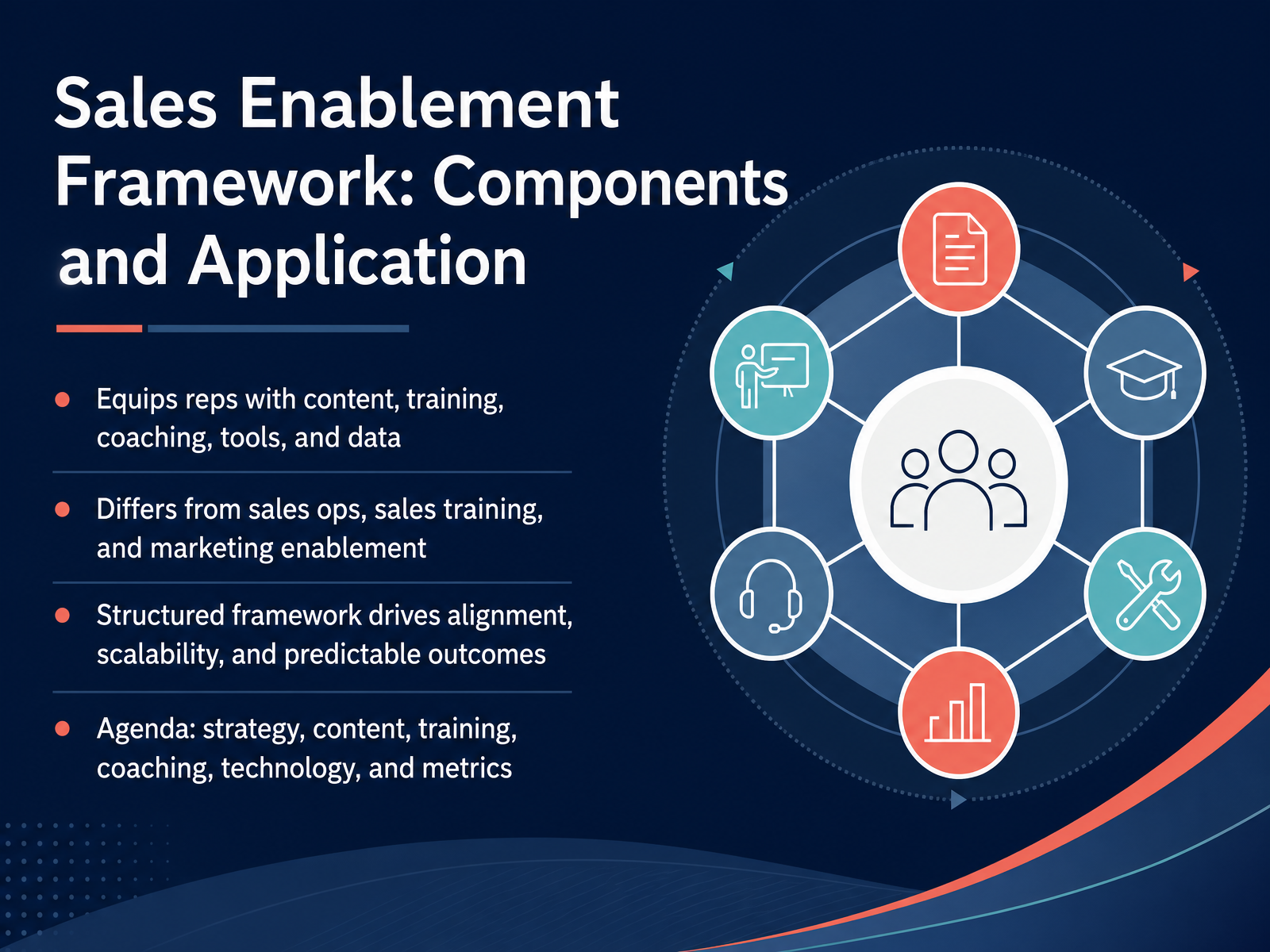
- 01Sales Enablement Framework: Components and ApplicationWelcome. If you're responsible for helping your sales team sell smarter, not just harder, this session is for you. We're going to break down the sales enablement framework, the operating system that equips your reps with the right content, training, coaching, tools, and data at the right moment. It's a discipline that's often confused with sales ops, which focuses on process and systems, or sales training, which is typically a one-time event. Enablement is the ongoing, strategic engine that connects all of it. A structured framework ensures alignment across teams, scales with your growth, and drives predictable revenue outcomes. Over the next few minutes, we'll walk through the six core components: strategy, content, training, coaching, technology, and metrics. Let's get started. First, we need to understand why a formal framework is non-negotiable for sustainable growth.blog.hubspot.comapollo.iogartner.com+22 min
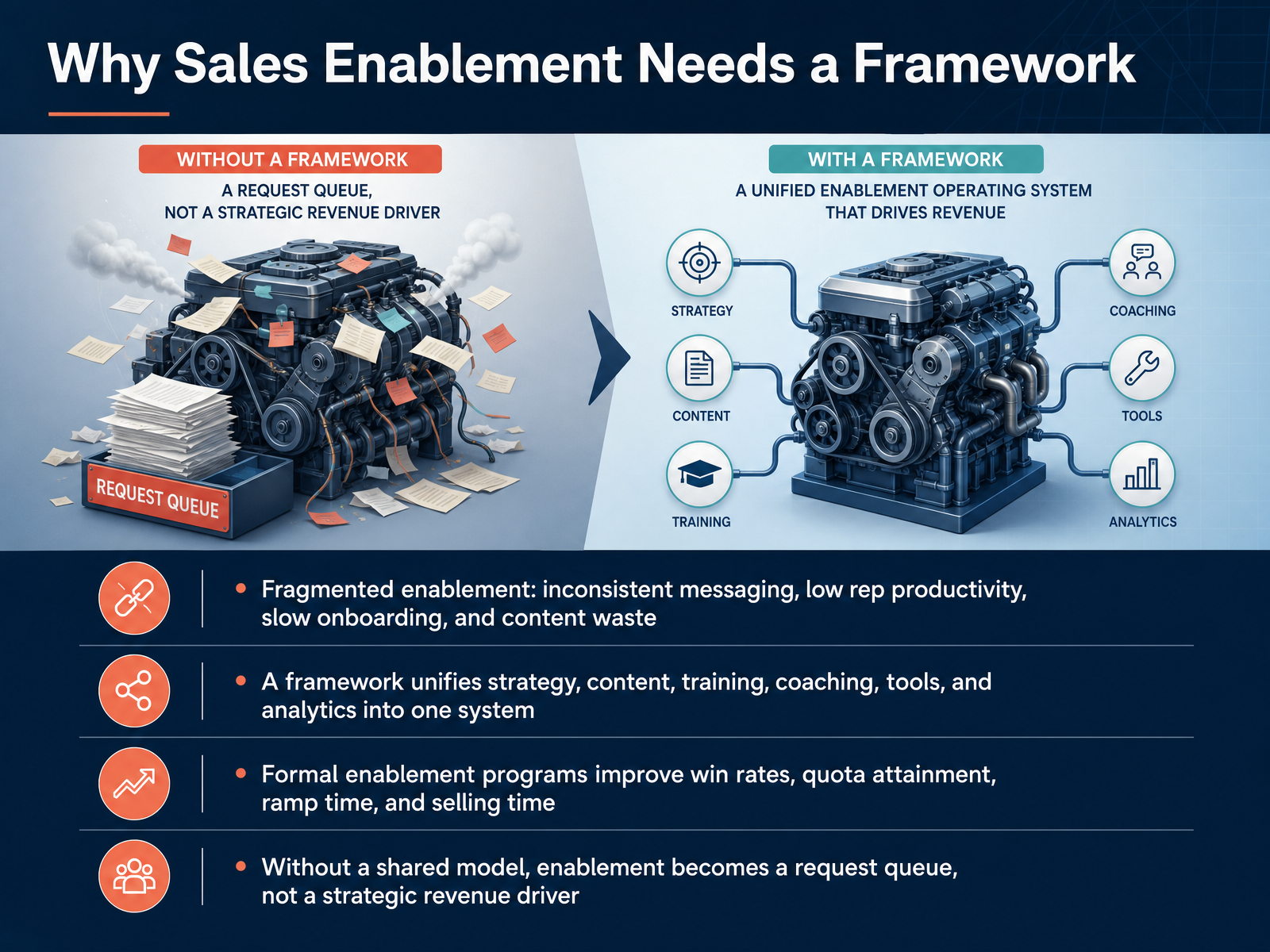
- 02Why Sales Enablement Needs a FrameworkLet’s be candid about the cost of fragmentation. When enablement is scattered, reps hear inconsistent messaging, onboarding drags, and content goes unused. That’s not just inefficient—it’s expensive. A framework changes that. It unifies strategy, content, training, coaching, tools, and analytics into one operating system. The data is clear. Formal enablement programs lift win rates and quota attainment, while cutting ramp time. Without a shared model, enablement becomes a request queue. You’re not driving revenue; you’re just fulfilling tickets. So the question isn’t whether you can afford a framework. It’s whether you can afford to keep operating without one. Let’s look at what actually makes up a high-impact framework—the core components you’ll need to build on.
 community.highspot.comindex.sbigrowth.combrainshark.com+21 min
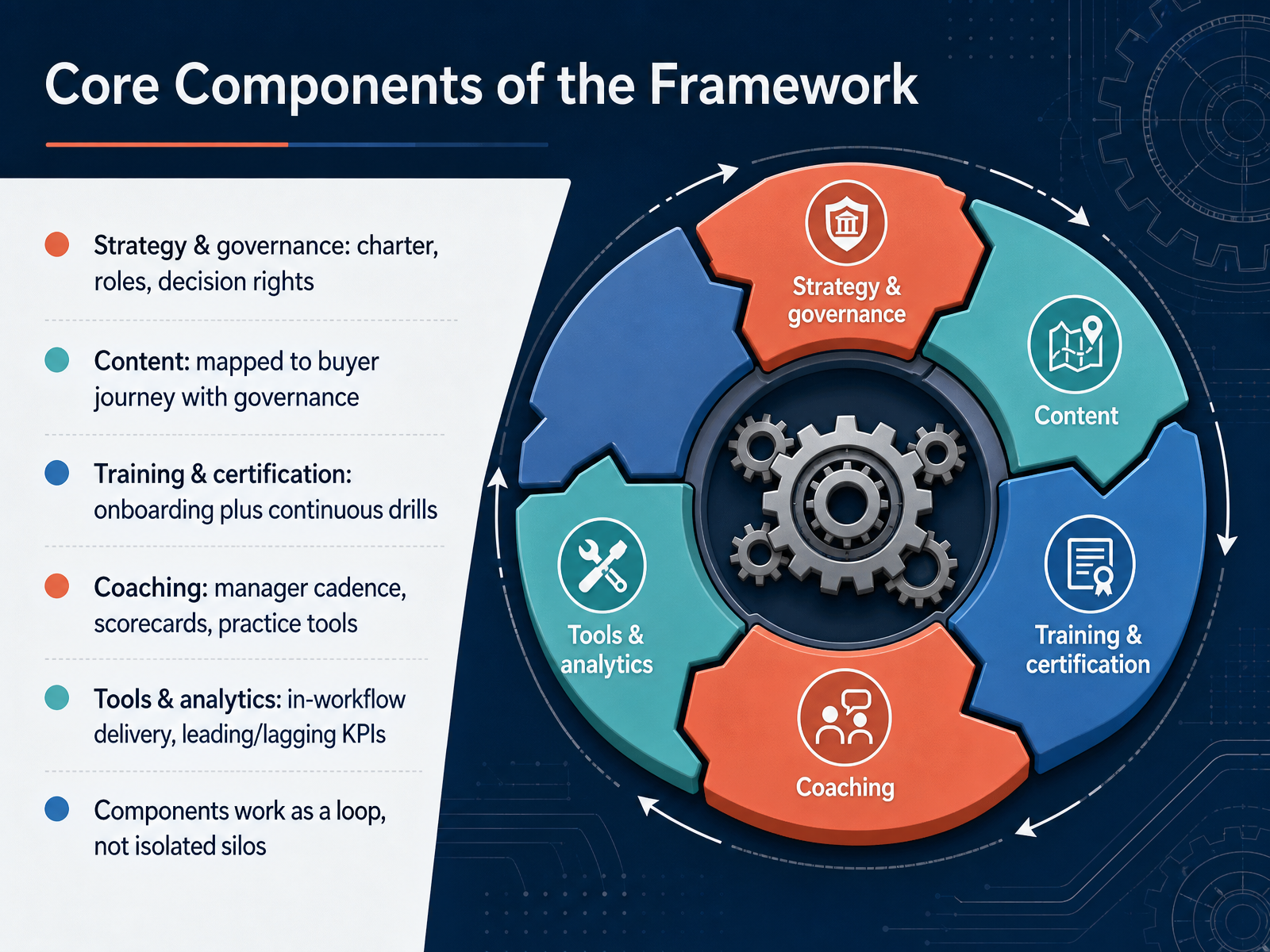
 - 03Core Components of the FrameworkNow let's break down the core components of the framework. These five pieces operate as a loop, not isolated silos—each one feeds the next. First, strategy and governance: this is your charter, your roles, and your decision rights. Without it, enablement becomes a request queue. Second, content—mapped to the buyer journey with real governance, so reps find the right asset in under thirty seconds. Third, training and certification: onboarding plus continuous drills, because one-and-done doesn't stick. Fourth, coaching: manager cadence, scorecards, and practice tools. Here's the hard truth—coaching is the single biggest predictor of impact. Fifth, tools and analytics: delivering guidance in the workflow, and tracking leading and lagging KPIs. Remember, these aren't five boxes on a chart. They're a loop. Training creates the baseline, content supports it, coaching reinforces it, and analytics tells you what to fix. Let's start with the foundation. Component 1: Strategy and Governance.
 vozah.comgtmonly.comsalesforce.com+22 min
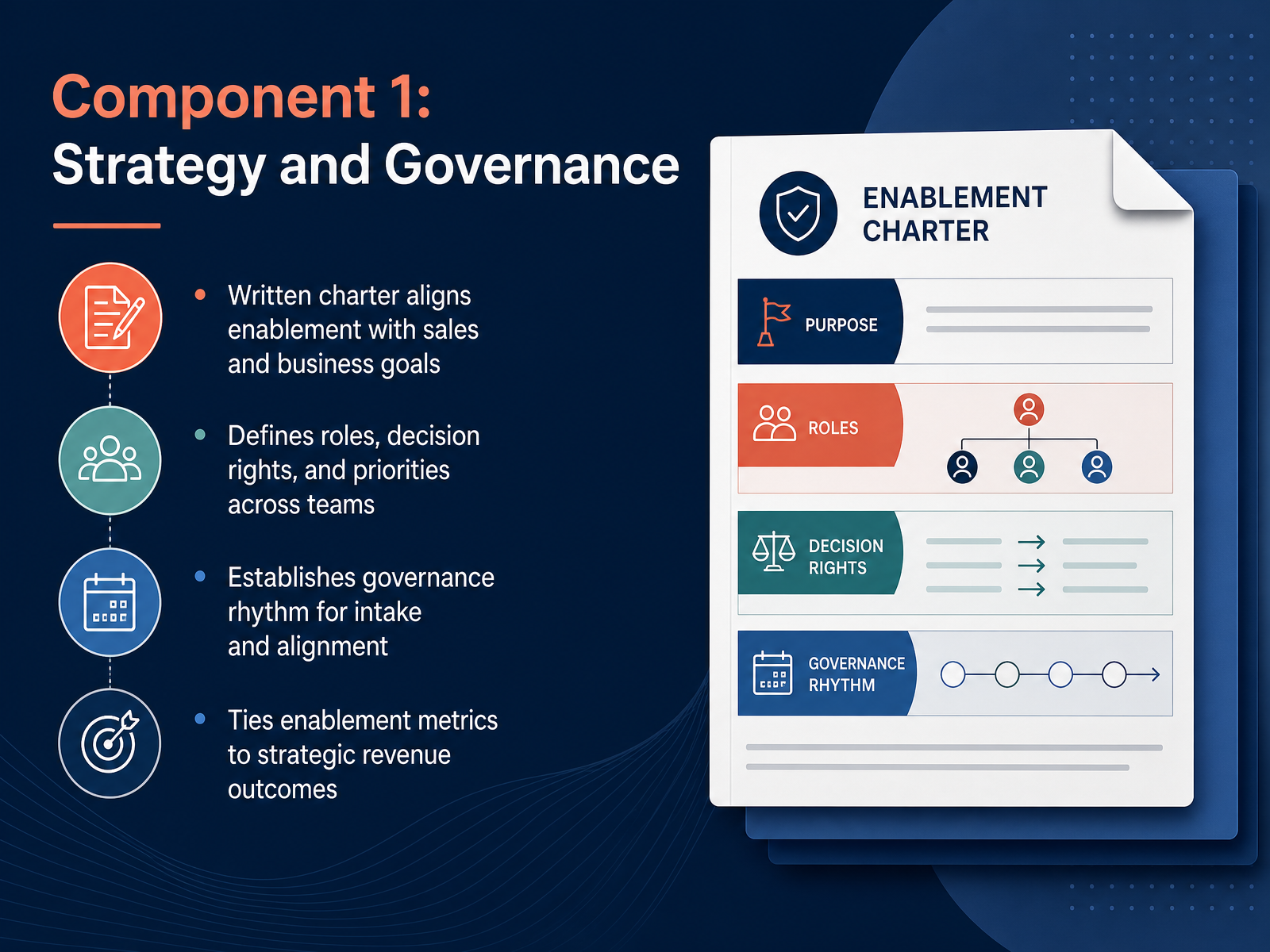
 - 04Component 1: Strategy and GovernanceLet’s anchor the framework with its first component: strategy and governance. This is where enablement earns its seat at the revenue table or gets reduced to a request queue. The foundation here is a written charter, one to two pages that aligns enablement to sales and business goals. It defines roles, decision rights, and priorities across sales, marketing, and product. Critically, that charter also states what enablement will not do, giving the team license to say no to inbound asks that do not move quota. On top of that sits a governance rhythm, a recurring cadence for intake and alignment so priorities are deliberate, not reactive. And finally, the charter ties enablement metrics to strategic revenue outcomes. Activity metrics alone will not protect your budget. Metrics tied to quota attainment and revenue will. Without this charter, enablement becomes whatever the loudest stakeholder demands that week. With it, you control the agenda. Now, let’s move to where that strategy becomes tangible: content and asset management.
 vozah.comgtmonly.comsalesforce.com+22 min
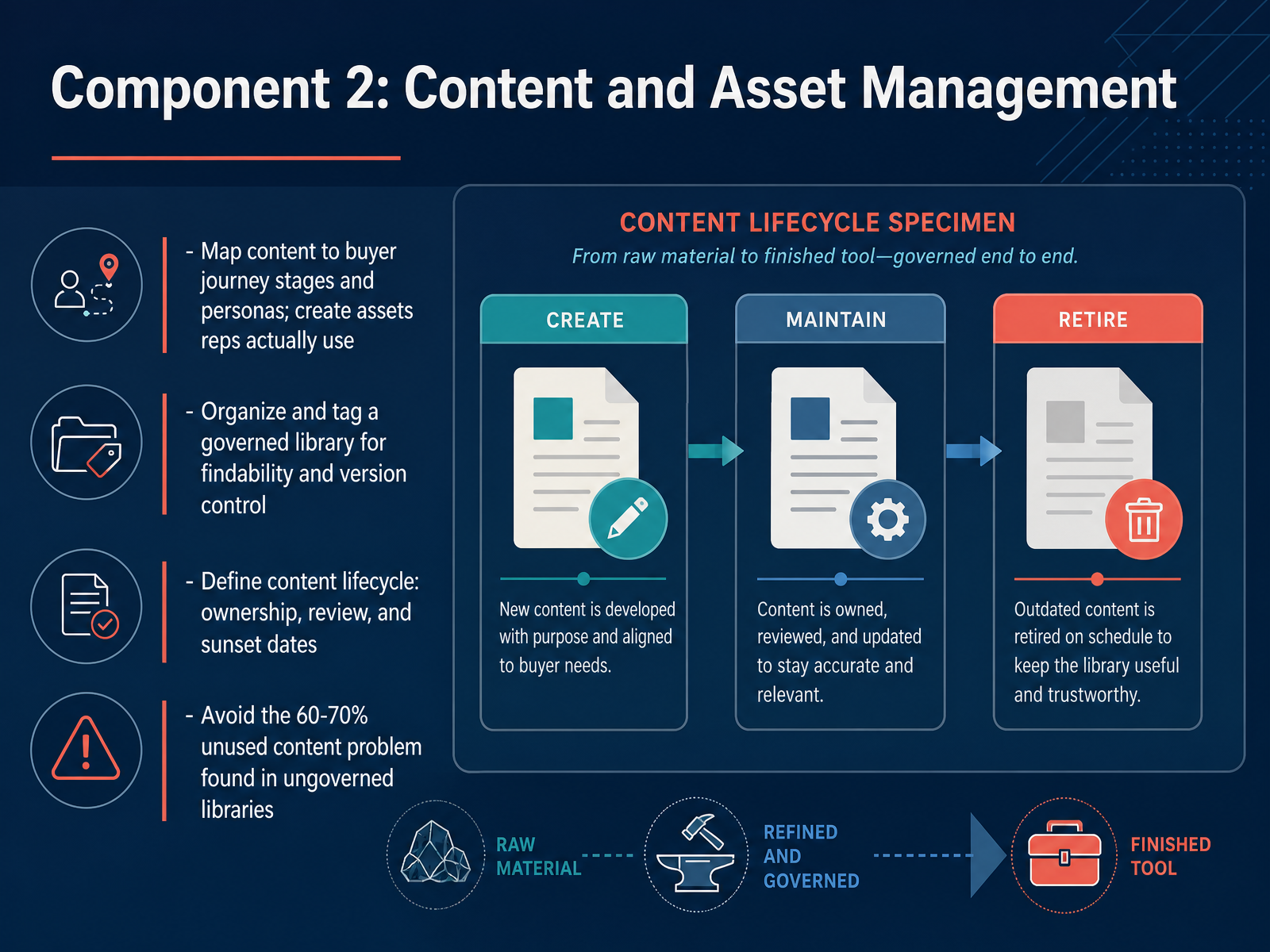
 - 05Component 2: Content and Asset ManagementLet's talk about content and asset management. This is where the framework lives or dies from a practical standpoint. First, map every card, case study, and one-pager to a specific buyer stage and persona. Build assets reps actually use, not what looks good in a marketing review. Second, organize and tag a governed library. If a rep can't find the right asset in under thirty seconds, they won't use it. Version control and metadata are non-negotiable. Third, define the content lifecycle. Every asset needs an owner, a review date, and a sunset date. If it hasn't been touched in ninety days, archive it. Here's the reality check. Sixty to seventy percent of content in ungoverned libraries never gets used. That's not a content problem, that's a governance problem. So shift from more content to fewer, higher quality, governed pieces. Next, we'll look at Component 3: Training, Certification, and Continuous Learning.
 vozah.comgtmonly.comsalesforce.com+22 min
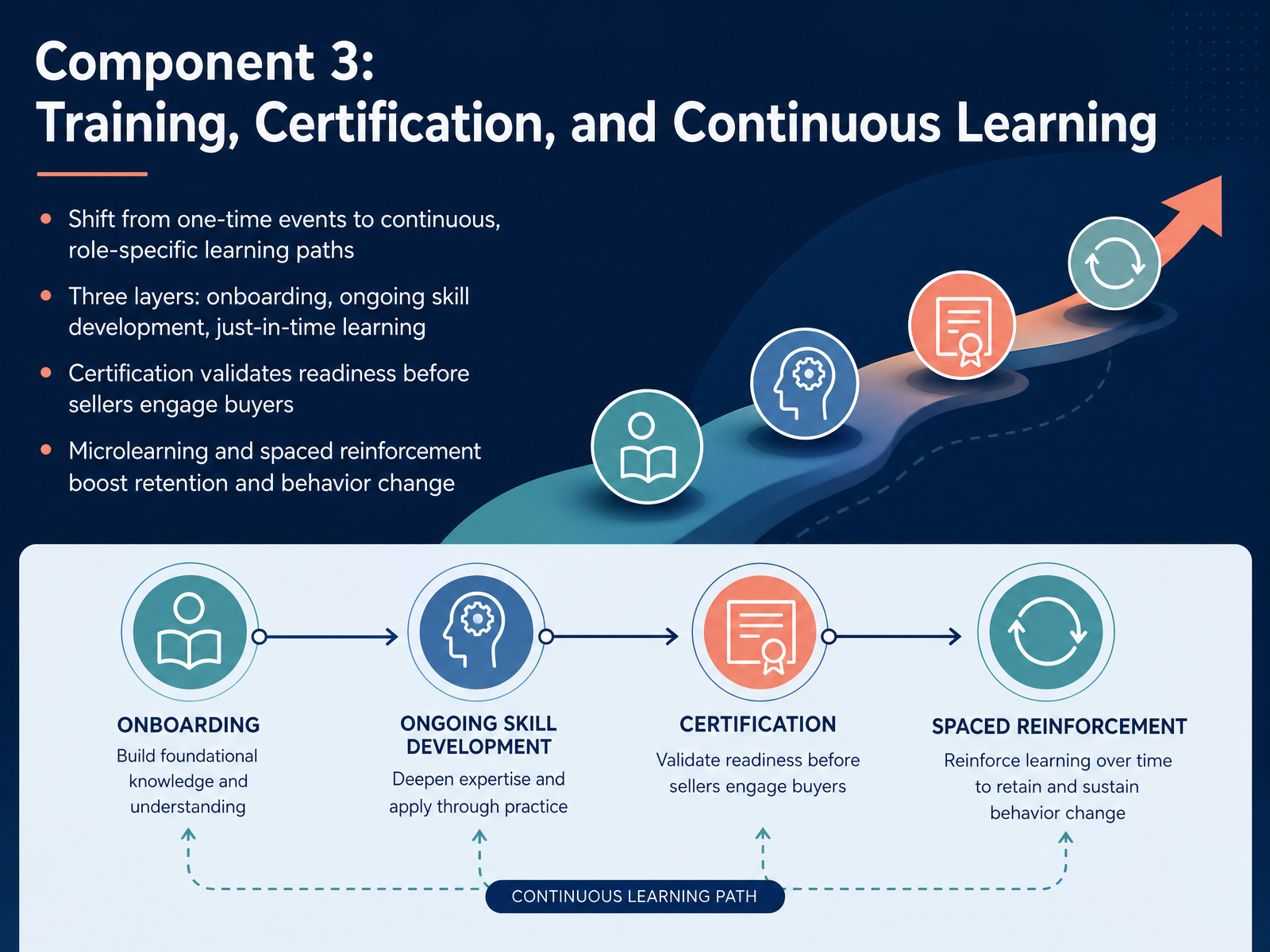
 - 06Component 3: Training, Certification, and Continuous LearningLet’s talk about the third component: training, certification, and continuous learning. The old model of a one-time sales kickoff simply doesn’t survive contact with the forgetting curve. Research shows sellers can forget up to 90 percent of new content within a month without reinforcement. So, we need to shift from events to continuous, role-specific learning paths. That means three layers working together. Onboarding gets new reps to competency fast. Ongoing skill development keeps the whole team sharp on discovery, objection handling, and qualification. And just-in-time learning delivers a micro-lesson or a job aid right when a rep needs it, before that next call. Certification plays a critical gatekeeping role here. It validates readiness before a seller ever engages a buyer, so you’re not sending someone into the field with untested skills. And for retention? Microlearning and spaced reinforcement are non-negotiable. Bite-sized modules, short quizzes, and weekly practice drills beat a two-day workshop every time when it comes to changing behavior. The goal isn’t attendance at a session. It’s verified skill adoption that shows up in real conversations. Now, let’s look at how you build the coaching and reinforcement system that makes all of this stick.
 brooksgroup.comtrainingindustry.combrooksgroup.com+22 min
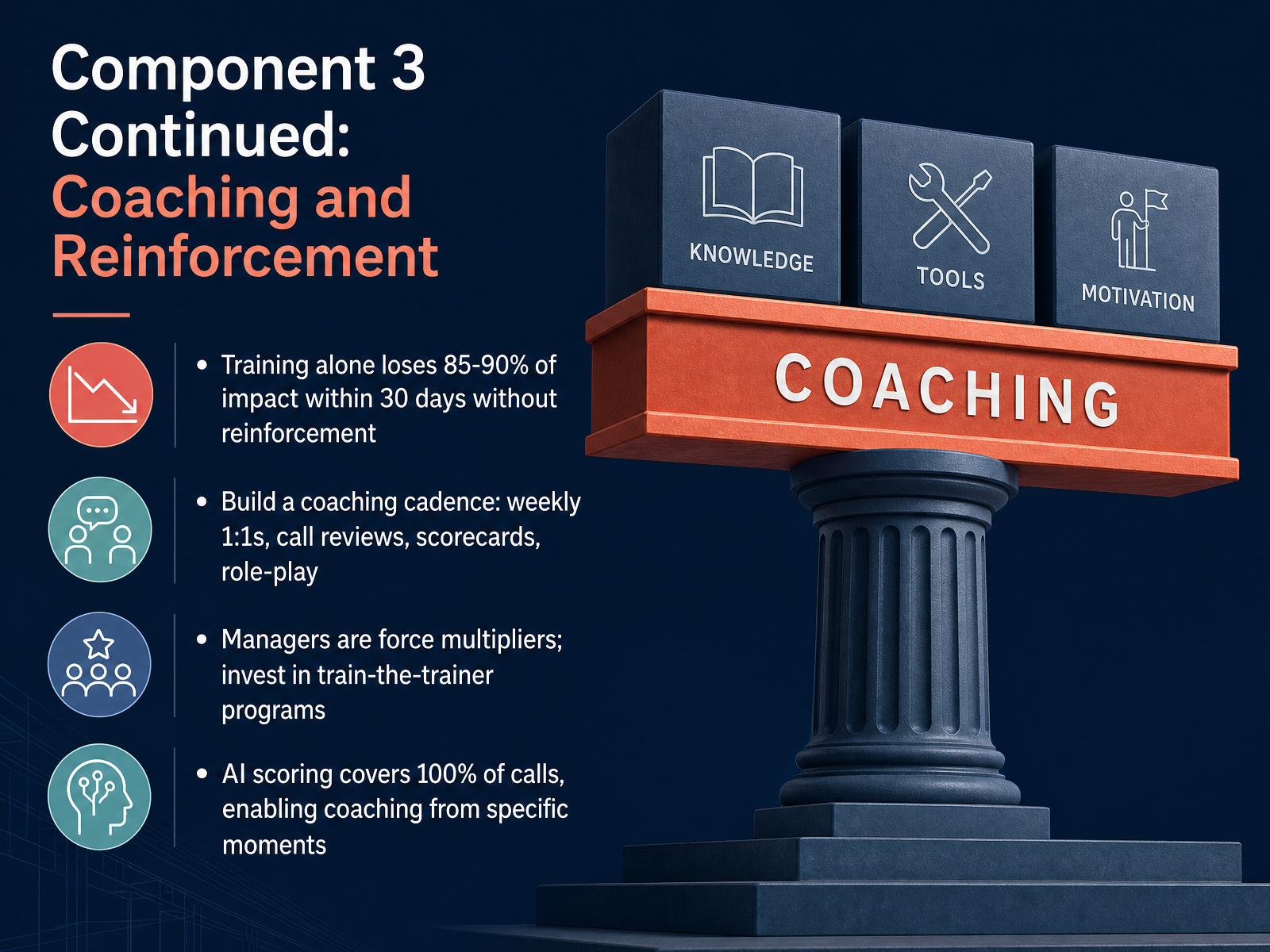
 - 07Component 3 Continued: Coaching and ReinforcementHere’s where the framework gets real. Training alone can lose 85 to 90 percent of its impact within 30 days. That’s not a training design flaw; it’s just how memory works. So if your goal is lasting behavior change, reinforcement is non-negotiable. Build a coaching cadence. Weekly 1-on-1s, call reviews, scorecards, and role-plays. Short, consistent sessions, 15 to 30 minutes, win over quarterly marathons. And remember, managers are your force multipliers. If they can’t coach, the training dies when the trainer leaves the building. Invest in train-the-trainer programs so they know how to coach against the methodology. Now, here’s the 2026 advantage. AI scoring covers 100 percent of calls, not just the 3 percent a manager can review. That means every rep gets specific feedback on moments that matter. Instead of coaching from memory, you coach from a specific call segment that happened yesterday. That is the specificity that turns training into permanent behavior. Now, let’s talk about the engine that makes this scale: Component 4, Tools, Technology, and Workflow.
 brooksgroup.comtrainingindustry.combrooksgroup.com+22 min
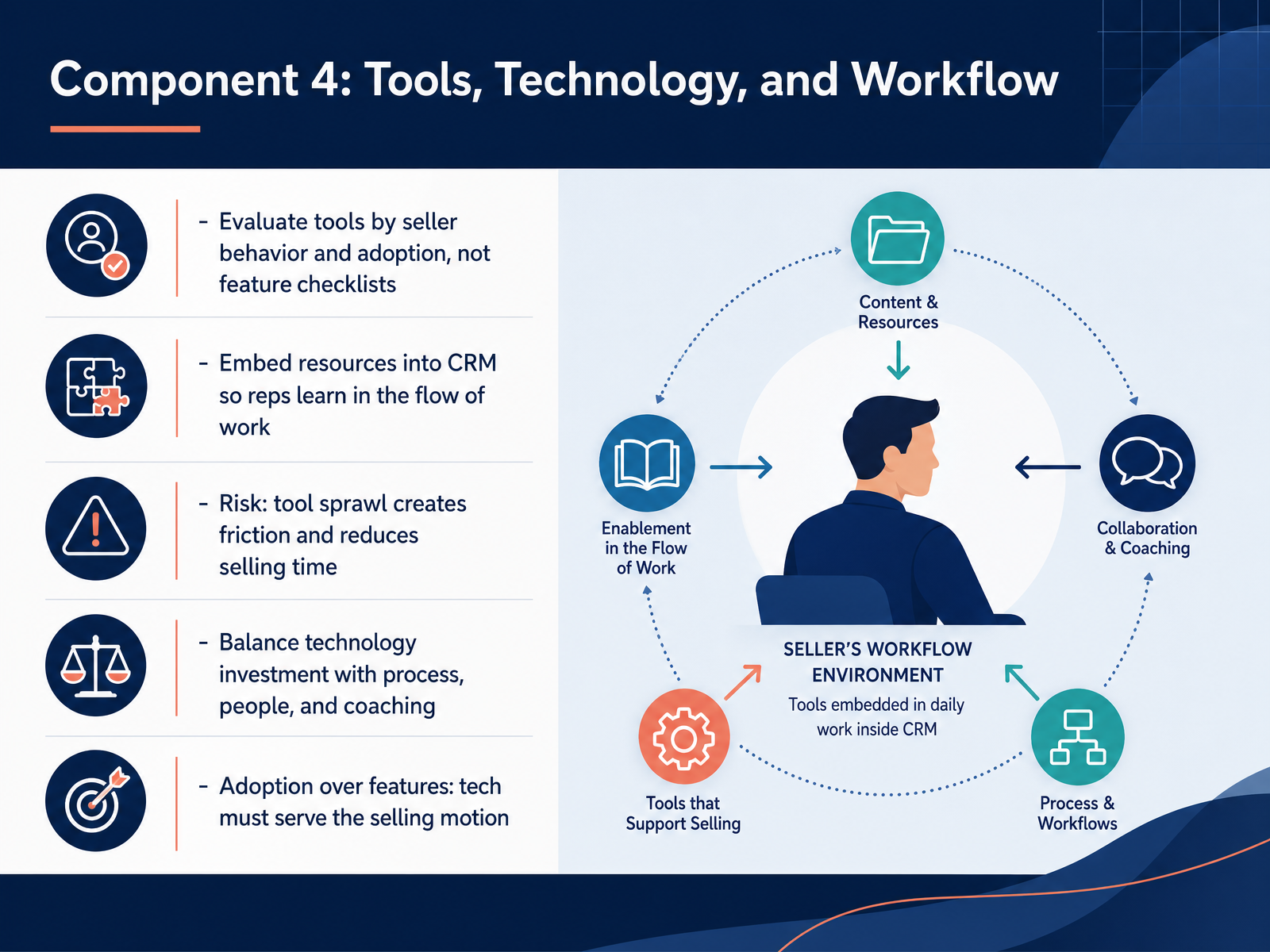
 - 08Component 4: Tools, Technology, and WorkflowNow let’s talk about the enabler that can make or break your entire framework: tools, technology, and workflow. Here’s the reality check. Too many teams evaluate technology by feature checklists. Don’t. Evaluate by seller behavior and adoption. If your reps aren’t using the tool in their daily workflow, the features don’t matter. The goal is to embed resources directly into the CRM, so reps learn in the flow of work. They shouldn’t have to open a separate portal or search a shared drive mid-call. The content finds them, right where they sell. The biggest risk here is tool sprawl. Every new platform adds friction and takes time away from selling. Before you buy, ask yourself: does this consolidate or complicate? And remember, technology is only one layer. You must balance the investment with process, people, and coaching. A tool won’t fix a broken process, and it won’t replace a manager who doesn’t coach. The guiding principle is simple: adoption over features. If the tech doesn’t serve the selling motion, it’s not serving your revenue. Keep that in mind as we move to our final component: measurement and continuous improvement.
 vozah.comgtmonly.comsalesforce.com+21 min
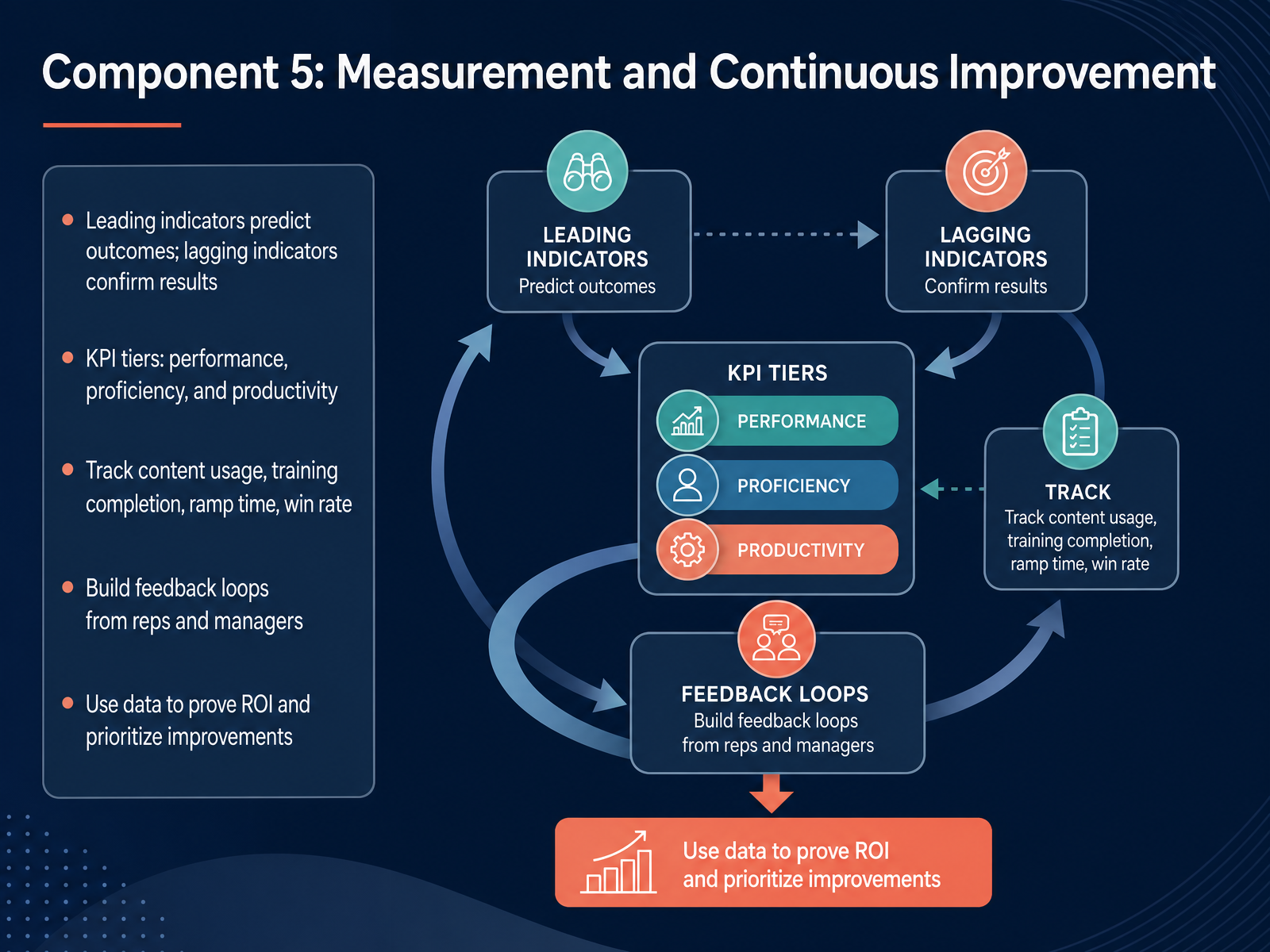
 - 09Component 5: Measurement and Continuous ImprovementNow let's talk about the component that keeps the entire framework honest: measurement. Here's the core principle: leading indicators predict outcomes, while lagging indicators confirm results. Win rate and quota attainment are lagging—they tell you what already happened. Content engagement and practice volume are leading—they let you course-correct before the quarter ends. You need both, but optimize against the leading ones. When selecting metrics, think in three tiers: performance, which is deal outcomes; proficiency, which is skill and readiness; and productivity, which is time and efficiency. Track at least two from each tier. Start with five to seven KPIs total, not twenty-five. For example, track content usage, training completion, ramp time, and win rate. But don't just collect data—build feedback loops. Get regular input from reps and managers on what's working and what's missing. That qualitative insight explains the why behind the numbers. Finally, use the data to prove ROI and prioritize improvements. The strongest case shows the delta in win rate or ramp time between reps who completed your program and those who didn't. Measure monthly, review quarterly, and let the data guide your next move. Now, let's see how all these components interact as a system.
 articulate.comguideflow.comindex.sbigrowth.com+21 min
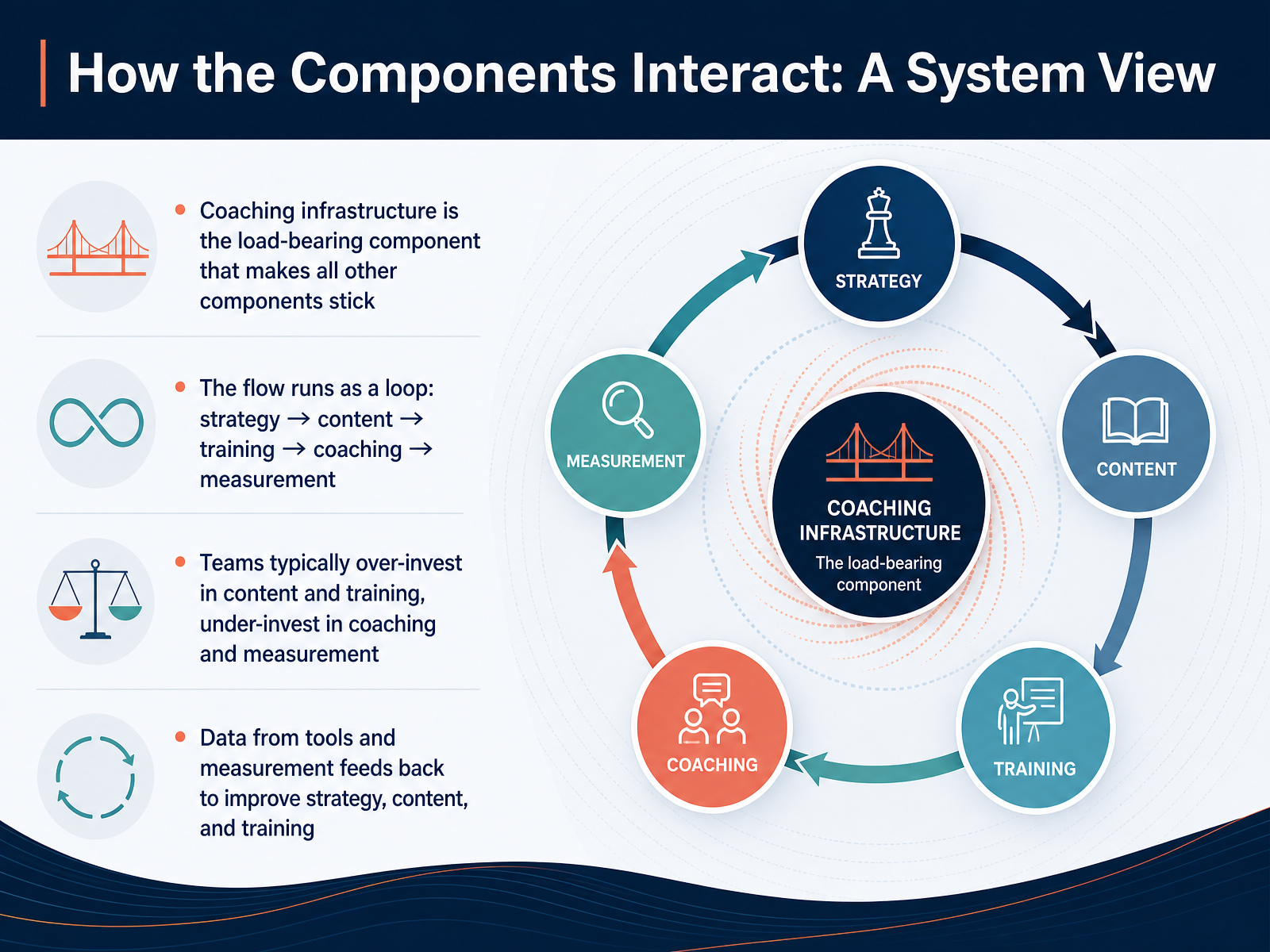
 - 10How the Components Interact: A System ViewNow let's look at how these pieces actually work together, because this is where most enablement programs either compound or collapse. Coaching infrastructure is the load-bearing component. It's what makes the other four stick. Without it, content goes stale, training fades, and measurement has nothing to act on. Think of the flow as a loop. Strategy shapes content. Content feeds training. Training is reinforced by coaching. And measurement closes the loop. That's the critical part: the data you capture needs to flow back to improve your strategy, refine your content, and sharpen your training. Here's the uncomfortable truth. Most teams over-invest in content and training, the visible sixty percent, and under-invest in coaching and measurement, the invisible forty percent that actually drives outcomes. That's a classic trap. The fix is rebalancing. Before you build another asset or schedule another workshop, ask yourself: do our managers have a coaching cadence and a scorecard they actually use? And are we measuring coaching activity at the same level as pipeline coverage? If the answer is no, that's where your next dollar goes. That's the system view. Next, let's assess where you are today by walking through a practical maturity model.
 vozah.comgtmonly.comsalesforce.com+21 min
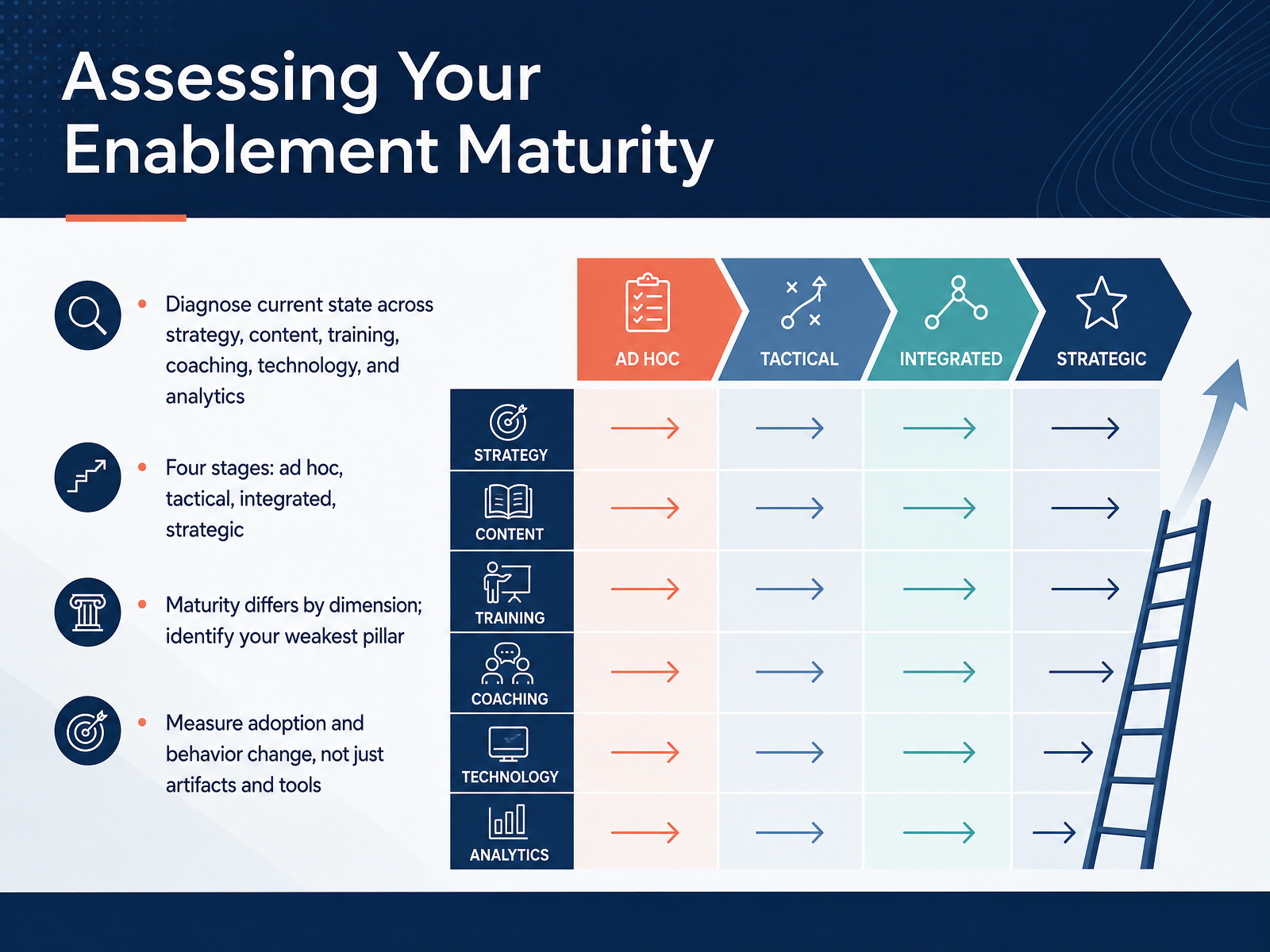
 - 11Assessing Your Enablement MaturityNow let’s talk about assessing your enablement maturity. This is where honest diagnosis beats ambition. You need to look across six dimensions: strategy, content, training, coaching, technology, and analytics. Your function will sit somewhere along a four-stage curve: ad hoc, tactical, integrated, and strategic. Here’s the trap though. Maturity almost never moves evenly. You might be integrated on content but still ad hoc on analytics. And your overall maturity is usually set by your weakest pillar, not your strongest. So find the pillar that’s dragging you down. That’s where your next investment goes. But whatever stage you land on, remember this. Don’t measure artifacts. Don’t count how many playbooks you published or tools you deployed. Measure adoption. Measure whether reps actually changed their behavior on a real deal. That’s the only evidence that matters. So the takeaway is simple. Diagnose honestly, fix the weakest pillar first, and track behavior change, not deliverables. Next, we’ll look at how to apply this framework inside your own organization.
 community.highspot.comindex.sbigrowth.combrainshark.com+21 min
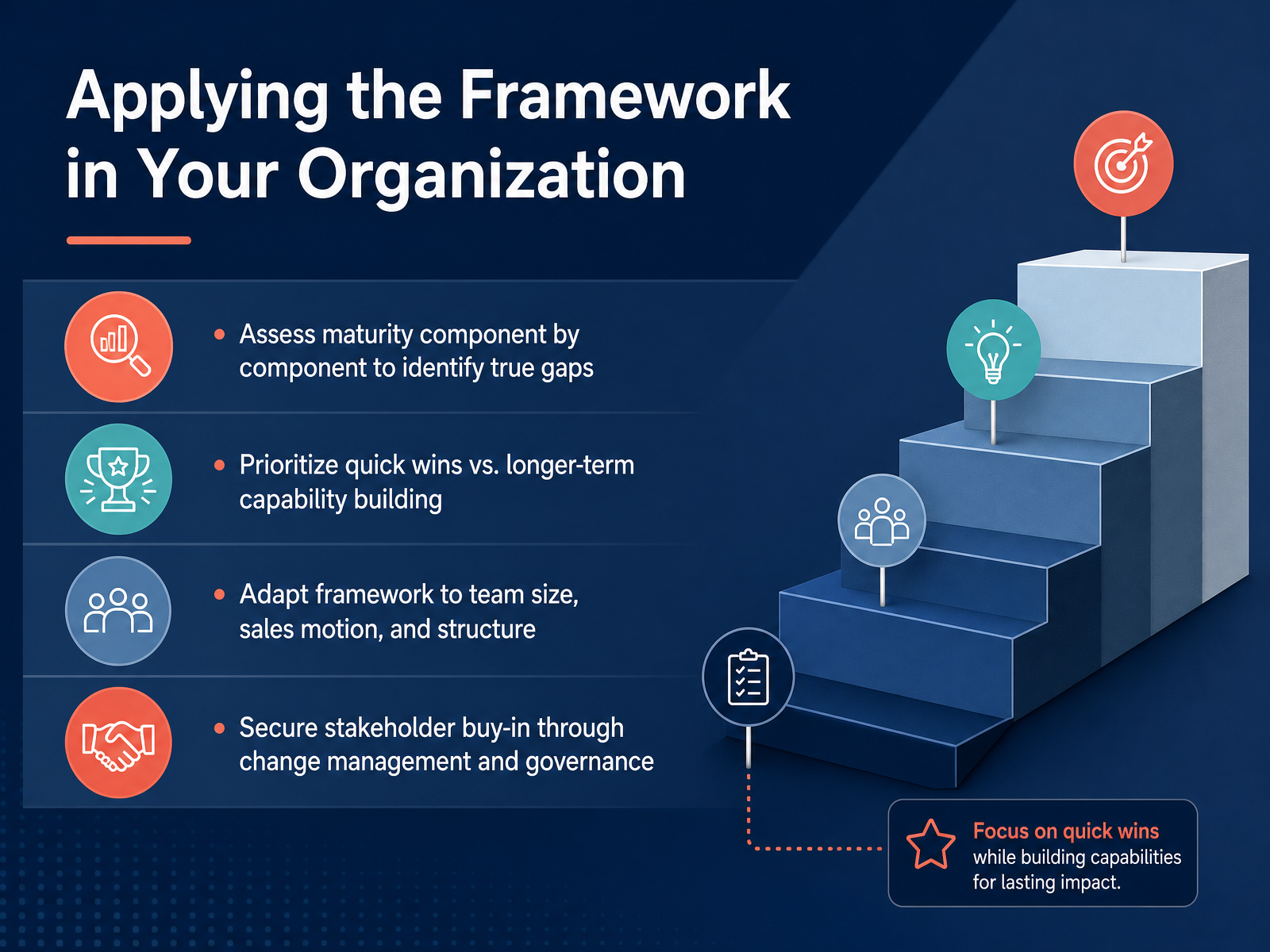
 - 12Applying the Framework in Your OrganizationSo how do you actually put this framework to work? First, assess your maturity honestly, component by component. Don't average it out. You might be scalable on content but still ad hoc on coaching. That gap is where the real opportunity lives. Next, prioritize. Not everything needs to be world class this quarter. Look for the quick wins that build momentum and credibility, then layer in the longer-term capability building. Third, adapt. A fifty-person startup doesn't need the same operating cadence as a five hundred-person enterprise. Shape the framework to fit your sales motion, your team size, and your structure. Finally, secure buy-in. A framework only works if stakeholders are committed to it. That means clear governance, consistent communication, and change management from the start. The goal isn't perfection. It's deliberate progress. Build credibility with early wins, then expand. Up next, we'll cover the common pitfalls and how to avoid them.
 community.highspot.comindex.sbigrowth.combrainshark.com+22 min
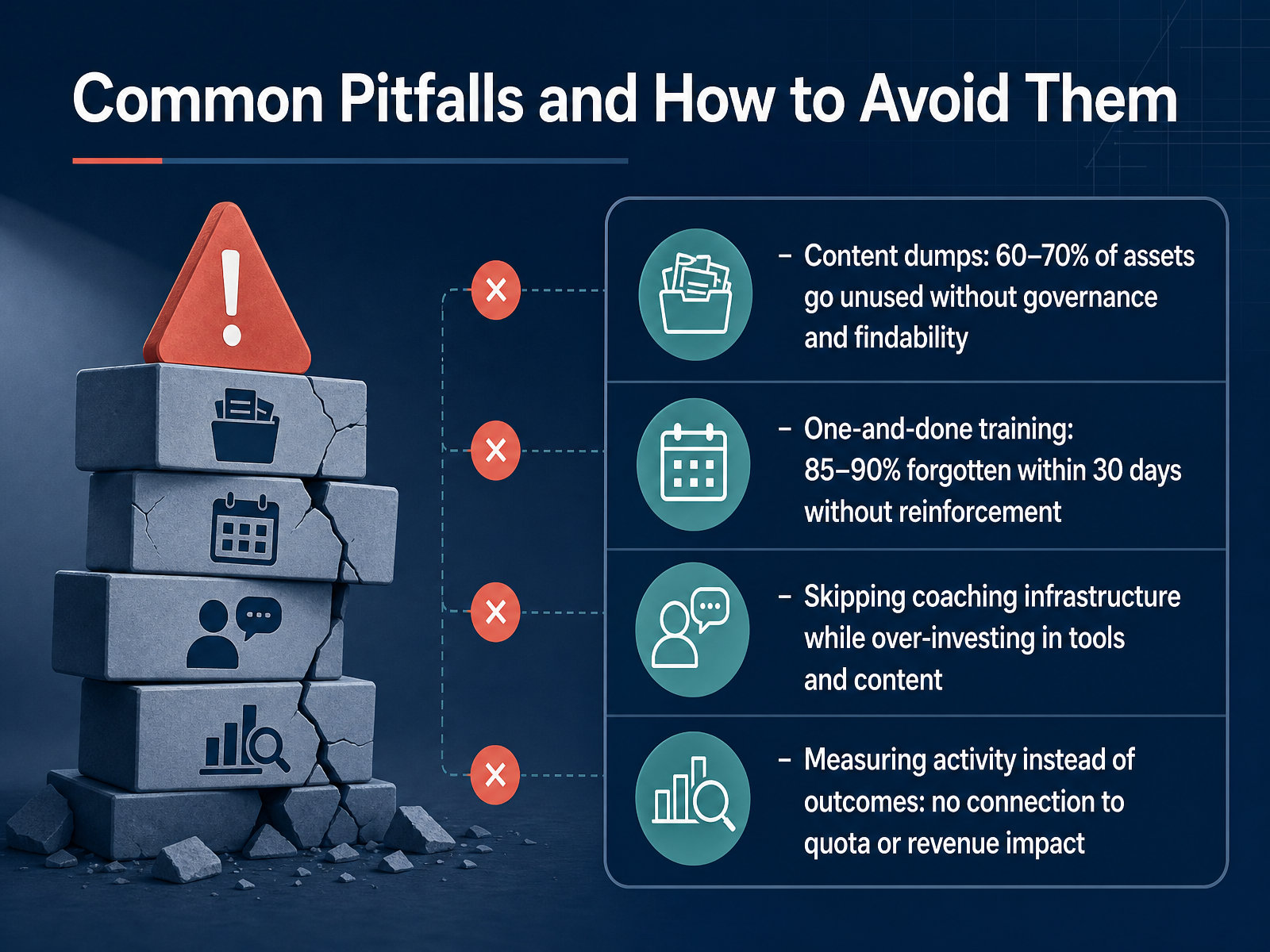
 - 13Common Pitfalls and How to Avoid ThemNow, let's talk about the pitfalls that can quietly derail even a well-designed sales enablement framework. First, content dumps. Without governance and findability, 60 to 70 percent of your assets go unused. Think about it: a rep in the middle of a call can't afford to dig through a shared drive. If they can't find the right asset in under thirty seconds, it might as well not exist. Second, one-and-done training. 85 to 90 percent of what's taught is forgotten within thirty days without reinforcement. That means your training should be the introduction, not the finale. Third, skipping coaching infrastructure while over-investing in tools and content. You can have the best battle cards and tech stack, but if managers don't coach against a clear cadence and scorecard, adoption decays fast. Finally, measuring activity instead of outcomes. Tracking training completions or content views is fine, but if that data doesn't connect to quota and revenue impact, you can't prove your value or improve the system. So, the takeaway is simple: avoid the dump, reinforce the training, build the coaching muscle, and tie every metric back to the number. Next up, we'll map out your action plan and next steps to turn these insights into a roadmap you can execute this quarter.
 brooksgroup.comtrainingindustry.combrooksgroup.com+22 min
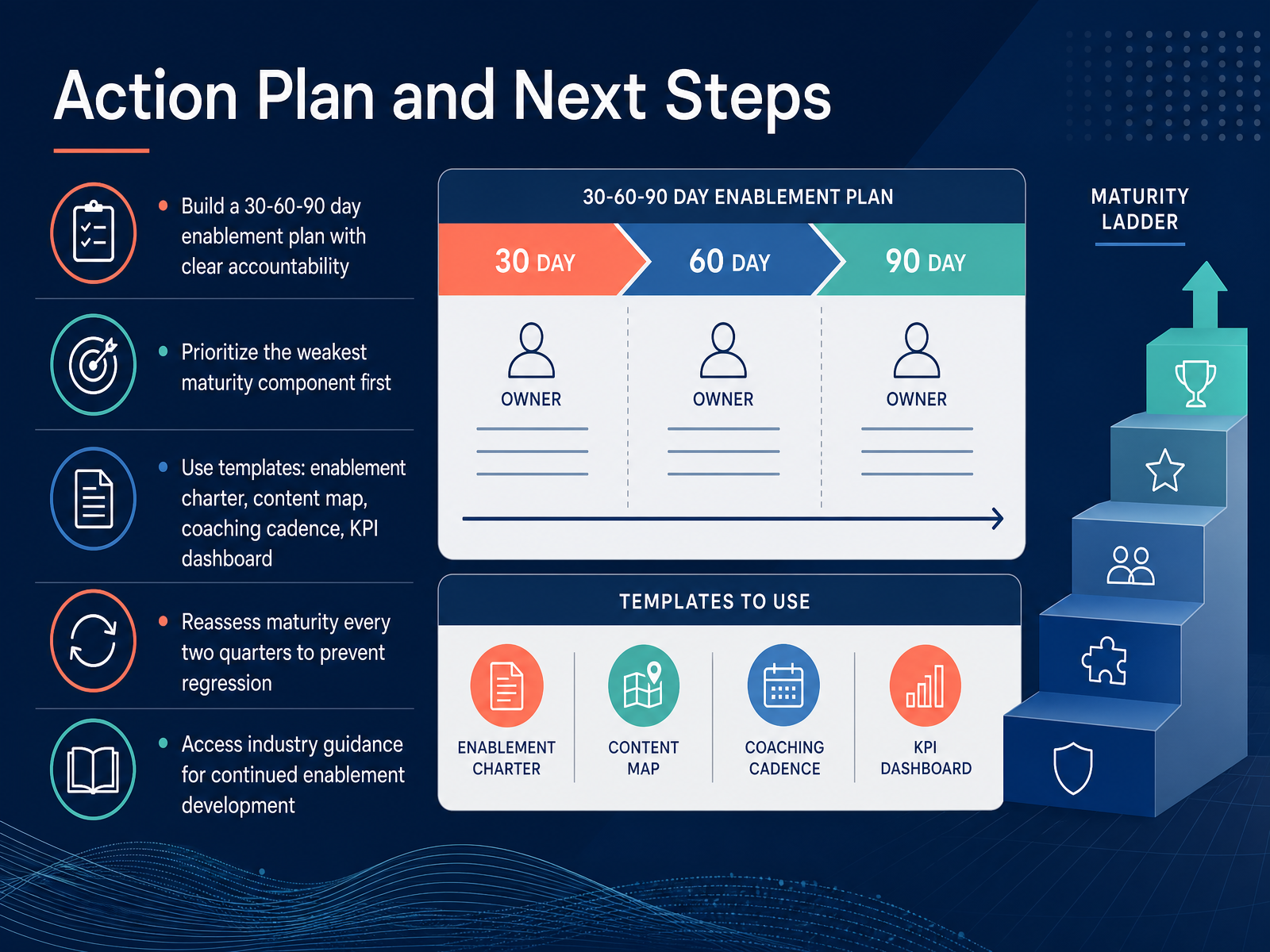
 - 14Action Plan and Next StepsThis is where the framework becomes your operating rhythm. Start by building a 30-60-90 day plan with clear ownership. Who owns the charter? Who owns the content map? Who owns coaching follow-through? Ambiguity is the enemy of execution. Next, prioritize the weakest maturity component first. Most teams are strong on content but weak on coaching. The data shows that without coaching, the other components decay within a quarter. Use the templates we covered today: the enablement charter, the content map, the coaching cadence, and the KPI dashboard. These are your load-bearing tools. Then, protect your progress. Reassess maturity every two quarters. Maturity can slide backward without anyone noticing. If you stop measuring adherence, you are effectively back at an earlier stage. And finally, keep learning. Use the industry guidance we shared to continue developing your practice. The goal is not perfection this quarter. The goal is one deliberate step forward. Pick one component, build the plan, and start.
 community.highspot.comindex.sbigrowth.combrainshark.com+21 min
Take the deck with you
Download this course as a file — free, no sign-up needed.
- PDF handoutEvery slide page, ready to print or share.15 pages · 3.6 MBDownload
- Narrated PowerPointThe deck that presents itself — every slide carries the digital human's narration video.15 pages · 13.8 MBDownload
- PowerPoint slidesThe full deck as a .pptx — open it in PowerPoint, Keynote, or Google Slides.15 pages · 3.5 MBDownload
Free to use in your own training — please keep the PersonWise credit page at the end.
Have your own deck? Turn it into a course
Sources consulted
Web sources consulted while building this course.
- How to Build A Sales Enablement Framework — blog.hubspot.com
- What Is A Sales Enablement Framework? Strategy, ROI (2026) | Apollo — apollo.io
- Sales Enablement: Strategies to Drive Strong Results — gartner.com
- What is Sales Enablement? A Complete Strategy Guide | Salesforce — salesforce.com
- Sales Enablement Framework: Pillars, Onboarding, Playbooks, and Tools — weflow.ai
- STATE OF SALES ENABLEMENT 2023 — community.highspot.com
- Modern Enablement Benchmarks Report — index.sbigrowth.com
- business case — brainshark.com
- https://community.highspot.com/wp-content/uploads/2019/10/CSO-Insights-5th-Annual-Sales-Enablement-Study.pdf — community.highspot.com
- The 2023 Value of Enablement Report — learn.seismic.com
- Sales Enablement Strategy 2026: 5-Component Framework | Vozah — vozah.com
- Sales Enablement Framework: The Complete Model for B2B Teams — gtmonly.com
- What is Sales Enablement: The Complete Guide to Strategy, Ownership, and Measurable Growth — Kayako — kayako.com
- Why Reinforcing Sales Training Is Critical in 2026 — brooksgroup.com
- 5 Coaching and Reinforcement Strategies to Solidify Your Sales Training - Training Industry — trainingindustry.com
- Sales Coaching for Managers: 6 Best Practices - The Brooks Group — brooksgroup.com
- Why Your Sales Training Does Not Stick and What Replaces It | Revenue — revenue.io
- Driving Sales Training Results Through Manager Coaching — trainingindustry.com
- Sales Enablement KPIs: The Ultimate Guide to Measuring Impact — articulate.com
- 25 sales enablement metrics: how to measure SE success - Guideflow Blog — guideflow.com