Moon Phases, Eclipses & Orbits
Begin
13 pages · ~26 min
Moon Phases, Eclipses & Orbits
Learn about the Moon's phases, orbit, and eclipses in this concise training for astronomy enthusiasts.
What you’ll learn
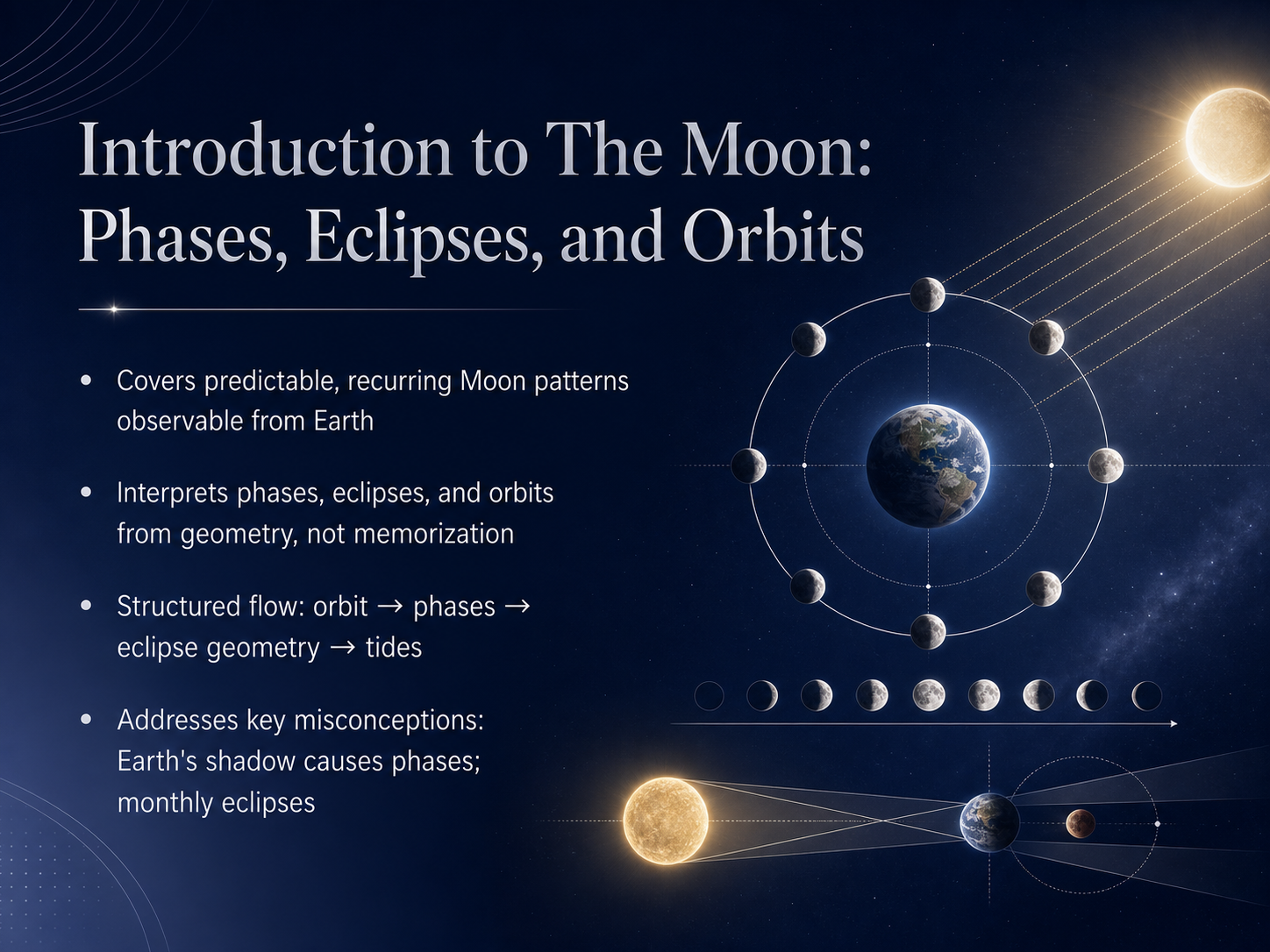
- 01Introduction to The Moon: Phases, Eclipses, and OrbitsWelcome. In this course, we’re going to explore the Moon not as a list of names to memorize, but as a set of predictable, recurring patterns you can see from Earth. Our goal is to understand why the Moon’s appearance changes, why eclipses happen, and how tides work—all through geometry and motion, not memorization. Here’s how this works: we’ll start with the Moon’s orbit, then use that to explain phases, then move to eclipse geometry, and finally tides. Along the way, we’ll tackle two common ideas that often cause confusion: the belief that Earth’s shadow causes the Moon’s phases, and the expectation that eclipses should happen every month. Let’s begin with the orbit that drives everything else. Next, we’ll look at the Moon’s orbit: shape, speed, and orientation.lpi.usra.eduscience.nasa.goveric.ed.gov+21 min
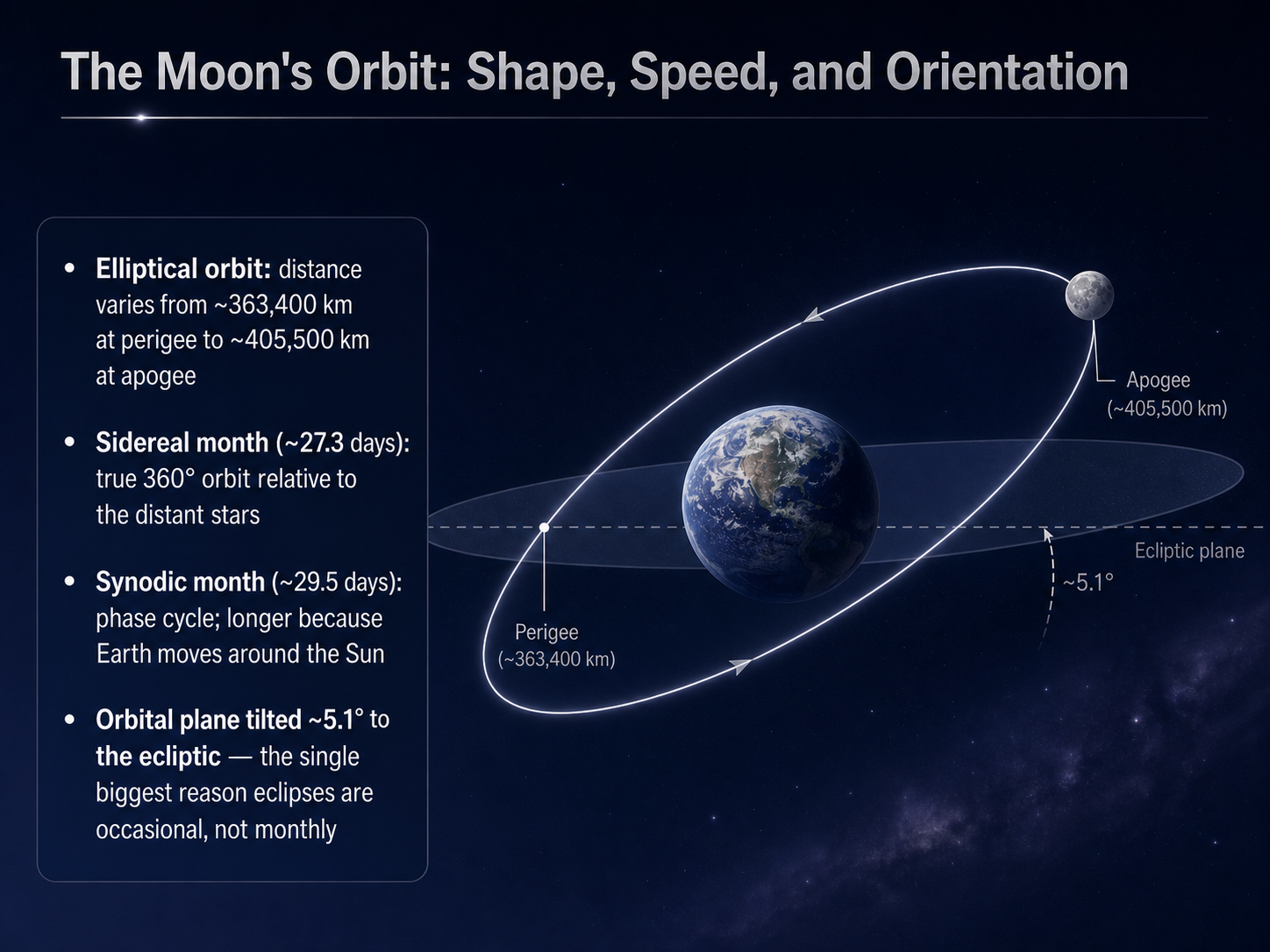
- 02The Moon's Orbit: Shape, Speed, and OrientationNow let's look at the Moon's actual orbit, because its shape, speed, and tilt explain why those phases aren't as simple as they first appear. Here’s how this works. The Moon’s path is not a perfect circle. It’s an ellipse, so the distance changes. At its closest, called perigee, it’s about three hundred sixty-three thousand four hundred kilometers away. At its farthest, apogee, that stretches to around four hundred five thousand five hundred kilometers. That variation matters a lot for eclipses. Next, we have two different ways to measure a month. The sidereal month is the true three-hundred-sixty-degree orbit against the distant stars, taking about twenty-seven point three days. But the synodic month, the phase cycle from one full moon to the next, is longer, about twenty-nine point five days. That extra time happens because Earth is also moving around the Sun, so the Moon has to catch up. Finally, the single biggest reason we don’t get eclipses every single month: the Moon’s orbital plane is tilted about five point one degrees to the ecliptic. Most months, the Moon simply passes above or below the perfect alignment needed for an eclipse. That tilt sets the stage for our next big question: how do we actually get the different phases from this moving, tilted system? Let’s find out in What Causes Moon Phases: The Sunlit Half.
 eclipse.gsfc.nasa.govastro.dur.ac.uken.wikipedia.org+22 min
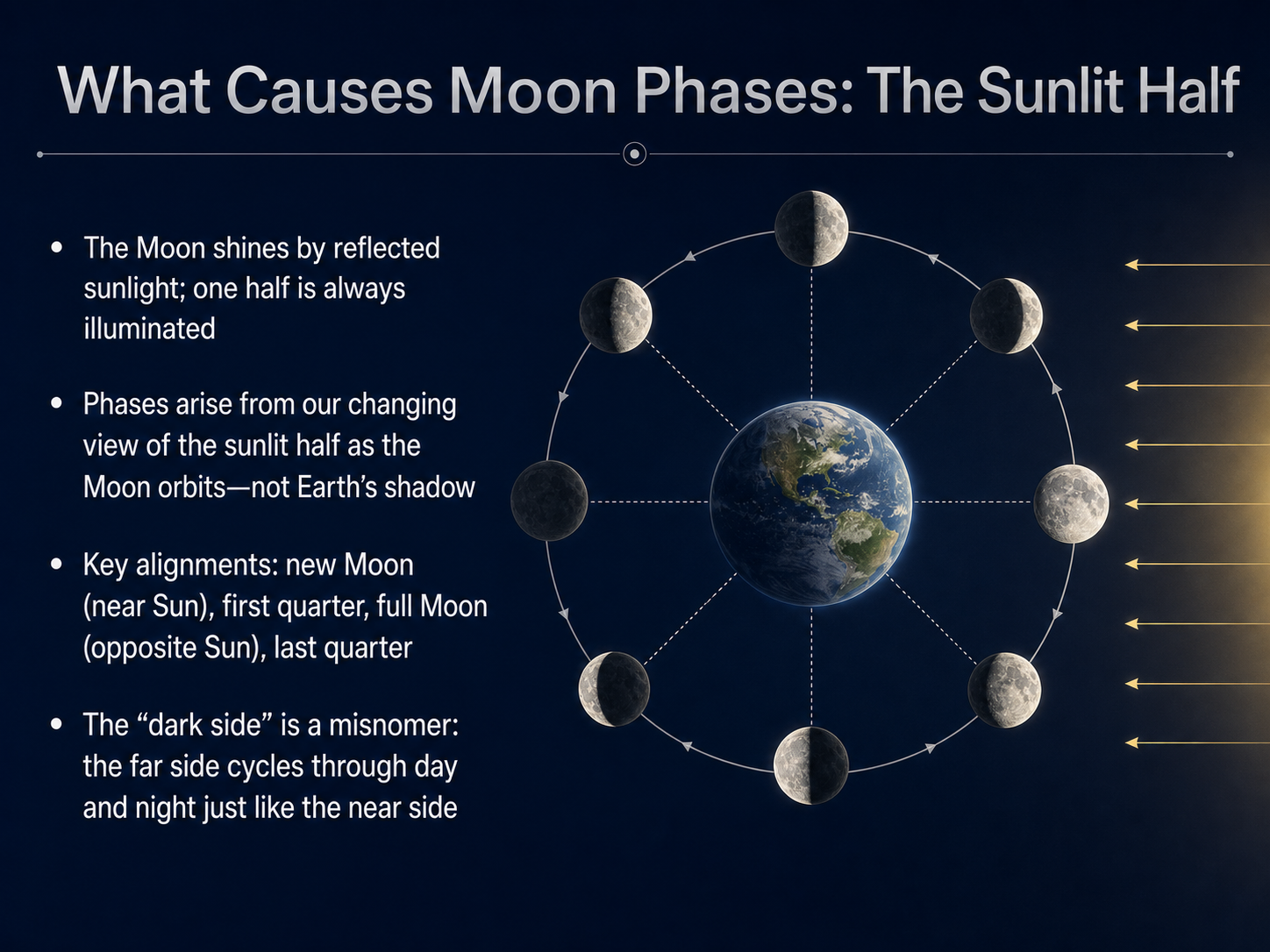
 - 03What Causes Moon Phases: The Sunlit HalfNow, let's tackle the core question: what actually causes the Moon's phases? The first thing to know is that the Moon does not make its own light. It shines only by reflecting sunlight. And because the Sun is a distant light source, it always illuminates exactly one half of the Moon—the half facing the Sun. The other half remains dark. So, why don't we always see a half-lit Moon? The phases arise because our view of that sunlit half changes as the Moon orbits Earth. Think of it this way: when the Moon is near the Sun in our sky, we are looking at its mostly dark side, so we see very little light—that's a new Moon. As the Moon continues its orbit, we start to see a crescent, then a quarter, and eventually, when the Moon is opposite the Sun, we see the entire sunlit side—a full Moon. This is not caused by Earth's shadow. That common idea is a misconception. Earth's shadow only touches the Moon during a lunar eclipse, which is a different event. Finally, a quick note on the so-called 'dark side' of the Moon. That name is misleading. There is no side in permanent darkness. The far side of the Moon, which we never see from Earth, cycles through the same two weeks of daylight and two weeks of night as the near side. Next, let's build on this foundation by predicting the phase cycle.
 lpi.usra.eduscience.nasa.goveric.ed.gov+22 min
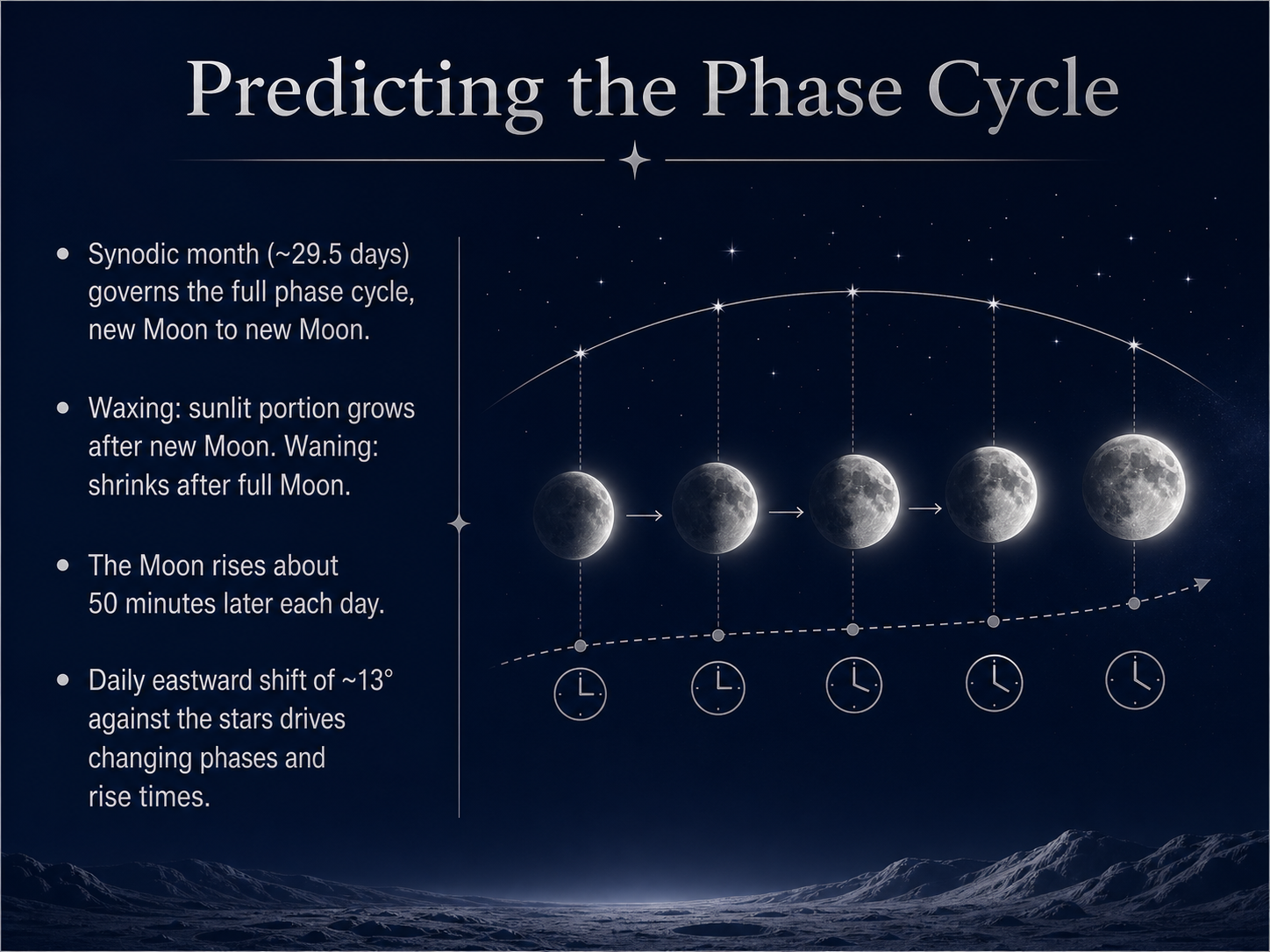
 - 04Predicting the Phase CycleSo, how can we predict the Moon's changing appearance? The key is a cycle called the synodic month. That's about twenty-nine and a half days, measured from one new Moon to the next. It's not just a random number—it's the time it takes for the Moon to realign with the Sun from our perspective. As the Moon orbits, we see the sunlit portion grow during the waxing phase, from a thin crescent to a full Moon. Then, after full Moon, the illuminated part shrinks during the waning phase. Here's how this works: each day, the Moon shifts about thirteen degrees eastward against the background stars. Because of this shift, the Earth has to rotate a little longer to bring the Moon back into view. That's why the Moon rises roughly fifty minutes later each day. This daily eastward drift is the engine driving the entire phase cycle. Now, this predictable rhythm of phases and motion sets the stage for something even more dramatic. Let's explore what happens when the shadows align, in eclipses.
 sten.astronomycafe.netiop.orgastronomy.com+21 min
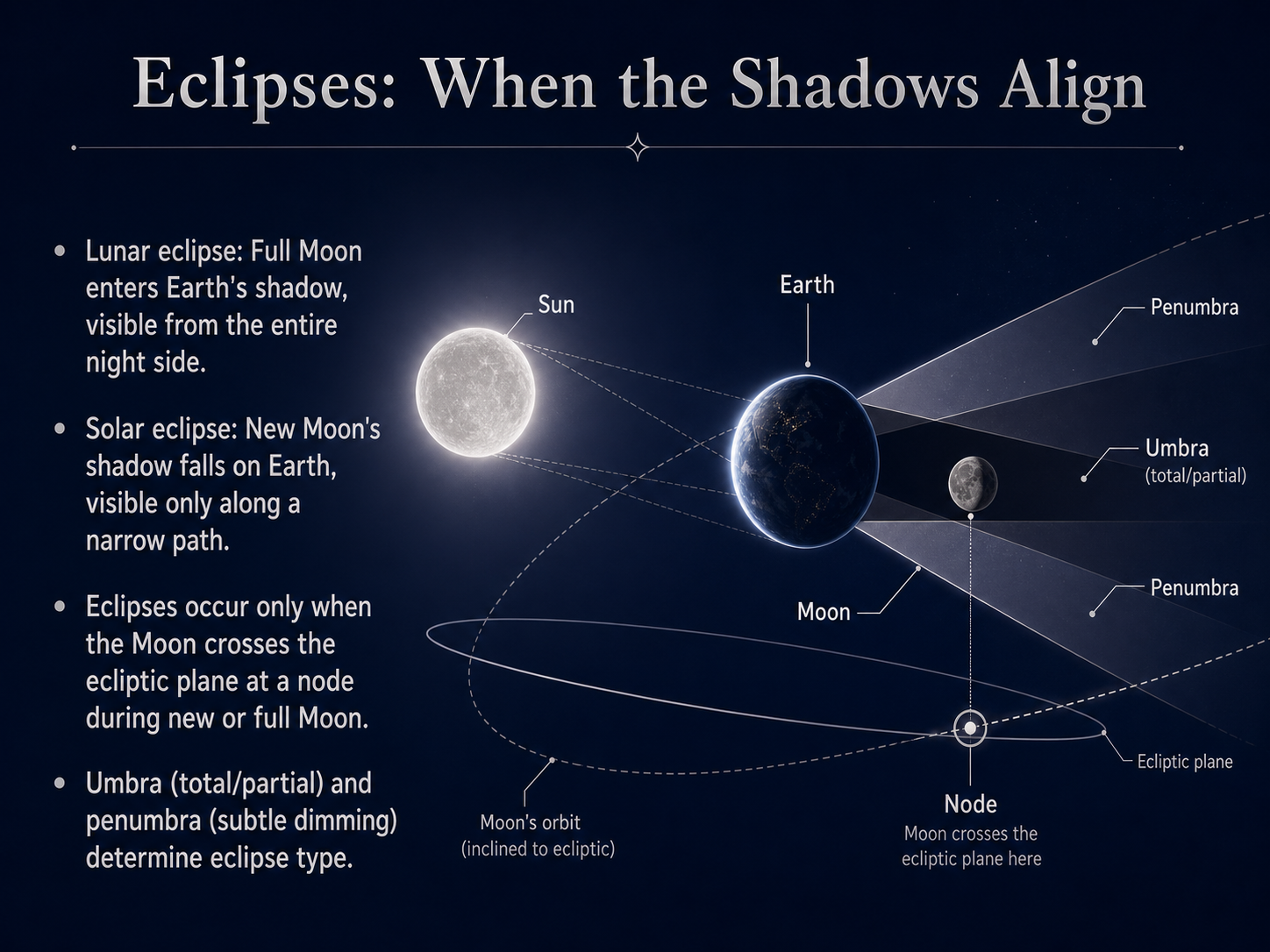
 - 05Eclipses: When the Shadows AlignNow, let's bring those shadows into focus and explore the conditions that create eclipses. Here’s how this works. A lunar eclipse happens during a Full Moon, when the Moon enters the Earth’s shadow. Because this is a real physical shadow falling on the Moon, the event is visible from the entire night side of our planet. A solar eclipse, on the other hand, occurs at New Moon, when the Moon’s shadow falls on a small part of the Earth. This is why a total solar eclipse is only visible along a narrow path. But why don’t these alignments happen every month? The Moon’s orbit is tilted about five degrees, so it usually passes above or below the Earth’s shadow or the Sun. An eclipse can only occur when the Moon crosses the ecliptic plane at a point called a node, and this crossing must happen exactly at the New or Full Moon. Finally, the type of eclipse depends on the shadow. The dark inner shadow, the umbra, creates total or partial eclipses. The faint outer shadow, the penumbra, creates a subtle dimming. Next, we’ll apply this logic to answer a common question: why eclipses don’t happen every month.
 members.bitstream.netphysics.unlv.eduen.wikipedia.org+22 min
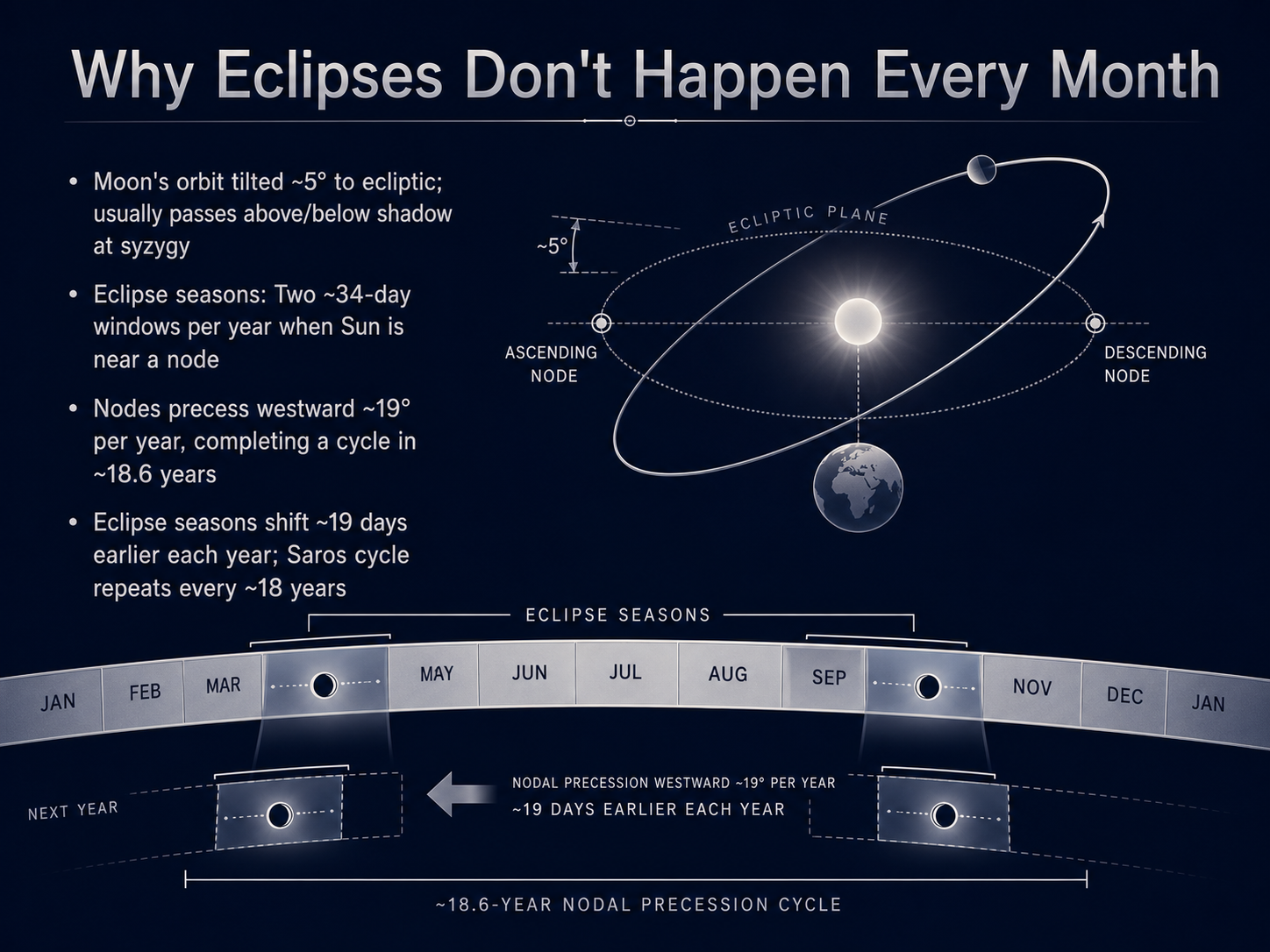
 - 06Why Eclipses Don't Happen Every MonthWe know the Moon aligns with the Earth and sun at new and full phases every month. So why don’t we get an eclipse every month? Here’s how this works. The Moon’s orbit is tilted about five degrees from the ecliptic, which is the plane of Earth’s orbit around the sun. That small tilt means the Moon usually passes above or below the sun during new moon, and above or below Earth’s shadow during full moon. For an eclipse, the alignment must happen when the Moon is crossing the ecliptic at points called nodes. But the sun also has to be near a node at the same time. These windows are called eclipse seasons. Each eclipse season lasts about thirty-four days and occurs roughly twice a year—whenever the sun is close enough to a node. The nodes themselves don’t stay fixed. They slowly precess, or drift westward, about nineteen degrees per year. That means the line of nodes completes a full cycle every eighteen point six years. Because of that drift, each eclipse season arrives about nineteen days earlier than the year before. Over longer periods, this rhythm feeds into the Saros cycle, where similar eclipses repeat every eighteen years. Up next, we’ll explore the different types of lunar eclipses and what makes each one unique.
 members.bitstream.netphysics.unlv.eduen.wikipedia.org+22 min
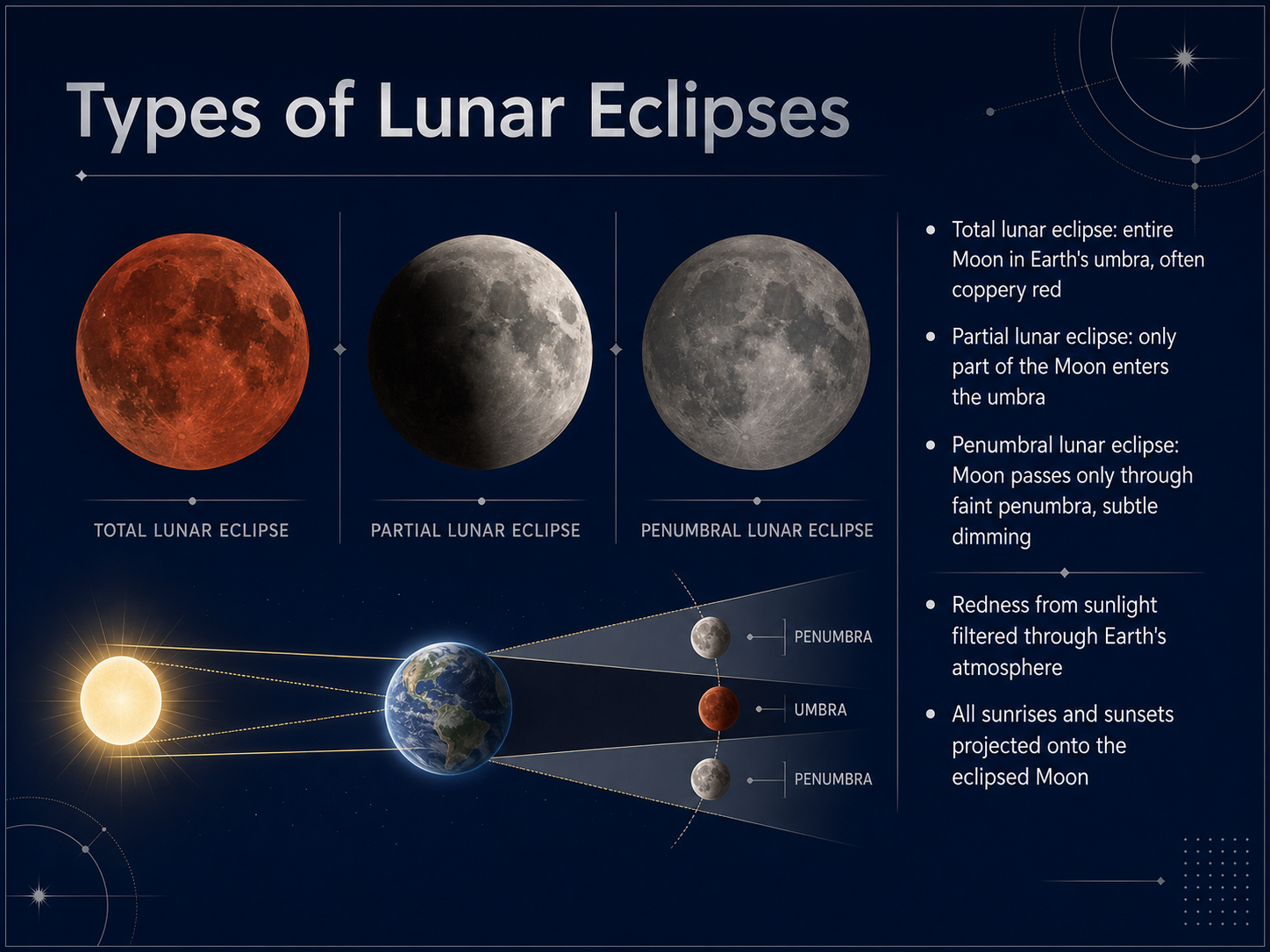
 - 07Types of Lunar EclipsesNow let’s sort lunar eclipses into three types, each tied to how the Moon passes through Earth’s shadow. Here’s how this works. When the full Moon slides completely into the umbra, the dark inner shadow, we get a total lunar eclipse. The Moon often turns a coppery red because sunlight is filtered and bent by Earth’s atmosphere. Think of it as all the world’s sunrises and sunsets projected onto the lunar surface. If the alignment isn’t perfect, only part of the Moon enters the umbra. That’s a partial lunar eclipse, where one section looks dark while the rest stays bright. And when the Moon only moves through the faint penumbra, we call it a penumbral lunar eclipse. The dimming is so subtle that many people don’t notice it at all. These differences depend on how close to the lunar node the full Moon happens to be. Up next, we’ll explore the parallel story for the Sun: types of solar eclipses.
 members.bitstream.netphysics.unlv.eduen.wikipedia.org+21 min
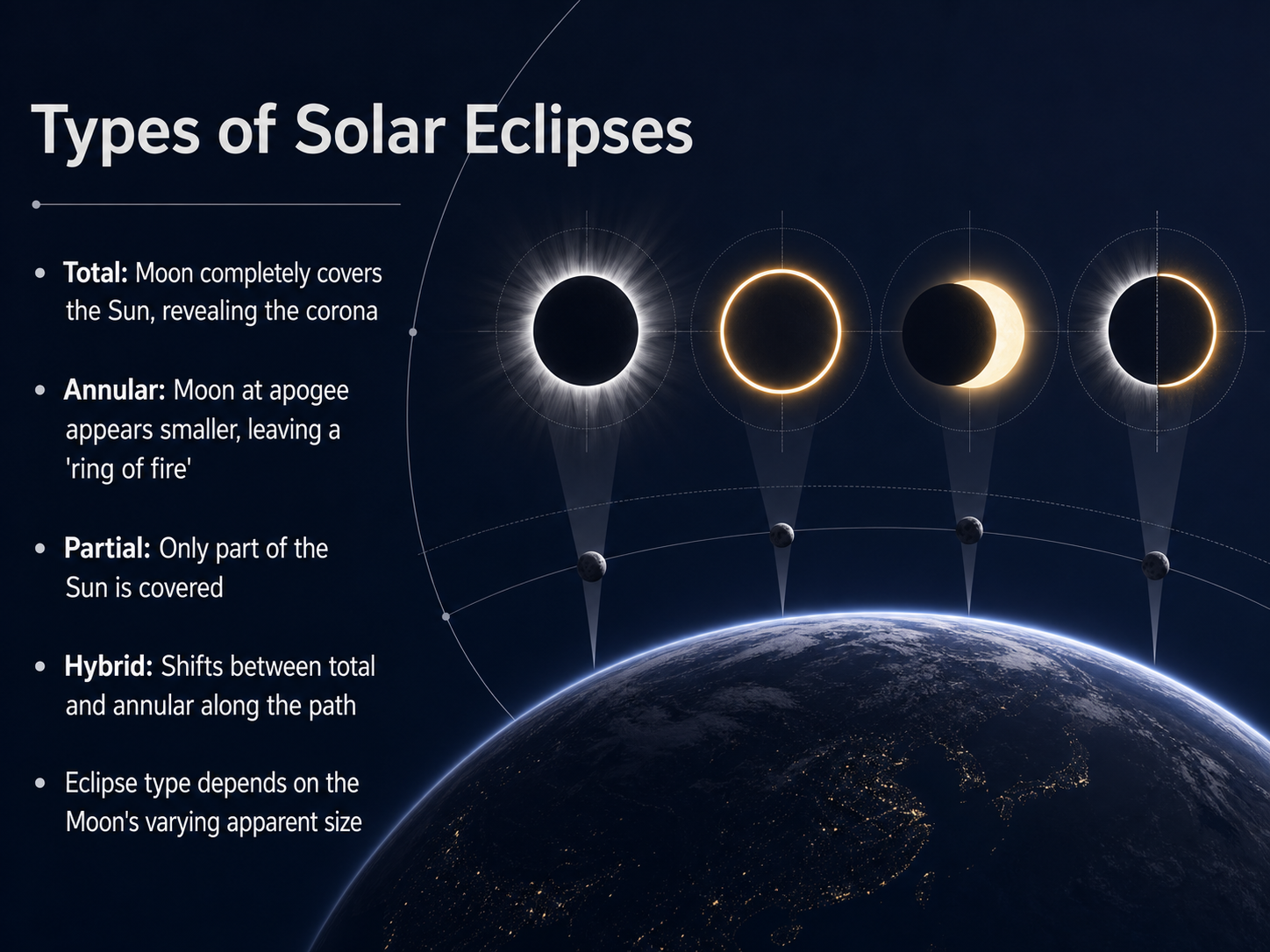
 - 08Types of Solar EclipsesSo, what makes the difference between a total, annular, and partial solar eclipse? It really comes down to one simple question: how big does the Moon look from Earth at that moment? The Moon’s orbit is not a perfect circle, so its distance from us is always changing. When the Moon is closer to Earth, near what we call perigee, it appears larger. If it lines up perfectly at that time, it can completely cover the Sun, giving us a total eclipse that reveals the breathtaking corona. But when the Moon is farther away, near apogee, it appears a bit smaller. If it passes directly in front of the Sun at this distance, it cannot cover the entire disk. Instead, we see a brilliant ring of sunlight around it, an annular eclipse, often called the 'ring of fire.' And if the alignment is not quite perfect, no matter the distance, we experience a partial eclipse, where only a portion of the Sun is covered. There is even a rare hybrid eclipse, where the curvature of the Earth causes the eclipse to shift between total and annular along its path. It all depends on the Moon's varying apparent size. Up next, let's explore that perception and reality of the Moon's size and distance in more detail.
 members.bitstream.netphysics.unlv.eduen.wikipedia.org+22 min
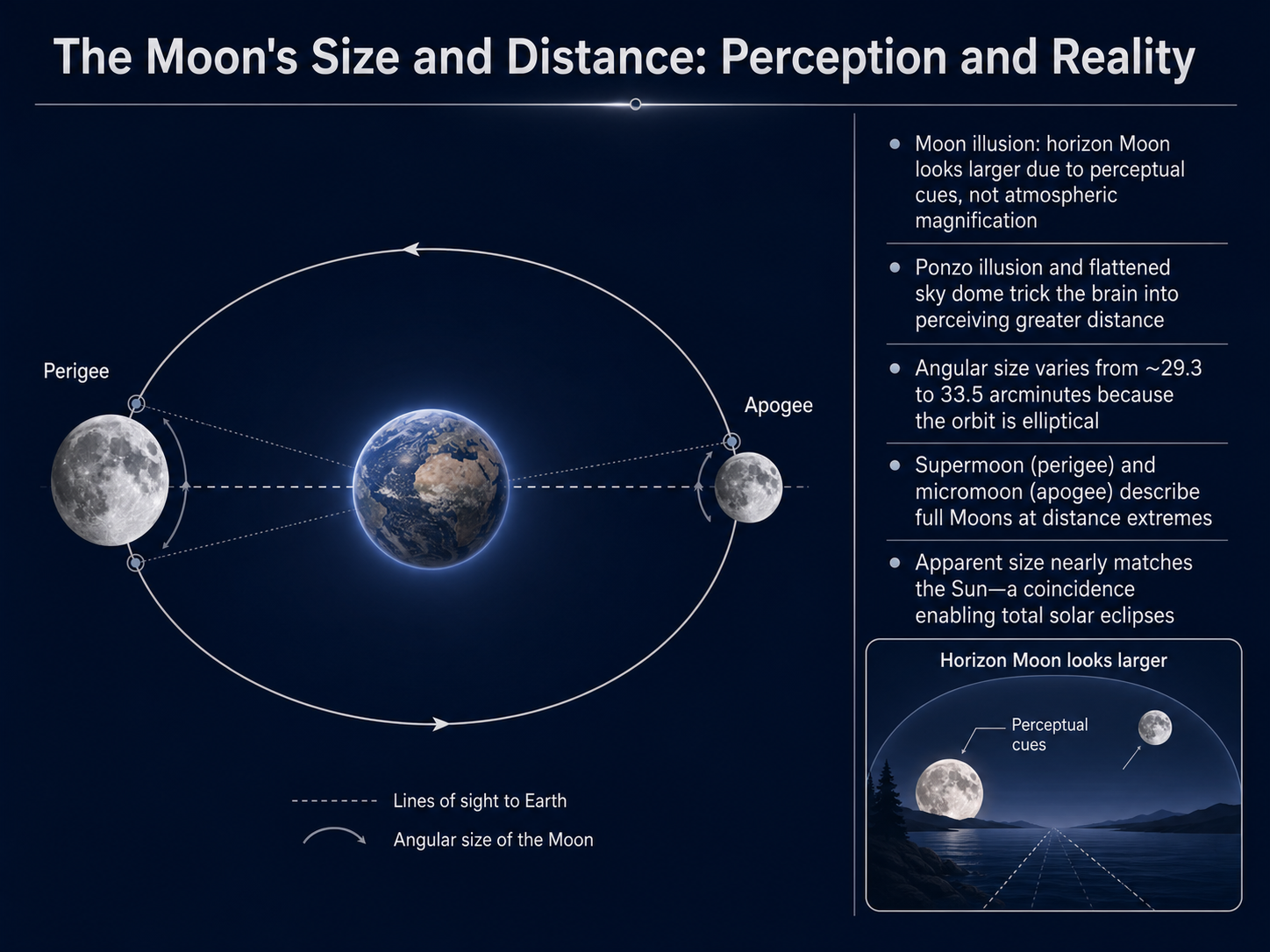
 - 09The Moon's Size and Distance: Perception and RealityHere’s how this works. When you see the Moon near the horizon, it often looks huge. This is the Moon illusion, and it is entirely a trick of perception. Photographs show the Moon measures exactly the same width no matter where it is in the sky. The atmosphere does not magnify it; if anything, air near the horizon squashes the Moon’s shape slightly. So why does your brain insist it is larger? One key reason is the Ponzo illusion. When the Moon hangs near the horizon, your brain sees foreground objects like trees and buildings and interprets the scene as stretching far into the distance. Because the Moon’s actual angular size stays the same, your brain concludes a distant object must be physically enormous. The flattened dome of the sky makes this stronger. You perceive the sky overhead as closer than the horizon, so the same angular size gets read as a smaller object when it is high up. Now, there is a real size change we can measure. The Moon’s orbit is elliptical, so its angular size varies from about twenty-nine point three arcminutes at apogee to thirty-three point five arcminutes at perigee. A full Moon at perigee is called a supermoon, and at apogee it is a micromoon. Still, the true change is small compared to the powerful illusion. And here is the remarkable coincidence. The Moon’s apparent size nearly matches the Sun’s. That match is the only reason total solar eclipses are possible from Earth. Let’s carry this idea of real influence forward and look at tides: the Moon’s gravitational signature.
 2 min
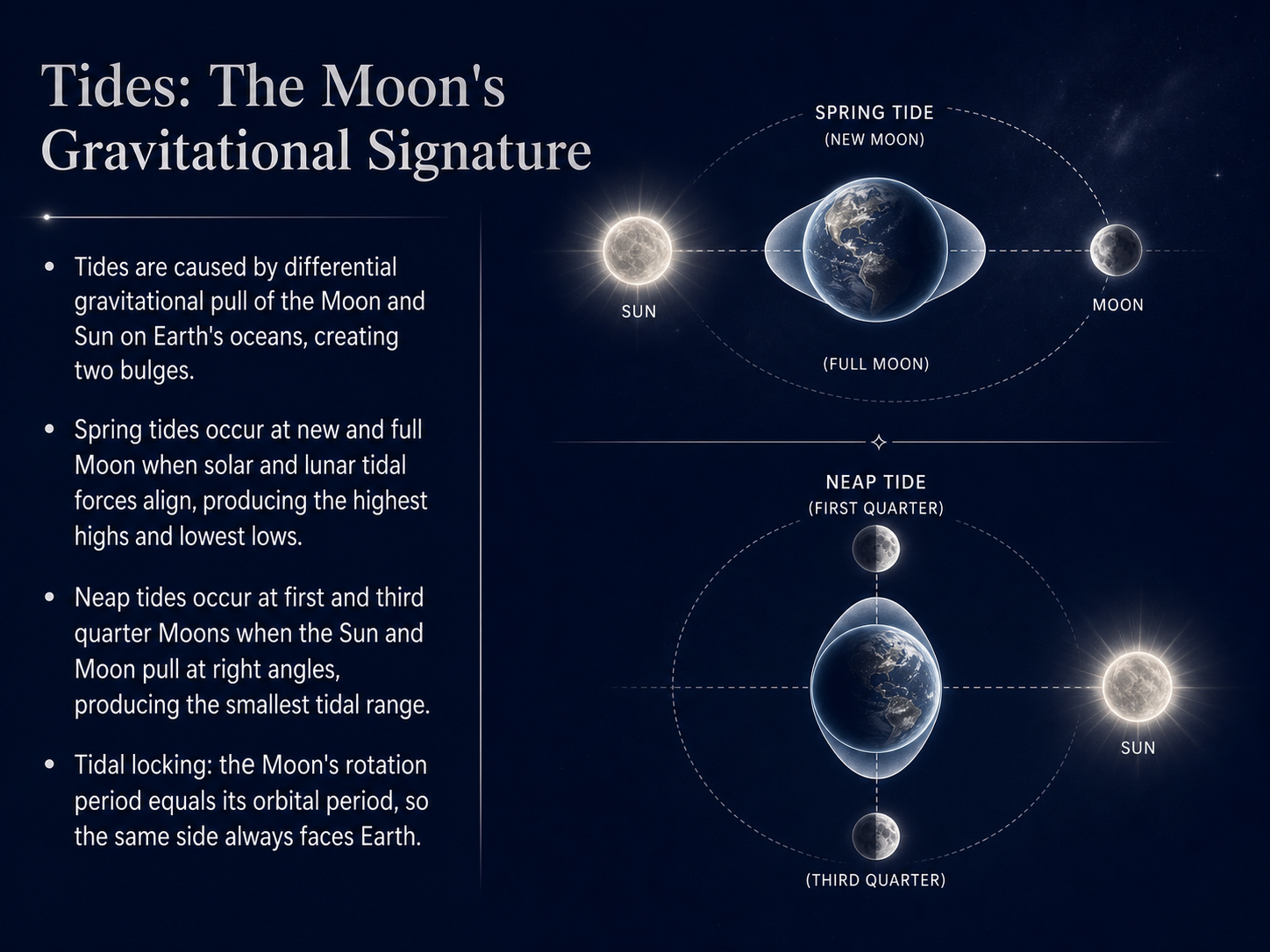
2 min - 10Tides: The Moon's Gravitational SignatureNow let’s explore tides, the Moon’s gravitational signature on our oceans. Here’s how this works. The Moon’s gravity pulls unevenly on the Earth—stronger on the near side, weaker on the far side. This difference creates two ocean bulges: one facing the Moon, and one on the opposite side. As Earth rotates, we pass through both bulges, giving most coasts two high tides and two low tides each day. But the Sun adds its own influence. When the Sun, Earth, and Moon align during new and full Moon phases, their gravitational pulls work together. This gives us spring tides—the highest highs and the lowest lows. About a week later, at first and third quarter Moons, the Sun and Moon pull at right angles. Their forces partially cancel, producing neap tides with the smallest tidal range. Finally, there’s a quiet pattern we don’t see directly. The Moon rotates once for every orbit around Earth, a state called tidal locking. That’s why the same side always faces us. Next, we’ll look at King Tides and Perigean Spring Tides.
 eclipse.gsfc.nasa.govastro.dur.ac.uken.wikipedia.org+22 min
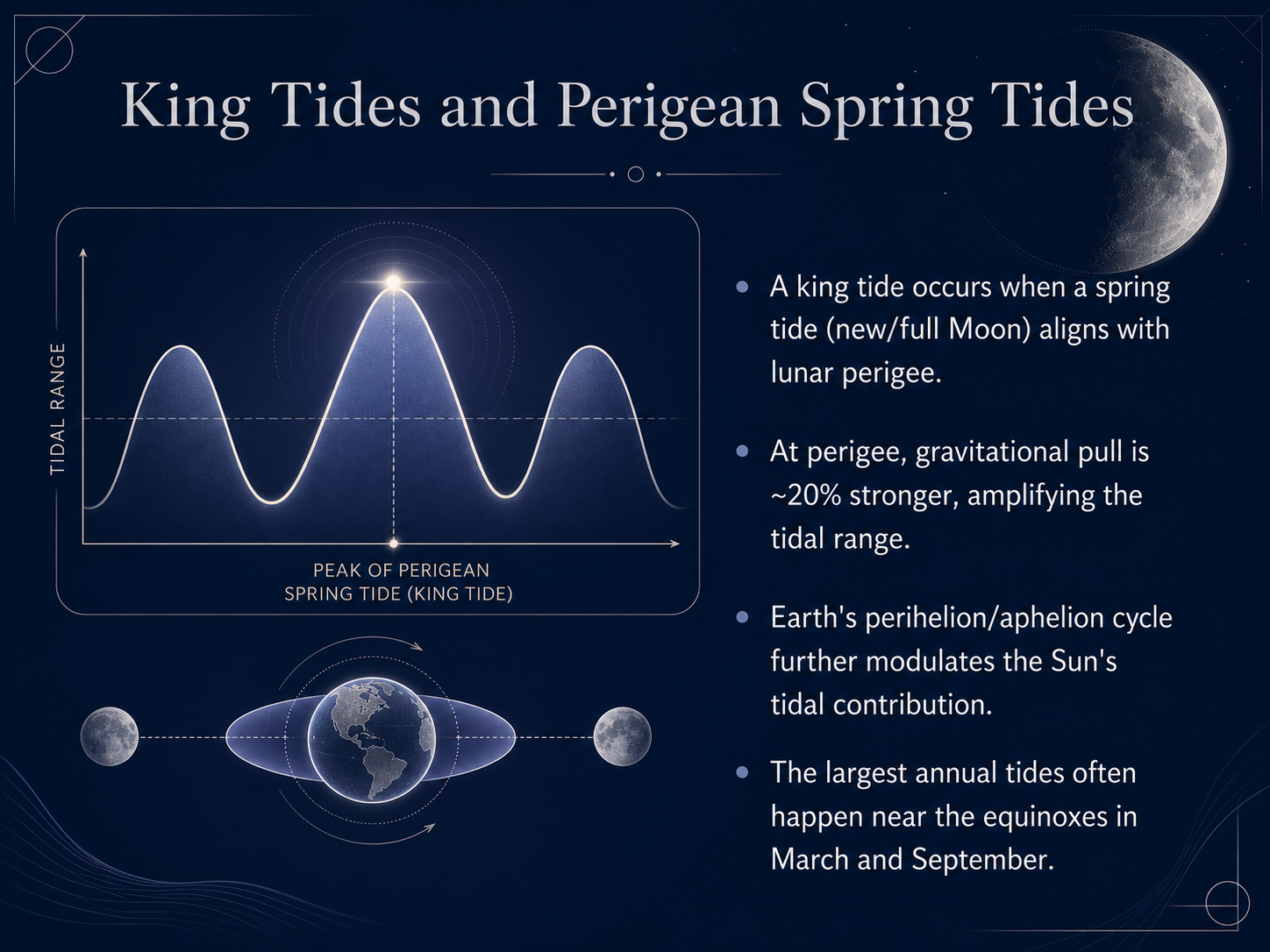
 - 11King Tides and Perigean Spring TidesHere’s how the Moon’s distance turns a spring tide into a king tide. A spring tide happens when the Sun, Earth, and Moon align during a new or full Moon. Now, the Moon’s orbit is elliptical, so its distance from Earth changes. When a spring tide coincides with the Moon’s closest point—called perigee—the gravitational pull is about 20 percent stronger. This amplifies the tidal range even further, creating what scientists call a perigean spring tide, or more commonly, a king tide. But the story doesn’t stop there. Earth’s own orbit around the Sun isn’t a perfect circle either. When Earth is closest to the Sun, around January, the solar tide also gets a boost. When Earth is farthest, the solar contribution weakens. These distance modulations, combined with seasonal alignment factors, are why the largest annual tides often occur near the equinoxes in March and September. Next, we’ll step back and connect all these patterns, from orbits to eclipses and tides.
 eclipse.gsfc.nasa.govastro.dur.ac.uken.wikipedia.org+21 min
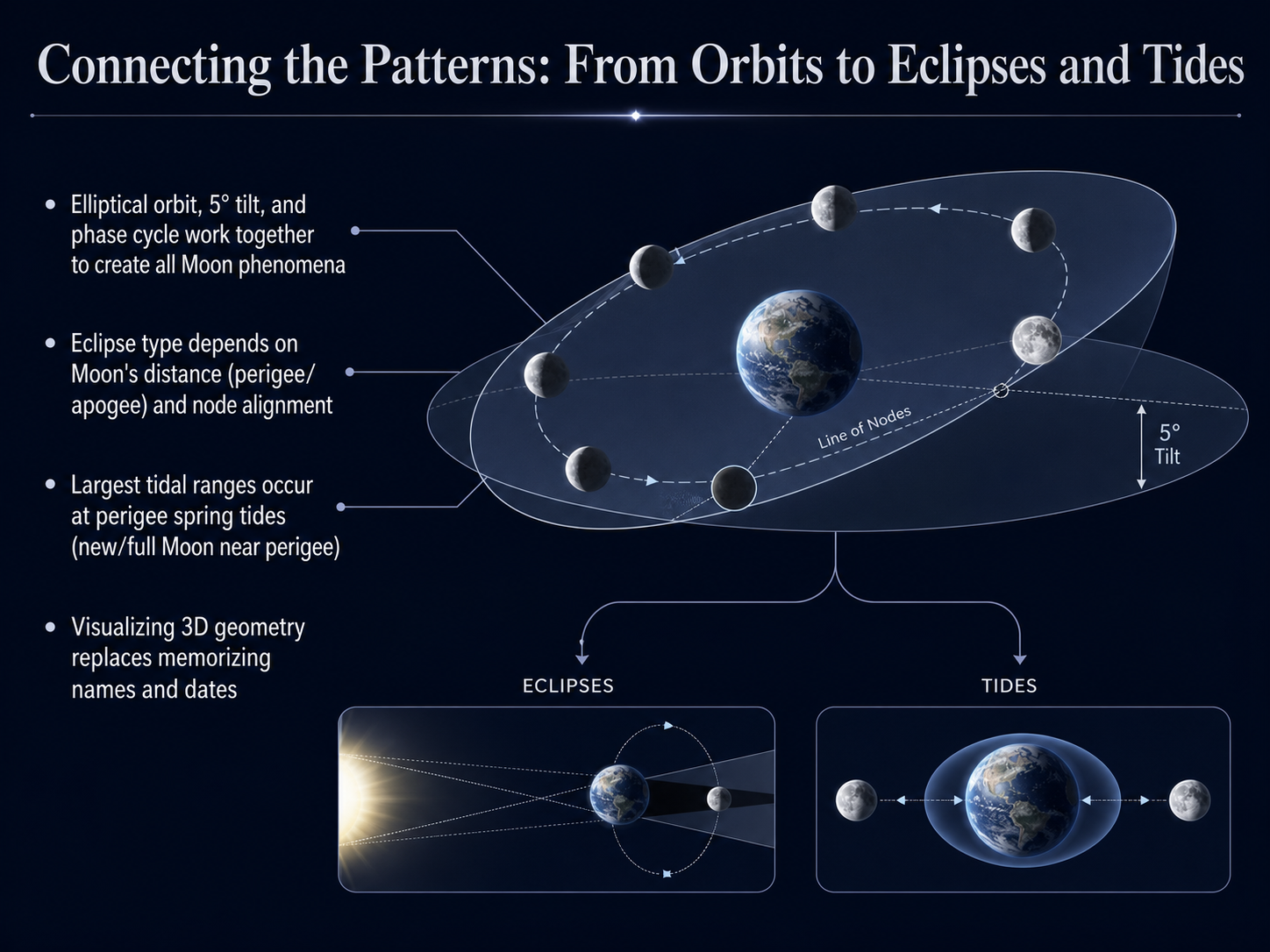
 - 12Connecting the Patterns: From Orbits to Eclipses and TidesWe’ve explored the orbit, the tilt, and the phase cycle. Now let’s connect them, because eclipses and extreme tides aren’t random events—they’re the result of these patterns working together. Here’s how this works. The Moon’s 5-degree tilt means it usually passes above or below the Sun and Earth’s shadow. Eclipses can only happen when the Moon is full or new near a node, where its orbit crosses the ecliptic. That’s the alignment we call an eclipse season. But the type of eclipse depends on distance. If the Moon is closer to Earth, at perigee, it appears larger and can fully cover the Sun in a total solar eclipse. If it’s farther, at apogee, it appears smaller, creating an annular eclipse where a ring of sunlight remains. The same geometry drives tides. Spring tides, with the largest range, occur at new and full moons when the Sun and Moon pull together. The absolute largest tidal ranges—sometimes called king tides—happen when a spring tide coincides with the Moon at perigee. Visualizing the 3D geometry of these orbits and nodes replaces memorizing names and dates with a real understanding of why these phenomena occur. Next, we’ll wrap up with key takeaways and how to apply these patterns.
 members.bitstream.netphysics.unlv.eduen.wikipedia.org+22 min
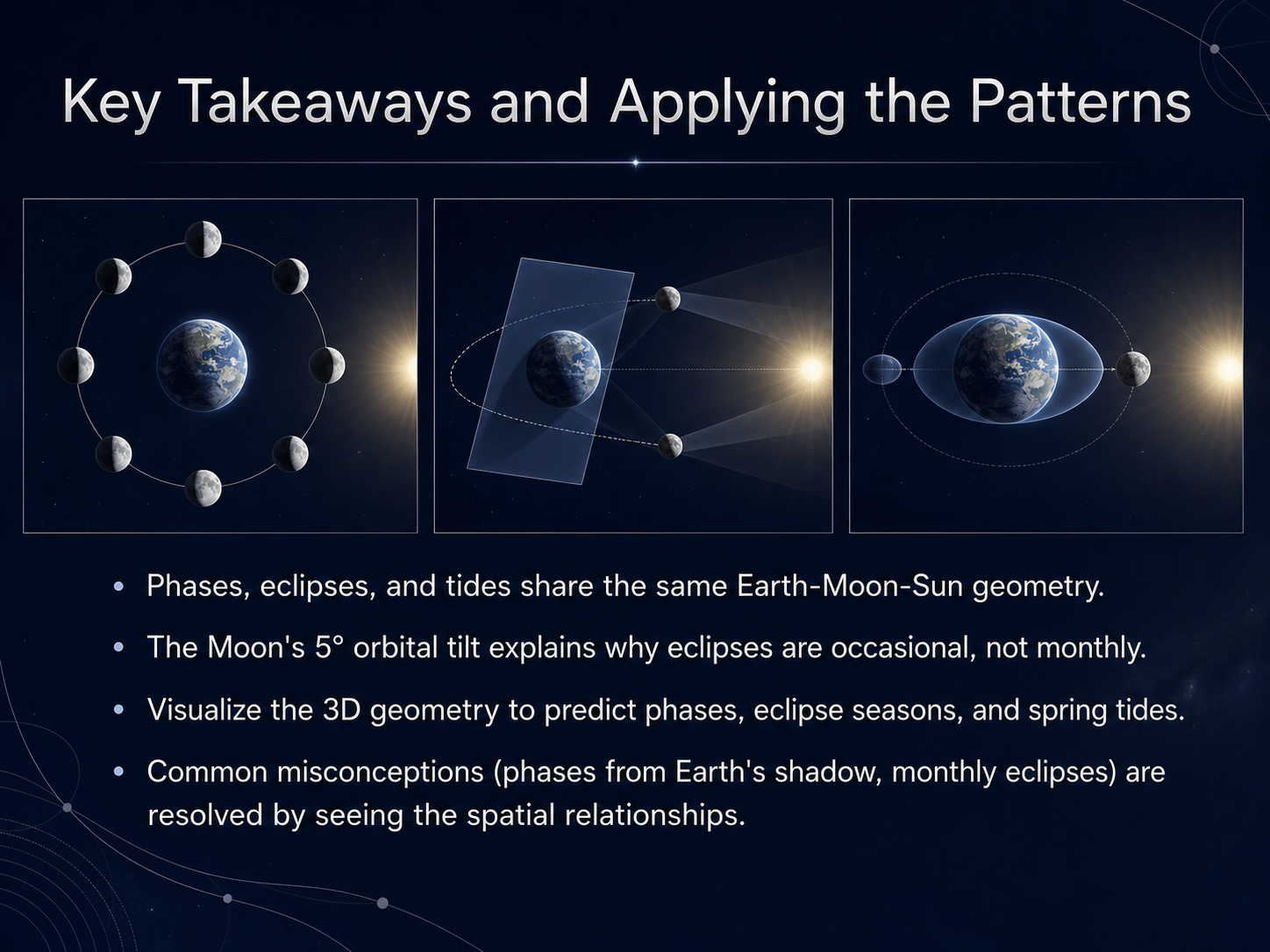
 - 13Key Takeaways and Applying the PatternsLet's bring everything together. The key idea is that phases, eclipses, and tides all arise from the same three-dimensional geometry of the Earth, Moon, and Sun. Once you see that spatial relationship, you can predict patterns instead of just memorizing them. Here’s what makes that possible. The Moon's orbit is tilted about five degrees relative to Earth's orbit. This tilt is why eclipses are occasional, not monthly. Most months, the Moon's shadow simply misses the Earth, and the Earth's shadow misses the Moon. Visualizing this geometry also clears up common misconceptions. For example, phases are not caused by Earth's shadow. That shadow only falls on the Moon during a lunar eclipse. And because of the orbital tilt, we never have eclipses every single month. When you mentally picture the real positions and motions in three dimensions, the whole system becomes logical and predictable. Thank you for exploring these patterns with me. Carry that spatial curiosity with you whenever you look up at the Moon.
 lpi.usra.eduscience.nasa.goveric.ed.gov+22 min
Take the deck with you
Download this course as a file — free, no sign-up needed.
- PDF handoutEvery slide page, ready to print or share.14 pages · 2.7 MBDownload
- Narrated PowerPointThe deck that presents itself — every slide carries the digital human's narration video.14 pages · 12.1 MBDownload
- PowerPoint slidesThe full deck as a .pptx — open it in PowerPoint, Keynote, or Google Slides.14 pages · 2.7 MBDownload
Free to use in your own training — please keep the PersonWise credit page at the end.
Have your own deck? Turn it into a course
Sources consulted
Web sources consulted while building this course.
- Moon Phases: Misconceptions and Educational Research — lpi.usra.edu
- Top Moon Questions - NASA Science — science.nasa.gov
- ERIC - EJ845809 - Learning about Phases of the Moon and Eclipses: A Guide for Teachers and Curriculum Developers, Astronomy Education Review, 2005 — eric.ed.gov
- Popular Misconceptions in Astronomy — astronomy.org
- Phil Plait's Bad Astronomy: Misconceptions — badastronomy.com
- NASA - Eclipses and the Moon's Orbit — eclipse.gsfc.nasa.gov
- Lunar Sidereal vs. Synodic — astro.dur.ac.uk
- Orbit of the Moon — en.wikipedia.org
- Lunar month — en.wikipedia.org
- Lecture 6 - The Cycles of the Moon (1/26/96) — aoc.nrao.edu
- Why does the moon rise 50 minutes later each day? - Sten's Space Blog — sten.astronomycafe.net
- Phases and orbits of the Moon | Institute of Physics — iop.org
- Why does the daily moonrise time vary by as much as 60 minutes, and as little ... — astronomy.com
- The Motion of the Moon — cseligman.com
- Why Does The Moon Rise Later Each Day? — Astroquizzical — astroquizzical.com
- Geometry of Eclipses — members.bitstream.net
- eclipse_season.html — physics.unlv.edu
- Lunar node - Wikipedia — en.wikipedia.org
- Lunar Eclipse Phenomena: Modeled and Explained — arxiv.org
- Eclipse Season Explained: Why Solar and Lunar Eclipses Come in Pairs (with 2026 Examples) | FP Softlab — fpsoftlab.com