Begin
14 pages · ~28 min
API Development Frameworks Comparison
Learn to evaluate and select the right API development frameworks by comparing their approaches, strengths, and ideal use cases for your projects.
A digital instructor presents all 14 pages. Hold “Ask” at any point and ask out loud — the answer comes from this course. No sign-up needed.
What you’ll learn
- 01API Development Frameworks: Comparing Approaches and Use CasesWelcome. This course is about one of the most consequential technical decisions your team will make: choosing an API development framework. We are going to look at this not just as a coding preference, but as a strategic business call. Your choice directly influences development speed, hiring, long-term maintainability, and infrastructure cost. We are also operating in a shifting landscape. The industry is moving toward API-first design, support for multiple protocols, and distributed architectures. That means the old default of simply picking a familiar tool is no longer enough. Throughout this course, we will compare architectural styles, examine specific frameworks, and work through a set of decision criteria. We will also cover real-world use cases and migration strategies. We will look at this from three perspectives. Developers care about daily ergonomics and productivity. Architects care about system fit and consistency. And product owners care about cost, risk, and delivery speed. By the end, you should be able to evaluate frameworks the way a technical leader does, balancing trade-offs instead of chasing trends. Let's start with the strategic weight of an API framework decision.digitalapi.airesourcifi.comapidog.com+21 min
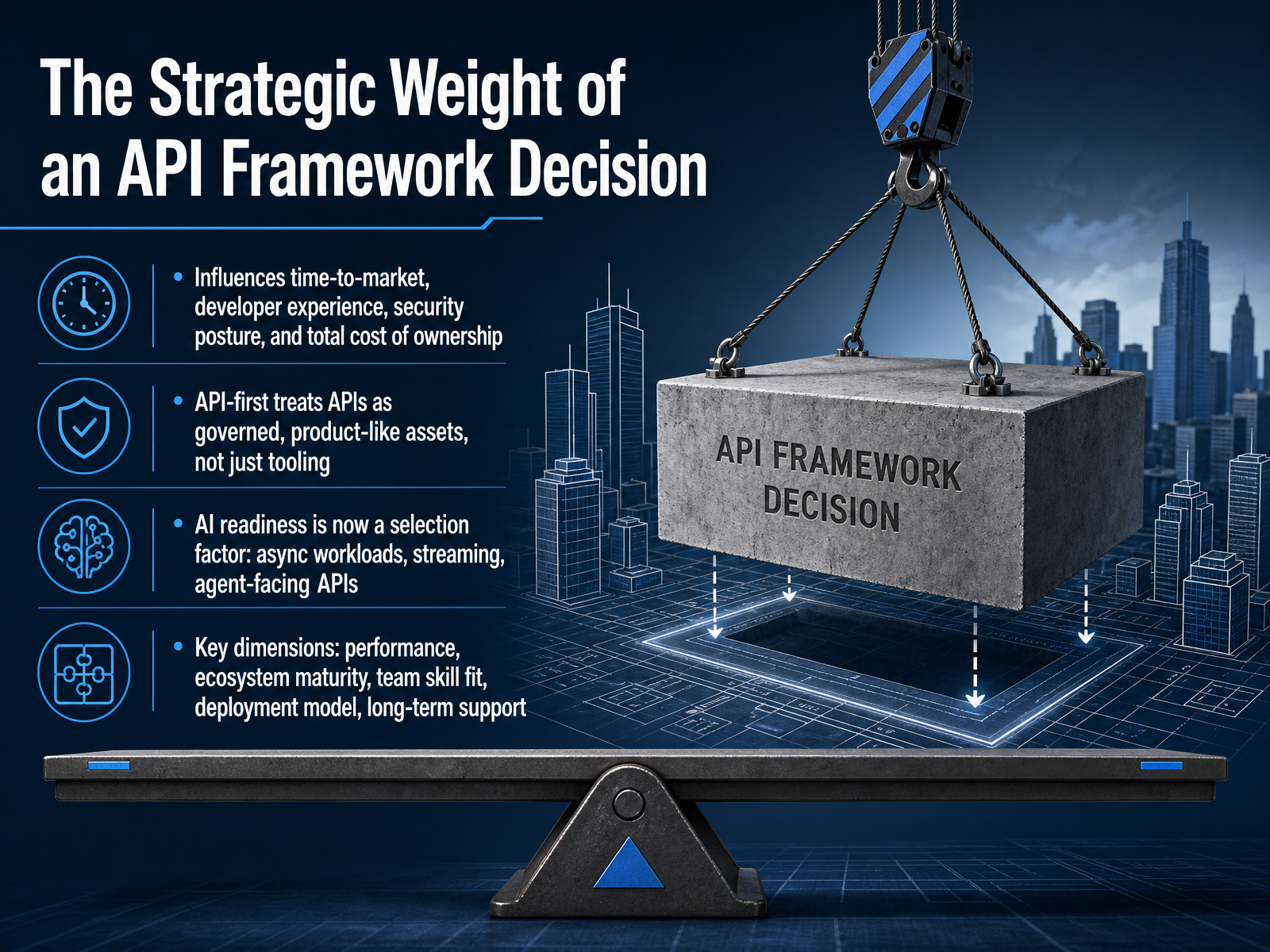
- 02The Strategic Weight of an API Framework DecisionLet's get straight to why this decision carries strategic weight. The framework you choose shapes more than just your code. It directly influences time-to-market, developer experience, your security posture, and the total cost of ownership over years, not months. That is a product and platform decision, not a purely technical preference. This is why API-first has shifted from a buzzword to an operating principle. APIs are now governed, product-like assets with roadmaps, versioning, and SLAs. The framework is the foundation that either supports or undermines that discipline. There is also a newer factor in play: AI readiness. As agent-facing APIs, streaming responses, and asynchronous workloads become common, the framework must handle those interaction patterns cleanly. That means considering async support, backpressure, and streaming behavior early, not as an afterthought. To make the call well, keep five dimensions in view: raw performance, ecosystem maturity, team skill fit, deployment model, and the long-term support horizon. Each of those will surface again as we move into the core architectural styles and their trade-offs.
 digitalapi.airesourcifi.comapidog.com+21 min
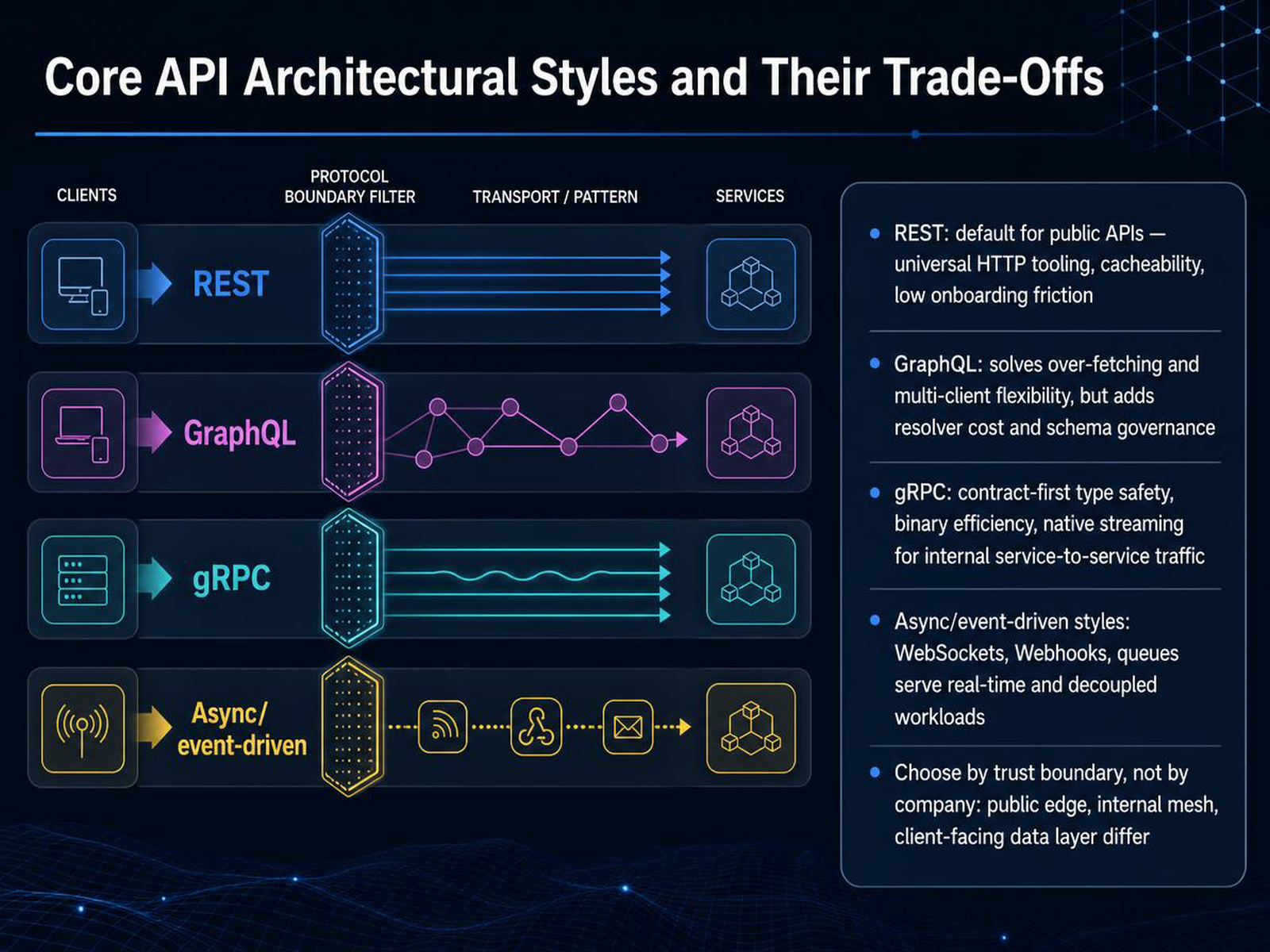
 - 03Core API Architectural Styles and Their Trade-OffsNow let's look at the core architectural styles and what each one actually buys you. REST remains the default for public APIs. It runs on universal HTTP tooling, supports native caching, and creates almost no onboarding friction. But it can force over-fetching when many clients need different data shapes. GraphQL solves that by letting clients select exactly the fields they need. That flexibility, however, adds resolver cost and requires real schema governance to avoid production incidents. gRPC takes a different path. With contract-first type safety, binary Protobuf efficiency, and native streaming, it is built for internal service-to-service traffic where you control both ends. Async and event-driven styles, like WebSockets, webhooks, and queues, serve real-time updates and decoupled workloads that synchronous request-response models handle poorly. The key decision point is not company-wide preference. It is trust boundary. A public edge, an internal mesh, and a client-facing data layer are different engineering problems. Choose the style that fits the boundary, not the organization. In the next section, we'll turn this into a decision matrix across REST, GraphQL, and gRPC.
 apiscout.devsystem-design.spacejsonic.io+21 min
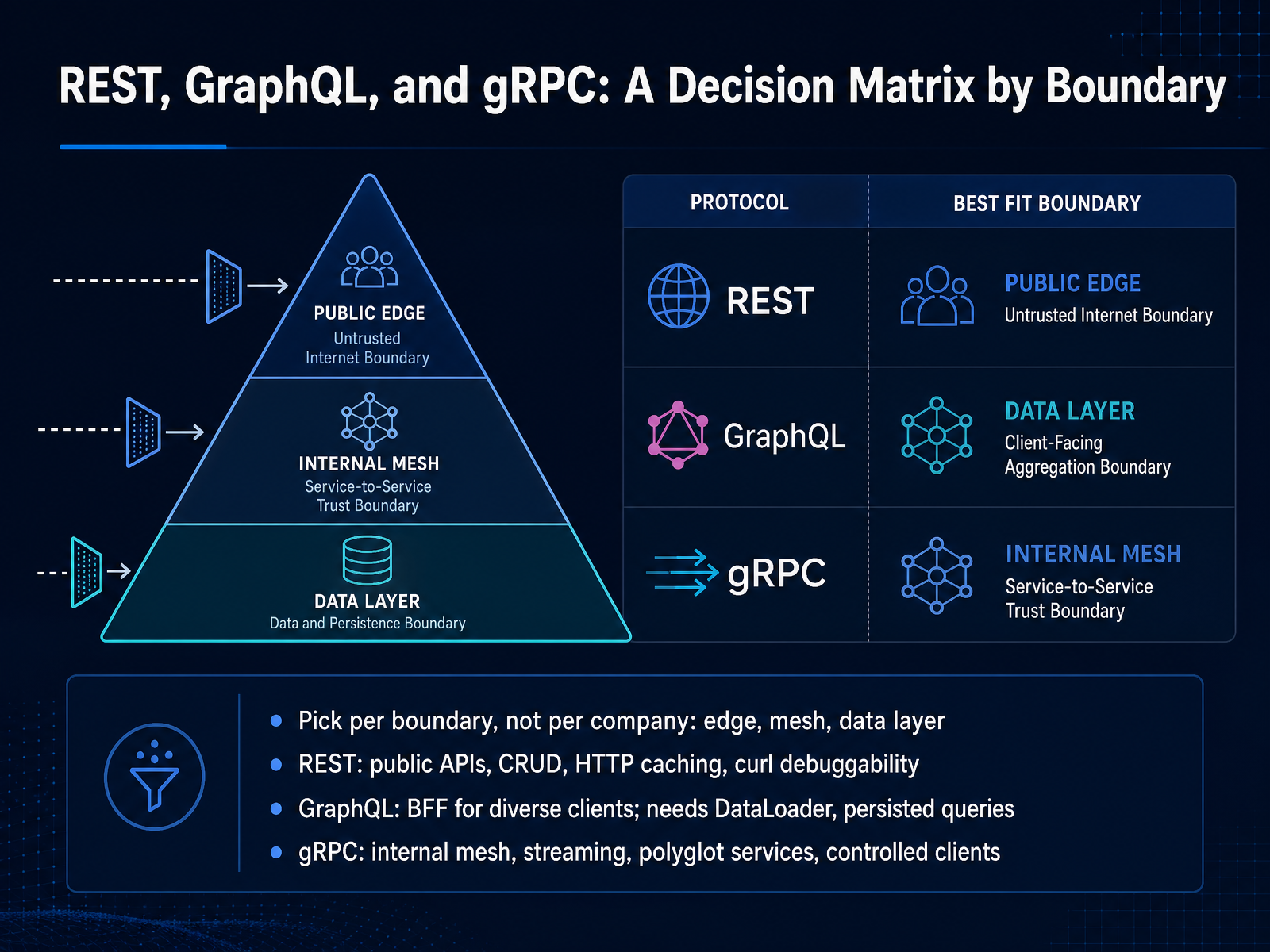
 - 04REST, GraphQL, and gRPC: A Decision Matrix by BoundaryNow let's turn that protocol discussion into a decision matrix based on architectural boundaries. The key principle here is to choose per boundary, not per company. An edge API has different constraints than a service mesh or a data layer, and forcing one framework across all three creates unnecessary friction. For public APIs, REST remains the safest default. It gives your consumers native HTTP caching, universal tooling, and the ability to debug calls with a simple curl command. When third-party developers need to integrate quickly, that familiarity is worth more than protocol sophistication. GraphQL belongs where you have diverse clients pulling from the same backend. In a Backend for Frontend, or BFF pattern, it reduces over-fetching for mobile apps and dashboards. But you need DataLoader and persisted queries from day one. Without them, the N plus one problem will surface in production as a database incident. For your internal service mesh, gRPC is the strongest option. It gives you compile-time type safety, native streaming, and polyglot code generation. Because you control both ends of the call, the operational cost of Protocol Buffers is manageable. This boundary-based view leads us naturally into the next piece: the framework families themselves.
 apiscout.devsystem-design.spacejsonic.io+21 min
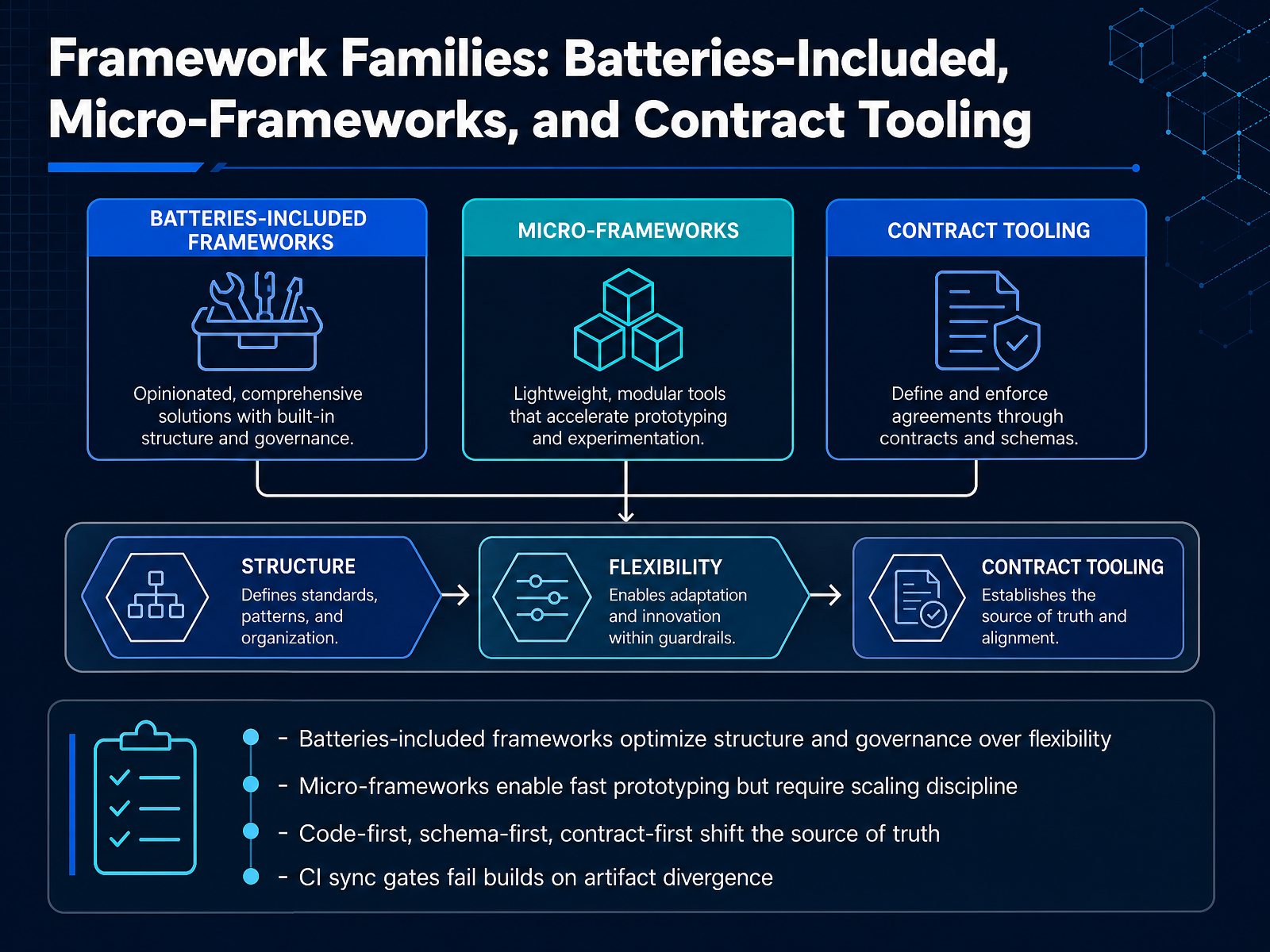
 - 05Framework Families: Batteries-Included, Micro-Frameworks, and Contract ToolingWhen choosing an API framework, we often talk about three families. Batteries-included frameworks like Spring Boot, NestJS, and Django REST prioritize structure and governance. They give you built-in security, validation, and architectural patterns. The trade-off is less flexibility, but for large teams that trade-off is usually worth it. Micro-frameworks, such as Express, Flask, or FastAPI, give you a lightweight core that gets you to a prototype quickly. You choose your own database, middleware, and testing approach. That speed is valuable, but it requires scaling discipline because the team must agree on conventions the framework does not enforce. The other major distinction is the source of truth for your contract. In a code-first approach, the implementation generates the spec. In a schema-first approach, the OpenAPI document drives code generation. Contract-first treats that document as a reviewable agreement between teams. Each shifts where drift can appear, and that is what the next slide examines more closely.
 digitalapi.airesourcifi.comapidog.com+22 min
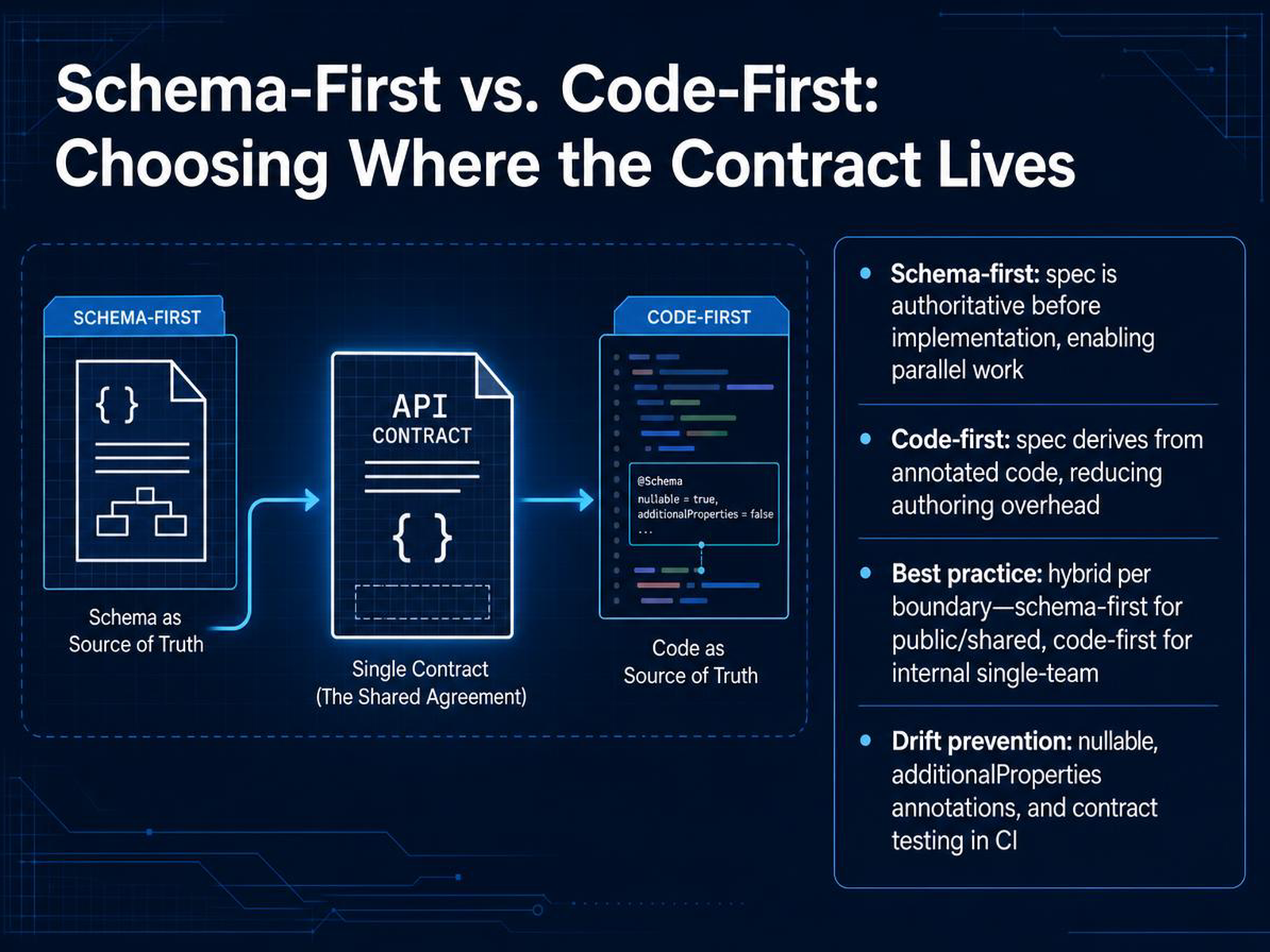
 - 06Schema-First vs. Code-First: Choosing Where the Contract LivesNow, let's get to a decision that shapes your whole workflow: where does the contract live? Both schema-first and code-first can ship correct APIs, but they fail in different ways and suit different team topologies. With schema-first, the spec is authoritative before implementation begins. It enables parallel work. Frontend and backend teams both generate from that single spec, and you have day-one mockability. The cost is higher upfront authoring. You are hand-writing and maintaining YAML, and you need discipline to regenerate code whenever the spec changes. Code-first flips this. You write annotated code, and the spec is generated as a build artifact. That reduces authoring overhead and keeps developers in familiar territory, which is why it works well for internal, single-team services that iterate quickly. The risk is silent drift. An omitted nullable annotation or an untyped change can produce a spec that looks correct but lies about runtime behavior. For most organizations, the practical answer is hybrid. Use schema-first for public and shared boundaries, where the contract must be reviewable and stable. Use code-first for internal leaf services, where speed matters more than governance. Whatever you choose, prevent drift with explicit annotations like nullable and additionalProperties, and add a contract test or CI sync gate so divergence fails the build. Next, we'll compare major frameworks by language and workload.
 sookocheff.comapi-contract-testing.comcanada.ca+22 min
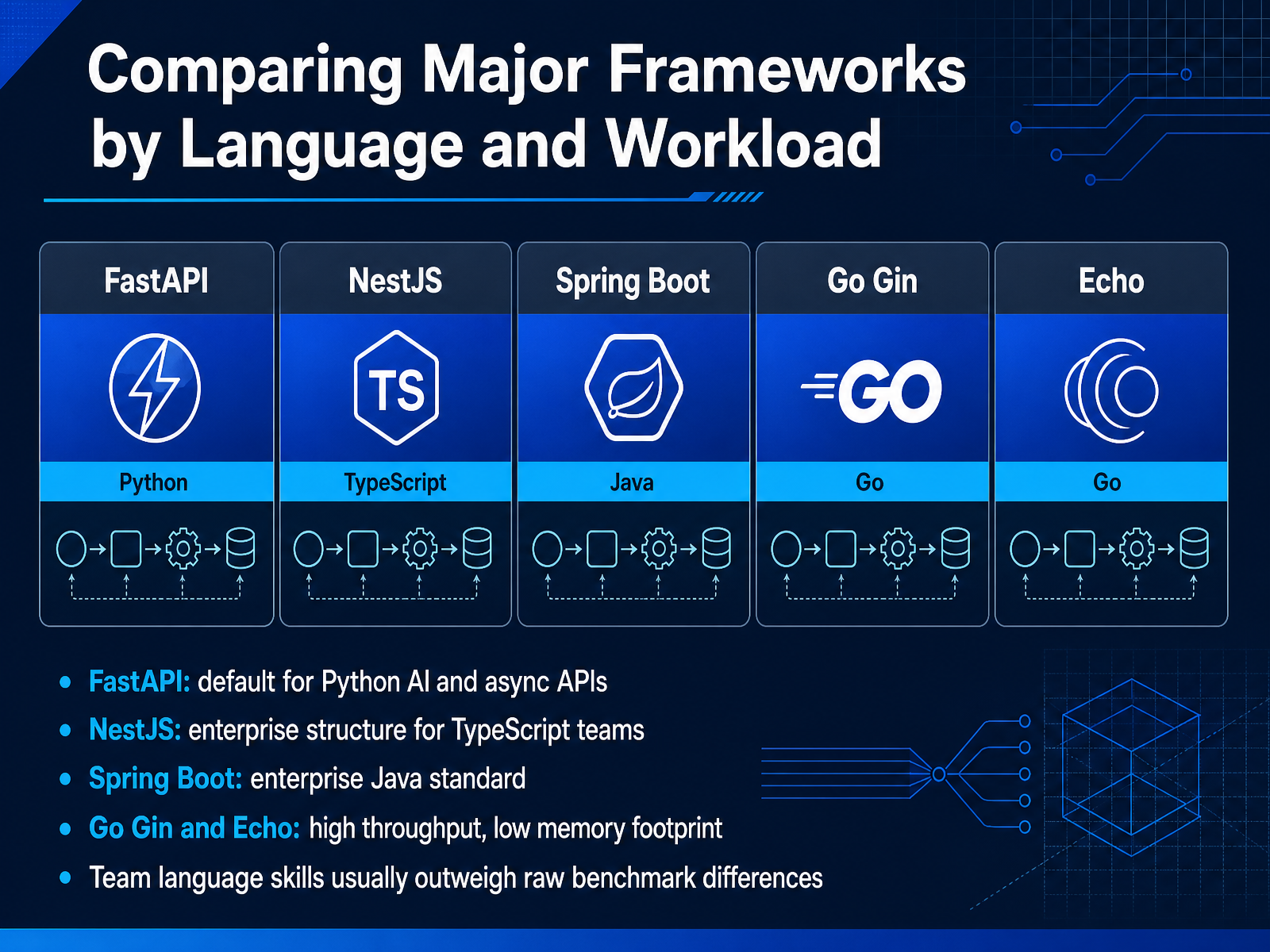
 - 07Comparing Major Frameworks by Language and WorkloadLet's map the major frameworks against the languages and workloads where they perform best. FastAPI is now the default for Python-based AI and async APIs. Its ASGI foundation and Pydantic validation make it a clean fit for model serving and high-concurrency I O pipelines. NestJS serves as the enterprise structure for TypeScript teams. Its modular architecture and dependency injection give larger codebases consistency and governance. Spring Boot remains the enterprise Java standard. Its mature ecosystem and strong typing support large, regulated systems. Go frameworks like Gin and Echo deliver high throughput with a low memory footprint. They are excellent for cloud-native microservices and API-heavy services. But here is the practical decision point. Your team's language skills usually outweigh raw benchmark differences. A framework your engineers already know well will ship faster and more reliably than an unfamiliar option with better synthetic numbers. With that foundation, let's look at performance realities, including benchmarks, cold starts, and workload profiles.
 digitalapi.airesourcifi.comapidog.com+21 min
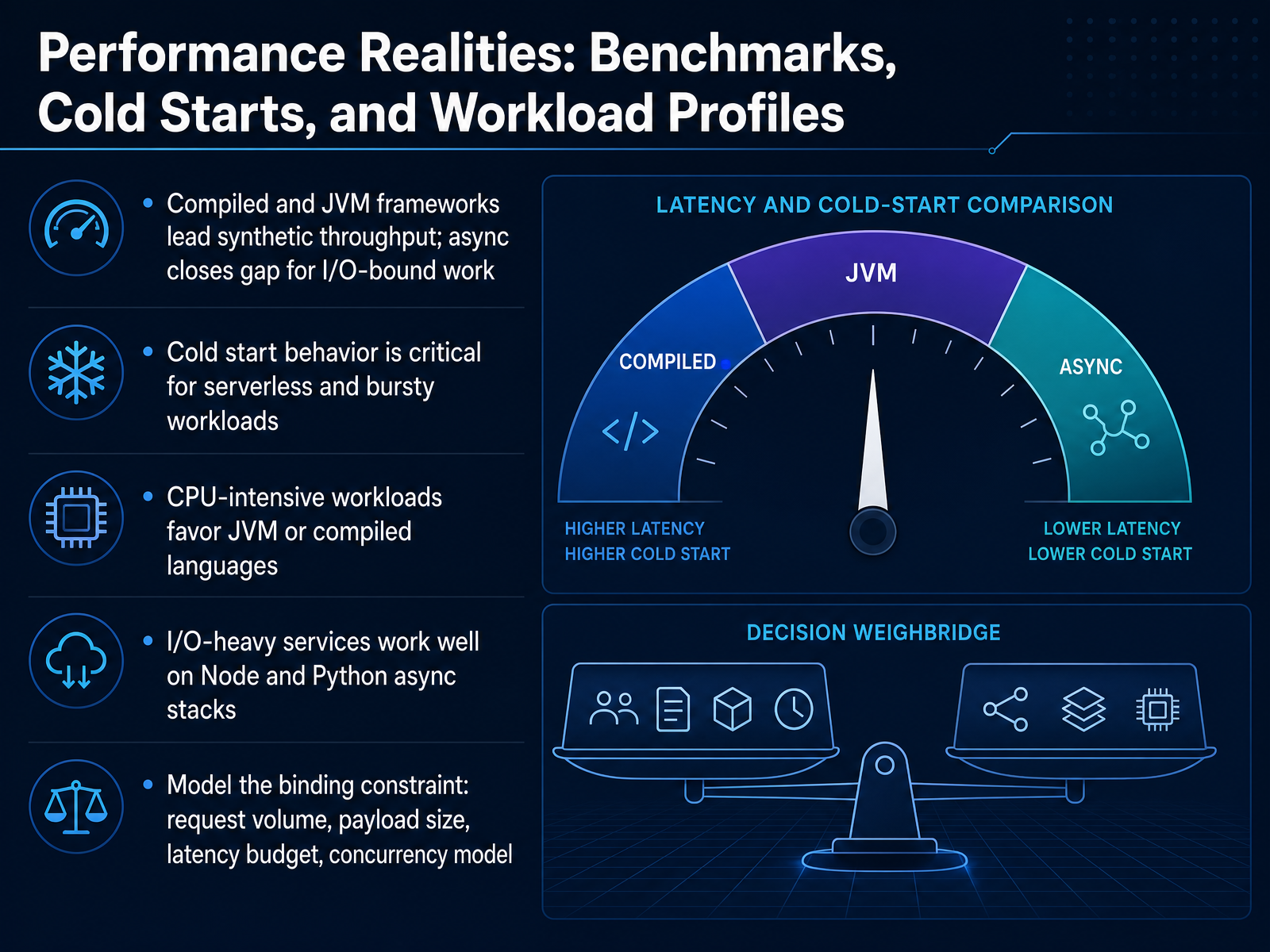
 - 08Performance Realities: Benchmarks, Cold Starts, and Workload ProfilesNow let's move from developer experience to the harder question: what actually happens under load. Performance claims can be misleading, so the useful approach is to match the framework to your workload profile. Compiled and JVM frameworks typically lead in raw synthetic throughput. But for I/O-bound services, async stacks like Node and Python close much of the gap, because the bottleneck is usually waiting on databases or external APIs, not CPU cycles. Cold start behavior becomes critical in serverless and bursty deployments. JVM applications often take several seconds to warm up. Node and Python are usually faster, and GraalVM native images can bring Spring Boot down to the low hundreds of milliseconds. For CPU-intensive work such as image processing or large batch transformations, the JVM still holds a real advantage. For I/O-heavy APIs and integration layers, Node and Python async frameworks are often the more economical fit. Before choosing, model the binding constraint: request volume, payload size, latency budget, and concurrency model. That will tell you which trade-offs actually matter. Next, we'll apply this thinking directly to selection criteria for API-first products.
 okami101.iodocs.bswen.comjohal.in+22 min
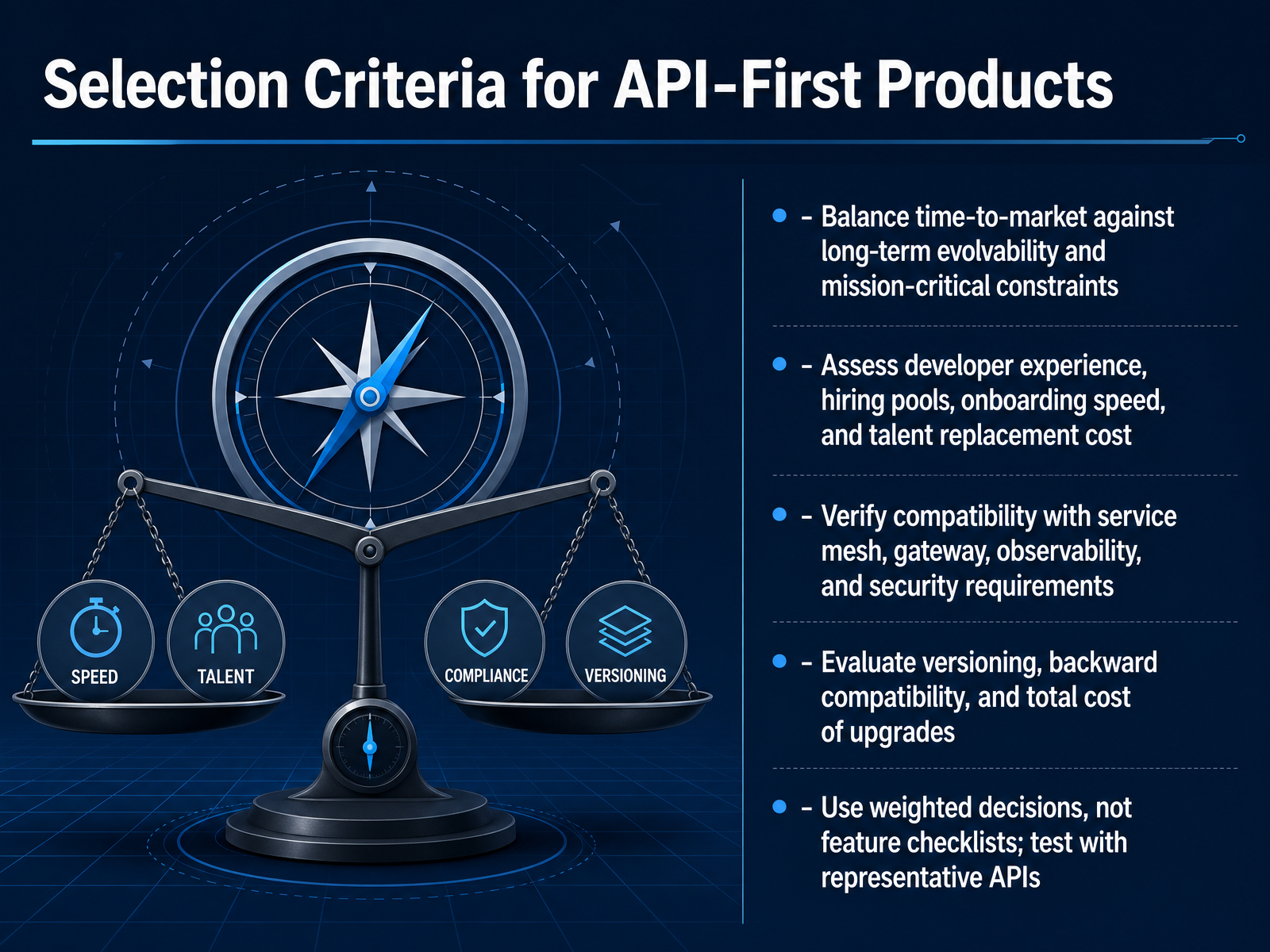
 - 09Selection Criteria for API-First ProductsSelecting a framework for an API-first product is really about making deliberate trade-offs. First, balance time-to-market against long-term evolvability. A fast prototype that cannot absorb mission-critical changes becomes a liability. Second, think about talent. Assess developer experience, the size of the hiring pool, onboarding speed, and what it costs to replace a specialist. Third, verify operational compatibility. The framework must fit your service mesh, gateway, observability stack, and security model. Fourth, look closely at versioning and upgrade economics. Backward compatibility and the total cost of upgrades often outweigh the initial feature list. Finally, make the decision with weighted criteria, not a feature checklist. Score candidates against your own constraints, and validate them with representative APIs before committing. A structured, evidence-based decision protects the product roadmap. Next, we will move into production use case deep dives, where these trade-offs become very concrete.
 okami101.iodocs.bswen.comjohal.in+21 min
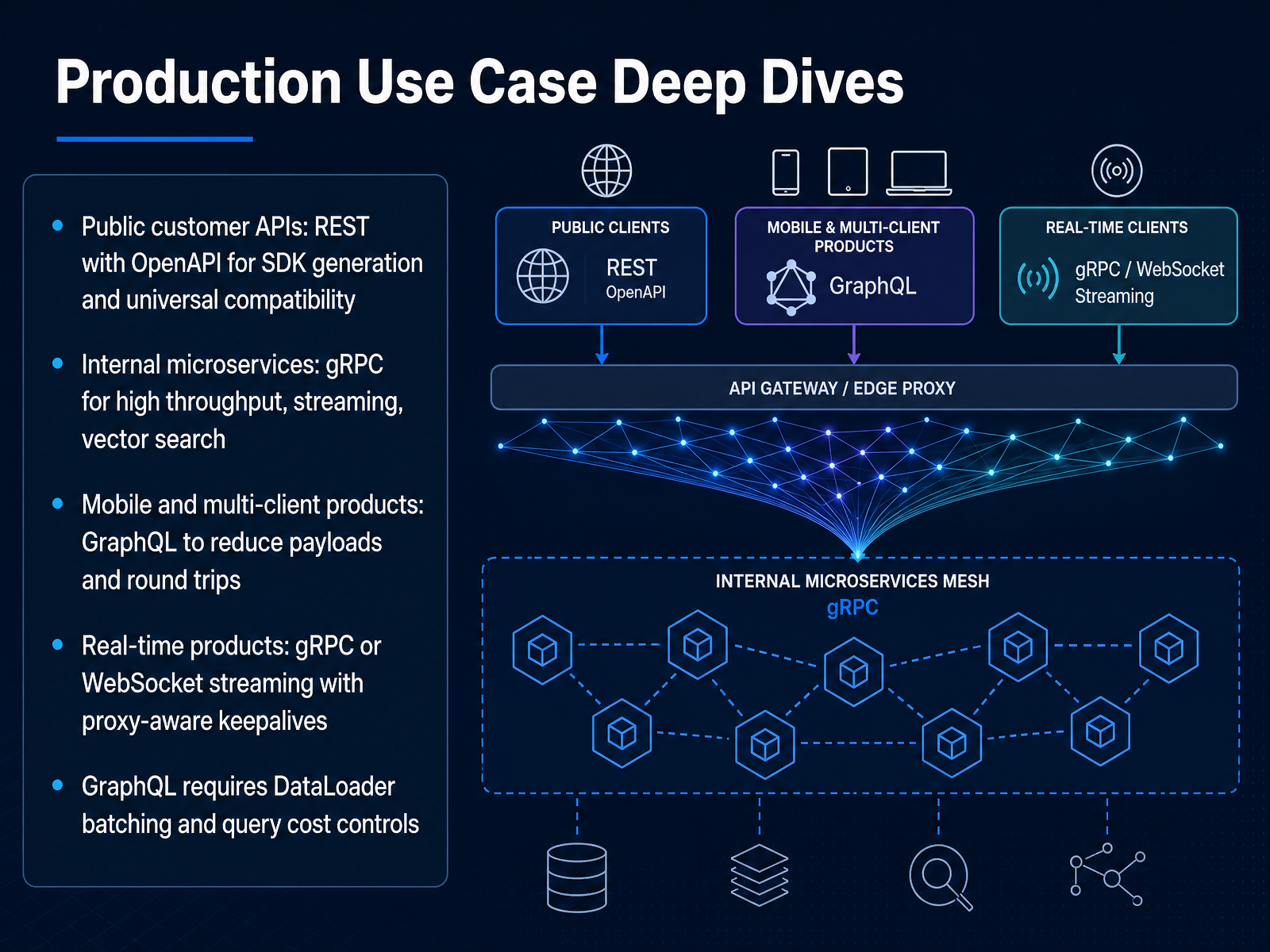
 - 10Production Use Case Deep DivesNow let's bring this down to concrete production decisions. For public customer APIs, REST with OpenAPI remains the safest default. It gives you SDK generation, universal compatibility, and a minimal integration burden for outside teams. Internally, the picture shifts. gRPC is the strong choice for high-throughput microservices, streaming patterns, and vector search workloads. At Uber, OpenSearch moved their Bulk and KNN search paths to native gRPC and saw meaningful latency reductions, especially for larger vector dimensions. When you're serving mobile and multi-client products, GraphQL earns its place by reducing payload size and eliminating extra round trips. But that efficiency carries real operational requirements. You need DataLoader batching to prevent N-plus-one query storms, and you need query cost controls so a deeply nested request cannot take down your backend. For real-time products, choose gRPC or WebSocket streaming, but plan for proxies. Keepalive frames get swallowed by Nginx and Envoy, so application-level ping and pong logic is often required. Each framework maps to a boundary, and choosing correctly depends on who your consumer is. Next, we'll fit these frameworks into the broader product architecture.
 apiscout.devsystem-design.spacejsonic.io+22 min
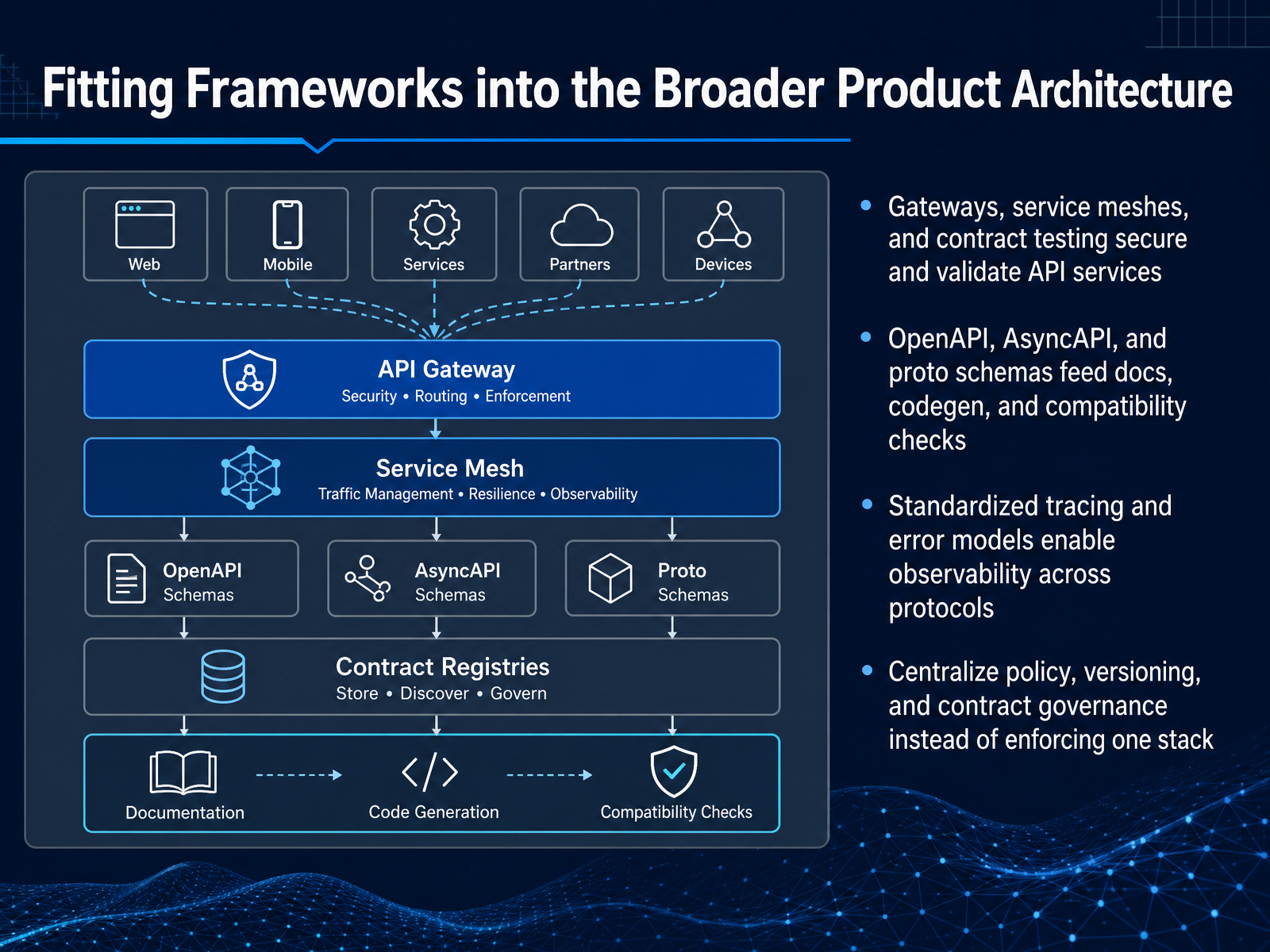
 - 11Fitting Frameworks into the Broader Product ArchitectureLet's step back and consider how these frameworks fit into your broader product architecture. The goal here is not to enforce a single stack, but to centralize the right controls. Gateways, service meshes, and contract testing work together to secure and validate your API services before they reach production. OpenAPI, AsyncAPI, and protocol buffers then feed your documentation, code generation, and compatibility checks from a single source of truth. For observability, standardized tracing and error models give you visibility across HTTP, gRPC, and event-driven services, rather than leaving each team to invent its own format. Most importantly, centralize policy, versioning, and contract governance at the platform level, while allowing teams to choose the framework that fits their runtime. That balance keeps governance consistent without slowing down delivery. Next, let's look at migration and evolution strategies.
 1 min
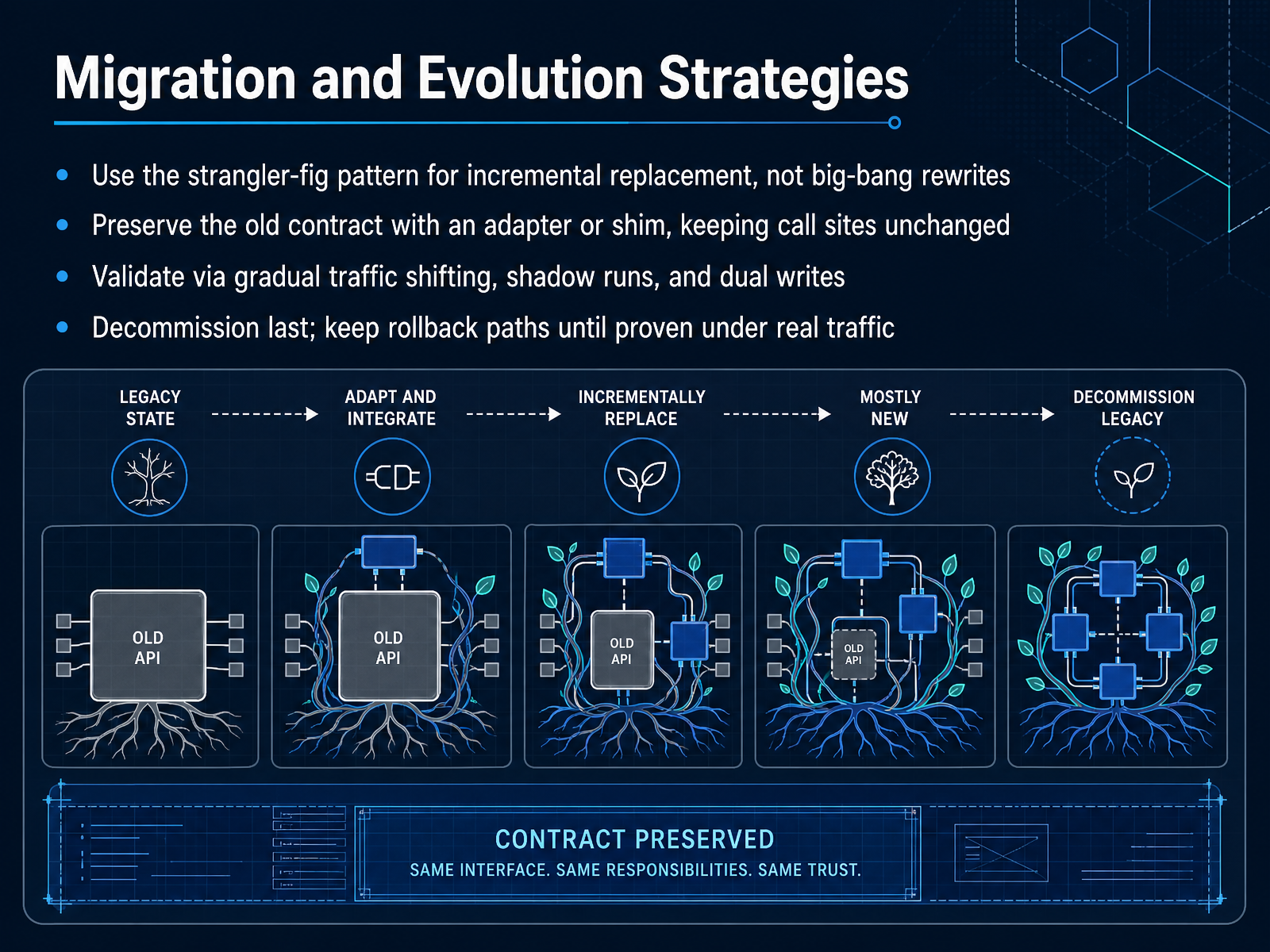
1 min - 12Migration and Evolution StrategiesNow, let's turn to migration and evolution strategies, because the way you move from one framework or architecture to another is often what determines whether the effort succeeds. The most practical approach is the strangler-fig pattern, which means incremental replacement rather than a big-bang rewrite. You build the new system alongside the old one and route individual capabilities over one at a time. A key principle is to preserve the old contract with an adapter or shim. This keeps existing call sites unchanged, which matters when you have dozens of consumers you cannot update simultaneously. Validation should happen through gradual traffic shifting, shadow runs, and dual writes. That way, you compare real behavior before committing. And remember to decommission last. Keep rollback paths available until the new implementation has proven itself under real traffic. This pattern comes up repeatedly in successful migrations, from monolith decomposition to identity provider swaps. Next, we'll look at common pitfalls and security risks.
 1 min
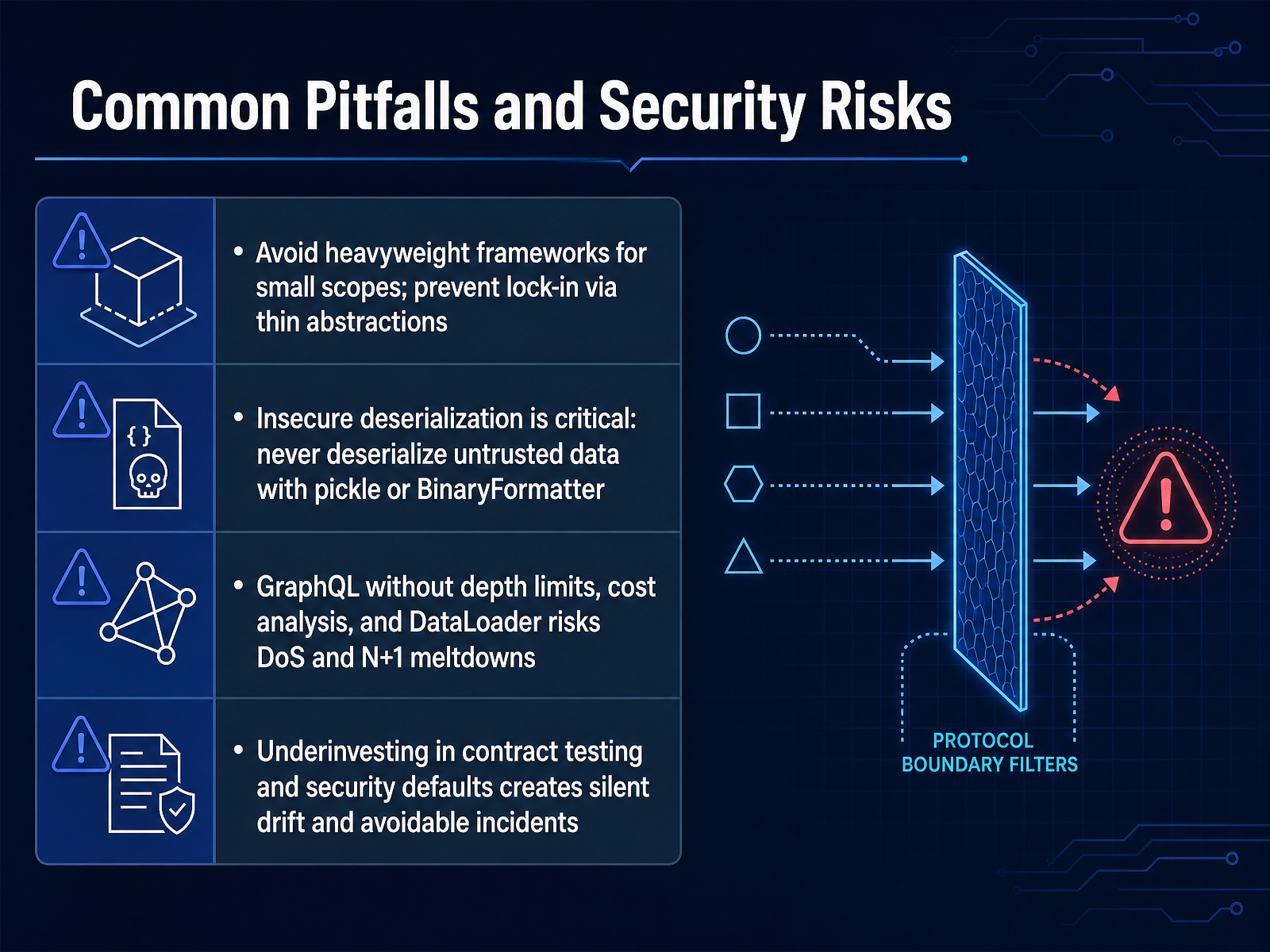
1 min - 13Common Pitfalls and Security RisksNow let's turn to the failure modes that turn a sound framework choice into an incident. The first is architectural mismatch. When a small internal service adopts a heavyweight framework, you pay for capabilities you never use, and every abstraction becomes a future migration cost. Wrap third-party frameworks behind thin interfaces so you can swap implementations without rewriting the business logic. Second, treat insecure deserialization as a critical vulnerability class, not a niche edge case. Never deserialize untrusted data with pickle or BinaryFormatter. Real-world advisories show remote code execution from exactly this pattern, including cases where attacker-controlled fields are deserialized during normal streaming. Third, GraphQL without depth limits, query cost analysis, and DataLoader does not fail gracefully. A nested query can fan out into hundreds of database calls or exhaust your server. Depth limiting and response caching must be non-negotiable if you expose a graph. Finally, contract testing and secure defaults are not documentation tasks. When teams underinvest here, drift is silent. The schema no longer matches runtime behavior, a nullable field is missing, or a dangerous default is left enabled, and the first notification is an avoidable production incident. Decide on your contract gate in CI, and make the unsafe path harder than the safe one. Next, we'll move from these risks to a practical decision playbook and next steps.
 sookocheff.comapi-contract-testing.comcanada.ca+22 min
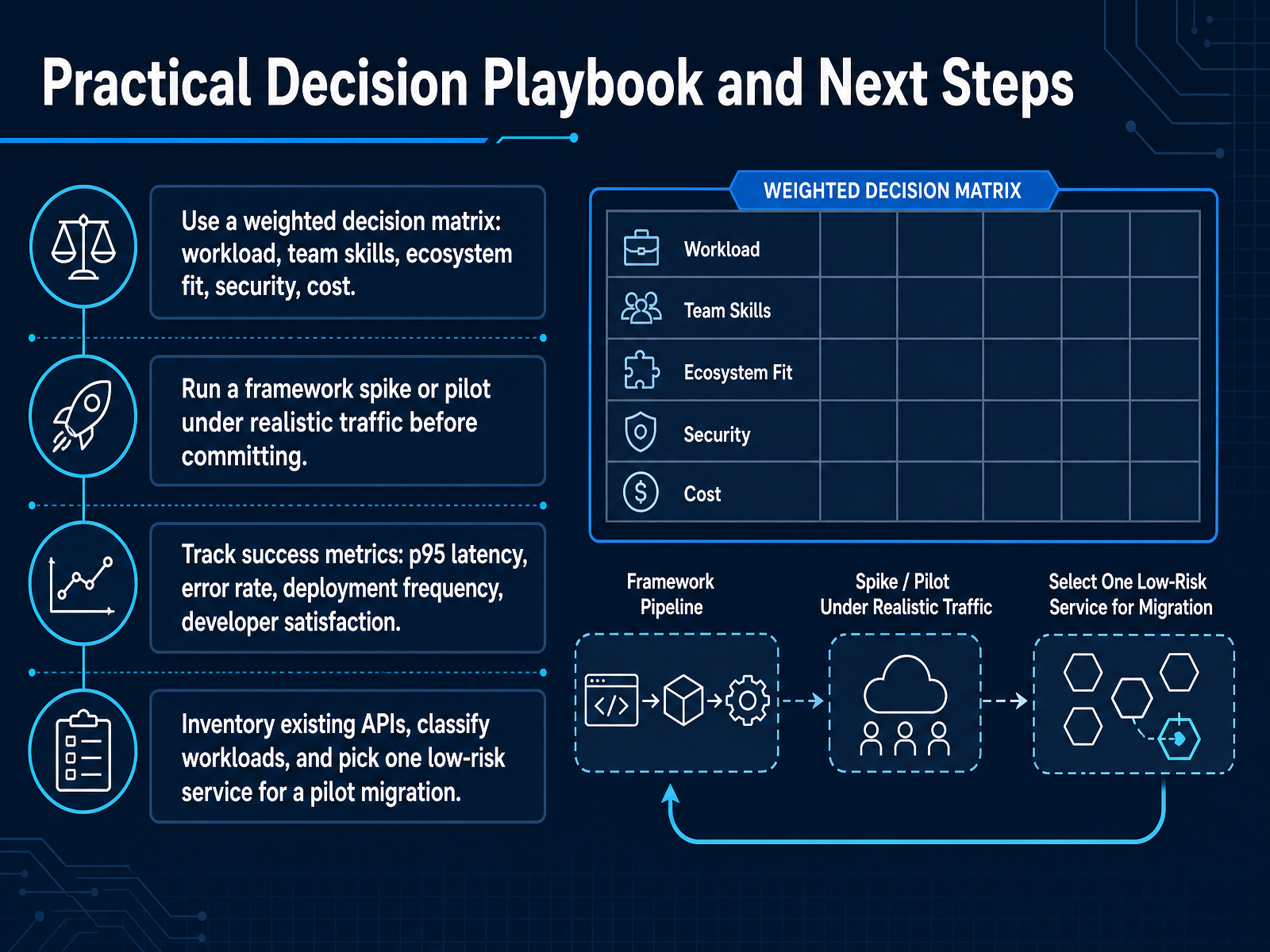
 - 14Practical Decision Playbook and Next StepsLet's turn this into a decision playbook you can use immediately. First, build a weighted decision matrix. Score each framework on workload fit, team skills, ecosystem compatibility, security posture, and total cost. Don't treat every criterion equally. Architecture fit and security typically deserve more weight than raw throughput alone. Second, run a spike or pilot under realistic traffic before committing. That means testing with representative load, actual identity patterns, and real failure scenarios, not just a happy path. Third, define your success metrics up front. Track p95 latency, error rate, deployment frequency, and developer satisfaction. These give you an objective baseline for comparing options. Finally, inventory your existing APIs, classify each workload, and pick one low-risk service for a pilot migration. Start with a read-heavy endpoint or an internal service where the blast radius is small. That gives you real production evidence without putting critical flows at risk. To wrap up, the goal isn't to find the perfect framework. It's to build a repeatable evaluation process, commit to evidence over opinion, and make your next migration safer and faster. Thanks for joining me, and good luck with your framework decision.
 okami101.iodocs.bswen.comjohal.in+22 min
Take the deck with you
Download this course as a file — free, no sign-up needed.
- PDF handoutEvery slide page, ready to print or share.15 pages · 4.0 MBDownload
- Narrated PowerPointThe deck that presents itself — every slide carries the digital human's narration video.15 pages · 18.3 MBDownload
- PowerPoint slidesThe full deck as a .pptx — open it in PowerPoint, Keynote, or Google Slides.15 pages · 3.9 MBDownload
Free to use in your own training — please keep the PersonWise credit page at the end.
Have your own deck? Turn it into a course
Sources consulted
Web sources consulted while building this course.
- Top 10 API Frameworks: Choose Your Best Fit for 2026 - DigitalAPI — digitalapi.ai
- Backend Frameworks Compared: A 2026 Guide — resourcifi.com
- Top API Frameworks: The Ultimate Guide — apidog.com
- Best API Frameworks Across All Languages 2026 | FastBuilder.AI Blog — fastbuilder.ai
- Top backend frameworks for enterprise API development: 2026 guide — digitalapi.ai
- gRPC vs REST vs GraphQL APIs 2026 | APIScout — apiscout.dev
- gRPC vs REST vs GraphQL: a comparative overview — System Design Space — system-design.space
- JSON REST vs GraphQL vs gRPC: Comparison and Choice — Jsonic — jsonic.io
- REST vs GraphQL vs gRPC: Choosing an API Paradigm in 2026 | DevToolNow — devtoolnow.com
- REST vs GraphQL vs gRPC: Which API Protocol Should You Choose? — apidog.com
- The False Dichotomy of Design-First and Code-First API Development | Kevin Sookocheff — sookocheff.com
- Schema-First vs Code-First API Workflows | API Contract Testing — api-contract-testing.com
- Contract First API Development Primer - Canada.ca — canada.ca
- Spec-First API Development: A Practical Guide for Modern API Teams — api-portal.io
- API Contract Definitions - Different Ways of Specifying API Contracts: Contract first, implementation first, OpenAPI, GraphQL, gRPC - API Conference — apiconference.net
- A 2026 benchmark of main Web API frameworks - Okami101 Blog — okami101.io
- NestJS vs FastAPI vs Spring Boot: Which Backend Framework Should ... — docs.bswen.com
- Performance Test: FastAPI 0.115 vs. Express 5 vs. Spring Boot 3.3 for 50k RPS REST API Throughput — johal.in — johal.in
- Best backend frameworks in 2026: compare and choose — netguru.com
- NestJS vs. Spring Boot 2026: A Decision-Maker's Comparison — happycoding.agency