Instructional Design Objectives
Begin
14 pages · ~28 min
Instructional Design Objectives
Learn to create effective learning objectives and apply instructional design principles to craft engaging, outcomes-driven training programs.
What you’ll learn
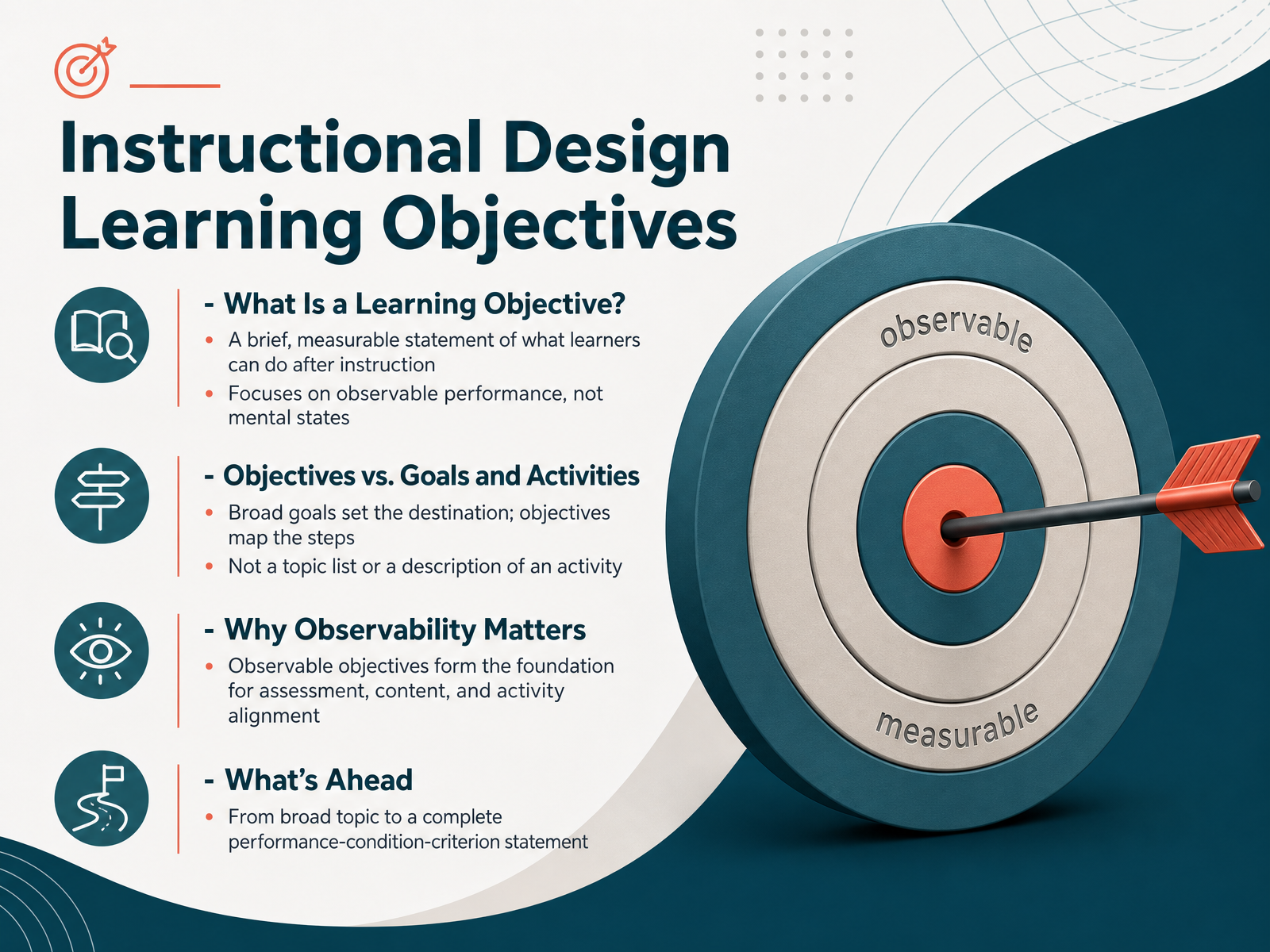
- 01Instructional Design Learning ObjectivesWelcome. If you have ever stared at a broad topic like communication skills or leadership and wondered where to start, this session is for you. We are going to turn vague ideas into crisp, practical learning objectives. A learning objective is a short, measurable statement of what a learner can do after instruction. Notice the key word: do. It is about observable performance, not internal feelings or thoughts. Now, let us separate objectives from goals and activities. A goal sets the destination. An objective maps the specific steps to get there. It is not a list of topics, and it is not a description of an activity. Why does observability matter so much? Because when an objective is observable, it gives you a solid foundation for building assessments, choosing content, and designing activities. Everything aligns. Over the next few slides, we will move from a broad topic all the way to a complete statement with performance, conditions, and criteria. Let us begin by looking at why vague objectives fail your learners and your design process.cdc.govteaching.uic.eduisu.pressbooks.pub+21 min
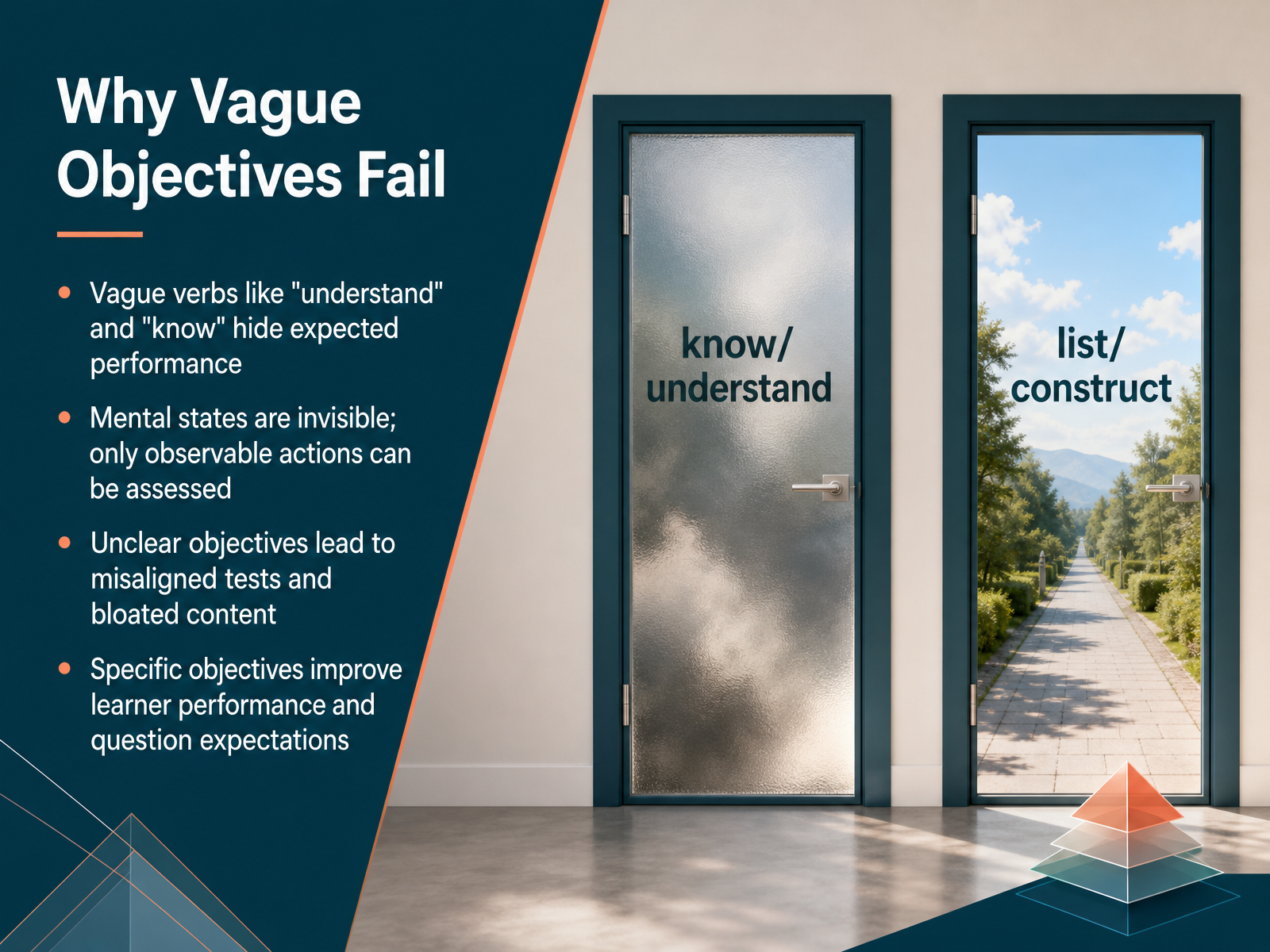
- 02Why Vague Objectives FailLet’s talk about why vague objectives fail. When we write that students will understand a topic, we’re actually hiding the expected performance. Understanding is invisible. You can’t see it, and you can’t measure it. Only observable actions can be assessed. Think about it. If you say your learners understand a concept, what would they do to prove it? Would they explain it? Compare it? Apply it to a case? Without those actions, your assessments become guesswork. And when your objectives are unclear, your tests can drift away from what you taught, or you end up stuffing in extra content just in case. That bloats your course and confuses your learners. On the flip side, specific objectives that use verbs like define, analyze, or design give learners a clear target. They know what to study and what question to expect. Research shows that specific objectives actually improve performance. So when you hear yourself writing understand or know, stop and ask: what will my learners do to show me? That simple shift makes your objectives clearer, your assessments fairer, and your teaching more effective. Up next, we’ll break down the difference between goals, objectives, and outcomes.
 teaching.washington.eduitali.uq.edu.autlc.uva.nl+22 min
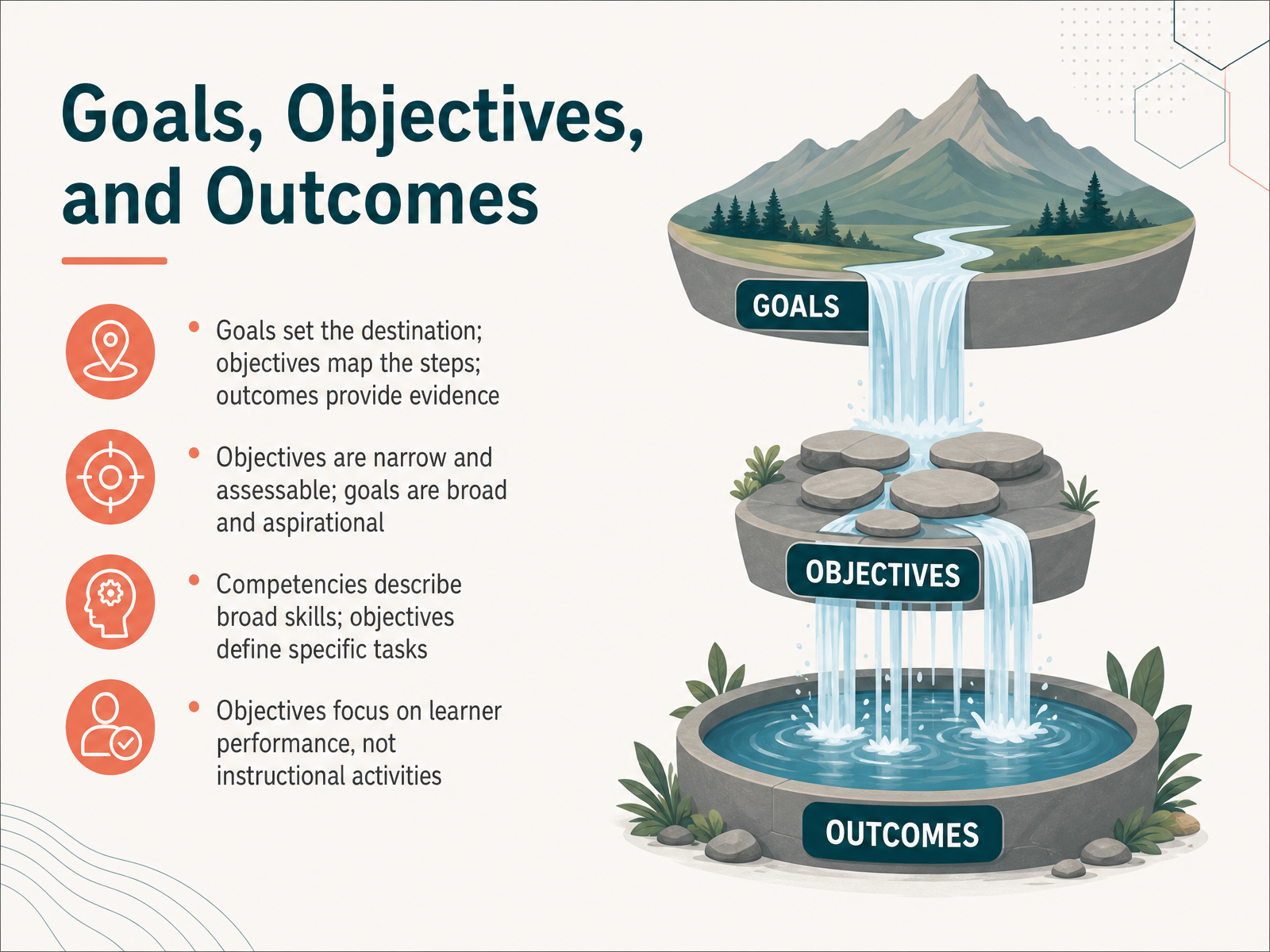
 - 03Goals, Objectives, and OutcomesLet’s quickly clarify three terms we often mix up: goals, objectives, and outcomes. Think of goals as the destination—they are broad, aspirational, and set the direction. Objectives are the steps you map to get there. They are narrow, precise, and written so you can assess them. Outcomes are the evidence you collect to show the journey worked. Now, competencies describe broad skill sets, while objectives break those down into specific, observable tasks. And here's the key point: objectives focus on what the learner will do, not what you as the instructor will do in the room. For example, instead of saying, “I will teach the steps of a needs analysis,” you write, “By the end of this module, learners will be able to list the four signs that a needs analysis is required.” See the shift? You are not describing your teaching. You are stating the learner's performance. Keep that distinction front and center, and your objectives will always guide your design and assessment choices. Next, let’s look at the anatomy of a truly measurable objective.
 cdc.govteaching.uic.eduisu.pressbooks.pub+21 min
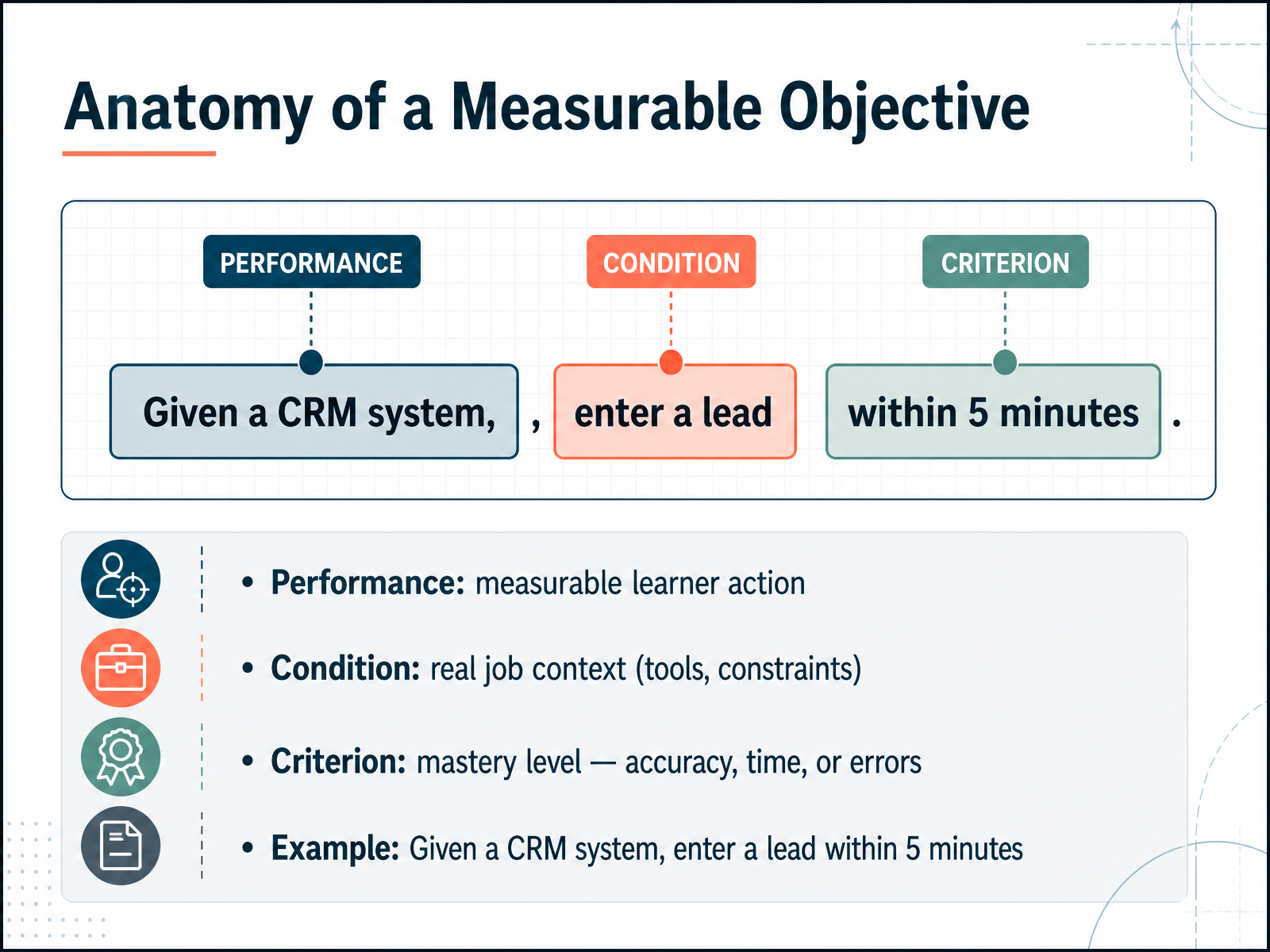
 - 04Anatomy of a Measurable ObjectiveLet's break down the anatomy of a measurable objective. It has three parts. First, performance. What will the learner actually do? Use a clear, observable verb like 'enter,' 'calculate,' or 'assemble.' Second, the condition. What tools or context are provided? This mirrors the real job environment. For example, 'Given a CRM system.' And third, the criterion. How well must they perform? Think accuracy, time, or error limits. So, the full objective is 'Given a CRM system, enter a lead within five minutes.' That's specific, observable, and testable. Now, let's look at how to choose the right action verbs to drive your assessment.
 acces.nysed.govmed.fsu.eduvectorsolutions.com+21 min
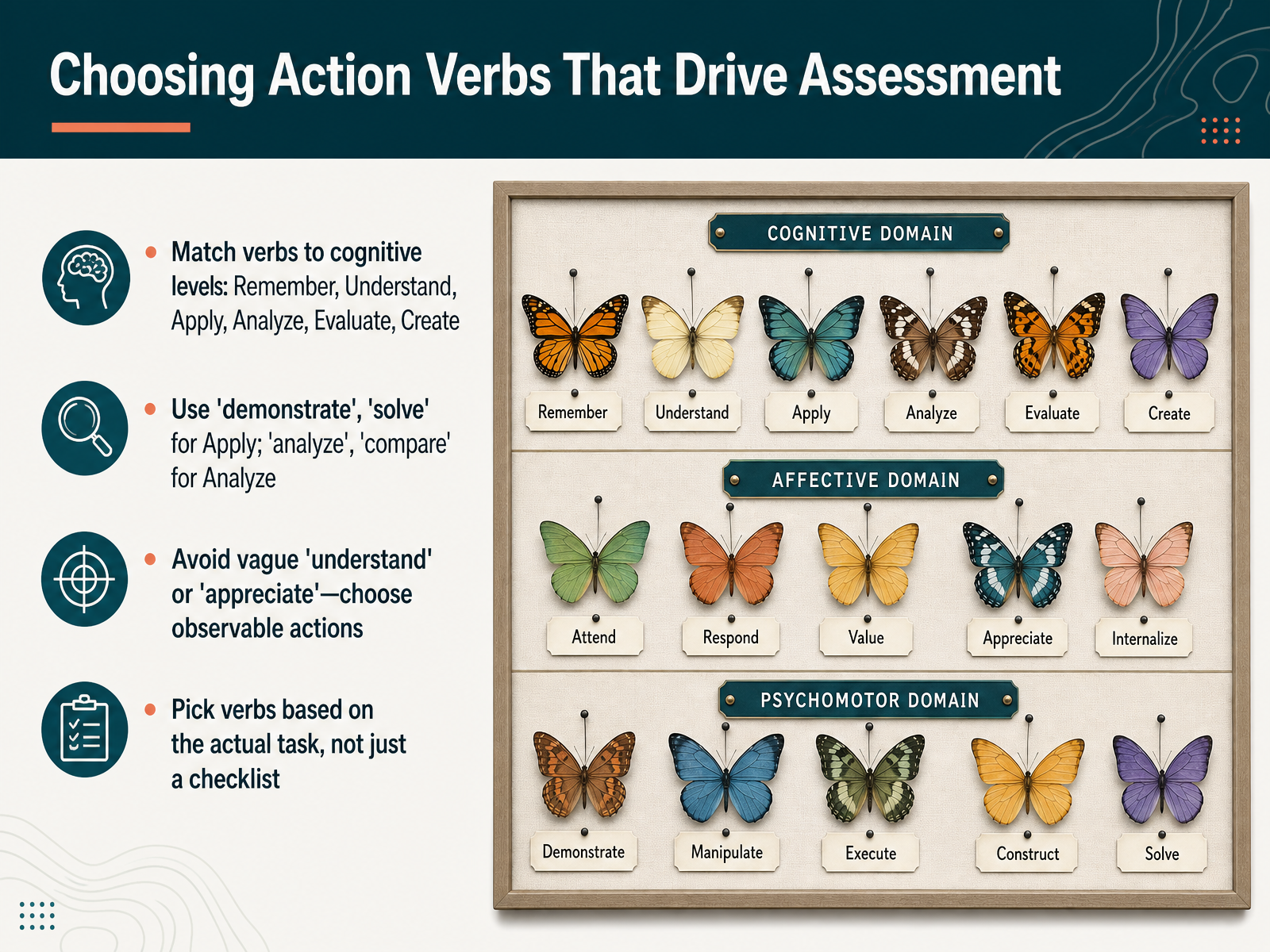
 - 05Choosing Action Verbs That Drive AssessmentNow let's talk about choosing action verbs that actually drive assessment. The first step is to match your verb to the cognitive level you're targeting. For lower-level recall, use verbs like list or define. For deeper understanding, use explain or summarize. When you need learners to apply knowledge, choose verbs like demonstrate or solve. For analysis, reach for compare or differentiate. At the evaluation level, verbs like critique or justify work well. And for the highest level, creation, use design or construct. Now, avoid vague verbs like understand or appreciate. They don't tell you what the learner will actually do. Instead, pick verbs that describe observable actions. For example, instead of saying learners will understand the sales process, say learners will demonstrate the sales process in a role-play. That's measurable and clear. One more tip: choose verbs based on the actual task, not just from a checklist. If the real-world job requires troubleshooting, use troubleshoot or diagnose, even if they're not on your favorite verb list. Your judgment matters more than the list. So, remember: match the verb to the cognitive demand, use verbs that show observable behavior, and always let the task guide your choice. Coming up next, we'll look at how Bloom's revised taxonomy applies to workplace performance.
 corporatetrainingcompanion.comcdc.govteachfloor.com+21 min
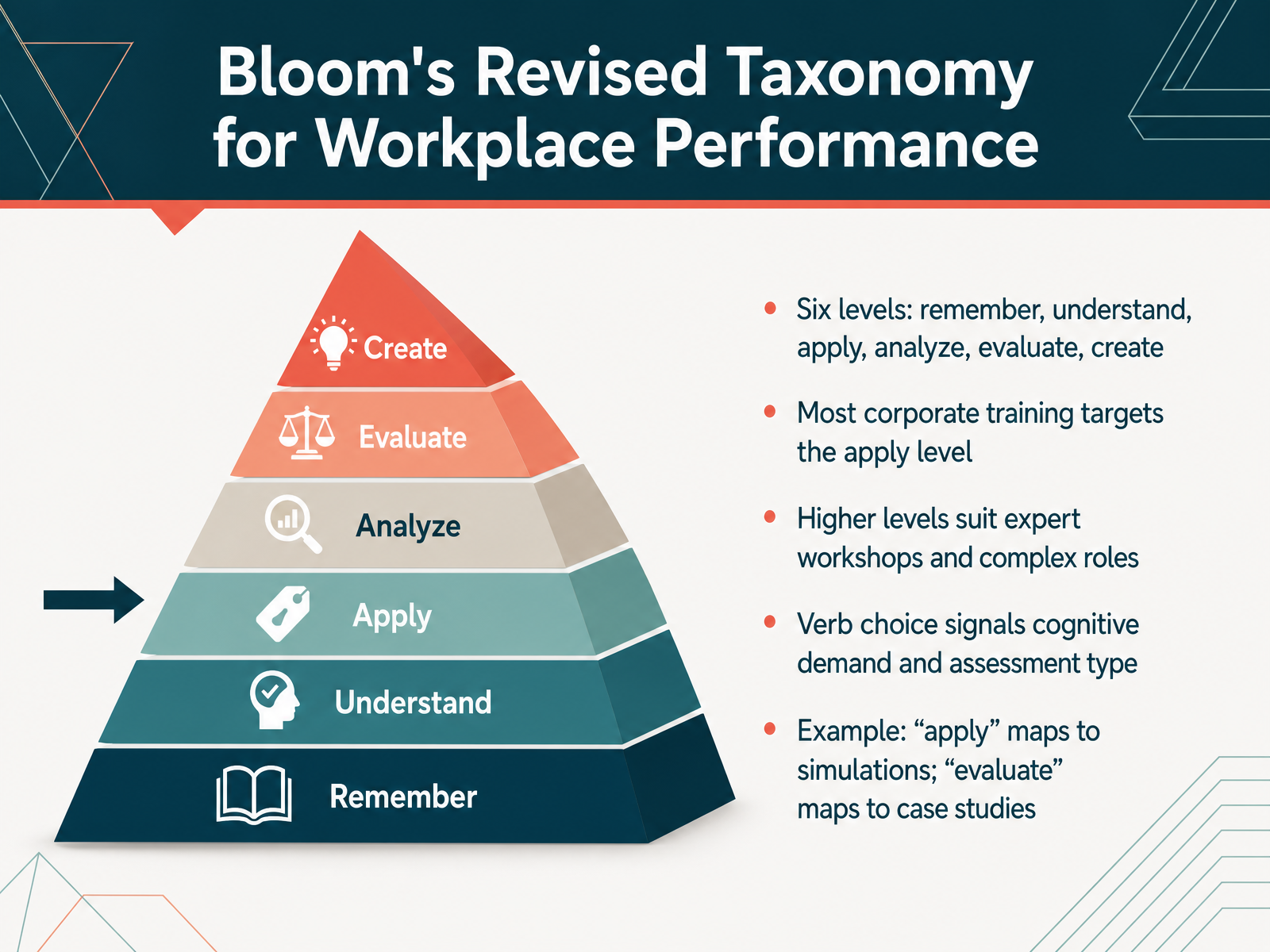
 - 06Bloom's Revised Taxonomy for Workplace PerformanceLet’s talk about the revised Bloom’s taxonomy and what it means for your training design. It has six levels: remember, understand, apply, analyze, evaluate, and create. Each one represents a deeper level of thinking. Now, here’s a practical reality: most corporate training targets the apply level. And that’s usually exactly where it needs to be. Your learners need to use the knowledge, not just hold it. Higher levels, like evaluate and create, are best reserved for expert workshops or complex roles where people must make judgments or build new solutions. The verb you choose signals the cognitive demand. It also tells you which assessment type fits. For example, if you say “apply,” you’re looking at simulations or hands-on practice. If you say “evaluate,” you’re designing case studies, peer reviews, or decision justifications. So, always pick your verb first. It keeps your objective honest and your assessment aligned. Now, let’s move from that idea into the practical steps with 'From Topic to Objective in Four Moves.'
 corporatetrainingcompanion.comcdc.govteachfloor.com+21 min
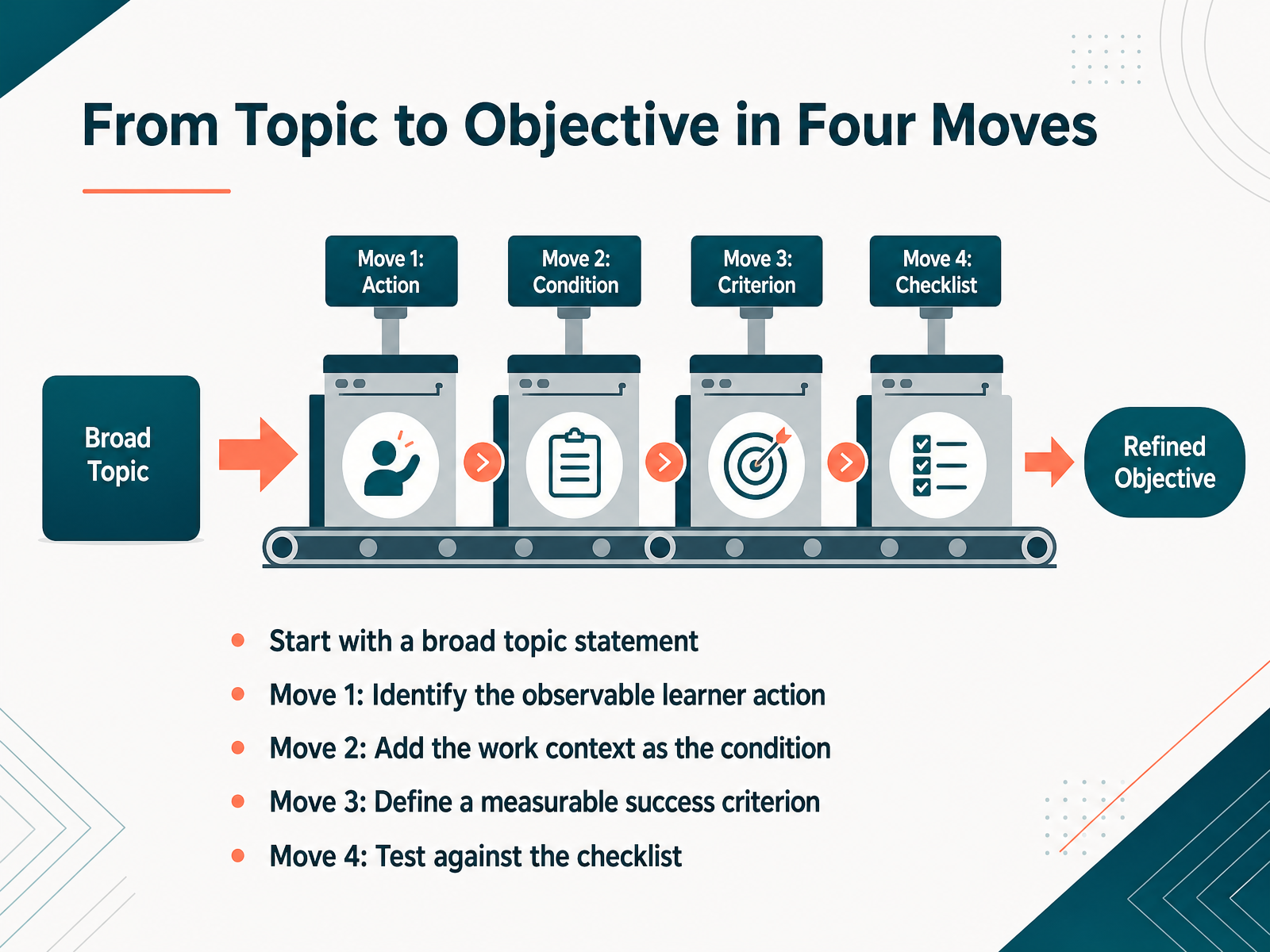
 - 07From Topic to Objective in Four MovesLet’s turn that broad topic into a clear, measurable objective in four simple moves. Start with your broad topic statement. For example, “customer service.” Move one: identify the observable action the learner will take. Not “understand,” but something you can see or hear, like “demonstrate” or “resolve.” Move two: add the work context as the condition. Under what circumstances will they do this? For instance, “during a simulated support call.” Move three: define a measurable success criterion. How well, how fast, or how accurately? Maybe “with at least ninety percent accuracy on the scoring rubric.” Move four: test it against the checklist we covered earlier. Does it name the action? Is there a condition? Is the standard measurable? If you answered yes, you are ready to write. Now, let’s look at how to align those objectives with your assessments.
 cdc.govteaching.uic.eduisu.pressbooks.pub+21 min
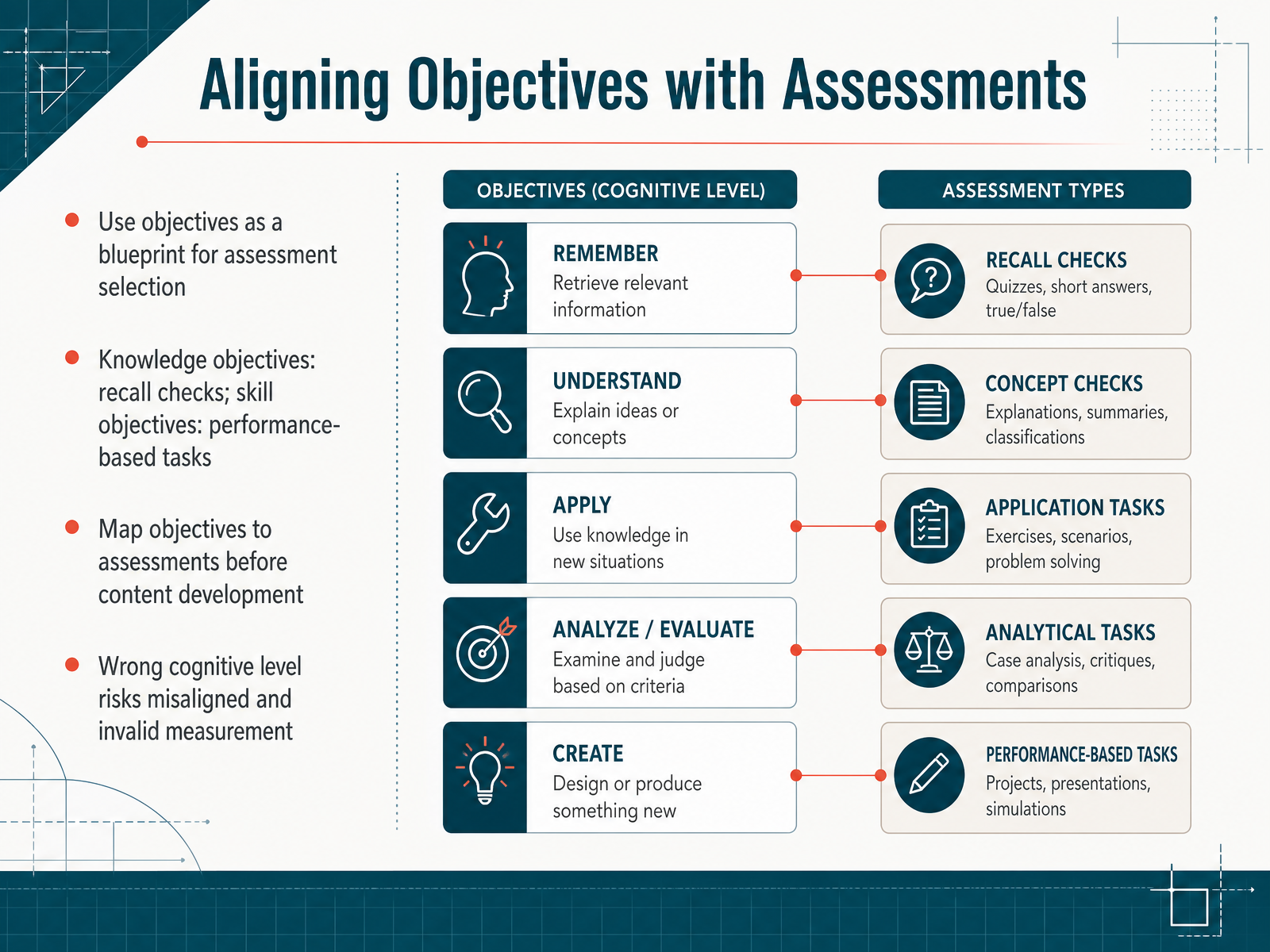
 - 08Aligning Objectives with AssessmentsNow let's talk about aligning your objectives with assessments. Think of your objective as the blueprint, and your assessment as the quality check. If the objective says students will recall key terms, a simple quiz works. But if the objective says students will apply a procedure, your assessment needs to be a performance-based task, like a simulation or a problem set. Here is the crucial part: map your objectives to your assessments before you build the content. This prevents a painful redesign later. When there is a mismatch, like teaching analytical skills but testing only with multiple-choice recall questions, your measurement is invalid. It doesn't truly tell you if learning happened. So, a quick takeaway: check every assessment. Does it demand the same cognitive level as its objective? If not, it's time to revise either one. Coming up next, we'll look at how constructive alignment works in practice.
 1 min
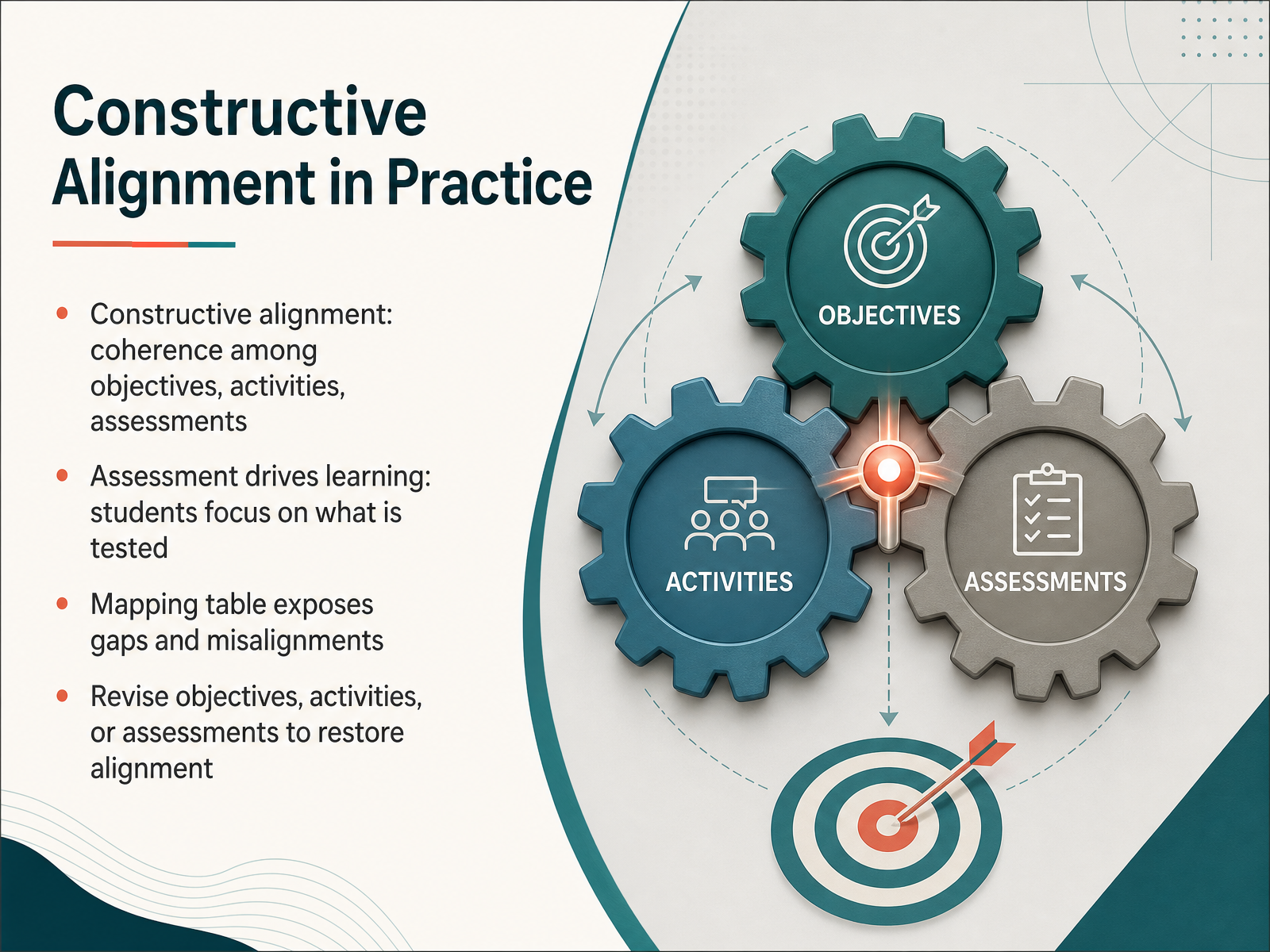
1 min - 09Constructive Alignment in PracticeLet's see constructive alignment in practice. At its core, this is about coherence. Your objectives, your teaching activities, and your assessments must support each other. Remember, assessment drives learning. Students will focus their energy on what is tested, not on what is simply covered in class. So, your assessment needs to be an authentic reflection of your intended outcomes. A mapping table is your best tool here. List your objectives, then map each activity and each assessment to them. This often exposes gaps. You might find an objective that has no assessment attached to it, or an activity that does not prepare students for what the test demands. When you spot that misalignment, you have two choices. You can revise the objectives, the activities, or the assessments to bring them back into harmony. If your objective asks students to analyze, but your exam only checks recall, then your students will practice recall and be frustrated. The fix is to align the exam with the objective. This is the practical work of alignment, and it is what makes your design solid.
 1 min
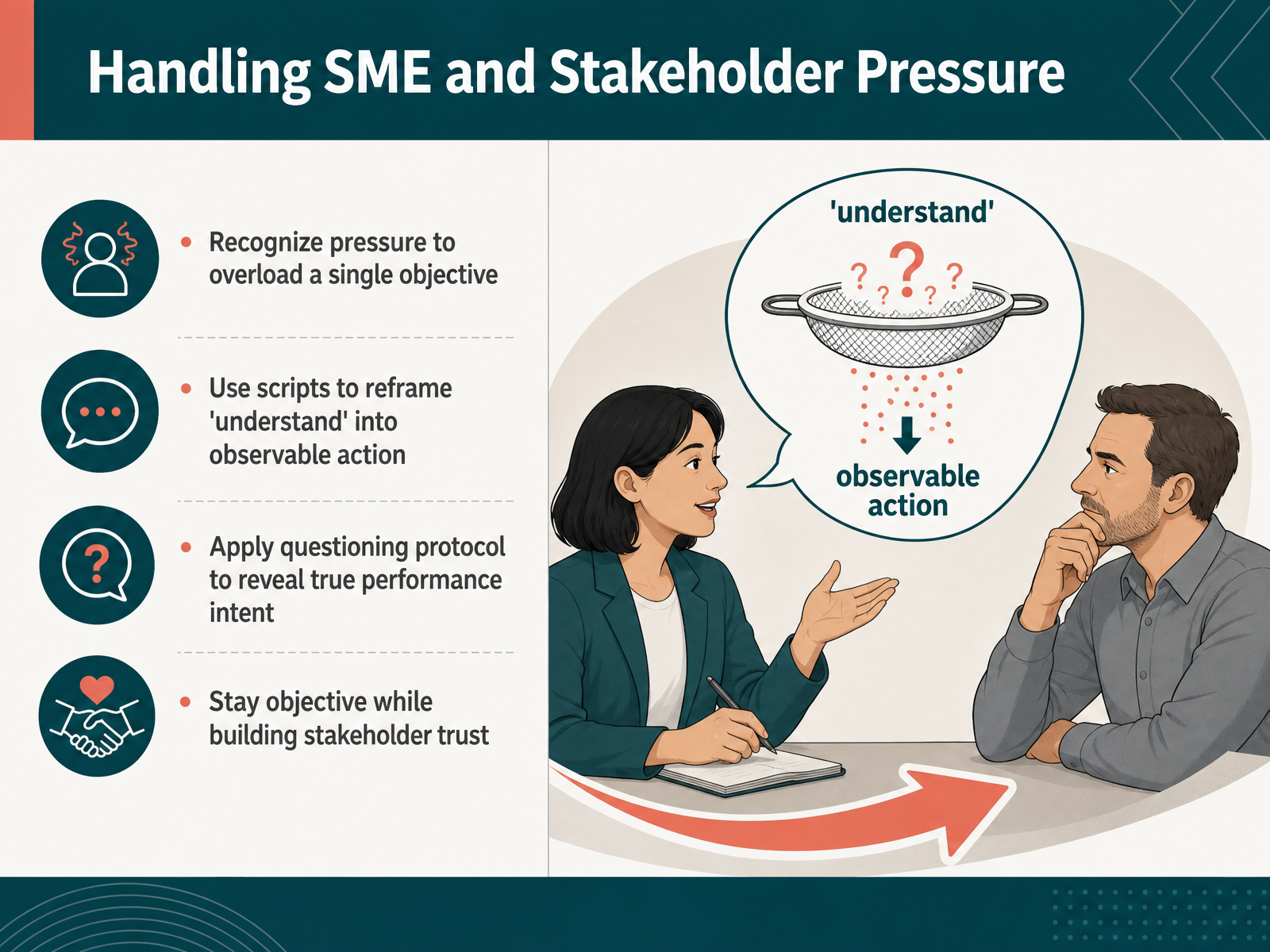
1 min - 10Handling SME and Stakeholder PressureNow let's talk about handling pressure from subject matter experts and stakeholders. You know the scenario: they want everything packed into one objective. Your job is to recognize when that overload happens and pull it back. Use a simple script when someone says learners should understand the system. Ask them, what will learners actually do with that understanding? Will they explain it to a client, or troubleshoot an error? That reframes understanding into something observable. Then apply your questioning protocol: ask what success looks like in the real workflow, what actions prove competence, and what mistakes you are trying to prevent. This reveals the true performance intent while keeping you objective. You are not rejecting their input. You are clarifying it. Stay calm, stay curious, and make the stakeholder part of the solution. When they see their goal turned into a clear, measurable outcome, trust grows. Remember, your role is to protect the learner from vague expectations. Keep the objective focused, observable, and tied to actual performance. Next, we will look at moving from those objectives into building content and activities that support them.
 1 min
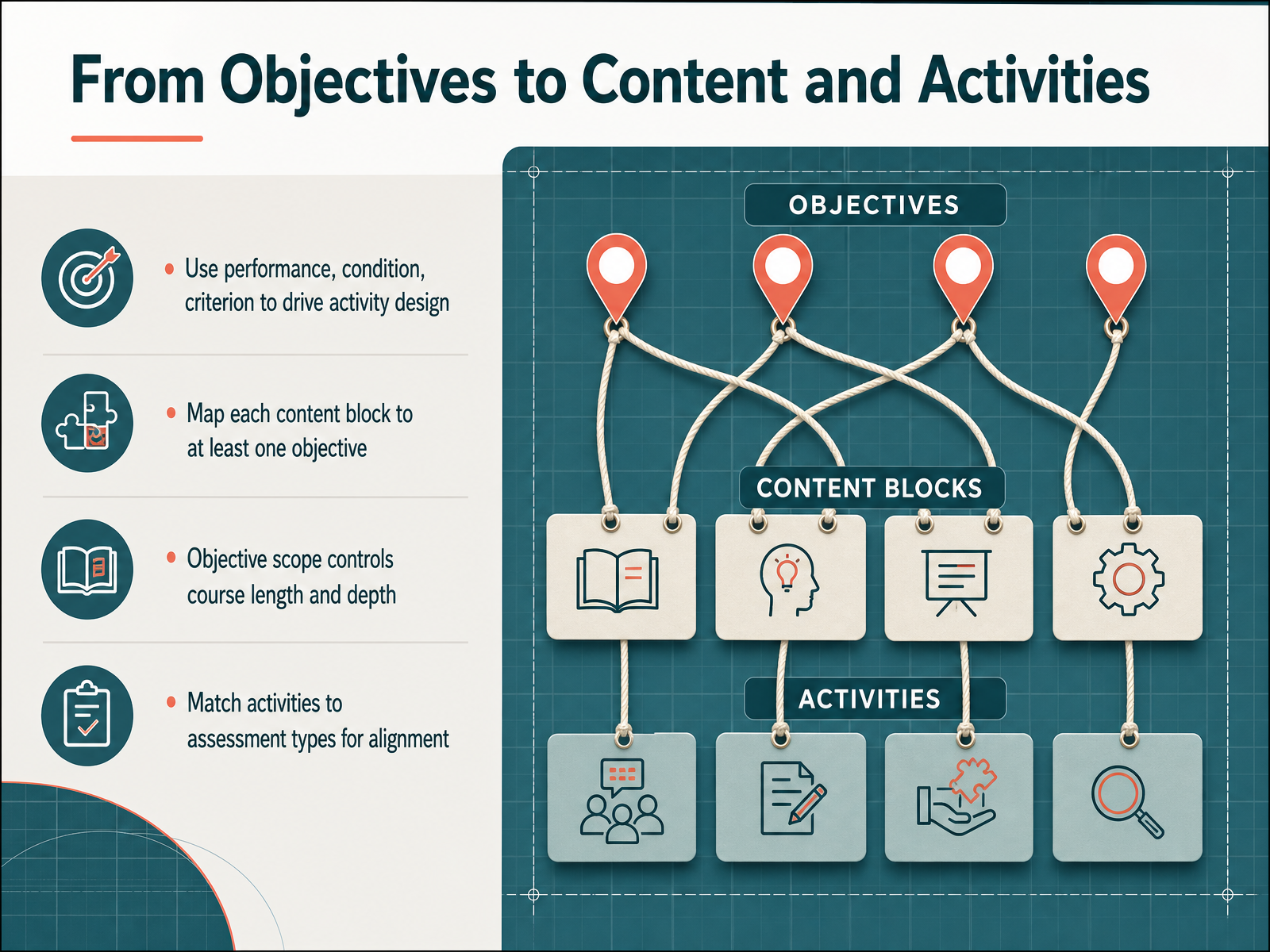
1 min - 11From Objectives to Content and ActivitiesNow let's see how your objectives become the backbone of everything else. Think of them as your design blueprint. Once you have a clear performance, condition, and criterion, you can build activities that let learners actually practice that performance. For example, if the objective is to analyze case studies, then your activity should involve reading and breaking apart cases—not just listening to a lecture. Next, map every content block back to at least one objective. If a block doesn't serve an objective, it might be extra—consider cutting it or rethinking it. Also, let the scope of your objectives guide the length and depth of the course. A narrow objective like "list the steps" needs less time than a broad one like "design a marketing plan." Finally, make sure your activities match how you'll assess. If you want learners to apply skills, assess them with a simulation or project, not just a multiple-choice quiz. This alignment keeps everything coherent, so learners know exactly what to focus on. Next, we'll walk through a review and refine checklist to catch any gaps.
 1 min
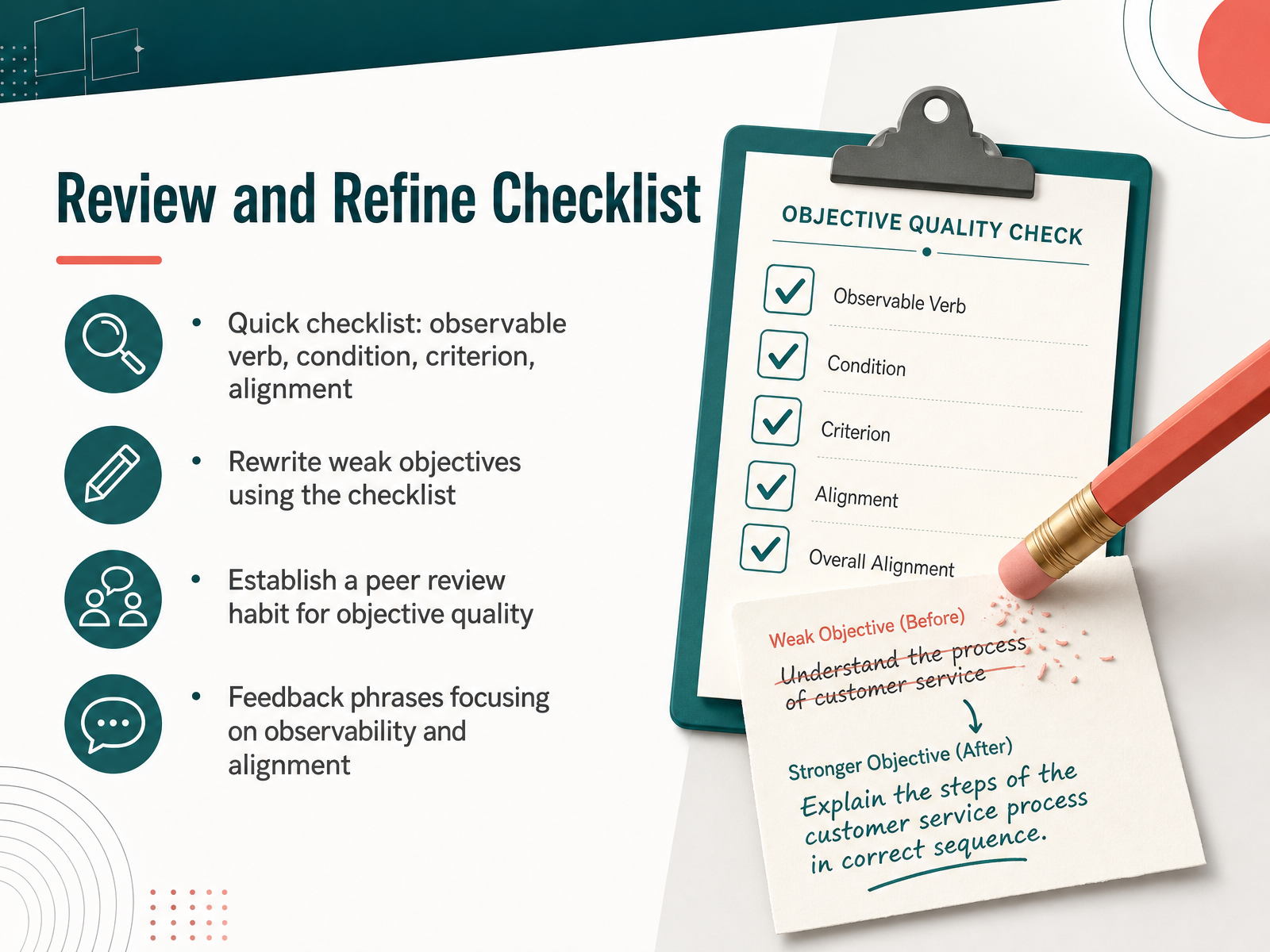
1 min - 12Review and Refine ChecklistLet's walk through a quick review checklist before you finalize your objectives. First, check for an observable verb. A word like "identify" or "construct" tells you exactly what the learner will do, while "understand" leaves too much open. Second, confirm the condition. What context or tools will the learner have? For instance, "Given a customer scenario, the learner will identify three potential risks." Third, make sure there is a criterion. How well or how accurately? You might say, "within five minutes," or "with at least ninety percent accuracy." Finally, double-check alignment. Does the objective match what you will teach and how you will assess it? If your assessment is a performance task, your objective should not be a recall-only statement. If you find a weak objective, rewrite it using this checklist right away. And build a habit of peer review. Swap objectives with a colleague and give feedback that focuses on what is observable and how the objective aligns with the assessment. Ask questions like, "What would successful demonstration look like?" That simple exchange strengthens your work and your team's. Once your objectives pass this checklist, they become a solid foundation for your next project.
 teaching.washington.eduitali.uq.edu.autlc.uva.nl+22 min
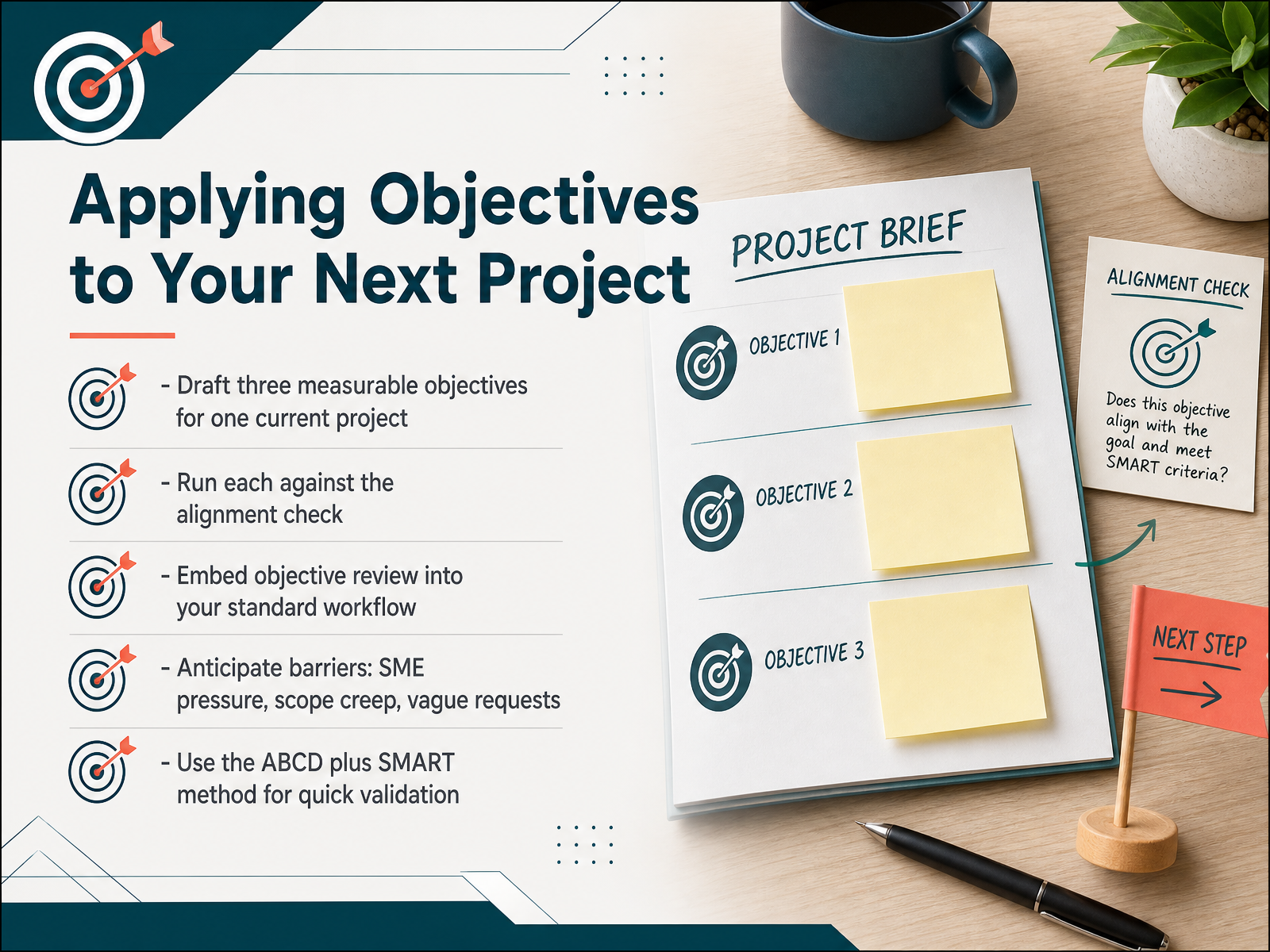
 - 13Applying Objectives to Your Next ProjectSo let’s make this practical. Take one current project, and draft three measurable objectives for it. Run each one against the alignment check. Does the assessment match the objective? Does the content support it? Then, make objective review a regular step in your workflow, not an afterthought. I know it’s tempting to skip this when deadlines hit, but it saves rework later. And anticipate the barriers before they slow you down. Subject matter experts may push for more content. Scope can creep. Requests can be vague. That’s where the ABCD plus SMART method gives you a quick validation. Write the objective, then check it. Audience, behavior, condition, degree. Specific, measurable, achievable, relevant, time-bound. One pass takes about two minutes, and it catches most issues early. As you do this, you’ll notice the quality of your training improves, because every activity and assessment is tied to a clear outcome. Next, let’s wrap up with key takeaways and the steps you can apply right away in your next project.
 cdc.govteaching.uic.eduisu.pressbooks.pub+21 min
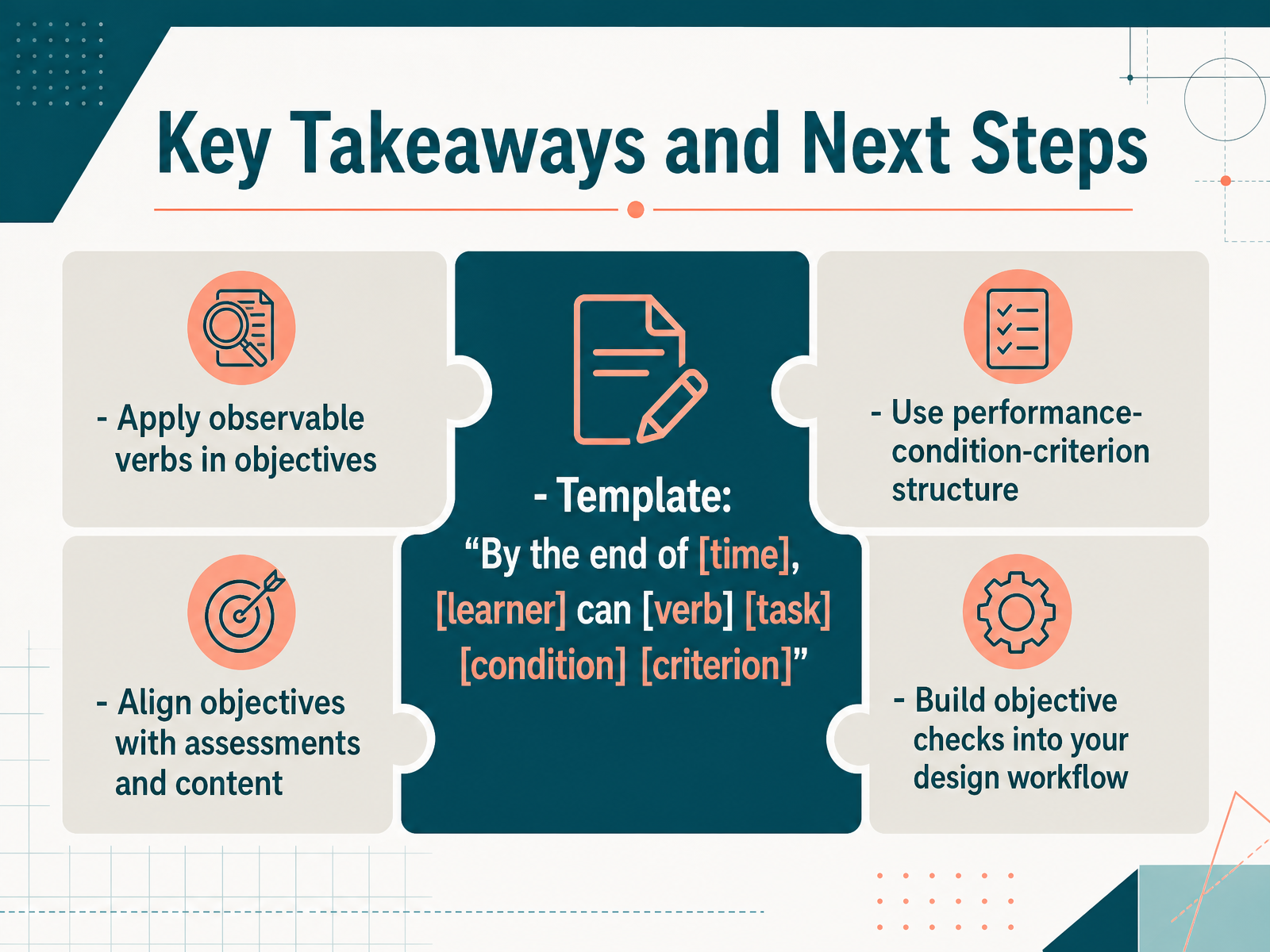
 - 14Key Takeaways and Next StepsHere’s where we land the plane. Throughout this course, we’ve built a clear path from broad topics to measurable outcomes. Start by choosing one observable verb. Something you can watch someone do, like draft, calculate, or troubleshoot. Then, frame it with performance, condition, and criterion. That structure turns a vague idea into a precise target. Next, make sure your assessments and your content point straight back at those objectives. If the test doesn’t match the verb, neither does the practice. Keep this template close: by the end of the session, the learner can perform the task, given specific tools, to a described standard. And finally, add an objective check into your own workflow. Review your drafts like you would a peer’s. Look for vague language, and replace it with action. You now have a repeatable system that saves you time and gives your learners clarity. Thank you for your focus and your craft. Now go write objectives that truly measure learning.
 cdc.govteaching.uic.eduisu.pressbooks.pub+21 min
Take the deck with you
Download this course as a file — free, no sign-up needed.
- PDF handoutEvery slide page, ready to print or share.15 pages · 3.7 MBDownload
- Narrated PowerPointThe deck that presents itself — every slide carries the digital human's narration video.15 pages · 13.7 MBDownload
- PowerPoint slidesThe full deck as a .pptx — open it in PowerPoint, Keynote, or Google Slides.15 pages · 3.6 MBDownload
Free to use in your own training — please keep the PersonWise credit page at the end.
Have your own deck? Turn it into a course
Sources consulted
Web sources consulted while building this course.
- Design Training: Learning Objectives | Training Development | CDC — cdc.gov
- Learning Objectives | Center for the Advancement of Teaching Excellence | University of Illinois Chicago — teaching.uic.edu
- Measurable Objectives and Instructional Alignment – Design in Progress: A Collaborative Text on Learning Theories — isu.pressbooks.pub
- Developing Course Objectives — uis.edu
- Write Learning Goals – L&S Instructional Design Collaborative – UW–Madison — idc.ls.wisc.edu
- Learning outcomes - Teaching@UW — teaching.washington.edu
- Alignment between Learning Outcomes and — itali.uq.edu.au
- Writing good learning objectives - UvA Teaching and Learning Centres (TLC) — tlc.uva.nl
- How to Write Well-Defined Learning Objectives - PMC - NIH — pmc.ncbi.nlm.nih.gov
- It is important that learning objectives be specific, measurable, and observable behaviors. Learning outcomes should describe what students should be able to know or do as a result of a learning experience. Words to be avoided include: appreciate, believe, know, learn, understand – these are open to — ctlo.caltech.edu
- Writing Performance Objectives — acces.nysed.gov
- Writing Learning Objectives: Beginning With The End In Mind — med.fsu.edu
- Robert Mager's Performance-Based Learning Objectives — vectorsolutions.com
- Robert Mager's Performance-Based Learning Objectives — learningeverest.com
- THREE-PART OBJECTIVE — ntc.blm.gov
- Bloom’s Taxonomy for Corporate Trainers - Corporate Training Companion — corporatetrainingcompanion.com
- Bloom’s Taxonomy of Educational Objectives (Revised) — cdc.gov
- Bloom’s Taxonomy of Verbs: 200+ Action Words for Learning Goals | Teachfloor — teachfloor.com
- Blooms Taxonomy in Corporate Learning - Jonathan Halls — jonathanhalls.com
- Developing Learning Objectives | Instructional Design | Eastern Illinois University — eiu.edu