Evidence of Past Life
Begin
16 pages · ~32 min
Evidence of Past Life
This training introduces learners to fossils, their formation, and how they provide evidence of past life on Earth.
What you’ll learn
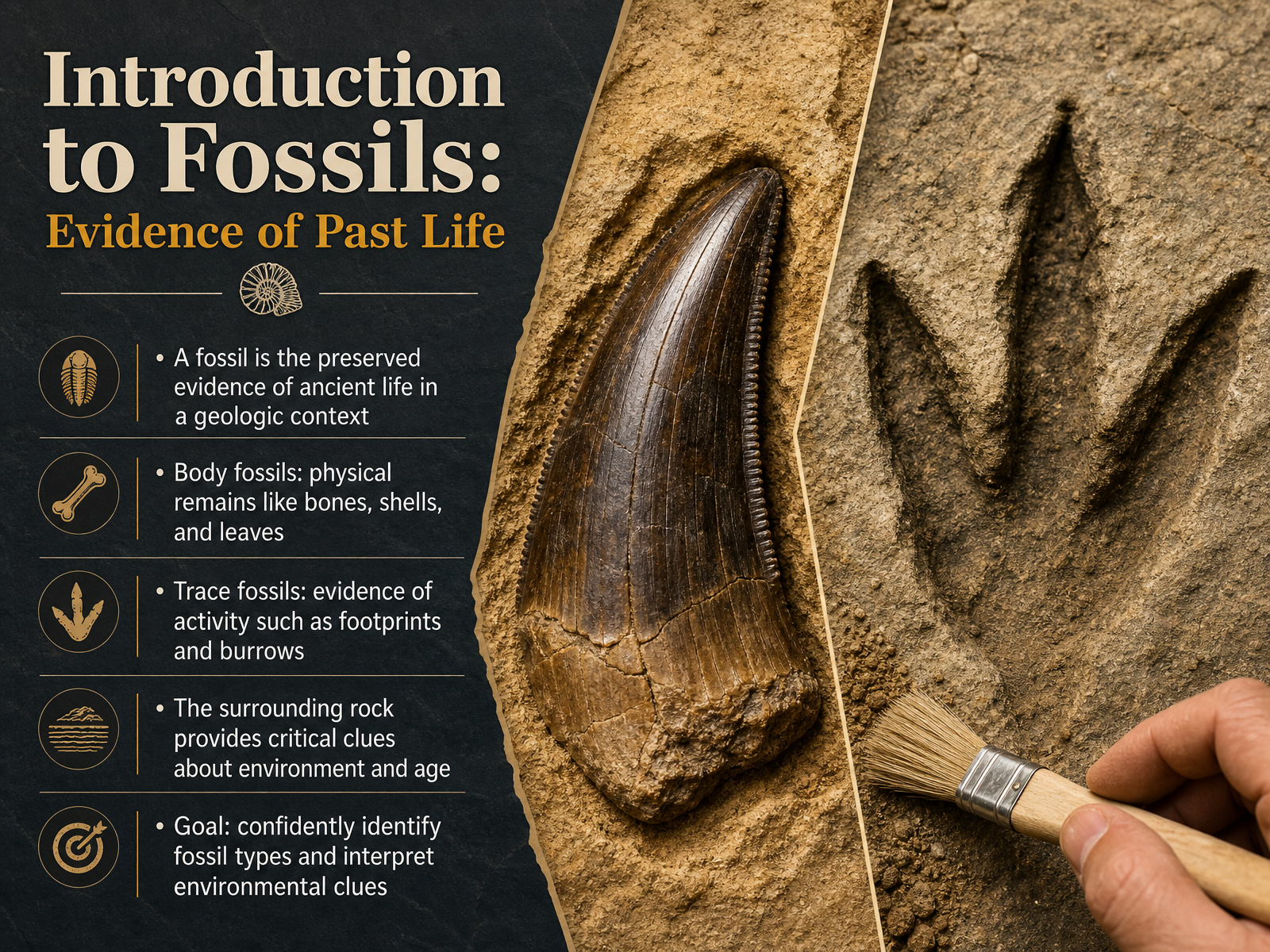
- 01Introduction to Fossils: Evidence of Past LifeWelcome to our course on fossils. Have you ever picked up a rock that seemed to hold a story inside? That's exactly what we're exploring here. This course is about fossils, the preserved evidence of ancient life. Our main goal today is simple but powerful: by the end, you'll be able to confidently look at a fossil and identify it as either a body fossil or a trace fossil, and start interpreting the environmental clues locked in the rock around it. So, what are these two types? Think of a body fossil as the physical remains of an ancient organism, like a dinosaur bone, a petrified piece of wood, or a delicate leaf impression. A trace fossil, on the other hand, isn't the organism itself, but evidence of its activity while it was alive, things like a footprint, a burrow, or even fossilized droppings. The rock surrounding a fossil isn't just a container; it's a vital part of the evidence. The type of rock tells us about the ancient environment where that organism once lived. With these tools, you'll soon be reading stories from stone. Now, let's build our understanding from the ground up, starting with the precise scientific definition of what a fossil really is.nps.govgeo.libretexts.orggeol.umd.edu+22 min
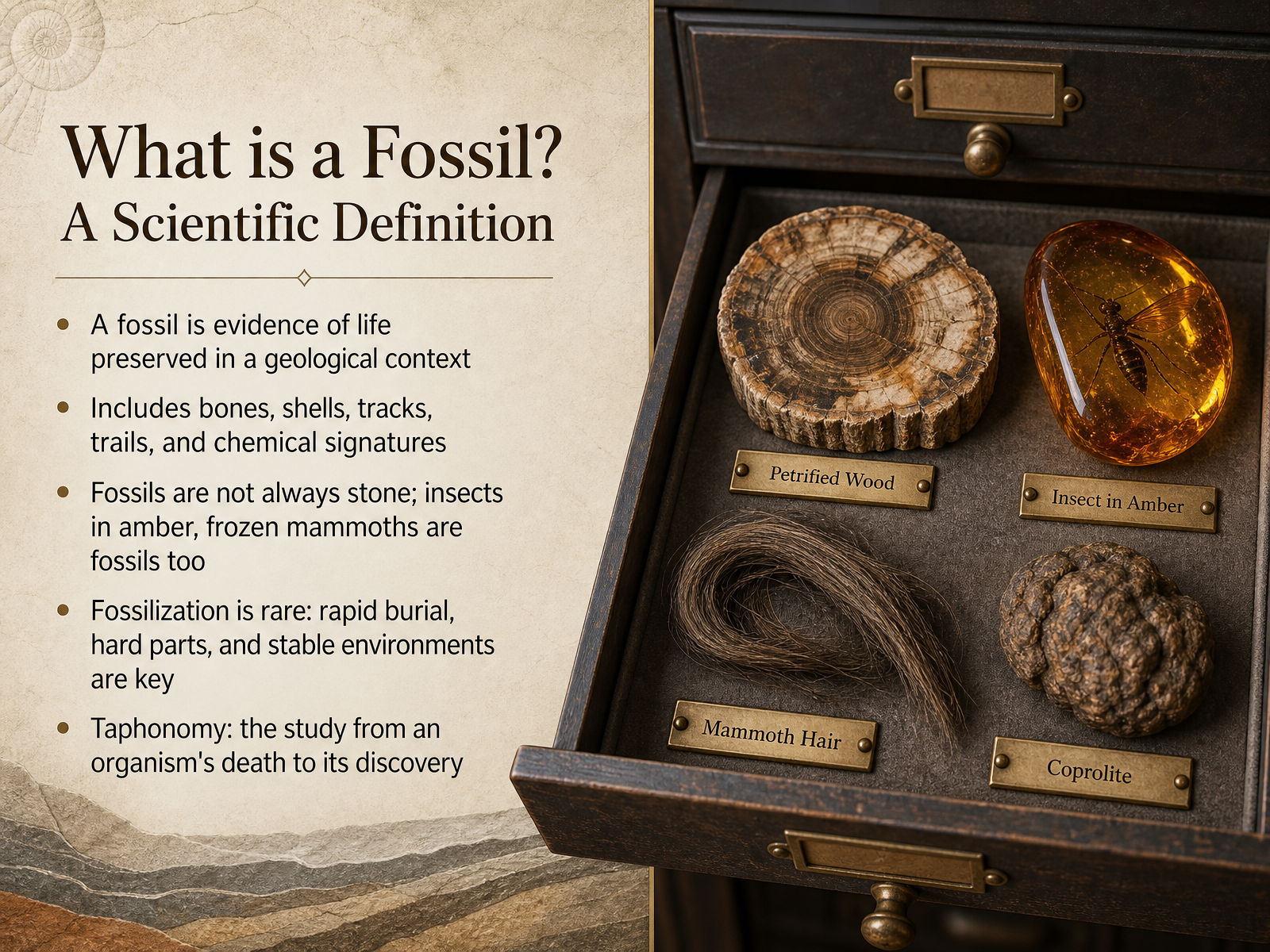
- 02What is a Fossil? A Scientific DefinitionNow let's build a clear scientific definition of what a fossil actually is. In paleontology, a fossil is simply evidence of life preserved in a geologic context. That definition has two important parts. First, evidence of life means it must be either the remains of a living thing, like bones or shells, or a trace of its activity, like footprints or burrows. Second, that evidence must be preserved in a geological setting, like sedimentary rock, volcanic ash, or even ancient amber. This means fossils are not always stone. A frozen mammoth in ice, an insect trapped in amber, and a dinosaur trackway in sandstone are all true fossils. Fossilization itself is quite rare. It typically requires rapid burial, the presence of durable hard parts, and a stable environment that limits decay. Scientists call the study of this entire journey from an organism's death to its discovery taphonomy. In the next slide, we'll explore the two major categories these fossils fall into: body and trace.
 nps.govgeo.libretexts.orggeol.umd.edu+22 min
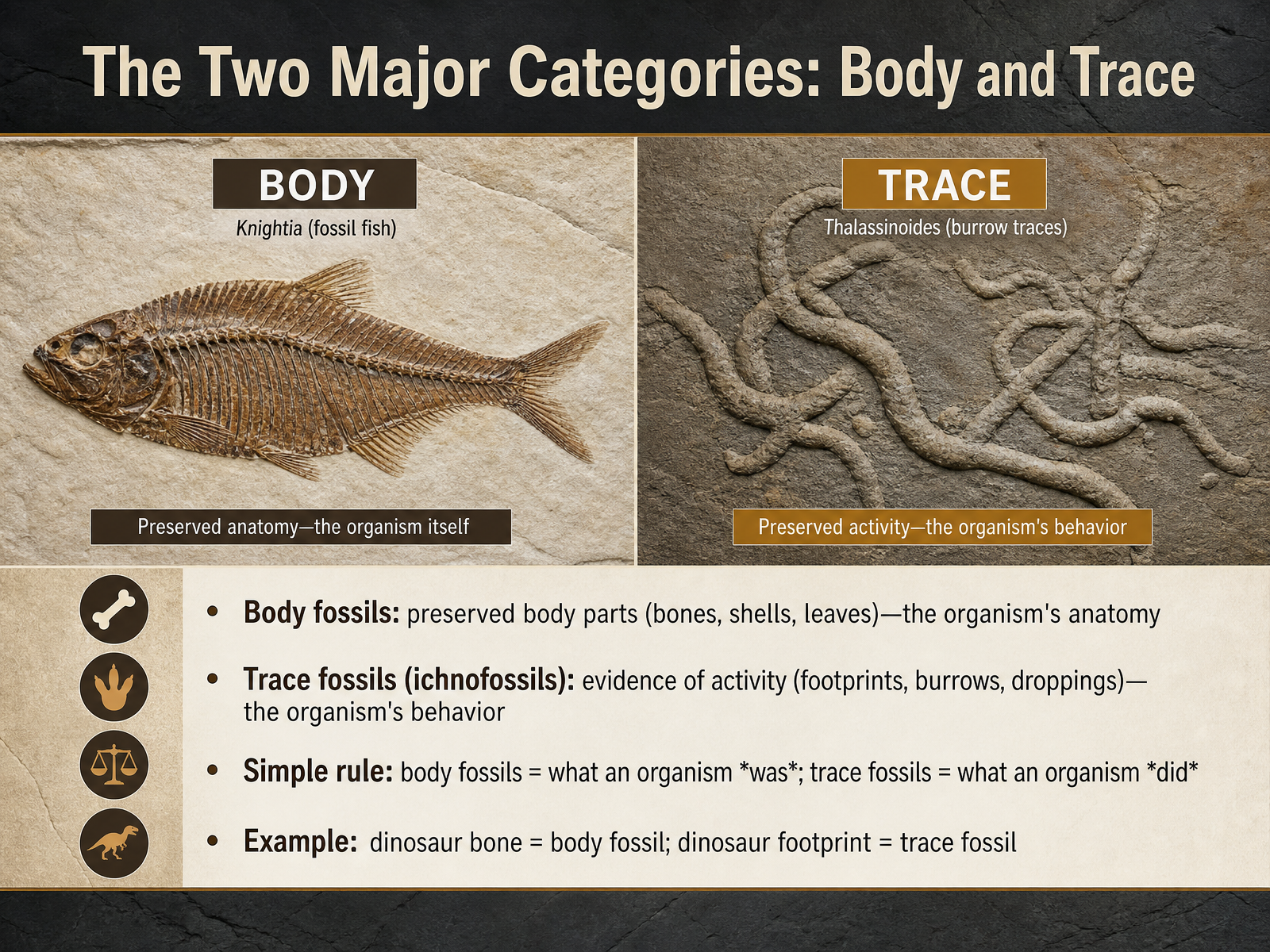
 - 03The Two Major Categories: Body and TraceNow that we have a sense of what a fossil is, let's look at the two major categories: body fossils and trace fossils. Think of it this way—body fossils are the preserved parts of an organism's actual body. We're talking about bones, shells, teeth, or even a delicate leaf impression. These fossils show us what an organism was—its physical anatomy. Trace fossils, on the other hand, are a record of activity. Scientists also call them ichnofossils. They capture behavior—footprints, burrows, or even fossilized droppings. A simple way to keep them straight is to remember: body fossils equal what an organism was, and trace fossils equal what an organism did. For a classic example, picture a dinosaur. A fossilized femur or rib is a body fossil. But a three-toed footprint pressed into ancient mud is a trace fossil—it's evidence of the dinosaur walking, living, and moving through its environment. This distinction matters because one shows us the creature, and the other shows us how it lived. Next, we'll dive deeper into body fossils—the direct remains of organisms.
 nps.govgeo.libretexts.orggeol.umd.edu+21 min
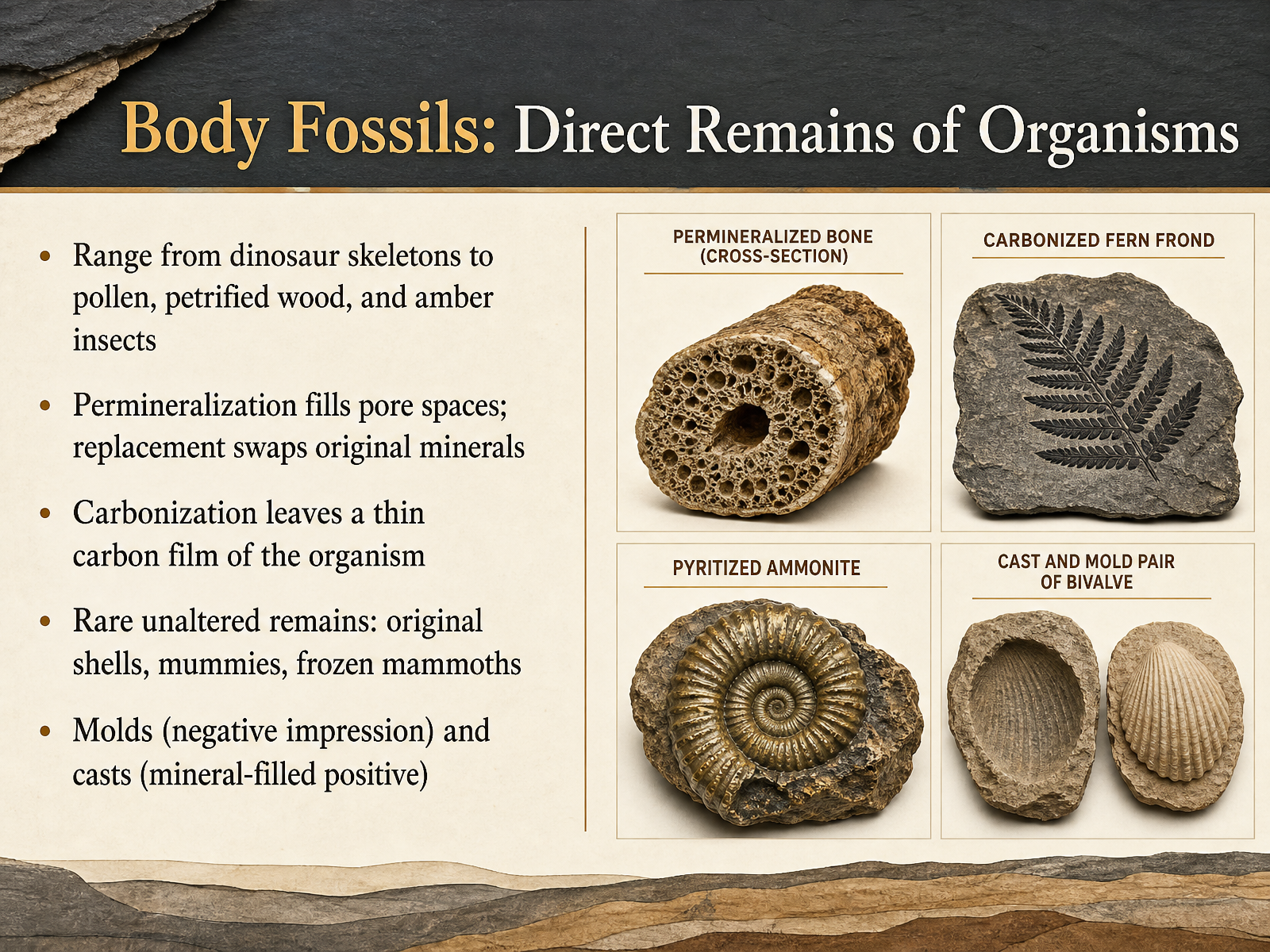
 - 04Body Fossils: Direct Remains of OrganismsNow let's look at body fossils, the direct remains of ancient organisms. These are the fossils most people picture, but they come in many forms. Think of dinosaur skeletons in museums, preserved insects in amber, petrified wood, or even fossilized pollen grains. How do these remains survive? A common process is permineralization. Mineral-rich water seeps into pores and tiny spaces, like inside bone or wood, and hardens. Over time, this turns the remains to stone. Another process is replacement, where the original minerals are swapped out molecule by molecule with new ones. Carbonization works differently. The organism gets compressed, and a thin film of carbon is left behind, like a delicate silhouette. This often preserves leaves and soft-bodied creatures. Rarely, we find unaltered remains, like original shells, dried-out mummies, or frozen mammoths. These give us an incredible glimpse into the past with almost no change. Body fossils also include molds and casts. Imagine a shell buried in mud. If the shell dissolves away, it leaves a hollow mold, a negative impression. If minerals fill that mold later, they form a cast, a solid, positive replica. Each type of preservation captures a different piece of life's history. Next, we'll explore trace fossils, the evidence of ancient activity.
 nps.govdigitalatlasofancientlife.orgaustralian.museum+22 min
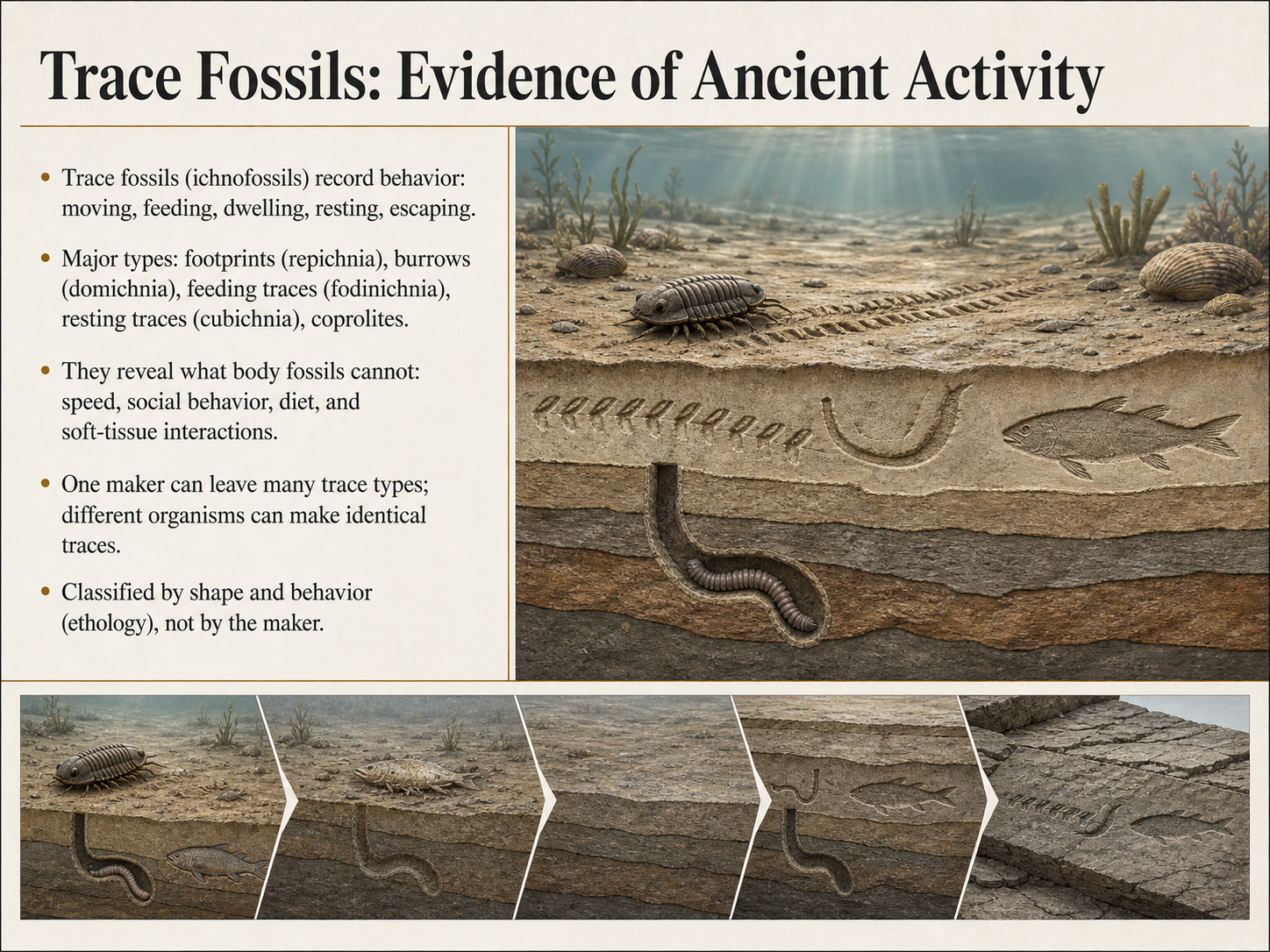
 - 05Trace Fossils: Evidence of Ancient ActivityNow let's turn our attention to trace fossils—or ichnofossils, if you want to use the scientific term. Unlike the body fossils we just explored, trace fossils don't preserve the organism's physical remains. Instead, they capture a moment of ancient activity. Think of them as fossilized behavior. A trace fossil can be a footprint, a burrow, a feeding mark, or even fossilized droppings we call coprolites. Scientists group these traces by the type of behavior they represent. For instance, repichnia are movement traces, like dinosaur trackways. Domichnia are dwelling structures, such as burrows. And cubichnia show where an animal once rested. Here's a fascinating detail: one animal can create many different trace types throughout its life. At the same time, completely unrelated organisms can leave behind traces that look almost identical. Because of this, ichnologists don't classify trace fossils by the maker. Instead, they build a separate classification system around the shape of the trace and the behavior it captures. This behavioral evidence reveals things body fossils often cannot—like the speed of a dinosaur, its social interactions, or what it ate. Up next, we’ll build on these concepts to create a practical guide for distinguishing body fossils from trace fossils in the field.
 en.wikipedia.orgpalaeos.comgeo.libretexts.org+22 min
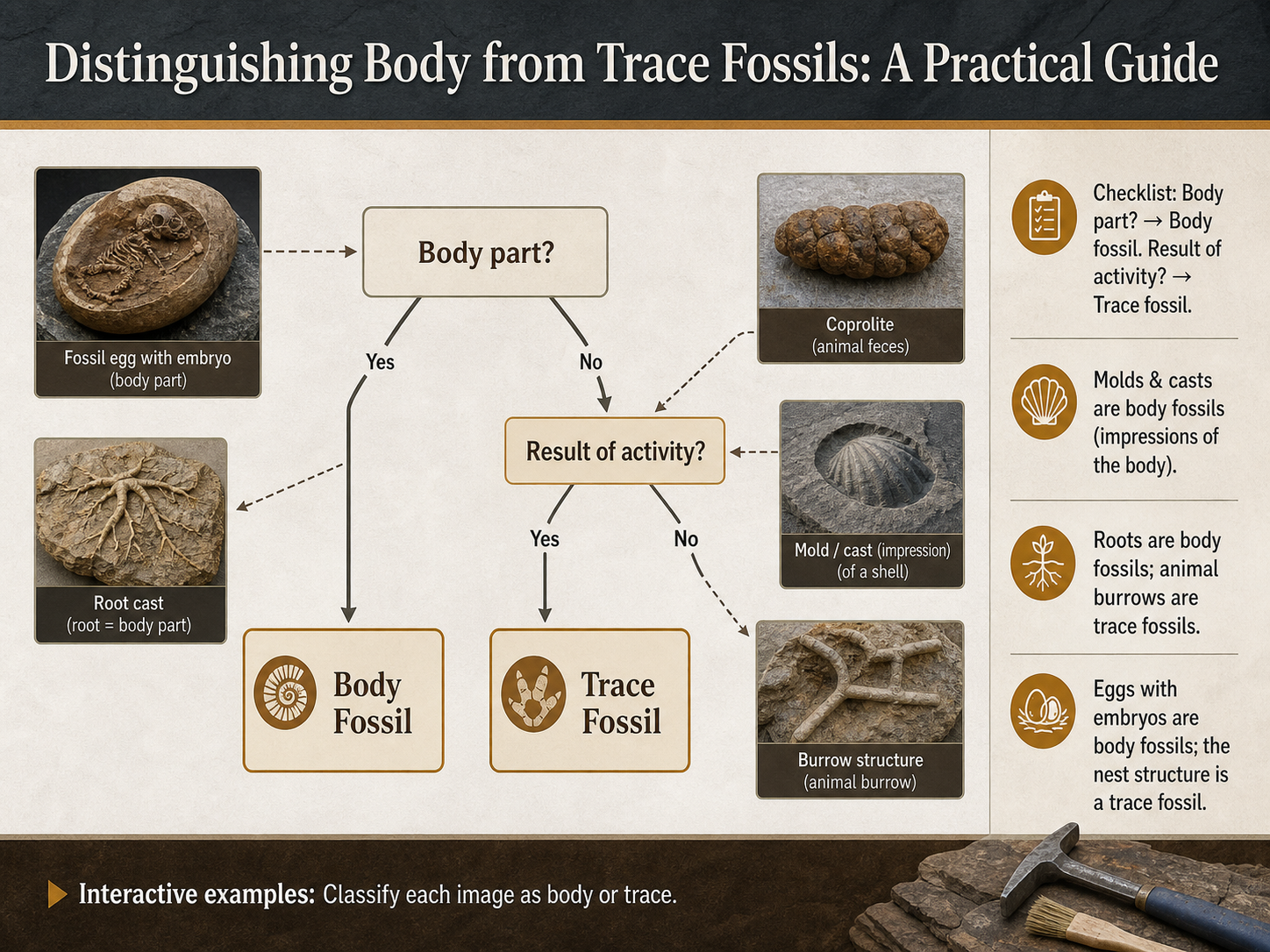
 - 06Distinguishing Body from Trace Fossils: A Practical GuideNow that we’ve seen the basic definitions, let’s build a practical toolkit for telling body and trace fossils apart. Think of it as a simple checklist. Ask yourself: is this a preserved part of an organism’s body—like a bone, a shell, or a leaf? Then it’s a body fossil. Does it instead record an activity the organism did while alive—like a footprint, a burrow, or even fossilized droppings? That’s a trace fossil. This line gets especially interesting with some specific cases. Molds and casts, for instance, are body fossils because they are impressions of the body itself, preserving its shape. A preserved root is a body fossil, since it’s part of the plant, while an animal burrow is a trace fossil, because it records the behavior of digging. And when you find fossil eggs, look closely: an egg with an embryo inside is a body fossil, but the nest structure around it is a trace fossil. Now, it’s your turn to practice. We’ll show you a series of images. For each one, decide: is it a body fossil, or a trace fossil? This exercise will sharpen your eye for the evidence of past life. Next, we’ll add another crucial layer to this skill: understanding why the geological context, the rock itself, matters as evidence.
 en.wikipedia.orgpalaeos.comgeo.libretexts.org+22 min
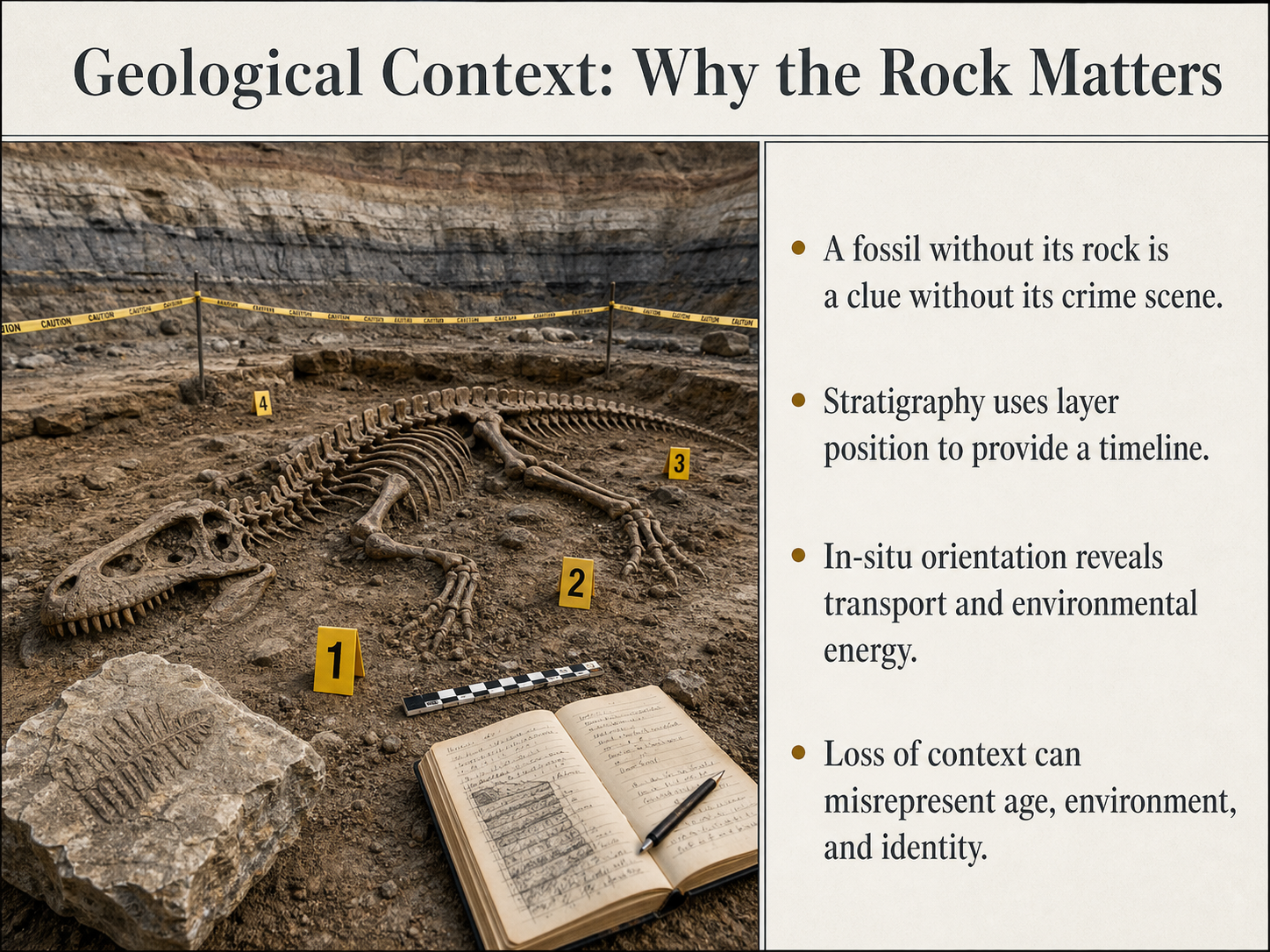
 - 07Geological Context: Why the Rock MattersNow let's talk about the rock that surrounds a fossil. Think of it this way: a fossil without its rock is like a clue without its crime scene. The geological context is the evidence that tells the full story. One of the main ways we unlock that context is through stratigraphy. By studying the position of a fossil within its rock layers, we can establish a timeline. Lower layers are generally older, and higher layers are younger. This gives us the sequence of events. We also look at how the fossil is oriented in the rock, which is called its in-situ orientation. If a shell is resting flat, it suggests a quiet, low-energy environment. But if shells are jumbled and broken, that points to powerful currents or waves that transported them. If we lose this context by simply pulling a fossil from the ground, we risk misrepresenting its true age, its ancient environment, and sometimes even the identity of the organism itself. So the rock is not just a container; it's a critical part of the evidence. Next, we will explore the specific sedimentary environments that form these fossil-bearing rocks.
 cambridge.orgpaleoitalia.itroyalsocietypublishing.org+22 min
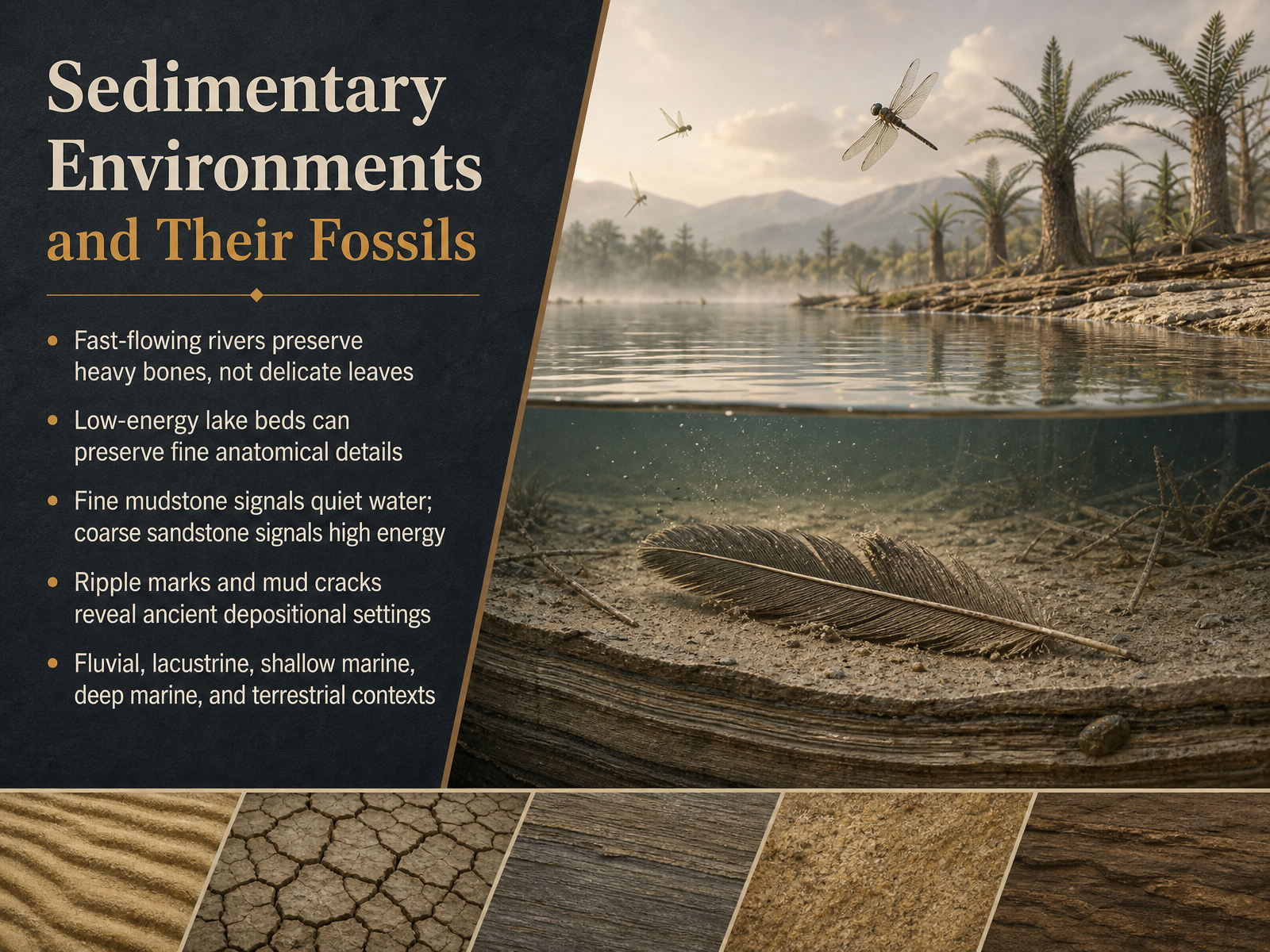
 - 08Sedimentary Environments and Their FossilsAlright, let's take what we've learned and apply it to real sedimentary environments, because where a fossil is found tells us a lot about how it lived and why it was preserved. Think of a fast-flowing river. In that high-energy setting, the water is powerful enough to carry heavy bones, but it would instantly destroy something delicate like a leaf. So, finding large, durable fossils in coarse sandstone points to a strong current. On the other hand, a low-energy lake bed is almost perfectly still. Here, fine particles gently settle out of the water, which can cover and preserve exquisite details like feathers or soft body outlines. The sediment itself is a clue. Fine mudstone signals quiet water, while coarse sandstone signals high energy. We can also look for physical features. Ripple marks and mud cracks are not fossils, but they are evidence of ancient settings, telling us about water movement and drying events long ago. These contexts range from rivers, or fluvial, to lakes, called lacustrine, and on to shallow marine, deep marine, and even terrestrial environments. Each one acts as a unique filter, preserving a biased but informative snapshot of past life. In the next section, we will see how those snapshots were actually made in the step-by-step process of fossilization.
 royalsocietypublishing.orgcambridge.orgpaleoitalia.it+22 min
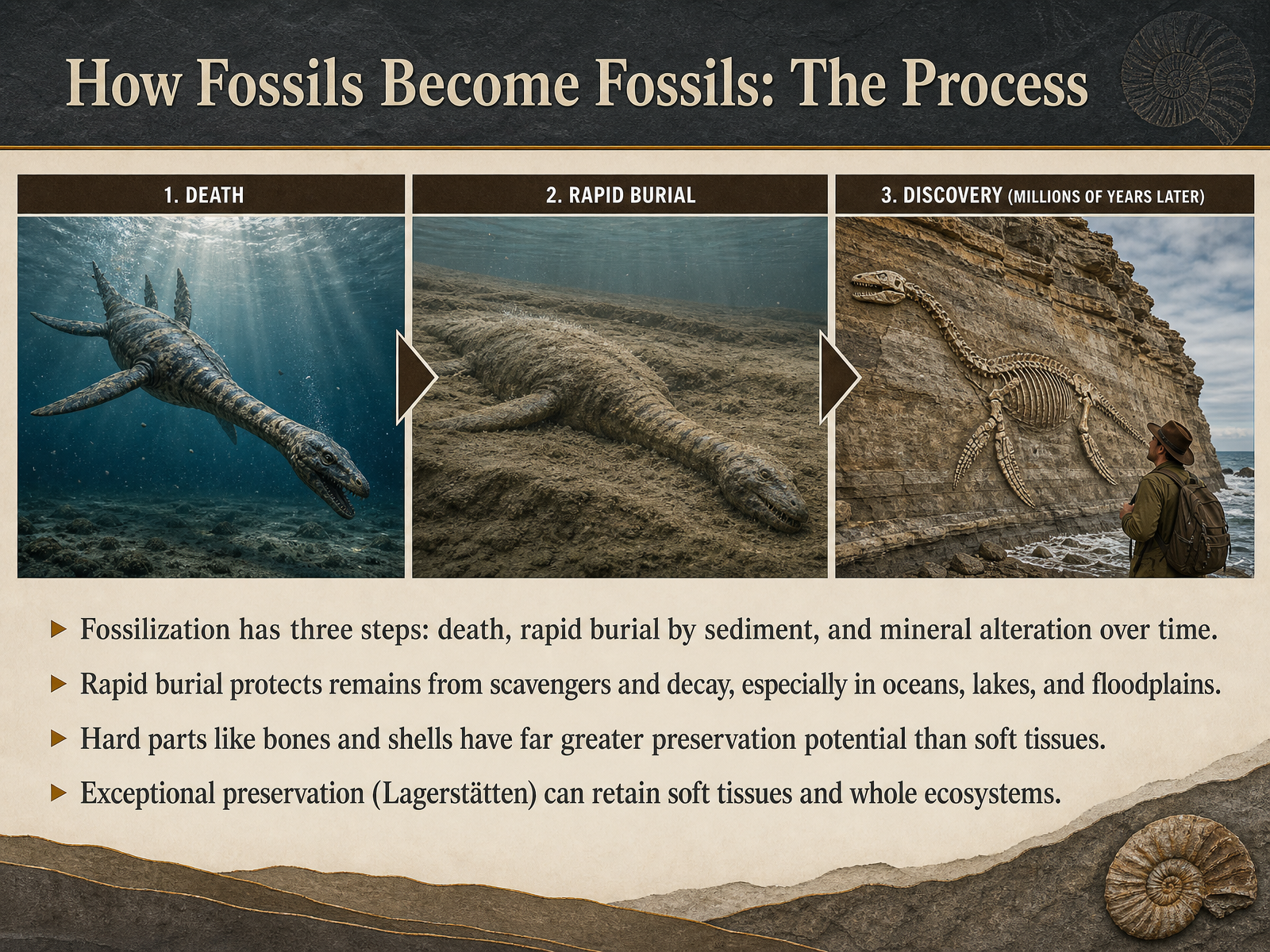
 - 09How Fossils Become Fossils: The ProcessNow let’s walk through how a fossil actually forms. The process has three essential steps: death, rapid burial by sediment, and mineral alteration over time. Think of rapid burial as nature’s preservation shield. When remains are quickly covered by mud, silt, or volcanic ash, they are protected from scavengers, bacteria, and weather. Oceans, lakes, and floodplains are especially good at this because sediment accumulates steadily. The next key filter is what the organism is made of. Hard parts like bones, shells, and teeth are far more durable than soft tissues, so they have a much better chance of surviving the long journey to fossilization. But sometimes conditions are so exceptional that even soft tissues, skin, or entire ecosystems are locked in place. These rare treasure troves are called Lagerstätten. They usually form in low-oxygen settings that slow decay almost to a halt. So whenever you see a beautifully preserved feather or a delicate leaf from millions of years ago, you are looking at a truly extraordinary burial story. Coming up next, we will put these ideas to work in our first integrated case study: a Jurassic tidal flat.
 nps.govdigitalatlasofancientlife.orgaustralian.museum+22 min
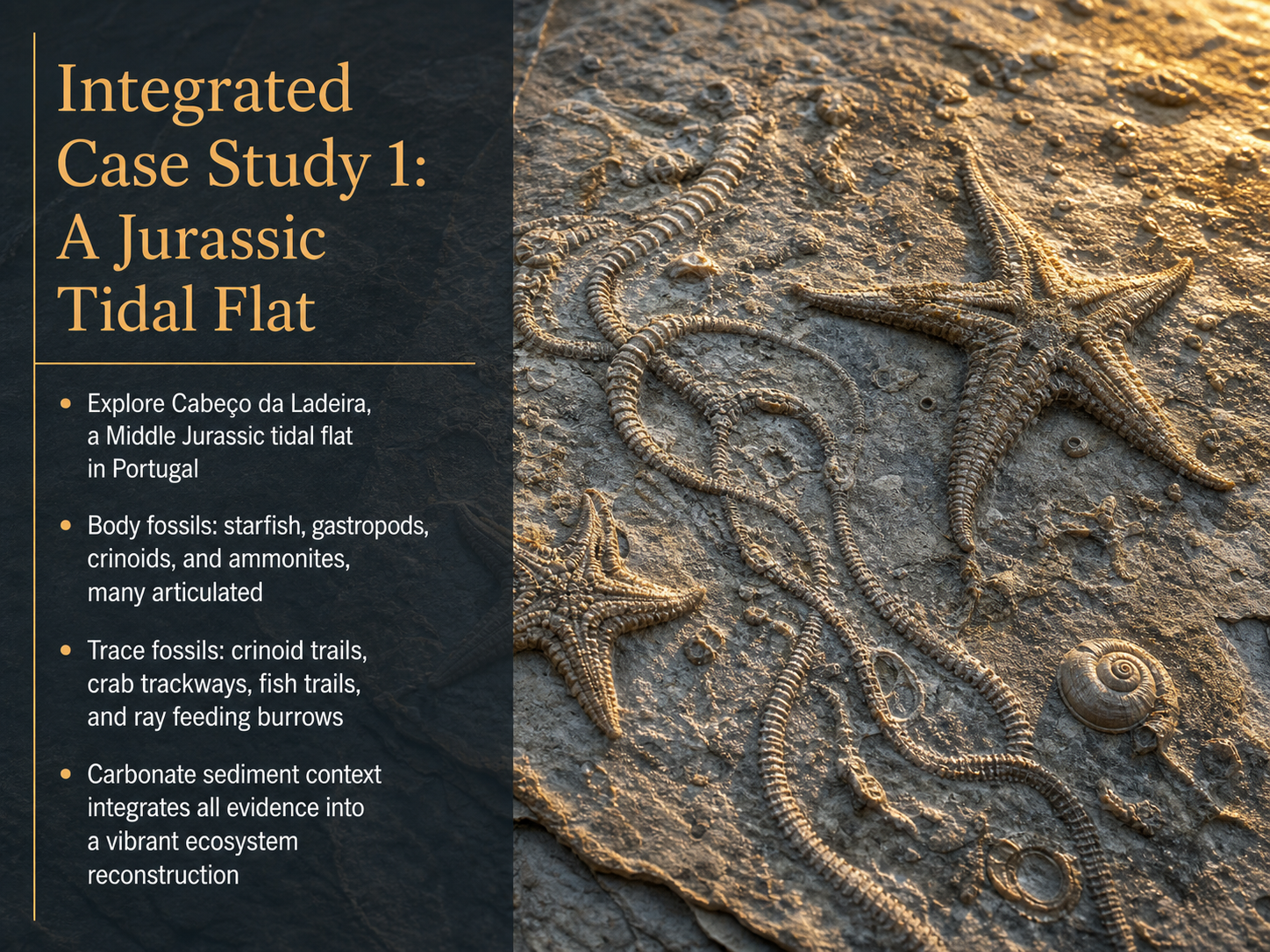
 - 10Integrated Case Study 1: A Jurassic Tidal FlatNow let's bring everything together with a visit to a remarkable fossil site. We are traveling to Cabeço da Ladeira in Portugal, a Middle Jurassic tidal flat that has been called the 'Jurassic Beach.' Here, the rock layers capture an entire coastal ecosystem in extraordinary detail. You can find beautifully preserved body fossils of starfish, gastropods, crinoids, and even ammonites, many of them still articulated and in near-life position. But that is only half the story. The same rock surfaces preserve trace fossils right alongside the bodies: we see the wavy trails left by crinoids as they dragged their stalks, the delicate trackways of crabs, the fin traces of swimming fish, and the distinctive circular feeding burrows made by rays stirring up the sediment. What makes this site truly powerful as evidence is the geological context. The surrounding rock is a carbonate tidal flat, a wide coastal environment moved by tides and regularly exposed to the air. When you study the body fossils, the trace fossils, and the mud‑cracked, ripple‑marked stone all together, you are not just looking at a list of dead organisms. You are reading a scene from a living ecosystem, one that tells you who lived here, how they moved, how they fed, and how the daily rhythm of the tides shaped their world. Let's carry that sense of an integrated living picture into our next case study, a Cretaceous river ecosystem.
 cambridge.orgpaleoitalia.itroyalsocietypublishing.org+22 min
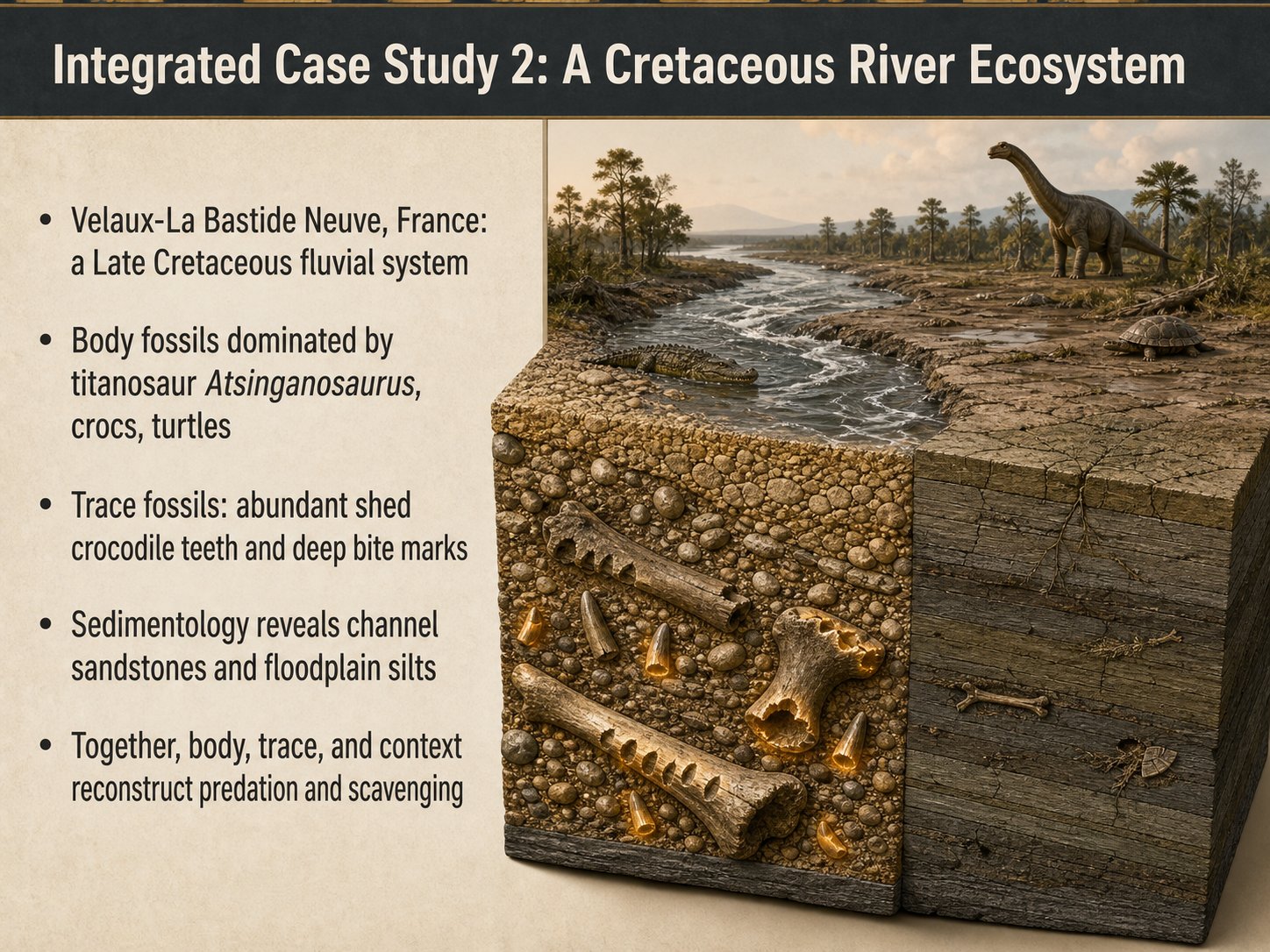
 - 11Integrated Case Study 2: A Cretaceous River EcosystemNow let's travel to Velaux-La Bastide Neuve in southeastern France to see how body fossils, trace fossils, and sedimentology combine to tell a single, richer story. This site preserves a Late Cretaceous fluvial system, basically a river channel and its surrounding floodplain. The body fossils are dominated by the titanosaur Atsinganosaurus, along with crocodiles and turtles. But look closer at the trace fossils: the team found abundant shed crocodile teeth and deep bite marks on bones, even on a crocodile skull. By themselves, bones tell us who was there. The shed teeth and bite marks add behavior, recording moments of predation and scavenging. And the sedimentology is what ties it all to a real landscape. Channel sandstones show where the main river flowed, while floodplain silts reveal the quieter ground beyond its banks. When you put body fossils, trace fossils, and the sedimentary context together, you don't just get a species list. You reconstruct a functioning Cretaceous river ecosystem, complete with its predators, prey, and physical environment. Next, we'll complete our case studies with a Late Pleistocene lakeshore environment.
 cambridge.orgpaleoitalia.itroyalsocietypublishing.org+22 min
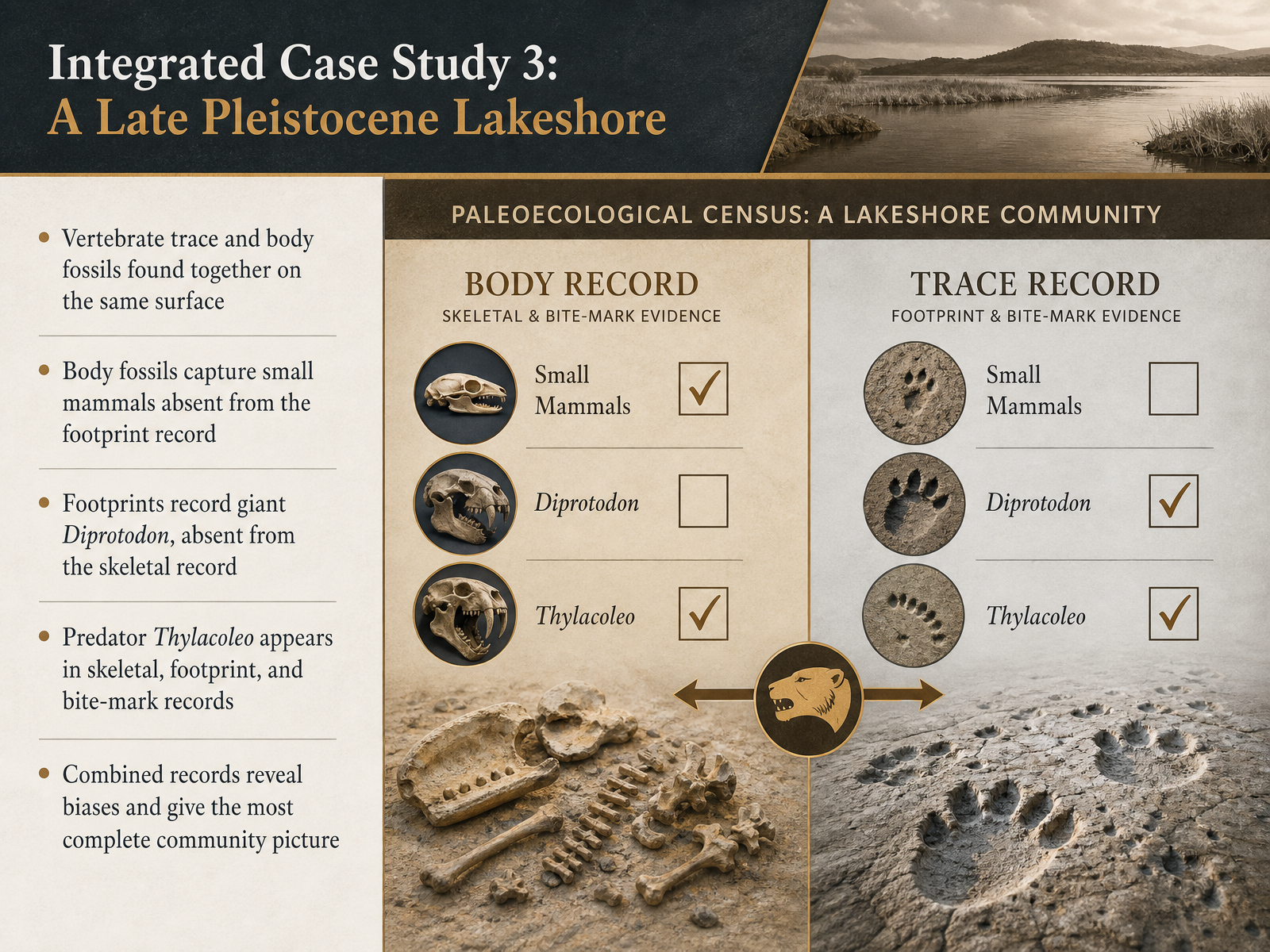
 - 12Integrated Case Study 3: A Late Pleistocene LakeshoreNow let’s apply what we’ve learned with a real integrated case study. This slide takes us to a late Pleistocene lakeshore in southeastern Australia. Here, vertebrate trace fossils and body fossils were found together right on the same bedding plane. What makes the site so instructive is how each record tells a different part of the story. The body fossils captured small mammals that didn’t register in the footprints at all. At the same time, the footprints preserved the giant marsupial Diprotodon, which was completely absent from the skeletal record. Interestingly, the large predator Thylacoleo was the only taxon that showed up in all three records: skeletal fossils, footprints, and bite marks on bones. By combining these lines of evidence, we can see the biases built into each type of fossil. Used together, they give us the most complete picture of the ancient community. Think of each record as a different witness to the same scene: each sees something the others miss, but together they tell the fuller truth. Next, we’ll look at pseudofossils and how nature sometimes imitates life.
 2 min
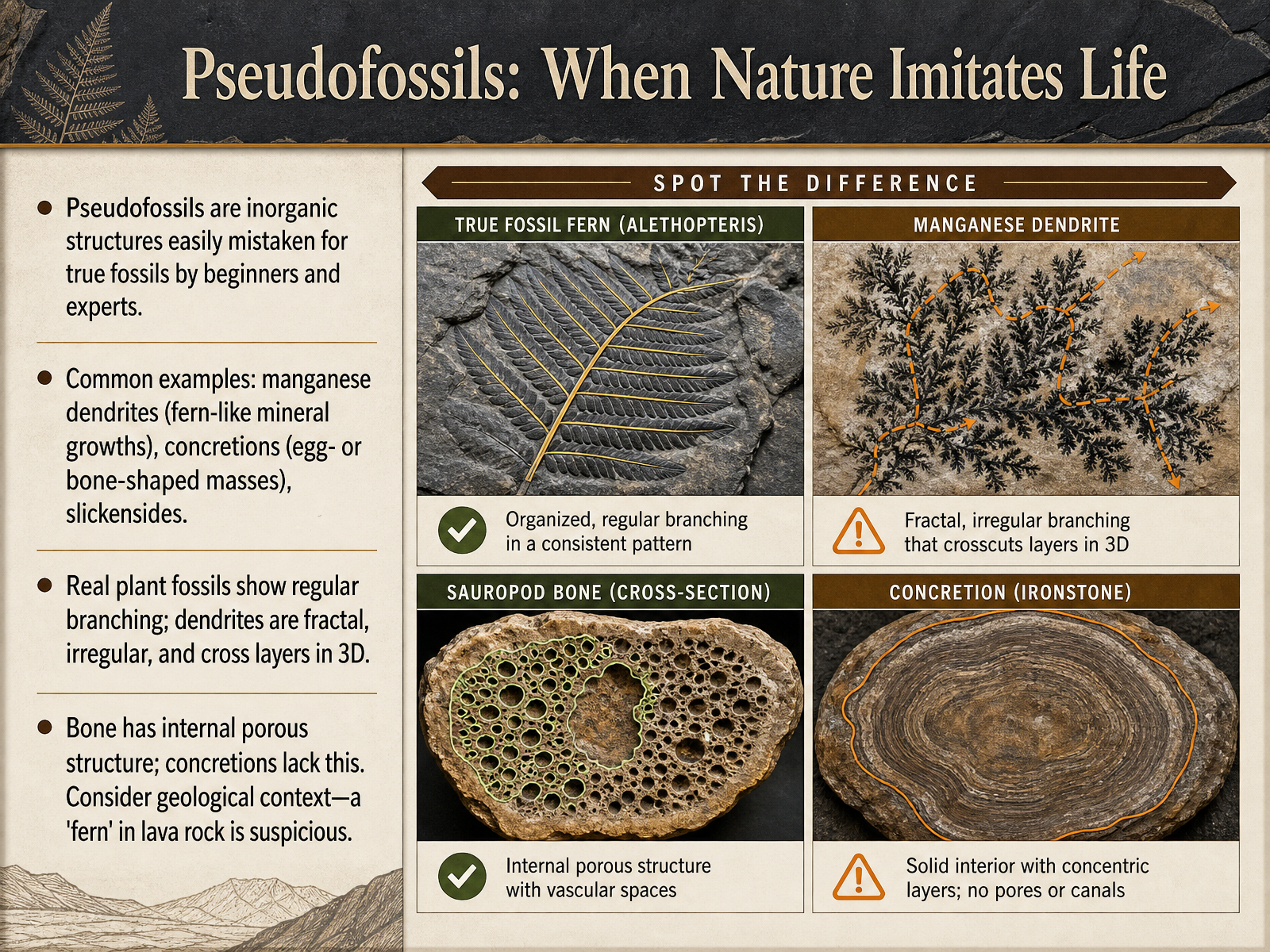
2 min - 13Pseudofossils: When Nature Imitates LifeNow, let's talk about a tricky concept: pseudofossils. These are natural, inorganic structures that look just like real fossils, fooling even experienced collectors sometimes. Think of them as nature's imitators. One common example is a manganese dendrite. It forms a dark, branching mineral pattern that strongly resembles a fern. But here's the key difference: real plant fossils show a regular, repeated branching structure. Dendrites are fractal and irregular, and they often grow three-dimensionally across rock layers, not on a single flat surface. Another frequent find is a concretion, which can look like an egg or a bone. The giveaway is the internal structure. Real bone has a porous, spongy texture. Concretions are just solid mineral masses, sometimes with internal rings, but lacking that biological framework. This is why geological context matters so much. If you spot a perfect fern-like shape in a volcanic rock, you should be suspicious. Ferns don't grow in lava. Thinking about the rock's story is often the best way to separate a fascinating pseudofossil from the real thing. Next, we'll put your new skills to the test with an activity: Practice: Fossil or Fake?
 2 min
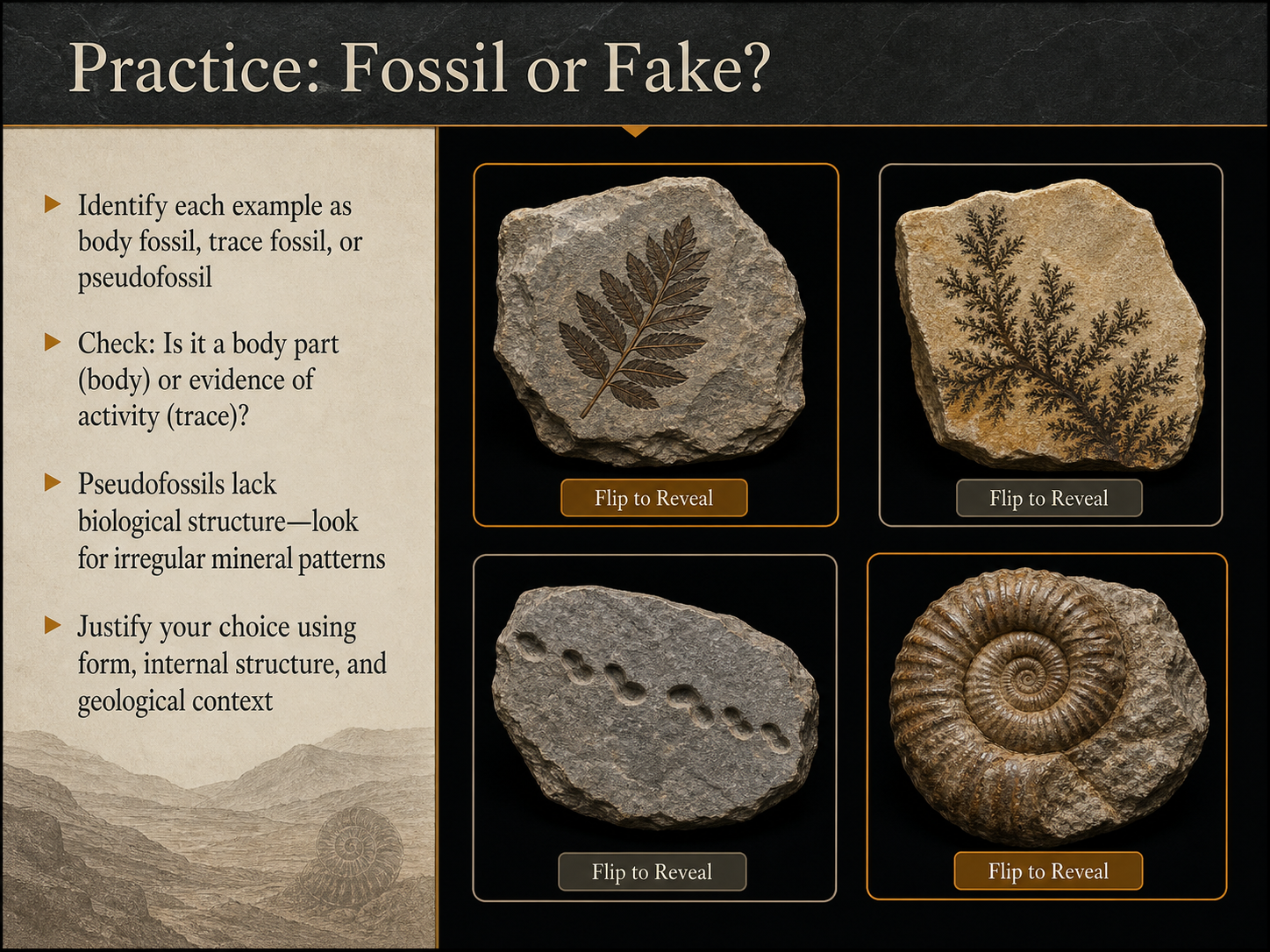
2 min - 14Practice: Fossil or Fake?Now it is your turn to play fossil detective. We will look at a series of examples together. For each one, your job is to determine: is this a body fossil, a trace fossil, or a pseudofossil? Start with a quick mental check. Ask yourself, does this show an actual body part, like a bone or a shell? If yes, it is likely a body fossil. If it instead captures evidence of activity, like a footprint, a burrow, or a bite mark, then you are looking at a trace fossil. But be careful. Sometimes inorganic forces create structures that look very convincing. These are pseudofossils. They lack any genuine biological structure. Watch for irregular mineral patterns that appear plant-like but have no consistent veins, or concentric layers formed by cementation that can mimic bones or eggs. To justify your choice, rely on three lines of evidence. Observe the form, check any visible internal structure, and consider the geological context where the object was found. This combination will help you confidently separate true fossils from look-alikes. Let's move on and see how these clues work together in a simple framework I call The Three-Part Evidence Model.
 en.wikipedia.orgpalaeos.comgeo.libretexts.org+21 min
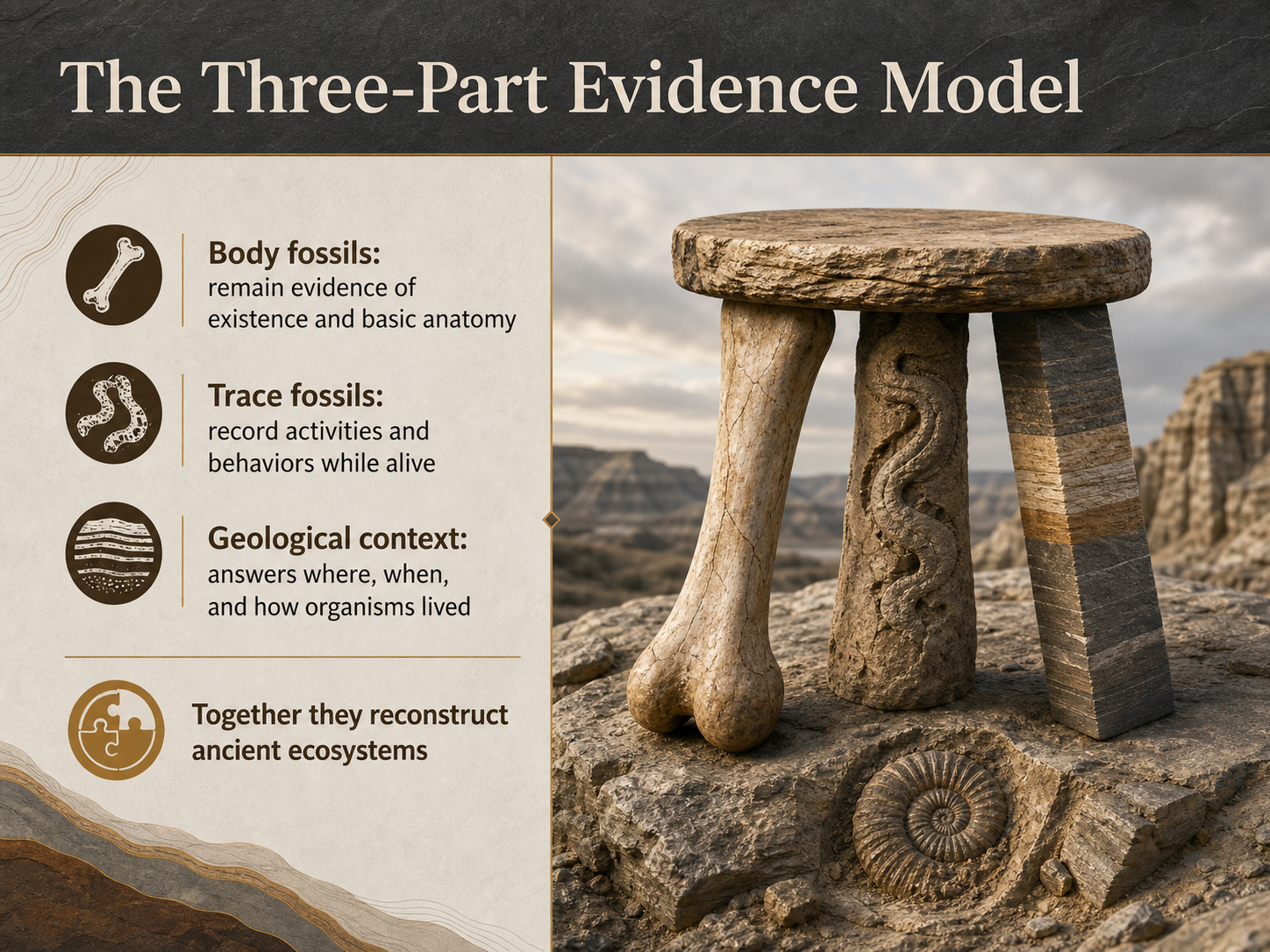
 - 15The Three-Part Evidence ModelNow we can connect all the pieces into a single, three-part model for interpreting evidence. Body fossils give us the remains of the organism itself, showing that it existed and revealing its basic anatomy. Trace fossils record what it did while it was alive, capturing behaviors like walking, burrowing, or feeding. Geological context answers the crucial questions of where, when, and how the organism lived, telling us about the ancient environment, the age of the rock, and how the remains came to be preserved. When you combine these three lines of evidence together, you move from isolated clues to a richer reconstruction of an ancient ecosystem. That integrated view is what we will focus on as we wrap up in our concluding section.
 cambridge.orgpaleoitalia.itroyalsocietypublishing.org+21 min
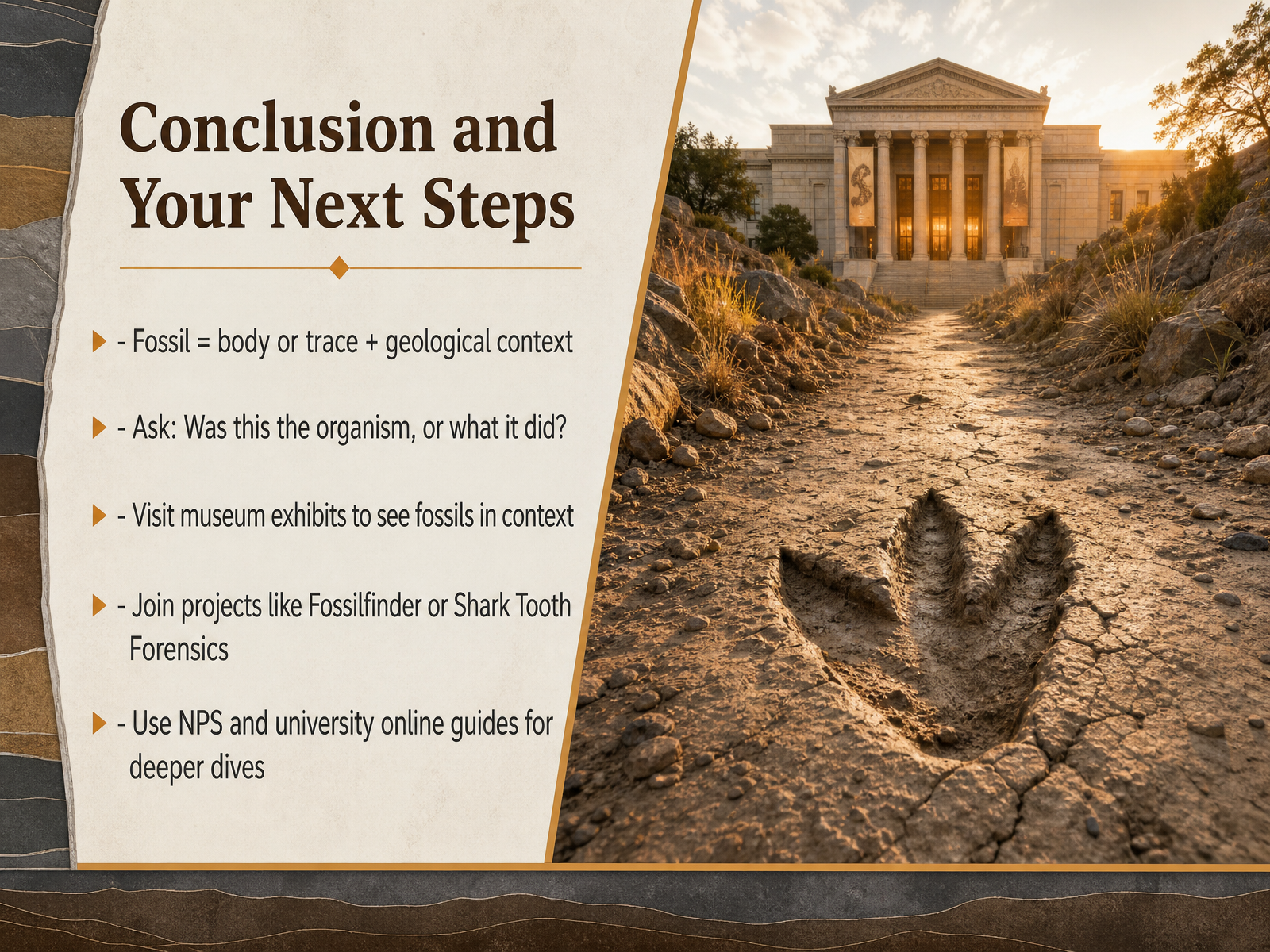
 - 16Conclusion and Your Next StepsWe have reached the end of our introduction, so let's pull everything together. Remember, a fossil is not just a bone or a shell. It is the combination of a body or trace fossil and its geological context. That surrounding rock tells you where the organism lived, how it was buried, and what the environment was like. So when you look at a fossil, ask yourself one guiding question: was this the organism itself, or was it something the organism did? That simple question instantly separates body fossils from trace fossils. Now, how do you keep exploring? Visit museum exhibits and see fossils displayed in their full geological setting. You can also join citizen science projects like Fossilfinder or Shark Tooth Forensics and contribute to real research from your own home or classroom. For deeper dives, explore the free online guides from the National Park Service and university paleontology programs. Thank you for joining this journey into Earth's deep past. The next time you see a fossil, you will see not just a shape in stone, but a story waiting to be read. Keep asking questions and keep exploring.
 2 min
2 min
Take the deck with you
Download this course as a file — free, no sign-up needed.
- PDF handoutEvery slide page, ready to print or share.17 pages · 7.6 MBDownload
- Narrated PowerPointThe deck that presents itself — every slide carries the digital human's narration video.17 pages · 19.4 MBDownload
- PowerPoint slidesThe full deck as a .pptx — open it in PowerPoint, Keynote, or Google Slides.17 pages · 7.6 MBDownload
Free to use in your own training — please keep the PersonWise credit page at the end.
Have your own deck? Turn it into a course
Sources consulted
Web sources consulted while building this course.
- What is a Fossil? - Fossils and Paleontology (U.S. National Park Service) — nps.gov
- 9.1: Types of Fossils - Geosciences LibreTexts — geo.libretexts.org
- GEOL 204 The Fossil Record: Bones in the Stones, Shells in the Shale: Fossils and Fossilization — geol.umd.edu
- What is the difference between a body and trace fossil? — ck12.org
- 1. Body fossils and trace fossils — digitalatlasofancientlife.org
- How Fossils Form - Fossils and Paleontology (U.S. ... — nps.gov
- 2. The process of fossilization — digitalatlasofancientlife.org
- How do fossils form? — australian.museum
- Fossils - British Geological Survey — bgs.ac.uk
- The Fossil Cycle - Teachers (U.S. National Park Service) — nps.gov
- Trace fossil — en.wikipedia.org
- Palaeos Paleontology: Palaeontology — palaeos.com
- 9.6: Trace Fossils - Geosciences LibreTexts — geo.libretexts.org
- Trace Fossils - Fossils and Paleontology (U.S. National Park Service) — nps.gov
- Behavioral biology of trace fossils — cambridge.org
- Stratigraphic paleobiology | Paleobiology | Cambridge Core — cambridge.org
- The contrasting controls on the occurrence of fossils in marine and nonmarine systems — paleoitalia.it
- The non-uniformity of fossil preservation — royalsocietypublishing.org
- Invertebrate Palaeontology and Sequence Stratigraphy: complementary methods and evidence to explain the geological record — exa.ai
- Fossils, Rocks, and Time: Fossil Succession — pubs.usgs.gov