Listening for Main Ideas and Details
Begin
15 pages · ~30 min
Listening for Main Ideas and Details
Learn to identify main ideas and supporting details in spoken English to improve listening comprehension and retention.
What you’ll learn
- 01Listening for Main Ideas and DetailsWelcome. I'm glad you're here. Today, we're going to work on a skill you'll use every day, both in the classroom and at work. And that skill is listening for the big picture. We'll call that the main idea. So what exactly is a main idea? Simply put, it's the central message. It's the point a speaker is trying to make. Think of it as the answer to the question, what is this really about? Now, to support that big idea, speakers use details. Details are the specific facts, the numbers, the names, and the examples that back things up. For instance, if someone says the company had a great year, that's the main idea. The detail is that sales went up by twenty percent. This course is designed step by step. We'll start with the core concepts, then move into some guided practice, and finish with self-study tips you can use on your own. By the end, you'll feel more confident following meetings, classes, and everyday conversations without getting lost. This foundation is key for what comes next, because soon we'll talk about why listening can sometimes feel challenging. Let's get started.5minuteenglish.comedu.comquizgecko.com+22 min
- 02Why Listening Feels HardLet's face it: listening in a new language can feel overwhelming. Real speech is fast, and sounds blend together. Unfamiliar words pop up when you least expect them. If you try to catch every single word, you will quickly fall behind and miss the bigger picture. The speakers may use different accents, and longer audio can push your focus. But here is the good news. You do not need to understand everything to understand the message. Your realistic goal is to catch enough to grasp what is happening, respond appropriately, and take simple action. We will build this skill step by step. Now, let's look at the difference between main ideas and supporting details.
 startupesl.combusinessenglishsite.comesl-lab.com+21 min
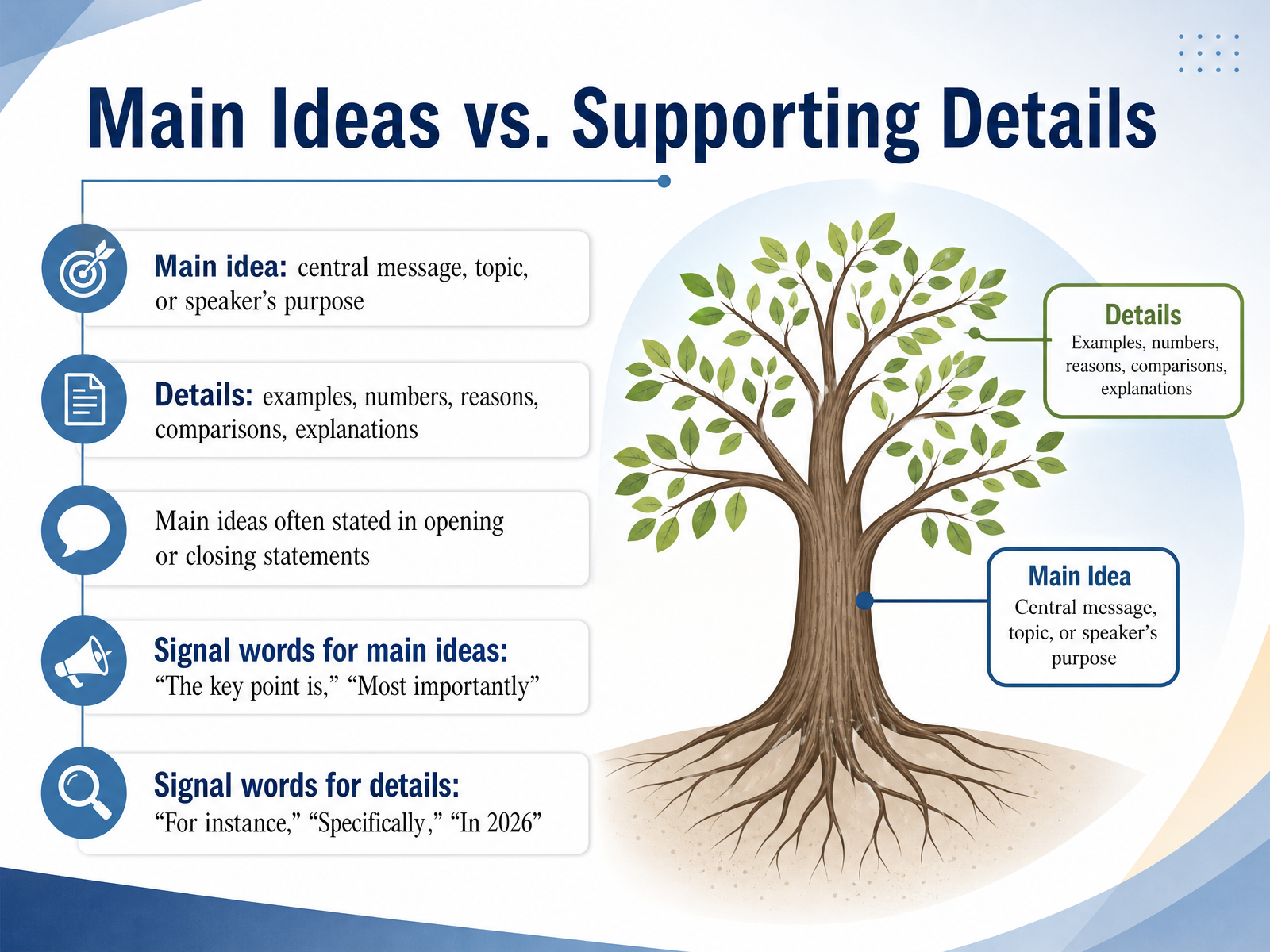
 - 03Main Ideas vs. Supporting DetailsLet’s start by thinking about what we’re really listening for. There are two key layers in any conversation, lecture, or presentation. First, the main idea. That’s the central message—the speaker’s main purpose. It answers the question: what is this talk really about? Second, supporting details. These are the specific pieces that back up that message. They include examples, numbers, reasons, comparisons, and explanations. Think of the main idea as the trunk of a tree, and the details as the branches. The branches grow out of the trunk and hold it up. Now, here is a helpful trick. Main ideas are often stated clearly in the opening or closing statements of a talk. Speaker gives you a summary, then the details follow. To make things easier, speakers often use signal words to guide you. For main ideas, listen for phrases like: The key point is… or Most importantly… These signals tell you to perk up your ears. On the other hand, details come with signals like: For instance…, Specifically…, or In 2026 numbers like that. When you hear these, you know a supporting detail is on its way. Now, let’s take a closer look at how to use these signal words to build your own personal audio map.
 5minuteenglish.comlenny.comthinka.ai+22 min
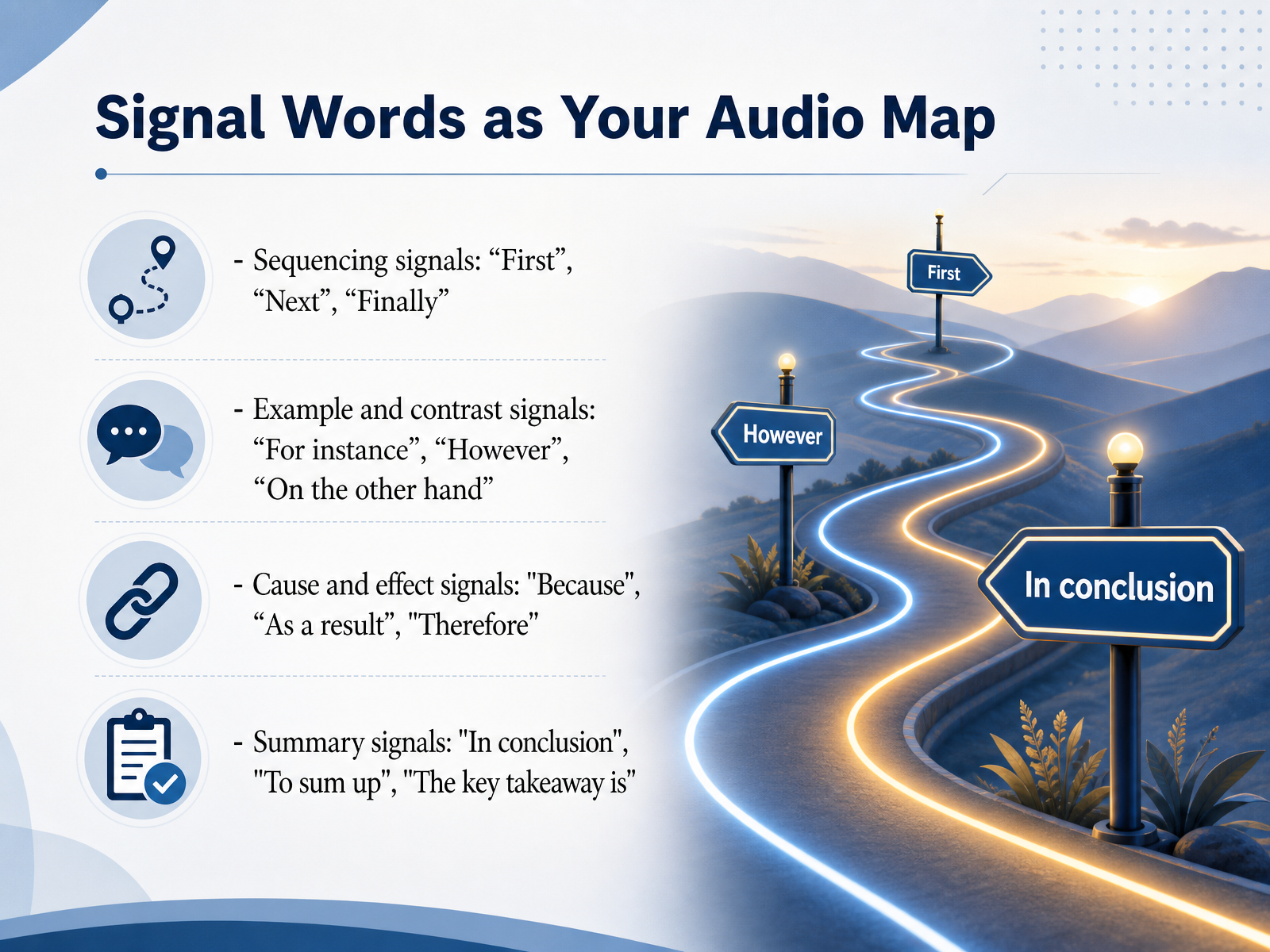
 - 04Signal Words as Your Audio MapNow, let's talk about your audio map. Signal words are like road signs. They guide you through what you hear. When the speaker says "First," "Next," or "Finally," you know they are giving steps in order. Words like "For instance" tell you an example is coming. "However" and "On the other hand" signal a contrast. Listen for "Because," "As a result," or "Therefore" to catch cause and effect. And when you hear "In conclusion" or "The key takeaway is," get ready to write down the speaker's main point. These words help you put the details in the right place. Instead of feeling lost, you can anticipate what is coming next. So, as you listen, keep your ears open for these signposts. They will point you to the main ideas that you absolutely need to catch. Before you listen, let's look at the best way to prepare yourself.
 5minuteenglish.comlenny.comthinka.ai+22 min
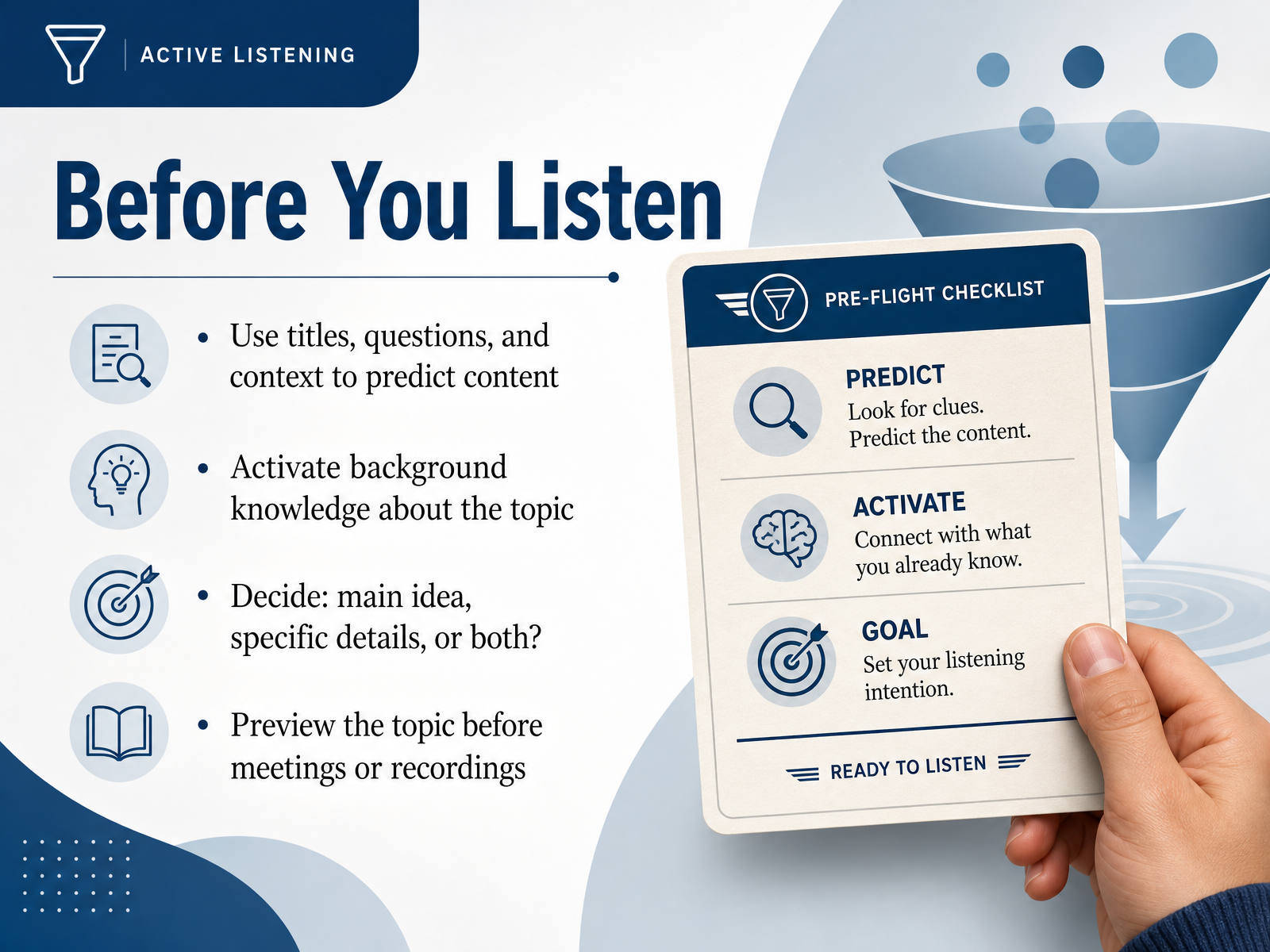
 - 05Before You ListenBefore you listen, take a moment to prepare. This small step can make a big difference. First, look at the title, any questions, or the context. This gives you clues about what you might hear. For example, if the title is about healthy food, you can expect words like nutrition or exercise. Next, activate your background knowledge. Think about what you already know about the topic. This warms up your brain and helps you understand better. Then, decide what you are listening for. Are you trying to understand the main idea? Or do you need specific details? Or both? Knowing your purpose focuses your attention. If you have a meeting or a recording coming up, preview the topic beforehand. Look at the agenda or summary. This gives you a roadmap. So remember, predict, activate, and decide. These simple steps will help you listen with purpose and confidence. Now, let’s look at how to actually listen for the main idea.
 5minuteenglish.com5minuteenglish.com5minuteenglish.com+21 min
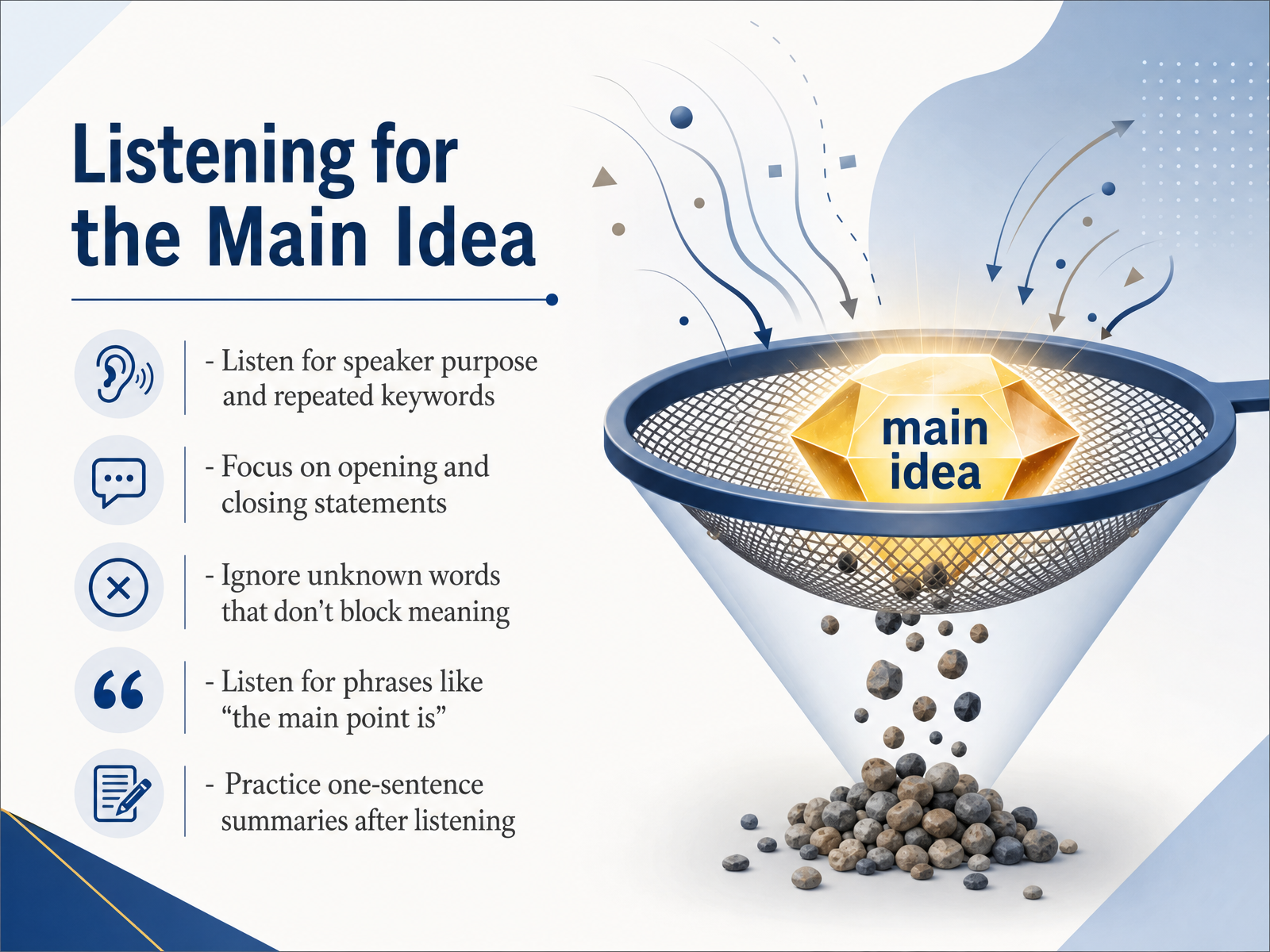
 - 06Listening for the Main IdeaNow let's talk about finding the main idea when you listen. Think of it as the one big message the speaker wants you to remember. Start by listening for the speaker's purpose. Why are they talking? Are they explaining something, giving an opinion, or solving a problem? Next, pay attention to keywords that you hear repeated. If you hear the word "budget" several times in a meeting, that is probably a key part of the message. Also, focus closely on the opening and closing statements. Speakers often state their main point right at the start, and then they summarize it again at the end. Here is a helpful tip: you do not need to understand every single word. If you hear an unfamiliar word, just let it go. It usually does not block the main meaning, so do not let it distract you. Also, listen for signal phrases. When a speaker says "the main point is" or "what I'm saying is," they are flagging the central idea for you. A great habit is to practice making a one-sentence summary after you listen. This builds your skill and your confidence. Next, we will look at how to catch the key details that support that main idea.
 5minuteenglish.com5minuteenglish.com5minuteenglish.com+22 min
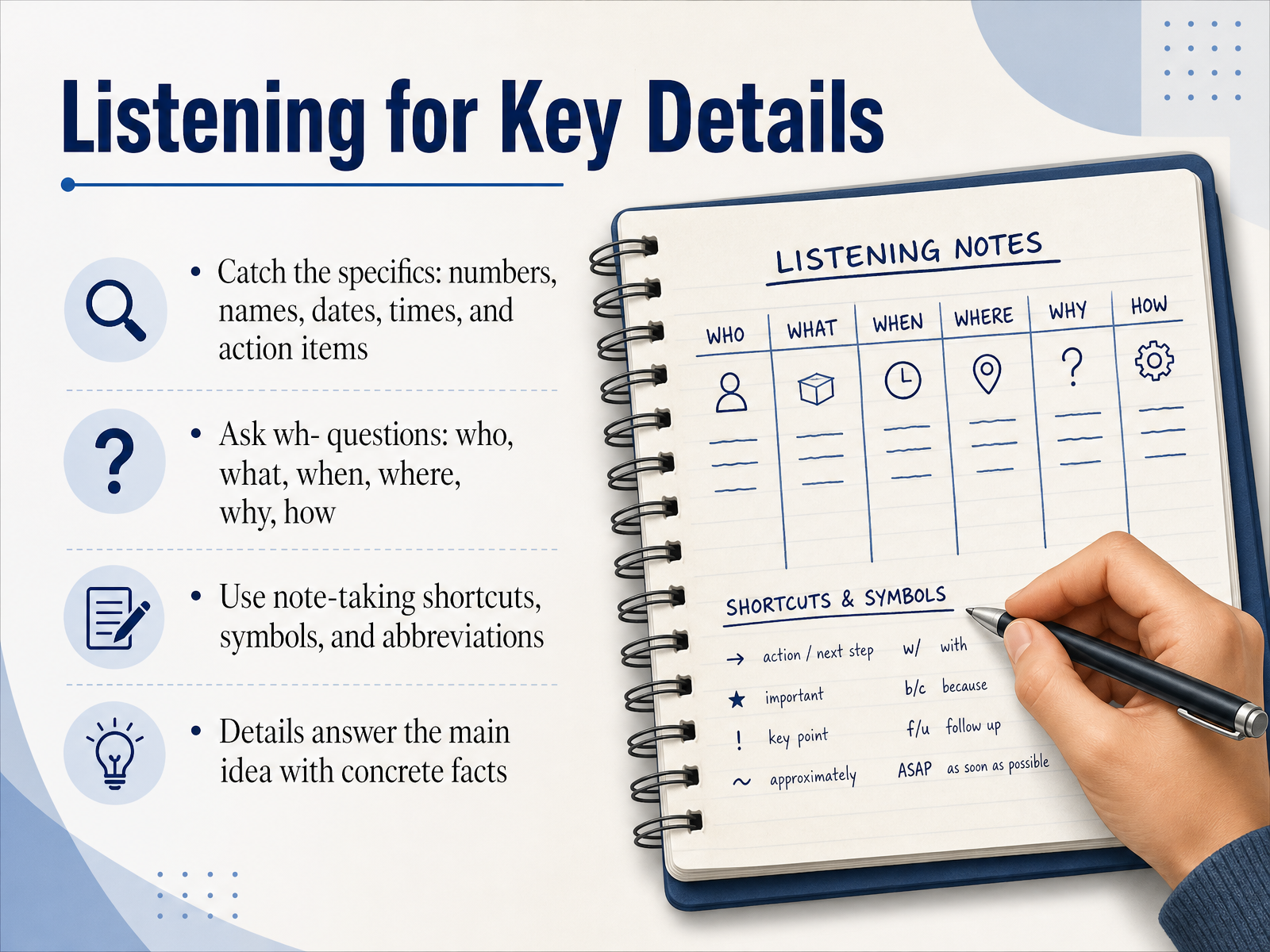
 - 07Listening for Key DetailsNow let's talk about catching the key details. Once you have the main idea, you need the specific facts that support it. Think of it this way. The main idea is the headline, but the details are the story. So what kind of details should you listen for? Listen for specifics like numbers, names, dates, times, and action items. For example, if a manager says the meeting is moved to Thursday at three, those are the details you need to write down. A great way to organize your listening is to ask the five W questions. Who is involved? What is happening? When and where will it take place? And how will it be done? Asking these questions in your head helps you know what to listen for next. You don't need to write full sentences. Use shortcuts. Use symbols and abbreviations. For example, write the ampersand instead of the word and, or use an arrow to show cause and effect. These little tricks save you valuable time. Remember, details answer your main idea with concrete facts. They turn a general topic into clear, usable information. So next time you listen, catch that main idea first, then quickly jot down the details that give it power. Coming up, we will look at some simple note-taking techniques that make this process even easier.
 5minuteenglish.comedu.comquizgecko.com+22 min
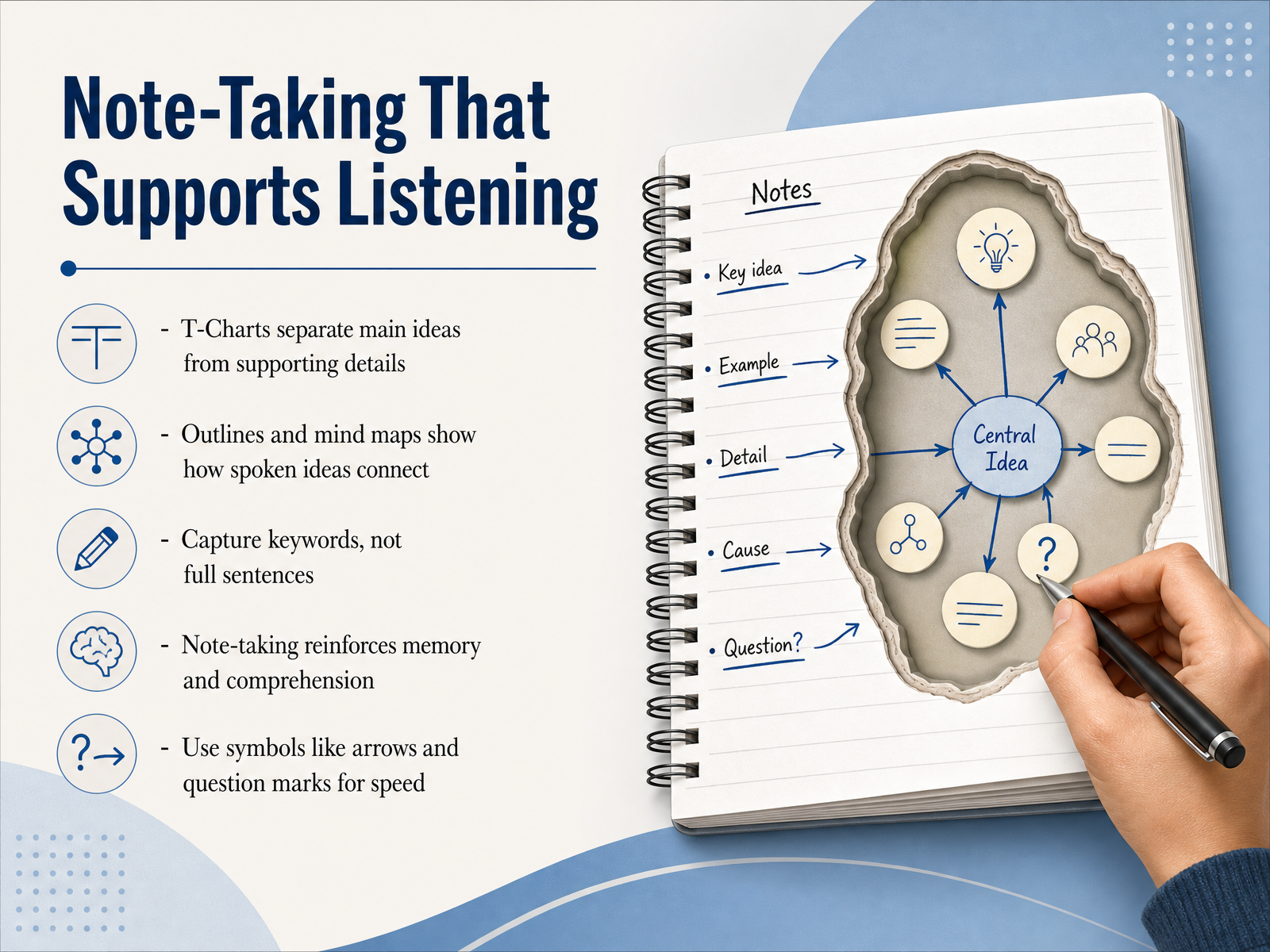
 - 08Note-Taking That Supports ListeningNow, let's talk about note-taking. The goal is simple: capture the main ideas and the key details that support them. You don't need to write full sentences. In fact, you shouldn't. Full sentences take too long, and you'll miss the next point. Instead, listen for keywords and short phrases. Here is a practical strategy. Try a simple T-chart. On the left side, write the main ideas. On the right side, write the supporting details under each one. This keeps things separate and clear. Another option is an outline or a mind map. These show you how spoken ideas connect to each other. A mind map is especially useful when a speaker jumps between different points. Remember, effective note-taking reinforces your memory and your comprehension. It helps you stay focused. You can also use symbols to write faster. For example, an arrow means 'leads to' or 'causes.' A question mark means 'not sure, check later.' You can even use simple abbreviations. The key is to create a system that works for you. Keep your notes short and visual, and you will follow the speaker more easily. Coming up next, we will look at common pitfalls in listening and how to fix them.
 startupesl.combusinessenglishsite.comesl-lab.com+22 min
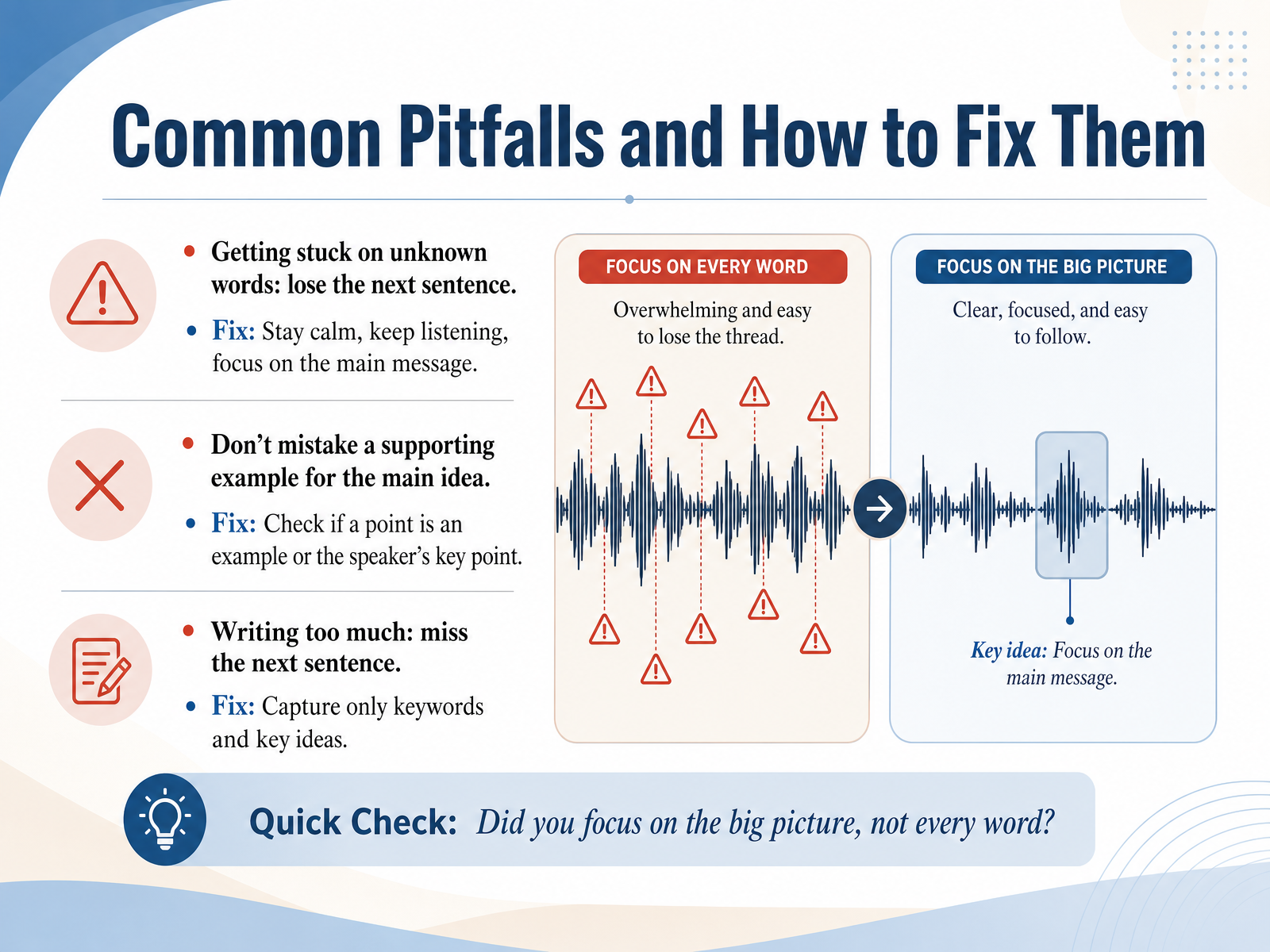
 - 09Common Pitfalls and How to Fix ThemNow, let's talk about some common listening pitfalls and, more importantly, how to fix them. One big mistake is getting stuck on a word you don't know. You focus on it, and then you miss the next sentence. The fix is simple. Stay calm, keep listening, and focus on the main message. Don't let one unknown word derail you. Another trap is mistaking a supporting example for the main idea. Speakers often tell stories to prove a point. Ask yourself: is this an example, or is this the key point they're trying to make? Finally, avoid trying to write everything down. If you write too much, you will miss the next part. The fix is to capture only the keywords and the big ideas. Just the essentials. So, quick check. When you listen, are you focused on the big picture, not every single word? Great. Now, let's apply these strategies to some practice scenarios you might hear at work.
 5minuteenglish.com5minuteenglish.com5minuteenglish.com+21 min
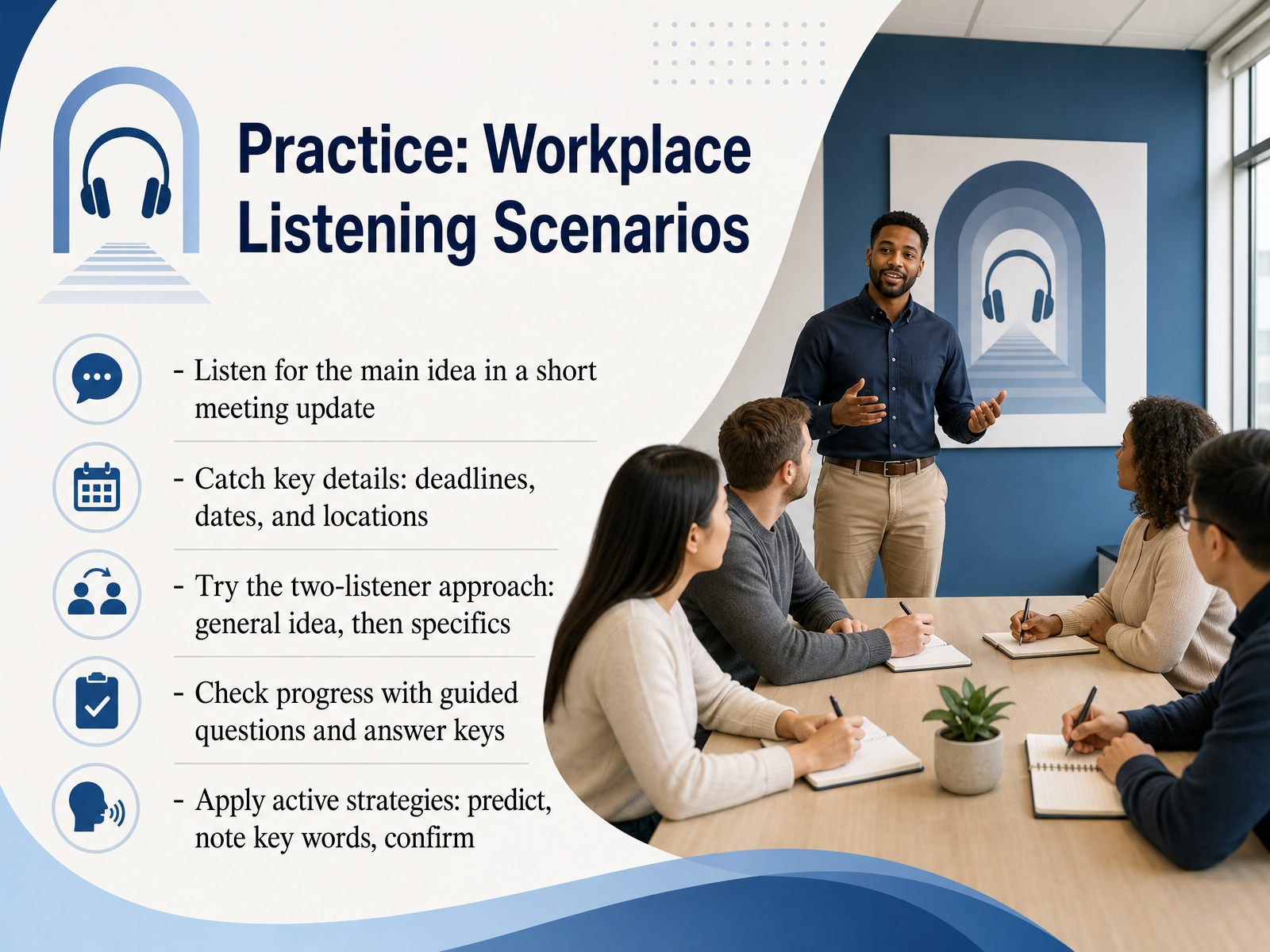
 - 10Practice: Workplace Listening ScenariosNow let's put these strategies into action with some workplace scenarios. Imagine you're in a short team meeting. First, listen just for the main idea. Is the update about a new project, a problem, or a schedule change? Don't worry about every word yet. Then, listen a second time. Now, focus on the key details. Catch the deadlines, the dates, and the locations. This is what we call the two-listener approach. The first time, you get the general picture. The second time, you zoom in on the specifics. As you practice, check your progress with the guided questions and answer keys. And remember to use your active strategies. Predict what you might hear, note down keywords, and confirm your understanding as you listen. Each scenario is short and realistic, so you can build your confidence step by step. Coming up, we'll look at how these same skills apply in everyday classroom conversations and daily life. Let's keep going.
 startupesl.combusinessenglishsite.comesl-lab.com+21 min
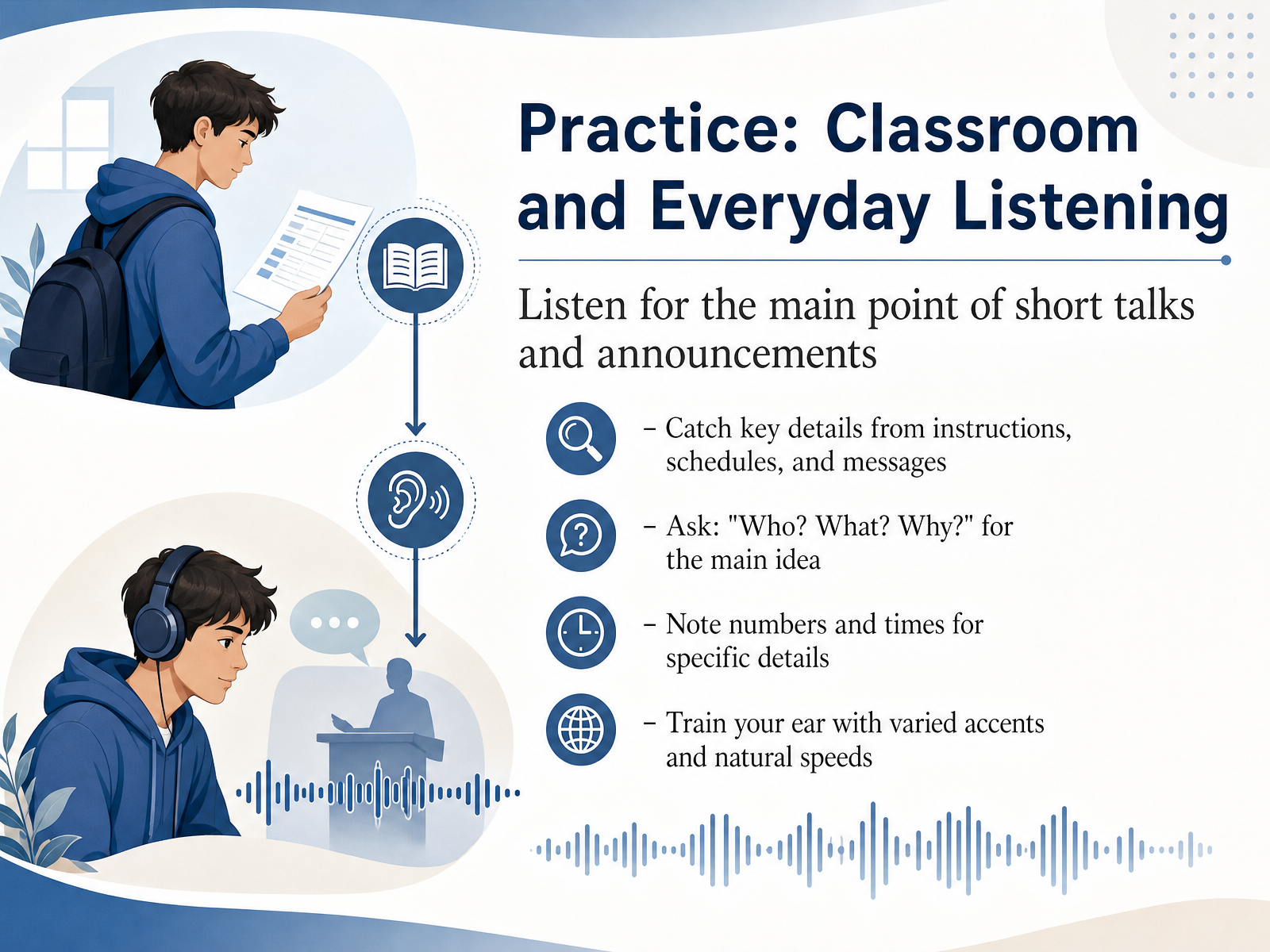
 - 11Practice: Classroom and Everyday ListeningLet’s put these strategies into action with some real-life practice. Start by listening for the main point in short talks and announcements. For example, if a teacher says a trip has changed, your first job is to catch what changed, not every detail. Next, focus on key details like instructions, schedules, and messages. Ask yourself simple questions: Who is involved? What is happening? Why does it matter? These questions help you find the main idea quickly. Then, listen closely for numbers and times. If someone says, the bus leaves at eight thirty, that time is a specific detail you need to remember. Don’t forget the big picture. In everyday English, you don’t need to understand every single word. Instead, train your ear with different accents and natural speeds. Practice with short videos, announcements, or even conversations at work. Over time, your brain will learn to separate the main point from the extra information. With regular practice, this will feel more natural. Next, let’s look at a simple method to make this whole process even easier, the Three-Step Listening Method.
 esleschool.comlearnenglish.britishcouncil.orgyoutube.com+22 min
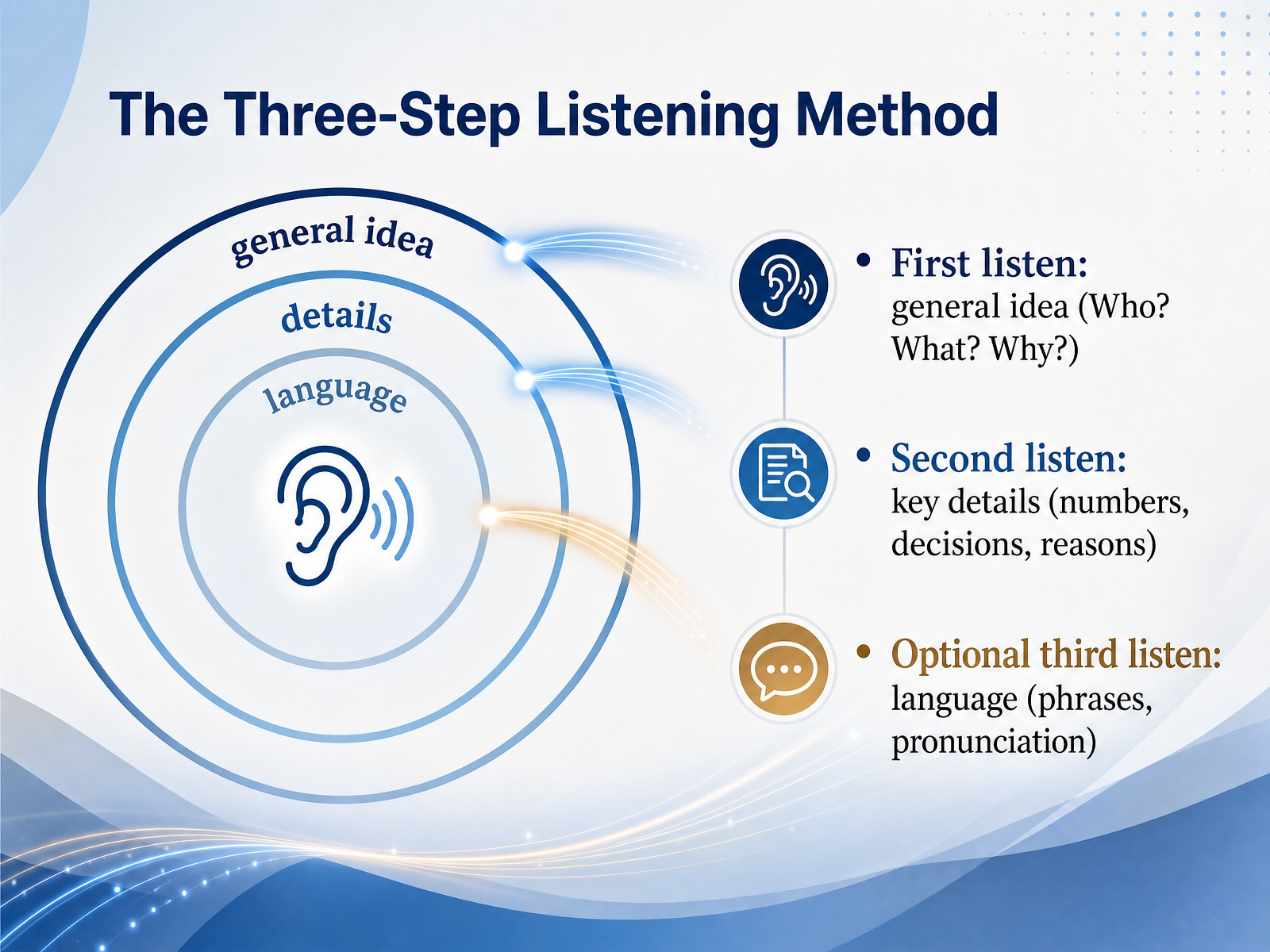
 - 12The Three-Step Listening MethodLet's bring those ideas together now with a simple three step method you can use for any listening practice. Step one. The first listen. Your job here is simple. Just catch the general idea. Ask yourself, who is speaking? What is the topic? And why are they talking? Don't worry about the details. Just get the big picture. Step two. The second listen. Now you focus on key details. Listen for numbers, dates, and times. Listen for decisions that people make. And listen for reasons why things happened. Step three is optional. The third listen. This time, listen for language. Notice new phrases. Notice how words sound together. And notice how the speaker uses stress. Here's your takeaway. One listen is not enough. First, get the main idea. Then, catch the details. And if you want, listen again for the language. Next, let's talk about what to do when you hear different accents, fast speech, and real-world English.
 startupesl.combusinessenglishsite.comesl-lab.com+22 min
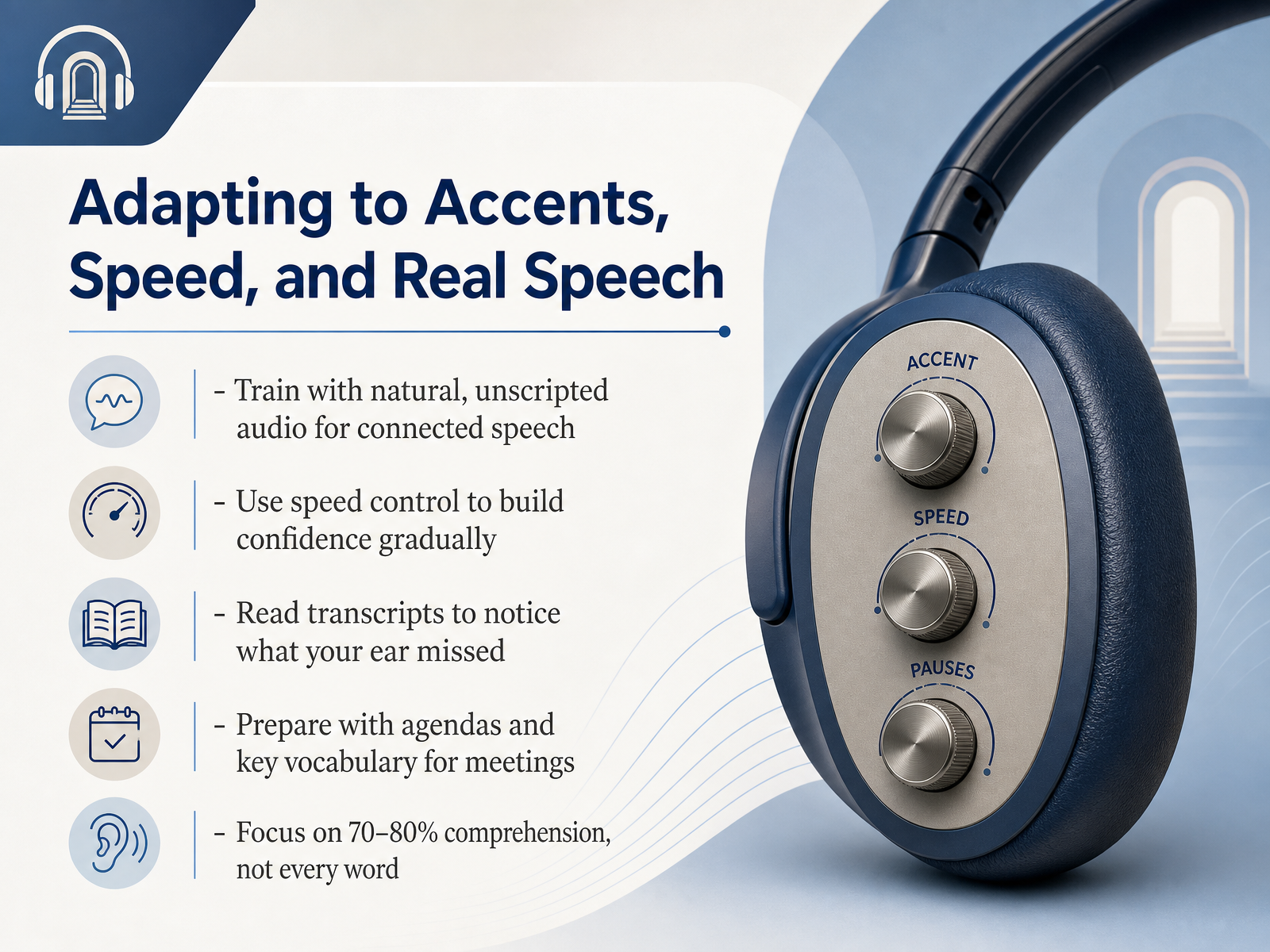
 - 13Adapting to Accents, Speed, and Real SpeechNow let's talk about real speech. Because real conversations are rarely slow and clear. Speakers talk fast, and they connect their words. Sounds get dropped or blended together. So, how do you train your ear for this? First, practice with natural, unscripted audio. Podcasts or interviews are great because they show real connected speech. Use the speed control on your player. Start at seventy-five percent speed if you need to, and gradually work up to normal speed. This builds your confidence step by step. Next, read the transcript after you listen. Notice the words your ear missed and see how they actually sounded. If you have meetings coming up, prepare in advance. Review the agenda and look up key vocabulary. This gives your brain a head start and helps you recognize those words when you hear them. And remember this important point: you do not need to understand every single word. Aim for seventy to eighty percent comprehension. If you catch the key decisions and the main message, that is enough. Real progress comes from patient practice with real speech. Next, we will look at building a personal study plan for continued growth.
 startupesl.combusinessenglishsite.comesl-lab.com+22 min
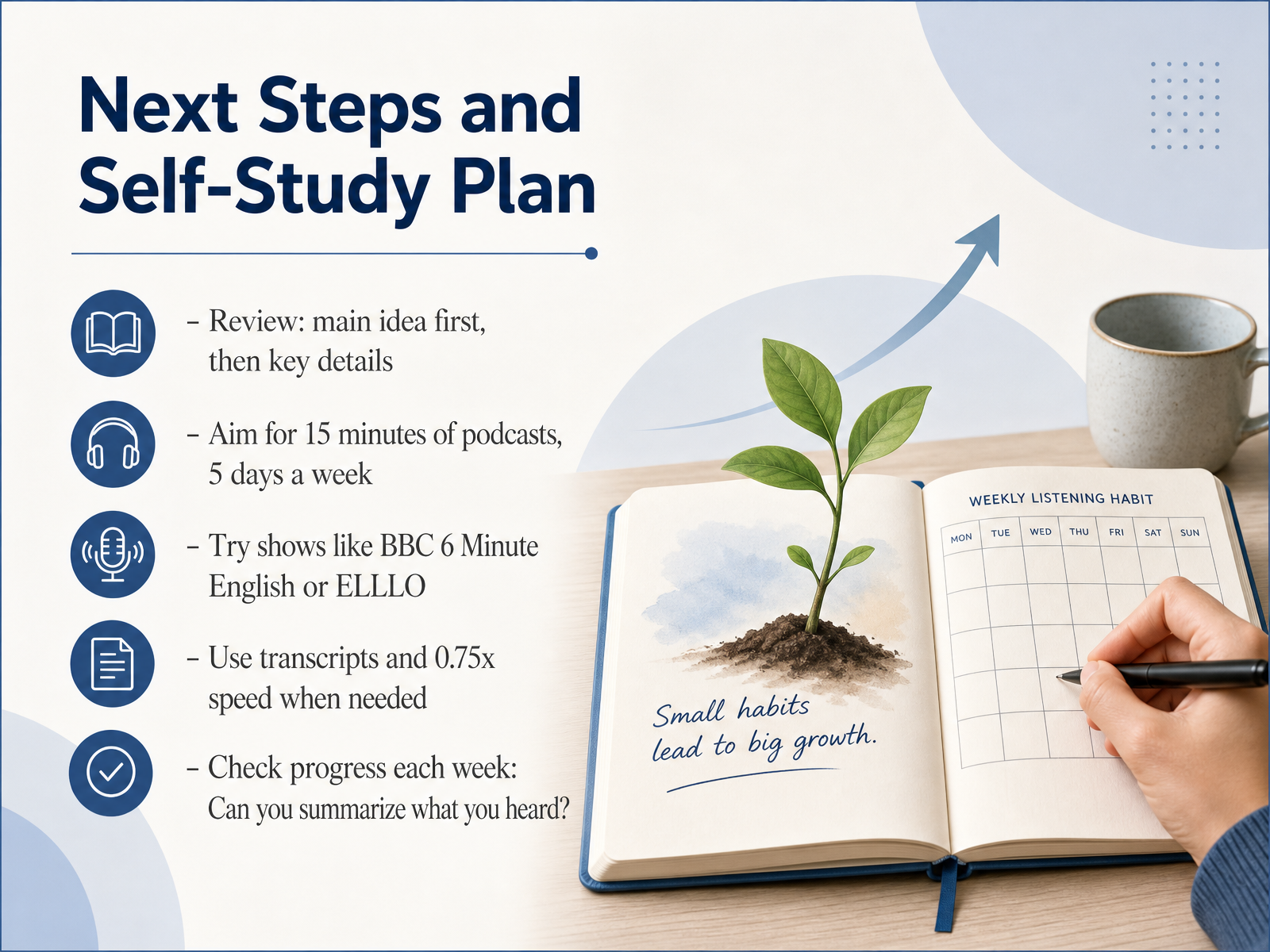
 - 14Next Steps and Self-Study PlanNow, let's talk about your next steps. This is where you turn everything you've learned into a real habit. First, always remember the core strategy: listen for the main idea first, then fill in the key details. Second, aim for just fifteen minutes of podcast practice, five days a week. That's about the length of your commute. Try shows made for learners, like BBC 6 Minute English or ELLLO. They speak clearly and cover everyday topics. When you listen, don't be afraid to use the tools. Use transcripts to read along, and try 0.75 speed when the speaker feels fast. There is no shame in slowing down; we all do it. Finally, check your progress each week. Ask yourself: can I summarize what I heard? A simple one or two sentence summary in your own words is a powerful test. Now, let's look at some resources and practice tools to help you build this routine.
 startupesl.combusinessenglishsite.comesl-lab.com+22 min
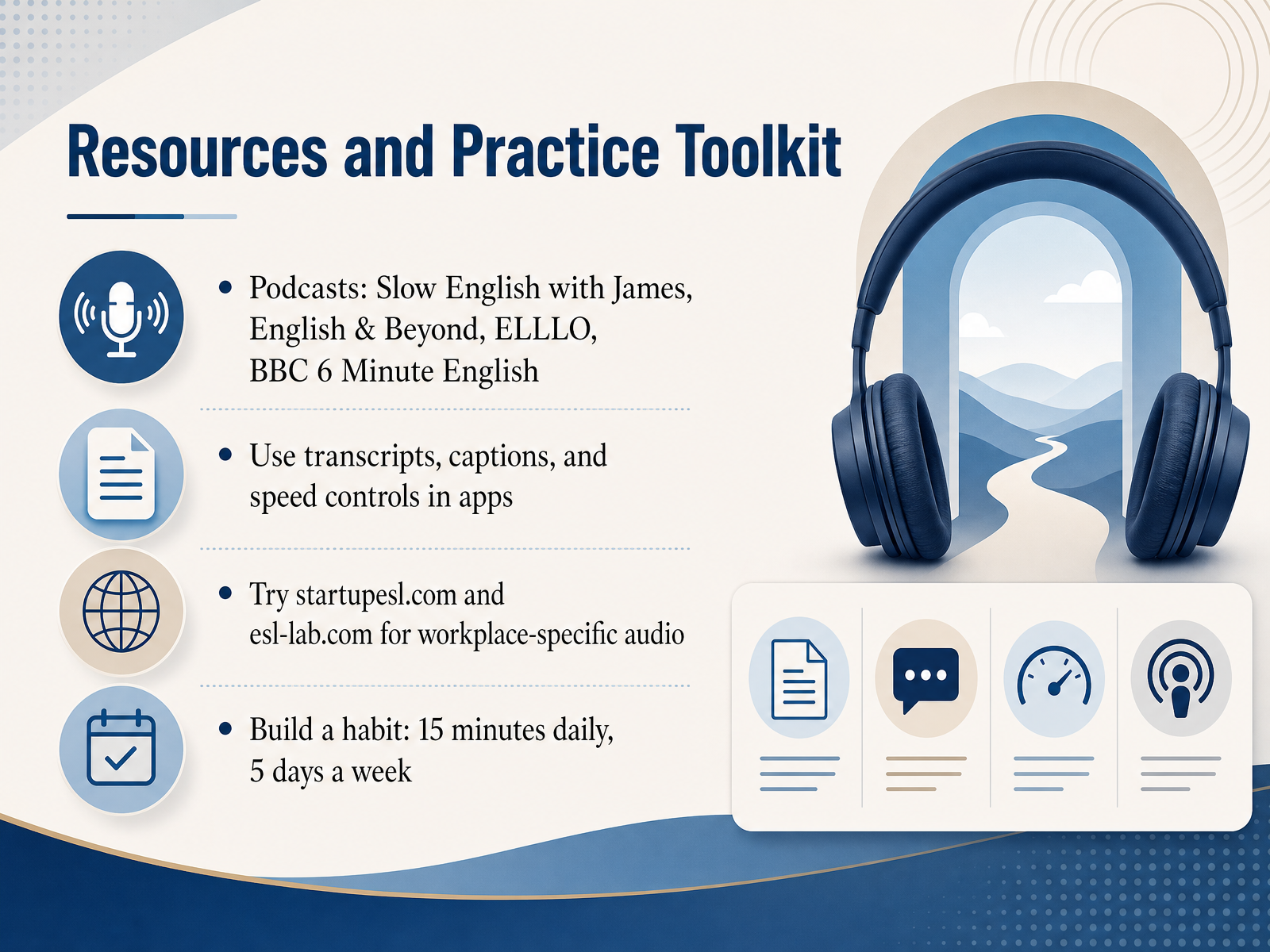
 - 15Resources and Practice ToolkitWe have covered a lot today, and now it is time to talk about where to go from here. Think of this as your practice toolkit. There are some excellent podcasts made just for learners like you. Look for Slow English with James, English and Beyond, and BBC 6 Minute English. When you listen, use the tools in your app. Turn on the transcript, or use the captions if you are watching a video. And do not be afraid to slow down the speed. Listening at a slower pace is smart practice, not a weakness. For workplace English specifically, try sites like Startup ESL and ESL Lab. They have real office situations you can listen to again and again. The most important part is your routine. Try to build a simple habit. Just fifteen minutes a day, five days a week. That is one hour and fifteen minutes of focused practice. Small steps, taken consistently, lead to real progress. Thank you for your attention today. Keep practicing, keep listening, and you will keep improving.
 startupesl.combusinessenglishsite.comesl-lab.com+22 min
Take the deck with you
Download this course as a file — free, no sign-up needed.
- PDF handoutEvery slide page, ready to print or share.16 pages · 3.9 MBDownload
- Narrated PowerPointThe deck that presents itself — every slide carries the digital human's narration video.16 pages · 16.5 MBDownload
- PowerPoint slidesThe full deck as a .pptx — open it in PowerPoint, Keynote, or Google Slides.16 pages · 3.8 MBDownload
Free to use in your own training — please keep the PersonWise credit page at the end.
Have your own deck? Turn it into a course
Sources consulted
Web sources consulted while building this course.
- Listening for Main Ideas: A Guide for ESL Learners — 5minuteenglish.com
- Listening for Important Details: Definition, Significance, Comparisons, Rules and Examples | EDU.COM — edu.com
- Listening for the Main Idea — quizgecko.com
- https://www.k-state.edu/elp/academics/LIST_SPK%20Workbook.pdf — k-state.edu
- Listening for Gist vs. Listening for Detail: What Teachers Need to Know — eltcorner.com
- A Quiet Problem - StartupESL — startupesl.com
- Business English listening comprehension practice exercises — businessenglishsite.com
- Study Path - Advanced English for the Workplace - Randall's ESL Cyber Listening Lab — esl-lab.com
- Practise English listening skills | LearnEnglish — learnenglish.britishcouncil.org
- Practice Listening Business English Exercises for A2 - Employees talk about their jobs - English Practice Online — english-practice.net
- https://www.lenny.com/lesson/academic-listening-lesson-plan-906097 — lenny.com
- Academic Talks: Main and Supporting Ideas | TOEFL TOEFL iBT — thinka.ai
- Impact of Teaching Academic Text Cohesive Devices on ESL Undergraduates’ Listening Comprehension — doi.org
- The Effect of Discourse Signaling Cues on Foreign Language Listening Comprehension of Iranian EFL Students — doi.org
- Listening Comprehension: How to Identify the Main Idea in Audio Clips — 5minuteenglish.com
- How to Focus on Keywords to Improve Your English Listening – 5 Minute English — 5minuteenglish.com
- IELTS Listening: How to Identify Main Ideas in IELTS Listening Passages — ieltsmumbai.com
- “Helping Pre-Intermediate Students improve strategies of prediction, inferencing and using background knowledge in Listening for gist and for specific — linkedin.com
- Five Topics Set 1 | A2 Key Listening Part 4 — esleschool.com
- English Listening Practice with Easy Daily Life Conversations for Beginners | English Podcast — youtube.com