Data Privacy Policy Patterns and Pitfalls
Begin
14 pages · ~28 min
Data Privacy Policy Patterns and Pitfalls
This training reviews real-world data privacy policy examples, helping privacy and compliance professionals identify effective patterns, strengths, and common pitfalls.
What you’ll learn
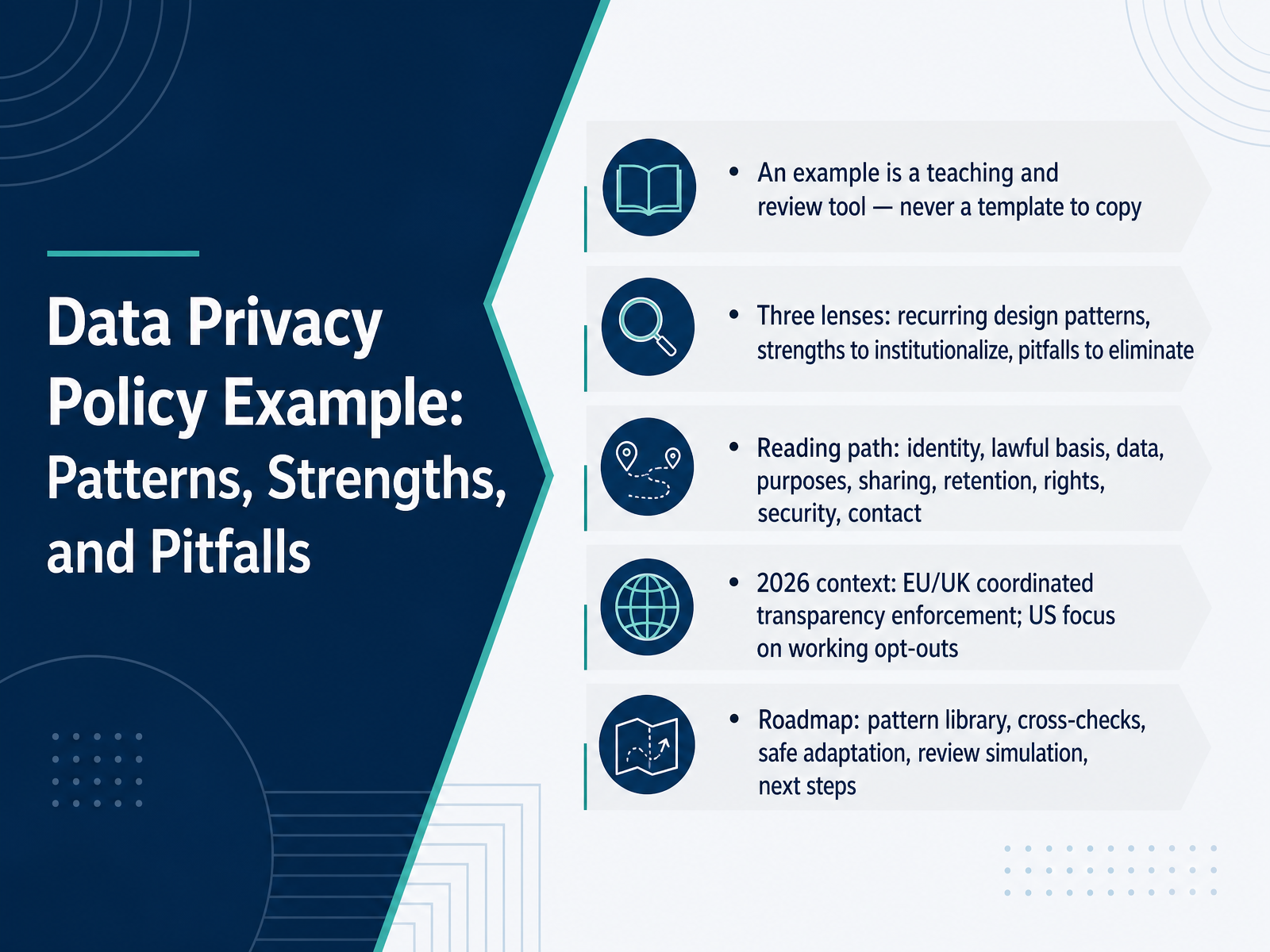
- 01Data Privacy Policy Example: Patterns, Strengths, and PitfallsWelcome. In this course, we'll look closely at a real data privacy policy example, so you can learn from it rather than copy it. That difference matters. A published policy is a teaching tool and a review tool, not a template. If you copy one, you inherit its mistakes. So we'll use three lenses: recurring design patterns, strengths worth keeping, and pitfalls to remove. You'll also follow a simple reading path: identity, lawful basis, data, purposes, sharing, retention, rights, security, and contact. One more thing. The context for twenty twenty six is active enforcement. In the EU and UK, regulators are coordinating transparency checks. In the US, they're testing whether opt-outs actually work. So we'll build a pattern library, run cross-checks, practise safe adaptation, and try a review simulation. Let's start with why we study an example instead of copying one.cookieyes.comprivacychecker.prodatashyre.com+22 min
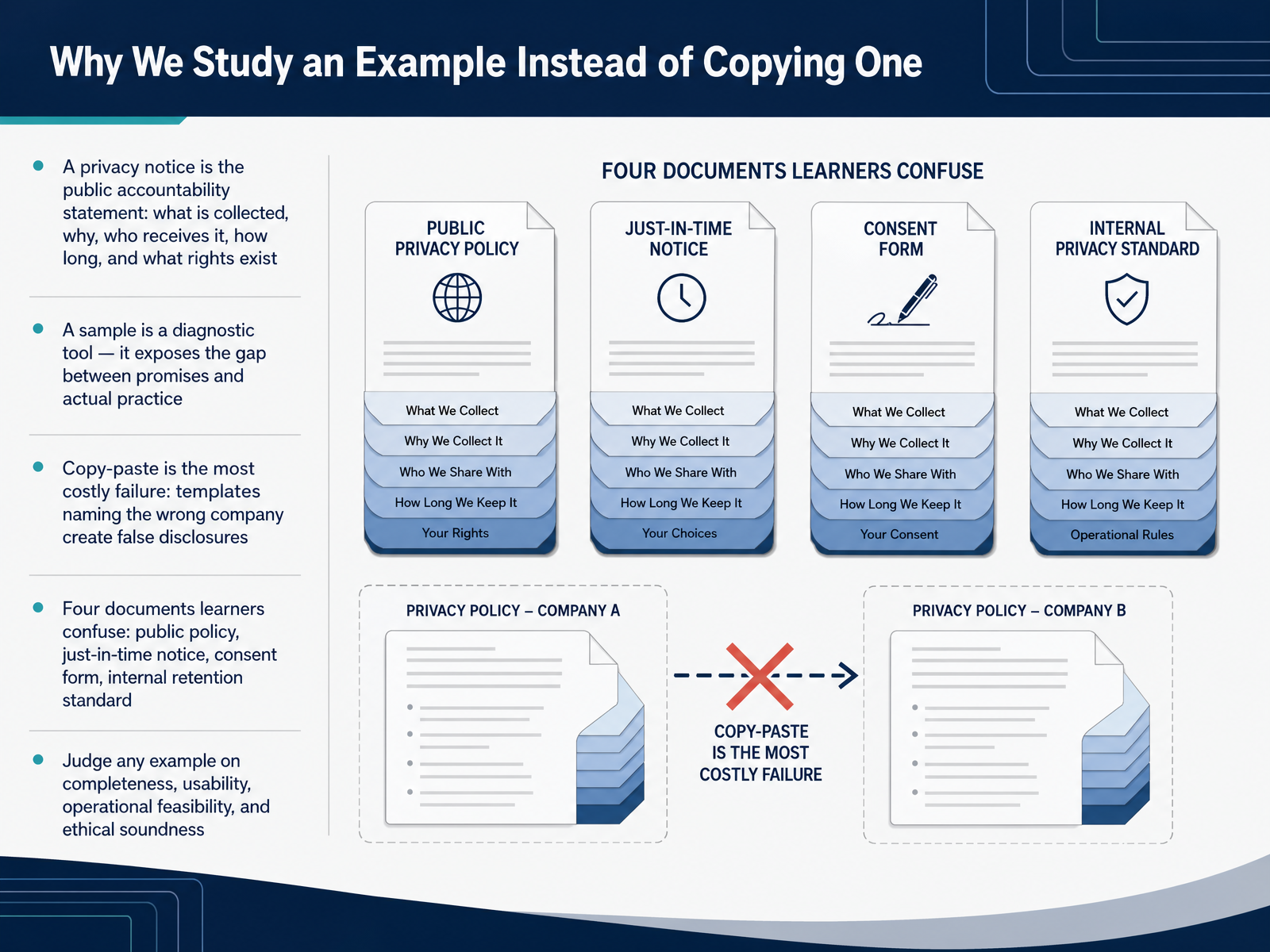
- 02Why We Study an Example Instead of Copying OneLet's take the next step. Why study an example, instead of copying one? A privacy notice is your public accountability statement. It says what you collect, why, who receives it, how long you keep it, and what rights people have. A sample is a diagnostic tool. It exposes the gap between your promises and your actual practice. Copy and paste is the most costly failure. Templates that name the wrong company create false disclosures. So watch for four documents people confuse. First, the public policy. Second, the just-in-time notice. Third, the consent form. And fourth, the internal retention standard. Each does a different job. Then judge any example on four tests. Completeness. Usability. Operational feasibility. And ethical soundness. Use the example to ask better questions, not to skip your own decisions. Next, let's look at the anatomy of a complete policy example.
 cookieyes.comprivacychecker.prodatashyre.com+22 min
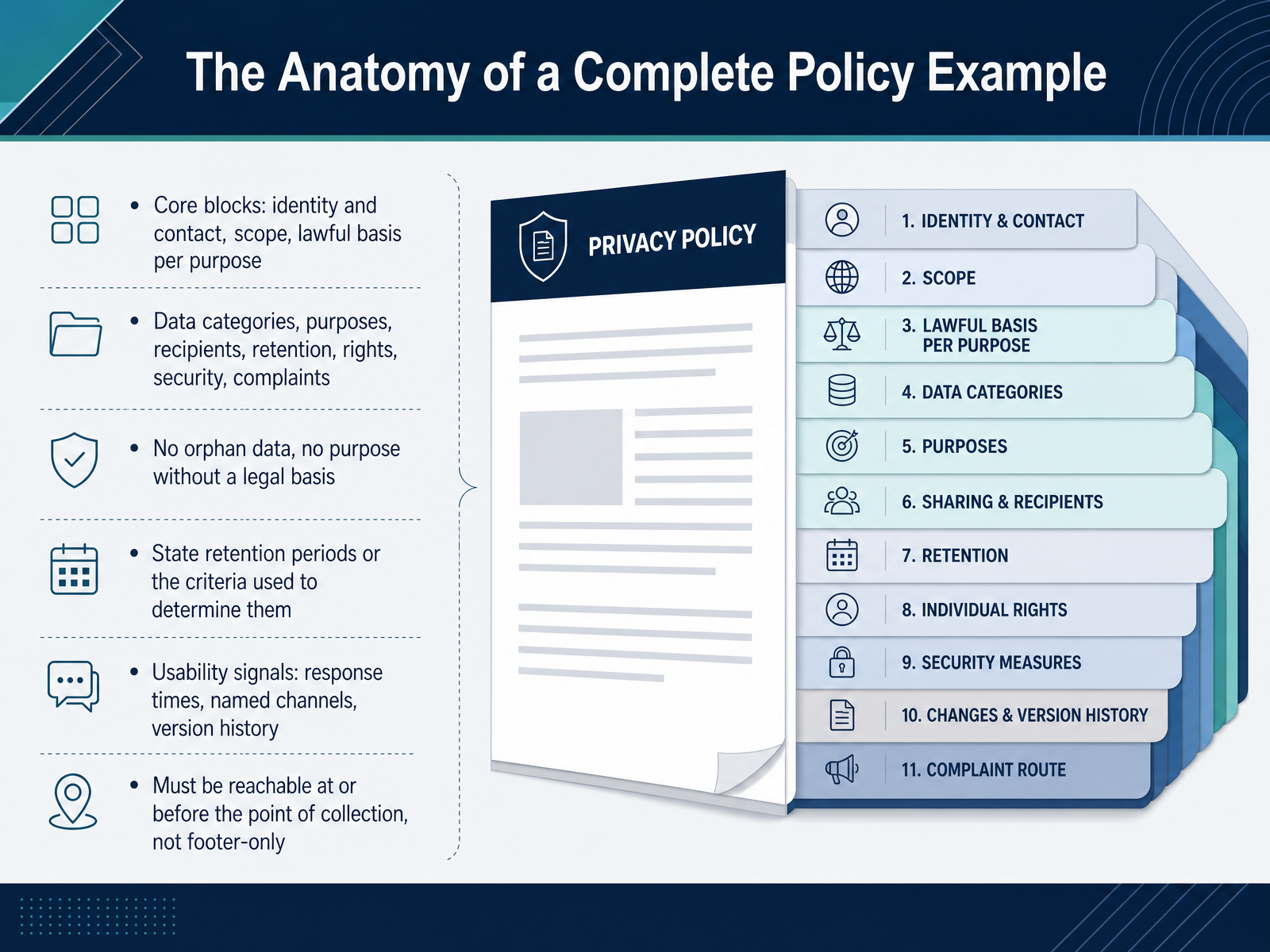
 - 03The Anatomy of a Complete Policy ExampleLet's look at the anatomy of a complete policy example. A strong policy starts with core blocks. First, identity and contact details. Then the scope of the notice. Then a lawful basis tied to each purpose. From there, it lists the data categories, purposes, recipients, retention, rights, security, and complaints. Here is the rule of thumb. No orphan data. Every data category needs a purpose. And no purpose stands without a legal basis. Next, retention. Give a specific period, or state the criteria you use to decide. Vague wording like "as long as necessary" is not enough on its own. What to watch for: usability signals. Name your channels, state your response times, and keep a version history with dates. Finally, placement. The notice must be reachable at or before the point of collection, not buried in the footer alone. Small teams often feel this is heavy, but you can build it once and reuse the blocks. Next, we move into Pattern Library 1: Notice and Choice.
 cookieyes.comprivacychecker.prodatashyre.com+22 min
 - 04Pattern Library 1: Notice and ChoiceNow let's build your pattern library. We'll start with notice and choice.
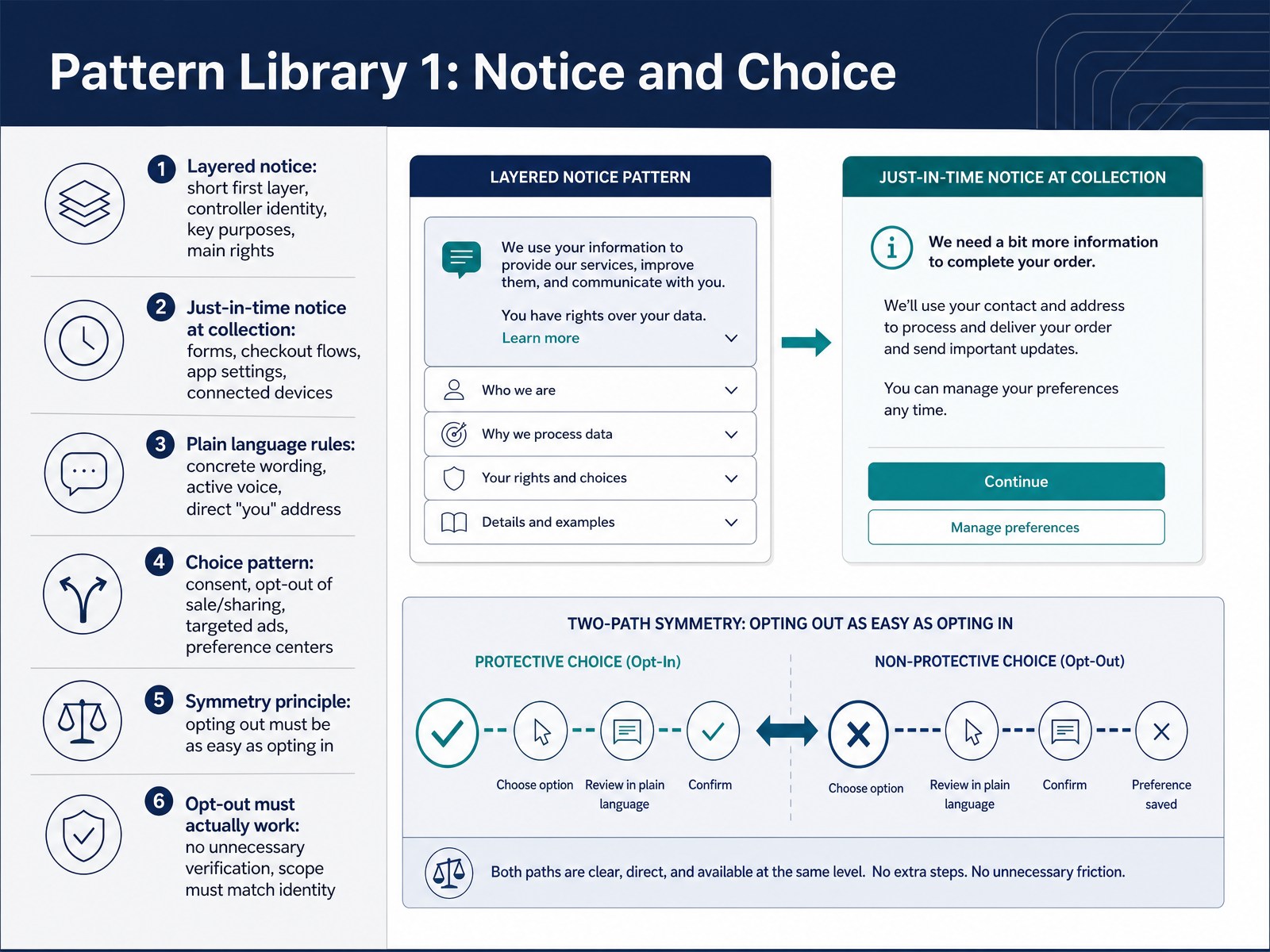
First, layered notice. Give people a short first layer: who you are, the key purposes, and their main rights. Keep the full detail underneath for anyone who wants it.
Next, just-in-time notice at collection. Show it where data is actually collected: forms, checkout flows, app settings, and connected devices.
Then plain language. Use concrete words, active voice, and direct address. Write "we will use your email to send updates," not vague phrasing.
For choice, offer a clear preference center. Cover consent, opt-outs for sale or sharing, and targeted ads.
The trade-off here is effort. Small teams often lack time, so reuse one notice component everywhere.
Now the symmetry principle. Opting out must be as easy as opting in. A recent California case fined a company millions because its opt-out only worked on one device and one service. That is a real cost.
What to watch for: opt-out must actually work. No unnecessary verification, like a confirmation email. And the scope must match the identity. If someone is logged in, apply the choice across their whole account.
So remember: short first layer, choices where data is collected, plain words, and symmetry.
Next, Pattern Library 2: Rights, Retention, Sharing, and Transfers.
 oag.ca.govprivacylawmap.comconsenteo.com+22 min
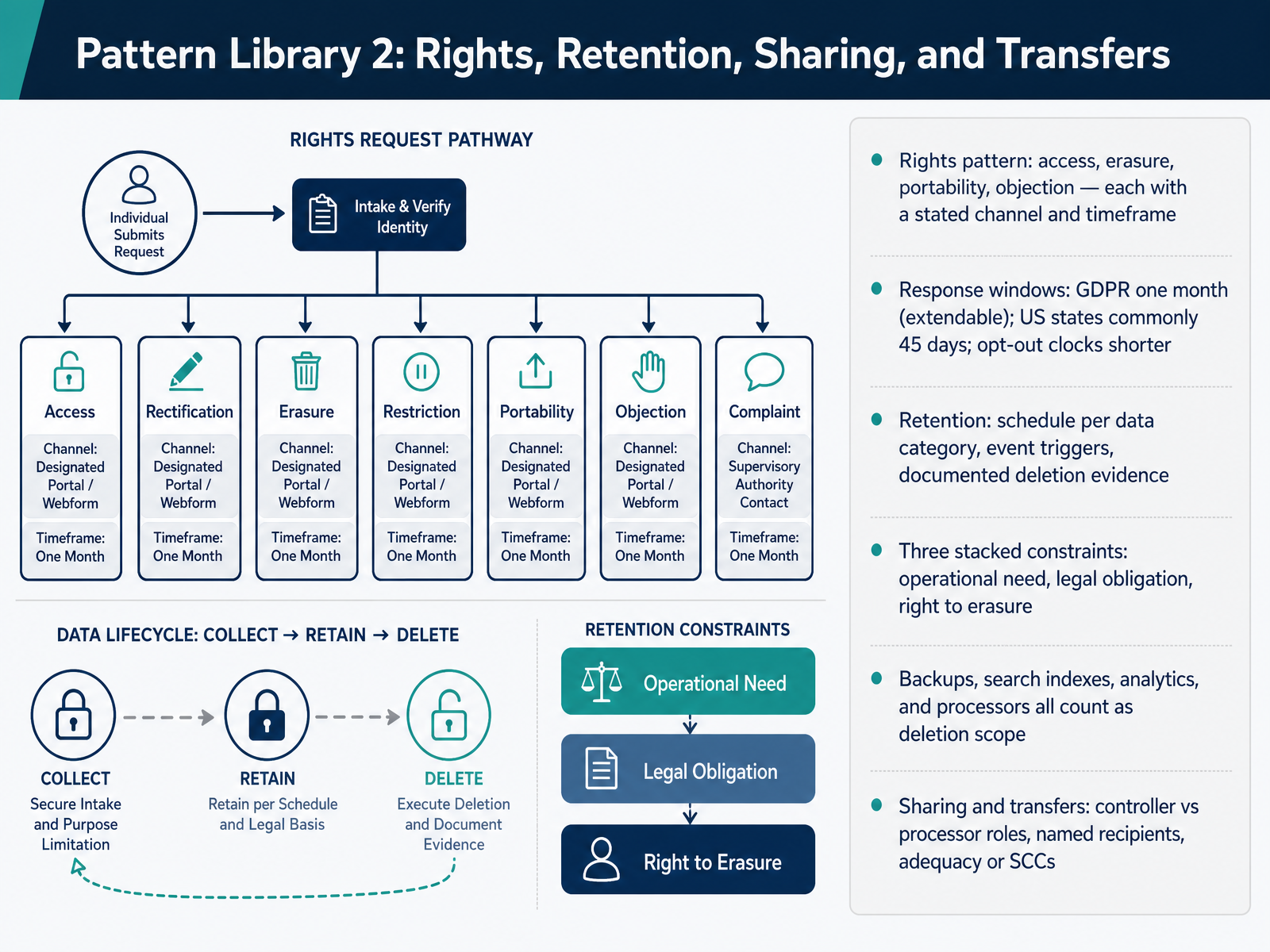
 - 05Pattern Library 2: Rights, Retention, Sharing, and TransfersLet's move on to the second pattern library. This slide covers rights, retention, sharing, and transfers. First, rights. Your privacy notice should name a channel and a timeframe for access, erasure, portability, and objection requests. Then, response windows. Under GDPR, you have one month, and you can extend it. Most US states use forty five days. Opt-out clocks are often shorter. What to watch for next: retention. Build a schedule per data category, with event triggers and documented deletion evidence. Here is the trade-off. Three constraints stack: operational need, legal obligation, and the right to erasure. Deletion scope includes backups, search indexes, analytics, and processors. Finally, sharing and transfers. Know who is a controller and who is a processor. Name your recipients. And for cross-border transfers, rely on an adequacy decision or standard contractual clauses. Next, we'll look at strengths worth institutionalizing.
 datenschutzarchiv.orgsota.iosesamedisk.com+21 min
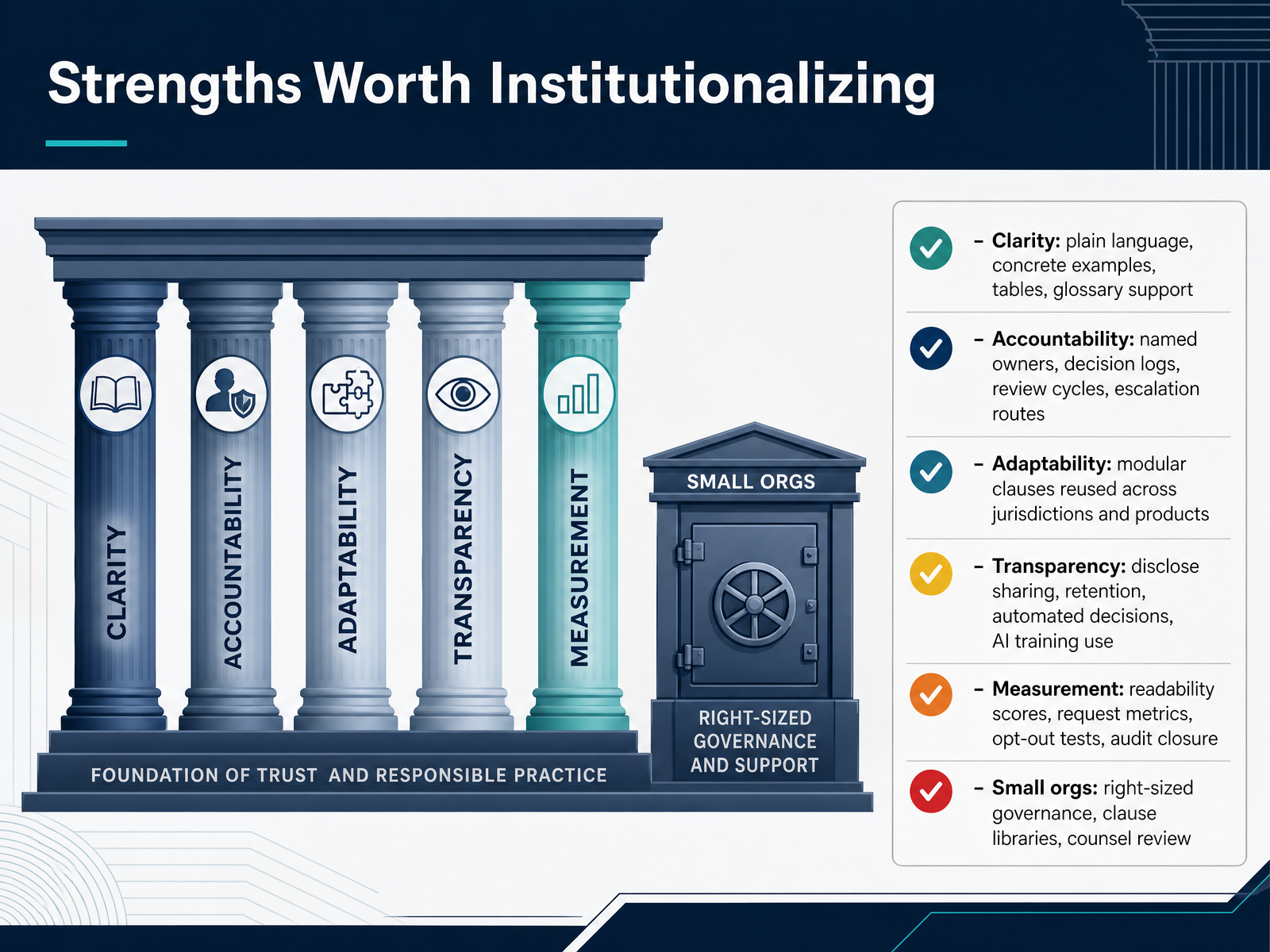
 - 06Strengths Worth InstitutionalizingNext, let's look at the strengths worth institutionalizing. These are patterns you can reuse, not one-off fixes. First, clarity. Write in plain language and add concrete examples. Tables and a short glossary help readers find answers fast. Second, accountability. Name a specific owner for your policy. Keep a decision log, set review cycles, and define escalation routes. The trade-off here is time, but it prevents drift. Third, adaptability. Build modular clauses you can reuse across jurisdictions and products. Fourth, transparency. Disclose data sharing, retention periods, automated decisions, and whether you use personal data to train AI. Fifth, measurement. Track readability scores, request volume, opt-out tests, and audit closure. Small organizations: right-size your governance. Start with a clause library and one counsel review. What to watch for: choose owners and metrics you can actually sustain. Now let's turn to the patterns that cause trouble, in Pitfalls That Trigger Enforcement.
 doi.orgdoi.orginria.hal.science+22 min
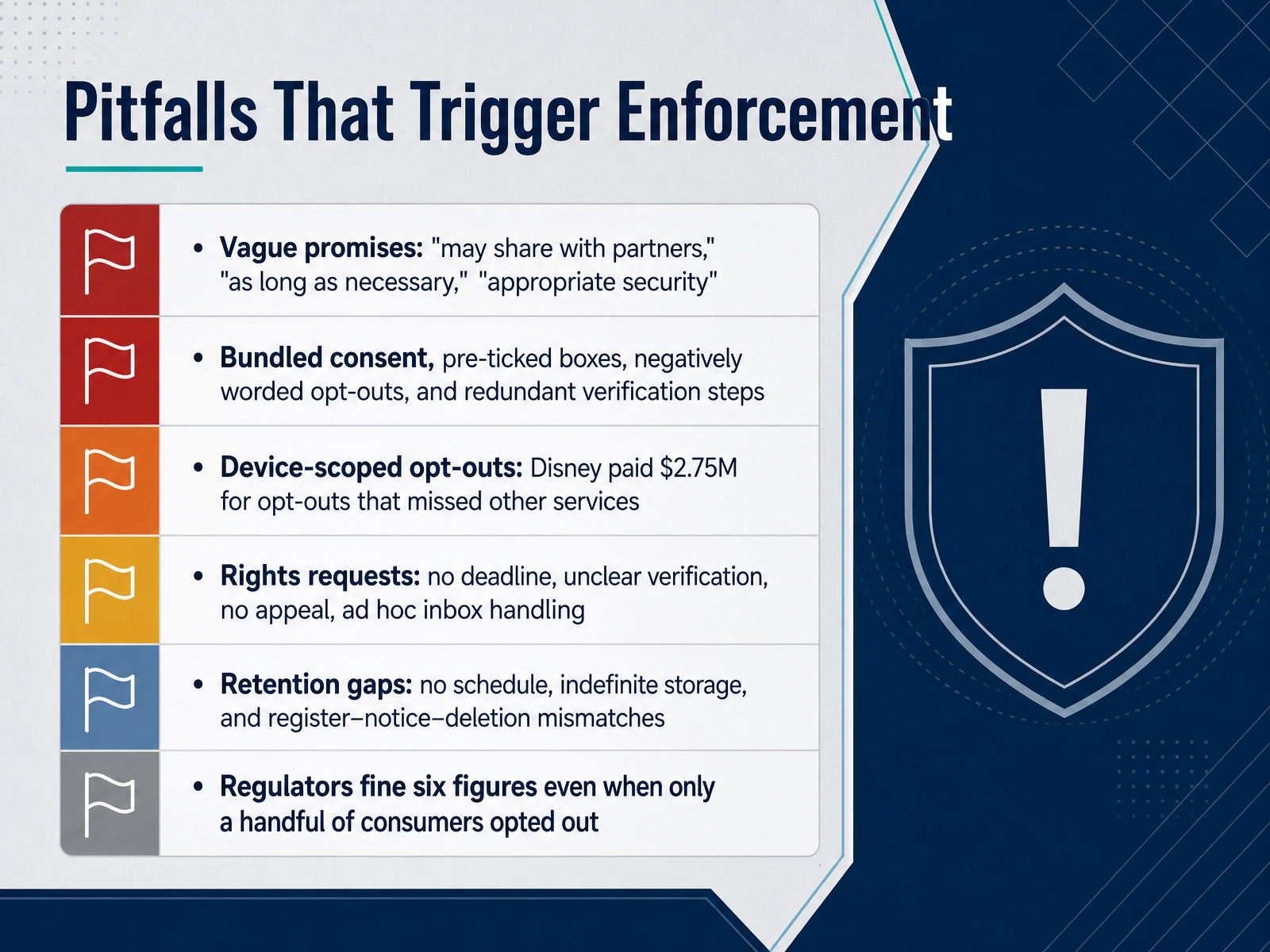
 - 07Pitfalls That Trigger EnforcementLet's look at the pitfalls that actually trigger enforcement, because small wording and design choices create real fines. First, watch vague promises. Phrases like "may share with partners" or "appropriate security" give no real limit. What to watch for next: bundled consent. Pre-ticked boxes, negatively worded opt-outs, and extra verification steps all add friction. Regulators call that unnecessary friction. Then there's scope. Disney paid two point seven five million dollars because its opt-out only covered one device or service, not the whole account. So opt-outs must follow the person. Next, rights requests. Without a deadline, clear verification, an appeal path, and tracked handling, requests fall through the cracks. Finally, retention gaps. No schedule means indefinite storage, and your register, notice, and deletion jobs drift apart. Remember, regulators fine six figures even when only a handful of consumers opted out. Fix the flow, not just the wording. Now let's move to jurisdiction cross-checks for multi-market policies.
 oag.ca.govprivacylawmap.comconsenteo.com+22 min
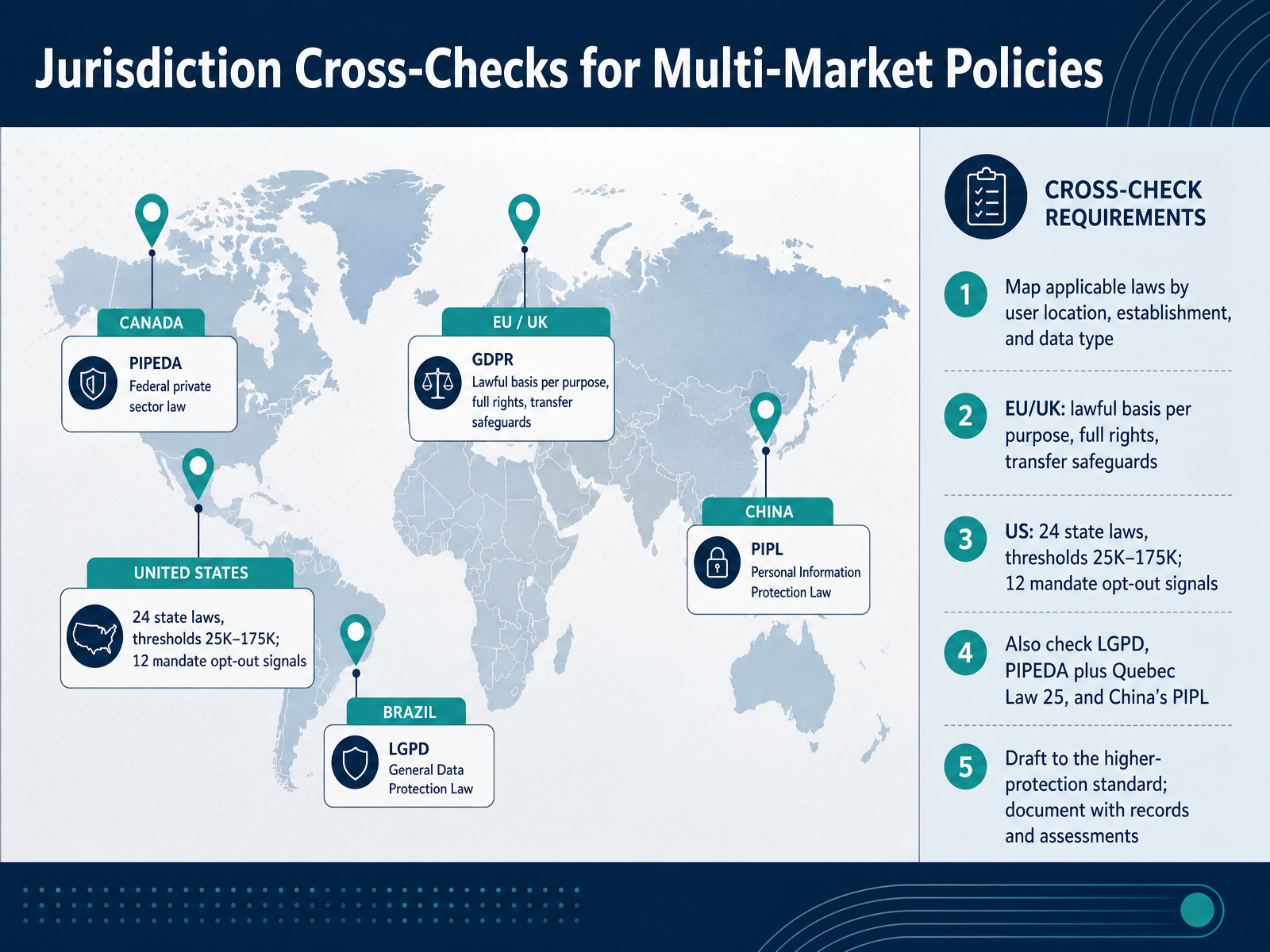
 - 08Jurisdiction Cross-Checks for Multi-Market PoliciesNext, let's look at jurisdiction cross-checks for multi-market policies. Start by mapping which laws apply to you. Ask three questions. Where are your users located? Where is your organisation established? And what kind of data are you handling? First, in the EU and UK, you need a lawful basis for every purpose. You must support the full set of rights, and you must have transfer safeguards in place. The trade-off here is more documentation, but fewer surprises later. In the United States, check state laws individually. There are around twenty-four state laws, and thresholds range from twenty-five thousand to one hundred and seventy-five thousand consumers. Twelve states also require you to honour opt-out signals, like the Global Privacy Control. What to watch for. Also check Brazil's LGPD, Canada's PIPEDA with Quebec Law 25, and China's PIPL. These carry their own consent and transfer rules. Here is your practical rule. Draft to the higher-protection standard. Then document your choices with records and assessments. That way one solid programme covers many markets. Adapting an Example Safely: A Working Sequence.
 2 min
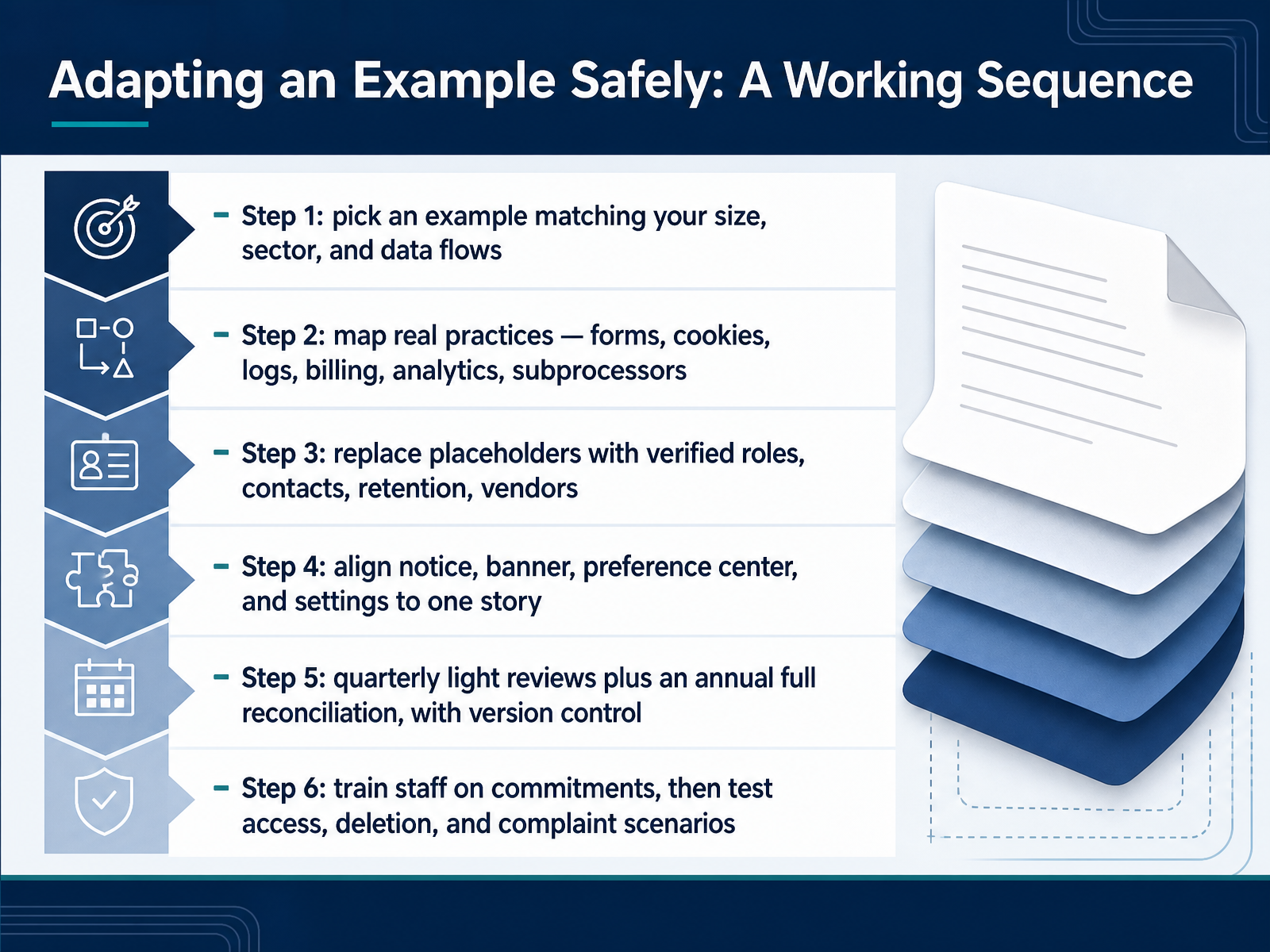
2 min - 09Adapting an Example Safely: A Working SequenceNow, let's look at adapting an example safely.
Here is a working sequence you can actually run.
First, pick an example that matches your size, your sector, and your data flows. A template from a global giant will not fit a small team.
The trade-off here is time. Step two takes the longest. Map your real practices. That means forms, cookies, logs, billing, analytics, and subprocessors. Name the systems actually running today.
Then replace every placeholder with verified detail. Real roles, real contacts, real retention periods, real vendors.
Next, align everything to one story. Your notice, banner, preference center, and settings should agree.
What to watch for: drift. So schedule light reviews each quarter, plus one full reconciliation each year, with version control.
Finally, train your staff on the commitments. Then test access, deletion, and complaint scenarios, so you know the promises work.
Quick takeaway: an example is a starting point, not a finished policy. Let's turn now to teaching and assessing policy examples.
 cookieyes.comdatenschutzarchiv.orgsota.io+22 min
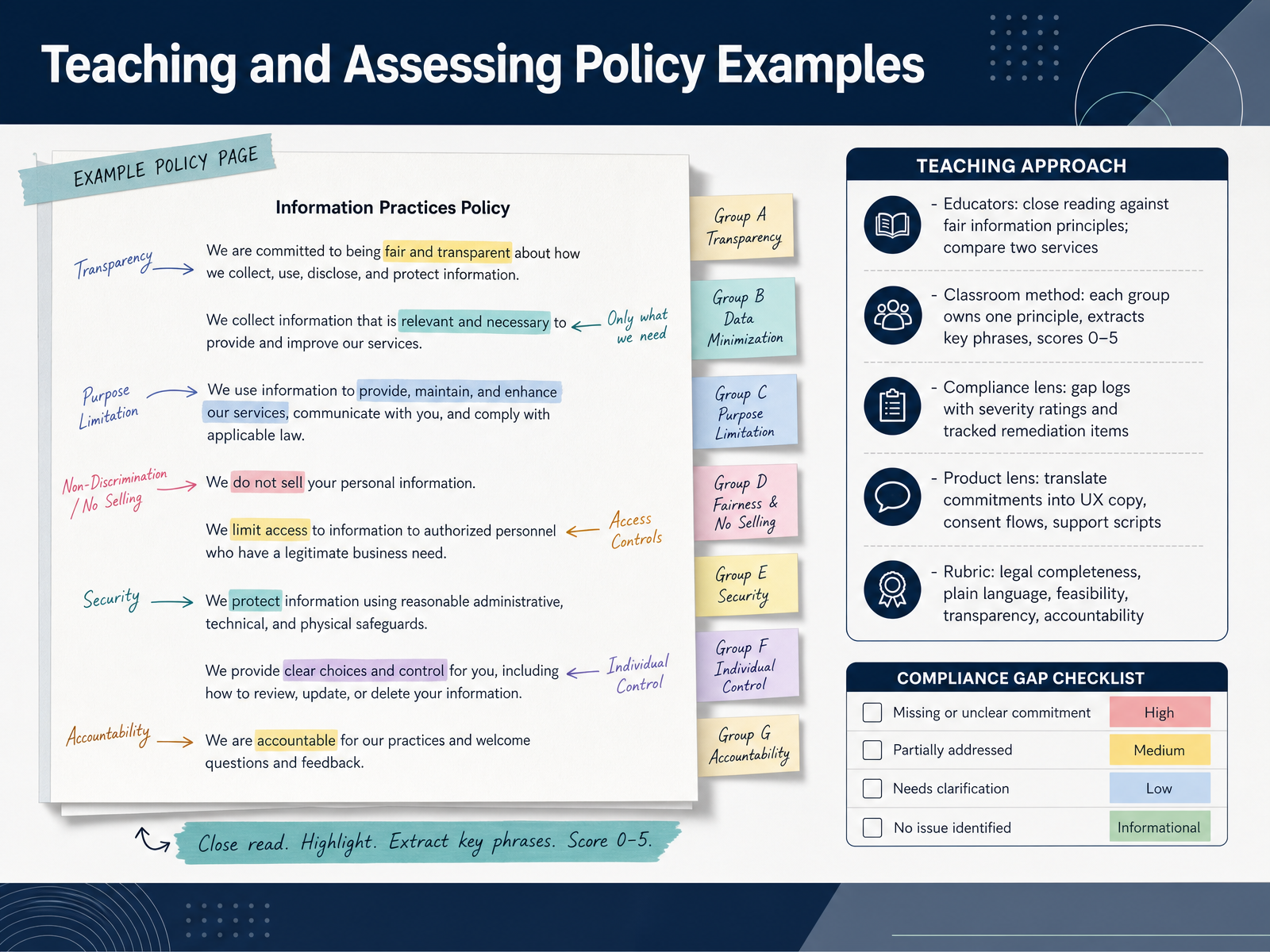
 - 10Teaching and Assessing Policy ExamplesNow let's look at how you teach and assess policy examples. First, educators. Ask learners to do a close reading against fair information principles, then compare two services side by side. In the classroom, give each group one principle. They extract key phrases and score the service from zero to five. What to watch for? Scores need evidence, not guesses. Next, the compliance lens. Keep gap logs with severity ratings and tracked remediation items. The trade-off here is time. A simple log beats a perfect one you never finish. Then the product lens. Turn commitments into user experience copy, consent flows, and support scripts. If the policy says one thing and the interface says another, users lose trust. Finally, build your rubric around five checks. Legal completeness. Plain language. Feasibility. Transparency. And accountability. That gives every team a usable standard. Next, we will walk through a rapid policy review simulation.
 doi.orgdoi.orginria.hal.science+22 min
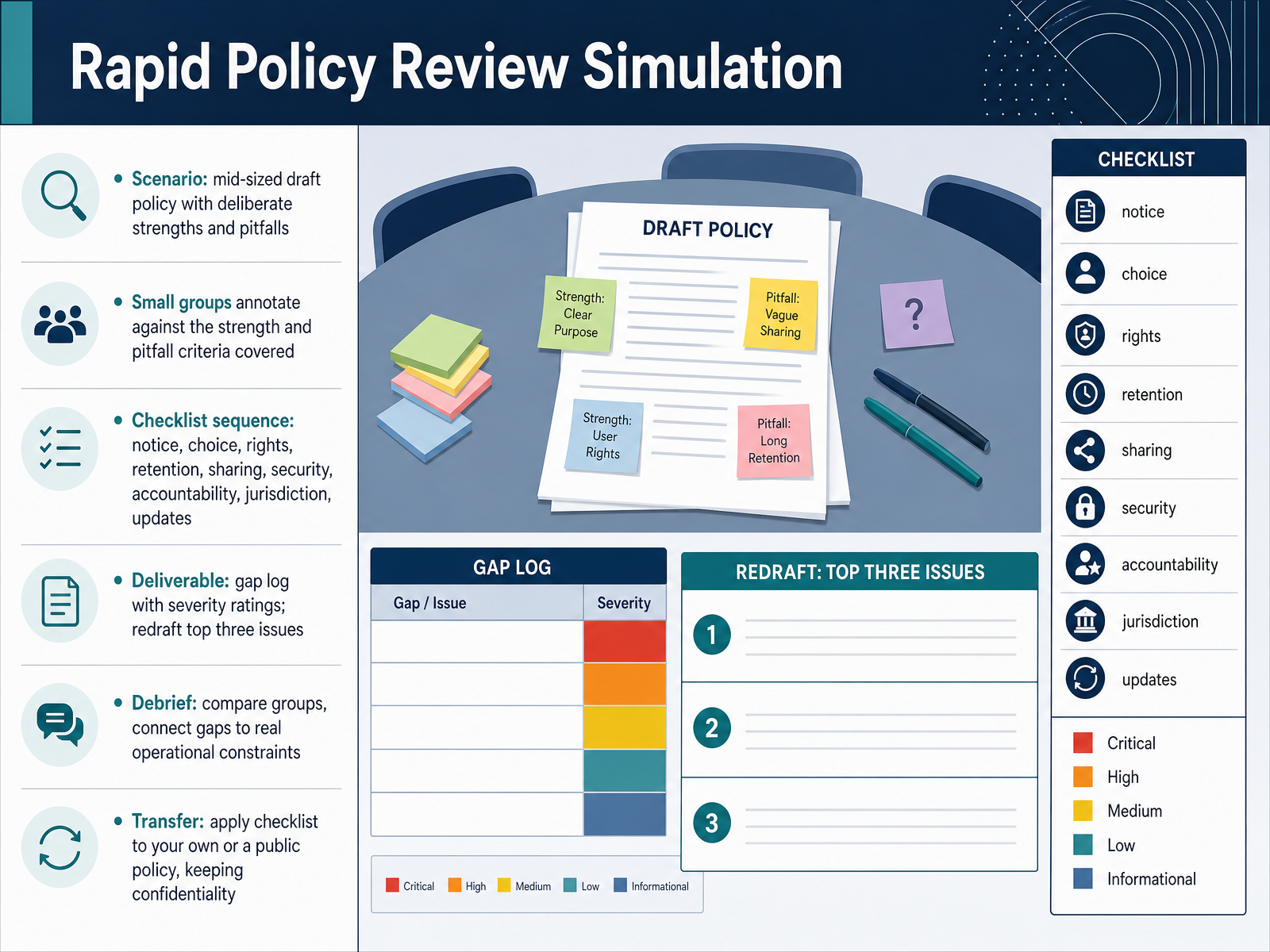
 - 11Rapid Policy Review SimulationNow let's put your review skills into practice. Here is a simulation. You get a mid-sized draft policy with deliberate strengths and deliberate pitfalls built in. In small groups, you annotate it against the strength and pitfall criteria we covered. Work through the checklist in order: notice, choice, rights, retention, sharing, security, accountability, jurisdiction, and updates. Say each one out loud as you go. First, mark what the policy does well, so you build on strengths, not just fix faults. The trade-off here is time. Small organisations often skip this step, but a short structured pass beats a long vague one. What to watch for is severity. Your deliverable is a gap log with severity ratings, then a redraft of your top three issues. In the debrief, compare groups. Connect each gap to a real operational constraint, such as a tool you cannot switch off this quarter. Then transfer the checklist to your own policy, or a public one, keeping confidentiality. Next, common misconceptions and how to correct them. It will help you spot the pitfalls that trip teams up most.
 cookieyes.comrobmelton.comdatenschutzarchiv.org+22 min
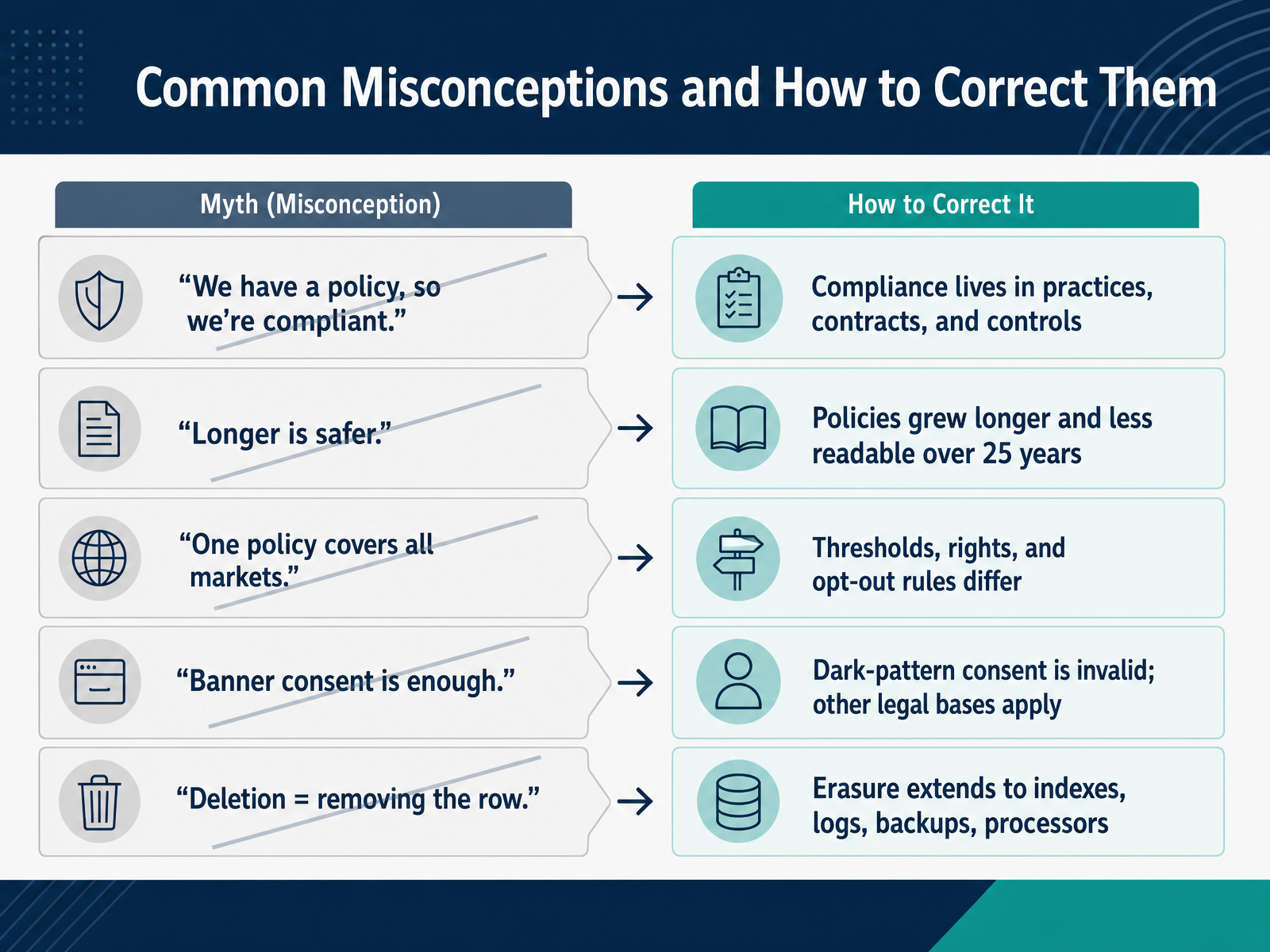
 - 12Common Misconceptions and How to Correct ThemLet's clear up five common misconceptions. First, a policy does not make you compliant. Compliance lives in your practices, your contracts, and your controls. You can write a perfect document and still fail an audit. Second, longer is not safer. Over twenty-five years, policies grew longer and harder to read. Longer often means less understood. Third, one policy rarely covers all markets. Thresholds, rights, and opt-out rules differ by region. What to watch for here is assuming your global template fits everywhere. Fourth, a consent banner alone is not enough. Consent collected through dark patterns is invalid, and other legal bases still apply. Keep your accept and reject options symmetrical. Fifth, deletion is not just removing a row. Erasure extends to indexes, logs, backups, and processors. So make deletion a workflow, not a single click. Correcting these five beliefs turns your policy from paperwork into a real control. Next, let's move to your key takeaways and next steps.
 doi.orgdoi.orginria.hal.science+22 min
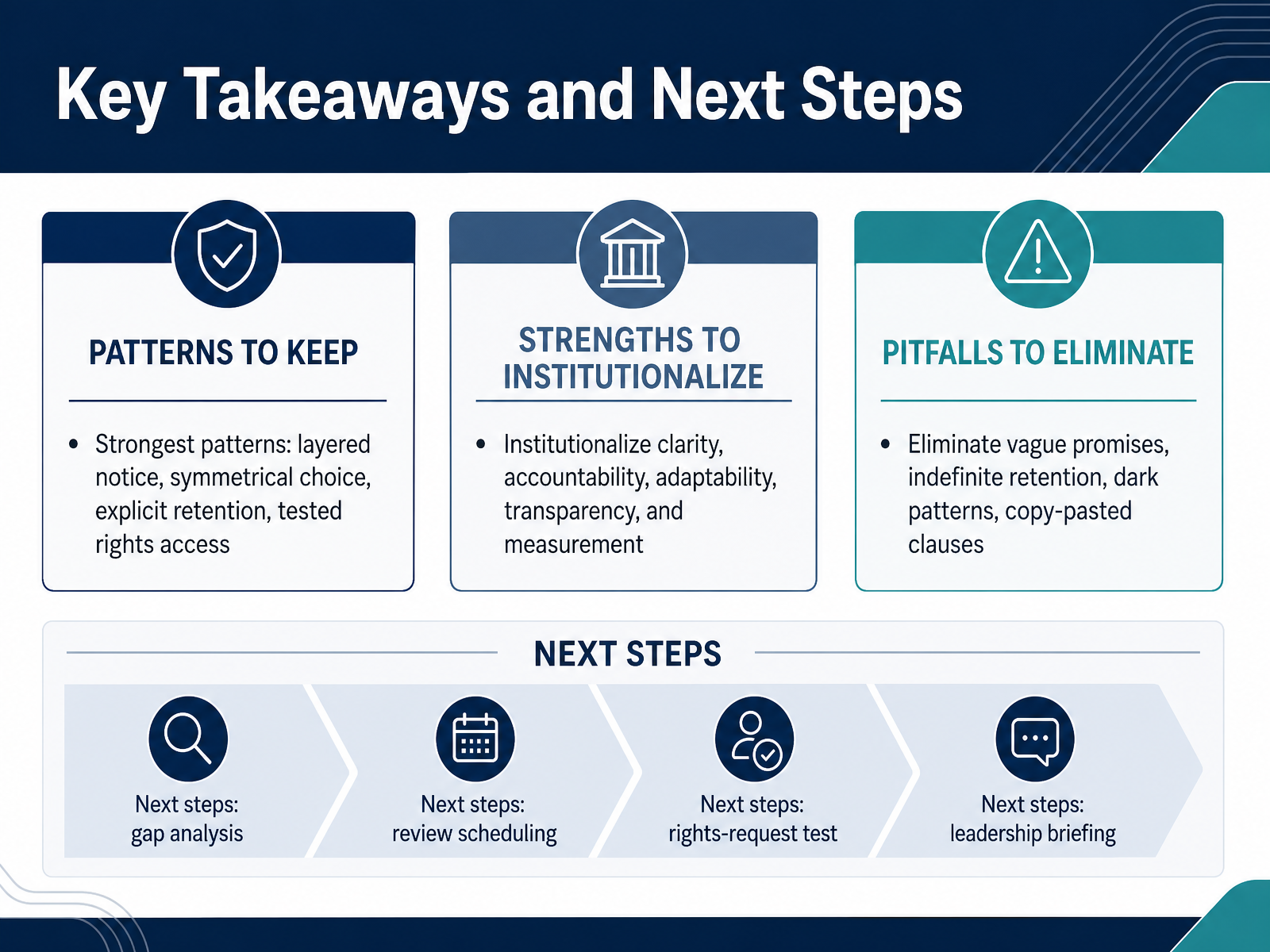
 - 13Key Takeaways and Next StepsLet's pull the course together with the key takeaways and next steps. First, the strongest patterns: layered notice, symmetrical choice, explicit retention, and tested rights access. Keep those four working in practice, not just on paper. Next, institutionalize five habits: clarity, accountability, adaptability, transparency, and measurement. The trade-off here is time, so start small. What to watch for: eliminate vague promises, indefinite retention, dark patterns, and copy-pasted clauses. If you serve multiple markets, map each requirement to your policy text, then draft to the higher standard. Build to the strictest rule you face and add local exceptions. For your next steps, run a gap analysis, schedule regular reviews, test a real rights request end to end, and brief your leadership. That sequence turns a document into a working program. Now let's look at Resources, Templates, and Ongoing Monitoring.
 cookieyes.comrobmelton.com2 min
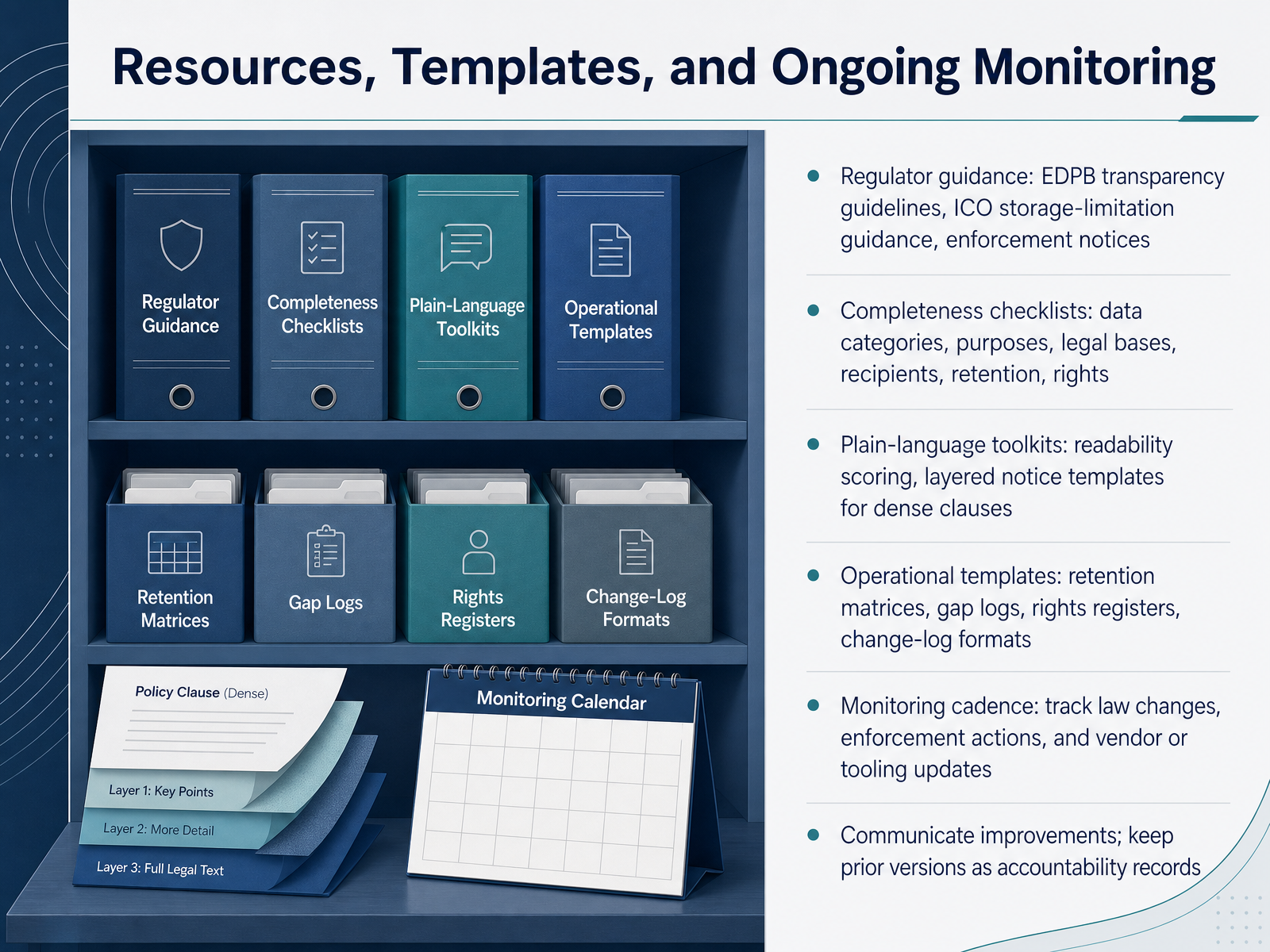
 - 14Resources, Templates, and Ongoing MonitoringLet's close with the resources that keep your work current. First, regulator guidance: the EDPB transparency guidelines, the ICO storage-limitation guidance, and published enforcement notices. These show you what regulators actually check. Second, completeness checklists. Cover data categories, purposes, legal bases, recipients, retention, and rights. If a checklist item has no answer, that is your gap. Third, plain-language toolkits. Use readability scoring and layered notice templates for dense clauses. The trade-off here is time. Small organisations rarely have a legal team, so start with a scored read of your top three clauses. Fourth, operational templates: retention matrices, gap logs, rights registers, and change-log formats. These turn policy into repeatable practice. Finally, set a monitoring cadence. Track law changes, enforcement actions, and vendor or tooling updates. Then communicate improvements, and keep prior versions as accountability records. You now have the patterns, the strengths, and the pitfalls. You also have usable checks. Thank you for your attention, and keep building trust, one clear notice at a time.
 cookieyes.comrobmelton.comprivacychecker.pro+22 min
Take the deck with you
Download this course as a file — free, no sign-up needed.
- PDF handoutEvery slide page, ready to print or share.15 pages · 3.8 MBDownload
- Narrated PowerPointThe deck that presents itself — every slide carries the digital human's narration video.15 pages · 14.7 MBDownload
- PowerPoint slidesThe full deck as a .pptx — open it in PowerPoint, Keynote, or Google Slides.15 pages · 3.7 MBDownload
Free to use in your own training — please keep the PersonWise credit page at the end.
Have your own deck? Turn it into a course
Sources consulted
Web sources consulted while building this course.
- Privacy Policy Checklist 2026: Is Yours Up-to-Date? - CookieYes — cookieyes.com
- Website Privacy Checklist 2026: 30 Checks Before You Launch | PrivacyChecker Blog — privacychecker.pro
- GDPR Compliant Privacy Notice: A 2026 Checklist for Clear Disclosures - DataShyre | Consent Management Platform & MarTech Services — datashyre.com
- Website Privacy Audit Checklist for 2026 — 47 Points to Review — businessconnect.lt
- Privacy & Data Protection GDPR Privacy Policy Requirements: What Every Business Must Include - Robert Melton — robmelton.com
- California Won't Let It Go: Attorney General Bonta Announces $2.75 Million Settlement with Disney, Largest CCPA Settlement in California History | State of California - Department of Justice - Office of the Attorney General — oag.ca.gov
- Dark Patterns and Privacy Opt-Out Compliance: What the CPPA Enforcement Actions Mean for Your Business | PrivacyLawMap — privacylawmap.com
- The Honda, Ford, and Disney CCPA Cases: What Every Cookie Banner Designer Must Learn | Consenteo — consenteo.com
- CalPrivacy Announces Final Stipulated Order with LocateSmarter LL — natlawreview.com
- CCPA Fines SpiceJet Rs 1 Lakh for Dark Patterns on Booking Website — medianama.com
- Implementation of the right to erasure by controllers — datenschutzarchiv.org
- Blog — sota.io — sota.io — sota.io
- GDPR Compliance Checklist 2026 - Sesame Disk — sesamedisk.com
- Principle (e): Storage limitation | ICO — ico.org.uk
- DSAR, Erasure and ISO 27001 Evidence in 2026 - Clarysec — blog.clarysec.com
- Large-scale readability analysis of privacy policies — doi.org
- Comprehensive evaluation of privacy policies using the contextual integrity framework — doi.org
- https://inria.hal.science/hal-03243632/file/496047_1_En_22_Chapter.pdf — inria.hal.science
- Evaluating AI-Based Privacy Policy Formats: Intention to Use, Trust, and Transparency — doi.org
- Privacy Policies Across the Ages: Content and Readability of Privacy Policies 1996--2021 — doi.org