Revolutions That Shaped Modern World
Begin
14 pages · ~28 min
Revolutions That Shaped Modern World
Explore the pivotal revolutions—political, industrial, and social—that transformed history and shaped today's global landscape for history enthusiasts and lifelong learners.
What you’ll learn
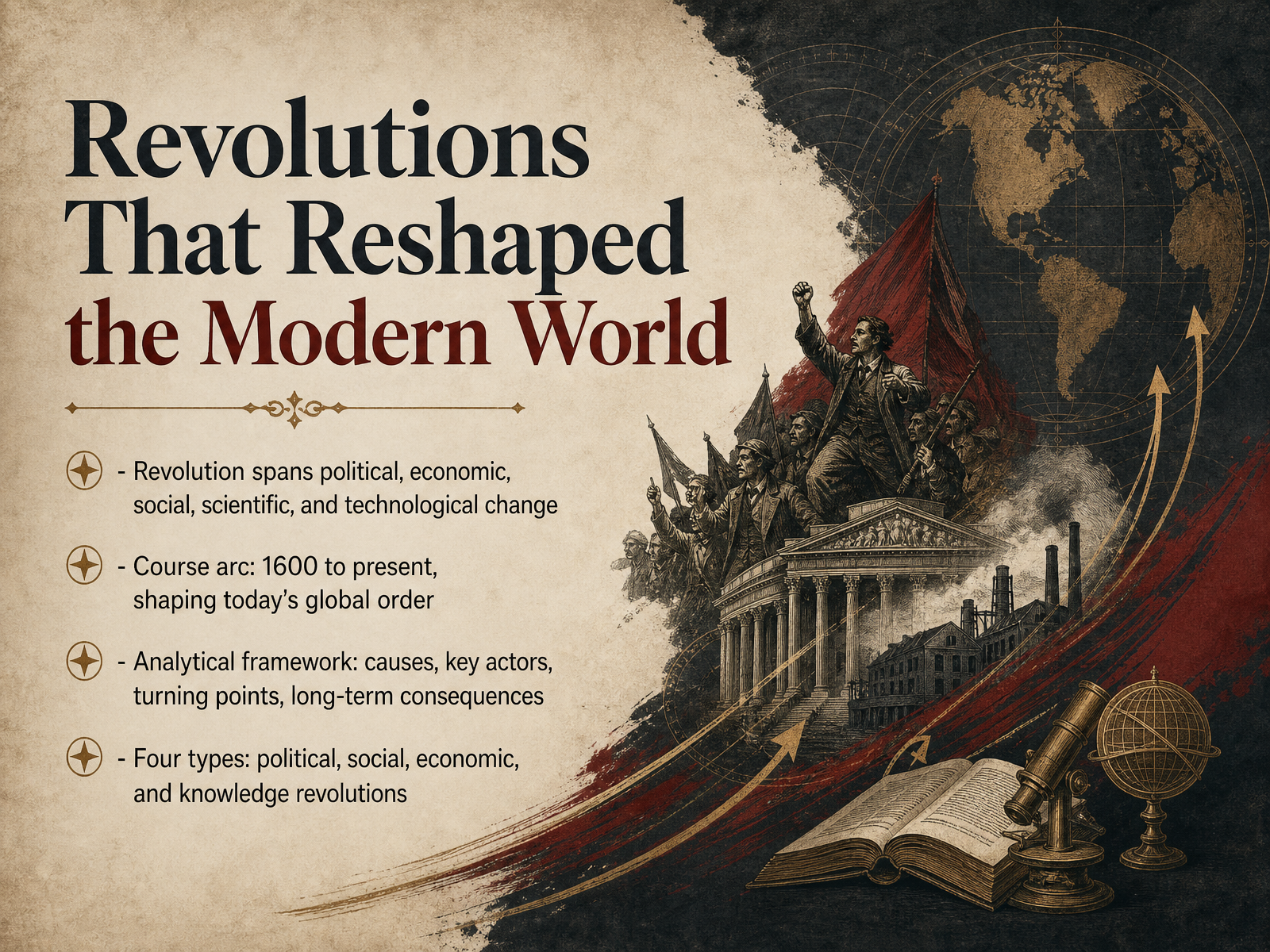
- 01Revolutions That Reshaped the Modern WorldWelcome. Whether you are a history learner, an educator, or a knowledge creator, you have probably sensed that the world we live in was not built gradually, but forged in dramatic breaks. This course, Revolutions That Reshaped the Modern World, invites you to think like a historian and trace the forces that created the global order we now inhabit. Revolution is not just a political event. It spans economic upheavals, social transformations, scientific breakthroughs, and technological leaps, all of which have redefined how we live, work, and govern. We will journey from the sixteen hundreds to the present, examining not only what happened, but why it happened and what it left behind. Our analytical lens will be sharp and consistent. We will investigate causes, identify the key actors, trace the turning points, and weigh the long term consequences. Throughout this course, we will organize our inquiry around four types of revolution: political, social, economic, and knowledge. Each one offers a different window into the same story of profound transformation. So, bring your curiosity and your critical thinking. Before we dive into specific upheavals, we need to establish the tools of comparison. Our next step is to build a working vocabulary that will make our analysis rigorous and precise. Let us begin there.plato.stanford.edurep.routledge.comideas.repec.org+22 min
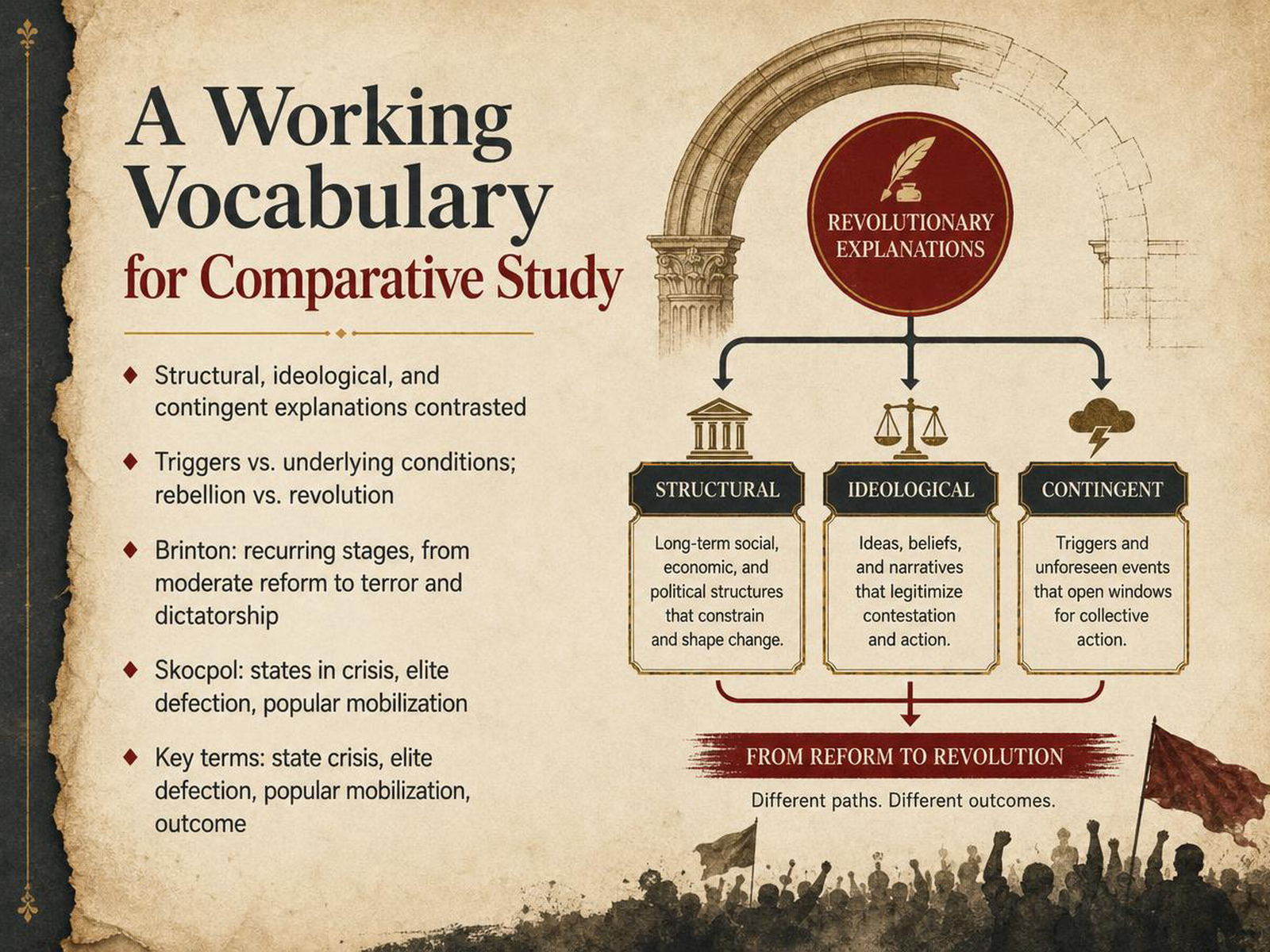
- 02A Working Vocabulary for Comparative StudyLet's build a shared vocabulary before we compare revolutions across centuries. We'll distinguish between structural explanations, which point to deep social and economic pressures, and ideological ones, which focus on beliefs and visions of a better order. Contingent explanations, meanwhile, highlight accidents, personalities, and timing. A trigger is not the same as an underlying condition—just as a rebellion, which rejects authority, differs from a revolution, which seeks to replace it. Crane Brinton's classic study found recurring stages: moderates start the process, radicals take over, terror follows, and eventually a dictator emerges. Theda Skocpol shifted the focus to states themselves—when administrative and military crises weaken a regime, elites defect, and popular groups mobilize, revolution becomes possible. Keep these key terms in mind: state crisis, elite defection, popular mobilization, and outcome. They'll help us see patterns across very different histories. Next, we'll turn to the English Civil War and the Glorious Revolution, 1642 to 1689.
 plato.stanford.edurep.routledge.comideas.repec.org+21 min
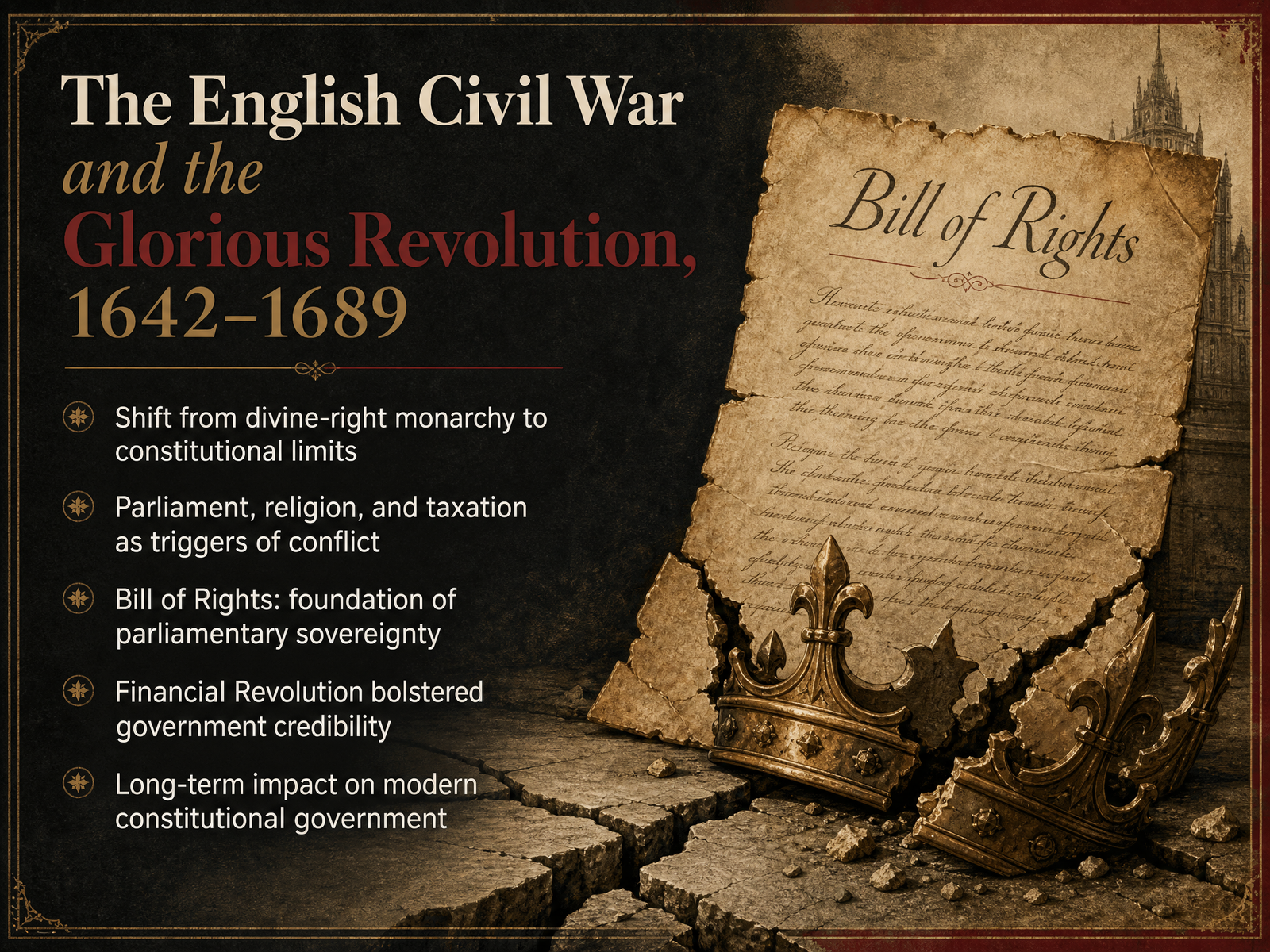
 - 03The English Civil War and the Glorious Revolution, 1642–1689Now let's turn to the English Civil War and the Glorious Revolution, a period that fundamentally shifted how political power was understood. Starting in 1642, England tore itself apart over questions of divine right, religion, and taxation. But the real turning point came in 1688. Parliament, tired of overreach from the crown, effectively replaced King James the Second with William and Mary, and crucially, imposed conditions. This is the Glorious Revolution that we still talk about today. The key product was the Bill of Rights of 1689, which placed clear limits on royal authority and laid the foundation for parliamentary sovereignty. But the even deeper shift was the idea of credible commitment, the government promised to honor its obligations, and because Parliament now had a real say, those promises became believable. That credibility unleashed the Financial Revolution, allowing the state to borrow on a massive scale and become a global power. So while these moments of upheaval sound distant, they built the modern machinery of constitutional government. Their legacy runs directly into the next great moment: the American Revolution and the Birth of Republicanism.
 parliament.ukeh.netparliament.uk+22 min
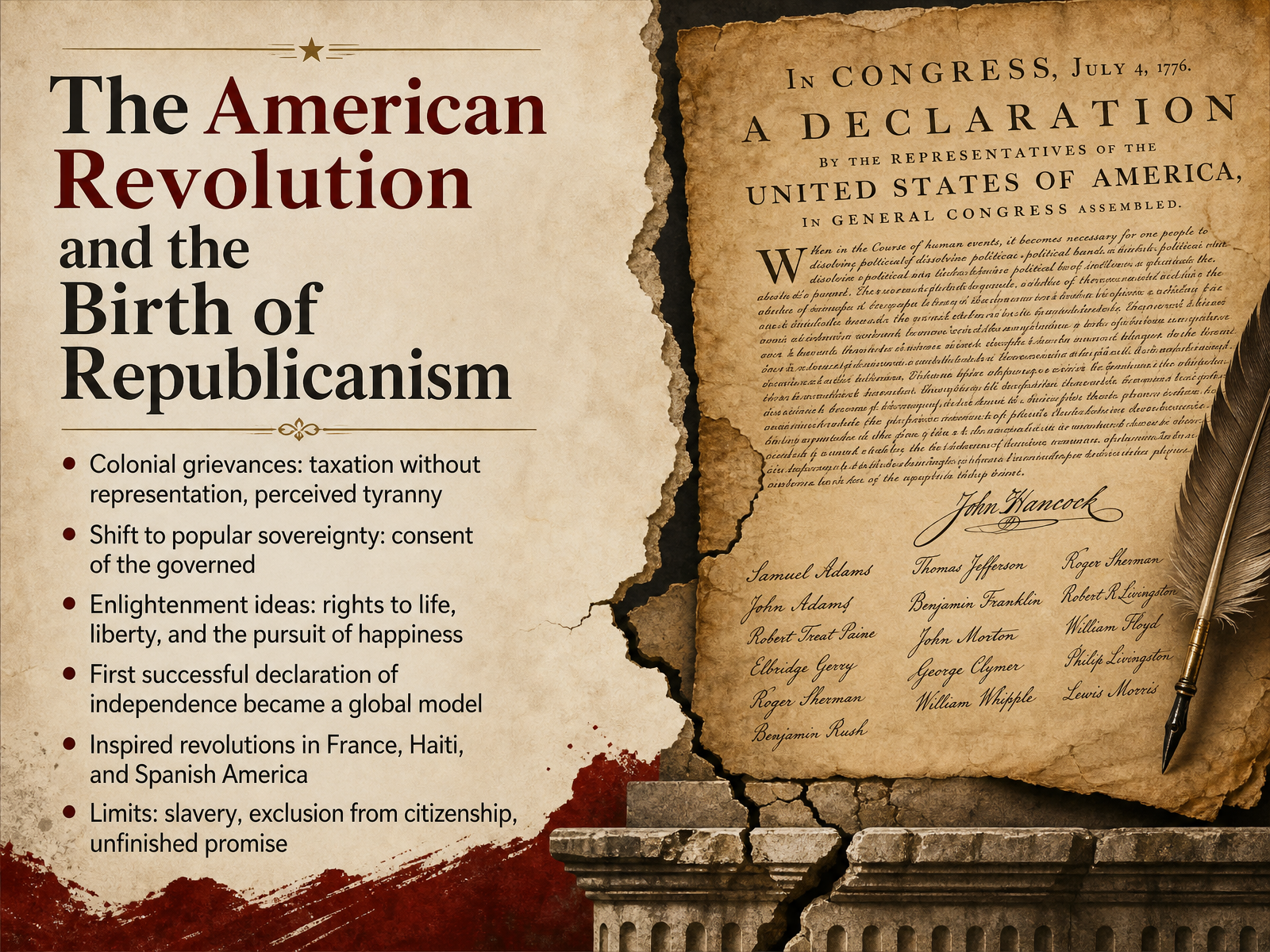
 - 04The American Revolution and the Birth of RepublicanismNow let's turn to a revolution that didn't just create a nation — it created a template. The American Revolution was built on a simple but explosive claim: that government derives its power from the consent of the governed. When colonists protested taxation without representation, they weren't just angry about money. They were challenging the very foundation of monarchy. Drawing on Enlightenment thinkers, Jefferson and his colleagues declared that every person holds rights to life, liberty, and the pursuit of happiness. And then they did something unprecedented — they declared independence. It was the first successful declaration of its kind, and it sent shockwaves around the Atlantic world. Within decades, revolutionaries in France, Haiti, and Spanish America would study it closely, adapting its language to their own struggles. But we must also face the hard truth: this republic was built on a contradiction. It tolerated slavery, excluded women and Indigenous peoples, and left its promise deeply unfinished. The American Revolution gave the world a democratic grammar, but it would take centuries of struggle to make that grammar honest. That unfinished business connects directly to what happened next in France, where revolutionaries took the American example and pushed it toward far more radical conclusions — a story we turn to now.
 gilderlehrman.orgconstitutioncenter.orgpress.princeton.edu+22 min
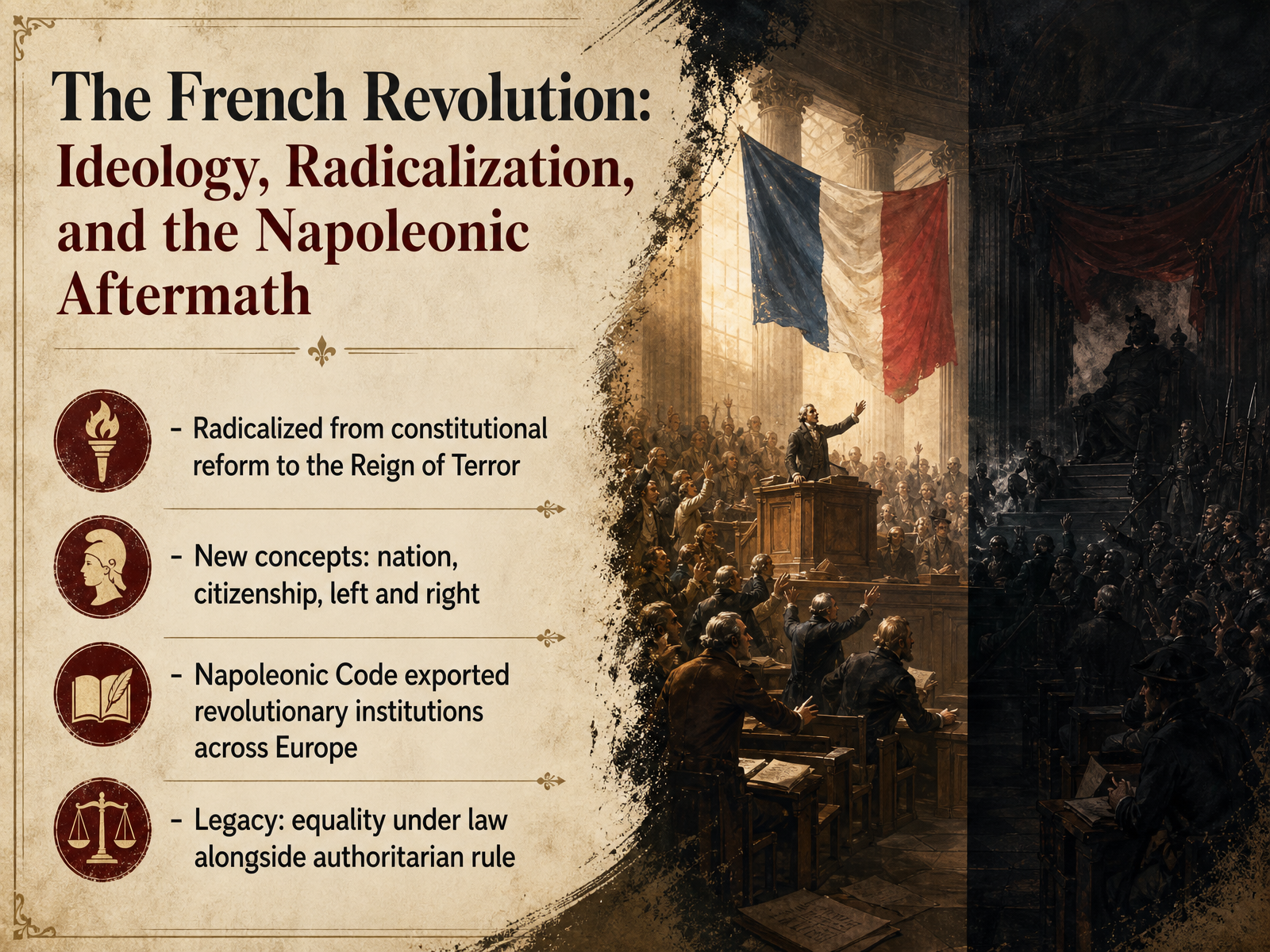
 - 05The French Revolution: Ideology, Radicalization, and the Napoleonic AftermathNow let’s turn to France, where the revolution took a far more radical and contradictory path. What began in 1789 as a push for constitutional reform quickly accelerated into something far more explosive. By 1793, the revolution had entered its most violent phase, the Reign of Terror, when the Committee of Public Safety, under Robespierre’s leadership, executed thousands suspected of opposing the revolution. The guillotine became its chilling symbol. But even amid the bloodshed, the revolution gave birth to transformative ideas. It introduced the modern concept of the nation, not as the king’s domain, but as the people’s collective identity. It redefined citizenship, creating new political categories—left and right—that still structure our debates today. Then came Napoleon. He ended the revolution, yet he also spread its core institutions across Europe. The Napoleonic Code exported the principle of equality under the law, establishing legal uniformity and merit-based advancement. So the legacy here is deeply paradoxical. The French Revolution promised liberty, delivered terror, and ultimately installed an emperor. Yet it permanently shattered the old order, leaving the world a legacy of legal equality fused with authoritarian rule. That tension would haunt Europe for the next century. Next, we’ll see how industry, not politics, would trigger the next great transformation.
 britannica.combritannica.comrevolution.chnm.org+22 min
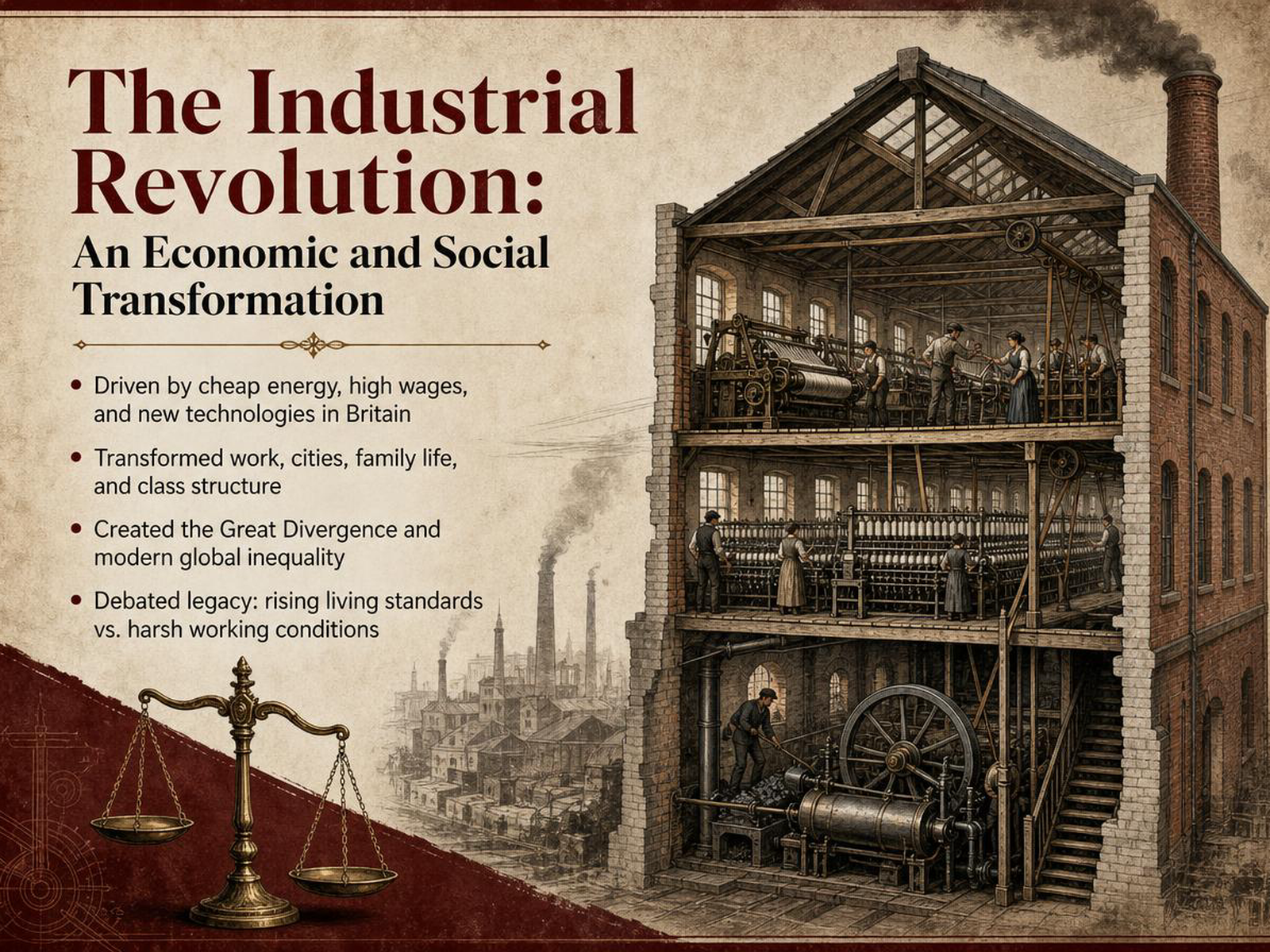
 - 06The Industrial Revolution: An Economic and Social TransformationNow we arrive at the Industrial Revolution, a transformation that reshaped economies, societies, and the very structure of daily life. At its heart was a unique combination of forces in Britain: cheap energy from coal, high wages that made labor-saving machinery profitable, and a stream of technological breakthroughs like the steam engine and the cotton mill. These innovations didn't just speed up production; they rewrote the rules of work. People moved from fields to factories, cities swelled, family routines shifted, and a new class structure emerged—industrialists, workers, and a growing middle class. The effects reached far beyond Britain. This was the moment of the Great Divergence, when the West began pulling ahead of the rest of the world, laying the groundwork for the global inequality we still grapple with today. But the legacy is fiercely debated. Did rising living standards and new opportunities outweigh the harsh working conditions, child labor, and urban poverty? It's a question historians still wrestle with, and it invites us to weigh progress against its human cost. As we shift our gaze across the Atlantic, we'll see how revolutionary ideas about rights and freedom sparked a different kind of upheaval in the Caribbean: the Haitian Revolution and the contest over universal rights from 1791 to 1804.
 2 min
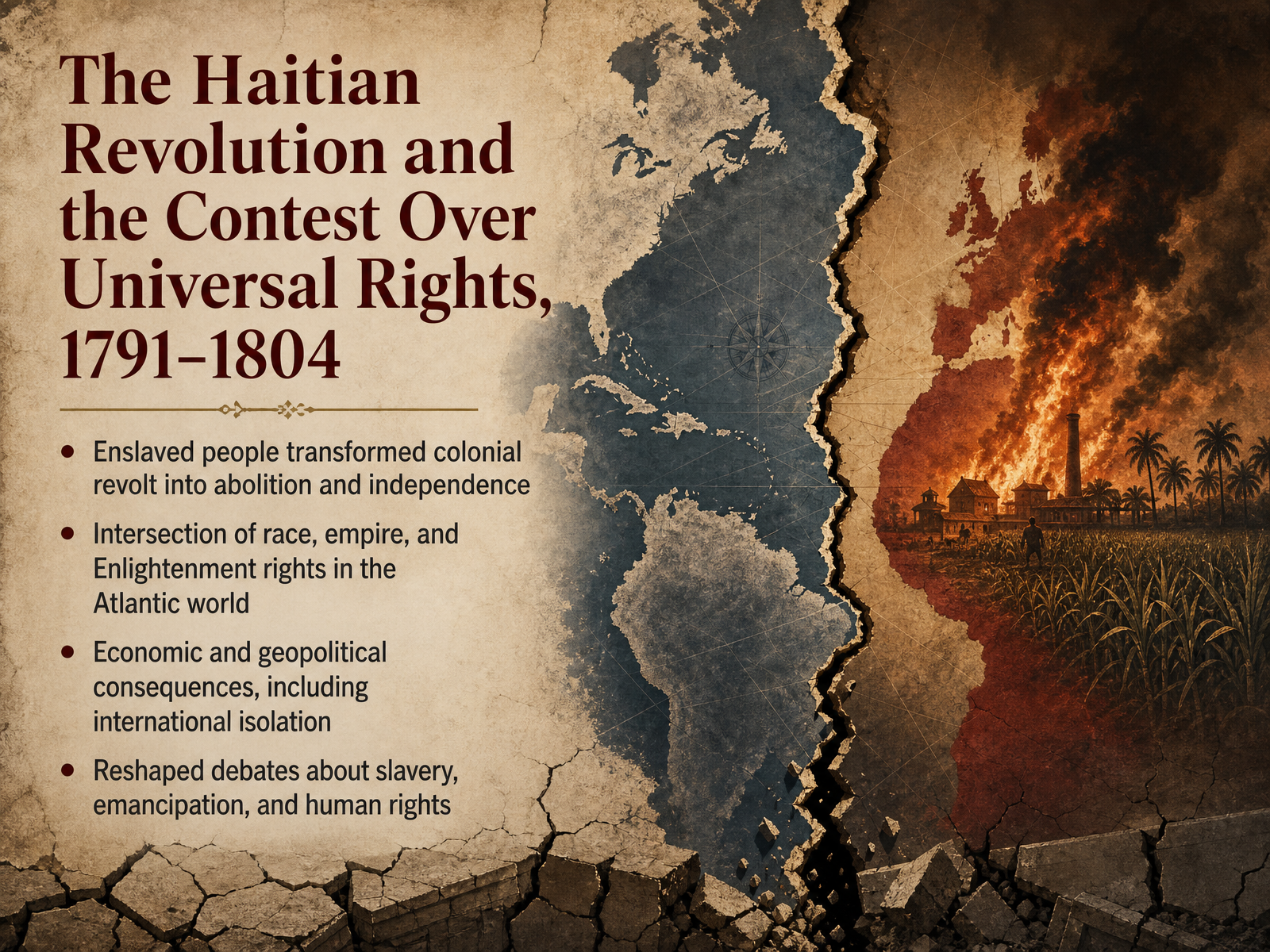
2 min - 07The Haitian Revolution and the Contest Over Universal Rights, 1791–1804Now we turn to a revolution that forced the Atlantic world to confront the deepest contradiction of the Enlightenment. The Haitian Revolution, between 1791 and 1804, was not simply a colonial revolt. It was a mass insurrection of enslaved people who transformed a struggle for survival into a radical project of abolition and independence. On the night of August twenty-second, 1791, uprising began on the Plaine du Nord of Saint-Domingue. At that time the colony was the jewel of the French empire, producing enormous wealth through the labor of nearly half a million enslaved Africans. By 1804 the revolutionaries had defeated Napoleon's armies and declared the independent nation of Haiti, the first republic in the Americas founded and governed by former slaves. The revolution's impact went far beyond the island. It forced the Atlantic world to confront the gap between universal rights and racial hierarchy. It challenged claims that liberty applied only to white Europeans, and it inspired both hope and terror across the Americas and Europe. Haitian independence also carried heavy economic and geopolitical costs. International isolation followed, as imperial powers refused to recognize a nation born of slave revolt. Yet the Haitian Revolution transformed debates about slavery, emancipation, and human rights permanently. It proved that universal rights could not be complete while slavery persisted. Next, we examine the Russian Revolution and the rise of revolutionary socialism.
 gilderlehrman.orgconstitutioncenter.orgpress.princeton.edu+22 min
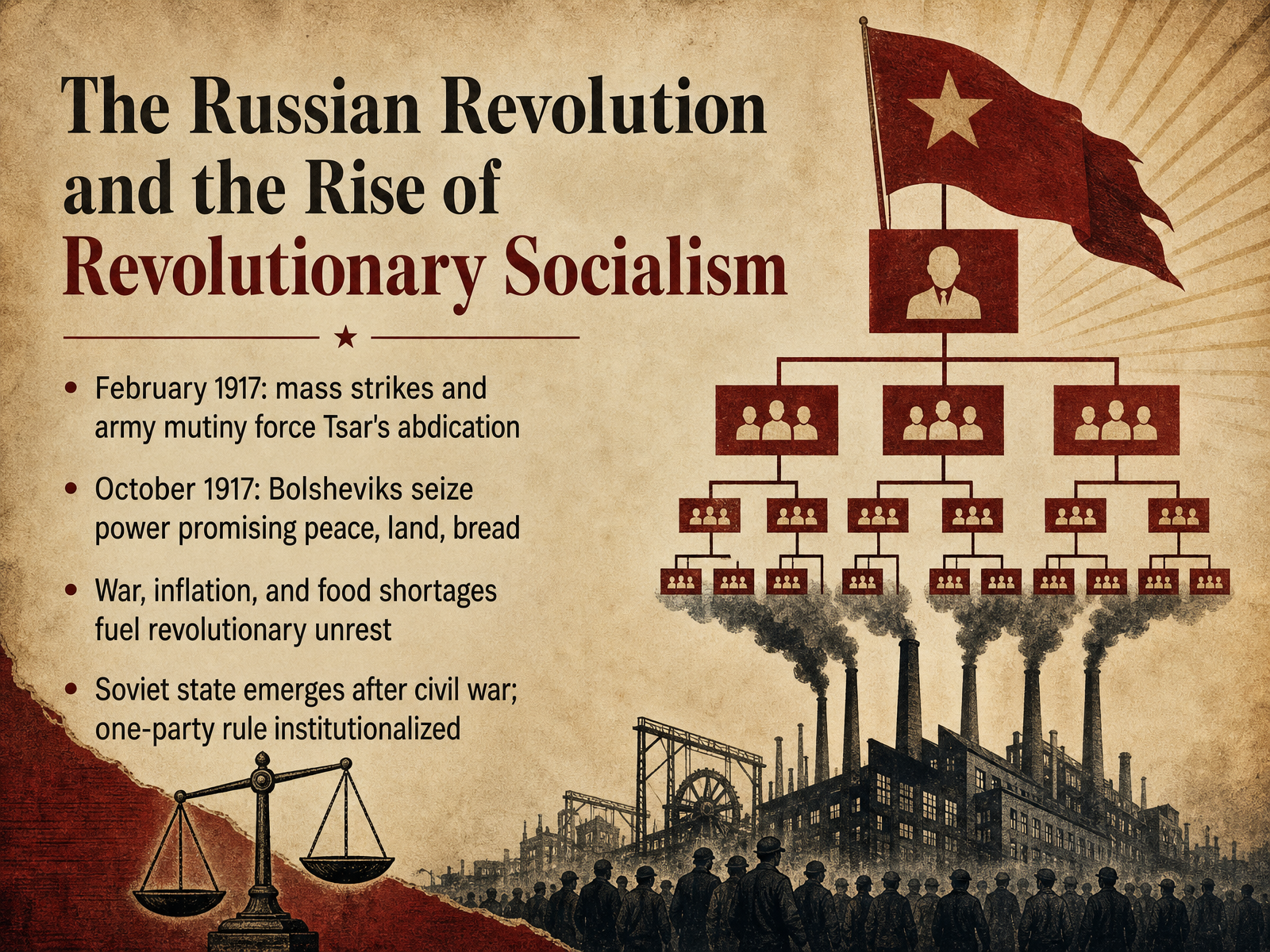
 - 08The Russian Revolution and the Rise of Revolutionary SocialismFrom the fall of the tsar to the rise of a new order, the Russian Revolution unfolded in two dramatic acts in nineteen seventeen. In February, mass strikes and army mutinies in Petrograd forced Tsar Nicholas the Second to abdicate, ending three centuries of Romanov rule. A provisional government stepped in, but it made a fatal choice: continuing the war and postponing land reform. By October, the Bolsheviks, led by Vladimir Lenin, seized power on a simple promise of peace, land, and bread. They appealed to a people exhausted by war, inflation, and devastating food shortages. After a brutal civil war, the Soviet state emerged, but it was not the workers' democracy many had imagined. The Bolsheviks, soon renamed the Communist Party, banned opposition and institutionalized one-party rule. The revolution reshaped global politics, setting the stage for a confrontation between capitalism and communism that would define the twentieth century. And as we will see, the wave of decolonization after nineteen forty-five would carry that same revolutionary energy to other corners of the world.
 2 min
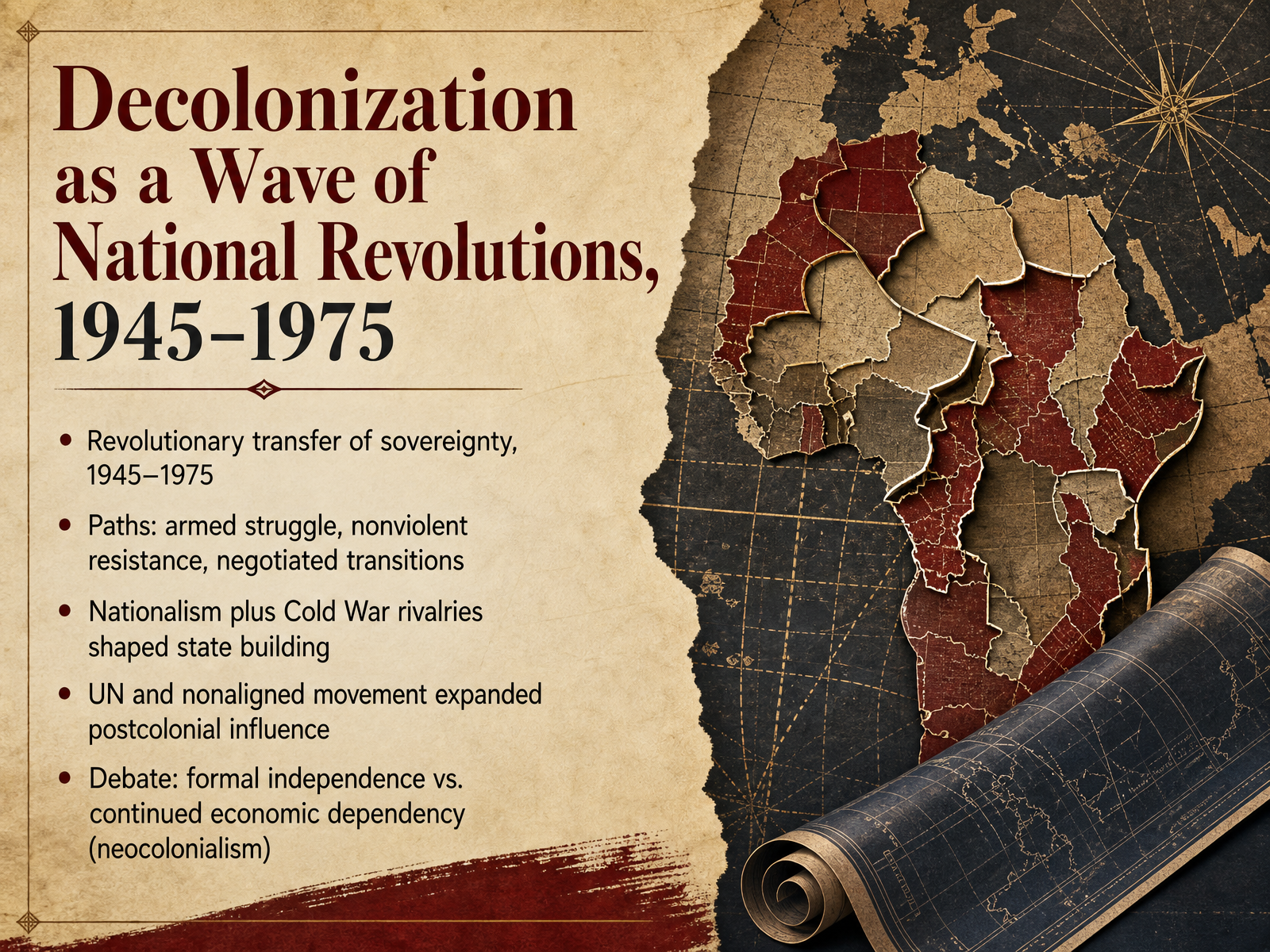
2 min - 09Decolonization as a Wave of National Revolutions, 1945–1975Between 1945 and 1975, the world witnessed something unprecedented: the collapse of European empires and the birth of dozens of new nations. This was not a single revolution but a wave of them, each following its own path. Some, like Algeria and Vietnam, were born through armed struggle. Others, like Ghana and India, emerged through negotiation and mass nonviolent resistance. But in nearly every case, nationalism and the Cold War were deeply intertwined. New leaders had to build states and identities while the superpowers jockeyed for influence. The United Nations gave these new nations a global platform, and the nonaligned movement offered an alternative to choosing sides. Yet formal independence did not end the debate. Many argued that economic control simply changed hands—that old colonial powers, now through markets and institutions, still held the strings. This question of neocolonialism remains central to understanding the limits of sovereignty. What independence truly meant, and what it did not, is a question we carry forward. Next, we turn to the Scientific Revolution and the birth of modern knowledge.
 2 min
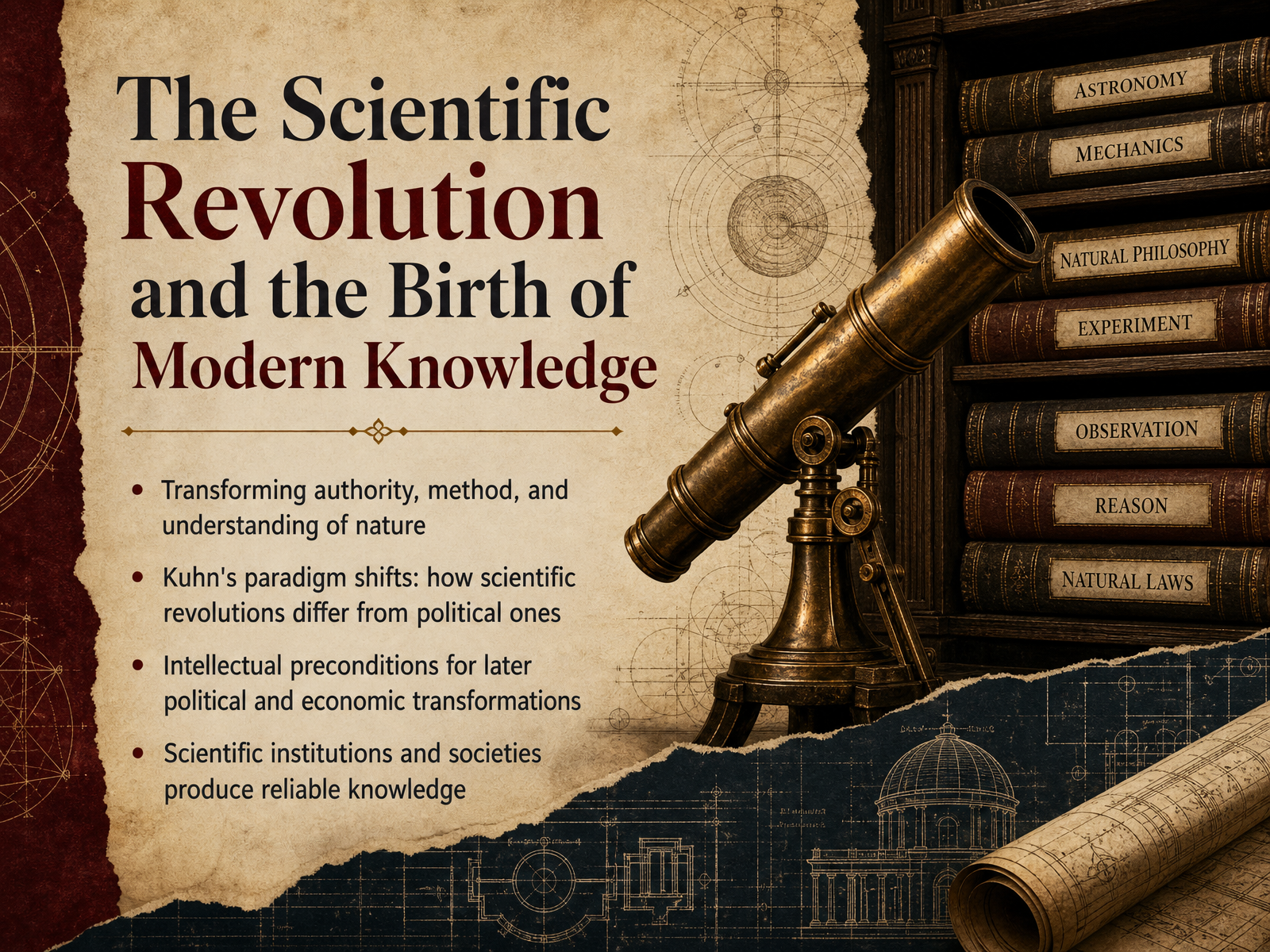
2 min - 10The Scientific Revolution and the Birth of Modern KnowledgeNow let's look at a revolution that didn't happen in the streets, but in the mind. The Scientific Revolution changed what counted as knowledge, and how we got it. It replaced blind trust in ancient authorities with something more demanding—methodical observation and experimentation. This was a profound shift in authority, method, and our very understanding of nature. The philosopher Thomas Kuhn argued that science doesn't just evolve by adding facts; it undergoes revolutions. These paradigm shifts are different from political ones. There's no overthrow of a government, but there is an overthrow of an entrenched worldview. When a paradigm can no longer explain anomalies, it's displaced by a new one. Think of the shift from Newtonian physics to Einstein's relativity. These intellectual upheavals created the preconditions for the political and economic transformations that followed. They instilled a belief that society too could be improved through reason and systematic inquiry. Crucially, this new mode of knowledge production was institutionalized. Scientific societies and journals emerged, creating a community where claims could be tested, debated, and verified. This infrastructure produces reliable knowledge, a legacy that frames our world today. And this sets us up to explore our next extraordinary transformation: the shift from the digital revolution to artificial intelligence.
 plato.stanford.edurep.routledge.comideas.repec.org+22 min
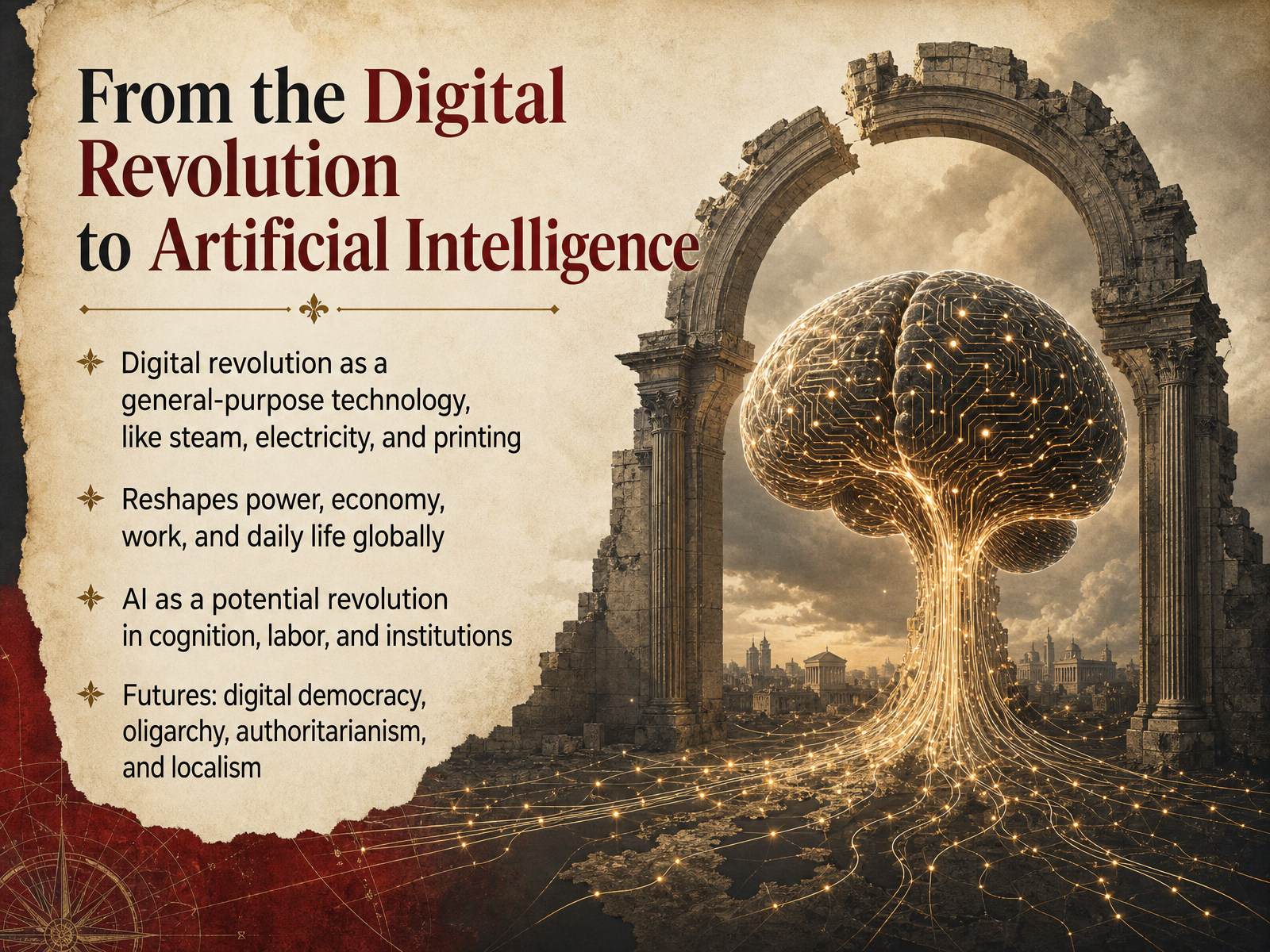
 - 11From the Digital Revolution to Artificial IntelligenceNow, let's consider the digital revolution. Economists call it a general-purpose technology, placing it alongside steam, electricity, and the printing press. Like those earlier forces, it's not just a new tool; it's a new foundation. It's reshaping power, the global economy, our work, and daily life in every corner of the world. But within this revolution, a new force has emerged: artificial intelligence. AI isn't just another app; it has the potential to be a revolution in cognition itself, transforming how we think, how we labor, and how our institutions are structured. The future isn't predetermined. We face a genuine crossroads. Society could evolve toward digital democracy, where participation is broad and open. Or we might slide into a digital oligarchy, where a few corporations dominate. There's also the risk of digital authoritarianism, where control is centralized and coercive. And there's the possibility of digital localism, where communities build more self-sufficient and resilient systems. The path we take will depend on the collective choices we make now, choices about data, privacy, and the very nature of work. This brings us to a key question: how do the causes, processes, and outcomes of this revolution compare to the great upheavals we've already explored?
 1 min
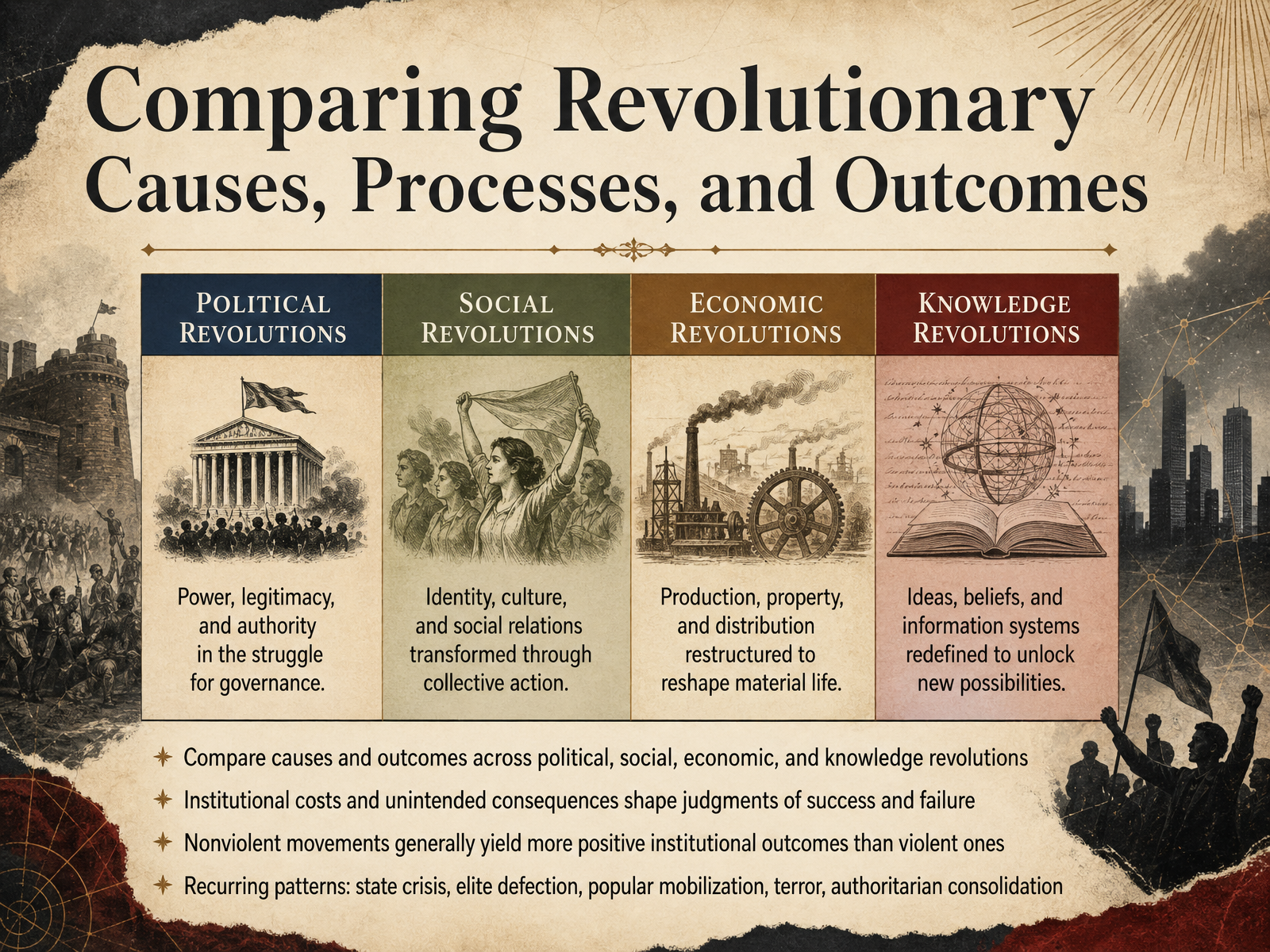
1 min - 12Comparing Revolutionary Causes, Processes, and OutcomesWhen we lay the great revolutions side by side, patterns begin to surface. Political, social, economic, and knowledge revolutions differ in their triggers, yet they share a common anatomy. Compare them and you will notice that state crisis, elite defection, popular mobilization, terror, and authoritarian consolidation tend to recur. This is not fate; it is a structural rhythm. The real judgment, however, lies in the outcomes. Institutional costs and unintended consequences often weigh as heavily as the stated goals. Consider the evidence across sixty-five quantitative studies: nonviolent movements generally produce more positive institutional results than violent ones. They are more likely to strengthen democracy, civil liberties, security forces, and even life expectancy. Violent revolutions, by contrast, often deliver rapid rupture but at a steep price, frequently consolidating power into new authoritarian forms. The French, Russian, and Chinese revolutions each followed this arc in their own way. So the question for us is not simply whether a revolution succeeds, but what it builds and at what cost. This leads us directly to contemporary movements and the question of the next revolution.
 plato.stanford.edurep.routledge.comideas.repec.org+22 min
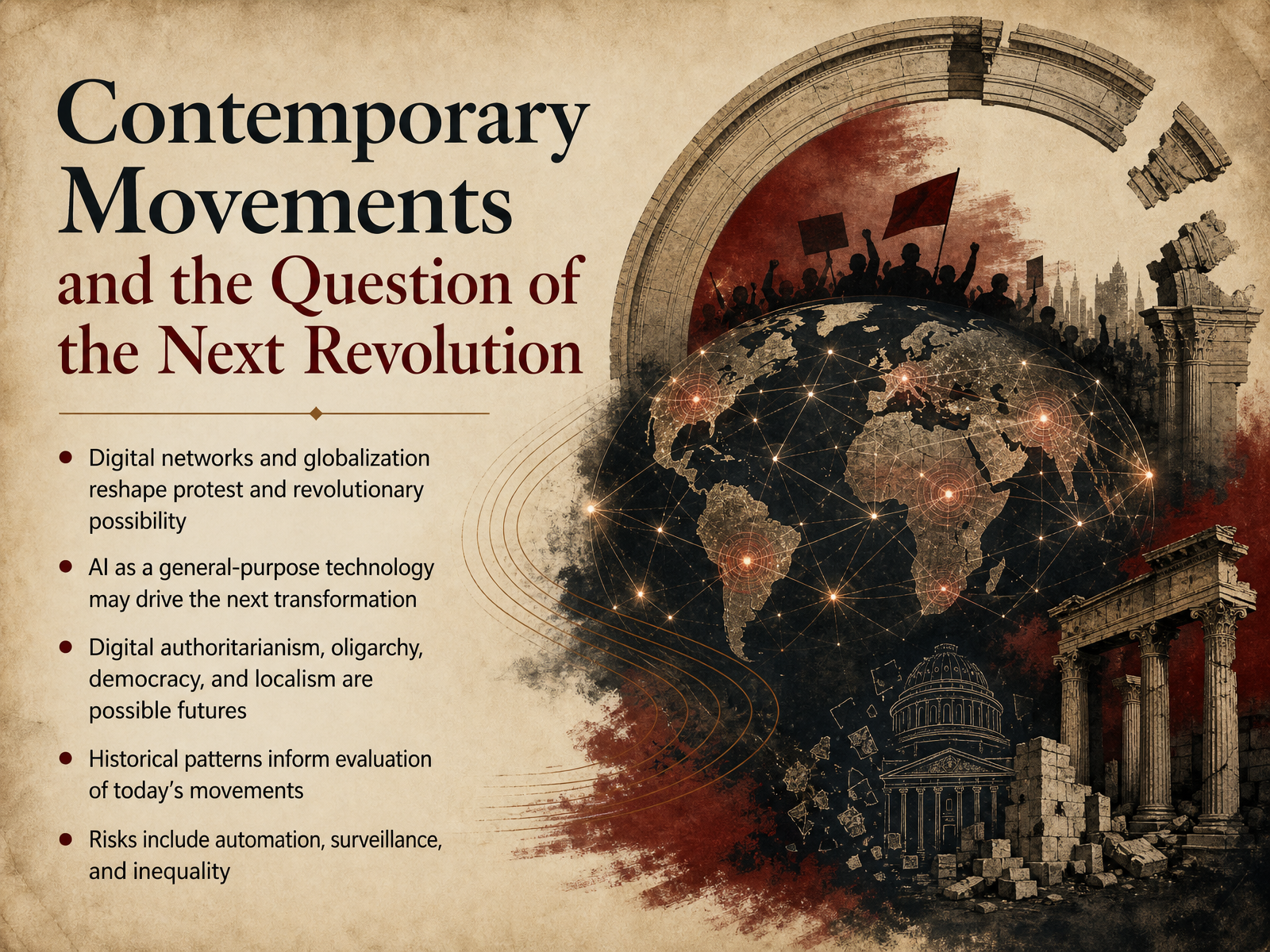
 - 13Contemporary Movements and the Question of the Next RevolutionLet's look forward and ask a question many are posing today: what will the next revolution be? We are living inside a transformation driven by digital networks and artificial intelligence. Unlike the steam engine or electricity, these are not just tools; they reshape how we coordinate and make decisions. Some call AI a general-purpose technology, like the printing press before it. But its path is not fixed. Scholars outline several possible futures: digital authoritarianism, digital oligarchy, digital democracy, or digital localism. Which one emerges depends on the choices we make about organization and policy. This is why history matters. It gives us a pattern for evaluating today's movements. Are they centralizing power or distributing it? The risks are real, including automation, surveillance, and deepening inequality. If we study the past, we see that the outcome of every revolution hinges on human decisions. As we turn to our final discussion, consider how these historical lessons might guide our response to the challenges ahead.
 2 min
2 min - 14Key Takeaways and Discussion PromptsAs we close, let's bring these threads together. Revolutions are more than dramatic ruptures; they reshape institutions, economies, and identities across political, social, and knowledge domains. Yet they follow recurring patterns of state crisis, elite defection, popular mobilization, and consolidation. The comparative evidence offers a striking finding: nonviolent revolutions tend to produce more positive institutional outcomes than violent ones, with better prospects for democratic quality, civil liberties, and human well-being. That said, revolution is never a shortcut to development. Even successful movements carry heavy costs, reduced growth, lower life expectancy, and legacies that remain contested for generations. So when you read about a revolution unfolding today, apply this framework. Trace the patterns. Weigh the outcomes. And ask yourself: what kind of transformation is truly being sought, and at what price? Understanding revolutions, past and present, is a way of understanding ourselves. Thank you for thinking through this journey with me. I hope these tools serve you well.
 plato.stanford.edurep.routledge.comideas.repec.org+22 min
Take the deck with you
Download this course as a file — free, no sign-up needed.
- PDF handoutEvery slide page, ready to print or share.15 pages · 6.9 MBDownload
- Narrated PowerPointThe deck that presents itself — every slide carries the digital human's narration video.15 pages · 33.8 MBDownload
- PowerPoint slidesThe full deck as a .pptx — open it in PowerPoint, Keynote, or Google Slides.15 pages · 6.9 MBDownload
Free to use in your own training — please keep the PersonWise credit page at the end.
Have your own deck? Turn it into a course
Sources consulted
Web sources consulted while building this course.
- Revolution (Stanford Encyclopedia of Philosophy) — plato.stanford.edu
- Revolution - Routledge Encyclopedia of Philosophy — rep.routledge.com
- Evolution and Typology of Revolutions — ideas.repec.org
- Social revolutions in pre-industrial and industrial societies. — cambridge.org
- Political Revolution | Internet Encyclopedia of Philosophy — iep.utm.edu
- The Glorious Revolution — parliament.uk
- The Glorious Revolution of 1688 – EH.net — eh.net
- The Convention and Bill of Rights — parliament.uk
- Was the Glorious Revolution a Constitutional Watershed? | The Journal of Economic History | Cambridge Core — cambridge.org
- What is constitutional monarchy, and what is its role in the UK? | UCL Constitution Unit Blog — blogs.ucl.ac.uk
- The Declaration of Independence in Global Perspective | Gilder Lehrman Institute of American History — gilderlehrman.org
- The Declaration of Independence’s Influence Around the World | Constitution Center — constitutioncenter.org
- The Expanding Blaze | Princeton University Press — press.princeton.edu
- Project MUSE - The Expanding Blaze — muse.jhu.edu
- How the American Revolution Spurred Independence Movements Around the World | HISTORY — history.com
- French Revolution - Revolution, Reforms, Legacy | Britannica — britannica.com
- France - Revolution, Napoleon, 1789-1815 | Britannica — britannica.com
- Legacies of the Revolution · Explore · LIBERTY, EQUALITY, FRATERNITY — revolution.chnm.org
- France - Revolution, Empire, Napoleon | Britannica — britannica.com
- Jacobins and Terror in the French Revolution (Chapter 8) - The Cambridge History of the Age of Atlantic Revolutions — cambridge.org