Repeatable Customer Service Framework
Begin
14 pages · ~28 min
Repeatable Customer Service Framework
This training teaches customer service professionals how to build a repeatable, consistent service process that enhances efficiency and improves customer satisfaction.
What you’ll learn
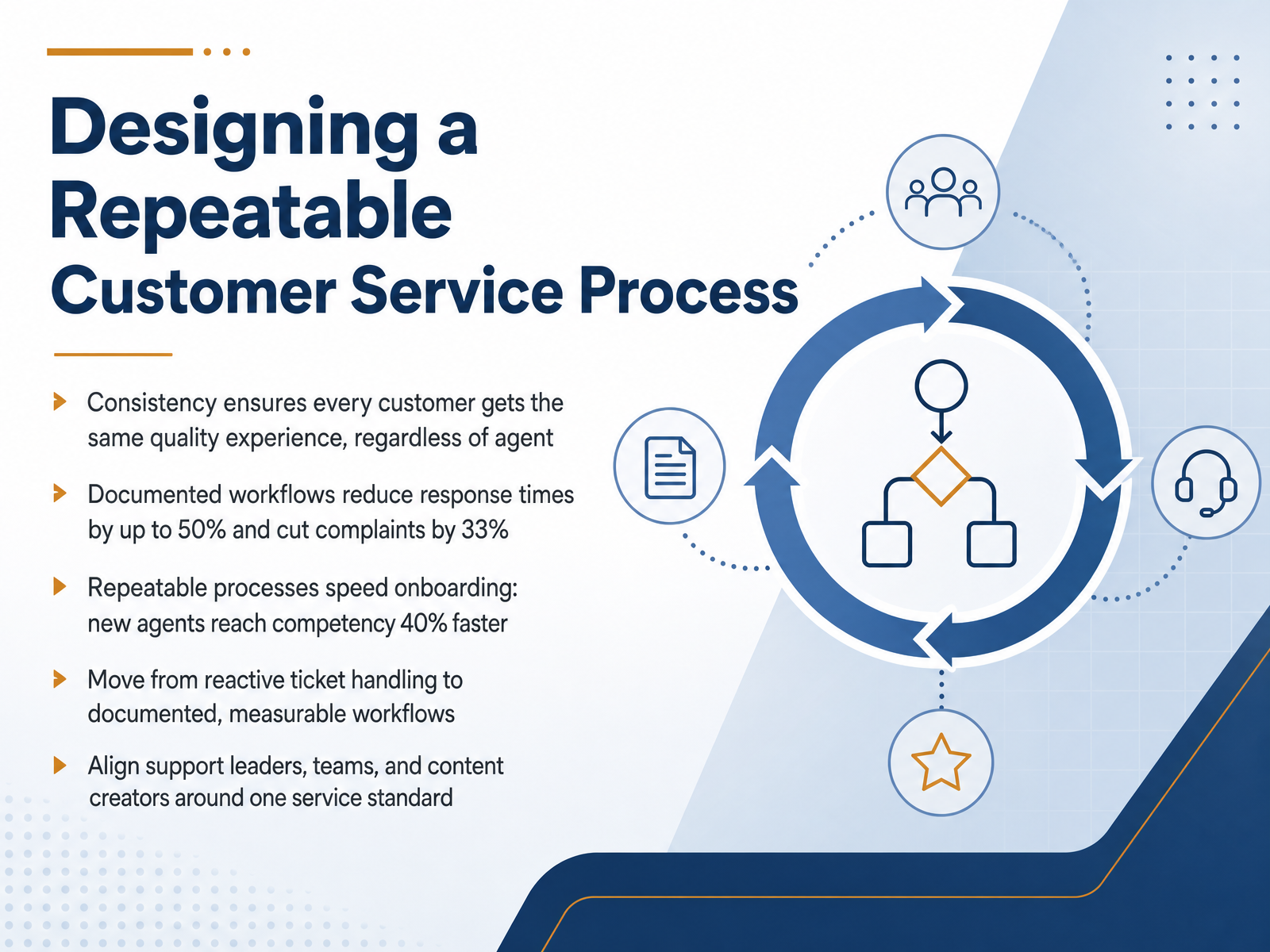
- 01Designing a Repeatable Customer Service ProcessWelcome. If you lead a support team, you already know the feeling. One agent handles a refund smoothly. Another hesitates. The customer walks away confused. That inconsistency is your real cost. Today, we will design a repeatable customer service process. One that works the same way, no matter who is on duty. Consistency means every customer gets the same quality experience, regardless of which agent they reach. That is not just good service. It is good business. Documented workflows cut response times by up to fifty percent and reduce complaints by a third. New agents reach full competency forty percent faster because they follow a clear playbook instead of guessing. This is about moving beyond reactive ticket handling. You will build documented, measurable workflows. And you will align your support leaders, your team, and your content creators around one single standard. Let us begin by looking at what inconsistent service really costs you.textexpander.comfeaturebase.appaiden.eu+22 min
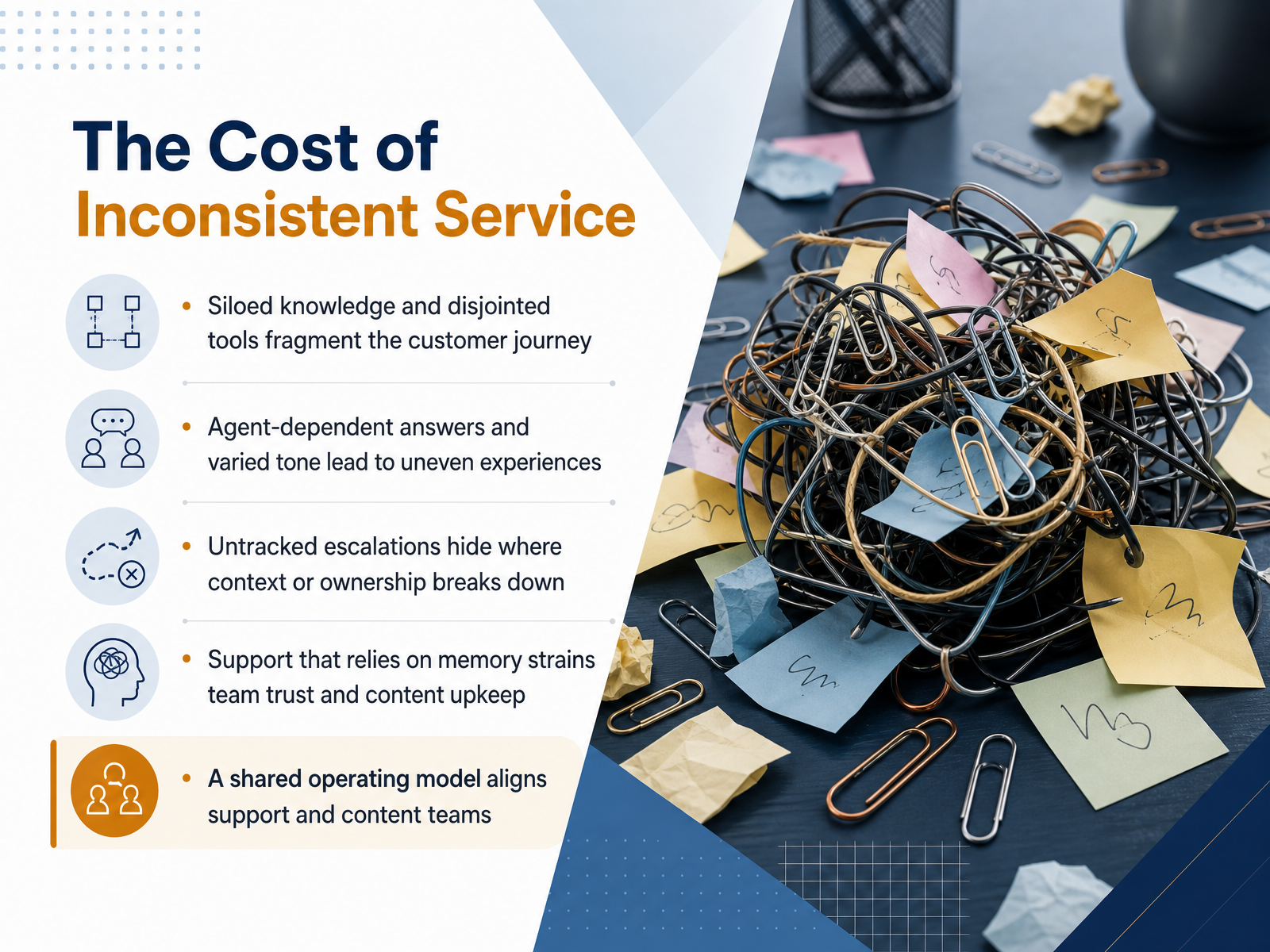
- 02The Cost of Inconsistent ServiceLet’s look at what inconsistent service really costs your team and your customers. When knowledge is scattered and tools don’t connect, the customer journey breaks into pieces. Customers feel it as friction. Agents feel it as frustration. Every time someone has to rely on memory or personal judgment, the experience changes. Different answers, different tone, different outcomes. Escalations become a hidden problem because you can’t track where context gets lost or ownership becomes unclear. The fix isn’t hiring more people. It’s building a shared operating model that support and content teams both follow. When everyone works from the same standards and the same knowledge, consistency becomes natural. That’s what we’ll build together. Next, let’s explore the core concepts: standards, playbooks, and feedback loops.
 consultevo.comaerochat.aiquiq.com+21 min
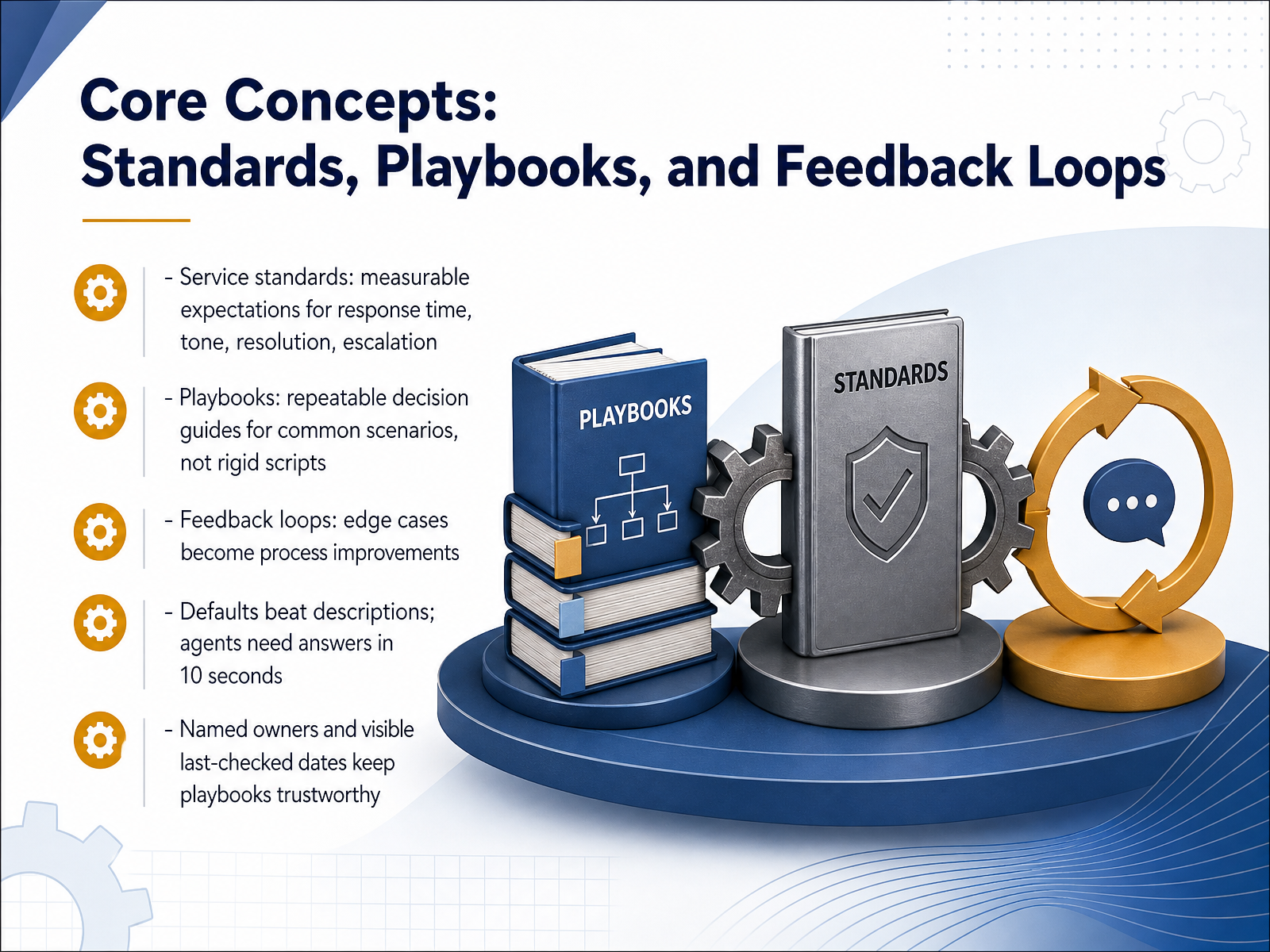
 - 03Core Concepts: Standards, Playbooks, and Feedback LoopsNow let's look at the three core concepts that will anchor your repeatable process. First, service standards. These are measurable expectations for response time, tone, resolution, and escalation. So instead of saying 'be fast,' you say 'first reply within two hours on chat.' Second, playbooks. A playbook is a set of repeatable decision guides for common scenarios. Think of it as a decision tree, not a rigid script. For example, 'Refund under fifty dollars without asking, and log the reason.' That's a decision an agent can make in seconds. Third, feedback loops. When an edge case appears, it becomes a process improvement. So your playbook evolves. Two important principles here. Defaults beat descriptions. Your agents need a clear answer within ten seconds, or they'll ask a colleague and the playbook dies. And named owners, with visible last-checked dates, keep playbooks trustworthy. A section without an owner is a section nobody updates. So as we move forward, hold on to these three ideas. Next, we'll map the service journey to define your scope.
 corebee.aisupplo.ioomni24.io+22 min
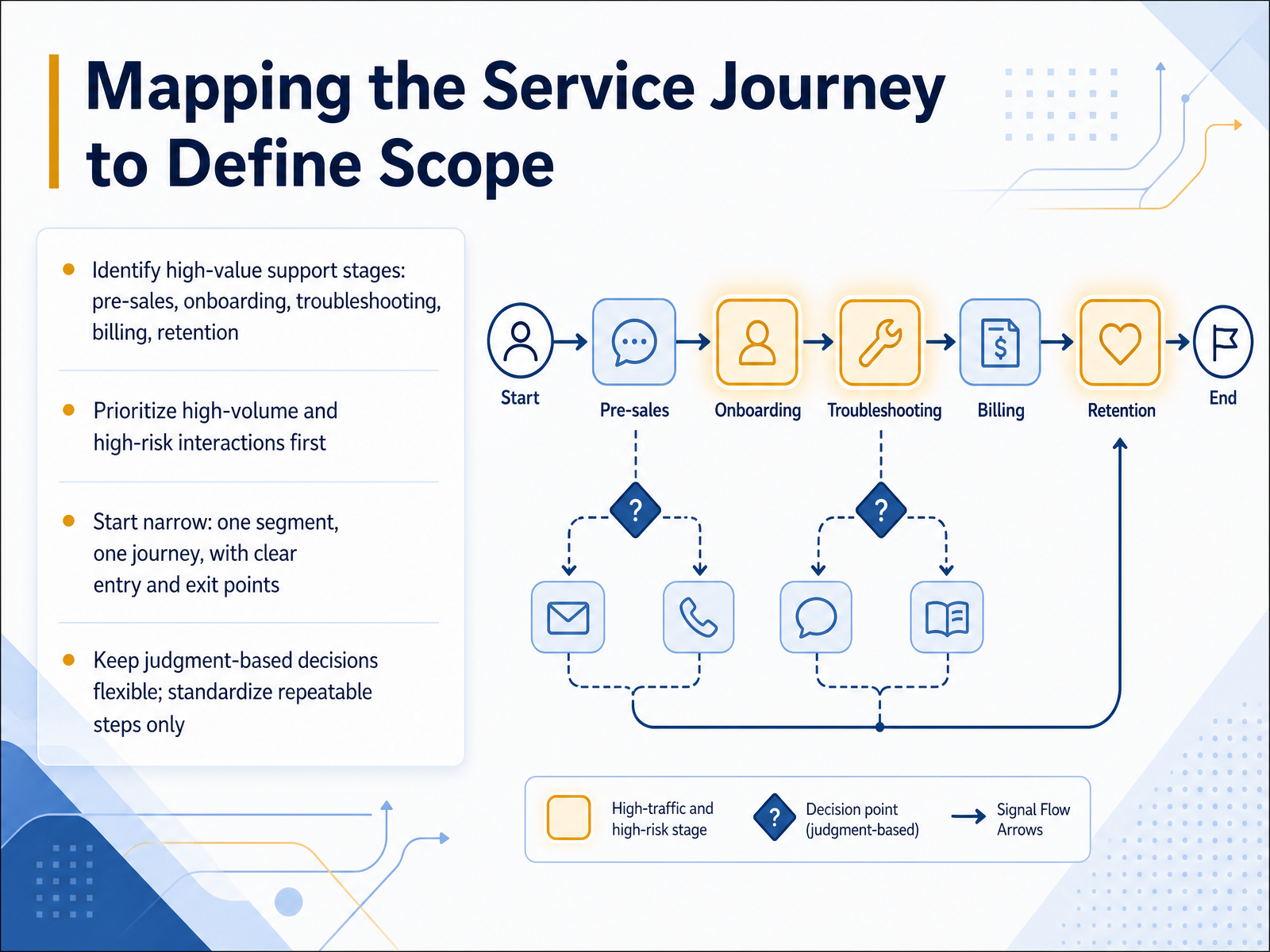
 - 04Mapping the Service Journey to Define ScopeNow, let's turn that high-level vision into a concrete scope. You cannot standardize everything at once, so start by mapping the service journey to see where your effort will pay off. First, identify the high-value support stages. These usually are pre-sales questions, onboarding, troubleshooting, billing, and retention. Second, prioritize the interactions that happen most often or carry the highest risk. A small fix in a high-volume step creates more consistency than a perfect solution for a rare edge case. Start narrow. Pick one customer segment and one journey, with a clear entry point and a clear exit point. For example, scope it to new customers onboarding from signup to first successful use. Do not try to boil the ocean. Finally, keep judgment-based decisions flexible. Standardize only the repeatable steps. This preserves your team's ability to think while making the routine parts predictable. We will look at documenting those workflows next.
 customerscience.com.ausmaply.comrenascence.io+21 min
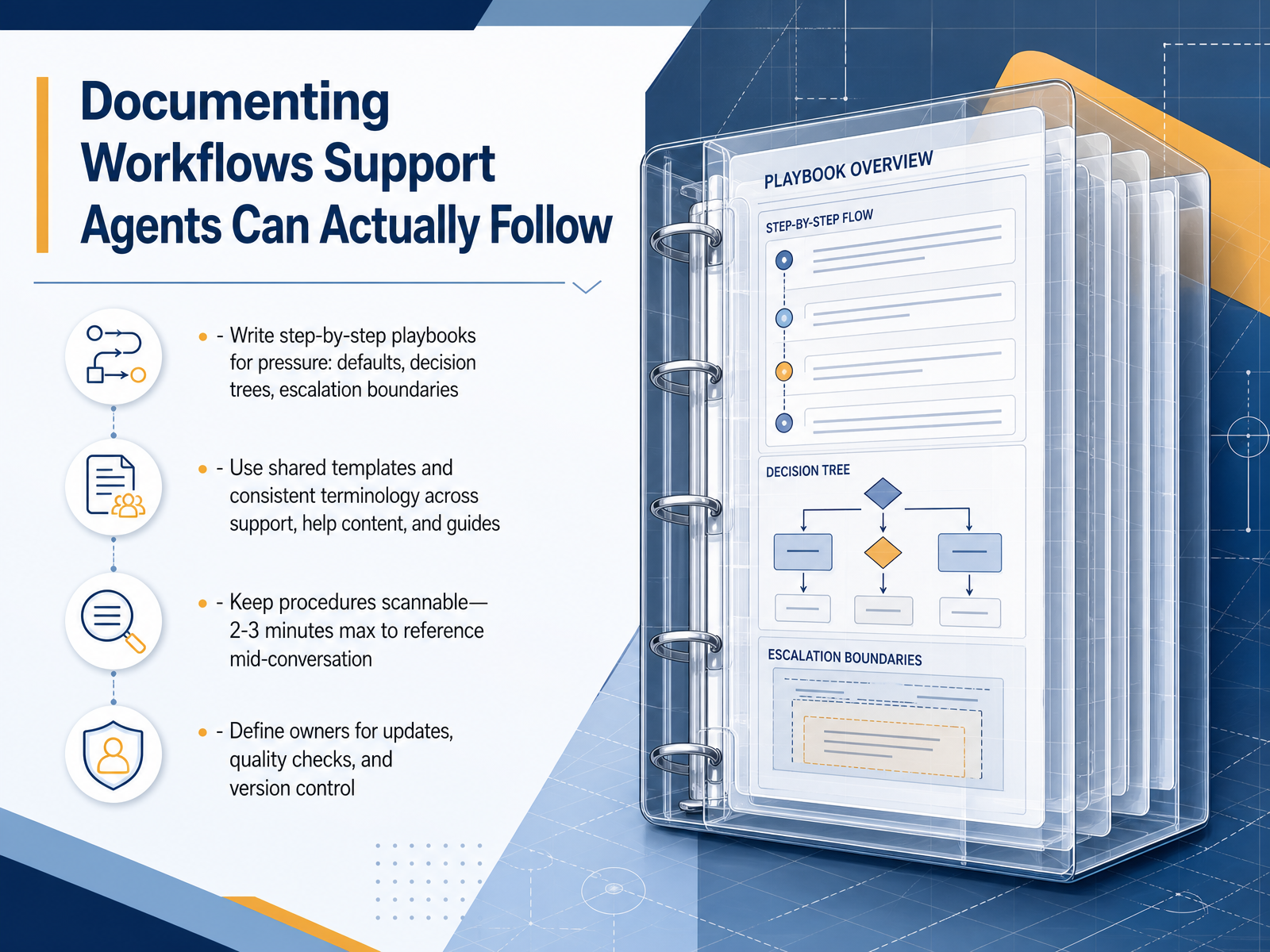
 - 05Documenting Workflows Support Agents Can Actually FollowNow let's talk about documenting workflows your agents will actually use under pressure. First, write step-by-step playbooks that cover your most common scenarios. Include clear defaults, decision trees, and escalation boundaries. If an agent knows exactly when to handle something and when to pass it up, they won't freeze mid-conversation. Second, use shared templates and consistent terminology across your support docs, help content, and guides. If you call something a refund in one place and a credit in another, that confusion shows up in your answers. Third, keep everything scannable. An agent should be able to reference the procedure in two to three minutes, even while a customer is waiting. If it takes longer, it's too long. Finally, define who owns each document. Assign someone for updates, quality checks, and version control. A procedure without an owner quietly goes stale. So, write for real pressure, keep language consistent, and make every document quick to use and clearly owned. That's how documentation becomes a daily tool, not a binder on a shelf. Next, we'll look at turning these documents into daily habits.
 textexpander.comglitter.ioconsultevo.com+21 min
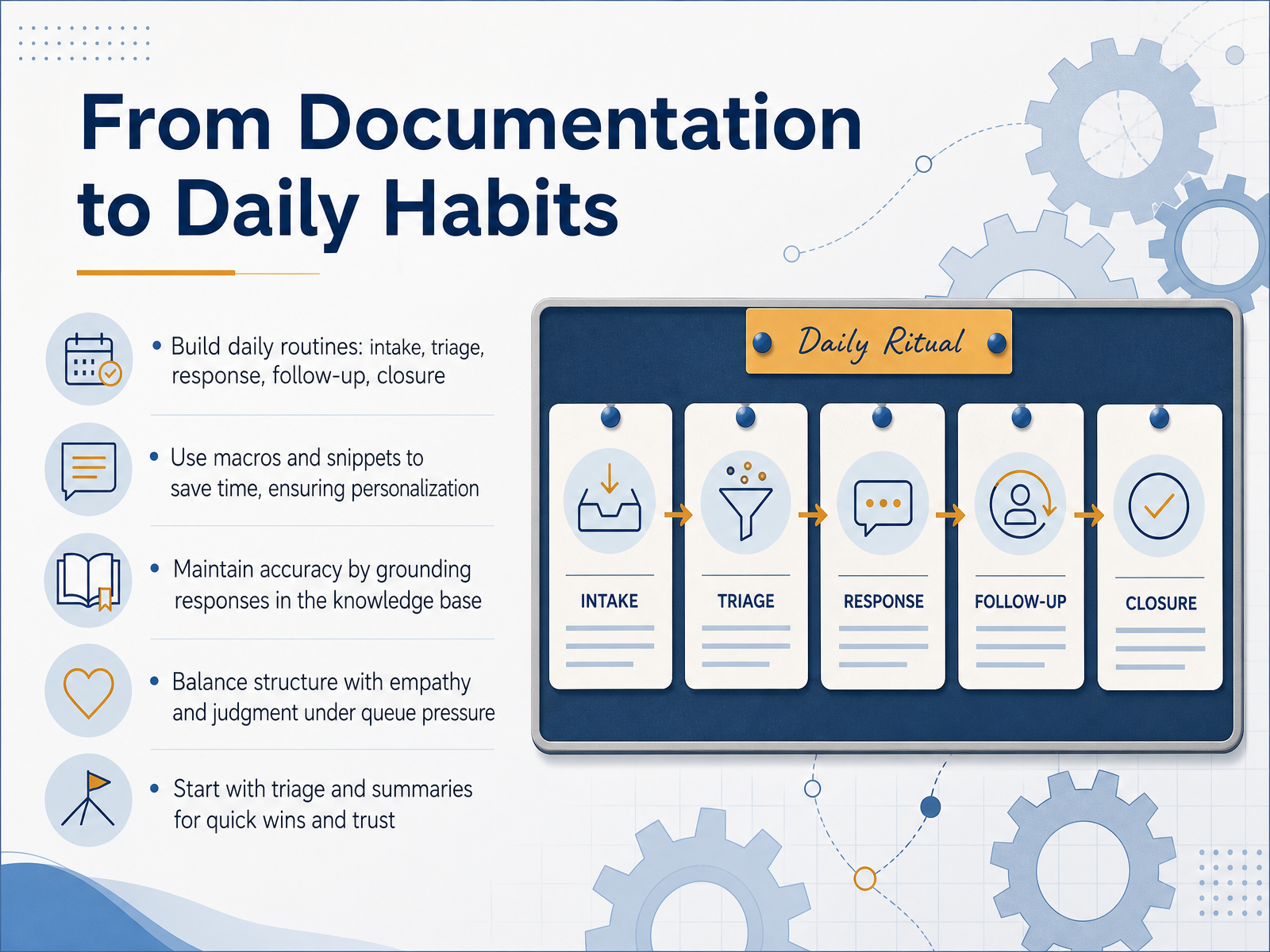
 - 06From Documentation to Daily HabitsNow let's turn your documentation into daily habits. First, build a simple routine that covers intake, triage, response, follow-up, and closure. Do this in the same order every time. Then, use macros and snippets to speed up repetitive replies, but always personalize the opening and closing lines. Keep your answers accurate by grounding them in your knowledge base. That is your single source of truth. Under queue pressure, stay structured but let empathy and judgment guide your tone. A quick apology and a clear next step go a long way. Finally, start with the quick wins. Implement your triage step and create concise summaries for each ticket. Your team will feel the difference immediately, and customers will trust the consistency. These habits turn your process into something you can repeat, refine, and scale. Next, we’ll look at embedding tone, empathy, and human judgment into every interaction.
 1 min
1 min - 07Embedding Tone, Empathy, and Human JudgmentNow let’s talk about how tone, empathy, and human judgment fit into a repeatable process. First, tone is an operational design choice. Your voice rules stay consistent across every interaction, but tone shifts based on the situation. For example, a billing dispute calls for a calmer, more formal tone, while a product question can be friendly and direct. Second, empathy is a lightweight move. Acknowledge the disruption in one believable sentence, then move to action. Customers don’t want a long emotional paragraph; they want to feel understood and then get a clear next step. Finally, preserve human judgment at high-stakes points. When money, policy, legal risk, or churn signals are involved, automation should draft or suggest, but a human must make the final call. Keep these three principles embedded in your workflow, and your process stays consistent without feeling robotic. Next, we’ll see how AI and automation can support this repeatable process while keeping the human touch intact.
 1 min
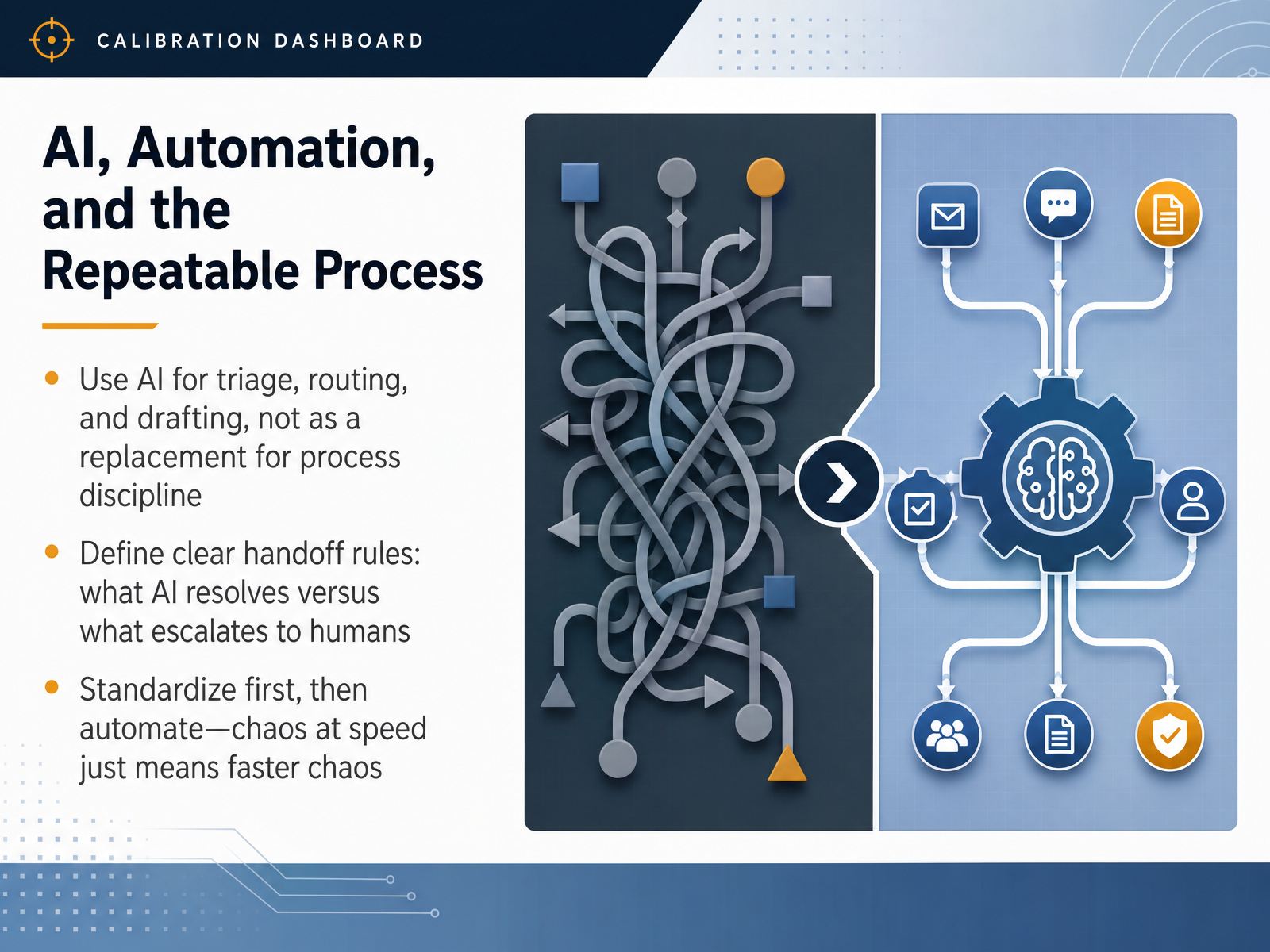
1 min - 08AI, Automation, and the Repeatable ProcessNow let's look at how AI and automation fit into a repeatable process. The key principle is simple: use AI for triage, routing, and drafting, but never as a replacement for process discipline. AI is a multiplier of good process, not a substitute for it. First, define clear handoff rules. Decide what AI can resolve on its own and what must escalate to a human. For example, a password reset might be safe to automate, while a billing dispute should always go to a person. Write these rules down so everyone follows the same path. Then, standardize first, then automate. Chaos at speed just means faster chaos. If your tickets are miscategorized and your knowledge base is outdated, AI will only amplify those problems. So start with a clean taxonomy, consistent responses, and clear escalation paths. Once those are solid, you can confidently add automation. Remember, the goal is to free humans for judgment, not to remove them from the equation. Coming up, we'll cover measurement, audit, and calibration to keep your process on track.
 1 min
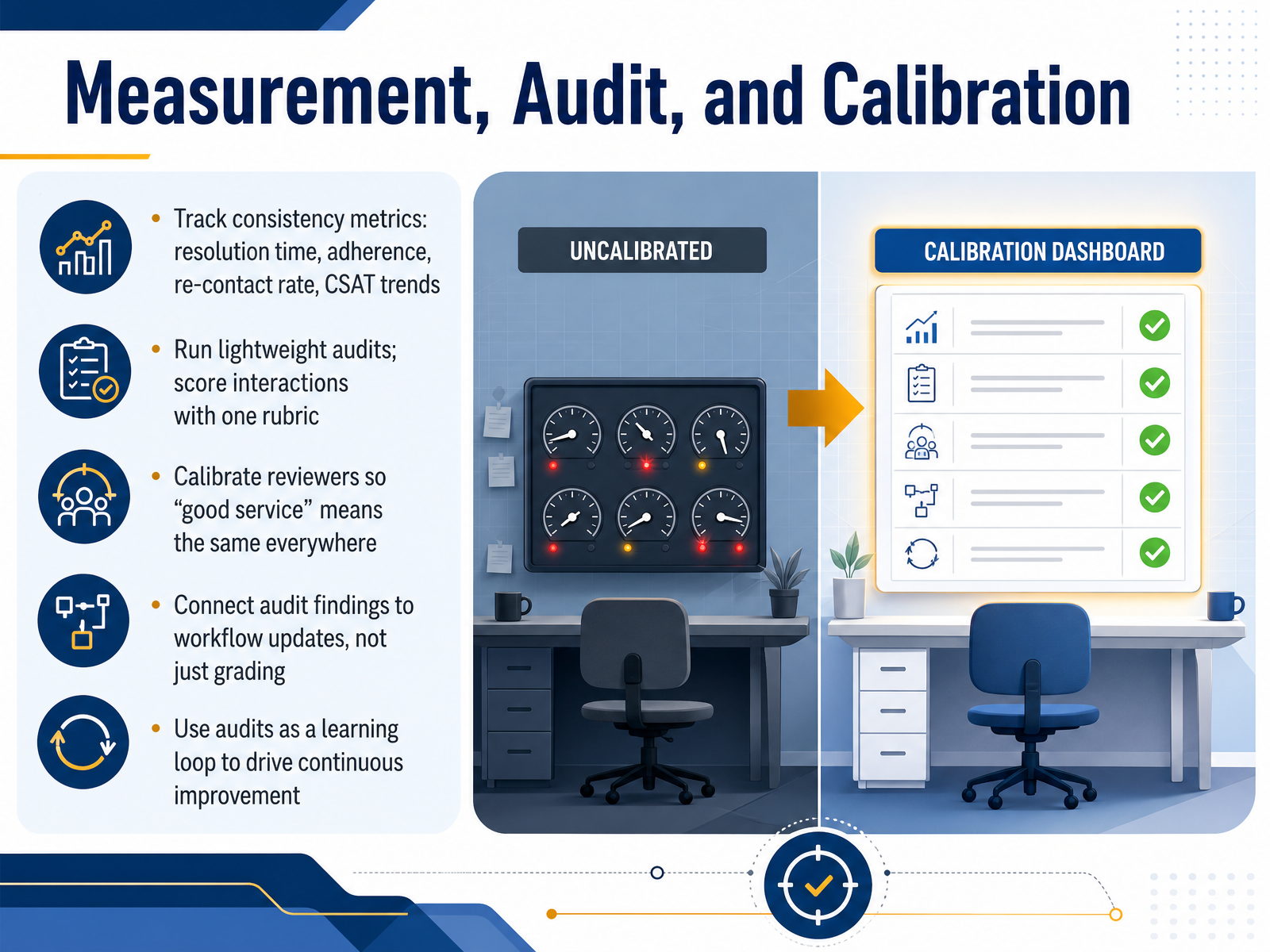
1 min - 09Measurement, Audit, and CalibrationNow let's talk about how you know the process is actually working. First, track a small set of consistency metrics. Resolution time, adherence to your workflow, re-contact rate, and CSAT trends are your best signals. Watch them over time, not as isolated snapshots. Then run lightweight audits on a regular cadence. Quarterly works well for steady state. Score actual interactions with one shared rubric. Use a simple scale, like zero to two, to keep it consistent. Next, calibrate your reviewers. If two managers score the same interaction differently, your data is noise. Hold regular calibration sessions where everyone grades the same ticket and aligns on the criteria. This makes sure good service means the same thing in every location and on every shift. And finally, connect what you find to workflow updates. An audit that leads to no action is a waste of time. Treat it as a learning loop. When you spot a pattern, update your process, your training, or your knowledge base. That is how you turn measurement into continuous improvement. Next, let's look at keeping the process alive over time.
 2 min
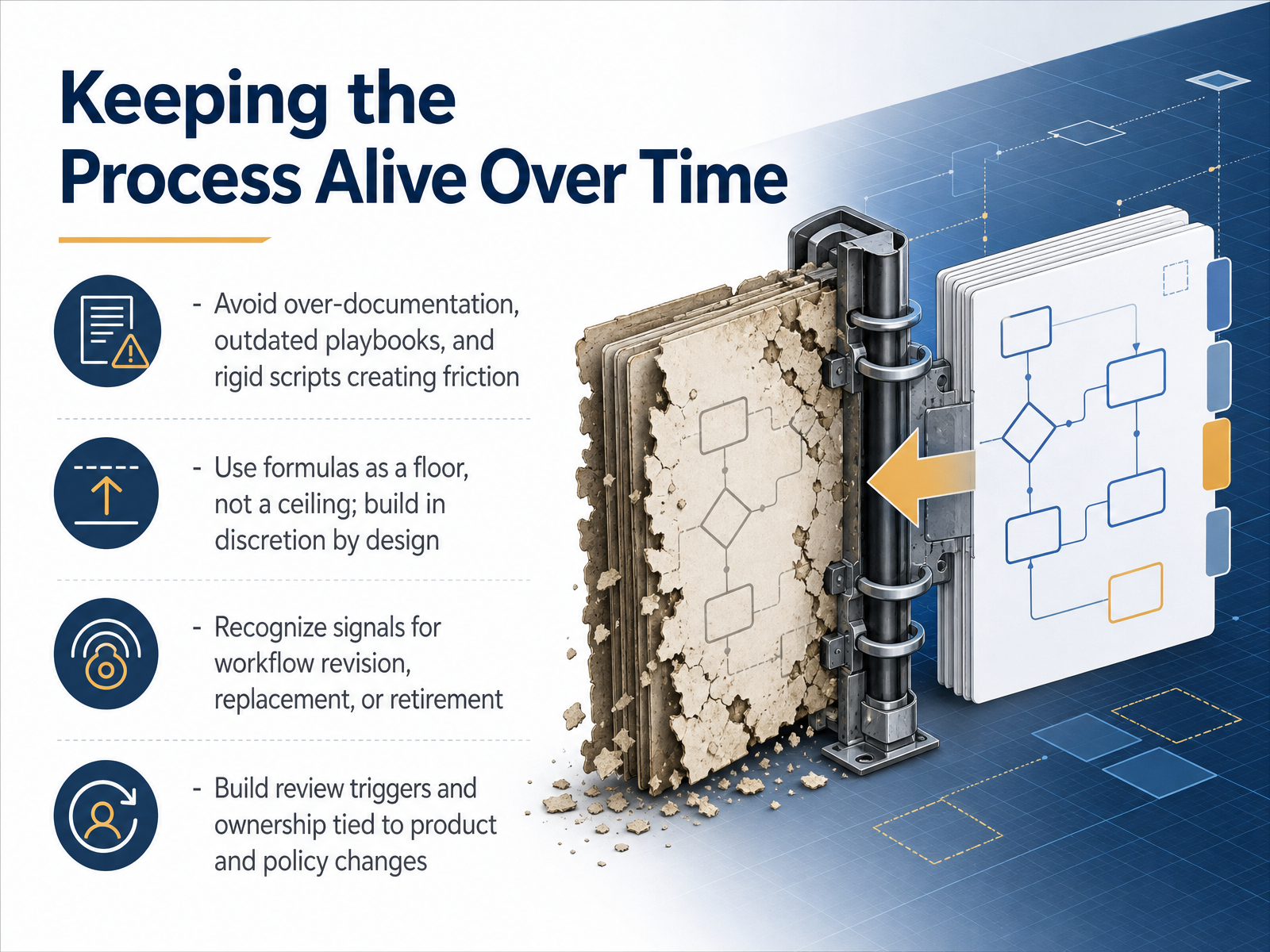
2 min - 10Keeping the Process Alive Over TimeNow, let's talk about keeping this process alive over time. A process is never finished. It needs care and attention, or it becomes a source of friction instead of a tool for good service. First, avoid over-documentation. A thick playbook that nobody reads is just noise. Outdated scripts create more problems than they solve. Keep your formulas lean and current. Second, treat your formula as a floor, not a ceiling. It sets the minimum standard for consistency. But it should never block your team's judgment. Build discretion into the design, so your people can adapt to each customer. Third, watch for signals that a workflow needs revision, replacement, or retirement. If your team is creating workarounds, that is a signal. If customers are frustrated, that is a signal. Listen to them. Finally, build review triggers. Tie your process reviews to product launches and policy changes. When something shifts, that is the moment to revisit the workflow. A living process stays useful. A frozen one becomes obsolete. Next, let's look at review cadences and continuous improvement.
 1 min
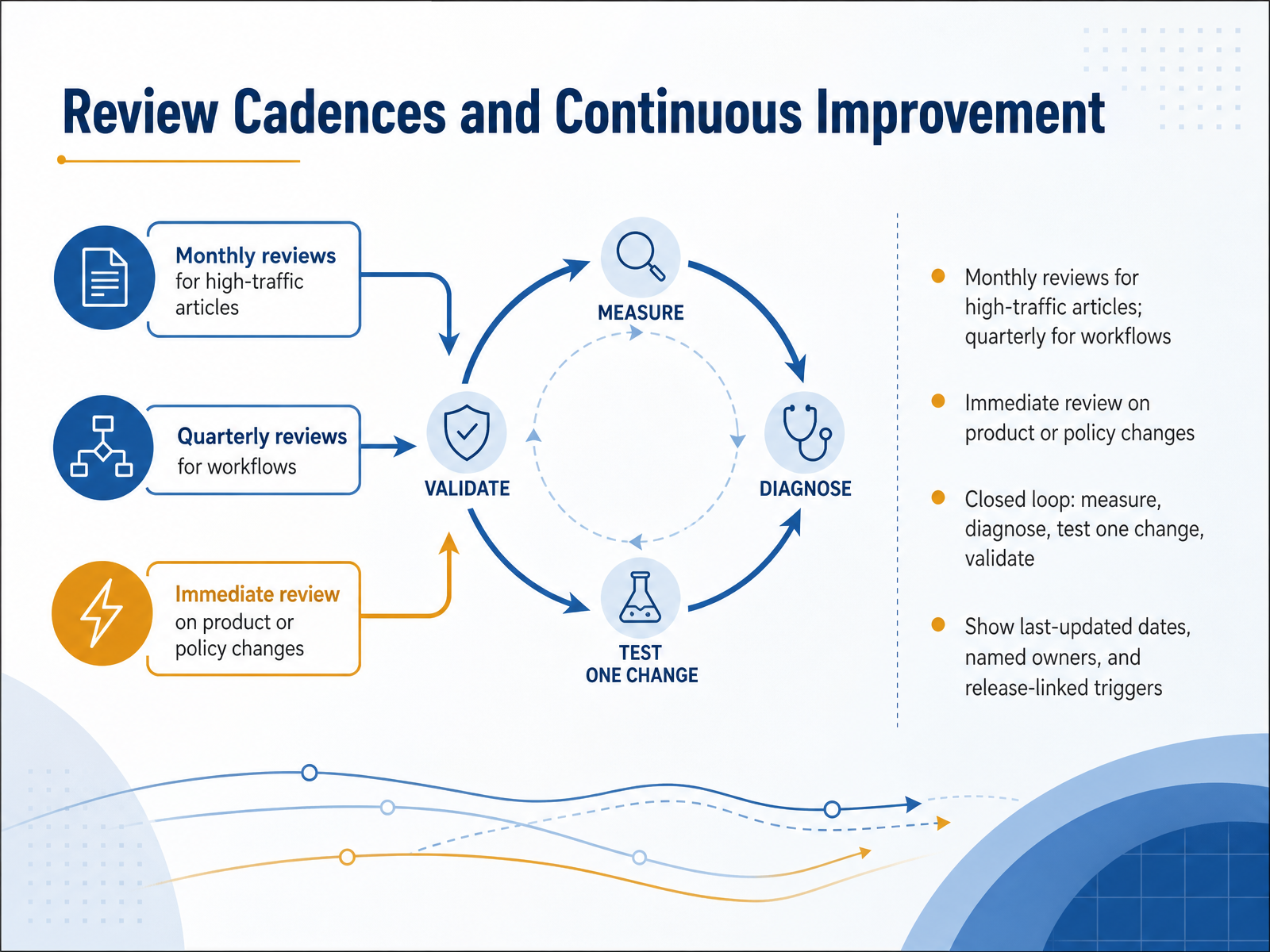
1 min - 11Review Cadences and Continuous ImprovementNow let’s talk about how to keep your process alive. A one-time effort won’t hold up. You need a review rhythm that fits your content’s traffic and risk. For high-traffic articles, do a monthly check. For standard workflows, a quarterly review is enough. But if a product changes or a new policy goes live, review immediately. Don’t wait for the calendar. Use a closed loop: measure, diagnose, test one change, validate. Change one variable at a time, then confirm it improved things before moving on. Finally, make it visible. Show the last-updated date on every article, name a clear owner, and link updates to release triggers. That way, your team knows what’s current and who to ask when something shifts. Remember, consistency comes from habit, not hope. Review, adjust, and document. Next, let’s look at an implementation roadmap you can follow with your leaders and content creators.
 2 min
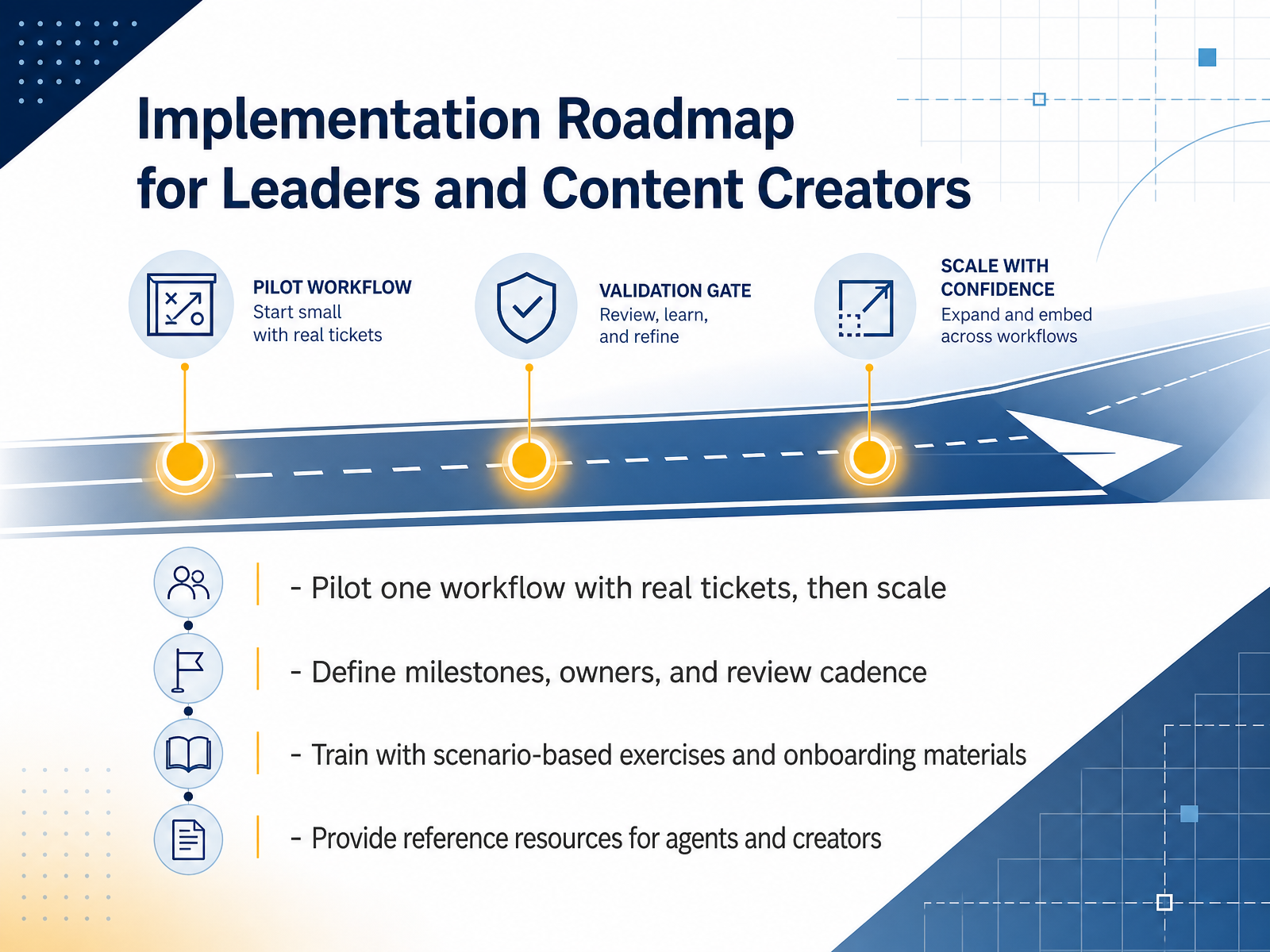
2 min - 12Implementation Roadmap for Leaders and Content CreatorsNow let's walk through the implementation roadmap for leaders and content creators. Start small. Pilot one workflow with real tickets before you scale it. This lets you spot gaps early and adjust without disrupting the whole team. Then define your milestones, name owners, and set a review cadence. For example, check progress every two weeks. Next, train your team with scenario-based exercises, not just system navigation. Use real customer situations they'll encounter daily. Finally, provide reference resources for agents and creators. Quick guides, scripts, and job aids that stay updated. These keep everyone consistent. Remember, a repeatable process only sticks when it's practiced and supported. So pilot, define, train, and resource. That sequence turns your workflow into a habit. Now let's look at how change management drives long-term adoption.
 1 min
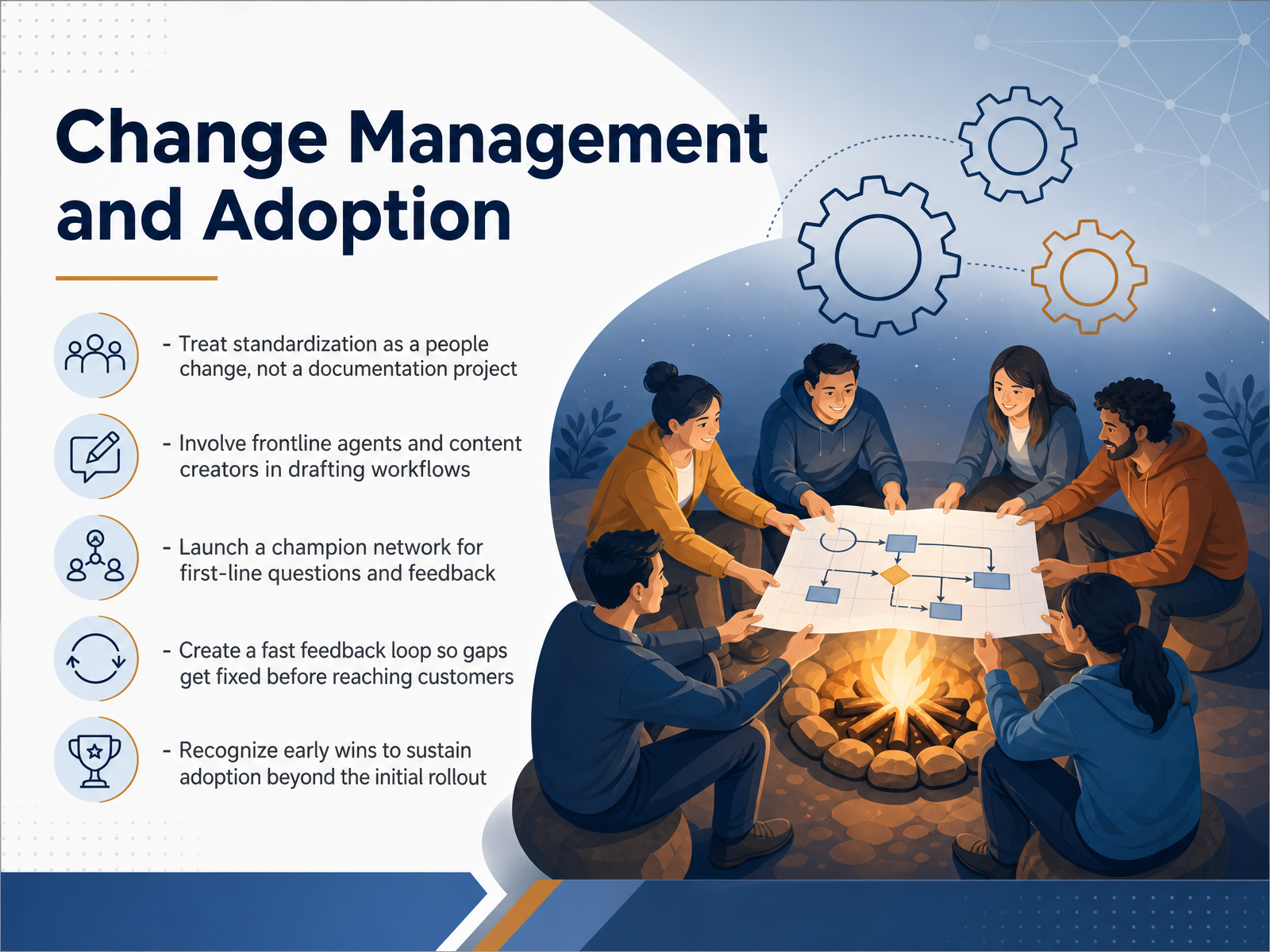
1 min - 13Change Management and AdoptionNow let's talk about the human side of rolling out your process. Treat standardization as a people change, not a documentation project. The best workflow in the world won't help if your team doesn't adopt it. So first, involve frontline agents and content creators in drafting the workflows. They know the real customer scenarios and will spot gaps you might miss. Then, launch a champion network — a few trusted peers who can answer first-line questions and gather feedback. This takes pressure off supervisors and gives the team a go-to person. Next, create a fast feedback loop. Set up a simple channel where agents can flag confusing steps or missing information daily, and make sure those issues get fixed quickly, before customers ever see the problem. Finally, recognize early wins. Celebrate the first team that uses the new process consistently, or the first case resolved faster. Recognition keeps momentum going after the initial rollout. Remember, adoption is a journey, not a one-time event. Keep listening, keep adjusting, and your process will stick. Next, we'll turn this into your action plan.
 1 min
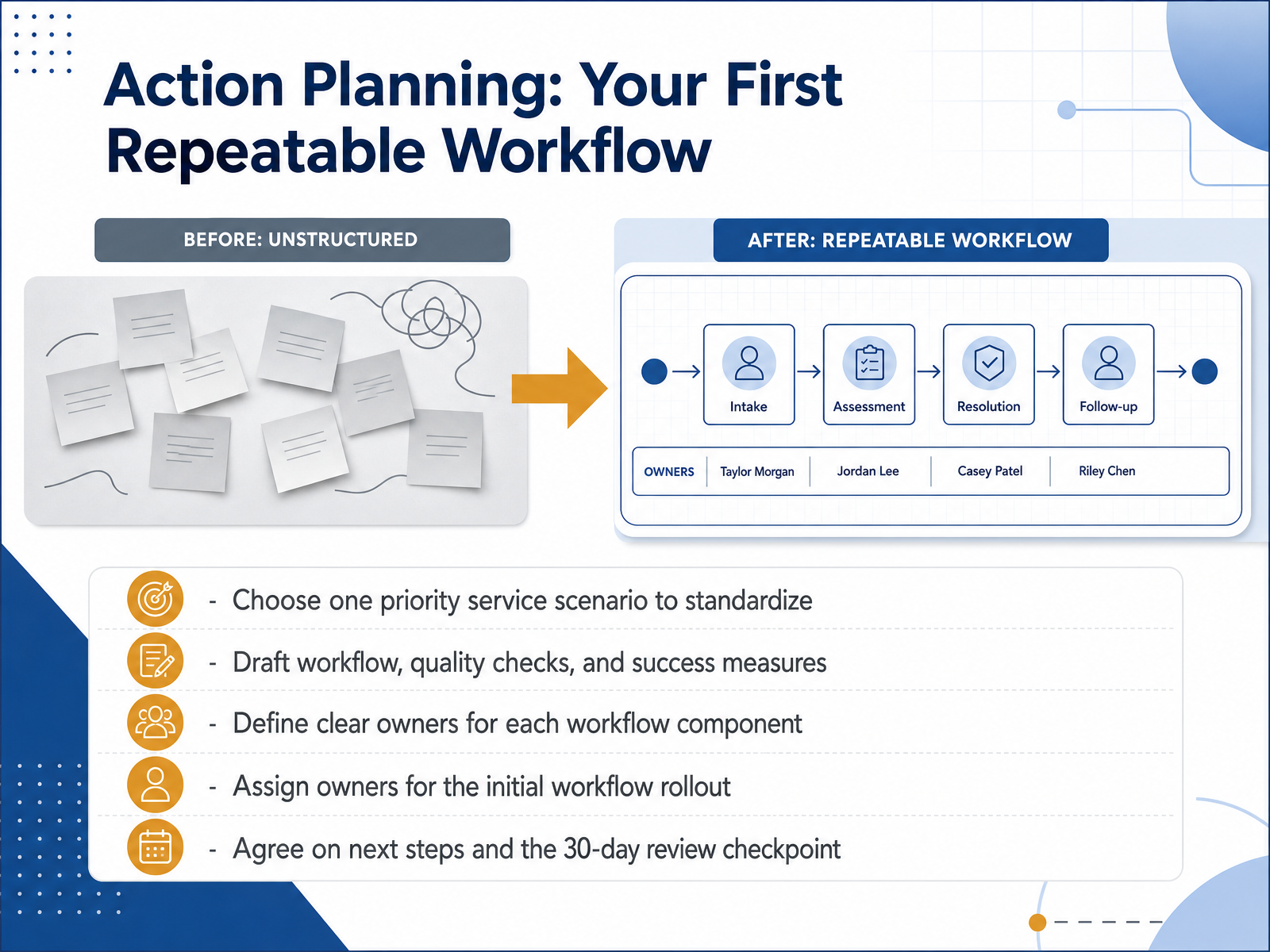
1 min - 14Action Planning: Your First Repeatable WorkflowNow it is time to put your process into action. Start by choosing one priority service scenario to standardize. Pick a common interaction, like returns or billing questions, not the most complex one. Then draft the workflow with clear steps, quality checks, and success measures. For example, define what a resolved ticket looks like and how fast it should be handled. Next, assign owners for each part of the workflow. This means naming who updates the steps, who reviews quality, and who tracks the numbers. Also assign owners for the rollout itself, so one person coordinates training and another handles communication. Finally, agree on your next steps and set a thirty-day review checkpoint. This is when you look at adoption, listen to feedback, and make small adjustments. That checkpoint is your safety net, and it keeps the process alive. You have the plan. Now take the first step, and trust the process to guide you.
 1 min
1 min
Take the deck with you
Download this course as a file — free, no sign-up needed.
- PDF handoutEvery slide page, ready to print or share.15 pages · 3.7 MBDownload
- Narrated PowerPointThe deck that presents itself — every slide carries the digital human's narration video.15 pages · 14.4 MBDownload
- PowerPoint slidesThe full deck as a .pptx — open it in PowerPoint, Keynote, or Google Slides.15 pages · 3.7 MBDownload
Free to use in your own training — please keep the PersonWise credit page at the end.
Have your own deck? Turn it into a course
Sources consulted
Web sources consulted while building this course.
- Customer Service Standard Operating Procedures [2026 Guide] | TextExpander — textexpander.com
- Customer Service Standards: A Complete Guide for ... — featurebase.app
- CX processes: How to standardise sales and service workflows - Aiden — aiden.eu
- Understanding Customer Service Standards in Modern Workflows — bolddesk.com
- How to Standardize Service Processes in Multi-Location Organizations | Qminder — qminder.com
- How SaaS Teams Can Reduce Inconsistent Customer Experience Without Hiring More People - — consultevo.com
- 10 Signs Your Customer Support Workflow Is Failing — aerochat.ai
- 13 Most Common Customer Service Challenges in 2026 — quiq.com
- Siloed systems in customer service: why they hurt experience and slow down operations | GB Advisors — gb-advisors.com
- The Operational Warning Signs Behind Support Ticket Chaos - — consultevo.com
- Building a Customer Support Playbook From Scratch | Corebee — corebee.ai
- How to Build a Customer Support Playbook — Supplo Blog — supplo.io
- How to Build a Customer Service Playbook That Drives CX – Omni24 — omni24.io
- Ultimate Customer Service Guide Template | Pipedrive — pipedrive.com
- Customer Service SOP: 12 Templates and Examples (2026) | Glitter AI — glitter.io
- Customer Journey Mapping Guide: Step-by-Step for CX — customerscience.com.au
- How to create a customer journey map: step-by-step guide — smaply.com
- Build a Customer Journey Map Teams Actually Use — Renascence — renascence.io
- Customer experience journey mapping: From static maps to real-time journeys — infobip.com
- Customer Journey Mapping in 2026: How to Create Maps That Drive Action — customersure.com