Sales Enablement Content Analysis
Begin
14 pages · ~28 min
Sales Enablement Content Analysis
Training on identifying patterns, strengths, and pitfalls in sales enablement content, helping sales professionals create more effective materials.
What you’ll learn
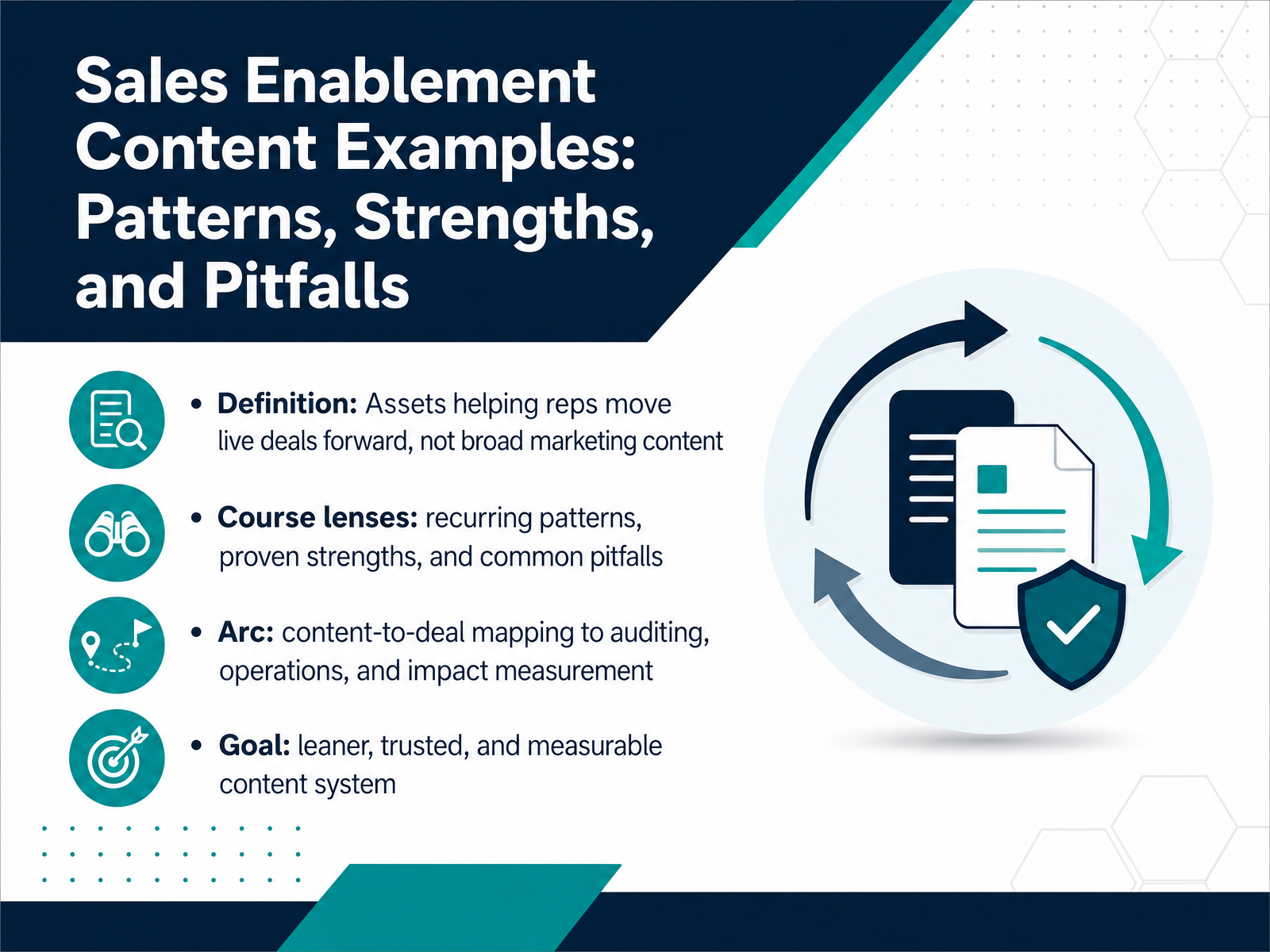
- 01Sales Enablement Content Examples: Patterns, Strengths, and PitfallsWelcome. If you're leading a sales enablement team, managing sellers, or creating content that needs to move deals, you're in the right place. Here's what we're going to do. We'll look at real sales enablement content examples, not generic marketing fluff, and we'll break them down into three parts: the recurring patterns that make them work, the proven strengths you can lean on, and the common pitfalls that quietly kill adoption. We'll walk from mapping content to the deal, all the way through auditing what you have, running the operations, and measuring real impact. The goal is simple. A leaner, trusted, and measurable content system that your reps actually reach for. This isn't about creating more assets. It's about creating the right ones. Before we see the strongest examples, let's talk about why most content fails before a rep even opens it.reachlabs.aioutsales.aidock.us+21 min
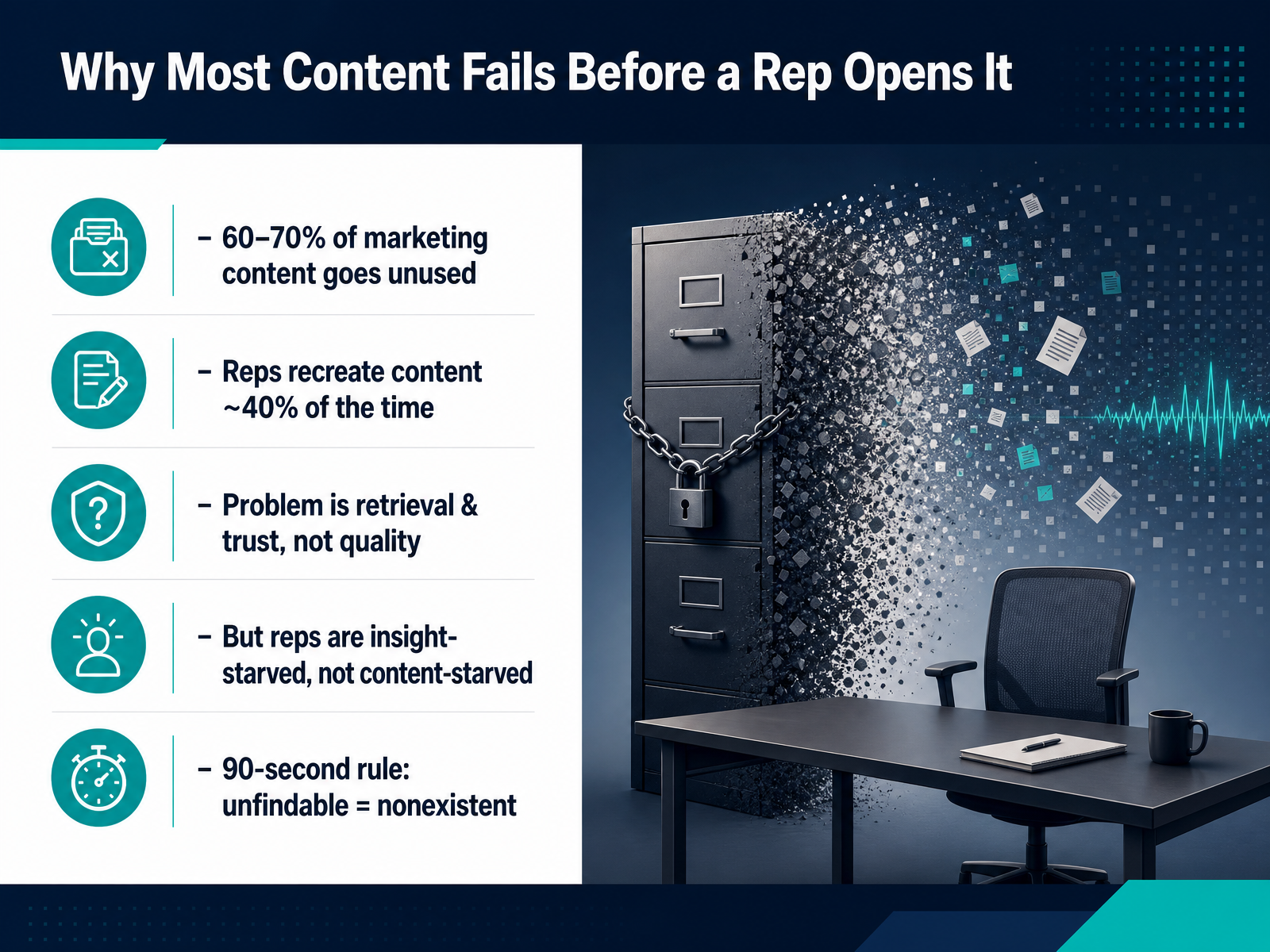
- 02Why Most Content Fails Before a Rep Opens ItLet’s start with a hard truth: most content fails before a rep ever opens it. Studies consistently show that sixty to seventy percent of marketing-produced content goes unused. And reps recreate content that already exists nearly forty percent of the time. That’s not a quality problem. It’s a retrieval and trust problem. Your reps aren’t content-starved—they’re insight-starved. They have plenty of material; what they don’t have is the right material at the right moment. The real rule is simple: if a rep can’t find it in ninety seconds, it doesn’t exist. Think about your own team. When they’re prepping for a call, do they search the library or build something on the fly? If they’re building, it’s not because they don’t value your content. It’s because the system let them down. The fix isn’t more content—it’s better findability, fresh assets, and a feedback loop that tells reps what actually works. That’s the foundation. Next, we’ll look at how to map content directly to deal stages, so what you create earns its place in the pipeline.
 paperflite.comsalesfit.aib2bcopywriter.uk+22 min
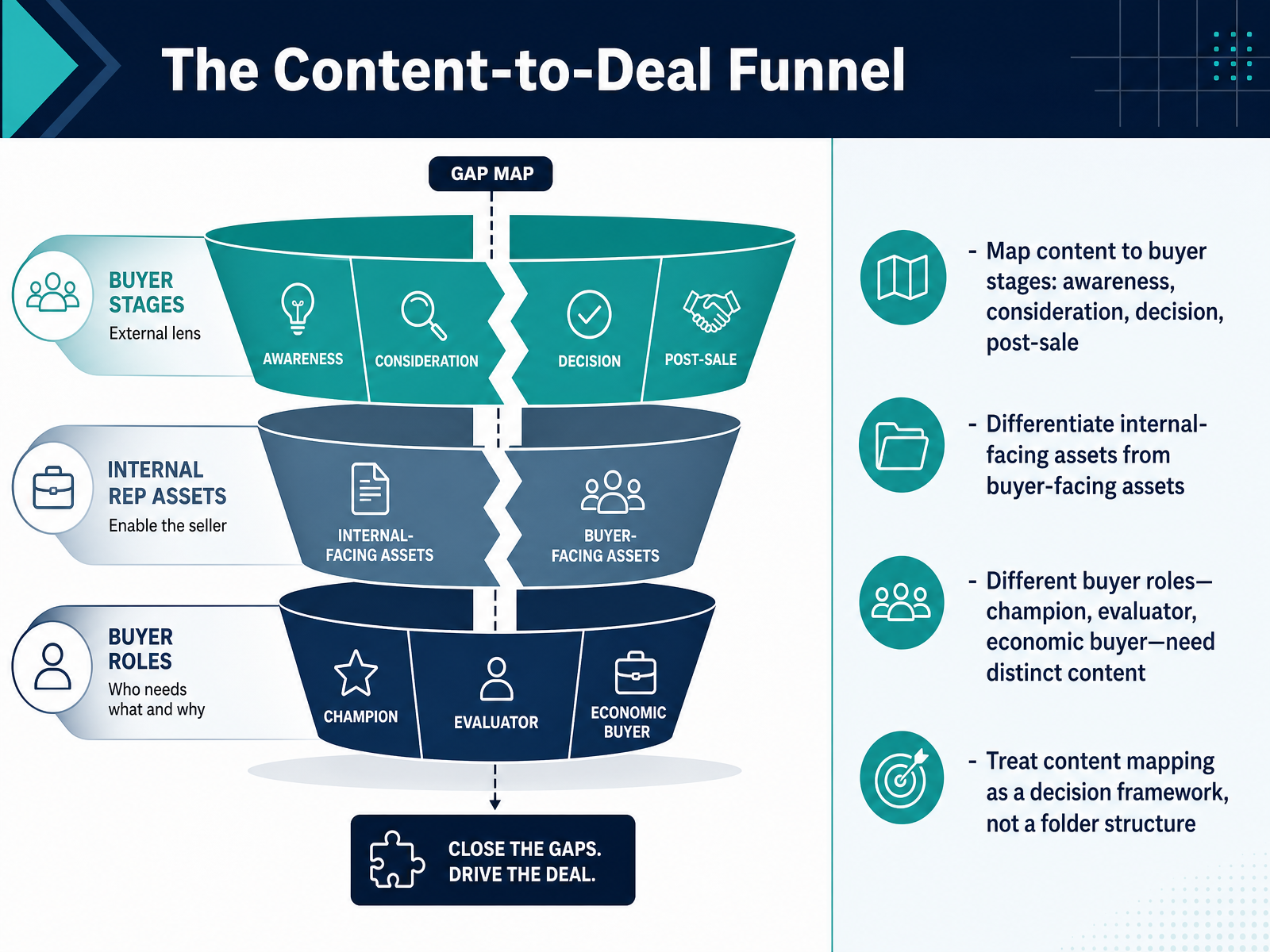
 - 03The Content-to-Deal FunnelLet's talk about the content-to-deal funnel. The strongest teams don't just organize assets by format or campaign. They map every piece of content to a specific buyer stage: awareness, consideration, decision, and post-sale. A case study that closes a deal at the decision stage will confuse a buyer who is just discovering they have a problem. Timing is everything.
Now, a critical distinction. Separate your internal-facing assets from buyer-facing ones. Battlecards and playbooks prepare your reps behind the scenes. Case studies and ROI calculators reduce friction for the buyer. Confusing the two creates noise, not momentum.
And remember, your content must serve different buyer roles. Your champion needs ammunition to sell internally. Your technical evaluator needs specs and architecture. Your economic buyer needs ROI and payback periods. One generic asset sent to all three stalls the deal.
Treat this mapping as a decision framework, not a folder structure. The question isn't where a file lives. It's what your buyer needs to see next to move forward. Get that right, and your content becomes a catalyst, not a library.
Next, let's look at the proven format patterns that earn real rep adoption.
 guideflow.comworksbuddy.aithinkinsights.net+22 min
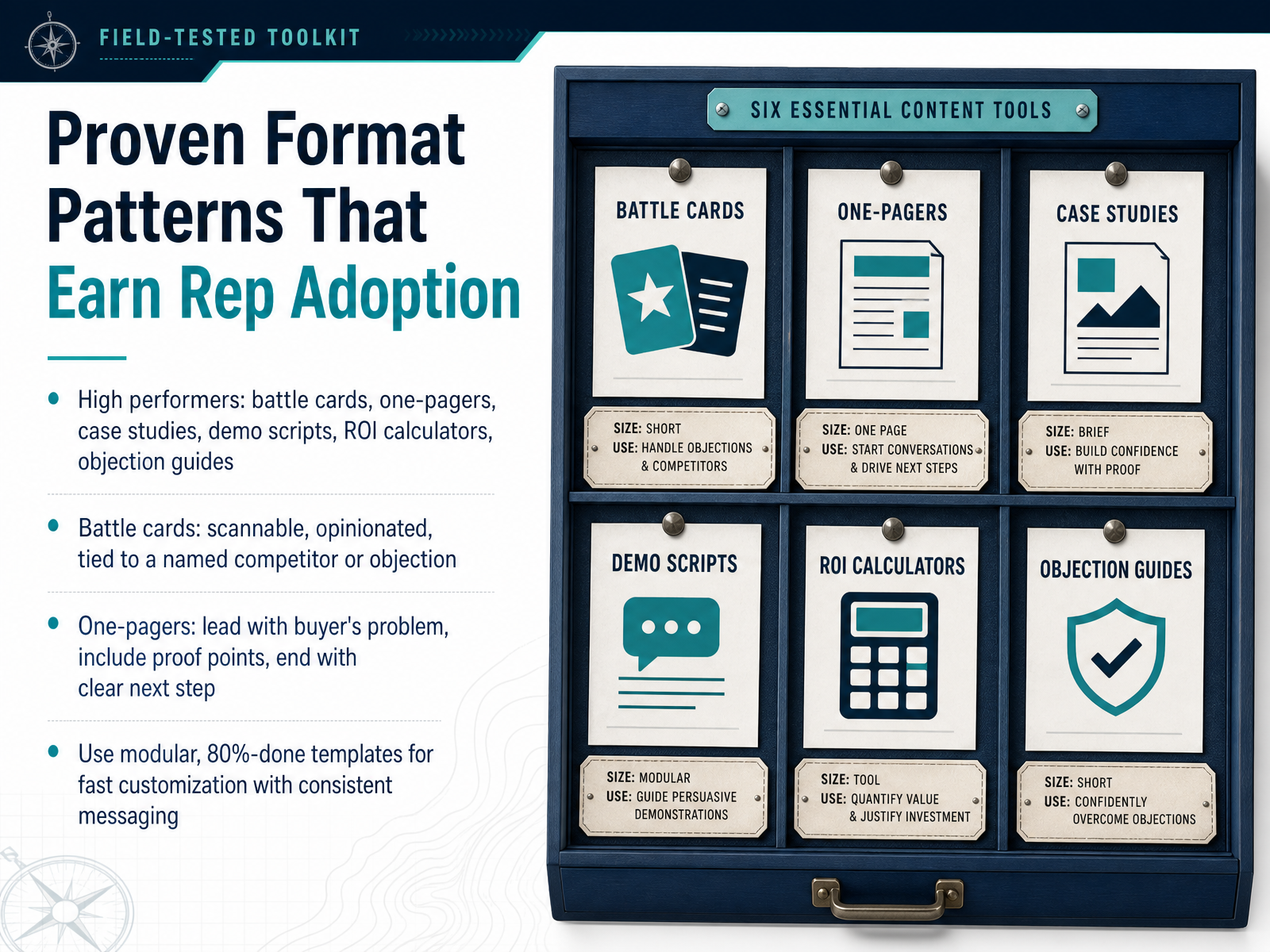
 - 04Proven Format Patterns That Earn Rep AdoptionLet's talk about formats that actually earn rep adoption. High performers consistently rely on six core assets: battle cards, one-pagers, case studies, demo scripts, ROI calculators, and objection guides. Notice what they have in common: they're quick to use and tied to a specific moment in the deal. Take battle cards. The best ones are scannable, opinionated, and tied to a named competitor or objection. A rep should be able to open one mid-call and find the answer in under sixty seconds. That's the bar. One-pagers work differently. They lead with the buyer's problem, include proof points, and end with a clear next step. They're not brochures; they're ammunition for the champion who needs to sell your solution internally. Here's the pattern that separates tools from shelfware: build modular, eighty-percent-done templates. Give your team the core message, structure, and proof points, then let them customize the last twenty percent for their specific prospect. That keeps messaging consistent without forcing reps to start from a blank page. Remember, the goal isn't more content. It's content that gets used in live deals and moves them forward. That's what earns adoption with your team. Now, let's look at the two formats that get confused most often: battle cards versus one-pagers, and why they serve completely different jobs.
 redefineyourmarketing.commedium.comthestacc.com+22 min
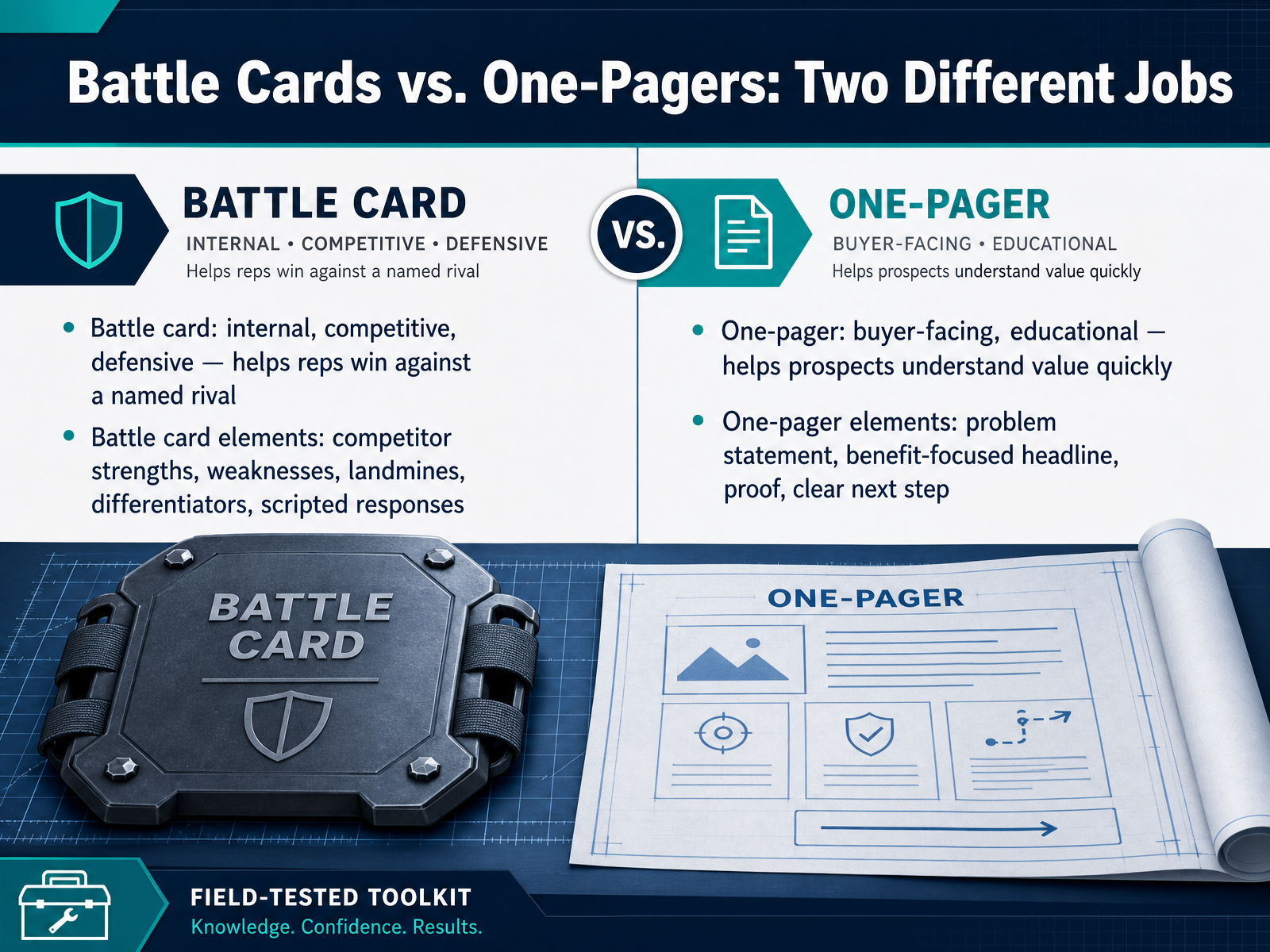
 - 05Battle Cards vs. One-Pagers: Two Different JobsLet’s clarify a common mix-up: battle cards and one-pagers are not the same asset. They do two completely different jobs. A battle card is internal, competitive, and defensive. It helps your reps win against a named rival in a live deal. A one-pager is buyer-facing and educational. It helps a prospect quickly understand the value you bring. Keep them separate in your mind and in your content library. A strong battle card includes competitor strengths and weaknesses, landmines, your differentiators, and scripted responses. It’s a cheat sheet for your rep, never something you hand to the prospect. A strong one-pager focuses on the buyer’s problem, has a benefit-driven headline, proof, and a clear next step. Notice how both are short, but the audience and purpose are completely different. Before you create either one, ask yourself: who is the reader, and what action do I want them to take? That decision determines the format. Next, let’s look at the strengths that drive rep confidence and deal velocity.
 redefineyourmarketing.commedium.comthestacc.com+22 min
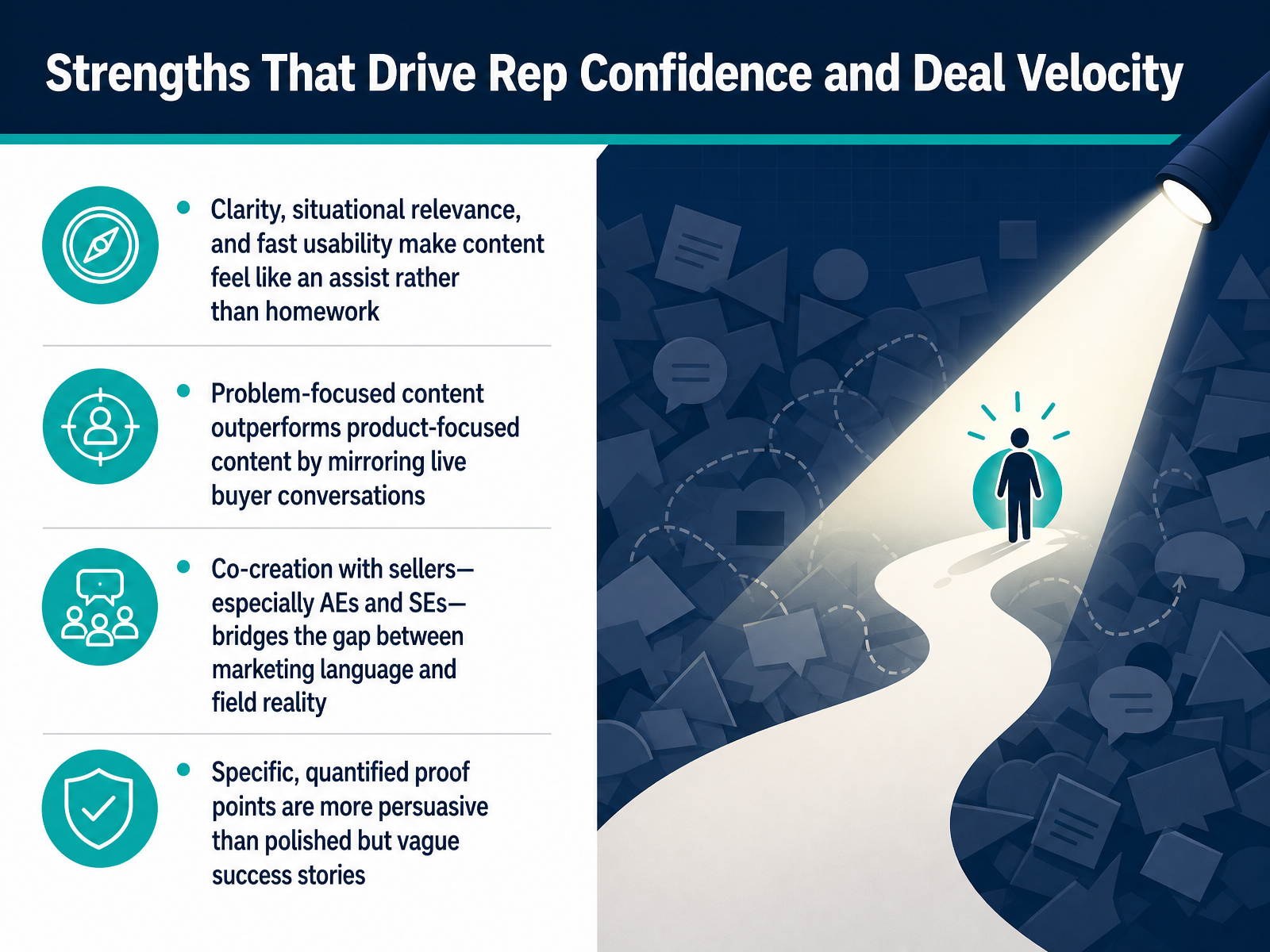
 - 06Strengths That Drive Rep Confidence and Deal VelocityNow let's talk about the strengths that actually build rep confidence and speed up deal velocity. Notice how the strongest content does three things at once: it's clear, it's situationally relevant, and it's fast to use. Your team should feel like content is an assist, not homework. If a rep has to read a twenty-page document to answer one objection, that content will not get used. Next, problem-focused content consistently outperforms product-focused material. Why? Because it mirrors how buyers actually talk. A case study that says this customer cut their cost per opportunity from thirty-two hundred to nineteen hundred dollars in ninety days will move a CFO conversation forward. A polished story about transformation will not. Here's the critical piece: co-create content with your sellers, especially your account executives and solutions engineers. They hear the real objections, the real language, and the real competitive pressure. A battlecard written by someone who has lost a deal to that competitor last month is worth ten written from marketing research alone. Finally, specific, quantified proof points beat vague success stories every single time. Give your team numbers they can defend. That is what builds trust in a live negotiation. In short, clarity, relevance, speed, and co-creation are the patterns that turn content into a revenue system. Now let's look at what happens when these patterns break down, the common pitfalls and failure modes.
 guideflow.comsifthub.ioreachlabs.ai+22 min
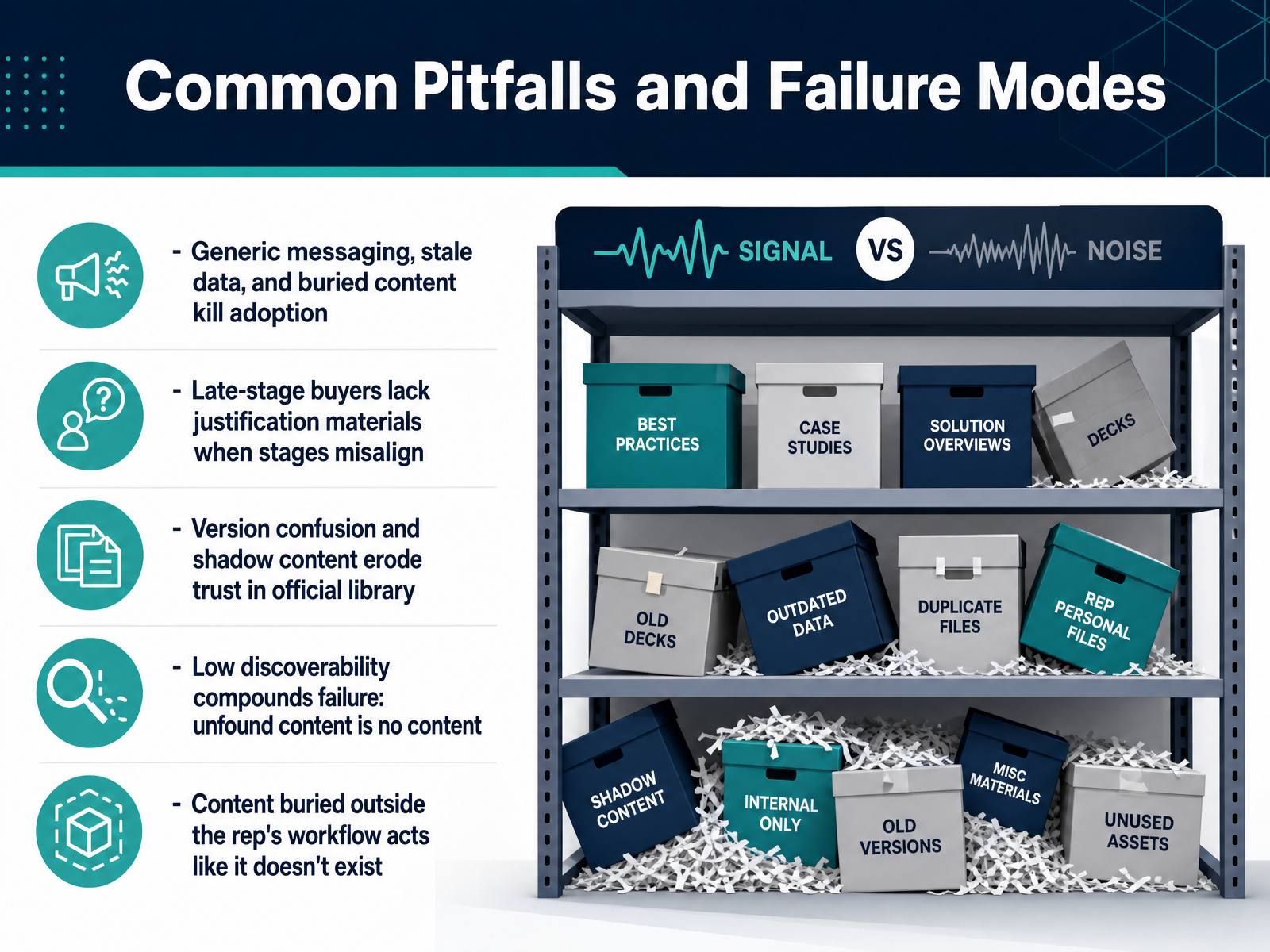
 - 07Common Pitfalls and Failure ModesLet’s talk about where enablement content actually breaks down in the field. The first pattern: generic messaging with stale data. You know the symptom—reps quietly build their own versions because the official piece doesn’t match the buyer in the room. That’s not a content problem, that’s a trust problem, and it kills adoption fast. Second pattern: stage misalignment. When content is mapped to the deal stage but not to the buyer’s actual journey, late-stage buyers never get the justification materials they need—like ROI models or security checklists. The deal stalls, and your rep loses credibility. Third pattern: version confusion. When there are three versions of the same battlecard floating around, your reps lose confidence in the entire library. Shadow content fills the gap, and your messaging becomes inconsistent. Fourth, and this is the quiet killer—low discoverability. If a rep can’t find the right asset in under thirty seconds during a call, it effectively doesn’t exist. Content buried in shared drives or outside the CRM workflow might as well be invisible. So the takeaway here is sharp. These aren’t separate training problems—they’re symptoms of one visibility gap. Fix findability, freshness, and feedback together. Now, let’s look at some real-world examples worth adapting.
 paperflite.comsalesfit.aib2bcopywriter.uk+22 min
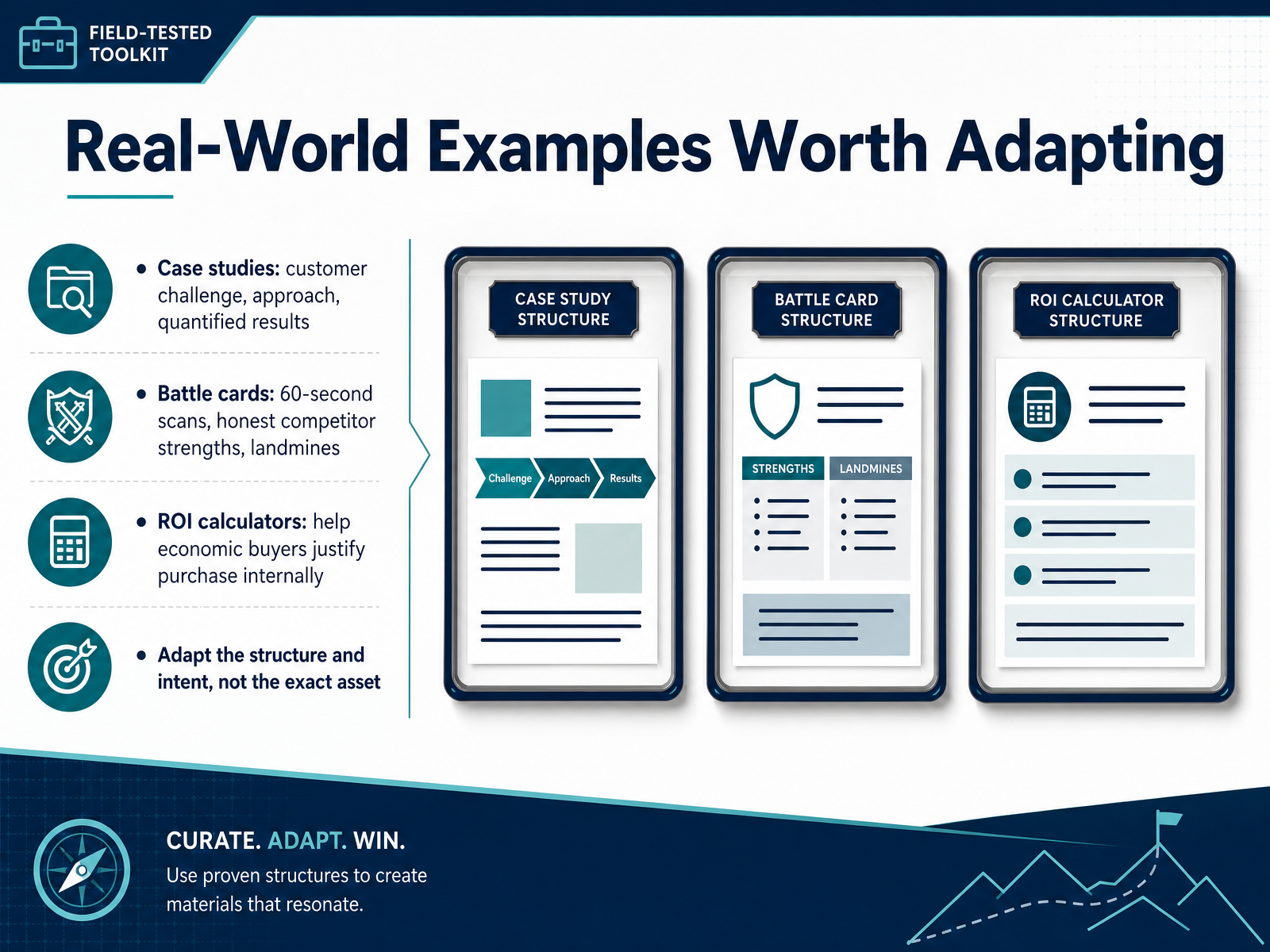
 - 08Real-World Examples Worth AdaptingLet's look at three real-world examples worth adapting for your own team. First, case studies. Notice how the strongest ones aren't just success stories. They follow a tight structure: the customer's challenge, the approach you took, and quantified results. That's it. No fluff. This structure lets your rep quickly match the proof to the prospect's specific situation. Second, battle cards. The best ones are designed for a sixty-second scan during a live call. They include honest competitor strengths, not just weaknesses, and they plant landmines, which are strategic questions that expose a competitor's gap. If a battle card takes more than a minute to absorb, your rep won't use it. Third, ROI calculators. These are powerful late in the deal because they help an economic buyer justify the purchase internally. The calculator gives them the numbers they need to build their own business case. Now, here's the key takeaway. Don't copy these assets. Adapt the structure and the intent behind them. A case study's structure works for any proof point, and a battle card's format works for any competitor. That's the pattern to replicate. Next, let's look at how to audit your existing content with a practical scorecard.
 dock.usredefineyourmarketing.commedium.com+22 min
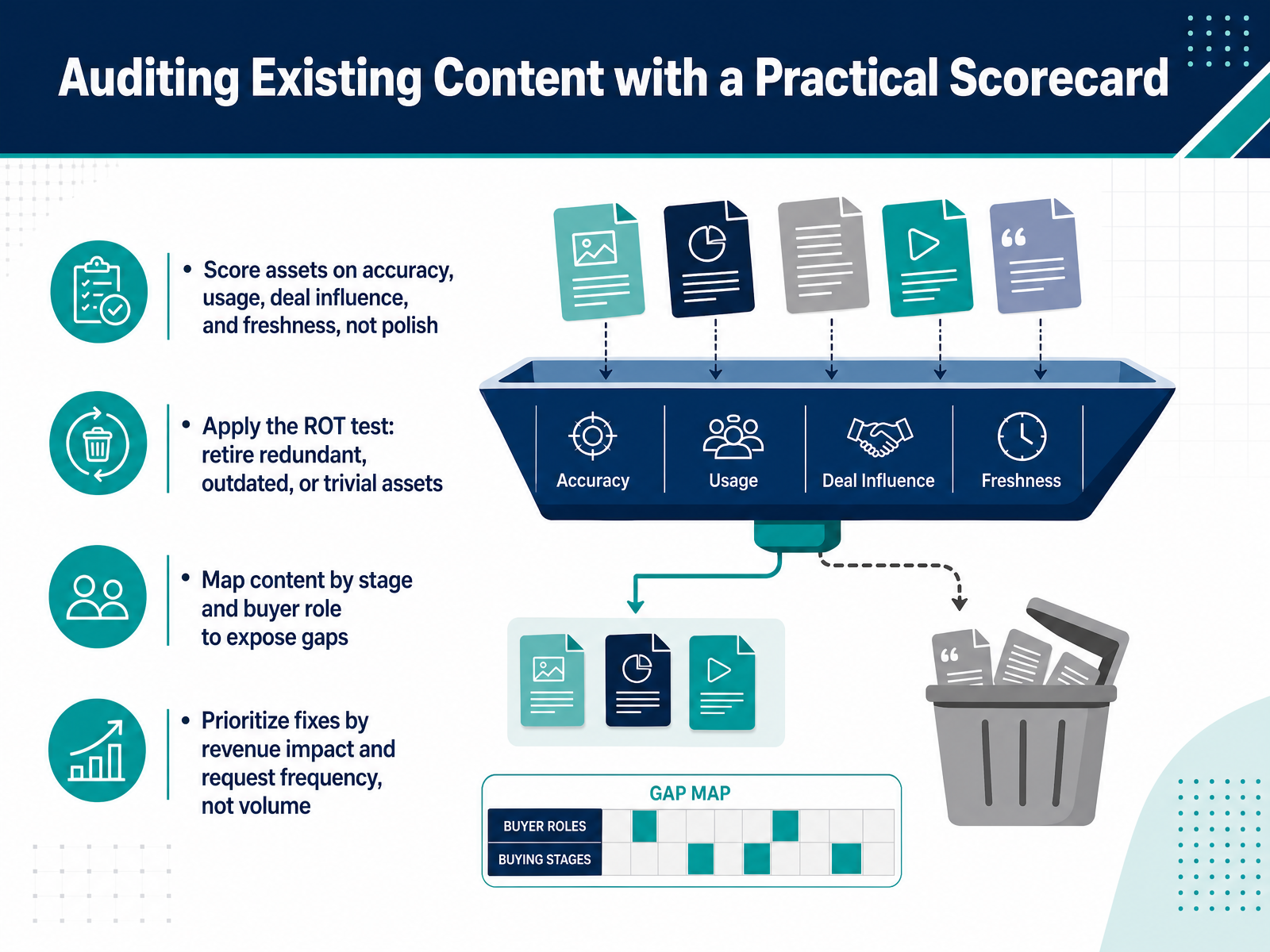
 - 09Auditing Existing Content with a Practical ScorecardNow let's get practical. You can't fix what you haven't measured, so let's walk through a simple scorecard you can apply today. Score every asset on four things: accuracy, usage, deal influence, and freshness. Not polish. A beautiful deck that nobody opens is just a liability. For accuracy, ask if the claims and stats are current and verified. For usage, check how often your reps actually pull it. For deal influence, look at whether it shows up in deals that move forward or close. And for freshness, be honest about when it was last updated. If something is redundant, outdated, or trivial, apply the ROT test and retire it. Don't agonize. A lean library that reps use beats a bloated one that collects dust. Then map everything by stage and buyer role. This exposes the gaps. Most teams are heavy on awareness content and light on decision-stage assets like ROI calculators and competitive battlecards. When you prioritize fixes, don't go by volume. Go by revenue impact and request frequency. Fix what blocks deals first. Ready to keep this from falling apart next quarter? Let's look at the governance and workflow that makes this repeatable.
 guideflow.comsifthub.ioreachlabs.ai+22 min
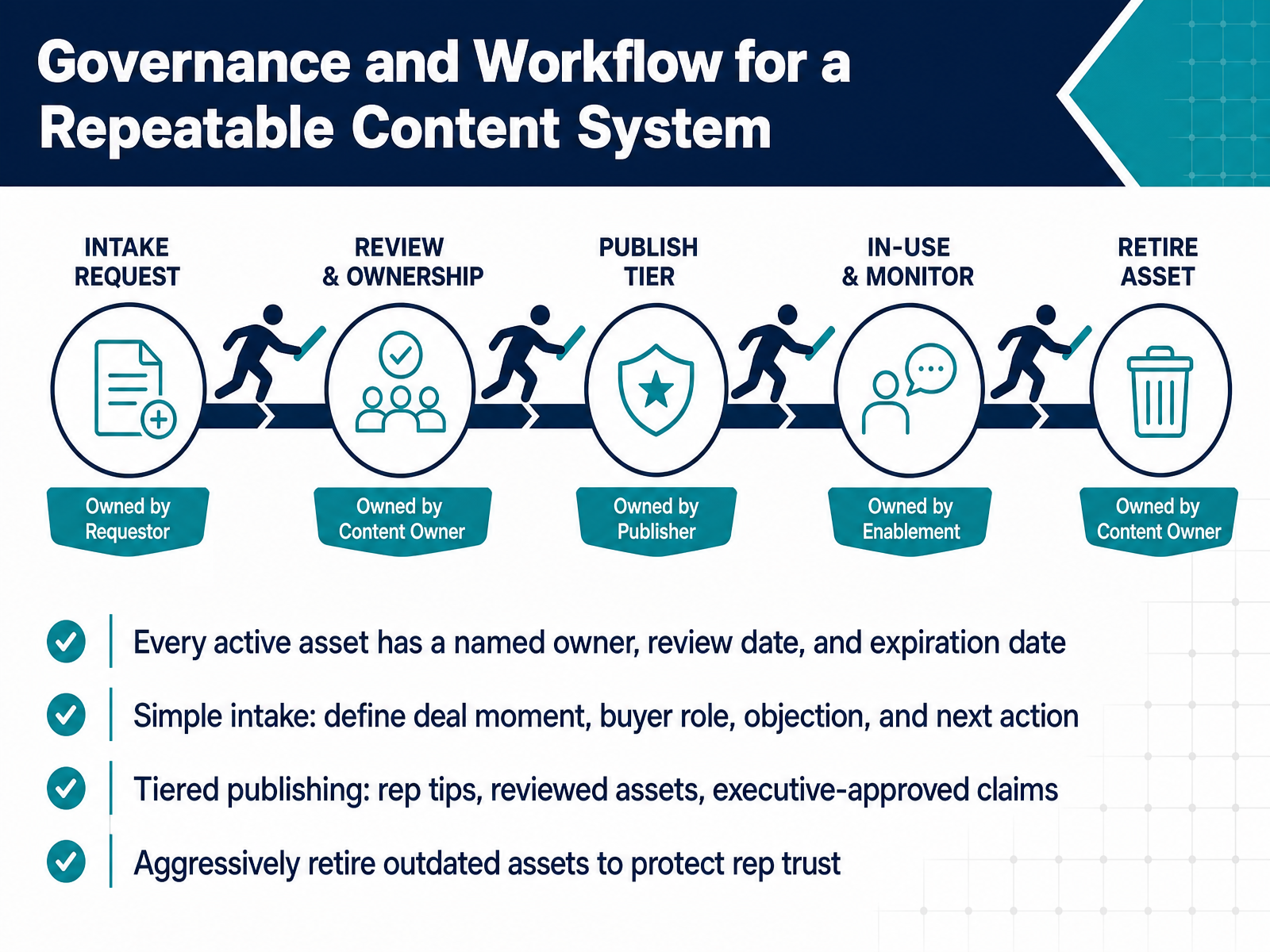
 - 10Governance and Workflow for a Repeatable Content SystemNow let's talk about how you actually operationalize all of this. The goal is a repeatable content system, not a one-time cleanup. Start with the basics. Every active asset gets a named owner, a review date, and an expiration date. No exceptions. If no one owns it, it's already stale. Your intake process should be ruthlessly simple. When someone requests content, ask four things. What deal moment is it for, which buyer role, what objection does it answer, and what's the next action for the rep. That's it. Then use a tiered publishing model. Rep tips go out fast with minimal friction. Reviewed assets like battlecards go through a steward. And pricing or security claims get executive sign-off before they ever hit the library. Finally, be aggressive about retiring outdated material. A lean library that reps trust beats a bloated one they ignore. When you pull something that's no longer accurate, you protect your team's confidence in everything that remains. That's the core of a healthy system. Up next, we'll look at how to measure content impact without overclaiming the results.
 guideflow.comsifthub.ioreachlabs.ai2 min
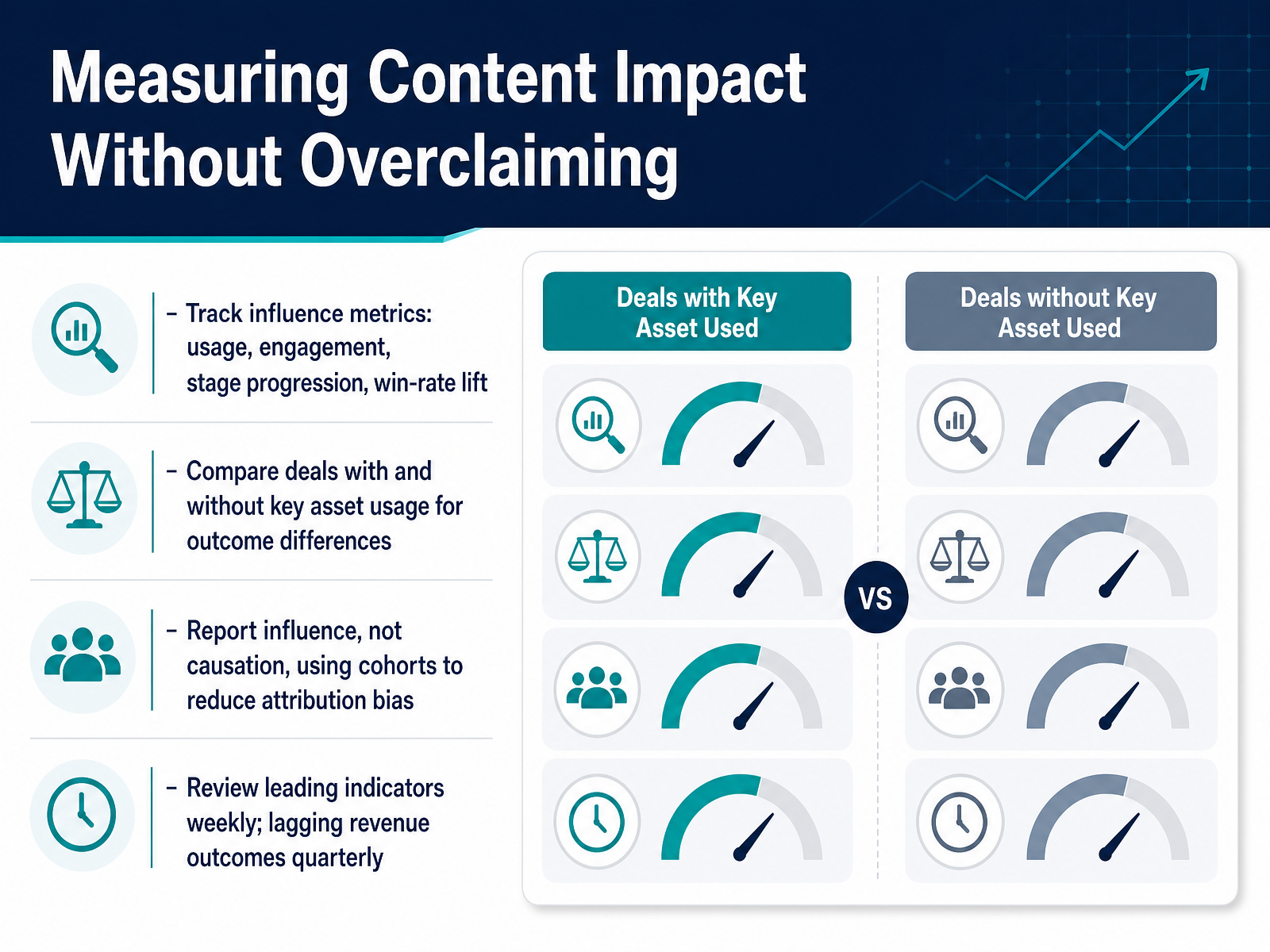
 - 11Measuring Content Impact Without OverclaimingNow let's talk about measuring content impact without overclaiming. This is where even strong enablement teams stumble. You want to track influence, not causation. Start with the leading indicators: usage, engagement, and stage progression. Review those weekly. They tell you if reps are actually reaching for your content in active deals. Then, for the lagging outcome, look at win-rate lift. Compare deals where a key asset was used against deals where it wasn't, matched on deal stage and deal size. That cohort comparison is the only credible way to speak to leadership. Report it as 'influence,' not 'proof.' Say, 'Deals that engaged the battlecard closed more often,' not 'The battlecard won these deals.' That framing keeps your credibility intact. And check revenue outcomes quarterly, not daily. Give the data time to settle. In short: track leading indicators weekly, lagging outcomes quarterly, and always compare cohorts. Now, let's look at building a lean measurement loop for your team.
 guideflow.comsifthub.ioreachlabs.ai1 min
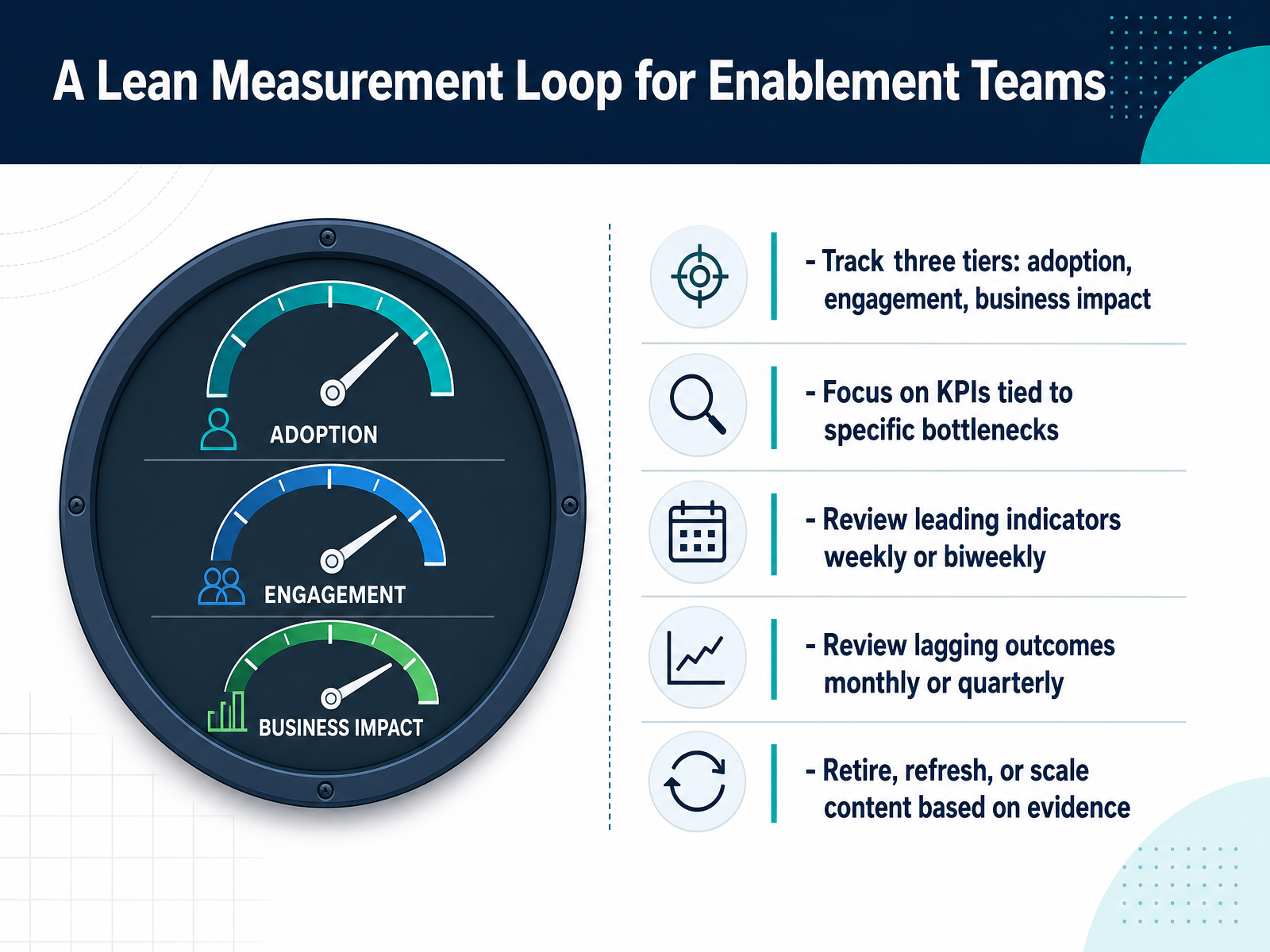
 - 12A Lean Measurement Loop for Enablement TeamsThis is where measurement gets practical. Think of it as a three tier loop. Tier one is adoption. Are your reps actually using the content? Track usage in active deals, not just downloads. If adoption is low, you have a discoverability problem, not a content problem. Tier two is engagement. Are buyers spending time with what you share? Look at viewing time and interaction depth. A one pager that gets opened two hundred times but appears in zero wins is just a cost center. Tier three is business impact. Compare win rates and deal size where specific assets were used versus where they weren't. That comparison is your real signal. Now, match your review cadence to the metric speed. Review leading indicators like content usage and buyer engagement weekly or bi weekly. That lets you adjust before the quarter slips away. Review lagging outcomes like win rate and ramp time monthly or quarterly. Those move slowly, and reviewing them too often just creates noise. Finally, let the evidence drive your library. Retire what doesn't show up in winning deals. Refresh what does. And scale the formats that correlate with faster movement. That's a lean loop your CFO will understand. Next, let's turn this into concrete priority moves for your team, your managers, and your content creators.
 guideflow.comsifthub.ioreachlabs.ai2 min
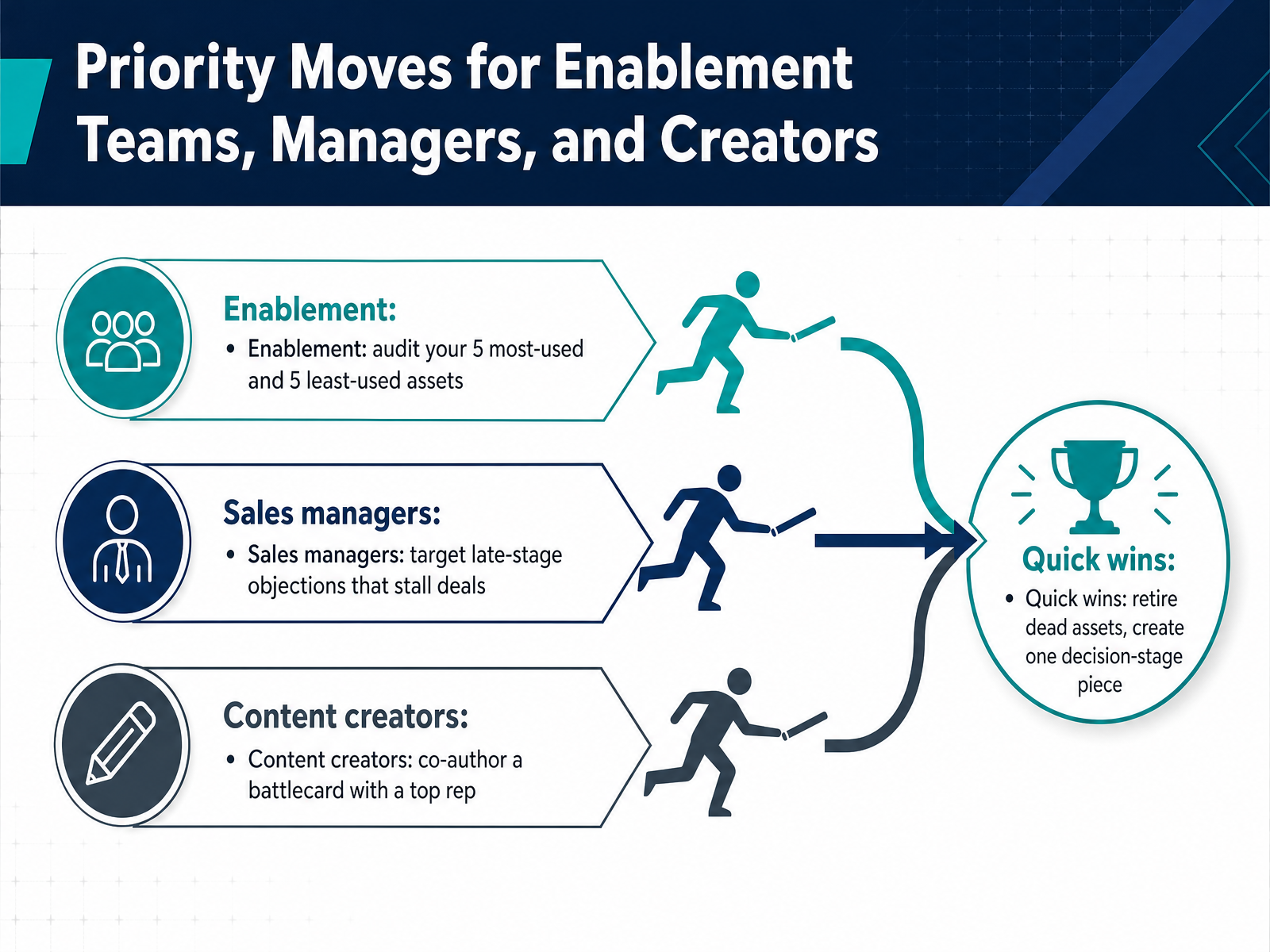
 - 13Priority Moves for Enablement Teams, Managers, and CreatorsLet’s turn all of that analysis into action, because knowing the patterns is only half the battle. For enablement teams, start with a disciplined audit: pull your five most-used assets and your five least-used assets. Score each one on freshness, rep usage, and whether it actually influenced a deal. That single comparison will show you where your library is working and where it's quietly decaying. Sales managers, your job is more surgical. Look at the late-stage objections that keep stalling deals — the pricing pushback, the security review, the champion’s internal doubts. If you don't have a sharp, current response for each one, that's the gap your reps will feel on every big opportunity. And content creators, here's a practical move: co-author one battlecard with a top-performing rep. They know the real objections because they hear them weekly. You know how to structure the response. Together, you'll build something reps will actually use. Then, two quick wins to close the quarter: retire anything that's been unused for two quarters — dead assets just add noise — and create one focused asset for the decision stage, because that's where most teams are weak. Do that, and you'll feel the momentum shift almost immediately. Next, let's lay out a full action plan to take this from a library of shelfware to a genuine revenue system.
 guideflow.comsifthub.ioreachlabs.ai+12 min
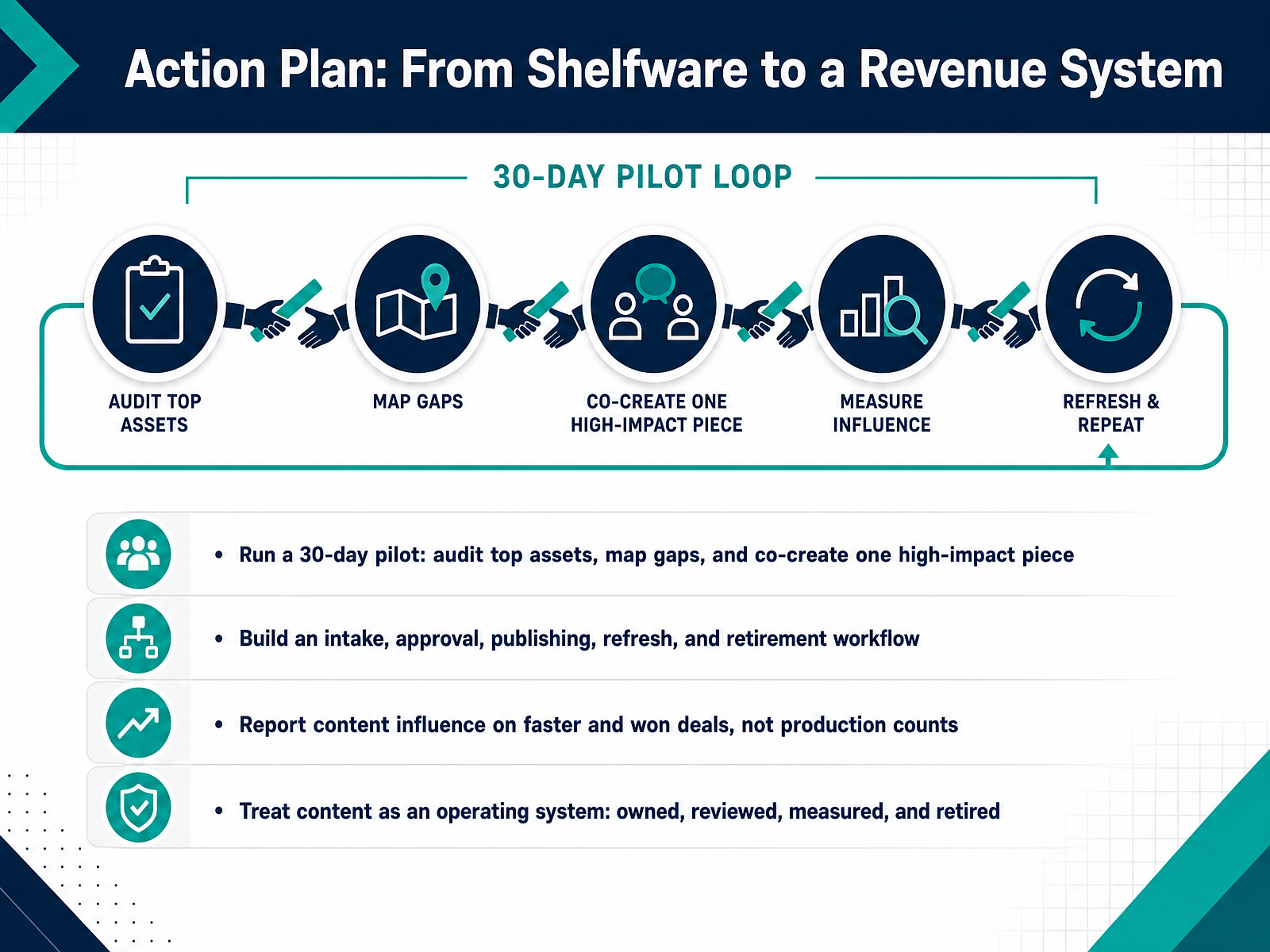
 - 14Action Plan: From Shelfware to a Revenue SystemLet’s turn all of this into a practical plan. Start with a thirty-day pilot. Audit the top assets your reps actually use, map the gaps against your ideal customer profile, and co-create one high-impact piece with input from your best sellers. That builds momentum and credibility fast. Next, design the workflow. Intake, approval, publishing, refresh, and retirement. Every asset needs a clear owner and a review date. Governance isn’t bureaucracy, it’s what keeps your library trustworthy. Then, change what you report. Stop counting downloads and production volume. Report content influence on faster deals and won deals. That directly answers your CFO’s question. Finally, treat content as an operating system. Owned, reviewed, measured, retired. Not a file cabinet. You now have the patterns, pitfalls, and a roadmap. Run the pilot, build the system, and measure the revenue impact. Thank you for your time, and go make your content work for your team.
 guideflow.comsifthub.ioreachlabs.ai2 min
Take the deck with you
Download this course as a file — free, no sign-up needed.
- PDF handoutEvery slide page, ready to print or share.15 pages · 3.8 MBDownload
- Narrated PowerPointThe deck that presents itself — every slide carries the digital human's narration video.15 pages · 15.0 MBDownload
- PowerPoint slidesThe full deck as a .pptx — open it in PowerPoint, Keynote, or Google Slides.15 pages · 3.7 MBDownload
Free to use in your own training — please keep the PersonWise credit page at the end.
Have your own deck? Turn it into a course
Sources consulted
Web sources consulted while building this course.
- Sales Enablement Content: The Definitive Guide for 2026 — reachlabs.ai
- Enablement Content: Definition, Types & the Usage Problem | Outsales — outsales.ai
- 25 Sales Enablement Content Examples From Real Companies — dock.us
- Sales Enablement Content: What It Is & How to Use It in 2026 | Content Repurposing Glossary | RepurposeMyWebinar — repurposeyourcontent.com
- How to create sales enablement content that actually gets used (16 SE content types) - Guideflow Blog — guideflow.com
- Why Do Reps Ignore Enablement Content? 7 Real Reasons (+ How to Fix Each One) — paperflite.com
- Sales Enablement Content: Why Your Reps Ignore 90% of Wha... — salesfit.ai
- Why B2B sales enablement content doesn't get used (and what to do about it) — b2bcopywriter.uk
- Content is Not Enablement: Why Reps Still Don't Use What You Build - SalesNexus — salesnexus.com
- Why Sales Doesn't Use the Content You Build (And Whose Fault It Really Is) — newsletter.marketinghq.io
- Sales Enablement Content Types: What Actually Converts — worksbuddy.ai
- Sales Enablement & Content Playbook | Think Insights — thinkinsights.net
- How to Create Sales Enablement Content — Stratridge — stratridge.com
- Buyer journey content mapping framework | Free download — salesenablementcollective.com
- Sales Enablement Content: What Sales Teams Need | Redefine Marketing Group — redefineyourmarketing.com
- Battlecard vs One-Pager in Product Marketing | by Aditya Raj | Product Marketing | Write A Catalyst | Mar, 2026 | Medium — medium.com
- Battle Card: Definition, Examples & 2026 Sales Playbook | theStacc Glossary — thestacc.com
- Sales Battlecards: Examples To Inspire B2B Sellers - Highspot — highspot.com
- Sales Enablement Content That Wins Deals | Everything-PR — everything-pr.com
- Sales Enablement Content Strategy: Complete Guide for 2026 — sifthub.io