Begin
14 pages · ~28 min
Scanning Stress and Rhythm in English Verse
This training teaches learners to scan English verse by identifying stressed and unstressed syllables, helping them recognize and analyze poetic meter and rhythm.
A digital instructor presents all 14 pages. Hold “Ask” at any point and ask out loud — the answer comes from this course. No sign-up needed.
What you’ll learn
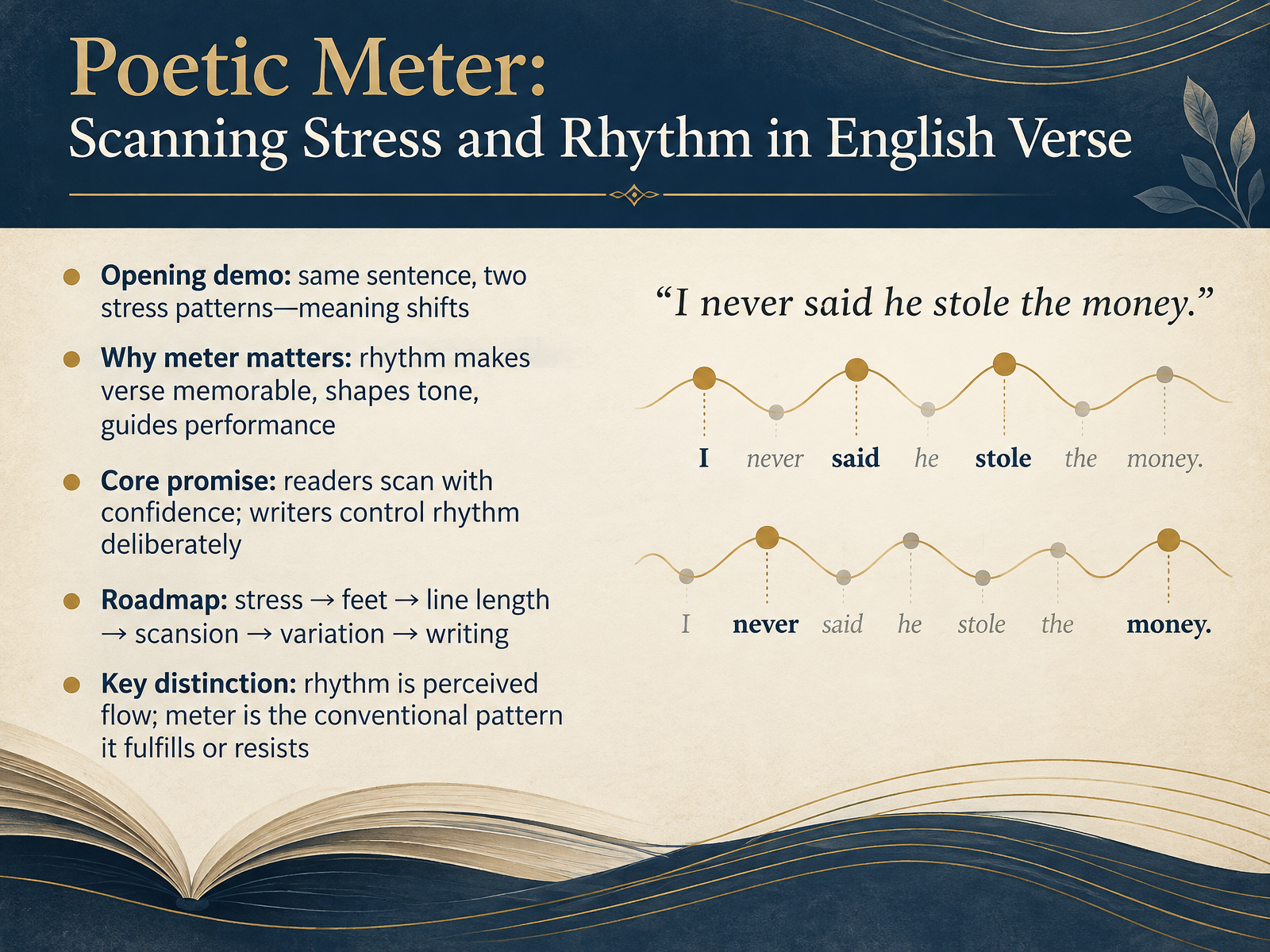
- 01Poetic Meter: Scanning Stress and Rhythm in English VerseWelcome. Today we work on poetic meter: how to scan stress and rhythm in English verse. Let's start with a demo. Say this sentence aloud: I never said she stole my money. Now stress a different word each time. I never said she stole my money. Hear how the meaning shifts? That is stress doing work. Next, why meter matters. Rhythm makes verse memorable. It shapes tone. And it guides performance. Here is our promise. By the end, readers will scan with confidence. Writers will control rhythm deliberately. Our roadmap runs from stress, to feet, to line length, to scansion, to variation, and finally to writing. One key distinction. Rhythm is the flow you hear. Meter is the conventional pattern a poem fulfills or resists. Next, we look closer at that pair.matrix.edu.aumseffie.comtacopeland.people.ysu.edu+21 min
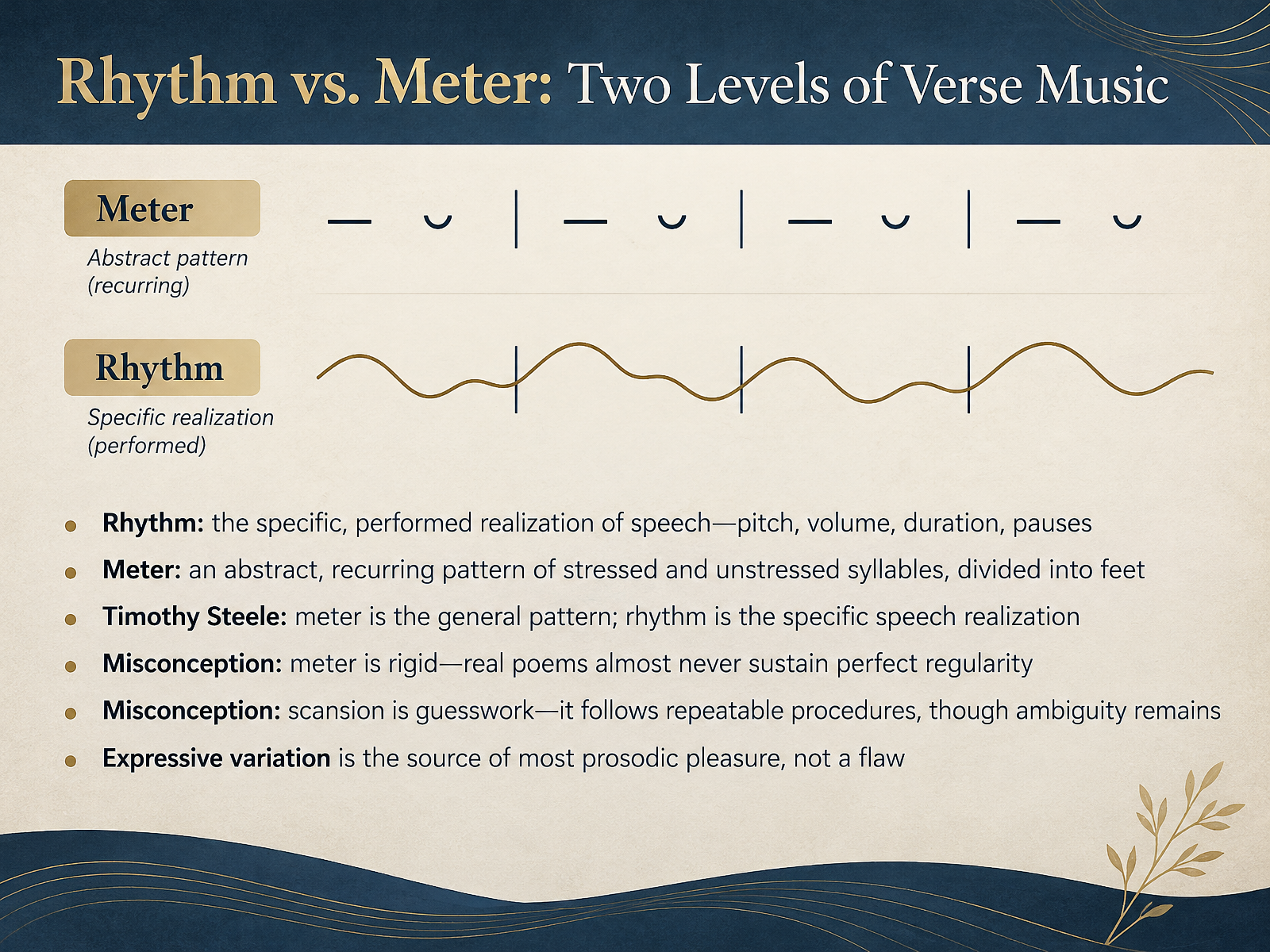
- 02Rhythm vs. Meter: Two Levels of Verse MusicNow let's separate two levels of verse music: rhythm and meter. First, rhythm. Rhythm is the specific, performed realization of speech. It includes pitch, volume, duration, and pauses. Next, meter. Meter is an abstract, recurring pattern of stressed and unstressed syllables. We divide that pattern into feet. Timothy Steele puts it plainly. Meter is the general pattern, and rhythm is the specific speech realization. Notice two common misconceptions. First, meter is not rigid. Real poems almost never sustain perfect regularity. Second, scansion is not guesswork. It follows repeatable procedures, though some ambiguity remains. Say a line aloud and hear how your voice bends the pattern. Expressive variation is the source of most prosodic pleasure, not a flaw. Next, we look at stress, syllables, and the sound system of English.
 matrix.edu.aumseffie.comtacopeland.people.ysu.edu+21 min
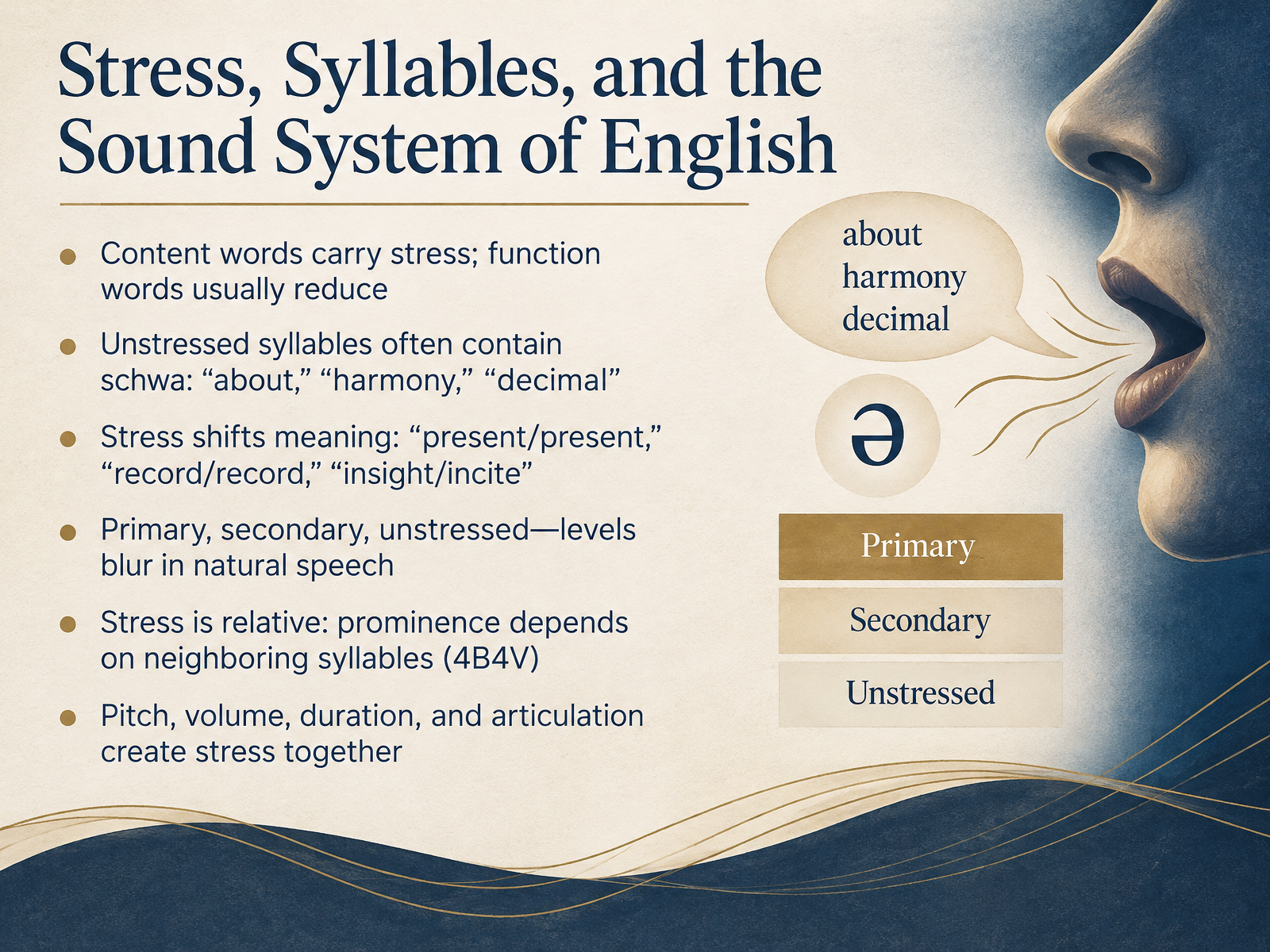
- 03Stress, Syllables, and the Sound System of EnglishNow let's look at the sound system beneath the meter. First, content words carry stress, while function words usually reduce. Next, notice the schwa in unstressed syllables: about, harmony, decimal. Stress can also shift meaning. Compare present and present, or record and record. Say each pair aloud and listen. We often describe primary, secondary, and unstressed levels, but those levels blur in natural speech. Stress is relative, not absolute. A syllable's prominence depends on its neighbors. Pitch, volume, duration, and articulation work together to create stress. So before you scan a line, read it aloud and listen for these cues. Next, we move to the foot, the building blocks of meter. The Foot: Building Blocks of Meter.
 web.mit.eduseas.elte.huen.wikipedia.org+21 min
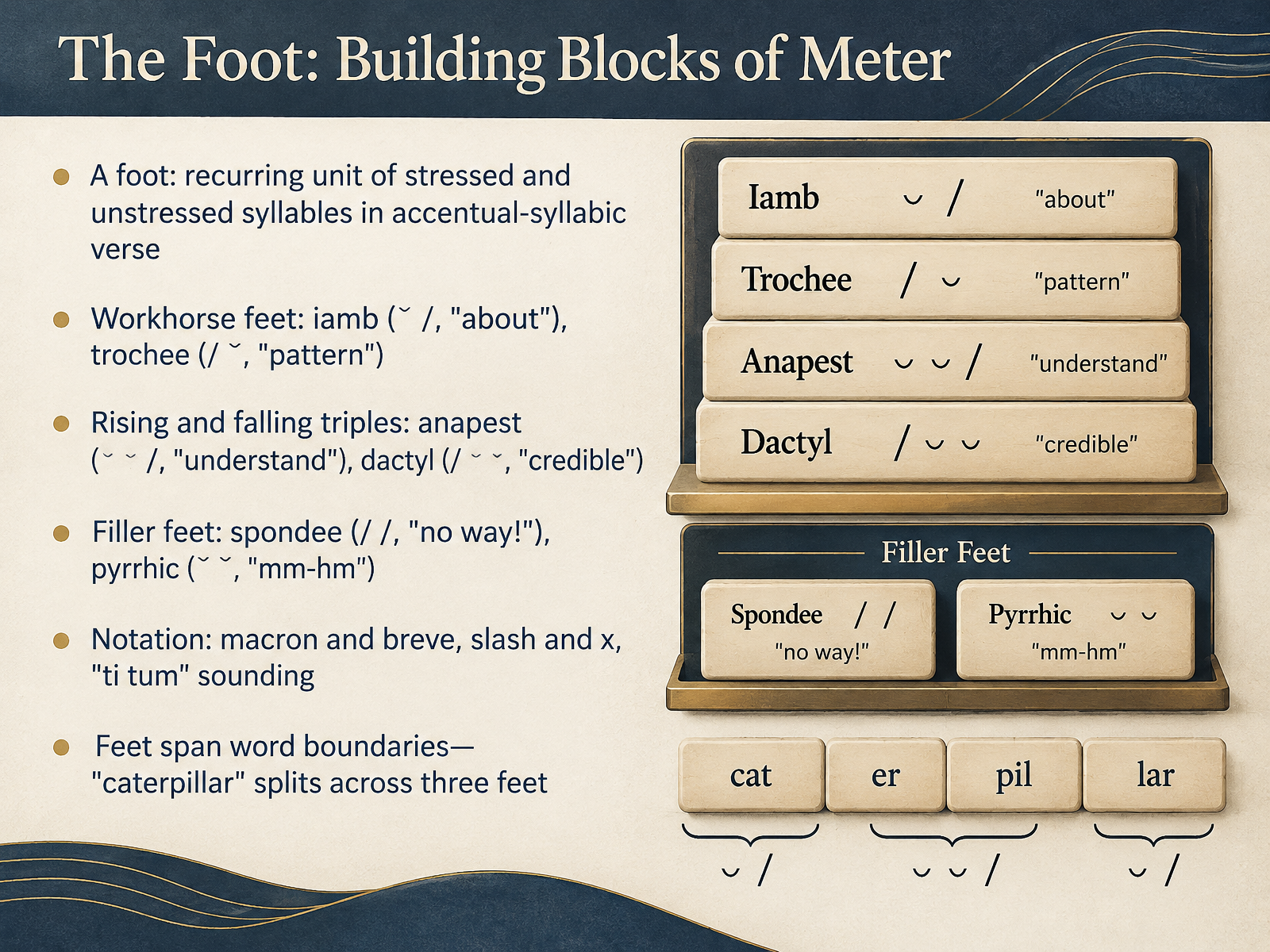
- 04The Foot: Building Blocks of MeterNow let's name the building blocks themselves. A foot is the recurring unit of stressed and unstressed syllables in accentual-syllabic verse. First, the workhorse feet. An iamb goes unstressed then stressed, like "about." A trochee reverses it, stressed then unstressed, like "pattern." Next, the triples. An anapest rises, unstressed unstressed stressed, like "understand." A dactyl falls, stressed unstressed unstressed, like "credible." Two filler feet round things out. A spondee has two stresses, like "no way!" A pyrrhic has two unstressed syllables, like "mm-hm." Notice that we mark these with a breve and a macron, or a slash and an x. Either way, sound it out as "ti tum." One more point: feet span word boundaries. In "caterpillar," the word splits across three feet. Try tapping it now. Next, we look at how feet combine into lines: Line Length: From Dimeter to Octameter.
 poetry.harvard.edupoetryfoundation.orgopen.edu+21 min
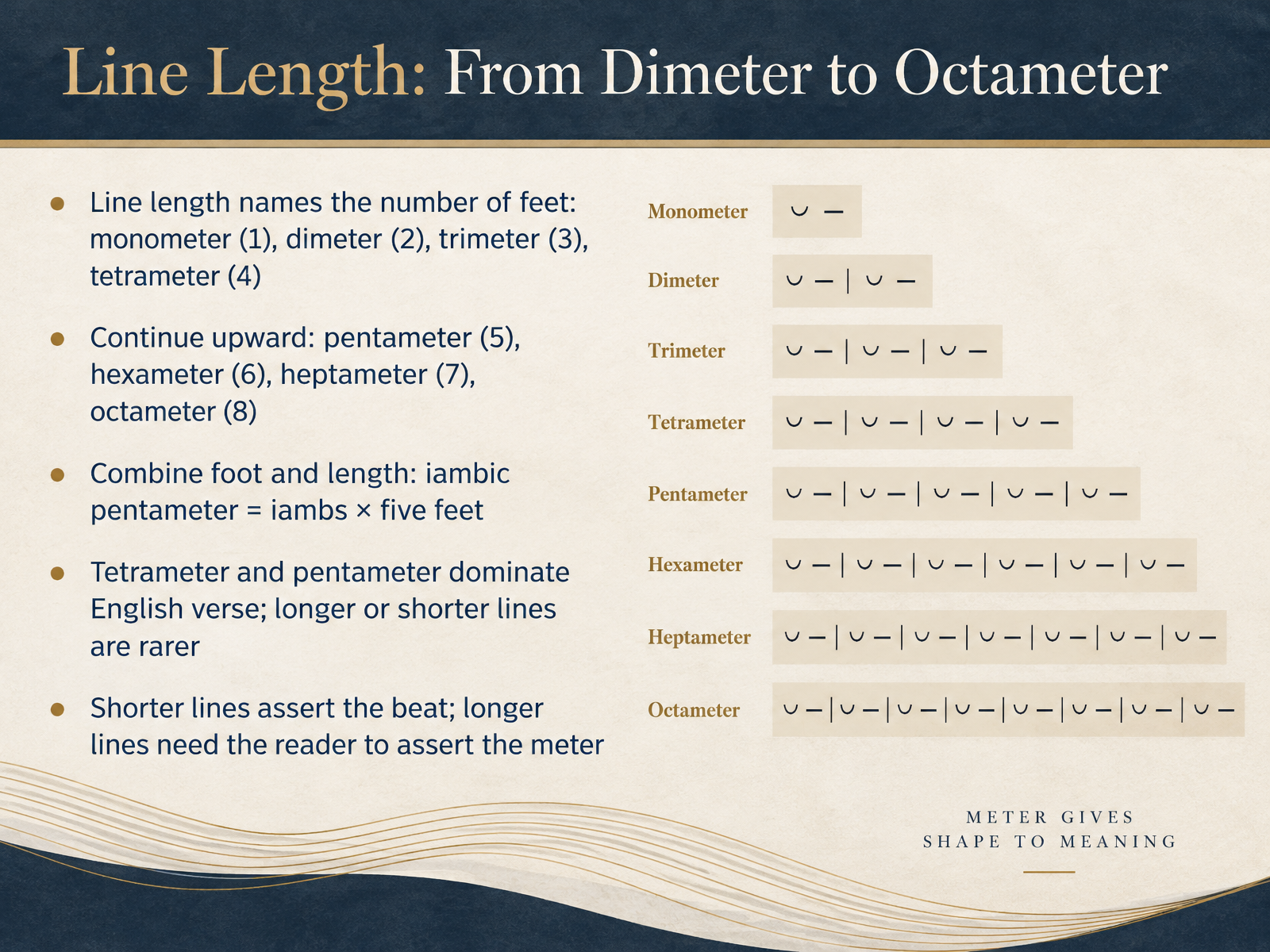
- 05Line Length: From Dimeter to OctameterNow let's look at line length. Line length names how many feet are in a line. One foot is monometer. Two feet, dimeter. Three, trimeter. Four, tetrameter. Then pentameter for five, hexameter for six, heptameter for seven, and octameter for eight. To combine foot and length, name the foot first. Iambic pentameter means iambs, times five feet. Say that phrase aloud: iambic pentameter. Now tap the five beats: da DUM, da DUM, da DUM, da DUM, da DUM. Tetrameter and pentameter dominate English verse. Longer or shorter lines are rarer. Notice this contrast. Shorter lines assert the beat, while longer lines need the reader to assert the meter. Next, we ask why iambic pentameter became the dominant line in English verse.
 poetry.harvard.edupoetryfoundation.orgopen.edu+21 min
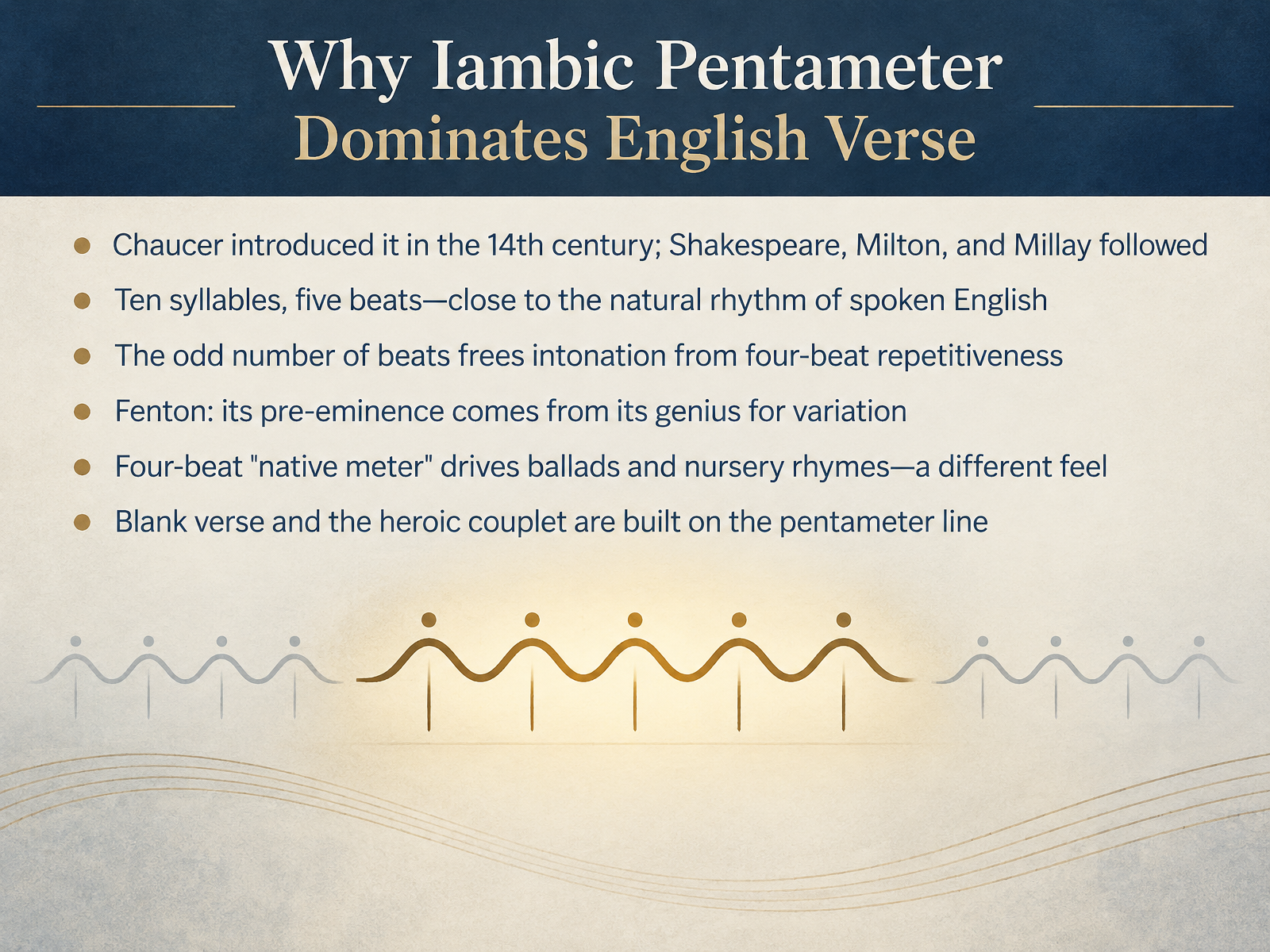
- 06Why Iambic Pentameter Dominates English VerseNext, let's ask why iambic pentameter dominates English verse. First, history. Chaucer introduced it in the fourteenth century. Shakespeare, Milton, and Millay later followed. Second, shape. Ten syllables, five beats, close to the natural rhythm of spoken English. Notice that the odd number of beats frees intonation from four-beat repetitiveness. The critic James Fenton says its pre-eminence comes from its genius for variation. Now compare the four-beat native meter. That meter drives ballads and nursery rhymes. Like this: da DUM da DUM da DUM da DUM. It has a different, more regular feel. Pentameter sounds more like speech. And blank verse and the heroic couplet are both built on the pentameter line. So remember this takeaway. Five beats give room for variation, and that variation is the source of its power. Next, we put this into practice with Scansion in Practice: A Five-Step Method.
 corescholar.libraries.wright.edutheguardian.comowl.purdue.edu+22 min
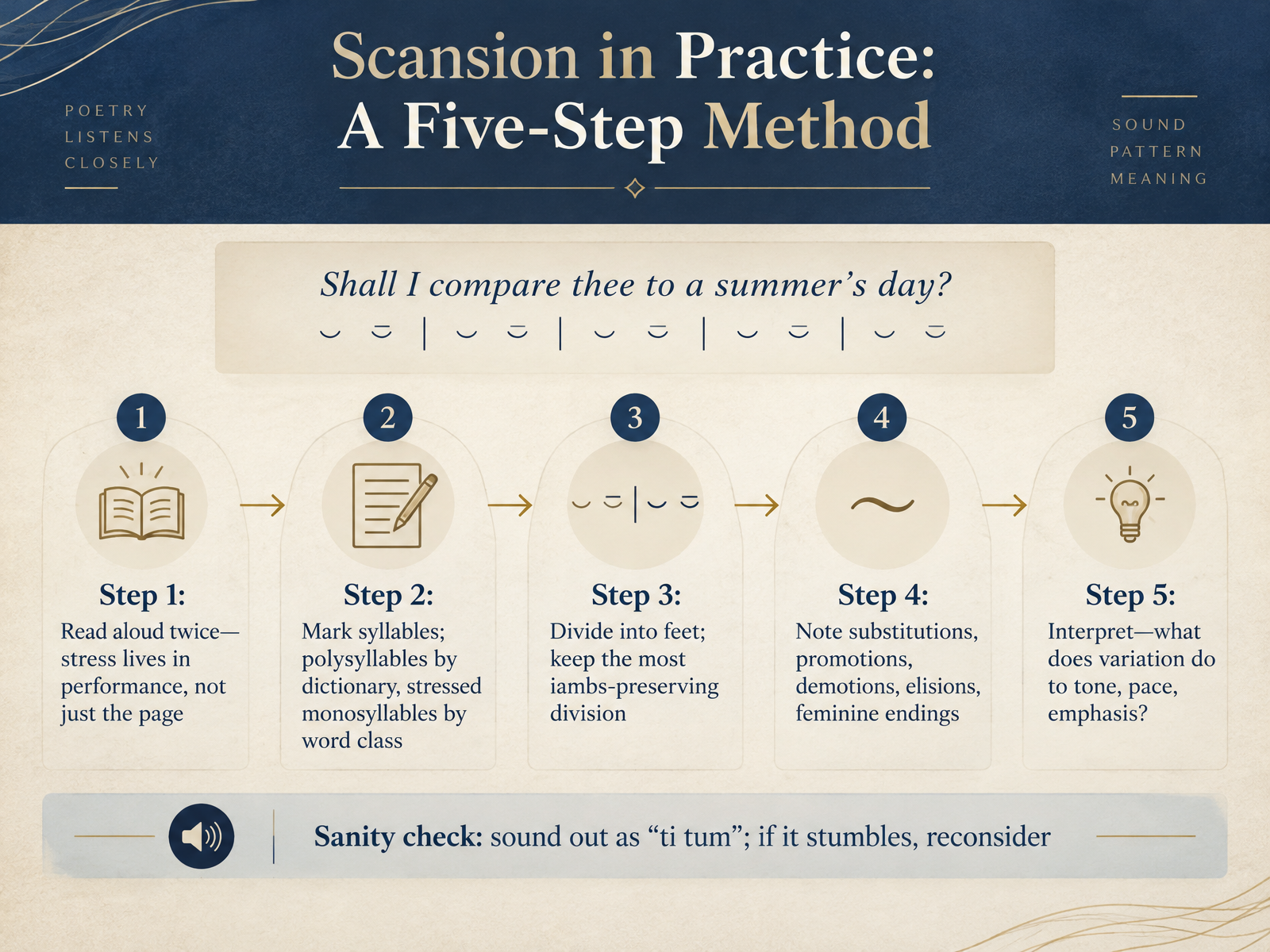
- 07Scansion in Practice: A Five-Step MethodLet's put scansion into practice with a five-step method. First, read the poem aloud twice. Stress lives in performance, not just on the page. Next, mark syllables. Check polysyllables in a dictionary, and stress monosyllables by word class, so nouns and verbs take weight. Then divide the line into feet, keeping the division that preserves the most iambs. After that, note the variations: substitutions, promotions, demotions, elisions, and feminine endings. Finally, interpret. Ask what that variation does to tone, pace, and emphasis. Here is a sanity check. Sound the line out as ti tum. If it stumbles, reconsider your marks. Now, what commonly goes wrong when we scan?
 matrix.edu.aumseffie.comtacopeland.people.ysu.edu+21 min
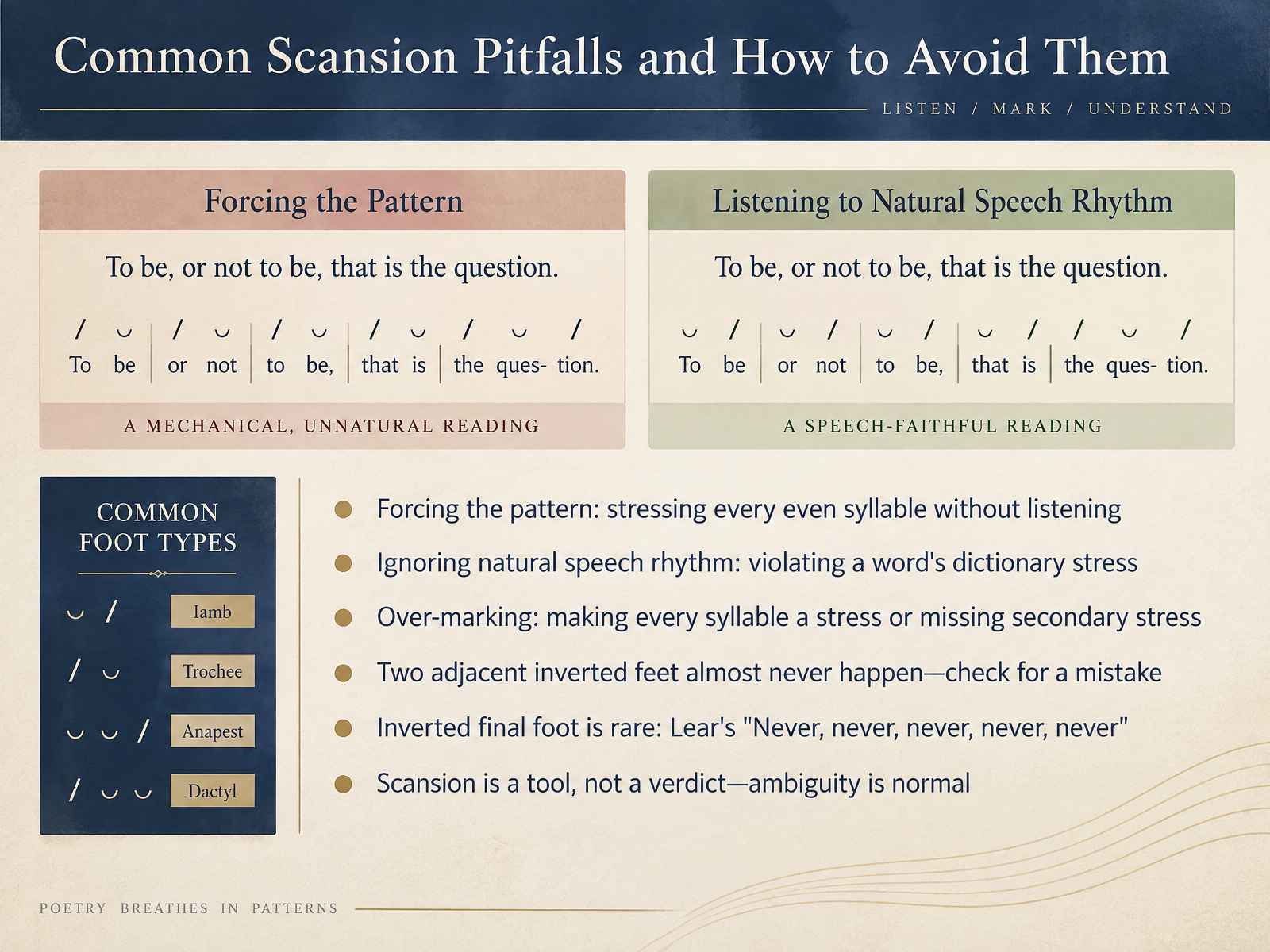
- 08Common Scansion Pitfalls and How to Avoid ThemNow let's look at common scansion pitfalls and how to avoid them. The first is forcing the pattern. Don't stress every even syllable without listening. Next, ignoring natural speech rhythm. Your scansion must respect a word's dictionary stress. Say the line aloud and check that it still sounds like human speech. Third, over-marking. Don't make every syllable a stress, and don't miss secondary stress. Notice that two adjacent inverted feet almost never happen. If you mark them, check for a mistake. An inverted final foot is also rare. Lear's line is the famous exception: Never, never, never, never, never. Finally, remember that scansion is a tool, not a verdict. Ambiguity is normal, so mark what you hear and stay open to other readings. Next, we'll walk through a worked example of regular iambic pentameter.
 matrix.edu.aumseffie.comtacopeland.people.ysu.edu+21 min
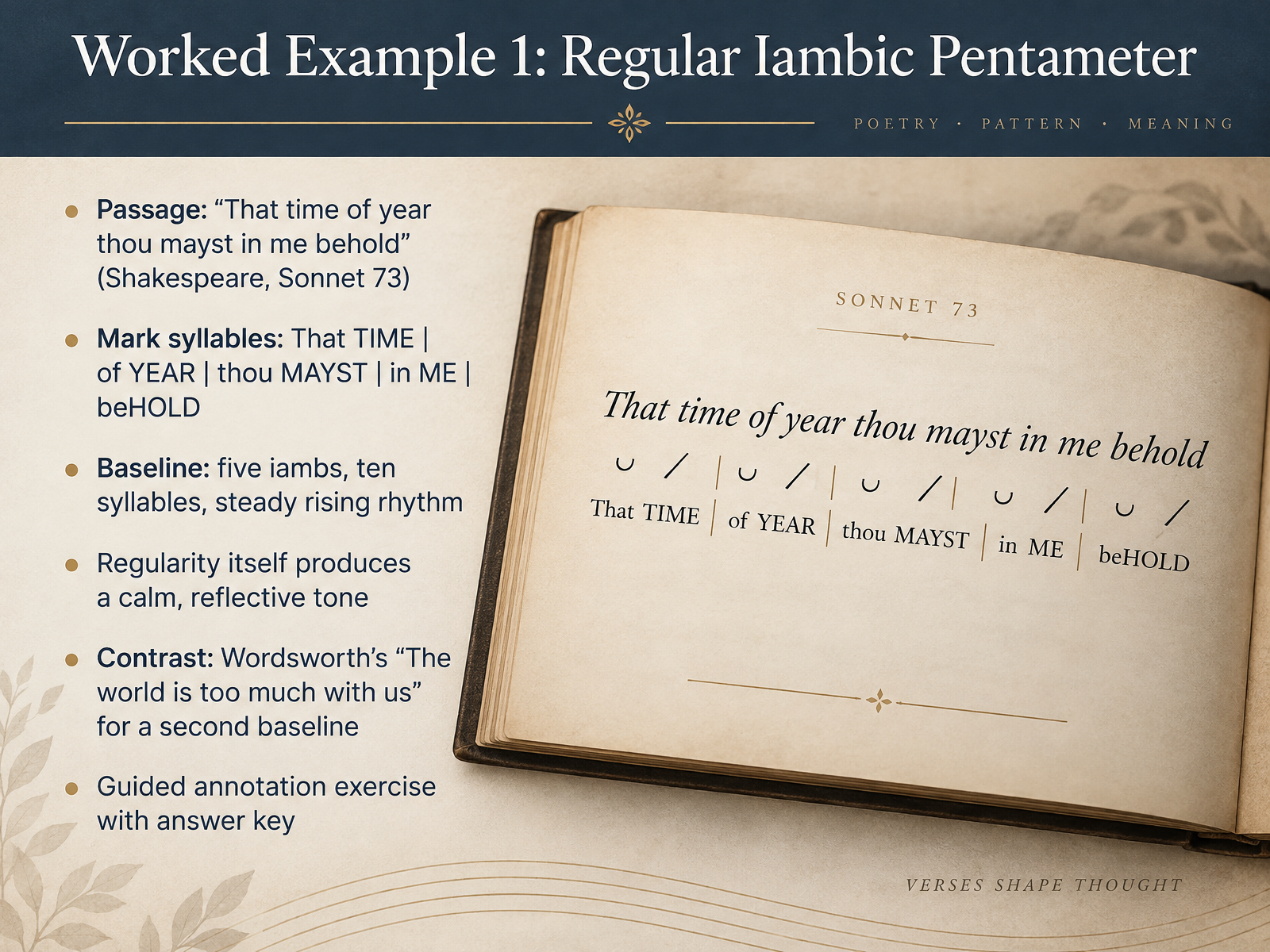
- 09Worked Example 1: Regular Iambic PentameterNow let's scan a line together. Here is Shakespeare's opening to Sonnet seventy-three: That time of year thou mayst in me behold. Say it aloud slowly with me. That time of year thou mayst in me behold. Now mark the stresses. That TIME, of YEAR, thou MAYST, in ME, beHOLD. Notice the pattern. Each foot is one unstressed syllable, then one stressed syllable. That is an iamb. You have five of them, and ten syllables total. Five iambs, then, gives you iambic pentameter. Notice that the rhythm rises steadily, beat by beat. The regularity itself produces a calm, reflective tone. Now try a second baseline. Wordsworth writes, The world is too much with us. Tap it out. The WORLD is TOO much WITH us. Feel the same rising pulse. Now your turn. Take Shakespeare's line and mark it yourself, foot by foot. Then check against the answer key on screen. In the next segment, we'll look at how poets break this regular pattern.
 poetry.harvard.edupoetryfoundation.orgopen.edu+22 min
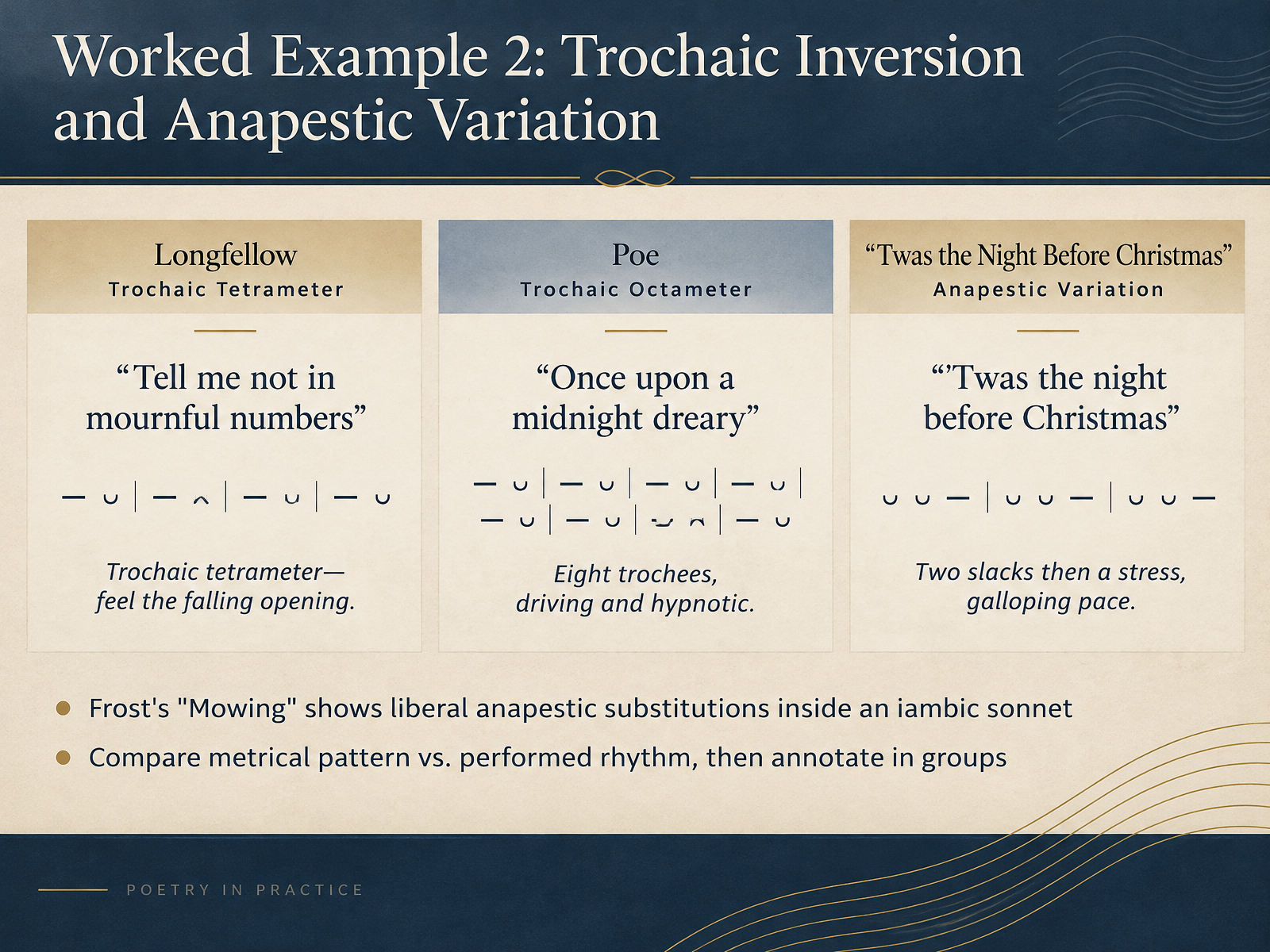
- 10Worked Example 2: Trochaic Inversion and Anapestic VariationNext, let's scan a line that opens with a trochaic inversion. Say it aloud: Tell me not in mournful numbers. Hear the falling opening? The first foot reverses the iamb, a trochee, stress then slack. Now try Poe: Once upon a midnight dreary. Eight trochees, driving and hypnotic. Next, 'Twas the night before Christmas: two slacks, then a stress, galloping pace. Then notice Frost's Mowing, where anapestic substitutions relax the iambic sonnet. So compare metrical pattern against performed rhythm. Mark the stresses you hear, then annotate in groups. Next, we look at rhythm beyond the foot: variation, pace, and enjambment.
 poetry.harvard.edupoetryfoundation.orgopen.edu+21 min
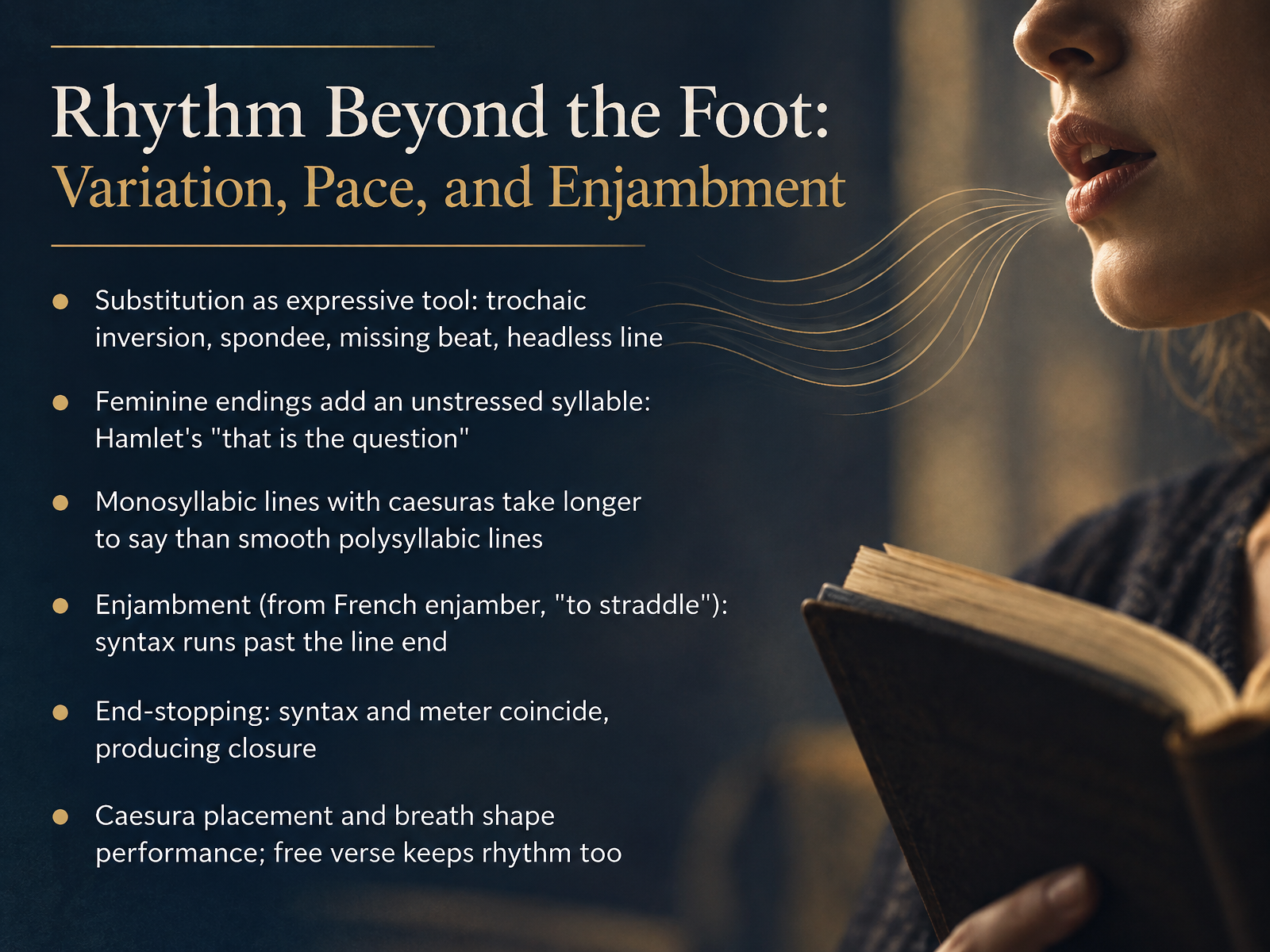
- 11Rhythm Beyond the Foot: Variation, Pace, and EnjambmentNext, let's look beyond the foot, at variation, pace, and enjambment. Meter sets the pattern, but rhythm is how a poem actually sounds. First, substitution. A trochaic inversion flips one foot. A spondee gives two stresses, as in "no way." A missing beat or a headless line starts without the expected syllable. All of these are expressive choices, not mistakes. Next, notice feminine endings. They add one unstressed syllable after the final stress. Hear Hamlet: "To be or not to be, that is the question." That last syllable, tion, is unstressed. Now pace. Monosyllabic lines with caesuras take longer to say than smooth polysyllabic lines. A caesura is a pause inside the line. Try reading a short, choppy line slowly, then a flowing one quickly. Enjambment comes from French, meaning to straddle. The syntax runs past the line ending. End-stopping is the opposite. Syntax and meter coincide, and you feel closure. Caesura placement shapes breath and performance. Even free verse keeps rhythm, so listen for it. Next, we'll write with meter: drafting, revising, and breaking rules deliberately.
 matrix.edu.aumseffie.comtacopeland.people.ysu.edu+22 min
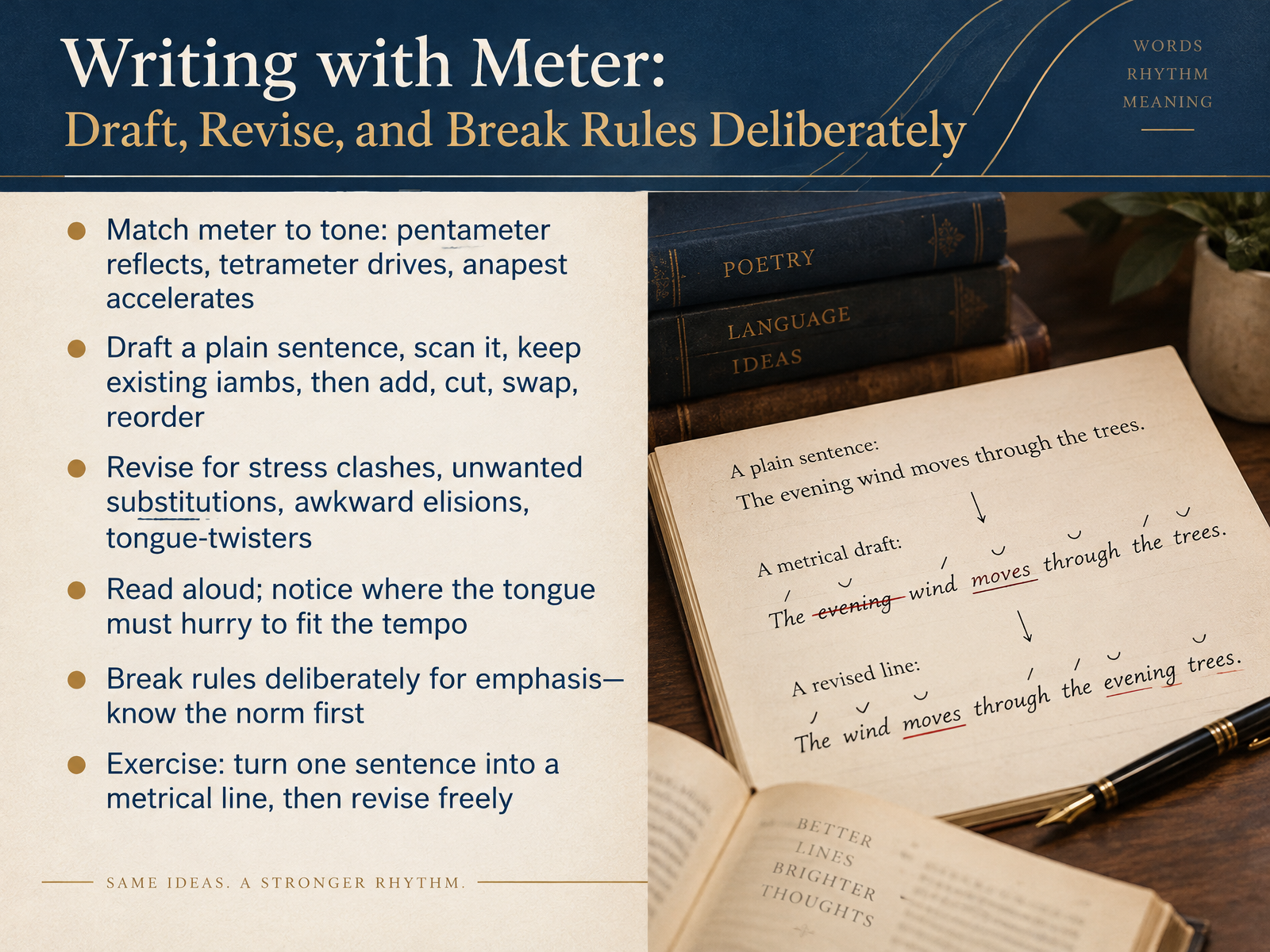
- 12Writing with Meter: Draft, Revise, and Break Rules DeliberatelyNow let's turn scanning into writing. First, match meter to tone. Pentameter tends to reflect, tetrameter drives, and anapest accelerates. Try saying each one aloud and feel the difference. Next, draft a plain sentence about what you mean. Scan it. Keep the iambs already there. Then add, cut, swap, or reorder words. Revise for stress clashes, unwanted substitutions, awkward elisions, and tongue-twisters. Read aloud and notice where your tongue must hurry to fit the tempo. Rule breaking comes last. Break a rule deliberately for emphasis, but know the norm first. Here is your exercise. Turn one sentence into a metrical line. Then revise it freely and read both versions aloud. Next, we look at meter today, in rap, spoken word, and contemporary debates.
 matrix.edu.aumseffie.comtacopeland.people.ysu.edu+21 min
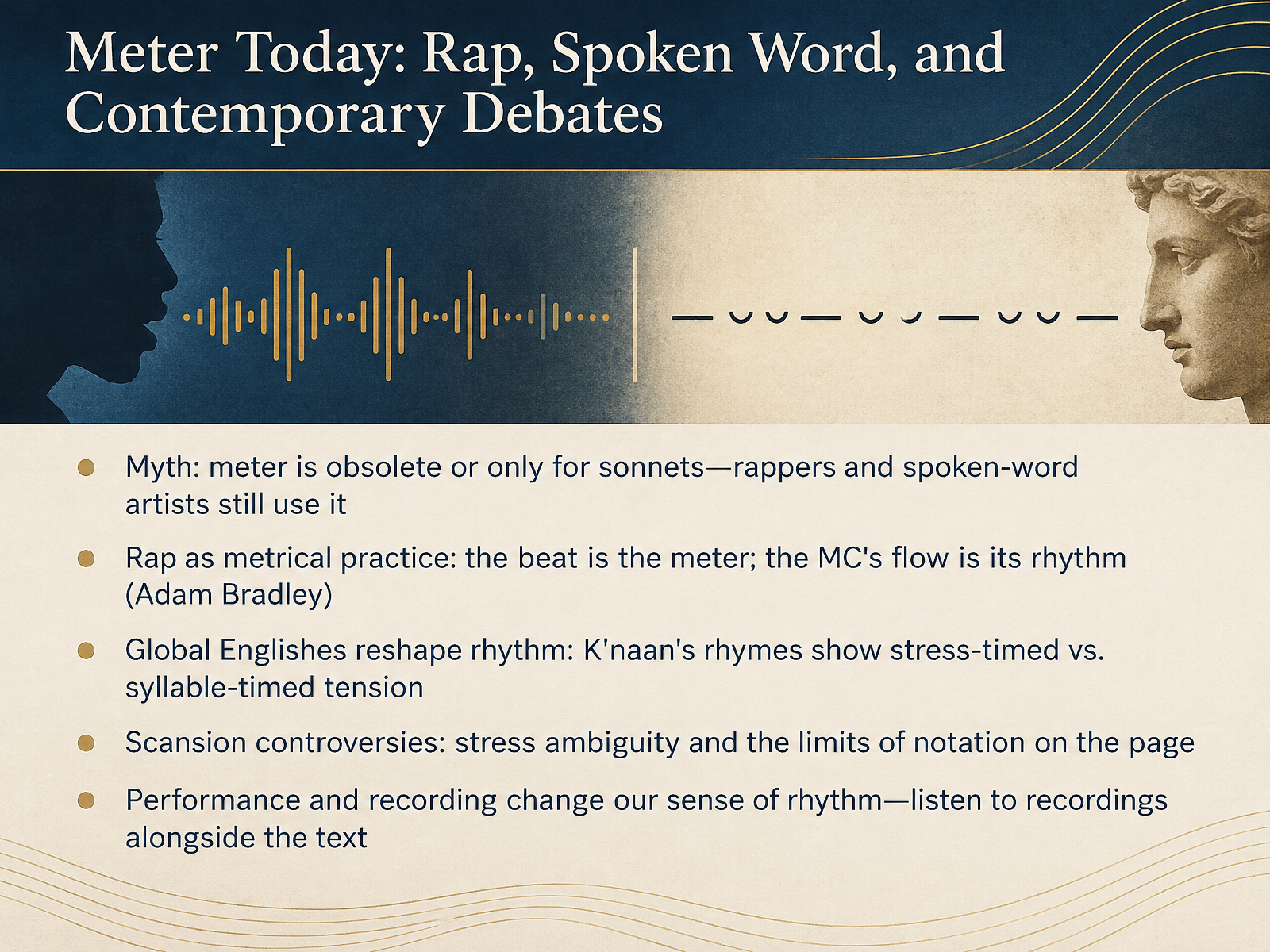
- 13Meter Today: Rap, Spoken Word, and Contemporary DebatesNow let's bring meter into the present. First, a myth to set aside: that meter is obsolete, or only for sonnets. Rappers and spoken-word artists use it every day. Next, think of rap as metrical practice. Adam Bradley puts it plainly: the beat is the meter, and the MC's flow is its rhythm on top. Try tapping a beat and saying one line over it. Then notice global Englishes. K'naan's rhymes show a tension between stress-timed and syllable-timed rhythm. Next, scansion controversies. Stress is sometimes ambiguous, and notation on the page has limits. Listen to a recording next to the text, and mark where your ear disagrees with the page. That disagreement is your evidence. Let's move to the practice workshop and key takeaways.
 corescholar.libraries.wright.edutheguardian.comowl.purdue.edu+21 min
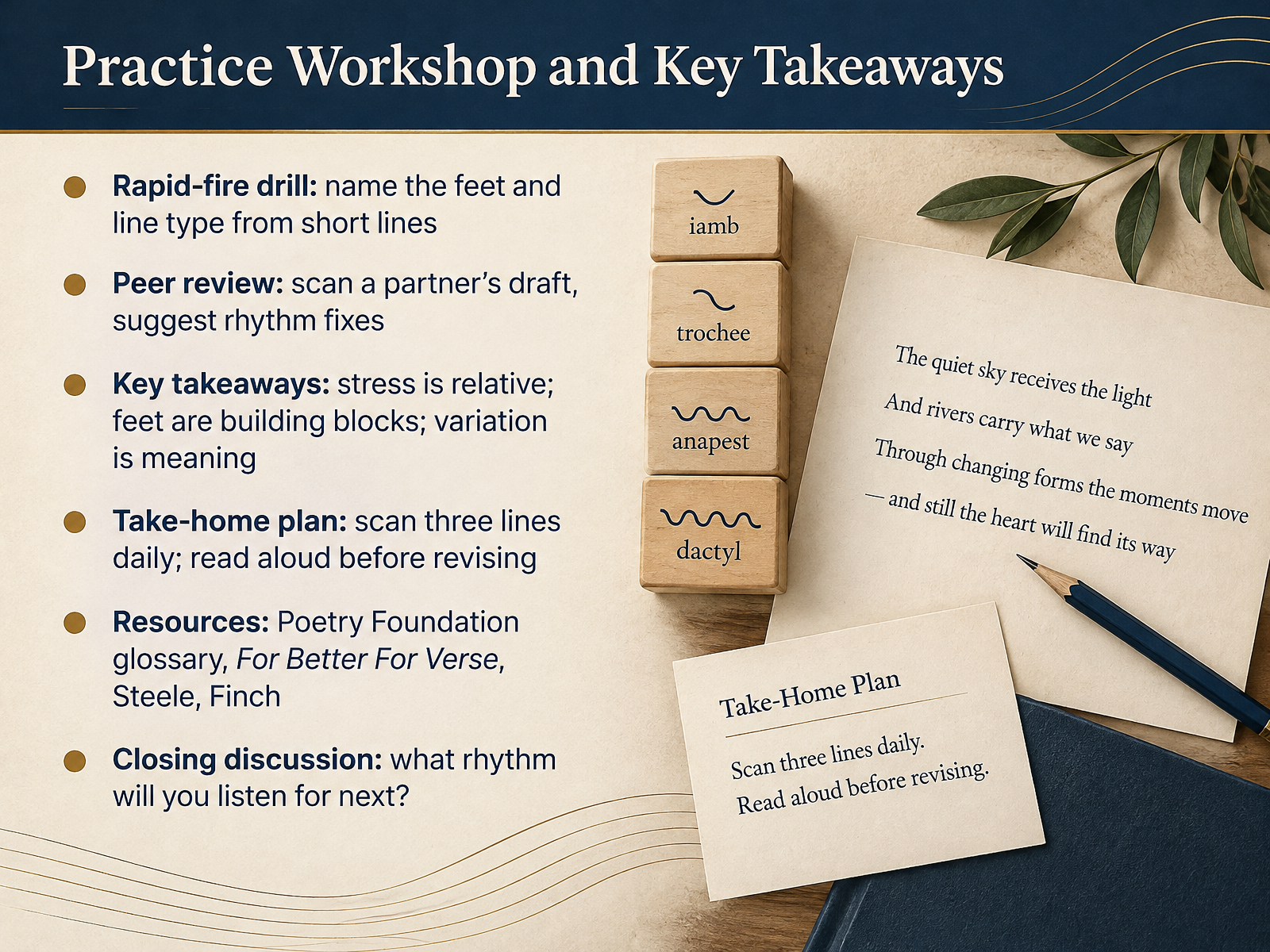
- 14Practice Workshop and Key TakeawaysNow let's put this into practice. First, a rapid-fire drill. I'll give a short line, and you name the foot and the line type. For example, "the sun" is one iamb, so iambic monometer. Try a few on your own. Next, peer review. Trade a draft with a partner and scan it line by line. Then suggest one or two rhythm fixes. Now the key takeaways. Stress is relative, not fixed. Feet are building blocks. And variation carries meaning, so notice where the pattern shifts. For a take-home plan, scan three lines daily, and read aloud before revising. Useful resources include the Poetry Foundation glossary, For Better For Verse, and the handbooks by Steele and Finch. Before we close, ask yourself: what rhythm will you listen for next? Thank you for working through this course with me. Keep reading aloud, keep scanning, and trust your ear. You now have the tools to hear the music in every line.
 matrix.edu.aumseffie.comtacopeland.people.ysu.edu+22 min
Take the deck with you
Download this course as a file — free, no sign-up needed.
- PDF handoutEvery slide page, ready to print or share.15 pages · 4.8 MBDownload
- Narrated PowerPointThe deck that presents itself — every slide carries the digital human's narration video.15 pages · 13.3 MBDownload
- PowerPoint slidesThe full deck as a .pptx — open it in PowerPoint, Keynote, or Google Slides.15 pages · 4.8 MBDownload
Free to use in your own training — please keep the PersonWise credit page at the end.
Have your own deck? Turn it into a course
Sources consulted
Web sources consulted while building this course.
- Part 1: How to Analyse Metre | Beginner's Guide to Poetry — matrix.edu.au
- Poetry Scanning — mseffie.com
- How to Scan — tacopeland.people.ysu.edu
- Scansion | The Poetry Foundation — poetryfoundation.org
- Scansion: The How and Why - Poetry editing services — telltellpoetry.com
- Stress Rules in English: A New Version — web.mit.edu
- Stress and vowel reduction in English — seas.elte.hu
- Stress and vowel reduction in English — en.wikipedia.org
- ZeuScansion: A tool for scansion of English poetry — doi.org
- A Grid-Based Theory of English Meter — brucehayes.org
- Guide to Prosody | Poetry at Harvard — poetry.harvard.edu
- Foot | The Poetry Foundation — poetryfoundation.org
- Approaching poetry: 3 Rhythm | OpenLearn - Open University — open.edu
- Foot - Glossary - Poetry Archive — poetryarchive.org
- https://english.emory.edu/classes/Handbook/meter.html — english.emory.edu
- Your Feet's Too Big: Downsizing English Metrics — corescholar.libraries.wright.edu
- The Iambic Pentameter — theguardian.com
- Poetic Feet, Line Length - Purdue OWL® - Purdue University — owl.purdue.edu
- Iambic pentameter — en.wikipedia.org
- Iambic pentameter | Literature and Writing | Research Starters | EBSCOhost — ebsco.com