Begin
14 pages · ~28 min
Negotiation Skills Practice Workflow
Learn a practical workflow to practice and improve negotiation skills, designed for professionals seeking hands-on techniques to achieve better outcomes in real-world scenarios.
A digital instructor presents all 14 pages. Hold “Ask” at any point and ask out loud — the answer comes from this course. No sign-up needed.
What you’ll learn
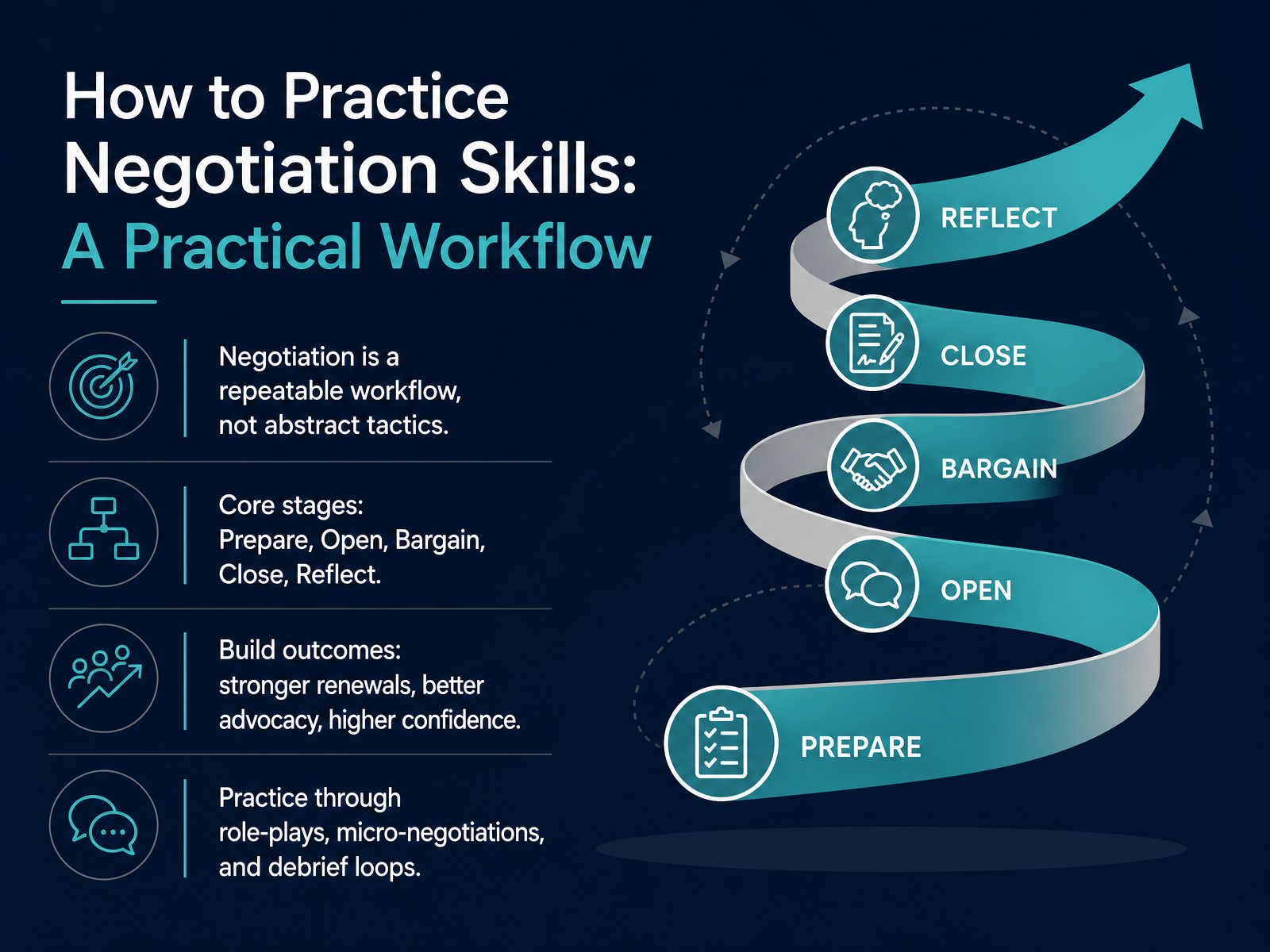
- 01How to Practice Negotiation Skills: A Practical WorkflowWelcome. If you want stronger renewals, better vendor terms, or more confident internal advocacy, this course is for you. Negotiation is not an abstract art or a gift some people are born with. It is a repeatable workflow you can practice and improve. Over the next few minutes, we will work through five practical stages: Prepare, Open, Bargain, Close, and Reflect. Each stage gives you a concrete move to use in real conversations, whether you are talking to a client, a supplier, or a colleague. We will focus on realistic trade-offs and the pushback you are likely to hear, not hypothetical extremes. You will see how to build these skills through role-plays, small everyday negotiations, and quick debrief loops. By the end, you will have a system you can apply immediately. Let's start by looking at why most professionals under-practice negotiation.devpulse.compon.harvard.edulegalclarity.org+21 min
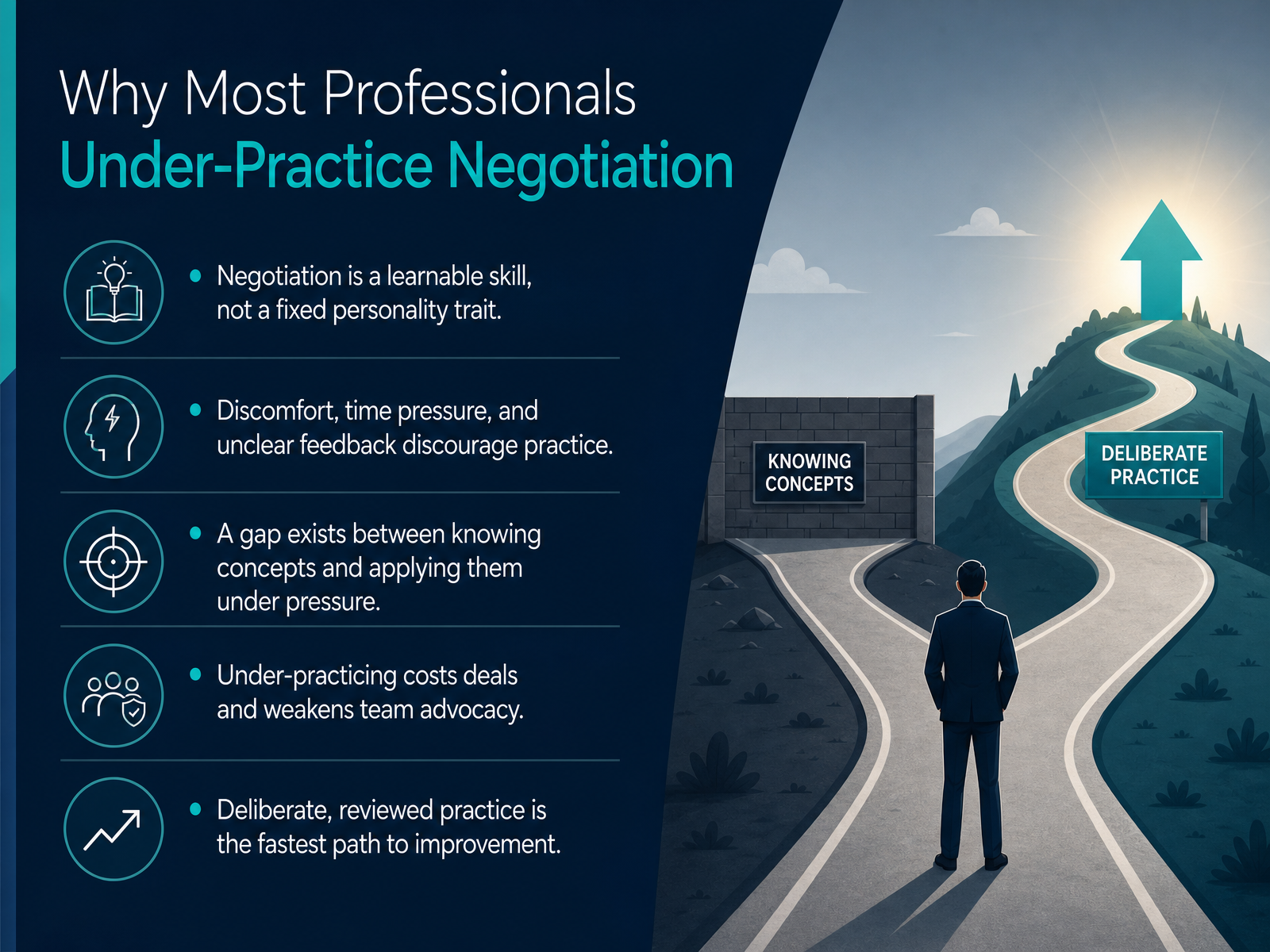
- 02Why Most Professionals Under-Practice NegotiationLet’s look at why negotiation remains under-practiced, even among capable professionals. First, the core belief: negotiation is not a fixed personality trait. It is a learnable skill, built the same way you build any other competency, through focused repetition. The problem is that the practice environment is difficult. Discomfort, time pressure, and a lack of clear feedback push people to avoid role plays or real-world experiments. That creates a dangerous gap between knowing a concept, like anchoring or logrolling, and actually executing it when the stakes are high and the other person pushes back. Research backs this up. Studies show that observing expert examples and using analogies improve outcomes far more than lecture alone, yet most professionals rarely stage these deliberate rehearsals. The cost of this gap is significant. You leave money on the table in vendor terms. You weaken your team’s position when advocating for resources. And you miss opportunities to expand the pie in client renewals. The solution is not more theory. It is deliberate, reviewed practice, with feedback. That is exactly what the next model provides. Let’s introduce the Negotiation Practice Loop.
 cbi.orgonlinelibrary.wiley.comjournals.sagepub.com+21 min
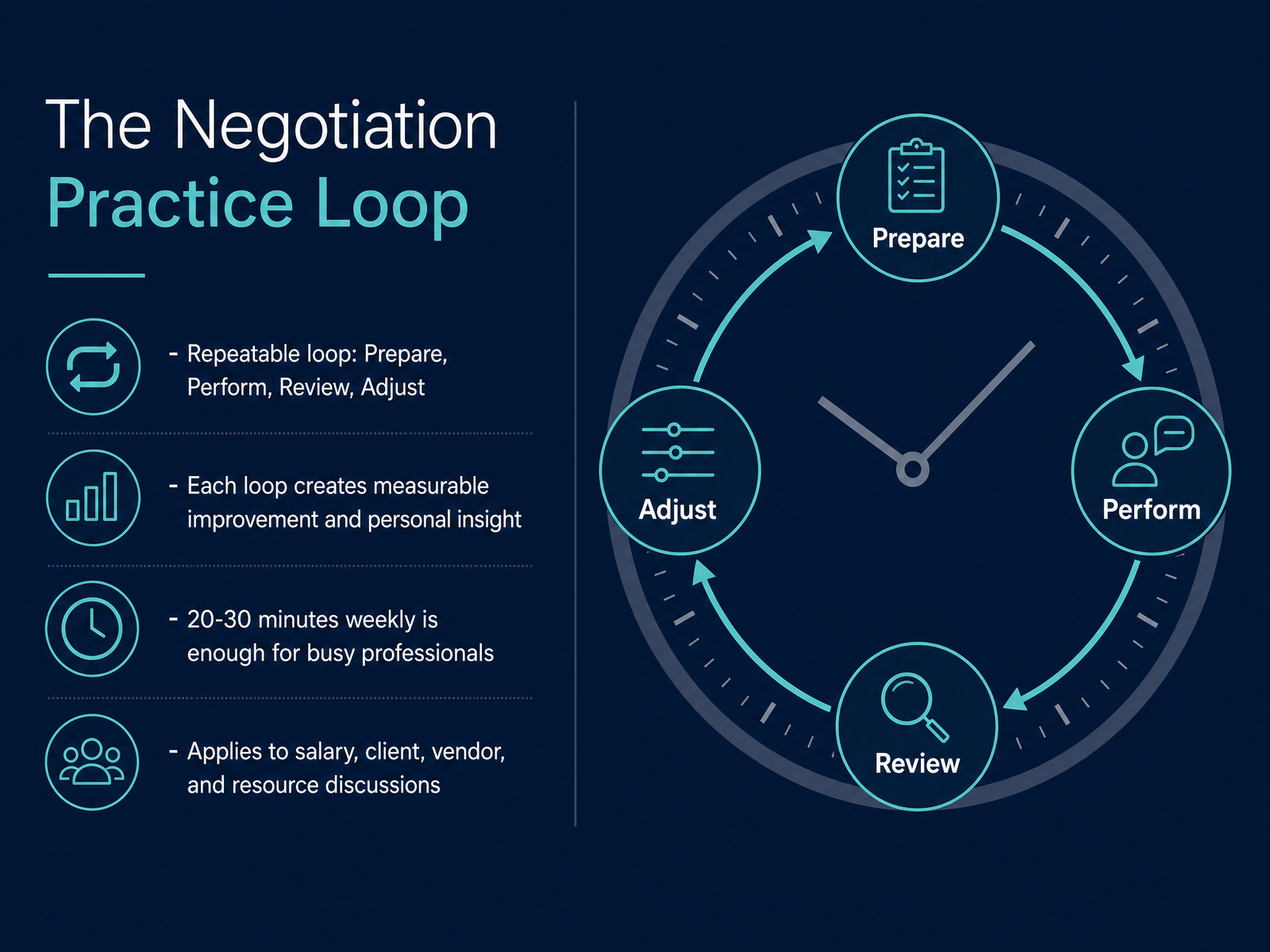
 - 03The Negotiation Practice LoopHere is where negotiation stops being a talent and starts being a system. The practice loop is built on four moves. Prepare. Perform. Review. Adjust. Before a conversation, prepare by knowing your walk-away point and what you can trade. Perform the negotiation itself, using silence and questions to stay grounded. Then review what actually happened, not what you hoped would happen. Finally, adjust one specific behavior for next time. The value of this loop is measurement. Each cycle gives you data about what works with clients, vendors, and internal stakeholders. And the time investment is smaller than you might think. Twenty to thirty minutes a week is enough for a busy professional, because consistency beats intensity. You can apply the same loop to a salary conversation, a client renewal, a vendor term sheet, or a resource trade-off inside your team. The mechanic is identical. Only the context changes. In the next section, we focus on the first move: how to prepare with a one-page negotiation plan.
 devpulse.compon.harvard.edulegalclarity.org+22 min
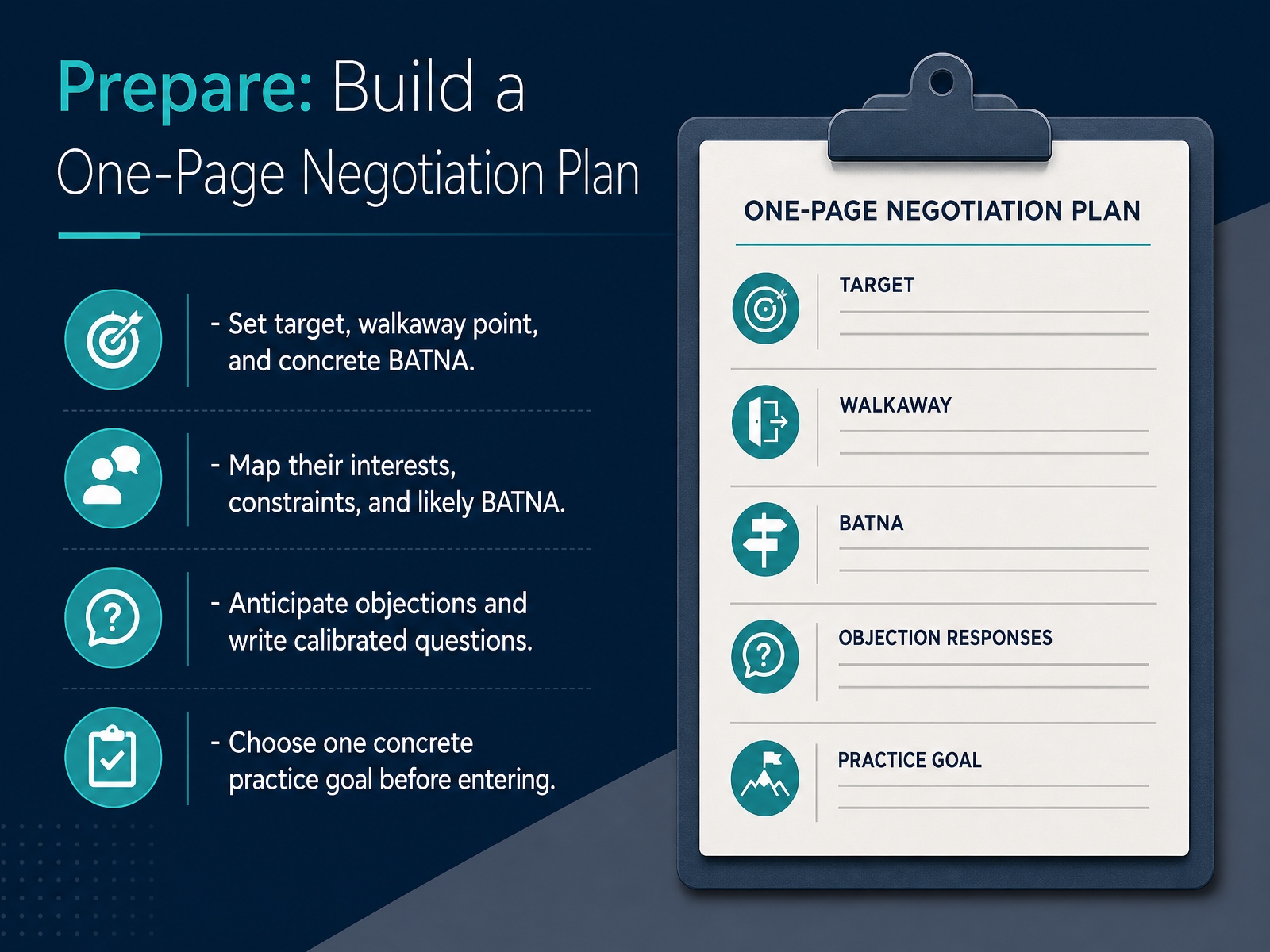
 - 04Prepare: Build a One-Page Negotiation PlanNow, let's get ready to build your one-page negotiation plan. Preparation is where most of your leverage gets created, so treat this as a focused, practical exercise. Start by setting three numbers that define your position. Your target is the ambitious but reasonable outcome you hope for. Your walkaway point is the worst deal you would still accept. And your BATNA is the concrete option you will pursue if this negotiation collapses. Remember, a wish is not a BATNA. It has to be measurable and executable, like a competing vendor's quote, or an internal build option.
Next, map the other side. Think about their interests and constraints, not just their position. What pressures are they under? What would they do if the deal fell through? Anticipate the objections they are most likely to raise, and write down a few calibrated questions you can use in response, questions that invite detail rather than a simple yes or no.
Finally, choose one concrete practice goal before you enter the room. Maybe it is holding your first number for a specific amount of time, or asking one more diagnostic question than usual. This keeps your preparation focused on the behavior you are trying to improve. Once your one-pager is filled out, you are ready to move from your own plan to a clear-eyed view of your counterpart.
 iienstitu.comsig.orgociservices.com+21 min
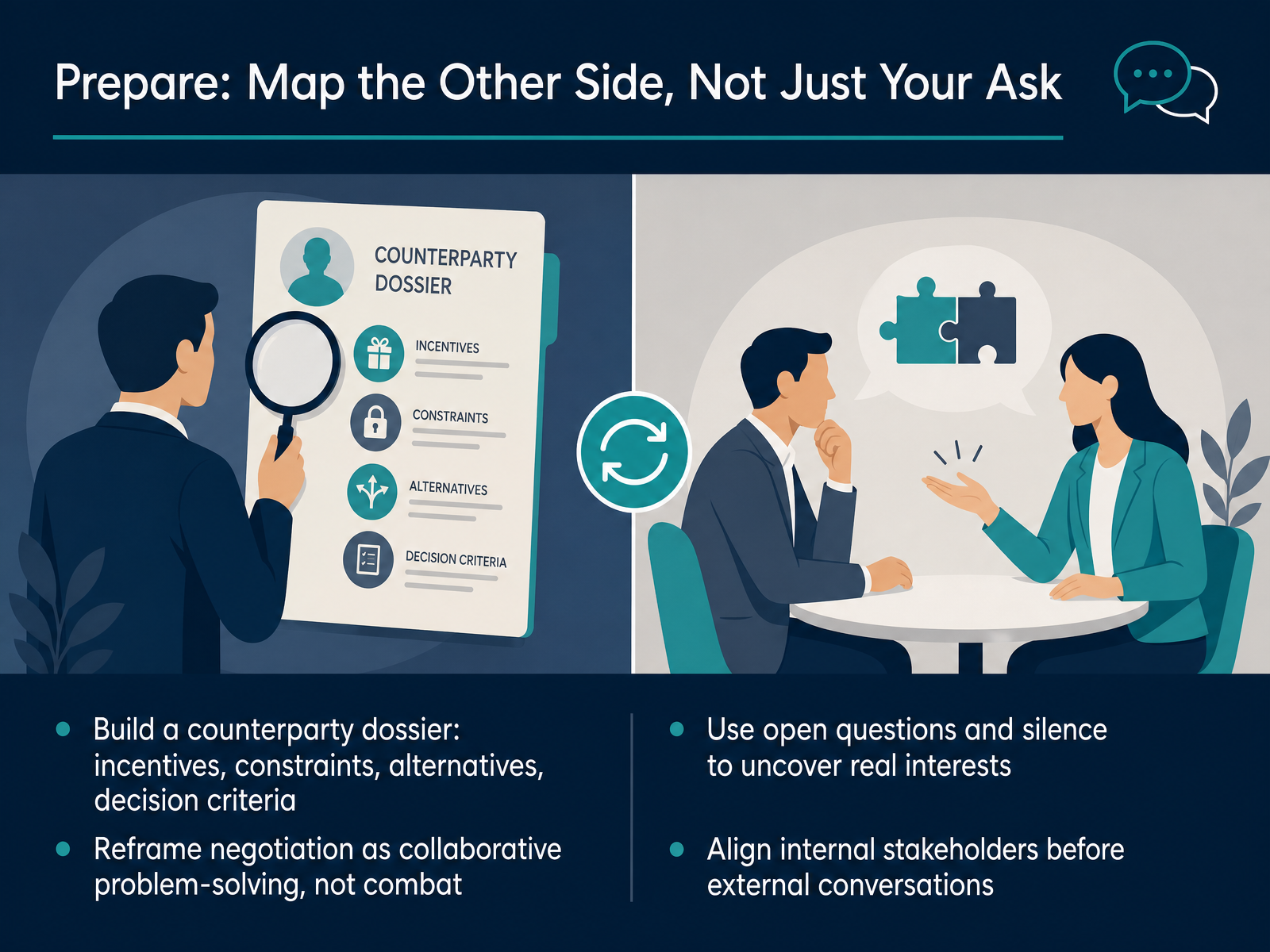
 - 05Prepare: Map the Other Side, Not Just Your AskLet's shift our focus outward, to the person across the table. Before you make your ask, take time to map their world. Build a simple counterparty dossier. What are their incentives? What constraints are they under? What alternatives do they have? And importantly, what do they actually need to look good internally? When you understand that, you can frame your proposal as a solution to their problem, not just a demand for what you want. And that changes the whole dynamic. Negotiation isn't combat. It's collaborative problem-solving. Once you're in the room, resist the urge to talk. Instead, ask open questions and then use silence. Let them reveal what's really driving their position. Often, the stated ask masks a deeper concern, like implementation risk or internal pressure. Finally, align your own team before you ever meet the other side. You cannot negotiate externally with confidence if your internal stakeholders haven't agreed on what's flexible and what's not. Get that alignment locked in first. Next, we'll talk about how to build this skill steadily with a practice habit: Practice Low-Stakes Every Day.
 powercalltraining.commonkhouseandcompany.comstartupfundraising.com+21 min
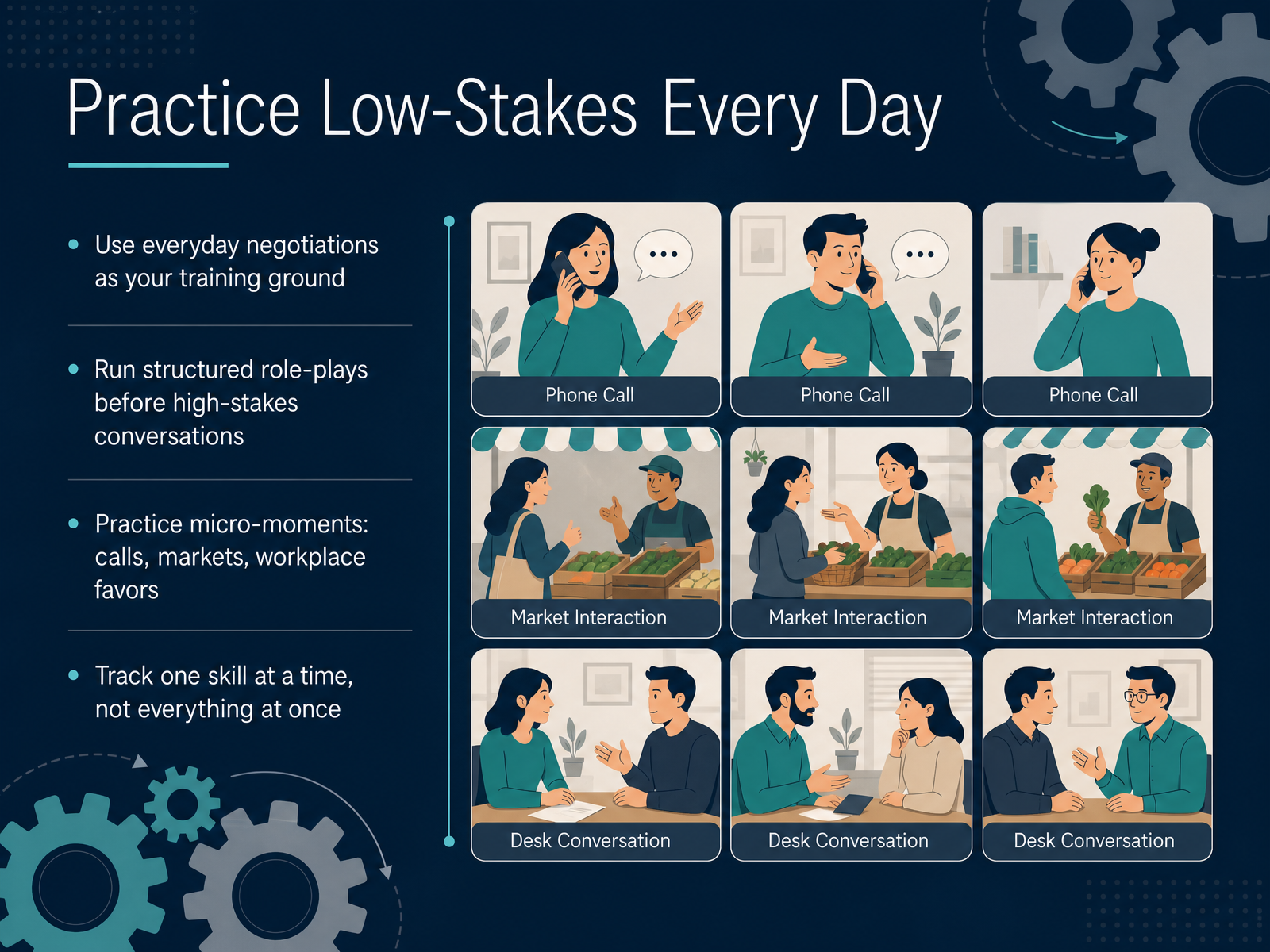
 - 06Practice Low-Stakes Every DayNow let's make this practical. The fastest way to improve is to treat low-stakes moments as your training ground. Negotiation isn't only about contracts and client renewals. It happens every time you ask for a deadline extension, clarify scope with a vendor, or trade favors with a colleague. Use those everyday interactions deliberately. Before a high-stakes conversation, run a structured role-play with a teammate. Pick one specific skill to focus on, like asking open-ended questions or pausing after a counteroffer, not everything at once. Try it in small settings first. A customer call, a quick request at work, a conversation at a market. These micro-moments let you experiment with tone and phrasing without real risk. The key is repetition with purpose. Track one skill at a time, reflect on what worked, and adjust. That's how you build the confidence and muscle memory you'll rely on later. Next, we'll break down the core skills that make that practice effective: ask, listen, and anchor.
 1 min
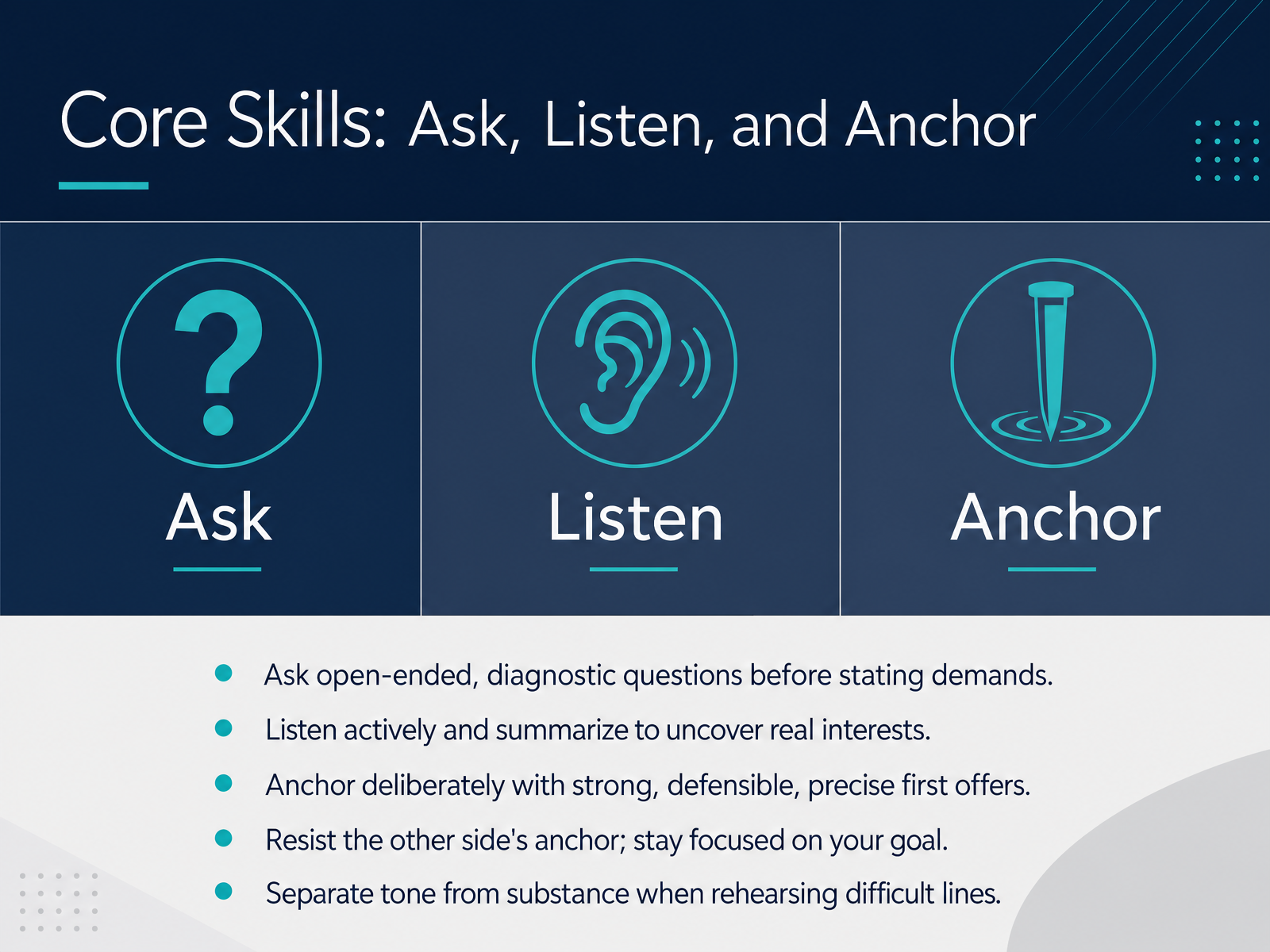
1 min - 07Core Skills: Ask, Listen, and AnchorNow let's turn to the core skills you will use in every negotiation: asking, listening, and anchoring. Start by asking open diagnostic questions before you state any demands. Questions like, what does a successful renewal look like for your team this year, or, what constraints are you working with internally, reveal information that a demand simply cannot. Then listen actively. When the other side answers, summarize what you heard and name the interest behind the position. That is how you move from price haggling to problem solving. When it is time to anchor, do it deliberately. Use a strong, defensible, precise number rather than a round guess. Research shows that precise offers signal preparation and pull the conversation toward your target, but only when you stay disciplined. If the other side anchors first, resist the pull. Keep your own goal and your best alternative at the front of your mind, and counter with your own number instead of adjusting from theirs. Finally, separate tone from substance when you rehearse. You can deliver a firm line about budget limits in a calm, professional voice. Practice saying the hard sentence until it feels normal, because what sounds aggressive in your head often sounds simply confident out loud. Next, we will move into bargaining: how to trade, not split the difference.
 2 min
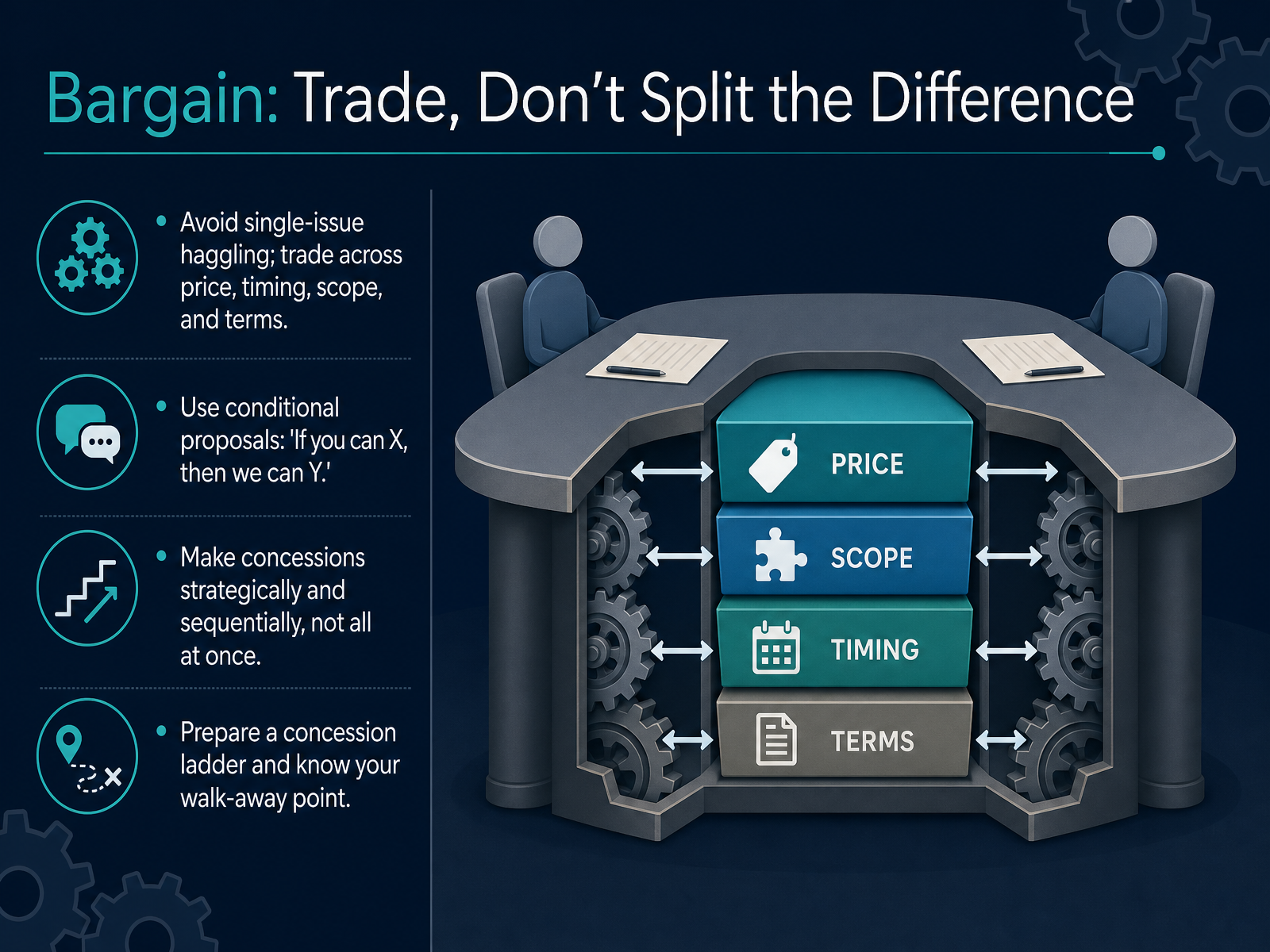
2 min - 08Bargain: Trade, Don't Split the DifferenceNow comes the actual bargaining, and here's the key move. Do not let the conversation collapse into haggling over a single number. That is a trap, because when both sides only fight about price, there can only be a winner and a loser. Instead, widen the table. Trade across price, timing, scope, and payment terms. If your client pushes for a lower rate, you might ask for a longer commitment or a faster payment cycle. If a vendor wants a bigger upfront payment, perhaps you gain more flexible delivery milestones. Use conditional language to keep the trade structured. Say, if you can confirm the annual term, then we can apply the preferred pricing. If you can adjust the start date, then we can stretch the implementation phase. This keeps every give tied to a specific get. Also, never lay all your concessions on the table at once. Release them one at a time, and make each one conditional. Before you walk in, build a simple concession ladder from low cost to high cost, and keep your walk-away point at the very bottom. That way, you stay in control even as you give ground. Next, we'll look at how to close the deal and confirm what you actually agreed.
 devpulse.compon.harvard.edulegalclarity.org+22 min
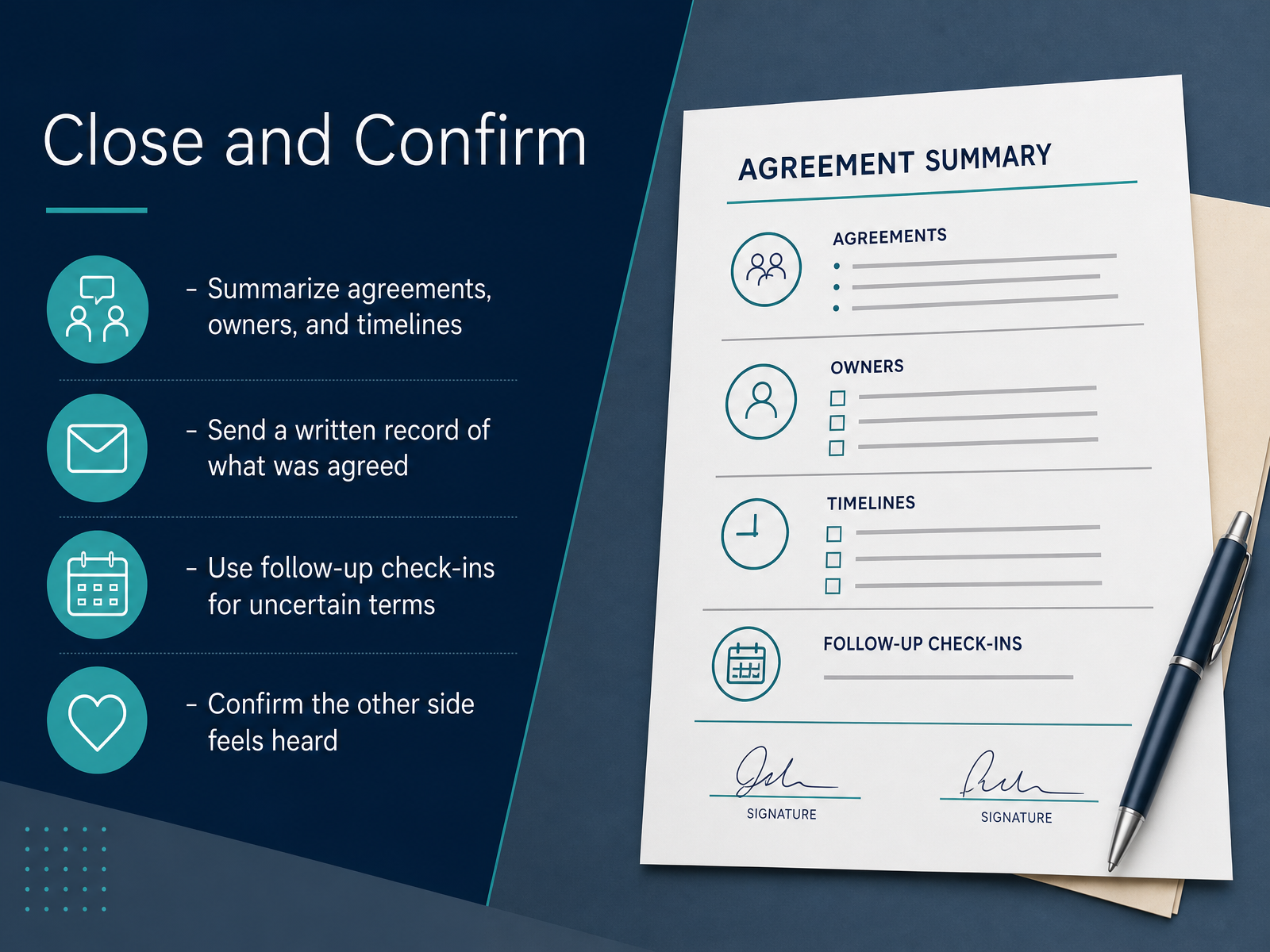
 - 09Close and ConfirmA negotiation isn't finished when the conversation winds down. It's finished when everyone leaves with the same understanding of what will happen next. So before you end the call, summarize the agreement out loud. Name the specific decisions, who owns each action, and the deadline attached to it. For example, you might say: we've agreed to move forward at the current price, your team will send the signed purchase order by Friday, and our team will begin onboarding on the first of the month. That simple recap prevents the drift that turns a good deal into a slow misunderstanding. Then send a written record. This doesn't have to be a formal contract. A concise email with the key terms, owners, and dates is enough to create a shared reference point. If any terms still feel uncertain, schedule a short follow-up check-in rather than hoping the ambiguity resolves itself. And finally, confirm the other side feels heard. A brief phrase like, I know the timeline wasn't your first choice, but I appreciate your flexibility, protects the relationship and makes follow-through more reliable. Next, we'll move into the debrief, where we turn every attempt into a lesson.
 powercalltraining.commonkhouseandcompany.comstartupfundraising.com+22 min
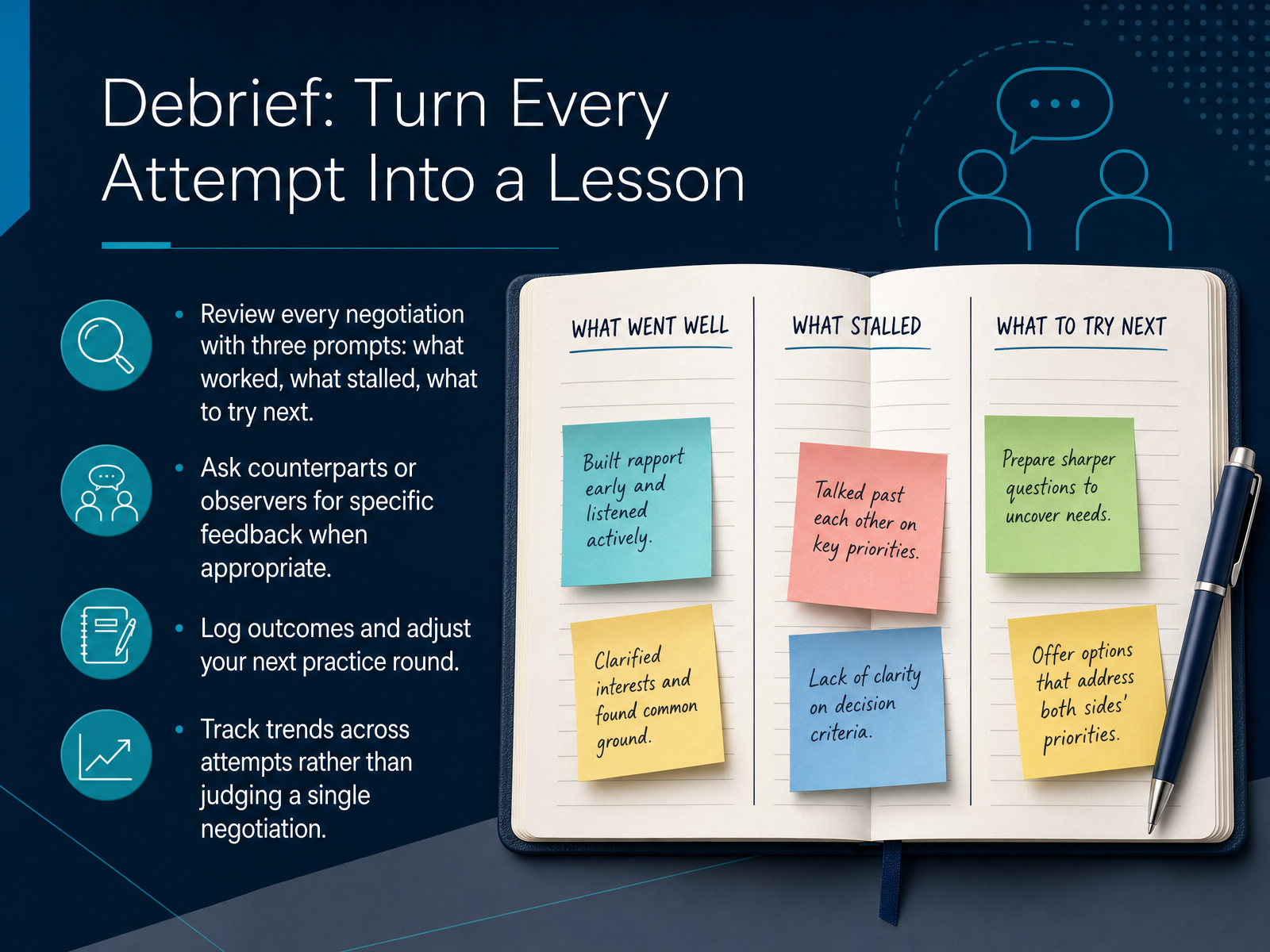
 - 10Debrief: Turn Every Attempt Into a LessonNegotiation is one of those skills where expertise comes from deliberate practice. And a big part of that discipline is the debrief. Every attempt, whether it went well or poorly, is raw material for your next conversation. So after any meaningful negotiation, take just five minutes to review it with three prompts. First, what worked. Name the specific phrase, pause, or tactic that moved things forward. Second, what stalled. Where did you feel friction or give up ground? Third, what to try next. This keeps the debrief forward-looking and turns any outcome into a lesson. When possible, ask the counterpart or a trusted observer for specific feedback. The key word is specific. You want observable behavior, not general impressions. Then log the outcome and adjust your next practice round accordingly. But avoid judging any single negotiation in isolation. Instead, track trends across attempts. Do you cave early on price? Do you lose composure when the other side goes silent? Those patterns surface over time, not in one meeting. This simple loop is how strong negotiators compound progress. So as we move forward, let’s bring all of it together and build a repeatable practice routine.
 cbi.orgonlinelibrary.wiley.comjournals.sagepub.com+21 min
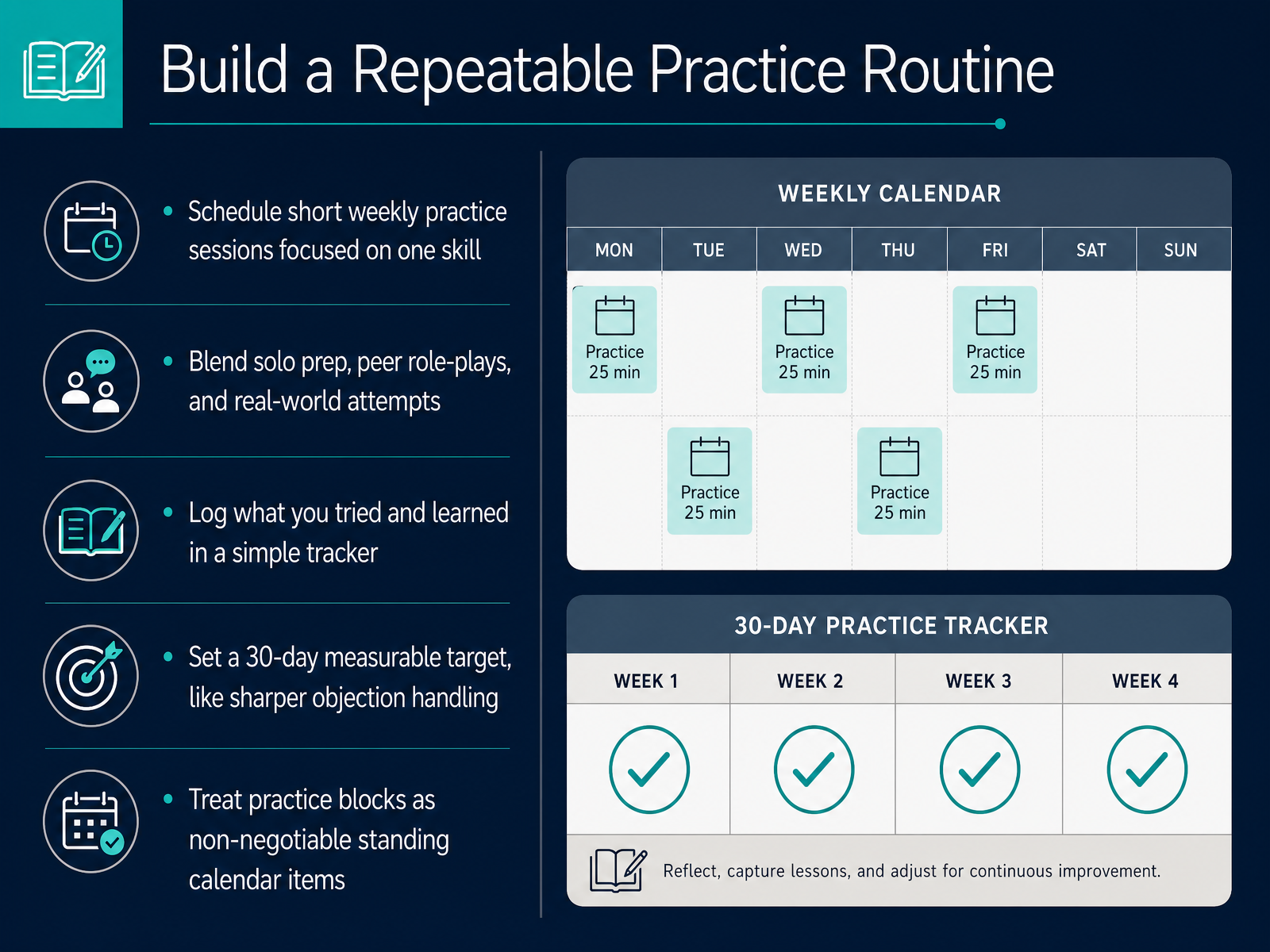
 - 11Build a Repeatable Practice RoutineGood habits are what turn negotiation theory into negotiation results. So let's build a routine you can actually keep. Start with short weekly practice sessions, and focus each one on a single skill. One week might be objection handling, the next might be anchoring. Don't try to fix everything at once. Then, blend your practice methods. Use a little solo prep to plan your language, run a few role-plays with a peer to test it under pressure, and then take it into a real client renewal or a vendor conversation. After each attempt, log it. A simple tracker works best. Note what you tried and what happened. That log becomes your personal improvement data. Next, set a thirty-day target that you can measure, like reducing the number of times you concede on price too quickly. Finally, protect this time. Put your practice blocks on the calendar as standing meetings, because if they're optional, they won't happen. Now, let's see how to apply this entire workflow to real business scenarios.
 1 min
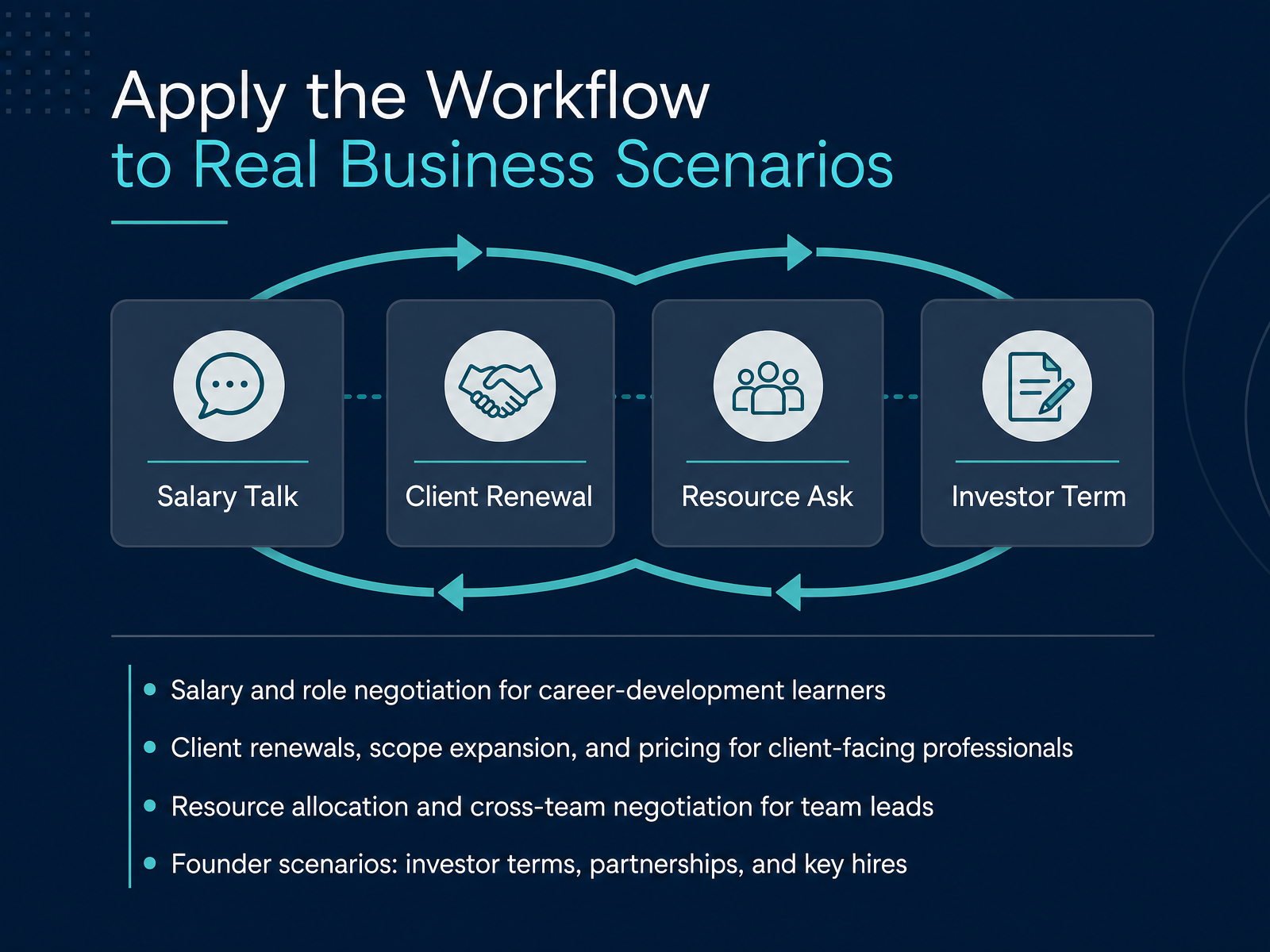
1 min - 12Apply the Workflow to Real Business ScenariosLet's ground this workflow in the scenarios you actually face. If you're negotiating your own salary or role, define your walk-away point and anchor on the full package, not just the base number. For client renewals, scope expansion, and pricing, don't buy a short-term yes with a discount you can't afford. Offer conditional trades instead, like adjusting scope or extending the term in exchange for a better rate. Team leads negotiating for resources should resist binary thinking. Instead of fighting over one person's time, look for overlap, staggered support, or a shared schedule. And founders, remember that control terms often matter more than headline numbers. Whether you're reviewing an investor term sheet, a partnership, or a key hire, protect the decision rights and exit clauses that decide who actually runs the company next year. In every case, the same core loop applies: prepare your alternatives, ask what approval really depends on, and trade deliberately rather than conceding on price alone. Now let's turn this into a habit with your thirty-day practice plan.
 powercalltraining.commonkhouseandcompany.comstartupfundraising.com+22 min
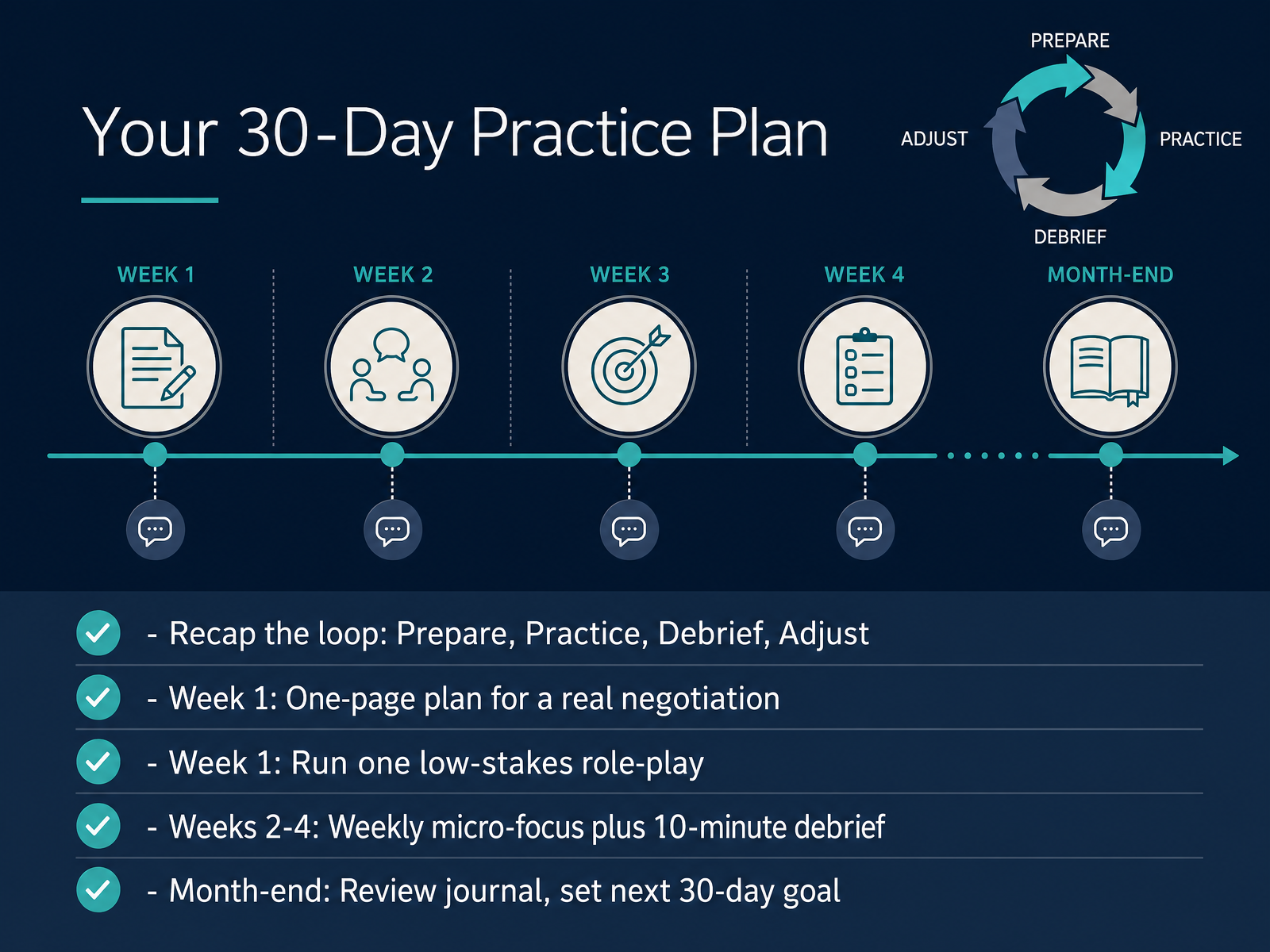
 - 13Your 30-Day Practice PlanLet's turn this framework into a concrete plan for the next thirty days. You are not just absorbing theory here. You are building a repeatable habit, and the structure is simple. Run the loop. Prepare, practice, debrief, and adjust. In week one, do not overcomplicate it. Pick one real negotiation you have coming up and write a one-page plan for it. Then, take ten minutes to run a low-stakes role-play. Practice the opening or the pushback moment, not the whole deal. For the following weeks, choose one micro-focus at a time. Maybe it is your anchoring, or your silence after a counteroffer. Spend ten minutes a week on just that skill, then do a short debrief. Write down what worked and what you would change. At the end of the month, review your notes. Look for patterns you want to break or strengths you want to double down on. Then, set your next thirty-day goal. This cadence keeps the skill alive without overwhelming your calendar. That brings us to our final slide, the key takeaways.
 cbi.orgonlinelibrary.wiley.comjournals.sagepub.com+21 min
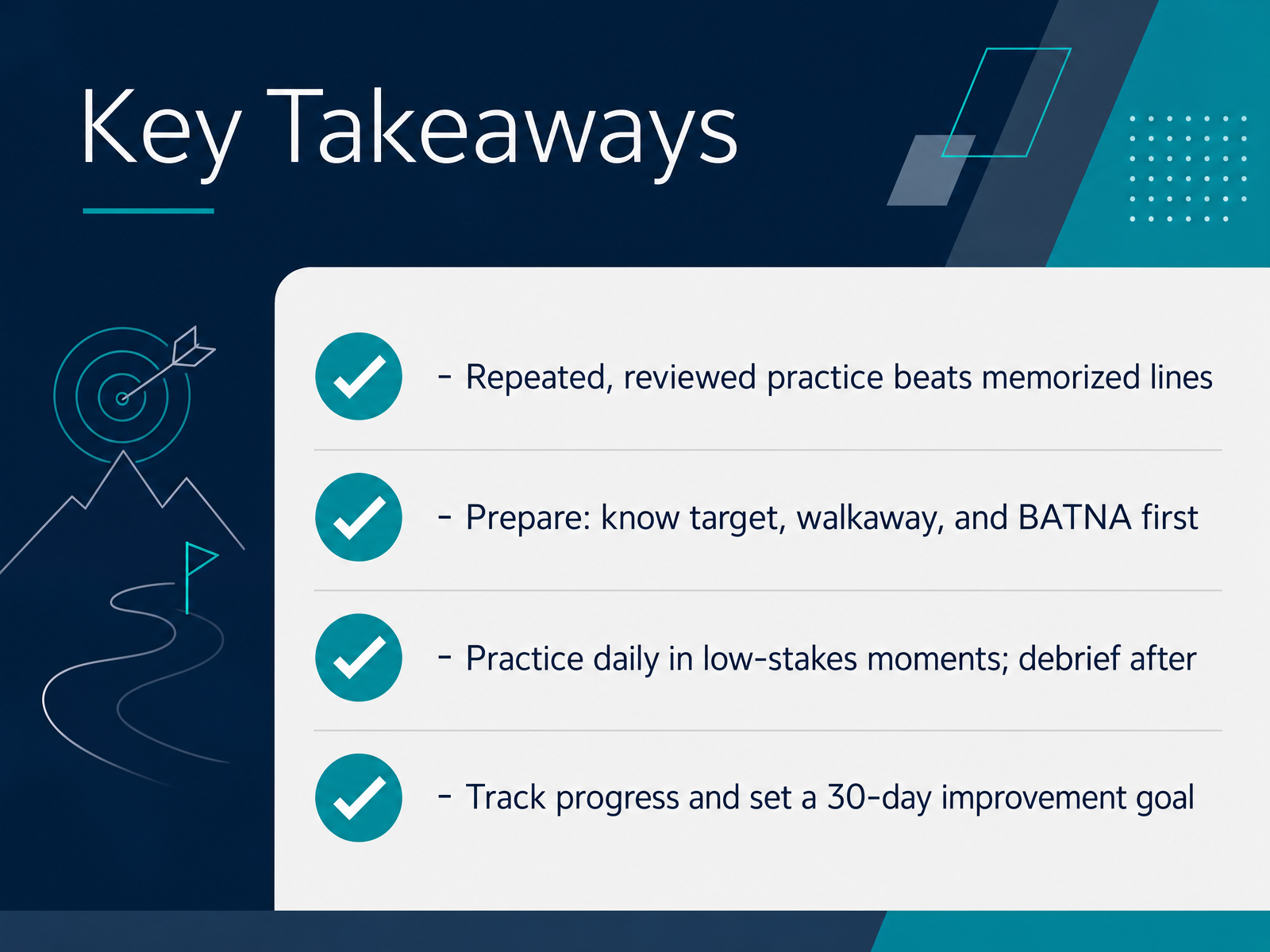
 - 14Key TakeawaysLet's bring this all together. The single most important idea here is that repeated, reviewed practice beats memorized lines every time. Negotiation is a skill you build through deliberate reps, not a set of scripts to recite. So commit to preparing first. Before any real conversation, know your target, your walkway, and your best alternative. That clarity alone will make you a calmer, stronger negotiator. Then, make practice a daily habit. Find low-stakes moments throughout your day to test small moves. After each practice or real negotiation, take a few minutes to debrief. Ask what worked, what didn't, and what you would do differently next time. Finally, track your progress and set a clear thirty-day improvement goal. Maybe it's holding silence longer, asking better questions, or preparing more consistently. Pick one thing, and measure it. Thank you for working through this course. The tools you have here are practical and repeatable. Now it's time to get your reps in, and I'm confident you'll see the difference.
 cbi.orgonlinelibrary.wiley.comjournals.sagepub.com+21 min
Take the deck with you
Download this course as a file — free, no sign-up needed.
- PDF handoutEvery slide page, ready to print or share.15 pages · 3.1 MBDownload
- Narrated PowerPointThe deck that presents itself — every slide carries the digital human's narration video.15 pages · 16.2 MBDownload
- PowerPoint slidesThe full deck as a .pptx — open it in PowerPoint, Keynote, or Google Slides.15 pages · 3.0 MBDownload
Free to use in your own training — please keep the PersonWise credit page at the end.
Have your own deck? Turn it into a course
Sources consulted
Web sources consulted while building this course.
- Negotiation workflow: streamline every stage for success — devpulse.com
- Top 10 Negotiation Skills You Must Learn to Succeed — pon.harvard.edu
- Contract Negotiation Process Flow Chart: Key Steps - LegalClarity — legalclarity.org
- Contract Negotiation: Strategies & Best Practices for Legal Teams — dilitrust.com
- How to prepare for contract negotiations in 2026 — juro.com
- The Effectiveness of Negotiation Training — cbi.org
- EFFECTS OF SELF-EFFICACY and GOAL-ORIENTATION TRAINING ON NEGOTIATION SKILL MAINTENANCE: WHAT ARE THE MECHANISMS? — onlinelibrary.wiley.com
- Teaching Negotiation Skills through Practice and Reflection with Virtual Humans — journals.sagepub.com
- A Systematic Approach to Evaluating the Effects of Collaborative Negotiation Training on Individuals and Groups — onlinelibrary.wiley.com
- Interactive Video Negotiator Training: A Preliminary Evaluation of the McGill Negotiation Simulator — journals.sagepub.com
- BATNA / ZOPA Negotiation Worksheet | IIENSTITU — iienstitu.com
- Negotiating Planning Sheet with Guidelines – SIG | ORG — sig.org
- Negotiation One-Sheet — ociservices.com
- https://gracelead.co/wp-content/uploads/2019/09/tool-negotiation-prep-one-sheet.pdf — gracelead.co
- MWI Negotiation Preparation Sheet — mwi.org
- Negotiation Practice Scenarios for Managers and Team Leads — powercalltraining.com
- Negotiation for founders: Stop giving away the business to keep the peace | M&Co — monkhouseandcompany.com
- The Founder's Field Guide to Negotiation — startupfundraising.com
- Negotiate Two-on-One Against a Buyer and Procurement Lead Template — Protect margin | MangoApps — mangoapps.com
- Negotiating Beyond Price for Strategic Account Leaders — shapironegotiations.com