Begin
14 pages · ~28 min
Cloud Computing Core Skills and Practice
This training builds core cloud computing skills, covering essential concepts and hands-on practice for IT professionals and beginners seeking practical cloud proficiency.
A digital instructor presents all 14 pages. Hold “Ask” at any point and ask out loud — the answer comes from this course. No sign-up needed.
What you’ll learn
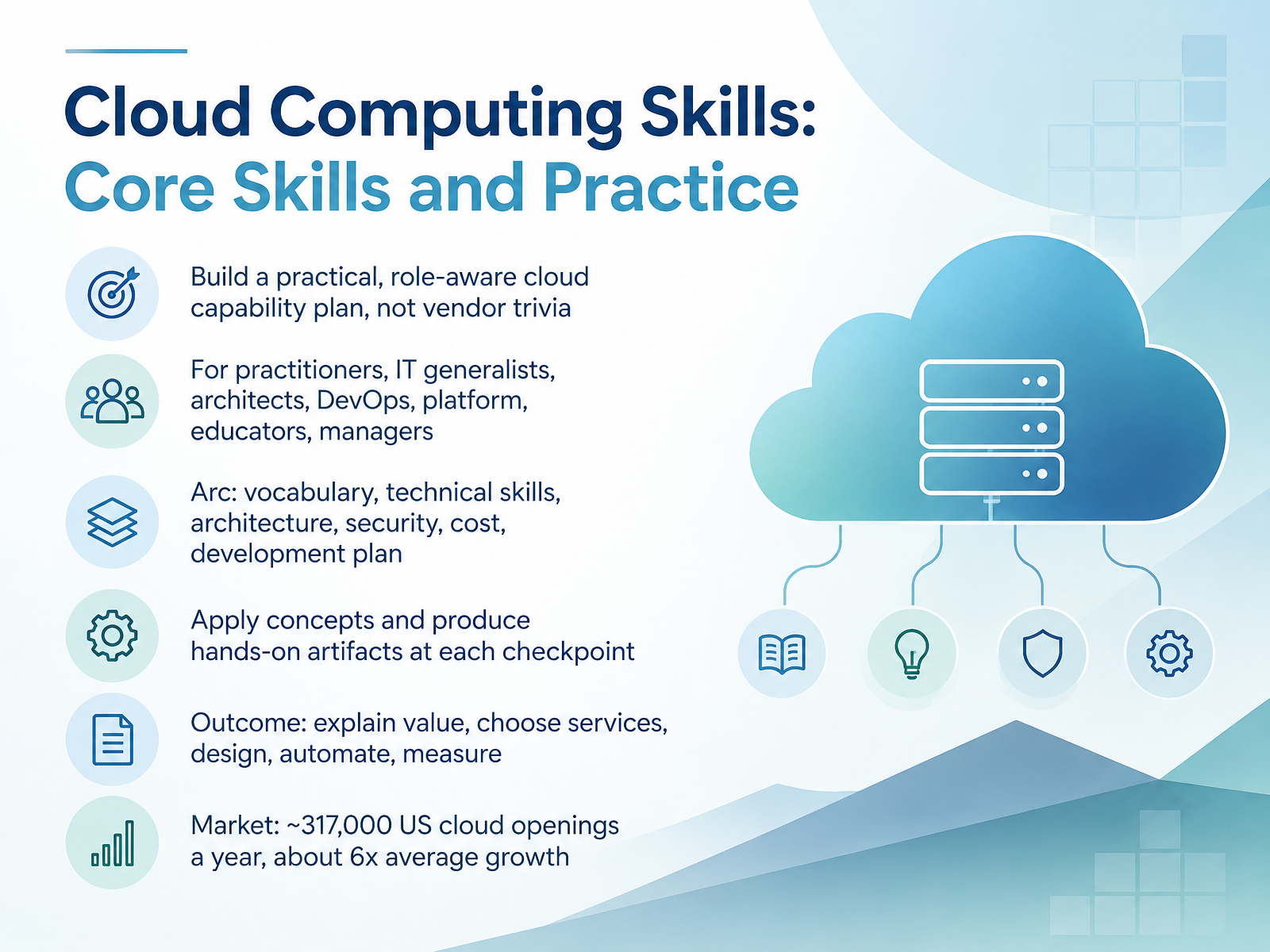
- 01Cloud Computing Skills: Core Skills and PracticeWelcome. This course is about cloud computing skills you can actually use, not vendor trivia. Our goal is a practical, role-aware capability plan, whether you're an aspiring practitioner, an IT generalist, an architect, a DevOps or platform engineer, an educator, or a manager building a team. Here's the arc. We start with vocabulary, then technical skills, architecture, security, and cost, and finish by writing your own development plan. Along the way, each checkpoint asks you to apply the concepts and produce a hands-on artifact, so you leave with evidence, not just notes. By the end, you should be able to explain cloud value, choose the right services, design a sound solution, automate it, and measure results. The opportunity is real. The United States sees roughly three hundred seventeen thousand cloud openings a year, and cloud roles grow about six times faster than the average job. So let's build that capability together. Next, what cloud computing actually is.csrc.nist.govgovinfo.govnist.gov+21 min
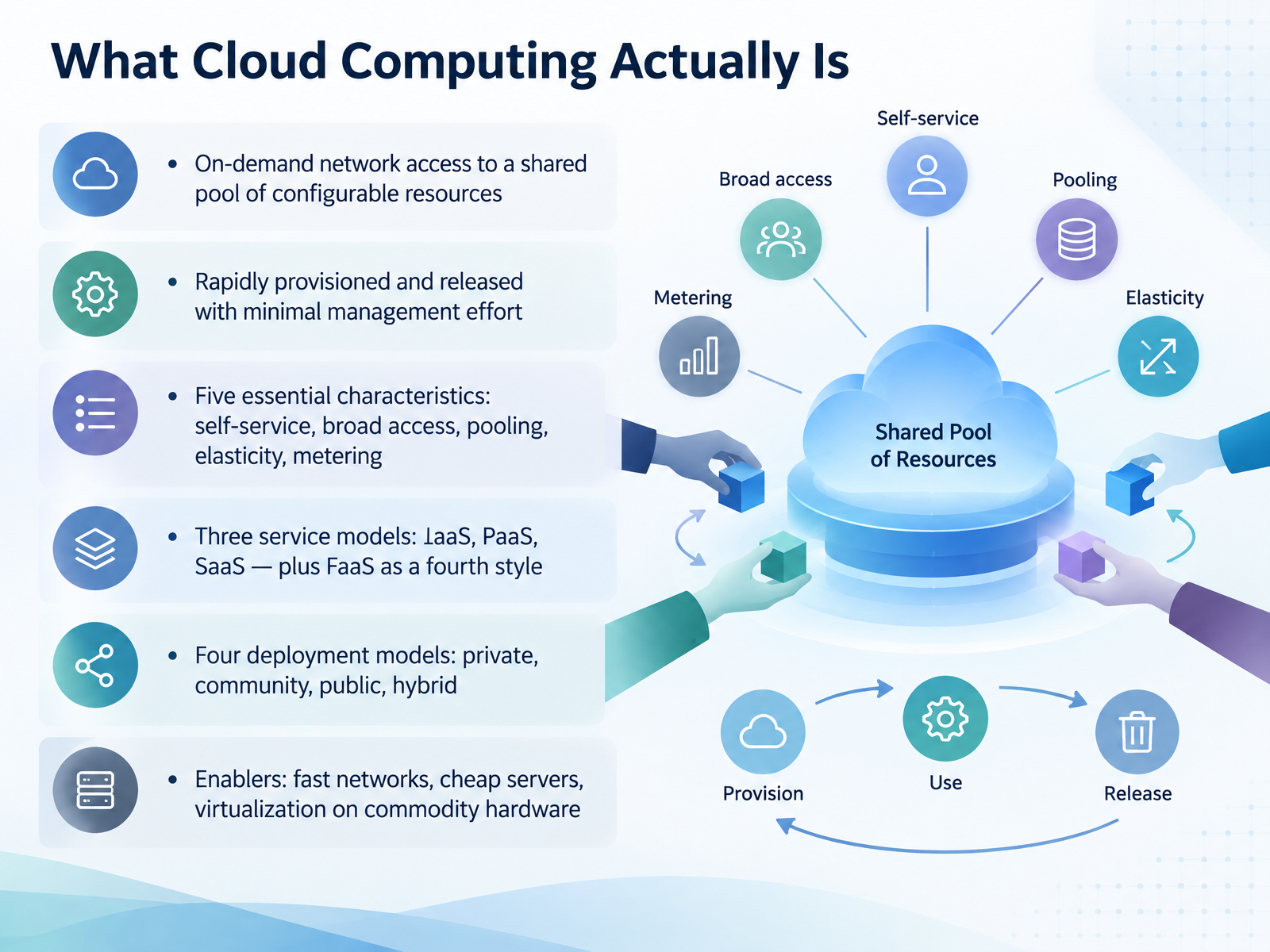
- 02What Cloud Computing Actually IsLet's define cloud computing in practical terms. The standard definition describes on-demand network access to a shared pool of configurable resources, such as servers, storage, and networks, that you can provision and release quickly with minimal management effort. That covers the what. The model also has a structure. Five essential characteristics: on-demand self-service, so you can spin up a server yourself with no ticket; broad network access from any device; resource pooling across many customers; rapid elasticity to scale up and down; and measured service, where usage is metered and billed. Then three service models: Infrastructure as a Service gives you raw compute and storage; Platform as a Service adds managed runtimes and tools; Software as a Service delivers finished applications. Function as a Service is often treated as a fourth style for event-driven code. Four deployment models follow: private, community, public, and hybrid. Finally, the enablers that made this possible: fast networks, inexpensive servers, and virtualization on commodity hardware. So when you evaluate a vendor, ask whether all five characteristics are genuinely present. Next, we'll look at regions, zones, and the shared responsibility model.
 csrc.nist.govgovinfo.govnist.gov+22 min
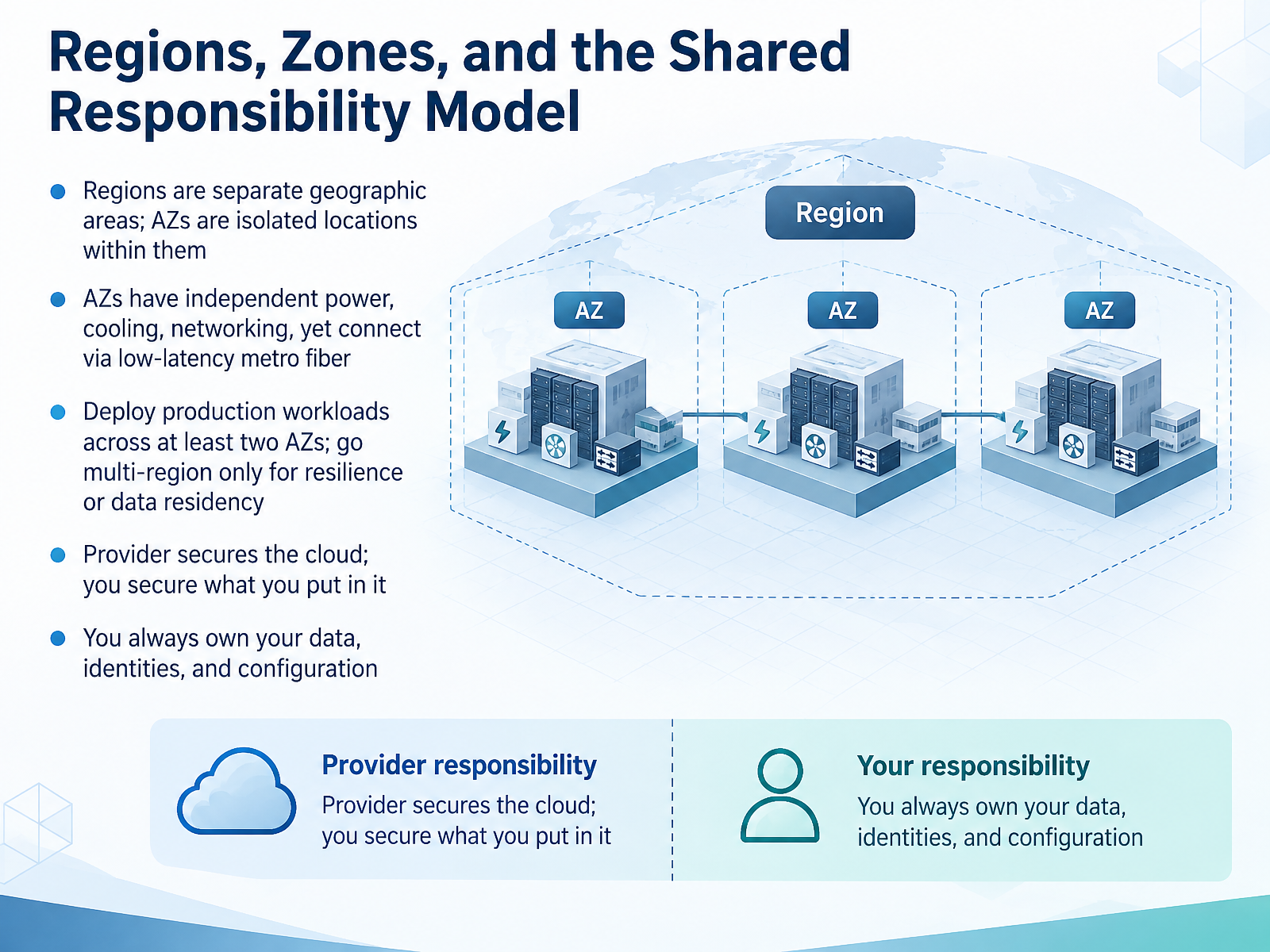
 - 03Regions, Zones, and the Shared Responsibility ModelLet's talk about where your workloads actually live, and who is responsible for what. A Region is a separate geographic area, like Virginia or Frankfurt. Inside each Region are Availability Zones, or AZs, which are isolated locations. Each AZ has independent power, cooling, and networking, yet they connect through low-latency metro fiber. That matters because AZs fail independently. For production workloads, deploy across at least two AZs. That way, if one loses power, the other keeps serving traffic. Go multi-region only when you need stronger resilience or your data must stay in a specific country. Finally, remember the shared responsibility model. The provider secures the cloud itself, the physical facilities, hardware, and core services. You secure what you put in it. You always own your data, your identities, and your configuration. So ask yourself two questions: is this workload spread across zones, and are my data and access controls handled correctly? Next, we'll look at accounts, identity, and resource hierarchy.
 docs.aws.amazon.comaws.amazon.comdocs.aws.amazon.com+21 min
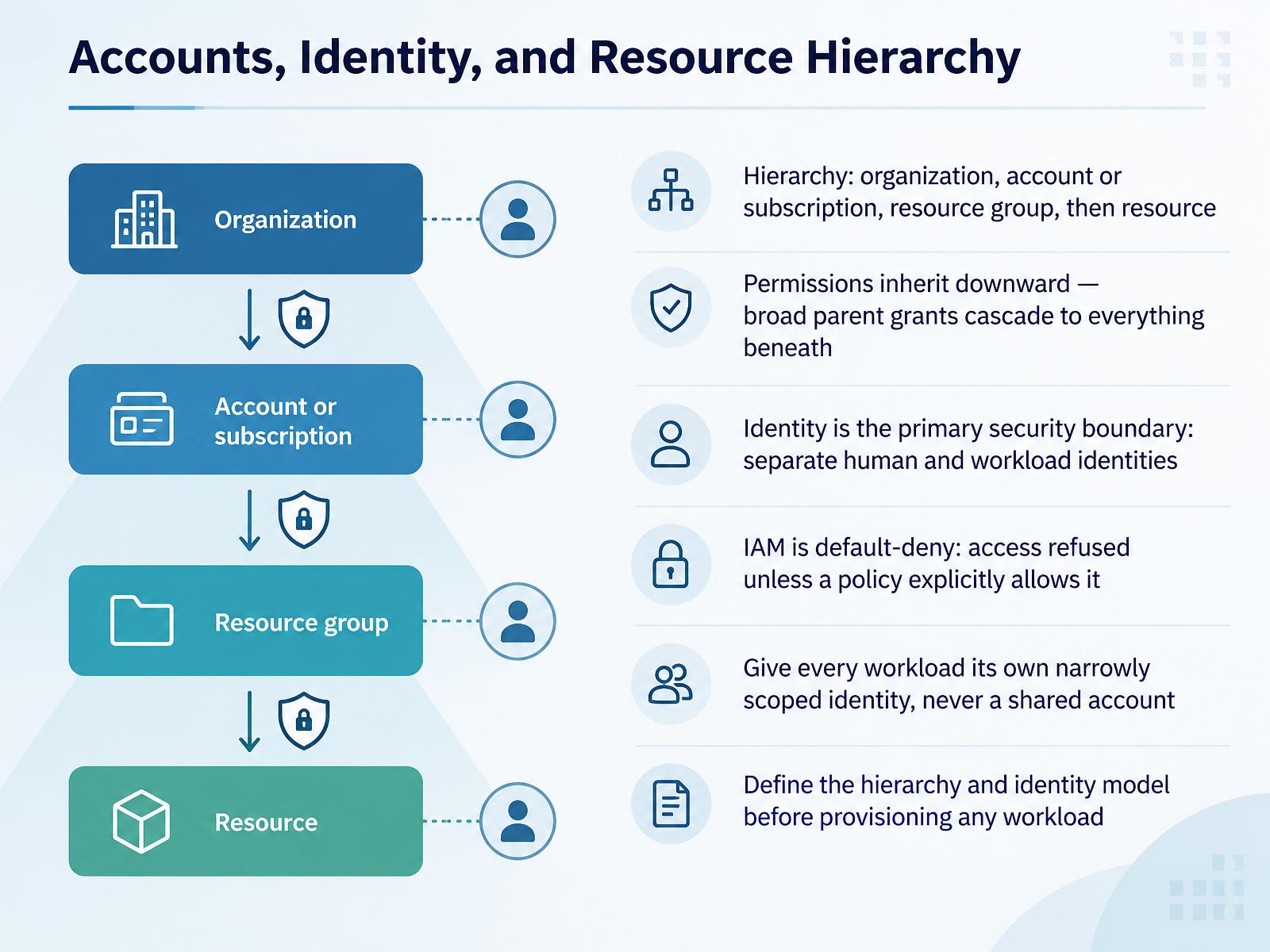
 - 04Accounts, Identity, and Resource HierarchyNow let's talk about accounts, identity, and resource hierarchy. This is the structure you set up before you build anything, and it determines how secure and manageable your cloud environment will be. The hierarchy runs from the organization, down to an account or subscription, then a resource group, and finally the individual resource. Permissions inherit downward, so a broad grant at the parent level cascades to everything beneath it. That inheritance is convenient, but it is also where over-permissioning starts. Identity is your primary security boundary. Keep human identities separate from workload identities, and give every workload its own narrowly scoped identity instead of a shared account. Most cloud IAM systems are default-deny, meaning access is refused unless a policy explicitly allows it. Build your allows on top of that deny baseline, and keep each grant as narrow as the task requires. Here is the practical takeaway. Define your hierarchy and your identity model first, before you provision any workload. That one decision prevents most access problems later. Next, we will look at compute, storage, and networking choices.
 csrc.nist.govgovinfo.govnist.gov+21 min
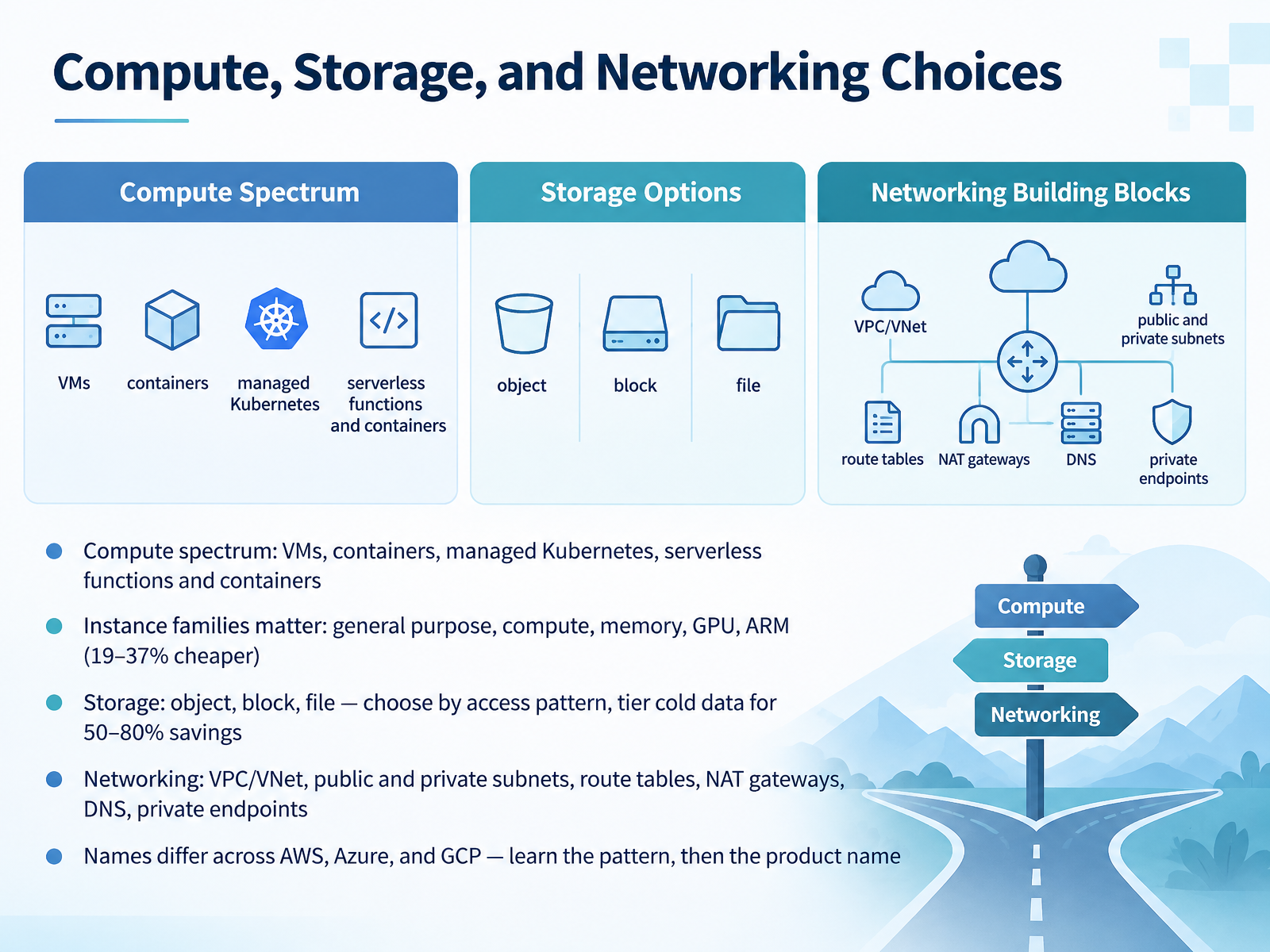
 - 05Compute, Storage, and Networking ChoicesLet's move into the core building blocks: compute, storage, and networking. Start with compute as a spectrum. Virtual machines give you full control. Containers package your app with its dependencies. Managed Kubernetes orchestrates containers at scale. And serverless functions or containers run code without you managing servers. Instance families matter, too. General purpose balances resources. Compute optimized favors CPU, memory optimized favors RAM, GPU handles heavy parallel work, and ARM instances like Graviton typically cost nineteen to thirty-seven percent less than x86 equivalents. For storage, match the type to the access pattern. Object storage suits files and media. Block storage backs databases and boot volumes. File storage shares data across many systems. Move cold data into archive tiers, and you can save fifty to eighty percent. Networking ties it together. A VPC or VNet holds public and private subnets, route tables direct traffic, NAT gateways give private resources outbound access, DNS resolves names, and private endpoints keep traffic off the public internet. Names differ across AWS, Azure, and Google Cloud. Learn the pattern first, then the product name. Next, let's put this into practice with a hands-on checkpoint: deploy a small workload.
 cloudjobs.iogitnexa.comitechguides.com+22 min
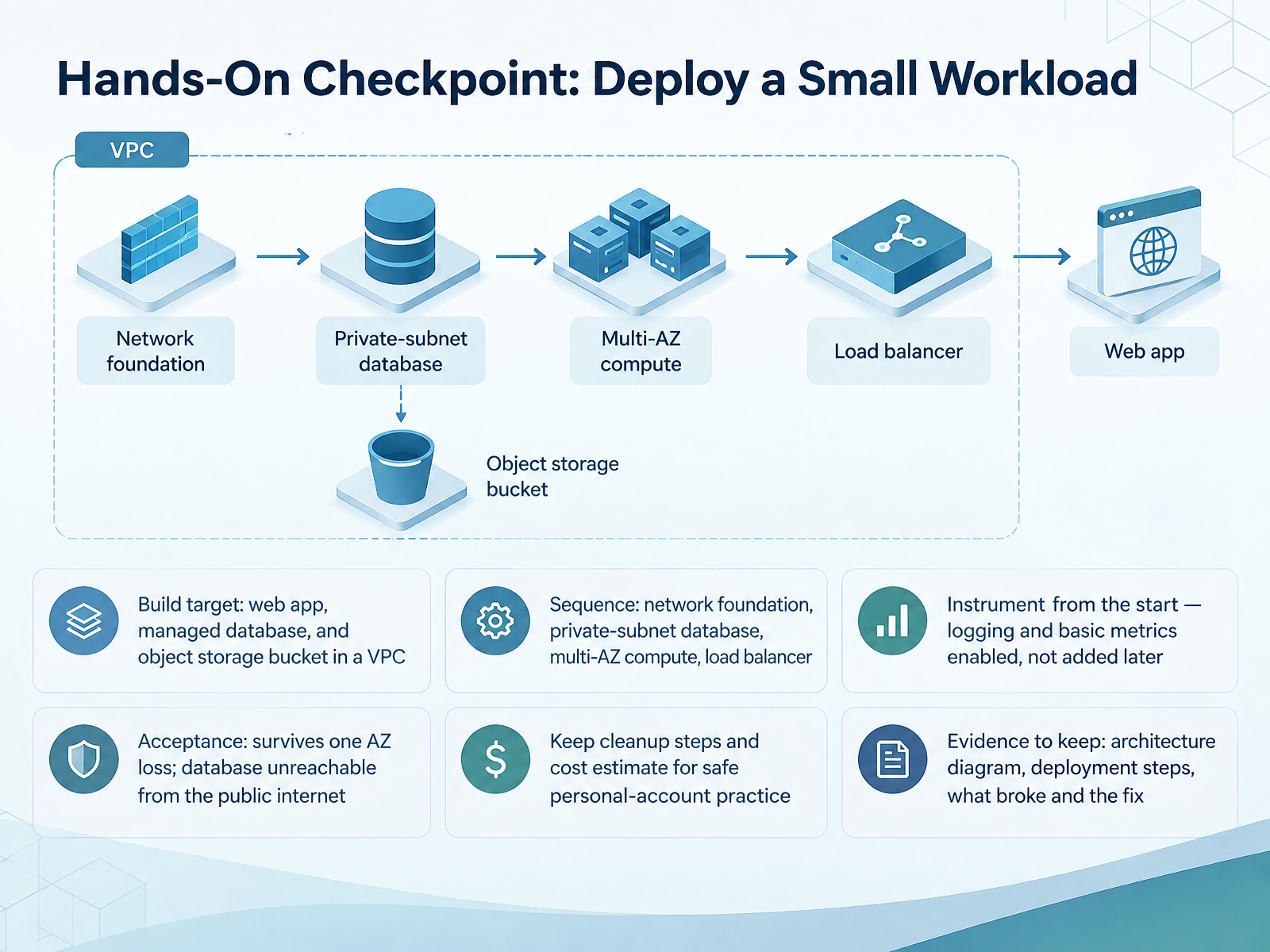
 - 06Hands-On Checkpoint: Deploy a Small WorkloadKeep building. This checkpoint puts your skills to work on a small but realistic workload. The target is a web app, a managed database, and an object storage bucket inside a virtual private cloud. Go in sequence: network foundation first, then the database in a private subnet, then compute spread across multiple availability zones, then a load balancer in front. Instrument as you build, not after. Enable logging and basic metrics from the start, because retrofitting them is harder than you think. Two acceptance tests decide whether you are done. The workload must survive the loss of one availability zone, and the database must be unreachable from the public internet. Because each availability zone sits in a physically separate facility, surviving one zone loss is a real resilience test, not a checkbox. Work in a personal account, keep a cost estimate, and write down your cleanup steps so you do not leave resources running. Finally, keep evidence: your architecture diagram, the deployment steps, and what broke and how you fixed it. That last item often teaches the most. Next, we move into Identity, Secrets, and Security by Default.
 docs.aws.amazon.comaws.amazon.comdocs.aws.amazon.com+22 min
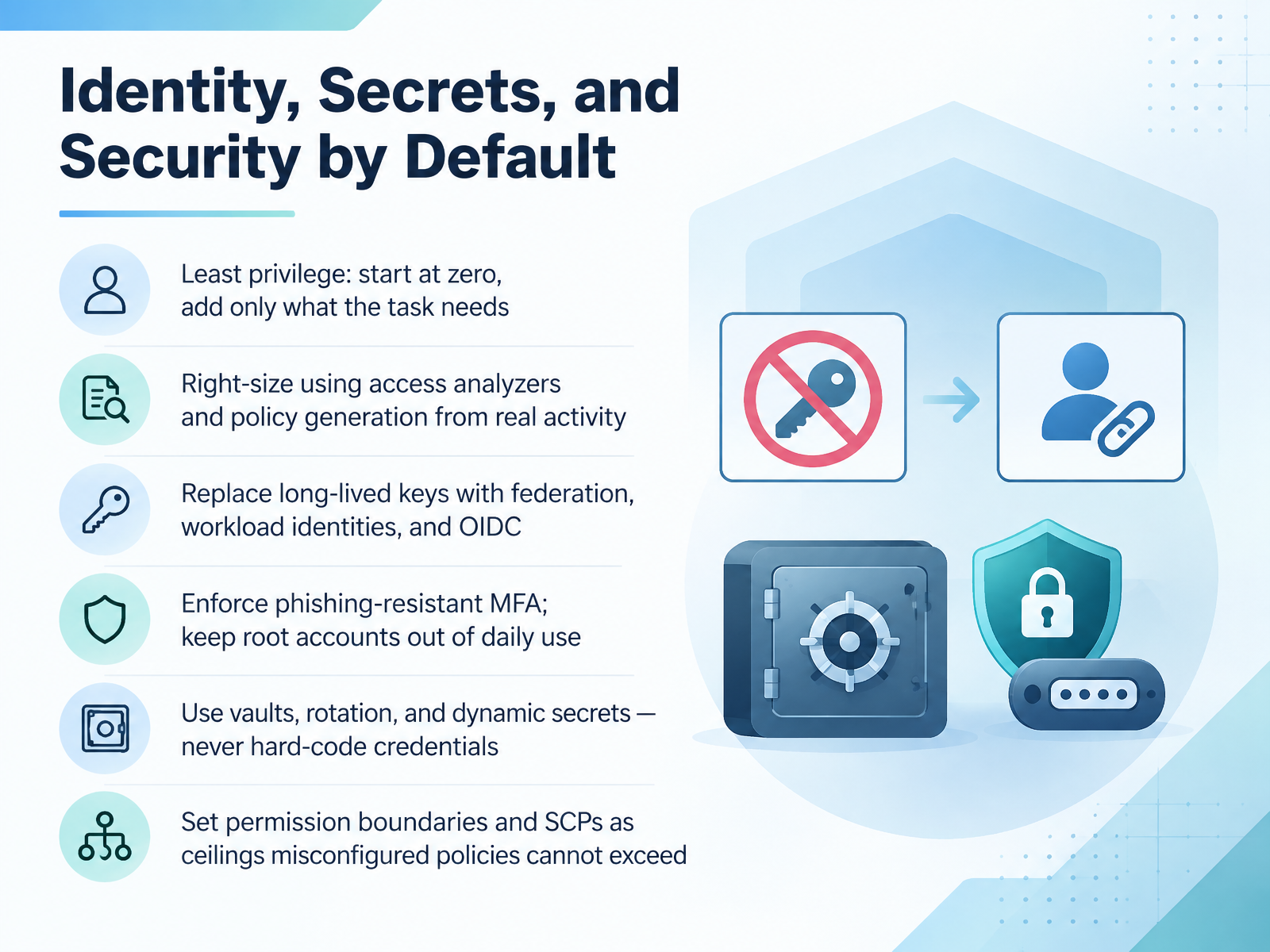
 - 07Identity, Secrets, and Security by DefaultSecurity by default starts with one habit: begin at zero permissions and add only what a task truly needs. Use access analyzers and policy generation from real activity to right size those permissions, because a role that reads one bucket should not reach seven hundred. Replace long lived keys with federation, workload identities, and OpenID Connect so credentials expire on their own. Enforce phishing resistant multi factor authentication, and keep root accounts out of daily use. Store secrets in vaults, rotate them, and use dynamic secrets instead of hard coding credentials anywhere. Finally, set permission boundaries and service control policies as ceilings that even a misconfigured policy cannot exceed. Grant less, expire more, and let guardrails hold the line. Next, we will look at common misconfigurations and how to prevent them.
 docs.aws.amazon.comdocs.cloud.google.comatlas-advisory.eu+22 min
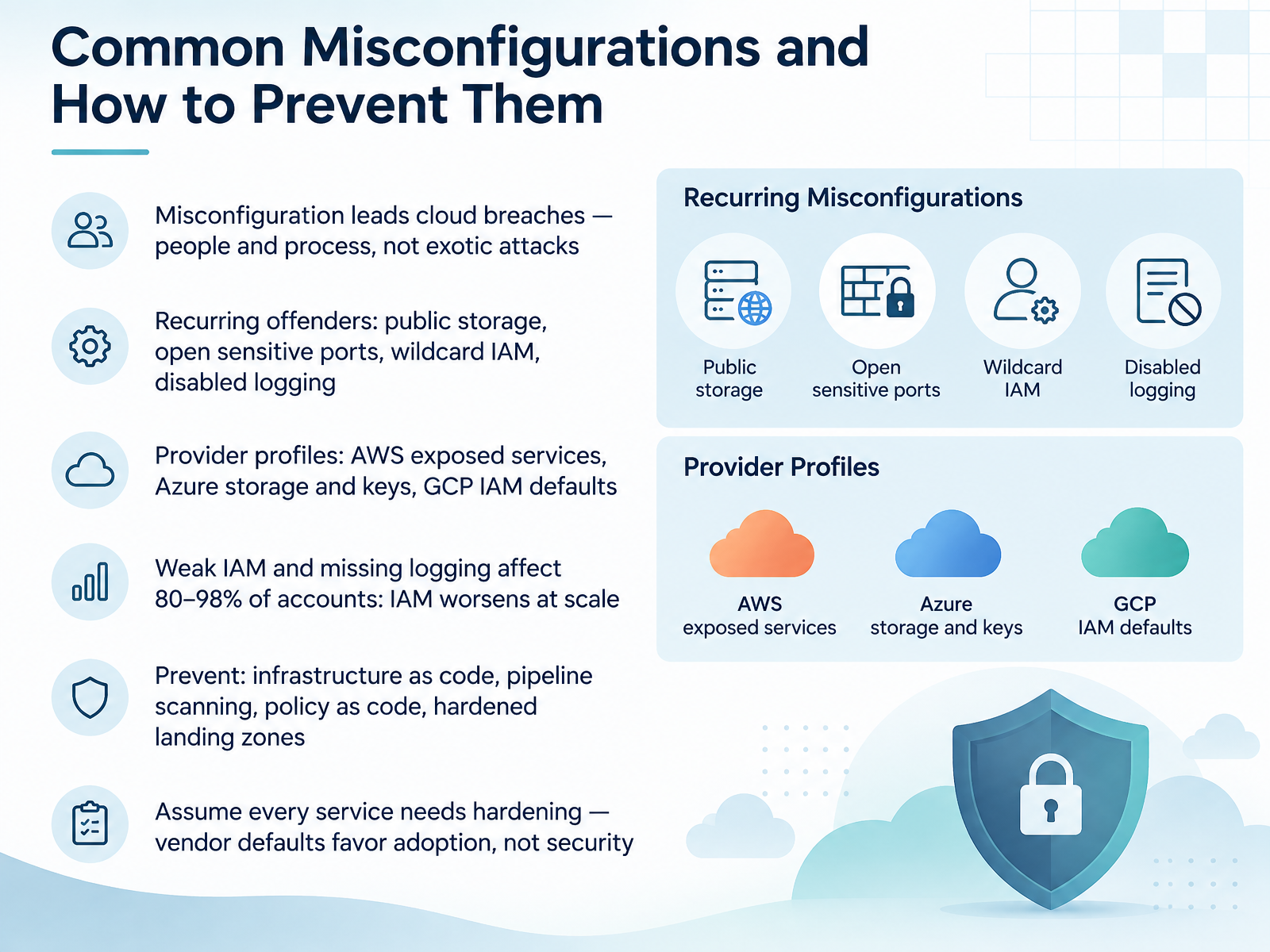
 - 08Common Misconfigurations and How to Prevent ThemNow let's look at the mistakes attackers count on most: common misconfigurations, and how to prevent them. Here's the core point. Misconfiguration causes most cloud breaches, and it's a people and process problem, not an exotic attack. The recurring offenders are familiar: public storage, open sensitive ports, wildcard IAM permissions, and disabled logging. Each provider has its own flavor. AWS tends to leak exposed services. Azure clusters around storage accounts and key management. Google Cloud struggles most with IAM defaults. And two issues are near universal. Weak IAM and missing logging affect between eighty and ninety-eight percent of accounts across all three providers. Here's the catch: IAM actually gets worse as organizations grow. More people, more roles, more permissions, and one overprivileged identity can undo everything else you hardened. So how do you prevent this? Four practices. Define infrastructure as code so it's reviewable. Scan that code in your pipeline. Enforce policy as code so bad configurations never deploy. And provision every new account from a hardened landing zone with logging, encryption, and MFA already on. The mindset that ties it together: assume every service needs hardening. Vendor defaults favor easy adoption, not security. Next, we move from configuration into design, with architecture patterns for reliability and scale.
 2 min
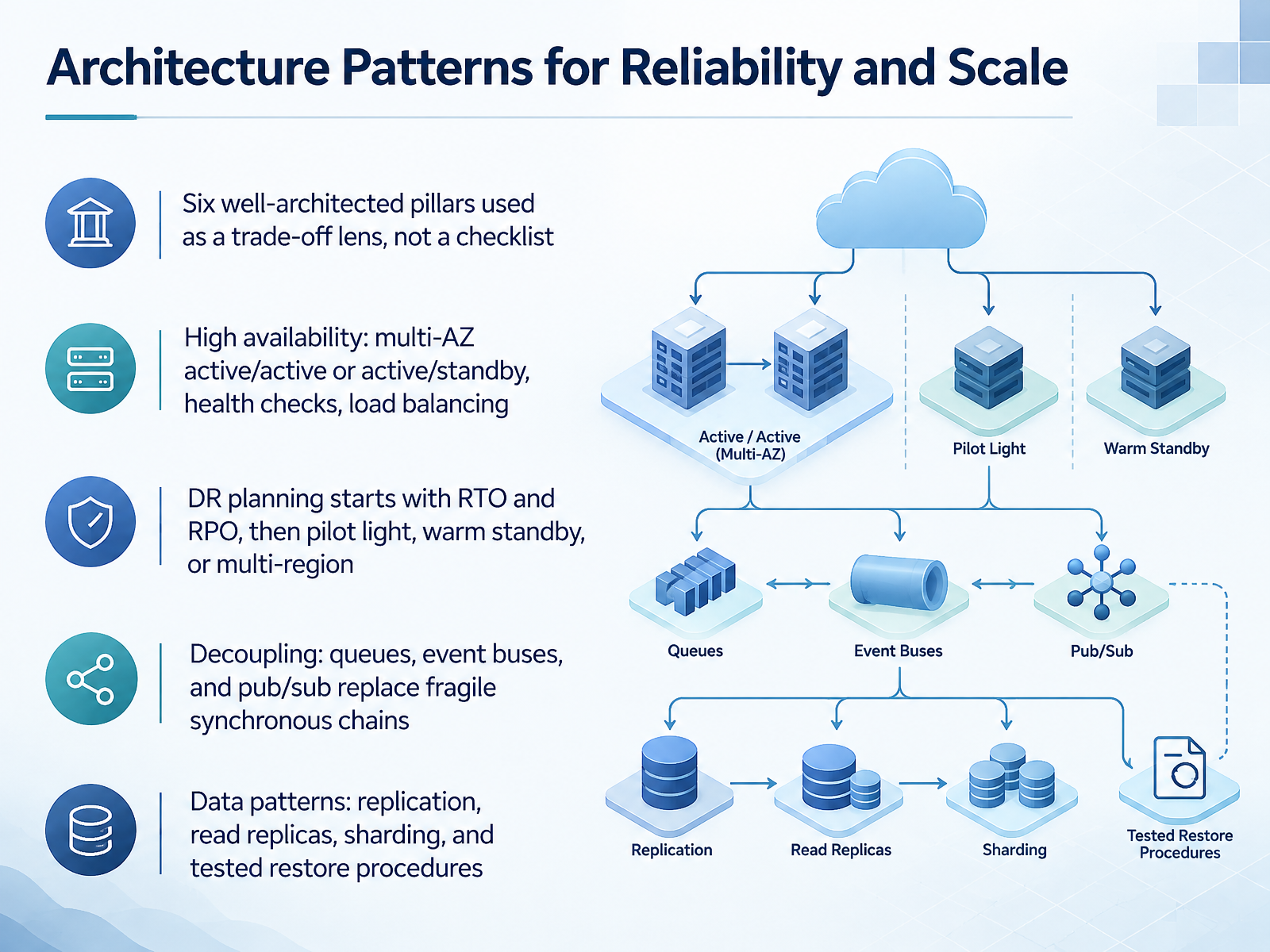
2 min - 09Architecture Patterns for Reliability and ScaleNow let's look at architecture patterns that keep systems reliable as they scale. Start with a mindset shift: the six well-architected pillars, operational excellence, security, reliability, performance efficiency, cost optimization, and sustainability, are a trade-off lens, not a checklist. You use them to reason about what you are giving up. For example, more redundancy usually means more cost. For high availability, spread workloads across multiple availability zones, either active active or active standby, and put health checks and a load balancer in front so traffic shifts when a zone fails. For disaster recovery, define your recovery time objective and recovery point objective first, then choose a pattern such as pilot light, warm standby, or multi-region. Decoupling matters too. Replace fragile synchronous chains with queues, event buses, and publish subscribe so one slow service does not stall everything. Finally, plan your data patterns: replication, read replicas, and sharding, plus restore procedures you actually test. The takeaway is simple. Reliability is a series of deliberate trade-offs, not a product you buy. Next, we will put this into practice with an architecture review checkpoint, where you critique a three-tier app.
 docs.aws.amazon.comaws.amazon.comdocs.aws.amazon.com+22 min
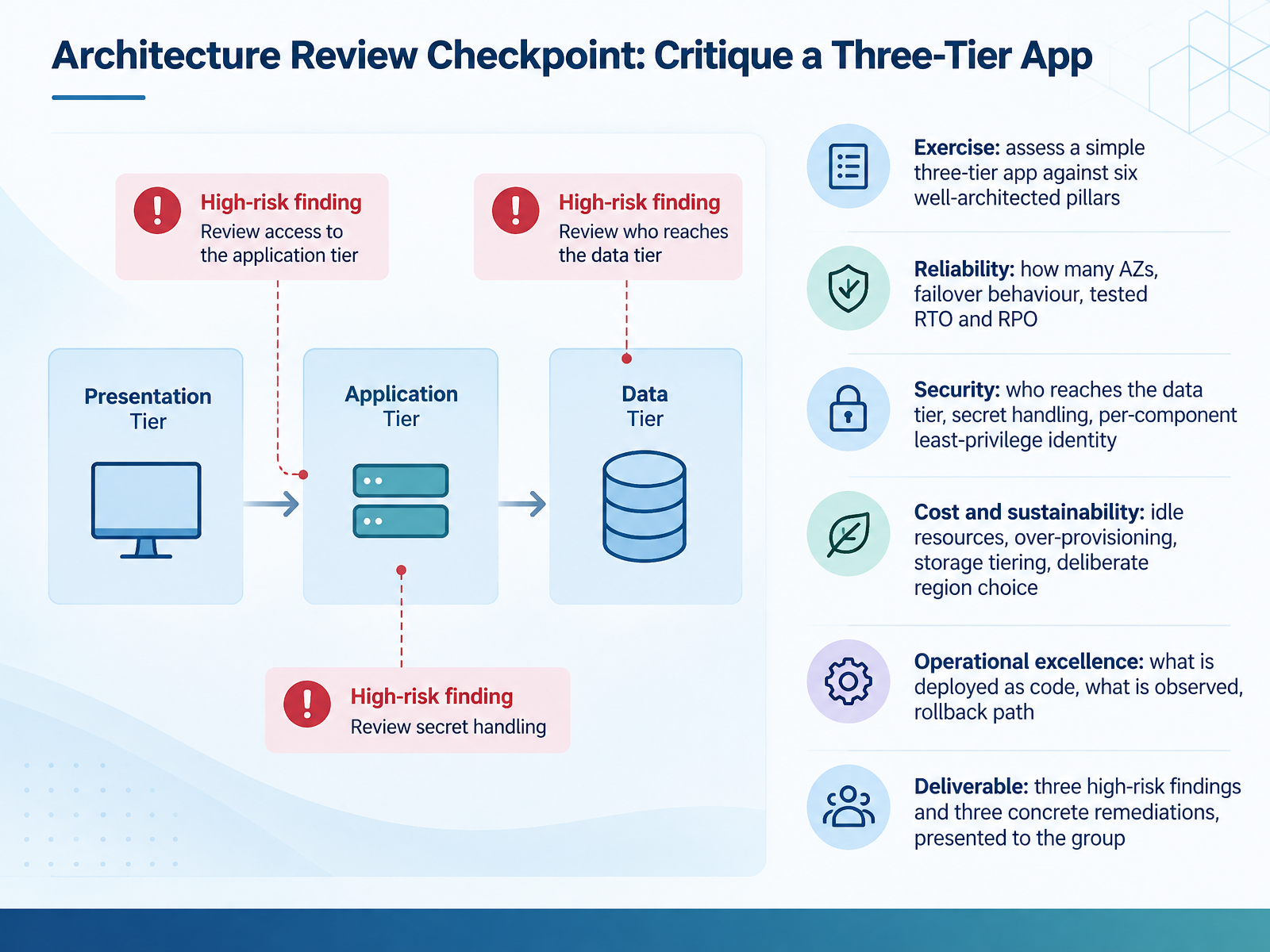
 - 10Architecture Review Checkpoint: Critique a Three-Tier AppLet's move into a working checkpoint. You'll critique a simple three-tier application against six well-architected pillars: operational excellence, security, reliability, performance efficiency, cost optimization, and sustainability. Start with reliability. Ask how many availability zones the app spans, how failover actually behaves, and whether recovery time and recovery point objectives have been tested, not just documented. Then security. Who can reach the data tier? How are secrets handled? Does each component have its own least-privilege identity? On cost and sustainability, look for idle resources, over-provisioning, storage tiering choices, and whether the region was chosen deliberately. For operational excellence, ask what is deployed as code, what is observed, and how you would roll back. Your deliverable is three high-risk findings with three concrete remediations, presented to the group. Next, automation and infrastructure as code.
 docs.aws.amazon.comaws.amazon.comdocs.aws.amazon.com+22 min
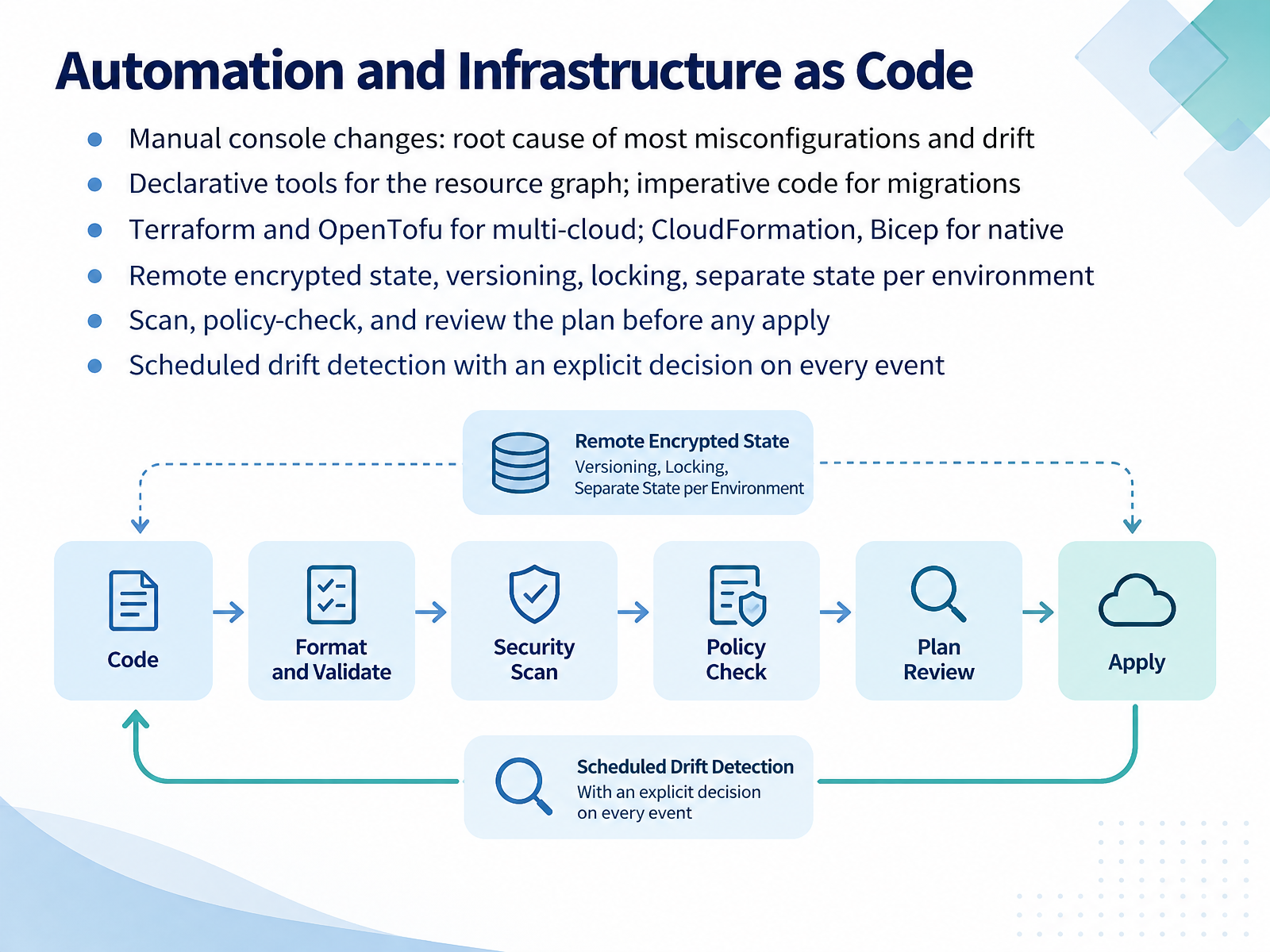
 - 11Automation and Infrastructure as CodeNext, let's talk about automation and infrastructure as code. Here's the core idea. If you build resources by clicking in a cloud console, you will eventually forget what you changed, and that is where most misconfigurations and drift come from. Infrastructure as code replaces those clicks with version controlled files. Use declarative tools to define the resource graph, and imperative code for one-off migrations. For multi-cloud work, teams commonly choose Terraform or OpenTofu. For a single cloud, native options like CloudFormation or Bicep work well. Now, protect your state. Keep it remote and encrypted, enable versioning and locking, and use a separate state file per environment so a staging mistake cannot corrupt production. Before any apply, scan the code, run policy checks, and have a human review the plan. Finally, schedule drift detection. When something changes outside your code, make an explicit decision to import it, revert it, or update the code. That keeps your declarations and reality aligned. Let's move on to observability, service level objectives, and incident response.
 2 min
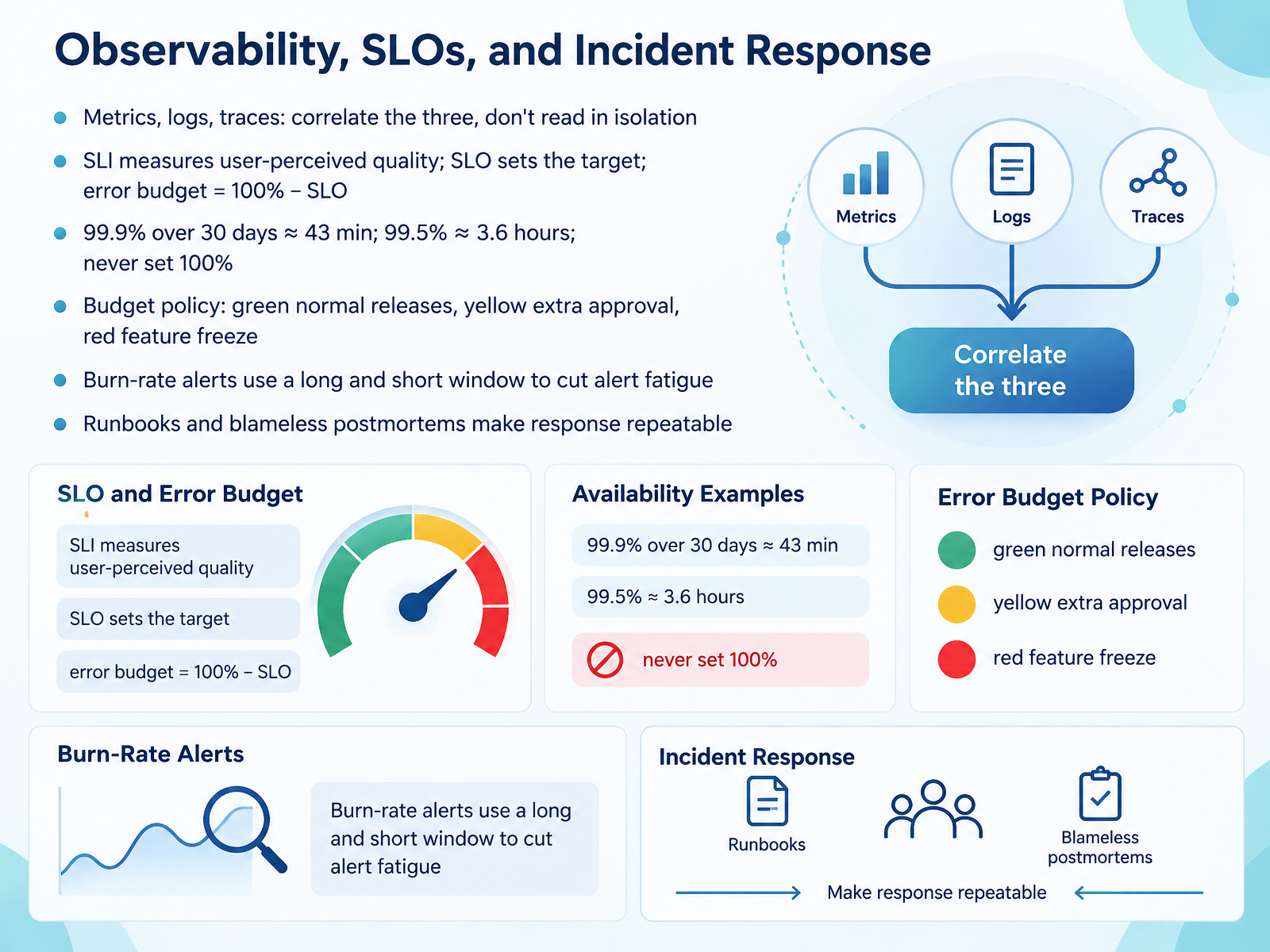
2 min - 12Observability, SLOs, and Incident ResponseNow let's talk about keeping systems healthy once they're running. Start with the three pillars: metrics, logs, and traces. Correlate them. Reading one in isolation is like diagnosing a car from the odometer alone. A trace shows where the slow hop is, logs explain why, and metrics tell you how widespread it is.
Next, define service level indicators, SLOs, and error budgets. Your SLI measures user-perceived quality, like the percentage of requests served in under three hundred milliseconds. Your SLO sets the target. The error budget is one hundred percent minus that SLO.
Do the math. At ninety-nine point nine percent over thirty days, that's roughly forty-three minutes of allowed downtime. At ninety-nine point five percent, about three point six hours. Never set one hundred percent. A zero error budget means you can never deploy anything.
Write a budget policy. Green means normal releases. Yellow means extra approval. Red means a feature freeze.
For alerting, use burn-rate alerts with a long and a short window. The long window spots real trends, and the short window confirms the issue is still happening. That combination cuts alert fatigue.
Finally, make response repeatable with runbooks and blameless postmortems. They turn incidents into learning instead of blame. Next, we'll look at cost, governance, and sustainability.
 2 min
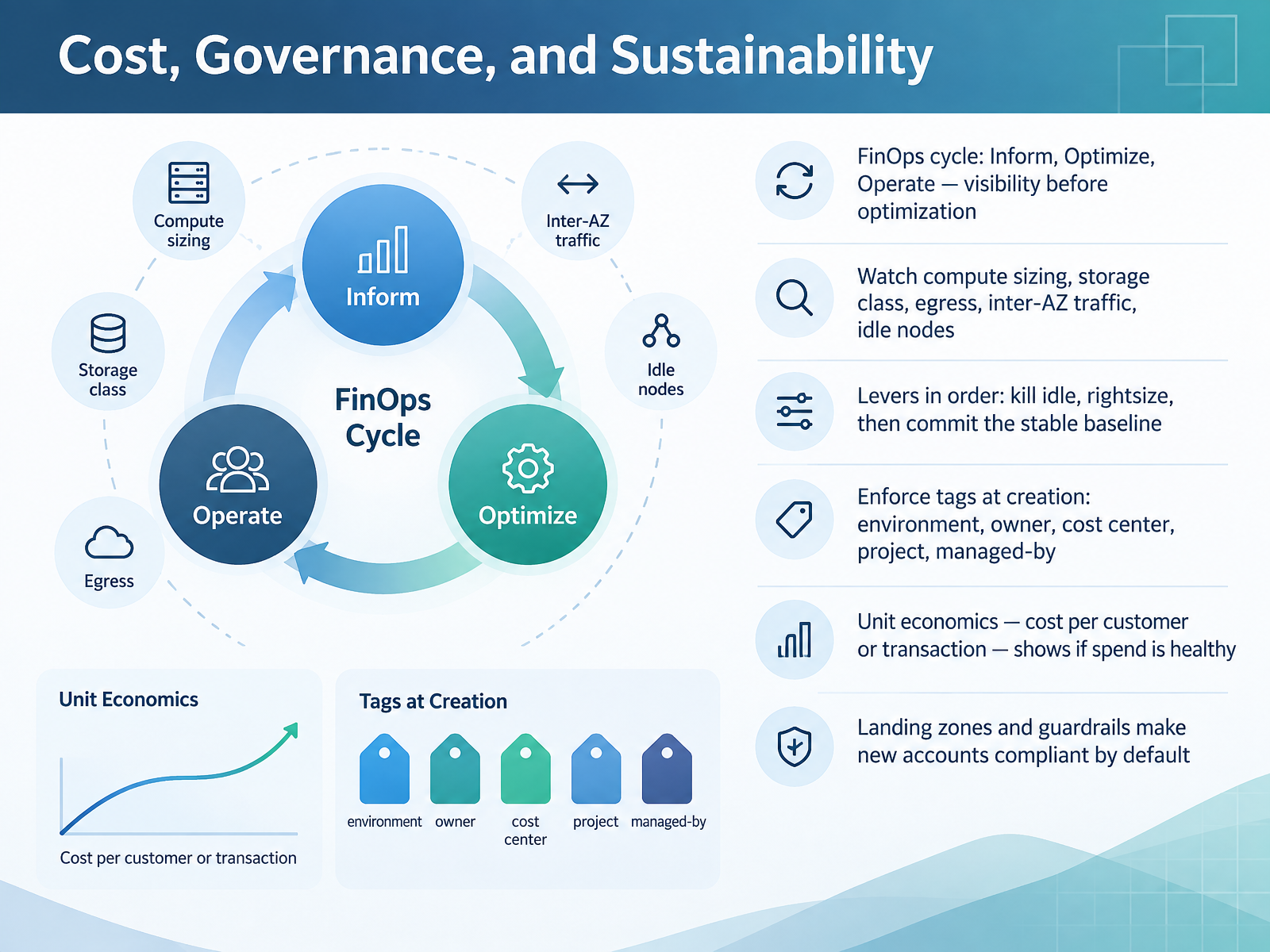
2 min - 13Cost, Governance, and SustainabilityNext, let's look at cost, governance, and sustainability together. FinOps runs as a cycle: Inform, Optimize, Operate. Visibility always comes first, because you cannot optimize what you cannot see. So start with the bill: watch compute sizing, storage class, egress, inter-availability-zone traffic, and idle nodes. Then pull levers in order. Kill idle resources first, rightsize second, and only commit to reserved capacity for the stable baseline you trust. Enforce tags at creation: environment, owner, cost center, project, and managed-by. Tags added later rarely happen. One example: an unattached storage volume costing a hundred dollars a month is twelve hundred dollars a year that buys nothing. Also track unit economics, like cost per customer or per transaction. That tells you whether rising spend is healthy growth or waste. Finally, landing zones and guardrails make new accounts compliant by default. Pause on that idea, because it leads into our final slide: building a personal and team cloud capability plan.
 2 min
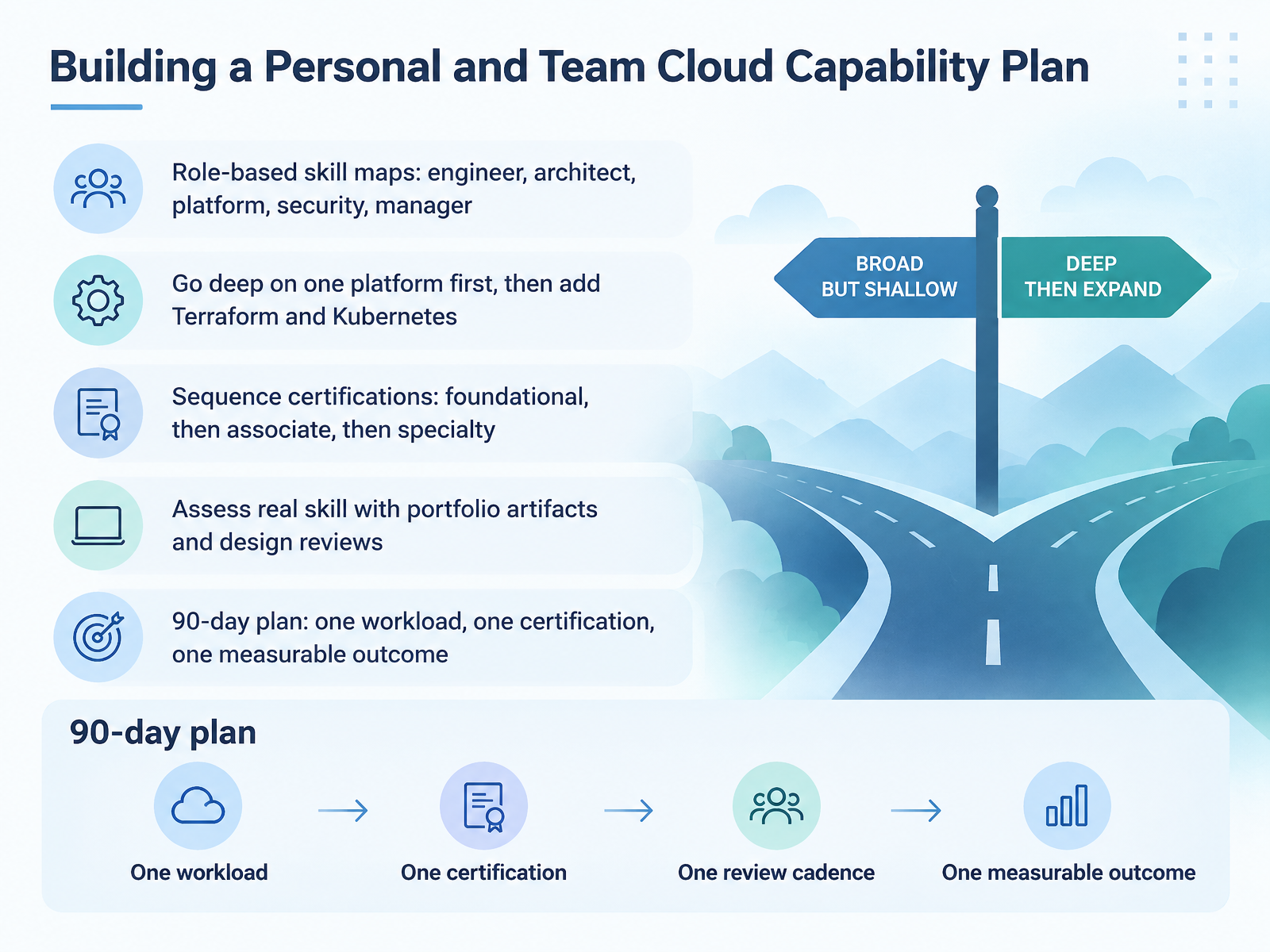
2 min - 14Building a Personal and Team Cloud Capability PlanLet's close by turning everything you've learned into a plan you can actually run. Start with role-based skill maps, because engineer, architect, platform, security, and manager each need different depth. Then go deep on one platform first, and add Terraform and Kubernetes once that foundation is solid. Sequence certifications deliberately: foundational, then associate, then specialty. Let me make that concrete. Pick one cloud, pass the foundational exam, then the associate. Remember, one associate plus one professional on your primary platform beats three foundational certificates across three providers. Next, assess real skill with portfolio artifacts and design reviews, not just exam scores. A small deployed workload you can walk through will outlast any badge. Finally, commit to a 90-day plan: one workload, one certification, one measurable outcome. So to wrap up the course, build your skill map, go deep on one platform, prove it with real work, and start the clock today. Thank you for your attention, and I wish you real progress ahead. You're ready for this.
 cloudjobs.iogitnexa.comitechguides.com+22 min
Take the deck with you
Download this course as a file — free, no sign-up needed.
- PDF handoutEvery slide page, ready to print or share.15 pages · 3.4 MBDownload
- Narrated PowerPointThe deck that presents itself — every slide carries the digital human's narration video.15 pages · 15.9 MBDownload
- PowerPoint slidesThe full deck as a .pptx — open it in PowerPoint, Keynote, or Google Slides.15 pages · 3.3 MBDownload
Free to use in your own training — please keep the PersonWise credit page at the end.
Have your own deck? Turn it into a course
Sources consulted
Web sources consulted while building this course.
- SP 800-145, The NIST Definition of Cloud Computing | CSRC — csrc.nist.gov
- The NIST definition of cloud computing — govinfo.gov
- The NIST definition of cloud computing: | NIST — nist.gov
- cloud computing - Glossary | CSRC — csrc.nist.gov
- NIST Cloud Computing Program - NCCP | NIST — nist.gov
- https://docs.aws.amazon.com/wellarchitected/latest/reliability-pillar/shared-responsibility-model-for-resiliency.html — docs.aws.amazon.com
- Shared Responsibility Model - Amazon Web Services (AWS) — aws.amazon.com
- https://docs.aws.amazon.com/global-infrastructure/latest/regions/aws-regions-availability-zones.html — docs.aws.amazon.com
- Shared Responsibility for Reliability | Microsoft Learn — learn.microsoft.com
- REL10-BP01 Deploy the workload to multiple locations - Reliability Pillar — docs.aws.amazon.com
- AWS vs Azure vs GCP Service Mapping: The Complete Comparison Chart (2026) — cloudjobs.io
- Cloud Provider Comparison Guide for 2026 | GitNexa | GitNexa Blog | GitNexa — gitnexa.com
- AWS vs Google Cloud vs Azure: Which Cloud Is Best in 2026? — itechguides.com
- Cloud Cost Comparison 2026 | CloudToolStack — cloudtoolstack.com
- Best Cloud Computing Services in 2026: Which Provider Fits Your Workload? — itechguides.com
- Security best practices in IAM - AWS Identity and Access ... — docs.aws.amazon.com
- Use IAM securely | Identity and Access Management (IAM) — docs.cloud.google.com
- Cloud IAM Best Practices: Managing Permissions Across AWS, Azure & GCP in 2026 | ATLAS Advisory SE — atlas-advisory.eu
- Cloud IAM Security Best Practices 2026: AWS, Azure, and GCP — decryptiondigest.com
- Least Privilege Cloud IAM: A Practical Guide — safeguard.sh