Team Working Agreements
Begin
12 pages · ~24 min
Team Working Agreements
Learn to establish clear, collaborative team working agreements that define norms, expectations, and processes for effective teamwork.
What you’ll learn
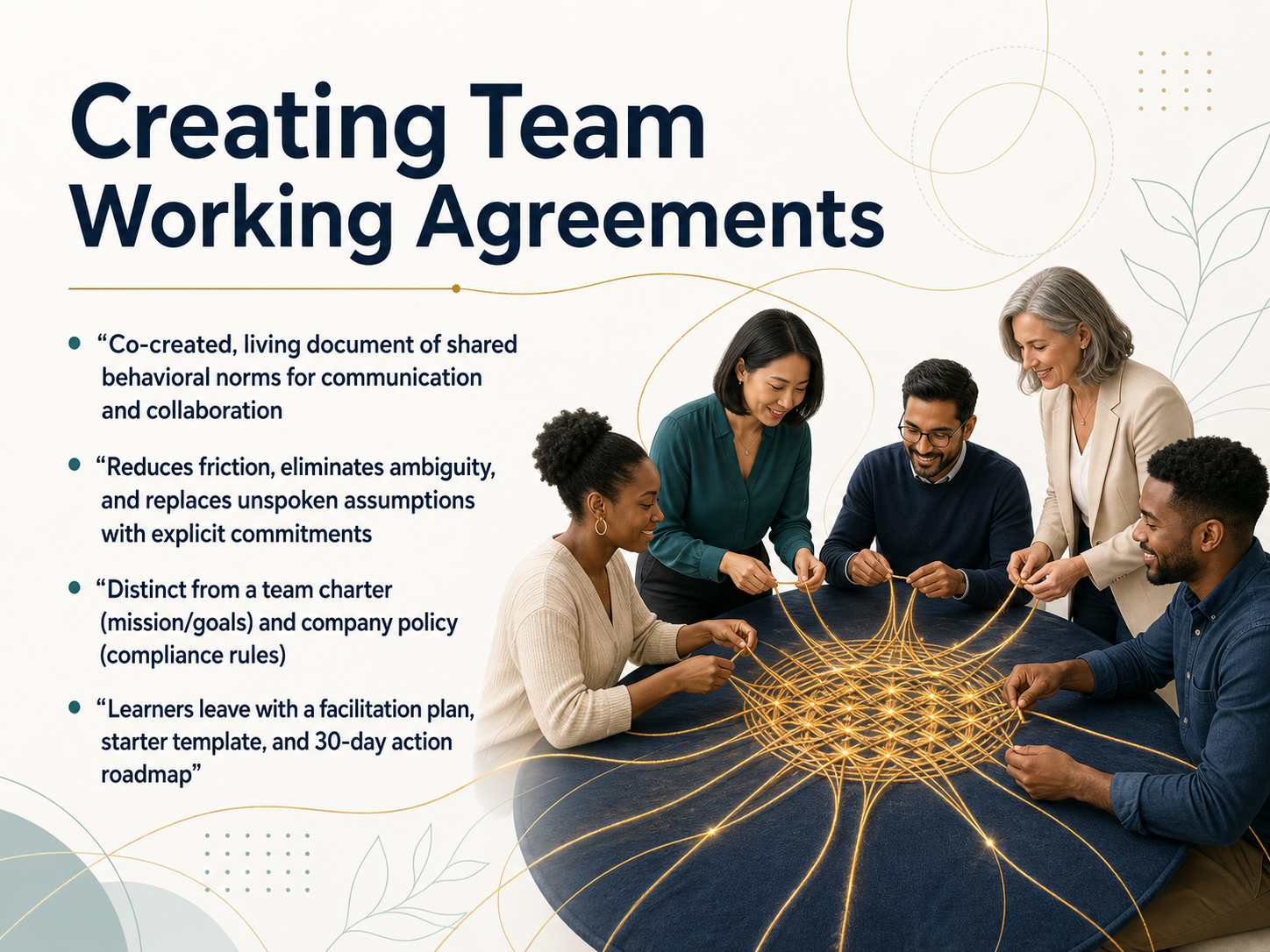
- 01Creating Team Working AgreementsWelcome. Today, we're going to create a Team Working Agreement. Think of this as a co-created, living document that sets the shared behavioral norms for how you communicate and collaborate. It's not a one-time project, but a practical guide that reduces friction and replaces unspoken assumptions with clear, explicit commitments. Now, let's clarify what this is not. It's distinct from a team charter, which defines your mission and goals, and it's separate from company policy, which sets compliance rules. By the end of this course, you won't just understand the theory. You'll leave with a concrete facilitation plan, a starter template you can use immediately, and a 30-day action roadmap to make these agreements stick. This is your first step toward transforming how your team works together. Let's get started. Next, let's look at the hidden cost of implicit norms.atlassian.complane.sorunn.io+21 min
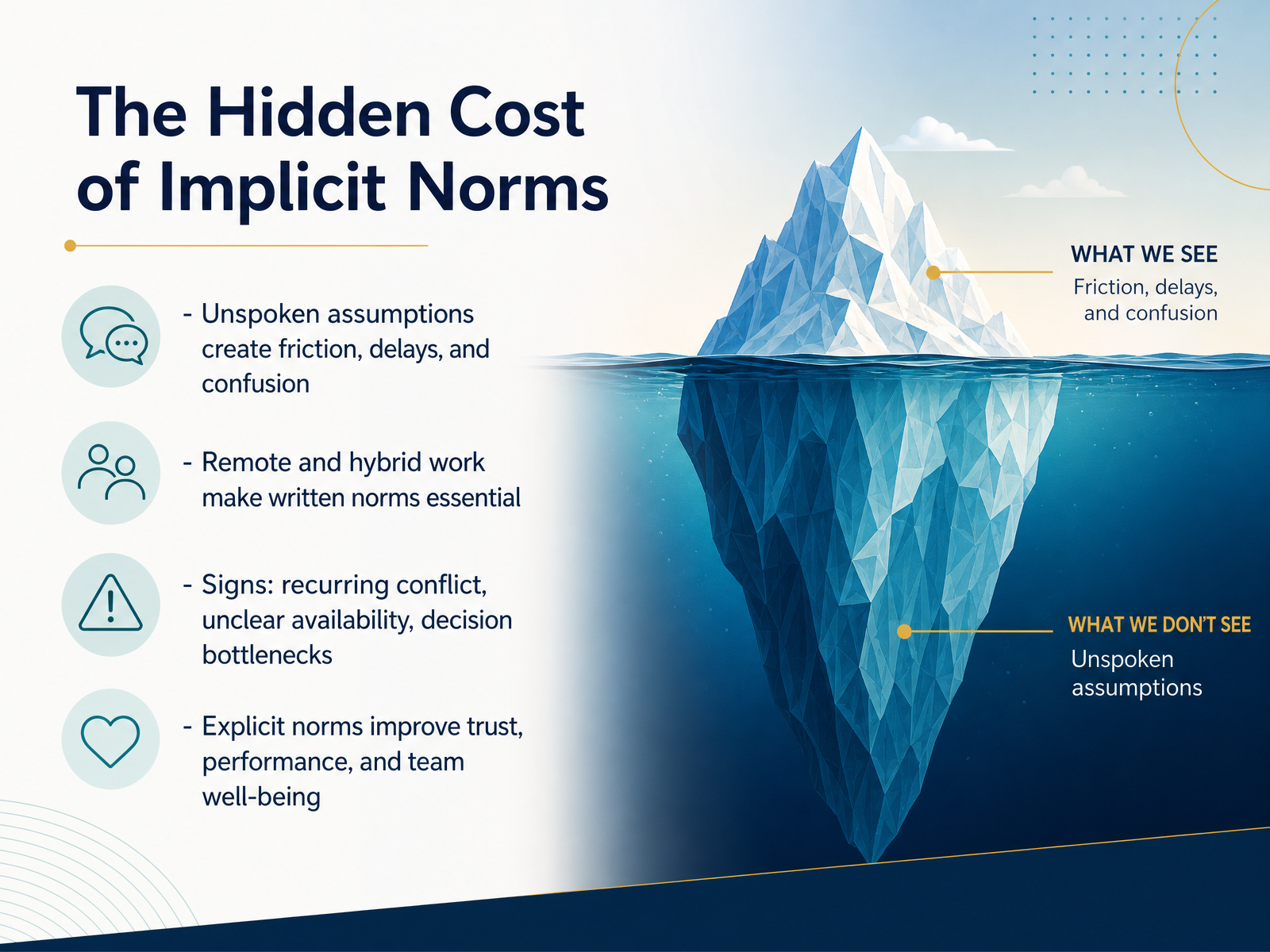
- 02The Hidden Cost of Implicit NormsNow, let's talk about the hidden cost of implicit norms. Every team has unspoken rules about how things get done. But when expectations stay inside people's heads, they create friction, delays, and confusion. One person assumes a quick chat message is fine at nine PM. Another feels pressured to respond immediately. A third person never saw the message at all. Those small gaps add up fast. In remote and hybrid work, written norms become essential. You can't rely on hallway conversations or reading body language through a screen. Watch for the warning signs: recurring conflict, unclear availability, and decision bottlenecks. These are symptoms that your team is running on guesswork. The good news is that explicit norms change the dynamic. They improve trust, performance, and team well-being because everyone operates from the same playbook. So, what does a strong working agreement actually cover? Let's move into that next.
 atlassian.complane.sorunn.io+22 min
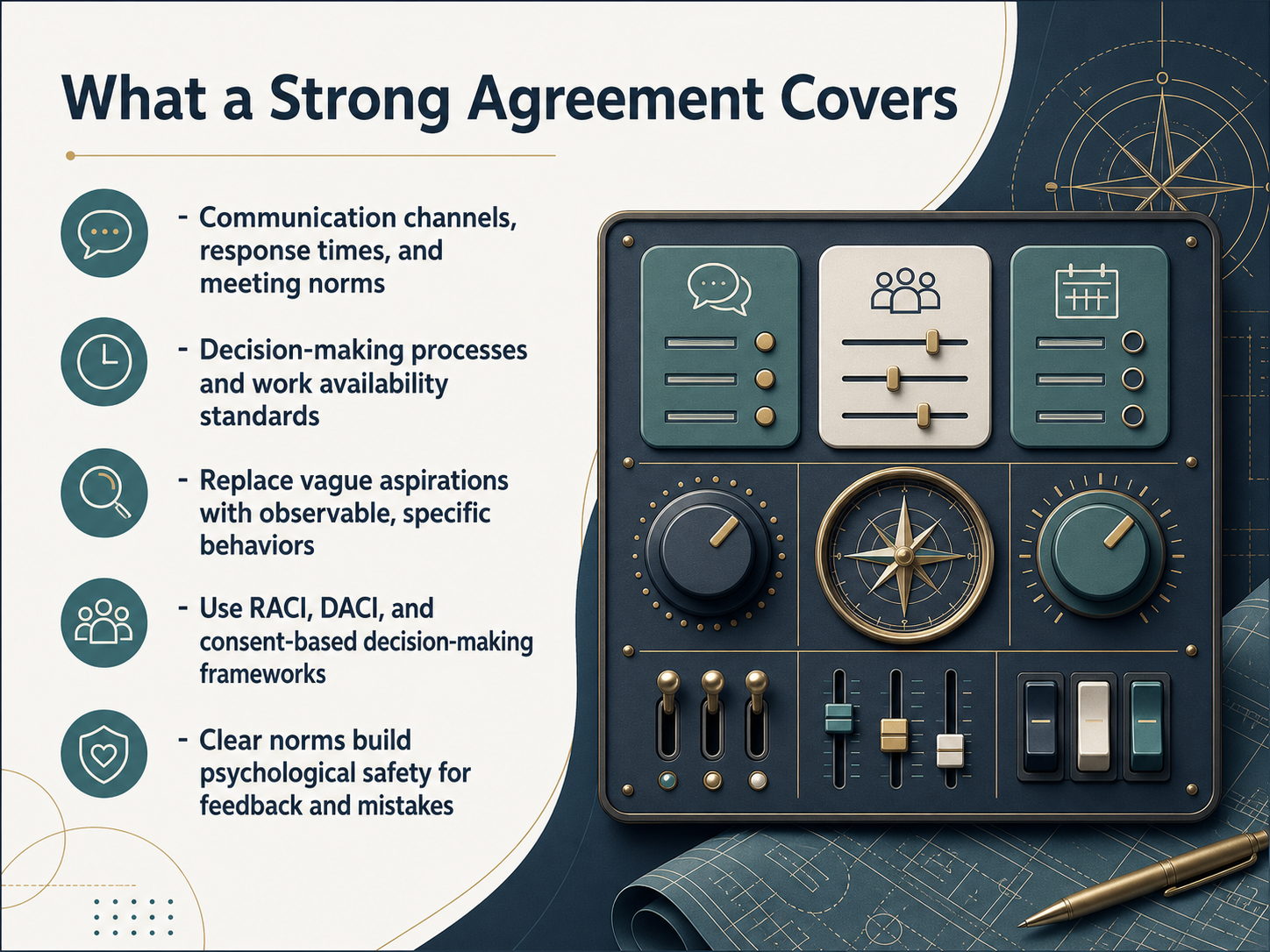
 - 03What a Strong Agreement CoversNow let's get concrete. A strong agreement doesn't just say 'be respectful.' It defines what that actually looks like. Think about communication. You'll decide which channels to use for what. For example, instant messages for urgent questions, and email for things that can wait a day. You'll nail down response times and set clear norms for meetings. Next, cover how you make decisions. Will you use a RACI or DACI framework to clarify roles? Or maybe a consent-based approach for faster alignment? Also, define your work availability standards, especially across time zones. The goal is to replace vague hopes with specific, observable behaviors. Instead of 'respond quickly,' you commit to 'respond to internal messages within 24 hours.' This clarity is what builds real psychological safety. When everyone knows the rules, it's safer to give honest feedback and own mistakes. In the next section, we'll look at the pre-work that sets your session up for success.
 atlassian.complane.sorunn.io+22 min
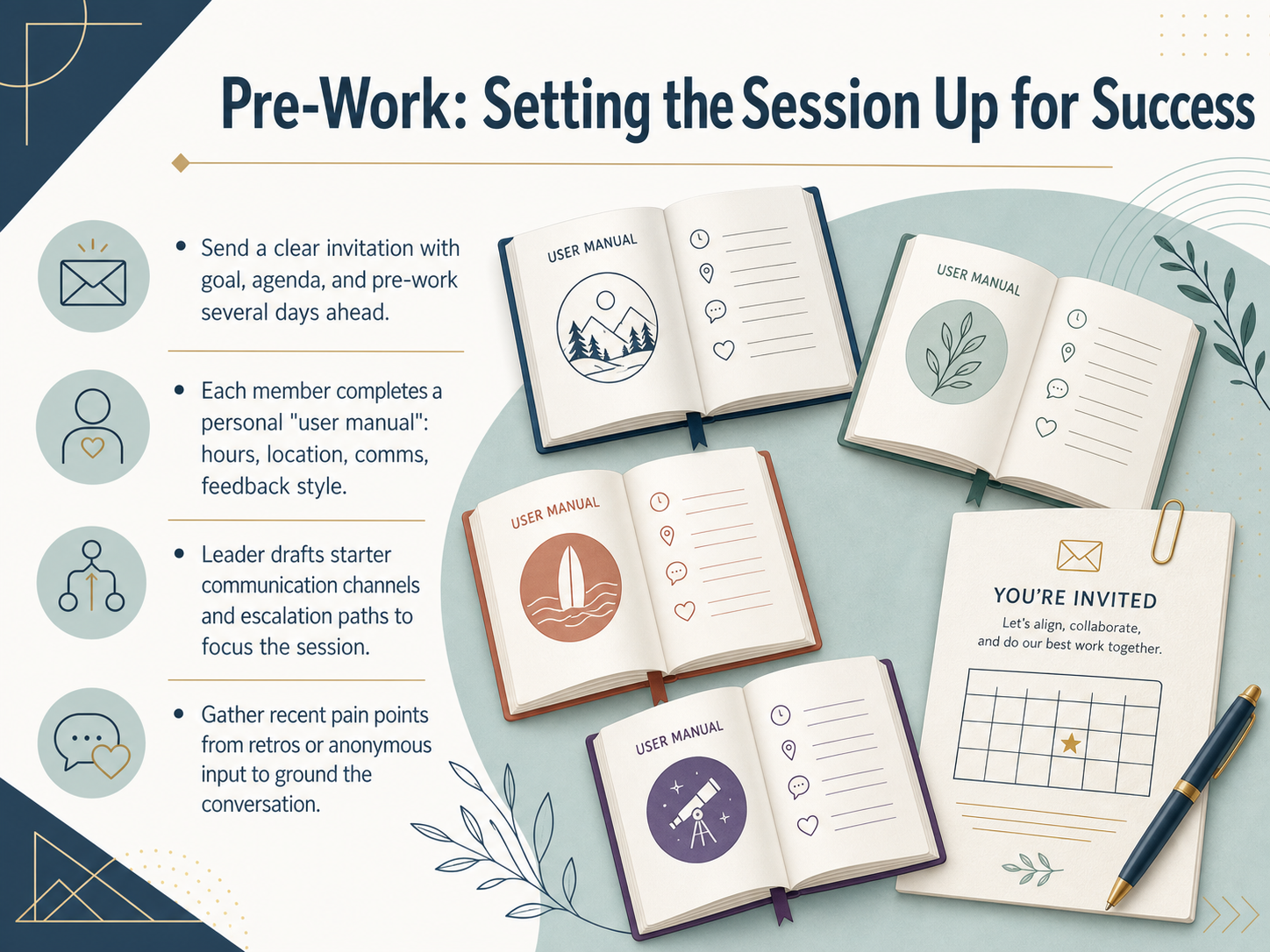
 - 04Pre-Work: Setting the Session Up for SuccessNow, let's talk about the pre-work that makes the actual session a success. Successful working agreements are built on preparation, not just conversation. First, send a clear invitation several days ahead. It should include the goal, the agenda, and the pre-work people need to complete. This frames the meeting as important and gives everyone time to think. Next, ask each team member to complete a personal user manual. This is a quick share about their working hours, location, communication preferences, and how they like to receive feedback. This makes individual needs visible before the group discussion starts. At the same time, the leader should draft a starter set of communication channels and escalation paths. This gives the team a concrete starting point to react to, rather than starting from a blank page. Finally, gather recent pain points. Look at past retrospectives or gather anonymous input. Grounding the session in real friction makes the agreements feel practical and necessary. When you walk into the workshop with this prep done, you are ready to build something real. Next, let’s move into the workshop itself and see how we go from brainstorming to a solid first draft.
 atlassian.complane.sorunn.io+22 min
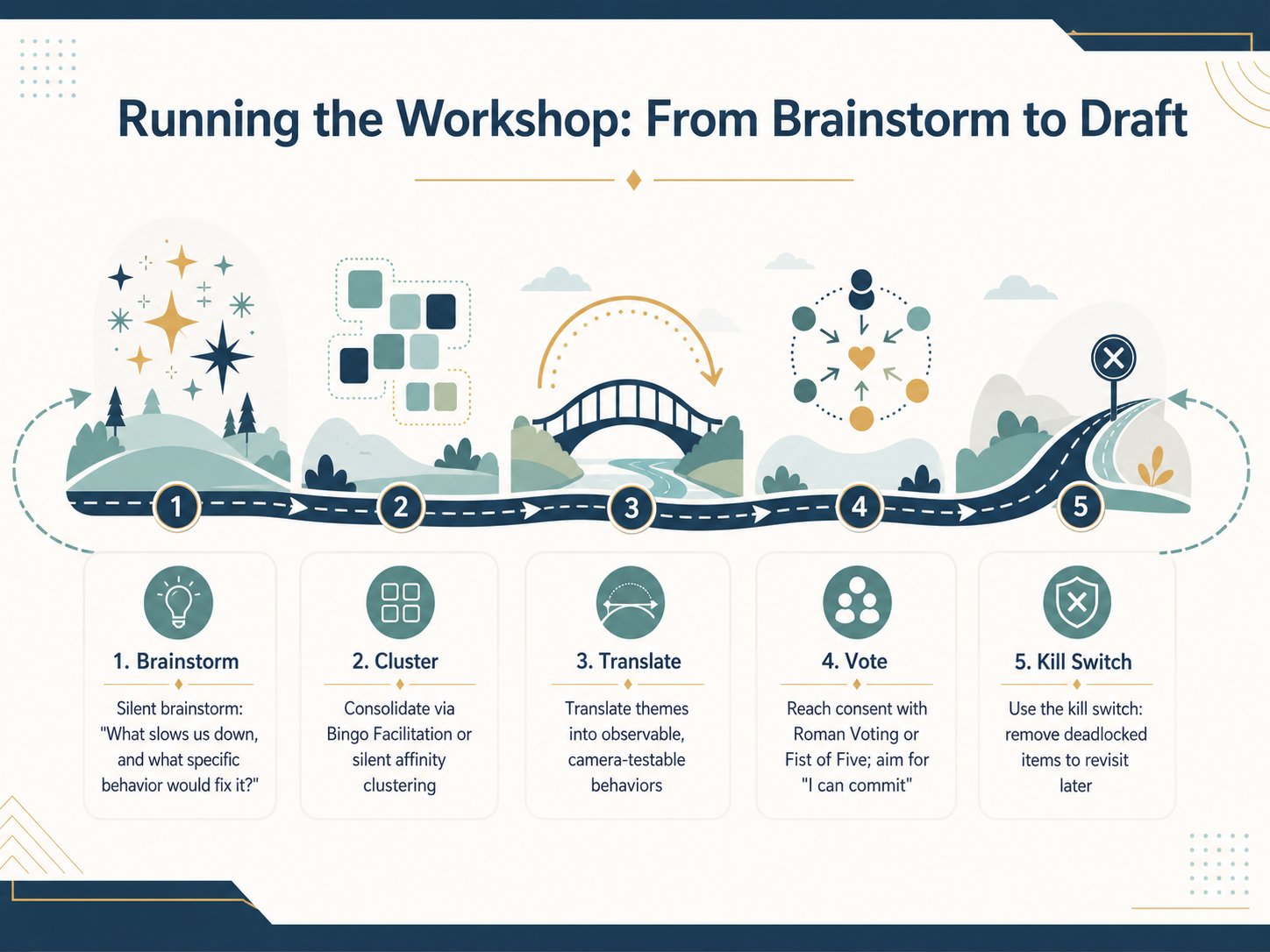
 - 05Running the Workshop: From Brainstorm to DraftNow let's move from theory to action. This is the core of the workshop where we turn friction into a first draft. We start with a silent brainstorm. Give everyone a few minutes and a specific prompt: 'What slows us down, and what specific behavior would fix it?' This quiet time ensures every voice is heard, not just the loudest. Next, we consolidate the ideas. You can use a quick game of Bingo Facilitation or a silent affinity clustering to group similar notes without getting lost in debate. Once we have clear themes, the real work begins. We translate these themes into observable, camera-testable behaviors. Instead of a vague idea like 'be more responsive,' we define the exact action, like 'we answer internal messages within twenty-four hours.' Then, we reach consent. Use Roman Voting or a Fist of Five to check commitment. Our goal is not perfect consensus, but a genuine 'I can commit to trying this.' And finally, remember the kill switch. If a specific item creates a deadlock, remove it immediately. It's better to start with fewer, real agreements than to include fake ones. We'll revisit those tricky items later. Now, let's look at how we take this draft and turn it into a living document.
 atlassian.complane.sorunn.io+22 min
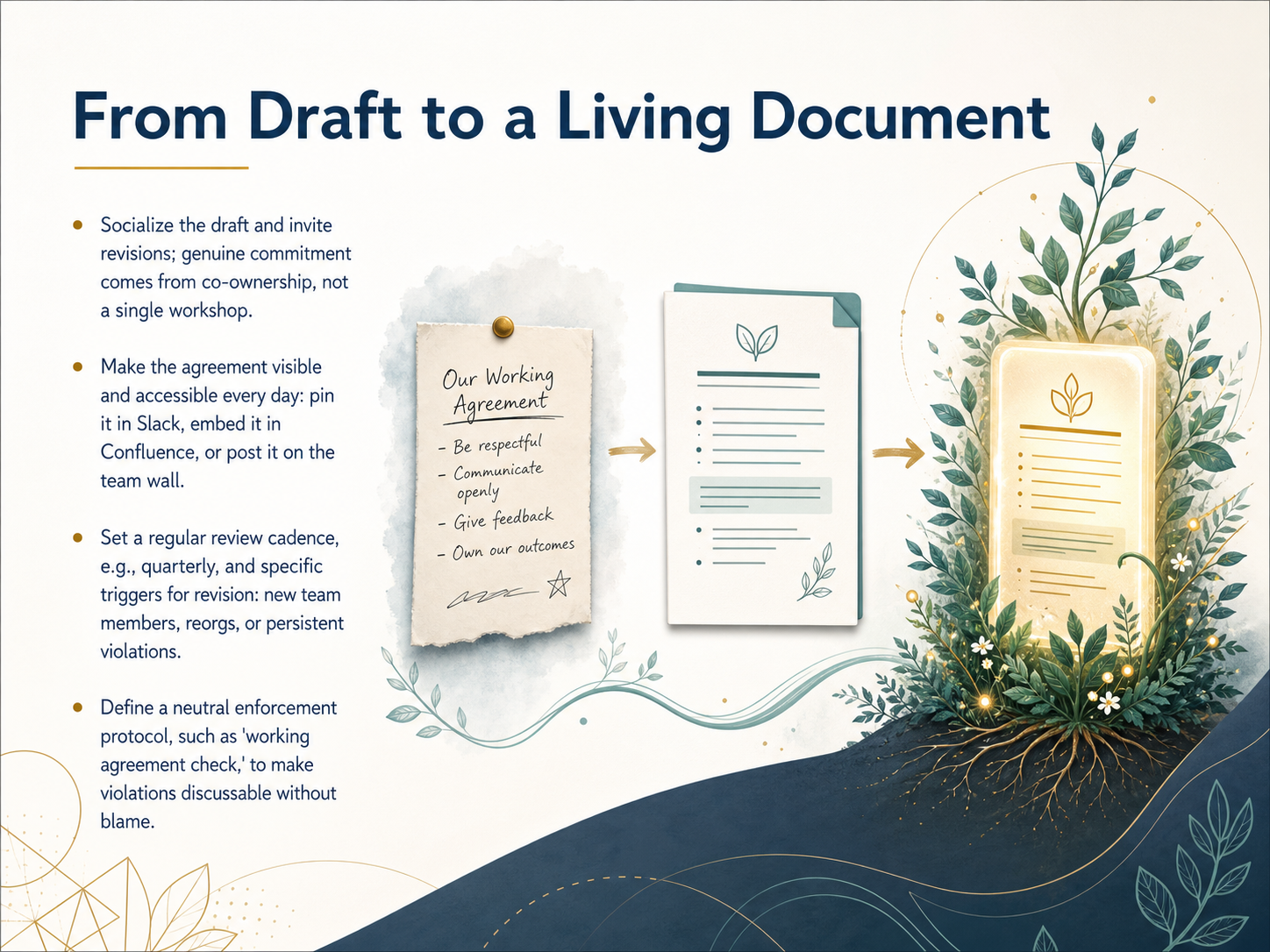
 - 06From Draft to a Living DocumentNow that you have a draft, let's talk about turning it into a living document. A document that sits in a folder gets ignored. True commitment comes from co-ownership, so socialize the draft and genuinely invite revisions. Don't just rely on the initial workshop. Next, make the agreement visible and accessible every single day. Pin it to your Slack channel, embed it on your Confluence page, or even post it on your team wall. If you can't see it, you can't live it. Then, set a regular review cadence. A quarterly check-in is a great starting point. Also, define specific triggers for an immediate review, like onboarding a new team member, a reorganization, or when you notice the same agreement being violated repeatedly. Finally, create a neutral way to address violations without blame. Agree on a simple phrase, like a 'working agreement check.' This allows anyone to point out a drift from the norms in a safe, objective way, focusing on the behavior, not the person. Let's keep this momentum going. Up next, we'll tackle common pitfalls and how to avoid them.
 atlassian.complane.sorunn.io+22 min
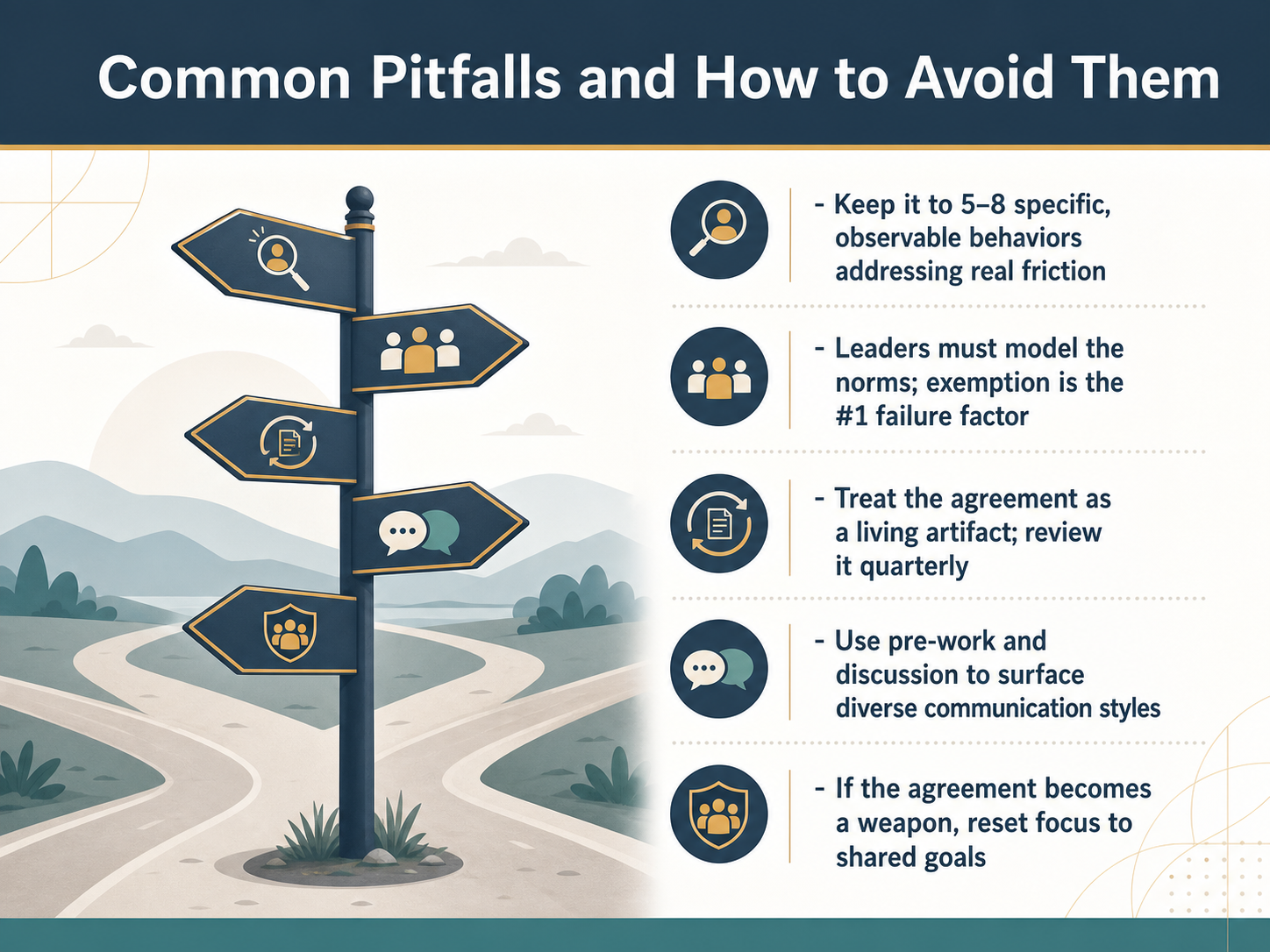
 - 07Common Pitfalls and How to Avoid ThemEven with the best intentions, working agreements can run into trouble. Let's talk about common pitfalls and how to avoid them. First, keep it focused. Your agreement should have five to eight specific, observable behaviors that address real friction. Avoid vague values like 'be respectful' and instead define what that looks like in practice. Second, leaders must model the norms. The number one failure factor is when a leader exempts themselves. If you don't follow the rules, nobody else will. Third, treat the agreement as a living artifact. Schedule a quarterly review to keep it relevant. Next, use pre-work and discussion to surface diverse communication styles. This way, everyone's voice is heard from the start. Finally, if the agreement ever becomes a weapon used to blame or shame, hit the reset button. Refocus on your shared goals and the spirit of collaboration. These guardrails will keep your agreements healthy and effective. Next, we'll explore tailoring agreements for your specific context.
 atlassian.complane.sorunn.io+22 min
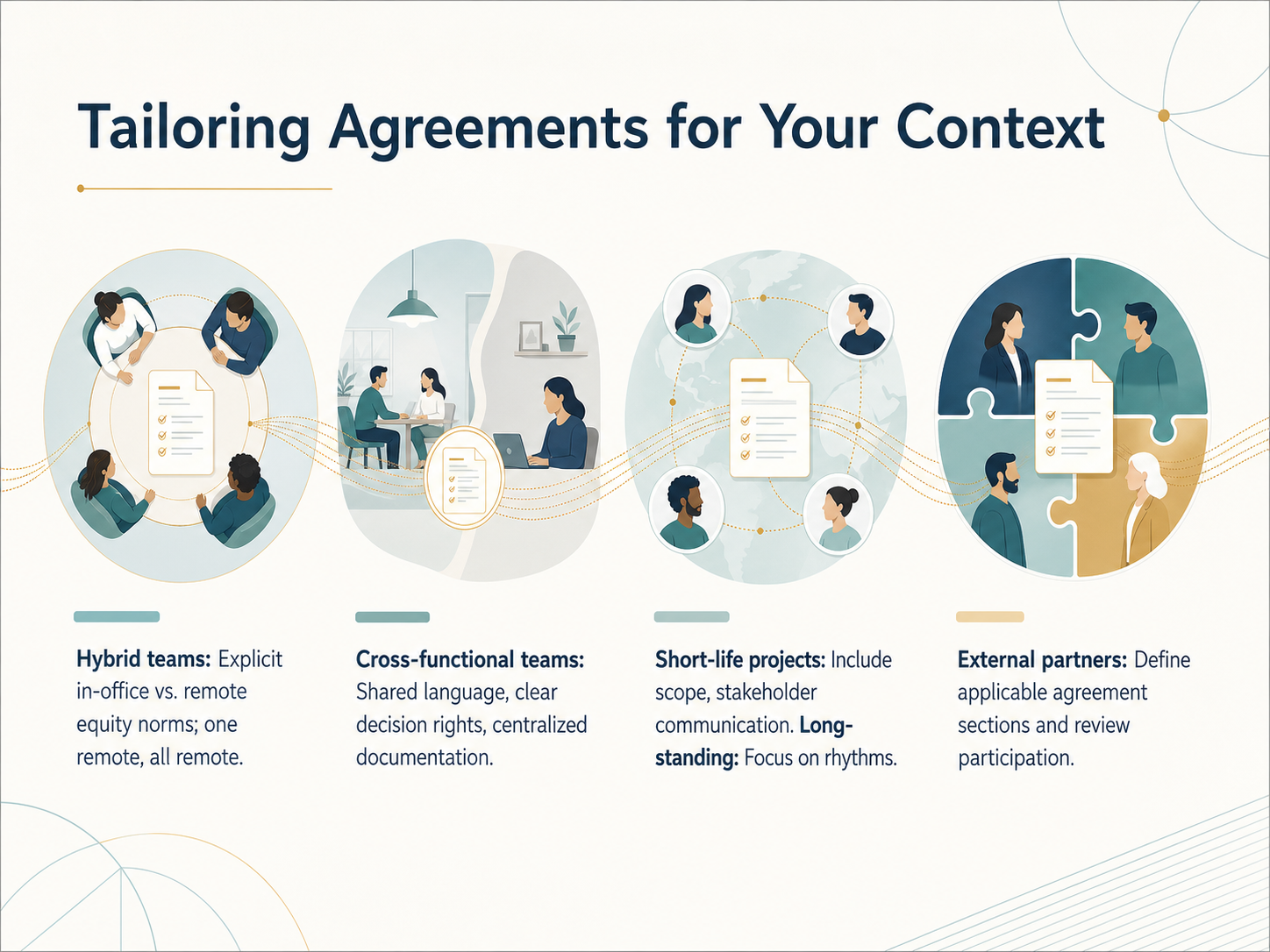
 - 08Tailoring Agreements for Your ContextNow, let's talk about tailoring your working agreements to fit your specific team context. A one-size approach rarely works. For hybrid teams, a critical rule is 'one remote, all remote.' If one person is on a video call, everyone joins from their own device, even in the office. This creates equity and prevents remote teammates from becoming second-class participants. For cross-functional teams, focus on using a shared language. Avoid department-specific jargon, and clearly define who has decision rights for what. Also, centralize all your documentation in one shared project board. If your project is short-lived, include agreements on scope and how you'll communicate with stakeholders right in the document. For long-standing teams, focus more on your rhythms, like meeting cadences and review cycles. When working with external partners, you don't need to share everything. Just define which sections of your agreement apply to them and how they'll participate in reviews. The key is to be intentional about your norms so they solve your actual problems. Next, let's look at some quick-start templates and real-world examples to make this even easier.
 atlassian.complane.sorunn.io+22 min
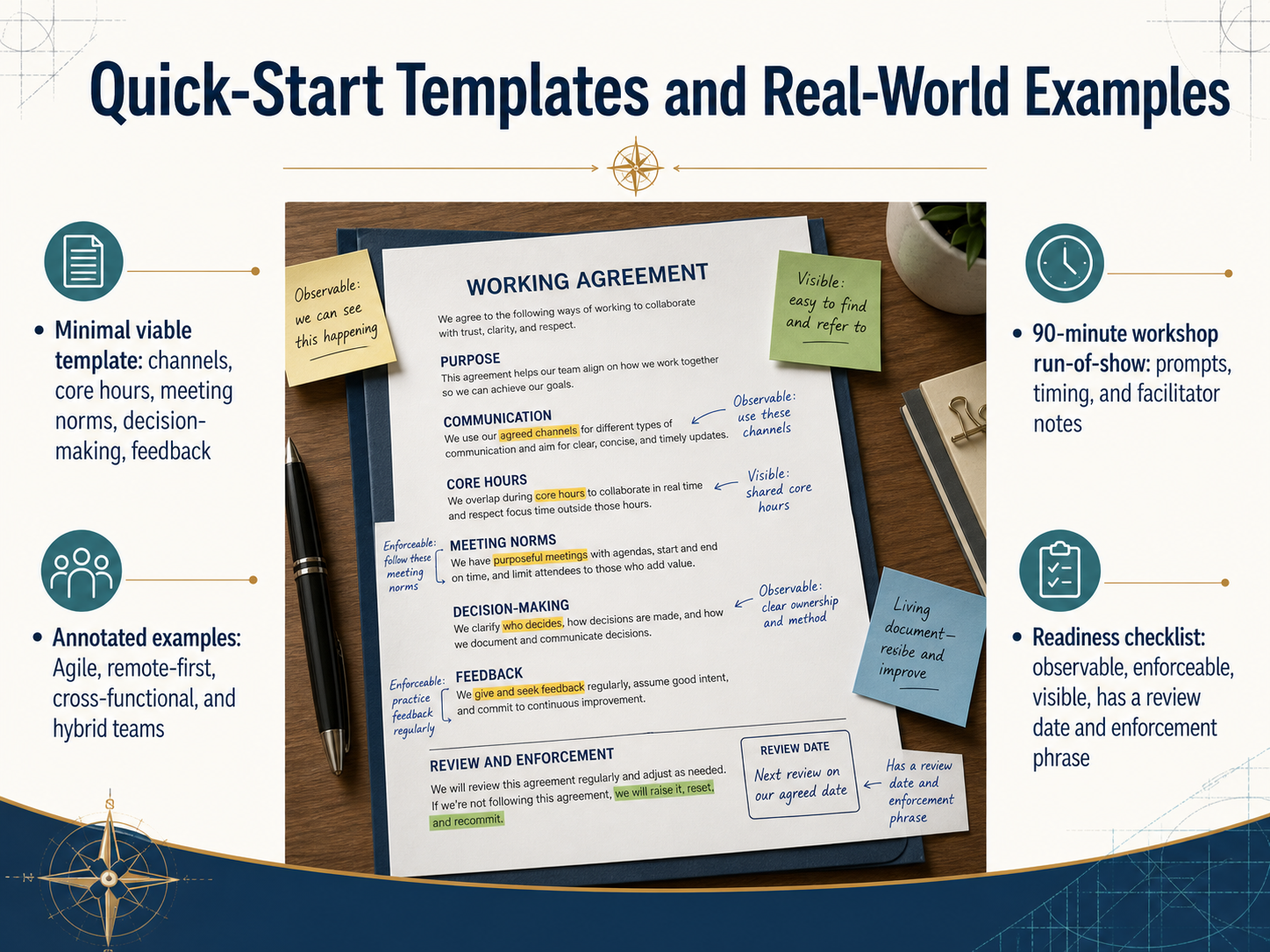
 - 09Quick-Start Templates and Real-World ExamplesNow let's look at some practical tools you can use right away. First, there's a minimal viable template. It covers the five essentials: channels, core hours, meeting norms, decision-making, and feedback. Start here if you want a fast, focused draft. Next, we have annotated examples from real teams. You'll see how Agile, remote-first, cross-functional, and hybrid teams structure their agreements. These aren't just theory. They show what specific commitments actually look like. We've also included a ninety-minute workshop run-of-show. It gives you prompts, timing, and facilitator notes so you can lead the session with confidence. Finally, use the readiness checklist to test your agreements. Ask: Is it observable? Can someone see it happening? Is it enforceable? Is it posted somewhere visible? Does it have a review date and a specific phrase for calling out violations? That last part is huge. A simple phrase like "working agreement check" makes accountability safe and direct. Coming up next, we'll tackle Building Commitment and Handling Resistance.
 atlassian.complane.sorunn.io+22 min
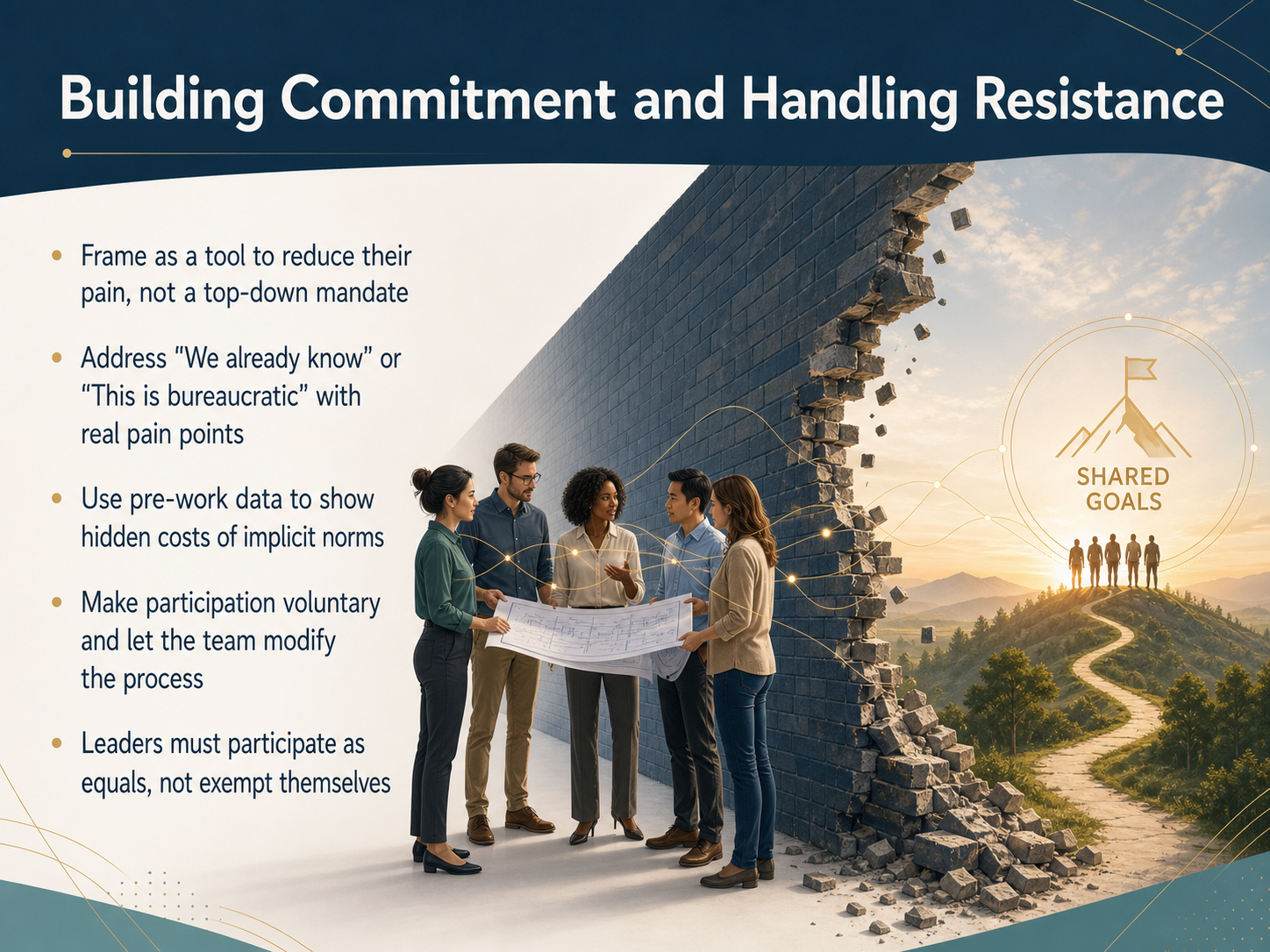
 - 10Building Commitment and Handling ResistanceNow, let's talk about getting your team to actually commit to these agreements. Resistance is normal. You might hear things like, 'We already know this stuff,' or 'This feels like bureaucracy.' The key is to frame the agreement not as a top-down mandate, but as a tool to solve your team's real pain points. If deadlines are constantly missed, for example, use that. Show how unclear expectations are the hidden cost driving that frustration. It also helps to use data from your pre-work. Point out the actual friction created by unspoken norms. Then, make participation voluntary. Let the team modify the process so they own it. And here is a critical point: leaders must participate as equals. They cannot be exempt from the rules. If the leader ignores the agreement, it signals that the document doesn't matter. When everyone is in it together, you build real, lasting commitment. Next, we'll move into measuring whether it's working.
 atlassian.complane.sorunn.io+22 min
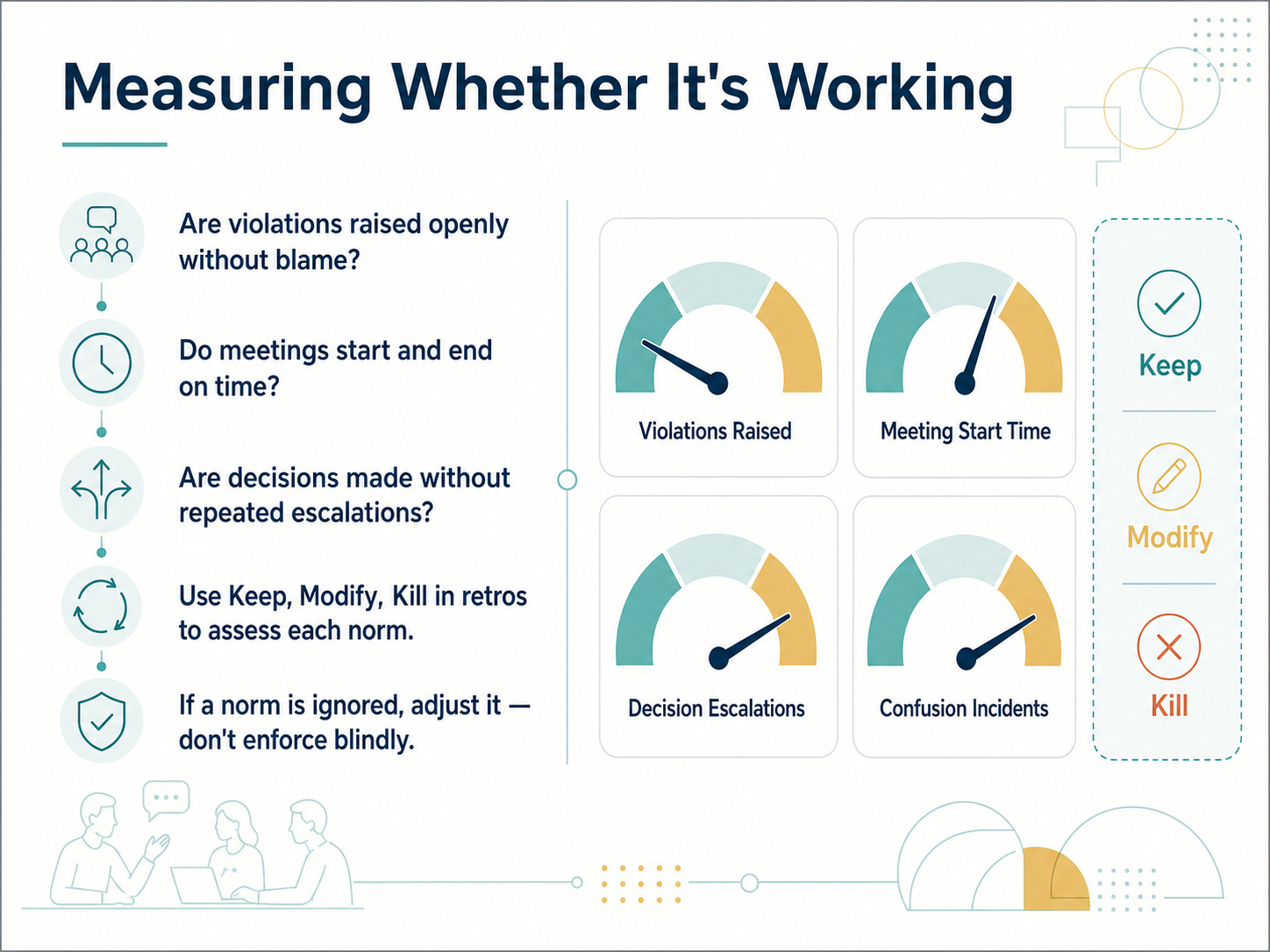
 - 11Measuring Whether It's WorkingNow, let's talk about a question every team faces: are these agreements actually working? You don't need a complex audit. You just need to look at real, observable behaviors. Start by asking simple questions. Are violations being raised openly, without fear of blame? Do your meetings start and end on time? And are decisions being made without constantly needing to escalate them to a manager? These are your health indicators. To assess each norm, use a simple framework from your retrospectives: Keep, Modify, or Kill. Keep what's working. Modify what needs a tweak. And if a norm is constantly ignored, don't just enforce it blindly. Ask why. Maybe the agreement is unrealistic, or the context has changed. The goal isn't to follow rules for the sake of rules. It's to be a more effective team. So, adjust the agreement to fit reality. This keeps your ways of working alive and useful. Next, let's move from measuring to acting. We'll look at your concrete action plan for the first thirty days.
 atlassian.complane.sorunn.io+21 min
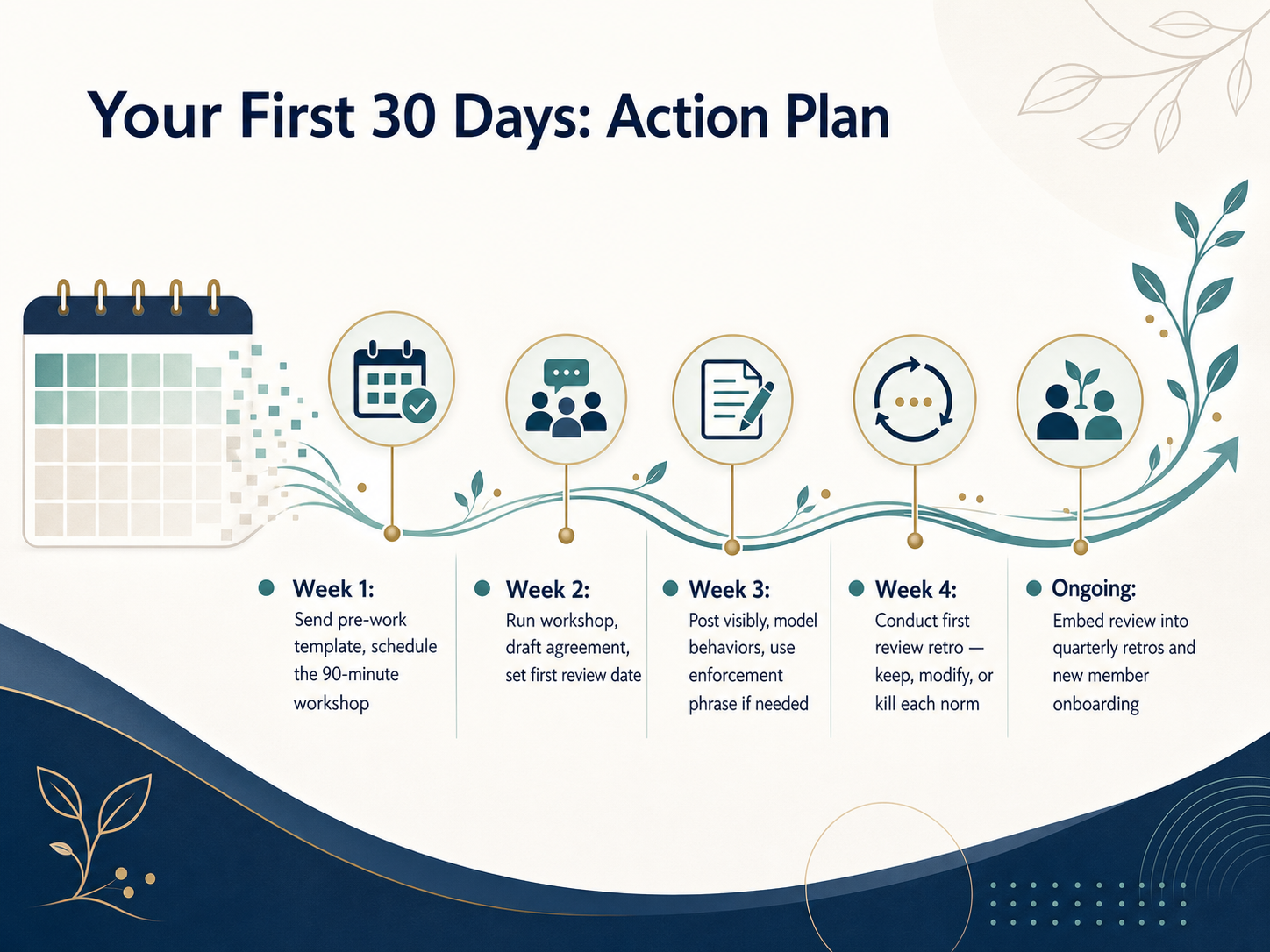
 - 12Your First 30 Days: Action PlanAnd here we are, at your action plan. Let's walk through your first thirty days, week by week, so this agreement becomes a living part of how you work together. In week one, your job is preparation. Send out the pre-work template so everyone arrives ready to contribute. Then, schedule your ninety-minute workshop. Week two is about creation. Run the workshop, and by the end of it, you'll have a draft agreement. Before you leave, set a date for your first review. Week three is where the real work begins. Post the agreement where everyone can see it, every day. Start modeling the behaviors you agreed on, and if you need to, don't be afraid to use your enforcement phrase. Week four is your first reality check. Hold a review retrospective and for every norm, make a simple, clear decision. Keep it, modify it, or kill it. For the long term, embed this review into your quarterly retros and your new member onboarding. This is how you make it stick. Thank you for taking this journey with me. You now have a clear, practical path to transform your team's collaboration. Go make it happen.
 atlassian.complane.sorunn.io+22 min
Take the deck with you
Download this course as a file — free, no sign-up needed.
- PDF handoutEvery slide page, ready to print or share.13 pages · 3.3 MBDownload
- Narrated PowerPointThe deck that presents itself — every slide carries the digital human's narration video.13 pages · 13.1 MBDownload
- PowerPoint slidesThe full deck as a .pptx — open it in PowerPoint, Keynote, or Google Slides.13 pages · 3.2 MBDownload
Free to use in your own training — please keep the PersonWise credit page at the end.
Have your own deck? Turn it into a course
Sources consulted
Web sources consulted while building this course.
- Working Agreements Play — atlassian.com
- What are team working agreements? Definition, structure ... — plane.so
- What is a Team Agreement + the 9 Steps to Create One | Runn — runn.io
- Working Agreement Template For Teams With Examples — monday.com
- How to Facilitate Powerful Working Agreements — resources.scrumalliance.org